Supervised by
Dr. Hamiduddin

Presented By
Dr. Mohammed Abdullah Tauheed Ahmed
Definition


Drying is defined as a process in which the liquid is removed
from a material by application of heat & is accomplished by the
transfer of liquid from a surface into an unsaturated vapor
phase.
NEED OF DRYING
 To make products stable.


 Preparation of powder and granules.


 Reducing the bulk and weight.


 Dried before extraction to facilitate grinding and to avoid
  deterioration.

 Preparation of certain products like dried Aluminum hydroxide,
  spray dried lactose & powder extracts.
Choice of Method of Drying

 Product is sensitive to heat or not.


 Nature of solvent to be removed.


 Process is to be carried out under aseptic condition.


 Quantity of products to be dried.


 Available source of heat.


 Cost involved.
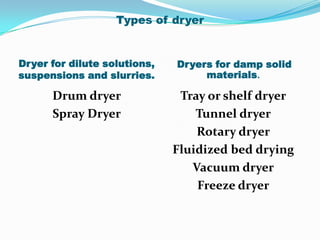
Types of dryer


Dryer for dilute solutions,   Dryers for damp solid
suspensions and slurries.          materials.

      Drum dryer               Tray or shelf dryer
      Spray Dryer                 Tunnel dryer
                                  Rotary dryer
                              Fluidized bed drying
                                 Vacuum dryer
                                  Freeze dryer
Drum Dryer

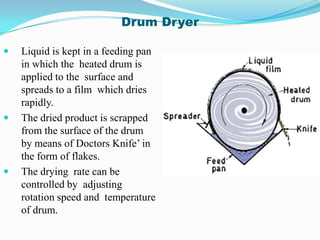
   Liquid is kept in a feeding pan
    in which the heated drum is
    applied to the surface and
    spreads to a film which dries
    rapidly.
   The dried product is scrapped
    from the surface of the drum
    by means of Doctors Knife’ in
    the form of flakes.
   The drying rate can be
    controlled by adjusting
    rotation speed and temperature
    of drum.
 Advantages


 It is quick method because of its large surface area, material is
  dried in few seconds.


 Instrument is compact which requires small space for operation.

 The equipment can be enclosed in vacuum chamber thereby
  temperature of drying can be reduced.
Uses

 Milk products


 Starch powder


 Iron salts


 Suspensions of kaolin or zinc oxide
Disadvantage


 The only disadvantage of drum dryer is that operating

  conditions are critical and it is necessary to introduce careful

  control on

 Feed rate

 Temperature of drum,

 Thickness of film

 Speed of rotation of drum.
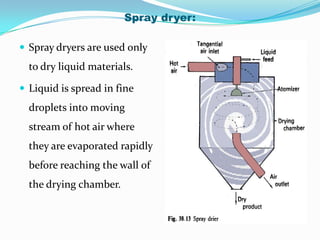
Spray dryer:

 Spray dryers are used only
  to dry liquid materials.

 Liquid is spread in fine
  droplets into moving
  stream of hot air where
  they are evaporated rapidly
  before reaching the wall of
  the drying chamber.
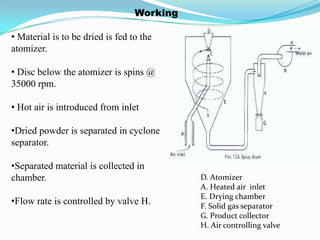
Working

• Material is to be dried is fed to the
atomizer.

• Disc below the atomizer is spins @
35000 rpm.

• Hot air is introduced from inlet

•Dried powder is separated in cyclone
separator.

•Separated material is collected in
chamber.                                    D. Atomizer
                                            A. Heated air inlet
                                            E. Drying chamber
•Flow rate is controlled by valve H.        F. Solid gas separator
                                            G. Product collector
                                            H. Air controlling valve
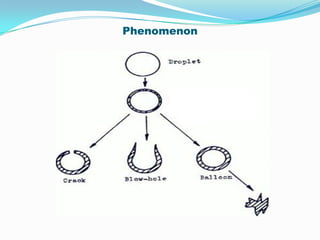
Phenomenon
Caution

• Inlet air temperature should be constant. Too high

 temp can result in improper drying. Similarly

 excessive feed rate will affect the drying.
• Temperature should not exceed 350 c.
Advantages
 Material is dried few seconds.

 Since the evaporation rate is very high droplets are not
  subjected to a very high temp.

 Spray dryer can be designed for drying in sterile conditions.

 The dried powder will have uniform particle size and
  shape.

 Labour costs are low.

 Volatile solvent can be recovered.
Disadvantages


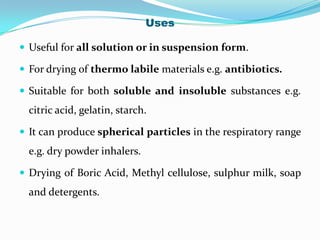
 Very bulky equipment 15mX6m drying chamber only.


 Lot of wastage of heat since air must be still hot when it leaves
  the dryer to avoid condensation.

 Both above factor make it costly.
Uses

 Useful for all solution or in suspension form.

 For drying of thermo labile materials e.g. antibiotics.

 Suitable for both soluble and insoluble substances e.g.
  citric acid, gelatin, starch.

 It can produce spherical particles in the respiratory range
  e.g. dry powder inhalers.

 Drying of Boric Acid, Methyl cellulose, sulphur milk, soap
  and detergents.
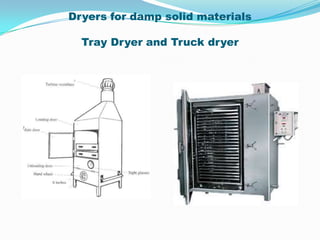
Dryers for damp solid materials

  Tray Dryer and Truck dryer
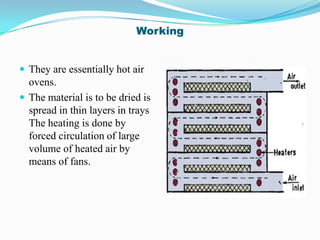
Working


 They are essentially hot air
  ovens.
 The material is to be dried is
  spread in thin layers in trays
  The heating is done by
  forced circulation of large
  volume of heated air by
  means of fans.
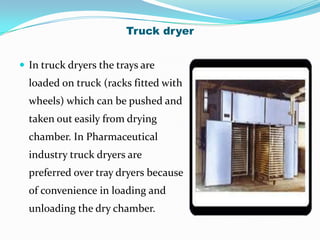
Truck dryer


 In truck dryers the trays are
  loaded on truck (racks fitted with
  wheels) which can be pushed and
  taken out easily from drying
  chamber. In Pharmaceutical
  industry truck dryers are
  preferred over tray dryers because
  of convenience in loading and
  unloading the dry chamber.
Advantage


 Drying by means of truck or tray dryers is a batch process

  rather than continuous.

 Each batch can be dried separately and same drying

  equipment can be used for drying the variety of materials.
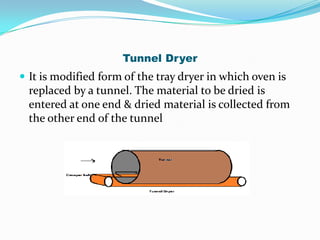
Tunnel Dryer
 It is modified form of the tray dryer in which oven is
  replaced by a tunnel. The material to be dried is
  entered at one end & dried material is collected from
  the other end of the tunnel
Working

 The trays containing the wet material are kept over truck or
  loaded on one or multiple belt conveyers which have an
  automatic speed control.


 In the multiple belt conveyer system the partially dried material
  which has completed one circle moves automatically from first
  belt on to the second belt running in opposite direction.
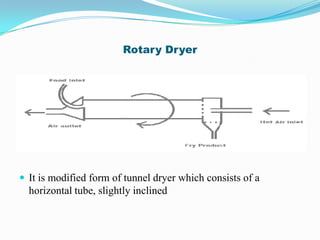
Rotary Dryer


 It is modified form of tunnel dryer which consists of a
  horizontal tube, slightly inclined
Working

 Horizontal slightly inclined tube is heated.


 Tube rotates slowly at about 10 rev/min due to rotation of tube
  material is turned over by tumbling effect and drying takes place
  from individual particles and not from static bed.


 When recovery of solvent is needed vacuum dryer may be fitted to
  tube. Small vacuum rotary dryer are used for aseptic works.
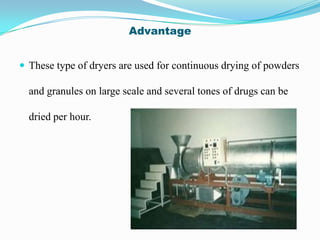
Advantage


 These type of dryers are used for continuous drying of powders

  and granules on large scale and several tones of drugs can be

  dried per hour.
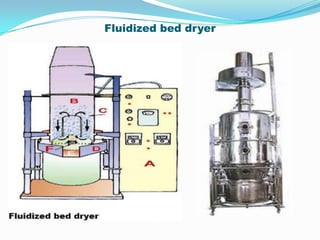
Fluidized bed dryer
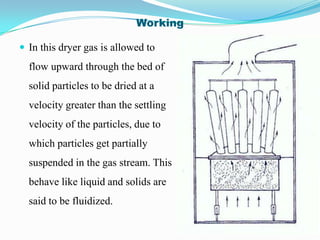
Working

 In this dryer gas is allowed to
  flow upward through the bed of
  solid particles to be dried at a
  velocity greater than the settling
  velocity of the particles, due to
  which particles get partially
  suspended in the gas stream. This
  behave like liquid and solids are
  said to be fluidized.
Advantages

 5 kg to 200 kg of materials can be dried in 20 to 40 minutes.


 Drying is taken place from individual particles and not from
  whole bed.


 Labor costs are reduced.


 Due to short drying time the unit has a high output.
Disadvantages

 Due to turbulence large quantity of fines are produced (this defect
  may be overcome by using suitable binder.).


 Too wet granules stick together on drying therefore too wet
  granules should not be used.


 Many powders develop electrostatic charges during fluidization.
  So efficient electrical earthing of drying chamber is necessary.
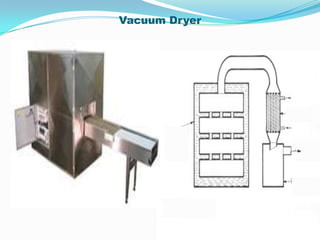
Vacuum Dryer
Working
 For drying the material is spread on trays which are
  placed on steam heated shelves in the jacket of
  vacuum oven.

 It provides large surface area for heat transfer by
  conduction and is provided with door.

 The oven is connected through condenser and receiver to a
  vacuum pump. The vacuum pump can be directly
  connected to oven.
Advantages

 Thermo labile substances can be dried at a low temperature and
  chances of oxidation are reduced.


 During the manufacture of dry extract, a porous and friable
  product is obtained which is especially useful in tablet
  manufacturing.


 By the use of condenser the solvent can be recovered from the
  product.
Disadvantages

 Heat transfer may be low and non uniform.

 It is not be suitable option for large scale drying.
 Labor and running costs are high.

 After drying a grinding process is necessary to get powder
  product.

 There is danger that the finally powder material may be drawn off
  by vacuum pump, and filter that requires frequent cleaning have
  to be provided.
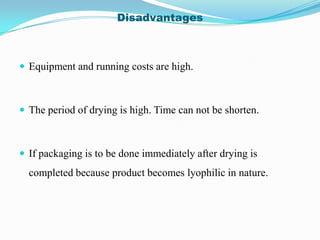
Freeze Drying

 In this process the initial liquid solution or suspension is
  frozen, the pressure above the frozen state is reduced and the
  water removed by sublimation.
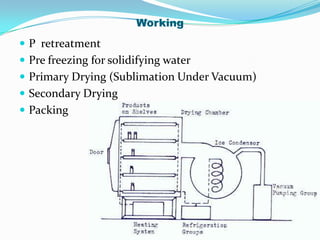
Working
 P retreatment
 Pre freezing for solidifying water
 Primary Drying (Sublimation Under Vacuum)
 Secondary Drying
 Packing
Uses

 It is used in production of dosage forms which are thermo
  labile such as injection solution and suspension.

 Used for drying the following products.

    Blood Plasma

    Bacterial and Viral Culture.

    Antibiotics and plant extract.

    Steroids, vitamins and enzymes.
Advantages

 Thermo labile materials can be dried.

 Denaturation does not occur.

 Loss of volatile matter is less.

 Material can be dried in its final container such as single dose
  and multiple dose vials.

 Sterility can be maintained.
Disadvantages


 Equipment and running costs are high.


 The period of drying is high. Time can not be shorten.


 If packaging is to be done immediately after drying is
  completed because product becomes lyophilic in nature.
Unani Methods of Drying

 Saya me khushk karna


 Dhoop me khushk karna


 Tannoor garm kamre me rakhna


 Chune ki potli dawa ke zaroof me rakhna


 Tahmees
Drying final

Drying final

  • 1.
    Supervised by Dr. Hamiduddin PresentedBy Dr. Mohammed Abdullah Tauheed Ahmed
  • 2.
    Definition Drying is definedas a process in which the liquid is removed from a material by application of heat & is accomplished by the transfer of liquid from a surface into an unsaturated vapor phase.
  • 3.
    NEED OF DRYING To make products stable.  Preparation of powder and granules.  Reducing the bulk and weight.  Dried before extraction to facilitate grinding and to avoid deterioration.  Preparation of certain products like dried Aluminum hydroxide, spray dried lactose & powder extracts.
  • 4.
    Choice of Methodof Drying  Product is sensitive to heat or not.  Nature of solvent to be removed.  Process is to be carried out under aseptic condition.  Quantity of products to be dried.  Available source of heat.  Cost involved.
  • 5.
    Types of dryer Dryerfor dilute solutions, Dryers for damp solid suspensions and slurries. materials. Drum dryer Tray or shelf dryer Spray Dryer Tunnel dryer Rotary dryer Fluidized bed drying Vacuum dryer Freeze dryer
  • 6.
    Drum Dryer  Liquid is kept in a feeding pan in which the heated drum is applied to the surface and spreads to a film which dries rapidly.  The dried product is scrapped from the surface of the drum by means of Doctors Knife’ in the form of flakes.  The drying rate can be controlled by adjusting rotation speed and temperature of drum.
  • 7.
     Advantages  Itis quick method because of its large surface area, material is dried in few seconds.  Instrument is compact which requires small space for operation.  The equipment can be enclosed in vacuum chamber thereby temperature of drying can be reduced.
  • 8.
    Uses  Milk products Starch powder  Iron salts  Suspensions of kaolin or zinc oxide
  • 9.
    Disadvantage  The onlydisadvantage of drum dryer is that operating conditions are critical and it is necessary to introduce careful control on  Feed rate  Temperature of drum,  Thickness of film  Speed of rotation of drum.
  • 10.
    Spray dryer:  Spraydryers are used only to dry liquid materials.  Liquid is spread in fine droplets into moving stream of hot air where they are evaporated rapidly before reaching the wall of the drying chamber.
  • 11.
    Working • Material isto be dried is fed to the atomizer. • Disc below the atomizer is spins @ 35000 rpm. • Hot air is introduced from inlet •Dried powder is separated in cyclone separator. •Separated material is collected in chamber. D. Atomizer A. Heated air inlet E. Drying chamber •Flow rate is controlled by valve H. F. Solid gas separator G. Product collector H. Air controlling valve
  • 12.
  • 13.
    Caution • Inlet airtemperature should be constant. Too high temp can result in improper drying. Similarly excessive feed rate will affect the drying. • Temperature should not exceed 350 c.
  • 14.
    Advantages  Material isdried few seconds.  Since the evaporation rate is very high droplets are not subjected to a very high temp.  Spray dryer can be designed for drying in sterile conditions.  The dried powder will have uniform particle size and shape.  Labour costs are low.  Volatile solvent can be recovered.
  • 15.
    Disadvantages  Very bulkyequipment 15mX6m drying chamber only.  Lot of wastage of heat since air must be still hot when it leaves the dryer to avoid condensation.  Both above factor make it costly.
  • 16.
    Uses  Useful forall solution or in suspension form.  For drying of thermo labile materials e.g. antibiotics.  Suitable for both soluble and insoluble substances e.g. citric acid, gelatin, starch.  It can produce spherical particles in the respiratory range e.g. dry powder inhalers.  Drying of Boric Acid, Methyl cellulose, sulphur milk, soap and detergents.
  • 17.
    Dryers for dampsolid materials Tray Dryer and Truck dryer
  • 18.
    Working  They areessentially hot air ovens.  The material is to be dried is spread in thin layers in trays The heating is done by forced circulation of large volume of heated air by means of fans.
  • 19.
    Truck dryer  Intruck dryers the trays are loaded on truck (racks fitted with wheels) which can be pushed and taken out easily from drying chamber. In Pharmaceutical industry truck dryers are preferred over tray dryers because of convenience in loading and unloading the dry chamber.
  • 20.
    Advantage  Drying bymeans of truck or tray dryers is a batch process rather than continuous.  Each batch can be dried separately and same drying equipment can be used for drying the variety of materials.
  • 21.
    Tunnel Dryer  Itis modified form of the tray dryer in which oven is replaced by a tunnel. The material to be dried is entered at one end & dried material is collected from the other end of the tunnel
  • 22.
    Working  The trayscontaining the wet material are kept over truck or loaded on one or multiple belt conveyers which have an automatic speed control.  In the multiple belt conveyer system the partially dried material which has completed one circle moves automatically from first belt on to the second belt running in opposite direction.
  • 23.
    Rotary Dryer  Itis modified form of tunnel dryer which consists of a horizontal tube, slightly inclined
  • 24.
    Working  Horizontal slightlyinclined tube is heated.  Tube rotates slowly at about 10 rev/min due to rotation of tube material is turned over by tumbling effect and drying takes place from individual particles and not from static bed.  When recovery of solvent is needed vacuum dryer may be fitted to tube. Small vacuum rotary dryer are used for aseptic works.
  • 25.
    Advantage  These typeof dryers are used for continuous drying of powders and granules on large scale and several tones of drugs can be dried per hour.
  • 26.
  • 27.
    Working  In thisdryer gas is allowed to flow upward through the bed of solid particles to be dried at a velocity greater than the settling velocity of the particles, due to which particles get partially suspended in the gas stream. This behave like liquid and solids are said to be fluidized.
  • 28.
    Advantages  5 kgto 200 kg of materials can be dried in 20 to 40 minutes.  Drying is taken place from individual particles and not from whole bed.  Labor costs are reduced.  Due to short drying time the unit has a high output.
  • 29.
    Disadvantages  Due toturbulence large quantity of fines are produced (this defect may be overcome by using suitable binder.).  Too wet granules stick together on drying therefore too wet granules should not be used.  Many powders develop electrostatic charges during fluidization. So efficient electrical earthing of drying chamber is necessary.
  • 30.
  • 31.
    Working  For dryingthe material is spread on trays which are placed on steam heated shelves in the jacket of vacuum oven.  It provides large surface area for heat transfer by conduction and is provided with door.  The oven is connected through condenser and receiver to a vacuum pump. The vacuum pump can be directly connected to oven.
  • 32.
    Advantages  Thermo labilesubstances can be dried at a low temperature and chances of oxidation are reduced.  During the manufacture of dry extract, a porous and friable product is obtained which is especially useful in tablet manufacturing.  By the use of condenser the solvent can be recovered from the product.
  • 33.
    Disadvantages  Heat transfermay be low and non uniform.  It is not be suitable option for large scale drying.  Labor and running costs are high.  After drying a grinding process is necessary to get powder product.  There is danger that the finally powder material may be drawn off by vacuum pump, and filter that requires frequent cleaning have to be provided.
  • 34.
    Freeze Drying  Inthis process the initial liquid solution or suspension is frozen, the pressure above the frozen state is reduced and the water removed by sublimation.
  • 35.
    Working  P retreatment Pre freezing for solidifying water  Primary Drying (Sublimation Under Vacuum)  Secondary Drying  Packing
  • 36.
    Uses  It isused in production of dosage forms which are thermo labile such as injection solution and suspension.  Used for drying the following products.  Blood Plasma  Bacterial and Viral Culture.  Antibiotics and plant extract.  Steroids, vitamins and enzymes.
  • 37.
    Advantages  Thermo labilematerials can be dried.  Denaturation does not occur.  Loss of volatile matter is less.  Material can be dried in its final container such as single dose and multiple dose vials.  Sterility can be maintained.
  • 38.
    Disadvantages  Equipment andrunning costs are high.  The period of drying is high. Time can not be shorten.  If packaging is to be done immediately after drying is completed because product becomes lyophilic in nature.
  • 39.
    Unani Methods ofDrying  Saya me khushk karna  Dhoop me khushk karna  Tannoor garm kamre me rakhna  Chune ki potli dawa ke zaroof me rakhna  Tahmees