PRESENTED BY-
MR. DEBASHIS PUROHIT
M.PHARM,2ND SEMESTER
(INDUSTRIALPHARMACY)
DATE-08/02/2018
SCHOOL OF PHARMACEUTICALSCIENCES,
SIKSHA ‘O’ ANUSANDHAN (DEEMED TO BE UNIVERSITY),
BHUBANESWAR
TOPIC-DRYING TECHNOLOGY USED IN
PHARMACEUTICAL INDUSTRY
PRINCIPLES OF DRYING [1]
Large surface area for heat transfer.
 Efficient heat transfer per unit area (to supply
sufficient latent heat of vaporization or heat of
sublimation in case of freeze-drying)
 Efficient mass transfer of evaporated water
through any surrounding vapour boundary layers,
i.e. sufficient turbulence to minimize vapour
boundary layer thickness.
 Efficient vapour removal , i.e. low relative
humidity air at adequate velocity.
Different Machinaries used in Pharmaceutical
drying [2]
Fluidized bed drying
Drum dryer
Rotary Dryers
Lyophillization(Freeze drying)
FLUID-BEDDRYERS
PRINCIPLE
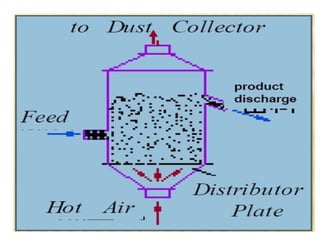
 The particulate matter is contained in a vessel, of which is
perforated, enabling a fluid to pass through the bed of solids
from below.
 If the air velocity through the bed is increased gradually and
the pressure drop through the bed is measured, a graph of
the operation shows several distinct regions.
WORKING
Material to be dried is placed on the bowl and heated
and air is passed for heating . Then air is passed
through the filter and passed through bed of material.
The air flow is generated by fans fitted at the top . As
the flow increases the bed bag expands and particles of
powder start a turbulent motion. Due to the regular
contact with a material gets dry. The air leaving the
FBD passes through the filter to collect the fine
particles of the material.
Advantages
 Efficient heat and mass transfer give high drying rates,
so that drying times are shorter than with static-bed
convection driers . Economic, heat challenge to
thermoliabile materials is minimized.
 The fluidized state of the bed ensures that drying occurs
from the surface of all the individual particles and not
just from the surface of the bed. Hence, most of the
drying will be at constant rate and the falling rate period
is very short.
 The temperature of a fluidized bed is uniform and can be
controlled precisely.
DISADVANTAGES
 The turbulence of the fluidized state may cause
excessive attrition of some materials, with damage to
some granules and the production of too much dust.
 The vigorous movement of particles in hot dry air can
lead to the generation of static electricity charges. The
danger is increased if the fluidized material contains a
volatile solvent such as isopropanol. Adequate electrical
earthing is essential.
USES
It is used to reduce or minimize the liquid
moisture content of the material.
DRUMDRYERS
PRINCIPLE-
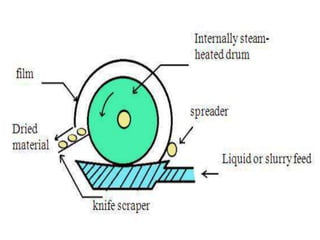
In drum dryers, slurries or pasty feedstock's are
dried on the surface of a slowly rotating steam-
heated drum. A thin film of the paste is applied
on the surface in various ways. The dried film is
not monitered once it is dry and collected as
flakes (rather than powder).
WORKING
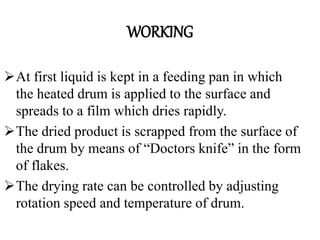
At first liquid is kept in a feeding pan in which
the heated drum is applied to the surface and
spreads to a film which dries rapidly.
The dried product is scrapped from the surface of
the drum by means of “Doctors knife” in the form
of flakes.
The drying rate can be controlled by adjusting
rotation speed and temperature of drum.
ADVANTAGES
It is quick method and compact.
It’s heating time is short.
Drying temperature can be reduced by enclosing
in a vacuum chamber.
DISADVANTAGES
Operating conditions are critical and it is necessary
to introduce careful control on:
Feed rate.
Temperature of drum.
Thickness of film.
Speed of rotation of drum.
USES
Milk products.
Starch powder.
Iron salts.
Suspensions of kaolin or zinc oxide.
ROTARY DRYERS
PRINCIPLE-
Rotary Dryer is a simple, inexpensive unit for
reducing the moisture content of flotation
concentrates, as well as chemical and industrial
products. Frequently the saving of shipping weight
so effected will pay for the dryer in a few months.
Difficulties from freezing while in transit are also
eliminated. Many industrial projects are now using
Dryers for control and production purposes on
many materials.
WORKING
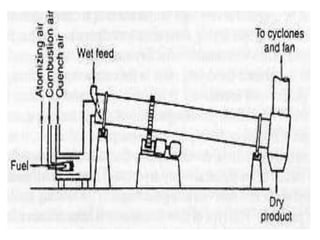
The dryer is made up of a large, rotating
cylindrical tube, usually supported by concrete
columns or steel beams. The dryer slopes slightly
so that the discharge end is lower than the material
feed end in order to convey the material through
the dryer under gravity. Material to be dried enters
the dryer, and as the dryer rotates, the material is
lifted up by a series of internal fins lining the inner
wall of the dryer. When the material gets high
enough to roll back off the fins, it falls back down
to the bottom of the dryer, passing through the hot
gas stream as it falls.
ADVANTAGES
Rotary dryers are less sensitive to particle size.
It can accept the highest flue gasses of any type of
dryer.
Low maintenance cost;thus economical.
It has the greatest capacity than any type of dryer.
DISADVANTAGES
Excessive entrainment losses in the exist gas
stream is possible especially if the material
contains extremely fine particles due to the large
gas volumes and high gas velocities that are
usually required.
USES
These are mostly used in the mineral industry for
drying sands,limestone,fertilizers,coal,iron
sulphate etc.
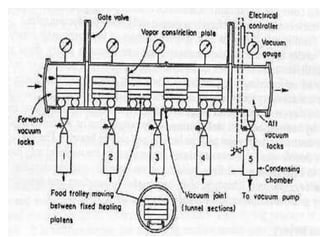
Lyophilization
PRINCIPLE-
Lyophilization, or cryodesiccation—is a dehydration
process typically used to preserve a perishable
material or make the material more convenient for
transport.
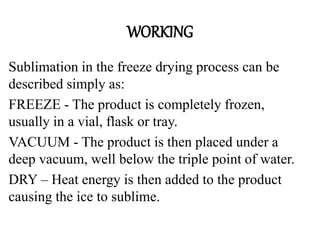
WORKING
Sublimation in the freeze drying process can be
described simply as:
FREEZE - The product is completely frozen,
usually in a vial, flask or tray.
VACUUM - The product is then placed under a
deep vacuum, well below the triple point of water.
DRY – Heat energy is then added to the product
causing the ice to sublime.
ADVANTAGES
Removal of water at low temperature.
Thermoliable materials can be dried.
Compactable with asceptic operations.
Sterility can be maintained.
DISADVANTAGES
Many biological molecules are damaged by the
stress associated with freeze-drying or both.
Cost may be an issue depending upon product.
It is a long time process.
USES
It is used in pharmaceuticals and biotechnology to
increase the shelf life of the product.
It is used in food industry to preserve food,produce
essence or flavouring agents.
In technical industry it is used in chemical synthesis
and formation of stable product.
REVIEW ARTICLE-1
Crystallization processes in pharmaceutical
technology and drug delivery design
Shek nov et al; suggested that crystallization possess a
major role for particle formation in pharmaceutical Industry
as well as it plays a vital role in defining stability and drug
release properties of final dosage form by the process of
direct compression and formation of amorphous,solvated
and polymeric form and finally recent development in
supercritical technology was considered for crystallization
process.
REVIEW ARTICLE-2
Freeze drying Process: A Review
Soham sukla has suggested ‘Freeze drying’ method for drying
thermoliable materials which involed 3 steps.
1-freezing-Here freezing material was kept in a freeze drying flask and
rotating the flask in a bath called shell freezer, which was cooled by
mechanical refrigiration.
2-Primary drying-In this phase pressure was lowered and enough heat
was supplied to the material and about 95% of water was sublimated.
3-Secondary drying-Here temperature is raised higher then in primary
raised above 0 degree celcius to break any physico chemical
interactions that have been happened between water molecules and
frozen materials. After the freezedrying process is complete vaccum is
usually broken with an inert gas and at the end the residual water
content in the product was 1 to 4% which is extremely low.
REFERENCE
 RM Mehta, Pharmaceutics-I: introduction to the drying
process, Page no-194(1996).
 C.V.S. Subrahmanyam ,J. Thimma Setty,Sarasija Suresh,
V. Kusum Devi pharmaceutical engineering principles and
practices-filtration,page no. 394 – 397(2001).
 Crystallization processes in Pharmaceutical technology
and drug delivery design. B.Yu Shekunov,P York. Asian
Journal of Pharmaceutical Sciences,10(4),Page no-283-
291, (2015)
 Freeze Drying Process:A Review.Soham Shukla.
International Journal of Pharmaceutical
Sciences,11(2),(2011).
Drying technology used in Pharmaceutical Industry

Drying technology used in Pharmaceutical Industry

  • 1.
    PRESENTED BY- MR. DEBASHISPUROHIT M.PHARM,2ND SEMESTER (INDUSTRIALPHARMACY) DATE-08/02/2018 SCHOOL OF PHARMACEUTICALSCIENCES, SIKSHA ‘O’ ANUSANDHAN (DEEMED TO BE UNIVERSITY), BHUBANESWAR TOPIC-DRYING TECHNOLOGY USED IN PHARMACEUTICAL INDUSTRY
  • 2.
    PRINCIPLES OF DRYING[1] Large surface area for heat transfer.  Efficient heat transfer per unit area (to supply sufficient latent heat of vaporization or heat of sublimation in case of freeze-drying)  Efficient mass transfer of evaporated water through any surrounding vapour boundary layers, i.e. sufficient turbulence to minimize vapour boundary layer thickness.  Efficient vapour removal , i.e. low relative humidity air at adequate velocity.
  • 3.
    Different Machinaries usedin Pharmaceutical drying [2] Fluidized bed drying Drum dryer Rotary Dryers Lyophillization(Freeze drying)
  • 4.
    FLUID-BEDDRYERS PRINCIPLE  The particulatematter is contained in a vessel, of which is perforated, enabling a fluid to pass through the bed of solids from below.  If the air velocity through the bed is increased gradually and the pressure drop through the bed is measured, a graph of the operation shows several distinct regions.
  • 6.
    WORKING Material to bedried is placed on the bowl and heated and air is passed for heating . Then air is passed through the filter and passed through bed of material. The air flow is generated by fans fitted at the top . As the flow increases the bed bag expands and particles of powder start a turbulent motion. Due to the regular contact with a material gets dry. The air leaving the FBD passes through the filter to collect the fine particles of the material.
  • 7.
    Advantages  Efficient heatand mass transfer give high drying rates, so that drying times are shorter than with static-bed convection driers . Economic, heat challenge to thermoliabile materials is minimized.  The fluidized state of the bed ensures that drying occurs from the surface of all the individual particles and not just from the surface of the bed. Hence, most of the drying will be at constant rate and the falling rate period is very short.  The temperature of a fluidized bed is uniform and can be controlled precisely.
  • 8.
    DISADVANTAGES  The turbulenceof the fluidized state may cause excessive attrition of some materials, with damage to some granules and the production of too much dust.  The vigorous movement of particles in hot dry air can lead to the generation of static electricity charges. The danger is increased if the fluidized material contains a volatile solvent such as isopropanol. Adequate electrical earthing is essential.
  • 9.
    USES It is usedto reduce or minimize the liquid moisture content of the material.
  • 10.
    DRUMDRYERS PRINCIPLE- In drum dryers,slurries or pasty feedstock's are dried on the surface of a slowly rotating steam- heated drum. A thin film of the paste is applied on the surface in various ways. The dried film is not monitered once it is dry and collected as flakes (rather than powder).
  • 12.
    WORKING At first liquidis kept in a feeding pan in which the heated drum is applied to the surface and spreads to a film which dries rapidly. The dried product is scrapped from the surface of the drum by means of “Doctors knife” in the form of flakes. The drying rate can be controlled by adjusting rotation speed and temperature of drum.
  • 13.
    ADVANTAGES It is quickmethod and compact. It’s heating time is short. Drying temperature can be reduced by enclosing in a vacuum chamber.
  • 14.
    DISADVANTAGES Operating conditions arecritical and it is necessary to introduce careful control on: Feed rate. Temperature of drum. Thickness of film. Speed of rotation of drum.
  • 15.
    USES Milk products. Starch powder. Ironsalts. Suspensions of kaolin or zinc oxide.
  • 16.
    ROTARY DRYERS PRINCIPLE- Rotary Dryeris a simple, inexpensive unit for reducing the moisture content of flotation concentrates, as well as chemical and industrial products. Frequently the saving of shipping weight so effected will pay for the dryer in a few months. Difficulties from freezing while in transit are also eliminated. Many industrial projects are now using Dryers for control and production purposes on many materials.
  • 18.
    WORKING The dryer ismade up of a large, rotating cylindrical tube, usually supported by concrete columns or steel beams. The dryer slopes slightly so that the discharge end is lower than the material feed end in order to convey the material through the dryer under gravity. Material to be dried enters the dryer, and as the dryer rotates, the material is lifted up by a series of internal fins lining the inner wall of the dryer. When the material gets high enough to roll back off the fins, it falls back down to the bottom of the dryer, passing through the hot gas stream as it falls.
  • 19.
    ADVANTAGES Rotary dryers areless sensitive to particle size. It can accept the highest flue gasses of any type of dryer. Low maintenance cost;thus economical. It has the greatest capacity than any type of dryer.
  • 20.
    DISADVANTAGES Excessive entrainment lossesin the exist gas stream is possible especially if the material contains extremely fine particles due to the large gas volumes and high gas velocities that are usually required.
  • 21.
    USES These are mostlyused in the mineral industry for drying sands,limestone,fertilizers,coal,iron sulphate etc.
  • 22.
    Lyophilization PRINCIPLE- Lyophilization, or cryodesiccation—isa dehydration process typically used to preserve a perishable material or make the material more convenient for transport.
  • 24.
    WORKING Sublimation in thefreeze drying process can be described simply as: FREEZE - The product is completely frozen, usually in a vial, flask or tray. VACUUM - The product is then placed under a deep vacuum, well below the triple point of water. DRY – Heat energy is then added to the product causing the ice to sublime.
  • 25.
    ADVANTAGES Removal of waterat low temperature. Thermoliable materials can be dried. Compactable with asceptic operations. Sterility can be maintained.
  • 26.
    DISADVANTAGES Many biological moleculesare damaged by the stress associated with freeze-drying or both. Cost may be an issue depending upon product. It is a long time process.
  • 27.
    USES It is usedin pharmaceuticals and biotechnology to increase the shelf life of the product. It is used in food industry to preserve food,produce essence or flavouring agents. In technical industry it is used in chemical synthesis and formation of stable product.
  • 28.
    REVIEW ARTICLE-1 Crystallization processesin pharmaceutical technology and drug delivery design Shek nov et al; suggested that crystallization possess a major role for particle formation in pharmaceutical Industry as well as it plays a vital role in defining stability and drug release properties of final dosage form by the process of direct compression and formation of amorphous,solvated and polymeric form and finally recent development in supercritical technology was considered for crystallization process.
  • 29.
    REVIEW ARTICLE-2 Freeze dryingProcess: A Review Soham sukla has suggested ‘Freeze drying’ method for drying thermoliable materials which involed 3 steps. 1-freezing-Here freezing material was kept in a freeze drying flask and rotating the flask in a bath called shell freezer, which was cooled by mechanical refrigiration. 2-Primary drying-In this phase pressure was lowered and enough heat was supplied to the material and about 95% of water was sublimated. 3-Secondary drying-Here temperature is raised higher then in primary raised above 0 degree celcius to break any physico chemical interactions that have been happened between water molecules and frozen materials. After the freezedrying process is complete vaccum is usually broken with an inert gas and at the end the residual water content in the product was 1 to 4% which is extremely low.
  • 30.
    REFERENCE  RM Mehta,Pharmaceutics-I: introduction to the drying process, Page no-194(1996).  C.V.S. Subrahmanyam ,J. Thimma Setty,Sarasija Suresh, V. Kusum Devi pharmaceutical engineering principles and practices-filtration,page no. 394 – 397(2001).  Crystallization processes in Pharmaceutical technology and drug delivery design. B.Yu Shekunov,P York. Asian Journal of Pharmaceutical Sciences,10(4),Page no-283- 291, (2015)  Freeze Drying Process:A Review.Soham Shukla. International Journal of Pharmaceutical Sciences,11(2),(2011).