Presented by:
Dr Rajesh Kumar Shah
Resident (MD-Pharmacology)
KUSMS, Dhulikhel, Nepal.
 Leprosy is a chronic granulomatous
infection of peripheral nerves and skin.
 Caused by Mycobacterium leprae
(hence contagious)
 May be Paucibacilliary or Multibacillary.
 It can be successfully treated with low
relapse rates, with suitable combination of
drugs.
 However, the nerve damage that has already
occurred due to the disease (in limbs and
eyes) cannot currently be satisfactorily be
reversed or treated.
 Hence, pharmacotherapy should be initiated
as soon as possible.
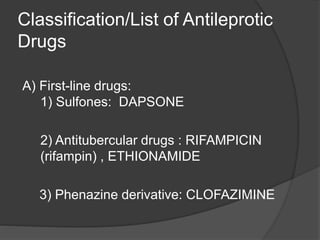
Classification/List of Antileprotic
Drugs
A) First-line drugs:
1) Sulfones: DAPSONE
2) Antitubercular drugs : RIFAMPICIN
(rifampin) , ETHIONAMIDE
3) Phenazine derivative: CLOFAZIMINE
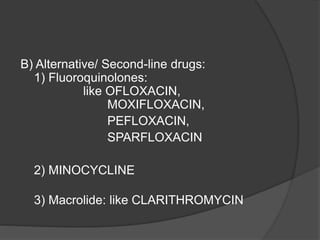
B) Alternative/ Second-line drugs:
1) Fluoroquinolones:
like OFLOXACIN,
MOXIFLOXACIN,
PEFLOXACIN,
SPARFLOXACIN
2) MINOCYCLINE
3) Macrolide: like CLARITHROMYCIN
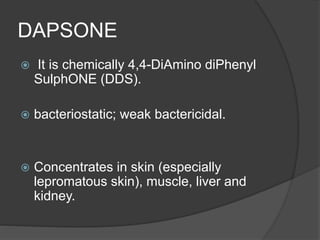
DAPSONE
 It is chemically 4,4-DiAmino diPhenyl
SulphONE (DDS).
 bacteriostatic; weak bactericidal.
 Concentrates in skin (especially
lepromatous skin), muscle, liver and
kidney.
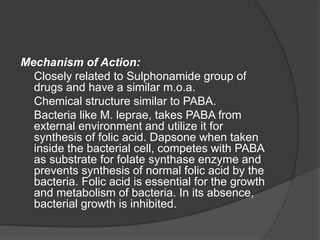
Mechanism of Action:
Closely related to Sulphonamide group of
drugs and have a similar m.o.a.
Chemical structure similar to PABA.
Bacteria like M. leprae, takes PABA from
external environment and utilize it for
synthesis of folic acid. Dapsone when taken
inside the bacterial cell, competes with PABA
as substrate for folate synthase enzyme and
prevents synthesis of normal folic acid by the
bacteria. Folic acid is essential for the growth
and metabolism of bacteria. In its absence,
bacterial growth is inhibited.
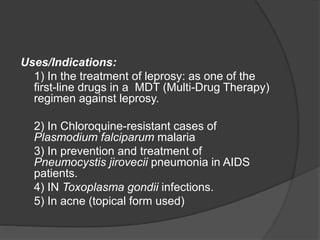
Uses/Indications:
1) In the treatment of leprosy: as one of the
first-line drugs in a MDT (Multi-Drug Therapy)
regimen against leprosy.
2) In Chloroquine-resistant cases of
Plasmodium falciparum malaria
3) In prevention and treatment of
Pneumocystis jirovecii pneumonia in AIDS
patients.
4) IN Toxoplasma gondii infections.
5) In acne (topical form used)
Adverse Drug Effects (ADE):
1) Haemolysis : mild; dose-dependent
2) Sulfone syndrome: after 4 to 6 weeks of
DDS therapy. Characterized by desquamation
of skin, lymphadenopathy, jaundice, fever and
anaemia.
3) Rarely : Haemolytic anaemia,
Methaemoglobinaemia, Agranulocytosis,
Hepatitis,Mental symptoms
4) Gastric intolerance: nausea, anorexia;
decreases later.
5) Cutaneous reactions : pruritis, rashes
Contraindications:
1) Severe anaemia (< 7g/dl)
2) In patients with G-6-PD (Glucose 6
Phosphate Dehydrogenase) deficiency
3) In patient hypersensitive to
sulfonamides
4) In patients with Methaemoglobinaemia
Treatment for leprosy
a) Monotherapy with Dapsone was used
in past: Discontinued now due to
emergence of strains resistant to
Dapsone.
b) MDT (Multi-Drug Therapy) regimen as
recommended by WHO followed
nowadays:
WHO/GDG (2018) MDT
regimen includes:
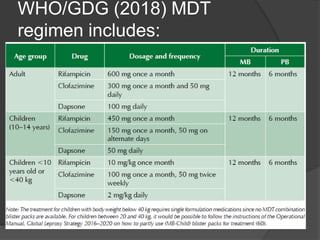
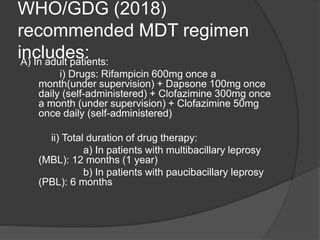
WHO/GDG (2018)
recommended MDT regimen
includes:A) In adult patients:
i) Drugs: Rifampicin 600mg once a
month(under supervision) + Dapsone 100mg once
daily (self-administered) + Clofazimine 300mg once
a month (under supervision) + Clofazimine 50mg
once daily (self-administered)
ii) Total duration of drug therapy:
a) In patients with multibacillary leprosy
(MBL): 12 months (1 year)
b) In patients with paucibacillary leprosy
(PBL): 6 months
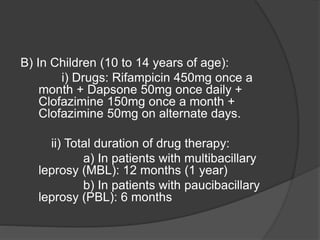
B) In Children (10 to 14 years of age):
i) Drugs: Rifampicin 450mg once a
month + Dapsone 50mg once daily +
Clofazimine 150mg once a month +
Clofazimine 50mg on alternate days.
ii) Total duration of drug therapy:
a) In patients with multibacillary
leprosy (MBL): 12 months (1 year)
b) In patients with paucibacillary
leprosy (PBL): 6 months
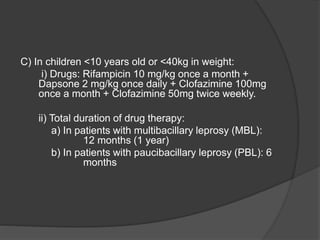
C) In children <10 years old or <40kg in weight:
i) Drugs: Rifampicin 10 mg/kg once a month +
Dapsone 2 mg/kg once daily + Clofazimine 100mg
once a month + Clofazimine 50mg twice weekly.
ii) Total duration of drug therapy:
a) In patients with multibacillary leprosy (MBL):
12 months (1 year)
b) In patients with paucibacillary leprosy (PBL): 6
months
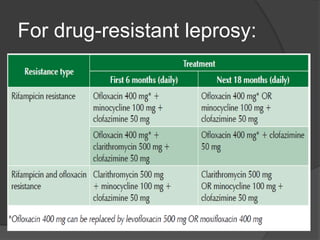
For drug-resistant leprosy:
THANK YOU

Antileprotic drugs

  • 1.
    Presented by: Dr RajeshKumar Shah Resident (MD-Pharmacology) KUSMS, Dhulikhel, Nepal.
  • 2.
     Leprosy isa chronic granulomatous infection of peripheral nerves and skin.  Caused by Mycobacterium leprae (hence contagious)  May be Paucibacilliary or Multibacillary.
  • 3.
     It canbe successfully treated with low relapse rates, with suitable combination of drugs.  However, the nerve damage that has already occurred due to the disease (in limbs and eyes) cannot currently be satisfactorily be reversed or treated.  Hence, pharmacotherapy should be initiated as soon as possible.
  • 4.
    Classification/List of Antileprotic Drugs A)First-line drugs: 1) Sulfones: DAPSONE 2) Antitubercular drugs : RIFAMPICIN (rifampin) , ETHIONAMIDE 3) Phenazine derivative: CLOFAZIMINE
  • 5.
    B) Alternative/ Second-linedrugs: 1) Fluoroquinolones: like OFLOXACIN, MOXIFLOXACIN, PEFLOXACIN, SPARFLOXACIN 2) MINOCYCLINE 3) Macrolide: like CLARITHROMYCIN
  • 6.
    DAPSONE  It ischemically 4,4-DiAmino diPhenyl SulphONE (DDS).  bacteriostatic; weak bactericidal.  Concentrates in skin (especially lepromatous skin), muscle, liver and kidney.
  • 7.
    Mechanism of Action: Closelyrelated to Sulphonamide group of drugs and have a similar m.o.a. Chemical structure similar to PABA. Bacteria like M. leprae, takes PABA from external environment and utilize it for synthesis of folic acid. Dapsone when taken inside the bacterial cell, competes with PABA as substrate for folate synthase enzyme and prevents synthesis of normal folic acid by the bacteria. Folic acid is essential for the growth and metabolism of bacteria. In its absence, bacterial growth is inhibited.
  • 8.
    Uses/Indications: 1) In thetreatment of leprosy: as one of the first-line drugs in a MDT (Multi-Drug Therapy) regimen against leprosy. 2) In Chloroquine-resistant cases of Plasmodium falciparum malaria 3) In prevention and treatment of Pneumocystis jirovecii pneumonia in AIDS patients. 4) IN Toxoplasma gondii infections. 5) In acne (topical form used)
  • 9.
    Adverse Drug Effects(ADE): 1) Haemolysis : mild; dose-dependent 2) Sulfone syndrome: after 4 to 6 weeks of DDS therapy. Characterized by desquamation of skin, lymphadenopathy, jaundice, fever and anaemia. 3) Rarely : Haemolytic anaemia, Methaemoglobinaemia, Agranulocytosis, Hepatitis,Mental symptoms 4) Gastric intolerance: nausea, anorexia; decreases later. 5) Cutaneous reactions : pruritis, rashes
  • 10.
    Contraindications: 1) Severe anaemia(< 7g/dl) 2) In patients with G-6-PD (Glucose 6 Phosphate Dehydrogenase) deficiency 3) In patient hypersensitive to sulfonamides 4) In patients with Methaemoglobinaemia
  • 11.
    Treatment for leprosy a)Monotherapy with Dapsone was used in past: Discontinued now due to emergence of strains resistant to Dapsone. b) MDT (Multi-Drug Therapy) regimen as recommended by WHO followed nowadays:
  • 12.
  • 13.
    WHO/GDG (2018) recommended MDTregimen includes:A) In adult patients: i) Drugs: Rifampicin 600mg once a month(under supervision) + Dapsone 100mg once daily (self-administered) + Clofazimine 300mg once a month (under supervision) + Clofazimine 50mg once daily (self-administered) ii) Total duration of drug therapy: a) In patients with multibacillary leprosy (MBL): 12 months (1 year) b) In patients with paucibacillary leprosy (PBL): 6 months
  • 14.
    B) In Children(10 to 14 years of age): i) Drugs: Rifampicin 450mg once a month + Dapsone 50mg once daily + Clofazimine 150mg once a month + Clofazimine 50mg on alternate days. ii) Total duration of drug therapy: a) In patients with multibacillary leprosy (MBL): 12 months (1 year) b) In patients with paucibacillary leprosy (PBL): 6 months
  • 15.
    C) In children<10 years old or <40kg in weight: i) Drugs: Rifampicin 10 mg/kg once a month + Dapsone 2 mg/kg once daily + Clofazimine 100mg once a month + Clofazimine 50mg twice weekly. ii) Total duration of drug therapy: a) In patients with multibacillary leprosy (MBL): 12 months (1 year) b) In patients with paucibacillary leprosy (PBL): 6 months
  • 16.
  • 17.