DRUG DISTRIBUTION SYSTEM IN
HOSPITAL
Dr.Mamta
What is Drug Distribution ?
One of the basic service provided by hospital
pharmacy department is Drug Distribution.
Types of Drug Distribution
In hospital Drug distribution is of two types.
1) Out patient Service
2) In patient service
1) In-Patient Drug Distribution Service
In-patients are those patients ,who require
hospitalization i.e. get themselves admitted in
the hospital, stay there for treatment till they
are discharged.
They are four systems in general use for dispensing
drugs for inpatients. They may be classified as
follows: -
A. Individual prescription order
B. Complete floor stock system
C. Combination of individual & floor stock system
D. Unit dose system
A) Individual prescription order system
It is a type of prescription system where the
physician writes the prescription for individual
patient who obtains the drug prescribed from any
medical store or hospital dispensary by paying own
charges.
Advantages
•All medication orders are directly reviewed by
pharmacists.
•It provides the interaction of pharmacist-doctor,
nurse and the patient.
•It provides clear control of inventory.
B) Complete floor stock system
Under this system ,the drugs are given to
the patient through the nursing station
and the pharmacy supplies from the drug
store of a hospital.
Drugs on the nursing station or ward may
be divided in to –
a. Charge floor stock drugs
b. Non charge floor stock drugs
a) Charge floor stock system
Medicines which are stocked on the nursing station
at all times and charged to the patient's account
after they have been administered to them.
Dispensing system of floor stock drugs –
 The patient is charged for every single dose
administered to him.
 Selection of these drugs in various wards is
decided by PTC.
 Once the floor stock list is prepared ,it becomes
the responsibility of the hospital pharmacist to
make the drugs available.
b) Non-charge floor stock drugs
Non charge floor stock drugs are the
medicaments that are placed at the nursing
station for the use of all patients on the floor.
These drugs ,there shall be no direct charge
from the patients account. It is divided in to
two methods –
i. Drug basket method.
ii. Mobile dispensary unit.
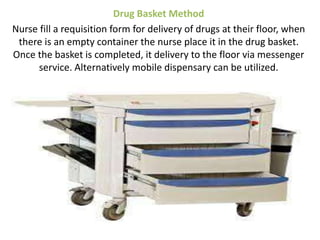
Drug Basket Method
Nurse fill a requisition form for delivery of drugs at their floor, when
there is an empty container the nurse place it in the drug basket.
Once the basket is completed, it delivery to the floor via messenger
service. Alternatively mobile dispensary can be utilized.
Difference between floor & non floor stock system
Charge floor stock system Non-charge floor stock system
The charges are made in the patients
account after the have been administered
from the stock drugs.
The drugs are not made in the account
directly even after the drug have been
administered.
Every dose of the drug administered to the
patients are charged.
This system charges are made indirectly to
the patients.
Only those dose are charged which are
expansive can rarely used.
The cost of the drugs are not high as they
are mostly used in tablets, capsules.
Floor stock list is prepared which is sent to
make the drugs available to all nursing
station.
A pre – determined list is prepared by
nursing station.
C) Combined of individual and floor stock system
This system is followed in the government and
also in private hospital who run on the basis of
no profit and no loss.
Individual prescription or medication system is
fallowed as a major means.
Requirement of drugs or surgical items are
given to the patient who purchase and deposit
these items in hospital wards or rooms under
supervision of registered nurse.
D) Unit dose dispensing
 Those medications which are ordered packed, handled administered and
charged in multiples of single dose units containing a predetermined amount of
drug or supply sufficient for one regular dose.
 A single unit package is one witch contains one complete pharmaceutical dosage
forms.
 Example - one tablet, caps
 Advantages -
• Better financial control.
•It prevents the loss of partially used medications.
•It does not require storage facilities at the nursing station.
 Methods - Two methods of dispensing unit doses are:
Centralized unit dose drug distribution system (CUDD)
Decentralized unit dose drug distribution system (DUDD)
Centralized unit-dose drug distribution
system(CUDD)
All in-patient drugs are dispensed in unit doses
and all the drugs are stored in central area of the
pharmacy and dispensed at the time the dose is
due to be given to the patient.
Drugs re transferred from the pharmacy to the
indoor patient by medication cards.
Decentralized unit dose dispensing (DUDD)
This operates through small satellite pharmacies
located on each floor of the hospital.
Procedure
Patient profile card containing full date ,disease,
diagnosis is prepared.
Prescription are sent directly to the pharmacist
which are then entered in the patient profile card.
Pharmacist checks medication order.
Patient profile card and prescription order is filled
by pharmacy technicians.
The nurses administer the drugs and make the
entry in their records.
Advantages
Easy for the administration staff
Accounting becomes easier in certain cases.
Better stability of the products
Example – Eno fruit salt in sachets.
Disadvantages
•High cost.
•consumes more time and doubtful.
•will occupy more space for storing.
•ledger posting and inventory control problem.
Out-patient
Out patient refers to patients not occupying beds in
a hospital or in clinics, health centers and other
places .
Drug distribution to out-patient
No medicaments should be issued without the
prescription.
After the issue has been made the quantities
supplied must be recorded.
Medicines are given to the out- patients from the
pharmacy situated in the out patient block.
Drug distribution.pptx

Drug distribution.pptx

  • 1.
    DRUG DISTRIBUTION SYSTEMIN HOSPITAL Dr.Mamta
  • 2.
    What is DrugDistribution ? One of the basic service provided by hospital pharmacy department is Drug Distribution. Types of Drug Distribution In hospital Drug distribution is of two types. 1) Out patient Service 2) In patient service
  • 3.
    1) In-Patient DrugDistribution Service In-patients are those patients ,who require hospitalization i.e. get themselves admitted in the hospital, stay there for treatment till they are discharged. They are four systems in general use for dispensing drugs for inpatients. They may be classified as follows: - A. Individual prescription order B. Complete floor stock system C. Combination of individual & floor stock system D. Unit dose system
  • 4.
    A) Individual prescriptionorder system It is a type of prescription system where the physician writes the prescription for individual patient who obtains the drug prescribed from any medical store or hospital dispensary by paying own charges. Advantages •All medication orders are directly reviewed by pharmacists. •It provides the interaction of pharmacist-doctor, nurse and the patient. •It provides clear control of inventory.
  • 5.
    B) Complete floorstock system Under this system ,the drugs are given to the patient through the nursing station and the pharmacy supplies from the drug store of a hospital. Drugs on the nursing station or ward may be divided in to – a. Charge floor stock drugs b. Non charge floor stock drugs
  • 6.
    a) Charge floorstock system Medicines which are stocked on the nursing station at all times and charged to the patient's account after they have been administered to them. Dispensing system of floor stock drugs –  The patient is charged for every single dose administered to him.  Selection of these drugs in various wards is decided by PTC.  Once the floor stock list is prepared ,it becomes the responsibility of the hospital pharmacist to make the drugs available.
  • 7.
    b) Non-charge floorstock drugs Non charge floor stock drugs are the medicaments that are placed at the nursing station for the use of all patients on the floor. These drugs ,there shall be no direct charge from the patients account. It is divided in to two methods – i. Drug basket method. ii. Mobile dispensary unit.
  • 8.
    Drug Basket Method Nursefill a requisition form for delivery of drugs at their floor, when there is an empty container the nurse place it in the drug basket. Once the basket is completed, it delivery to the floor via messenger service. Alternatively mobile dispensary can be utilized.
  • 9.
    Difference between floor& non floor stock system Charge floor stock system Non-charge floor stock system The charges are made in the patients account after the have been administered from the stock drugs. The drugs are not made in the account directly even after the drug have been administered. Every dose of the drug administered to the patients are charged. This system charges are made indirectly to the patients. Only those dose are charged which are expansive can rarely used. The cost of the drugs are not high as they are mostly used in tablets, capsules. Floor stock list is prepared which is sent to make the drugs available to all nursing station. A pre – determined list is prepared by nursing station.
  • 10.
    C) Combined ofindividual and floor stock system This system is followed in the government and also in private hospital who run on the basis of no profit and no loss. Individual prescription or medication system is fallowed as a major means. Requirement of drugs or surgical items are given to the patient who purchase and deposit these items in hospital wards or rooms under supervision of registered nurse.
  • 11.
    D) Unit dosedispensing  Those medications which are ordered packed, handled administered and charged in multiples of single dose units containing a predetermined amount of drug or supply sufficient for one regular dose.  A single unit package is one witch contains one complete pharmaceutical dosage forms.  Example - one tablet, caps  Advantages - • Better financial control. •It prevents the loss of partially used medications. •It does not require storage facilities at the nursing station.  Methods - Two methods of dispensing unit doses are: Centralized unit dose drug distribution system (CUDD) Decentralized unit dose drug distribution system (DUDD)
  • 12.
    Centralized unit-dose drugdistribution system(CUDD) All in-patient drugs are dispensed in unit doses and all the drugs are stored in central area of the pharmacy and dispensed at the time the dose is due to be given to the patient. Drugs re transferred from the pharmacy to the indoor patient by medication cards. Decentralized unit dose dispensing (DUDD) This operates through small satellite pharmacies located on each floor of the hospital.
  • 13.
    Procedure Patient profile cardcontaining full date ,disease, diagnosis is prepared. Prescription are sent directly to the pharmacist which are then entered in the patient profile card. Pharmacist checks medication order. Patient profile card and prescription order is filled by pharmacy technicians. The nurses administer the drugs and make the entry in their records.
  • 14.
    Advantages Easy for theadministration staff Accounting becomes easier in certain cases. Better stability of the products Example – Eno fruit salt in sachets. Disadvantages •High cost. •consumes more time and doubtful. •will occupy more space for storing. •ledger posting and inventory control problem.
  • 15.
    Out-patient Out patient refersto patients not occupying beds in a hospital or in clinics, health centers and other places . Drug distribution to out-patient No medicaments should be issued without the prescription. After the issue has been made the quantities supplied must be recorded. Medicines are given to the out- patients from the pharmacy situated in the out patient block.