
COMMUNITY PHARMACY
Hospital and Clinical pharmacy by d. J. Patil and A Textbook of Hospital Pharmacy, B. S. Shah Prakashan
By
Venkataiah Gudise
Faculty of Pharmacology
SSJ College of Pharmacy, Hyderabad
Called Hybrid of professionalism and business
Is a place where the medicines are stored and dispensed to the patients on valid
prescription and legally permitted without Rx (OTC) and also offer various health
care services by the qualified pharmacist in the community for improvement of the
health of the patient. (Corporate Pharmacy/Chain Pharmacy)
Scope of Community Pharmacy
1. Introduction of various latest techniques and globalisation of pharmacy profession
2. National Health Schemes checks and health promotion
3. Rationale use of drugs
4. Epidemiological control
5. Changing the dispensing to pharmacy care provider
6. Smoking cessation services
7. Emergency hormonal contraception
8. Prevention of misuse and addiction
9. Nutritional advise
10. Infection control, Chronic disease management
11. Minor ailment schemes (Camps)
12. Decrease the growth of the populations
13. Provides the basic sanitation system
14. Reduce the level of poverty
15. Reduce the morbidity and mortality
WHAT IS COMMUNITY PHARMACY
1. Establishment of Professional Pharmacy
2. Processing of prescriptions and Dispensing
• Communicating with patients
• Receiving prescriptions and registering patients
• Reviewing the Rx for DI, AE, errors and advice/suggestion to the physician
• Ensuring patient privacy
• Transferring Prescriptions
• Entering prescriptions in computer
• Handling restricted-use medications
• Filling & labelling pharmaceutical products
• Compounding prescriptions
• Collecting payment & offering patient counselling
3. Patient counselling - Link (disease, medicine and diet related)
4. Family or Homecare Service (Domiciliary services)
5. Treating common diseases (act as a prescriber for minor ailments)
6. Clinical services (rounds, review of Rx, diet etc.)
ROLE AND RESPONSIBILITIES OF COMMUNITY PHARMACIST
7. Health Screening Services (estimation of biochemical parameters)
8. Health promotion (education, life style, diet, smoking, alcohol,
vaccination, family planning, STD etc.)
9. Drug Information centre (review of new approved drugs, providing
information to physicians, finding and solving the DIs)
10. Consultation to general practitioners and medical representatives
11. Participation in pharmacoepidemiology (safety, efficacy and risk)
12. Records maintenance of health and pharmacy
13. Monitoring of drug utilization
14. Use of traditional and alternative medicines
15. Extemporaneous preparation and small-scale manufacture of
medicines
16. Agricultural and veterinary practice
ROLE AND RESPONSIBILITIES OF COMMUNITY PHARMACIST
Cont…
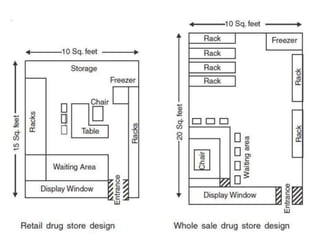
Wholesale or retail drug store
1. Selection of Pharmacy Site
2. Attract A Large Number Of Customers
3. Increase The Sales Of The Store
4. Reduce The Selling Expenses To The Minimum.
5. Provide Customer Satisfaction
6. Have Adequate Space For Reserve Stock , Office And Resting Space.
7. Proper Entrance For The Newly Arrived Goods
8. Project A Professional Image And Improve General Appearance.
9. Minimize The Movement Of The Customers In The Premises Of The
Pharmacy.
ESTABLISHMENT AND MANAGEMENT
Legal requirements
General license
form 20A for Schedule C,C1 and X
form 20F for Schedule X drugs
Condition for general license
• Should be displayed in a prominent place open to the public.
• should comply with the Drug and Cosmetics rule there under in force.
• Any change in the qualified staff should be reported to the licensing authority
within one month.
• Precaution for storage of schedule C and C1 drugs
• Restricted sale of drugs other than those specified in Schedule C, C1 and X
are issued in the form 20A Staff / personnel
The qualification
Over hiring is avoided
Orientation and training of staff
Maintenance of register
1. Legal records for acquisition and disposition of drugs
Drugs and cosmetics act 1940, Rules 1945 and the Poison Act 1919.
2. Patient records for Regarding the patient utilization of the drugs
3. Financial records for Regarding the past and present financial
status of the company
Analysing revenues and expenses
Measuring return on investment
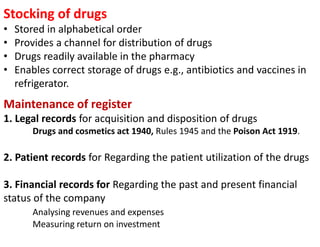
Stocking of drugs
• Stored in alphabetical order
• Provides a channel for distribution of drugs
• Drugs readily available in the pharmacy
• Enables correct storage of drugs e.g., antibiotics and vaccines in
refrigerator.
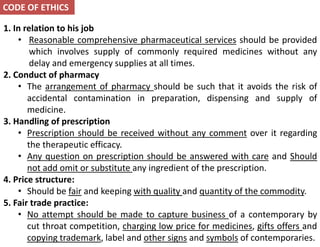
1. In relation to his job
• Reasonable comprehensive pharmaceutical services should be provided
which involves supply of commonly required medicines without any
delay and emergency supplies at all times.
2. Conduct of pharmacy
• The arrangement of pharmacy should be such that it avoids the risk of
accidental contamination in preparation, dispensing and supply of
medicine.
3. Handling of prescription
• Prescription should be received without any comment over it regarding
the therapeutic efficacy.
• Any question on prescription should be answered with care and Should
not add omit or substitute any ingredient of the prescription.
4. Price structure:
• Should be fair and keeping with quality and quantity of the commodity.
5. Fair trade practice:
• No attempt should be made to capture business of a contemporary by
cut throat competition, charging low price for medicines, gifts offers and
copying trademark, label and other signs and symbols of contemporaries.
CODE OF ETHICS
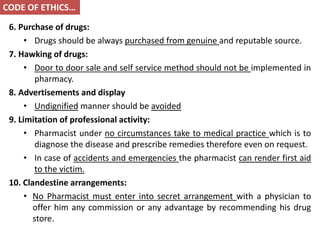
6. Purchase of drugs:
• Drugs should be always purchased from genuine and reputable source.
7. Hawking of drugs:
• Door to door sale and self service method should not be implemented in
pharmacy.
8. Advertisements and display
• Undignified manner should be avoided
9. Limitation of professional activity:
• Pharmacist under no circumstances take to medical practice which is to
diagnose the disease and prescribe remedies therefore even on request.
• In case of accidents and emergencies the pharmacist can render first aid
to the victim.
10. Clandestine arrangements:
• No Pharmacist must enter into secret arrangement with a physician to
offer him any commission or any advantage by recommending his drug
store.
CODE OF ETHICS…
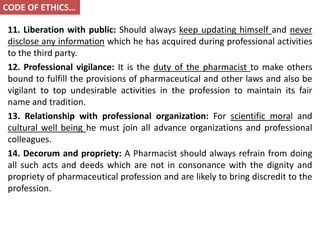
11. Liberation with public: Should always keep updating himself and never
disclose any information which he has acquired during professional activities
to the third party.
12. Professional vigilance: It is the duty of the pharmacist to make others
bound to fulfill the provisions of pharmaceutical and other laws and also be
vigilant to top undesirable activities in the profession to maintain its fair
name and tradition.
13. Relationship with professional organization: For scientific moral and
cultural well being he must join all advance organizations and professional
colleagues.
14. Decorum and propriety: A Pharmacist should always refrain from doing
all such acts and deeds which are not in consonance with the dignity and
propriety of pharmaceutical profession and are likely to bring discredit to the
profession.
CODE OF ETHICS…
Community pharmacy

Community pharmacy

  • 1.
    COMMUNITY PHARMACY Hospital andClinical pharmacy by d. J. Patil and A Textbook of Hospital Pharmacy, B. S. Shah Prakashan By Venkataiah Gudise Faculty of Pharmacology SSJ College of Pharmacy, Hyderabad
  • 2.
    Called Hybrid ofprofessionalism and business Is a place where the medicines are stored and dispensed to the patients on valid prescription and legally permitted without Rx (OTC) and also offer various health care services by the qualified pharmacist in the community for improvement of the health of the patient. (Corporate Pharmacy/Chain Pharmacy) Scope of Community Pharmacy 1. Introduction of various latest techniques and globalisation of pharmacy profession 2. National Health Schemes checks and health promotion 3. Rationale use of drugs 4. Epidemiological control 5. Changing the dispensing to pharmacy care provider 6. Smoking cessation services 7. Emergency hormonal contraception 8. Prevention of misuse and addiction 9. Nutritional advise 10. Infection control, Chronic disease management 11. Minor ailment schemes (Camps) 12. Decrease the growth of the populations 13. Provides the basic sanitation system 14. Reduce the level of poverty 15. Reduce the morbidity and mortality WHAT IS COMMUNITY PHARMACY
  • 3.
    1. Establishment ofProfessional Pharmacy 2. Processing of prescriptions and Dispensing • Communicating with patients • Receiving prescriptions and registering patients • Reviewing the Rx for DI, AE, errors and advice/suggestion to the physician • Ensuring patient privacy • Transferring Prescriptions • Entering prescriptions in computer • Handling restricted-use medications • Filling & labelling pharmaceutical products • Compounding prescriptions • Collecting payment & offering patient counselling 3. Patient counselling - Link (disease, medicine and diet related) 4. Family or Homecare Service (Domiciliary services) 5. Treating common diseases (act as a prescriber for minor ailments) 6. Clinical services (rounds, review of Rx, diet etc.) ROLE AND RESPONSIBILITIES OF COMMUNITY PHARMACIST
  • 4.
    7. Health ScreeningServices (estimation of biochemical parameters) 8. Health promotion (education, life style, diet, smoking, alcohol, vaccination, family planning, STD etc.) 9. Drug Information centre (review of new approved drugs, providing information to physicians, finding and solving the DIs) 10. Consultation to general practitioners and medical representatives 11. Participation in pharmacoepidemiology (safety, efficacy and risk) 12. Records maintenance of health and pharmacy 13. Monitoring of drug utilization 14. Use of traditional and alternative medicines 15. Extemporaneous preparation and small-scale manufacture of medicines 16. Agricultural and veterinary practice ROLE AND RESPONSIBILITIES OF COMMUNITY PHARMACIST Cont…
  • 5.
    Wholesale or retaildrug store 1. Selection of Pharmacy Site 2. Attract A Large Number Of Customers 3. Increase The Sales Of The Store 4. Reduce The Selling Expenses To The Minimum. 5. Provide Customer Satisfaction 6. Have Adequate Space For Reserve Stock , Office And Resting Space. 7. Proper Entrance For The Newly Arrived Goods 8. Project A Professional Image And Improve General Appearance. 9. Minimize The Movement Of The Customers In The Premises Of The Pharmacy. ESTABLISHMENT AND MANAGEMENT
  • 7.
    Legal requirements General license form20A for Schedule C,C1 and X form 20F for Schedule X drugs Condition for general license • Should be displayed in a prominent place open to the public. • should comply with the Drug and Cosmetics rule there under in force. • Any change in the qualified staff should be reported to the licensing authority within one month. • Precaution for storage of schedule C and C1 drugs • Restricted sale of drugs other than those specified in Schedule C, C1 and X are issued in the form 20A Staff / personnel The qualification Over hiring is avoided Orientation and training of staff
  • 8.
    Maintenance of register 1.Legal records for acquisition and disposition of drugs Drugs and cosmetics act 1940, Rules 1945 and the Poison Act 1919. 2. Patient records for Regarding the patient utilization of the drugs 3. Financial records for Regarding the past and present financial status of the company Analysing revenues and expenses Measuring return on investment Stocking of drugs • Stored in alphabetical order • Provides a channel for distribution of drugs • Drugs readily available in the pharmacy • Enables correct storage of drugs e.g., antibiotics and vaccines in refrigerator.
  • 9.
    1. In relationto his job • Reasonable comprehensive pharmaceutical services should be provided which involves supply of commonly required medicines without any delay and emergency supplies at all times. 2. Conduct of pharmacy • The arrangement of pharmacy should be such that it avoids the risk of accidental contamination in preparation, dispensing and supply of medicine. 3. Handling of prescription • Prescription should be received without any comment over it regarding the therapeutic efficacy. • Any question on prescription should be answered with care and Should not add omit or substitute any ingredient of the prescription. 4. Price structure: • Should be fair and keeping with quality and quantity of the commodity. 5. Fair trade practice: • No attempt should be made to capture business of a contemporary by cut throat competition, charging low price for medicines, gifts offers and copying trademark, label and other signs and symbols of contemporaries. CODE OF ETHICS
  • 10.
    6. Purchase ofdrugs: • Drugs should be always purchased from genuine and reputable source. 7. Hawking of drugs: • Door to door sale and self service method should not be implemented in pharmacy. 8. Advertisements and display • Undignified manner should be avoided 9. Limitation of professional activity: • Pharmacist under no circumstances take to medical practice which is to diagnose the disease and prescribe remedies therefore even on request. • In case of accidents and emergencies the pharmacist can render first aid to the victim. 10. Clandestine arrangements: • No Pharmacist must enter into secret arrangement with a physician to offer him any commission or any advantage by recommending his drug store. CODE OF ETHICS…
  • 11.
    11. Liberation withpublic: Should always keep updating himself and never disclose any information which he has acquired during professional activities to the third party. 12. Professional vigilance: It is the duty of the pharmacist to make others bound to fulfill the provisions of pharmaceutical and other laws and also be vigilant to top undesirable activities in the profession to maintain its fair name and tradition. 13. Relationship with professional organization: For scientific moral and cultural well being he must join all advance organizations and professional colleagues. 14. Decorum and propriety: A Pharmacist should always refrain from doing all such acts and deeds which are not in consonance with the dignity and propriety of pharmaceutical profession and are likely to bring discredit to the profession. CODE OF ETHICS…