Dr.Mamta
Assistant. Professor
Mechanism of drug action
 Only a handful of drugs act by virtue of their simple
physical or chemical property; examples are:
 Bulk laxatives (ispaghula)—physical mass
 Paraamino benzoic acid—absorption of UV rays
 Activated charcoal—adsorptive property
 Mannitol, mag. sulfate—osmotic activity
 131 I and other radioisotopes—radioactivity
 Antacids—neutralization of gastric HCl
 Pot. permanganate—oxidizing property
 Chelating agents (EDTA, dimercaprol)—chelation of heavy
metals.
9
 Majority of drugs produce their effects by
interacting with a discrete target biomolecule,
which usually is a protein. Such mechanism
confers selectivity of action to the drug.
 Functional proteins that are targets of drug action
can be grouped into four major categories, viz.
1) Enzymes,
2) Ion channels,
3) Transporters and
4) Receptors.
10
Enzymes
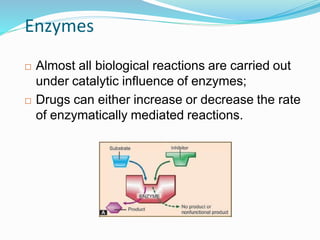
 Almost all biological reactions are carried out
under catalytic influence of enzymes;
 Drugs can either increase or decrease the rate
of enzymatically mediated reactions.
11
Enzyme inhibition
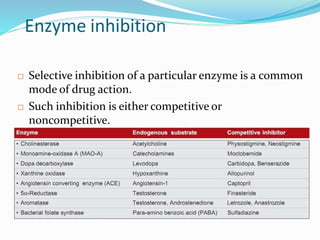
 Selective inhibition of a particular enzyme is a common
mode of drug action.
 Such inhibition is either competitive or
noncompetitive.
12
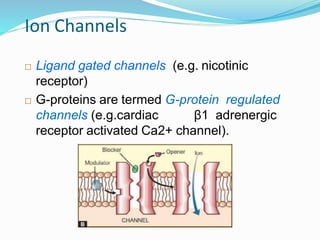
Ion Channels
 Ligand gated channels (e.g. nicotinic
receptor)
 G-proteins are termed G-protein regulated
channels (e.g.cardiac β1 adrenergic
receptor activated Ca2+ channel).
13
Ion Channels
 Drugs can also act on voltage operated and
stretch sensitive channels by directly binding
to the channel and affecting ion movement
through it, e.g. local anaesthetics which
obstruct voltage sensitive Na+ channels.
14
Ion Channels
 Certain drugs modulate opening and closing of
the channels, e.g.:
 Nifedipine blocks L-type of voltage sensitive
Ca2+ channel.
 Ethosuximide inhibits T-type of Ca2+ channels
in thalamic neurones.
15
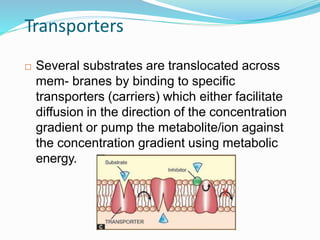
Transporters
 Several substrates are translocated across
mem- branes by binding to specific
transporters (carriers) which either facilitate
diffusion in the direction of the concentration
gradient or pump the metabolite/ion against
the concentration gradient using metabolic
energy.
16
Transporters
 Many drugs produce their action by directly
interacting with the solute carrier (SLC) class
of transporter proteins to inhibit the ongoing
physiological transport of the metabolite/ion.
17
Receptors
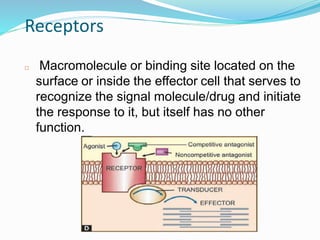
 Macromolecule or binding site located on the
surface or inside the effector cell that serves to
recognize the signal molecule/drug and initiate
the response to it, but itself has no other
function.
18
Describing drug-receptor
Interaction
:
 Agonist: An agent which activates a receptor to produce an
effect similar to that of the physiological signal molecule.
 Inverse agonist: An agent which activates a receptor to
produce an effect in the opposite direction to that of the
agonist.
 Antagonist: An agent which prevents the action of an
agonist on a receptor or the subsequent response, but does
not have any effect of its own.
 Partial agonist: An agent which activates a receptor to
produce submaximal effect but antagonizes the action of a
full agonist.
19
 Agonists have both affinity and maximal intrinsic activity (IA
= 1), e.g. adrenaline, histamine, morphine.
 Competitive antagonists have affinity but no intrinsic activity
(IA = 0), e.g. propranolol, atropine, chlorpheniramine,
naloxone.
 Partial agonists have affinity and submaximal intrinsic
activity (IA between 0 and 1), e.g. dichloroisoproterenol (on β
adrenergic receptor), pentazocine (on μ opioid receptor).
 Inverse agonists have affinity but intrinsic activity with a
minus sign (IA between 0 and –1),e.g. DMCM (on
benzodiazepine receptor),chlorpheniramine (on H1 histamine
receptor)
***(note- all the ligands possess affinity i.e A=1)
20
RECEPTOR transduction FAMILIES
Four types of receptors families
1. Receptors with intrinsic ion channels.
2.G-protien coupled receptor
3. Enzymatic receptors
4. Intracellular/nuclear receptor
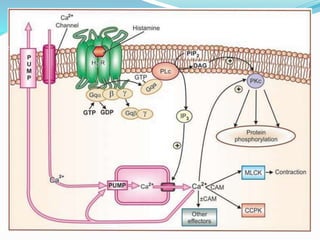
GPCR
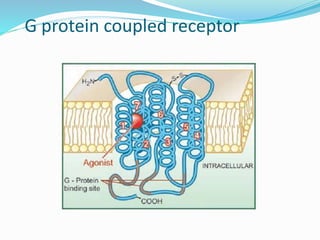
 large family of cell membrane receptors
 Seven α-helical membrane spanning hydrophobic
amino acid (AA) segments which run into 3
extracellular and 3 intracellular loops
 G protein is a connecting link between receptor and
effector systems ,like enzymes, carrier molecules
etc.
 The agonist binding site is located between the helices
on the extracellular face
 They are called so because of their link with GDP
and GTP
G protein coupled receptor
21
22
23
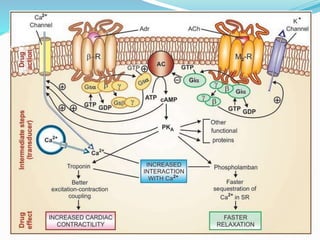
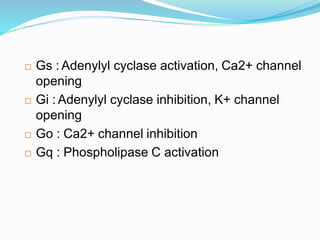
 Gs : Adenylyl cyclase activation, Ca2+ channel
opening
 Gi : Adenylyl cyclase inhibition, K+ channel
opening
 Go : Ca2+ channel inhibition
 Gq : Phospholipase C activation
24
Ion channel receptor
25
Ion channel receptor
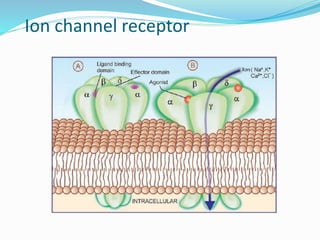
 These cell surface receptors, also called ligand
gated ion channels, enclose ion selective
channels (for Na+, K+, Ca2+ or Cl¯) within their
molecules.
 Agonist binding opens the channel and causes
depolarization/hyperpolarization/ changes in
cytosolic ionic composition, depending on the ion
that flows through.
 The nicotinic cholinergic, GABAA, glycine
(inhibitory AA), excitatory AA-glutamate (kainate,
NMDA and AMPA) and 5HT3 receptors fall in this
category.
26
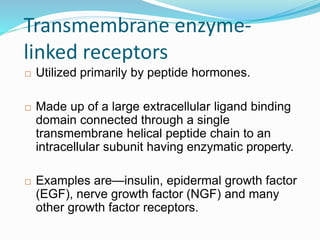
Transmembrane enzyme-
linked receptors
 Utilized primarily by peptide hormones.
 Made up of a large extracellular ligand binding
domain connected through a single
transmembrane helical peptide chain to an
intracellular subunit having enzymatic property.
 Examples are—insulin, epidermal growth factor
(EGF), nerve growth factor (NGF) and many
other growth factor receptors.
27
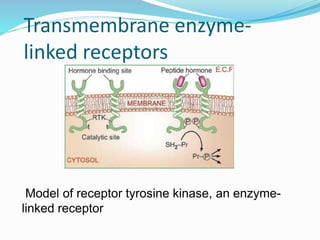
Transmembrane enzyme-
linked receptors
Model of receptor tyrosine kinase, an enzyme-
linked receptor
28
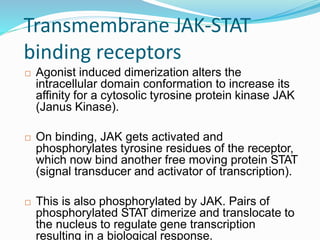
Transmembrane JAK-STAT
binding receptors
 Agonist induced dimerization alters the
intracellular domain conformation to increase its
affinity for a cytosolic tyrosine protein kinase JAK
(Janus Kinase).
 On binding, JAK gets activated and
phosphorylates tyrosine residues of the receptor,
which now bind another free moving protein STAT
(signal transducer and activator of transcription).
 This is also phosphorylated by JAK. Pairs of
phosphorylated STAT dimerize and translocate to
the nucleus to regulate gene transcription
resulting in a biological response.
29
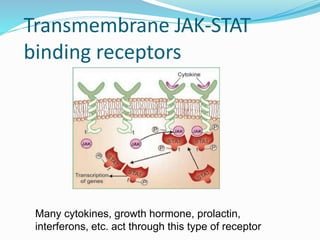
Transmembrane JAK-STAT
binding receptors
Many cytokines, growth hormone, prolactin,
interferons, etc. act through this type of receptor
30
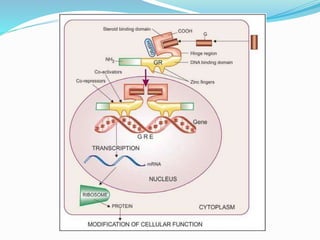
Receptors regulating gene expression
(Transcription factors, Nuclear
receptors)
 These are intracellular (cytoplasmic or nuclear) soluble
proteins which respond to lipid soluble chemical
messengers that penetrate the cell.
 The liganded receptor diamer moves to the nucleus and
binds other co-activator/co-repressor proteins which
have a modulatory influence on its capacity to alter gene
function.
 All steroidal hormones (glucocorticoids,
mineralocorticoids, androgens, estrogens, progeste-
rone), thyroxine, vit D and vit A function in this manner.
31
32
SILENT RECEPTORS
A drug when bound to such receptors, exhibits no
pharmacological response.
Eg: silent tissue receptors.
SPECIAL TYPE OF RECEPTORS
SPARE RECEPTORS
Even when a receptor is blocked by irreversible
blocker ,an agonist is still capable of producing
undiminished maximum response.
Eg: if beta adrenergic receptors are blocked
irreversibly and then adrenaline is pushed , there is
still production of an undiminished maximum
inotropic response.
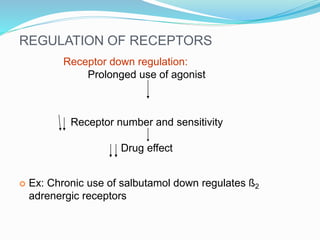
REGULATION OF RECEPTORS
Receptor down regulation:
Prolonged use of agonist
Receptor number and sensitivity
Drug effect
 Ex: Chronic use of salbutamol down regulates ß2
adrenergic receptors
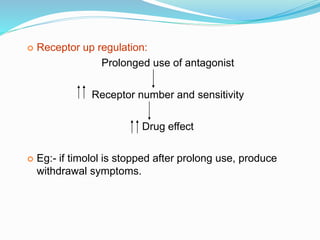
 Receptor up regulation:
Prolonged use of antagonist
Receptor number and sensitivity
Drug effect
 Eg:- if timolol is stopped after prolong use, produce
withdrawal symptoms.
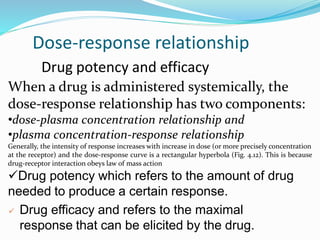
Dose-response relationship
Drug potency and efficacy
When a drug is administered systemically, the
dose-response relationship has two components:
•dose-plasma concentration relationship and
•plasma concentration-response relationship
Generally, the intensity of response increases with increase in dose (or more precisely concentration
at the receptor) and the dose-response curve is a rectangular hyperbola (Fig. 4.12). This is because
drug-receptor interaction obeys law of mass action
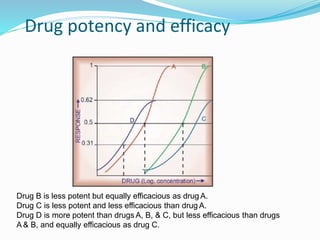
Drug potency which refers to the amount of drug
needed to produce a certain response.
 Drug efficacy and refers to the maximal
response that can be elicited by the drug.
33
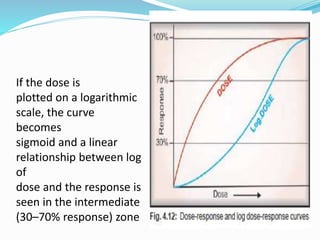
If the dose is
plotted on a logarithmic
scale, the curve
becomes
sigmoid and a linear
relationship between log
of
dose and the response is
seen in the intermediate
(30–70% response) zone
Drug potency and efficacy
Drug B is less potent but equally efficacious as drug A.
Drug C is less potent and less efficacious than drug A.
Drug D is more potent than drugs A, B, & C, but less efficacious than drugs
A & B, and equally efficacious as drug C.
34
Therapeutic index
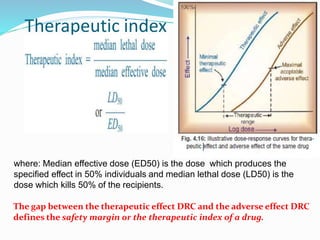
where: Median effective dose (ED50) is the dose which produces the
specified effect in 50% individuals and median lethal dose (LD50) is the
dose which kills 50% of the recipients.
The gap between the therapeutic effect DRC and the adverse effect DRC
defines the safety margin or the therapeutic index of a drug.
35
Combined effect of Drugs
 Synergism
 When the action of one drug is facilitated or
increased by the other, they are said to be
synergistic.
36
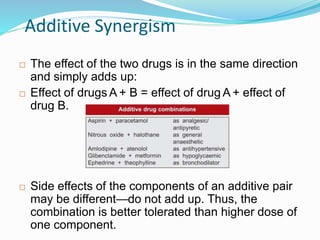
Additive Synergism
 The effect of the two drugs is in the same direction
and simply adds up:
 Effect of drugs A + B = effect of drug A + effect of
drug B.
 Side effects of the components of an additive pair
may be different—do not add up. Thus, the
combination is better tolerated than higher dose of
one component.
37
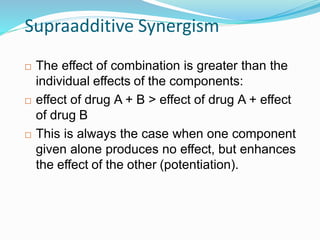
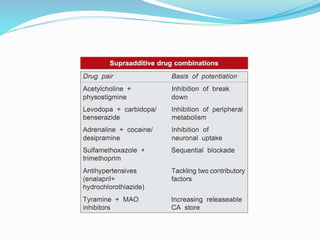
Supraadditive Synergism
 The effect of combination is greater than the
individual effects of the components:
 effect of drug A + B > effect of drug A + effect
of drug B
 This is always the case when one component
given alone produces no effect, but enhances
the effect of the other (potentiation).
38
39
Antagonism
 When one drug decreases or abolishes the
action of another, they are said to be
antagonistic:
 effect of drugsA + B < effect of drug A + effect
of drug B
40
Physical antagonism
 Based on the physical property of the drugs,
e.g. charcoal adsorbs alkaloids and can
prevent their absorption—used in alkaloidal
poisonings.
41
Chemical antagonism
 The two drugs react chemically and form an
inactive product, e.g
 KMnO4 oxidizes alkaloids—used for gastric
lavage in poisoning.
 Chelating agents (BAL, Cal. disod. edetate)
complex toxic metals (As, Pb).
42
Physiological/functional
antagonism
 The two drugs act on different receptors or by
different mechanisms, but have opposite overt
effects on the same physiological function, i.e.
have pharmacological effects in opposite
direction.
 Histamine and adrenaline on bronchial muscles
and BP.
 Glucagon and insulin on blood sugar level.
43
Receptor antagonism
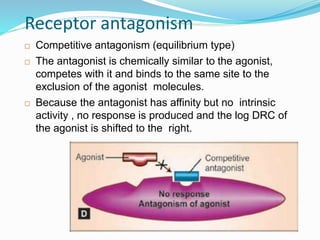
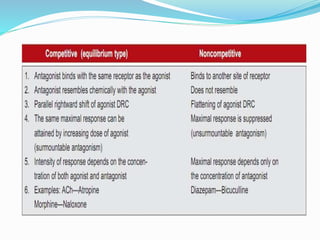
 Competitive antagonism (equilibrium type)
 The antagonist is chemically similar to the agonist,
competes with it and binds to the same site to the
exclusion of the agonist molecules.
 Because the antagonist has affinity but no intrinsic
activity , no response is produced and the log DRC of
the agonist is shifted to the right.
44
Noncompetitive antagonism
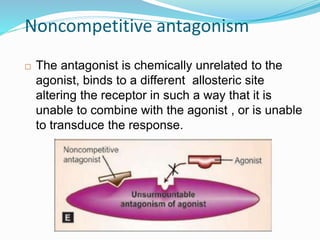
 The antagonist is chemically unrelated to the
agonist, binds to a different allosteric site
altering the receptor in such a way that it is
unable to combine with the agonist , or is unable
to transduce the response.
45
46
Thank You
47

pharmacodynamics I.pptx

  • 1.
  • 2.
    Mechanism of drugaction  Only a handful of drugs act by virtue of their simple physical or chemical property; examples are:  Bulk laxatives (ispaghula)—physical mass  Paraamino benzoic acid—absorption of UV rays  Activated charcoal—adsorptive property  Mannitol, mag. sulfate—osmotic activity  131 I and other radioisotopes—radioactivity  Antacids—neutralization of gastric HCl  Pot. permanganate—oxidizing property  Chelating agents (EDTA, dimercaprol)—chelation of heavy metals. 9
  • 3.
     Majority ofdrugs produce their effects by interacting with a discrete target biomolecule, which usually is a protein. Such mechanism confers selectivity of action to the drug.  Functional proteins that are targets of drug action can be grouped into four major categories, viz. 1) Enzymes, 2) Ion channels, 3) Transporters and 4) Receptors. 10
  • 4.
    Enzymes  Almost allbiological reactions are carried out under catalytic influence of enzymes;  Drugs can either increase or decrease the rate of enzymatically mediated reactions. 11
  • 5.
    Enzyme inhibition  Selectiveinhibition of a particular enzyme is a common mode of drug action.  Such inhibition is either competitive or noncompetitive. 12
  • 6.
    Ion Channels  Ligandgated channels (e.g. nicotinic receptor)  G-proteins are termed G-protein regulated channels (e.g.cardiac β1 adrenergic receptor activated Ca2+ channel). 13
  • 7.
    Ion Channels  Drugscan also act on voltage operated and stretch sensitive channels by directly binding to the channel and affecting ion movement through it, e.g. local anaesthetics which obstruct voltage sensitive Na+ channels. 14
  • 8.
    Ion Channels  Certaindrugs modulate opening and closing of the channels, e.g.:  Nifedipine blocks L-type of voltage sensitive Ca2+ channel.  Ethosuximide inhibits T-type of Ca2+ channels in thalamic neurones. 15
  • 9.
    Transporters  Several substratesare translocated across mem- branes by binding to specific transporters (carriers) which either facilitate diffusion in the direction of the concentration gradient or pump the metabolite/ion against the concentration gradient using metabolic energy. 16
  • 10.
    Transporters  Many drugsproduce their action by directly interacting with the solute carrier (SLC) class of transporter proteins to inhibit the ongoing physiological transport of the metabolite/ion. 17
  • 11.
    Receptors  Macromolecule orbinding site located on the surface or inside the effector cell that serves to recognize the signal molecule/drug and initiate the response to it, but itself has no other function. 18
  • 12.
    Describing drug-receptor Interaction :  Agonist:An agent which activates a receptor to produce an effect similar to that of the physiological signal molecule.  Inverse agonist: An agent which activates a receptor to produce an effect in the opposite direction to that of the agonist.  Antagonist: An agent which prevents the action of an agonist on a receptor or the subsequent response, but does not have any effect of its own.  Partial agonist: An agent which activates a receptor to produce submaximal effect but antagonizes the action of a full agonist. 19
  • 13.
     Agonists haveboth affinity and maximal intrinsic activity (IA = 1), e.g. adrenaline, histamine, morphine.  Competitive antagonists have affinity but no intrinsic activity (IA = 0), e.g. propranolol, atropine, chlorpheniramine, naloxone.  Partial agonists have affinity and submaximal intrinsic activity (IA between 0 and 1), e.g. dichloroisoproterenol (on β adrenergic receptor), pentazocine (on μ opioid receptor).  Inverse agonists have affinity but intrinsic activity with a minus sign (IA between 0 and –1),e.g. DMCM (on benzodiazepine receptor),chlorpheniramine (on H1 histamine receptor) ***(note- all the ligands possess affinity i.e A=1) 20
  • 14.
    RECEPTOR transduction FAMILIES Fourtypes of receptors families 1. Receptors with intrinsic ion channels. 2.G-protien coupled receptor 3. Enzymatic receptors 4. Intracellular/nuclear receptor
  • 15.
    GPCR  large familyof cell membrane receptors  Seven α-helical membrane spanning hydrophobic amino acid (AA) segments which run into 3 extracellular and 3 intracellular loops  G protein is a connecting link between receptor and effector systems ,like enzymes, carrier molecules etc.  The agonist binding site is located between the helices on the extracellular face  They are called so because of their link with GDP and GTP
  • 16.
    G protein coupledreceptor 21
  • 17.
  • 18.
  • 19.
     Gs :Adenylyl cyclase activation, Ca2+ channel opening  Gi : Adenylyl cyclase inhibition, K+ channel opening  Go : Ca2+ channel inhibition  Gq : Phospholipase C activation 24
  • 20.
  • 21.
    Ion channel receptor These cell surface receptors, also called ligand gated ion channels, enclose ion selective channels (for Na+, K+, Ca2+ or Cl¯) within their molecules.  Agonist binding opens the channel and causes depolarization/hyperpolarization/ changes in cytosolic ionic composition, depending on the ion that flows through.  The nicotinic cholinergic, GABAA, glycine (inhibitory AA), excitatory AA-glutamate (kainate, NMDA and AMPA) and 5HT3 receptors fall in this category. 26
  • 22.
    Transmembrane enzyme- linked receptors Utilized primarily by peptide hormones.  Made up of a large extracellular ligand binding domain connected through a single transmembrane helical peptide chain to an intracellular subunit having enzymatic property.  Examples are—insulin, epidermal growth factor (EGF), nerve growth factor (NGF) and many other growth factor receptors. 27
  • 23.
    Transmembrane enzyme- linked receptors Modelof receptor tyrosine kinase, an enzyme- linked receptor 28
  • 24.
    Transmembrane JAK-STAT binding receptors Agonist induced dimerization alters the intracellular domain conformation to increase its affinity for a cytosolic tyrosine protein kinase JAK (Janus Kinase).  On binding, JAK gets activated and phosphorylates tyrosine residues of the receptor, which now bind another free moving protein STAT (signal transducer and activator of transcription).  This is also phosphorylated by JAK. Pairs of phosphorylated STAT dimerize and translocate to the nucleus to regulate gene transcription resulting in a biological response. 29
  • 25.
    Transmembrane JAK-STAT binding receptors Manycytokines, growth hormone, prolactin, interferons, etc. act through this type of receptor 30
  • 26.
    Receptors regulating geneexpression (Transcription factors, Nuclear receptors)  These are intracellular (cytoplasmic or nuclear) soluble proteins which respond to lipid soluble chemical messengers that penetrate the cell.  The liganded receptor diamer moves to the nucleus and binds other co-activator/co-repressor proteins which have a modulatory influence on its capacity to alter gene function.  All steroidal hormones (glucocorticoids, mineralocorticoids, androgens, estrogens, progeste- rone), thyroxine, vit D and vit A function in this manner. 31
  • 27.
  • 28.
    SILENT RECEPTORS A drugwhen bound to such receptors, exhibits no pharmacological response. Eg: silent tissue receptors.
  • 29.
    SPECIAL TYPE OFRECEPTORS SPARE RECEPTORS Even when a receptor is blocked by irreversible blocker ,an agonist is still capable of producing undiminished maximum response. Eg: if beta adrenergic receptors are blocked irreversibly and then adrenaline is pushed , there is still production of an undiminished maximum inotropic response.
  • 30.
    REGULATION OF RECEPTORS Receptordown regulation: Prolonged use of agonist Receptor number and sensitivity Drug effect  Ex: Chronic use of salbutamol down regulates ß2 adrenergic receptors
  • 31.
     Receptor upregulation: Prolonged use of antagonist Receptor number and sensitivity Drug effect  Eg:- if timolol is stopped after prolong use, produce withdrawal symptoms.
  • 32.
    Dose-response relationship Drug potencyand efficacy When a drug is administered systemically, the dose-response relationship has two components: •dose-plasma concentration relationship and •plasma concentration-response relationship Generally, the intensity of response increases with increase in dose (or more precisely concentration at the receptor) and the dose-response curve is a rectangular hyperbola (Fig. 4.12). This is because drug-receptor interaction obeys law of mass action Drug potency which refers to the amount of drug needed to produce a certain response.  Drug efficacy and refers to the maximal response that can be elicited by the drug. 33
  • 33.
    If the doseis plotted on a logarithmic scale, the curve becomes sigmoid and a linear relationship between log of dose and the response is seen in the intermediate (30–70% response) zone
  • 34.
    Drug potency andefficacy Drug B is less potent but equally efficacious as drug A. Drug C is less potent and less efficacious than drug A. Drug D is more potent than drugs A, B, & C, but less efficacious than drugs A & B, and equally efficacious as drug C. 34
  • 35.
    Therapeutic index where: Medianeffective dose (ED50) is the dose which produces the specified effect in 50% individuals and median lethal dose (LD50) is the dose which kills 50% of the recipients. The gap between the therapeutic effect DRC and the adverse effect DRC defines the safety margin or the therapeutic index of a drug. 35
  • 36.
    Combined effect ofDrugs  Synergism  When the action of one drug is facilitated or increased by the other, they are said to be synergistic. 36
  • 37.
    Additive Synergism  Theeffect of the two drugs is in the same direction and simply adds up:  Effect of drugs A + B = effect of drug A + effect of drug B.  Side effects of the components of an additive pair may be different—do not add up. Thus, the combination is better tolerated than higher dose of one component. 37
  • 38.
    Supraadditive Synergism  Theeffect of combination is greater than the individual effects of the components:  effect of drug A + B > effect of drug A + effect of drug B  This is always the case when one component given alone produces no effect, but enhances the effect of the other (potentiation). 38
  • 39.
  • 40.
    Antagonism  When onedrug decreases or abolishes the action of another, they are said to be antagonistic:  effect of drugsA + B < effect of drug A + effect of drug B 40
  • 41.
    Physical antagonism  Basedon the physical property of the drugs, e.g. charcoal adsorbs alkaloids and can prevent their absorption—used in alkaloidal poisonings. 41
  • 42.
    Chemical antagonism  Thetwo drugs react chemically and form an inactive product, e.g  KMnO4 oxidizes alkaloids—used for gastric lavage in poisoning.  Chelating agents (BAL, Cal. disod. edetate) complex toxic metals (As, Pb). 42
  • 43.
    Physiological/functional antagonism  The twodrugs act on different receptors or by different mechanisms, but have opposite overt effects on the same physiological function, i.e. have pharmacological effects in opposite direction.  Histamine and adrenaline on bronchial muscles and BP.  Glucagon and insulin on blood sugar level. 43
  • 44.
    Receptor antagonism  Competitiveantagonism (equilibrium type)  The antagonist is chemically similar to the agonist, competes with it and binds to the same site to the exclusion of the agonist molecules.  Because the antagonist has affinity but no intrinsic activity , no response is produced and the log DRC of the agonist is shifted to the right. 44
  • 45.
    Noncompetitive antagonism  Theantagonist is chemically unrelated to the agonist, binds to a different allosteric site altering the receptor in such a way that it is unable to combine with the agonist , or is unable to transduce the response. 45
  • 46.
  • 47.