
Hospital Pharmacy
And
Its Organization
Ravinandan A P
Doctoral Research Scholar
&
Assistant Professor & Clinical Pharmacist
Sree Siddaganga College of Pharmacy
In association with
Siddaganga Hospital & Research Centre
Tumkur-02
Presentation outlines
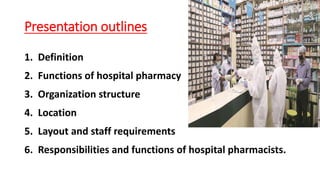
1. Definition
2. Functions of hospital pharmacy
3. Organization structure
4. Location
5. Layout and staff requirements
6. Responsibilities and functions of hospital pharmacists.
Learning objectives
Upon completion of the chapter, the student shall be able to –
Write the definition of hospital pharmacy
Describe the various functions of hospital pharmacy
Explain the organization structure of a Hospital pharmacy
Write the layout of hospital pharmacy
Calculate the staff requirements
Describe the responsibilities and functions of hospital pharmacists
Introduction
• Dispensing function of pharmacist is very important and vital
• New role clinical pharmacist and drug consultant
• Most of the time people seen pharmacists are as simply
transferring pills from large bottle to small.
• Pharmacists are devoted to merchandizing of cosmetics, shaving
supplies, stationary and other commodities
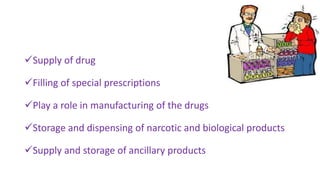
Supply of drug
Filling of special prescriptions
Play a role in manufacturing of the drugs
Storage and dispensing of narcotic and biological products
Supply and storage of ancillary products
Is that department in the hospital from where drugs and
pharmaceuticals preparations are distributed to various other
departments with in the hospital.
 Handles both inpatients and out patients prescriptions
 In some countries even manufacturing of pharmaceuticals will
be done.
Dispense medicines and accessories like surgical dressings,
cotton gauze bandages and gloves etc.
Definition
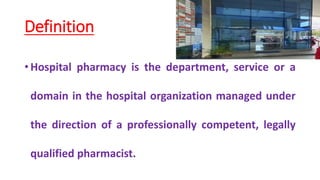
• Hospital pharmacy is the department, service or a
domain in the hospital organization managed under
the direction of a professionally competent, legally
qualified pharmacist.
• Pharmaceutical services in a hospital comprises of the services rendered to the
patient through a number of activities like:
• Dispensing of drug
• Management of the stores which include:
a) Purchase of drugs as per the recommendation of Pharmacy and Therapy
Committee
b) Providing instructions for proper storage of such drugs
c) Maintenance of proper records of the drugs purchased and there distribution
• Manufacture and distribution of medicaments and products
• Providing the therapeutic drug monitoring services
• Establishment and maintenance of Drug Information Centre
• Patient counseling service
• Maintaining liaison with medical staff, nursing staff and the patients
themselves
• To maintain the nursing department and the central sterile supply unit in
the hospital
• Participate in teaching programme of nursing and pharmacy students and
medical students.
Functions Of A Hospital Pharmacist
1. To provide and evaluate pharmaceutical services
2. To draw a plan for hospital pharmacy administration
3. To establish liaison between administrative authorities and medical Doctors.
4. To estimate the requirements for the department and enforce the policies and
procedures for the recruitment of adequate and competent staff
5. To develop and maintain an effective system of clinical and administrative records
and reports
6. To participate in and adhere to the financial plan of the operation for the hospital
Functions of Chief Hospital Pharmacist
• To provide pharmaceutical care services meeting the
therapeutic objectives to Patients, Prescribers and
Nurses.
• To provide departmental services, and implement the
pharmaceutical principles, objectives, policies and
standards of the hospital.
• To participate and provide necessary cognitive &
liaising services to all the departments in the hospital.
• To develop policies and procedures for the successful functioning of the
department.
• To recruit, train and encourage the pharmacy staff to provide quality
services.
• To participate in the financial plan of the operation of the hospital
• To develop and maintain an effective system of clinical and administrative
records and reports.
• To initiate, utilize and / or participate in patient care research studies
• To estimate the needs for facilities, supplies and
equipment for the proper functioning of the
department.
• To initiate and conduct Continuing Professional
Developments (CPD) for knowledge and skills
improvement among the personnel working in
pharmacy department.
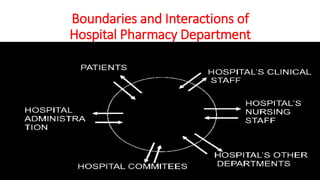
Boundaries and Interactions of
Hospital Pharmacy Department
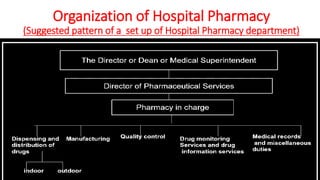
Organization of Hospital Pharmacy
(Suggested pattern of a set up of Hospital Pharmacy department)
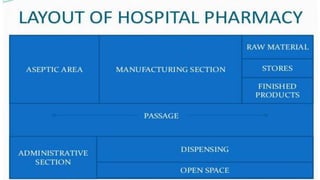
Location and layout
• In hospital premises so that patients and staff can easily
approach it.
• In multi storied building, on the ground floor especially the
dispensing unit.
• The manufacturing room should be adjacent to the pharmacy.
• Outpatient pharmacy should give pleasant appearance and
must have enough space for seating of patients who have to
wait for medicines.
• Medical stores of a pharmacy should be adjacent to the
pharmacy itself or should be directly connected to pharmacy.
What is layout and its importance?
•An arrangement or a plan, especially the schematic
arrangement of parts or areas.
Importance?
•It plays significant role in the development of the
customers perception which have a positive impact on
its sale potential.
Objective of layout design
1. To attract a large number of customer
2. To increase the sale and decrease the selling expenses
3. To have space for reserve for stock, office and resting place
for the employees
4. Proper entrance for goods
5. To minimize the movement of customers with within the
premises of the drug store
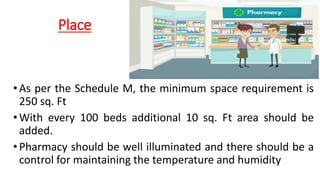
Place
•As per the Schedule M, the minimum space requirement is
250 sq. Ft
•With every 100 beds additional 10 sq. Ft area should be
added.
•Pharmacy should be well illuminated and there should be a
control for maintaining the temperature and humidity
Floor Space Requirements
• 250 sq. feet is the minimum required area for any sized
hospital.
• 10 sq. feet per bed in 100 bedded hospital.
• 6 sq. feet per bed in 200 bedded hospital.
• Floors of pharmacy should be smooth, easily washable and
acid resistant.
• In manufacturing sections, drains should be provided, walls
should be smooth, painted in light color.
• Wooden cabinets are laminated.
• Fluorescent lamps are placed above prescription counter.
• Counter for Bunsen burner are also required.
Staff and their Qualifications:
The number of Pharmacy staff members depends on
1. Number of beds in the hospital
2. Scope of services – out-patients and in-patients
3. Activities of pharmacy
4. Whether it is involved in manufacturing of drugs and
formulations
5. Whether the pharmacy stocks and dispenses surgical and
laboratory supplies
Qualification
• The Chief pharmacist or director should have minimum post
graduate degree in pharmacy preferably in pharmacology or
hospital pharmacy.
• Manufacturing chemist should be graduate in pharmacy with
minimum 18 months experience in manufacturing process of
drugs and formulations.
• Analytical Chemist should be post-graduate in pharmaceutical
chemistry or analytical chemistry.
• Registered pharmacist and pharmacist-cum-clerk should have
diploma in pharmacy and should be registered in state
pharmacy council.
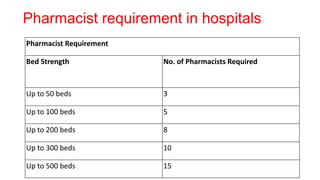
Pharmacist requirement in hospitals
Pharmacist Requirement
Bed Strength No. of Pharmacists Required
Up to 50 beds 3
Up to 100 beds 5
Up to 200 beds 8
Up to 300 beds 10
Up to 500 beds 15
Responsibilities
Central Dispensing Area
Patient care in wards
Patient care in OPDs
General Responsibilities
Central Dispensing area
1. To ensure that all drugs are stored dispensed correctly
2. To check the accuracy of the dosages prepared
3. To keep proper records and preparation of bills
4. To co-ordinate the over all pharmaceutical needs of the “patient
Care”
5. To ensure that established policies and procedures are followed
6. To maintain professional competence, and communication.
7. To communicate with all pharmacy staff regarding new
developments
8. To co-ordinate the activities of the area
B} In patient ward areas
1. To maintain liaison with nurses
2. Reviewing drug administration in each patient
3. To provide instruction and assistance to the juniors
4. To co-ordinate overall pharmaceutical services on the
running unit level.
Direct patient care area
1. Identification of drugs brought in to the hospital by the
patient.
2. Obtaining patient medication history and communicating
to all the attending doctors.
3. To assist doctors in the selection of drug products and their
doses.
•To monitor patients total drug therapy for
1) Effectiveness
2) side effects
3) Toxicities
4) ADRs and Drug interactions
•Patient counseling
•Participating in cardio – pulmonary emergencies
C} Out patient areas
• To ensure proper technique in compounding and
dispensing.
• Maintaining all the records and bills of patient
medication, record of investigational drugs
• Maintaining prescription files
• Keep outdoor pharmacy neat, clean and tidy.
• provide necessary counseling to the patients for
proper usage of their medication.
D} General Responsibilities
•Providing drug information to patients and doctors
•Education to medical, nursing and pharmacy students.
•To coordinate overall needs of the outdoor service area and
exercise control over such drugs
•To ensure that all drugs are handled properly such as
storage of investigational drugs
•To participate in cardio pulmonary emergency
•To provide for in services education and training for
pharmacists, pharmacy items.
Hospital Pharmacy  And Its Organization -Ravinandan  A P