
1
Prepared by: Ms. Shivanee Vyas
Assistant Professor
The pharmacy and therapeutics committee is a policy framing and recommending body
to the medical staff and the administration of hospital on matters related to therapeutic
use of drugs.
Pharmacy And Therapeutic
Committee
COMPOSITION OF PTC
It might vary from hospital to hospital.
The PTC may be composed of:
• A pharmacist
• At least three physicians from the medical staff
• A representative of the nursing staff
• An hospital administrator
One of the physicians may be appointed as the chairman of PTC.
2
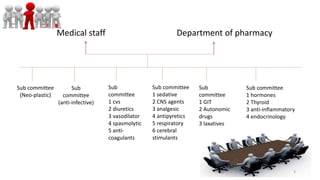
Medical staff Department of pharmacy
Sub committee
(Neo-plastic)
Sub
committee
(anti-infective)
Sub
committee
1 cvs
2 diuretics
3 vasodilator
4 spasmolytic
5 anti-
coagulants
Sub committee
1 sedative
2 CNS agents
3 analgesic
4 antipyretics
5 respiratory
6 cerebral
stimulants
Sub
committee
1 GIT
2 Autonomic
drugs
3 laxatives
Sub committee
1 hormones
2 Thyroid
3 anti-inflammatory
4 endocrinology
3
Role of PTC
The committee plays dual role:
1. Advisory:
The committee assists in the formulation of professional policies regarding selection, evaluation and
therapeutic use of drugs in hospital.
2. Educational:
The committee recommends and assist in various functions designed to provide current knowledge of
the drugs to the health care professionals.
4
Functions of PTC
1. To serve as an advisory council to medical staff and hospital administration in all matters related to the use
of the drug.
2. To develop and compile an hospital formulary system.
3. The committee promotes the rational therapeutic treatment and prevent duplication, waste and confusion.
4. It also develops policies regarding safety of drugs.
5. To establish or plan suitable educational schemes for the hospital professional staff on the matter related to
the use of drugs.
6. To study the problems related to the distribution and use of drugs.
7. To make recommendations concerning the drugs to be stocked in wards and emergency.
8. It provides training to physician, nurse, and volunteers.
9. To develops policies and procedures for the purchasing, distribution, selection, storage and uses of drug.
10. It inspects over the routine activities of the hospital.
11. It makes the list of emergency drugs, dangerous drugs, narcotic drugs, alcohol containing and other drugs.
12. It helps to review ADR in hospital. 5
ROLE OF PTC IN DRUG
SAFETY
Since drug are potent substances there is need to create safety awareness in all hospital departments.
The following checklist developed by the PTC for drug safety:
• Are the pharmacist and his assistants adequately qualified?
• Is there a practice of dispensing by non pharmacist?
• Is the man – power of hospital pharmacy adequate to do justice to workload?
• Is the hospital pharmacy spacious enough? Has it storage facilities ?
• Is there regulation of dangerous drugs?
• What is policy of dispensing in off hours?
• How are the poisons and non poisons are separated?
• How are the external and internal preparation are separated?
• Is manufacturing carried out in hospital?
• Is there a training program actively engaging the services of the pharmacist to teach other
professional the use of the drugs?
6
PTC and Adverse Drug Reaction
1. How to prevent adverse reaction
2. Once they occurred how to treat them
 Since the drug therapy is becoming complex there is increase in incidence of adverse reaction. The problem
is to be tackle at two levels:
 The ward or nurses passes this report to the chairman of PTC (Physician).
 The same is also kept in medical record rooms.
 Name of the drugs and dosage form
 Route of administration
 The date of starting and ending treatment
 The indication for which the drug were used
 The adverse reactions noted from them
 The steps taken to treat this adverse reactions
 The PTC develops reporting system for this purpose
7
 Certain emergency drugs must be placed to the bed side.
 The PTC has to make the list of such drugs & supplies to prepare Emergency Box or Kit.
 The emergency box contains :
 Syringes, Needles, Ampoule cutters
 Drugs like:
 Atropine sulphate 0.4 mg/ml
 Digoxin 0.25 mg/ml
 Heparin 10.000 units/ml
 Neostigmine methyl sulphate 0.25 mg/ml
 Mannitol injection 25%
 Saline for injection 0.9% 30 ml
 Water for injection 20 ml.
 The list is constantly reviewed by the PTC.
PTC and Emergency Drugs
8
9

PTC: Pharmacy and Therapeutics committee

  • 1.
    1 Prepared by: Ms.Shivanee Vyas Assistant Professor
  • 2.
    The pharmacy andtherapeutics committee is a policy framing and recommending body to the medical staff and the administration of hospital on matters related to therapeutic use of drugs. Pharmacy And Therapeutic Committee COMPOSITION OF PTC It might vary from hospital to hospital. The PTC may be composed of: • A pharmacist • At least three physicians from the medical staff • A representative of the nursing staff • An hospital administrator One of the physicians may be appointed as the chairman of PTC. 2
  • 3.
    Medical staff Departmentof pharmacy Sub committee (Neo-plastic) Sub committee (anti-infective) Sub committee 1 cvs 2 diuretics 3 vasodilator 4 spasmolytic 5 anti- coagulants Sub committee 1 sedative 2 CNS agents 3 analgesic 4 antipyretics 5 respiratory 6 cerebral stimulants Sub committee 1 GIT 2 Autonomic drugs 3 laxatives Sub committee 1 hormones 2 Thyroid 3 anti-inflammatory 4 endocrinology 3
  • 4.
    Role of PTC Thecommittee plays dual role: 1. Advisory: The committee assists in the formulation of professional policies regarding selection, evaluation and therapeutic use of drugs in hospital. 2. Educational: The committee recommends and assist in various functions designed to provide current knowledge of the drugs to the health care professionals. 4
  • 5.
    Functions of PTC 1.To serve as an advisory council to medical staff and hospital administration in all matters related to the use of the drug. 2. To develop and compile an hospital formulary system. 3. The committee promotes the rational therapeutic treatment and prevent duplication, waste and confusion. 4. It also develops policies regarding safety of drugs. 5. To establish or plan suitable educational schemes for the hospital professional staff on the matter related to the use of drugs. 6. To study the problems related to the distribution and use of drugs. 7. To make recommendations concerning the drugs to be stocked in wards and emergency. 8. It provides training to physician, nurse, and volunteers. 9. To develops policies and procedures for the purchasing, distribution, selection, storage and uses of drug. 10. It inspects over the routine activities of the hospital. 11. It makes the list of emergency drugs, dangerous drugs, narcotic drugs, alcohol containing and other drugs. 12. It helps to review ADR in hospital. 5
  • 6.
    ROLE OF PTCIN DRUG SAFETY Since drug are potent substances there is need to create safety awareness in all hospital departments. The following checklist developed by the PTC for drug safety: • Are the pharmacist and his assistants adequately qualified? • Is there a practice of dispensing by non pharmacist? • Is the man – power of hospital pharmacy adequate to do justice to workload? • Is the hospital pharmacy spacious enough? Has it storage facilities ? • Is there regulation of dangerous drugs? • What is policy of dispensing in off hours? • How are the poisons and non poisons are separated? • How are the external and internal preparation are separated? • Is manufacturing carried out in hospital? • Is there a training program actively engaging the services of the pharmacist to teach other professional the use of the drugs? 6
  • 7.
    PTC and AdverseDrug Reaction 1. How to prevent adverse reaction 2. Once they occurred how to treat them  Since the drug therapy is becoming complex there is increase in incidence of adverse reaction. The problem is to be tackle at two levels:  The ward or nurses passes this report to the chairman of PTC (Physician).  The same is also kept in medical record rooms.  Name of the drugs and dosage form  Route of administration  The date of starting and ending treatment  The indication for which the drug were used  The adverse reactions noted from them  The steps taken to treat this adverse reactions  The PTC develops reporting system for this purpose 7
  • 8.
     Certain emergencydrugs must be placed to the bed side.  The PTC has to make the list of such drugs & supplies to prepare Emergency Box or Kit.  The emergency box contains :  Syringes, Needles, Ampoule cutters  Drugs like:  Atropine sulphate 0.4 mg/ml  Digoxin 0.25 mg/ml  Heparin 10.000 units/ml  Neostigmine methyl sulphate 0.25 mg/ml  Mannitol injection 25%  Saline for injection 0.9% 30 ml  Water for injection 20 ml.  The list is constantly reviewed by the PTC. PTC and Emergency Drugs 8
  • 9.