Factors Influencing
Absorption of Drugs
Mr. Adinath .B Sangale
Mpharm (QA)
Introduction
Factors affecting
absorption
Conclusion
CONTENT
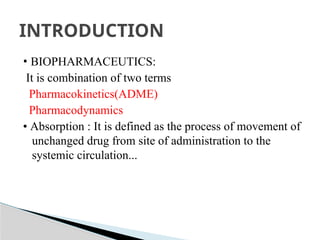
• BIOPHARMACEUTICS:
It is combination of two terms
Pharmacokinetics(ADME)
Pharmacodynamics
• Absorption : It is defined as the process of movement of
unchanged drug from site of administration to the
systemic circulation...
INTRODUCTION
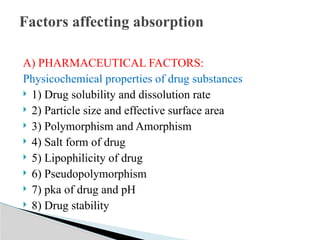
A) PHARMACEUTICAL FACTORS:
Physicochemical properties of drug substances
 1) Drug solubility and dissolution rate
 2) Particle size and effective surface area
 3) Polymorphism and Amorphism
 4) Salt form of drug
 5) Lipophilicity of drug
 6) Pseudopolymorphism
 7) pka of drug and pH
 8) Drug stability
Factors affecting absorption
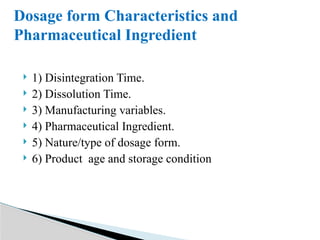
 1) Disintegration Time.
 2) Dissolution Time.
 3) Manufacturing variables.
 4) Pharmaceutical Ingredient.
 5) Nature/type of dosage form.
 6) Product age and storage condition
Dosage form Characteristics and
Pharmaceutical Ingredient
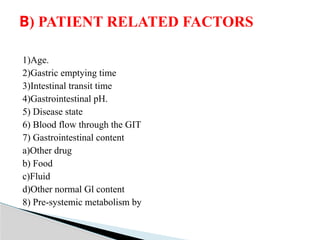
1)Age.
2)Gastric emptying time
3)Intestinal transit time
4)Gastrointestinal pH.
5) Disease state
6) Blood flow through the GIT
7) Gastrointestinal content
a)Other drug
b) Food
c)Fluid
d)Other normal Gl content
8) Pre-systemic metabolism by
B) PATIENT RELATED FACTORS
 Dissolution Rate: amount of drug in solution / time(at
specific pH, temp and solvent composition)
 Two slowest rate-determine processes in the orally
administered drugs are:
 Rate of dissolution
 Rate of drug permeation through bio-membrane
 Dissolution is the RDS for hydrophobic, poorly
aqueous soluble drugs
 e.g. Griseofulvin and Spironolactone,
 these drug are dissolution rate limited
A. Drug solubility and dissolution rate
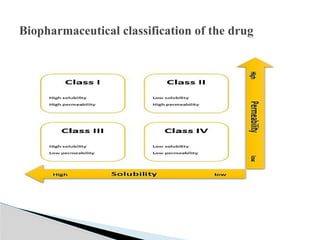
Biopharmaceutical classification of the drug
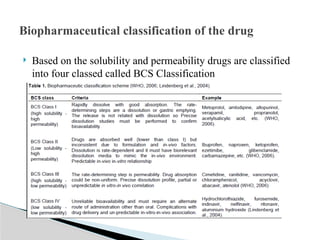
 Based on the solubility and permeability drugs are classified
into four classed called BCS Classification
Biopharmaceutical classification of the drug
A. Drug solubility and dissolution rate
 If drug is hydrophilic with high aqueous solubility
 e.g. cromalin sodium or neomycine, then dissolution is
rapid and the RDS in the absorption of such drugs is
rate of permeation through the biomembrane.
 In other word, absorption of such drug is said to be
permeation rate limited or transmembrane rate limited.
 Its is correlation between drug absorption with its solubility
 Which is given by the eqn
MAD=Ka SGI VGI tr
where,
Ka =intrinsic absorption
SGI =solubility of drug in GI fluid
VGI =volume of GI fluid present
tr =residence time of drug in GI
 So proper drug absorption depends upon the:
a) Solubilty of the drug in GI fluids
b) Intrinsic absorption rate constant.
Maximum absorbable dose
 Amount of the solid that goes into the solution per unit
time under the standard condition like pH and
temperature.
 In short drug solublise into liquids.
 The dissolution procces is well explained by three
theroies
Dissolution Rate
•Dissolution:
Dissolution is process in which a solid substance
solubilizes in a given solvent
i.e. mass transfer from the solid surface to the liquid phase.
 The three basic theories of dissolution involves:
1) Film theory (Diffusion layer model).
2) Permeation or Surface renewal theory (Danckwart's
model).
3)Double barrier or Limited solvation theory
(intefacial barrier model).
THEORIES OF DISSOLUTION
proposed by Nernst
According to this theory dissolution process completes
in two steps
A)Formation of stagnant layer
B) diffusion of drug from this layer
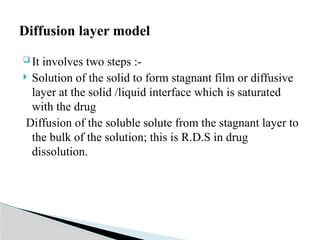
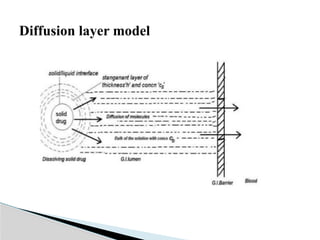
Diffusion layer model
 It involves two steps :-
 Solution of the solid to form stagnant film or diffusive
layer at the solid /liquid interface which is saturated
with the drug
Diffusion of the soluble solute from the stagnant layer to
the bulk of the solution; this is R.D.S in drug
dissolution.
Diffusion layer model
 The equation to explain the rate of dissolution
when the process is diffusion controlled and
involve no chemical reaction was given by
Noyes and Whitney:
dc/dt = k (Cs-Cb)
 Where,
 dc/dt= dissolution rate of drug
 K=dissolution rate constant
 Cs=concentration of drug in the stagnant layer
 Cb-concentration drug in bulk of solution
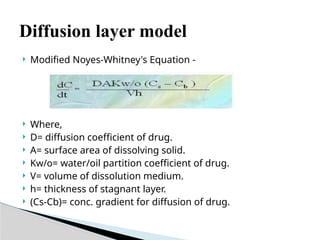
Diffusion layer model
 Modified Noyes-Whitney's Equation -
 Where,
 D= diffusion coefficient of drug.
 A= surface area of dissolving solid.
 Kw/o= water/oil partition coefficient of drug.
 V= volume of dissolution medium.
 h= thickness of stagnant layer.
 (Cs-Cb)= conc. gradient for diffusion of drug.
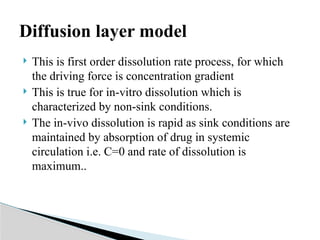
Diffusion layer model
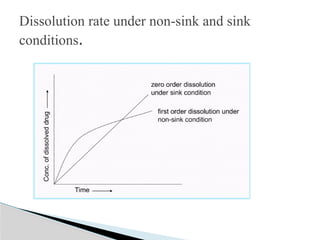
 This is first order dissolution rate process, for which
the driving force is concentration gradient
 This is true for in-vitro dissolution which is
characterized by non-sink conditions.
 The in-vivo dissolution is rapid as sink conditions are
maintained by absorption of drug in systemic
circulation i.e. C=0 and rate of dissolution is
maximum..
Diffusion layer model
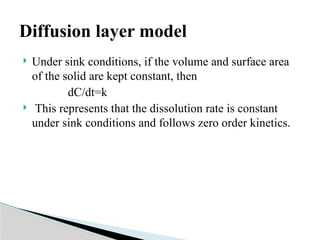
 Under sink conditions, if the volume and surface area
of the solid are kept constant, then
dC/dt=k
 This represents that the dissolution rate is constant
under sink conditions and follows zero order kinetics.
Diffusion layer model
Dissolution rate under non-sink and sink
conditions.
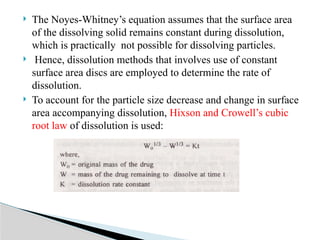
 The Noyes-Whitney’s equation assumes that the surface area
of the dissolving solid remains constant during dissolution,
which is practically not possible for dissolving particles.
 Hence, dissolution methods that involves use of constant
surface area discs are employed to determine the rate of
dissolution.
 To account for the particle size decrease and change in surface
area accompanying dissolution, Hixson and Crowell’s cubic
root law of dissolution is used:
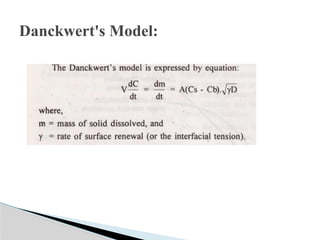
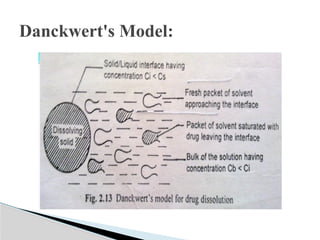
 Danckwert suggested that,
The turbulence in dissolution medium exists at the solid-liquid
interface.
this turbulence create mass of eddies that reaches to solid –liquid
interface by eddies current
And then they absorbs the solute by diffusion and carry it to the
bulk of the solution.
These packets transfer the drug away so concentration is
Ci<Cs
Such solute containing packets are continuously replaced with
new packets of fresh solvent so called as a solvent renewal
theory.
2. Danckwert's Model:
Danckwert's Model:
Danckwert's Model:
 According to interfacial barrier model
an intermediate concentration can exist at the interface as
a result of solvation mechanism and is a function of
solubility rather than diffusion.
 While considering the dissolution of a crystal each face
of the crystal will have a different interfacial barrier
G = Ki (Cs-Cb)
Where,
G = dissiolution rate per unit time
Ki = effective interfacial transport constant
3. Interfacial barrier model:
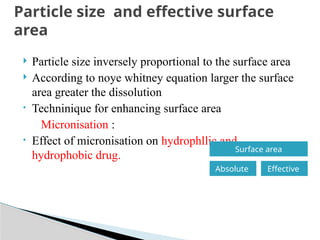
 Particle size inversely proportional to the surface area
 According to noye whitney equation larger the surface
area greater the dissolution
• Techninique for enhancing surface area
Micronisation :
• Effect of micronisation on hydrophllic and
hydrophobic drug.
Particle size and effective surface
area
Surface area
Absolute Effective
1. Surfactant
2. Adding hydrophillic diluents like dextrose,PVP
Technique to increase the effective surface area of the
hydrophobic drug
Internal structure of compound
Crystalline
Polymorph
Enantiotropic Monotropic
Molecular adduct
Non stoichiometric
complexes
Stoichiometric
complexes
(pseudo
polymorph )
Organic solvates Hydrates
Amorphous
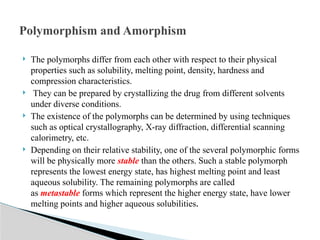
Polymorphism and Amorphism
 The polymorphs differ from each other with respect to their physical
properties such as solubility, melting point, density, hardness and
compression characteristics.
 They can be prepared by crystallizing the drug from different solvents
under diverse conditions.
 The existence of the polymorphs can be determined by using techniques
such as optical crystallography, X-ray diffraction, differential scanning
calorimetry, etc.
 Depending on their relative stability, one of the several polymorphic forms
will be physically more stable than the others. Such a stable polymorph
represents the lowest energy state, has highest melting point and least
aqueous solubility. The remaining polymorphs are called
as metastable forms which represent the higher energy state, have lower
melting points and higher aqueous solubilities.
Polymorphism and Amorphism
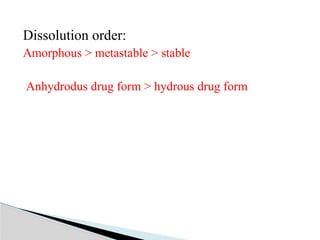
Dissolution order:
Amorphous > metastable > stable
Anhydrodus drug form > hydrous drug form
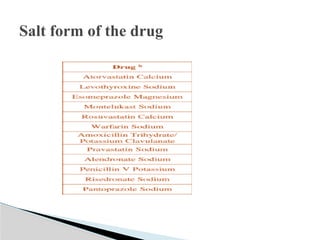
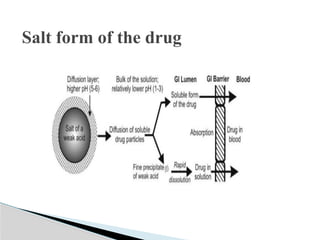
Salt form of the drug
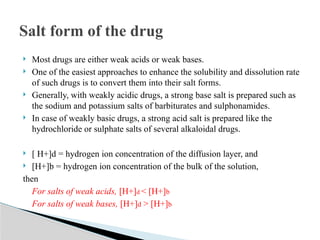
 Most drugs are either weak acids or weak bases.
 One of the easiest approaches to enhance the solubility and dissolution rate
of such drugs is to convert them into their salt forms.
 Generally, with weakly acidic drugs, a strong base salt is prepared such as
the sodium and potassium salts of barbiturates and sulphonamides.
 In case of weakly basic drugs, a strong acid salt is prepared like the
hydrochloride or sulphate salts of several alkaloidal drugs.
 [ H+]d = hydrogen ion concentration of the diffusion layer, and
 [H+]b = hydrogen ion concentration of the bulk of the solution,
then
For salts of weak acids, [H+]d < [H+]b
For salts of weak bases, [H+]d > [H+]b
Salt form of the drug
1. Type of salt form
Theophylline
Choline salt > ethelendismine salt
2. Size of counter ion
Where the counter ion is very large in size and/or has poor ionic strength (as
in the case of ester form of drugs), the solubility may be much lower
than the free drug itself,
for example, the pamoates, stearates and palmitates of weak bases have poor
aqueous solubility. These forms are, however, useful in several ways
such as to prolong the duration of action (steroidal salts), to overcome
bad taste (chloramphenicol palmitate), to enhance GI stability
(erythromycin estolate) or to decrease the side effects, local or systemic.
Factor influencing Salt form of the drug
Factors Influencing Absorption of Drugs.pptx