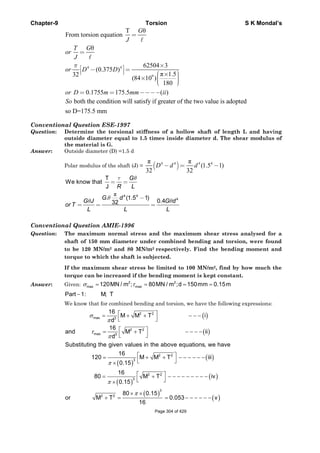
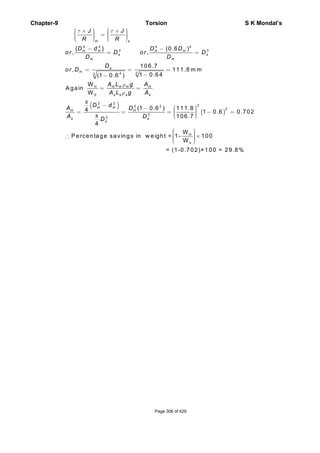
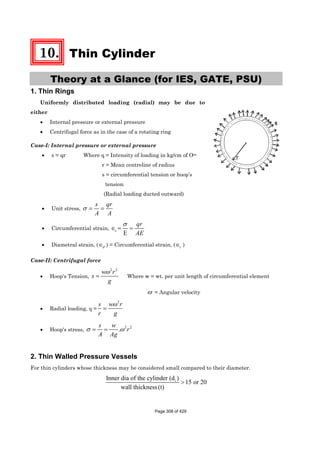
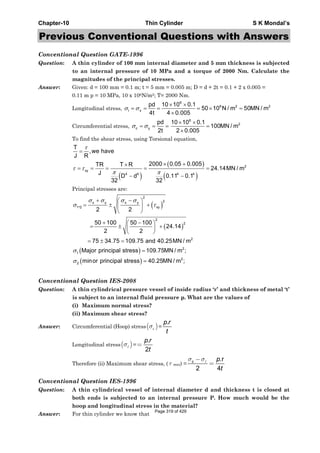
S K Mondal’s
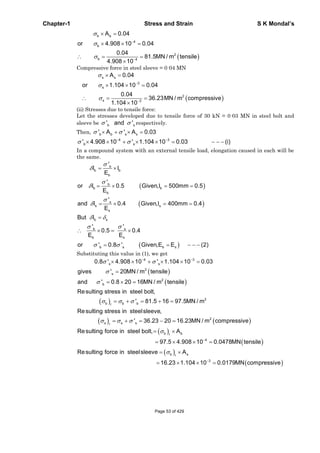
Strength of Materials
Contents
Chapter – 1: Stress and Strain
Chapter - 2 : Principal Stress and Strain
Chapter - 3 : Moment of Inertia and Centroid
Chapter - 4 : Bending Moment and Shear Force Diagram
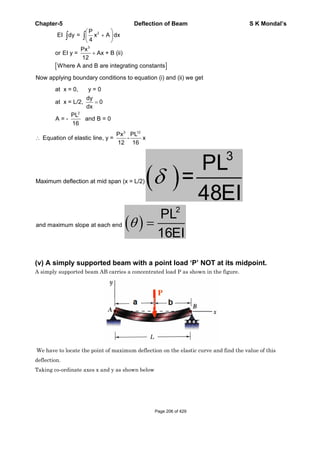
Chapter - 5 : Deflection of Beam
Chapter - 6 : Bending Stress in Beam
Chapter - 7 : Shear Stress in Beam
Chapter - 8 : Fixed and Continuous Beam
Chapter - 9 : Torsion
Chapter-10 : Thin Cylinder
Chapter-11 : Thick Cylinder
Chapter-12 : Spring
Chapter-13 : Theories of Column
Chapter-14 : Strain Energy Method
Chapter-15 : Theories of Failure
Chapter-16 : Riveted and Welded Joint
Er. S K Mondal
IES Officer (Railway), GATE topper, NTPC ET-2003 batch, 12 years teaching
experienced, Author of Hydro Power Familiarization (NTPC Ltd)
Page 1 of 429
Note
“Asked Objective Questions” is the total collection of questions from:-
20 yrs IES (2010-1992) [Engineering Service Examination]
21 yrs. GATE (2011-1992)
and 14 yrs. IAS (Prelim.) [Civil Service Preliminary]
Copyright © 2007 S K Mondal
Every effort has been made to see that there are no errors (typographical or otherwise) in the
material presented. However, it is still possible that there are a few errors (serious or
otherwise). I would be thankful to the readers if they are brought to my attention at the
following e-mail address: swapan_mondal_01@yahoo.co.in
S K Mondal
Page 2 of 429
1. Stress and Strain
Theory at a Glance (for IES, GATE, PSU)
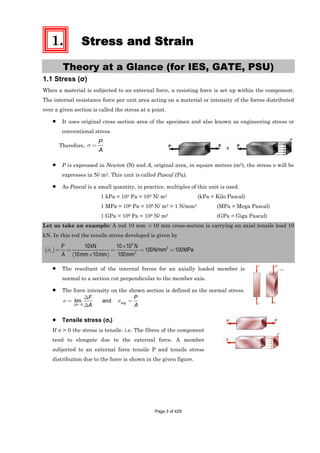
1.1 Stress ( )
When a material is subjected to an external force, a resisting force is set up within the component.
The internal resistance force per unit area acting on a material or intensity of the forces distributed
over a given section is called the stress at a point.
It uses original cross section area of the specimen and also known as engineering stress or
conventional stress.
Therefore,
P
A
P is expressed in Newton (N) and A, original area, in square meters (m2), the stress will be
expresses in N/ m2. This unit is called Pascal (Pa).
As Pascal is a small quantity, in practice, multiples of this unit is used.
1 kPa = 103 Pa = 103 N/ m2 (kPa = Kilo Pascal)
1 MPa = 106 Pa = 106 N/ m2 = 1 N/mm2 (MPa = Mega Pascal)
1 GPa = 109 Pa = 109 N/ m2 (GPa = Giga Pascal)
Let us take an example: A rod 10 mm 10 mm cross-section is carrying an axial tensile load 10
kN. In this rod the tensile stress developed is given by
3
2
2
10 10 10
100N/mm 100MPa
10 10 100
t
P kN N
A mm mm mm
The resultant of the internal forces for an axially loaded member is
normal to a section cut perpendicular to the member axis.
The force intensity on the shown section is defined as the normal stress.
0
lim and avg
A
F P
A A
Tensile stress ( t)
If > 0 the stress is tensile. i.e. The fibres of the component
tend to elongate due to the external force. A member
subjected to an external force tensile P and tensile stress
distribution due to the force is shown in the given figure.
Page 3 of 429
Chapter-1 Stress and Strain S K Mondal’s
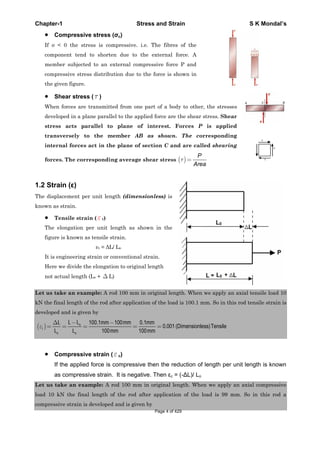
Compressive stress ( c)
If < 0 the stress is compressive. i.e. The fibres of the
component tend to shorten due to the external force. A
member subjected to an external compressive force P and
compressive stress distribution due to the force is shown in
the given figure.
Shear stress ( )
When forces are transmitted from one part of a body to other, the stresses
developed in a plane parallel to the applied force are the shear stress. Shear
stress acts parallel to plane of interest. Forces P is applied
transversely to the member AB as shown. The corresponding
internal forces act in the plane of section C and are called shearing
forces. The corresponding average shear stress
P
Area
1.2 Strain ( )
The displacement per unit length (dimensionless) is
known as strain.
Tensile strain ( t)
The elongation per unit length as shown in the
figure is known as tensile strain.
t = L/ Lo
It is engineering strain or conventional strain.
Here we divide the elongation to original length
not actual length (Lo + L)
Let us take an example: A rod 100 mm in original length. When we apply an axial tensile load 10
kN the final length of the rod after application of the load is 100.1 mm. So in this rod tensile strain is
developed and is given by
100.1 100 0.1
0.001 (Dimensionless)Tensile
100 100
o
t
o o
L LL mm mm mm
L L mm mm
Compressive strain ( c)
If the applied force is compressive then the reduction of length per unit length is known
as compressive strain. It is negative. Then c = (- L)/ Lo
Let us take an example: A rod 100 mm in original length. When we apply an axial compressive
load 10 kN the final length of the rod after application of the load is 99 mm. So in this rod a
compressive strain is developed and is given by
Page 4 of 429
Chapter-1 Stress and Strain S K Mondal’s
99 100 1
0.01 (Dimensionless)compressive
100 100
o
c
o o
L LL mm mm mm
L L mm mm
Shear Strain ( ): When a
force P is applied tangentially to
the element shown. Its edge
displaced to dotted line. Where
is the lateral displacement of
the upper face
of the element relative to the lower face and L is the distance between these faces.
Then the shear strain is ( )
L
Let us take an example: A block 100 mm × 100 mm base and 10 mm height. When we apply a
tangential force 10 kN to the upper edge it is displaced 1 mm relative to lower face.
Then the direct shear stress in the element
( )
3
210 10 10
1N/mm 1MPa
100 100 100 100
kN N
mm mm mm mm
And shear strain in the element ( ) =
1
0.1
10
mm
mm
Dimensionless
1.3 True stress and True Strain
The true stress is defined as the ratio of the load to the cross section area at any instant.
load
Instantaneous area
T
1
Where and is the engineering stress and engineering strain respectively.
True strain
ln ln 1 ln 2ln
o
L
o o
T
oL
A ddl L
l L A d
or engineering strain ( ) = T
e -1
The volume of the specimen is assumed to be constant during plastic deformation.
[ o oA L AL ] It is valid till the neck formation.
Comparison of engineering and the true stress-strain curves shown below
Page 5 of 429
Chapter-1 Stress and Strain S K Mondal’s
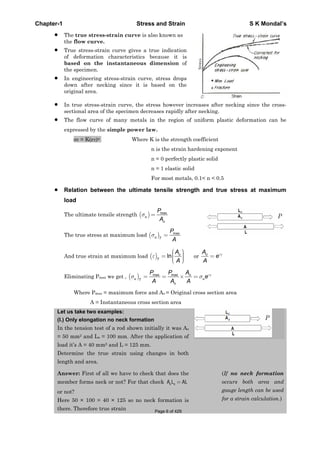
The true stress-strain curve is also known as
the flow curve.
True stress-strain curve gives a true indication
of deformation characteristics because it is
based on the instantaneous dimension of
the specimen.
In engineering stress-strain curve, stress drops
down after necking since it is based on the
original area.
In true stress-strain curve, the stress however increases after necking since the cross-
sectional area of the specimen decreases rapidly after necking.
The flow curve of many metals in the region of uniform plastic deformation can be
expressed by the simple power law.
T = K( T)n Where K is the strength coefficient
n is the strain hardening exponent
n = 0 perfectly plastic solid
n = 1 elastic solid
For most metals, 0.1< n < 0.5
Relation between the ultimate tensile strength and true stress at maximum
load
The ultimate tensile strength max
u
o
P
A
The true stress at maximum load max
u T
P
A
And true strain at maximum load ln o
T
A
A
or ToA
e
A
Eliminating Pmax we get , max max To
u uT
o
P P A
e
A A A
Where Pmax = maximum force and Ao = Original cross section area
A = Instantaneous cross section area
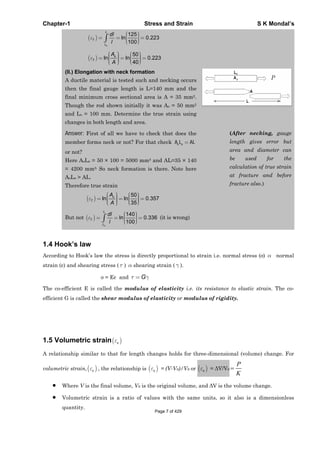
Let us take two examples:
(I.) Only elongation no neck formation
In the tension test of a rod shown initially it was Ao
= 50 mm2 and Lo = 100 mm. After the application of
load it’s A = 40 mm2 and L = 125 mm.
Determine the true strain using changes in both
length and area.
Answer: First of all we have to check that does the
member forms neck or not? For that check o oA L AL
or not?
Here 50 × 100 = 40 × 125 so no neck formation is
there. Therefore true strain
(If no neck formation
occurs both area and
gauge length can be used
for a strain calculation.)
Page 6 of 429
Chapter-1 Stress and Strain S K Mondal’s
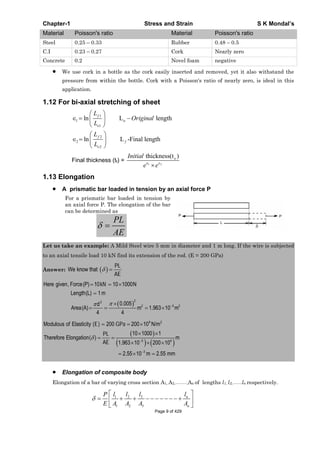
125
ln 0.223
100
o
L
T
L
dl
l
50
ln ln 0.223
40
o
T
A
A
(II.) Elongation with neck formation
A ductile material is tested such and necking occurs
then the final gauge length is L=140 mm and the
final minimum cross sectional area is A = 35 mm2.
Though the rod shown initially it was Ao = 50 mm2
and Lo = 100 mm. Determine the true strain using
changes in both length and area.
Answer: First of all we have to check that does the
member forms neck or not? For that check o oA L AL
or not?
Here AoLo = 50 × 100 = 5000 mm3 and AL=35 × 140
= 4200 mm3. So neck formation is there. Note here
AoLo > AL.
Therefore true strain
50
ln ln 0.357
35
o
T
A
A
But not
140
ln 0.336
100
o
L
T
L
dl
l
(it is wrong)
(After necking, gauge
length gives error but
area and diameter can
be used for the
calculation of true strain
at fracture and before
fracture also.)
1.4 Hook’s law
According to Hook’s law the stress is directly proportional to strain i.e. normal stress ( ) normal
strain ( ) and shearing stress ( ) shearing strain ( ).
= E and G
The co-efficient E is called the modulus of elasticity i.e. its resistance to elastic strain. The co-
efficient G is called the shear modulus of elasticity or modulus of rigidity.
1.5 Volumetric strain v
A relationship similar to that for length changes holds for three-dimensional (volume) change. For
volumetric strain, v , the relationship is v = (V-V0)/V0 or v = V/V0
P
K
Where V is the final volume, V0 is the original volume, and V is the volume change.
Volumetric strain is a ratio of values with the same units, so it also is a dimensionless
quantity.
Page 7 of 429
Chapter-1 Stress and Strain S K Mondal’s
V/V= volumetric strain = x + y + z = 1 + 2 + 3
Dilation: The hydrostatic component of the total stress contributes to deformation by
changing the area (or volume, in three dimensions) of an object. Area or volume change is
called dilation and is positive or negative, as the volume increases or decreases,
respectively.
p
e
K
Where p is pressure.
1.6 Young’s modulus or Modulus of elasticity (E) =
PL
=
A
1.7 Modulus of rigidity or Shear modulus of elasticity (G) = =
PL
A
1.8 Bulk Modulus or Volume modulus of elasticity (K) =
p p
v R
v R
1.10 Relationship between the elastic constants E, G, K, μ
9KG
E 2G 1 3K 1 2
3K G [VIMP]
Where K = Bulk Modulus, = Poisson’s Ratio, E= Young’s modulus, G= Modulus of rigidity
For a linearly elastic, isotropic and homogeneous material, the number of elastic
constants required to relate stress and strain is two. i.e. any two of the four must be
known.
If the material is non-isotropic (i.e. anisotropic), then the elastic modulii will vary with
additional stresses appearing since there is a coupling between shear stresses and
normal stresses for an anisotropic material.
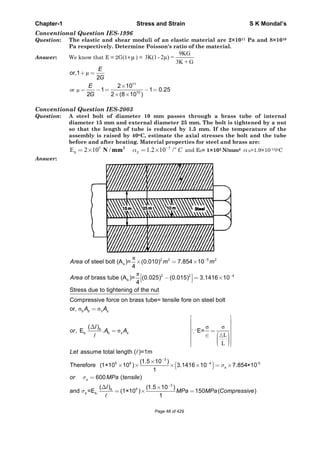
Let us take an example: The modulus of elasticity and rigidity of a material are 200 GPa and 80
GPa, respectively. Find all other elastic modulus.
Answer: Using the relation
9KG
E 2G 1 3K 1 2
3K G
we may find all other elastic modulus
easily
Poisson’s Ratio
E E 200
( ) : 1 1 1 0.25
2G 2G 2 80
Bulk Modulus (K) :
E E 200
3K K 133.33GPa
1 2 3 1 2 3 1 2 0.25
1.11 Poisson’s Ratio (μ)
=
Transverse strainor lateral strain
Longitudinal strain
=
y
x
(Under unidirectional stress in x-direction)
The theory of isotropic elasticity allows Poisson's ratios in the range from -1 to 1/2.
Poisson's ratio in various materials Page 8 of 429
Chapter-1 Stress and Strain S K Mondal’s
Material Poisson's ratio Material Poisson's ratio
Steel 0.25 – 0.33 Rubber 0.48 – 0.5
C.I 0.23 – 0.27 Cork Nearly zero
Concrete 0.2 Novel foam negative
We use cork in a bottle as the cork easily inserted and removed, yet it also withstand the
pressure from within the bottle. Cork with a Poisson's ratio of nearly zero, is ideal in this
application.
1.12 For bi-axial stretching of sheet
1
1 o
1
2
2
2
ln L length
ln L -Final length
f
o
f
f
o
L
Original
L
L
L
Final thickness (tf) =
1 2
thickness(t )oInitial
e e
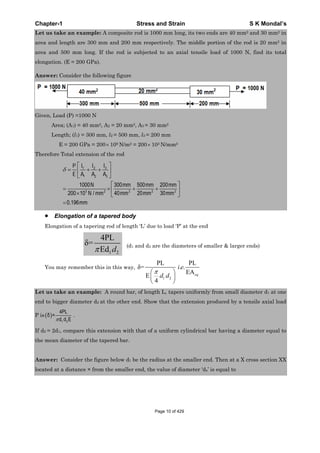
1.13 Elongation
A prismatic bar loaded in tension by an axial force P
For a prismatic bar loaded in tension by
an axial force P. The elongation of the bar
can be determined as
PL
AE
Let us take an example: A Mild Steel wire 5 mm in diameter and 1 m long. If the wire is subjected
to an axial tensile load 10 kN find its extension of the rod. (E = 200 GPa)
Answer: We know that
PL
AE
22
2 5 2
Here given, Force(P) 10 10 1000N
Length(L) 1 m
0.005
Area(A) m 1.963 10 m
4 4
kN
d
9 2
5 9
3
Modulous of Elasticity ( ) 200 200 10 N/m
10 1000 1
Therefore Elongation( ) m
1.963 10 200 10
2.55 10 m 2.55 mm
E GPa
PL
AE
Elongation of composite body
Elongation of a bar of varying cross section A1, A2,----------,An of lengths l1, l2,--------ln respectively.
31 2 n
1 2 3 n
ll l lP
E A A A A
Page 9 of 429
Chapter-1 Stress and Strain S K Mondal’s
Let us take an example: A composite rod is 1000 mm long, its two ends are 40 mm2 and 30 mm2 in
area and length are 300 mm and 200 mm respectively. The middle portion of the rod is 20 mm2 in
area and 500 mm long. If the rod is subjected to an axial tensile load of 1000 N, find its total
elongation. (E = 200 GPa).
Answer: Consider the following figure
Given, Load (P) =1000 N
Area; (A1) = 40 mm2, A2 = 20 mm2, A3 = 30 mm2
Length; (l1) = 300 mm, l2 = 500 mm, l3 = 200 mm
E = 200 GPa = 200 109 N/m2 = 200 103 N/mm2
Therefore Total extension of the rod
31 2
1 2 3
3 2 2 2 2
1000 300 500 200
200 10 / 40 20 30
0.196mm
ll lP
E A A A
N mm mm mm
N mm mm mm mm
Elongation of a tapered body
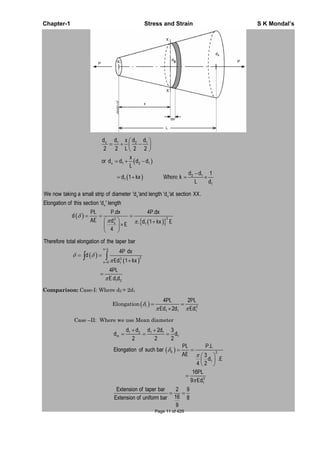
Elongation of a tapering rod of length ‘L’ due to load ‘P’ at the end
1 2
4PL
=
Ed d
(d1 and d2 are the diameters of smaller & larger ends)
You may remember this in this way,
1 2
PL PL
= . .
EA
E
4
eq
i e
d d
Let us take an example: A round bar, of length L, tapers uniformly from small diameter d1 at one
end to bigger diameter d2 at the other end. Show that the extension produced by a tensile axial load
P is
1 2
4PL
=
Ed d
.
If d2 = 2d1, compare this extension with that of a uniform cylindrical bar having a diameter equal to
the mean diameter of the tapered bar.
Answer: Consider the figure below d1 be the radius at the smaller end. Then at a X cross section XX
located at a distance × from the smaller end, the value of diameter ‘dx’ is equal to
Page 10 of 429
Chapter-1 Stress and Strain S K Mondal’s
1 2 1
1 2 1
2 1
1
1
2 2 2 2
1
1
x
x
d d d dx
L
x
or d d d d
L
d d
d kx Where k
L d
x x
x
22
1
We now taking a small strip of diameter 'd 'and length 'd 'at section .
Elongation of this section 'd ' length
. 4 .
. 1
4
x
XX
PL P dx P dx
d
AE d d kx EE
22
0 1
1 2
Therefore total elongation of the taper bar
4
1
4
x L
x
P dx
d
Ed kx
PL
E d d
Comparison: Case-I: Where d2 = 2d1
Elongation 2
1 1 1
4 2
2
I
PL PL
Ed d Ed
Case –II: Where we use Mean diameter
1 2 1 1
1
2
1
2
1
2 3
2 2 2
.
Elongation of such bar
3
.
4 2
16
9
Extension of taper bar 2 9
16Extension of uniform bar 8
9
m
II
d d d d
d d
PL P L
AE
d E
PL
Ed
Page 11 of 429
Chapter-1 Stress and Strain S K Mondal’s
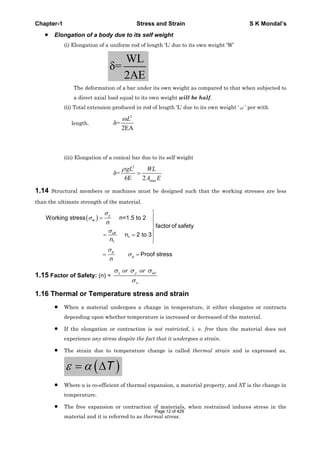
Elongation of a body due to its self weight
(i) Elongation of a uniform rod of length ‘L’ due to its own weight ‘W’
WL
=
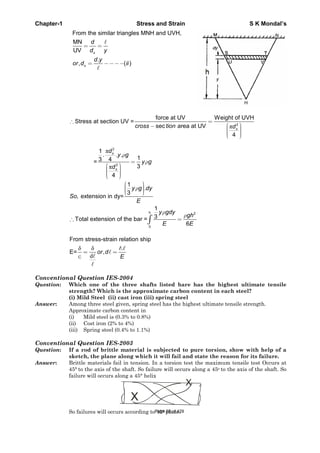
2AE
The deformation of a bar under its own weight as compared to that when subjected to
a direct axial load equal to its own weight will be half.
(ii) Total extension produced in rod of length ‘L’ due to its own weight ‘ ’ per with
length.
2
=
2EA
L
(iii) Elongation of a conical bar due to its self weight
2
max
=
6E 2
gL WL
A E
1.14 Structural members or machines must be designed such that the working stresses are less
than the ultimate strength of the material.
1
1
Working stress n=1.5 to 2
factor of safety
n 2 to 3
Proof stress
y
w
ult
p
p
n
n
n
1.15 Factor of Safety: (n) =
y p ult
w
or or
1.16 Thermal or Temperature stress and strain
When a material undergoes a change in temperature, it either elongates or contracts
depending upon whether temperature is increased or decreased of the material.
If the elongation or contraction is not restricted, i. e. free then the material does not
experience any stress despite the fact that it undergoes a strain.
The strain due to temperature change is called thermal strain and is expressed as,
T
Where is co-efficient of thermal expansion, a material property, and T is the change in
temperature.
The free expansion or contraction of materials, when restrained induces stress in the
material and it is referred to as thermal stress.
Page 12 of 429
Chapter-1 Stress and Strain S K Mondal’s
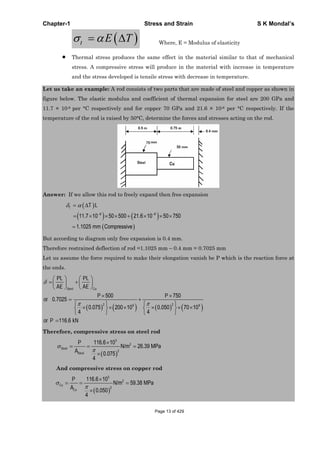
t E T Where, E = Modulus of elasticity
Thermal stress produces the same effect in the material similar to that of mechanical
stress. A compressive stress will produce in the material with increase in temperature
and the stress developed is tensile stress with decrease in temperature.
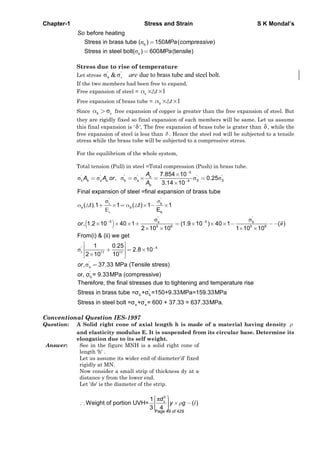
Let us take an example: A rod consists of two parts that are made of steel and copper as shown in
figure below. The elastic modulus and coefficient of thermal expansion for steel are 200 GPa and
11.7 × 10⁻⁶ per °C respectively and for copper 70 GPa and 21.6 × 10⁻⁶ per °C respectively. If the
temperature of the rod is raised by 50°C, determine the forces and stresses acting on the rod.
Answer: If we allow this rod to freely expand then free expansion
6 6
11.7 10 50 500 21.6 10 50 750
1.1025 mm Compressive
T T L
But according to diagram only free expansion is 0.4 mm.
Therefore restrained deflection of rod =1.1025 mm – 0.4 mm = 0.7025 mm
Let us assume the force required to make their elongation vanish be P which is the reaction force at
the ends.
2 29 9
500 750
0.7025
0.075 200 10 0.050 70 10
4 4
116.6
Steel Cu
PL PL
AE AE
P P
or
or P kN
Therefore, compressive stress on steel rod
3
2
2
116.6 10
N/m 26.39 MPa
0.075
4
Steel
Steel
P
A
And compressive stress on copper rod
3
2
2
116.6 10
N/m 59.38 MPa
0.050
4
Cu
Cu
P
A
Page 13 of 429
Chapter-1 Stress and Strain S K Mondal’s
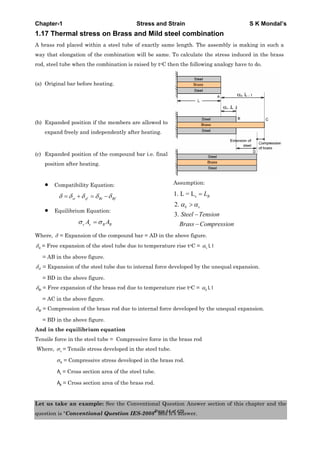
1.17 Thermal stress on Brass and Mild steel combination
A brass rod placed within a steel tube of exactly same length. The assembly is making in such a
way that elongation of the combination will be same. To calculate the stress induced in the brass
rod, steel tube when the combination is raised by toC then the following analogy have to do.
(a) Original bar before heating.
(b) Expanded position if the members are allowed to
expand freely and independently after heating.
(c) Expanded position of the compound bar i.e. final
position after heating.
Compatibility Equation:
st sf Bt Bf
Equilibrium Equation:
s s B BA A
Assumption:
s1. L = L
2.
3.
B
b s
L
Steel Tension
Brass Compression
Where, = Expansion of the compound bar = AD in the above figure.
st = Free expansion of the steel tube due to temperature rise toC = s L t
= AB in the above figure.
sf = Expansion of the steel tube due to internal force developed by the unequal expansion.
= BD in the above figure.
Bt = Free expansion of the brass rod due to temperature rise toC = b L t
= AC in the above figure.
Bf = Compression of the brass rod due to internal force developed by the unequal expansion.
= BD in the above figure.
And in the equilibrium equation
Tensile force in the steel tube = Compressive force in the brass rod
Where, s = Tensile stress developed in the steel tube.
B = Compressive stress developed in the brass rod.
sA = Cross section area of the steel tube.
BA = Cross section area of the brass rod.
Let us take an example: See the Conventional Question Answer section of this chapter and the
question is “Conventional Question IES-2008” and it’s answer.Page 14 of 429
Chapter-1 Stress and Strain S K Mondal’s
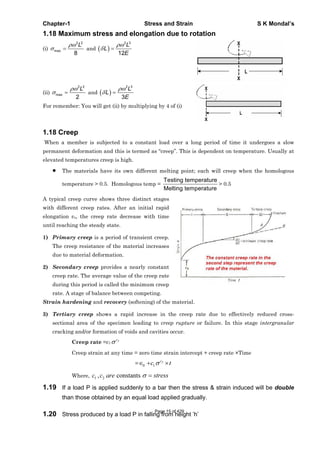
1.18 Maximum stress and elongation due to rotation
(i)
2 2
max
8
L
and
2 3
12
L
L
E
(ii)
2 2
max
2
L
and
2 3
3
L
L
E
For remember: You will get (ii) by multiplying by 4 of (i)
1.18 Creep
When a member is subjected to a constant load over a long period of time it undergoes a slow
permanent deformation and this is termed as “creep”. This is dependent on temperature. Usually at
elevated temperatures creep is high.
The materials have its own different melting point; each will creep when the homologous
temperature > 0.5. Homologous temp =
Testing temperature
Melting temperature
> 0.5
A typical creep curve shows three distinct stages
with different creep rates. After an initial rapid
elongation o, the creep rate decrease with time
until reaching the steady state.
1) Primary creep is a period of transient creep.
The creep resistance of the material increases
due to material deformation.
2) Secondary creep provides a nearly constant
creep rate. The average value of the creep rate
during this period is called the minimum creep
rate. A stage of balance between competing.
Strain hardening and recovery (softening) of the material.
3) Tertiary creep shows a rapid increase in the creep rate due to effectively reduced cross-
sectional area of the specimen leading to creep rupture or failure. In this stage intergranular
cracking and/or formation of voids and cavities occur.
Creep rate =c1
2c
Creep strain at any time = zero time strain intercept + creep rate ×Time
= 2
0 1
c
c t
Where, 1 2, constantsc c are stress
1.19 If a load P is applied suddenly to a bar then the stress & strain induced will be double
than those obtained by an equal load applied gradually.
1.20 Stress produced by a load P in falling from height ’h’
Page 15 of 429
Chapter-1 Stress and Strain S K Mondal’s
2
1 1 ,
being stress & strain produced by static load P & L=length of bar.
d
h
L
2
1 1
A AEh
P PL
1.21 Loads shared by the materials of a compound bar made of bars x & y due to load W,
.
.
x x
x
x x y y
y y
y
x x y y
A E
P W
A E A E
A E
P W
A E A E
1.22 Elongation of a compound bar,
x x y y
PL
A E A E
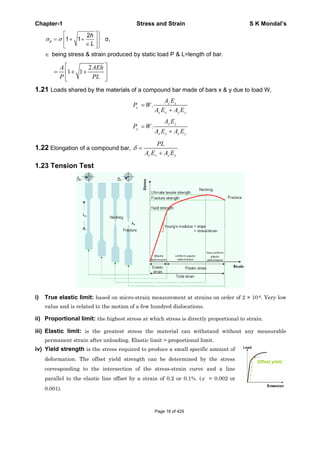
1.23 Tension Test
i) True elastic limit: based on micro-strain measurement at strains on order of 2 × 10⁻⁶. Very low
value and is related to the motion of a few hundred dislocations.
ii) Proportional limit: the highest stress at which stress is directly proportional to strain.
iii) Elastic limit: is the greatest stress the material can withstand without any measurable
permanent strain after unloading. Elastic limit > proportional limit.
iv) Yield strength is the stress required to produce a small specific amount of
deformation. The offset yield strength can be determined by the stress
corresponding to the intersection of the stress-strain curve and a line
parallel to the elastic line offset by a strain of 0.2 or 0.1%. ( = 0.002 or
0.001).
Page 16 of 429
Chapter-1 Stress and Strain S K Mondal’s
The offset yield stress is referred to proof stress either at 0.1 or 0.5% strain used for design
and specification purposes to avoid the practical difficulties of measuring the elastic limit or
proportional limit.
v) Tensile strength or ultimate tensile strength (UTS) u is the maximum load Pmax divided
by the original cross-sectional area Ao of the specimen.
vi) % Elongation, f o
o
L L
L
, is chiefly influenced by uniform elongation, which is dependent on the
strain-hardening capacity of the material.
vii) Reduction of Area: o f
o
A A
q
A
Reduction of area is more a measure of the deformation required to produce failure and
its chief contribution results from the necking process.
Because of the complicated state of stress state in the neck, values of reduction of area
are dependent on specimen geometry, and deformation behaviour, and they should not be
taken as true material properties.
RA is the most structure-sensitive ductility parameter and is useful in detecting quality
changes in the materials.
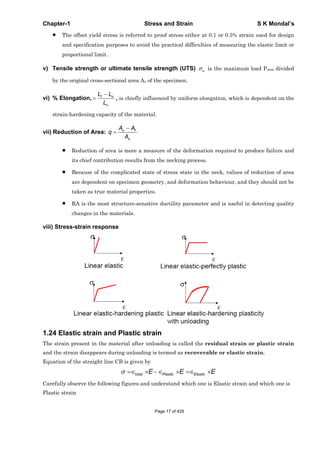
viii) Stress-strain response
1.24 Elastic strain and Plastic strain
The strain present in the material after unloading is called the residual strain or plastic strain
and the strain disappears during unloading is termed as recoverable or elastic strain.
Equation of the straight line CB is given by
total Plastic ElasticE E E
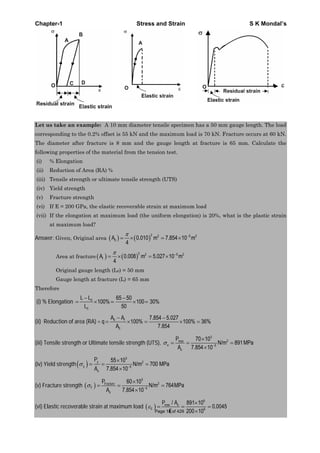
Carefully observe the following figures and understand which one is Elastic strain and which one is
Plastic strain
Page 17 of 429
Chapter-1 Stress and Strain S K Mondal’s
Let us take an example: A 10 mm diameter tensile specimen has a 50 mm gauge length. The load
corresponding to the 0.2% offset is 55 kN and the maximum load is 70 kN. Fracture occurs at 60 kN.
The diameter after fracture is 8 mm and the gauge length at fracture is 65 mm. Calculate the
following properties of the material from the tension test.
(i) % Elongation
(ii) Reduction of Area (RA) %
(iii) Tensile strength or ultimate tensile strength (UTS)
(iv) Yield strength
(v) Fracture strength
(vi) If E = 200 GPa, the elastic recoverable strain at maximum load
(vii) If the elongation at maximum load (the uniform elongation) is 20%, what is the plastic strain
at maximum load?
Answer: Given, Original area
2 2 5 2
0 0.010 m 7.854 10 m
4
A
Area at fracture
2 2 5 2
0.008 m 5.027 10 m
4
fA
Original gauge length (L0) = 50 mm
Gauge length at fracture (L) = 65 mm
Therefore
(i) % Elongation 0
0
65 50
100% 100 30%
50
L L
L
(ii) Reduction of area (RA) = q 0
0
7.854 5.027
100% 100% 36%
7.854
fA A
A
(iii) Tensile strength or Ultimate tensile strength (UTS),
3
2
5
70 10
N/m 891MPa
7.854 10
max
u
o
P
A
(iv) Yield strength
3
2
5
55 10
N/m 700 MPa
7.854 10
y
y
o
P
A
(v) Fracture strength
3
2
5
60 10
N/m 764MPa
7.854 10
Fracture
F
o
P
A
(vi) Elastic recoverable strain at maximum load
6
max
9
/ 891 10
0.0045
200 10
o
E
P A
EPage 18 of 429
Chapter-1 Stress and Strain S K Mondal’s
(vii) Plastic strain 0.2000 0.0045 0.1955P total E
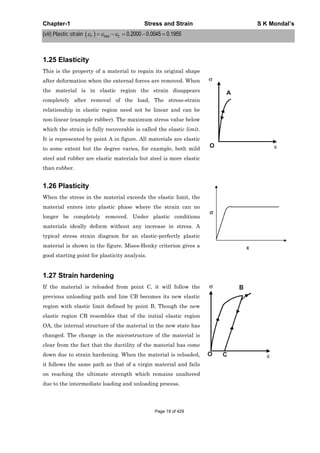
1.25 Elasticity
This is the property of a material to regain its original shape
after deformation when the external forces are removed. When
the material is in elastic region the strain disappears
completely after removal of the load, The stress-strain
relationship in elastic region need not be linear and can be
non-linear (example rubber). The maximum stress value below
which the strain is fully recoverable is called the elastic limit.
It is represented by point A in figure. All materials are elastic
to some extent but the degree varies, for example, both mild
steel and rubber are elastic materials but steel is more elastic
than rubber.
1.26 Plasticity
When the stress in the material exceeds the elastic limit, the
material enters into plastic phase where the strain can no
longer be completely removed. Under plastic conditions
materials ideally deform without any increase in stress. A
typical stress strain diagram for an elastic-perfectly plastic
material is shown in the figure. Mises-Henky criterion gives a
good starting point for plasticity analysis.
1.27 Strain hardening
If the material is reloaded from point C, it will follow the
previous unloading path and line CB becomes its new elastic
region with elastic limit defined by point B. Though the new
elastic region CB resembles that of the initial elastic region
OA, the internal structure of the material in the new state has
changed. The change in the microstructure of the material is
clear from the fact that the ductility of the material has come
down due to strain hardening. When the material is reloaded,
it follows the same path as that of a virgin material and fails
on reaching the ultimate strength which remains unaltered
due to the intermediate loading and unloading process.
Page 19 of 429
Chapter-1 Stress and Strain S K Mondal’s
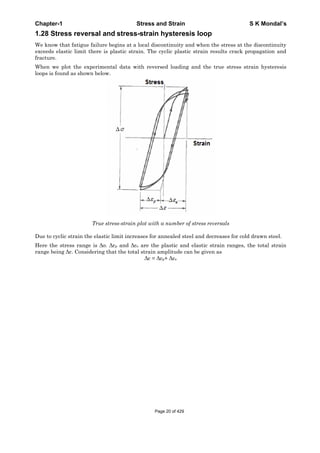
1.28 Stress reversal and stress-strain hysteresis loop
We know that fatigue failure begins at a local discontinuity and when the stress at the discontinuity
exceeds elastic limit there is plastic strain. The cyclic plastic strain results crack propagation and
fracture.
When we plot the experimental data with reversed loading and the true stress strain hysteresis
loops is found as shown below.
True stress-strain plot with a number of stress reversals
Due to cyclic strain the elastic limit increases for annealed steel and decreases for cold drawn steel.
Here the stress range is . p and e are the plastic and elastic strain ranges, the total strain
range being . Considering that the total strain amplitude can be given as
= p+ e
Page 20 of 429
Chapter-1 Stress and Strain S K Mondal’s
OBJECTIVE QUESTIONS (GATE, IES, IAS)
Previous 20-Years GATE Questions
Stress in a bar due to self-weight
GATE-1. Two identical circular rods of same diameter and same length are subjected to
same magnitude of axial tensile force. One of the rods is made out of mild steel
having the modulus of elasticity of 206 GPa. The other rod is made out of cast
iron having the modulus of elasticity of 100 GPa. Assume both the materials to
be homogeneous and isotropic and the axial force causes the same amount of
uniform stress in both the rods. The stresses developed are within the
proportional limit of the respective materials. Which of the following
observations is correct? [GATE-2003]
(a) Both rods elongate by the same amount
(b) Mild steel rod elongates more than the cast iron rod
(c) Cast iron rod elongates more than the mild steel rod
(d) As the stresses are equal strains are also equal in both the rods
GATE-1. Ans. (c)
PL 1
L or L [AsP, L and A is same]
AE E
mild steel CI
CI MS
MSC.I
L E 100
L L
L E 206
GATE-2. A steel bar of 40 mm × 40 mm square cross-section is subjected to an axial
compressive load of 200 kN. If the length of the bar is 2 m and E = 200 GPa, the
elongation of the bar will be: [GATE-2006]
(a) 1.25 mm (b) 2.70 mm (c) 4.05 mm (d) 5.40 mm
GATE-2. Ans. (a) 9
200 1000 2PL
L m 1.25mm
AE 0.04 0.04 200 10
True stress and true strain
GATE-3. The ultimate tensile strength of a material is 400 MPa and the elongation up to
maximum load is 35%. If the material obeys power law of hardening, then the
true stress-true strain relation (stress in MPa) in the plastic deformation range
is: [GATE-2006]
(a) 0.30
540 (b) 0.30
775 (c) 0.35
540 (d) 0.35
775
GATE-3. Ans. (c)
A true stress – true strain curve in
tension n
k
k = Strength co-efficient = 400 ×
(1.35) = 540 MPa
n = Strain – hardening exponent =
0.35
Elasticity and Plasticity
GATE-4. An axial residual compressive stress due to a manufacturing process is present
on the outer surface of a rotating shaft subjected to bending. Under a given
Page 21 of 429
Chapter-1 Stress and Strain S K Mondal’s
bending load, the fatigue life of the shaft in the presence of the residual
compressive stress is: [GATE-2008]
(a) Decreased
(b) Increased or decreased, depending on the external bending load
(c) Neither decreased nor increased
(d) Increased
GATE-4. Ans. (d)
A cantilever-loaded rotating beam, showing the normal distribution of surface stresses.
(i.e., tension at the top and compression at the bottom)
The residual compressive stresses induced.
Net stress pattern obtained when loading a surface treated beam. The reduced
magnitude of the tensile stresses contributes to increased fatigue life.
GATE-5. A static load is mounted at the centre of a shaft rotating at uniform angular
velocity. This shaft will be designed for [GATE-2002]
(a) The maximum compressive stress (static) (b) The maximum tensile stress (static)
(c) The maximum bending moment (static) (d) Fatigue loading
GATE-5. Ans. (d)
GATE-6. Fatigue strength of a rod subjected to cyclic axial force is less than that of a
rotating beam of the same dimensions subjected to steady lateral force because
(a) Axial stiffness is less than bending stiffness [GATE-1992]
(b) Of absence of centrifugal effects in the rod
(c) The number of discontinuities vulnerable to fatigue are more in the rod
(d) At a particular time the rod has only one type of stress whereas the beam has both
the tensile and compressive stresses.
GATE-6. Ans. (d)
Relation between the Elastic Modulii
GATE-7. A rod of length L and diameter D is subjected to a tensile load P. Which of the
following is sufficient to calculate the resulting change in diameter?
(a) Young's modulus (b) Shear modulus [GATE-2008]
(c) Poisson's ratio (d) Both Young's modulus and shear modulus
Page 22 of 429
Chapter-1 Stress and Strain S K Mondal’s
GATE-7. Ans. (d) For longitudinal strain we need Young's modulus and for calculating transverse
strain we need Poisson's ratio. We may calculate Poisson's ratio from )1(2GE for
that we need Shear modulus.
GATE-8. In terms of Poisson's ratio (μ) the ratio of Young's Modulus (E) to Shear
Modulus (G) of elastic materials is
[GATE-2004]
1 1
( )2(1 ) ( )2(1 ) ( ) (1 ) ( ) (1 )
2 2
a b c d
GATE-8. Ans. (a)
GATE-9. The relationship between Young's modulus (E), Bulk modulus (K) and Poisson's
ratio (μ) is given by: [GATE-2002]
(a) E 3 K 1 2 (b) K 3 E 1 2
(c) E 3 K 1 (d) K 3 E 1
GATE-9. Ans. (a)
9KG
Remember E 2G 1 3K 1 2
3K G
Stresses in compound strut
GATE-10. In a bolted joint two members
are connected with an axial
tightening force of 2200 N. If
the bolt used has metric
threads of 4 mm pitch, then
torque required for achieving
the tightening force is
(a) 0.7Nm (b) 1.0 Nm
(c) 1.4Nm (d) 2.8Nm [GATE-2004]
GATE-10. Ans. (c)
0.004
T F r 2200 Nm 1.4Nm
2
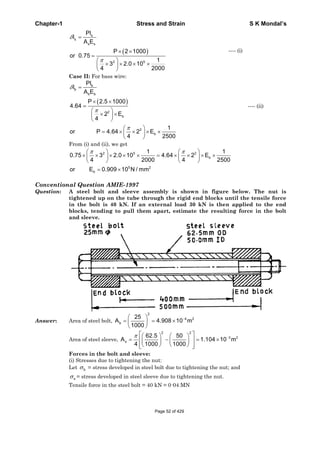
GATE-11. The figure below shows a steel rod of 25 mm2 cross sectional area. It is loaded
at four points, K, L, M and N. [GATE-2004, IES 1995, 1997, 1998]
Assume Esteel = 200 GPa. The total change in length of the rod due to loading is:
(a) 1 μm (b) -10 μm (c) 16 μm (d) -20 μm
GATE-11. Ans. (b) First draw FBD of all parts separately then
Total change in length =
PL
AE
GATE-12. A bar having a cross-sectional area of 700mm2 is subjected to axial loads at the
positions indicated. The value of stress in the segment QR is: [GATE-2006]
Page 23 of 429
Chapter-1 Stress and Strain S K Mondal’s
P Q R S
(a) 40 MPa (b) 50 MPa (c) 70 MPa (d) 120 MPa
GATE-12. Ans. (a)
F.B.D
QR
P 28000
MPa 40MPa
A 700
GATE-13. An ejector mechanism consists of a
helical compression spring having a
spring constant of K = 981 × 103 N/m.
It is pre-compressed by 100 mm
from its free state. If it is used to
eject a mass of 100 kg held on it, the
mass will move up through a
distance of
(a) 100mm (b) 500mm
(c) 981 mm (d) 1000mm
[GATE-2004]
GATE-13. Ans. (a) No calculation needed it is pre-
compressed by 100 mm from its free
state. So it can’t move more than 100
mm. choice (b), (c) and (d) out.
GATE-14. The figure shows a pair of pin-jointed
gripper-tongs holding an object
weighing 2000 N. The co-efficient of
friction (μ) at the gripping surface is
0.1 XX is the line of action of the
input force and YY is the line of
application of gripping force. If the
pin-joint is assumed to be
frictionless, then magnitude of force
F required to hold the weight is:
(a) 1000 N
(b) 2000 N
(c) 2500 N
(d) 5000 N
[GATE-2004]
GATE-14. Ans. (d) Frictional force required = 2000 N
Force needed to produce 2000N frictional force at Y-Y section =
2000
20000N
0.1
So for each side we need (Fy) = 10000 N force Page 24 of 429
Chapter-1 Stress and Strain S K Mondal’s
Taking moment about PIN
y
y
F 50 10000 50
F 50 F 100 or F 5000N
100 100
GATE-15. A uniform, slender cylindrical rod is made of a homogeneous and isotropic
material. The rod rests on a frictionless surface. The rod is heated uniformly. If
the radial and longitudinal thermal stresses are represented by r and z,
respectively, then [GATE-2005]
( ) 0, 0 ( ) 0, 0 ( ) 0, 0 ( ) 0, 0r z r z r z r za b c d
GATE-15. Ans. (a) Thermal stress will develop only when you prevent the material to
contrast/elongate. As here it is free no thermal stress will develop.
Tensile Test
GATE-16. A test specimen is stressed slightly beyond the yield point and then unloaded.
Its yield strength will [GATE-1995]
(a) Decrease (b) Increase
(c) Remains same (d) Becomes equal to ultimate tensile strength
GATE-16. Ans. (b)
GATE-17. Under repeated loading a
material has the stress-strain
curve shown in figure, which of
the following statements is
true?
(a) The smaller the shaded area,
the better the material damping
(b) The larger the shaded area, the
better the material damping
(c) Material damping is an
independent material property
and does not depend on this
curve
(d) None of these
[GATE-1999]
GATE-17. Ans. (a)
Previous 20-Years IES Questions
Stress in a bar due to self-weight
IES-1. A solid uniform metal bar of diameter D and length L is hanging vertically
from its upper end. The elongation of the bar due to self weight is: [IES-2005]
(a) Proportional to L and inversely proportional to D2
(b) Proportional to L2 and inversely proportional to D2
(c) Proportional of L but independent of D
(d) Proportional of U but independent of DPage 25 of 429
Chapter-1 Stress and Strain S K Mondal’s
IES-1. Ans. (a) 2 2
WL WL 1
L &
2AE D D
2 E
4
IES-2. The deformation of a bar under its own weight as compared to that when
subjected to a direct axial load equal to its own weight will be: [IES-1998]
(a) The same (b) One-fourth (c) Half (d) Double
IES-2. Ans. (c)
IES-3. A rigid beam of negligible weight is supported in a horizontal position by two
rods of steel and aluminum, 2 m and 1 m long having values of cross - sectional
areas 1 cm2 and 2 cm2 and E of 200 GPa and 100 GPa respectively. A load P is
applied as shown in the figure [IES-2002]
If the rigid beam is to remain horizontal then
(a) The forces on both sides should be equal
(b) The force on aluminum rod should be twice the force on steel
(c) The force on the steel rod should be twice the force on aluminum
(d) The force P must be applied at the centre of the beam
IES-3. Ans. (b)
Bar of uniform strength
IES-4. Which one of the following statements is correct? [IES 2007]
A beam is said to be of uniform strength, if
(a) The bending moment is the same throughout the beam
(b) The shear stress is the same throughout the beam
(c) The deflection is the same throughout the beam
(d) The bending stress is the same at every section along its longitudinal axis
IES-4. Ans. (d)
IES-5. Which one of the following statements is correct? [IES-2006]
Beams of uniform strength vary in section such that
(a) bending moment remains constant (b) deflection remains constant
(c) maximum bending stress remains constant (d) shear force remains constant
IES-5. Ans. (c)
IES-6. For bolts of uniform strength, the shank diameter is made equal to [IES-2003]
(a) Major diameter of threads (b) Pitch diameter of threads
(c) Minor diameter of threads (d) Nominal diameter of threads
IES-6. Ans. (c)
IES-7. A bolt of uniform strength can be developed by [IES-1995]
(a) Keeping the core diameter of threads equal to the diameter of unthreaded portion
of the bolt
(b) Keeping the core diameter smaller than the diameter of the unthreaded portion
Page 26 of 429
Chapter-1 Stress and Strain S K Mondal’s
(c) Keeping the nominal diameter of threads equal the diameter of unthreaded portion
of the bolt
(d) One end fixed and the other end free
IES-7. Ans. (a)
Elongation of a Taper Rod
IES-8. Two tapering bars of the same material are subjected to a tensile load P. The
lengths of both the bars are the same. The larger diameter of each of the bars is
D. The diameter of the bar A at its smaller end is D/2 and that of the bar B is
D/3. What is the ratio of elongation of the bar A to that of the bar B? [IES-2006]
(a) 3 : 2 (b) 2: 3 (c) 4 : 9 (d) 1: 3
IES-8. Ans. (b) Elongation of a taper rod
1 2
PL
l
d d E
4
2A B
2B A
l d D / 3 2
or
l d D / 2 3
IES-9. A bar of length L tapers uniformly from diameter 1.1 D at one end to 0.9 D at
the other end. The elongation due to axial pull is computed using mean
diameter D. What is the approximate error in computed elongation? [IES-2004]
(a) 10% (b) 5% (c) 1% (d) 0.5%
IES-9. Ans. (c) act
1 2
PL PL
Actual elongation of the bar l
d d E 1.1D 0.9D E
4 4
2Cal
2
act cal
cal
PL
Calculated elongation of the bar l
D
E
4
l l D
Error % 100 1 100% 1%
l 1.1D 0.9D
IES-10. The stretch in a steel rod of circular section, having a length 'l' subjected to a
tensile load' P' and tapering uniformly from a diameter d1 at one end to a
diameter d2 at the other end, is given [IES-1995]
(a)
1 24
Pl
Ed d
(b)
1 2
.pl
Ed d
(c)
1 2
.
4
pl
Ed d
(d)
1 2
4pl
Ed d
IES-10. Ans. (d) act
1 2
PL
Actual elongation of the bar l
d d E
4
IES-11. A tapering bar (diameters of end sections being d1 and d2 a bar of uniform
cross-section ’d’ have the same length and are subjected the same axial pull.
Both the bars will have the same extension if’d’ is equal to [IES-1998]
1 2 1 2 1 2
1 2a b c d
2 2 2
d d d d d d
d d
IES-11. Ans. (b)
Poisson’s ratio
IES-12. In the case of an engineering material under unidirectional stress in the x-
direction, the Poisson's ratio is equal to (symbols have the usual meanings)
[IAS 1994, IES-2000]
Page 27 of 429
Chapter-1 Stress and Strain S K Mondal’s
(a)
x
y
(b)
x
y
(c)
x
y
(d)
x
y
IES-12. Ans. (a)
IES-13. Which one of the following is correct in respect of Poisson's ratio (v) limits for
an isotropic elastic solid? [IES-2004]
(a) (b) 1/ 4 1/ 3 (c) 1 1/ 2 (d) 1/ 2 1/ 2
IES-13. Ans. (c) Theoretically 1 1/ 2 but practically 0 1/ 2
IES-14. Match List-I (Elastic properties of an isotropic elastic material) with List-II
(Nature of strain produced) and select the correct answer using the codes
given below the Lists: [IES-1997]
List-I List-II
A. Young's modulus 1. Shear strain
B. Modulus of rigidity 2. Normal strain
C. Bulk modulus 3. Transverse strain
D. Poisson's ratio 4. Volumetric strain
Codes: A B C D A B C D
(a) 1 2 3 4 (b) 2 1 3 4
(c) 2 1 4 3 (d) 1 2 4 3
IES-14. Ans. (c)
IES-15. If the value of Poisson's ratio is zero, then it means that [IES-1994]
(a) The material is rigid.
(b) The material is perfectly plastic.
(c) There is no longitudinal strain in the material
(d) The longitudinal strain in the material is infinite.
IES-15. Ans. (a) If Poisson's ratio is zero, then material is rigid.
IES-16. Which of the following is true (μ= Poisson's ratio) [IES-1992]
(a) 0 1/ 2 (b) 1 0 (c) 1 1 (d)
IES-16. Ans. (a)
Elasticity and Plasticity
IES-17. If the area of cross-section of a wire is circular and if the radius of this circle
decreases to half its original value due to the stretch of the wire by a load, then
the modulus of elasticity of the wire be: [IES-1993]
(a) One-fourth of its original value (b) Halved (c) Doubled (d) Unaffected
IES-17. Ans. (d) Note: Modulus of elasticity is the property of material. It will remain same.
IES-18. The relationship between the Lame’s constant ‘ ’, Young’s modulus ‘E’ and the
Poisson’s ratio ‘ ’ [IES-1997]
a ( ) c d
1 1 2 1 2 1 1 1
E E E E
b
IES-18. Ans. (a)
IES-19. Which of the following pairs are correctly matched? [IES-1994]
1. Resilience…………… Resistance to deformation.
2. Malleability …………..Shape change.
3. Creep ........................ Progressive deformation.
4. Plasticity .... ………….Permanent deformation.
Select the correct answer using the codes given below:
Codes: (a) 2, 3 and 4 (b) 1, 2 and 3 (c) 1, 2 and 4 (d) 1, 3 and 4
IES-19. Ans. (a) Strain energy stored by a body within elastic limit is known as resilience.
Page 28 of 429
Chapter-1 Stress and Strain S K Mondal’s
Creep and fatigue
IES-20. What is the phenomenon of progressive extension of the material i.e., strain
increasing with the time at a constant load, called? [IES 2007]
(a) Plasticity (b) Yielding (b) Creeping (d) Breaking
IES-20. Ans. (c)
IES-21. The correct sequence of creep deformation in a creep curve in order of their
elongation is: [IES-2001]
(a) Steady state, transient, accelerated (b) Transient, steady state, accelerated
(c) Transient, accelerated, steady state (d) Accelerated, steady state, transient
IES-21. Ans. (b)
IES-22. The highest stress that a material can withstand for a specified length of time
without excessive deformation is called [IES-1997]
(a) Fatigue strength (b) Endurance strength
(c) Creep strength (d) Creep rupture strength
IES-22. Ans. (c)
IES-23. Which one of the following features improves the fatigue strength of a metallic
material? [IES-2000]
(a) Increasing the temperature (b) Scratching the surface
(c) Overstressing (d) Under stressing
IES-23. Ans. (d)
IES-24. Consider the following statements: [IES-1993]
For increasing the fatigue strength of welded joints it is necessary to employ
1. Grinding 2. Coating 3. Hammer peening
Of the above statements
(a) 1 and 2 are correct (b) 2 and 3 are correct
(c) 1 and 3 are correct (d) 1, 2 and 3 are correct
IES-24. Ans. (c) A polished surface by grinding can take more number of cycles than a part with
rough surface. In Hammer peening residual compressive stress lower the peak tensile
stress
Relation between the Elastic Modulii
IES-25. For a linearly elastic, isotropic and homogeneous material, the number of
elastic constants required to relate stress and strain is: [IAS 1994; IES-1998]
(a) Two (b) Three (c) Four (d) Six
IES-25. Ans. (a)
IES-26. E, G, K and represent the elastic modulus, shear modulus, bulk modulus and
Poisson's ratio respectively of a linearly elastic, isotropic and homogeneous
material. To express the stress-strain relations completely for this material, at
least [IES-2006]
(a) E, G and must be known (b) E, K and must be known
(c) Any two of the four must be known (d) All the four must be known
IES-26. Ans. (c)
IES-27. The number of elastic constants for a completely anisotropic elastic material
which follows Hooke's law is: [IES-1999]
(a) 3 (b) 4 (c) 21 (d) 25
IES-27. Ans. (c)
IES-28. What are the materials which show direction dependent properties, called?
(a) Homogeneous materials (b) Viscoelastic materials [IES 2007]
(c) Isotropic materials (d) Anisotropic materials
IES-28. Ans. (d)
IES-29. An orthotropic material, under plane stress condition will have: [IES-2006]
Page 29 of 429
Chapter-1 Stress and Strain S K Mondal’s
(a) 15 independent elastic constants (b) 4 independent elastic constants
(c) 5 independent elastic constants (d) 9 independent elastic constants
IES-29. Ans. (d)
IES-30. Match List-I (Properties) with List-II (Units) and select the correct answer
using the codes given below the lists: [IES-2001]
List I List II
A. Dynamic viscosity 1. Pa
B. Kinematic viscosity 2. m2/s
C. Torsional stiffness 3. Ns/m2
D. Modulus of rigidity 4. N/m
Codes: A B C D A B C D
(a) 3 2 4 1 (b) 5 2 4 3
(b) 3 4 2 3 (d) 5 4 2 1
IES-30. Ans. (a)
IES-31. Young's modulus of elasticity and Poisson's ratio of a material are 1.25 × 10⁵
MPa and 0.34 respectively. The modulus of rigidity of the material is:
[IAS 1994, IES-1995, 2001, 2002, 2007]
(a) 0.4025 ×10⁵ Mpa (b) 0.4664 × 10⁵ Mpa
(c) 0.8375 × 10⁵ MPa (d) 0.9469 × 10⁵ MPa
IES-31. Ans.(b) )1(2GE or 1.25x105 = 2G(1+0.34) or G = 0.4664 × 10⁵ MPa
IES-32. In a homogenous, isotropic elastic material, the modulus of elasticity E in
terms of G and K is equal to [IAS-1995, IES - 1992]
(a)
3
9
G K
KG
(b)
3
9
G K
KG
(c)
9
3
KG
G K
(d)
9
3
KG
K G
IES-32. Ans. (c)
IES-33. What is the relationship between the linear elastic properties Young's modulus
(E), rigidity modulus (G) and bulk modulus (K)? [IES-2008]
1 9 3 3 9 1 9 3 1 9 1 3
(a) (b) (c) (d)
E K G E K G E K G E K G
IES-33. Ans. (d)
9KG
E 2G 1 3K 1 2
3K G
IES-34. What is the relationship between the liner elastic properties Young’s modulus
(E), rigidity modulus (G) and bulk modulus (K)? [IES-2009]
(a)
9
KG
E
K G
(b)
9KG
E
K G
(c)
9
3
KG
E
K G
(d)
9
3
KG
E
K G
IES-34. Ans. (d)
9KG
E 2G 1 3K 1 2
3K G
IES-35. If E, G and K denote Young's modulus, Modulus of rigidity and Bulk Modulus,
respectively, for an elastic material, then which one of the following can be
possibly true? [IES-2005]
(a) G = 2K (b) G = E (c) K = E (d) G = K = E
IES-35. Ans.(c)
9KG
E 2G 1 3K 1 2
3K G
1
the value of must be between 0 to 0.5 so E never equal to G but if then
3
E k so ans. is c
IES-36. If a material had a modulus of elasticity of 2.1 × 10⁶ kgf/cm2 and a modulus of
rigidity of 0.8 × 10⁶ kgf/cm2 then the approximate value of the Poisson's ratio of
the material would be: [IES-1993]
(a) 0.26 (b) 0.31 (c) 0.47 (d) 0.5
Page 30 of 429
Chapter-1 Stress and Strain S K Mondal’s
IES-36. Ans. (b) Use 2 1E G
IES-37. The modulus of elasticity for a material is 200 GN/m2 and Poisson's ratio is 0.25.
What is the modulus of rigidity? [IES-2004]
(a) 80 GN/m2 (b) 125 GN/m2 (c) 250 GN/m2 (d) 320 GN/m2
IES-37. Ans. (a) 2E 200
E 2G 1 or G 80GN / m
2 1 2 1 0.25
IES-38. Consider the following statements: [IES-2009]
1. Two-dimensional stresses applied to a thin plate in its own plane
represent the plane stress condition.
2. Under plane stress condition, the strain in the direction perpendicular to
the plane is zero.
3. Normal and shear stresses may occur simultaneously on a plane.
Which of the above statements is /are correct?
(a) 1 only (b) 1 and 2 (c) 2 and 3 (d) 1 and 3
IES-38. Ans. (d) Under plane stress condition, the strain in the direction perpendicular to the plane
is not zero. It has been found experimentally that when a body is stressed within elastic
limit, the lateral strain bears a constant ratio to the linear strain. [IES-2009]
Stresses in compound strut
IES-39. Eight bolts are to be selected for fixing the cover plate of a cylinder subjected
to a maximum load of 980·175 kN. If the design stress for the bolt material is
315 N/mm2, what is the diameter of each bolt? [IES-2008]
(a) 10 mm (b) 22 mm (c) 30 mm (d) 36 mm
IES-39. Ans. (b)
2
d P 980175
Total load P 8 or d 22.25mm
4 2 2 315
IES-40. For a composite consisting of a bar enclosed inside a tube of another material
when compressed under a load 'w' as a whole through rigid collars at the end
of the bar. The equation of compatibility is given by (suffixes 1 and 2) refer to
bar and tube respectively [IES-1998]
1 2 1 2
1 2 1 2
1 1 2 2 1 2 2 1
( ) ( ) . ( ) ( )
W W W W
a W W W b W W Const c d
A E A E A E A E
IES-40. Ans. (c) Compatibility equation insists that the change in length of the bar must be
compatible with the boundary conditions. Here (a) is also correct but it is equilibrium
equation.
IES-41. When a composite unit consisting of a steel rod surrounded by a cast iron tube
is subjected to an axial load. [IES-2000]
Assertion (A): The ratio of normal stresses induced in both the materials is
equal to the ratio of Young's moduli of respective materials.
Reason (R): The composite unit of these two materials is firmly fastened
together at the ends to ensure equal deformation in both the materials.
(a) Both A and R are individually true and R is the correct explanation of A
(b) Both A and R are individually true but R is not the correct explanation of A
(c) A is true but R is false
(d) A is false but R is true
IES-41. Ans. (a)
IES-42. The figure below shows a steel rod of 25 mm2 cross sectional area. It is loaded
at four points, K, L, M and N. [GATE-2004, IES 1995, 1997, 1998]
Page 31 of 429
Chapter-1 Stress and Strain S K Mondal’s
Assume Esteel = 200 GPa. The total change in length of the rod due to loading is
(a) 1 μm (b) -10 μm (c) 16 μm (d) -20 μm
IES-42. Ans. (b) First draw FBD of all parts separately then
Total change in length =
PL
AE
IES-43. The reactions at the rigid
supports at A and B for
the bar loaded as shown
in the figure are
respectively.
(a) 20/3 kN,10/3 kN
(b) 10/3 kN, 20/3 kN
(c) 5 kN, 5 kN
(d) 6 kN, 4 kN
[IES-2002; IAS-
2003]
IES-43. Ans. (a) Elongation in AC = length reduction in CB
A BR 1 R 2
AE AE
And RA + RB = 10
IES-44. Which one of the following is correct? [IES-2008]
When a nut is tightened by placing a washer below it, the bolt will be subjected
to
(a) Compression only (b) Tension
(c) Shear only (d) Compression and shear
IES-44. Ans. (b)
IES-45. Which of the following stresses are associated with the tightening of nut on a
bolt? [IES-1998]
1. Tensile stress due to the stretching of bolt
2. Bending stress due to the bending of bolt
3. Crushing and shear stresses in threads
4. Torsional shear stress due to frictional resistance between the nut and
the bolt.
Select the correct answer using the codes given below
Codes: (a) 1, 2 and 4 (b) 1, 2 and 3 (c) 2, 3 and 4 (d) 1, 3 and 4
IES-45. Ans. (d)
Thermal effect
IES-46. A 100 mm × 5 mm × 5 mm steel bar free to expand is heated from 15°C to 40°C.
What shall be developed? [IES-2008]
(a) Tensile stress (b) Compressive stress (c) Shear stress (d) No stress
IES-46. Ans. (d) If we resist to expand then only stress will develop.
IES-47. Which one of the following statements is correct? [GATE-1995; IES 2007]
If a material expands freely due to heating, it will developPage 32 of 429
Chapter-1 Stress and Strain S K Mondal’s
(a) Thermal stress (b) Tensile stress (c) Compressive stress (d) No stress
IES-47. Ans. (d)
IES-48. A cube having each side of length a, is constrained in all directions and is
heated uniformly so that the temperature is raised to T°C. If is the thermal
coefficient of expansion of the cube material and E the modulus of elasticity,
the stress developed in the cube is: [IES-2003]
(a)
TE
(b)
1 2
TE
(c)
2
TE
(d)
1 2
TE
IES-48. Ans. (b)
33 3
3
1p a T aV
V K a
3
3 1 2
P
Or T
E
IES-49. Consider the following statements: [IES-2002]
Thermal stress is induced in a component in general, when
1. A temperature gradient exists in the component
2. The component is free from any restraint
3. It is restrained to expand or contract freely
Which of the above statements are correct?
(a) 1 and 2 (b) 2 and 3 (c) 3 alone (d) 2 alone
IES-49. Ans. (c)
IES-50. A steel rod 10 mm in diameter and 1m long is heated from 20°C to 120°C, E = 200
GPa and = 12 × 10-6 per °C. If the rod is not free to expand, the thermal stress
developed is: [IAS-2003, IES-1997, 2000, 2006]
(a) 120 MPa (tensile) (b) 240 MPa (tensile)
(c) 120 MPa (compressive) (d) 240 MPa (compressive)
IES-50. Ans. (d) 6 3
E t 12 10 200 10 120 20 240MPa
It will be compressive as elongation restricted.
IES-51. A cube with a side length of 1 cm is heated uniformly 1° C above the room
temperature and all the sides are free to expand. What will be the increase in
volume of the cube? (Given coefficient of thermal expansion is per °C)
(a) 3 cm3 (b) 2 cm3 (c) cm3 (d) zero [IES-2004]
IES-51. Ans. (a) co-efficient of volume expansion 3 co efficient of linear expansion
IES-52. A bar of copper and steel form a composite system. [IES-2004]
They are heated to a temperature of 40 ° C. What type of stress is induced in the
copper bar?
(a) Tensile (b) Compressive (c) Both tensile and compressive (d) Shear
IES-52. Ans. (b)
IES-53.
-6 o
=12.5×10 / C, E= 200GPa If the rod fitted strongly between the supports as
shown in the figure, is heated, the stress induced in it due to 20oC rise in
temperature will be: [IES-1999]
(a) 0.07945 MPa (b) -0.07945 MPa (c) -0.03972 MPa (d) 0.03972 MPa
Page 33 of 429
Chapter-1 Stress and Strain S K Mondal’s
IES-53. Ans. (b) Let compression of the spring = x m
Therefore spring force = kx kN
Expansion of the rod due to temperature rise = L t
Reduction in the length due to compression force =
kx L
AE
Now
kx L
L t x
AE
Or
6
2
6
0.5 12.5 10 20
x 0.125mm
50 0.5
1
0.010
200 10
4
Compressive stress = 2
kx 50 0.125
0.07945MPa
A 0.010
4
IES-54. The temperature stress is a function of [IES-1992]
1. Coefficient of linear expansion 2. Temperature rise 3. Modulus of elasticity
The correct answer is:
(a) 1 and 2 only (b) 1 and 3 only (c) 2 and 3 only (d) 1, 2 and 3
IES-54. Ans. (d) Stress in the rod due to temperature rise = t E
Impact loading
IES-55. Assertion (A): Ductile materials generally absorb more impact loading than a
brittle material [IES-2004]
Reason (R): Ductile materials generally have higher ultimate strength than
brittle materials
(a) Both A and R are individually true and R is the correct explanation of A
(b) Both A and R are individually true but R is not the correct explanation of A
(c) A is true but R is false
(d) A is false but R is true
IES-55. Ans. (c)
IES-56. Assertion (A): Specimens for impact testing are never notched. [IES-1999]
Reason (R): A notch introduces tri-axial tensile stresses which cause brittle
fracture.
(a) Both A and R are individually true and R is the correct explanation of A
(b) Both A and R are individually true but R is NOT the correct explanation of A
(c) A is true but R is false
(d) A is false but R is true
IES-56. Ans. (d) A is false but R is correct.
Page 34 of 429
Chapter-1 Stress and Strain S K Mondal’s
Tensile Test
IES-57. During tensile-testing of a specimen using a Universal Testing Machine, the
parameters actually measured include [IES-1996]
(a) True stress and true strain (b) Poisson’s ratio and Young's modulus
(c) Engineering stress and engineering strain (d) Load and elongation
IES-57. Ans. (d)
IES-58. In a tensile test, near the elastic limit zone [IES-2006]
(a) Tensile stress increases at a faster rate
(b) Tensile stress decreases at a faster rate
(c) Tensile stress increases in linear proportion to the stress
(d) Tensile stress decreases in linear proportion to the stress
IES-58. Ans. (b)
IES-59. Match List-I (Types of Tests and Materials) with List-II (Types of Fractures)
and select the correct answer using the codes given below the lists:
List I List-II [IES-2002; IAS-2004]
(Types of Tests and Materials) (Types of Fractures)
A. Tensile test on CI 1. Plain fracture on a transverse plane
B. Torsion test on MS 2. Granular helecoidal fracture
C. Tensile test on MS 3. Plain granular at 45° to the axis
D. Torsion test on CI 4. Cup and Cone
5. Granular fracture on a transverse plane
Codes:
A B C D A B C D
(a) 4 2 3 1 (c) 4 1 3 2
(b) 5 1 4 2 (d) 5 2 4 1
IES-59. Ans. (d)
IES-60. Which of the following materials generally exhibits a yield point? [IES-2003]
(a) Cast iron (b) Annealed and hot-rolled mild steel
(c) Soft brass (d) Cold-rolled steel
IES-60. Ans. (b)
IES-61. For most brittle materials, the ultimate strength in compression is much large
then the ultimate strength in tension. The is mainly due to [IES-1992]
(a) Presence of flaws and microscopic cracks or cavities
(b) Necking in tension
(c) Severity of tensile stress as compared to compressive stress
(d) Non-linearity of stress-strain diagram
IES-61. Ans. (a)
IES-62. What is the safe static tensile load for a M36 × 4C bolt of mild steel having yield
stress of 280 MPa and a factor of safety 1.5? [IES-2005]
(a) 285 kN (b) 190 kN (c) 142.5 kN (d) 95 kN
IES-62. Ans. (b)
2
c c2
W d
or W
4d
4
;
2 2
c
safe
dW 280 36
W N 190kN
fos fos 4 1.5 4
IES-63. Which one of the following properties is more sensitive to increase in strain
rate? [IES-2000]
(a) Yield strength (b) Proportional limit (c) Elastic limit (d) Tensile strength
IES-63. Ans. (b)
Page 35 of 429
Chapter-1 Stress and Strain S K Mondal’s
IES-64. A steel hub of 100 mm internal diameter and uniform thickness of 10 mm was
heated to a temperature of 300oC to shrink-fit it on a shaft. On cooling, a crack
developed parallel to the direction of the length of the hub. Consider the
following factors in this regard: [IES-1994]
1. Tensile hoop stress 2. Tensile radial stress
3. Compressive hoop stress 4. Compressive radial stress
The cause of failure is attributable to
(a) 1 alone (b) 1 and 3 (c) 1, 2 and 4 (d) 2, 3 and 4
IES-64. Ans. (a) A crack parallel to the direction of length of hub means the failure was due to
tensile hoop stress only.
IES-65. If failure in shear along 45° planes is to be avoided, then a material subjected
to uniaxial tension should have its shear strength equal to at least [IES-1994]
(a) Tensile strength (b) Compressive strength
(c) Half the difference between the tensile and compressive strengths.
(d) Half the tensile strength.
IES-65. Ans. (d)
IES-66. Select the proper sequence [IES-1992]
1. Proportional Limit 2. Elastic limit 3. Yielding 4. Failure
(a) 2, 3, 1, 4 (b) 2, 1, 3, 4 (c) 1, 3, 2, 4 (d) 1, 2, 3, 4
IES-66. Ans. (d)
Previous 20-Years IAS Questions
Stress in a bar due to self-weight
IAS-1. A heavy uniform rod of length 'L' and material density ' ' is hung vertically
with its top end rigidly fixed. How is the total elongation of the bar under its
own weight expressed? [IAS-2007]
(a)
2
2 L g
E
(b)
2
L g
E
(c)
2
2
L g
E
(d)
2
2
L g
E
IAS-1. Ans. (d) Elongation due to self weight =
2
2 2 2
ALg LWL L g
AE AE E
IAS-2. A rod of length 'l' and cross-section area ‘A’ rotates about an axis passing
through one end of the rod. The extension produced in the rod due to
centrifugal forces is (w is the weight of the rod per unit length and is the
angular velocity of rotation of the rod). [IAS 1994]
(a)
gE
wl2
(b)
gE
wl
3
32
(c)
gE
wl32
(d) 32
3
wl
gE
IAS-2. Ans. (b)
Page 36 of 429
Chapter-1 Stress and Strain S K Mondal’s
Elongation of a Taper Rod
IAS-3. A rod of length, " " tapers uniformly from a diameter ''D1' to a diameter ''D2' and
carries an axial tensile load of "P". The extension of the rod is (E represents the
modulus of elasticity of the material of the rod) [IAS-1996]
(a)
1 2
4 1P
ED D 1 2
4 1
( )
PE
b
D D
(c)
1 2
1
4
EP
D D
(d)
1 2
1
4
P
ED D
IAS-3. Ans. (a) The extension of the taper rod =
1 2
Pl
D D .E
4
Poisson’s ratio
IAS-4. In the case of an engineering material under unidirectional stress in the x-
direction, the Poisson's ratio is equal to (symbols have the usual meanings)
[IAS 1994, IES-2000]
(a)
x
y
(b)
x
y
(c)
x
y
(d)
x
y
IAS-4. Ans. (a)
IAS-5. Assertion (A): Poisson's ratio of a material is a measure of its ductility.
Reason (R): For every linear strain in the direction of force, Poisson's ratio of
the material gives the lateral strain in directions perpendicular to the
direction of force. [IAS-1999]
(a) Both A and R are individually true and R is the correct explanation of A
(b) Both A and R are individually true but R is not the correct explanation of A
(c) A is true but R is false
(d) A is false but R is true
IAS-5. ans. (d)
IAS-6. Assertion (A): Poisson's ratio is a measure of the lateral strain in all direction
perpendicular to and in terms of the linear strain. [IAS-1997]
Reason (R): The nature of lateral strain in a uni-axially loaded bar is opposite
to that of the linear strain.
(a) Both A and R are individually true and R is the correct explanation of A
(b) Both A and R are individually true but R is not the correct explanation of A
(c) A is true but R is false
(d) A is false but R is true
IAS-6. Ans. (b)
Elasticity and Plasticity
IAS-7. A weight falls on a plunger fitted in a container filled with oil thereby
producing a pressure of 1.5 N/mm2 in the oil. The Bulk Modulus of oil is 2800
N/mm2. Given this situation, the volumetric compressive strain produced in the
oil will be: [IAS-1997]
(a) 400 × 10-6 (b) 800 × 106 (c) 268 × 106 (d) 535 × 10-6
IAS-7. Ans. (d) Bulk modulus of elasticity (K) = 6
v
v
P P 1.5
or 535 10
K 2800
Relation between the Elastic Modulii
IAS-8. For a linearly elastic, isotropic and homogeneous material, the number of
elastic constants required to relate stress and strain is: [IAS 1994; IES-1998]
(a) Two (b) Three (c) Four (d) Six
IAS-8. Ans. (a)
Page 37 of 429
Chapter-1 Stress and Strain S K Mondal’s
IAS-9. The independent elastic constants for a homogenous and isotropic material are
(a) E, G, K, v (b) E, G, K (c) E, G, v (d) E, G [IAS-1995]
IAS-9. Ans. (d)
IAS-10. The unit of elastic modulus is the same as those of [IAS 1994]
(a) Stress, shear modulus and pressure (b) Strain, shear modulus and force
(c) Shear modulus, stress and force (d) Stress, strain and pressure.
IAS-10. Ans. (a)
IAS-11. Young's modulus of elasticity and Poisson's ratio of a material are 1.25 × 10⁵
MPa and 0.34 respectively. The modulus of rigidity of the material is:
[IAS 1994, IES-1995, 2001, 2002, 2007]
(a) 0.4025 × 10⁵ MPa (b) 0.4664 × 10⁵ MPa
(c) 0.8375 × 10⁵ MPa (d) 0.9469 × 10⁵ MPa
IAS-11. Ans.(b) )1(2GE or 1.25x105 = 2G(1+0.34) or G = 0.4664 × 10⁵ MPa
IAS-12. The Young's modulus of elasticity of a material is 2.5 times its modulus of
rigidity. The Posson's ratio for the material will be: [IAS-1997]
(a) 0.25 (b) 0.33 (c) 0.50 (d) 0.75
IAS-12. Ans. (a)
E E 2.5
E 2G 1 1 1 1 0.25
2G 2G 2
IAS-13. In a homogenous, isotropic elastic material, the modulus of elasticity E in
terms of G and K is equal to [IAS-1995, IES - 1992]
(a)
3
9
G K
KG
(b)
3
9
G K
KG
(c)
9
3
KG
G K
(d)
9
3
KG
K G
IAS-13. Ans. (c)
IAS-14. The Elastic Constants E and K are related as ( is the Poisson’s ratio)[IAS-1996]
(a) E = 2k (1 – 2 ) (b) E = 3k (1- 2 ) (c) E = 3k (1 + ) (d) E = 2K(1 + 2 )
IAS-14. Ans. (b) E = 2G (1 + ) = 3k (1- 2 )
IAS-15. For an isotropic, homogeneous and linearly elastic material, which obeys
Hooke's law, the number of independent elastic constant is: [IAS-2000]
(a) 1 (b) 2 (c) 3 (d) 6
IAS-15. Ans. (b) E, G, K and μ represent the elastic modulus, shear modulus, bulk modulus and
poisons ratio respectively of a ‘linearly elastic, isotropic and homogeneous material.’ To
express the stress – strain relations completely for this material; at least any two of the
four must be known.
9
2 1 3 1 3
3
KG
E G K
K G
IAS-16. The moduli of elasticity and rigidity of a material are 200 GPa and 80 GPa,
respectively. What is the value of the Poisson's ratio of the material? [IAS-2007]
(a) 0·30 (b) 0·26 (c) 0·25 (d) 0·24
IAS-16. Ans. (c) E = 2G (1+ ) or =
200
1 1 0.25
2 2 80
E
G
Stresses in compound strut
IAS-17. The reactions at the rigid supports at A and B for the bar loaded as shown in
the figure are respectively. [IES-2002; IAS-2003]
(a) 20/3 kN,10/3 Kn (b) 10/3 kN, 20/3 kN (c) 5 kN, 5 kN (d) 6 kN, 4 kN
Page 38 of 429
Chapter-1 Stress and Strain S K Mondal’s
IAS-17. Ans. (a) Elongation in AC = length reduction in CB
A BR 1 R 2
AE AE
And RA + RB = 10
Thermal effect
IAS-18. A steel rod 10 mm in diameter and 1m long is heated from 20°C to 120°C, E = 200
GPa and = 12 × 10-6 per °C. If the rod is not free to expand, the thermal stress
developed is: [IAS-2003, IES-1997, 2000, 2006]
(a) 120 MPa (tensile) (b) 240 MPa (tensile)
(c) 120 MPa (compressive) (d) 240 MPa (compressive)
IAS-18. Ans. (d) 6 3
E t 12 10 200 10 120 20 240MPa
It will be compressive as elongation restricted.
IAS-19. A. steel rod of diameter 1 cm and 1 m long is heated from 20°C to 120°C. Its
6
12 10 / K and E=200 GN/m2. If the rod is free to expand, the thermal
stress developed in it is: [IAS-2002]
(a) 12 × 104 N/m2 (b) 240 kN/m2 (c) zero (d) infinity
IAS-19. Ans. (c) Thermal stress will develop only if expansion is restricted.
IAS-20. Which one of the following pairs is NOT correctly matched? [IAS-1999]
(E = Young's modulus, = Coefficient of linear expansion, T = Temperature
rise, A = Area of cross-section, l= Original length)
(a) Temperature strain with permitted expansion ….. ( Tl )
(b) Temperature stress ….. TE
(c) Temperature thrust ….. TEA
(d) Temperature stress with permitted expansion …..
( )E Tl
l
IAS-20. Ans. (a) Dimensional analysis gives (a) is wrong
Impact loading
IAS-21. Match List I with List II and select the correct answer using the codes given
below the lists: [IAS-1995]
List I (Property) List II (Testing Machine)
A. Tensile strength 1. Rotating Bending Machine
B. Impact strength 2. Three-Point Loading Machine
C. Bending strength 3. Universal Testing Machine
D. Fatigue strength 4. Izod Testing Machine
Codes: A B C D A B C D
(a) 4 3 2 1 (b) 3 2 1 4
(c) 2 1 4 3 (d) 3 4 2 1
IAS-21. Ans. (d)
Page 39 of 429
Chapter-1 Stress and Strain S K Mondal’s
Tensile Test
IAS-22. A mild steel specimen is tested in tension up to fracture in a Universal Testing
Machine. Which of the following mechanical properties of the material can be
evaluated from such a test? [IAS-2007]
1. Modulus of elasticity 2. Yield stress 3. Ductility
4. Tensile strength 5. Modulus of rigidity
Select the correct answer using the code given below:
(a) 1, 3, 5 and 6 (b) 2, 3, 4 and 6 (c) 1, 2, 5 and 6 (d) 1, 2, 3 and 4
IAS-22. Ans. (d)
IAS-23. In a simple tension test, Hooke's law is valid upto the [IAS-1998]
(a) Elastic limit (b) Limit of proportionality (c) Ultimate stress (d) Breaking point
IAS-23. Ans. (b)
IAS-24. Lueder' lines on steel specimen under simple tension test is a direct indication
of yielding of material due to slip along the plane [IAS-1997]
(a) Of maximum principal stress (b) Off maximum shear
(c) Of loading (d) Perpendicular to the direction of loading
IAS-24. Ans. (b)
IAS-25. The percentage elongation of a material as obtained from static tension test
depends upon the [IAS-1998]
(a) Diameter of the test specimen (b) Gauge length of the specimen
(c) Nature of end-grips of the testing machine (d) Geometry of the test specimen
IAS-25. Ans. (b)
IAS-26. Match List-I (Types of Tests and Materials) with List-II (Types of Fractures)
and select the correct answer using the codes given below the lists:
List I List-II [IES-2002; IAS-2004]
(Types of Tests and Materials) (Types of Fractures)
A. Tensile test on CI 1. Plain fracture on a transverse plane
B. Torsion test on MS 2. Granular helecoidal fracture
C. Tensile test on MS 3. Plain granular at 45° to the axis
D. Torsion test on CI 4. Cup and Cone
5. Granular fracture on a transverse plane
Codes: A B C D A B C D
(a) 4 2 3 1 (c) 4 1 3 2
(b) 5 1 4 2 (d) 5 2 4 1
IAS-26. Ans. (d)
IAS-27. Assertion (A): For a ductile material stress-strain curve is a straight line up to
the yield point. [IAS-2003]
Reason (R): The material follows Hooke's law up to the point of proportionality.
(a) Both A and R are individually true and R is the correct explanation of A
(b) Both A and R are individually true but R is not the correct explanation of A
(c) A is true but R is false
(d) A is false but R is true
IAS-27. Ans. (d)
IAS-28. Assertion (A): Stress-strain curves for brittle material do not exhibit yield
point. [IAS-1996]
Reason (R): Brittle materials fail without yielding.
(a) Both A and R are individually true and R is the correct explanation of A
(b) Both A and R are individually true but R is NOT the correct explanation of A
(c) A is true but R is false
(d) A is false but R is true
IAS-28. Ans. (a) Up to elastic limit.
Page 40 of 429
Chapter-1 Stress and Strain S K Mondal’s
IAS-29. Match List I (Materials) with List II (Stress-Strain curves) and select the
correct answer using the codes given below the Lists: [IAS-2001]
Codes: A B C D A B C D
(a) 3 1 4 1 (b) 3 2 4 2
(c) 2 4 3 1 (d) 4 1 3 2
IAS-29. Ans. (b)
IAS-30. The stress-strain curve of an ideal elastic strain hardening material will be as
[IAS-1998]
IAS-30. Ans. (d)
IAS-31. An idealised stress-strain curve for a perfectly plastic material is given by
[IAS-1996]
IAS-31. Ans. (a)
IAS-32. Match List I with List II and select the correct answer using the codes given
below the Lists: [IAS-2002]
List I List II
A. Ultimate strength 1. Internal structure
Page 41 of 429
Chapter-1 Stress and Strain S K Mondal’s
B. Natural strain 2. Change of length per unit instantaneous length
C. Conventional strain 3. Change of length per unit gauge length
D. Stress 4. Load per unit area
Codes: A B C D A B C D
(a) 1 2 3 4 (b) 4 3 2 1
(c) 1 3 2 4 (d) 4 2 3 1
IAS-32. Ans. (a)
IAS-33. What is the cause of failure of a short MS strut under an axial load? [IAS-2007]
(a) Fracture stress (b) Shear stress (c) Buckling (d) Yielding
IAS-33. Ans. (d) In compression tests of ductile materials fractures is seldom obtained.
Compression is accompanied by lateral expansion and a compressed cylinder ultimately
assumes the shape of a flat disc.
IAS-34. Match List I with List II and select the correct answer using the codes given
the lists: [IAS-1995]
List I List II
A. Rigid-Perfectly plastic
B. Elastic-Perfectly plastic
C. Rigid-Strain hardening
D. Linearly elastic
Codes: A B C D A B C D
(a) 3 1 4 2 (b) 1 3 2 4
(c) 3 1 2 4 (d) 1 3 4 2
IAS-34. Ans. (a)
IAS-35. Which one of the following materials is highly elastic? [IAS-1995]
(a) Rubber (b) Brass (c) Steel (d) Glass
IAS-35. Ans. (c) Steel is the highly elastic material because it is deformed least on loading, and
regains its original from on removal of the load.
IAS-36. Assertion (A): Hooke's law is the constitutive law for a linear elastic material.
Reason (R) Formulation of the theory of elasticity requires the hypothesis that there
exists a unique unstressed state of the body, to which the body returns
whenever all the forces are removed. [IAS-2002]
(a) Both A and R are individually true and R is the correct explanation of A
(b) Both A and R are individually true but R is not the correct explanation of A
(c) A is true but R is false
(d) A is false but R is true
IAS-36. Ans. (a)
IAS-37. Consider the following statements: [IAS-2002]Page 42 of 429
Chapter-1 Stress and Strain S K Mondal’s
1. There are only two independent elastic constants.
2. Elastic constants are different in orthogonal directions.
3. Material properties are same everywhere.
4. Elastic constants are same in all loading directions.
5. The material has ability to withstand shock loading.
Which of the above statements are true for a linearly elastic, homogeneous and
isotropic material?
(a) 1, 3, 4 and 5 (b) 2, 3 and 4 (c) 1, 3 and 4 (d) 2 and 5
IAS-37. Ans. (a)
IAS-38. Which one of the following pairs is NOT correctly matched? [IAS-1999]
(a) Uniformly distributed stress …. Force passed through the centroid of the
cross-section
(b) Elastic deformation …. Work done by external forces during
deformation is dissipated fully as heat
(c) Potential energy of strain …. Body is in a state of elastic deformation
(d) Hooke's law …. Relation between stress and strain
IAS-38. Ans. (b)
IAS-39. A tensile bar is stressed to 250 N/mm2 which is beyond its elastic limit. At this
stage the strain produced in the bar is observed to be 0.0014. If the modulus of
elasticity of the material of the bar is 205000 N/mm2 then the elastic component
of the strain is very close to [IAS-1997]
(a) 0.0004 (b) 0.0002 (c) 0.0001 (d) 0.00005
IAS-39. Ans. (b)
Page 43 of 429
Chapter-1 Stress and Strain S K Mondal’s
Previous Conventional Questions with Answers
Conventional Question IES-2010
Q. If a load of 60 kN is applied to a rigid
bar suspended by 3 wires as shown
in the above figure what force will
be resisted by each wire?
The outside wires are of Al, cross-
sectional area 300 mm2 and length 4
m. The central wire is steel with area
200 mm2 and length 8 m.
Initially there is no slack in the
wires 5 2
E 2 10 N / mm for Steel
5 2
0.667 10 N / mm for Aluminum
[2 Marks]
Ans.
FA1
FSt
Aluminium wire
Steel wire
FA1
60kN
P 60 kN
2
A1 A1a 300mm l 4m
2
st sta 200mm l 8m
5 2
A1E 0.667 10 N / mm
5 2
stE 2 10 N / mm
Force balance along vertical direction
A1 st2F F 60 kN (1)
Elongation will be same in all wires because rod is rigid remain horizontal after
loading
st stA1 A1
Al Al st st
F .lF l
a .E a .E
(2)
stA1
5 5
F 8F 4
300 0.667 10 200 2 10
A1 stF 1.0005 F (3)
Page 44 of 429
Chapter-1 Stress and Strain S K Mondal’s
From equation (1)
3
st
60 10
F 19.99 kN or 20 kN
3.001
A1F 20 kN
A1
st
F 20 kN
F 20 kN
Answer.
Conventional Question GATE
Question: The diameters of the brass and steel segments of the axially loaded bar
shown in figure are 30 mm and 12 mm respectively. The diameter of the
hollow section of the brass segment is 20 mm.
Determine: (i) The maximum normal stress in the steel and brass (ii) The displacement of the free
end ; Take Es = 210 GN/m2 and Eb = 105 GN/m2
Answer:
2 2 6 2
sA 12 36 mm 36 10 m
4
2 2 6 2
b BC
A 30 225 mm 225 10 m
4
2 2 2 6 2
b CD
A 30 20 125 mm 125 10 m
4
(i) The maximum normal stress in steel and brass:
3
6 2 2
s 6
3
6 2 2
b 6BC
3
6 2 2
b 6CD
10 10
10 MN / m 88.42MN / m
36 10
5 10
10 MN / m 7.07MN / m
225 10
5 10
10 MN / m 12.73MN / m
125 10
(ii) The displacement of the free end:
s b bAB BC CD
9 6 9 6 9 6
5
l l l l
88.42 0.15 7.07 0.2 12.73 0.125 l
l
E210 10 10 105 10 10 105 10 10
9.178 10 m 0.09178 mm
Conventional Question IES-1999
Question: Distinguish between fatigue strength and fatigue limit.
Answer: Fatigue strength as the value of cyclic stress at which failure occurs after N cycles. And
fatigue limit as the limiting value of stress at which failure occurs as N becomes very
large (sometimes called infinite cycle)
Conventional Question IES-1999 Page 45 of 429
Chapter-1 Stress and Strain S K Mondal’s
Question: List at least two factors that promote transition from ductile to brittle
fracture.
Answer: (i) With the grooved specimens only a small reduction in area took place, and the
appearance of the facture was like that of brittle materials.
(ii) By internal cavities, thermal stresses and residual stresses may combine with
the effect of the stress concentration at the cavity to produce a crack. The
resulting fracture will have the characteristics of a brittle failure without
appreciable plastic flow, although the material may prove ductile in the usual
tensile tests.
Conventional Question IES-1999
Question: Distinguish between creep and fatigue.
Answer: Fatigue is a phenomenon associated with variable loading or more precisely to cyclic
stressing or straining of a material, metallic, components subjected to variable loading
get fatigue, which leads to their premature failure under specific conditions.
When a member is subjected to a constant load over a long period of time it undergoes
a slow permanent deformation and this is termed as ''Creep''. This is dependent on
temperature.
Conventional Question IES-2008
Question: What different stresses set-up in a bolt due to initial tightening, while used as
a fastener? Name all the stresses in detail.
Answer: (i) When the nut is initially tightened there will be some elongation in the bolt so
tensile stress will develop.
(ii) While it is tightening a torque across some shear stress. But when tightening will
be completed there should be no shear stress.
Conventional Question IES-2008
Question: A Copper rod 6 cm in diameter is placed within a steel tube, 8 cm external
diameter and 6 cm internal diameter, of exactly the same length. The two
pieces are rigidly fixed together by two transverse pins 20 mm in diameter,
one at each end passing through both rod and the tube.
Calculated the stresses induced in the copper rod, steel tube and the pins if
the temperature of the combination is raised by 50oC.
[Take ES=210 GPa, 0.0000115/o
s C ; Ec=105 GPa, 0.000017 /o
c C ]
Answer:
( )c s
c s
c s
t
E E
22
2 3 2
c
6
Area of copper rod(A ) = 2.8274 10
4 4 100
d
m m
2 22
2 3 28 6
Area of steel tube (A ) = 2.1991 10
4 4 100 100
s
d
m m
in temperature, 50o
Rise t C
cFree expansion of copper bar= L t
Free expansion of steel tube = sL tPage 46 of 429
Chapter-1 Stress and Strain S K Mondal’s
Difference in free expansion = c s L t
6 -4
= 17-11.5 ×10 50=2.75×10L Lm
A compressive force (P) exerted by the steel tube on the copper rod opposed the extra
expansion of the copper rod and the copper rod exerts an equal tensile force P to pull
the steel tube. In this combined effect reduction in copper rod and increase in length of
steel tube equalize the difference in free expansions of the combined system.
Reduction in the length of copper rod due to force P Newton=
3 9
m
2.8275 10 105 10C
c c
PL PL
L
A E
Increase in length of steel tube due to force P
3 9
.
2.1991 10 210 10S
s s
PL P L
L m
A E
Difference in length is equated
4
2.75 10c s
L L L
4
3 9 3 9
.
2.75 10
2.8275 10 105 10 2.1991 10 210 10
PL P L
L
Or P = 49.695 kN
c 3
49695
Stress in copper rod, MPa=17.58MPa
2.8275 10c
P
A
3
49695
in steel tube, MPa 22.6MPa
2.1991 10
s
s
P
Stress
A
Since each of the pin is in double shear, shear stress in pins ( pin )
=
2
49695
=79MPa
2 2 0.02
4
pin
P
A
Conventional Question IES-2002
Question: Why are the bolts, subjected to impact, made longer?
Answer: If we increase length its volume will increase so shock absorbing capacity will
increased.
Conventional Question IES-2007
Question: Explain the following in brief:
(i) Effect of size on the tensile strength
(ii) Effect of surface finish on endurance limit.
Answer: (i) When size of the specimen increases tensile strength decrease. It is due to the
reason that if size increases there should be more change of defects (voids) into
the material which reduces the strength appreciably.
(ii) If the surface finish is poor, the endurance strength is reduced because of
scratches present in the specimen. From the scratch crack propagation will start.
Conventional Question IES-2004
Question: Mention the relationship between three elastic constants i.e. elastic modulus
(E), rigidity modulus (G), and bulk modulus (K) for any Elastic material. How
is the Poisson's ratio ( ) related to these modulli?
Answer:
9
3
KG
E
K G
9KG
μ) = 2G(1+μ) =
3K + G
3 (1 2E K
Page 47 of 429
Chapter-1 Stress and Strain S K Mondal’s
Conventional Question IES-1996
Question: The elastic and shear moduli of an elastic material are 2×10¹¹ Pa and 8×10¹⁰
Pa respectively. Determine Poisson's ratio of the material.
Answer: We know that E = 2G(1+μ ) =
9KG
3K(1- 2μ) =
3K + G
or μ
μ
11
10
or,1
2
2 10
1 1 0.25
2 2 (8 10 )
E
G
E
G
Conventional Question IES-2003
Question: A steel bolt of diameter 10 mm passes through a brass tube of internal
diameter 15 mm and external diameter 25 mm. The bolt is tightened by a nut
so that the length of tube is reduced by 1.5 mm. If the temperature of the
assembly is raised by 40oC, estimate the axial stresses the bolt and the tube
before and after heating. Material properties for steel and brass are:
5 5
SE 2 10 / 1.2 10 /o
S C2
N mm and Eb= 1×10⁵ N/mm2 b=1.9×10⁻¹⁵/oC
Answer:
2 2 5 2
s
2 2 4
b
of steel bolt (A )= (0.010) 7.854 10
4
of brass tube (A )= (0.025) (0.015) 3.1416 10
4
Area m m
Area
S
L
L
b
b. b
Stress due to tightening of the nut
Compressive force on brass tube= tensile fore on steel bolt
or,
( )
, E . E=
b s
b
s s
A A
l
or A A
3
5 6 4 -5
3
5
b.
assume total length ( )=1m
(1.5 10 )
Therefore (1×10 10 ) 3.1416 10 7.854×10
1
600 ( )
( ) (1.5 10 )
and =E (1×10 ) 150 ( )
1
s
s
b
b
Let
or MPa tensile
l
MPa MPa Compressive
Page 48 of 429
Chapter-1 Stress and Strain S K Mondal’s
b
s
before heating
Stress in brass tube ( ) 150 ( )
Stress in steel bolt( ) 600 (tensile)
So
MPa compressive
MPa
Stress due to rise of temperature
Let stress
' '
b & s due to brass tube and steel bolt.are
If the two members had been free to expand,
Free expansion of steel = s 1t
Free expansion of brass tube = 1b t
Since b s free expansion of copper is greater than the free expansion of steel. But
they are rigidly fixed so final expansion of each members will be same. Let us assume
this final expansion is ' ', The free expansion of brass tube is grater than , while the
free expansion of steel is less than . Hence the steel rod will be subjected to a tensile
stress while the brass tube will be subjected to a compressive stress.
For the equilibrium of the whole system,
Total tension (Pull) in steel =Total compression (Push) in brass tube.
'
b
5
' ' ' ' '
b s 4
7.854 10
, 0.25
3.14 10
s
b s s S S
b
A
A A or
A
'
s
sE
'
b
s
b
' '
5 5
5 6 5 6
Final expansion of steel =final expansion of brass tube
( ).1 1 ( ) 1 1
E
, 1.2 10 40 1 (1.9 10 ) 40 1 ( )
2 10 10 1 10 10
b
s b
t t
or ii
'
s
4
11 11
'
'
b
From(i) & (ii) we get
1 0.25
2.8 10
2 10 10
, 37.33 MPa (Tensile stress)
or, = 9.33MPa (compressive)
sor
'
b b
'
s s
Therefore, the final stresses due to tightening and temperature rise
Stress in brass tube = + =150+9.33MPa=159.33MPa
Stress in steel bolt = + = 600 + 37.33 = 637.33MPa.
Conventional Question IES-1997
Question: A Solid right cone of axial length h is made of a material having density
and elasticity modulus E. It is suspended from its circular base. Determine its
elongation due to its self weight.
Answer: See in the figure MNH is a solid right cone of
length 'h' .
Let us assume its wider end of diameter’d’ fixed
rigidly at MN.
Now consider a small strip of thickness dy at a
distance y from the lower end.
Let 'ds' is the diameter of the strip.
2
1
Weight of portion UVH= ( )
3 4
sd
y g i
Page 49 of 429
Chapter-1 Stress and Strain S K Mondal’s
From the similar triangles MNH and UVH,
MN
UV
.
, ( )
s
s
d
d y
d y
or d ii
2
force at UV Weight of UVH
Stress at section UV =
sec area at UV
4
s
cross tion d
2
2
1
. . .
13 4=
3
4
s
s
d
y g
y g
d
h 2
0
1
.
3
, extension in dy=
1
3Total extension of the bar =
6
y g dy
So
E
y gdy
gh
E E
d
From stress-strain relation ship
.
E= ,or d
E
Conventional Question IES-2004
Question: Which one of the three shafts listed hare has the highest ultimate tensile
strength? Which is the approximate carbon content in each steel?
(i) Mild Steel (ii) cast iron (iii) spring steel
Answer: Among three steel given, spring steel has the highest ultimate tensile strength.
Approximate carbon content in
(i) Mild steel is (0.3% to 0.8%)
(ii) Cost iron (2% to 4%)
(iii) Spring steel (0.4% to 1.1%)
Conventional Question IES-2003
Question: If a rod of brittle material is subjected to pure torsion, show with help of a
sketch, the plane along which it will fail and state the reason for its failure.
Answer: Brittle materials fail in tension. In a torsion test the maximum tensile test Occurs at
45° to the axis of the shaft. So failure will occurs along a 45o to the axis of the shaft. So
failure will occurs along a 45° helix
X
X
So failures will occurs according to 45° plane.Page 50 of 429
Chapter-1 Stress and Strain S K Mondal’s
Conventional Question IAS-1995
Question: The steel bolt shown in Figure has a thread pitch of 1.6 mm. If the nut is
initially tightened up by hand so as to cause no stress in the copper spacing
tube, calculate the stresses induced in the tube and in the bolt if a spanner is
then used to turn the nut through 90°.Take Ec and Es as 100 GPa and 209 GPa
respectively.
Answer: Given: p = 1.6 mm, Ec= 100 GPa ; Es = 209 CPa.
Stresses induced in the tube and the bolt, c s, :
2
5 2
s
2 2
5 2
s
10
A 7.584 10 m
4 1000
18 12
A 14.14 10 m
4 1000 1000
Tensile force on steel bolt, Ps = compressive force in copper tube, Pc = P
Also, Increase in length of bolt + decrease in length of tube = axial displacement of nut
3
s c
3
s c
s s c c
3
5 9 5 9
s c
90
i,e l l 1.6 0.4mm 0.4 10 m
360
Pl Pl
or 0.4 10 l l l
A E A E
100 1 1
or P 0.4 10
1000 7.854 10 209 10 14.14 10 100 10
or P 30386N
P P
386.88MPa and 214.89MPa
A A
Conventional Question AMIE-1997
Question: A steel wire 2 m long and 3 mm in diameter is extended by 0·75 mm when a
weight W is suspended from the wire. If the same weight is suspended from a
brass wire, 2·5 m long and 2 mm in diameter, it is elongated by 4 -64 mm.
Determine the modulus of elasticity of brass if that of steel be 2.0 × 10⁵ N /
mm2
Answer: Given, sl 2 m, ds = 3 mm, sl 0·75 mm; Es = 2·0 × 105 N / mm2; bl 2.5 m, db
=2 mm bl 4.64mm and let modulus of elasticity of brass = Eb
Hooke's law gives,
Pl
l
AE
[Symbol has usual meaning]
Case I: For steel wire:
Page 51 of 429
Chapter-1 Stress and Strain S K Mondal’s
s
s
s s
2 5
Pl
l
A E
P 2 1000
or 0.75
1
3 2.0 10
4 2000
---- (i)
Case II: For bass wire:
b
b
b b
2
b
2
b
Pl
l
A E
P 2.5 1000
4.64
2 E
4
1
or P 4.64 2 E
4 2500
---- (ii)
From (i) and (ii), we get
2 5 2
b
5 2
b
1 1
0.75 3 2.0 10 4.64 2 E
4 2000 4 2500
or E 0.909 10 N / mm
Conventional Question AMIE-1997
Question: A steel bolt and sleeve assembly is shown in figure below. The nut is
tightened up on the tube through the rigid end blocks until the tensile force
in the bolt is 40 kN. If an external load 30 kN is then applied to the end
blocks, tending to pull them apart, estimate the resulting force in the bolt
and sleeve.
Answer: Area of steel bolt,
2
4 2
b
25
A 4.908 10 m
1000
Area of steel sleeve,
2 2
3 2
s
62.5 50
A 1.104 10 m
4 1000 1000
Forces in the bolt and sleeve:
(i) Stresses due to tightening the nut:
Let b = stress developed in steel bolt due to tightening the nut; and
s = stress developed in steel sleeve due to tightening the nut.
Tensile force in the steel bolt = 40 kN = 0·04 MN
Page 52 of 429
Chapter-1 Stress and Strain S K Mondal’s
b b
4
b
2
b 4
A 0.04
or 4.908 10 0.04
0.04
81.5MN / m tensile
4.908 10
Compressive force in steel sleeve = 0·04 MN
s s
3
s
2
s 3
A 0.04
or 1.104 10 0.04
0.04
36.23MN / m compressive
1.104 10
(ii) Stresses due to tensile force:
Let the stresses developed due to tensile force of 30 kN = 0·03 MN in steel bolt and
sleeve be b s' and ' respectively.
Then, b b s s' A ' A 0.03
4 3
b s' 4.908 10 ' 1.104 10 0.03 (i)
In a compound system with an external tensile load, elongation caused in each will be
the same.
b
b b
b
b
b b
b
s
s s
s
b s
b s
b s
b s b s
'
l l
E
'
or l 0.5 Given,l 500mm 0.5
E
'
and l 0.4 Given,l 400mm 0.4
E
But l
' '
0.5 0.4
E E
or ' 0.8 ' Given,E E (2)
Substituting this value in (1), we get
4 3
s s
2
s
2
b
2
b b br
s s sr
0.8 ' 4.908 10 ' 1.104 10 0.03
gives ' 20MN / m tensile
and ' 0.8 20 16MN / m tensile
Resulting stress in steel bolt,
' 81.5 16 97.5MN / m
Resulting stress in steelsleeve,
' 36.23 20 16.23MN / 2
b br
4
b sr
3
m compressive
Resulting force in steel bolt, A
97.5 4.908 10 0.0478MN tensile
Resulting force in steelsleeve A
16.23 1.104 10 0.0179MN compressive
Page 53 of 429
2. Principal Stress and Strain
Theory at a Glance (for IES, GATE, PSU)
2.1 States of stress
Uni-axial stress: only one non-zero
principal stress, i.e. 1
Right side figure represents Uni-axial state of
stress.
Bi-axial stress: one principal stress
equals zero, two do not, i.e. 1 > 3 ; 2 = 0
Right side figure represents Bi-axial state of
stress.
Tri-axial stress: three non-zero
principal stresses, i.e. 1 > 2 > 3
Right side figure represents Tri-axial state of
stress.
Isotropic stress: three principal
stresses are equal, i.e. 1 = 2 = 3
Right side figure represents isotropic state of
stress.
Axial stress: two of three principal
stresses are equal, i.e. 1 = 2 or 2 = 3
Right side figure represents axial state of
stress.
Page 54 of 429
Chapter-2 Principal Stress and Strain S K Mondal’s
Hydrostatic pressure: weight of column of
fluid in interconnected pore spaces.
Phydrostatic = fluid gh (density, gravity, depth)
Hydrostatic stress: Hydrostatic stress is
used to describe a state of tensile or
compressive stress equal in all directions
within or external to a body. Hydrostatic
stress causes a change in volume of a
material. Shape of the body remains
unchanged i.e. no distortion occurs in the
body.
Right side figure represents Hydrostatic state of
stress.
Or
2.2 Uni-axial stress on oblique plane
Let us consider a bar of uniform cross sectional area A under direct tensile load P giving rise to axial
normal stress P/A acting on a cross section XX. Now consider another section given by the plane YY
inclined at with the XX. This is depicted in following three ways.
Fig. (a)
Fig. (b)
Fig. (c)
Area of the YY Plane =
cos
A
; Let us assume the normal stress in the YY plane is n and there is
a shear stress acting parallel to the YY plane.
Now resolve the force P in two perpendicular direction one normal to the plane YY = cosP and
another parallel to the plane YY = Pcos
Page 55 of 429
Chapter-2 Principal Stress and Strain S K Mondal’s
Therefore equilibrium gives, cos
cos
n
A
P or
2
cosn
P
A
and sin
cos
A
P or sin cos
P
A
or
sin 2
2
P
A
Note the variation of normal stress n and shear stress with the variation of .
When 0 , normal stress n is maximum i.e. maxn
P
A
and shear stress 0 . As is
increased, the normal stress n diminishes, until when 0, 0n . But if angle
increased shear stress increases to a maximum value max
2
P
A
at 45
4
o
and then
diminishes to 0 at 90o
The shear stress will be maximum when sin2 1 45o
or
And the maximum shear stress, max
2
P
A
In ductile material failure in tension is initiated by shear stress i.e. the failure occurs across
the shear planes at 45o (where it is maximum) to the applied load.
Let us clear a concept about a common mistake: The angle is not between the applied load
and the plane. It is between the planes XX and YY. But if in any question the angle between the
applied load and the plane is given don’t take it as . The angle between the applied load and the
plane is 90 - . In this case you have to use the above formula as
2
cos (90 ) and sin(180 2 )
2
n
P P
A A
where is the angle between the applied load and the
plane. Carefully observe the following two figures it will be clear.
Let us take an example: A metal block of 100 mm2 cross sectional area carries an axial tensile load
of 10 kN. For a plane inclined at 300 with the direction of applied load, calculate:
(a) Normal stress
(b) Shear stress
(c) Maximum shear stress.
Answer: Here 90 30 60o o o
Page 56 of 429
Chapter-2 Principal Stress and Strain S K Mondal’s
(a) Normal stress
3
2 2
2
10 10
cos cos 60 25MPa
100
o
n
P N
A mm
(b) Shear stress
3
2
10 10
sin2 sin120 43.3MPa
2 2 100
oP N
A mm
(c) Maximum shear stress
3
max 2
10 10
50MPa
2 2 100
P N
A mm
Complementary stresses
Now if we consider the stresses on an oblique plane Y’Y’ which is perpendicular to the previous
plane YY. The stresses on this plane are known as complementary stresses. Complementary
normal stress is n and complementary shear stress is . The following figure shows all
the four stresses. To obtain the stresses n and we need only to replace by
0
90 in the
previous equation. The angle
0
90 is known as aspect angle.
Therefore
2 2
cos 90 sino
n
P P
A A
sin2 90 sin2
2 2
oP P
A A
It is clear n n
P
A
and
i.e. Complementary shear stresses are always equal in magnitude but opposite in sign.
Sign of Shear stress
For sign of shear stress following rule have to be followed:
Page 57 of 429
Chapter-2 Principal Stress and Strain S K Mondal’s
The shear stress on any face of the element will be considered positive when it has a
clockwise moment with respect to a centre inside the element. If the moment is counter-
clockwise with respect to a centre inside the element, the shear stress in negative.
Note: The convention is opposite to that of moment of force. Shear stress tending to turn clockwise is
positive and tending to turn counter clockwise is negative.
Let us take an example: A prismatic bar of 500 mm2 cross sectional area is axially loaded with a
tensile force of 50 kN. Determine all the stresses acting on an element which makes 300 inclination
with the vertical plane.
Answer: Take an small element ABCD in 300 plane as shown in figure below,
Given, Area of cross-section, A = 500 mm2, Tensile force (P) = 50 kN
Normal stress on 30° inclined plane,
3
2 2
n 2
P 50×10 N
= cos = ×cos 30 =75MPa
A 500 mm
o
(+ive means tensile).
Shear stress on 30° planes,
3
2
50 10
sin2 sin 2 30 43.3MPa
2 2 500
oP N
A mm
(+ive means clockwise)
Complementary stress on 90 30 120o
Normal stress on 1200 inclined plane,
3
2 2
2
50 10
cos cos 120 25MPa
500
o
n
P N
A mm
(+ ive means tensile)
Shear stress on 1200 nclined plane,
3
2
50 10
sin2 sin 2 120 43.3MPa
2 2 500
oP N
A mm
(- ive means counter clockwise)
State of stress on the element ABCD is given below (magnifying)
Page 58 of 429
Chapter-2 Principal Stress and Strain S K Mondal’s
2.3 Complex Stresses (2-D Stress system)
i.e. Material subjected to combined direct and shear stress
We now consider a complex stress system below. The given figure ABCD shows on small element of
material
Stresses in three dimensional element Stresses in cross-section of the element
x and y are normal stresses and may be tensile or compressive. We know that normal stress
may come from direct force or bending moment. xy is shear stress. We know that shear stress may
comes from direct shear force or torsion and xy and yx are complementary and
xy = yx
Let n is the normal stress and is the shear stress on a plane at angle .
Considering the equilibrium of the element we can easily get
Normal stress cos2 sin2
2 2
x y x y
n xy
and
Shear stress 2 - cos2
2
x y
xysin
Above two equations are coming from considering equilibrium. They do not depend on material
properties and are valid for elastic and in elastic behavior.
Page 59 of 429
Chapter-2 Principal Stress and Strain S K Mondal’s
Location of planes of maximum stress
(a) Normal stress,
maxn
For n maximum or minimum
xy
x
0, where cos2 sin2
2 2
2
sin2 2 cos2 2 0 or tan2 =
2 ( )
x y x yn
n xy
x y
xy p
y
or
(b) Shear stress, max
For maximum or minimum
0, where sin2 cos2
2
x y
xy
cos2 2 sin2 2 0
2
cot 2
x y
xy
xy
x y
or
or
Let us take an example: At a point in a crank shaft the stresses on two mutually perpendicular
planes are 30 MPa (tensile) and 15 MPa (tensile). The shear stress across these planes is 10 MPa.
Find the normal and shear stress on a plane making an angle 300 with the plane of first stress. Find
also magnitude and direction of resultant stress on the plane.
Answer: Given 0
25MPa tensile , 15MPa tensile , 10MPa and 40x y xy
Therefore, Normal stress cos2 sin2
2 2
30 15 30 15
cos 2 30 10sin 2 30 34.91MPa
2 2
x y x y
n xy
o o
Shear stress sin2 cos2
2
30 15
sin 2 30 10cos 2 30 1.5MPa
2
x y
xy
o o
2 2
0
Resultant stress 34.91 1.5 34.94MPa
1.5
and Obliquity , tan 2.46
34.91
r
n
Page 60 of 429
Chapter-2 Principal Stress and Strain S K Mondal’s
2.4 Bi-axial stress
Let us now consider a stressed element ABCD where xy =0, i.e. only x and y is there. This type
of stress is known as bi-axial stress. In the previous equation if you put xy =0 we get Normal stress,
n and shear stress, on a plane at angle .
Normal stress , n 2
2 2
x y x y
cos
Shear/Tangential stress, sin 2
2
x y
For complementary stress, aspect angle =
0
90
Aspect angle ‘ ’ varies from 0 to /2
Normal stress varies between the valuesn
y( 0) & ( / 2)x
Let us take an example: The principal tensile stresses at a point across two perpendicular planes
are 100 MPa and 50 MPa. Find the normal and tangential stresses and the resultant stress and its
obliquity on a plane at 200 with the major principal plane
Answer: Given 0
100MPa tensile , 50MPa tensile 20x y and
100 50 100 50
Normal stress, cos2 cos 2 20 94MPa
2 2 2 2
x y x y o
n
0
2 2
100 50
Shear stress, sin2 sin 2 20 16MPa
2 2
Resultant stress 94 16 95.4MPa
x y
r
1 1 016
Therefore angle of obliquity, tan tan 9.7
94n
Page 61 of 429
Chapter-2 Principal Stress and Strain S K Mondal’s
We may derive uni-axial stress on oblique plane from
cos2 sin2
2 2
x y x y
n xy
and
2 - cos2
2
x y
xysin
Just put 0y and xy =0
Therefore,
20 0 1
cos2 1 cos2 cos
2 2 2
x x
n x x
and
0
sin2 sin2
2 2
x x
2.5 Pure Shear
Pure shear is a particular case of bi-axial stress where
x y
Note: orx y which one is compressive that is immaterial but one should be tensile and
other should be compressive and equal magnitude. If 100MPax then
mustbe 100MPay otherwise if 100MPay then must be 100MPax .
In case of pure shear on 45o
planes
max x ; 0 and 0n n
We may depict the pure shear in an element by following two ways
Page 62 of 429
Chapter-2 Principal Stress and Strain S K Mondal’s
(a) In a torsion member, as shown below, an element ABCD is in pure shear (only shear
stress is present in this element) in this member at 45o plane an element A B C D is also
in pure shear where x y but in this element no shear stress is there.
(b) In a bi-axial state of stress a member, as shown below, an element ABCD in pure shear
where x y but in this element no shear stress is there and an element A B C D at
45o plane is also in pure shear (only shear stress is present in this element).
Let us take an example: See the in the Conventional question answer section in this chapter and
the question is “Conventional Question IES-2007”
2.6 Stress Tensor
State of stress at a point ( 3-D)
Stress acts on every surface that passes through the point. We can use three mutually
perpendicular planes to describe the stress state at the point, which we approximate as a cube
each of the three planes has one normal component & two shear components therefore, 9
components necessary to define stress at a point 3 normal and 6 shear stress.
Therefore, we need nine components, to define the state of stress at a point
x xy xz
y yx yz
z zx zy
For cube to be in equilibrium (at rest: not moving, not spinning)
Page 63 of 429
Chapter-2 Principal Stress and Strain S K Mondal’s
xy yx
xz zx
yz zy
If they don’t offset, block spins therefore,
only six are independent.
The nine components (six of which are independent) can be written in matrix form
11 12 13
21 22 23
31 32 33
or
xx xy xz xx xy xz x xy xz
ij yx yy yz ij yx yy yz yx y yz
zx zy zz zx zy zz zx zy z
This is the stress tensor
Components on diagonal are normal stresses; off are shear stresses
State of stress at an element (2-D)
2.7 Principal stress and Principal plane
When examining stress at a point, it is possible to choose three mutually perpendicular
planes on which no shear stresses exist in three dimensions, one combination of
orientations for the three mutually perpendicular planes will cause the shear stresses on all
three planes to go to zero this is the state defined by the principal stresses.
Page 64 of 429
Chapter-2 Principal Stress and Strain S K Mondal’s
Principal stresses are normal stresses that are orthogonal to
each other
Principal planes are the planes across which principal
stresses act (faces of the cube) for principal stresses (shear
stresses are zero)
Major Principal Stress
2
2
1
2 2
x y x y
xy
Minor principal stress
2
2
2
2 2
x y x y
xy
Position of principal planes
xy
x
2
tan2 =
( )
p
y
Maximum shear stress
2
21 2
max
2 2
x y
xy
Let us take an example: In the wall of a cylinder the state of stress is given by,
85MPax compressive , 25MPa tensile and shear stress 60MPay xy
Calculate the principal planes on which they act. Show it in a figure.
Answer: Given 85MPa, 25MPa, 60MPax y xy
Page 65 of 429
Chapter-2 Principal Stress and Strain S K Mondal’s
2
2
1
2
2
Major principal stress
2 2
85 25 85 25
60 51.4MPa
2 2
x y x y
xy
2
2
2
2
2
Minorprincipalstress
2 2
85 25 85 25
60
2 2
111.4 MPa i.e. 111.4 MPa Compressive
x y x y
xy
Forprincipalplanes
2 2 60
tan2
85 25
xy
P
x y
0
1
0
2
or 24 it is for
Complementary plane 90 66 it is for
The Figure showing state of stress and principal stresses is given below
P
P P
The direction of one principle plane and the principle stresses acting on this would be 1 when is
acting normal to this plane, now the direction of other principal plane would be 900 + p because the
principal planes are the two mutually perpendicular plane, hence rotate the another plane 900 + p
in the same direction to get the another plane, now complete the material element as p is negative
that means we are measuring the angles in the opposite direction to the reference plane BC. The
following figure gives clear idea about negative and positive p .
Page 66 of 429
Chapter-2 Principal Stress and Strain S K Mondal’s
2.8 Mohr's circle for plane stress
The transformation equations of plane stress can be represented in a graphical form which is
popularly known as Mohr's circle.
Though the transformation equations are sufficient to get the normal and shear stresses on
any plane at a point, with Mohr's circle one can easily visualize their variation with respect
to plane orientation .
Equation of Mohr's circle
We know that normal stress, cos2 sin 2
2 2
x y x y
n xy
And Tangential stress, 2 - cos2
2
x y
xysin
Rearranging we get, cos2 sin 2
2 2
x y x y
n xy ……………(i)
and 2 - cos2
2
x y
xysin ……………(ii)
A little consideration will show that the above two equations are the equations of a circle with n
and as its coordinates and 2 as its parameter.
If the parameter 2 is eliminated from the equations, (i) & (ii) then the significance of them will
become clear.
2
x y
avg and R =
2
2
2
x y
xy
Or
2 2 2
n avg xy R
It is the equation of a circle with centre, ,0 . . ,0
2
x y
avg i e
Page 67 of 429
Chapter-2 Principal Stress and Strain S K Mondal’s
and radius,
2
2
2
x y
xyR
Construction of Mohr’s circle
Convention for drawing
A xy that is clockwise (positive) on a face resides above the axis; a xy
anticlockwise (negative) on a face resides below axis.
Tensile stress will be positive and plotted right of the origin O. Compressive stress
will be negative and will be plotted left to the origin O.
An angle on real plane transfers as an angle 2 on Mohr’s circle plane.
We now construct Mohr’s circle in the following stress conditions
I. Bi-axial stress when x and y known and xy = 0
II. Complex state of stress ( ,x y and xy known)
I. Constant of Mohr’s circle for Bi-axial stress (when only x and y known)
If x and y both are tensile or both compressive sign of x and y will be same and this state of
stress is known as “ like stresses” if one is tensile and other is compressive sign of x and y will
be opposite and this state of stress is known as ‘unlike stress’.
Construction of Mohr’s circle for like stresses (when x and y are same type of stress)
Step-I: Label the element ABCD and draw all stresses.
Step-II: Set up axes for the direct stress (as abscissa) i.e., in x-axis and shear stress (as
ordinate) i.e. in Y-axis
Page 68 of 429
Chapter-2 Principal Stress and Strain S K Mondal’s
Step-III: Using sign convention and some suitable scale, plot the stresses on two adjacent faces
e.g. AB and BC on the graph. Let OL and OM equal to x and y respectively on the
axis O .
Step-IV: Bisect ML at C. With C as centre and CL or CM as radius, draw a circle. It is the
Mohr’s circle.
Step-V: At the centre C draw a line CP at an angle 2 , in the same direction as the normal to
the plane makes with the direction of x . The point P represents the state of
stress at plane ZB.
Page 69 of 429
Chapter-2 Principal Stress and Strain S K Mondal’s
Step-VI: Calculation, Draw a perpendicular PQ and PR where PQ = and PR = n
OC and MC = CL = CP =
2 2
PR = cos 2
2 2
PQ = = CPsin 2 = sin 2
2
x y x y
x y x y
x y
n
[Note: In the examination you only draw final figure (which is in Step-V) and follow the
procedure step by step so that no mistakes occur.]
Construction of Mohr’s circle for unlike stresses (when x and y are opposite in sign)
Follow the same steps which we followed for construction for ‘like stresses’ and finally will get
the figure shown below.
Note: For construction of Mohr’s circle for principal stresses when ( 1and 2 is known) then follow
the same steps of Constant of Mohr’s circle for Bi-axial stress (when only x and y known) just
change the 1x and 2y
Page 70 of 429
Chapter-2 Principal Stress and Strain S K Mondal’s
II. Construction of Mohr’s circle for complex state of stress ( x , y and xy known)
Step-I: Label the element ABCD and draw all stresses.
Step-II: Set up axes for the direct stress (as abscissa) i.e., in x-axis and shear stress (as
ordinate) i.e. in Y-axis
Step-III: Using sign convention and some suitable scale, plot the stresses on two adjacent faces
e.g. AB and BC on the graph. Let OL and OM equal to x and y respectively on the
axis O . Draw LS perpendicular to o axis and equal to xy .i.e. LS= xy . Here LS
is downward as xy on AB face is (– ive) and draw MT perpendicular to o axis and
equal to xy i.e. MT= xy . Here MT is upward as xy BC face is (+ ive).
Page 71 of 429
Chapter-2 Principal Stress and Strain S K Mondal’s
Step-IV: Join ST and it will cut oσ axis at C. With C as centre and CS or CT as radius, draw
circle. It is the Mohr’s circle.
Step-V: At the centre draw a line CP at an angle 2θ in the same direction as the normal to the
plane makes with the direction of xσ .
Step-VI: Calculation, Draw a perpendicular PQ and PR where PQ = τ and PR = σn
Centre, OC =
2
x yσ σ+
Radius CS = ( ) ( )
2
2 2 2CL LS CT= CP
2
yx
xy
σ σ
τ
−⎛ ⎞
+ = + =⎜ ⎟⎜ ⎟
⎝ ⎠
PR cos 2 sin 2
2 2
PQ sin2 cos2 .
2
x y x y
n xy
x y
xy
σ σ σ σ
σ θ τ θ
σ σ
τ θ τ θ
+ −
= = + +
−
= = −
[Note: In the examination you only draw final figure (which is in Step-V) and follow the
procedure step by step so that no mistakes occur.]
PDF created with pdfFactory Pro trial version www.pdffactory.com
Page 72 of 429
Chapter-2 Principal Stress and Strain S K Mondal’s
Note: The intersections of o axis are two principal stresses, as shown below.
Let us take an example: See the in the Conventional question answer section in this chapter and
the question is “Conventional Question IES-2000”
2.9 Mohr's circle for some special cases:
i) Mohr’s circle for axial loading:
; 0x y xy
P
A
ii) Mohr’s circle for torsional loading:
; 0xy x y
Tr
J
It is a case of pure shear
iii) In the case of pure shear
( 1 = - 2 and 3 = 0)Page 73 of 429
Chapter-2 Principal Stress and Strain S K Mondal’s
x y
max x
iv) A shaft compressed all round by a hub
1 = 2 = 3 = Compressive (Pressure)
v) Thin spherical shell under internal pressure
1 2
2 4
pr pD
t t
(tensile)
vi) Thin cylinder under pressure
1
2
pD pr
t t
(tensile) and 2
4 2
pd pr
t t
(tensile)
vii) Bending moment applied at the free end of a cantilever
Only bending stress, 1
My
I
and 2 0xy
Page 74 of 429
Chapter-2 Principal Stress and Strain S K Mondal’s
2.10 Strain
Normal strain
Let us consider an element AB of infinitesimal length x. After deformation of the actual body if
displacement of end A is u, that of end B is
u
u+ . x.
x
This gives an increase in length of element AB
is
u u
u+ . x -u x
x x
and therefore the strain in x-direction is x
u
x
Similarly, strains in y and z directions are y
w
and .
x z
z
Therefore, we may write the three normal strain components
x y
u w
; ; and
x y z
z .
Change in length of an infinitesimal element.
Shear strain
Let us consider an element ABCD in x-y plane and let the displaced position of the element be
A B C D .This gives shear strain in x-y plane as xy where is the angle made by the
displaced live B C with the vertical and is the angle made by the displaced line A D with the
horizontal. This gives
u
. y . x
ux xand =
y y x x
We may therefore write the three shear strain components as
xy yz
u w
;
x z yy
and zx
w u
x z
Therefore the state of strain at a point can be completely described by the six strain components
and the strain components in their turns can be completely defined by the displacement components
u, , and w.
Therefore, the complete strain matrix can be written as
Page 75 of 429
Chapter-2 Principal Stress and Strain S K Mondal’s
0 0
0 0
u0 0
0 w
0
0
x
y
z
xy
yz
zx
x
y
z
x y
y z
z x
Shear strain associated with the distortion of an infinitesimal element.
Strain Tensor
The three normal strain components are
x xx y
u w
; and
x y z
yy z zz .
The three shear strain components are
1 u 1 w 1 w
; and
2 2 x 2 2 z y 2 2 z
xy yz zx
xy yz zx
u
y x
Therefore the strain tensor is
2 2
2 2
2 2
xy xz
xx
xx xy xz
yx yz
ij yx yy yz yy
zx zy zz
zyzx
zz
Constitutive Equation
The constitutive equations relate stresses and strains and in linear elasticity. We know from the
Hook’s law E.
Where E is modulus of elasticity
Page 76 of 429
Chapter-2 Principal Stress and Strain S K Mondal’s
It is known that x produces a strain of
E
x
in x-direction
and Poisson’s effect gives
E
x
in y-direction and
E
x
in z-direction.
Therefore we my write the generalized Hook’s law as
1
x x y z
E
,
1
y y z x
E
and
1
z z x y
E
It is also known that the shear stress, G , where G is the shear modulus and is shear strain.
We may thus write the three strain components as
xy yz zx
xy yz zx, and
G G G
In general each strain is dependent on each stress and we may write
11 12 13 14 15 16
21 22 23 24 25 26
31 32 33 34 35 36
41 42 43 44 45 46
51 52 53 54 55 56
61 62 63 64 65 66
K K K K K K
K K K K K K
K K K K K K
K K K K K K
K K K K K K
K K K K K K
x x
y y
z z
xy xy
yz yz
zx zx
The number of elastic constant is 36 (For anisotropic materials)
For isotropic material
11 22 33
44 55 66
12 13 21 23 31 32
1
K K K
E
1
K K K
K K K K K K
E
G
Rest of all elements in K matrix are zero.
For isotropic material only two independent elastic constant is there say E and G.
1-D Strain
Let us take an example: A rod of cross sectional area Ao is
loaded by a tensile force P.
It’s stresses , 0, 0
A
x y z
o
P
and
1-D state of stress or Uni-axial state of stress
0 0 0 0 0 0
0 0 0 or 0 0 0 0 0 0
0 0 0 0 0 0 0 0 0
xx xx x
ij ij
Therefore strain components are
Page 77 of 429
Chapter-2 Principal Stress and Strain S K Mondal’s
x
x
E
;
x
y x
E
; and
x
z x
E
1-D state of strain or Uni-axial state of strain
0 0
0 0 0 0
0 0 0 0 0 0
0 0 0 0
0 0
x
x y
x
ij x y
x y
x
E p
q
E
q
E
2-D Strain ( 0)z
(i)
1
x x y
E
1
y y x
E
z x y
E
[Where, , ,x y z are strain component in X, Y, and Z axis respectively]
(ii)
2
1
x x y
E
2
1
y y x
E
3-D Strain
(i)
1
x x y z
E
1
y y z x
E
1
z z x y
E
(ii) 1
1 1 2
x x y z
E
Page 78 of 429
Chapter-2 Principal Stress and Strain S K Mondal’s
1
1 1 2
1
1 1 2
y y z x
z z x y
E
E
Let us take an example: At a point in a loaded member, a state of plane stress exists and the
strains are 6 6 6
x xy270 10 ; 90 10 and 360 10 .y If the elastic constants
E, and G are 200 GPa, 0.25 and 80 GPa respectively.
Determine the normal stress x and y and the shear stress xy
at the point.
Answer: We know that
.
x x
1
E
1
E
G
y
y y x
xy
xy
9
6 6
x x y2 2
E 200 10
This gives 270 10 0.25 90 10 Pa
1 1 0.25
52.8 MPa (i.e. tensile)
x2
9
6 6
2
6 9
xy xy
E
and
1
200 10
90 10 0.25 270 10 Pa 4.8 MPa (i.e.compressive)
1 0.25
and .G 360 10 80 10 Pa 28.8MPa
y y
2.12 An element subjected to strain components , &
2
xy
x y
Consider an element as shown in the figure given. The strain component In X-direction is x , the
strain component in Y-direction is y and the shear strain component is xy .
Now consider a plane at an angle with X- axis in this plane a normal strain and a shear
strain . Then
2 sin 2
2 2 2
x y x y xy
cos
2 cos2
2 2 2
x y xy
sin
Page 79 of 429
Chapter-2 Principal Stress and Strain S K Mondal’s
We may find principal strain and principal plane for strains in the same process which we
followed for stress analysis.
In the principal plane shear strain is zero.
Therefore principal strains are
2 2
1,2
2 2 2
x y x y xy
The angle of principal plane
tan2
( )
xy
p
x y
Maximum shearing strain is equal to the difference between the 2 principal strains i.e
max 1 2( )xy
Mohr's Circle for circle for Plain Strain
We may draw Mohr’s circle for strain following same procedure which we followed for drawing
Mohr’s circle in stress. Everything will be same and in the place of x write x , the place of
y write y and in place of xy write
2
xy
.
Page 80 of 429
Chapter-2 Principal Stress and Strain S K Mondal’s
2.15 Volumetric Strain (Dilation)
Rectangular block,
0
x y z
V
V
Proof: Volumetric strain
0 0
3
3
1 1 1
o
x y z
x y z
V VV
V V
L L L L
L
(neglecting second and third order
term, as very small )
Before deformation,
Volume (Vo) = L3
After deformation,
Volume (V)
= 1 1 1x y zL L L
In case of prismatic bar,
Volumetric strain,
dv
1 2
v
Proof: Before deformation, the volume of the
bar, V = A.L
After deformation, the length L 1L
and the new cross-sectional area
2
A A 1
Therefore now volume
2
A L =AL 1 1V
Page 81 of 429
Chapter-2 Principal Stress and Strain S K Mondal’s
2
AL 1 1 ALV V -V
1 2
V V AL
V
1 2
V
Thin Cylindrical vessel
1=Longitudinal strain = 1 2
1 2
2
pr
E E Et
2 =Circumferential strain = 2 1
2
2
pr
E E Et
1 22 [5 4 ]
2o
V pr
V Et
Thin Spherical vessels
1 2 [1 ]
2
pr
Et
0
3
3 [1 ]
2
V pr
V Et
In case of pure shear
x y
Therefore
x
y
z
1
E
1
E
0
x y z
dv
Therefore 0
v
v
2.16 Measurement of Strain
Unlike stress, strain can be measured directly. The most common way of measuring strain is by use
of the Strain Gauge.
Strain Gauge
Page 82 of 429
Chapter-2 Principal Stress and Strain S K Mondal’s
A strain gage is a simple device, comprising of a thin
electric wire attached to an insulating thin backing
material such as a bakelite foil. The foil is exposed to the
surface of the specimen on which the strain is to be
measured. The thin epoxy layer bonds the gauge to the
surface and forces the gauge to shorten or elongate as if it
were part of the specimen being strained.
A change in length of the gauge due to longitudinal strain
creates a proportional change in the electric resistance,
and since a constant current is maintained in the gauge, a
proportional change in voltage. (V = IR).
The voltage can be easily measured, and through
calibration, transformed into the change in length of the
original gauge length, i.e. the longitudinal strain along the
gauge length.
Strain Gauge factor (G.F)
The strain gauge factor relates a change in resistance with strain.
Strain Rosette
The strain rosette is a device used to measure the state of strain at a point in a plane.
It comprises three or more independent strain gauges, each of which is used to read normal strain
at the same point but in a different direction.
The relative orientation between the three gauges is known as , and
The three measurements of normal strain provide sufficient information for the determination of the
complete state of strain at the measured point in 2-D.
We have to find out , ,x y xyand form measured value , ,a b cand
Page 83 of 429
Chapter-2 Principal Stress and Strain S K Mondal’s
General arrangement:
The orientation of strain gauges is given in the
figure. To relate strain we have to use the
following formula.
2 sin2
2 2 2
x y x y xy
cos
We get
2 sin2
2 2 2
x y x y xy
a cos
2 sin2
2 2 2
x y x y xy
b cos
2 sin2
2 2 2
x y x y xy
c cos
From this three equations and three unknown we may solve , ,x y xyand
Two standard arrangement of the of the strain rosette are as follows:
(i) 45° strain rosette or Rectangular strain rosette.
In the general arrangement above, put
0 ; 45 45o o o
and
Putting the value we get
a x
2 2
xyx x
b
c y
45
o
(ii) 60° strain rosette or Delta strain rosette
In the general arrangement above, put
0 ; 60 60o o o
and
Putting the value we get
a y
3 3
4 4
x y
b xy
3 3
4 4
x y
c xy
Solving above three equation we get
60o
1200
or
Page 84 of 429
Chapter-2 Principal Stress and Strain S K Mondal’s
OBJECTIVE QUESTIONS (GATE, IES, IAS)
Previous 20-Years GATE Questions
Stresses due to Pure Shear
GATE-1. A block of steel is loaded by a tangential force on its top surface while the
bottom surface is held rigidly. The deformation of the block is due to
[GATE-1992]
(a) Shear only (b) Bending only (c) Shear and bending (d) Torsion
GATE-1. Ans. (a) It is the definition of shear stress. The force is applied tangentially it is not a
point load so you cannot compare it with a cantilever with a point load at its free end.
GATE-2. A shaft subjected to torsion experiences a pure shear stress on the surface.
The maximum principal stress on the surface which is at 45° to the axis will
have a value [GATE-2003]
(a) cos 45° (b) 2 cos 45° (c) cos2 45° (d) 2 sin 45° cos 45°
GATE-2. Ans. (d)
x y x y
n xycos2 sin2
2 2
Here o
x 2 xy0, , 45
GATE-3. The number of components in a stress tensor defining stress at a point in three
dimensions is: [GATE-2002]
(a) 3 (b) 4 (c) 6 (d) 9
GATE-3. Ans. (d) It is well known that,
xy yx, xz zx yz zy
x y z xy yz zx
and
so that the state of stress at a point is given by six components , , and , ,
Principal Stress and Principal Plane
GATE-4. A body is subjected to a pure tensile stress of 100 units. What is the maximum
shear produced in the body at some oblique plane due to the above? [IES-2006]
(a) 100 units (b) 75 units (c) 50 units (d) 0 unit
GATE-4. Ans. (c) 1 2
max
100 0
50 units.
2 2
GATE-5. In a strained material one of the principal stresses is twice the other. The
maximum shear stress in the same case is max .Then, what is the value of the
maximum principle stress? [IES 2007]
(a) max (b) 2 max (c) 4 max (d) 8 max
GATE-5. Ans. (c)
2
21
max , 21 2 or
2
2
max or max2 2 or 21 2 = max4
GATE-6. A material element subjected to a plane state of stress such that the maximum
shear stress is equal to the maximum tensile stress, would correspond to
[IAS-1998]
Page 85 of 429
Chapter-2 Principal Stress and Strain S K Mondal’s
GATE-6. Ans. (d) 1 2 1 1
max 1
( )
2 2
GATE-7. A solid circular shaft is subjected to a maximum shearing stress of 140 MPs.
The magnitude of the maximum normal stress developed in the shaft is:
[IAS-1995]
(a) 140 MPa (b) 80 MPa (c) 70 MPa (d) 60 MPa
GATE-7. Ans. (a) 1 2
max
2
Maximum normal stress will developed if 1 2
GATE-8. The state of stress at a point in a loaded member is shown in the figure. The
magnitude of maximum shear stress is [1MPa = 10 kg/cm2] [IAS 1994]
(a) 10 MPa (b) 30 MPa (c) 50 MPa (d) 100MPa
GATE-8. Ans. (c)
2
2
max
2
xy
yx
=
2
2
30
2
4040
= 50 MPa
GATE-9. A solid circular shaft of diameter 100 mm is subjected to an axial stress of 50
MPa. It is further subjected to a torque of 10 kNm. The maximum principal
stress experienced on the shaft is closest to [GATE-2008]
(a) 41 MPa (b) 82 MPa (c) 164 MPa (d) 204 MPa
GATE-9. Ans. (b) Shear Stress ( )= MPaPa
d
T
93.50
)1.0(
100001616
33
Maximum principal Stress =
2
2
22
bb
=82 MPa
GATE-10. In a bi-axial stress problem, the stresses in x and y directions are ( x = 200 MPa
and y =100 MPa. The maximum principal stress in MPa, is: [GATE-2000]
(a) 50 (b) 100 (c) 150 (d) 200
GATE-10. Ans. (d)
2
x y x y 2
1 xy xyif 0
2 2
Page 86 of 429
Chapter-2 Principal Stress and Strain S K Mondal’s
2
x y x y
x
2 2
GATE-11. The maximum principle stress for the stress
state shown in the figure is
(a) (b) 2
(c) 3 (d) 1.5
[GATE-2001]
GATE-11. Ans. (b) x y xy, ,
2
2x y x y 2 2
1 xymax
0 2
2 2 2
GATE-12. The normal stresses at a point are x = 10 MPa and, y = 2 MPa; the shear stress
at this point is 4MPa. The maximum principal stress at this point is:
[GATE-1998]
(a) 16 MPa (b) 14 MPa (c) 11 MPa (d) 10 MPa
GATE-12. Ans. (c)
2
x y x y 2
1 xy
2 2
2
210 2 10 2
4 11.66 MPa
2 2
GATE-13. In a Mohr's circle, the radius of the circle is taken as: [IES-2006; GATE-1993]
(a)
2
2
2
x y
xy (b)
2
2
2
x y
xy
(c)
2
2
2
x y
xy (d)
2 2
x y xy
Where, x and y are normal stresses along x and y directions respectively and xy is the
shear stress.
GATE-13. Ans. (a)
GATE-14. A two dimensional fluid element rotates like a rigid body. At a point within the
element, the pressure is 1 unit. Radius of the Mohr's circle, characterizing the
state of stress at that point, is: [GATE-2008]
(a) 0.5 unit (b) 0 unit (c) 1 unit (d) 2 units
GATE-14. Ans. (b)
Page 87 of 429
Chapter-2 Principal Stress and Strain S K Mondal’s
GATE-15. The Mohr's circle of plane stress
for a point in a body is shown.
The design is to be done on the
basis of the maximum shear
stress theory for yielding. Then,
yielding will just begin if the
designer chooses a ductile
material whose yield strength is:
(a) 45 MPa (b) 50 MPa
(c) 90 MPa (d) 100 MPa [GATE-2005]
GATE-15. Ans. (c)
1 2
y1 2
max
1 2 y y
Given 10 MPa, 100 MPa
Maximum shear stresstheory give
2 2
or 10 ( 100) 90MPa
GATE-16. The figure shows the state of
stress at a certain point in a
stressed body. The magnitudes of
normal stresses in the x and y
direction are 100MPa and 20 MPa
respectively. The radius of
Mohr's stress circle representing
this state of stress is:
(a) 120 (b) 80
(c) 60 (d) 40
[GATE-2004]
GATE-16. Ans. (c)
x y
x y
100MPa, 20MPa
100 20
Radius of Mohr 'scircle 60
2 2
Data for Q17–Q18 are given below. Solve the problems and choose correct answers.
[GATE-2003]
The state of stress at a point "P" in a two dimensional loading is such that the Mohr's
circle is a point located at 175 MPa on the positive normal stress axis.
GATE-17. Determine the maximum and minimum principal stresses respectively from the
Mohr's circle
(a) + 175 MPa, –175MPa (b) +175 MPa, +175 MPa
(c) 0, –175 MPa (d) 0, 0
GATE-17. Ans. (b)
1 2 x y 175 MPa
GATE-18. Determine the directions of maximum and minimum principal stresses at the
point “P” from the Mohr's circle [GATE-2003]Page 88 of 429
Chapter-2 Principal Stress and Strain S K Mondal’s
(a) 0, 90° (b) 90°, 0 (c) 45°, 135° (d) All directions
GATE-18. Ans. (d) From the Mohr’s circle it will give all directions.
Principal strains
GATE-19. If the two principal strains at a point are 1000 × 10-6 and -600 × 10-6, then the
maximum shear strain is: [GATE-1996]
(a) 800 × 10-6 (b) 500 × 10-6 (c) 1600 × 10-6 (d) 200 × 10-6
GATE-19. Ans. (c) Shear strain 6 6
max mine e 1000 600 10 1600 10
Previous 20-Years IES Questions
Stresses due to Pure Shear
IES-1. If a prismatic bar be subjected to an axial tensile stress , then shear stress
induced on a plane inclined at with the axis will be: [IES-1992]
2 2
a sin 2 b cos2 c cos d sin
2 2 2 2
IES-1. Ans. (a)
IES-2. In the case of bi-axial state of normal stresses, the normal stress on 45° plane is
equal to [IES-1992]
(a) The sum of the normal stresses (b) Difference of the normal stresses
(c) Half the sum of the normal stresses (d) Half the difference of the normal stresses
IES-2. Ans. (c)
x y x y
n xycos2 sin2
2 2
x yo
xy nAt 45 and 0;
2
IES-3. In a two-dimensional problem, the state of pure shear at a point is
characterized by [IES-2001]
(a) 0x y xyand (b) 0x y xyand
(c) 2 0x y xyand (d) 0.5 0x y xyand
IES-3. Ans. (b)
IES-4. Which one of the following Mohr’s circles represents the state of pure shear?
[IES-2000]
IES-4. Ans. (c)
Page 89 of 429
Chapter-2 Principal Stress and Strain S K Mondal’s
IES-5. For the state of stress of pure shear the strain energy stored per unit volume
in the elastic, homogeneous isotropic material having elastic constants E and
will be: [IES-1998]
(a)
2
1
E
(b)
2
1
2E
(c)
2
2
1
E
(d)
2
2
2E
IES-5. Ans. (a) 1 2 3, , 0
22 21 1
U 2 V V
2E E
IES-6. Assertion (A): If the state at a point is pure shear, then the principal planes
through that point making an angle of 45° with plane of shearing stress carries
principal stresses whose magnitude is equal to that of shearing stress.
Reason (R): Complementary shear stresses are equal in magnitude, but
opposite in direction. [IES-1996]
(a) Both A and R are individually true and R is the correct explanation of A
(b) Both A and R are individually true but R is NOT the correct explanation of A
(c) A is true but R is false
(d) A is false but R is true
IES-6. Ans. (b)
IES-7. Assertion (A): Circular shafts made of brittle material fail along a helicoidally
surface inclined at 45° to the axis (artery point) when subjected to twisting
moment. [IES-1995]
Reason (R): The state of pure shear caused by torsion of the shaft is equivalent
to one of tension at 45° to the shaft axis and equal compression in the
perpendicular direction.
(a) Both A and R are individually true and R is the correct explanation of A
(b) Both A and R are individually true but R is NOT the correct explanation of A
(c) A is true but R is false
(d) A is false but R is true
IES-7. Ans. (a) Both A and R are true and R is correct explanation for A.
IES-8. A state of pure shear in a biaxial state of stress is given by [IES-1994]
(a)
1
2
0
0
(b)
1
1
0
0
(c)
x xy
yx y
(d) None of the above
IES-8. Ans. (b) 1 2 3, , 0
IES-9. The state of plane stress in a plate of 100 mm thickness is given as [IES-2000]
xx = 100 N/mm2, yy = 200 N/mm2, Young's modulus = 300 N/mm2, Poisson's ratio
= 0.3. The stress developed in the direction of thickness is:
(a) Zero (b) 90 N/mm2 (c) 100 N/mm2 (d) 200 N/mm2
IES-9. Ans. (a)
IES-10. The state of plane stress at a point is described by and 0x y xy . The
normal stress on the plane inclined at 45° to the x-plane will be: [IES-1998]
a b 2 c 3 d 2
IES-10. Ans. (a)
x y x y
n xycos2 sin2
2 2
IES-11. Consider the following statements: [IES-1996, 1998]
State of stress in two dimensions at a point in a loaded component can be
completely specified by indicating the normal and shear stresses on
1. A plane containing the point
2. Any two planes passing through the point
3. Two mutually perpendicular planes passing through the pointPage 90 of 429
Chapter-2 Principal Stress and Strain S K Mondal’s
Of these statements
(a) 1, and 3 are correct (b) 2 alone is correct
(c) 1 alone is correct (d) 3 alone is correct
IES-11. Ans. (d)
Principal Stress and Principal Plane
IES-12. A body is subjected to a pure tensile stress of 100 units. What is the maximum
shear produced in the body at some oblique plane due to the above? [IES-2006]
(a) 100 units (b) 75 units (c) 50 units (d) 0 unit
IES-12. Ans. (c) 1 2
max
100 0
50 units.
2 2
IES-13. In a strained material one of the principal stresses is twice the other. The
maximum shear stress in the same case is max . Then, what is the value of the
maximum principle stress? [IES 2007]
(a) max (b) 2 max (c) 4 max (d) 8 max
IES-13. Ans. (c)
2
21
max , 21 2 or
2
2
max or max2 2 or 21 2 = max4
IES-14. In a strained material, normal stresses on two mutually perpendicular planes
are x and y (both alike) accompanied by a shear stress xy One of the principal
stresses will be zero, only if [IES-2006]
(a)
2
x y
xy (b) xy x y (c) xy x y (d)
2 2
xy x y
IES-14. Ans. (c)
2
x y x y 2
1,2 xy
2 2
2
x y x y 2
2 xy
2 2
x y x y 2
xy xy x y
if 0
2 2
or or
2 2
IES-15. The principal stresses 1, 2 and 3 at a point respectively are 80 MPa, 30 MPa
and –40 MPa. The maximum shear stress is: [IES-2001]
(a) 25 MPa (b) 35 MPa (c) 55 MPa (d) 60 MPa
IES-15. Ans. (d) 1 2
max
80 ( 40)
60
2 2
MPa
IES-16. Plane stress at a point in a body is defined by principal stresses 3 and . The
ratio of the normal stress to the maximum shear stresses on the plane of
maximum shear stress is: [IES-2000]
(a) 1 (b) 2 (c) 3 (d) 4
IES-16. Ans. (b)
xy
x y
2
tan2 0
1 2
max
3
2 2
Major principal stress on the plane of maximum shear = 1
3
2
2
Page 91 of 429
Chapter-2 Principal Stress and Strain S K Mondal’s
IES-17. Principal stresses at a point in plane stressed element are
2
500kg/cmx y .
Normal stress on the plane inclined at 45o to x-axis will be: [IES-1993]
(a) 0 (b) 500 kg/cm2 (c) 707 kg/cm2 (d) 1000 kg/cm2
IES-17. Ans. (b) When stresses are alike, then normal stress n on plane inclined at angle 45° is
2 2
2 2 21 1 1 1
cos sin 500 500kg/cm
2 22 2
n y x y x
IES-18. If the principal stresses corresponding to a two-dimensional state of stress are
1 and 2 is greater than 2 and both are tensile, then which one of the
following would be the correct criterion for failure by yielding, according to
the maximum shear stress criterion? [IES-1993]
1 2 1 2
1( ) ( ) ( ) ( ) 2
2 2 2 2 2 2
yp yp yp
ypa b c d
IES-18. Ans. (a)
IES-19. For the state of plane stress.
Shown the maximum and
minimum principal stresses are:
(a) 60 MPa and 30 MPa
(b) 50 MPa and 10 MPa
(c) 40 MPa and 20 MPa
(d) 70 MPa and 30 MPa
[IES-1992]
IES-19. Ans. (d)
2
x y x y 2
1,2 xy
2 2
2
2
1,2
50 ( 10) 50 10
40
2 2
max min70 and 30
IES-20. Normal stresses of equal magnitude p, but of opposite signs, act at a point of a
strained material in perpendicular direction. What is the magnitude of the
resultant normal stress on a plane inclined at 45° to the applied stresses?
[IES-2005]
(a) 2 p (b) p/2 (c) p/4 (d) Zero
IES-20. Ans. (d)
x y x y
x cos2
2 2
n
P P P P
cos2 45 0
2 2
IES-21. A plane stressed element is subjected to the state of stress given by
2
100kgf/cmx xy and y = 0. Maximum shear stress in the element is equal
to [IES-1997]
2 2 2 2
a 50 3 kgf/cm b 100kgf/cm c 50 5 kgf/cm d 150kgf/cm
Page 92 of 429
Chapter-2 Principal Stress and Strain S K Mondal’s
IES-21. Ans. (c)
2
2
1,2
0 0
50 50 5
2 2
x x
xy
Maximum shear stress = 1 2
50 5
2
IES-22. Match List I with List II and select the correct answer, using the codes given
below the lists: [IES-1995]
List I(State of stress) List II(Kind of loading)
Codes: A B C D A B C D
(a) 1 2 3 4 (b) 2 3 4 1
(c) 2 4 3 1 (d) 3 4 1 2
IES-22. Ans. (c)
Mohr's circle
IES-23. Consider the Mohr's circle shown
above:
What is the state of stress
represented by this circle?
x y xy
x y xy
x y xy
x y xy
(a) 0, 0
(b) 0, 0
(c) 0, 0
(d) 0, 0
[IES-2008]
IES-23. Ans. (b) It is a case of pure shear. 1 2Just put
IES-24. For a general two dimensional stress system, what are the coordinates of the
centre of Mohr’s circle? [IE
(a)
2
yx
, 0 (b) 0,
2
yx
(c)
2
yx
,0 (d) 0,
2
yx
IES-24. Ans. (c)
IES-25. In a Mohr's circle, the radius of the circle is taken as: [IES-2006; GATE-1993]
(a)
2
2
2
x y
xy (b)
2
2
2
x y
xy
(c)
2
2
2
x y
xy (d)
2 2
x y xy
Page 93 of 429
Chapter-2 Principal Stress and Strain S K Mondal’s
Where, x and y are normal stresses along x and y directions respectively and xy is the
shear stress.
IES-25. Ans. (a)
IES-26. Maximum shear stress in a Mohr's Circle [IES- 2008]
(a) Is equal to radius of Mohr's circle (b) Is greater than radius of Mohr's circle
(c) Is less than radius of Mohr's circle (d) Could be any of the above
IES-26. Ans. (a)
2
2 2
x y x y2 2
x x y xy
2
x y 2
xy
2
x y x y 2
t xy
2
x y x y 2
2 xy
x y1 2
max max
2 2
Radius of the Mohr Circle
2
2 2
2 2
r
2 2
2
2
xy
IES-27. At a point in two-dimensional stress system x = 100 N/mm2, y = xy = 40 N/mm2.
What is the radius of the Mohr circle for stress drawn with a scale of: 1 cm = 10
N/mm2? [IES-2005]
(a) 3 cm (b) 4 cm (c) 5 cm (d) 6 cm
Page 94 of 429
Chapter-2 Principal Stress and Strain S K Mondal’s
IES-27. Ans. (c) Radius of the Mohr circle
2 2
x y 2 2
xy
100 40
/ 10 40 / 10 50 / 10 5cm
2 2
IES-28. Consider a two dimensional state of stress given for an element as shown in the
diagram given below: [IES-2004]
What are the coordinates of the centre of Mohr's circle?
(a) (0, 0) (b) (100, 200) (c) (200, 100) (d) (50, 0)
IES-28. Ans. (d) Centre of Mohr’s circle is
x y 200 100
,0 ,0 50,0
2 2
IES-29. Two-dimensional state of stress at a point in a plane stressed element is
represented by a Mohr circle of zero radius. Then both principal stresses
(a) Are equal to zero [IES-2003]
(b) Are equal to zero and shear stress is also equal to zero
(c) Are of equal magnitude but of opposite sign
(d) Are of equal magnitude and of same sign
IES-29. Ans. (d)
IES-30. Assertion (A): Mohr's circle of stress can be related to Mohr's circle of strain by
some constant of proportionality. [IES-2002]
Reason (R): The relationship is a function of yield stress of the material.
(a) Both A and R are individually true and R is the correct explanation of A
(b) Both A and R are individually true but R is NOT the correct explanation of A
(c) A is true but R is false
(d) A is false but R is true
IES-30. Ans. (c)
IES-31. When two mutually perpendicular principal stresses are unequal but like, the
maximum shear stress is represented by [IES-1994]
(a) The diameter of the Mohr's circle
(b) Half the diameter of the Mohr's circle
(c) One-third the diameter of the Mohr's circle
(d) One-fourth the diameter of the Mohr's circle
IES-31. Ans. (b)
IES-32. State of stress in a plane element is shown in figure I. Which one of the
following figures-II is the correct sketch of Mohr's circle of the state of stress?
[IES-1993, 1996]
Figure-I Figure-II
Page 95 of 429
Chapter-2 Principal Stress and Strain S K Mondal’s
IES-32. Ans. (c)
Strain
IES-33. A point in a two dimensional state of strain is subjected to pure shearing strain
of magnitude xy radians. Which one of the following is the maximum principal
strain? [IES-2008]
(a) xy (b) xy / 2 (c) xy /2 (d) 2 xy
IES-33. Ans. (c)
IES-34. Assertion (A): A plane state of stress does not necessarily result into a plane
state of strain as well. [IES-1996]
Reason (R): Normal stresses acting along X and Y directions will also result
into normal strain along the Z-direction.
(a) Both A and R are individually true and R is the correct explanation of A
(b) Both A and R are individually true but R is NOT the correct explanation of A
(c) A is true but R is false
(d) A is false but R is true
IES-34. Ans. (a)
Principal strains
IES-35. Principal strains at a point are 6
100 10 and 6
200 10 . What is the maximum
shear strain at the point? [IES-2006]
(a) 300 × 10–6 (b) 200 × 10–6 (c) 150 × 10–6 (d) 100 × 10–6
IES-35. Ans. (a) 6 6
max 1 2 100 200 10 300 10
1 2
max
xy 1 2 1 2
max
don't confusewithMaximumShear stress
2
in strain and that is the difference.
2 2 2
IES-36. The principal strains at a point in a body, under biaxial state of stress, are
1000×10–6 and –600 × 10–6. What is the maximum shear strain at that point?
[IES-2009]
(a) 200 × 10–6 (b) 800 × 10–6 (c) 1000 × 10–6 (d) 1600 × 10–6
IES-36. Ans. (d)
x y xy 6 6 6
xy x y 1000 10 600 10 1600 10
2 2
IES-37. The number of strain readings (using strain gauges) needed on a plane surface
to determine the principal strains and their directions is: [IES-1994]
(a) 1 (b) 2 (c) 3 (d) 4
IES-37. Ans. (c) Three strain gauges are needed on a plane surface to determine the principal
strains and their directions.
Principal strain induced by principal stress
IES-38. The principal stresses at a point in two dimensional stress system are 1 and
2 and corresponding principal strains are 1 and 2 . If E and denote
Young's modulus and Poisson's ratio, respectively, then which one of the
following is correct? [IES-2008]
1 1 1 1 22
1 1 2 1 1 22
E
(a) E (b)
1
E
(c) (d) E
1
Page 96 of 429
Chapter-2 Principal Stress and Strain S K Mondal’s
IES-38. Ans. (b) 1 2 2 1
1 2and
E E E E
From these two equation eliminate 2 .
IES-39. Assertion (A): Mohr's construction is possible for stresses, strains and area
moment of inertia. [IES-2009]
Reason (R): Mohr's circle represents the transformation of second-order tensor.
(a) Both A and R are individually true and R is the correct explanation of A.
(b) Both A and R are individually true but R is NOT the correct explanation of A.
(c) A is true but R is false.
(d) A is false but R is true.
IES-39. Ans. (a)
Previous 20-Years IAS Questions
Stresses due to Pure Shear
IAS-1. On a plane, resultant stress is inclined at an angle of 45o to the plane. If the
normal stress is 100 N /mm2, the shear stress on the plane is: [IAS-2003]
(a) 71.5 N/mm2 (b) 100 N/mm2 (c) 86.6 N/mm2 (d) 120.8 N/mm2
IAS-1. Ans. (b) 2
nWeknow cos and sin cos
2
100 cos 45 or 200
200sin45cos45 100
IAS-2. Biaxial stress system is correctly shown in [IAS-1999]
IAS-2. Ans. (c)
IAS-3. The complementary shear stresses of
intensity are induced at a point in
the material, as shown in the figure.
Which one of the following is the
correct set of orientations of principal
planes with respect to AB?
(a) 30° and 120° (b) 45° and 135°
(c) 60° and 150° (d) 75° and 165°
[IAS-1998]
Page 97 of 429
Chapter-2 Principal Stress and Strain S K Mondal’s
IAS-3. Ans. (b) It is a case of pure shear so principal planes will be along the diagonal.
IAS-4. A uniform bar lying in the x-direction is subjected to pure bending. Which one
of the following tensors represents the strain variations when bending moment
is about the z-axis (p, q and r constants)? [IAS-2001]
(a)
0 0
0 0
0 0
py
qy
ry
(b)
0 0
0 0
0 0 0
py
qy
(c)
0 0
0 0
0 0
py
py
py
(d)
0 0
0 0
0 0
py
qy
qy
IAS-4. Ans. (d) Stress in x direction = x
Therefore x x x
, ,x y z
E E E
IAS-5. Assuming E = 160 GPa and G = 100 GPa for a material, a strain tensor is given
as: [IAS-2001]
0.002 0.004 0.006
0.004 0.003 0
0.006 0 0
The shear stress, xy is:
(a) 400 MPa (b) 500 MPa (c) 800 MPa (d) 1000 MPa
IAS-5. Ans. (c)
and
2
xx xy xz
xy
yx yy yz xy
zx zy zz
3
100 10 0.004 2 MPa 800MPaxy xyG
Principal Stress and Principal Plane
IAS-6. A material element subjected to a plane state of stress such that the maximum
shear stress is equal to the maximum tensile stress, would correspond to
[IAS-1998]
IAS-6. Ans. (d) 1 2 1 1
max 1
( )
2 2
IAS-7. A solid circular shaft is subjected to a maximum shearing stress of 140 MPs.
The magnitude of the maximum normal stress developed in the shaft is:
[IAS-1995]
Page 98 of 429
Chapter-2 Principal Stress and Strain S K Mondal’s
(a) 140 MPa (b) 80 MPa (c) 70 MPa (d) 60 MPa
IAS-7. Ans. (a) 1 2
max
2
Maximum normal stress will developed if 1 2
IAS-8. The state of stress at a point in a loaded member is shown in the figure. The
magnitude of maximum shear stress is [1MPa = 10 kg/cm2] [IAS 1994]
(a) 10 MPa (b) 30 MPa (c) 50 MPa (d) 100MPa
IAS-8. Ans. (c)
2
2
max
2
xy
yx
=
2
2
30
2
4040
= 50 MPa
IAS-9. A horizontal beam under bending has a maximum bending stress of 100 MPa
and a maximum shear stress of 20 MPa. What is the maximum principal stress
in the beam? [IAS-2004]
(a) 20 (b) 50 (c) 50 + 2900 (d) 100
IAS-9. Ans. (c) b=100MPa =20 mPa
1,2=
2
2
2 2
b b
2 2
2 2
1,2
100 100
20 50 2900 MPa
2 2 2 2
b b
IAS-10. When the two principal stresses are equal and like: the resultant stress on any
plane is: [IAS-2002]
(a) Equal to the principal stress (b) Zero
(c) One half the principal stress (d) One third of the principal stress
IAS-10. Ans. (a) cos2
2 2
x y x y
n
[We may consider this as 0xy ] ( )x y say So foranyplanen
IAS-11. Assertion (A): When an isotropic, linearly elastic material is loaded biaxially,
the directions of principal stressed are different from those of principal
strains. [IAS-2001]
Reason (R): For an isotropic, linearly elastic material the Hooke's law gives
only two independent material properties.
(a) Both A and R are individually true and R is the correct explanation of A
(b) Both A and R are individually true but R is NOT the correct explanation of A
(c) A is true but R is false
(d) A is false but R is true
IAS-11. Ans. (d) They are same.
Page 99 of 429
Chapter-2 Principal Stress and Strain S K Mondal’s
IAS-12. Principal stress at a point in a stressed solid are 400 MPa and 300 MPa
respectively. The normal stresses on planes inclined at 45° to the principal
planes will be: [IAS-2000]
(a) 200 MPa and 500 MPa (b) 350 MPa on both planes
(c) 100MPaand6ooMPa (d) 150 MPa and 550 MPa
IAS-12. Ans. (b)
400 300 400 300
cos2 cos2 45 350
2 2 2 2
x y x y o
n MPa
IAS-13. The principal stresses at a point in an elastic material are 60N/mm2 tensile, 20
N/mm2 tensile and 50 N/mm2 compressive. If the material properties are: μ =
0.35 and E = 105 Nmm2, then the volumetric strain of the material is: [IAS-1997]
(a) 9 × 10⁻⁵ (b) 3 × 10⁻⁴ (c) 10.5 × 10⁻⁵ (d) 21 × 10–5
IAS-13. Ans. (a)
y y yx z z x z x
x y z, and
E E E E E E E E E
x y z
v x y z x y z
x y z 5
5
2
E E
60 20 50
1 2 1 2 0.35 9 10
E 10
Mohr's circle
IAS-14. Match List-I (Mohr's Circles of stress) with List-II (Types of Loading) and select
the correct answer using the codes given below the lists: [IAS-2004]
List-I List-II
(Mohr's Circles of Stress) (Types of Loading)
1. A shaft compressed all round by a hub
2. Bending moment applied at the free
end of a cantilever
3. Shaft under torsion
4. Thin cylinder under pressure
5. Thin spherical shell under internal
pressure
Codes: A B C D A B C D
(a) 5 4 3 2 (b) 2 4 1 3
(c) 4 3 2 5 (d) 2 3 1 5
IAS-14. Ans. (d)
Page 100 of 429
Chapter-2 Principal Stress and Strain S K Mondal’s
IAS-15. The resultant stress on a certain plane makes an angle of 20° with the normal
to the plane. On the plane perpendicular to the above plane, the resultant
stress makes an angle of with the normal. The value of can be: [IAS-2001]
(a) 0° or 20° (b) Any value other than 0° or 90°
(c) Any value between 0° and 20° (d) 20° only
IAS-15. Ans. (b)
IAS-16. The correct Mohr's stress-circle drawn for a point in a solid shaft compressed
by a shrunk fit hub is as (O-Origin and C-Centre of circle; OA = 1 and OB = 2)
[IAS-2001]
IAS-16. Ans. (d)
IAS-17. A Mohr's stress circle is drawn for a body subjected to tensile stress xf and yf
in two mutually perpendicular directions such that xf > yf . Which one of the
following statements in this regard is NOT correct? [IAS-2000]
(a) Normal stress on a plane at 45° to xf is equal to
2
x yf f
(b) Shear stress on a plane at 450 to xf is equal to
2
x yf f
(c) Maximum normal stress is equal to xf .
(d) Maximum shear stress is equal to
2
x yf f
IAS-17. Ans. (d) Maximum shear stress is
2
x yf f
IAS-18. For the given stress condition x =2 N/mm2, x =0 and 0xy , the correct
Mohr’s circle is: [IAS-1999]
IAS-18. Ans. (d)
x y 2 0
Centre ,0 ,0 1, 0
2 2
2 2
x y 2
x
2 0
radius 0 1
2 2
IAS-19. For which one of the following two-dimensional states of stress will the Mohr's
stress circle degenerate into a point? [IAS-1996]
Page 101 of 429
Chapter-2 Principal Stress and Strain S K Mondal’s
IAS-19. Ans. (c) Mohr’s circle will be a point.
Radius of the Mohr’s circle =
2
x y 2
xy xy x y0 and
2
Principal strains
IAS-20. In an axi-symmetric plane strain problem, let u be the radial displacement at r.
Then the strain components , ,r e are given by [IAS-1995]
(a)
2
, ,r r
u u u
r r r
(b) , ,r r
u u
o
r r
(c) , , 0r r
u u
r r
(d)
2
, ,r r
u u u
r r
IAS-20. Ans. (b)
IAS-21. Assertion (A): Uniaxial stress normally gives rise to triaxial strain.
Reason (R): Magnitude of strains in the perpendicular directions of applied
stress is smaller than that in the direction of applied stress. [IAS-2004]
(a) Both A and R are individually true and R is the correct explanation of A
(b) Both A and R are individually true but R is NOT the correct explanation of A
(c) A is true but R is false
(d) A is false but R is true
IAS-21. Ans. (b)
IAS-22. Assertion (A): A plane state of stress will, in general, not result in a plane state
of strain. [IAS-2002]
Reason (R): A thin plane lamina stretched in its own plane will result in a state
of plane strain.
(a) Both A and R are individually true and R is the correct explanation of A
(b) Both A and R are individually true but R is NOT the correct explanation of A
(c) A is true but R is false
(d) A is false but R is true
IAS-22. Ans. (c) R is false. Stress in one plane always induce a lateral strain with its orthogonal
plane.
Page 102 of 429
Chapter-2 Principal Stress and Strain S K Mondal’s
Previous Conventional Questions with Answers
Conventional Question IES-1999
Question: What are principal in planes?
Answer: The planes which pass through the point in such a manner that the resultant stress
across them is totally a normal stress are known as principal planes. No shear stress
exists at the principal planes.
Conventional Question IES-2009
Q. The Mohr’s circle for a plane stress is a circle of radius R with its origin at + 2R
on axis. Sketch the Mohr’s circle and determine max , min , av , xy max
for
this situation. [2 Marks]
Ans. Here max 3R
min
v
max min
xy
R
3R R
2R
2
3R R
and R
2 2
R
(2R,0)
R
3R
Conventional Question IES-1999
Question: Direct tensile stresses of 120 MPa and 70 MPa act on a body on mutually
perpendicular planes. What is the magnitude of shearing stress that can be
applied so that the major principal stress at the point does not exceed 135
MPa? Determine the value of minor principal stress and the maximum shear
stress.
Answer: Let shearing stress is ' ' MPa.
2
2
1,2
The principal stresses are
120 70 120 70
2 2
2
2
1
Major principal stress is
120 70 120 70
2 2
135(Given) , 31.2 .or MPa
Page 103 of 429
Chapter-2 Principal Stress and Strain S K Mondal’s
2
2
2
1 2
max
Minor principal stress is
120 70 120 70
31.2 55MPa
2 2
135 55
40MPa
2 2
Conventional Question IES-2009
Q. The state of stress at a point in a loaded machine member is given by the
principle stresses. [ 2 Marks]
1 600 MPa, 2 0 and 3 600 MPa .
(i) What is the magnitude of the maximum shear stress?
(ii) What is the inclination of the plane on which the maximum shear stress
acts with respect to the plane on which the maximum principle stress
1 acts?
Ans. (i) Maximum shear stress,
1 3 600 600
2 2
600 MPa
(ii) At = 45º max. shear stress occurs with 1 plane. Since 1 and 3 are principle
stress does not contains shear stress. Hence max. shear stress is at 45º with principle
plane.
Conventional Question IES-2008
Question: A prismatic bar in compression has a cross- sectional area A = 900 mm2 and
carries an axial load P = 90 kN. What are the stresses acts on
(i) A plane transverse to the loading axis;
(ii) A plane at = 60o to the loading axis?
Answer: (i) From figure it is clear A plane
transverse to loading axis, =0o
2 2
n
2
90000
cos = /
900
100 /
P 90000
= 2 = sin =0
2A 2×900
P
N mm
A
N mm
and Sin
(iii) A plane at 60o to loading axis,
= 60°- 30° = 30°
2 2
n
2
90000
cos = cos 30
900
75 /
P
A
N mm
2
90000
sin2 sin2 60
2 2 900
43.3 /
oP
A
N mm
Conventional Question IES-2001
Question: A tension member with a cross-sectional area of 30 mm2 resists a load of 80
kN, Calculate the normal and shear stresses on the plane of maximum shear
stress.
Answer:
2
cos sin2
2
n
P P
A A
Page 104 of 429
Chapter-2 Principal Stress and Strain S K Mondal’s
o
For maximum shear stress sin2 = 1, or, = 45
33
2
max
80 1080 10
cos 45 1333 and 1333
30 2 30 2
n
P
MPa MPa
A
Conventional Question IES-2007
Question: At a point in a loaded structure, a pure shear stress state = 400 MPa
prevails on two given planes at right angles.
(i) What would be the state of stress across the planes of an element taken at
+45° to the given planes?
(ii) What are the magnitudes of these stresses?
Answer: (i) For pure shear
max; 400x y x MPa
(ii) Magnitude of these stresses
2 90 400 and ( cos2 ) 0o
n xy xy xy xySin Sin MPa
Conventional Question IAS-1997
Question: Draw Mohr's circle for a 2-dimensional stress field subjected to
(a) Pure shear (b) Pure biaxial tension (c) Pure uniaxial tension and (d) Pure
uniaxial compression
Answer: Mohr's circles for 2-dimensional stress field subjected to pure shear, pure biaxial
tension, pure uniaxial compression and pure uniaxial tension are shown in figure
below:
Conventional Question IES-2003
Question: A Solid phosphor bronze shaft 60 mm in diameter is rotating at 800 rpm and
transmitting power. It is subjected torsion only. An electrical resistance
Page 105 of 429
Chapter-2 Principal Stress and Strain S K Mondal’s
strain gauge mounted on the surface of the shaft with its axis at 45° to the
shaft axis, gives the strain reading as 3.98 × 10⁻⁴. If the modulus of elasticity
for bronze is 105 GN/m2 and Poisson's ratio is 0.3, find the power being
transmitted by the shaft. Bending effect may be neglected.
Answer:
Let us assume maximum shear stress on the cross-sectional plane MU is . Then
2
2
1
Principal stress along, VM = - 4 = - (compressive)
2
1
Principal stress along, LU = 4 (tensile)
2
μ 4
4 9
Thus magntude of the compressive strain along VM is
= (1 ) 3.98 10
E
3.98 10 105 10
= 32.15
1 0.3
or MPa
3
6 3
Torque being transmitted (T) =
16
32.15 10 0.06 =1363.5 Nm
16
d
2 N 2 ×800
Power being transmitted, P =T. =T. =1363.5× 114.23
60 60
W kW
Conventional Question IES-2002
Question: The magnitude of normal stress on two mutually perpendicular planes, at a
point in an elastic body are 60 MPa (compressive) and 80 MPa (tensile)
respectively. Find the magnitudes of shearing stresses on these planes if the
magnitude of one of the principal stresses is 100 MPa (tensile). Find also the
magnitude of the other principal stress at this point.
Page 106 of 429
Chapter-2 Principal Stress and Strain S K Mondal’s
Answer: Above figure shows stress condition assuming
shear stress is ' xy'
Principal stresses
2
y 2
1,2
2 2
x y x
xy
2
2
1,2
60 80 60 80
,
2 2
xyor
2
2
1,2
60 80 60 80
,
2 2
xyor
80Mpa
80Mpa
60Mpa60Mpa
Jxy
Jxy
Jxy
Jxy
2 2
1
To make principal stress 100 MPa we have to consider '+' .
100MPa 10 70 ; or, 56.57MPaxy xy
2
2
2
Therefore other principal stress will be
60 80 60 80
(56.57)
2 2
. . 80MPa(compressive)i e
Conventional Question IES-2001
Question: A steel tube of inner diameter 100 mm and wall thickness 5 mm is subjected to a
torsional moment of 1000 Nm. Calculate the principal stresses and
orientations of the principal planes on the outer surface of the tube.
Answer:
4 4 6 4
Polar moment of Inertia (J)= 0.110 0.100 = 4.56 10
32
m
6
T . 1000 (0.055)
Now
4.56 10
12.07MPa
T R
or J
J R J
p
0 0
p
0
1
0
2
2
Now,tan2 ,
gives 45 135
2 12.07 sin90
12.07
12.07sin270
12.07
xy
x y
xy
or
Sin
MPa
and
MPa
50mm
5mm
Conventional Question IES-2000
Question: At a point in a two dimensional stress system the normal stresses on two
mutually perpendicular planes are yandx and the shear stress is xy. At
what value of shear stress, one of the principal stresses will become zero?
Answer: Two principal stressdes are
2
2
1,2
-
2 2
x y x y
xy
Page 107 of 429
Chapter-2 Principal Stress and Strain S K Mondal’s
Considering (-)ive sign it may be zero
2 2 2
xx 2 2
or,
2 2 22
x y y x yy
xy xy
2 2
2 2
yor, or, or,
2 2
x y x y
xy xy x y xy x
Conventional Question IES-1996
Question: A solid shaft of diameter 30 mm is fixed at one end. It is subject to a tensile
force of 10 kN and a torque of 60 Nm. At a point on the surface of the shaft,
determine the principle stresses and the maximum shear stress.
Answer: Given: D = 30 mm = 0.03 m; P = 10 kN; T= 60 Nm
1 2 max
3
6 2 2
t x
2
Pr incipal stresses , and maximum shear stress :
10 10
Tensile stress 14.15 10 N / m or 14.15 MN / m
0.03
4
T
As per torsion equation,
J R
6 2
44
2
TR TR 60 0.015
Shear stress, 11.32 10 N / m
J
D 0.03
32 32
or 11.32 MN / m
2
x y x y 2
1 2 xy
2 2
x y xy
2
2
1 2
2
The principal stresses are calculated by using the relations :
,
2 2
Here 14.15MN / m , 0; 11.32 MN / m
14.15 14.15
, 11.32
2 2
7.07 13.35 20.425 MN / m , 6.275M 2
2
1
2
2
21 2
max
N / m .
Hence,major principal stress, 20.425 MN / m tensile
Minor principal stress, 6.275MN / m compressive
24.425 6.275
Maximum shear stress, 13.35mm / m
2 2
Conventional Question IES-2000
Question: Two planes AB and BC which are at right angles are acted upon by tensile
stress of 140 N/mm2 and a compressive stress of 70 N/mm2 respectively and
also by stress 35 N/mm2. Determine the principal stresses and principal
planes. Find also the maximum shear stress and planes on which they act.
Sketch the Mohr circle and mark the relevant data.
Page 108 of 429
Chapter-2 Principal Stress and Strain S K Mondal’s
Answer: Given
x
y
=140MPa(tensile)
=-70MPa(compressive)
35MPaxy
1 2Principal stresses; , ;
70N/mm
2
35Nmm
2
A
C B
140N/mm
2
x
2
2
1,2
2
2
1 2
We know that,
2 2
140 70 140 70
35 35 110.7
2 2
Therefore =145.7 MPa and 75.7MPa
x y y
xy
y
-
1 2
1 2
max
Position of Principal planes ,
2 2 35
tan2 0.3333
140 70
145 75.7
Maximum shear stress, 110.7
2 2
xy
p
x
MPa
Mohr cirle:
xOL= 140
70
35
Joining ST that cuts at 'N'
y
xy
MPa
OM MPa
SM LT MPa
1
2
SN=NT=radius of Mohr circle =110.7 MPa
OV= 145.7
75.7
MPa
OV MPa
T
V
L
2 =198.4p
S
U
M O 2
140=
Y
N
Conventional Question IES-2010
Q6. The data obtained from a rectangular strain gauge rosette attached to a
stressed steel member are
6 0 6
0 45= 220 10 , 120 100 , and
6
90 =220 10 . Given that the value of E =
5 2
2 10 N / mm and Poisson’s
Ratio 0.3 , calculate the values of principal stresses acting at the point and
their directions. [10 Marks]
Ans. A rectangular strain gauge rosette strain
0
6 6 6
0 9045
11 2
220 10 120 10 220 10
E = 2 10 N / m poisson ratio 0.3
Find out principal stress and their direction.
Let a o c 90 b 45e e and e
We know that principal strain are
2 2a b
12 a b b c
e e
e e e e
2
6 6
2 2
6 6
220 10 120 10 1
220 120 10 120 220 10
2 2
6 61
50 10 354.40 10
2 Page 109 of 429
Chapter-2 Principal Stress and Strain S K Mondal’s
6 6
12 50 10 250.6 10
4
1 2.01 10
4
2 3.01 10
Direction can be find out : -
6
b a c
p 6 6
c a
2e e e 2 120 10
tan2
e e 220 10 220 10
240
0.55
440
p2 28.81
0
p 114.45 clockwiseform principalstraint
Principal stress:-
11 4
1 2
1 2 2
2 10 2 0.3 3 10E
1 1 0.3
5 2
241.78 10 N / m
5 2
527.47 10 N / m
Conventional Question IES-1998
Question: When using strain-gauge system for stress/force/displacement measurements
how are in-built magnification and temperature compensation achieved?
Answer: In-built magnification and temperature compensation are achieved by
(a) Through use of adjacent arm balancing of Wheat-stone bridge.
(b) By means of self temperature compensation by selected melt-gauge and dual
element-gauge.
Conventional Question AMIE-1998
Question: A cylinder (500 mm internal diameter and 20 mm wall thickness) with closed
ends is subjected simultaneously to an internal pressure of 0-60 MPa, bending
moment 64000 Nm and torque 16000 Nm. Determine the maximum tensile
stress and shearing stress in the wall.
Answer: Given: d = 500 mm = 0·5 m; t = 20 mm = 0·02 m; p = 0·60 MPa = 0.6 MN/m2;
M = 64000 Nm = 0·064 MNm; T= 16000 Nm = 0·016 MNm.
Maximum tensile stress:
First let us determine the principle stresses 1 2and assuming this as a thin
cylinder.
We know,
2
1
pd 0.6 0.5
7.5MN / m
2t 2 0.02
2
2
pd 0.6 0.5
and 3.75MN / m
4t 4 0.02
Next consider effect of combined bending moment and torque on the walls of the
cylinder. Then the principal stresses 1 2' and ' are given by
Page 110 of 429
Chapter-2 Principal Stress and Strain S K Mondal’s
2 2
1 3
2 2
2 3
2 2 2
1 3
2 2 2
2 3
max
I II
max
II 2 2
16
' M M T
d
16
and ' M M T
d
16
' 0.064 0.064 0.016 5.29MN / m
0.5
16
and ' 0.064 0.064 0.016 0.08MN / m
0.5
Maximum shearing stress, :
We Know,
2
' 3.75 2
2
max
0.08 3.67MN / m tensile
12.79 3.67
4.56MN / m
2
Page 111 of 429
3. Moment of Inertia and Centroid
Theory at a Glance (for IES, GATE, PSU)
3.1 Centre of gravity
The centre of gravity of a body defined as the point through which the whole weight of a body may be
assumed to act.
3.2 Centroid or Centre of area
The centroid or centre of area is defined as the point where the whole area of the figure is assumed
to be concentrated.
3.3 Moment of Inertia (MOI)
About any point the product of the force and the perpendicular distance between them is
known as moment of a force or first moment of force.
This first moment is again multiplied by the perpendicular distance between them to obtain
second moment of force.
In the same way if we consider the area of the figure it is called second moment of area or
area moment of inertia and if we consider the mass of a body it is called second moment of
mass or mass moment of Inertia.
Mass moment of inertia is the measure of resistance of the body to rotation and forms the
basis of dynamics of rigid bodies.
Area moment of Inertia is the measure of resistance to bending and forms the basis of
strength of materials.
3.4 Mass moment of Inertia (MOI)
2
i i
i
I m r
Notice that the moment of inertia ‘I’ depends on the distribution of mass in the system.
The furthest the mass is from the rotation axis, the bigger the moment of inertia.
For a given object, the moment of inertia depends on where we choose the rotation axis.
In rotational dynamics, the moment of inertia ‘I’ appears in the same way that mass m does
in linear dynamics.
Page 112 of 429
Chapter-3 Moment of Inertia and Centroid
Solid disc or cylinder of mass M and radius R, about perpendicular axis through its
centre, 21
2
I MR
Solid sphere of mass M and radius R, about an axis through its centre, I = 2/5 M R2
Thin rod of mass M and length L, about a perpendicular axis through
its centre.
21
12
I ML
Thin rod of mass M and length L, about a perpendicular axis through its
end.
21
3
I ML
3.5 Area Moment of Inertia (MOI) or Second moment of area
To find the centroid of an area by the first moment of the area
about an axis was determined ( x dA )
Integral of the second moment of area is called moment of
inertia ( x2dA)
Consider the area ( A )
By definition, the moment of inertia of the differential area
about the x and y axes are dIxx and dIyy
dIxx = y2dA Ixx = y2 dA
dIyy = x2dA Iyy = x2 dA
3.6 Parallel axis theorem for an area
The rotational inertia about any axis is the sum of
second moment of inertia about a parallel axis
through the C.G and total area of the body times
square of the distance between the axes.
INN = ICG + Ah2
Page 113 of 429
Chapter-3 Moment of Inertia and Centroid
3.7 Perpendicular axis theorem for an area
If x, y & z are mutually perpendicular axes as shown, then
zz xx yyI J I I
Z-axis is perpendicular to the plane of x – y and vertical to this page as
shown in figure.
To find the moment of inertia of the differential area about the pole (point of origin) or z-axis,
(r) is used. (r) is the perpendicular distance from the pole to dA for the entire area
J = r2 dA = (x2 + y2 )dA = Ixx + Iyy (since r2 = x2 + y2 )
Where, J = polar moment of inertia
3.8 Moments of Inertia (area) of some common area
(i) MOI of Rectangular area
Moment of inertia about axis XX which passes
through centroid.
Take an element of width ‘dy’ at a distance y
from XX axis.
Area of the element (dA) = b dy.
and Moment of Inertia of the element about XX
axis 2 2
dA y b.y .dy
Total MOI about XX axis (Note it is area
moment of Inertia)
32 2
2 2
0
2
2
12
h h
xx
h
bh
I by dy by dy
3
12
xx
bh
I
Similarly, we may find,
3
12
yy
hb
I
Polar moment of inertia (J) = Ixx + Iyy =
3 3
12 12
bh hb
Page 114 of 429
Chapter-3 Moment of Inertia and Centroid
If we want to know the MOI about an axis NN passing
through the bottom edge or top edge.
Axis XX and NN are parallel and at a distance h/2.
Therefore INN = Ixx + Area (distance) 2
23 3
12 2 3
bh h bh
b h
Case-I: Square area
4
12
xx
a
I
Case-II: Square area with diagonal as axis
4
12
xx
a
I
Case-III: Rectangular area with a centrally
rectangular hole
Moment of inertia of the area = moment of inertia of BIG
rectangle – moment of inertia of SMALL rectangle
3 3
12 12
xx
BH bh
I
Page 115 of 429
Chapter-3 Moment of Inertia and Centroid
(ii) MOI of a Circular area
The moment of inertia about axis XX this passes through
the centroid. It is very easy to find polar moment of inertia
about point ‘O’. Take an element of width ‘dr’ at a distance
‘r’ from centre. Therefore, the moment of inertia of this
element about polar axis
2
xx yy
2
d(J) = d(I + I ) = area of ring (radius)
or d(J) 2 rdr r
4 4
3
0
4
Integrating both side we get
2
2 32
Due to summetry
Therefore,
2 64
R
xx yy
xx yy
R D
J r dr
I I
J D
I I
4 4
and
64 32
xx yy
D D
I I J
Case-I: Moment of inertia of a circular
area with a concentric hole.
Moment of inertia of the area = moment of inertia of
BIG circle – moment of inertia of SMALL circle.
Ixx = Iyy =
4
64
D
–
4
64
d
4 4
4 4
( )
64
and ( )
32
D d
J D d
Case-II: Moment of inertia of a semi-
circular area.
4 4
1
of the momemt of total circular lamina
2
1
2 64 128
NNI
D D
We know that distance of CG from base is
4 2D
h say
3 3
r
i.e. distance of parallel axis XX and NN is (h)
According to parallel axis theory
Page 116 of 429
Chapter-3 Moment of Inertia and Centroid
2
4 2
2
4 2
Area × distance
1
or
128 2 4
1 2
or
128 2 4 3
NN G
xx
xx
I I
D D
I h
D D D
I
or
4
0.11xxI R
Case – III: Quarter circle area
IXX = one half of the moment of Inertia of the Semi-
circular area about XX.
4 41
0.11 0.055
2
XXI R R
4
0.055XXI R
INN = one half of the moment of Inertia of the Semi-
circular area about NN.
4 4
1
2 64 128
NN
D D
I
(iii) Moment of Inertia of a Triangular area
(a) Moment of Inertia of a Triangular area of
a axis XX parallel to base and passes through
C.G.
3
36
XX
bh
I
(b) Moment of inertia of a triangle about an
axis passes through base
3
12
NN
bh
I
Page 117 of 429
Chapter-3 Moment of Inertia and Centroid
(iv) Moment of inertia of a thin circular ring:
Polar moment of Inertia
2
J R area of whole ring
2 3
R 2 Rt 2 R t
3
2
XX YY
J
I I R t
(v) Moment of inertia of a elliptical area
3
4
XX
ab
I
Let us take an example: An I-section beam of 100 mm wide, 150 mm depth flange and web of
thickness 20 mm is used in a structure of length 5 m. Determine the Moment of Inertia (of area) of
cross-section of the beam.
Answer: Carefully observe the figure below. It has sections with symmetry about the neutral axis.
We may use standard value for a rectangle about an axis passes through centroid. i.e.
3
.
12
bh
I
The section can thus be divided into convenient rectangles for each of which the neutral axis passes
the centroid.
Re tan
3
3
4
-4 4
-
0.100 0.150 0.40 0.130
-2 m
12 12
1.183 10 m
Beam c gle Shaded areaI I I
3.9 Radius of gyration
Consider area A with moment of inertia Ixx. Imagine
that the area is concentrated in a thin strip parallel to
Page 118 of 429
Chapter-3 Moment of Inertia and Centroid
the x axis with equivalent Ixx.
2
xx xxI k A or
xx
xx
I
k
A
kxx =radius of gyration with respect to the x axis.
Similarly
2
yy yyI k A or
yy
yy
I
k
A
2
oJ k A or o
J
k
A
2 2 2
o xx yyk k k
Let us take an example: Find radius of gyration for a circular area of diameter ‘d’ about central
axis.
Answer:
We know that, 2
xx xxI K A
Page 119 of 429
Chapter-3 Moment of Inertia and Centroid
or
4
2
64
4
4
XX
XX
d
I d
K
A d
Page 120 of 429
Chapter-3 Moment of Inertia and Centroid
OBJECTIVE QUESTIONS (GATE, IES, IAS)
Previous 20-Years GATE Questions
Moment of Inertia (Second moment of an area)
GATE-1. The second moment of a circular area about the diameter is given by (D is the
diameter) [GATE-2003]
(a)
4
4
D
(b)
4
16
D
(c)
4
32
D
(d)
4
64
D
GATE-1. Ans. (d)
GATE-2. The area moment of inertia of a square of size 1 unit about its diagonal is:
[GATE-2001]
(a)
1
3
(b)
1
4
(c)
1
12
(d)
1
6
GATE-2. Ans. (c)
4
4
1
12 12
xx
a
I
Radius of Gyration
Data for Q3–Q4 are given below. Solve the problems and choose correct
answers.
A reel of mass “m” and radius of gyration “k” is rolling down smoothly from rest with one
end of the thread wound on it held in the ceiling as depicted in the figure. Consider the
thickness of the thread and its mass negligible in comparison with the radius “r” of the
hub and the reel mass “m”. Symbol “g” represents the acceleration due to gravity.
[GATE-2003]
Page 121 of 429
Chapter-3 Moment of Inertia and Centroid
GATE-3. The linear acceleration of the reel is:
(a)
2
2 2
gr
r k
(b)
2
2 2
gk
r k
(c) 2 2
grk
r k
(d)
2
2 2
mgr
r k
GATE-3. Ans. (a) For downward linear motion mg – T = mf, where f = linear tangential
acceleration = r , = rotational acceleration. Considering rotational motion
.Tr I
or, T = 2
2
f
mk
r
therefore mg – T = mf gives f =
2
2 2
gr
r k
GATE-4. The tension in the thread is:
(a)
2
2 2
mgr
r k
(b) 2 2
mgrk
r k
(c)
2
2 2
mgk
r k
(d) 2 2
mg
r k
GATE-4. Ans. (c)
2 2
2 2
2 2 2 2 2 2
f gr mgk
T mk mk
r r r k r k
Previous 20-Years IES Questions
Centroid
IES-1. Assertion (A): Inertia force always acts through the centroid of the body and is
directed opposite to the acceleration of the centroid. [IES-2001]
Reason (R): It has always a tendency to retard the motion.
(a) Both A and R are individually true and R is the correct explanation of A
(b) Both A and R are individually true but R is NOT the correct explanation of A
(c) A is true but R is false
(d) A is false but R is true
IES-1. Ans. (c) It has always a tendency to oppose the motion not retard. If we want to retard a
motion then it will wand to accelerate.
Page 122 of 429
Chapter-3 Moment of Inertia and Centroid
Radius of Gyration
IES-2. Figure shows a rigid body of mass
m having radius of gyration k
about its centre of gravity. It is to
be replaced by an equivalent
dynamical system of two masses
placed at A and B. The mass at A
should be:
(a)
a m
a b
(b)
b m
a b
(c)
3
m a
b
(d)
2
m b
a
[IES-2003]
IES-2. Ans. (b)
IES-3. Force required to accelerate a cylindrical body which rolls without slipping on a
horizontal plane (mass of cylindrical body is m, radius of the cylindrical
surface in contact with plane is r, radius of gyration of body is k and
acceleration of the body is a) is: [IES-2001]
(a) 2 2
/ 1 .m k r a (b) 2 2
/ .mk r a (c) 2
.mk a (d) 2
/ 1 .mk r a
IES-3. Ans. (a)
IES-4. A body of mass m and radius of gyration k is to be replaced by two masses m1 and
m2 located at distances h1 and h2 from the CG of the original body. An
equivalent dynamic system will result, if [IES-2001]
(a) 1 2h h k (b)
2 2 2
1 2h h k (c)
2
1 2h h k (d)
2
1 2h h k
IES-4. Ans. (c)
Previous 20-Years IAS Questions
Radius of Gyration
IAS-1. A wheel of centroidal radius of gyration 'k' is rolling on a horizontal surface
with constant velocity. It comes across an obstruction of height 'h' Because of
its rolling speed, it just overcomes the obstruction. To determine v, one should
use the principle (s) of conservation of [IAS 1994]
(a) Energy (b) Linear momentum
(c) Energy and linear momentum (d) Energy and angular momentum
IAS-1. Ans. (a)
Page 123 of 429
Chapter-3 Moment of Inertia and Centroid
Previous Conventional Questions with Answers
Conventional Question IES-2004
Question: When are I-sections preferred in engineering applications? Elaborate your
answer.
Answer: I-section has large section modulus. It will reduce the stresses induced in the material.
Since I-section has the considerable area are far away from the natural so its section
modulus increased.
Page 124 of 429
4. Bending Moment and Shear
Force Diagram
Theory at a Glance (for IES, GATE, PSU)
4.1 Shear Force and Bending Moment
At first we try to understand what shear force is and what is bending moment?
We will not introduce any other co-ordinate system.
We use general co-ordinate axis as shown in the
figure. This system will be followed in shear force and
bending moment diagram and in deflection of beam.
Here downward direction will be negative i.e.
negative Y-axis. Therefore downward deflection of the
beam will be treated as negative.
We use above Co-ordinate system
Some books fix a co-ordinate axis as shown in the
following figure. Here downward direction will be
positive i.e. positive Y-axis. Therefore downward
deflection of the beam will be treated as positive. As
beam is generally deflected in downward directions
and this co-ordinate system treats downward
deflection is positive deflection.
Some books use above co-ordinate system
Consider a cantilever beam as shown subjected to
external load ‘P’. If we imagine this beam to be cut by
a section X-X, we see that the applied force tend to
displace the left-hand portion of the beam relative to
the right hand portion, which is fixed in the wall.
This tendency is resisted by internal forces between
the two parts of the beam. At the cut section a
resistance shear force (Vx) and a bending moment
(Mx) is induced. This resistance shear force and the
bending moment at the cut section is shown in the
left hand and right hand portion of the cut beam.
Using the three equations of equilibrium
0 , 0 0x y iF F and M
We find that xV P and .xM P x
In this chapter we want to show pictorially thePage 125 of 429
Chapter-4 Bending Moment and Shear Force Diagram S K Mondal’s
variation of shear force and bending moment in a
beam as a function of ‘x' measured from one end of
the beam.
Shear Force (V) equal in magnitude but opposite in direction
to the algebraic sum (resultant) of the components in the
direction perpendicular to the axis of the beam of all external
loads and support reactions acting on either side of the section
being considered.
Bending Moment (M) equal in magnitude but opposite in
direction to the algebraic sum of the moments about (the
centroid of the cross section of the beam) the section of all
external loads and support reactions acting on either side of
the section being considered.
What are the benefits of drawing shear force and bending moment diagram?
The benefits of drawing a variation of shear force and bending moment in a beam as a function of ‘x'
measured from one end of the beam is that it becomes easier to determine the maximum absolute
value of shear force and bending moment. The shear force and bending moment diagram gives a
clear picture in our mind about the variation of SF and BM throughout the entire section of the
beam.
Further, the determination of value of bending moment as a function of ‘x' becomes very important
so as to determine the value of deflection of beam subjected to a given loading where we will use the
formula,
2
2 x
d y
EI M
dx
.
4.2 Notation and sign convention
Shear force (V)
Positive Shear Force
A shearing force having a downward direction to the right hand side of a section or upwards
to the left hand of the section will be taken as ‘positive’. It is the usual sign conventions to be
followed for the shear force. In some book followed totally opposite sign convention.
Page 126 of 429
Chapter-4 Bending Moment and Shear Force Diagram S K Mondal’s
The upward direction shearing
force which is on the left hand
of the section XX is positive
shear force.
The downward direction
shearing force which is on the
right hand of the section XX is
positive shear force.
Negative Shear Force
A shearing force having an upward direction to the right hand side of a section or downwards
to the left hand of the section will be taken as ‘negative’.
The downward direction
shearing force which is on the
left hand of the section XX is
negative shear force.
The upward direction shearing
force which is on the right
hand of the section XX is
negative shear force.
Bending Moment (M)
Positive Bending Moment
A bending moment causing concavity upwards will be taken as ‘positive’ and called as
sagging bending moment.
Page 127 of 429
Chapter-4 Bending Moment and Shear Force Diagram S K Mondal’s
Sagging
If the bending moment of
the left hand of the section
XX is clockwise then it is a
positive bending moment.
If the bending moment of
the right hand of the
section XX is anti-
clockwise then it is a
positive bending moment.
A bending moment causing
concavity upwards will be
taken as ‘positive’ and
called as sagging bending
moment.
Negative Bending Moment
Hogging
If the bending moment of
the left hand of the
section XX is anti-
clockwise then it is a
positive bending moment.
If the bending moment of
the right hand of the
section XX is clockwise
then it is a positive
bending moment.
A bending moment causing
convexity upwards will be
taken as ‘negative’ and called
as hogging bending moment.
Way to remember sign convention
Remember in the Cantilever beam both Shear force and BM are negative (–ive).
4.3 Relation between S.F (Vx), B.M. (Mx) & Load (w)
xdV
= -w (load)
dx
The value of the distributed load at any point in the beam is
equal to the slope of the shear force curve. (Note that the sign of this rule may change
depending on the sign convention used for the external distributed load).
x
x
dM
= V
dx
The value of the shear force at any point in the beam is equal to the slope
of the bending moment curve.
Page 128 of 429
Chapter-4 Bending Moment and Shear Force Diagram S K Mondal’s
4.4 Procedure for drawing shear force and bending moment diagram
Construction of shear force diagram
From the loading diagram of the beam constructed shear force diagram.
First determine the reactions.
Then the vertical components of forces and reactions are successively summed from the left
end of the beam to preserve the mathematical sign conventions adopted. The shear at a
section is simply equal to the sum of all the vertical forces to the left of the section.
The shear force curve is continuous unless there is a point force on the beam. The curve then
“jumps” by the magnitude of the point force (+ for upward force).
When the successive summation process is used, the shear force diagram should end up with
the previously calculated shear (reaction at right end of the beam). No shear force acts
through the beam just beyond the last vertical force or reaction. If the shear force diagram
closes in this fashion, then it gives an important check on mathematical calculations. i.e. The
shear force will be zero at each end of the beam unless a point force is applied at the end.
Construction of bending moment diagram
The bending moment diagram is obtained by proceeding continuously along the length of
beam from the left hand end and summing up the areas of shear force diagrams using proper
sign convention.
The process of obtaining the moment diagram from the shear force diagram by summation is
exactly the same as that for drawing shear force diagram from load diagram.
The bending moment curve is continuous unless there is a point moment on the beam. The
curve then “jumps” by the magnitude of the point moment (+ for CW moment).
We know that a constant shear force produces a uniform change in the bending moment,
resulting in straight line in the moment diagram. If no shear force exists along a certain
portion of a beam, then it indicates that there is no change in moment takes place. We also
know that dM/dx= Vx therefore, from the fundamental theorem of calculus the maximum or
minimum moment occurs where the shear is zero.
The bending moment will be zero at each free or pinned end of the beam. If the end is built
in, the moment computed by the summation must be equal to the one calculated initially for
the reaction.
4.5 Different types of Loading and their S.F & B.M Diagram
(i) A Cantilever beam with a concentrated load ‘P’ at its free end.
Page 129 of 429
Chapter-4 Bending Moment and Shear Force Diagram S K Mondal’s
Shear force:
At a section a distance x from free end consider the forces to
the left, then (Vx) = - P (for all values of x) negative in sign
i.e. the shear force to the left of the x-section are in downward
direction and therefore negative.
Bending Moment:
Taking moments about the section gives (obviously to the left
of the section) Mx = -P.x (negative sign means that the
moment on the left hand side of the portion is in the
anticlockwise direction and is therefore taken as negative
according to the sign convention) so that the maximum
bending moment occurs at the fixed end i.e. Mmax = - PL
(at x = L)
S.F and B.M diagram
(ii) A Cantilever beam with uniformly distributed load over the whole length
When a cantilever beam is subjected to a uniformly
distributed load whose intensity is given w /unit length.
Shear force:
Consider any cross-section XX which is at a distance of x from
the free end. If we just take the resultant of all the forces on
the left of the X-section, then
Vx = -w.x for all values of ‘x'.
At x = 0, Vx = 0
At x = L, Vx = -wL (i.e. Maximum at fixed end)
Plotting the equation Vx = -w.x, we get a straight line
because it is a equation of a straight line y (Vx) = m(- w) .x
Bending Moment:
Bending Moment at XX is obtained by treating the load to the
left of XX as a concentrated load of the same value (w.x)
acting through the centre of gravity at x/2.
S.F and B.M diagram
Therefore, the bending moment at any cross-section XX is
2
.
. .
2 2
x
x w x
M w x
Therefore the variation of bending moment is according to parabolic law.
The extreme values of B.M would be
at x = 0, Mx = 0
and x = L, Mx =
2
2
wL
Page 130 of 429
Chapter-4 Bending Moment and Shear Force Diagram S K Mondal’s
Maximum bending moment,
2
max
wL
2
M at fixed end
Another way to describe a cantilever beam with uniformly distributed load (UDL) over it’s whole
length.
(iii) A Cantilever beam loaded as shown below draw its S.F and B.M diagram
In the region 0 < x < a
Following the same rule as followed previously, we get
x xV =- P; and M = - P.x
In the region a < x < L
x xV =- P+P=0; and M = - P.x +P .x a P a
S.F and B.M diagram
(iv) Let us take an example: Consider a cantilever bean of 5 m length. It carries a uniformly
distributed load 3 KN/m and a concentrated load of 7 kN at the free end and 10 kN at 3 meters from
the fixed end.
Draw SF and BM diagram.
Page 131 of 429
Chapter-4 Bending Moment and Shear Force Diagram S K Mondal’s
Answer: In the region 0 < x < 2 m
Consider any cross section XX at a distance x from free end.
Shear force (Vx) = -7- 3x
So, the variation of shear force is linear.
at x = 0, Vx = -7 kN
at x = 2 m , Vx = -7 - 3 2 = -13 kN
at point Z Vx = -7 -3 2-10 = -23 kN
Bending moment (Mx) = -7x - (3x).
2
x 3x
7x
2 2
So, the variation of bending force is parabolic.
at x = 0, Mx = 0
at x = 2 m, Mx = -7 2 – (3 2)
2
2
= - 20 kNm
In the region 2 m < x < 5 m
Consider any cross section YY at a distance x from free
end
Shear force (Vx) = -7 - 3x – 10 = -17- 3x
So, the variation of shear force is linear.
at x = 2 m, Vx = - 23 kN
at x = 5 m, Vx = - 32 kN
Bending moment (Mx) = - 7x – (3x)
x
2
- 10 (x - 2)
23
x 17 20
2
x
So, the variation of bending force is parabolic.
at x = 2 m, Mx
23
2 17 2 20
2
= - 20 kNm
at x = 5 m, Mx = - 102.5 kNm
Page 132 of 429
Chapter-4 Bending Moment and Shear Force Diagram S K Mondal’s
(v) A Cantilever beam carrying uniformly varying load from zero at free end and w/unit
length at the fixed end
Consider any cross-section XX which is at a distance of x from the free end.
At this point load (wx) =
w
.x
L
Therefore total load (W)
L L
x
0 0
wL
w dx .xdx =
L 2
w
2
max
area of ABC (load triangle)
1 w wx
. x .x
2 2L
The shear force variation is parabolic.
at x = 0, V 0
WL WL
at x = L, V i.e. Maximum Shear force (V ) at fi
2 2
x
x
L
xShear force V
xed end
Page 133 of 429
Chapter-4 Bending Moment and Shear Force Diagram S K Mondal’s
2 3
2 2
max
load distance from centroid of triangle ABC
wx 2x wx
.
2L 3 6L
The bending moment variation is cubic.
at x= 0, M 0
wL wL
at x = L, M i.e. Maximum Bending moment (M ) at fi
6 6
x
x
xBending moment M
xed end.
x
Integration method
d V w
We know that load .x
dx L
w
or d(V ) .x .dx
L
x
Alternative way :
V x
0 0
2
Integrating both side
w
d V . x .dx
L
w x
or V .
L 2
x
x
x
2
x
x
2
x
Again we know that
d M wx
V -
dx 2L
wx
or d M - dx
2L
Page 134 of 429
Chapter-4 Bending Moment and Shear Force Diagram S K Mondal’s
x
M 2
x
0 0
3 3
x
Integrating both side we get at x=0,M =0
wx
d(M ) .dx
2L
w x wx
or M - × -
2L 3 6L
x x
(vi) A Cantilever beam carrying gradually varying load from zero at fixed end and
w/unit length at the free end
Considering equilibrium we get,
2
A A
wL wL
M and Reaction R
3 2
Considering any cross-section XX which is at a distance of x from the fixed end.
At this point load
W
(W ) .x
L
x
Shear force AR area of triangle ANMxV
2
x max
x
wL 1 w wL wx
- . .x .x = + -
2 2 L 2 2L
The shear force variation is parabolic.
wL wL
at x 0, V i.e. Maximum shear force, V
2 2
at x L, V 0
Bending moment
2
A A
wx 2x
=R .x - . - M
2L 3
xM
3 2
2 2
max
x
wL wx wL
= .x - -
2 6L 3
The bending moment variation is cubic
wL wL
at x = 0, M i.e.Maximum B.M. M .
3 3
at x L, M 0
x
Page 135 of 429
Chapter-4 Bending Moment and Shear Force Diagram S K Mondal’s
(vii) A Cantilever beam carrying a moment M at free end
Consider any cross-section XX which is at a distance of x from the free end.
Shear force: Vx = 0 at any point.
Bending moment (Mx) = -M at any point, i.e. Bending moment is constant throughout the
length.
(viii) A Simply supported beam with a concentrated load ‘P’ at its mid span.
Considering equilibrium we get, A B
P
R = R =
2
Now consider any cross-section XX which is at a distance of x from left end A and section YY at
a distance from left end A, as shown in figure below.
Shear force: In the region 0 < x < L/2
Page 136 of 429
Chapter-4 Bending Moment and Shear Force Diagram S K Mondal’s
Vx = RA = + P/2 (it is constant)
In the region L/2 < x < L
Vx = RA – P =
2
P
- P = - P/2 (it is constant)
Bending moment: In the region 0 < x < L/2
Mx =
P
2
.x (its variation is linear)
at x = 0, Mx = 0 and at x = L/2 Mx =
PL
4
i.e. maximum
Maximum bending moment,
max
PL
4
M at x = L/2 (at mid-point)
In the region L/2 < x < L
Mx =
2
P
.x – P(x - L/2) =
PL
2
P
2
.x (its variation is linear)
at x = L/2 , Mx =
PL
4
and at x = L, Mx = 0
(ix) A Simply supported beam with a concentrated load ‘P’ is not at its mid span.
Considering equilibrium we get, RA = B
Pb Pa
and R =
L L
Now consider any cross-section XX which is at a distance x from left end A and another section
YY at a distance x from end A as shown in figure below.Page 137 of 429
Chapter-4 Bending Moment and Shear Force Diagram S K Mondal’s
Shear force: In the range 0 < x < a
Vx = RA = +
Pb
L
(it is constant)
In the range a < x < L
Vx = RA - P = -
Pa
L
(it is constant)
Bending moment: In the range 0 < x < a
Mx = +RA.x =
Pb
L
.x (it is variation is linear)
at x = 0, Mx = 0 and at x = a, Mx =
Pab
L
(i.e. maximum)
In the range a < x < L
Mx = RA.x – P(x- a) =
Pb
L
.x – P.x + Pa (Put b = L - a)
= Pa (1 -
x
1
L
Pa )
at x = a, Mx =
Pab
L
and at x = L, Mx = 0
(x) A Simply supported beam with two concentrated load ‘P’ from a distance ‘a’ both end.
The loading is shown below diagram
Page 138 of 429
Chapter-4 Bending Moment and Shear Force Diagram S K Mondal’s
Take a section at a distance x from the left support. This section is applicable for any value of x just
to the left of the applied force P. The shear, remains constant and is +P. The bending moment varies
linearly from the support, reaching a maximum of +Pa.
A section applicable anywhere between the two applied forces. Shear force is not necessary to
maintain equilibrium of a segment in this part of the beam. Only a constant bending moment of +Pa
must be resisted by the beam in this zone.
Such a state of bending or flexure is called pure bending.
Shear and bending-moment diagrams for this loading condition are shown below.
(xi) A Simply supported beam with a uniformly distributed load (UDL) through out its
length
We will solve this problem by following two alternative ways.
(a) By Method of Section
Considering equilibrium we get RA = RB =
wL
2
Now Consider any cross-section XX which is at a distance x from left end A.
Page 139 of 429
Chapter-4 Bending Moment and Shear Force Diagram S K Mondal’s
Then the section view
Shear force: Vx =
wL
wx
2
(i.e. S.F. variation is linear)
at x = 0, Vx =
wL
2
at x = L/2, Vx = 0
at x = L, Vx = -
wL
2
Bending moment:
2
.
2 2
x
wL wx
M x
(i.e. B.M. variation is parabolic)
at x = 0, Mx = 0
at x = L, Mx = 0
Now we have to determine maximum bending
moment and its position.
For maximum B.M: 0 . . 0x x
x x
d M d M
i e V V
dx dx
or 0
2 2
wL L
wx or x
Therefore, maximum bending moment,
2
max
8
wL
M at x = L/2
(a) By Method of Integration
Shear force:
We know that,
xd V
w
dx
xor d V wdx
Integrating both side we get (at x =0, Vx =
2
wL
)
Page 140 of 429
Chapter-4 Bending Moment and Shear Force Diagram S K Mondal’s
0
2
2
2
xV x
x
wL
x
x
d V wdx
wL
or V wx
wL
or V wx
Bending moment:
We know that,
x
x
d M
V
dx
2
x x
wL
or d M V dx wx dx
Integrating both side we get (at x =0, Vx =0)
0
2
2
.
2 2
xM x
x
o
x
wL
d M wx dx
wL wx
or M x
Let us take an example: A loaded beam as shown below. Draw its S.F and B.M diagram.
Considering equilibrium we get
A
B
M 0 gives
- 200 4 2 3000 4 R 8 0
R 1700NBor
A B
A
R R 200 4 3000
R 2100N
And
or
Now consider any cross-section which is at a distance 'x' from left end A and
as shown in figure
XX
Page 141 of 429
Chapter-4 Bending Moment and Shear Force Diagram S K Mondal’s
In the region 0 < x < 4m
Shear force (Vx) = RA – 200x = 2100 – 200 x
Bending moment (Mx) = RA .x – 200 x .
x
2
= 2100 x -100 x2
at x = 0, Vx = 2100 N, Mx = 0
at x = 4m, Vx = 1300 N, Mx = 6800 N.m
In the region 4 m < x < 8 m
Shear force (Vx) = RA - 200 4 – 3000 = -1700
Bending moment (Mx) = RA. x - 200 4 (x-2) – 3000 (x- 4)
= 2100 x – 800 x + 1600 – 3000x +12000 = 13600 -1700 x
at x = 4 m, Vx = -1700 N, Mx = 6800 Nm
at x = 8 m, Vx = -1700 N, Mx = 0
Page 142 of 429
Chapter-4 Bending Moment and Shear Force Diagram S K Mondal’s
(xii) A Simply supported beam with a gradually varying load (GVL) zero at one end and
w/unit length at other span.
Consider equilibrium of the beam =
1
wL
2
acting at a point C at a distance 2L/3 to the left end A.
B
A
A
BA
M 0 gives
wL L
R .L - . 0
2 3
wL
or R
6
wL
Similarly M 0 gives R
3
The free body diagram of section A - XX as shown below, Load at section XX, (wx) =
w
x
L
Page 143 of 429
Chapter-4 Bending Moment and Shear Force Diagram S K Mondal’s
The resulted of that part of the distributed load which acts on this free body is
2
1 w wx
x . x
2 L 2L
applied at a point Z, distance x/3 from XX section.
Shear force (Vx) =
2 2
A
wx wL wx
R - -
2L 6 2L
Therefore the variation of shear force is parabolic
at x = 0, Vx =
wL
6
at x = L, Vx = -
wL
3
2 3
wL wx x wL wx
and .x . .x
6 2L 3 6 6L
xBendingMoment (M )
The variation of BM is cubic
at x = 0, Mx = 0
at x = L, Mx = 0
For maximum BM;
x x
x x
d M d M
0 i.e. V 0 V
dx dx
2
3 2
max
wL wx L
or - 0 or x
6 2L 3
wL L w L wL
and M
6 6L3 3 9 3
i.e.
2
max
wL
M
9 3
L
at x
3
Page 144 of 429
Chapter-4 Bending Moment and Shear Force Diagram S K Mondal’s
(xiii) A Simply supported beam with a gradually varying load (GVL) zero at each end and
w/unit length at mid span.
Consider equilibrium of the beam AB total load on the beam
1 L wL
2 w
2 2 2
A B
wL
Therefore R R
4
The free body diagram of section A –XX as shown below, load at section XX (wx)
2w
.x
L
The resultant of that part of the distributed load which acts on this free body is
2
1 2w wx
.x. .x
2 L L
applied at a point, distance x/3 from section XX.
Shear force (Vx):
Page 145 of 429
Chapter-4 Bending Moment and Shear Force Diagram S K Mondal’s
In the region 0 < x < L/2
2 2
x A
wx wL wx
V R
L 4 L
Therefore the variation of shear force is parabolic.
at x = 0, Vx =
wL
4
at x = L/4, Vx = 0
In the region of L/2 < x < L
The Diagram will be Mirror image of AC.
Bending moment (Mx):
In the region 0 < x < L/2
3
x
wL 1 2wx wL wx
M .x .x. . x / 3 -
4 2 L 4 3L
The variation of BM is cubic
at x = 0, Mx = 0
at x = L/2, Mx =
2
wL
12
In the region L/2 < x < L
BM diagram will be mirror image of AC.
For maximum bending moment
x x
x x
d M d M
0 i.e. V 0 V
dx dx
2
2
max
wL wx L
or - 0 or x
4 L 2
wL
and M
12
i.e.
2
max
wL
M
12
L
at x
2
Page 146 of 429
Chapter-4 Bending Moment and Shear Force Diagram S K Mondal’s
(xiv) A Simply supported beam with a gradually varying load (GVL) zero at mid span and
w/unit length at each end.
We now superimpose two beams as
(1) Simply supported beam with a UDL
through at its length
x 1
2
x 1
wL
V wx
2
wL wx
M .x
2 2
And (2) a simply supported beam with a gradually varying load (GVL) zero at each end and w/unit
length at mind span.
In the range 0 < x < L/2
2
x 2
3
x 2
wL wx
V
4 L
wL wx
M .x
4 3L
Now superimposing we get
Shear force (Vx):
In the region of 0< x < L/2
Page 147 of 429
Chapter-4 Bending Moment and Shear Force Diagram S K Mondal’s
2
x x x1 2
2
wL wL wx
V V V -wx -
2 4 L
w
x - L/2
L
Therefore the variation of shear force is parabolic
at x = 0, Vx = +
wL
4
at x = L/2, Vx = 0
In the region L/2 < x < L
The diagram will be mirror image of AC
Bending moment (Mx) = x 1
M - x 2
M =
2 3 3 2
wL wx wL wx wx wx wL
.x .x .x
2 2 4 3L 3L 2 4
The variation of BM is cubic
x
2
x
at x 0, M 0
wx
at x L / 2, M
24
(xv) A simply supported beam with a gradually varying load (GVL) w1/unit length at one
end and w2/unit length at other end.
Page 148 of 429
Chapter-4 Bending Moment and Shear Force Diagram S K Mondal’s
At first we will treat this problem by considering a UDL of identifying (w1)/unit length over the
whole length and a varying load of zero at one end to (w2- w1)/unit length at the other end. Then
superimpose the two loadings.
Consider a section XX at a distance x from left end A
(i) Simply supported beam with UDL (w1) over whole length
1
x 11
21
x 11
w L
V w x
2
w L 1
M .x w x
2 2
And (ii) simply supported beam with (GVL) zero at one end (w2- w1) at other end gives
2
2 1 2 1
2
3
2 1
2 12
6 2
. .
6 6
x
x
w w w w x
V
L
w w xL
M w w x
L
Now superimposing we get
Shear force
2
1 2
x x 1 2 11 2
w L w L x
V + V + w x w w
3 6 2L
xV
The SF variation is parabolic
1 2
x 1 2
x 1 2
w L w L L
at x 0, V 2w w
3 6 6
L
at x L, V w 2w
6
Bending moment
2 31 1 2 1
x x 11 2
w L w L w -w1
M M .x .x w x .x
3 6 2 6L
xM
The BM variation is cubic.
x
x
at x 0, M 0
at x L, M 0
Page 149 of 429
Chapter-4 Bending Moment and Shear Force Diagram S K Mondal’s
(xvi) A Simply supported beam carrying a continuously distributed load. The intensity of
the load at any point is, sinx
x
w w
L
. Where ‘x’ is the distance from each end of
the beam.
We will use Integration method as it is easier in this case.
We know that
x x
x
d V d M
load and V
dx dx
x
x
d V
Therefore sin
dx L
d V sin dx
L
x
w
x
w
x x
Integrating both side we get
x
w cos
x wL xL
d V w sin dx or V A cos
L L
L
where, constant of Integration
A
A
Page 150 of 429
Chapter-4 Bending Moment and Shear Force Diagram S K Mondal’s
x
x x x
2
x 2
Again we know that
d M wL x
V or d M V dx cos dx
dx L
Integrating both side we get
wL x
sin
wL xL
M x + B sin x + B
L
L
A
A A
[Where B = constant of Integration]
Now apply boundary conditions
At x = 0, Mx = 0 and at x = L, Mx = 0
This gives A = 0 and B = 0
x max
2
x 2
2
max 2
wL x wL
Shear force V cos and V at x 0
L
wL x
And M sin
L
wL
M at x = L/2
(xvii) A Simply supported beam with a couple or moment at a distance ‘a’ from left end.
Considering equilibrium we get
Page 151 of 429
Chapter-4 Bending Moment and Shear Force Diagram S K Mondal’s
A
B B
B
A A
M 0 gives
M
R ×L+M 0 R
L
and M 0 gives
M
R ×L+M 0 R
L
or
or
Now consider any cross-section XX which is at a distance ‘x’ from left end A and another section YY
at a distance ‘x’ from left end A as shown in figure.
In the region 0 < x < a
Shear force (Vx) = RA =
M
L
Bending moment (Mx) = RA.x =
M
L
.x
In the region a< x < L
Shear force (Vx) = RA =
M
L
Bending moment (Mx) = RA.x – M =
M
L
.x - M
Page 152 of 429
Chapter-4 Bending Moment and Shear Force Diagram S K Mondal’s
(xviii) A Simply supported beam with an eccentric load
When the beam is subjected to an eccentric load, the eccentric load is to be changed into a couple =
Force (distance travel by force)
= P.a (in this case) and a force = P
Therefore equivalent load diagram will be
Considering equilibrium
AM 0 gives
-P.(L/2) + P.a + RB L = 0
or RB =
P P.a
2 L
and RA + RB = P gives RA =
P P.a
2 L
Now consider any cross-section XX which is at a distance ‘x’ from left end A and another section YY
at a distance ‘x’ from left end A as shown in figure.
Page 153 of 429
Chapter-4 Bending Moment and Shear Force Diagram S K Mondal’s
In the region 0 < x < L/2
Shear force (Vx) =
P P.a
2 L
Bending moment (Mx) = RA . x =
P Pa
2 L
. x
In the region L/2 < x < L
Shear force (Vx) =
P Pa P Pa
P = -
2 L 2 L
Bending moment (Vx) = RA . x – P.( x - L/2 ) – M
=
PL P Pa
.x - Pa
2 2 L
4.6 Bending Moment diagram of Statically Indeterminate beam
Beams for which reaction forces and internal forces cannot be found out from static equilibrium
equations alone are called statically indeterminate beam. This type of beam requires deformation
equation in addition to static equilibrium equations to solve for unknown forces.
Statically determinate - Equilibrium conditions sufficient to compute reactions.
Statically indeterminate - Deflections (Compatibility conditions) along with equilibrium equations
should be used to find out reactions.
Page 154 of 429
Chapter-4 Bending Moment and Shear Force Diagram S K Mondal’s
Type of Loading & B.M Diagram Reaction Bending Moment
RA= RB =
P
2 MA = MB =
PL
-
8
RA = RB =
wL
2 MA= MB =
2
wL
-
12
2
A 3
2
3
R (3 )
(3 )B
Pb
a b
L
Pa
R b a
L
MA = -
2
2
Pab
L
MB = -
2
2
Pa b
L
RA= RB =
3
16
wL
Rc =
5
8
wL
R A RB
+
--
Page 155 of 429
Chapter-4 Bending Moment and Shear Force Diagram S K Mondal’s
4.7 Load and Bending Moment diagram from Shear Force diagram
OR
Load and Shear Force diagram from Bending Moment diagram
If S.F. Diagram for a beam is given, then
(i) If S.F. diagram consists of rectangle then the load will be point load
(ii) If S.F diagram consists of inclined line then the load will be UDL on that portion
(iii) If S.F diagram consists of parabolic curve then the load will be GVL
(iv) If S.F diagram consists of cubic curve then the load distribute is parabolic.
After finding load diagram we can draw B.M diagram easily.
If B.M Diagram for a beam is given, then
(i) If B.M diagram consists of inclined line then the load will be free point load
(ii) If B.M diagram consists of parabolic curve then the load will be U.D.L.
(iii) If B.M diagram consists of cubic curve then the load will be G.V.L.
(iv) If B.M diagram consists of fourth degree polynomial then the load distribution is
parabolic.
Let us take an example: Following is the S.F diagram of a beam is given. Find its loading
diagram.
Answer: From A-E inclined straight line so load will be UDL and in AB = 2 m length load = 6 kN if
UDL is w N/m then w.x = 6 or w 2 = 6 or w = 3 kN/m after that S.F is constant so no force is
there. At last a 6 kN for vertical force complete the diagram then the load diagram will be
As there is no support at left end it must be a cantilever beam.
Page 156 of 429
Chapter-4 Bending Moment and Shear Force Diagram S K Mondal’s
4.8 Point of Contraflexure
In a beam if the bending moment changes sign at a point, the point itself having zero bending
moment, the beam changes curvature at this point of zero bending moment and this point is called
the point of contra flexure.
Consider a loaded beam as shown below along with the B.M diagrams and deflection diagram.
In this diagram we noticed that for the beam loaded as in this case, the bending moment diagram is
partly positive and partly negative. In the deflected shape of the beam just below the bending
moment diagram shows that left hand side of the beam is ‘sagging' while the right hand side of the
beam is ‘hogging’.
The point C on the beam where the curvature changes from sagging to hogging is a point of
contraflexure.
There can be more than one point of contraflexure in a beam.
4.9 General expression
EI
4
2
d y
dx
3
3 x
d y
EI V
dx
2
2 x
d y
EI M
dx
Page 157 of 429
Chapter-4 Bending Moment and Shear Force Diagram S K Mondal’s
dy
= = slope
dx
y= = Deflection
Flexural rigidity = EI
Page 158 of 429
Chapter-4 Bending Moment and Shear Force Diagram S K Mondal’s
OBJECTIVE QUESTIONS (GATE, IES, IAS)
Previous 20-Years GATE Questions
Shear Force (S.F.) and Bending Moment (B.M.)
GATE-1. A concentrated force, F is applied
(perpendicular to the plane of the figure) on
the tip of the bent bar shown in Figure. The
equivalent load at a section close to the fixed
end is:
(a) Force F
(b) Force F and bending moment FL
(c) Force F and twisting moment FL
(d) Force F bending moment F L, and twisting
moment FL
[GATE-1999]
GATE-1. Ans. (c)
GATE-2. The shear force in a beam subjected to pure positive bending is……
(positive/zero/negative) [GATE-1995]
GATE-2. Ans. Zero
Cantilever
GATE-3. Two identical cantilever beams are supported as shown, with their free ends in
contact through a rigid roller. After the load P is applied, the free ends will
have [GATE-2005]
(a) Equal deflections but not equal slopes
(b) Equal slopes but not equal deflections
(c) Equal slopes as well as equal deflections
(d) Neither equal slopes nor equal deflections
GATE-3. Ans. (a) As it is rigid roller, deflection must be same, because after deflection they also
will be in contact. But slope unequal.
GATE-4. A beam is made up of two
identical bars AB and BC, by
hinging them together at B. The
end A is built-in (cantilevered)
and the end C is simply-
supported. With the load P acting
as shown, the bending moment at
A is:
[GATE-2005]
Page 159 of 429
Chapter-4 Bending Moment and Shear Force Diagram S K Mondal’s
(a) Zero (b)
PL
2
(c)
3PL
2
(d) Indeterminate
GATE-4. Ans. (b)
Cantilever with Uniformly Distributed Load
GATE-5. The shapes of the bending moment diagram for a uniform cantilever beam
carrying a uniformly distributed load over its length is: [GATE-2001]
(a) A straight line (b) A hyperbola (c) An ellipse (d) A parabola
GATE-5. Ans. (d)
Cantilever Carrying load Whose Intensity varies
GATE-6. A cantilever beam carries the anti-
symmetric load shown, where o is
the peak intensity of the
distributed load. Qualitatively, the
correct bending moment diagram
for this beam is:
[GATE-2005]
GATE-6. Ans. (d)
Page 160 of 429
Chapter-4 Bending Moment and Shear Force Diagram S K Mondal’s
2 3
x
wx wx
M
2 6L
Simply Supported Beam Carrying Concentrated Load
GATE-7. A concentrated load of P acts on a simply supported beam of span L at a
distance
3
L
from the left support. The bending moment at the point of
application of the load is given by [GATE-2003]
2 2
( ) ( ) ( ) ( )
3 3 9 9
PL PL PL PL
a b c d
GATE-7. Ans. (d)
c
L 2L
P
Pab 2PL3 3
M
l L 9
GATE-8. A simply supported beam carries a load 'P'
through a bracket, as shown in Figure. The
maximum bending moment in the beam is
(a) PI/2 (b) PI/2 + aP/2
(c) PI/2 + aP (d) PI/2 – aP
[GATE-2000]
GATE-8. Ans. (c)
Taking moment about Ra
b
lP Pa R l 0
2
b a
P a P a
or R P R P
2 l 2 l
Maximum bending moment will be at centre ‘C’
c a b max
l l Pl
M R P a R or M Pa
2 2 2
Simply Supported Beam Carrying a Uniformly
Distributed Load
Statement for Linked Answer and Questions Q9-Q10:
A mass less beam has a loading pattern as shown in the figure. The beam is of rectangular
cross-section with a width of 30 mm and height of 100 mm. [GATE-2010]
Page 161 of 429
Chapter-4 Bending Moment and Shear Force Diagram S K Mondal’s
GATE-9. The maximum bending moment occurs at
(a) Location B (b) 2675 mm to the right of A
(c) 2500 mm to the right of A (d) 3225 mm to the right of A
GATE-9. Ans. (C)
R1 R2
3000 N/m
1 2
1
1
n
1
R R 3000 2 6000N
R 4 3000 2 1 0
R 1500,
S.F. eq . at any section x from end A.
R 3000 x 2 0 for x 2m}
x 2.5 m.
GATE-10. The maximum magnitude of bending stress (in MPa) is given by
(a) 60.0 (b) 67.5 (c) 200.0 (d) 225.0
GATE-10. Ans. (b)
Binding stress will be maximum at the outer surface
So taking 9 = 50 mm
3
3
2
3
x
6
2500
6
3
50
and &
12
12
m 1.5 10 [2000 ]
2
3.375 10
3.375 10 50 12
67.5
30 100
ld m
I
dl
x
x
m N mm
MPa
Data for Q11-Q12 are given below. Solve the problems and choose correct
answers
A steel beam of breadth 120 mm and
height 750 mm is loaded as shown in the
figure. Assume Esteel= 200 GPa.
[GATE-2004]
GATE-11. The beam is subjected to a maximum bending moment of
(a) 3375 kNm (b) 4750 kNm (c) 6750 kNm (d) 8750 kNmPage 162 of 429
Chapter-4 Bending Moment and Shear Force Diagram S K Mondal’s
GATE-11. Ans. (a)
2 2
max
wl 120 15
M kNm 3375kNm
8 8
GATE-12. The value of maximum deflection of the beam is:
(a) 93.75 mm (b) 83.75 mm (c) 73.75 mm (d) 63.75 mm
GATE-12. Ans. (a) Moment of inertia (I) =
33
3 4
0.12 0.75bh
4.22 10 m
12 12
4 3 4
max 9 3
5 wl 5 120 10 15
m 93.75mm
384 EI 384 200 10 4.22 10
Statement for Linked Answer and Questions Q13-Q14:
A simply supported beam of span length 6m and 75mm diameter carries a uniformly
distributed load of 1.5 kN/m [GATE-2006]
GATE-13. What is the maximum value of bending moment?
(a) 9 kNm (b) 13.5 kNm (c) 81 kNm (d) 125 kNm
GATE-13. Ans. (a)
2 2
max
wl 1.5 6
M 6.75kNm
8 8
But not in choice. Nearest choice (a)
GATE-14. What is the maximum value of bending stress?
(a) 162.98 MPa (b) 325.95 MPa (c) 625.95 Mpa (d) 651.90 Mpa
GATE-14. Ans. (a)
3
3 2
32M 32 6.75 10
Pa 162.98MPa
d 0.075
Simply Supported Beam Carrying a Load whose
Intensity varies Uniformly from Zero at each End to w
per Unit Run at the MiD Span
GATE-15. A simply supported beam is
subjected to a distributed
loading as shown in the
diagram given below:
What is the maximum shear
force in the beam?
(a) WL/3 (b) WL/2
(c) WL/3 (d) WL/6
[IES-2004]
GATE-15. Ans. (d)
2
x
max at x 0
1 WL
Total load L W
2 2
WL 1 W WL Wx
S x. X
L4 2 4 L
2
WL
S
4
GATE-16. A simply supported beam of length 'l' is subjected to a symmetrical uniformly
varying load with zero intensity at the ends and intensity w (load per unit
length) at the mid span. What is the maximum bending moment? [IAS-2004]
Page 163 of 429
Chapter-4 Bending Moment and Shear Force Diagram S K Mondal’s
(a)
2
3
8
wl
(b)
2
12
wl
(c)
2
24
wl
(d)
2
5
12
wl
GATE-16. Ans. (b)
Previous 20-Years IES Questions
Shear Force (S.F.) and Bending Moment (B.M.)
IES-1. A lever is supported on two
hinges at A and C. It carries a
force of 3 kN as shown in the
above figure. The bending
moment at B will be
(a) 3 kN-m (b) 2 kN-m
(c) 1 kN-m (d) Zero
[IES-1998]
IES-1. Ans. (a)
IES-2. A beam subjected to a load P is shown in
the given figure. The bending moment at
the support AA of the beam will be
(a) PL (b) PL/2
(c) 2PL (d) zero
[IES-1997]
IES-2. Ans. (b) Load P at end produces moment
2
PL
in
anticlockwise direction. Load P at end
produces moment of PL in clockwise
direction. Net moment at AA is PL/2.
IES-3. The bending moment (M) is constant over a length segment (I) of a beam. The
shearing force will also be constant over this length and is given by [IES-1996]
(a) M/l (b) M/2l (c) M/4l (d) None of the above
IES-3. Ans. (d) Dimensional analysis gives choice (d)
IES-4. A rectangular section beam subjected to a bending moment M varying along its
length is required to develop same maximum bending stress at any cross-
section. If the depth of the section is constant, then its width will vary as
[IES-1995]
(a) M (b) M (c) M2 (d) 1/M
IES-4. Ans. (a)
3
M bh
const. and I
I 12
IES-5. Consider the following statements: [IES-1995]
If at a section distant from one of the ends of the beam, M represents the
bending moment. V the shear force and w the intensity of loading, then
1. dM/dx = V 2. dV/dx = w
3. dw/dx = y (the deflection of the beam at the section)
Select the correct answer using the codes given below:
(a) 1 and 3 (b) 1 and 2 (c) 2 and 3 (d) 1, 2 and 3
IES-5. Ans. (b) Page 164 of 429
Chapter-4 Bending Moment and Shear Force Diagram S K Mondal’s
Cantilever
IES-6. The given figure shows a beam BC simply supported at C and hinged at B (free
end) of a cantilever AB. The beam and the cantilever carry forces of
100 kg and 200 kg respectively. The bending moment at B is: [IES-1995]
(a) Zero (b) 100 kg-m (c) 150 kg-m (d) 200 kg-m
IES-6. Ans. (a)
IES-7. Match List-I with List-II and select the correct answer using the codes given
below the lists: [IES-1993]
List-I List-II
(Condition of beam) (Bending moment diagram)
A. Subjected to bending moment at the 1. Triangle
end of a cantilever
B. Cantilever carrying uniformly distributed 2. Cubic parabola
load over the whole length
C. Cantilever carrying linearly varying load 3. Parabola
from zero at the fixed end to maximum at
the support
D. A beam having load at the centre and 4. Rectangle
supported at the ends
Codes: A B C D A B C D
(a) 4 1 2 3 (b) 4 3 2 1
(c) 3 4 2 1 (d) 3 4 1 2
IES-7. Ans. (b)
IES-8. If the shear force acting at every section of a beam is of the same magnitude
and of the same direction then it represents a [IES-1996]
(a) Simply supported beam with a concentrated load at the centre.
(b) Overhung beam having equal overhang at both supports and carrying equal
concentrated loads acting in the same direction at the free ends.
(c) Cantilever subjected to concentrated load at the free end.
(d) Simply supported beam having concentrated loads of equal magnitude and in the
same direction acting at equal distances from the supports.
IES-8. Ans. (c)
Cantilever with Uniformly Distributed Load
IES-9. A uniformly distributed load (in kN/m) is acting over the entire length of a 3
m long cantilever beam. If the shear force at the midpoint of cantilever is 6 kN,
what is the value of ? [IES-2009]
(a) 2 (b) 3 (c) 4 (d) 5
IES-9. Ans. (c)
Shear force at mid point of cantilever
6
2
3
6
2
6 2
4 kN / m
3
l
Page 165 of 429
Chapter-4 Bending Moment and Shear Force Diagram S K Mondal’s
IES-10. Match List-I with List-II and select the correct answer using the code given
below the Lists: [IES-2009]
Code: A B C D A B C D
(a) 1 5 2 4 (b) 4 5 2 3
(c) 1 3 4 5 (d) 4 2 5 3
IES-10. Ans. (b)
IES-11. The shearing force diagram for a
beam is shown in the above figure.
The bending moment diagram is
represented by which one of the
following?
[IES-2008]
IES-11. Ans. (b) Uniformly distributed load on cantilever beam.
Page 166 of 429
Chapter-4 Bending Moment and Shear Force Diagram S K Mondal’s
IES-12. A cantilever beam having 5 m length is so loaded that it develops a shearing
force of 20T and a bending moment of 20 T-m at a section 2m from the free end.
Maximum shearing force and maximum bending moment developed in the
beam under this load are respectively 50 T and 125 T-m. The load on the beam
is: [IES-1995]
(a) 25 T concentrated load at free end
(b) 20T concentrated load at free end
(c) 5T concentrated load at free end and 2 T/m load over entire length
(d) 10 T/m udl over entire length
IES-12. Ans. (d)
Cantilever Carrying Uniformly Distributed Load for a
Part of its Length
IES-13. A vertical hanging bar of length L and weighing w N/ unit length carries a load
W at the bottom. The tensile force in the bar at a distance Y from the support
will be given by [IES-1992]
a b ( ) c / d ( )
W
W wL W w L y W w y L W L y
w
IES-13. Ans. (b)
Cantilever Carrying load Whose Intensity varies
IES-14. A cantilever beam of 2m length supports a triangularly distributed load over
its entire length, the maximum of which is at the free end. The total load is 37.5
kN.What is the bending moment at the fixed end? [IES 2007]
(a) 50 106 N mm (b) 12.5 106 N mm (c) 100 106 N mm (d) 25 106 N mm
IES-14. Ans. (a)
Page 167 of 429
Chapter-4 Bending Moment and Shear Force Diagram S K Mondal’s
M = 37.5
3
4
KNm = 50 106 Nmm
Simply Supported Beam Carrying Concentrated Load
IES-15. Assertion (A): If the bending moment along the length of a beam is constant,
then the beam cross section will not experience any shear stress. [IES-1998]
Reason (R): The shear force acting on the beam will be zero everywhere along
the length.
(a) Both A and R are individually true and R is the correct explanation of A
(b) Both A and R are individually true but R is NOT the correct explanation of A
(c) A is true but R is false
(d) A is false but R is true
IES-15. Ans. (a)
IES-16. Assertion (A): If the bending moment diagram is a rectangle, it indicates that
the beam is loaded by a uniformly distributed moment all along the length.
Reason (R): The BMD is a representation of internal forces in the beam and not
the moment applied on the beam. [IES-2002]
(a) Both A and R are individually true and R is the correct explanation of A
(b) Both A and R are individually true but R is NOT the correct explanation of A
(c) A is true but R is false
(d) A is false but R is true
IES-16. Ans. (d)
IES-17. The maximum bending moment in a simply supported beam of length L loaded
by a concentrated load W at the midpoint is given by [IES-1996]
(a) WL (b)
2
WL
(c)
4
WL
(d)
8
WL
IES-17. Ans. (c)
IES-18. A simply supported beam is
loaded as shown in the above
figure. The maximum shear force
in the beam will be
(a) Zero (b) W
(c) 2W (d) 4W
[IES-1998]
IES-18. Ans. (c)
IES-19. If a beam is subjected to a constant bending moment along its length, then the
shear force will [IES-1997]
(a) Also have a constant value everywhere along its length
(b) Be zero at all sections along the beam
(c) Be maximum at the centre and zero at the ends (d) zero at the centre and
maximum at the ends
IES-19. Ans. (b)
Page 168 of 429
Chapter-4 Bending Moment and Shear Force Diagram S K Mondal’s
IES-20. A loaded beam is shown in
the figure. The bending
moment diagram of the
beam is best represented as:
[IES-2000]
IES-20. Ans. (a)
IES-21. A simply supported beam has equal over-hanging lengths and carries equal
concentrated loads P at ends. Bending moment over the length between the
supports [IES-2003]
(a) Is zero (b) Is a non-zero constant
(c) Varies uniformly from one support to the other (d) Is maximum at mid-span
IES-21. Ans. (b)
IES-22. The bending moment diagram for the case shown below will be q as shown in
(a) (b)
(c) (d)
[IES-1992]
IES-22. Ans. (a)
Page 169 of 429
Chapter-4 Bending Moment and Shear Force Diagram S K Mondal’s
IES-23. Which one of the following
portions of the loaded beam
shown in the given figure is
subjected to pure bending?
(a) AB (b)DE
(c) AE (d) BD
[IES-1999]
IES-23. Ans. (d) Pure bending takes place in the section between two weights W
IES-24. Constant bending moment over span "l" will occur in [IES-1995]
IES-24. Ans. (d)
IES-25. For the beam shown in the above
figure, the elastic curve between the
supports B and C will be:
(a) Circular (b) Parabolic
(c) Elliptic (d) A straight line
[IES-1998]
IES-25. Ans. (b)
IES-26. A beam is simply supported at its ends and is loaded by a couple at its mid-span
as shown in figure A. Shear force diagram for the beam is given by the figure.
[IES-1994]
(a) B (b) C (c) D (d) E
IES-26. Ans. (d)
IES-27. A beam AB is hinged-supported at its ends and is loaded by couple P.c. as
shown in the given figure. The magnitude or shearing force at a section x of the
beam is: [IES-1993]
(a) 0 (b) P (c) P/2L (d) P.c./2L
Page 170 of 429
Chapter-4 Bending Moment and Shear Force Diagram S K Mondal’s
IES-27. Ans. (d) If F be the shearing force at section x (at point A), then taking moments about B, F
x 2L = Pc
Thus shearing force in zone x
2 2
Pc Pc
or F
L L
Simply Supported Beam Carrying a Uniformly
Distributed Load
IES-28. A freely supported beam at its ends carries a central concentrated load, and maximum
bending moment is M. If the same load be uniformly distributed over the beam length,
then what is the maximum bending moment? [IES-2009]
(a) M (b)
2
M
(c)
3
M
(d) 2M
IES-28. Ans. (b)
Max
WL
B.M M
4
Where the Load is U.D.L.
Maximum Bending Moment
2
W L
L 8
WL 1 WL M
8 2 4 2
Page 171 of 429
Chapter-4 Bending Moment and Shear Force Diagram S K Mondal’s
Simply Supported Beam Carrying a Load whose
Intensity varies Uniformly from Zero at each End to w
per Unit Run at the MiD Span
IES-29. A simply supported beam is
subjected to a distributed
loading as shown in the
diagram given below:
What is the maximum shear
force in the beam?
(a) WL/3 (b) WL/2
(c) WL/3 (d) WL/6
[IES-2004]
IES-29. Ans. (d)
2
x
max at x 0
1 WL
Total load L W
2 2
WL 1 W WL Wx
S x. X
L4 2 4 L
2
WL
S
4
Simply Supported Beam carrying a Load whose
Intensity varies
IES-30. A beam having uniform cross-section carries a uniformly distributed load of
intensity q per unit length over its entire span, and its mid-span deflection is .
The value of mid-span deflection of the same beam when the same load is
distributed with intensity varying from 2q unit length at one end to zero at the
other end is: [IES-1995]
(a) 1/3 (b) 1/2 (c) 2/3 (d)
IES-30. Ans. (d)
Simply Supported Beam with Equal Overhangs and
carrying a Uniformly Distributed Load
IES-31. A beam, built-in at both ends, carries a uniformly distributed load over its
entire span as shown in figure-I. Which one of the diagrams given below,
represents bending moment distribution along the length of the beam?
[IES-1996]
Page 172 of 429
Chapter-4 Bending Moment and Shear Force Diagram S K Mondal’s
IES-31. Ans. (d)
The Points of Contraflexure
IES-32. The point· of contraflexure is a point where: [IES-2005]
(a) Shear force changes sign (b) Bending moment changes sign
(c) Shear force is maximum (d) Bending moment is maximum
IES-32. Ans. (b)
IES-33. Match List I with List II and select the correct answer using the codes given
below the Lists: [IES-2000]
List-I List-II
A. Bending moment is constant 1. Point of contraflexure
B. Bending moment is maximum or minimum 2. Shear force changes sign
C. Bending moment is zero 3. Slope of shear force diagram is
zero over the portion of the beam
D. Loading is constant 4. Shear force is zero over the
portion of the beam
Code: A B C D A B C D
(a) 4 1 2 3 (b) 3 2 1 4
(c) 4 2 1 3 (d) 3 1 2 4
IES-33. Ans. (b)
Loading and B.M. diagram from S.F. Diagram
IES-34. The bending moment diagram shown in Fig. I correspond to the shear force
diagram in [IES-1999]
IES-34. Ans. (b) If shear force is zero, B.M. will also be zero. If shear force varies linearly with
length, B.M. diagram will be curved line.
IES-35. Bending moment distribution in a built be am is shown in the given
Page 173 of 429
Chapter-4 Bending Moment and Shear Force Diagram S K Mondal’s
The shear force distribution in the beam is represented by [IES-2001]
IES-35. Ans. (a)
IES-36. The given figure shows the
shear force diagram for the
beam ABCD.
Bending moment in the portion
BC of the beam
[IES-1996]
(a) Is a non-zero constant (b) Is zero
(c) Varies linearly from B to C (d) Varies parabolically from B to C
IES-36. Ans. (a)
IES-37. Figure shown above represents the
BM diagram for a simply supported
beam. The beam is subjected to
which one of the following?
(a) A concentrated load at its mid-
length
(b) A uniformly distributed load over
its length
(c) A couple at its mid-length
(d) Couple at 1/4 of the span from each
end
[IES-2006]
IES-37. Ans. (c)
IES-38. If the bending moment diagram for
a simply supported beam is of the
form given below.
Then the load acting on the beam
is:
(a) A concentrated force at C
(b) A uniformly distributed load over
the whole length of the beam
(c) Equal and opposite moments
applied at A and B
(d) A moment applied at C [IES-1994]
IES-38. Ans. (d) A vertical line in centre of B.M. diagram is possible when a moment is applied
there.
IES-39. The figure given below shows a bending moment diagram for the beam CABD:
Page 174 of 429
Chapter-4 Bending Moment and Shear Force Diagram S K Mondal’s
Load diagram for the above beam will be: [IES-1993]
IES-39. Ans. (a) Load diagram at (a) is correct because B.M. diagram between A and B is parabola
which is possible with uniformly distributed load in this region.
IES-40. The shear force diagram shown in the following figure is that of a [IES-1994]
(a) Freely supported beam with symmetrical point load about mid-span.
(b) Freely supported beam with symmetrical uniformly distributed load about mid-
span
(c) Simply supported beam with positive and negative point loads symmetrical about
the mid-span
(d) Simply supported beam with symmetrical varying load about mid-span
IES-40. Ans. (b) The shear force diagram is possible on simply supported beam with symmetrical
varying load about mid span.
Previous 20-Years IAS Questions
Shear Force (S.F.) and Bending Moment (B.M.)
IAS-1. Assertion (A): A beam subjected only to end moments will be free from shearing
force. [IAS-2004]
Reason (R): The bending moment variation along the beam length is zero.
(a) Both A and R are individually true and R is the correct explanation of A
Page 175 of 429
Chapter-4 Bending Moment and Shear Force Diagram S K Mondal’s
(b) Both A and R are individually true but R is NOT the correct explanation of A
(c) A is true but R is false
(d) A is false but R is true
IAS-1. Ans. (a)
IAS-2. Assertion (A): The change in bending moment between two cross-sections of a
beam is equal to the area of the shearing force diagram between the two
sections. [IAS-1998]
Reason (R): The change in the shearing force between two cross-sections of
beam due to distributed loading is equal to the area of the load intensity
diagram between the two sections.
(a) Both A and R are individually true and R is the correct explanation of A
(b) Both A and R are individually true but R is NOT the correct explanation of A
(c) A is true but R is false
(d) A is false but R is true
IAS-2. Ans. (b)
IAS-3. The ratio of the area under the bending moment diagram to the flexural
rigidity between any two points along a beam gives the change in [IAS-1998]
(a) Deflection (b) Slope (c) Shear force (d) Bending moment
IAS-3. Ans. (b)
Cantilever
IAS-4. A beam AB of length 2 L having a
concentrated load P at its mid-span
is hinge supported at its two ends A
and B on two identical cantilevers as
shown in the given figure. The
correct value of bending moment at
A is
(a) Zero (b) PLl2
(c) PL (d) 2 PL [IAS-1995]
IAS-4. Ans. (a) Because of hinge support between beam AB and cantilevers, the bending moment
can't be transmitted to cantilever. Thus bending moment at points A and B is zero.
IAS-5. A load perpendicular to the plane of the handle is applied at the free end as
shown in the given figure. The values of Shear Forces (S.F.), Bending Moment
(B.M.) and torque at the fixed end of the handle have been determined
respectively as 400 N, 340 Nm and 100 by a student. Among these values, those
of [IAS-1999]
(a) S.F., B.M. and torque are correct
(b) S.F. and B.M. are correct
(c) B.M. and torque are correct
(d) S.F. and torque are correct
IAS-5. Ans. (d)
S.F 400N and BM 400 0.4 0.2 240Nm
Torque 400 0.25 100Nm
Cantilever with Uniformly Distributed Load
IAS-6. If the SF diagram for a beam is a triangle with length of the beam as its base,
the beam is: [IAS-2007]
(a) A cantilever with a concentrated load at its free end
(b) A cantilever with udl over its whole span
(c) Simply supported with a concentrated load at its mid-point
(d) Simply supported with a udl over its whole span
Page 176 of 429
Chapter-4 Bending Moment and Shear Force Diagram S K Mondal’s
IAS-6. Ans. (b)
IAS-7. A cantilever carrying a uniformly distributed load is shown in Fig. I.
Select the correct R.M. diagram of the cantilever. [IAS-1999]
IAS-7. Ans. (c)
2
x
x wx
M wx
2 2
IAS-8. A structural member ABCD is loaded
as shown in the given figure. The
shearing force at any section on the
length BC of the member is:
(a) Zero (b) P
(c) Pa/k (d) Pk/a
[IAS-1996]
IAS-8. Ans. (a)
Cantilever Carrying load Whose Intensity varies
IAS-9. The beam is loaded as shown in Fig. I. Select the correct B.M. diagram
[IAS-1999]
Page 177 of 429
Chapter-4 Bending Moment and Shear Force Diagram S K Mondal’s
IAS-9. Ans. (d)
Simply Supported Beam Carrying Concentrated Load
IAS-10. Assertion (A): In a simply supported beam carrying a concentrated load at mid-
span, both the shear force and bending moment diagrams are triangular in
nature without any change in sign. [IAS-1999]
Reason (R): When the shear force at any section of a beam is either zero or
changes sign, the bending moment at that section is maximum.
(a) Both A and R are individually true and R is the correct explanation of A
(b) Both A and R are individually true but R is NOT the correct explanation of A
(c) A is true but R is false
(d) A is false but R is true
IAS-10. Ans. (d) A is false.
IAS-11. For the shear force to be uniform throughout the span of a simply supported
beam, it should carry which one of the following loadings? [IAS-2007]
(a) A concentrated load at mid-span
(b) Udl over the entire span
(c) A couple anywhere within its span
(d) Two concentrated loads equal in magnitude and placed at equal distance from each
support
Page 178 of 429
Chapter-4 Bending Moment and Shear Force Diagram S K Mondal’s
IAS-11. Ans. (d) It is a case of pure bending.
IAS-12. Which one of the following figures represents the correct shear force diagram
for the loaded beam shown in the given figure I? [IAS-1998; IAS-1995]
IAS-12. Ans. (a)
Simply Supported Beam Carrying a Uniformly
Distributed Load
IAS-13. For a simply supported beam of length fl' subjected to downward load of
uniform intensity w, match List-I with List-II and select the correct answer
using the codes given below the Lists: [IAS-1997]
List-I List-II
A. Slope of shear force diagram 1.
4
5
384
w
E I
B. Maximum shear force 2. w
C. Maximum deflection 3.
4
8
w
D. Magnitude of maximum bending moment 4.
2
w
Codes: A B C D A B C D
(a) 1 2 3 4 (b) 3 1 2 4
(c) 3 2 1 4 (d) 2 4 1 3Page 179 of 429
Chapter-4 Bending Moment and Shear Force Diagram S K Mondal’s
IAS-13. Ans. (d)
Simply Supported Beam Carrying a Load whose
Intensity varies Uniformly from Zero at each End to w
per Unit Run at the MiD Span
IAS-14. A simply supported beam of length 'l' is subjected to a symmetrical uniformly
varying load with zero intensity at the ends and intensity w (load per unit
length) at the mid span. What is the maximum bending moment? [IAS-2004]
(a)
2
3
8
wl
(b)
2
12
wl
(c)
2
24
wl
(d)
2
5
12
wl
IAS-14. Ans. (b)
Simply Supported Beam carrying a Load whose
Intensity varies
IAS-15. A simply supported beam of span l is subjected to a uniformly varying load
having zero intensity at the left support and w N/m at the right support. The
reaction at the right support is: [IAS-2003]
(a)
2
wl
(b)
5
wl
(c)
4
wl
(d)
3
wl
IAS-15. Ans. (d)
Simply Supported Beam with Equal Overhangs and
carrying a Uniformly Distributed Load
IAS-16. Consider the following statements for a simply supported beam subjected to a
couple at its mid-span: [IAS-2004]
1. Bending moment is zero at the ends and maximum at the centre
2. Bending moment is constant over the entire length of the beam
3. Shear force is constant over the entire length of the beam
4. Shear force is zero over the entire length of the beam
Which of the statements given above are correct?
(a) 1, 3 and 4 (b) 2, 3 and 4 (c) 1 and 3 (d) 2 and 4
IAS-16. Ans. (c)
Page 180 of 429
Chapter-4 Bending Moment and Shear Force Diagram S K Mondal’s
IAS-17. Match List-I (Beams) with List-II (Shear force diagrams) and select the correct
answer using the codes given below the Lists: [IAS-2001]
Codes: A B C D A B C D
(a) 4 2 5 3 (b) 1 4 5 3
(c) 1 4 3 5 (d) 4 2 3 5
IAS-17. Ans. (d)
The Points of Contraflexure
IAS-18. A point, along the length of a beam subjected to loads, where bending moment
changes its sign, is known as the point of [IAS-1996]
(a) Inflexion (b) Maximum stress (c) Zero shear force (d) Contra flexure
IAS-18. Ans. (d)
IAS-19. Assertion (A): In a loaded beam, if the shear force diagram is a straight line
parallel to the beam axis, then the bending moment is a straight line inclined
to the beam axis. [IAS 1994]
Reason (R): When shear force at any section of a beam is zero or changes sign,
the bending moment at that section is maximum.
(a) Both A and R are individually true and R is the correct explanation of A
(b) Both A and R are individually true but R is NOT the correct explanation of A
Page 181 of 429
Chapter-4 Bending Moment and Shear Force Diagram S K Mondal’s
(c) A is true but R is false
(d) A is false but R is true
IAS-19. Ans. (b)
Loading and B.M. diagram from S.F. Diagram
IAS-20. The shear force diagram of a
loaded beam is shown in the
following figure:
The maximum Bending Moment of
the beam is:
(a) 16 kN-m (b) 11 kN-m
(c) 28 kN-m (d) 8 kN-m
[IAS-1997]
IAS-20. Ans. (a)
IAS-21. The bending moment for a loaded beam is shown below: [IAS-2003]
The loading on the beam is represented by which one of the followings
diagrams?
(a) (b)
(c) (d)
IAS-21. Ans. (d)
Page 182 of 429
Chapter-4 Bending Moment and Shear Force Diagram S K Mondal’s
IAS-22. Which one of the given bending moment diagrams correctly represents that of
the loaded beam shown in figure? [IAS-1997]
IAS-22. Ans. (c) Bending moment does not depends on moment of inertia.
IAS-23. The shear force diagram is shown
above for a loaded beam. The
corresponding bending moment
diagram is represented by
[IAS-2003]
IAS-23. Ans. (a)
IAS-24. The bending moment diagram for a simply supported beam is a rectangle over
a larger portion of the span except near the supports. What type of load does
the beam carry? [IAS-2007]
(a) A uniformly distributed symmetrical load over a larger portion of the span except
near the supports
(b) A concentrated load at mid-span
(c) Two identical concentrated loads equidistant from the supports and close to mid-
point of the beam
Page 183 of 429
Chapter-4 Bending Moment and Shear Force Diagram S K Mondal’s
(d) Two identical concentrated loads equidistant from the mid-span and close to
supports
IAS-24. Ans. (d)
Page 184 of 429
Chapter-4 Bending Moment and Shear Force Diagram S K Mondal’s
Previous Conventional Questions with Answers
Conventional Question IES-2005
Question: A simply supported beam of length 10 m carries a uniformly varying load
whose intensity varies from a maximum value of 5 kN/m at both ends to zero
at the centre of the beam. It is desired to replace the beam with another
simply supported beam which will be subjected to the same maximum
'bending moment’ and ‘shear force' as in the case of the previous one.
Determine the length and rate of loading for the second beam if it is
subjected to a uniformly distributed load over its whole length. Draw the
variation of 'SF' and 'BM' in both the cases.
Answer:
10mR A R B
5KN/m 5KN/m
X
X
B
10
Total load on beam =5× 25
2
25
12.5
2
a section X-X from B at a distance x.
For 0 x 5 we get rate of loading
[ lineary varying]
at x=0, =5 /
at x = 5, 0
These two bounday con
A B
kN
R R kN
Take
m
a bx as
kN m
and
dition gives a = 5 and b = -1
5 x
2
1
B 1
2
dV
We know that shear force(V),
dx
or V= = (5 ) 5
2
x = 0, F =12.5 kN (R ) so c 12.5
x
= -5x + 12.5
2
It is clear that maximum S.F = 12.5 kN
x
dx x dx x c
at
V
Page 185 of 429
Chapter-4 Bending Moment and Shear Force Diagram S K Mondal’s
2 2 3
2
2
2 3
dM
For a beam
dx
5x
, M = Vdx ( 5 12.5) = - 12.5
2 2 6
x = 0, M = 0 gives C 0
M = 12.5x - 2.5x / 6
V
x x
or x dx x C
at
x
2
2
2 3
max
dM
for Maximum bending moment at 0
dx
x
or-5x+ 12.5 0
2
, 10 25 0
, 5 means at centre.
So, M 12.5 2.5 2.5 5 5 / 6 20.83 kNm
or x x
or x
A B
RA RB
L
X
X
KNm
A
Now we consider a simply supported beam carrying uniform distributed load
over whole length ( KN/m).
Here R
2
B
WL
R
max
. . section X-X
2
12.5
x
S F at
W
V x
V kN
2
x
2 2
. section X-X
M
2 2
20.83 ( )
2 2 2 8
( )& ( ) we get L=6.666m and =3.75kN/m
x
B M at
W Wx
x
dM WL L WL
ii
dx
Solving i ii
Page 186 of 429
Chapter-4 Bending Moment and Shear Force Diagram S K Mondal’s
10mRA RB
5KN/m 5KN/m
X
X
B
-12.5KN/m 12.5KN/m
20.83KNm
Cubic parabola
S.F.D
6.666m
S.F.D
12.5kN 12.5kN
B.M.D
3.75kN/m
Parabola
20.83kNm
Conventional Question IES-1996
Question: A Uniform beam of length L is carrying a uniformly distributed load w per
unit length and is simply supported at its ends. What would be the maximum
bending moment and where does it occur?
Answer: By symmetry each support
reaction is equal i.e. RA=RB=
2
W
B.M at the section x-x is
Mx=+
2
2 2
W Wx
x
For the B.M to be maximum we
have to 0xdM
dx
that gives.
+
0
2
or x= i.e. at mid point.
2
W
x Bending Moment Diagram
And Mmax=
2 2
22 2 2 8
w
Conventional Question AMIE-1996
Question: Calculate the reactions at A and D for the beam shown in figure. Draw the
bending moment and shear force diagrams showing all important values.
Page 187 of 429
Chapter-4 Bending Moment and Shear Force Diagram S K Mondal’s
Answer: Equivalent figure below shows an overhanging beam ABCDF supported by a roller
support at A and a hinged support at D. In the figure, a load of 4 kN is applied through
a bracket 0.5 m away from the point C. Now apply equal and opposite load of 4 kN at
C. This will be equivalent to a anticlockwise couple of the value of (4 x 0.5) = 2 kNm
acting at C together with a vertical downward load of 4 kN at C. Show U.D.L. (1 kN/m)
over the port AB, a point load of 2 kN vertically downward at F, and a horizontal load
of 2 3 kN as shown.
For reaction and A and D.
Let ue assume RA= reaction at roller A.
RDV vertically component of the reaction at the hinged support D, and
RDH horizontal component of the reaction at the hinged support D.
Page 188 of 429
Chapter-4 Bending Moment and Shear Force Diagram S K Mondal’s
Obviously RDH= 2 3 kN ( )
In order to determine RA, takings moments about D, we get
A
A
A DV
2
R 6 2 1 1 2 2 2 2 4 2
2
or R 3kN
Also R R 1 2 4 2 8
DV
222 2
D DV DH
1 0
or R 5kNvetricallyupward
Reaction at D, R R R 5 2 3 6.08kN
5
Inclination with horizontal tan 55.3
2 3
F
D
C
B
A
S.F.Calculation :
V 2kN
V 2 5 3kN
V 3 4 1kN
V 1kN
V 1 1 2 3kN
F
D
C
B.M.Calculation :
M 0
M 2 1 2kNm
M 2 1 2 5 2 2 6kNm
B
P
A
The bending moment increases from 4kNm in i,e., 2 1 2 5 2
to 6kNm as shown
M 2 1 2 2 5 2 4 2 2 4kNm
2 1
M 2 1 2 2 5 2 2 1 4 2 1 2 1 1
2 2
2.5kNm
M 0
Conventional Question GATE-1997
Question: Construct the bending moment and shearing force diagrams for the beam
shown in the figure.
Answer:
Page 189 of 429
Chapter-4 Bending Moment and Shear Force Diagram S K Mondal’s
Calculation: First find out reaction at B and E.
Taking moments, about B, we get
E
E
B E
B E
0.5
R 4.5 20 0.5 100 50 3 40 5
2
or R 55kN
Also, R R 20 0.5 50 40
or R 45kN R 55kN
F
E
D
B
S.F. Calculation : V 40kN
V 40 55 15kN
V 15 50 35kN
V 35 45 10kN
G
F
E
D
C
B.M.Calculation : M 0
M 0
M 40 0.5 20kNm
M 40 2 55 1.5 2.5kNm
M 40 4 55 3.5 50 2 67.5kNm
B
The bending moment increases from 62.5kNm to 100.
0.5
M 20 0.5 2.5kNm
2
Conventional Question GATE-1996
Question: Two bars AB and BC are connected by a frictionless hinge at B. The assembly
is supported and loaded as shown in figure below. Draw the shear force and
bending moment diagrams for the combined beam AC. clearly labelling the
Page 190 of 429
Chapter-4 Bending Moment and Shear Force Diagram S K Mondal’s
important values. Also indicate your sign convention.
Answer: There shall be a vertical reaction at hinge B and we can split the problem in two parts.
Then the FBD of each part is shown below
Calculation: Referring the FBD, we get,
y 1 2F 0, and R R 200kN
B 2
2
From M 0,100 2 100 3 R 4 0
500
or R 125kN
4
1
3 1
R 200 125 75kN
Again, R R 75kN
and M 75 1.5 112.5kNm.
Conventional Question IES-1998
Page 191 of 429
Chapter-4 Bending Moment and Shear Force Diagram S K Mondal’s
Question: A tube 40 mm outside diameter; 5 mm thick and 1.5 m long simply supported
at 125 mm from each end carries a concentrated load of 1 kN at each extreme
end.
(i) Neglecting the weight of the tube, sketch the shearing force and bending
moment diagrams;
(ii) Calculate the radius of curvature and deflection at mid-span. Take the
modulus of elasticity of the material as 208 GN/m2
Answer: (i) Given, 0 i 0d 40mm 0.04m; d d 2t 40 2 5 30mm 0.03m;
2 2 2
W 1kN; E 208GN / m 208 10 N / m ; l 1.5; a 125mm 0.125m
Calculation:
(ii) Radius of coordinate R
As per bending equation:
3
4 4
0 1
4 4 8 4
M E
I y R
EI
or R i
M
Here,M W a 1 10 0.125 125Nm
I d d
64
0.04 0.03 8.59 10 m
64
8 8
2
x2
Substituting the values in equation i ,we get
208 10 8.59 10
R 142.9m
125
Deflection at mid span :
d y
EI M Wx W x a Wx Wx Wa Wa
dx
Page 192 of 429
Chapter-4 Bending Moment and Shear Force Diagram S K Mondal’s
1
1 1
Integrating,we get
dy
EI Wax C
dx
1 dy
When, x , 0
2 dx
1 Wal
0 Wa C or C
2 2
dy Wal
EI Wax
dx 2
2
2
3 2
2
3 2
2
Integrating again, we get
x Wal
EIy Wa x C
2 2
When x a,y 0
Wa Wa l
0 C
2 2
Wa Wa l
or C
2 2
2 3 2
2 2
Wax Walx Wa Wa l
EIy
2 2 2 2
Wa x lx a al
or y
EI 2 2 2 2
2 2
2 2
2 2
9 8
At mid span,i,e., x l / 2
l / 2 l l / 2Wa a al
y
EI 2 2 2 2
Wa l a al
EI 8 2 2
1 1000 0.125 1.5 0.125 0.125 1.5
8 2 2208 10 8.59 10
0.001366m 1.366mm
It will be in upward direction
Conventional Question IES-2001
Question: What is meant by point of contraflexure or point of inflexion in a beam? Show
the same for the beam given below:
4M 4M
2m
A C B D
20kN17.5kN/m
Answer: In a beam if the bending moment changes sign at a point, the point itself having zero
bending moment, the beam changes curvature at this point of zero bending moment
and this point is called the point of contra flexure.
Page 193 of 429
Chapter-4 Bending Moment and Shear Force Diagram S K Mondal’s
4M 4M 2M
A C B D
20kN17.5kN/m
BMD
From the bending moment diagram we have seen that it is between A & C.
[If marks are more we should calculate exact point.]
Page 194 of 429
5. Deflection of Beam
Theory at a Glance (for IES, GATE, PSU)
5.1 Introduction
We know that the axis of a beam deflects from its initial position under action of applied
forces.
In this chapter we will learn how to determine the elastic deflections of a beam.
Selection of co-ordinate axes
We will not introduce any other co-ordinate system.
We use general co-ordinate axis as shown in the
figure. This system will be followed in deflection of
beam and in shear force and bending moment
diagram. Here downward direction will be negative
i.e. negative Y-axis. Therefore downward deflection of
the beam will be treated as negative.
To determine the value of deflection of beam
subjected to a given loading where we will use the
formula,
2
2 x
d y
EI M
dx
.
We use above Co-ordinate system
Some books fix a co-ordinate axis as shown in the
following figure. Here downward direction will be
positive i.e. positive Y-axis. Therefore downward
deflection of the beam will be treated as positive. As
beam is generally deflected in downward directions
and this co-ordinate system treats downward
deflection is positive deflection.
To determine the value of deflection of beam
subjected to a given loading where we will use the
formula,
2
2 x
d y
EI M
dx
.
Some books use above co-ordinate system
Why to calculate the deflections?
To prevent cracking of attached brittle materials
To make sure the structure not deflect severely and to “appear” safe for its occupants
To help analyzing statically indeterminate structures
Page 195 of 429
Chapter-5 Deflection of Beam S K Mondal’s
Information on deformation characteristics of members is essential in the study of vibrations
of machines
Several methods to compute deflections in beam
Double integration method (without the use of singularity functions)
Macaulay’s Method (with the use of singularity functions)
Moment area method
Method of superposition
Conjugate beam method
Castigliano’s theorem
Work/Energy methods
Each of these methods has particular advantages or disadvantages.
Assumptions in Simple Bending Theory
Beams are initially straight
The material is homogenous and isotropic i.e. it has a uniform composition and its
mechanical properties are the same in all directions
The stress-strain relationship is linear and elastic
Young’s Modulus is the same in tension as in compression
Sections are symmetrical about the plane of bending
Sections which are plane before bending remain plane after bending
Non-Uniform Bending
In the case of non-uniform bending of a beam, where bending moment varies from section to
section, there will be shear force at each cross section which will induce shearing stresses
Also these shearing stresses cause warping (or out-of plane distortion) of the cross section so
that plane cross sections do not remain plane even after bending
Methods to find
deflection
Double integration Geometrical Energy Method
Moment area
method
Conjugate
beam method
Castiglian’s
theorem
Virtual
Work
Page 196 of 429
Chapter-5 Deflection of Beam S K Mondal’s
5.2 Elastic line or Elastic curve
We have to remember that the differential equation of the elastic line is
2
2
d
=M
dx
x
y
EI
Proof: Consider the following simply supported beam with UDL over its length.
From elementary calculus we know that curvature of a line (at point Q in figure)
2
2
3/22
2
2
d y
1 dx where R radius of curvature
R dy
1
dx
dy
For small deflection, 0
dx
1 d y
or
R dx
Page 197 of 429
Chapter-5 Deflection of Beam S K Mondal’s
x
x
x
x
x
2
x
2
2
x2
Bending stress of the beam (at point Q)
M .y
EI
From strain relation we get
1
and
R E
M1
R EI
Md y
Therefore
EIdx
d y
or EI M
dx
x
y
5.3 General expression
From the equation
2
2 x
d y
EI M
dx
we may easily find out the following relations.
4
4
d y
EI
dx
Shear force density (Load)
3
3 x
d y
EI V
dx
Shear force
2
2 x
d y
EI M
dx
Bending moment
dy
= = slope
dx
y = = Deflection, Displacement
Flexural rigidity = EI
5.4 Double integration method (without the use of singularity functions)
Vx = dx
Mx = xV dx
2
2 x
d y
EI M
dx
1
xSlope M dx
EI
Deflection dx
4-step procedure to solve deflection of beam problems by double integration method
Page 198 of 429
Chapter-5 Deflection of Beam S K Mondal’s
Step 1: Write down boundary conditions (Slope boundary conditions and displacement boundary
conditions), analyze the problem to be solved
Step 2: Write governing equations for,
2
2 x
d y
EI M
dx
Step 3: Solve governing equations by integration, results in expression with unknown integration
constants
Step 4: Apply boundary conditions (determine integration constants)
Following table gives boundary conditions for different types of support.
Types of support and Boundary Conditions Figure
Clamped or Built in support or Fixed end :
( Point A)
, 0
, 0
Deflection y
Slope
, 0 . .A finite valueMoment M i e
Free end: (Point B)
, 0 . .Afinitevalue
, 0 . .Afinitevalue
Deflection y i e
Slope i e
, 0Moment M
Roller (Point B) or Pinned Support (Point A) or
Hinged or Simply supported.
, 0Deflection y
, 0 . .A finite valueSlope i e
, 0Moment M
End restrained against rotation but free to
deflection
, 0 . .A finite valueDeflection y i e
, 0Slope
, 0Shear force V
Flexible support
, 0 . .A finite valueDeflection y i e
, 0 . .A finitevalueSlope i e
Page 199 of 429
Chapter-5 Deflection of Beam S K Mondal’s
, r
dy
Moment M k
dx
, .Shear force V k y
Using double integration method we will find the
deflection and slope of the following loaded
beams one by one.
(i) A Cantilever beam with point load at the free end.
(ii) A Cantilever beam with UDL (uniformly distributed load)
(iii) A Cantilever beam with an applied moment at free end.
(iv) A simply supported beam with a point load at its midpoint.
(v) A simply supported beam with a point load NOT at its midpoint.
(vi) A simply supported beam with UDL (Uniformly distributed load)
(vii) A simply supported beam with triangular distributed load (GVL) gradually varied load.
(viii) A simply supported beam with a moment at mid span.
(ix) A simply supported beam with a continuously distributed load the intensity of which at
any point ‘x’ along the beam is sinx
x
w w
L
(i) A Cantilever beam with point load at the free end.
We will solve this problem by double integration method. For that at first we have to calculate (Mx).
Consider any section XX at a distance ‘x’ from free end which is left end as shown in figure.
Mx = - P.x
We know that differential equation of elastic line
2
2
d y
EI .
dx
xM P x
Integrating both side we get Page 200 of 429
Chapter-5 Deflection of Beam S K Mondal’s
2
2
2
d y
EI P x dx
dx
dy x
or EI P. A .............(i)
dx 2
2
3
Again integrating both side we get
x
EI dy = P A dx
2
Px
or EIy = - Ax+B ..............(ii)
6
Where A and B is integration constants.
Now apply boundary condition at fixed end which is at a distance x = L from free end and we also
know that at fixed end
at x = L, y = 0
at x = L,
dy
0
dx
from equation (ii) EIL = -
3
PL
+ AL+B ..........(iii)
6
from equation (i) EI.(0) = -
2
PL
2
+ A …..(iv)
Solving (iii) & (iv) we get A =
2
PL
2
and B = -
3
PL
3
Therefore, y = -
3 2 3
Px PL x PL
6EI 2EI 3EI
The slope as well as the deflection would be maximum at free end hence putting x = 0 we get
ymax = -
3
PL
3EI
(Negative sign indicates the deflection is downward)
(Slope)max = max =
2
PL
2EI
Remember for a cantilever beam with a point load at free end.
Downward deflection at free end,
3
PL
3EI
And slope at free end,
2
PL
2EI
Page 201 of 429
Chapter-5 Deflection of Beam S K Mondal’s
(ii) A Cantilever beam with UDL (uniformly distributed load)
We will now solve this problem by double integration method, for that at first we have to calculate
(Mx).
Consider any section XX at a distance ‘x’ from free end which is left end as shown in figure.
2
x
x wx
M w.x .
2 2
We know that differential equation of elastic line
2 2
2
d y wx
EI
dx 2
Integrating both sides we get
2 2
2
3
d y wx
EI dx
2dx
dy wx
EI A ......(i)
dx 6
or
3
4
Again integrating both side we get
wx
EI dy A dx
6
wx
or EIy = - Ax B.......(ii)
24
where A and B are integration constants
Now apply boundary condition at fixed end which is at a distance x = L from free end and we also
know that at fixed end.
at x = L, y = 0
at x = L,
dy
dx
= 0
from equation (i) we get EI (0) =
3
-wL
6
+ A or A =
3
+wL
6
from equation (ii) we get EI.y = -
4
wL
24
+ A.L + B
or B = -
4
wL
8
The slope as well as the deflection would be maximum at the free end hence putting x = 0, we get
Page 202 of 429
Chapter-5 Deflection of Beam S K Mondal’s
4
max
3
maxmax
wL
y Negative sign indicates the deflection is downward
8EI
wL
slope
6EI
Remember: For a cantilever beam with UDL over its whole length,
Maximum deflection at free end
4
wL
8EI
Maximum slope,
3
wL
6EI
(iii) A Cantilever beam of length ‘L’ with an applied moment ‘M’ at free end.
Consider a section XX at a distance ‘x’ from free end, the bending moment at section XX is
(Mx) = -M
We know that differential equation of elastic line
2
2
d y
or EI M
dx
2
2
Integrating both side we get
d y
or EI M dx
dy
or EI Mx + A ...(i)
dx
dx
Page 203 of 429
Chapter-5 Deflection of Beam S K Mondal’s
2
Again integrating both side we get
EI dy = M x +A dx
Mx
or EI y Ax + B ...(ii)
2
Where A and B are integration constants.
2 2
2
2 2
applying boundary conditions in equation (i) &(ii)
dy
at x = L, 0 gives A = ML
dx
ML ML
at x = L, y = 0 gives B = ML
2 2
Mx MLx ML
Therefore deflection equation is y = -
2EI EI 2EI
Which is the equation of elastic curve.
Maximum deflection at free end
2
ML
=
2EI
(It is downward)
Maximum slope at free end
ML
EI
Let us take a funny example: A cantilever beam AB of length ‘L’ and uniform flexural rigidity EI
has a bracket BA (attached to its free end. A vertical downward force P is applied to free end C of the
bracket. Find the ratio a/L required in order that the deflection of point A is zero.
[ISRO – 2008]
We may consider this force ‘P’ and a moment (P.a) act on free end A of the cantilever beam.
Page 204 of 429
Chapter-5 Deflection of Beam S K Mondal’s
Due to point load ‘P’ at free end ‘A’ downward deflection
3
PL
3EI
Due to moment M = P.a at free end ‘A’ upward deflection
2 2
ML (P.a)L
2EI 2EI
For zero deflection of free end A
3
PL
3EI
=
2
(P.a)L
2EI
or
a 2
L 3
(iv) A simply supported beam with a point load P at its midpoint.
A simply supported beam AB carries a concentrated load P at its midpoint as shown in the figure.
We want to locate the point of maximum deflection on the elastic curve and find its value.
In the region 0 < x < L/2
Bending moment at any point x (According to the shown co-ordinate system)
Mx =
P
.x
2
and In the region L/2 < x < L
Mx =
P
x L / 2
2
We know that differential equation of elastic line
2
2
d y P
.x In the region 0 < x < L/2
2dx
EI
Integrating both side we get
2
2
2
d y P
or EI x dx
2dx
dy P x
or EI . A (i)
dx 2 2
Again integrating both side we get
Page 205 of 429
Chapter-5 Deflection of Beam S K Mondal’s
2
3
P
EI dy = x A dx
4
Px
or EI y = Ax + B (ii)
12
Where A and B are integrating constants
Now applying boundary conditions to equation (i) and (ii) we get
2
at x = 0, y = 0
dy
at x = L/2, 0
dx
PL
A = - and B = 0
16
3 12
Px PL
Equation of elastic line, y = - x
12 16
Maximum deflection at mid span (x = L/2)
3
PL
=
48EI
and maximum slope at each end
2
PL
16EI
(v) A simply supported beam with a point load ‘P’ NOT at its midpoint.
A simply supported beam AB carries a concentrated load P as shown in the figure.
We have to locate the point of maximum deflection on the elastic curve and find the value of this
deflection.
Taking co-ordinate axes x and y as shown below
Page 206 of 429
Chapter-5 Deflection of Beam S K Mondal’s
For the bending moment we have
In the region x
P.a
0 x a, M .x
L
And, In the region a x L, x
P.a
M L - x
L
2
2
2
2
So we obtain two differential equation for the elastic curve.
d y P.a
EI .x for 0 x a
Ldx
d y P.a
and EI . L - x for a x L
Ldx
Successive integration of these equations gives
2
1
2
2
3
1 1
2 3
2 2
dy P.a x
EI . + A ......(i) for o x a
dx L 2
dy P.a
EI P.a x - x A ......(ii) for a x L
dx L
P.a x
EI y . +A x+B ......(iii) for 0 x
L 6
x P.a x
EI y P.a . A x + B .....(iv) for a x L
2 L 6
a
Where A1, A2, B1, B2 are constants of Integration.
Now we have to use Boundary conditions for finding constants:
BCS (a) at x = 0, y = 0
(b) at x = L, y = 0
(c) at x = a,
dy
dx
= Same for equation (i) & (ii)
(d) at x = a, y = same from equation (iii) & (iv)
We get
2 2 2 2
1 2
Pb P.a
A L b ; A 2L a
6L 6L
3
1 2B 0; B Pa / 6EIand
Therefore we get two equations of elastic curve
Page 207 of 429
Chapter-5 Deflection of Beam S K Mondal’s
2 2 2
3 2 2 3
Pbx
EI y = - L b x ..... (v) for 0 x a
6L
Pb L
EI y = x - a L b x - x . ...(vi) for a x L
6L b
For a > b, the maximum deflection will occur in the left portion of the span, to which equation (v)
applies. Setting the derivative of this expression equal to zero gives
2 2
a(a+2b) (L-b)(L+b) L b
x =
3 3 3
at that point a horizontal tangent and hence the point of maximum deflection substituting this value
of x into equation (v), we find,
2 2 3/2
max
P.b(L b )
y
9 3. EIL
Case –I: if a = b = L/2 then
Maximum deflection will be at x =
22
L L/2
L/2
3
i.e. at mid point
and
3/2
22
3
max
P. L/2 L L/2 PL
y
48EI9 3 EIL
(vi) A simply supported beam with UDL (Uniformly distributed load)
A simply supported beam AB carries a uniformly distributed load (UDL) of intensity w/unit length
over its whole span L as shown in figure. We want to develop the equation of the elastic curve and
find the maximum deflection at the middle of the span.
Taking co-ordinate axes x and y as shown, we have for the bending moment at any point x
2
x
wL x
M .x - w.
2 2
Then the differential equation of deflection becomes
2 2
x2
d y wL x
EI M .x - w.
2 2dx
Integrating both sides we get
2 3
dy wL x x
EI . . A .....(i)
dx 2 2 2 3
w Page 208 of 429
Chapter-5 Deflection of Beam S K Mondal’s
Again Integrating both side we get
3 4
wL x x
EI y . . Ax + B .....(ii)
2 6 2 12
w
Where A and B are integration constants. To evaluate these constants we have to use boundary
conditions.
at x = 0, y = 0 gives B = 0
at x = L/2, 0
dy
dx
gives
3
24
wL
A
Therefore the equation of the elastic curve
3
3 4 3 2 3wL wL wx
y . . .x = 2 . x
12EI 24EI 12EI 24EI
w
x x L L x
The maximum deflection at the mid-span, we have to put x = L/2 in the equation and obtain
Maximum deflection at mid-span,
4
5
384
wL
EI
(It is downward)
And Maximum slope A B at the left end A and at the right end b is same putting x = 0 or x = L
Therefore we get Maximum slope
3
24
wL
EI
(vii) A simply supported beam with triangular distributed load (GVL)
gradually varied load.
A simply supported beam carries a triangular distributed load (GVL) as shown in figure below. We
have to find equation of elastic curve and find maximum deflection .
In this (GVL) condition, we get Page 209 of 429
Chapter-5 Deflection of Beam S K Mondal’s
4
4
d y w
EI .x .....(i)
Ldx
load
Separating variables and integrating we get
3 2
x3
d y wx
EI V + A .....(ii)
2Ldx
Again integrating thrice we get
2 3
x2
d y wx
EI M + Ax+B .....(iii)
6Ldx
4 2
dy wx Ax
EI + +Bx+C .....(iv)
dx 24L 2
5 3 2
wx Ax Bx
EI y + + +Cx+D .....(v)
120L 6 2
Where A, B, C and D are integration constant.
Boundary conditions at x = 0, Mx = 0, y = 0
at x = L, Mx = 0, y = 0 gives
wL
A = ,
6
B = 0,
3
7wL
C = - ,
360
D = 0
Therefore
4 2 2 4wx
y = - 7L 10L x 3x
360EIL
(negative sign indicates downward deflection)
To find maximum deflection , we have
dy
dx
= 0
And it gives x = 0.519 L and maximum deflection = 0.00652
4
wL
EI
(viii) A simply supported beam with a moment at mid-span
A simply supported beam AB is acted upon by a couple M applied at an intermediate point distance
‘a’ from the equation of elastic curve and deflection at point where the moment acted.
Considering equilibrium we get A
M
R
L
and B
M
R
L
Taking co-ordinate axes x and y as shown, we have for bending moment
In the region x
M
0 x a, M .x
L
In the region x
M
a x L, M x - M
L
So we obtain the difference equation for the elastic curve
Page 210 of 429
Chapter-5 Deflection of Beam S K Mondal’s
2
2
2
2
d y M
EI .x for 0 x a
Ldx
d y M
and EI .x M for a x L
Ldx
Successive integration of these equation gives
2
1
2
2
3
1 1
3 2
2 2
dy M x
EI . A ....(i) for 0 x a
dx L 2
dy M x
EI - Mx+ A .....(ii) for a x L
dx L 2
M x
and EI y = . A x + B ......(iii) for 0 x a
L
M x Mx
EI y = A x + B ......(iv) for a x L
L 2
Where A1, A2, B1 and B2 are integration constants.
To finding these constants boundary conditions
(a) at x = 0, y = 0
(b) at x = L, y = 0
(c) at x = a,
dy
dx
= same form equation (i) & (ii)
(d) at x = a, y = same form equation (iii) & (iv)
2 2
1 2
2
1 2
ML Ma ML Ma
A M.a + + , A
3 2L 3 2L
Ma
B 0, B
2
With this value we get the equation of elastic curve
2 2 2
2 2
Mx
y = - 6aL - 3a x 2L for 0 x a
6L
deflection of x = a,
Ma
y = 3aL - 2a L
3EIL
(ix) A simply supported beam with a continuously distributed load the
intensity of which at any point ‘x’ along the beam is sinx
x
w w
L
At first we have to find out the bending moment at any point ‘x’ according to the shown co-ordinate
system.
We know that Page 211 of 429
Chapter-5 Deflection of Beam S K Mondal’s
xd V x
w sin
dx L
Integrating both sides we get
x
x
x
d V w sin dx +A
L
wL x
or V .cos A
L
and we also know that
x
x
d M wL x
V cos A
dx L
Again integrating both sides we get
x
2
x 2
wL x
d M cos A dx
L
wL x
or M sin Ax+B
L
Where A and B are integration constants, to find out the values of A and B. We have to use boundary
conditions
at x = 0, Mx = 0
and at x = L, Mx = 0
From these we get A = B = 0. Therefore
2
x 2
wL x
M sin
L
So the differential equation of elastic curve
2 2
x2 2
d y wL x
EI M sin
Ldx
Successive integration gives
3
3
4
4
dy wL x
EI cos C .......(i)
dx L
wL x
EIy sin Cx D .....(ii)
L
Where C and D are integration constants, to find out C and D we have to use boundary conditions
at x = 0, y = 0
at x = L, y = 0
and that give C = D = 0
Therefore slope equation
3
3
dy wL x
EI cos
dx L
and Equation of elastic curve
4
4
wL x
y sin
LEI
(-ive sign indicates deflection is downward)
Deflection will be maximum if
x
sin
L
is maximum
Page 212 of 429
Chapter-5 Deflection of Beam S K Mondal’s
x
sin
L
= 1 or x = L/2
and Maximum downward deflection =
4
4
WL
EI
(downward).
5.5 Macaulay's Method (Use of singularity function)
When the beam is subjected to point loads (but several loads) this is very convenient method
for determining the deflection of the beam.
In this method we will write single moment equation in such a way that it becomes
continuous for entire length of the beam in spite of the discontinuity of loading.
After integrating this equation we will find the integration constants which are valid for
entire length of the beam. This method is known as method of singularity constant.
Procedure to solve the problem by Macaulay’s method
Step – I: Calculate all reactions and moments
Step – II: Write down the moment equation which is valid for all values of x. This must contain
brackets.
Step – III: Integrate the moment equation by a typical manner. Integration of (x-a) will be
2 2
x-a x
not ax
2 2
and integration of (x-a)2 will be
3
x-a
3
so on.
Step – IV: After first integration write the first integration constant (A) after first terms and after
second time integration write the second integration constant (B) after A.x . Constant A and B are
valid for all values of x.
Step – V: Using Boundary condition find A and B at a point x = p if any term in Macaulay’s method,
(x-a) is negative (-ive) the term will be neglected.
(i) Let us take an example: A simply supported beam AB length 6m with a point load of 30 kN is
applied at a distance 4m from left end A. Determine the equations of the elastic curve between each
change of load point and the maximum deflection of the beam.
Answer: We solve this problem using Macaulay’s method, for that first writes the general
momentum equation for the last portion of beam BC of the loaded beam.
2
x2
d y
EI M 10x -30 x - 4 .m ....(i)
dx
N
By successive integration of this equation (using Macaulay’s integration rule
Page 213 of 429
Chapter-5 Deflection of Beam S K Mondal’s
e.g
2
x a
a dx )
2
x
We get
22 2
3 3 3
dy
EI 5x A -15 x-4 N.m ..... ii
dx
5
and EI y = x Ax + B - 5 (x - 4) N.m ..... iii
3
Where A and B are two integration constants. To evaluate its value we have to use following
boundary conditions.
at x = 0, y = 0
and at x = 6m, y = 0
Note: When we put x = 0, x - 4 is negativre (–ive) and this term will not be considered for x = 0 , so
our equation will be EI y =
35
x Ax +B,
3
and at x = 0 , y = 0 gives B = 0
But when we put x = 6, x-4 is positive (+ive) and this term will be considered for x = 6, y = 0 so our
equation will be EI y =
35
x
3
+ Ax + 0 – 5 (x – 4)3
This gives
EI .(0) =
3 35
.6 A.6 0 5(6 4)
3
or A = - 53
So our slope and deflection equation will be
22
33
dy
EI 5x - 53 - 15 x - 4
dx
5
and EI y x - 53x + 0 - 5 x - 4
3
Now we have two equations for entire section of the beam and we have to understand how we use
these equations. Here if x < 4 then x – 4 is negative so this term will be deleted. That so why in the
region o x 4m we will neglect (x – 4) term and our slope and deflection equation will be
2dy
EI 5x -53
dx
and
35
EI y x - 53x
3
But in the region 4 x 6mm , (x – 4) is positive so we include this term and our slope and
deflection equation will be
22dy
EI 5x - 53 - 15 x - 4
dx
335
EI y x - 53x - 5 x - 4
3
Now we have to find out maximum deflection, but we don’t know at what value of ‘x’ it will be
maximum. For this assuming the value of ‘x’ will be in the region 0 x 4m .
Page 214 of 429
Chapter-5 Deflection of Beam S K Mondal’s
Deflection (y) will be maximum for that
dy
dx
= 0 or 2
5x - 53 = 0 or x = 3.25 m as our calculated x is
in the region 0 x 4m ; at x = 3.25 m deflection will be maximum
or EI ymax =
5
3
3.253 – 53 3.25
or ymax = -
115
EI
(-ive sign indicates downward deflection)
But if you have any doubt that Maximum deflection may be in the range of 4 x 6m , use EIy =
5x2 – 53x – 5 (x – 4)3 and find out x. The value of x will be absurd that indicates the maximum
deflection will not occur in the region 4 x 6m .
Deflection (y) will be maximum for that
dy
dx
= 0
or
22
5x -53 - 15 x - 4 = 0
or 10x2 -120x + 293 = 0
or x = 3.41 m or 8.6 m
Both the value fall outside the region 4 x 6m and in this region 4 x 6m and in this region
maximum deflection will not occur.
(ii) Now take an example where Point load, UDL and Moment applied simultaneously in
a beam:
Let us consider a simply supported beam AB (see Figure) of length 3m is subjected to a point load 10
kN, UDL = 5 kN/m and a bending moment M = 25 kNm. Find the deflection of the beam at point D if
flexural rigidity (EI) = 50 KNm2.
Answer: Considering equilibrium
A
B
B
A B A
M 0 gives
-10 1 - 25 - 5 1 1 1 1/ 2 R 3 0
or R 15.83kN
R R 10 5 1 gives R 0.83kN
We solve this problem using Macaulay’s method, for that first writing the general momentum
equation for the last portion of beam, DB of the loaded beam.
22
0
x2
5 x-2d y
EI M 0.83x -10 x-1 25 x-2
dx 2Page 215 of 429
Chapter-5 Deflection of Beam S K Mondal’s
By successive integration of this equation (using Macaulay’s integration rule
e.g
2
x a
a dx )
2
x
We get
2 32
3 2 43
dy 0.83 5
EI .x A -5 x 1 25 x 2 x 2
dx 2 6
0.83 5 25 5
and EIy = x Ax+B - x 1 x 2 x 2
6 3 2 24
Where A and B are integration constant we have to use following boundary conditions to find out A
& B.
at x = 0, y = 0
at x = 3m, y = 0
Therefore B = 0
3 3 2 40.83 5 5
and 0 = - 3 A 3 + 0 - 2 12.5 1 1
6 3 24
or A = 1.93
3 2 43
EIy = - 0.138x 1.93x -1.67 x 1 12.5 x 2 0.21 x 2
3 3
D
D 3
Deflextion atpoint D at x = 2m
EIy 0.138 2 1.93 2 1.67 1 8.85
8.85 8.85
or y m ive sign indicates deflection downward
EI 50 10
0.177mm downward .
(iii) A simply supported beam with a couple M at a distance ‘a’ from left end
If a couple acts we have to take the distance in
the bracket and this should be raised to the
power zero. i.e. M(x – a)0. Power is zero because
(x – a)0 = 1 and unit of M(x – a)0 = M but we
introduced the distance which is needed for
Macaulay’s method.
2
0
A.2
d y
EI M R x M x-a
dx
Successive integration gives
2
1
2
3
dy M x
EI . A - M x-a
dx L 2
M x-aM
EI x Ax + B -
6L 2
y
Where A and B are integration constants, we have to use boundary conditions to find out A & B.
at x = 0, y = 0 gives B = 0
at x = L, y = 0 gives A =
2
M L-a ML
2L 6
Page 216 of 429
Chapter-5 Deflection of Beam S K Mondal’s
8. Moment area method
This method is used generally to obtain displacement and rotation at a single point on a
beam.
The moment area method is convenient in case of beams acted upon with point loads in
which case bending moment area consist of triangle and rectangles.
A C B
MB
Loading
B.M.diag
Deflection
L
Mn
Mc
X
θ
2θ
ymax
AtÎ
ABθ
ADθ
OA
A
B
tBA
C
D
Angle between the tangents drawn at 2 points A&B on the elastic line, AB
AB =
1
Area of the bending moment diagram between A&B
EI
i.e. slope B.M.A
EI
AB
Deflection of B related to 'A'
yBA = Moment of
M
EI
diagram between B&A taking about B (or w.r.t. B)
i.e. deflection B.MA
EI
BA
x
y
Important Note
If 1A = Area of shear force (SF) diagram
2A = Area of bending moment (BM) diagram,
Then, Change of slope over any portion of the loaded beam = 1 2A A
EI
Page 217 of 429
Chapter-5 Deflection of Beam S K Mondal’s
Some typical bending moment diagram and their area (A) and distance of
C.G from one edge x is shown in the following table. [Note the distance
will be different from other end]
Shape BM Diagram Area Distance from C.G
1. Rectangle
A bh
2
b
x
2. Triangle
3
b
x
3. Parabola
4
b
x
4. Parabola
5.Cubic Parabola
6. y = k xn
7. Sine curve
Determination of Maximum slope and deflection
by Moment Area- Method
(i) A Cantilever beam with a point load at free end
Page 218 of 429
Chapter-5 Deflection of Beam S K Mondal’s
Area of BM (Bending moment diagram)
2
2
2
3
1 PL
A L PL
2 2
Therefore
A PL
Maximum slope (at free end)
EI 2EI
Ax
Maximum deflection
EI
PL 2
L
2 3 PL
(at free end)
EI 3EI
(ii) A cantilever beam with a point load not at free end
Area of BM diagram
2
1 Pa
A a Pa
2 2
Therefore
2
A Pa
Maximum slope
EI 2EI
( at free end)
2
2
Ax
Maximum deflection
EI
Pa
L-
2 3 Pa
. L- (at free end)
EI 2EI 3
a
a
(iii) A cantilever beam with UDL over its whole length
Area of BM diagram
2 3
1 wL wL
A L
3 2 6
Therefore
3
A wL
Maximum slope
EI 6EI
(at free end)
Ax
Maximum deflection
EI
3
4
wL 3
L
6 4 wL
EI 8EI
(at free end)
(iv) A simply supported beam with point load at mid-spam
Page 219 of 429
Chapter-5 Deflection of Beam S K Mondal’s
Area of shaded BM diagram
2
1 L PL PL
A
2 2 4 16
Therefore
2
A PL
Maximum slope
EI 16EI
(at each ends)
Ax
Maximum deflection
EI
2
3
PL L
16 3 PL
EI 48EI
(at mid point)
(v) A simply supported beam with UDL over its whole length
Area of BM diagram (shaded)
2 3
2 L wL wL
A
3 2 8 24
Therefore
3
A wL
Maximum slope
EI 24EI
(at each ends)
Ax
Maximum deflection
EI
3
4
wL 5 L
24 8 2 5 wL
EI 384 EI
(at mid point)
9. Method of superposition
Assumptions:
Structure should be linear
Slope of elastic line should be very small.
The deflection of the beam should be small such that the effect due to the shaft or rotation of
the line of action of the load is neglected.
Principle of Superposition:
• Deformations of beams subjected to combinations of loadings may be obtained as the linear
combination of the deformations from the individual loadings
• Procedure is facilitated by tables of solutions for common types of loadings and supports.
Example:
For the beam and loading shown, determine
the slope and deflection at point B.
Page 220 of 429
Chapter-5 Deflection of Beam S K Mondal’s
Superpose the deformations due to Loading I and Loading II as shown.
10. Conjugate beam method
In the conjugate beam method, the length of the conjugate beam is the same as the length of the
actual beam, the loading diagram (showing the loads acting) on the conjugate beam is simply the
bending-moment diagram of the actual beam divided by the flexural rigidity EI of the actual beam,
and the corresponding support condition for the conjugate beam is given by the rules as shown
below.
Corresponding support condition for the conjugate beam
Page 221 of 429
Chapter-5 Deflection of Beam S K Mondal’s
Conjugates of Common Types of Real Beams
Conjugate beams for statically determinate
real beams
Conjugate beams for Statically
indeterminate real beams
By the conjugate beam method, the slope and deflection of the actual beam can be found by
using the following two rules:
The slope of the actual beam at any cross section is equal to the shearing force at the
corresponding cross section of the conjugate beam.
The deflection of the actual beam at any point is equal to the bending moment of the
conjugate beam at the corresponding point.
Procedure for Analysis
Construct the M / EI diagram for the given (real) beam subjected to the specified (real)
loading. If a combination of loading exists, you may use M-diagram by parts
Determine the conjugate beam corresponding to the given real beam
Apply the M / EI diagram as the load on the conjugate beam as per sign convention
Calculate the reactions at the supports of the conjugate beam by applying equations of
equilibrium and conditions
Determine the shears in the conjugate beam at locations where slopes is desired in the
real beam, Vconj = real
Determine the bending moments in the conjugate beam at locations where deflections is
desired in the real beam, Mconj = yreal
Page 222 of 429
Chapter-5 Deflection of Beam S K Mondal’s
The method of double integration, method of superposition, moment-area theorems, and
Castigliano’s theorem are all well established methods for finding deflections of beams, but they
require that the boundary conditions of the beams be known or specified. If not, all of them
become helpless. However, the conjugate beam method is able to proceed and yield a solution for the
possible deflections of the beam based on the support conditions, rather than the boundary
conditions, of the beams.
(i) A Cantilever beam with a point load ‘P’ at its free end.
For Real Beam: At a section a distance ‘x’ from free end
consider the forces to the left. Taking moments about the
section gives (obviously to the left of the section) Mx = -P.x
(negative sign means that the moment on the left hand side
of the portion is in the anticlockwise direction and is
therefore taken as negative according to the sign convention)
so that the maximum bending moment occurs at the fixed
end i.e. Mmax = - PL ( at x = L)
Considering equilibrium we get,
2
A A
wL wL
M and Reaction R
3 2
Considering any cross-section XX which is at a distance of x from the fixed end.
At this point load
W
(W ) .x
L
x
Shear force AR area of triangle ANMxV
2
x max
x
wL 1 w wL wx
- . .x .x = + -
2 2 L 2 2L
The shear force variation is parabolic.
wL wL
at x 0, V i.e. Maximum shear force, V
2 2
at x L, V 0
Bending moment
2
A A
wx 2x
= R .x - . - M
2L 3
xM
Page 223 of 429
Chapter-5 Deflection of Beam S K Mondal’s
3 2
2 2
max
x
wL wx wL
= .x - -
2 6L 3
The bending moment variation is cubic
wL wL
at x = 0, M i.e.Maximum B.M. M .
3 3
at x L, M 0
x
Page 224 of 429
Chapter-5 Deflection of Beam S K Mondal’s
OBJECTIVE QUESTIONS (GATE, IES, IAS)
Previous 20-Years GATE Questions
Beam Deflection
GATE-1. A lean elastic beam of given flexural
rigidity, EI, is loaded by a single force F
as shown in figure. How many boundary
conditions are necessary to determine
the deflected centre line of the beam?
(a) 5 (b) 4
(c) 3 (d) 2
[GATE-1999]
GATE-1. Ans. (d)
2
2
d y
EI M
dx
. Since it is second order differential equation so we need two boundary
conditions to solve it.
Double Integration Method
GATE-2. A simply supported beam carrying a concentrated load W at mid-span deflects
by 1 under the load. If the same beam carries the load W such that it is
distributed uniformly over entire length and undergoes a deflection 2 at the
mid span. The ratio 1: 2 is: [IES-1995; GATE-1994]
(a) 2: 1 (b) 2 : 1 (c) 1: 1 (d) 1: 2
GATE-2. Ans. (d)
3
1
Wl
48EI
and
4
3
2
W
5 l
5Wll
384EI 384EI
Therefore 1: 2 = 5: 8
GATE-3. A simply supported laterally loaded beam was found to deflect more than a
specified value. [GATE-2003]
Which of the following measures will reduce the deflection?
(a) Increase the area moment of inertia
(b) Increase the span of the beam
(c) Select a different material having lesser modulus of elasticity
(d) Magnitude of the load to be increased
GATE-3. Ans. (a) Maximum deflection ( ) =
3
Wl
48EI
To reduce, , increase the area moment of Inertia.
Page 225 of 429
Chapter-5 Deflection of Beam S K Mondal’s
Previous 20-Years IES Questions
Double Integration Method
IES-1. Consider the following statements: [IES-2003]
In a cantilever subjected to a concentrated load at the free end
1. The bending stress is maximum at the free end
2. The maximum shear stress is constant along the length of the beam
3. The slope of the elastic curve is zero at the fixed end
Which of these statements are correct?
(a) 1, 2 and 3 (b) 2 and 3 (c) 1 and 3 (d) 1 and 2
IES-1. Ans. (b)
IES-2. A cantilever of length L, moment of inertia I. Young's modulus E carries a
concentrated load W at the middle of its length. The slope of cantilever at the
free end is: [IES-2001]
(a)
2
2
WL
EI
(b)
2
4
WL
EI
(c)
2
8
WL
EI
(d)
2
16
WL
EI
IES-2. Ans. (c)
2
2
2
2 8
L
W
WL
EI EI
IES-3. The two cantilevers A
and B shown in the
figure have the same
uniform cross-section
and the same material.
Free end deflection of
cantilever 'A' is . [IES-2000]
The value of mid- span deflection of the cantilever ‘B’ is:
1 2
a b c d 2
2 3
IES-3. Ans. (c)
3 2 3
WL WL 5WL
L
3EI 2EI 6EI
2 3 3
mid
at x L
W 2Lx x 5WL
y
EI 2 6 6EI
IES-4. A cantilever beam of rectangular cross-section is subjected to a load W at its
free end. If the depth of the beam is doubled and the load is halved, the
deflection of the free end as compared to original deflection will be: [IES-1999]
(a) Half (b) One-eighth (c) One-sixteenth (d) Double
IES-4. Ans. (c)
3 3 3
3 3
12 4
Deflectionin cantilever
3 3
Wl Wl Wl
EI Eah Eah
3 3
3 3
4 1 4
If h is doubled, and W is halved, New deflection =
162 2
Wl Wl
EahEa h
IES-5. A simply supported beam of constant flexural rigidity and length 2L carries a
concentrated load 'P' at its mid-span and the deflection under the load is . If a
cantilever beam of the same flexural rigidity and length 'L' is subjected to load
'P' at its free end, then the deflection at the free end will be: [IES-1998]
1
a b c 2 d 4
2 Page 226 of 429
Chapter-5 Deflection of Beam S K Mondal’s
IES-5. Ans. (c)
3 3
2
forsimply supported beam
48 6
W L WL
EI EI
3
anddeflection for Cantilever 2
3
WL
EI
IES-6. Two identical cantilevers are
loaded as shown in the
respective figures. If slope at
the free end of the cantilever in
figure E is , the slope at free
and of the cantilever in figure
F will be:
Figure E Figure F
[IES-1997]
(a)
1
3
(b)
1
2
(c)
2
3
(d)
IES-6. Ans. (d) When a B. M is applied at the free end of cantilever,
2
/ 2
2
PL LML PL
EI EI EI
When a cantilever is subjected to a single concentrated load at free end, then
2
2
PL
EI
IES-7. A cantilever beam carries a load W uniformly distributed over its entire length.
If the same load is placed at the free end of the same cantilever, then the ratio
of maximum deflection in the first case to that in the second case will be:
[IES-1996]
(a) 3/8 (b) 8/3 (c) 5/8 (d) 8/5
IES-7. Ans. (a)
3 3
3
8 3 8
Wl Wl
EI EI
IES-8. The given figure shows a
cantilever of span 'L' subjected to
a concentrated load 'P' and a
moment 'M' at the free end.
Deflection at the free end is
given by
[IES-1996]
(a)
2 2
2 3
PL ML
EI EI
(b)
2 3
2 3
ML PL
EI EI
(c)
2 3
3 2
ML PL
EI EI
(d)
2 3
2 48
ML PL
EI EI
IES-8. Ans. (b)
IES-9. For a cantilever beam of length 'L', flexural rigidity EI and loaded at its free
end by a concentrated load W, match List I with List II and select the correct
answer. [IES-1996]
List I List II
A. Maximum bending moment 1. Wl
B. Strain energy 2. Wl2/2EI
C. Maximum slope 3. Wl3/3EI
D. Maximum deflection 4. W2l2/6EI
Codes: A B C D A B C D
(a) 1 4 3 2 (b) 1 4 2 3
(c) 4 2 1 3 (d) 4 3 1 2
IES-9. Ans. (b)
IES-10. Maximum deflection of a cantilever beam of length ‘l’ carrying uniformly
distributed load w per unit length will be: [IES- 2008]
Page 227 of 429
Chapter-5 Deflection of Beam S K Mondal’s
(a) wl4/ (EI) (b) w l4/ (4 EI) (c) w l4/ (8 EI) (d) w l4/ (384 EI)
[Where E = modulus of elasticity of beam material and I = moment of inertia of beam
cross-section]
IES-10. Ans. (c)
IES-11. A cantilever beam of length ‘l’ is subjected to a concentrated load P at a
distance of l/3 from the free end. What is the deflection of the free end of the
beam? (EI is the flexural rigidity) [IES-2004]
(a)
3
2
81
Pl
EI
(b)
3
3
81
Pl
EI
(c)
3
14
81
Pl
EI
(d)
3
15
81
Pl
EI
IES-11. Ans. (d)
A
3 3
2
2
max
3
3
Moment Area method gives us
1 2Pl 2l l 4
l
Area 2 3 3 3 9
x
EI EI
Pl 2 7 14 Pl
EI 9 9 81 EI
2l
W
Wa l a l 2l / 33
Alternatively Y
EI 2 6 EI 2 6
9 2Wl 4
EI 9 18
14 Wl
81 EI
IES-12. A 2 m long beam BC carries a single
concentrated load at its mid-span
and is simply supported at its ends
by two cantilevers AB = 1 m long and
CD = 2 m long as shown in the figure.
The shear force at end A of the
cantilever AB will be
(a) Zero (b) 40 kg
(c) 50 kg (d) 60 kg [IES-1997]
IES-12. Ans. (c) Reaction force on B and C is same 100/2 = 50 kg. And we know that shear force is
same throughout its length and equal to load at free end.
IES-13. Assertion (A): In a simply supported beam subjected to a concentrated load P at
mid-span, the elastic curve slope becomes zero under the load. [IES-2003]
Reason (R): The deflection of the beam is maximum at mid-span.
(a) Both A and R are individually true and R is the correct explanation of A
(b) Both A and R are individually true but R is NOT the correct explanation of A
(c) A is true but R is false
(d) A is false but R is true
IES-13. Ans. (a)
IES-14. At a certain section at a distance 'x' from one of the supports of a simply
supported beam, the intensity of loading, bending moment and shear force arc
Wx, Mx and Vx respectively. If the intensity of loading is varying continuously
along the length of the beam, then the invalid relation is: [IES-2000]
2
2
a Slope b c dx x x x
x x x x
x
M dM d M dV
Q V W W
V dx dx dx
IES-14. Ans. (a)
Page 228 of 429
Chapter-5 Deflection of Beam S K Mondal’s
IES-15. The bending moment equation, as a function of distance x measured from the
left end, for a simply supported beam of span L m carrying a uniformly
distributed load of intensity w N/m will be given by [IES-1999]
3 2
2 3 2
wL w wL w
a M= L-x - L-x Nm b M= x - x Nm
2 2 2 2
wL w wL wLx
c M= L-x - L-x Nm d M= x - Nm
2 2 2 2
IES-15. Ans. (b)
IES-16. A simply supported beam with width 'b' and depth ’d’ carries a central load W
and undergoes deflection at the centre. If the width and depth are
interchanged, the deflection at the centre of the beam would attain the value
[IES-1997]
2 3 3/2
a b c d
d d d d
b b b b
IES-16. Ans. (b) Deflection at center
3 3
3
Wl Wl
48EI bd
48E
12
3 3 3 2 2
2 23 3
Insecondcase,deflection
48
48 48
12 12
Wl Wl Wl d d
EI b bdb bd
E E
IES-17. A simply supported beam of rectangular section 4 cm by 6 cm carries a mid-
span concentrated load such that the 6 cm side lies parallel to line of action of
loading; deflection under the load is . If the beam is now supported with the 4
cm side parallel to line of action of loading, the deflection under the load will
be: [IES-1993]
(a) 0.44 (b) 0.67 (c) 1.5 (d) 2.25
IES-17. Ans. (d) Use above explanation
IES-18. A simply supported beam carrying a concentrated load W at mid-span deflects
by 1 under the load. If the same beam carries the load W such that it is
distributed uniformly over entire length and undergoes a deflection 2 at the
mid span. The ratio 1: 2 is: [IES-1995; GATE-1994]
(a) 2: 1 (b) 2 : 1 (c) 1: 1 (d) 1: 2
IES-18. Ans. (d)
3
1
Wl
48EI
and
4
3
2
W
5 l
5Wll
384EI 384EI
Therefore 1: 2 = 5: 8
Moment Area Method
IES-19. Match List-I with List-II and select the correct answer using the codes given
below the Lists: [IES-1997]
List-I List-II
A. Toughness 1. Moment area method
B. Endurance strength 2. Hardness
C. Resistance to abrasion 3. Energy absorbed before fracture in
a tension test
D. Deflection in a beam 4. Fatigue loading
Code: A B C D A B C D
(a) 4 3 1 2 (b) 4 3 2 1
(c) 3 4 2 1 (d) 3 4 1 2
IES-19. Ans. (c)
Page 229 of 429
Chapter-5 Deflection of Beam S K Mondal’s
Previous 20-Years IAS Questions
Slope and Deflection at a Section
IAS-1. Which one of the following is represented by the area of the S.F diagram from
one end upto a given location on the beam? [IAS-2004]
(a) B.M. at the location (b) Load at the location
(c) Slope at the location (d) Deflection at the location
IAS-1. Ans. (a)
Double Integration Method
IAS-2. Which one of the following is the correct statement? [IAS-2007]
If for a beam 0
dM
dx
for its whole length, the beam is a cantilever:
(a) Free from any load (b) Subjected to a concentrated load at its free end
(c) Subjected to an end moment (d) Subjected to a udl over its whole span
IAS-2. Ans. (c) udl or point load both vary with x. But
if we apply Bending Moment (M) = const.
and 0
dM
dx
IAS-3. In a cantilever beam, if the length is doubled while keeping the cross-section
and the concentrated load acting at the free end the same, the deflection at the
free end will increase by [IAS-1996]
(a) 2.66 times (b) 3 times (c) 6 times (d) 8 times
IAS-3. Ans. (d)
3
3
3 2 2
1 1
LPL
L 8
3EI L
Conjugate Beam Method
IAS-4. By conjugate beam method, the slope at any section of an actual beam is equal
to: [IAS-2002]
(a) EI times the S.F. of the conjugate beam (b) EI times the B.M. of the conjugate beam
(c) S.F. of conjugate beam (d) B.M. of the conjugate beam
IAS-4. Ans. (c)
IAS-5. I = 375 × 10-6 m4; l = 0.5 m
E = 200 GPa
Determine the stiffness of the
beam shown in the above figure
(a) 12 × 1010 N/m
(b) 10 × 1010 N/m
(c) 4 × 10¹⁰ N/m
(d) 8 × 10¹⁰ N/m
[IES-2002]
IAS-5. Ans. (c) Stiffness means required load for unit deformation. BMD of the given beam
Page 230 of 429
Chapter-5 Deflection of Beam S K Mondal’s
Loading diagram of conjugate beam
The deflection at the free end of the actual beam = BM of the at fixed point of conjugate
beam
3
1 2 1 2 3
2 3 2 2 2 2 3 2
ML L WL L WL L WL
y L L L L L
EI EI EI EI
Or stiffness =
9 6
10
3 3
2 200 10 375 102
4 10 /
3 3 0.5
W EI
N m
y L
Page 231 of 429
Chapter-5 Deflection of Beam S K Mondal’s
Previous Conventional Questions with Answers
Conventional Question GATE-1999
Question: Consider the signboard mounting shown in figure below. The wind load
acting perpendicular to the plane of the figure is F = 100 N. We wish to limit
the deflection, due to bending, at point A of the hollow cylindrical pole of
outer diameter 150 mm to 5 mm. Find the wall thickness for the pole. [Assume
E = 2.0 X 10¹¹ N/m2]
Answer: Given: F = 100 N; d0 = 150 mm, 0.15 my = 5 mm; E = 2.0 X 1O11 N/m2
Thickness of pole, t
The system of signboard mounting can be considered as a cantilever loaded at A i.e. W
= 100 N and also having anticlockwise moment of M = 100 x 1 = 100 Nm at the free
end. Deflection of cantilever having concentrated load at the free end,
3 2
3 3
3
11 11
3 3
6 4
3 11 11
WL ML
y
3EI 2EI
100 5 100 5
5 10
3 2.0 10 I 2 2.0 10 I
1 100 5 100 5
or I 5.417 10 m
5 10 3 2.0 10 2 2.0 10
4 4
0 i
6 4 4
i
But I d d
64
5.417 10 0.15 d
64
i
0 i
or d 0.141m or 141 mm
d d 150 141
t 4.5mm
2 2
Conventional Question IES-2003
Question: Find the slope and deflection at the free end of a cantilever beam of length
6m as loaded shown in figure below, using method of superposition. Evaluate
their numerical value using E = 200 GPa, I = 1×10⁻⁴ m4 and W = 1 kN.
Page 232 of 429
Chapter-5 Deflection of Beam S K Mondal’s
Answer: We have to use superposition
theory.
1st consider
33
2 2
(3 ) 2 8
3 3
(3 ).2 6
2 2
c
c
WPL W
EI EI EI
PL W W
EI EI EI
1 c
8W 6 32
at A due to this load( ) = .(6 2) = 4
EI
c
W W
Deflection
EI EI
2
nd
3
B
2
2 consider:
2 4 128
3 3
(2 ) 4 16
2
at A due to this load( )
224W
= (6 4)=
3EI
B
B B
W W
EI EI
W W
EI EI
Deflection
.
3
3
2
A
6 72
( )
3
6 18
2
rd
3 consider :
A
W W
EI EI
W W
EI EI
1
3
A 9 4
2 3
3
9 4
Apply superpositioning formula
40 106 16 18 40
=
200 10 10
32 224 72 40 563×W
=
3 3EI
563×(10 )
= 8.93 mm
3 (200 10 ) 10
B c
W W W W
EI EI EI EI
W W W W
EI EI EI EI
Conventional Question IES-2002
Question: If two cantilever beams of identical dimensions but made of mild steel and
grey cast iron are subjected to same point load at the free end, within elastic
limit, which one will deflect more and why?
Answer: Grey cost iron will deflect more.
We know that a cantilever beam of length 'L' end load 'P' will deflect at free end
( ) =
3
3
PL
EI
Page 233 of 429
Chapter-5 Deflection of Beam S K Mondal’s
Mild steel
1
125 and E 200Cast Iron
E
E GPa GPa
Conventional Question IES-1997
Question: A uniform cantilever beam (EI = constant) of length L is carrying a
concentrated load P at its free end. What would be its slope at the (i) Free end
and (ii) Built in end
Answer: (i) Free end, =
2
PL
2EI
(ii) Built-in end, 0
L
P
Page 234 of 429
6. Bending Stress in Beam
Theory at a Glance (for IES, GATE, PSU)
6.1 Euler Bernoulli’s Equation or (Bending stress formula) or Bending
Equation
M E
y I R
Where = Bending Stress
M = Bending Moment
I = Moment of Inertia
E = Modulus of elasticity
R = Radius of curvature
y = Distance of the fibre from NA (Neutral axis)
6.2 Assumptions in Simple Bending Theory
All of the foregoing theory has been developed for the case of pure bending i.e. constant B.M along
the length of the beam. In such case
The shear force at each c/s is zero.
Normal stress due to bending is only produced.
Beams are initially straight
The material is homogenous and isotropic i.e. it has a uniform composition and its
mechanical properties are the same in all directions
The stress-strain relationship is linear and elastic
Young’s Modulus is the same in tension as in compression
Sections are symmetrical about the plane of bending
Sections which are plane before bending remain plane after bending
6.3
Page 235 of 429
Chapter-6 Bending Stress in Beam S K Mondal’s
1
max t
Mc
I
2
min c
Mc
I
(Minimum in sense of sign)
6.4 Section Modulus (Z)
I
Z =
y
Z is a function of beam c/s only
Z is other name of the strength of the beam
The strength of the beam sections depends mainly on the section modulus
The flexural formula may be written as,
M
Z
Rectangular c/s of width is "b" & depth "h" with sides horizontal, Z =
2
6
bh
Square beam with sides horizontal, Z =
3
6
a
Square c/s with diagonal horizontal, Z =
3
6 2
a
Circular c/s of diameter "d", Z =
3
32
d
Page 236 of 429
Chapter-6 Bending Stress in Beam S K Mondal’s
A log diameter "d" is available. It is proposed to cut out a strongest beam
from it. Then
Z =
2 2
( )
6
b d b
Therefore, Zmax =
3
d
for b =
9 3
bd
6.5 Flexural Rigidity (EI)
Reflects both
Stiffness of the material (measured by E)
Proportions of the c/s area (measured by I )
6.6 Axial Rigidity = EA
6.7 Beam of uniform strength
It is one is which the maximum bending stress is same in every section along the longitudinal axis.
For it
2
bhM
Where b = Width of beam
h = Height of beam
To make Beam of uniform strength the section of the beam may be varied by
Keeping the width constant throughout the length and varying the depth, (Most widely used)
Keeping the depth constant throughout the length and varying the width
By varying both width and depth suitably.
6.8 Bending stress due to additional Axial thrust (P).
A shaft may be subjected to a combined bending and axial thrust. This type of situation arises in
various machine elements.
If P = Axial thrust
Then direct stress ( d ) = P / A (stress due to axial thrust)
This direct stress ( d ) may be tensile or compressive depending upon the load P is tensile or
compressive.
Page 237 of 429
Chapter-6 Bending Stress in Beam S K Mondal’s
And the bending stress ( b ) =
My
I
is varying linearly from zero at centre and extremum (minimum
or maximum) at top and bottom fibres.
If P is compressive then
At top fibre
P My
A I
(compressive)
At mid fibre
P
A
(compressive)
At bottom fibre
P
A
–
My
I
(compressive)
6.9 Load acting eccentrically to one axis
max
P e yP
A I
where ‘e’ is the eccentricity at which ‘P’ is act.
min
P e yP
A I
Condition for No tension in any section
For no tension in any section, the eccentricity must not exceed
2
2k
d
[Where d = depth of the section; k = radius of gyration of c/s]
For rectangular section (b x h) ,
6
h
e i.e load will be 2
3
h
e of the middle section.
For circular section of diameter ‘d’ ,
8
d
e i.e. diameter of the kernel, 2
4
d
e
For hollow circular section of diameter ‘d’ ,
2 2
8
D d
e
D
i.e. diameter of the kernel,
2 2
2 .
4
D d
e
D
Page 238 of 429
Chapter-6 Bending Stress in Beam S K Mondal’s
OBJECTIVE QUESTIONS (GATE, IES, IAS)
Previous 20-Years GATE Questions
Bending equation
GATE-1. A cantilever beam has the
square cross section 10mm ×
10 mm. It carries a transverse
load of 10 N. Considering only
the bottom fibres of the beam,
the correct representation of
the longitudinal variation of
the bending stress is:
[GATE-2005]
GATE-1. Ans. (a) x 4
10 x 0.005M My
M P.x or 60.(x) MPa
I y I 0.01
12
At x 0; 0
At x 1m; 60MPa
And it is linear as x
GATE-2. Two beams, one having square cross section and another circular cross-section,
are subjected to the same amount of bending moment. If the cross sectional
area as well as the material of both the beams are the same then [GATE-2003]
(a) Maximum bending stress developed in both the beams is the same
(b) The circular beam experiences more bending stress than the square one
(c) The square beam experiences more bending stress than the circular one
(d) As the material is same both the beams will experience same deformation
GATE-2. Ans. (b)
M E My
; or ;
I y I
2
2
sq cir3 4 3 3 3
3
a d
M M
6M 32M 4 M 22.27M d2 2
; a
1 4a d d a a
a.a
12 64
sq cir
Section Modulus
GATE-3. Match the items in Columns I and II. [GATE-2006]
Column-I Column-II
P. Addendum 1. Cam
Q. Instantaneous centre of velocity 2. BeamPage 239 of 429
Chapter-6 Bending Stress in Beam S K Mondal’s
R. Section modulus 3. Linkage
S. Prime circle 4. Gear
(a) P – 4, Q – 2, R – 3, S – l (b) P – 4, Q – 3, R – 2, S – 1
(c) P – 3, Q – 2, R – 1, S – 4 (d) P – 3, Q – 4, R – 1, S – 2
GATE-3. Ans. (b)
Combined direct and bending stress
GATE-4. For the component loaded with a force F as shown in the figure, the axial
stress at the corner point P is: [GATE-2008]
(a) 3
4
)3(
b
bLF
(b) 3
4
)3(
b
bLF
(c) 3
4
)43(
b
bLF
(d) 3
4
)23(
b
bLF
GATE-4. Ans. (d) Total Stress = Direct stress + Stress due to Moment
= 2 3
( )
4 2 ( )
12
P My F F L b b
A I b b b
Previous 20-Years IES Questions
Bending equation
IES-1. Beam A is simply supported at its ends and carries udl of intensity w over its
entire length. It is made of steel having Young's modulus E. Beam B is
cantilever and carries a udl of intensity w/4 over its entire length. It is made of
brass having Young's modulus E/2. The two beams are of same length and have
same cross-sectional area. If A and B denote the maximum bending stresses
developed in beams A and B, respectively, then which one of the following is
correct? [IES-2005]
(a) A/ B (b) A/ B < 1.0
(c) A/ B > 1.0 (d) A/ B depends on the shape of cross-section
IES-1. Ans. (d) Bending stress
My
, y and I both depends on the
I
A
B
Shape of cross sec tion so depends on the shape of cross sec tion
IES-2. If the area of cross-section of a circular section beam is made four times,
keeping the loads, length, support conditions and material of the beam
unchanged, then the qualities (List-I) will change through different factors
(List-II). Match the List-I with the List-II and select the correct answer using
the code given below the Lists: [IES-2005]
List-I List-II
A. Maximum BM 1. 8
Page 240 of 429
Chapter-6 Bending Stress in Beam S K Mondal’s
B. Deflection 2. 1
C. Bending Stress 3. 1/8
D. Section Modulus 4. 1/16
Codes: A B C D A B C D
(a) 3 1 2 4 (b) 2 4 3 1
(c) 3 4 2 1 (d) 2 1 3 4
IES-2. Ans. (b) Diameter will be double, D = 2d.
A. Maximum BM will be unaffected
B. deflection ratio
4
1
2
EI d 1
EI 4 16
C. Bending stress
3
2
4
1
M d / 2My d 1
or Bending stress ratio
I D 8d
64
D. Selection Modulus ratio
3
2 2 1
1 1 1
Z I y D
8
Z y I d
IES-3. Consider the following statements in case of beams: [IES-2002]
1. Rate of change of shear force is equal to the rate of loading at a particular
section
2. Rate of change of bending moment is equal to the shear force at a
particular suction.
3. Maximum shear force in a beam occurs at a point where bending moment
is either zero or bending moment changes sign
Which of the above statements are correct?
(a) 1 alone (b) 2 alone (c) 1 and 2 (d) 1, 2 and 3
IES-3. Ans. (c)
IES-4. Match List-I with List-II and select the correct answer using the code given
below the Lists: [IES-2006]
List-I (State of Stress) List-II (Kind of Loading)
1. Combined bending and torsion of circular
shaft
2. Torsion of circular shaft
3. Thin cylinder subjected to internal
pressure
4. Tie bar subjected to tensile force
Codes: A B C D A B C D
(a) 2 1 3 4 (b) 3 4 2 1
(c) 2 4 3 1 (d) 3 1 2 4
IES-4. Ans. (c)
Page 241 of 429
Chapter-6 Bending Stress in Beam S K Mondal’s
Section Modulus
IES-5. Two beams of equal cross-sectional area are subjected to equal bending
moment. If one beam has square cross-section and the other has circular
section, then [IES-1999]
(a) Both beams will be equally strong
(b) Circular section beam will be stronger
(c) Square section beam will be stronger
(d) The strength of the beam will depend on the nature of loading
IES-5. Ans. (b) If D is diameter of circle and 'a' the side of square section,
2 2 4
4
d a or d a
Z for circular section =
2 3 3
; and Z for square section =
32 64
d a a
IES-6. A beam cross-section is used in
two different orientations as
shown in the given figure:
Bending moments applied to the
beam in both cases are same. The
maximum bending stresses
induced in cases (A) and (B) are
related as:
(a) 4A B (b) 2A B
(c)
2
B
A (d)
4
B
A
[IES-1997]
IES-6. Ans. (b) Z for rectangular section is
2
6
bd
,
2
2
3 3
2 2,
6 24 6 12
A B
b bb bb b
Z Z
3 3
. . , 2
24 12
A A B B A B A B
b b
M Z Z or or
IES-7. A horizontal beam with square cross-section is simply supported with sides of
the square horizontal and vertical and carries a distributed loading that
produces maximum bending stress a in the beam. When the beam is placed
with one of the diagonals horizontal the maximum bending stress will be:
[IES-1993]
1
(a) (b) (c) 2 (d) 2
2
IES-7. Ans. (c) Bending stress =
M
Z
For rectangular beam with sides horizontal and vertical, Z =
3
6
a
For same section with diagonal horizontal, Z =
3
6 2
a
Ratio of two stresses = 2
IES-8. Which one of the following combinations of angles will carry the maximum
load as a column? [IES-1994]
Page 242 of 429
Chapter-6 Bending Stress in Beam S K Mondal’s
IES-8. Ans. (a)
IES-9. Assertion (A): For structures steel I-beams preferred to other shapes. [IES-1992]
Reason (R): In I-beams a large portion of their cross-section is located far from
the neutral axis.
(a) Both A and R are individually true and R is the correct explanation of A
(b) Both A and R are individually true but R is NOT the correct explanation of A
(c) A is true but R is false
(d) A is false but R is true
IES-9. Ans. (a)
Combined direct and bending stress
IES-10. Assertion (A): A column subjected to eccentric load will have its stress at
centroid independent of the eccentricity. [IES-1994]
Reason (R): Eccentric loads in columns produce torsion.
(a) Both A and R are individually true and R is the correct explanation of A
(b) Both A and R are individually true but R is NOT the correct explanation of A
(c) A is true but R is false
(d) A is false but R is true
IES-10. Ans. (c) A is true and R is false.
IES-11. For the configuration of loading shown in the given figure, the stress in fibre
AB is given by: [IES-1995]
(a) P/A (tensile) (b)
. .5
xx
P P e
A I
(Compressive)
(c)
. .5
xx
P P e
A I
(Compressive) (d) P/A (Compressive)
IES-11. Ans. (b) (compressive), (tensile)d x
x x
P My Pky
A I I
Page 243 of 429
Chapter-6 Bending Stress in Beam S K Mondal’s
IES-12. A column of square section 40 mm × 40
mm, fixed to the ground carries an
eccentric load P of 1600 N as shown in
the figure.
If the stress developed along the edge
CD is –1.2 N/mm2, the stress along the
edge AB will be:
(a) –1.2 N/mm2
(b) +1 N/mm2
(c) +0.8 N/mm2
(d) –0.8 N/mm2
[IES-1999]
IES-12. Ans. (d) Compressive stress at CD = 1.2 N/mm2 =
6 1600 6
1 1
1600 20
P e e
A b
26 1600
or 0.2. Sostressat 1 0.2 0.8 N/mm (com)
20 1600
e
AB
IES-13. A short column of symmetric cross-
section made of a brittle material is
subjected to an eccentric vertical load P
at an eccentricity e. To avoid tensile
stress in the short column, the
eccentricity e should be less than or equal
to:
(a) h/12 (b) h/6
(c) h/3 (d) h/2
[IES-2001]
IES-13. Ans. (b)
IES-14. A short column of external diameter D and internal diameter d carries an
eccentric load W. Toe greatest eccentricity which the load can have without
producing tension on the cross-section of the column would be: [IES-1999]
2 2 2 2 2 2
(a) (b) (c) (d)
8 8 8 8
D d D d D d D d
d D
IES-14. Ans. (c)
Page 244 of 429
Chapter-6 Bending Stress in Beam S K Mondal’s
Previous 20-Years IAS Questions
Bending equation
IAS-1. Consider the cantilever loaded as shown below: [IAS-2004]
What is the ratio of the maximum compressive to the maximum tensile stress?
(a) 1.0 (b) 2.0 (c) 2.5 (d) 3.0
IAS-1. Ans. (b) = compressive, Max
2
at lower end of A.
3
My M h
I I
tensile, max = at upper end of
3
M h
B
I
IAS-2. A 0.2 mm thick tape goes over a frictionless pulley of 25 mm diameter. If E of
the material is 100 GPa, then the maximum stress induced in the tape is:
[IAS 1994]
(a) 100 MPa (b) 200 MPa (c) 400 MPa (d) 800 MPa
IAS-2. Ans. (d)
R
E
y
Here y = 1.0
2
2.0
mm = 0.1 x 10⁻³ m, R =
2
25
mm = 12.5 x 10⁻³ m
or 3
33
105.12
101.010100
MPa = 800MPa
Section Modulus
IAS-3. A pipe of external diameter 3 cm and internal diameter 2 cm and of length 4 m
is supported at its ends. It carries a point load of 65 N at its centre. The
sectional modulus of the pipe will be: [IAS-2002]Page 245 of 429
Chapter-6 Bending Stress in Beam S K Mondal’s
(a)
365
64
cm (b)
365
32
cm (c)
365
96
cm (d)
365
128
cm
IAS-3. Ans. (c)
4 4
3
3 2
64Section modulus(z) cm
3
2
I
y
365
96
cm
IAS-4. A Cantilever beam of rectangular cross-section is 1m deep and 0.6 m thick. If
the beam were to be 0.6 m deep and 1m thick, then the beam would. [IAS-1999]
(a) Be weakened 0.5 times
(b) Be weakened 0.6 times
(c) Be strengthened 0.6 times
(d) Have the same strength as the original beam because the cross-sectional area
remains the same
IAS-4. Ans. (b)
3
3
1
I 0.6 1
z 1.2m
y 0.5
3
3
2
I 1 0.6
and z 0.72m
y 0.3
2
1
z 0.72
0.6times
z 1.2
IAS-5. A T-beam shown in the given figure is
subjected to a bending moment such that
plastic hinge forms. The distance of the
neutral axis from D is (all dimensions are
in mm)
(a) Zero
(b) 109 mm
(c) 125 mm
(d) 170 mm
[IAS-2001]
IAS-5. Ans. (b)
IAS-6. Assertion (A): I, T and channel sections are preferred for beams. [IAS-2000]
Reason(R): A beam cross-section should be such that the greatest possible
amount of area is as far away from the neutral axis as possible.
(a) Both A and R are individually true and R is the correct explanation of A
(b) Both A and R are individually true but R is NOT the correct explanation of A
(c) A is true but R is false
(d) A is false but R is true
IAS-6. Ans. (a) Because it will increase area moment of inertia, i.e. strength of the beam.Page 246 of 429
Chapter-6 Bending Stress in Beam S K Mondal’s
IAS-7. If the T-beam cross-section
shown in the given figure has
bending stress of 30 MPa in the
top fiber, then the stress in the
bottom fiber would be (G is
centroid)
(a) Zero
(b) 30 MPa
(c) –80 MPa
(d) 50 Mpa
[IAS-2000]
IAS-7. Ans. (c)
1 1
1 2 1
2 2
2
30
110 30 80
30
M
or y MPa
I y y y
As top fibre in tension so bottom fibre will be in compression.
IAS-8. Assertion (A): A square section is more economical in bending than the circular
section of same area of cross-section. [IAS-1999]
Reason (R): The modulus of the square section is less than of circular section of
same area of cross-section.
(a) Both A and R are individually true and R is the correct explanation of A
(b) Both A and R are individually true but R is NOT the correct explanation of A
(c) A is true but R is false
(d) A is false but R is true
IAS-8. ans. (c)
Bimetallic Strip
IAS-9. A straight bimetallic strip of copper and steel is heated. It is free at ends. The
strip, will: [IAS-2002]
(a) Expand and remain straight (b) Will not expand but will bend
(c) Will expand and bend also (d) Twist only
IAS-9. Ans. (c) As expansion of copper will be more than steel.
Combined direct and bending stress
IAS-10. A short vertical column having a
square cross-section is subjected to
an axial compressive force, centre
of pressure of which passes
through point R as shown in the
above figure. Maximum
compressive stress occurs at point
(a) S
(b) Q
(c) R
(d) P
[IAS-2002]
IAS-10. Ans. (a) As direct and bending both the stress is compressive here.
IAS-11. A strut's cross-sectional area A is subjected to load P a point S (h, k) as shown
in the given figure. The stress at the point Q (x, y) is: [IAS-2000]
Page 247 of 429
Chapter-6 Bending Stress in Beam S K Mondal’s
(a)
x y
P Phy Pkx
A I I
(b)
y x
P Phx Pky
A I I
(c)
y x
P Phy Pkx
A I I
(d)
y x
P Phx Pky
A I I
IAS-11. Ans. (b) All stress are compressive, direct stress,
(compressive), (compressive)d x
x x
P My Pky
A I I
and (compressive)y
y y
Mx Phx
I I
Page 248 of 429
Chapter-6 Bending Stress in Beam S K Mondal’s
Previous Conventional Questions with Answers
Conventional Question IES-2008
Question: A Simply supported beam AB of span length 4 m supports a uniformly
distributed load of intensity q = 4 kN/m spread over the entire span and a
concentrated load P = 2 kN placed at a distance of 1.5 m from left end A. The
beam is constructed of a rectangular cross-section with width b = 10 cm and
depth d = 20 cm. Determine the maximum tensile and compressive stresses
developed in the beam to bending.
Answer:
A
B
RA RB
X
1.5
4m
2KN 4kN/M
X
C/s
B=10cm
NA
A BR + R = 2 + 4×4.........(i)
A-R ×4 + 2×(4-1.5) + (4×4)×2=0.......(ii)
A B Aor R = 9.25 kN, R =18-R = 8.75 kN
if 0 x 2.5 m
x B
xM =R ×x - 4x. -2(x-2.5)
2
2 2
=8.75x - 2x - 2x + 5 = 6.75x - 2x + 5 ...(ii)
From (i) & (ii) we find out that bending movment at x = 2.1875 m in(i)
gives maximum bending movement
2
max
dM
[Just find for both the casses]
dx
M 8.25 2.1875 2 1875 9.57 7K kNm
Area movement of Inertia (I) =
3 3
5 40.1 0.2
6.6667 10
12 12
bh
m
Maximum distance from NA is y = 10 cm = 0.1m
3
2max 5
(9.57 10 ) 0.1
14.355
6.6667 10
My N MPa
mI
Therefore maximum tensile stress in the lowest point in the beam is 14.355 MPa and
maximum compressive stress in the topmost fiber of the beam is -14.355 MPa.
Conventional Question IES-2007
Question: A simply supported beam made of rolled steel joist (I-section: 450mm ×
200mm) has a span of 5 m and it carriers a central concentrated load W. The
flanges are strengthened by two 300mm × 20mm plates, one riveted to each
flange over the entire length of the flanges. The second moment of area of the
joist about the principal bending axis is 35060 cm4. CalculatePage 249 of 429
Chapter-6 Bending Stress in Beam S K Mondal’s
(i) The greatest central load the beam will carry if the bending stress in the
300mm/20mm plates is not to exceed 125 MPa.
(ii) The minimum length of the 300 mm plates required to restrict the
maximum bending stress is the flanges of the joist to 125 MPa.
Answer:
Moment of Inertia of the total section about X-X
(I) = moment of inertia of I –section + moment of inertia of the plates about X-X axis.
23
30 2 45 2
35060 2 30 2
12 2 2
4
101370 cm
6 8
(i) Greatest central point load(W):
For a simply supported beam a concentrated load at centre.
WL 5
M = 1.25
4 4
125 10 101370 10.
517194
0.245
1.25W = 517194 or W = 413.76 kN
W
W
I
M Nm
y
(ii) Suppose the cover plates are absent for a distance of x-meters from each support.
Then at these points the bending moment must not exceed moment of resistance of
‘I’ section alone i.e
8
6
35060 10.
125 10 178878
0.245
I
Nm
y
moment at x metres from each supportBending
Page 250 of 429
Chapter-6 Bending Stress in Beam S K Mondal’s
W
= 178878
2
41760
, 178878
2
0.86464
leaving 0.86464 m from each support, for the
middle 5 - 2×0.86464 = 3.27 m the cover plate should be
provided.
x
or x
or x m
Hence
Conventional Question IES-2002
Question: A beam of rectangular cross-section 50 mm wide and 100 mm deep is simply
supported over a span of 1500 mm. It carries a concentrated load of 50 kN, 500
mm from the left support.
Calculate: (i) The maximum tensile stress in the beam and indicate where it occurs:
(ii) The vertical deflection of the beam at a point 500 mm from the right
support. E for the material of the beam = 2 × 10⁵ MPa.
Answer: Taking moment about L
RR 1500 50 500
, 16.667
, 50
50 16.667=33.333 kN
R
L R
L
or R kN
or R R
R
Take a section from right R,
x-xat a distance x.
xBending moment (M ) .RR x
Therefore maximum bending moment will occur at 'c' Mmax=16.667×1 KNm
(i) Moment of Inertia of beam cross-section
33
4 6 40.050 (0.100)
( ) = 4.1667×10
12 12
bh
I m m
3
2
max 6
Applying bending equation
0.001
16.67 10
M 2
or, / 200MPa
I 4.1667 10
E My
N m
y I
It will occure where M is maximum at point 'C'
2
x 2
(ii) Macaulay's method for determing the deflection
of the beam will be convenient as there is point load.
M 33.333 50 ( 0.5)
d y
EI x x
dx
Page 251 of 429
Chapter-6 Bending Stress in Beam S K Mondal’s
2 2
2
1 22
2
3 3
1
1
Integrate both side we get
d 50
EI 33.333 ( 0.5)
2 2
x=0, y=0 gives c 0
x=1.5, y=0 gives
0=5.556×(1.5) 8.333 1 1.5
, 6.945
y x
x c x c
dx
at
at
c
or c
3 3
5 6 6
5.556 8.333( 0.5) 6.945 1 2.43
2.43
, m = -2.9167mm[downward so -ive]
(2×10 10 ) (4.1667 10 )
EIy x x
or y
Conventional Question AMIE-1997
Question: If the beam cross-section is rectangular having a width of 75 mm, determine
the required depth such that maximum bending stress induced in the beam
does not exceed 40 MN/m2
Answer: Given: b =75 mm =0·075 m, max =40 MN/m2
Depth of the beam, d: Figure below shows a rectangular section of width b = 0·075 m
and depth d metres. The bending is considered to take place about the horizontal
neutral axis N.A. shown in the figure. The maximum bending stress occurs at the outer
fibres of the rectangular section at a distance
d
2
above or below the neutral axis. Any
fibre at a distance y from N.A. is subjected to a bending stress,
My
I
, where I
denotes the second moment of area of the rectangular section about the N.A. i.e.
3
bd
12
.
At the outer fibres, y =
d
2
, the maximum bending stress there becomes
max 3 2
2
max
d
M
M2
i
bd bd
12 6
bd
or M . (ii)
6
For the condition of maximum strength i.e. maximum moment M, the product bd2 must
be a maximum, since max is constant for a given material. To maximize the quantity
bd2 we realise that it must be expressed in terms of one independent variable, say, b,
and we may do this from the right angle triangle relationship.
Page 252 of 429
Chapter-6 Bending Stress in Beam S K Mondal’s
2 2 2
2 2 2
b d D
or d D b
Multiplying both sides by b, we get 2 2 3
bd bD b
To maximize bd2 we take the first derivative of expression with respect to b and set it
equal to zero, as follows:
2 2 3 2 2 2 2 2 2 2d d
bd bD b D 3b b d 3b d 2b 0
db db
Solving, we have, depth d 2 b ...(iii)
This is the desired radio in order that the beam will carry a maximum moment M.
It is to be noted that the expression appearing in the denominator of the right side of
eqn. (i) i. e.
2
bd
6
is the section modulus (Z) of a rectangular bar. Thus, it follows; the
section modulus is actually the quantity to be maximized for greatest strength of the
beam.
Using the relation (iii), we have
d = 2 x 0·075 = 0·0106 m
Now, M = max x Z = max x
2
bd
6
Substituting the values, we get
M = 40 ×
2
0.075 0.106
6
= 0.005618 MNm
2
max
M 0.005618
40MN / m
Z 0.075 0.106 2 / 6
Hence, the required depth d = 0·106 m = 106 mm
Page 253 of 429
7. Shear Stress in Beam
Theory at a Glance (for IES, GATE, PSU)
1. Shear stress in bending ( )
=
vQ
Ib
Where, V = Shear force =
dM
dx
Q = Statical moment =
1
1
c
y
ydA
I = Moment of inertia
b = Width of beam c/s.
2. Statical Moment (Q)
Q=
1
1
c
y
ydA= Shaded Area × distance of the centroid of the shaded area from the neutral axis of
the c/s.
3. Variation of shear stress
Section Diagram Position of
max
max
Rectangular N.A
max =
3
2
V
A
max 1.5 mean
NA
Circular N.A
max
4
3
mean
Page 254 of 429
Chapter-7 Shear Stress in Beam S K Mondal’s
Triangular
6
h
from N.A max 1.5 mean
NA = 1.33 mean
Trapezoidal
6
h
from N.A
Section Diagram
max
Uni form
I-Section
In Flange,
( max )
2
1
1
2 1
max
2 8
h
h
y
V
h
I
1 2
max hy
o
In Web
1
2 2 2
max 1 1 1( )
8y o
v
b h h th
It
1
22
1m 1
2 8
him y
vb
h h
It
4. Variation of shear stress for some more section [Asked in different examinations]
Non uniform I-Section Diagonally placed square section
L-section Hollow circle
T-section Cross
Page 255 of 429
Chapter-7 Shear Stress in Beam S K Mondal’s
5. Rectangular section
Maximum shear stress for rectangular beam: max =
3
2
V
A
For this, A is the area of the entire cross section
Maximum shear occurs at the neutral axis
Shear is zero at the top and bottom of beam
6. Shear stress in beams of thin walled profile section.
Shear stress at any point in the wall distance "s" from the free edge
B
Shearing occurs here
A
Vx
O
force
= Thickness of the section
I = Moment of inrertia about NA
s
x
o
x
V
ydA
It
where V Shear
Shear Flow (q)
q =
s
x
NA o
V
t ydA
I
Shear Force (F)
Page 256 of 429
Chapter-7 Shear Stress in Beam S K Mondal’s
F= qds
Shear Centre (e)
Point of application of shear stress resultant
Page 257 of 429
Chapter-7 Shear Stress in Beam S K Mondal’s
OBJECTIVE QUESTIONS (GATE, IES, IAS)
Previous 20-Years GATE Questions
Shear Stress Variation
GATE-1. The transverse shear stress acting
in a beam of rectangular cross-
section, subjected to a transverse
shear load, is:
(a) Variable with maximum at the
bottom of the beam
(b) Variable with maximum at the
top of the beam
(c) Uniform
(d) Variable with maximum on the
neutral axis
[IES-1995, GATE-2008]
GATE-1. Ans (d) mean
2
3
max
GATE-2. The ratio of average shear stress to the maximum shear stress in a beam with a
square cross-section is: [GATE-1994, 1998]
2 3
(a) 1 (b) (c) (d) 2
3 2
GATE-2. Ans. (b)
max mean
3
2
Previous 20-Years IES Questions
Shear Stress Variation
IES-1. At a section of a beam, shear force is F with zero BM. The cross-section is
square with side a. Point A lies on neutral axis and point B is mid way between
neutral axis and top edge, i.e. at distance a/4 above the neutral axis. If A and
B denote shear stresses at points A and B, then what is the value of A / B?
[IES-2005]
(a) 0 (b) ¾ (c) 4/3 (d) None of above
IES-1. Ans. (c)
2
2
2
3
2 2 A
4 3 2
B 2
3
a a 3 VV y .a2 4VAy 3 V 42 aa 4y or
Ib 2 3a a 3 V aa . . a 412 2 4aPage 258 of 429
Chapter-7 Shear Stress in Beam S K Mondal’s
IES-2. A wooden beam of rectangular cross-section 10 cm deep by 5 cm wide carries
maximum shear force of 2000 kg. Shear stress at neutral axis of the beam
section is: [IES-1997]
(a) Zero (b) 40 kgf/cm2 (c) 60 kgf/cm2 (d) 80 kgf/cm2
IES-2. Ans. (c) Shear stress at neutral axis =
23 3 2000
60kg/cm
2 2 10 5
F
bd
IES-3. In case of a beam of circular cross-section subjected to transverse loading, the
maximum shear stress developed in the beam is greater than the average shear
stress by: [IES-2006; 2008]
(a) 50% (b) 33% (c) 25% (d) 10%
IES-3. Ans. (b) In the case of beams with circular cross-section, the ratio of the maximum shear
stress to average shear stress 4:3
IES-4. What is the nature of distribution of shear stress in a rectangular beam?
[IES-1993, 2004; 2008]
(a) Linear (b) Parabolic (c) Hyperbolic (d) Elliptic
IES-4. Ans. (b)
2
2
1
V h
y
4I 4
indicating a parabolic distribution of shear stress across the cross-
section.
IES-5. Which one of the following statements is correct? [IES 2007]
When a rectangular section beam is loaded transversely along the length, shear
stress develops on
(a) Top fibre of rectangular beam (b) Middle fibre of rectangular beam
(c) Bottom fibre of rectangular beam (d) Every horizontal plane
IES-5. Ans. (b)
IES-6. A beam having rectangular cross-section is subjected to an external loading.
The average shear stress developed due to the external loading at a particularPage 259 of 429
Chapter-7 Shear Stress in Beam S K Mondal’s
cross-section is avgt . What is the maximum shear stress developed at the same
cross-section due to the same loading? [IES-2009]
(a)
1
2
avgt (b) avgt (c)
3
2
avgt (d) 2 avgt
IES-6. Ans. (c)
Shear stress in a rectangular
beam, maximum shear stress,
max (average)
3F
1.5
2b. h
Shear stress in a circular beam, the
maximum shear stress,
max (average)
2
4F 4
33 d
4
IES-7. The transverse shear stress
acting in a beam of rectangular
cross-section, subjected to a
transverse shear load, is:
(a) Variable with maximum at the
bottom of the beam
(b) Variable with maximum at the
top of the beam
(c) Uniform
(d) Variable with maximum on the
neutral axis
[IES-1995, GATE-2008]
IES-7. Ans (d) mean
2
3
max
IES-8.
A cantilever is loaded by a concentrated load P at the free end as shown. The
shear stress in the element LMNOPQRS is under consideration. Which of the
following figures represents the shear stress directions in the cantilever?
[IES-2002]
Page 260 of 429
Chapter-7 Shear Stress in Beam S K Mondal’s
IES-8. Ans. (d)
IES-9. In I-Section of a beam subjected to transverse shear force, the maximum shear
stress is developed. [IES- 2008]
(a) At the centre of the web (b) At the top edge of the top flange
(c) At the bottom edge of the top flange (d) None of the above
IES-9. Ans. (a)
IES-10. The given figure (all
dimensions are in mm) shows
an I-Section of the beam. The
shear stress at point P (very
close to the bottom of the
flange) is 12 MPa. The stress at
point Q in the web (very close
to the flange) is:
(a) Indeterminable due to
incomplete data
(b) 60MPa
(c) 18 MPa
(d) 12 MPa
[IES-2001]
IES-10. Ans. (b)
IES-11. Assertion (A): In an I-Section beam subjected to concentrated loads, the
shearing force at any section of the beam is resisted mainly by the web portion.
Reason (R): Average value of the shearing stress in the web is equal to the
value of shearing stress in the flange. [IES-1995]
(a) Both A and R are individually true and R is the correct explanation of A
(b) Both A and R are individually true but R is NOT the correct explanation of A
(c) A is true but R is false
(d) A is false but R is true
IES-11. Ans. (c)
Shear stress distribution for different section
IES-12. The shear stress distribution over a beam cross-
section is shown in the figure above. The beam is of
(a) Equal flange I-Section
(b) Unequal flange I-Section
(c) Circular cross-section
(d) T-section
[IES-2003]
IES-12. Ans. (b)
Page 261 of 429
Chapter-7 Shear Stress in Beam S K Mondal’s
Previous 20-Years IAS Questions
Shear Stress Variation
IAS-1. Consider the following statements: [IAS-2007]
Two beams of identical cross-section but of different materials carry same
bending moment at a particular section, then
1. The maximum bending stress at that section in the two beams will be
same.
2. The maximum shearing stress at that section in the two beams will be
same.
3. Maximum bending stress at that section will depend upon the elastic
modulus of the beam material.
4. Curvature of the beam having greater value of E will be larger.
Which of the statements given above are correct?
(a) 1 and 2 only (b) 1, 3 and 4 (c) 1, 2 and 3 (d) 2, 3 and 4
IAS-1. Ans. (a) Bending stress =
My
I
and shear stress ( ) =
VAy
Ib
both of them does not depends
on material of beam.
IAS-2. In a loaded beam under bending [IAS-2003]
(a) Both the maximum normal and the maximum shear stresses occur at the skin
fibres
(b) Both the maximum normal and the maximum shear stresses occur the neutral axis
(c) The maximum normal stress occurs at the skin fibres while the maximum shear
stress occurs at the neutral axis
(d) The maximum normal stress occurs at the neutral axis while the maximum shear
stress occurs at the skin fibres
IAS-2. Ans. (c)
2
2
1
V h
y
4I 4
indicating a parabolic distribution of shear stress across the cross-
section.
Shear stress distribution for different section
IAS-3. Select the correct shear stress distribution diagram for a square beam with a
diagonal in a vertical position: [IAS-2002]
Page 262 of 429
Chapter-7 Shear Stress in Beam S K Mondal’s
IAS-3. Ans. (d)
IAS-4. The distribution of shear stress of a beam is shown in the given figure. The
cross-section of the beam is: [IAS-2000]
IAS-4. Ans. (b)
IAS-5. A channel-section of the beam shown in the given figure carries a uniformly
distributed load. [IAS-2000]
Assertion (A): The line of action of the load passes through the centroid of the
cross-section. The beam twists besides bending.
Reason (R): Twisting occurs since the line of action of the load does not pass
through the web of the beam.
(a) Both A and R are individually true and R is the correct explanation of A
(b) Both A and R are individually true but R is NOT the correct explanation of A
Page 263 of 429
Chapter-7 Shear Stress in Beam S K Mondal’s
(c) A is true but R is false
(d) A is false but R is true
IAS-5. Ans. (c) Twisting occurs since the line of action of the load does not pass through the shear.
Page 264 of 429
Chapter-7 Shear Stress in Beam S K Mondal’s
Previous Conventional Questions with Answers
Conventional Question IES-2009
Q. (i)A cantilever of circular solid cross-section is fixed at one end and carries a
concentrated load P at the free end. The diameter at the free end is 200 mm
and increases uniformly to 400 mm at the fixed end over a length of 2 m. At
what distance from the free end will the bending stresses in the cantilever be
maximum? Also calculate the value of the maximum bending stress if the
concentrated load P = 30 kN [15-Marks]
Ans. We have
M
.... (i)
y I
Taking distance x from the free end we have
3
4
M = 30x kN.m = 30x × 10 N.m
x
y = 100 + 200 100
2
100 50x mm
d
and I =
64
Let d be the diameter at x from free end.
4
4
4
400 200
200 x
2
64
200 100x
mm
64
From equation (i), we have
3
3
4 12
3 12
100 50x 10
30x 10
200 100x 10
64
960x
200 100x 10 ...... (ii)
3 12960x
200 100x 10
d
For max , 0
dx
12
10 960
4 3
x 3 100 200 100x 1. 200 100x 0
- 300x + 200 + 100x = 0
x = 1m
Page 265 of 429
Chapter-7 Shear Stress in Beam S K Mondal’s
30kN
2000mm
(2m)
200
400
Hence maximum bending stress occurs at the midway and from equation (ii), maximum
bending stress
3 12
12
3
960
1 200 100 10
960 10
11.32 MPa
300
Conventional Question IES-2006
Question: A timber beam 15 cm wide and 20 cm deep carries uniformly distributed load
over a span of 4 m and is simply supported.
If the permissible stresses are 30 N/mm2 longitudinally and 3 N/mm2
transverse shear, calculate the maximum load which can be carried by the
timber beam.
N
m
ω
20cmN/A
Answer:
3
3
4 4
0.15 0.20
Moment of inertia (I) 10 m
12 12
bh
2 2
20
Distance of neutral axis from the top surface 10cm 0.1 m
2
We know that or
Where maximum bending moment due to uniformly
4
distributed load in simply supported beam ( ) 2
8 8
Cons
y
M My
I y I
M
6
4
idering longitudinal stress
2 0.1
30 10
10
or, 15 kN/m
Page 266 of 429
Chapter-7 Shear Stress in Beam S K Mondal’s
mean
max
6
Now consideng Shear
. .4
Maximum shear force 2
2 2
2
Therefore average shear stress ( ) 66.67
0.15 0.2
For rectangular cross-section
3 3
Maximum shear stress( ) . 66.67 100
2 2
Now 3 10 100 ;
L
30 kN/m
So maximum load carring capacity of the beam = 15 kN/m (without fail).
Page 267 of 429
8. Fixed and Continuous Beam
Theory at a Glance (for IES, GATE, PSU)
What is a beam?
A (usually) horizontal structural member that is subjected to a load that tends to bend it.
Types of Beams
Simply supported beam Cantilever beam
Simply Supported Beams Cantilever Beam
Continuous Beam
Single Overhang Beam
Double Overhang Beam
Single Overhang Beam with internal hinge
Fixed Beam Continuous beam
Continuous beams
Beams placed on more than 2 supports are called continuous beams. Continuous beams are used
when the span of the beam is very large, deflection under each rigid support will be equal zero.
Analysis of Continuous Beams
(Using 3-moment equation)
Stability of structure
If the equilibrium and geometry of structure is maintained under the action of forces than the
structure is said to be stable.
Page 268 of 429
Chapter-8 Fixed and Continuous Beam Page-267
External stability of the structure is provided by the reaction at the supports. Internal stability is
provided by proper design and geometry of the member of the structure.
Statically determinate and indeterminate structures
Beams for which reaction forces and internal forces can be found out from static equilibrium
equations alone are called statically determinate beam.
Example:
RA
RB
P
i A .0, 0 and M 0 is sufficient to calculate R &i i BX Y R
Beams for which reaction forces and internal forces cannot be found out from static equilibrium
equations alone are called statically indeterminate beam. This type of beam requires deformation
equation in addition to static equilibrium equations to solve for unknown forces.
Example:
RA RB Rc
RD
P P
Page 269 of 429
Chapter-8 Fixed and Continuous Beam Page-268
Advantages of fixed ends or fixed supports
Slope at the ends is zero.
Fixed beams are stiffer, stronger and more stable than SSB.
In case of fixed beams, fixed end moments will reduce the BM in each section.
The maximum deflection is reduced.
Bending moment diagram for fixed beam
Example:
BMD for Continuous beams
BMD for continuous beams can be obtained by superimposing the fixed end moments diagram over
the free bending moment diagram.
Page 270 of 429
Chapter-8 Fixed and Continuous Beam Page-269
Three - moment Equation for continuous beams OR
Clapeyron’s Three Moment Equation
Page 271 of 429
Chapter-8 Fixed and Continuous Beam Page-270
OBJECTIVE QUESTIONS (GATE, IES, IAS)
Previous 20-Years IES Questions
Overhanging Beam
IES-1. An overhanging beam ABC is supported at points A and B, as shown in the
above figure. Find the maximum bending moment and the point where it
occurs. [IES-2009]
(a) 6 kN-m at the right support
(b) 6 kN-m at the left support
(c) 4.5 kN-m at the right support
(d) 4.5 kN-m at the midpoint
between the supports
IES-1. Ans. (a) Taking moment about A
B
B
B
A B
A
V 2 = 2 1 6 3
2V 2 18
V 10 kN
V V 2 6 8kN
V 8 10 2 kN
Maximum Bending Moment =
6 kN-m at the right support
IES-2. A beam of length 4 L is simply supported on two supports with equal overhangs
of L on either sides and carries three equal loads, one each at free ends and the
third at the mid-span. Which one of the following diagrams represents correct
distribution of shearing force on the beam? [IES-2004]
IES-2. Ans. (d)
Page 272 of 429
Chapter-8 Fixed and Continuous Beam Page-271
They use opposite sign conversions but for correct sign remember S.F & B.M of cantilever
is (-) ive.
IES-3. A horizontal beam carrying
uniformly distributed load is
supported with equal
overhangs as shown in the
given figure
The resultant bending moment at the mid-span shall be zero if a/b is: [IES-2001]
(a) 3/4 (b) 2/3 (c) 1/2 (d) 1/3
IES-3. Ans. (c)
Previous 20-Years IAS Questions
Overhanging Beam
IAS-1.
If the beam shown in the given figure is to have zero bending moment at its
middle point, the overhang x should be: [IAS-2000]
(a)
2
/ 4wl P (b)
2
/ 6wl P (c)
2
/ 8wl P (d)
2
/12wl P
IAS-1. Ans. (c)
2
c D
wl
R R P
Bending moment at mid point (M) =
2
0
2 4 2 2 8
D
wl l l l wl
R P x gives x
P
IAS-2. A beam carrying a uniformly distributed load rests on two supports 'b' apart
with equal overhangs 'a' at each end. The ratio b/a for zero bending moment at
mid-span is: [IAS-1997]
(a)
1
2
(b) 1 (c)
3
2
(d) 2
Page 273 of 429
Chapter-8 Fixed and Continuous Beam Page-272
IAS-2. Ans. (d)
(i) By similarity in the B.M diagram a must be b/2
(ii) By formula
2
2b
M a 0
2 4
gives a = b/2
IAS-3. A beam carries a uniformly distributed load and is supported with two equal
overhangs as shown in figure 'A'. Which one of the following correctly shows
the bending moment diagram of the beam? [IAS 1994]
IAS-3. Ans. (a)
Page 274 of 429
Chapter-8 Fixed and Continuous Beam Page-273
Previous Conventional Questions with Answers
Conventional Question IES-2006
Question: What are statically determinate and in determinate beams? Illustrate each
case through examples.
Answer: Beams for which reaction forces and internal forces can be found out from static
equilibrium equations alone are called statically determinate beam.
Example:
RA
RB
P
i
A .
0, 0 and M 0 is sufficient
to calculate R &
i i
B
X Y
R
Beams for which reaction forces and internal forces cannot be found out from static
equilibrium equations alone are called statically indeterminate beam. This type of
beam requires deformation equation in addition to static equilibrium equations to solve
for unknown forces.
Example:
RA
RB Rc
RD
P P
Page 275 of 429
9. Torsion
Theory at a Glance (for IES, GATE, PSU)
• In machinery, the general term “shaft” refers to a member, usually of circular cross-
section, which supports gears, sprockets, wheels, rotors, etc., and which is subjected to
torsion and to transverse or axial loads acting singly or in combination.
• An “axle” is a rotating/non-rotating member that supports wheels, pulleys,… and
carries no torque.
• A “spindle” is a short shaft. Terms such as lineshaft, headshaft, stub shaft, transmission
shaft, countershaft, and flexible shaft are names associated with special usage.
Torsion of circular shafts
1. Equation for shafts subjected to torsion "T"
T G
= =
J L
τ θ
R
Torsion Equation
Where J = Polar moment of inertia
τ = Shear stress induced due to torsion T.
G = Modulus of rigidity
θ = Angular deflection of shaft
R, L = Shaft radius & length respectively
Assumptions
• The bar is acted upon by a pure torque.
• The section under consideration is remote from the point of application of the load and from
a change in diameter.
• Adjacent cross sections originally plane and parallel remain plane and parallel after
twisting, and any radial line remains straight.
• The material obeys Hooke’s law
• Cross-sections rotate as if rigid, i.e. every diameter rotates through the same angle
Page 276 of 429
Chapter-9 Torsion S K Mondal’s
2. Polar moment of inertia
• Solid shaft “J” =
4
d
32
π
• Hollow shaft, "J” = 4 4
( )
32
π
−o id d
3. The polar section modulus
Zp= J / c, where c = r = D/2
• For a solid circular cross-section, Zp = π D3 / 16
• For a hollow circular cross-section, Zp = π (Do4 - Di4 ) / (16Do)
• Then, maxτ = T / Zp
• If design shears stress, dτ is known, required polar section modulus can be calculated from:
Zp = T / dτ
4. Power Transmission (P)
• P (in Watt ) =
2
60
NTπ
As stated above, the polar second moment of area, J is defined as
J = 2 3
0
π r dr
R
z
For a solid shaft J = 2
4
2
4 32
4
0
4 4
π
π πr R D
R
L
NM O
QP = = (6)
For a hollow shaft of internal radius r:
J = 2 3
0
π r dr
R
z = 2
4 2 32
4
4 4 4 4
π
π πr
R r D d
r
R
L
NM O
QP = − = −( ) c h (7)
Where D is the external and d is the internal diameter.
Page 277 of 429
Chapter-9 Torsion S K Mondal’s
• P (in hp) =
2
4500
NTπ
(1 hp = 75 Kgm/sec).
[Where N = rpm; T = Torque in N-m.]
5. Safe diameter of Shaft (d)
• Stiffness consideration
θ
=
T G
J L
• Shear Stress consideration
T
J R
τ
=
We take higher value of diameter of both cases above for overall safety if other parameters are given.
6. In twisting
• Solid shaft, maxτ = 3
16T
dπ
• Hollow shaft, maxτ = o
4 4
16Td
( )π −o id d
• Diameter of a shaft to have a maximum deflection "α " d = 4.9 × 4
α
TL
G
[Where T in N-mm, L in mm, G in N/mm2]
7. Comparison of solid and hollow shaft
• A Hollow shaft will transmit a greater torque than a solid shaft of the same weight & same
material because the average shear stress in the hollow shaft is smaller than the average
shear stress in the solid shaft
• max
max
( ) shaft 16
( ) shaft 15
τ
τ
=
holloow
solid o i
If solid shaft dia = D
D
Hollow shaft, d = D, d =
2
⎡ ⎤
⎢ ⎥
⎢ ⎥
⎣ ⎦
• Strength comparison (same weight, material, length and maxτ )
2
2
1
1
h
s
T n
T n n
+
=
−
Externaldiameter of hollow shaft
Where, n=
Internaldiameter of hollow shaft
[ONGC-2005]
• Weight comparison (same Torque, material, length and maxτ )
( )
( )
2 2/3
2/3
4
1
1
h
s
n nW
W n
−
=
−
Externaldiameter of hollow shaft
Where, n=
Internaldiameter of hollow shaft
[WBPSC-2003]
• Strain energy comparison (same weight, material, length and maxτ )
2
2
1h
s
U n
U n
+
= 2
1
1
n
= +
Page 278 of 429
Chapter-9 Torsion S K Mondal’s
8. Shaft in series
1 2θ θ θ= +
Torque (T) is same in all section
Electrical analogy gives torque(T) = Current (I)
9. Shaft in parallel
1 2θ θ= and 1 2T T T= +
Electrical analogy gives torque(T) = Current (I)
10. Combined Bending and Torsion
• In most practical transmission situations shafts which carry torque are also subjected to
bending, if only by virtue of the self-weight of the gears they carry. Many other practical
applications occur where bending and torsion arise simultaneously so that this type of
loading represents one of the major sources of complex stress situations.
• In the case of shafts, bending gives rise to tensile stress on one surface and compressive
stress on the opposite surface while torsion gives rise to pure shear throughout the shaft.
• For shafts subjected to the simultaneous application of a bending moment M and torque T
the principal stresses set up in the shaft can be shown to be equal to those produced by an
equivalent bending moment, of a certain value Me acting alone.
• Figure
• Maximum direct stress ( xσ ) & Shear stress ( ( )xyτ in element A
3
3
32
16
σ
π
τ
π
= +
=
x
xy
M P
d A
T
d
• Principal normal stresses ( 1,2σ ) & Maximum shearing stress ( maxτ )Page 279 of 429
Chapter-9 Torsion S K Mondal’s
1,2σ =
2
2
2 2
σ σ
τ
⎛ ⎞
± +⎜ ⎟
⎝ ⎠
x x
xy
2
21 2
max ( )
2 2
σσ σ
τ τ
− ⎛ ⎞
= = ± +⎜ ⎟
⎝ ⎠
x
xy
• Maximum Principal Stress ( maxσ ) & Maximum shear stress ( maxτ )
maxσ =
2 2
3
16
π
⎡ ⎤+ +
⎣ ⎦
M M T
d
maxτ =
2 2
3
16
π
+M T
d
• Location of Principal plane (θ )
θ =
11
tan
2
− ⎛ ⎞
⎜ ⎟
⎝ ⎠
T
M
• Equivalent bending moment (Me) & Equivalent torsion (Te).
2 2
2
⎡ ⎤+ +
= ⎢ ⎥
⎢ ⎥⎣ ⎦
e
M M T
M
2 2
= +eT M T
• Important Note
o Uses of the formulas are limited to cases in which both M & T are known. Under any
other condition Mohr’s circle is used.
• Safe diameter of shaft (d) on the basis of an allowable working stress.
o wσ in tension , d = 3
32 e
w
M
πσ
o wτ in shear , d= 3
16 e
w
T
πτ
11. Shaft subjected to twisting moment only
• Figure
Page 280 of 429
Chapter-9 Torsion S K Mondal’s
• Normal force ( nF ) & Tangential for ( tF ) on inclined plane AB
[ ]
[ ]
sin + AC cos
× BC cos - AC sin
τ θ θ
τ θ θ
= − ×
=
n
t
F BC
F
• Normal stress ( nσ ) & Tangential stress (shear stress) ( tσ ) on inclined plane AB.
nσ = sin 2τ θ−
tσ = 2τ θcos
• Maximum normal & shear stress on AB
θ ( nσ )max τ max
0 0 +τ
45° –τ 0
90 0 –τ
135 +τ 0
• Important Note
• Principal stresses at a point on the surface of the shaft = +τ , -τ , 0
i.e 1,2 sin2σ τ θ= ±
• Principal strains
1 2 3(1 ); (1 ); 0
τ τ
μ μ∈ = + ∈ = − + ∈ =
E E
• Volumetric strain,
1 2 3 0∈ =∈ +∈ +∈ =v
• No change in volume for a shaft subjected to pure torque.
12. Torsional Stresses in Non-Circular Cross-section Members
• There are some applications in machinery for non-circular cross-section members and shafts
where a regular polygonal cross-section is useful in transmitting torque to a gear or pulley
that can have an axial change in position. Because no key or keyway is needed, the
possibility of a lost key is avoided.
• Saint Venant (1855) showed that maxτ in a rectangular b × c section bar occurs in the middle
of the longest side b and is of magnitude formula
max 2 2
1.8
3
/
T T
b cbc bc
τ
α
⎛ ⎞
= = +⎜ ⎟
⎝ ⎠
Where b is the longer side and α factor that is function of the ratio b/c.
The angle of twist is given by Page 281 of 429
Chapter-9 Torsion S K Mondal’s
3
Tl
bc G
θ
β
=
Where β is a function of the ratio b/c
Shear stress distribution in different cross-section
Rectangular c/s Elliptical c/s Triangular c/s
13. Torsion of thin walled tube
• For a thin walled tube
Shear stress,
02
τ =
T
A t
Angle of twist,
2 O
sL
A G
τ
φ =
[Where S = length of mean centre line, OA = Area enclosed by mean centre line]
• Special Cases
o For circular c/s
3 2
2 ; ; 2π π π= = =oJ r t A r S r
[r = radius of mean Centre line and t = wall thickness]
2
.
=
2 r 2
τ
π
∴ = =
o
T T r T
t J A t
3
2
τ
ϕ
π
= = =
o
TL L TL
GJ A JG r tG
o For square c/s of length of each side ‘b’ and thickness ‘t’
2
0
=4b
A b
S
=
o For elliptical c/s ‘a’ and ‘b’ are the half axis lengths.
0
3
( )
2
A ab
S a b ab
π
π
=
⎡ ⎤
≈ + −⎢ ⎥⎣ ⎦
Page 282 of 429
Chapter-9 Torsion S K Mondal’s
OBJECTIVE QUESTIONS (GATE, IES, IAS)
Previous 20-Years GATE Questions
Torsion Equation
GATE-1. A solid circular shaft of 60 mm diameter transmits a torque of 1600 N.m. The
value of maximum shear stress developed is: [GATE-2004]
(a) 37.72 MPa (b) 47.72 MPa (c) 57.72 MPa (d) 67.72 MPa
GATE-1. Ans. (a) 3
16T
d
τ
π
=
GATE-2. Maximum shear stress developed on the surface of a solid circular shaft under
pure torsion is 240 MPa. If the shaft diameter is doubled then the maximum
shear stress developed corresponding to the same torque will be: [GATE-2003]
(a) 120 MPa (b) 60 MPa (c) 30 MPa (d) 15 MPa
GATE-2. Ans. (c)
( )
3 3 3
16T 16T 16T 240
, 240 if diameter doubled d 2d, then 30MPa
8d d 2d
τ τ
π π π
′ ′= = = = = =
GATE-3. A steel shaft 'A' of diameter 'd' and length 'l' is subjected to a torque ‘T’ Another
shaft 'B' made of aluminium of the same diameter 'd' and length 0.5l is also
subjected to the same torque 'T'. The shear modulus of steel is 2.5 times the
shear modulus of aluminium. The shear stress in the steel shaft is 100 MPa. The
shear stress in the aluminium shaft, in MPa, is: [GATE-2000]
(a) 40 (b) 50 (c) 100 (d) 250
GATE-3. Ans. (c) 3
16T
d
τ
π
= as T & d both are same τ is same
GATE-4. For a circular shaft of diameter d subjected to torque T, the maximum value of
the shear stress is: [GATE-2006]
3 3 3 3
64 32 16 8
(a) (b) (c) (d)
T T T T
d d d dπ π π π
GATE-4. Ans. (c)
Power Transmitted by Shaft
GATE-5. The diameter of shaft A is twice the diameter or shaft B and both are made of
the same material. Assuming both the shafts to rotate at the same speed, the
maximum power transmitted by B is: [IES-2001; GATE-1994]
(a) The same as that of A (b) Half of A (c) 1/8th of A (d) 1/4th of A
GATE-5. Ans. (c)
3
3
2 N 16T d
Power, P T and or T
60 16d
π τπ
τ
π
= × = =
3
3d 2 N
or P orP d
16 60
τπ π
α= ×
Combined Bending and Torsion
GATE-6. A solid shaft can resist a bending moment of 3.0 kNm and a twisting moment of
4.0 kNm together, then the maximum torque that can be applied is: [GATE-1996]
(a) 7.0 kNm (b) 3.5 kNm (c)4.5 kNm (d) 5.0 kNm
GATE-6. Ans. (d) Equivalent torque ( ) 2 2 2 2
eT M T 3 4 5kNm= + = + =
Page 283 of 429
Chapter-9 Torsion S K Mondal’s
Comparison of Solid and Hollow Shafts
GATE-7. The outside diameter of a hollow shaft is twice its inside diameter. The ratio of
its torque carrying capacity to that of a solid shaft of the same material and the
same outside diameter is: [GATE-1993; IES-2001]
(a)
15
16
(b)
3
4
(c)
1
2
(d)
1
16
GATE-7. Ans. (a)
T G J
or T if is const. T J
J L R R
θ τ τ
τ α= = =
4
4
h h
4
D
D
32 2T J 15
T J 16
D
32
π
π
⎡ ⎤⎛ ⎞
−⎢ ⎥⎜ ⎟
⎝ ⎠⎢ ⎥⎣ ⎦= = =
Shafts in Series
GATE-8. A torque of 10 Nm is transmitted through a stepped shaft as shown in figure.
The torsional stiffness of individual sections of lengths MN, NO and OP are 20
Nm/rad, 30 Nm/rad and 60 Nm/rad respectively. The angular deflection between
the ends M and P of the shaft is: [GATE-2004]
(a) 0.5 rad (b) 1.0 rad (c) 5.0 rad (d) 10.0 rad
GATE-8. Ans. (b)
TL
We know that or T k. [let k tortional stiffness]
GJ
θ θ= = =
NO OPMN
MN NO OP
MN NO OP
T TT 10 10 10
1.0 rad
k k k 20 30 60
θ θ θ θ∴ = + + = + + = + + =
Shafts in Parallel
GATE-9. The two shafts AB and BC, of equal
length and diameters d and 2d, are
made of the same material. They are
joined at B through a shaft coupling,
while the ends A and C are built-in
(cantilevered). A twisting moment T is
applied to the coupling. If TA and TC
represent the twisting moments at the
ends A and C, respectively, then [GATE-2005]
(a) TC = TA (b) TC =8 TA (c) TC =16 TA (d) TA=16 TC
GATE-9. Ans. (c)
( )
C C C CA A A
AB BC A4 4
A A C C
T L T TT L T
or or or T
G J G J 16d 2d
32 32
θ θ
π π
= = = =
Previous 20-Years IES Questions
Torsion Equation
IES-1. Consider the following statements: [IES- 2008]
Maximum shear stress induced in a power transmitting shaft is:
1. Directly proportional to torque being transmitted.
2. Inversely proportional to the cube of its diameter.
Page 284 of 429
Chapter-9 Torsion S K Mondal’s
3. Directly proportional to its polar moment of inertia.
Which of the statements given above are correct?
(a) 1, 2 and 3 (b) 1 and 3 only (c) 2 and 3 only (d) 1 and 2 only
IES-1. Ans. (d) 3
T r 16T
J d
τ
π
×
= =
IES-2. A solid shaft transmits a torque T. The allowable shearing stress is τ . What is
the diameter of the shaft? [IES-2008]
3 3 3 3
16T 32T 16T T
(a) (b) (c) (d)
πτ πτ τ τ
IES-2. Ans. (a)
IES-3. Maximum shear stress developed on the surface of a solid circular shaft under
pure torsion is 240 MPa. If the shaft diameter is doubled, then what is the
maximum shear stress developed corresponding to the same torque? [IES-2009]
(a) 120 MPa (b) 60 MPa (c) 30 MPa (d) 15 MPa
IES-3. Ans. (c) Maximum shear stress = 3
16T
dπ
= 240 MPa = τ
Maximum shear stress developed when diameter is doubled
( )
τ τ⎛ ⎞
= = = = =⎜ ⎟π⎝ ⎠π
3 3
16 1 16T 240
30MPa
8 d 8 82d
IES-4. The diameter of a shaft is increased from 30 mm to 60 mm, all other conditions
remaining unchanged. How many times is its torque carrying capacity
increased? [IES-1995; 2004]
(a) 2 times (b) 4 times (c) 8 times (d) 16 times
IES-4. Ans. (c)
3
3
16T d
or T for same material const.
16d
τπ
τ τ
π
= = =
3 3
3 2 2
1 1
T d 60
T d or 8
T d 30
α
⎛ ⎞ ⎛ ⎞
∴ = = =⎜ ⎟ ⎜ ⎟
⎝ ⎠⎝ ⎠
IES-5. A circular shaft subjected to twisting moment results in maximum shear stress
of 60 MPa. Then the maximum compressive stress in the material is: [IES-2003]
(a) 30 MPa (b) 60 MPa (c) 90 MPa (d) 120 MPa
IES-5. Ans. (b)
IES-6. Angle of twist of a shaft of diameter ‘d’ is inversely proportional to [IES-2000]
(a) d (b) d2 (c) d3 (d) d4
IES-6. Ans. (d)
IES-7. A solid circular shaft is subjected to pure torsion. The ratio of maximum shear
to maximum normal stress at any point would be: [IES-1999]
(a) 1 : 1 (b) 1: 2 (c) 2: 1 (d) 2: 3
IES-7. Ans. (a) 3 3
16 32
Shear stress and normal stress
T T
d dπ π
= =
∴ Ratio of shear stress and normal stress = 1: 2
IES-8. Assertion (A): In a composite shaft having two concentric shafts of different
materials, the torque shared by each shaft is directly proportional to its polar
moment of inertia. [IES-1999]
Reason (R): In a composite shaft having concentric shafts of different
materials, the angle of twist for each shaft depends upon its polar moment of
inertia.
(a) Both A and R are individually true and R is the correct explanation of A
(b) Both A and R are individually true but R is NOT the correct explanation of A
(c) A is true but R is false
(d) A is false but R is true
Page 285 of 429
Chapter-9 Torsion S K Mondal’s
IES-8. Ans. (c)
IES-9. A shaft is subjected to torsion as shown. [IES-2002]
Which of the following figures represents the shear stress on the element
LMNOPQRS ?
IES-9. Ans. (d)
IES-10. A round shaft of diameter 'd' and
length 'l' fixed at both ends 'A' and
'B' is subjected to a twisting moment
'T’ at 'C', at a distance of 1/4 from A
(see figure). The torsional stresses in
the parts AC and CB will be:
(a) Equal
(b) In the ratio 1:3
(c) In the ratio 3 :1
(d) Indeterminate [IES-1997]
IES-10. Ans. (c)
T G GR 1
or
J R L L L
τ θ θ
τ τ= = = ∴ ∞
Hollow Circular Shafts
IES-11. One-half length of 50 mm diameter steel rod is solid while the remaining half is
hollow having a bore of 25 mm. The rod is subjected to equal and opposite
torque at its ends. If the maximum shear stress in solid portion is τ or, the
maximum shear stress in the hollow portion is: [IES-2003]
(a)
15
16
τ (b) τ (c)
4
3
τ (d)
16
15
τ
IES-11. Ans. (d)
τ τ
= =
T J
orT
J r r
;
2
τ τ ⎡ ⎤
= = =⎢ ⎥
⎣ ⎦
s h h
s h
s h
J J D
or r r
r r
Page 286 of 429
Chapter-9 Torsion S K Mondal’s
( )
4
4 4
32
32
π
τ τ τ
π
= × = ×
−
s
h
h
D
J
or
J D d
4 4
1 1 16
1525
1 1
50
τ τ τ
⎛ ⎞
= × = × = ⎜ ⎟
⎡ ⎤ ⎡ ⎤ ⎝ ⎠⎛ ⎞ ⎛ ⎞
− −⎢ ⎥ ⎢ ⎥⎜ ⎟ ⎜ ⎟
⎝ ⎠ ⎝ ⎠⎢ ⎥ ⎢ ⎥⎣ ⎦ ⎣ ⎦
d
D
Power Transmitted by Shaft
IES-12. In power transmission shafts, if the polar moment of inertia of a shaft is
doubled, then what is the torque required to produce the same angle of twist?
[IES-2006]
(a) 1/4 of the original value (b) 1/2 of the original value
(c) Same as the original value (d) Double the original value
IES-12. Ans. (d)
T G T.L
or Q if is const. T J if J is doubled then T is also doubled.
J L R G.J
θ τ
θ α= = =
IES-13. While transmitting the same power by a shaft, if its speed is doubled, what
should be its new diameter if the maximum shear stress induced in the shaft
remains same? [IES-2006]
(a)
1
2
of the original diameter (b)
1
2
of the original diameter
(c) 2 of the original diameter (d)
( )
1
3
1
2
of the original diameter
IES-13. Ans. (d) ( ) ( )Power (P) torque T angular speed ω= ×
( )
( )
( )
3 3 3
1 T 1
if P is const.T if or T T / 2
T 2
16 T / 216T d 1
or
dd 2d
ω
α
ω ω
σ
π π
′
′= = =
′
′⎛ ⎞
= = =⎜ ⎟
′ ⎝ ⎠
IES-14. For a power transmission shaft transmitting power P at N rpm, its diameter is
proportional to: [IES-2005]
(a)
1/3
P
N
⎛ ⎞
⎜ ⎟
⎝ ⎠
(b)
1/2
P
N
⎛ ⎞
⎜ ⎟
⎝ ⎠
(c)
2/3
P
N
⎛ ⎞
⎜ ⎟
⎝ ⎠
(d)
P
N
⎛ ⎞
⎜ ⎟
⎝ ⎠
IES-14. Ans. (a)
3
3
2 N 16T d
Power, P T and or T
60 16d
π τπ
τ
π
= × = =
1/33
3
2
d 2 N 480 P P
or P or d or d
16 60 NJ N
τπ π
α
π
⎛ ⎞
= × = ⎜ ⎟
⎝ ⎠
IES-15. A shaft can safely transmit 90 kW while rotating at a given speed. If this shaft
is replaced by a shaft of diameter double of the previous one and rotated at
half the speed of the previous, the power that can be transmitted by the new
shaft is: [IES-2002]
(a) 90 kW (b) 180 kW (c) 360 kW (d) 720 kW
IES-15. Ans. (c)
IES-16. The diameter of shaft A is twice the diameter or shaft B and both are made of
the same material. Assuming both the shafts to rotate at the same speed, the
maximum power transmitted by B is: [IES-2001; GATE-1994]
(a) The same as that of A (b) Half of A (c) 1/8th of A (d) 1/4th of A
IES-16. Ans. (c)
3
3
2 N 16T d
Power, P T and or T
60 16d
π τπ
τ
π
= × = =
3
3d 2 N
or P orP d
16 60
τπ π
α= ×
Page 287 of 429
Chapter-9 Torsion S K Mondal’s
IES-17. When a shaft transmits power through gears, the shaft experiences [IES-1997]
(a) Torsional stresses alone
(b) Bending stresses alone
(c) Constant bending and varying torsional stresses
(d) Varying bending and constant torsional stresses
IES-17. Ans. (d)
Combined Bending and Torsion
IES-18. The equivalent bending moment under combined action of bending moment M
and torque T is: [IES-1996; 2008; IAS-1996]
(a)
2 2
M T+ (b)
2 21
2
M M T⎡ ⎤+ +
⎣ ⎦
(c) [ ]
1
2
M T+ (d)
2 21
4
M T⎡ ⎤+
⎣ ⎦
IES-18. Ans. (b)
IES-19. A solid circular shaft is subjected to a bending moment M and twisting moment
T. What is the equivalent twisting moment Te which will produce the same
maximum shear stress as the above combination? [IES-1992; 2007]
(a) M2 + T2 (b) M + T (c) +2 2
M T (d) M – T
IES-19. Ans. (c) Te =
22
TM +
IES-20. A shaft is subjected to fluctuating loads for which the normal torque (T) and
bending moment (M) are 1000 N-m and 500 N-m respectively. If the combined
shock and fatigue factor for bending is 1.5 and combined shock and fatigue
factor for torsion is 2, then the equivalent twisting moment for the shaft is:
[IES-1994]
(a) 2000N-m (b) 2050N-m (c) 2100N-m (d) 2136 N-m
IES-20. Ans. (d) ( ) ( )
2 2
1.5 500 2 1000 2136 Nm= × + × =eqT
IES-21. A member is subjected to the combined action of bending moment 400 Nm and
torque 300 Nm. What respectively are the equivalent bending moment and
equivalent torque? [IES-1994; 2004]
(a) 450 Nm and 500 Nm (b) 900 Nm and 350 Nm
(c) 900 Nm and 500 Nm (d) 400 Nm and 500 Nm
IES-21. Ans. (a) ( )
2 2 2 2
e
M M T 400 400 300
Equivalent Bending Moment M 450N.m
2 2
+ + + +
= = =
( ) 2 2 2 2
eEquivalent torque T M T 400 300 500N.m= + = + =
IES-22. A shaft was initially subjected to bending moment and then was subjected to
torsion. If the magnitude of bending moment is found to be the same as that of
the torque, then the ratio of maximum bending stress to shear stress would be:
[IES-1993]
(a) 0.25 (b) 0.50 (c) 2.0 (d) 4.0
IES-22. Ans. (c) Use equivalent bending moment formula,
1st case: Equivalent bending moment (Me) = M
2nd case: Equivalent bending moment (Me) =
2 2
0 0
2 2
T T+ +
=Page 288 of 429
Chapter-9 Torsion S K Mondal’s
IES-23. A shaft is subjected to simultaneous action of a torque T, bending moment M
and an axial thrust F. Which one of the following statements is correct for this
situation? [IES-2004]
(a) One extreme end of the vertical diametral fibre is subjected to maximum
compressive stress only
(b) The opposite extreme end of the vertical diametral fibre is subjected to
tensile/compressive stress only
(c) Every point on the surface of the shaft is subjected to maximum shear stress only
(d) Axial longitudinal fibre of the shaft is subjected to compressive stress only
IES-23. Ans. (a)
IES-24. For obtaining the
maximum shear stress
induced in the shaft
shown in the given
figure, the torque
should be equal to
( )
1
2 2
2
1
2 22
2
(a) (b)
(c)
2
(d)
2
T Wl T
wL
Wl
wL
Wl T
+
⎡ ⎤⎛ ⎞
+⎢ ⎥⎜ ⎟
⎝ ⎠⎢ ⎥⎣ ⎦
⎡ ⎤⎧ ⎫
⎢ ⎥+ +⎨ ⎬
⎢ ⎥⎩ ⎭⎣ ⎦ [IES-1999]
IES-24. Ans. (d) Bending Moment, M =
2
2
+
wL
Wl
IES-25. Bending moment M and torque is applied on a solid circular shaft. If the
maximum bending stress equals to maximum shear stress developed, them M is
equal to: [IES-1992]
(a) (b) (c) 2 (d) 4
2
T
T T T
IES-25. Ans. (a) 3
32 M
d
σ
π
×
= and 3
16T
d
τ
π
=
IES-26. A circular shaft is subjected to the combined action of bending, twisting and
direct axial loading. The maximum bending stress σ, maximum shearing force
3σ and a uniform axial stress σ(compressive) are produced. The maximum
compressive normal stress produced in the shaft will be: [IES-1998]
(a) 3 σ (b) 2 σ (c) σ (d) Zero
IES-26. Ans. (a) Maximum normal stress = bending stress σ + axial stress (σ) = 2 σ
We have to take maximum bending stress σ is (compressive)
The maximum compressive normal stress =
2
2
2 2
σ σ
τ
⎛ ⎞
− +⎜ ⎟
⎝ ⎠
b b
xy
( )
2
22 2
3 3
2 2
σ σ
σ σ
− −⎛ ⎞
= − + = −⎜ ⎟
⎝ ⎠
IES-27. Which one of the following statements is correct? Shafts used in heavy duty
speed reducers are generally subjected to: [IES-2004]
(a) Bending stress only
Page 289 of 429
Chapter-9 Torsion S K Mondal’s
(b) Shearing stress only
(c) Combined bending and shearing stresses
(d) Bending, shearing and axial thrust simultaneously
IES-27. Ans. (c)
Comparison of Solid and Hollow Shafts
IES-28. The ratio of torque carrying capacity of a solid shaft to that of a hollow shaft is
given by: [IES-2008]
( ) ( )
1
4 4 4 4
(a) 1 K (b) 1 K (c)K (d)1/ K
−
− −
Where K = i
o
D
D
; Di = Inside diameter of hollow shaft and Do = Outside diameter of hollow
shaft. Shaft material is the same.
IES-28. Ans. (b) τ should be same for both hollow and solid shaft
( )
( )
1
44
s s o sh i
4 4
4 4 4 h h oo i
o o i
1
4s
h
T T D TT D
1
T T DD DD D D
32 32
T
1 k
T
−
−
⎛ ⎞⎛ ⎞
⎜ ⎟= ⇒ = ⇒ = − ⎜ ⎟
π π ⎜ ⎟− ⎝ ⎠− ⎝ ⎠
∴ −
IES-29. A hollow shaft of outer dia 40 mm and inner dia of 20 mm is to be replaced by a
solid shaft to transmit the same torque at the same maximum stress. What
should be the diameter of the solid shaft? [IES 2007]
(a) 30 mm (b) 35 mm (c) 10×(60)1/3 mm (d) 10×(20)1/3 mm
IES-29. Ans. (c) Section modules will be same
H
H
J
R
= s
s
J
R
or
2
40
)2040(
64
44
−
π
=
64
π
×
2
4
d
d
or, d3 = (10)3 ×60 or d = 10 3
60 mm
IES-30. The diameter of a solid shaft is D. The inside and outside diameters of a hollow
shaft of same material and length are
3
D
and
3
2D
respectively. What is the
ratio of the weight of the hollow shaft to that of the solid shaft? [IES 2007]
(a) 1:1 (b) 1: 3 (c) 1:2 (d) 1:3
IES-30. Ans. (a)
S
H
W
W
= 1
4
33
4
4
2
22
=
×××
×××⎟⎟
⎠
⎞
⎜⎜
⎝
⎛
−
gLD
gL
DD
ρ
π
ρ
π
IES-31. What is the maximum torque transmitted by a hollow shaft of external radius R
and internal radius r? [IES-2006]
(a) ( )3 3
16
sR r f
π
− (b) ( )4 4
2
sR r f
R
π
− (c) ( )4 4
8
sR r f
R
π
− (d)
4 4
32
s
R r
f
R
π ⎛ ⎞−
⎜ ⎟
⎝ ⎠
( sf = maximum shear stress in the shaft material)
IES-31. Ans. (b)
( )
( )
4 4
4 4s
s s s
R rfT J 2or T f f R r .f .
J R R R 2R
π
π−
= = × = × = −
IES-32. A hollow shaft of the same cross-sectional area and material as that of a solid
shaft transmits: [IES-2005]
Page 290 of 429
Chapter-9 Torsion S K Mondal’s
(a) Same torque (b) Lesser torque
(c) More torque (d) Cannot be predicted without more data
IES-32. Ans. (c)
2
H H
2
S H
T Dn 1
, Where n
T dn n 1
+
= =
−
IES-33. The outside diameter of a hollow shaft is twice its inside diameter. The ratio of
its torque carrying capacity to that of a solid shaft of the same material and the
same outside diameter is: [GATE-1993; IES-2001]
(a)
15
16
(b)
3
4
(c)
1
2
(d)
1
16
IES-33. Ans. (a)
T G J
or T if is const. T J
J L R R
θ τ τ
τ α= = =
4
4
h h
4
D
D
32 2T J 15
T J 16
D
32
π
π
⎡ ⎤⎛ ⎞
−⎢ ⎥⎜ ⎟
⎝ ⎠⎢ ⎥⎣ ⎦= = =
IES-34. Two hollow shafts of the same material have the same length and outside
diameter. Shaft 1 has internal diameter equal to one-third of the outer
diameter and shaft 2 has internal diameter equal to half of the outer diameter.
If both the shafts are subjected to the same torque, the ratio of their twists
1 2/θ θ will be equal to: [IES-1998]
(a) 16/81 (b) 8/27 (c) 19/27 (d) 243/256
IES-34. Ans. (d)
4
4 1
1
1
4
42 1
1
21 243
256
3
d
d
Q
Q
J Q d
d
⎛ ⎞−⎜ ⎟
⎝ ⎠∞ ∴ = =
⎛ ⎞−⎜ ⎟
⎝ ⎠
IES-35. Maximum shear stress in a solid shaft of diameter D and length L twisted
through an angle θ is τ. A hollow shaft of same material and length having
outside and inside diameters of D and D/2 respectively is also twisted through
the same angle of twist θ. The value of maximum shear stress in the hollow
shaft will be: [IES-1994; 1997]
( ) ( ) ( ) ( )
16 8 4
a b c d
15 7 3
τ τ τ τ
IES-35. Ans. (d)
T G G.R.
or if is const. R
J L R L
θ τ θ
τ θ τ α= = = and outer diameter is same in both
the cases.
Note: Required torque will be different.
IES-36. A solid shaft of diameter 'D' carries a twisting moment that develops maximum
shear stress τ. If the shaft is replaced by a hollow one of outside diameter 'D'
and inside diameter D/2, then the maximum shear stress will be: [IES-1994]
(a) 1.067 τ (b) 1.143 τ (c) 1.333 τ (d) 2 τ
IES-36. Ans. (a)
T G TR 1
or if T is const.
J L R J J
θ τ
τ τ α= = =
4
h
4
h 4
J D 16
1.06666
J 15D
D
2
τ
τ
= = = =
⎛ ⎞
− ⎜ ⎟
⎝ ⎠
IES-37. A solid shaft of diameter 100 mm, length 1000 mm is subjected to a twisting
moment 'T’ The maximum shear stress developed in the shaft is 60 N/mm2. A
hole of 50 mm diameter is now drilled throughout the length of the shaft. To
Page 291 of 429
Chapter-9 Torsion S K Mondal’s
develop a maximum shear stress of 60 N/mm2 in the hollow shaft, the torque 'T’
must be reduced by: [IES-1998]
(a) T/4 (b) T/8 (c) T/12 (d)T/16
IES-37. Ans. (d)
( )
43 4
16 32( / 2) 15
or
16/ 2
s
Tr T T d T
J d Td d
τ
π
′ ′
= = = =
−
1
Reduction
16
∴ =
IES-38. Assertion (A): A hollow shaft will transmit a greater torque than a solid shaft of
the same weight and same material. [IES-1994]
Reason (R): The average shear stress in the hollow shaft is smaller than the
average shear stress in the solid shaft.
(a) Both A and R are individually true and R is the correct explanation of A
(b) Both A and R are individually true but R is NOT the correct explanation of A
(c) A is true but R is false
(d) A is false but R is true
IES-38. Ans. (a)
IES-39. A hollow shaft is subjected to torsion. The shear stress variation in the shaft
along the radius is given by: [IES-1996]
IES-39. Ans. (c)
Shafts in Series
IES-40. What is the total angle of
twist of the stepped
shaft subject to torque T
shown in figure given
above?
(a) 4
16 lT
Gdπ
(b) 4
38 lT
Gdπ
(c) 4
64 lT
Gdπ
(d) 4
66 lT
Gdπ [IES-2005]
IES-40. Ans. (d)
( )
[ ]1 2 4 4 4
4
T 2l T l Tl 66Tl
64 2
d Gd GdG 2dG.
3232
θ θ θ
ππ
× ×
= + = + = + =
× ×
Shafts in Parallel
IES-41. For the two shafts connected in parallel, find which statement is true?
(a) Torque in each shaft is the same [IES-1992]
(b) Shear stress in each shaft is the same
(c) Angle of twist of each shaft is the same
(d) Torsional stiffness of each shaft is the same
IES-41. Ans. (c)
Page 292 of 429
Chapter-9 Torsion S K Mondal’s
IES-42. A circular section rod ABC is fixed at ends A and C. It is subjected to torque T
at B. AB = BC = L and the polar moment of inertia of portions AB and BC are 2
J and J respectively. If G is the modulus of rigidity, what is the angle of twist at
point B? [IES-2005]
(a)
3
TL
GJ
(b)
2
TL
GJ
(c)
TL
GJ
(d)
2TL
GJ
IES-42. Ans. (a) AB BCθ θ=
BC.AB
AB BC
AB BC BC
B AB
T LT L
or or T 2T
G.2J G.J
T T T or T T / 3
T L TL
or Q Q .
3 GJ 3GJ
= =
+ = =
= = =
IES-43. A solid circular rod AB of diameter D and length L is fixed at both ends. A
torque T is applied at a section X such that AX = L/4 and BX = 3L/4. What is the
maximum shear stress developed in the rod? [IES-2004]
(a) 3
16T
Dπ
(b) 3
12T
Dπ
(c) 3
8T
Dπ
(d) 3
4T
Dπ
IES-43. Ans. (b) AX XB A B
B
A.
A B A
A
max 4
3
&T T T
3L
T
T L / 4 4or
GJ GJ
3T
or T 3T or T ,
4
3
16 T
16T 12T4
D3 D3D
θ θ
τ
π ππ
= + =
×
=
= =
× ×
= = =
IES-44. Two shafts are shown in
the above figure. These
two shafts will be
torsionally equivalent to
each other if their
(a) Polar moment of inertias
are the same
(b) Total angle of twists are
the same
(c) Lengths are the same
(d) Strain energies are the
same [IES-1998]
IES-44. Ans. (b)
Previous 20-Years IAS Questions
Torsion Equation
IAS-1. Assertion (A): In theory of torsion, shearing strains increase radically away
from the longitudinal axis of the bar. [IAS-2001]
Reason (R): Plane transverse sections before loading remain plane after the
torque is applied.
Page 293 of 429
Chapter-9 Torsion S K Mondal’s
(a) Both A and R are individually true and R is the correct explanation of A
(b) Both A and R are individually true but R is NOT the correct explanation of A
(c) A is true but R is false
(d) A is false but R is true
IAS-1. Ans. (b)
IAS-2. The shear stress at a point in a shaft subjected to a torque is: [IAS-1995]
(a) Directly proportional to the polar moment of inertia and to the distance of the point
form the axis
(b) Directly proportional to the applied torque and inversely proportional to the polar
moment of inertia.
(c) Directly proportional to the applied torque and polar moment of inertia
(d) inversely proportional to the applied torque and the polar moment of inertia
IAS-2. Ans. (b)
RJ
T τ
=
IAS-3. If two shafts of the same length, one of which is hollow, transmit equal torque
and have equal maximum stress, then they should have equal. [IAS-1994]
(a) Polar moment of inertia (b) Polar modulus of section
(c) Polar moment of inertia (d) Angle of twist
IAS-3. Ans. (b)
RJ
T τ
= Here T & τ are same, so
J
R
should be same i.e. polar modulus of section will
be same.
Hollow Circular Shafts
IAS-4. A hollow circular shaft having outside diameter 'D' and inside diameter ’d’
subjected to a constant twisting moment 'T' along its length. If the maximum
shear stress produced in the shaft is sσ then the twisting moment 'T' is given
by: [IAS-1999]
(a)
4 4
4
8
s
D d
D
π
σ
−
(b)
4 4
4
16
s
D d
D
π
σ
−
(c)
4 4
4
32
s
D d
D
π
σ
−
(d)
4 4
4
64
s
D d
D
π
σ
−
IAS-4. Ans. (b)
( ) ( )
4 4
4 4
s
s
D d D dT G J 32gives T
DJ L R R 16 D
2
π
σ
θ τ τ π
σ
× − −
= = = = =
Torsional Rigidity
IAS-5. Match List-I with List-II and select the correct answer using the codes given
below the lists: [IAS-1996]
List-I (Mechanical Properties) List-II ( Characteristics)
A. Torsional rigidity 1. Product of young's modulus and second
moment of area about the plane of
bending
B. Modulus of resilience 2. Strain energy per unit volume
C. Bauschinger effect 3. Torque unit angle of twist
D. Flexural rigidity 4. Loss of mechanical energy due to local
yielding
Codes: A B C D A B C D
(a) 1 3 4 2 (b) 3 2 4 1
(c) 2 4 1 3 (d) 3 1 4 2
IAS-5. Ans. (b)
IAS-6. Assertion (A): Angle of twist per unit length of a uniform diameter shaft
depends upon its torsional rigidity. [IAS-2004]
Reason (R): The shafts are subjected to torque only.
(a) Both A and R are individually true and R is the correct explanation of A
(b) Both A and R are individually true but R is NOT the correct explanation of A
Page 294 of 429
Chapter-9 Torsion S K Mondal’s
(c) A is true but R is false
(d) A is false but R is true
IAS-6. Ans. (c)
Combined Bending and Torsion
IAS-7. A shaft is subjected to a bending moment M = 400 N.m alld torque T = 300 N.m
The equivalent bending moment is: [IAS-2002]
(a) 900 N.m (b) 700 N.m (c) 500 N.m (d) 450 N.m
IAS-7. Ans. (d)
2 2 2 2
400 400 300
450
2 2
M M T
Me Nm
+ + + +
= = =
Comparison of Solid and Hollow Shafts
IAS-8. A hollow shaft of length L is fixed at its both ends. It is subjected to torque T at
a distance of
3
L
from one end. What is the reaction torque at the other end of
the shaft? [IAS-2007]
(a)
2
3
T
(b)
2
T
(c)
3
T
(d)
4
T
IAS-8. Ans. (c)
IAS-9. A solid shaft of diameter d is replaced by a hollow shaft of the same material
and length. The outside diameter of hollow shaft
2
3
d
while the inside diameter
is
3
d
. What is the ratio of the torsional stiffness of the hollow shaft to that of
the solid shaft? [IAS-2007]
(a)
2
3
(b)
3
5
(c)
5
3
(d) 2
IAS-9. Ans. (c) Torsional stiffness =
4 4
4
2
32 3 3 5
3.
32
H
S
d d
KT GJ
or
L K d
π
πθ
⎧ ⎫⎛ ⎞ ⎛ ⎞⎪ ⎪
−⎨ ⎬⎜ ⎟ ⎜ ⎟
⎝ ⎠ ⎝ ⎠⎪ ⎪⎛ ⎞ ⎩ ⎭= = =⎜ ⎟
⎝ ⎠
IAS-10. Two steel shafts, one solid of diameter D and the other hollow of outside
diameter D and inside diameter D/2, are twisted to the same angle of twist per
unit length. The ratio of maximum shear stress in solid shaft to that in the
hollow shaft is: [IAS-1998]
(a)
4
9
τ (b)
8
7
τ (c)
16
15
τ (d) τ
IAS-10. Ans. (d)
T G G R
or
J R L L
τ θ θ
τ= = = as outside diameter of both the shaft is D so τ is
same for both the cases.
Page 295 of 429
Chapter-9 Torsion S K Mondal’s
Shafts in Series
IAS-11. Two shafts having the same length and material are joined in series. If the
ratio of the diameter of the first shaft to that of the second shaft is 2, then the
ratio of the angle of twist of the first shaft to that of the second shaft is:
[IAS-1995; 2003]
(a) 16 (b) 8 (c) 4 (d) 2
IAS-11. Ans. (a) Angle of twist is proportional to 4
1 1
J d
∞
IAS-12. A circular shaft fixed at A has diameter D for half of its length and diameter
D/2 over the other half. What is the rotation of C relative of B if the rotation of
B relative to A is 0.1 radian? [IAS-1994]
(a) 0.4 radian (b) 0.8 radian (c) 1.6 radian (d) 3.2 radian
(T, L and C remaining same in both cases)
IAS-12. Ans. (c)
L
G
J
T θ
= or
J
1
∞θ or 4
1
d
∞θ
32
4
d
J
π
=∵
Here
( )4
4
2/1.0 d
d
=
θ
or 6.1=θ radian.
Shafts in Parallel
IAS-13. A stepped solid circular shaft shown in the given figure is built-in at its ends
and is subjected to a torque To at the shoulder section. The ratio of reactive
torque T1 and T2 at the ends is (J1 and J2 are polar moments of inertia):
(a) 2 2
1 1
J l
J l
×
×
(b) 2 1
1 2
J l
J l
×
×
(c) 1 2
2 1
J l
J l
×
×
(d) 1 1
2 2
J l
J l
×
×
[IAS-2001]
IAS-13. Ans. (c) 1 1 2 2 1 1 2
1 2
1 2 2 2 1
or or
Tl T l T J l
GJ GJ T J l
θ θ
⎛ ⎞
= = = ×⎜ ⎟
⎝ ⎠
IAS-14. Steel shaft and brass shaft of same length and diameter are connected by a
flange coupling. The assembly is rigidity held at its ends and is twisted by a
torque through the coupling. Modulus of rigidity of steel is twice that of brass.
If torque of the steel shaft is 500 Nm, then the value of the torque in brass shaft
will be: [IAS-2001]
(a) 250 Nm (b) 354 Nm (c) 500 Nm (d) 708 Nm
IAS-14. Ans. (a)
1 2
1
250 Nm
2 2
s s b b s b b b s
b
s s b b s b s s
T l T l T T T G T
or or or or T
G J G J G G T G
θ θ= = = = = = =
IAS-15. A steel shaft with bult-in ends is subjected to the action of a torque Mt applied
at an intermediate cross-section 'mn' as shown in the given figure. [IAS-1997]
Page 296 of 429
Chapter-9 Torsion S K Mondal’s
Assertion (A): The magnitude of the twisting moment to which the portion BC
is subjected is
+
tM a
a b
Reason(R): For geometric compatibility, angle of twist at 'mn' is the same for
the portions AB and BC.
(a) Both A and R are individually true and R is the correct explanation of A
(b) Both A and R are individually true but R is NOT the correct explanation of A
(c) A is true but R is false
(d) A is false but R is true
IAS-15. Ans. (a)
IAS-16. A steel shaft of outside diameter 100 mm is solid over one half of its length and
hollow over the other half. Inside diameter of hollow portion is 50 mm. The
shaft if held rigidly at two ends and a pulley is mounted at its midsection i.e., at
the junction of solid and hollow portions. The shaft is twisted by applying
torque on the pulley. If the torque carried by the solid portion of the shaft is
16000kg-m, then the torque carried by the hollow portion of the shaft will be:
[IAS-1997]
(a) 16000 kg-m (b) 15000 kg-m (c) 14000 kg-m (d) 12000 kg-m
IAS-16. Ans.(b)
( )
( )
4 4
s H H
s H H S
4s H s
100 50
T L T L J 32or or T T 16000 15000kgm
GJ GJ J
100
32
π
θ θ
π
−
= = = × = × =
Page 297 of 429
Chapter-9 Torsion S K Mondal’s
Previous Conventional Questions with Answers
Conventional Question IES 2010
Q. A hollow steel rod 200 mm long is to be used as torsional spring. The ratio of
inside to outside diameter is 1 : 2. The required stiffness of this spring is 100
N.m /degree.
Determine the outside diameter of the rod.
Value of G is
4 2
8 10 N/mm× . [10 Marks]
Ans. Length of a hollow steel rod = 200mm
Ratio of inside to outside diameter = 1 : 2
Stiffness of torsional spring = 100 Nm /degree. = 5729.578 N m/rad
Rigidity of modulus (G) =
4 2
8 10 N / mm×
Find outside diameter of rod : -
We know that
T G.
=
J L
θ
Where T = Torque
T N M
Stiffness
θ rad
−⎛ ⎞
= ⎜ ⎟
⎝ ⎠
J = polar moment
Stiffness =
T G.J
=
Lθ
θ = twist angle in rad
L = length of rod.
2 1d 2d=
( )
( )
−
π
×
π
×
π
× ×
× × π
× × ×
× ×
× × π×
×
×
∵
4 4
2 1
4 4 1
1 1
2
4
1
4 6 2
4
1
4
110
3
1
1
2
J = d - d
32
d 1
J = 16d - d =
32 d 2
J = d 15
32
8 10 10 N / m
5729.578Nm / rad = d 15
0.2 32
5729.578 .2 32
= d
8 10 15
d = 9.93 10 m.
d = 9.93mm.
d = 2 9.93 = 19.86 mm Ans.
Conventional Question GATE - 1998
Question: A component used in the Mars pathfinder can be idealized as a circular bar
clamped at its ends. The bar should withstand a torque of 1000 Nm. The
component is assembled on earth when the temperature is 30°C. Temperature
on Mars at the site of landing is -70°C. The material of the bar has an
allowable shear stress of 300 MPa and its young's modulus is 200 GPa. Design
the diameter of the bar taking a factor of safety of 1.5 and assuming a
coefficient of thermal expansion for the material of the bar as 12 × 10–6/°C.
Answer: Given:
Page 298 of 429
Chapter-9 Torsion S K Mondal’s
( )
0 0
max E m allowable
6 0
6 4
T 1000Nm; t 30 C; t 70 C; 300MPa
E 200GPa; F.O.S. 1.5; 12 10 / C
Diameter of the bar,D :
Change in length, L L t,where L original length,m.
Change in lengthat Mars L 12 10 30 70 12 10 L meters
τ
α
δ
−
− −
= = = − =
= = = ×
= ∝ Δ =
⎡ ⎤= × × × − − = ×⎣ ⎦
2
4
4
9 4 8
a
22
a
max 3
max
Change in length 12 10 L
Linear strain 12 10
original length L
axial stress E linear strain 200 10 12 10 2.4 10 N / m
From maximum shear stress equation,we have
16T
D 2
where,
σ
σ
τ
π
τ
−
−
−
×
= = = ×
= = × = × × × = ×
⎡ ⎤⎛ ⎞⎛ ⎞
= +⎢ ⎥⎜ ⎟ ⎜ ⎟
⎝ ⎠ ⎝ ⎠⎢ ⎥⎣ ⎦
( )
allowable
2
216 8
3
8
3
1/3
8
300
200MPa
F.O.S 1.5
Substituting the values, we get
16 1000
4 10 1.2 10
D
16 1000
or 1.6 10
D
16 1000
or D 0.03169 m 31.69 mm
1.6 10
τ
π
π
π
= = =
×⎛ ⎞
× = + ×⎜ ⎟
⎝ ⎠
×
= ×
×⎛ ⎞
= = =⎜ ⎟× ×⎝ ⎠
Conventional Question IES-2009
Q. In a torsion test, the specimen is a hollow shaft with 50 mm external and 30 mm
internal diameter. An applied torque of 1.6 kN-m is found to produce an
angular twist of 0.4º measured on a length of 0.2 m of the shaft. The Young’s
modulus of elasticity obtained from a tensile test has been found to be 200 GPa.
Find the values of
(i) Modulus of rigidity.
(ii) Poisson’s ratio. [10-Marks]
Ans. We have
T G
......... (i)
J r L
τ θ
= =
Where J = polar moment of inertia
( )
( )
4 4
4 4 12
7
3
J = D d
32
50 30 10
32
5.338 10
T 1.6 kN m 1.6 10 N-m
= 0.4º
l = 0.2 m
−
−
π
−
π
= − ×
= ×
= − = ×
θ
9 2
E = 200 × 10 N/m
T G
From equation (i)
J L
θ
=
Page 299 of 429
Chapter-9 Torsion S K Mondal’s
We also have
Conventional Question IAS - 1996
Question: A solid circular uniformly tapered shaft of length I, with a small angle of
taper is subjected to a torque T. The diameter at the two ends of the shaft are
D and 1.2 D. Determine the error introduced of its angular twist for a given
length is determined on the uniform mean diameter of the shaft.
Answer: For shaft of tapering's section, we have
2 2 2 2
1 1 2 2 1 1 2 2
3 3 3 3
1 2 1 2
R R R R D D D D2TL 32TL
3G R R 3G D D
θ
π π
⎡ ⎤ ⎡ ⎤+ + + +
= =⎢ ⎥ ⎢ ⎥
⎣ ⎦ ⎣ ⎦
( ) ( )
( ) ( )
[ ]
2 2
1 23 34
4
1.2 1.2 1 132TL
D D and D 1.2D
3G D 1.2 1
32TL
2.1065
3G D
π
π
⎡ ⎤+ × +
= = =⎢ ⎥
×⎢ ⎥⎣ ⎦
= ×
∵
avg
1.2D D
Now, D 1.1D
2
+
= =
( )
( ) ( )
2
6 4 44
3 1.1D32TL 32TL 3 32TL
' 2.049
3G 3G 3G D1.1D 1.2 .D
θ
π π π
⎡ ⎤
∴ = × = × = ×⎢ ⎥
⎢ ⎥⎣ ⎦
' 2.1065 2.049
Error 0.0273 or 2.73%
2.1065
θ θ
θ
− −
= = =
Conventional Question ESE-2008
Question: A hollow shaft and a solid shaft construction of the same material have the
same length and the same outside radius. The inside radius of the hollow
shaft is 0.6 times of the outside radius. Both the shafts are subjected to the
same torque.
(i) What is the ratio of maximum shear stress in the hollow shaft to that of
solid shaft?
(ii) What is the ratio of angle of twist in the hollow shaft to that of solid shaft?
Solution: Using
T Gθ
= =
J R L
τ
Given,
Inside radius (r)
0.6 and T
Out side (R)
= = =h sT T
(i) τ =
( )
h
4 4
. .
gives ; For hollow shaft ( )
2
τ
π
=
−
T R T R
J R r
3
7
3
7
G 0.4
1.6 10 180
0.25.338 10
1.6 0.2 10 180
G =
0.4 5.338 10
85.92 GPa
−
−
π⎡ ⎤
× ×⎢ ⎥× ⎣ ⎦=
×
× × ×
⇒
× π × ×
=
( )
E = 2 G (1 + v)
200 = 2 × 85.92 1 v
1 + v = 1.164
v = 0.164
∴ +
⇒
⇒
Page 300 of 429
Chapter-9 Torsion S K Mondal’s
and for solid shaft ( τ s)=
4
.
.
2
π
T R
R
Therefore
4
44 4 4
1 1
1.15
1 0.6
1
τ
τ
= = = =
− −⎛ ⎞⎟⎜− ⎟⎜ ⎟⎜⎝ ⎠
n
s
R
R r r
R
(ii)
( )4 4 4
TL . .
= gives
GJ . . .
2 2
θ θ θ
π π
= =
⎛ ⎞⎟⎜− ⎟⎜ ⎟⎜⎝ ⎠
h s
T L T L
and
G R r G R
4
44 4 4
θ 1 1
Therefore 1.15
θ 1 0.6
1
= = = =
− −⎛ ⎞⎟⎜− ⎟⎜ ⎟⎜⎝ ⎠
h
s
R
R r r
R
Conventional Question ESE-2006:
Question: Two hollow shafts of same diameter are used to transmit same power. One
shaft is rotating at 1000 rpm while the other at 1200 rpm. What will be the
nature and magnitude of the stress on the surfaces of these shafts? Will it be
the same in two cases of different? Justify your answer.
Answer: We know power transmitted (P) = Torque (T) ×rotation speed ( ω )
And shear stress ( τ ) =
( )4 4
.. 2
2 π
60 32
πω
= =
⎛ ⎞⎟⎜ −⎟⎜ ⎟⎜⎝ ⎠
DPT R PR
NJ J
D d
Therefore τ α
1
N
as P, D and d are constant.
So the shaft rotating at 1000 rpm will experience greater stress then 1200 rpm shaft.
Conventional Question ESE-2002
Question: A 5 cm diameter solid shaft is welded to a flat plate by 1 cm filled weld. What
will be the maximum torque that the welded joint can sustain if the
permissible shear stress in the weld material is not to exceed 8 kN/cm2?
Deduce the expression for the shear stress at the throat from the basic
theory.
Answer: Consider a circular shaft connected to a
plate by means of a fillet joint as shown in
figure. If the shaft is subjected to a torque,
shear stress develops in the weld.
Assuming that the weld thickness is very
small compared to the diameter of the
shaft, the maximum shear stress occurs in
the throat area. Thus, for a given torque
the maximum shear stress in the weld is
max
2
d
T t
J
τ
⎛ ⎞⎟⎜ + ⎟⎜ ⎟⎜⎝ ⎠
=
Where T = Torque applied.
d = outer diameter of the shaft
t = throat thickness
J = polar moment of area of the throat
section
= ( )
4 4 3
2
32 4
d t d d t
π π⎡ ⎤+ − = ×⎢ ⎥⎣ ⎦
Page 301 of 429
Chapter-9 Torsion S K Mondal’s
[As t <<d] then max
3
2
4
d
T
d t
τ
π
= = 2
2
π
T
td
( )
π π
2 6 2
max 4 2
2 2 6
max
Given
d = 5 cm = 0.05 m & t = 1cm = 0.1 m
8000
8 / 80 80 10 /
10
0.05 0.01 80 10
3.142
2 2
N
kN cm MPa N m
m
d t
T kNm
τ
τ
−
= = = = ×
× × × ×
∴ = = =
Conventional Question ESE-2000
Question: The ratio of inside to outside diameter of a hollow shaft is 0.6. If there is a
solid shaft with same torsional strength, what is the ratio of the outside
diameter of hollow shaft to the diameter of the equivalent solid shaft.
Answer: Let D = external diameter of hollow shaft
So d = 0.6D internal diameter of hollow shaft
And Ds=diameter of solid shaft
From torsion equation
( )
π
π
3 2
π Dπ D
4 4
4
33
4
3
4
{ ( 0 .6 ) }
3 2, f o r h o llo w s h a ft
/ 2
J
T = fo r s o lid s h a ft
R
2
{1 ( 0 .6 ) }
1 6 1 6
1
, 1 .0 7 2
1 ( 0 .6 )
s
s
s
s
T
J R
D D
J
o r T
R D
D
a n d J
D
D
o r
D
τ
τ
τ
τ
τ τ
=
−
= = ×
= ×
− =
= =
−
Conventional Question ESE-2001
Question: A cantilever tube of length 120 mm is subjected to an axial tension P = 9.0 kN,
A torsional moment T = 72.0 Nm and a pending Load F = 1.75 kN at the free
end. The material is aluminum alloy with an yield strength 276 MPa. Find the
thickness of the tube limiting the outside diameter to 50 mm so as to ensure a
factor of safety of 4.
Answer: 3 π
πR
3
Polar moment of inertia (J) =2
4
D t
t =
Page 302 of 429
Chapter-9 Torsion S K Mondal’s
π π π
σ
π π
σ
3 2 2
1
2
T.R 2 2 72 18335
or, =
2 (0.050)
2
4
9000 9000 57296
Direct stress ( )
(0.050)
2Maximum bending stress ( ) [ 2 ]
1750
T TD TD T
J R J J tD t D t t
P
A dt t t
dMMy Md
J I
I I J
τ
τ
×
= = = = = =
× ×
×
= = = =
= = = =
×
=
( )
π
σ σ σ
σ σ
σ
3
b 1 2
2 2 2 6
2b
1
0.120 0.050 4 106952
(0.050)
164248
Total longitudinal stress ( )
Maximum principal stress
164248 164248 18335 276 10
2 2 2 2 4
, 2
b
tt
t
t t t
or t
τ
× ×
=
×
∴ = + =
⎛ ⎞⎛ ⎞ ⎛ ⎞ ⎛ ⎞ × ⎟⎜⎟ ⎟ ⎟⎜ ⎜ ⎜ ⎟= + + = + + =⎟ ⎟ ⎟ ⎜⎜ ⎜ ⎜ ⎟⎟ ⎟ ⎟ ⎜⎟ ⎜ ⎜⎜ ⎟⎜⎝ ⎠ ⎝ ⎠⎝ ⎠ ⎝ ⎠
= 3
.4 10 2.4m mm−
× =
Conventional Question ESE-2000 & ESE 2001
Question: A hollow shaft of diameter ratio 3/8 required to transmit 600 kW at 110 rpm,
the maximum torque being 20% greater than the mean. The shear stress is
not to exceed 63 MPa and the twist in a length of 3 m not to exceed 1.4
degrees. Determine the diameter of the shaft. Assume modulus of rigidity for
the shaft material as 84 GN/m2.
Answer: Let d = internal diameter of the hollow shaft
And D = external diameter of the hollow shaft
(given) d = 3/8 D = 0.375D
Power (P)= 600 kW, speed (N) =110 rpm, Shear stress( τ )= 63 MPa. Angle of twist (θ
)=1.4°, Length ( ) =3m , modulus of rigidity (G) = 84GPa
We know that, (P) = T. ω= T.
2πN
60
[T is average torque]
or T=
60
2π
P
N
×
=
3
60 (600 10 )
52087Nm
2 π×110
× ×
=
×
max 1.2 1.2 52087 =62504 Nm∴ = × = ×T T
First we consider that shear stress is not to exceed 63 MPa
From torsion equation
τ
=
T
J R
4 4
6
. .
2
π 62504
(0.375 )
32 2 (63 10 )
0.1727 172.7 ( )
τ τ
= =
×⎡ ⎤− =⎢ ⎥⎣ ⎦ × ×
= = −−−−
T R T D
or J
D
or D D
or D m mm i
0 17 1.4
Second we consider angle of twist is not exceed 1.4 radian
180
×
=
Page 303 of 429
Chapter-9 Torsion S K Mondal’s
4 4
9
T θ
From torsion equation
θ
62504 3
(0.375 )
π 1.532
(84 10 )
180
0.1755 175.5 ( )
π
=
=
×⎡ ⎤− =⎢ ⎥⎣ ⎦ ⎛ ⎞× ⎟⎜× ⎟⎜ ⎟⎜⎝ ⎠
= = −−−−
G
J
T G
or
J
or D D
or D m mm ii
both the condition will satisfy if greater of the two value is adopted
so D=175.5 mm
So
Conventional Question ESE-1997
Question: Determine the torsional stiffness of a hollow shaft of length L and having
outside diameter equal to 1.5 times inside diameter d. The shear modulus of
the material is G.
Answer: Outside diameter (D) =1.5 d
Polar modulus of the shaft (J) = ( )4 4 4 4π π
(1.5 1)
32 32
D d d− = −
π 4 4
4
T
We know that
J
. (1.5 1)
0.432
G
R L
G d
G J G d
or T
L L L
τ θ
θ
θ θ
= =
−
= = =
Conventional Question AMIE-1996
Question: The maximum normal stress and the maximum shear stress analysed for a
shaft of 150 mm diameter under combined bending and torsion, were found
to be 120 MN/m2 and 80 MN/m2 respectively. Find the bending moment and
torque to which the shaft is subjected.
If the maximum shear stress be limited to 100 MN/m2, find by how much the
torque can be increased if the bending moment is kept constant.
Answer: Given: 2 2
max max120MN / m ; 80MN / m ;d 150mm 0.15mσ τ= = = =
Part 1: M; T−
We know that for combined bending and torsion, we have the following expressions:
( )
( )
2 2
max 3
2 2
max 3
16
M M T i
d
16
and M T ii
d
σ
π
τ
π
⎡ ⎤= + + − − −
⎣ ⎦
⎡ ⎤= + − − − −
⎣ ⎦
( )
( )
( )
( )
( )
( )
2 2
3
2 2
3
3
2 2
Substituting the given values in the above equations, we have
16
120 M M T iii
0.15
16
80 M T iv
0.15
80 0.15
or M T 0.053 v
16
π
π
π
⎡ ⎤= + + − − − − − −
⎣ ⎦×
⎡ ⎤= + − − − − − − − − −
⎣ ⎦×
× ×
+ = = − − − − − −
Page 304 of 429
Chapter-9 Torsion S K Mondal’s
( )
( )
[ ]3
Substituting this values in equation iii ,we get
16
120 M 0.053
0.150
M 0.0265MNm
π
= +
×
∴ =
( )
( )
2 2
Substituting for M in equation v ,we have
0.0265 T 0.053
or T 0.0459MNm
+ =
=
( )
2
maxPart II: [ 100MN / m ]
Increase in torque :
Bending moment M to be kept constant 0.0265MNm
τ =
=
∵
( )
( )
23
2 2
100 0.15
or 0.0265 T 0.004391
16
π⎡ ⎤× ×
⎢ ⎥+ = =
⎢ ⎥⎣ ⎦
T 0.0607 MNm
The increased torque 0.0607 0.0459 0.0148MNm
∴ =
∴ = − =
Conventional Question ESE-1996
Question: A solid shaft is to transmit 300 kW at 120 rpm. If the shear stress is not to
exceed 100 MPa, Find the diameter of the shaft, What percent saving in
weight would be obtained if this shaft were replaced by a hollow one whose
internal diameter equals 0.6 of the external diameter, the length, material
and maximum allowable shear stress being the same?
Answer: Given P= 300 kW, N = 120 rpm, τ =100 MPa, 0.6H Hd D=
Diameter of solid shaft, Ds:
We know that P =
2π
60 1000
NT
×
or 300 =
2π 120
or T=23873 Nm
60 1000
× ×
×
T
We know that
τ
=
T
J R
or, T=
.τ J
R
or, 23873 =
6 4π
100 10
32
2
× × s
s
D
D
or, Ds= 0.1067 m =106.7mm
Percentage saving in weight:
H sT T=
Page 305 of 429
Chapter-9 Torsion S K Mondal’s
( )
π
π
4 4 4 4
3 3
343
H
S
2 2
22 2
2
2
{ } (0.6 )
, ,
106.7
, 111.8 m m
1 0.64(1 0.6 )
W
A gain
W
(1 0.6 ) 111.84 1
106.7
4
H s
H H H H
s s
H H
s
H
H H H H
s s s s
H H
H H
s s
s
J J
R R
D d D D
or D or D
D D
D
or D
A L g A
A L g A
D d
A D
A DD
τ τ
ρ
ρ
⎛ ⎞ ⎛ ⎞× ×⎟ ⎟⎜ ⎜=⎟ ⎟⎜ ⎜⎟ ⎟⎜ ⎜⎝ ⎠ ⎝ ⎠
− −
= =
= = =
−−
= =
− ⎛ ⎞− ⎟⎜= = = −⎟⎜ ⎟⎜⎝ ⎠
( )
2
H
s
0.6 0.702
W
P ercentage savings in w eight = 1- 100
W
= (1-0.702)×100 = 29.8%
=
⎛ ⎞⎟⎜ ⎟∴ ×⎜ ⎟⎜ ⎟⎜⎝ ⎠
Page 306 of 429
Page 307 of 429
10. Thin Cylinder
Theory at a Glance (for IES, GATE, PSU)
1. Thin Rings
Uniformly distributed loading (radial) may be due to
either
• Internal pressure or external pressure
• Centrifugal force as in the case of a rotating ring
Case-I: Internal pressure or external pressure
• s = qr Where q = Intensity of loading in kg/cm of Oce
r = Mean centreline of radius
s = circumferential tension or hoop’s
tension
(Radial loading ducted outward)
• Unit stress, σ = =
s qr
A A
• Circumferential strain,
E
c
qr
AE
σ
∈ = =
• Diametral strain, (∈d ) = Circumferential strain, (∈c )
Case-II: Centrifugal force
• Hoop's Tension,
2 2
ω
=
w r
s
g
Where w = wt. per unit length of circumferential element
ω = Angular velocity
• Radial loading, q =
2
ω
=
w rs
r g
• Hoop's stress,
2 2
.σ ω= =
s w
r
A Ag
2. Thin Walled Pressure Vessels
For thin cylinders whose thickness may be considered small compared to their diameter.
iInner dia of the cylinder (d )
15 or 20
wall thickness(t)
>
Page 308 of 429
Chapter-10 Thin Cylinder S K Mondal’s
3. General Formula
1 2
1 2
σ σ
+ =
p
r r t
Where 1σ =Meridional stress at A
2σ =Circumferential / Hoop's stress
P = Intensity of internal gas pressure/ fluid pressure
t = Thickness of pressure vessel.
4. Some cases:
• Cylindrical vessel
1 2=
2 4 2
σ σ= = =
pr pD pr pD
t t t t
1 2,r r r⎡ ⎤→ ∞ =⎣ ⎦
1 2
max
2 4 8
σ σ
τ
−
= = =
pr pD
t t
• Spherical vessel
1 2
2 4
σ σ= = =
pr pD
t t
[r1 = r2 = r]
• Conical vessel
1 1
tan
[ ]
2 cos
py
r
t
α
σ
α
= → ∞ and 2
tan
cos
py
t
α
σ
α
=
Notes:
• Volume 'V' of the spherical shell,
3
V=
6
π
iD
1/3
6
π
⎛ ⎞
⇒ = ⎜ ⎟
⎝ ⎠
i
V
D
• Design of thin cylindrical shells is based on hoop's stress
5. Volumetric Strain (Dilation)
• Rectangular block,
0
x y z
V
V
Δ
=∈ +∈ +∈
• Cylindrical pressure vessel
∈1=Longitudinal strain = [ ]1 2
1 2
2
pr
E E Et
σ σ
μ μ− = −
2∈ =Circumferential strain = [ ]2 1
1 2
2
σ σ
μ μ− = −
pr
E E Et
Volumetric Strain, 1 22 [5 4μ] [5 4μ]
2 4
Δ
=∈ + ∈ = − = −
o
V pr pD
V Et Et
i.e. ( ) ( ) ( )1 2, 2vVolumetric strain longitudinal strain circumferential strain∈ = ∈ + × ∈
• Spherical vessels
1 2 [1 ]
2
pr
Et
μ∈=∈ =∈ = −
α
α α
α
1σ
2σ2σ
Page 309 of 429
Chapter-10 Thin Cylinder S K Mondal’s
0
3
3 [1 ]
2
V pr
V Et
μ
Δ
= ∈= −
6. Thin cylindrical shell with hemispherical end
Condition for no distortion at the junction of cylindrical and hemispherical portion
2
1
1
2
t
t
μ
μ
−
=
−
Where, t1= wall thickness of cylindrical portion
t2 = wall thickness of hemispherical portion
7. Alternative method
Consider the equilibrium of forces in the z-direction acting on the part
cylinder shown in figure.
Force due to internal pressure p acting on area π D2/4 = p. π D2/4
Force due to longitudinal stress sL acting on area π Dt = 1σ π Dt
Equating: p. π D2/4 = 1σ π Dt
or 1
4 2
pd pr
t t
σ = =
Now consider the equilibrium of forces in the x-direction acting on the
sectioned cylinder shown in figure. It is assumed that the
circumferential stress 2σ is constant through the thickness of the
cylinder.
Force due to internal pressure p acting on area Dz = pDz
Force due to circumferential stress 2σ acting on area 2tz = 2σ 2tz
Equating: pDz = 2σ 2tz
or 2
2
pD pr
t t
σ = =
Page 310 of 429
Chapter-10 Thin Cylinder S K Mondal’s
OBJECTIVE QUESTIONS (GATE, IES, IAS)
Previous 20-Years GATE Questions
Longitudinal stress
GATE-1. The maximum principal strain in a thin cylindrical tank, having a radius of 25
cm and wall thickness of 5 mm when subjected to an internal pressure of 1MPa,
is (taking Young's modulus as 200 GPa and Poisson's ratio as 0.2) [GATE-1998]
(a) 2.25 × 10⁻⁴ (b) 2.25 (c) 2.25 × 10⁻⁶ (d) 22.5
GATE-1. Ans. (a) Circumferential or Hoop stress ( )c
pr 1 250
50MPa
t 5
σ
×
= = =
Longitudinal stress ( )l
pr
25MPa
2t
σ = =
6 6
4c l
c 9 9
50 10 25 10
e 0.2 2.25 10
E E 200 10 200 10
σ σ
μ −× ×
= − = − × = ×
× ×
Maximum shear stress
GATE-2. A thin walled cylindrical vessel of well thickness, t and diameter d is fitted
with gas to a gauge pressure of p. The maximum shear stress on the vessel wall
will then be: [GATE-1999]
(a) (b) (c) (d)
2 4 8
pd pd pd pd
t t t t
GATE-2. Ans. (d) c l
c l
pd pd pd
, , Maximum shear stress
2t 4t 2 8t
σ σ
σ σ
−
= = = =
Change in dimensions of a thin cylindrical shell due to an internal
pressure
Statement for Linked Answers and Questions 3 and 4
A cylindrical container of radius R = 1 m, wall
thickness 1 mm is filled with water up to a depth
of 2 m and suspended along its upper rim. The
density of water is 1000 kg/m3 and acceleration
due to gravity is 10 m/s2. The self-weight of the
cylinder is negligible. The formula for hoop
stress in a thin-walled cylinder can be used at all
points along the height of the cylindrical
container.
[GATE-2008]
GATE-3. The axial and circumferential stress ( ), ca σσ experienced by the cylinder wall
at mid-depth (1 m as shown) are
(a) (10,10) MPa (b) (5,10) MPa (c) (10,5) MPa (d) (5,5)MPa
GATE-3. Ans. (a) Pressure (P) = h ρ g = 1×1000×10 = 10 kPa
Axial Stress ( aσ ) LRgRta
2
2 πρπσ ×=×⇒
or
ρ
σ −
× × ×
= = =
× 3
1000 10 1 1
10MPa
1 10
a
gRL
t
Circumferential Stress( cσ )= −
×
= =
× 3
10 1
10MPa
1 10
PR
t
Page 311 of 429
Chapter-10 Thin Cylinder S K Mondal’s
GATE-4. If the Young's modulus and Poisson's ratio of the container material are 100
GPa and 0.3, respectively, the axial strain in the cylinder wall at mid-depth is:
(a) 2 × 10⁻⁵ (b) 6 × 10⁻⁵ (c) 7 × 10⁻⁵ (d) 1.2 × 10⁻⁵
GATE-4. Ans. (c)
5
33
107
10100
10
3.0
10100
10 −
−−
×=
×
×−
×
=−=
EE
ca
a
σ
μ
σ
ε
Previous 20-Years IES Questions
Circumferential or hoop stress
IES-1. Match List-I with List-II and select the correct answer: [IES-2002]
List-I List-II
(2-D Stress system loading) (Ratio of principal stresses)
A. Thin cylinder under internal pressure 1. 3.0
B. Thin sphere under internal pressure 2. 1.0
C. Shaft subjected to torsion 3. –1.0
4. 2.0
Codes: A B C A B C
(a) 4 2 3 (b) 1 3 2
(c) 4 3 2 (d) 1 2 3
IES-1. Ans. (a)
IES-2. A thin cylinder of radius r and thickness t when subjected to an internal
hydrostatic pressure P causes a radial displacement u, then the tangential
strain caused is: [IES-2002]
(a)
du
dr
(b)
1
.
du
r dr
(c)
u
r
(d)
2u
r
IES-2. Ans. (c)
IES-3. A thin cylindrical shell is subjected to internal pressure p. The Poisson's ratio
of the material of the shell is 0.3. Due to internal pressure, the shell is subjected
to circumferential strain and axial strain. The ratio of circumferential strain to
axial strain is: [IES-2001]
(a) 0.425 (b) 2.25 (c) 0.225 (d) 4.25
IES-3. Ans. (d) Circumferential strain, ( )c l
c
pr
e 2
E E 2Et
σ σ
μ μ= − = −
Longitudinal strain, ( )cl
l
pr
e 1 2
E E 2Et
σσ
μ μ= − = −
IES-4. A thin cylindrical shell of diameter d, length ‘l’ and thickness t is subjected to
an internal pressure p. What is the ratio of longitudinal strain to hoop strain in
terms of Poisson's ratio (1/m)? [IES-2004]
(a)
2
2 1
m
m
−
+
(b)
2
2 1
m
m
−
−
(c)
2 1
2
m
m
−
−
(d)
2 2
1
m
m
+
−
IES-4. Ans. (b) ( )l
Pr
longitudinal stress
2t
σ =
Page 312 of 429
Chapter-10 Thin Cylinder S K Mondal’s
( )c
cl
l
c lc
Pr
hoop stress
t
1 1 1
m 2E m E 2 m
11 2m 1
1
2mE m E
σ
σσ
σ σ
=
− −
∈ −
∴ = = =
∈ −
−−
IES-5. When a thin cylinder of diameter 'd' and thickness 't' is pressurized with an
internal pressure of 'p', (1/m = μ is the Poisson's ratio and E is the modulus of
elasticity), then [IES-1998]
(a) The circumferential strain will be equal to
1 1
2 2
pd
tE m
⎛ ⎞
−⎜ ⎟
⎝ ⎠
(b) The longitudinal strain will be equal to
1
1
2 2
pd
tE m
⎛ ⎞
−⎜ ⎟
⎝ ⎠
(c) The longitudinal stress will be equal to
2
pd
t
(d) The ratio of the longitudinal strain to circumferential strain will be equal to
2
2 1
m
m
−
−
IES-5. Ans. (d) Ratio of longitudinal strain to circumferential strain
=
{ }
{ }
1 1
2
2
1 1 2 1
2
l c l l
c l l l
mm m
m
m m
σ σ σ σ
σ σ σ σ
⎛ ⎞ ⎛ ⎞
− −⎜ ⎟ ⎜ ⎟ −⎝ ⎠ ⎝ ⎠= =
−⎛ ⎞ ⎛ ⎞
− −⎜ ⎟ ⎜ ⎟
⎝ ⎠ ⎝ ⎠
Circumferential strain, ( )c l
c
pr
e 2
E E 2Et
σ σ
μ μ= − = −
Longitudinal strain, ( )cl
l
pr
e 1 2
E E 2Et
σσ
μ μ= − = −
IES-6. A thin cylinder contains fluid at a pressure of 500 N/m2, the internal diameter
of the shell is 0.6 m and the tensile stress in the material is to be limited to 9000
N/m2. The shell must have a minimum wall thickness of nearly [IES-2000]
(a) 9 mm (b) 11 mm (c) 17 mm (d) 21 mm
IES-6. Ans. (c)
IES-7. A thin cylinder with closed
lids is subjected to internal
pressure and supported at
the ends as shown in figure.
The state of stress at point
X is as represented in
[IES-1999]
Page 313 of 429
Chapter-10 Thin Cylinder S K Mondal’s
IES-7. Ans. (a) Point 'X' is subjected to circumferential and longitudinal stress, i.e. tension on all
faces, but there is no shear stress because vessel is supported freely outside.
IES-8. A thin cylinder with both ends closed is subjected to internal pressure p. The
longitudinal stress at the surface has been calculated as σo. Maximum shear
stress at the surface will be equal to: [IES-1999]
( ) ( ) ( ) ( )a 2 b 1.5 c d 0.5o o o oσ σ σ σ
IES-8. Ans. (d)
2
Longitudinal stress hoop stress 2 Max. shear stress
2 2
o o o
o oand
σ σ σ
σ σ
−
= = = =
IES-9. A metal pipe of 1m diameter contains a fluid having a pressure of 10 kgf/cm2. lf
the permissible tensile stress in the metal is 200 kgf/cm2, then the thickness of
the metal required for making the pipe would be: [IES-1993]
(a) 5 mm (b) 10 mm (c) 20 mm (d) 25 mm
IES-9. Ans. (d)
10 100 1000
Hoop stress 200 2.5
2 2 400
pd
or or t cm
t t
×
= = = =
×
IES-10. Circumferential stress in a cylindrical steel boiler shell under internal
pressure is 80 MPa. Young's modulus of elasticity and Poisson's ratio are
respectively 2 × 10⁵ MPa and 0.28. The magnitude of circumferential strain in
the boiler shell will be: [IES-1999]
(a) 3.44 × 10⁻⁴ (b) 3.84 × 10⁻⁴ (c) 4 × 10⁻⁴ (d) 4.56 ×10 –4
IES-10. Ans. (a) Circumferential strain = ( )1 2
1
E
σ μσ−
[ ]
1 2
6 4
5 6
Since circumferential stress 80 MPa and longitudinal stress 40 MPa
1
Circumferential strain 80 0.28 40 10 3.44 x10
2 10 10
σ σ
−
= =
∴ = − × × =
× ×
IES-11. A penstock pipe of 10m diameter carries water under a pressure head of 100 m.
If the wall thickness is 9 mm, what is the tensile stress in the pipe wall in MPa?
[IES-2009]
(a) 2725 (b) 545·0 (c) 272·5 (d) 1090
IES-11. Ans. (b) Tensile stress in the pipe wall = Circumferential stress in pipe wall =
Pd
2t
2
6 2 2
3
Where, P gH 980000N / m
980000 10
Tensile stress 544.44 10 N / m 544.44MN / m 544.44MPa
2 9 10−
= ρ =
×
∴ = = × = =
× ×
IES-12. A water main of 1 m diameter contains water at a pressure head of 100 metres.
The permissible tensile stress in the material of the water main is 25 MPa.
What is the minimum thickness of the water main? (Take g = 10 m/
2
s ).
[IES-2009]
(a) 10 mm (b) 20mm (c) 50 mm (d) 60 mm
IES-12. Ans. (b) Pressure in the main
6 2
gh 1000 10 1000 = 10 N / mm 1000 KPa= ρ = × × =
( )( )
c
6
6
c
Pd
Hoop stress
2t
10 1Pd 1
t m 20 mm
2 502 25 10
= σ =
∴ = = = =
σ × ×
Page 314 of 429
Chapter-10 Thin Cylinder S K Mondal’s
Longitudinal stress
IES-13. Hoop stress and longitudinal stress in a boiler shell under internal pressure
are 100 MN/m2 and 50 MN/m2 respectively. Young's modulus of elasticity and
Poisson's ratio of the shell material are 200 GN/m2 and 0.3 respectively. The
hoop strain in boiler shell is: [IES-1995]
(a) 0.425
3
10−
× (b) 0.5
3
10−
× (c) 0.585
3
10−
× (d) 0.75
3
10−
×
IES-13. Ans. (a) ( ) [ ] 31 1
Hoopstrain = 100 0.3 50 0.425 10
200 1000
h l
E
σ μσ −
− = − × = ×
×
IES-14. In strain gauge dynamometers, the use of how many active gauge makes the
dynamometer more effective? [IES 2007]
(a) Four (b) Three (c) Two (d) One
IES-14. Ans. (b)
Volumetric strain
IES-15. Circumferential and longitudinal strains in a cylindrical boiler under internal
steam pressure are 1ε and 2ε respectively. Change in volume of the boiler
cylinder per unit volume will be: [IES-1993; IAS 2003]
2 2
1 2 1 2 1 2 1 2(a) 2 (b) (c)2 (d)ε ε ε ε ε ε ε ε+ +
IES-15. Ans. (c) Volumetric stream = 2 × circumferential strain + longitudinal strain
IES-16. The volumetric strain in case of a thin cylindrical shell of diameter d, thickness
t, subjected to internal pressure p is: [IES-2003; IAS 1997]
(a) ( ). 3 2
2
pd
tE
μ− (b) ( ). 4 3
3
pd
tE
μ− (c) ( ). 5 4
4
pd
tE
μ− (d) ( ). 4 5
4
pd
tE
μ−
(Where E = Modulus of elasticity, μ = Poisson's ratio for the shell material)
IES-16. Ans. (c) Remember it.
Spherical Vessel
IES-17. For the same internal diameter, wall thickness, material and internal pressure,
the ratio of maximum stress, induced in a thin cylindrical and in a thin
spherical pressure vessel will be: [IES-2001]
(a) 2 (b) 1/2 (c) 4 (d) 1/4
IES-17. Ans. (a)
IES-18. From design point of view, spherical pressure vessels are preferred over
cylindrical pressure vessels because they [IES-1997]
(a) Are cost effective in fabrication
(b) Have uniform higher circumferential stress
(c) Uniform lower circumferential stress
(d) Have a larger volume for the same quantity of material used
IES-18. Ans. (d)
Previous 20-Years IAS Questions
Circumferential or hoop stress
IAS-1. The ratio of circumferential stress to longitudinal stress in a thin cylinder
subjected to internal hydrostatic pressure is: [IAS 1994]
(a) 1/2 (b) 1 (c) 2 (d) 4
IAS-1. Ans. (c)
Page 315 of 429
Chapter-10 Thin Cylinder S K Mondal’s
IAS-2. A thin walled water pipe carries water under a pressure of 2 N/mm2 and
discharges water into a tank. Diameter of the pipe is 25 mm and thickness is
2·5 mm. What is the longitudinal stress induced in the pipe? [IAS-2007]
(a) 0 (b) 2 N/mm2 (c) 5 N/mm2 (d) 10 N/mm2
IAS-2. Ans. (c)
2Pr 2 12.5
5N/mm
2 2 2.5t
σ
×
= = =
×
IAS-3. A thin cylindrical shell of mean diameter 750 mm and wall thickness 10 mm has
its ends rigidly closed by flat steel plates. The shell is subjected to internal
fluid pressure of 10 N/mm2 and an axial external pressure P1. If the
longitudinal stress in the shell is to be zero, what should be the approximate
value of P1? [IAS-2007]
(a) 8 N/mm2 (b) 9 N/mm2 (c) 10 N/mm2 (d) 12 N/mm2
IAS-3. Ans. (c) Tensile longitudinal stress due to internal fluid pressure (δ 1) t =
2
750
10
4
750 10
π
π
⎛ ⎞×
×⎜ ⎟
⎝ ⎠
× ×
tensile. Compressive longitudinal stress due to external pressure p1 ( δ l)c =
2
1
750
4
750 10
P
π
π
⎛ ⎞×
×⎜ ⎟
⎝ ⎠
× ×
compressive. For zero longitudinal stress (δ l) t = (δ l)c.
IAS-4. Assertion (A): A thin cylindrical shell is subjected to internal fluid pressure
that induces a 2-D stress state in the material along the longitudinal and
circumferential directions. [IAS-2000]
Reason(R): The circumferential stress in the thin cylindrical shell is two times
the magnitude of longitudinal stress.
(a) Both A and R are individually true and R is the correct explanation of A
(b) Both A and R are individually true but R is NOT the correct explanation of A
(c) A is true but R is false
(d) A is false but R is true
IAS-4. Ans. (b) For thin cell
Pr Pr
2
c l
t t
σ σ= =
IAS-5. Match List-I (Terms used in thin cylinder stress analysis) with List-II
(Mathematical expressions) and select the correct answer using the codes
given below the lists: [IAS-1998]
List-I List-II
A. Hoop stress 1. pd/4t
B. Maximum shear stress 2. pd/2t
C. Longitudinal stress 3. pd/2σ
D. Cylinder thickness 4. pd/8t
Codes: A B C D A B C D
(a) 2 3 1 4 (b) 2 3 4 1
(c) 2 4 3 1 (d) 2 4 1 3
IAS-5. Ans. (d)
Longitudinal stress
IAS-6. Assertion (A): For a thin cylinder under internal pressure, At least three strain
gauges is needed to know the stress state completely at any point on the shell.Page 316 of 429
Chapter-10 Thin Cylinder S K Mondal’s
Reason (R): If the principal stresses directions are not know, the minimum
number of strain gauges needed is three in a biaxial field. [IAS-2001]
(a) Both A and R are individually true and R is the correct explanation of A
(b) Both A and R are individually true but R is NOT the correct explanation of A
(c) A is true but R is false
(d) A is false but R is true
IAS-6. Ans. (d) For thin cylinder, variation of radial strain is zero. So only circumferential and
longitudinal strain has to measurer so only two strain gauges are needed.
Maximum shear stress
IAS-7. The maximum shear stress is induced in a thin-walled cylindrical shell having
an internal diameter 'D' and thickness’t’ when subject to an internal pressure
'p' is equal to: [IAS-1996]
(a) pD/t (b) pD/2t (c) pD/4t (d) pD/8t
IAS-7. Ans. (d) c l
c l max
PD PD PD
Hoop stress( ) and Longitudinalstress( )
2t 4t 2 8t
σ σ
σ σ τ
−
= = ∴ = =
Volumetric strain
IAS-8. Circumferential and longitudinal strains in a cylindrical boiler under internal
steam pressure are 1ε and 2ε respectively. Change in volume of the boiler
cylinder per unit volume will be: [IES-1993; IAS 2003]
2 2
1 2 1 2 1 2 1 2(a) 2 (b) (c)2 (d)ε ε ε ε ε ε ε ε+ +
IAS-8. Ans. (c) Volumetric stream = 2 x circumferential strain + longitudinal strain.
IAS-9. The volumetric strain in case of a thin cylindrical shell of diameter d, thickness
t, subjected to internal pressure p is: [IES-2003; IAS 1997]
(a) ( ). 3 2
2
pd
tE
μ− (b) ( ). 4 3
3
pd
tE
μ− (c) ( ). 5 4
4
pd
tE
μ− (d) ( ). 4 5
4
pd
tE
μ−
(Where E = Modulus of elasticity, μ = Poisson's ratio for the shell material)
IAS-9. Ans. (c) Remember it.
IAS-10. A thin cylinder of diameter ‘d’ and thickness 't' is subjected to an internal
pressure 'p' the change in diameter is (where E is the modulus of elasticity and
μ is the Poisson's ratio) [IAS-1998]
(a)
2
(2 )
4
pd
tE
μ− (b)
2
(1 )
2
pd
tE
μ+ (c)
2
(2 )
pd
tE
μ+ (d)
2
(2 )
4
pd
tE
μ+
IAS-10. Ans. (a)
IAS-11. The percentage change in volume of a thin cylinder under internal pressure
having hoop stress = 200 MPa, E = 200 GPa and Poisson's ratio = 0·25 is:
[IAS-2002]
(a) 0.40 (b) 0·30 (c) 0·25 (d) 0·20
IAS-11. Ans. (d) ( ) 6Pr
Hoop stress 200 10t aP
t
σ = = ×
Page 317 of 429
Chapter-10 Thin Cylinder S K Mondal’s
( ) ( )
( )
6
9
Pr
Volumetric strain ( ) 5 4 5 4
2 2
200 10 2
5 4 0.25
2 200 10 1000
t
ve
Et E
σ
μ μ= − = −
×
= − × =
× ×
IAS-12. A round bar of length l, elastic modulus E and Poisson's ratio μ is subjected to
an axial pull 'P'. What would be the change in volume of the bar? [IAS-2007]
(a)
(1 2 )
Pl
Eμ−
(b)
(1 2 )Pl
E
μ−
(c)
Pl
E
μ
(d)
Pl
Eμ
IAS-12. Ans. (b)
, 0 and 0
or ,
x y z
x x
x y
P
A
E E
σ σ σ
σ σ
ε ε μ
= = =
= = −
( ) ( )
( )
and
or 1 2 1 2
. 1 2
x
z
x
v x y z
v v
E
P
E AE
Pl
V V Al
E
σ
ε μ
σ
ε ε ε ε μ μ
δ ε ε μ
= −
= + + = − = −
= × = = −
IAS-13. If a block of material of length 25 cm. breadth 10 cm and height 5 cm undergoes
a volumetric strain of 1/5000, then change in volume will be: [IAS-2000]
(a) 0.50 cm3 (b) 0.25 cm3 (c) 0.20 cm3 (d) 0.75 cm3
IAS-13. Ans. (b)
3
Volumechange(δV)
Volumetricstrain( )
Initialvolume(V)
1
or ( ) 25 10 5 0.25
5000
v
vV V cm
ε
δ ε
=
= × = × × × =
Page 318 of 429
Chapter-10 Thin Cylinder S K Mondal’s
Previous Conventional Questions with Answers
Conventional Question GATE-1996
Question: A thin cylinder of 100 mm internal diameter and 5 mm thickness is subjected
to an internal pressure of 10 MPa and a torque of 2000 Nm. Calculate the
magnitudes of the principal stresses.
Answer: Given: d = 100 mm = 0.1 m; t = 5 mm = 0.005 m; D = d + 2t = 0.1 + 2 x 0.005 =
0.11 m p = 10 MPa, 10 x 106N/m2; T= 2000 Nm.
Longitudinal stress,
6
6 2 2
l x
pd 10 10 0.1
50 10 N / m 50MN / m
4t 4 0.005
σ σ
× ×
= = = = × =
×
Circumferential stress, c y
pd
2t
σ σ= = =
6
210 10 0.1
100MN / m
2 0.005
× ×
=
×
To find the shear stress, using Torsional equation,
( )
( )
( )
2
xy
4 4 4 4
T
,we have
J R
2000 0.05 0.005TR T R
24.14MN / m
J
D d 0.11 0.1
32 32
τ
τ τ
π π
=
× +×
= = = = =
− −
Principal stresses are:
( )
( )
( )
( )
2
2x y x y
1 2 xy
2
2
2
2
1
2
2
,
2 2
50 100 50 100
24.14
2 2
75 34.75 109.75 and 40.25MN / m
Major principal stress 109.75MN / m ;
minor principal stress 40.25MN / m ;
σ σ σ σ
σ τ
σ
σ
+ −⎛ ⎞
= ± +⎜ ⎟
⎝ ⎠
+ −⎛ ⎞
= ± +⎜ ⎟
⎝ ⎠
= ± =
=
=
Conventional Question IES-2008
Question: A thin cylindrical pressure vessel of inside radius ‘r’ and thickness of metal ‘t’
is subject to an internal fluid pressure p. What are the values of
(i) Maximum normal stress?
(ii) Maximum shear stress?
Answer: Circumferential (Hoop) stress( )cσ =
.p r
t
Longitudinal stress( )σ =
.
2
=
p r
t
Therefore (ii) Maximum shear stress, ( τ max) =
.r
2 4
σ σ−
=c p
t
Conventional Question IES-1996
Question: A thin cylindrical vessel of internal diameter d and thickness t is closed at
both ends is subjected to an internal pressure P. How much would be the
hoop and longitudinal stress in the material?
Answer: For thin cylinder we know that
Page 319 of 429
Chapter-10 Thin Cylinder S K Mondal’s
Hoop or circumferential stress ( )σ
2
c
Pd
t
=
And longitudinal stress( )σ =
4
Pd
t
Therefore σ 2σc =
Conventional Question IES-2009
Q. A cylindrical shell has the following dimensions:
Length = 3 m
Inside diameter = 1 m
Thickness of metal = 10 mm
Internal pressure = 1.5 MPa
Calculate the change in dimensions of the shell and the maximum intensity of
shear stress induced. Take E = 200 GPa and Poisson’s ratio ν = 0.3 [15-Marks]
Ans. We can consider this as a thin cylinder.
Hoop stresses,
Longitudinal stresses,
Shear stress =
Hence from the given data
6
8
1 3
1.5 10 1
0.75 10
2 10 10−
× ×
σ = = ×
× ×
6
6
2 3
1.5 10 1
37.5 10
4 10 10
37.5 MPa
−
× ×
σ = = ×
× ×
=
( )
( )
( )
( )
1
1 1 2
6
3 9
6
9
3
3
Hoop strain
1
v
E
Pd
2 v
4tE
1.5 10 1
2 0.3
4 10 10 200 10
37.5 10
2 0.3
200 10
0.31875 10
d
0.3187 10
d
−
−
−
ε
ε = σ − σ
= −
× ×
= −
× × × ×
×
= −
×
= ×
Δ
= ×
3
change in diameter,
d = 1 × 0.31875 × 10 m
= 0.31875 mm
−
∴
Δ
1
pd
2t
σ =
2
pd
4t
σ =
1 2
2
σ − σ
pd
8t
=
75 MPa=
Page 320 of 429
Chapter-10 Thin Cylinder S K Mondal’s
( )
( )
2
2
6
9
5
5
5
4
Logitudinal strain,
pd
1 2v
4tE
37.5 10
1 2 0.3
200 10
7.5 10
l
7.5 10
l
or l 7.5 10 3
2.25 10 m 0.225mm
−
−
−
−
ε
∈ = −
×
= − ×
×
= ×
Δ
= ×
Δ = × ×
= × =
⇒ Change in length = 0.225 mm and maximum shear stress,
Conventional Question IES-1998
Question: A thin cylinder with closed ends has an internal diameter of 50 mm and a
wall thickness of 2.5 mm. It is subjected to an axial pull of 10 kN and a torque
of 500 Nm while under an internal pressure of 6 MN/m2
(i) Determine the principal stresses in the tube and the maximum shear
stress.
(ii) Represent the stress configuration on a square element taken in the load
direction with direction and magnitude indicated; (schematic).
Answer: Given: d = 50 mm = 0.05 m D = d + 2t = 50 + 2 x 2.5 = 55 mm = 0.055 m;
Axial pull, P = 10 kN; T= 500 Nm; p = 6MN/m2
(i) Principal stresses ( 1 2,σ ) in the tube and the maximum shear stress ( maxt ):
6 3
x 3 3
6 6 6 2
6
6
y 3
pd P 6 10 0.05 10 10
4t dt 4 2.5 10 0.05 2.5 10
30 10 25.5 10 55.5 10 N / m
pd 6 10 0.05
60 10
2t 2 2.5 10
σ
π π
σ
− −
−
× × ×
= + = +
× × × × ×
= × + × = ×
× ×
= = = ×
× ×
Principal stresses are:
( )
( )
( ) ( ) ( )
( )
x y x y 2
1 2 xy
4 44 4 7 4
, 1
2 2
T
UseTorsional equation, i
J R
where J D d 0.055 0.05 2.848 10 m
32 32
J polar moment of inertia
σ σ σ σ
σ τ
τ
π π −
+ −⎛ ⎞ ⎛ ⎞
= ± + − − −⎜ ⎟ ⎜ ⎟
⎝ ⎠ ⎝ ⎠
= − − −
⎡ ⎤= − = − = ×
⎣ ⎦
=
( )Substituting the values in i ,we get
6
3
pd 1.5 10 1
8t 8 10 10
18.75 MPa
−
× ×
σ = =
× ×
=
Page 321 of 429
Chapter-10 Thin Cylinder S K Mondal’s
( )
( )
7
6 2
7
500
0.055 / 22.848 10
500 0.055 / 2
or 48.28 10 N / m
2.848 10
τ
τ
−
−
=
×
×
= = ×
×
Now, substituting the various values in eqn. (i), we have
( )
6 6 6 6
26
1 2
6
12 12
6 6 2 2
2 2
1 2
55.5 10 60 10 55.5 10 60 10
, 48.28 10
2 2
(55.5 60) 10
4.84 10 2330.96 10
2
57.75 10 48.33 10 106.08MN / m ,9.42MN / m
Principal stresses are : 106.08MN / m ; 9.42MN / m
Maximum shea
σ
σ σ
⎛ ⎞ ⎛ ⎞× + × × − ×
= ± + ×⎜ ⎟ ⎜ ⎟
⎝ ⎠ ⎝ ⎠
+ ×
= ± × + ×
= × ± × =
= =
21 2
max
106.08 9.42
r stress, 48.33MN / m
2 2
σ σ
τ
− −
= = =
( )ii Stress configuration on a square element :
Page 322 of 429
11. Thick Cylinder
Theory at a Glance (for IES, GATE, PSU)
1. Thick cylinder
iInner dia of the cylinder (d )
15 or 20
wall thickness(t)
<
2. General Expression
3. Difference between the analysis of stresses in thin & thick cylinders
• In thin cylinders, it is assumed that the tangential stress tσ is uniformly distributed over
the cylinder wall thickness.
In thick cylinder, the tangential stress tσ has the highest magnitude at the inner surface of
the cylinder & gradually decreases towards the outer surface.
• The radial stress rσ is neglected in thin cylinders while it is of significant magnitude in case
of thick cylinders.
4. Strain
• Radial strain, .r
du
dr
∈ =
• Circumferential /Tangential strain t
u
r
∈ =
• Axial strain, tz r
z
E E E
σσ σ
μ
⎛ ⎞
∈ = − +⎜ ⎟
⎝ ⎠ Page 323 of 429
Chapter-11 Thick Cylinder S K Mondal’s
5. Stress
• Axial stress,
2
2 2
0
σ =
−
i i
z
i
p r
r r
• Radial stress, 2r
B
A
r
σ = −
• Circumferential /Tangential stress, 2t
B
A
r
σ = +
[Note: Radial stress always compressive so its magnitude always –ive. But in some books they
assume that compressive radial stress is positive and they use, 2
σ = −r
B
A
r
]
6. Boundary Conditions
At = ir r , σ = −r ip
At = or r r opσ = −
7.
2 2
2 2
−
=
−
i i o o
o i
p r p r
A
r r
and
2 2
2 2
( )
( )
= −
−
i o
i o
o i
r r
B p p
r r
8. Cylinders with internal pressure (pi) i.e. 0op =
•
2
2 2
0
σ =
−
i i
z
i
p r
r r
•
2 2
0
2 2 2
0
1σ
⎡ ⎤
= − −⎢ ⎥
− ⎣ ⎦
i i
r
i
p r r
r r r
[ -ive means compressive stress]
•
2 2
0
2 2 2
0
1σ
⎡ ⎤
= + +⎢ ⎥
− ⎣ ⎦
i i
t
i
p r r
r r r
(a) At the inner surface of the cylinder
r
2 2
t 2 2
2
max 2 2
( )
( )
( )
( )
( ) .
i
i
i o i
o i
o
i
o i
i r r
ii p
p r r
iii
r r
r
iv p
r r
σ
σ
τ
=
= −
+
= +
−
=
−
(b) At the outer surface of the cylinder
Page 324 of 429
Chapter-11 Thick Cylinder S K Mondal’s
2
i
2 2
( ) r = r
( ) 0
2p r
( ) =
σ
σ
=
−
o
r
i
t
o i
i
ii
iii
r r
(c) Radial and circumferential stress distribution within the cylinder wall when only
internal pressure acts.
9. Cylinders with External Pressure (po) i.e. 0ip =
•
2 2
r 2 2 2
σ
⎡ ⎤
= − −⎢ ⎥
− ⎣ ⎦
o o i
o i
p r r
i
r r r
•
2 2
2 2 2
σ
⎡ ⎤
= − +⎢ ⎥
− ⎣ ⎦
o o i
t
o i
p r r
i
r r r
(a) At the inner surface of the cylinder
(i) r = ir
(ii) r oσ =
(iii)
2
2 2
2
σ = −
−
o o
t
o i
p r
r r
(b) At the outer surface of the cylinder
(i) r = ro
(ii) r opσ = −
(iii)
2 2
2 2
( )
σ
+
= −
−
o o i
t
o i
p r r
r r
(c) Distribution of radial and circumferential stresses within the cylinder wall when
only external pressure acts
Page 325 of 429
Chapter-11 Thick Cylinder S K Mondal’s
10. Lame's Equation [for Brittle Material, open or closed end]
There is a no of equations for the design of thick cylinders. The choice of equation depends upon two
parameters.
• Cylinder Material (Whether brittle or ductile)
• Condition of Cylinder ends (open or closed)
When the material of the cylinder is brittle, such as cast iron or cast steel, Lame's Equation is used to
determine the wall thickness. Condition of cylinder ends may open or closed.
It is based on maximum principal stress theory of failure.
There principal stresses at the inner surface of the cylinder are as follows: (i) (ii) & (iii)
2 2
0
t 2 2
0
2
z 2 2
( )
( )
( )
( )
σ
σ
σ
= −
+
= +
−
= +
−
r i
i i
i
i i
o i
i p
p r r
ii
r r
p r
iii
r r
• tσ σ σ> >z r
• t is the criterion of designσ o
i
σ
σ
+
=
−
t i
t i
r p
r p
• For o ir r t= +
• t 1
σ
σ
⎡ ⎤+
= × −⎢ ⎥
−⎢ ⎥⎣ ⎦
t i
i
t i
p
r
p
( ' )Lame s Equation
• t
σ
σ = ult
fos
11. Clavarino's Equation [for cylinders with closed end & made of ductile material]
When the material of a cylinder is ductile, such as mild steel or alloy steel, maximum strain theory
of failure is used (St. Venant's theory) is used.
Three principal stresses at the inner surface of the cylinder are as follows (i) (ii) & (iii)
Page 326 of 429
Chapter-11 Thick Cylinder S K Mondal’s
r
2 2
2 2
2
2 2
( )
( )
( )
( )
( )
( )
σ
σ
σ
= −
+
= +
−
= +
−
i
i o i
t
o i
i i
z
o i
i p
p r r
ii
r r
p r
iii
r r
• ( )1
σ σ σ⎡ ⎤∈ = − +⎣ ⎦t t r z
E
•
/σσ
∈ = = yld
t
fos
E E
• Or
yld
( ). Where =
fos
σ
σ σ μ σ σ σ= − +t r z
• σ is the criterion of design
(1 2 )
(1 )
σ μ
σ μ
+ −
=
− +
o i
i i
r p
r p
• For ro = ri + t
(1 2 )
1
(1 )
σ μ
σ μ
⎡ ⎤+ −
= −⎢ ⎥
− +⎣ ⎦
i
i
i
p
t r
p
( )Clavarion's Equation
12. Birne's Equation [for cylinders with open end & made of ductile material]
When the material of a cylinder is ductile, such as mild steel or alloy steel, maximum strain theory
of failure is used (St. Venant's theory) is used.
Three principal stresses at the inner surface of the cylinder are as follows (i) (ii) & (iii)
r
2 2
2 2
( )
( )
( )
( )
( ) 0
σ
σ
σ
= −
+
= +
−
=
i
i o i
t
o i
z
i p
p r r
ii
r r
iii
•
yld
where =
fos
σ
σ σ μσ σ= −t r
• σ is the criterion of design
(1 )
(1 )
σ μ
σ μ
+ −
=
− +
o i
i i
r p
r p
• For ro = ri + t
(1 )
1
(1 )
σ μ
σ μ
⎡ ⎤+ −
= × −⎢ ⎥
− +⎣ ⎦
i
i
i
p
t r
p
(Birnie's Equation)
13. Barlow’s equation: [for high pressure gas pipe brittle or ductile material]
Page 327 of 429
Chapter-11 Thick Cylinder S K Mondal’s
i
o
t
p
t r
σ
= [GAIL exam 2004]
Where
y
t for ductile material
fos
σ
σ =
ult
for brittlematerial
fos
σ
=
14. Compound Cylinder (A cylinder & A Jacket)
• When two cylindrical parts are assembled by shrinking or press-fitting, a contact pressure is
created between the two parts. If the radii of the inner cylinder are a and c and that of the
outer cylinder are (c- δ ) and b, δ being the radial interference the contact pressure is given
by:
( )2 2 2 2
2 2 2
( )
2 ( )
b c c aE
P
c c b a
δ
⎡ ⎤− −⎢ ⎥= ⎢ ⎥
−⎢ ⎥⎣ ⎦
Where E is the Young's modulus of the material
• The inner diameter of the jacket is slightly smaller than the outer diameter of cylinder
• When the jacket is heated, it expands sufficiently to move over the cylinder
• As the jacket cools, it tends to contract onto the inner cylinder, which induces residual
compressive stress.
• There is a shrinkage pressure 'P' between the cylinder and the jacket.
• The pressure 'P' tends to contract the cylinder and expand the jacket
• The shrinkage pressure 'P' can be evaluated from the above equation for a given amount of
interference δ
• The resultant stresses in a compound cylinder are found by supervision losing the 2- stresses
stresses due to shrink fit
stresses due to internal pressure
Derivation:
j
δ
δ
δ δ δ
j
c
c
Due to interference let us assume increase in inner diameter
of jacket and decrease in outer diameter of cylinder.
so = + i.e. without sign.
=
=
Page 328 of 429
Chapter-11 Thick Cylinder S K Mondal’s
[ ]
( )
( )
j
µ
δ
σ µσ
t
2 2 2 2
2 2 2 2
r
Now tangential strain
1
=
σ =circumferential stress
cP p(b +c )
= ( ) +
E b -c
σ =-p radialstress
j j
t r
c
c
E
b c
i
b c
⎡ ⎤=∈ ∈ =⎢ ⎥⎣ ⎦
−
⎡ ⎤
⎢ ⎥
⎢ ⎥
⎡ ⎤ ⎢ ⎥+⎢ ⎥ ⎢ ⎥+ −−−
⎢ ⎥ ⎢ ⎥−⎣ ⎦ ⎢ ⎥
⎢ ⎥
⎢ ⎥⎣ ⎦
[ ] ( )
µ
σ
δ σ µσ
σ
-
2 2
t 2 2
2 2
2 2
( )
1
And in similar way =
cP
=- ( ) Here -ivesignrepresentscontraction
E
c c t r
r
p c a
c ac c
E
p
c a
ii
c a
⎡ ⎤+⎢ ⎥= −
⎢ ⎥−=∈ − ⎢ ⎥
⎢ ⎥
= −⎢ ⎥⎣ ⎦
⎡ ⎤+⎢ ⎥ −−−
⎢ ⎥−⎣ ⎦
δ
δ δ δ
2 2 2 2 2 2 2
2 2 2 2 2 2 2
Adding ( ) & ( )
2 ( ) ( )( )
or
( )( ) 2 ( )
j c
i ii
Pc c b a E b c c a
P
E cb c c a c b a
⎡ ⎤ ⎡ ⎤− − −⎢ ⎥ ⎢ ⎥∴ = + = =
⎢ ⎥ ⎢ ⎥− − −⎣ ⎦ ⎣ ⎦
15. Autofrettage
Autofrettage is a process of pre-stressing the cylinder before using it in operation.
We know that when the cylinder is subjected to internal pressure, the circumferential stress at the
inner surface limits the pressure carrying capacity of the cylinder.
In autofrettage pre-stressing develops a residual compressive stresses at the inner surface. When
the cylinder is actually loaded in operation, the residual compressive stresses at the inner surface
begin to decrease, become zero and finally become tensile as the pressure is gradually increased.
Thus autofrettage increases the pressure carrying capacity of the cylinder.
16. Rotating Disc
The radial & circumferential (tangential) stresses in a rotating disc of uniform thickness are given
by
( )
2 22
2 2 20
0 2
3
8
ρω
σ μ
⎛ ⎞
= + + − −⎜ ⎟
⎝ ⎠
i
r i
R R
R R r
r
( )
2 22
2 2 20
0 2
1 3
3 .
8 3
ρω μ
σ μ
μ
⎛ ⎞+
= + + + −⎜ ⎟
+⎝ ⎠
i
t i
R R
R R r
r
Where Ri = Internal radius
Ro = External radius
ρ = Density of the disc material
ω = Angular speed
μ = Poisson's ratio.
Page 329 of 429
Chapter-11 Thick Cylinder S K Mondal’s
Or, Hoop’s stress,
2 2 2
0
μ3 1 μ
σ . .
4 3 μ
ρω
⎡ ⎤⎛ ⎞+ −⎛ ⎞
= +⎢ ⎥⎜ ⎟⎜ ⎟
+⎝ ⎠ ⎝ ⎠⎣ ⎦
t iR R
Radial stress,
2 2 2
0
3
.
8
μ
σ ρω
+⎛ ⎞
⎡ ⎤= −⎜ ⎟ ⎣ ⎦
⎝ ⎠
r iR R
Page 330 of 429
Chapter-11 Thick Cylinder S K Mondal’s
OBJECTIVE QUESTIONS (GATE, IES, IAS)
Previous 20-Years GATE Questions
Lame's theory
GATE-1. A thick cylinder is subjected to an internal pressure of 60 MPa. If the hoop
stress on the outer surface is 150 MPa, then the hoop stress on the internal
surface is: [GATE-1996; IES-2001]
(a) 105 MPa (b) 180 MPa (c) 210 MPa (d) 135 MPa
GATE-1. Ans. (c) If internal pressure = pi; External pressure = zero
Circumferential or hoop stress (σc) =
22
oi i
2 2 2
o i
rpr
1
r r r
⎡ ⎤
+⎢ ⎥
− ⎣ ⎦
At i c op 60MPa, 150MPa and r rσ= = =
222 2 2
o oi i i
2 2 2 2 2 2 2
io i o o i o i
i
22
oi
c 2 2 2
o i i
r rr r r 150 5 9
150 60 1 120 or or
120 4 r 5r r r r r r r
at r r
rr 5 9
60 1 60 1 210 MPa
4 5r r r
σ
⎡ ⎤ ⎛ ⎞
∴ = + = = = =⎜ ⎟⎢ ⎥
− − − ⎝ ⎠⎣ ⎦
∴ =
⎡ ⎤ ⎛ ⎞
= + = × × + =⎢ ⎥ ⎜ ⎟
− ⎝ ⎠⎣ ⎦
Previous 20-Years IES Questions
Thick cylinder
IES-1. If a thick cylindrical shell is subjected to internal pressure, then hoop stress,
radial stress and longitudinal stress at a point in the thickness will be:
(a) Tensile, compressive and compressive respectively [IES-1999]
(b) All compressive
(c) All tensile
(d) Tensile, compressive and tensile respectively
IES-1. Ans. (d) Hoop stress – tensile, radial stress – compressive and longitudinal stress – tensile.
Radial and circumferential stress
distribution within the cylinder wall
when only internal pressure acts.
Distribution of radial and circumferential
stresses within the cylinder wall when only
external pressure acts.
IES-2. Where does the maximum hoop stress in a thick cylinder under external
pressure occur? [IES-2008]
(a) At the outer surface (b) At the inner surface
(c) At the mid-thickness (d) At the 2/3rd outer radius
Page 331 of 429
Chapter-11 Thick Cylinder S K Mondal’s
IES-2. Ans. (b)
Circumferential or hoop stress = tσ
IES-3. In a thick cylinder pressurized from inside, the hoop stress is maximum at
(a) The centre of the wall thickness (b) The outer radius [IES-1998]
(c) The inner radius (d) Both the inner and the outer radii
IES-3. Ans. (c)
IES-4. Where does the maximum hoop stress in a thick cylinder under external
pressure occur? [IES-2008]
(a) At the outer surface (b) At the inner surface
(c) At the mid-thickness (d) At the 2/3rd outer radius
IES-4. Ans. (a) Maximum hoop stress in thick cylinder under external pressure occur at the outer
surface.
IES-5. A thick-walled hollow cylinder having outside and inside radii of 90 mm and 40
mm respectively is subjected to an external pressure of 800 MN/m2. The
maximum circumferential stress in the cylinder will occur at a radius of
[IES-1998]
(a) 40 mm (b) 60 mm (c) 65 mm (d) 90 mm
IES-5. Ans. (a)
IES-6. In a thick cylinder, subjected to internal and external pressures, let r1 and r2 be
the internal and external radii respectively. Let u be the radial displacement of
a material element at radius r, 2 1r r r≥ ≥ . Identifying the cylinder axis as z axis,
the radial strain component rrε is: [IES-1996]
(a) u/r (b) /u θ (c) du/dr (d) du/dθ
IES-6. Ans. (c) The strains εr and εθ may be given by
Page 332 of 429
Chapter-11 Thick Cylinder S K Mondal’s
( )
θ
θ θ
ε σ σ σ
θ θ
ε σ σ
θ
∂
= = − =⎡ ⎤⎣ ⎦∂
+ Δ − Δ
= = = −⎡ ⎤⎣ ⎦Δ
1
since 0
1
r
r r z
r r
r
u
v
r E
r u r u
v
r r E
Representation of radial and
circumferential strain.
Lame's theory
IES-7. A thick cylinder is subjected to an internal pressure of 60 MPa. If the hoop
stress on the outer surface is 150 MPa, then the hoop stress on the internal
surface is: [GATE-1996; IES-2001]
(a) 105 MPa (b) 180 MPa (c) 210 MPa (d) 135 MPa
IES-7. Ans. (c) If internal pressure = pi; External pressure = zero
Circumferential or hoop stress (σc) =
22
oi i
2 2 2
o i
rpr
1
r r r
⎡ ⎤
+⎢ ⎥
− ⎣ ⎦
At i c op 60MPa, 150MPa and r rσ= = =
222 2 2
o oi i i
2 2 2 2 2 2 2
io i o o i o i
i
22
oi
c 2 2 2
o i i
r rr r r 150 5 9
150 60 1 120 or or
120 4 r 5r r r r r r r
at r r
rr 5 9
60 1 60 1 210 MPa
4 5r r r
σ
⎡ ⎤ ⎛ ⎞
∴ = + = = = =⎜ ⎟⎢ ⎥
− − − ⎝ ⎠⎣ ⎦
∴ =
⎡ ⎤ ⎛ ⎞
= + = × × + =⎢ ⎥ ⎜ ⎟
− ⎝ ⎠⎣ ⎦
IES-8. A hollow pressure vessel is subject to internal pressure. [IES-2005]
Consider the following statements:
1. Radial stress at inner radius is always zero.
2. Radial stress at outer radius is always zero.
3. The tangential stress is always higher than other stresses.
4. The tangential stress is always lower than other stresses.
Which of the statements given above are correct?
(a) 1 and 3 (b) 1 and 4 (c) 2 and 3 (d) 2 and 4
IES-8. Ans. (c)
IES-9. A thick open ended cylinder as shown in the
figure is made of a material with permissible
normal and shear stresses 200 MPa and 100 MPa
respectively. The ratio of permissible pressure
based on the normal and shear stress is:
[di = 10 cm; do = 20 cm]
(a) 9/5 (b) 8/5
(c) 7/5 (d) 4/5
[IES-2002]
IES-9. Ans. (b)
Longitudinal and shear stress
IES-10. A thick cylinder of internal radius and external radius a and b is subjected to
internal pressure p as well as external pressure p. Which one of the following
statements is correct? [IES-2004]
The magnitude of circumferential stress developed is:
(a) Maximum at radius r = a (b) Maximum at radius r = b
Page 333 of 429
Chapter-11 Thick Cylinder S K Mondal’s
(c) Maximum at radius r = ab (d) Constant
IES-10. Ans. (d)
( )
2 2 2 2
i i o o
c 2 2 2 2 2
o i
2 2
i o o i
c 2 2
o i
Pr P rB Pa Pb
A A P
r r r b a
P P r r
P B o
r r
σ
σ
− −
= + = = = −
− −
−
∴ = − = =
−
IES-11. Consider the following statements: [IES-2007]
In a thick walled cylindrical pressure vessel subjected to internal pressure, the
Tangential and radial stresses are:
1. Minimum at outer side
2. Minimum at inner side
3. Maximum at inner side and both reduce to zero at outer wall
4. Maximum at inner wall but the radial stress reduces to zero at outer wall
Which of the statements given above is/are correct?
(a) 1 and 2 (b) 1 and 3 (c) 1 and 4 (d) 4 only
IES-11. Ans. (c)
IES-12. Consider the following statements at given point in the case of thick cylinder
subjected to fluid pressure: [IES-2006]
1. Radial stress is compressive
2. Hoop stress is tensile
3. Hoop stress is compressive
4. Longitudinal stress is tensile and it varies along the length
5. Longitudinal stress is tensile and remains constant along the length of the
cylinder
Which of the statements given above are correct?
(a) Only 1, 2 and 4 (b) Only 3 and 4 (c) Only 1,2 and 5 (d) Only 1,3 and 5
IES-12. Ans. (c) 3. For internal fluid pressure Hoop or circumferential stress is tensile.
4. Longitudinal stress is tensile and remains constant along the length of the cylinder.
IES-13. A thick cylinder with internal diameter d and outside diameter 2d is subjected
to internal pressure p. Then the maximum hoop stress developed in the
cylinder is: [IES-2003]
(a) p (b)
2
3
p (c)
5
3
p (d) 2p
IES-13. Ans. (c) In thick cylinder, maximum hoop stress
2
2
2 2
2 1
22 2
2 1 2
52
3
2
hoop
d
d
r r
p p p
r r d
d
σ
⎛ ⎞
+ ⎜ ⎟+ ⎝ ⎠= × = × =
− ⎛ ⎞
−⎜ ⎟
⎝ ⎠
Compound or shrunk cylinder
IES-14. Autofrettage is a method of: [IES-1996; 2005; 2006]
(a) Joining thick cylinders (b) Relieving stresses from thick cylinders
(c) Pre-stressing thick cylinders (d) Increasing the life of thick cylinders
IES-14. Ans. (c)
IES-15. Match List-I with List-II and select the correct answer using the codes given
below the Lists: [IES-2004]
List-I List-II
A. Wire winding 1. Hydrostatic stress
B. Lame's theory 2. Strengthening of thin cylindrical shell
C. Solid sphere subjected to uniform 3. Strengthening of thick cylindrical shell
pressure on the surface
D. Autofrettage 4. Thick cylinders
Page 334 of 429
Chapter-11 Thick Cylinder S K Mondal’s
Coeds: A B C D A B C D
(a) 4 2 1 3 (b) 4 2 3 1
(c) 2 4 3 1 (d) 2 4 1 3
IES-15. Ans. (d)
IES-16. If the total radial interference between two cylinders forming a compound
cylinder is δ and Young's modulus of the materials of the cylinders is E, then
the interface pressure developed at the interface between two cylinders of the
same material and same length is: [IES-2005]
(a) Directly proportional of E x δ (b) Inversely proportional of E/ δ
(c) Directly proportional of E/ δ (d) Inversely proportional of E / δ
IES-16. Ans. (a)
( )
( )( )
2 2 2
2 3 12
2 2 2 2
3 2 2 1
2D D DPD
E D D D D
P E.
δ
α δ
⎡ ⎤−
⎢ ⎥=
⎢ ⎥⎡ ⎤− −⎣ ⎦⎣ ⎦
∴
Alternatively : if E then P
and if then P so P Eδ α δ
↑ ↑
↑ ↑
IES-17. A compound cylinder with inner radius 5 cm and outer radius 7 cm is made by
shrinking one cylinder on to the other cylinder. The junction radius is 6 cm
and the junction pressure is 11 kgf/cm2. The maximum hoop stress developed in
the inner cylinder is: [IES-1994]
(a) 36 kgf/cm2 compression (b) 36 kgf/cm2 tension
(c) 72 kgf/cm2 compression (d) 72 kgf/cm2 tension.
IES-17. Ans. (c)
Thick Spherical Shell
IES-18. The hemispherical end of a pressure vessel is fastened to the cylindrical
portion of the pressure vessel with the help of gasket, bolts and lock nuts. The
bolts are subjected to: [IES-2003]
(a) Tensile stress (b) Compressive stress (c) Shear stress (d) Bearing stress
IES-18. Ans. (a)
Previous 20-Years IAS Questions
Longitudinal and shear stress
IAS-1. A solid thick cylinder is subjected to an external hydrostatic pressure p. The
state of stress in the material of the cylinder is represented as: [IAS-1995]
Page 335 of 429
Chapter-11 Thick Cylinder S K Mondal’s
IAS-1. Ans. (c)
Distribution of radial and circumferential stresses within the cylinder wall when only
external pressure acts.
Page 336 of 429
Chapter-11 Thick Cylinder S K Mondal’s
Previous Conventional Questions with Answers
Conventional Question IES-1997
Question: The pressure within the cylinder of a hydraulic press is 9 MPa. The inside
diameter of the cylinder is 25 mm. Determine the thickness of the cylinder
wall, if the permissible tensile stress is 18 N/mm2
Answer: Given: P = 9 MPa = 9 N/mm2, Inside radius, r1 = 12.5 mm;
tσ = 18 N/mm2
Thickness of the cylinder:
2 2
2 1
t 2 2
2 1
2 2
2
2 2
2
2
2 1
r r
Using the equation; p ,we have
r r
r 12.5
18 9
r 12.5
or r 21.65mm
Thickness of the cylinder r r 21.65 12.5 9.15mm
σ
⎡ ⎤+
= ⎢ ⎥
−⎣ ⎦
⎡ ⎤+
= ⎢ ⎥
−⎣ ⎦
=
∴ = − = − =
Conventional Question IES-2010
Q. A spherical shell of 150 mm internal diameter has to withstand an internal
pressure of 30 MN/m2. Calculate the thickness of the shell if the allowable
stress is 80 MN/m2.
Assume the stress distribution in the shell to follow the law
[10 Marks]
Ans. A spherical shell of 150 mm internal diameter internal pressure = 30 MPa.
Allowable stress = 80 MN/m2
Assume radial stress =
Circumference stress =
At internal diameter (r)
σ = − σ = +r 03 3
2b b
a and a .
r r
r 3
2b
a
r
σ = −
3
b
a
r
θσ = +
Page 337 of 429
Chapter-11 Thick Cylinder S K Mondal’s
r
2
2
3
3
n
3
3
3
3
30N / mm
80N / mm
2b
30 a ..............(i)
(75)
b
80 a .................(ii)
(75)
Soluing eq (i)&(ii)
110 75 130
b a
3 3
At outer Radius (R) radial stress should be zero
2b
o a
R
2b 2 110 75
R 713
130a
3
3
θ
σ
σ
= −
=
− = −
= +
×
= =
= −
× ×
= = =
×
942.3077
R 89.376mm
There fore thickness of cylinder = (R r)
89.376 75 14.376mm
=
−
= − =
Conventional Question IES-1993
Question: A thick spherical vessel of inner 'radius 150 mm is subjected to an internal
pressure of 80 MPa. Calculate its wall thickness based upon the
(i) Maximum principal stress theory, and
(ii) Total strain energy theory.
Poisson's ratio = 0.30, yield strength = 300 MPa
Answer: Given:
( ) 6 2
1 r
6 2
1
r 150mm; p 80MPa 80 10 N / m ; 0.30;
m
300MPa 300 10 N / m
Wall thickness t :
σ μ
σ
= = = × = =
= = ×
( )
2
2
r 2
1
2
6 6
2
i Maximum principal stress theory :
rK 1
We know that, Where K
rK 1
K 1
or 80 10 300 10
K 1
σ σ
⎛ ⎞⎛ ⎞+
≤ =⎜ ⎟⎜ ⎟
−⎝ ⎠ ⎝ ⎠
⎛ ⎞+
× ≤ ×⎜ ⎟
−⎝ ⎠
2
2 1
1
2 1
or K 1.314
or K 1.314
r
i.e. 1.314 or r r 1.314 150 1.314 197.1mm
r
Metal thickness, t r r 197.1 150 47.1 mm
≥
=
= = × = × =
∴ = − = − =
(ii) Total strain energy theory:
2 2 2
1 2 1 2 yUse σ σ μσ σ σ+ − ≤
Page 338 of 429
Chapter-11 Thick Cylinder S K Mondal’s
( ) ( )
( )
( )
( ) ( ) ( )
( )
( ) ( )
2 4
r2
2
2
26 4
26
2
2
2
2 2 2 4
2
2
1
2 1
2 K 1 1
K 1
2 80 10 K 1 03 1 0.3
300 10
K 1
or 300 K 1 2 80 1.3K 0.7
gives K 1.86 or 0.59
It is clear thatK 1
K 1.364
r
or 1.364 or r 150 1.364 204.6 mm
r
t r r 204.6 150 54.6 mm
σ μ μ
σ
⎡ ⎤+ + −⎣ ⎦≥
−
⎡ ⎤× × + + −⎣ ⎦∴ × ≥
−
− = × +
=
>
∴ =
= = × =
∴ = − = − =
Conventional Question ESE-2002
Question: What is the difference in the analysis of think tubes compared to that for thin
tubes? State the basic equations describing stress distribution in a thick
tube.
Answer: The difference in the analysis of stresses in thin and thick cylinder:
(i) In thin cylinder, it is assumed that the tangential stress is uniformly distributed
over the cylinder wall thickness. In thick cylinder, the tangential stress has highest
magnitude at the inner surface of the cylinder and gradually decreases towards the
outer surface.
(ii) The radial stress is neglected in thin cylinders, while it is of significant magnitude
in case of thick cylinders.
Basic equation for describing stress distribution in thick tube is Lame's equation.
2 2
andr t
B B
A A
r r
σ σ= − = +
Conventional Question ESE-2006
Question: What is auto frettage?
How does it help in increasing the pressure carrying capacity of a thick
cylinder?
Answer: Autofrettage is a process of pre-stressing the cylinder before using it in operation.
We know that when the cylinder is subjected to internal pressure, the circumferential
stress at the inner surface limits the pressure carrying capacity of the cylinder.
In autofrettage pre-stressing develops a residual compressive stresses at the inner
surface. When the cylinder is actually loaded in operation, the residual compressive
stresses at the inner surface begin to decrease, become zero and finally become tensile
as the pressure is gradually increased. Thus autofrettage increases the pressure
carrying capacity of the cylinder.
Conventional Question ESE-2001
Question: When two cylindrical parts are assembled by shrinking or press-fitting, a
contact pressure is created between the two parts. If the radii of the inner
cylinder are a and c and that of the outer cylinder are (c- δ ) and b, δ being
the radial interference the contact pressure is given by:
( )2 2 2 2
2 2 2
( )
2 ( )
b c c aE
P
c c b a
δ
⎡ ⎤− −⎢ ⎥= ⎢ ⎥−⎢ ⎥⎣ ⎦
Where E is the Young's modulus of the material, Can you outline the steps
involved in developing this important design equation?
Page 339 of 429
Chapter-11 Thick Cylinder S K Mondal’s
Answer:
j
δ
δ
δ δ δ
j
c
c
Due to interference let us assume increase in inner diameter
of jacket and decrease in outer diameter of cylinder.
so = + i.e. without sign.
=
=
[ ]
( )
( )
j
µ
δ
σ µσ
t
2 2 2 2
2 2 2 2
r
Now tangential strain
1
=
σ =circumferential stress
cP p(b +c )
= ( ) +
E b -c
σ =-p radialstress
j j
t r
c
c
E
b c
i
b c
⎡ ⎤=∈ ∈ =⎢ ⎥⎣ ⎦
−
⎡ ⎤
⎢ ⎥
⎢ ⎥
⎡ ⎤ ⎢ ⎥+⎢ ⎥ ⎢ ⎥+ −−−
⎢ ⎥ ⎢ ⎥−⎣ ⎦ ⎢ ⎥
⎢ ⎥
⎢ ⎥⎣ ⎦
[ ] ( )
µ
δ
σ
σ µσ
σ
-
2 2
t 2 2
2 2
2 2
And in similar way
( )
1
=
cP
=- ( ) Here -ivesignrepresentscontraction
E
c c
t r
r
c
p c a
c ac
E
p
c a
ii
c a
=∈
⎡ ⎤+⎢ ⎥= −
⎢ ⎥−− ⎢ ⎥
⎢ ⎥
= −⎢ ⎥⎣ ⎦
⎡ ⎤+⎢ ⎥ −−−
⎢ ⎥−⎣ ⎦
δ δ δ
δ
2 2 2
2 2 2 2
2 2 2 2
2 2 2
Adding ( ) & ( )
2 ( )
( )( )
( )( )
Proved.
2 ( )
j c
i ii
Pc c b a
E b c c a
E b c c a
or P
c c b a
⎡ ⎤−⎢ ⎥∴ = + =
⎢ ⎥− −⎣ ⎦
⎡ ⎤− −⎢ ⎥=
⎢ ⎥−⎣ ⎦
Page 340 of 429
Chapter-11 Thick Cylinder S K Mondal’s
Conventional Question ESE-2003
Question: A steel rod of diameter 50 mm is forced into a bronze casing of outside
diameter 90 mm, producing a tensile hoop stress of 30 MPa at the outside
diameter of the casing.
Find (i) The radial pressure between the rod and the casing
(ii) The shrinkage allowance and
(iii) The rise in temperature which would just eliminate the force fit.
Assume the following material properties:
Es = 2×10⁵ MPa, 0.25Sμ = ,
5
1.2 10 /o
s Cα −
= ×
Eb = 1×10⁵ MPa ,
5
0.3, 1.9 10 /o
b b Cμ μ −
= = ×
Answer:
There is a shrinkage pressure P between the steel rod and the bronze casing. The
pressure P tends to contract the steel rod and expand the bronze casing.
(i) Consider Bronze casing, According to Lames theory
σ
2 2
i 0 0
2 2 2
0
2 2
i 0 0
2 2
0
P
Where A =
(P )
and B =
i
t
i
i
i
r P rB
A
r r r
P r r
r r
−
= +
−
−
−
0
2 22 2
0i
2 2 2 2 2 2
0 0 0
, P 0 and
PrPr 2Pr
A= , B=
r
i
i i
i i i
P P
r
r r r r r
= =
=
− − −
2 2 2
i i i
2 2 2 2 2 2 2
0 0 0
22 2 2
0 0
2 2
Pr Pr 2Pr
30
r r r
30(r ) 90
, P= 15 1 15 1 MPa=33.6MPa
502
Therefore the radial pressure between the rod and the casing is P=
o i i i
i
i i
B
A
r r r r
r r
or
r r
∴ = + = + =
− − −
⎡ ⎤⎡ ⎤ ⎛ ⎞− ⎢ ⎥⎟⎜⎢ ⎥= − = −⎟⎜⎢ ⎥⎟⎢ ⎥ ⎜⎝ ⎠⎢ ⎥⎣ ⎦ ⎣ ⎦
33.6 MPa.
(ii) The shrinkage allowance:
Let δ j = increase in inert diameter of bronze casing
δ C= decrease in outer diameter of steel rod
1st consider bronze casing:
( )
σt 2
2
2 2 22
0 0 1
2 2 2 2 22 2
0 0 0
Tangential stress at the inner surface( )
90
1
Pr ( )Pr 50
= 33.6 = 63.6MPa
r 90
1
50
j
i
i
i i i
B
A
r
P r r
r r r r r
= +
⎡ ⎤⎛ ⎞⎢ ⎥⎟⎜ +⎟⎜⎢ ⎥⎟⎜⎝ ⎠+ ⎢ ⎥+ = = ×⎢ ⎥− − ⎛ ⎞− ⎢ ⎥⎟⎜ −⎟⎜⎢ ⎥⎟⎜⎝ ⎠⎢ ⎥⎣ ⎦
Page 341 of 429
Chapter-11 Thick Cylinder S K Mondal’s
σ
σ
rand radial stress( ) 33.6
longitudial stress( ) 0
j
j
P MPa= − = −
=
( )σ µ σ
δ
-4
5
4
1
Therefore tangential strain ( ) ( )
1
= [63.6 0.3 33.6] =7.368×10
1×10
( ) 7.368 10 0.050 0.03684mm
t j t r jj
j t j i
E
d
ε
ε −
⎡ ⎤= −⎢ ⎥⎣ ⎦
+ ×
∴ = × = × × =
2nd Consider steel rod:
( )
[ ]
σ
σ
δ σ µ σ
µ
t
r
5
j c
Circumferential stress ( )
radial stress ( )
1
( ) ( )
33.6 0.050
(1 ) 1 0.3 0.00588mm [reduction]
2 10
Total shrinkage = δ + δ =0.04272mm[it is diametral] =
s
s
c t s i t r s iS
s
i
s
P
and P
d d
E
Pd
E
= −
= −
⎡ ⎤∴ = ∈ × = − ×⎢ ⎥⎣ ⎦
×
= − − = − − = −
×
0.02136mm [radial]
(iii) Let us temperature rise is ( tΔ )
As b sα α> due to same temperature rise steel not will expand less than bronze
casing. When their difference of expansion will be equal to the shrinkage then
force fit will eliminate.
5 5
0.04272
0.04272 0.04272
122
50 1.9 10 1.2 10
i b i s
o
i b s
d t d t
or t C
d
α α
α α − −
× ×Δ − × ×Δ =
= = =
⎡ ⎤ ⎡ ⎤− × × − ×⎢ ⎥ ⎢ ⎥⎣ ⎦ ⎣ ⎦
Conventional Question AMIE-1998
Question: A thick walled closed-end cylinder is made of an AI-alloy (E = 72 GPa,
1
0.33),
m
= has inside diameter of 200 mm and outside diameter of 800 mm.
The cylinder is subjected to internal fluid pressure of 150 MPa. Determine the
principal stresses and maximum shear stress at a point on the inside surface
of the cylinder. Also determine the increase in inside diameter due to fluid
pressure.
Answer: Given:
2
1 2
200 800
r 100mm 0.1m;r 400mm 0.4;p 150MPa 150MN / m ;
2 2
= = = = = = = =
9 2 1
E 72GPa 72 10 N / m ; 0.33
m
μ= = × = =
Principal stress and maximum shear stress:
Using the condition in Lame’s equation:
r 2
2
2
2
b
a
r
At r 0.1m, p 150MN / m
r 0.4m, 0
σ
σ
σ
= −
= = + =
= =
Substituting the values in the above equation we have
Page 342 of 429
Chapter-11 Thick Cylinder S K Mondal’s
( )
( )
( )
( )
( ) ( )
2
2
b
150 a i
0.1
b
0 a ii
0.4
From i and ii ,weget
a 10 and b 1.6
= − − − − −
= − − − − −
= =
( )
( ) ( ) ( )
( ) ( ) ( )
c 2
2
c 1 2max
2
c 2 2min
2 2
The circumferential or hoop stress by Lame's equation,is given by
b
a
r
1.6
,at r r 0.1m 10 170MN / m tensile , and
0.1
1.6
,at r r 0.4m 10 20MN / m tensile .
0.4
Pr incipal stresses are 170 MN / m and 20MN / m
Maxi
σ
σ
σ
= +
∴ = = = + =
= = = + =
∴
( ) ( )c c 2max min
max
170 20
mum shear stress, 75MN / m
2 2
σ σ
τ
− −
= = =
( )
( )
( ) ( )
δ
σ
×
= = =
− −
1
22
21
l 2 22 2
2 1
Increase in inside diameter, d :
150 0.1pr
We know,longitudinal or axial stress, 10MN / m
r r 0.4 0.1
( )
( ) ( )6 6
1 c r l 9
Circumferential or hoop strain at the inner radius,is given by :
1 1
170 10 0.33 150 10 10 0.003
E 72 10
σ μ σ σ ⎡ ⎤⎡ ⎤∈ = + − = × + − × =⎣ ⎦ ⎣ ⎦×
1
1
1
d
Also,
d
δ
∈ =
1d
or 0.003
0.1
δ
=
1d 0.003 0.1 0.003m or 0.3 mmδ = × = Page 343 of 429
12. Spring
Theory at a Glance (for IES, GATE, PSU)
1. A spring is a mechanical device which is used for the efficient storage
and release of energy.
2. Helical spring – stress equation
Let us a close-coiled helical spring has coil diameter D, wire diameter d and number of turn n. The
spring material has a shearing modulus G. The spring index,
D
C
d
= . If a force ‘P’ is exerted in both
ends as shown.
The work done by the axial
force 'P' is converted into
strain energy and stored in
the spring.
( )
( )
U= average torque
× angular displacement
T
= ×θ
2
TL
From the figure we get, θ =
GJ
PD
Torque (T)=
2
4
2 3
4
length of wire (L)=πDn
πd
Polar moment of Inertia(J)=
32
4P D n
Therefore U=
Gd
According to Castigliano's theorem, the displacement corresponding to force P is obtained by
partially differentiating strain energy with respect to that force.
2 3 3
4 4
4 8U
Therefore =
p D n PD n
P P Gd Gd
δ
⎡ ⎤∂∂ ⎢ ⎥= =
⎢ ⎥∂ ∂ ⎣ ⎦
Axial deflection
3
4
8
=
PD n
Gd
δ
Spring stiffness or spring constant ( )
4
3
P
k =
8
Gd
D nδ
= Page 344 of 429
Chapter-12 Spring S K Mondal’s
The torsional shear stress in the bar,
( )
1 3 3 3
16 / 216 8PDT PD
d d d
τ
π π π
= = =
The direct shear stress in the bar, 2 2 32
4 8 0.5
4
P P PD d
Dd dd
τ
π ππ
⎛ ⎞
= = = ⎜ ⎟
⎛ ⎞ ⎝ ⎠
⎜ ⎟
⎝ ⎠
Therefore the total shear stress, 1 2 3 3
8 0.5 8
1 s
PD d PD
K
Dd d
τ τ τ
π π
⎛ ⎞
= + = + =⎜ ⎟
⎝ ⎠
3
8
s
PD
K
d
τ
π
=
Where
0.5
1s
d
K
D
= + is correction factor for direct shear stress.
3. Wahl’s stress correction factor
3
8PD
K
d
τ
π
=
Where
4 1 0.615
4 4
C
K
C C
−⎛ ⎞
= +⎜ ⎟−⎝ ⎠
is known as Wahl’s stress correction factor
Here K = KsKc; Where sK is correction factor for direct shear stress and Kc is correction
factor for stress concentration due to curvature.
Note: When the spring is subjected to a static force, the effect of stress concentration is neglected
due to localized yielding. So we will use, 3
8
s
PD
K
d
τ
π
=
4. Equivalent stiffness (keq)
Spring in series 1 2(δ δ δ )e = + Spring in Parallel 1 2(δ δ = δ )=e
eq 1 2
1 1 1
K K K
= + or 1 2
1 2
=
+
eq
K K
K
K K
eq 1 2K = +K K
Shaft in series ( 1 2θ θ θ= + ) Shaft in Parallel ( 1 2θ θ θ= =eq )
Page 345 of 429
Chapter-12 Spring S K Mondal’s
eq 1 2
1 1 1
K K K
= + or 1 2
1 2
=
+
eq
K K
K
K K
eq 1 2K = +K K
5. Important note
• If a spring is cut into ‘n’ equal lengths then spring constant of each new spring = nk
• When a closed coiled spring is subjected to an axial couple M then the rotation,
4
64
φ = cMDn
Ed
6. Laminated Leaf or Carriage Springs
• Central deflection,
3
3
3
δ
8
=
PL
Enbt
• Maximum bending stress, max 2
3
σ
2
=
PL
nbt
Where P = load on spring
b = width of each plate
n = no of plates
L= total length between 2 points
t =thickness of one plate.
7. Belleville Springs
3
2 2
0
4 δ δ
Load, ( δ)
(1 μ ) 2
⎡ ⎤⎛ ⎞
= − − +⎜ ⎟⎢ ⎥− ⎝ ⎠⎣ ⎦f
E
P h h t t
k D
Where, E = Modulus of elasticity
δ= Linear deflection
μ =Poisson’s Ratio
kf =factor for Belleville spring
Do = outside diamerer
h = Deflection required to flatten Belleville spring
t = thickness
Note:
• Total stiffness of the springs kror = stiffness per spring × No of springs
• In a leaf spring ratio of stress between full length and graduated leaves = 1.5
• Conical spring- For application requiring variable stiffness
• Belleville Springs -For application requiring high capacity springs into small space
Do
t
P
ho
Page 346 of 429
Chapter-12 Spring S K Mondal’s
OBJECTIVE QUESTIONS (GATE, IES, IAS)
Previous 20-Years GATE Questions
Helical spring
GATE-1. If the wire diameter of a closed coil helical spring subjected to compressive
load is increased from 1 cm to 2 cm, other parameters remaining same, then
deflection will decrease by a factor of: [GATE-2002]
(a) 16 (b) 8 (c) 4 (d) 2
GATE-1. Ans. (a)
3
4
8PD N
G.d
δ =
GATE-2. A compression spring is made of music wire of 2 mm diameter having a shear
strength and shear modulus of 800 MPa and 80 GPa respectively. The mean coil
diameter is 20 mm, free length is 40 mm and the number of active coils is 10. If
the mean coil diameter is reduced to 10 mm, the stiffness of the spring is
approximately [GATE-2008]
(a) Decreased by 8 times (b) Decreased by 2 times
(c) Increased by 2 times (d) Increased by 8 times
GATE-2. Ans. (d) Spring constant (K) =
ND
dGP
3
4
8
.
=
δ
or K∝ 3
1
D
8
10
20
33
2
1
1
2
=⎟
⎠
⎞
⎜
⎝
⎛
=⎟⎟
⎠
⎞
⎜⎜
⎝
⎛
=
D
D
K
K
GATE-3. Two helical tensile springs of the same material and also having identical mean
coil diameter and weight, have wire diameters d and d/2. The ratio of their
stiffness is: [GATE-2001]
(a) 1 (b) 4 (c) 64 (d) 128
GATE-3. Ans. (c) Spring constant (K) =
ND
dGP
3
4
8
.
=
δ
Therefore
4
d
k
n
∞
GATE-4. A uniform stiff rod of length 300 mm
and having a weight of 300 N is
pivoted at one end and connected to
a spring at the other end. For
keeping the rod vertical in a stable
position the minimum value of
spring constant K needed is:
(a) 300 N/m (b) 400N/m
(c) 500N/m (d) 1000 N/m
[GATE-2004]
GATE-4. Ans. (c) Inclined it to a very low angle, dθ
For equilibrium taking moment about ‘hinge’
( )
l W 300
W d k ld l 0 or k 500N / m
2 2l 2 0.3
θ θ
⎛ ⎞
× − × = = = =⎜ ⎟ ×⎝ ⎠
GATE-5. A weighing machine consists of a 2 kg pan resting on spring. In this condition,
with the pan resting on the spring, the length of the spring is 200 mm. When a
mass of 20 kg is placed on the pan, the length of the spring becomes 100 mm.
For the spring, the un-deformed length lo and the spring constant k (stiffness)
are: [GATE-2005]
Page 347 of 429
Chapter-12 Spring S K Mondal’s
(a) lo = 220 mm, k = 1862 N/m (b) lo = 210 mm, k = 1960 N/m
(c) lo = 200 mm, k = 1960 N/m (d) lo = 200 mm, k = 2156 N/m
GATE-5. Ans. (b) Initial length = lo m and stiffness = k N/m
( )
( )
o
o
2 g k l 0.2
2 g 20 g k l 0.1
× = −
× + × = −
Just solve the above equations.
Springs in Series
GATE-6. The deflection of a spring with 20 active turns under a load of 1000 N is 10 mm.
The spring is made into two pieces each of 10 active coils and placed in parallel
under the same load. The deflection of this system is: [GATE-1995]
(a) 20 mm (b) 10 mm (c) 5 mm (d) 2.5 mm
GATE-6. Ans. (d) When a spring is cut into two, no. of coils gets halved.
∴ Stiffness of each half gets doubled.
When these are connected in parallel, stiffness = 2k + 2k = 4k
Therefore deflection will be ¼ times. = 2.5 mm
Previous 20-Years IES Questions
Helical spring
IES-1. A helical coil spring with wire diameter ’d’ and coil diameter 'D' is subjected to
external load. A constant ratio of d and D has to be maintained, such that the
extension of spring is independent of d and D. What is this ratio? [IES-2008]
4/3 4/3
3 4 3 4
3 3
D d
(a)D / d (b)d / D (c) (d)
d D
IES-1. Ans. (a)
3
4
8PD N
Gd
δ =
= × = θ
θ =
= π
⎛ ⎞ ⎛ ⎞
= =⎜ ⎟ ⎜ ⎟
⎝ ⎠ ⎝ ⎠
∂
δ = =
∂
2 2 3
4
3
4
D 1
T F ; U T
2 2
FD TL
Τ = ;
2 GJ
L DN
1 FD L 4F D N
U
2 2 GJ Gd
U 8FD N
F Gd
IES-2. Assertion (A): Concentric cylindrical helical springs are used to have greater
spring force in a limited space. [IES-2006]
Reason (R): Concentric helical springs are wound in opposite directions to
prevent locking of coils under heavy dynamic loading.
(a) Both A and R are individually true and R is the correct explanation of A
(b) Both A and R are individually true but R is NOT the correct explanation of A
(c) A is true but R is false
(d) A is false but R is true
IES-2. Ans. (b)
IES-3. Assertion (A): Two concentric helical springs used to provide greater spring
force are wound in opposite directions. [IES-1995; IAS-2004]
Reason (R): The winding in opposite directions in the case of helical springs
prevents buckling.
(a) Both A and R are individually true and R is the correct explanation of A
(b) Both A and R are individually true but R is NOT the correct explanation of A
Page 348 of 429
Chapter-12 Spring S K Mondal’s
(c) A is true but R is false
(d) A is false but R is true
IES-3. Ans. (c) It is for preventing locking not for buckling.
IES-4. Which one of the following statements is correct? [IES-1996; 2007; IAS-1997]
If a helical spring is halved in length, its spring stiffness
(a) Remains same (b) Halves (c) Doubles (d) Triples
IES-4. Ans. (c) ( )
4
3
Gd 1
Stiffness of sprin k so k andnwiil behalf
n8D n
= ∞
IES-5. A body having weight of 1000 N is dropped from a height of 10 cm over a close-
coiled helical spring of stiffness 200 N/cm. The resulting deflection of spring is
nearly [IES-2001]
(a) 5 cm (b) 16 cm (c) 35 cm (d) 100 cm
IES-5. Ans. (b)
21
mg(h x) kx
2
+ =
IES-6. A close-coiled helical spring is made of 5 mm diameter wire coiled to 50 mm
mean diameter. Maximum shear stress in the spring under the action of an
axial force is 20 N/mm2. The maximum shear stress in a spring made of 3 mm
diameter wire coiled to 30 mm mean diameter, under the action of the same
force will be nearly [IES-2001]
(a) 20 N/mm2 (b) 33.3 N/mm2 (c) 55.6 N/mm2 (d) 92.6 N/mm2
IES-6. Ans. (c) s 3
8PD
Use k
d
τ
π
=
IES-7. A closely-coiled helical spring is acted upon by an axial force. The maximum
shear stress developed in the spring is τ . Half of the length of the spring is cut
off and the remaining spring is acted upon by the same axial force. The
maximum shear stress in the spring the new condition will be: [IES-1995]
(a) ½ τ (b) τ (c) 2 τ (d) 4 τ
IES-7. Ans. (b) s 3
8PD
Use k
d
τ
π
= it is independent of number of turn
IES-8. The maximum shear stress occurs on the outermost fibers of a circular shaft
under torsion. In a close coiled helical spring, the maximum shear stress
occurs on the [IES-1999]
(a) Outermost fibres (b) Fibres at mean diameter (c) Innermost fibres (d) End coils
IES-8. Ans. (c)
IES-9. A helical spring has N turns of coil of diameter D, and a second spring, made of
same wire diameter and of same material, has N/2 turns of coil of diameter 2D.
If the stiffness of the first spring is k, then the stiffness of the second spring
will be: [IES-1999]
(a) k/4 (b) k/2 (c) 2k (d) 4k
IES-9. Ans. (a)
( )
4 4
23
3
Stiffness (k) ; econd spring,stiffness (k )=
64 464 2
2
Gd Gd k
S
NR N R
= =
×
IES-10. A closed-coil helical spring is subjected to a torque about its axis. The spring
wire would experience a [IES-1996; 1998]
(a) Bending stress
(b) Direct tensile stress of uniform intensity at its cross-section
(c) Direct shear stress
(d) Torsional shearing stress
IES-10. Ans. (a)
IES-11. Given that: [IES-1996]
d = diameter of spring, R = mean radius of coils, n = number of coils and G =
modulus of rigidity, the stiffness of the close-coiled helical spring subject to an
axial load W is equal to Page 349 of 429
Chapter-12 Spring S K Mondal’s
(a)
4
3
64
Gd
R n
(b)
3
3
64
Gd
R n
(c)
4
3
32
Gd
R n
(d)
4
2
64
Gd
R n
IES-11. Ans. (a)
IES-12. A closely coiled helical spring of 20 cm mean diameter is having 25 coils of 2 cm
diameter rod. The modulus of rigidity of the material if 107 N/cm2. What is the
stiffness for the spring in N/cm? [IES-2004]
(a) 50 (b) 100 (c) 250 (d) 500
IES-12. Ans. (b) ( )
( ) ( )
( )
7 2 4 44
3 3 3
10 N / cm 2 cmGd
Stiffness of sprin k 100N / cm
8D n 8 20 cm 25
×
= = =
× ×
IES-13. Which one of the following expresses the stress factor K used for design of
closed coiled helical spring? [IES-2008]
4C 4 4C 1 0.615 4C 4 0.615 4C 1
(a) (b) (c) (d)
4C 1 4C 4 C 4C 1 C 4C 4
− − − −
+ +
− − − −
Where C = spring index
IES-13. Ans. (b)
IES-14. In the calculation of induced shear stress in helical springs, the Wahl's
correction factor is used to take care of [IES-1995; 1997]
(a) Combined effect of transverse shear stress and bending stresses in the wire.
(b) Combined effect of bending stress and curvature of the wire.
(c) Combined effect of transverse shear stress and curvature of the wire.
(d) Combined effect of torsional shear stress and transverse shear stress in the wire.
IES-14. Ans. (c)
IES-15. While calculating the stress induced in a closed coil helical spring, Wahl's
factor must be considered to account for [IES-2002]
(a) The curvature and stress concentration effect (b) Shock loading
(c) Poor service conditions (d) Fatigue loading
IES-15. Ans. (a)
IES-16. Cracks in helical springs used in Railway carriages usually start on the inner
side of the coil because of the fact that [IES-1994]
(a) It is subjected to the higher stress than the outer side.
(b) It is subjected to a higher cyclic loading than the outer side.
(c) It is more stretched than the outer side during the manufacturing process.
(d) It has a lower curvature than the outer side.
IES-16. Ans. (a)
IES-17. Two helical springs of the same material and of equal circular cross-section
and length and number of turns, but having radii 20 mm and 40 mm, kept
concentrically (smaller radius spring within the larger radius spring), are
compressed between two parallel planes with a load P. The inner spring will
carry a load equal to [IES-1994]
(a) P/2 (b) 2P/3 (c) P/9 (d) 8P/9
IES-17. Ans. (d)
33
3
20 1 8
;
40 8 8 8 9
o i i i
o i i
i o
W R W W
W So W P or W P
W R
⎛ ⎞
= = = = + = =⎜ ⎟
⎝ ⎠
IES-18. A length of 10 mm diameter steel wire is coiled to a close coiled helical spring
having 8 coils of 75 mm mean diameter, and the spring has a stiffness K. If the
same length of wire is coiled to 10 coils of 60 mm mean diameter, then the
spring stiffness will be: [IES-1993]
(a) K (b) 1.25 K (c) 1.56 K (d) 1.95 K
IES-18. Ans. (c)
4
3
Stiffnessof spring (k) Where G and d issame
64
=
Gd
R n
Page 350 of 429
Chapter-12 Spring S K Mondal’s
3 3
2
2 2
1 1 1
Therefore
1.5675 8
60 10
= = =
⎛ ⎞ ⎛ ⎞ ⎛ ⎞ ⎛ ⎞
⎜ ⎟ ⎜ ⎟⎜ ⎟ ⎜ ⎟
⎝ ⎠ ⎝ ⎠⎝ ⎠ ⎝ ⎠
k
k R n
R n
IES-19. A spring with 25 active coils cannot be accommodated within a given space.
Hence 5 coils of the spring are cut. What is the stiffness of the new spring?
(a) Same as the original spring (b) 1.25 times the original spring [IES-2004]
(c) 0.8 times the original spring (d) 0.5 times the original spring
IES-19. Ans. (b) ( )
4
3
Gd
Stiffness of spring k
8D n
= 2 1
1 2
k n1 25
k or 1.25
n k n 20
α∴ = = =
IES-20. Wire diameter, mean coil diameter and number of turns of a closely-coiled steel
spring are d, D and N respectively and stiffness of the spring is K. A second
spring is made of same steel but with wire diameter, mean coil diameter and
number of turns 2d, 2D and 2N respectively. The stiffness of the new spring is:
[IES-1998; 2001]
(a) K (b) 2K (c) 4K (d) 8K
IES-20. Ans. (a) ( )
4
3
Gd
Stiffness of spring k
8D n
=
IES-21. When two springs of equal lengths are arranged to form cluster springs which
of the following statements are the: [IES-1992]
1. Angle of twist in both the springs will be equal
2. Deflection of both the springs will be equal
3. Load taken by each spring will be half the total load
4. Shear stress in each spring will be equal
(a) 1 and 2 only (b) 2 and 3 only (c) 3 and 4 only (d) 1, 2 and 4 only
IES-21. Ans. (a)
IES-22. Consider the following statements: [IES-2009]
When two springs of equal lengths are arranged to form a cluster spring
1. Angle of twist in both the springs will be equal
2. Deflection of both the springs will be equal
3. Load taken by each spring will be half the total load
4. Shear stress in each spring will be equal
Which of the above statements is/are correct?
(a) 1 and 2 (b) 3 and 4 (c)2 only (d) 4 only
IES-22. Ans. (a) Same as [IES-1992]
Page 351 of 429
Chapter-12 Spring S K Mondal’s
Close-coiled helical spring with axial load
IES-23. Under axial load, each section of a close-coiled helical spring is subjected to
(a) Tensile stress and shear stress due to load [IES-2003]
(b) Compressive stress and shear stress due to torque
(c) Tensile stress and shear stress due to torque
(d) Torsional and direct shear stresses
IES-23. Ans. (d)
IES-24. When a weight of 100 N falls on a spring of stiffness 1 kN/m from a height of 2
m, the deflection caused in the first fall is: [IES-2000]
(a) Equal to 0.1 m (b) Between 0.1 and 0.2 m
(c) Equal to 0.2 m (d) More than 0.2 m
IES-24. Ans. (d) use ( ) 21
mg h x kx
2
+ =
Subjected to 'Axial twist'
IES-25. A closed coil helical spring of mean coil diameter 'D' and made from a wire of
diameter 'd' is subjected to a torque 'T' about the axis of the spring. What is the
maximum stress developed in the spring wire? [IES-2008]
π π π π3 3 3 3
8T 16T 32T 64T
(a) (b) (c) (d)
d d d d
IES-25. Ans. (b)
Springs in Series
IES-26. When a helical compression spring is cut into two equal halves, the stiffness of
each of the result in springs will be: [IES-2002; IAS-2002]
(a) Unaltered (b) Double (c) One-half (d) One-fourth
IES-26. Ans. (b)
IES-27. If a compression coil spring is cut into two equal parts and the parts are then
used in parallel, the ratio of the spring rate to its initial value will be:[IES-1999]
Page 352 of 429
Chapter-12 Spring S K Mondal’s
(a) 1 (b) 2 (c) 4 (d) Indeterminable for want of sufficient data
IES-27. Ans. (c) When a spring is cut into two, no. of coils gets halved.
∴ Stiffness of each half gets doubled.
When these are connected in parallel, stiffness = 2k + 2k = 4k
Springs in Parallel
IES-28. The equivalent spring stiffness for the
system shown in the given figure (S is
the spring stiffness of each of the three
springs) is:
(a) S/2 (b) S/3
(c) 2S/3 (d) S
[IES-1997; IAS-2001]
IES-28. Ans. (c)
1 1 1 2
2 3
e
e
or S S
S S S
= + =
IES-29. Two coiled springs, each having stiffness K, are placed in parallel. The stiffness
of the combination will be: [IES-2000]
( ) ( ) ( ) ( )a 4 b 2 c d
2 4
K K
K K
IES-29. Ans. (b) 1 2W k k kδ δ δ= = +
IES-30. A mass is suspended at the bottom of two springs in series having stiffness 10
N/mm and 5 N/mm. The equivalent spring stiffness of the two springs is nearly
[IES-2000]
(a) 0.3 N/mm (b) 3.3 N/mm (c) 5 N/mm (d) 15 N/mm
IES-30. Ans. (b)
1 1 1 10
10 5 3
= + =e
e
or S
S Page 353 of 429
Chapter-12 Spring S K Mondal’s
IES-31. Figure given above shows a spring-
mass system where the mass m is
fixed in between two springs of
stiffness S1 and S2. What is the
equivalent spring stiffness?
(a) S1- S2 (b) S1+ S2
(c) (S1+ S2)/ S1 S2 (d) (S1- S2)/
S1 S2
[IES-2005]
IES-31. Ans. (b)
IES-32. Two identical springs
labelled as 1 and 2 are
arranged in series and
subjected to force F as
shown in the given
figure.
Assume that each spring constant is K. The strain energy stored in spring 1 is:
[IES-2001]
(a)
2
2
F
K
(b)
2
4
F
K
(c)
2
8
F
K
(d)
2
16
F
K
IES-32. Ans. (c) The strain energy stored per spring =
2
21 1
. / 2 / 2
2 2
eq
eq
F
k x k
k
⎛ ⎞
= × ×⎜ ⎟⎜ ⎟
⎝ ⎠
and here total
force ‘F’ is supported by both the spring 1 and 2 therefore keq = k + k =2k
IES-33. What is the equivalent stiffness (i.e. spring
constant) of the system shown in the given
figure?
(a) 24 N/mm (b) 16 N/mm
(c) 4 N/mm (d) 5.3 N/mm
[IES-1997]
IES-33. Ans. (a) Stiffness K1 of 10 coils spring = 8 N/mm
∴ Stiffness K2 of 5 coils spring = 16 N/mm
Though it looks like in series but they are in parallel combination. They are not subjected
to same force. Equivalent stiffness (k) = k1 + k2 = 24 N/mm
Previous 20-Years IAS Questions
Helical spring
IAS-1. Assertion (A): Concentric cylindrical helical springs which are used to have
greater spring force in a limited space is wound in opposite directions.Page 354 of 429
Chapter-12 Spring S K Mondal’s
Reason (R): Winding in opposite directions prevents locking of the two coils in
case of misalignment or buckling. [IAS-1996]
(a) Both A and R are individually true and R is the correct explanation of A
(b) Both A and R are individually true but R is NOT the correct explanation of A
(c) A is true but R is false
(d) A is false but R is true
IAS-1. Ans. (a)
IAS-2. An open-coiled helical spring of mean diameter D, number of coils N and wire
diameter d is subjected to an axial force' P. The wire of the spring is subject to:
[IAS-1995]
(a) direct shear only (b) combined shear and bending only
(c) combined shear, bending and twisting (d) combined shear and twisting only
IAS-2. Ans. (d)
IAS-3. Assertion (A): Two concentric helical springs used to provide greater spring
force are wound in opposite directions. [IES-1995; IAS-2004]
Reason (R): The winding in opposite directions in the case of helical springs
prevents buckling.
(a) Both A and R are individually true and R is the correct explanation of A
(b) Both A and R are individually true but R is NOT the correct explanation of A
(c) A is true but R is false
(d) A is false but R is true
IAS-3. Ans. (c) It is for preventing locking not for buckling.
IAS-4. Which one of the following statements is correct? [IES-1996; 2007; IAS-1997]
If a helical spring is halved in length, its spring stiffness
(a) Remains same (b) Halves (c) Doubles (d) Triples
IAS-4. Ans. (c) ( )
4
3
Gd 1
Stiffness of sprin k so k andnwiil behalf
n8D n
= ∞
IAS-5. A closed coil helical spring has 15 coils. If five coils of this spring are removed
by cutting, the stiffness of the modified spring will: [IAS-2004]
(a) Increase to 2.5 times (b) Increase to 1.5 times
(c) Reduce to 0.66 times (d) Remain unaffected
IAS-5. Ans. (b) K=
4
2 1
3
1 2
1 15
1.5
8 10
K NGd
or K or
D N N K N
α = = =
IAS-6. A close-coiled helical spring has wire diameter 10 mm and spring index 5. If the
spring contains 10 turns, then the length of the spring wire would be: [IAS-2000]
(a) 100 mm (b) 157 mm (c) 500 mm (d) 1570 mm
IAS-6. Ans. (d) ( ) ( )5 10 10 1570l Dn cd n mmπ π π= = = × × × =
IAS-7. Consider the following types of stresses: [IAS-1996]
1. torsional shear 2. Transverse direct shear 3. Bending stress
The stresses, that are produced in the wire of a close-coiled helical spring
subjected to an axial load, would include
(a) 1 and 3 (b) 1 and 2 (c) 2 and 3 (d) 1, 2 and 3
IAS-7. Ans. (b)
IAS-8. Two close-coiled springs are subjected to the same axial force. If the second
spring has four times the coil diameter, double the wire diameter and double
the number of coils of the first spring, then the ratio of deflection of the second
spring to that of the first will be: [IAS-1998]
(a) 8 (b) 2 (c)
1
2
(d) 1/16
Page 355 of 429
Chapter-12 Spring S K Mondal’s
IAS-8. Ans. (a)
2 2
3 3
1 12
4 4 4
1 2
1
D N
D N8PD N 4 2
or 8
Gd 2d
d
δ
δ
δ
⎛ ⎞⎛ ⎞
⎜ ⎟⎜ ⎟
×⎝ ⎠⎝ ⎠= = = =
⎛ ⎞
⎜ ⎟
⎝ ⎠
IAS-9. A block of weight 2 N falls from a height of 1m on the top of a spring· If the
spring gets compressed by 0.1 m to bring the weight momentarily to rest, then
the spring constant would be: [IAS-2000]
(a) 50 N/m (b) 100 N/m (c) 200N/m (d) 400N/m
IAS-9. Ans. (d) Kinetic energy of block = potential energy of spring
or
2
2 2
1 2 2 2 1
. / 400 /
2 0.1
Wh
W h k x or k N m N m
x
× ×
× = = = =
IAS-10. The springs of a chest expander are 60 cm long when unstretched. Their
stiffness is 10 N/mm. The work done in stretching them to 100 cm is: [IAS-1996]
(a) 600 Nm (b) 800 Nm (c) 1000 Nm (d) 1600 Nm
IAS-10. Ans. (b) { }
22 21 1 10N
E kx 1 0.6 m 800Nm
12 2
m
1000
⎧ ⎫
⎪ ⎪⎪ ⎪
= = × × − =⎨ ⎬
⎛ ⎞⎪ ⎪
⎜ ⎟⎪ ⎪⎝ ⎠⎩ ⎭
IAS-11. A spring of stiffness 'k' is extended from a displacement x1 to a displacement x2
the work done by the spring is: [IAS-1999]
(a)
2 2
1 2
1 1
2 2
−k x k x (b)
2
1 2
1
( )
2
−k x x (c)
2
1 2
1
( )
2
+k x x (d)
2
1 2
2
x x
k
+⎛ ⎞
⎜ ⎟
⎝ ⎠
IAS-11. Ans. (a) Work done by the spring is = −2 2
1 2
1 1
k x k x
2 2
IAS-12. A spring of stiffness 1000 N/m is stretched initially by 10 cm from the
undeformed position. The work required to stretch it by another 10 cm is:
[IAS-1995]
(a) 5 Nm (b) 7 Nm (c) 10 Nm (d) 15 Nm.
IAS-12. Ans. (d) ( ) { }2 2 2 2
2 1
1 1
E k x x 1000 0.20 0.10 15Nm
2 2
= − = × × − =
Springs in Series
IAS-13. When a helical compression spring is cut into two equal halves, the stiffness of
each of the result in springs will be: [IES-2002; IAS-2002]
(a) Unaltered (b) Double (c) One-half (d) One-fourth
IAS-13. Ans. (b)
IAS-14. The length of the chest-expander spring when it is un-stretched, is 0.6 m and its
stiffness is 10 N/mm. The work done in stretching it to 1m will be: [IAS-2001]
(a) 800 J (b) 1600 J (c) 3200 J (d) 6400 J
IAS-14. Ans. (a)
Work done = ( )
22 2 2 21 1 10N 1 10
k.x 1 0.6 m 0.4 800
12 2 1mm 2
1000
⎛ ⎞
= × × − = × × =⎜ ⎟
⎛ ⎞⎝ ⎠
⎜ ⎟
⎝ ⎠
N
m J
m
Page 356 of 429
Chapter-12 Spring S K Mondal’s
Springs in Parallel
IAS-15. The equivalent spring stiffness for the
system shown in the given figure (S is
the spring stiffness of each of the three
springs) is:
(a) S/2 (b) S/3
(c) 2S/3 (d) S
[IES-1997; IAS-2001]
IAS-15. Ans. (c)
1 1 1 2
2 3
e
e
or S S
S S S
= + =
IAS-16. Two identical springs, each of stiffness K, are
assembled as shown in the given figure. The
combined stiffness of the assembly is:
(a) K2 (b) 2K
(c) K (d) (1/2)K
[IAS-1998]
IAS-16. Ans. (b) Effective stiffness = 2K. Due to applied force one spring will be under tension and
another one under compression so total resistance force will double.
Flat spiral Spring
IAS-17. Mach List-I (Type of spring) with List-II (Application) and select the correct
answer: [IAS-2000]
List-I List-II
A. Leaf/Helical springs 1. Automobiles/Railways coachers
B. Spiral springs 2. Shearing machines
C. Belleville springs 3. Watches
Codes: A B C A B C
(a) 1 2 3 (b) 1 3 2
(c) 3 1 2 (d) 2 3 1
IAS-17. Ans. (b)
Page 357 of 429
Chapter-12 Spring S K Mondal’s
Semi-elliptical spring
IAS-18. The ends of the leaves of a semi-elliptical leaf spring are made triangular in
plain in order to: [IAS 1994]
(a) Obtain variable I in each leaf
(b) Permit each leaf to act as a overhanging beam
(c) Have variable bending moment in each leaf
(d) Make Mil constant throughout the length of the leaf.
IAS-18. Ans. (d) The ends of the leaves of a semi-elliptical leaf spring are made rectangular in plan
in order to make M/I constant throughout the length of the leaf.
Page 358 of 429
Chapter-12 Spring S K Mondal’s
Previous Conventional Questions with Answers
Conventional Question ESE-2008
Question: A close-coiled helical spring has coil diameter D, wire diameter d and number
of turn n. The spring material has a shearing modulus G. Derive an
expression for the stiffness k of the spring.
Answer: The work done by the
axial force 'P' is
converted into strain
energy and stored in
the spring.
( )
( )
U= average torque
× angular displacement
T
= ×θ
2
TL
From the figure we get, θ =
GJ
PD
Torque (T)=
2
4
2 3
4
length of wire (L)=πDn
πd
Polar moment of Inertia(J)=
32
4P D n
Therefore U=
Gd
According to Castigliano's theorem, the displacement corresponding to force P is
obtained by partially differentiating strain energy with respect to that force.
( )
2 3 3
4 4
4
3
4 8U
Therefore =
P
So Spring stiffness, k =
8
p D n PD n
P P Gd Gd
Gd
D n
δ
δ
⎡ ⎤∂∂ ⎢ ⎥= =
⎢ ⎥∂ ∂ ⎣ ⎦
=
Conventional Question ESE-2010
Q. A stiff bar of negligible weight transfers a load P to a combination of three
helical springs arranged in parallel as shown in the above figure. The springs
are made up of the same material and out of rods of equal diameters. They are
of same free length before loading. The number of coils in those three springs
are 10, 12 and 15 respectively, while the mean coil diameters are in ratio of 1 :
1.2 : 1.4 respectively. Find the distance ‘x’ as shown in figure, such that the stiff
bar remains horizontal after the application of load P. [10 Marks]
l l
x
P
Ans. Same free length of spring before loading
Page 359 of 429
Chapter-12 Spring S K Mondal’s
The number of coils in the spring 1,2 and 3 is 10, 12 and 15 mean diameter of spring 1,2
and 3 in the ratio of 1 : 1.2 : 1.4 Find out distance x so that rod remains horizontal
after loading.
Since the rod is rigid and remains horizontal after the load p is applied therefore the
deflection of each spring will be same
1 2 3 (say)δ = δ = δ = δ
Spring are made of same material and out of the rods of equal diameter
= = = = = =1 2 3 1 2 3G G G G and d d d d
Load in spring 1
δ δ δ
= = =
×
4 4 4
1 3 3 3
1 1 1 1
Gd Gd Gd
P .....(1)
64R n 64R 10 640R
Load in spring 2
δ δ δ
= = =
× × ×
4 4 4
2 3 3 3 3
2 2 1 1
Gd Gd Gd
P .....(2)
64 R n 64 (1.2) 12R 1327.10R
Load in spring 3
δ δ δ
= = =
× ×
4 4 4
3 3 3 3 3
3 3 1 1
Gd Gd Gd
P .....(3)
64R n 64 (1.4) 15R 2634.2R
From eqn (1) & (2)
2 1
2 1
640
P P
1327.1
P 0.482P
=
=
( )
= =
× + × =
+ × =
+
=
= + +
n
3 1 1
1
2 3
1 1
1
1 2 3
1 1
from eq (1) & (3)
640
P P 0.2430P
2634.2
Taking moment about the line of action P
P L P 2L P.x
0.4823 P L 0.2430 P 2L P.x.
0.4823 0.486 P L
x ........(4)
P
total load in the rod is
P=P +P +P
P P .4823P 0.24
=
= = =
=
1
1
1 1
30P
P 1.725 P ......(5)
Equation (4) & (5)
0.9683L 0.9683L
x 0.5613L
1.725 P / P 1.725
x 0.5613 L
Conventional Question ESE-2008
Question: A close-coiled helical spring has coil diameter to wire diameter ratio of 6. The
spring deflects 3 cm under an axial load of 500N and the maximum shear
stress is not to exceed 300 MPa. Find the diameter and the length of the
spring wire required. Shearing modulus of wire material = 80 GPa.
Answer:
δ
4
3
,
8
GdP
Stiffness K
D n
= =
Page 360 of 429
Chapter-12 Spring S K Mondal’s
( )9
3
4
80 10500 D
, [ c= 6]
0.03 8 6 d
, 3.6 10 ( )
d
or given
n
or d n i−
× ×
= =
× ×
= × −−−
static loading correcting factor(k)
0.5 0.5
k= 1+ 1 1.0833
c 6
For
⎛ ⎞ ⎛ ⎞⎟ ⎟⎜ ⎜= + =⎟ ⎟⎜ ⎜⎟ ⎟⎜ ⎜⎝ ⎠ ⎝ ⎠
( )
π
d
π
3
2
8PD
know that =k
d
8
6
We
kPC D
C
d
τ
τ
⎡ ⎤
⎢ ⎥= = =
⎢ ⎥⎣ ⎦
∵
3
6
1.0833 8 500 6
5.252 10 5.252
300 10
D=cd=6×5.252mm=31.513mm
d m mm
So
π
−× × ×
= = × =
× ×
π π×
From, equation (i) n=14.59 15
Now length of spring wire(L) = Dn = 31.513×15 mm =1.485 m
Conventional Question ESE-2007
Question: A coil spring of stiffness 'k' is cut to two halves and these two springs are
assembled in parallel to support a heavy machine. What is the combined
stiffness provided by these two springs in the modified arrangement?
Answer: When it cut to two halves stiffness of
each half will be 2k. Springs in parallel.
Total load will be shared so
Total load = W+W
δ δ δ. .(2 ) .(2 )
4 .
eq
eq
or K k k
or K k
= +
=
Conventional Question ESE-2001
Question: A helical spring B is placed inside the coils of a second helical spring A ,
having the same number of coils and free axial length and of same material.
The two springs are compressed by an axial load of 210 N which is shared
between them. The mean coil diameters of A and B are 90 mm and 60 mm and
the wire diameters are 12 mm and 7 mm respectively. Calculate the load
shared by individual springs and the maximum stress in each spring.
Answer:
4
3
Gd
The stiffness of the spring (k) =
8D N
⎛ ⎞ ⎛ ⎞ ⎛ ⎞ ⎛ ⎞⎟ ⎟⎜ ⎜ ⎟ ⎟⎜ ⎜⎟ ⎟ = = × =⎜ ⎜ ⎟ ⎟⎜ ⎜⎟ ⎟ ⎟ ⎟⎜ ⎜ ⎜ ⎜⎟ ⎟⎜ ⎜ ⎝ ⎠ ⎝ ⎠⎝ ⎠ ⎝ ⎠
e A B
4 3 4 3
A A
A
B B A
Here load shared the springs are arranged in parallel
Equivalent stiffness(k )=k +k
K d 12 60
Hear = [As N ] 2.559
K d 7 90
N
D
N
D
B
= =
+
Total load 210
Let total deflection is 'x' m x
Equivalet stiffness A B
N
K K
Page 361 of 429
Chapter-12 Spring S K Mondal’s
( )
A
210 210
Load shared by spring 'A'(F ) =151N
1
11
2.559
Load shared by spring 'A'(F ) 210 151 59 N
= × = =
⎛ ⎞ ⎛ ⎞⎟ ⎟⎜ ⎜ +⎟ ⎟+⎜ ⎜ ⎟⎟ ⎜⎜ ⎝ ⎠⎟⎜⎝ ⎠
= × = − =
A
B
A
B B
K x
k
k
K x
3
0.5 8
For static load: = 1+
C π
τ
⎛ ⎞⎟⎜ ⎟⎜ ⎟⎜⎝ ⎠
PD
d
( )
( )
3max
0.5 8 151 0.090
1 21.362MPa
90 π 0.012
12
τ
⎧ ⎫⎪ ⎪⎪ ⎪⎪ ⎪⎪ ⎪ × ×⎪ ⎪= + =⎨ ⎬
⎛ ⎞⎪ ⎪ ×⎟⎪ ⎪⎜ ⎟⎪ ⎪⎜ ⎟⎜⎪ ⎪⎝ ⎠⎪ ⎪⎩ ⎭
A
( )
( )
3max
0.5 8 59 0.060
1 27.816 MPa
60 π 0.007
7
τ
⎛ ⎞⎟⎜ ⎟⎜ ⎟⎜ × ×⎟⎜ ⎟= + =⎜ ⎟⎜ ⎟⎛ ⎞⎜ ⎟ ×⎟⎜ ⎟⎜ ⎟⎜ ⎟⎜ ⎟⎜ ⎟⎜ ⎝ ⎠⎝ ⎠
B
Conventional Question AMIE-1997
Question: A close-coiled spring has mean diameter of 75 mm and spring constant of 90
kN/m. It has 8 coils. What is the suitable diameter of the spring wire if
maximum shear stress is not to exceed 250 MN/m2? Modulus of rigidity of the
spring wire material is 80 GN/m2. What is the maximum axial load the spring
can carry?
Answer: Given D 75mm; k 80kN / m; n 8= = =
τ = = = ×2 2 9 2
250MN / m ; G 80GN / m 80 10 N / m
Diameter of the spring wire, d:
We know,
( )
( ) ( )
( )
π
τ
π
δ
δ
= × = ×
× = × × − − −
=
= × × − − −
3
6 3
3
T d whereT P R
16
P 0.0375 250 10 d i
16
Also P k
or P 80 10 ii
Using the relation:
( )δ
δ
−
−
× ×
= = = × ×
× ×
= × × × × =
33
14
4 9 4 4
3 14
4
8P 0.075 88PD n P
33.75 10
Gd 80 10 d d
Substituting for in equation(ii),we get
P
P 80 10 33.75 10 or d 0.0128m or 12.8mm
d
Maximum axial load the spring can carry P:
From equation (i), we get
( ) ( )
π
× = × × × ∴ = =
36
P 0.0375 250 10 0.0128 ; P 2745.2N 2.7452kN
16
Page 362 of 429
Page 363 of 429
13. Theories of Column
Theory at a Glance (for IES, GATE, PSU)
1. Introduction
• Strut: A member of structure which carries an axial compressive load.
• Column: If the strut is vertical it is known as column.
• A long, slender column becomes unstable when its axial compressive load reaches a value
called the critical buckling load.
• If a beam element is under a compressive load and its length is an order of magnitude larger
than either of its other dimensions such a beam is called a columns.
• Due to its size its axial displacement is going to be very small compared to its lateral
deflection called buckling.
• Buckling does not vary linearly with load it occurs suddenly and is therefore dangerous
• Slenderness Ratio: The ratio between the length and least radius of gyration.
• Elastic Buckling: Buckling with no permanent deformation.
• Euler buckling is only valid for long, slender objects in the elastic region.
• For short columns, a different set of equations must be used.
2. Which is the critical load?
• At this value the structure is in equilibrium regardless of the magnitude of the angle
(provided it stays small)
• Critical load is the only load for which the structure will be in equilibrium in the disturbed
position
• At this value, restoring effect of the moment in the spring matches the buckling effect of the
axial load represents the boundary between the stable and unstable conditions.
• If the axial load is less than Pcr the effect of the moment in the spring dominates and the
structure returns to the vertical position after a small disturbance – stable condition.
• If the axial load is larger than Pcr the effect of the axial force predominates and the structure
buckles – unstable condition.
• Because of the large deflection caused by buckling, the least moment of inertia I can be
expressed as, I = Ak2
• Where: A is the cross sectional area and r is the radius of gyration of the cross sectional area,
i.e. kmin = minI
A
Page 364 of 429
Chapter-13 Theories of Column S K Mondal’s
• Note that the smallest radius of gyration of the column, i.e. the least moment of inertia I
should be taken in order to find the critical stress. l/ k is called the slenderness ratio, it is a
measure of the column's flexibility.
3. Euler’s Critical Load for Long Column
Assumptions:
(i) The column is perfectly straight and of uniform cross-section
(ii) The material is homogenous and isotropic
(iii) The material behaves elastically
(iv) The load is perfectly axial and passes through the centroid of the column section.
(v) The weight of the column is neglected.
Euler’s critical load,
2
2
π
cr
e
EI
P
l
=
Where e=Equivalent length of column (1st mode of bending)
4. Remember the following table
Case Diagram Pcr Equivalent
length(le)
Both ends hinged/pinned
Both ends fixed
One end fixed & other end free
2
2
π EI
2
2
4π EI
2
2
2
π EI
4
2
Page 365 of 429
C
O
/h
5
6
R
Chapter-13
One end fixe
hinged
5. Slender
=
Sle
=
∴
crP
6. Rankine
Rankine theo
• Short
• Long
• Slend
• Cripp
• P =
wher
d & other en
rness Rat
2
2
2
2
min
π
whe
π
=
enderness R
=
⎛ ⎞
⎜ ⎟
⎝ ⎠
e
e
EI
L
EA
k
e’s Cripp
ory is applie
t strut /colu
g Column (V
derness ratio
π
σ
=e
k
pling Load ,
cσ
=
1 '
⎛
+ ⎜
⎝
e
A
K
k
re k' = Rank
nd pinned
tio of Col
2
min
e
min
ere I=A k
Ratio =
k
pling Load
ed to both
mn (valid up
alid upto SR
o
2
π
σe
E
P
2
⎞
⎟
⎠
kine constan
Theorie
lumn
n
mink leas=
d
pto SR-40)
R 120)
(σ criti=e
c
2
σ
nt = de
π E
es of Colum
st radius of
ical stress)=
epends on m
mn
gyration
crP
=
A
material & end conditio
S K Mo
ons
2
ondal’s
Page 366 of 429
Chapter-13 Theories of Column S K Mondal’s
cσ stress= crushing
• For steel columns
K’ =
1
25000
for both ends fixed
=
1
12500
for one end fixed & other hinged 20 100≤ ≤e
k
7. Other formulas for crippling load (P)
• Gordon’s formula,
2
σ
b = a constant, d = least diameter or breadth of bar
1
=
⎛ ⎞
+ ⎜ ⎟
⎝ ⎠
c
e
A
P
b
d
• Johnson Straight line formula,
σ 1 c = a constant depending on material.
⎡ ⎤⎛ ⎞
= − ⎜ ⎟⎢ ⎥
⎝ ⎠⎣ ⎦
e
cP A c
k
• Johnson parabolic formulae :
where the value of index ‘b' depends on the end conditions.
• Fiddler’s formula,
( ) ( )
2
cσ σ σ σ 2 σ σ
⎡ ⎤
= + − + −⎢ ⎥
⎣ ⎦
c e e c e
A
P c
C
2
e 2
π
where, σ =
⎛ ⎞
⎜ ⎟
⎝ ⎠
e
E
k
8. Eccentrically Loaded Columns
• Secant formula
max 2
σ 1 sec
2
⎡ ⎤⎛ ⎞
= +⎢ ⎥⎜ ⎟
⎝ ⎠⎣ ⎦
c eeyP P
A k k EA
Where maxσ =maximum compressive stress
P = load
u
P
P
PP
M
M
Page 367 of 429
Chapter-13 Theories of Column S K Mondal’s
c
A = Area of c/s
y = Distance of the outermost fiber in compression from the NA
e = Eccentricity of the load
el = Equivalent length
I
k = Radius of gyration =
A
Modulus of elasticity of the material=E
e
. .
2k
Where M = Moment introduced.
⎛ ⎞
= ⎜ ⎟⎜ ⎟
⎝ ⎠
P
M P e Sec
EA
• Prof. Perry’s Formula
max 1
2
σ σ
1 1
σ σ
⎛ ⎞⎛ ⎞
− − =⎜ ⎟⎜ ⎟
⎝ ⎠⎝ ⎠
d c
d e
e y
k
maxWhere σ maximum compressive stress=
d
2
2
Load
σ
c/s area
Euler's load
σ
/ area
π
'
= =
= =
= =
e
e
e
e
P
A
P
A c s
EI
p Euler s load
1
' Versine at mid-length of column due to initial curvature
e = Eccentricity of the load
e ' 1.2
distance of outer most fiber in compression form the NA
k = Radius of gyration
=
= +
=c
e
e e
y
If maxσ is allowed to go up to fσ (permssible stress)
Then, 1
2
η = ce y
k
2
f
σ σ (1 ) σ σ (1 )
σ σ σ
2 2
f e f e
d e
η η+ + + +⎧ ⎫
= − −⎨ ⎬
⎩ ⎭
• Perry-Robertson Formula
0.003
σ σ 1 0.003 σ σ (1 0.003
σ σ σ
2 2
η
⎛ ⎞
= ⎜ ⎟
⎝ ⎠
⎛ ⎞ ⎧ ⎫+ + + +⎜ ⎟ ⎪ ⎪⎝ ⎠= − −⎨ ⎬
⎪ ⎪
⎩ ⎭
e
e e
f e f e
d e f
k
k k
Page 368 of 429
Chapter-13 Theories of Column S K Mondal’s
9. ISI’s Formula for Columns and Struts
• For
e
k
=0 to 160
'
σ
1 0.2sec
4
=
⎛ ⎞×
+ ⎜ ⎟
⎝ ⎠
y
c
e c
fos
P
fos p
k E
Where, Pc = Permissible axial compressive stress
Pc’ = A value obtained from above Secant formula
yσ = Guaranteed minimum yield stress = 2600 kg/cm2 for mild steel
fos = factor of safety = 1.68
el
k
= Slenderness ratio
E = Modulus of elasticity =
6 2
2.045 10 /kg cm× for mild steel
• For 160el
k
>
Page 369 of 429
Chapter-13 Theories of Column S K Mondal’s
OBJECTIVE QUESTIONS (GATE, IES, IAS)
Previous 20-Years GATE Questions
Strength of Column
GATE-1. The rod PQ of length L and with
flexural rigidity EI is hinged at
both ends. For what minimum
force F is it expected to buckle?
(a) 2
2
L
EIπ
(b)
2
2
2 EI
L
π
(c)
2
2
2L
EIπ
(b) 2
2
2L
EIπ
[GATE-2008]
GATE-1. Ans. (b) Axial component of the force FPQ = F Sin 450
We know for both end fixed column buckling load (P) = 2
2
L
EIπ
and 0
Fsin45 = P or F =
2
2
2 EI
L
π
Equivalent Length
GATE-2. The ratio of Euler's buckling loads of columns with the same parameters
having (i) both ends fixed, and (ii) both ends hinged is:
[GATE-1998; 2002; IES-2001]
(a) 2 (b) 4 (c) 6 (d) 8
GATE-2. Ans. (b) Euler’s buckling loads of columns
( )
( )
2
2
2
2
4 EI
1 both ends fixed
l
EI
2 both ends hinged
l
π
π
=
=
Euler's Theory (For long column)
GATE-3. A pin-ended column of length L, modulus of elasticity E and second moment of
the cross-sectional area I is loaded centrically by a compressive load P. The
critical buckling load (Pcr) is given by: [GATE-2006]
(a) 2 2cr
EI
P
Lπ
= (b)
2
2
3
cr
EI
P
L
π
= (c) 2cr
EI
P
L
π
= (d)
2
2cr
EI
P
L
π
=
GATE-3. Ans. (d)
GATE-4. What is the expression for the crippling load for a column of length ‘l’ with one
end fixed and other end free? [IES-2006; GATE-1994]
(a)
2
2
2 EI
P
l
π
= (b)
2
2
4
EI
P
l
π
= (c)
2
2
4 EI
P
l
π
= (d)
2
2
EI
P
l
π
=Page 370 of 429
Chapter-13 Theories of Column S K Mondal’s
GATE-4. Ans. (b)
21. The piston rod of diameter 20 mm and length 700 mm in a hydraulic cylinder is subjected to
a compressive force of 10 KN due to the internal pressure. The end conditions for the rod may
be assumed as guided at the piston end and hinged at the other end. The Young’s modulus is
200 GPa. The factor of safety for the piston rod is
(a) 0.68 (b) 2.75 (c) 5.62 (d) 11.0 [GATE-2007]
21. Ans. (c)
Previous 20-Years IES Questions
Classification of Column
IES-1. A structural member subjected to an axial compressive force is called
[IES-2008]
(a) Beam (b) Column (c) Frame (d) Strut
IES-1. Ans. (d) A machine part subjected to an axial compressive force is called a strut. A strut may
be horizontal, inclined or even vertical. But a vertical strut is known as a column,
pillar or stanchion.
The term column is applied to all such members except those in which failure would be
by simple or pure compression. Columns can be categorized then as:
1. Long column with central loading
2. Intermediate-length columns with central loading
3. Columns with eccentric loading
4. Struts or short columns with eccentric loading
IES-2. Which one of the following loadings is considered for design of axles?
(a) Bending moment only [IES-1995]
(b) Twisting moment only
(c) Combined bending moment and torsion
(d) Combined action of bending moment, twisting moment and axial thrust.
IES-2. Ans. (a) Axle is a non-rotating member used for supporting rotating wheels etc. and do not
transmit any torque. Axle must resist forces applied laterally or transversely to their
axes. Such members are called beams.
Page 371 of 429
Chapter-13 Theories of Column S K Mondal’s
IES-3. The curve ABC is the Euler's
curve for stability of column. The
horizontal line DEF is the
strength limit. With reference to
this figure Match List-I with List-
II and select the correct answer
using the codes given below the
lists:
List-I List-II
(Regions) (Column specification)
A. R1 1. Long, stable
B. R2 2. Short
C. R3 3. Medium
D. R4 4. Long, unstable
[IES-1997]
Codes: A B C D A B C D
(a) 2 4 3 1 (b) 2 3 1 4
(c) 1 2 4 3 (d) 2 1 3 4
IES-3. Ans. (b)
IES-4. Mach List-I with List-II and select the correct answer using the codes given
below the lists: [IAS-1999]
List-I List-II
A. Polar moment of inertia of section 1. Thin cylindrical shell
B. Buckling 2. Torsion of shafts
C. Neutral axis 3. Columns
D. Hoop stress 4. Bending of beams
Codes: A B C D A B C D
(a) 3 2 1 4 (b) 2 3 4 1
(c) 3 2 4 1 (d) 2 3 1 4
IES-4. Ans. (b)
Strength of Column
IES-5. Slenderness ratio of a column is defined as the ratio of its length to its
(a) Least radius of gyration (b) Least lateral dimension [IES-2003]
(c) Maximum lateral dimension (d) Maximum radius of gyration
IES-5. Ans. (a)
IES-6. Assertion (A): A long column of square cross section has greater buckling
stability than a similar column of circular cross-section of same length, same
material and same area of cross-section with same end conditions.
Reason (R): A circular cross-section has a smaller second moment of area than
a square cross-section of same area. [IES-1999; IES-1996]
(a) Both A and R are individually true and R is the correct explanation of A
(b) Both A and R are individually true but R is NOT the correct explanation of A
(c) A is true but R is false
(d) A is false but R is true
IES-6. Ans. (a)
Equivalent Length
IES-7. Four columns of same material and same length are of rectangular cross-
section of same breadth b. The depth of the cross-section and the end
conditions are, however different are given as follows: [IES-2004]
Column Depth End conditions
1 0.6 b Fixed-Fixed
2 0.8 b Fixed-hinged
3 1.0 b Hinged-Hinged
4 2.6 b Fixed-Free
Which of the above columns Euler buckling load maximum?
(a) Column 1 (b) Column 2 (c) Column 3 (d) Column 4
IES-7. Ans. (b)
Page 372 of 429
Chapter-13 Theories of Column S K Mondal’s
IES-8. Match List-I (End conditions of columns) with List-II (Equivalent length in
terms of length of hinged-hinged column) and select the correct answer using
the codes given below the Lists: [IES-2000]
List-I List-II
A. Both ends hinged 1. L
B. One end fixed and other end free 2. L/ 2
C. One end fixed and the other pin-pointed 3. 2L
D. Both ends fixed 4. L/2
Code: A B C D A B C D
(a) 1 3 4 2 (b) 1 3 2 4
(c) 3 1 2 4 (d) 3 1 4 2
IES-8. Ans. (b)
IES-9. The ratio of Euler's buckling loads of columns with the same parameters
having (i) both ends fixed, and (ii) both ends hinged is:
[GATE-1998; 2002; IES-2001]
(a) 2 (b) 4 (c) 6 (d) 8
IES-9. Ans. (b) Euler’s buckling loads of columns
( )
( )
2
2
2
2
4 EI
1 both ends fixed
l
EI
2 both ends hinged
l
π
π
=
=
Euler's Theory (For long column)
IES-10. What is the expression for the crippling load for a column of length ‘l’ with one
end fixed and other end free? [IES-2006; GATE-1994]
(a)
2
2
2 EI
P
l
π
= (b)
2
2
4
EI
P
l
π
= (c)
2
2
4 EI
P
l
π
= (d)
2
2
EI
P
l
π
=
IES-10. Ans. (b)
IES-11. Euler's formula gives 5 to 10% error in crippling load as compared to
experimental results in practice because: [IES-1998]
(a) Effect of direct stress is neglected
(b) Pin joints are not free from friction
(c) The assumptions made in using the formula are not met in practice
(d) The material does not behave in an ideal elastic way in tension and compression
IES-11. Ans. (c)
IES-12. Euler's formula can be used for obtaining crippling load for a M.S. column with
hinged ends.
Which one of the following conditions for the slenderness ratio
l
k
is to be
satisfied? [IES-2000]
(a) 5 8
l
k
< < (b) 9 18
l
k
< < (c) 19 40
l
k
< < (d) 80
l
k
≥
IES-12. Ans. (d)
IES-13. If one end of a hinged column is made fixed and the other free, how much is the
critical load compared to the original value? [IES-2008]
(a) ¼ (b) ½ (c) Twice (d) Four times
IES-13. Ans. (a) Critical Load for both ends hinged = π 2EI/ l 2
And Critical Load for one end fixed, and other end free = π 2EI/4l2
IES-14. If one end of a hinged column is made fixed and the other free, how much is the
critical load compared to the original value? [IES-2008]
(a) ¼ (b) ½ (c) Twice (d) Four times
IES-14. Ans. (a) Original load =
2
2
EI
I
π Page 373 of 429
Chapter-13 Theories of Column S K Mondal’s
When one end of hinged column is fixed and other free. New Le = 2L
∴ New load =
( )
2 2
2 2
EI EI 1
Original value
44L2L
π π
= = ×
IES-15. Match List-I with List-II and select the correct answer using the code given
below the Lists: [IES-1995; 2007; IAS-1997]
List-I (Long Column) List-II (Critical Load)
A. Both ends hinged 1. π 2EI/4l2
B. One end fixed, and other end free 2. 4 π 2EI/ l2
C. Both ends fixed 3. 2 π 2EI/ l2
D. One end fixed, and other end hinged 4. π 2EI/ l2
Code: A B C D A B C D
(a) 2 1 4 3 (b) 4 1 2 3
(c) 2 3 4 1 (d) 4 3 2 1
IES-15. Ans. (b)
IES-16. The ratio of the compressive critical load for a long column fixed at both the
ends and a column with one end fixed and the other end free is: [IES-1997]
(a) 1 : 2 (b) 1: 4 (c) 1: 8 (d) 1: 16
IES-16. Ans. (d) Critical Load for one end fixed, and other end free is π 2EI/4l2 and both ends fixed
is 4 π 2EI/ l 2
IES-17. The buckling load will be maximum for a column, if [IES-1993]
(a) One end of the column is clamped and the other end is free
(b) Both ends of the column are clamped
(c) Both ends of the column are hinged
(d) One end of the column is hinged and the other end is free
IES-17. Ans. (b) Buckling load of a column will be maximum when both ends are fixed
IES-18. If diameter of a long column is reduced by 20%, the percentage of reduction in
Euler buckling load is: [IES-2001]
(a) 4 (b) 36 (c) 49 (d) 59
IES-18. Ans. (d)
2
2
π
=
EI
P
L
4
P I or P d∞ ∞ or
( )4 4 4
4
d dp p 0.8d
1 0.59
p dd
′−′− ⎛ ⎞
= = − =⎜ ⎟
⎝ ⎠
IES-19. A long slender bar having uniform rectangular cross-section 'B x H' is acted
upon by an axial compressive force. The sides B and H are parallel to x- and y-
axes respectively. The ends of the bar are fixed such that they behave as pin-
jointed when the bar buckles in a plane normal to x-axis, and they behave as
built-in when the bar buckles in a plane normal to y-axis. If load capacity in
either mode of buckling is same, then the value of H/B will be: [IES-2000]
(a) 2 (b) 4 (c) 8 (d) 16
IES-19. Ans. (a)
2
2
π
=xx
EI
P
L
and
2
2
4π ′
=yy
EI
P
L
as xx yyP P= then
3 3
BH HB H
I 4I or 4 or 2
12 12 B
′= = × =
IES-20. The Euler's crippling load for a 2m long slender steel rod of uniform cross-
section hinged at both the ends is 1 kN. The Euler's crippling load for 1 m long
steel rod of the same cross-section and hinged at both ends will be: [IES-1998]
(a) 0.25 kN (b) 0.5 kN (c) 2 kN (d) 4 kN
IES-20. Ans. (d) For column with both ends hinged, P =
2
2
EI
l
π
. If ‘l’ is halved, P will be 4 times.
IES-21. If σc and E denote the crushing stress and Young's modulus for the material of
a column, then the Euler formula can be applied for determination of cripping
load of a column made of this material only, if its slenderness ratio is:
(a) More than / cEπ σ (b) Less than / cEπ σ [IES-2005]
Page 374 of 429
Chapter-13 Theories of Column S K Mondal’s
(c) More than
2
c
E
π
σ
⎛ ⎞
⎜ ⎟
⎝ ⎠
(d) Less than
2
c
E
π
σ
⎛ ⎞
⎜ ⎟
⎝ ⎠
IES-21. Ans. (a) For long column PEuler < Pcrushing
or
22 2 2 2
c c c2 2
ce e
EI EAK le E le
A or A or or E /
k kl l
π π π
σ σ π σ
σ
⎛ ⎞
< < > >⎜ ⎟
⎝ ⎠
IES-22. Four vertical columns of same material, height and weight have the same end
conditions. Which cross-section will carry the maximum load? [IES-2009]
(a) Solid circular section (b) Thin hollow circular section
(c) Solid square section (d) I-section
IES-22. Ans. (b)
Rankine's Hypothesis for Struts/Columns
IES-23. Rankine Gordon formula for buckling is valid for [IES-1994]
(a) Long column (b) Short column
(c) Short and long column (d) Very long column
IES-23. Ans. (c)
Prof. Perry's formula
IES-24. Match List-I with List-II and select the correct answer using the code given
below the lists: [IES-2008]
List-I (Formula/theorem/ method) List-II (Deals with topic)
A. Clapeyron's theorem 1. Deflection of beam
B. Maculay's method 2. Eccentrically loaded column
C. Perry's formula 3. Riveted joints
4. Continuous beam
Code: A B C A B C
(a) 3 2 1 (b) 4 1 2
(c) 4 1 3 (d) 2 4 3
IES-24. Ans. (b)
Previous 20-Years IAS Questions
Classification of Column
IAS-1. Mach List-I with List-II and select the correct answer using the codes given
below the lists: [IAS-1999]
List-I List-II
A. Polar moment of inertia of section 1. Thin cylindrical shell
B. Buckling 2. Torsion of shafts
C. Neutral axis 3. Columns
D. Hoop stress 4. Bending of beams
Codes: A B C D A B C D
(a) 3 2 1 4 (b) 2 3 4 1
(c) 3 2 4 1 (d) 2 3 1 4
IAS-1. Ans. (b)
Strength of Column
IAS-2. Assertion (A): A long column of square cross-section has greater buckling
stability than that of a column of circular cross-section of same length, same
material, same end conditions and same area of cross-section. [IAS-1998]
Reason (R): The second moment of area of a column of circular cross-section is
smaller than that of a column of square cross section having the same area.
(a) Both A and R are individually true and R is the correct explanation of A
Page 375 of 429
Chapter-13 Theories of Column S K Mondal’s
(b) Both A and R are individually true but R is NOT the correct explanation of A
(c) A is true but R is false
(d) A is false but R is true
IAS-2. Ans. (a)
IAS-3. Which one of the following pairs is not correctly matched? [IAS-2003]
(a) Slenderness ratio : The ratio of length of the column to the least radius of gyration
(b) Buckling factor : The ratio of maximum load to the permissible axial load on the
column
(c) Short column : A column for which slenderness ratio < 32
(d) Strut : A member of a structure in any position and carrying an axial
compressive load
IAS-3. Ans. (b) Buckling factor: The ratio of equivalent length of the column to the least radius of
gyration.
Equivalent Length
IAS-4. A column of length 'I' is fixed at its both ends. The equivalent length of the
column is: [IAS-1995]
(a) 2 l (b) 0.5 l (c) 2 l (d) l
IAS-4. Ans. (b)
IAS-5. Which one of the following statements is correct? [IAS-2000]
(a) Euler's formula holds good only for short columns
(b) A short column is one which has the ratio of its length to least radius of gyration
greater than 100
(c) A column with both ends fixed has minimum equivalent or effective length
(d) The equivalent length of a column with one end fixed and other end hinged is half
of its actual length
IAS-5. Ans. (c) A column with both ends fixed has minimum equivalent effective length (l/2)
Euler's Theory (For long column)
IAS-6. For which one of the following columns, Euler buckling load =
2
2
4 EI
l
π
?
(a) Column with both hinged ends [IAS-1999; 2004]
(b) Column with one end fixed and other end free
(c) Column with both ends fixed
(d) Column with one end fixed and other hinged
IAS-6. Ans. (c)
IAS-7. Assertion (A): Buckling of long columns causes plastic deformation. [IAS-2001]
Reason (R): In a buckled column, the stresses do not exceed the yield stress.
(a) Both A and R are individually true and R is the correct explanation of A
(b) Both A and R are individually true but R is NOT the correct explanation of A
(c) A is true but R is false
(d) A is false but R is true
IAS-7. Ans. (d) And Critical Load for one end fixed, and other end free = π 2EI/4l2
IAS-8. Match List-I with List-II and select the correct answer using the code given
below the Lists: [IES-1995; 2007; IAS-1997]
List-I (Long Column) List-II (Critical Load)
A. Both ends hinged 1. π 2EI/4l2
B. One end fixed, and other end free 2. 4 π 2EI/ l 2
Page 376 of 429
Chapter-13 Theories of Column S K Mondal’s
C. Both ends fixed 3. 2 π 2EI/ l 2
D. One end fixed, and other end hinged 4. π 2EI/ l 2
Code: A B C D A B C D
(a) 2 1 4 3 (b) 4 1 2 3
(c) 2 3 4 1 (d) 4 3 2 1
IAS-8. Ans. (b)
Page 377 of 429
Chapter-13 Theories of Column S K Mondal’s
Previous Conventional Questions with Answers
Conventional Question ESE-2001, ESE 2000
Question: Differentiate between strut and column. What is the general expression used
for determining of their critical load?
Answer: Strut: A member of structure which carries an axial compressive load.
Column: If the strut is vertical it is known as column.
For strut failure due to compression or
force
σ =c
Compressive
Area
If c ycσ σ> it fails.
Euler's formula for column( )
2
2
π
=C
e
EI
P
Conventional Question ESE-2009
Q. Two long columns are made of identical lengths ‘l’ and flexural rigidities ‘EI’.
Column 1 is hinged at both ends whereas for column 2 one end is fixed and the
other end is free.
(i) Write the expression for Euler’s buckling load for column 1.
(ii) What is the ratio of Euler’s buckling load of column 1 to that column 2? [ 2 Marks]
Ans. (i)
( )
2 2
1 22 2
EI EI
P ; P right
L 4L
π π
= =
eForcolumnl,bothendhinged l L=
(ii)
Conventional Question ESE-2010
Q. The piston rod of diameter 20 mm and length 700 mm in a hydraulic cylinder is
subjected to a compressive force of 10 kN due to internal pressure. The piston end
of the rod is guided along the cylinder and the other end of the rod is hinged at the
cross-head. The modulus of elasticity for piston rod material is 200 GPa. Estimate
the factor of safety taken for the piston rod design. [2 Marks]
Ans.
20mm PP
P
σ
A
= ;
PL
δ
AE
= ; e
2
= ;
2
e 2
e
EI
P
π
= (considering one end of the column is fixed and
other end is hinged)
Pe = Euler Crippling load
Compressive load, c cP σ Area= × = 10 kN
Euler’s load,
( ) ( )2 9 4
e 2
2 200 10 0.020 / 64
P
(0.7)
π × × × π ×
= = 63.278 kN
F.S =
Euler's load
Compressiveload
F.S =
63.278
6.3
10
=
1
2
P
4
P
=
Page 378 of 429
Chapter-13 Theories of Column S K Mondal’s
Conventional Question ESE-1999
Question: State the limitation of Euler's formula for calculating critical load on
columns
Answer: Assumptions:
(i) The column is perfectly straight and of uniform cross-section
(ii) The material is homogenous and isotropic
(iii) The material behaves elastically
(iv) The load is perfectly axial and passes through the centroid of the column section.
(v) The weight of the column is neglected.
Conventional Question ESE-2007
Question: What is the value of Euler's buckling load for an axially loaded pin-ended
(hinged at both ends) strut of length 'l' and flexural rigidity 'EI'? What would
be order of Euler's buckling load carrying capacity of a similar strut but
fixed at both ends in terms of the load carrying capacity of the earlier one?
Answer: From Euler's buckling load formula,
π2
C 2
Critical load (P )
e
EI
=
Equivalent length ( ) for both end hinged = for both end fixed.
2e =
π2
c 2
So for both end hinged (P )beh
EI
=
( )
π π2 2
c 2 2
4
and for both fixed (P )
2
bef
EI EI
= =
Conventional Question ESE-1996
Question: Euler's critical load for a column with both ends hinged is found as 40 kN.
What would be the change in the critical load if both ends are fixed?
Answer: We know that Euler's critical laod,
PEuler=
2
2
π
e
EI
[Where E = modulus of elasticity, I = least moment of inertia
equivalent lengthe = ]
For both end hinged ( e) =
And For both end fixed ( e) = /2
2
π
π π
. . . 2
2 2
Euler . . . 2 2
( ) =40kN(Given)
and (P ) = 4 4 40 160
( / 2)
Euler b e h
b e F
EI
P
EI EI
kN
∴ =
= × = × =
Conventional Question ESE-1999
Question: A hollow cast iron column of 300 mm external diameter and 220 mm internal
diameter is used as a column 4 m long with both ends hinged. Determine the
safe compressive load the column can carry without buckling using Euler's
formula and Rankine's formula
E = 0.7×10⁵ N/mm2, FOS = 4, Rankine constant (a) = 1/1600
Crushing Stress ( σc ) = 567 N/mm2
Answer: Given outer diameter of column (D) = 300 mm = 0.3 m.
Inner diameter of the column (d) = 220 mm = 0.22 m.
Length of the column ( ) = 4 m
End conditions is both ends hinged. Therefore equivalent length ( e ) = = 4 m.
Yield crushing stress ( σc ) = 567 MPa = 567×106 N/m2
Rankine constant (a) = 1/ 1600 and E = 0.7×10⁵ N/mm2 = 70 x 109 N/m2Page 379 of 429
Chapter-13 Theories of Column S K Mondal’s
( )
π π
π
π
4
π π
4 4 4 4 4 4
4 4
2 22 2
2 2
2 2 2 2 2
Momentof Inertia(I) ( ) 0.3 0.22 2.826 10
64 64
0.3 0.2264Slenderness ratio(k)= 0.093
16 16( )
Area(A) ( ) (0.3 0.22 ) 0.03267
4 4
D d m
D d
I D d
m
A D d
D d m
−⎡ ⎤= − = − = ×⎢ ⎥⎣ ⎦
−
++
= = = =
−
= − = − =
2
π π
Euler
2 9 4
2 2
(i) Euler's buckling load, P
(70 10 ) (2.826 10 )
12.2MN
4
P 12.2
Safe load = 3.05
fos 4
Euler
e
Euler
EI
P
MN
−
× × × ×
= = =
∴ = =
( )σ
Rankine
6
Rankine 2 2
Rankine
(ii)Rankine's buckling load, P
567×10 0.03267.
P = = 8.59 MN
1 4
1+1 .
1600 0.093
P 8.59
load = 2.148
fos 4
c
e
A
a
k
Safe MPa
×
=
⎛ ⎞ ⎛ ⎞⎟ ⎟⎜ ⎜×+ ⎟ ⎟⎜ ⎜⎟ ⎟⎜⎟⎜ ⎝ ⎠⎝ ⎠
∴ = =
Conventional Question ESE-2008
Question: A both ends hinged cast iron hollow cylindrical column 3 m in length has a
critical buckling load of P kN. When the column is fixed at both the ends, its
critical buckling load raise by 300 kN more. If ratio of external diameter to
internal diameter is 1.25 and E = 100 GPa determine the external diameter of
column.
Answer:
2
2c
e
EI
P
I
π
=
2
2
For both end hinged column
EI
P= ( )
L
i
π
−−−
( )
2 2
2 2
For both end fixed column
4
P+300= ( )
2
EI EI
ii
LL
π π
= −−−
(ii) by (i) we get
P+300
4 or P=100kN
P
Dividing
=
( )
( )
2
4 4
2
3 2
4 4 5
2 9
Moment of inertia of a hollow cylinder c/s is
64
100 10 364
1.8577 10
100 10
PL
I D d
E
orD d
π
π
π π
−
= − =
×
− = = ×
× ×
Page 380 of 429
Chapter-13 Theories of Column S K Mondal’s
Conventional Question AMIE-1996
Question: A piston rod of steam engine 80 cm long in subjected to a maximum load of 60
kN. Determine the diameter of the rod using Rankine's formula with
permissible compressive stress of 100 N/mm2. Take constant in Rankine's
formula as
1
7500
for hinged ends. The rod may be assumed partially fixed
with length coefficient of 0·6.
Answer: Given: 3 2
cl 80 cm 800mm ;P 60kN 60 10 N, 100N / mm ;σ= = = = × =
1
a for hinged ends; length coefficient 0.6
7500
= =
To find diameter of the rod, d:
Use Rankine’s formula
c
2
e
A
P
l
1 a
k
σ
=
⎛ ⎞
+ ⎜ ⎟
⎝ ⎠
eHere l 0.6l 0.6 800 480 mm [ length coefficient 0.6]= = × = =∵
4
2
d
I d64k
A 4d
4
π
π
= = =
2
3
2
100 d
4
60 10
1 480
1
7500 d / 4
π⎛ ⎞
× ⎜ ⎟
⎝ ⎠∴ × =
⎡ ⎤
+ ⎢ ⎥
⎣ ⎦
Solving the above equation we get the value of ‘d’
Note: Unit of d comes out from the equation will be mm as we put the equivalent
length in mm.
=or d 33.23mm
Conventional Question ESE-2005
Question: A hollow cylinder CI column, 3 m long its internal and external diameters as
80 mm and 100 mm respectively. Calculate the safe load using Rankine
formula: if
(i) Both ends are hinged and
(ii) Both ends are fixed.
Take crushing strength of material as 600
2
/N mm , Rankine constant 1/1600
and factor of safety = 3.
Answer:
π 4 4 4 6 4
Moment of Inertia (I)= (0.1 0.08 ) 2.898 10
64
m m−
− = ×
4
4 5
D D
1.25 or d =
d 1.25-5
1
D 1 1.8577 10
1.25
D=0.0749 m = 74.9 mm
given
or
or
−
=
⎡ ⎤⎛ ⎞⎢ ⎥⎟⎜− = ×⎟⎜⎢ ⎥⎟⎜⎝ ⎠⎢ ⎥⎣ ⎦
Page 381 of 429
C
C
Q
A
Chapter-13
Convention
Question:
Answer:
Area( )
Radius of
=
1
Rankine
A
P
=
(i)
=2
Safe load
(ii) For bo
RankineP
loadSafe
nal Questi
A slender
free end.
maximum
exceed th
Above figu
and eccent
Let y be th
deflection a
The bendin
(
π
σ
2
2
0.1
4
f gyration (
.
;c
e
A
a
k
= −
⎛ ⎞⎟⎜+ ⎟⎜ ⎟⎜⎝ ⎠
(600
Rank
10
=
1
1
2.61026kN
P
d (P)=
FOS
×
⎛
⎜+⎜⎜⎝
(
oth end fix
600
1
e
×
=
+
RankP
d (P)=
FOS
ion AMIE-
column is
Working
m length of
he eccentric
ure shows a
ric load P is
he deflection
at A.
ng moment a
Theorie
)2
0.08 2
I
(k) =
A
[ = eque
− =
=
) (6
ine
2.827
1 3
600 0.0
N
2612
S 3
×
⎞ ⎛⎟ ⎜×⎟ ⎜⎟ ⎜⎠ ⎝
=
)
e
6
xed,
10 (2.8
1
1600 0
=
×
⎛
⎜+ ×⎜⎜⎝
kine 714.8
S 3
=
-1997
built-in at
from the
f column su
city of load
slender colu
applied at t
n at any sect
at the sectio
es of Colum
2.8274 10
2.898
2.8274
uivalent len
×
×
×
)3
2
4 10
;
3
032
6
87.09
−
×
⎞⎟⎟⎟⎠
=
3
2
1.5
2
274 10
1.5
0.032
m
−
=
×
⎞⎟⎟⎟⎠
8
238.27=
t one end a
first prin
uch that th
ding.
umn of lengt
the free end
tion XX dist
n XX is give
mn
3 2
6
3
0
10
0.
10
ngth]
m−
−
−
×
=
×
[ = l = 3e
kN
)
714.8k=
7kN
and an ecce
nciples fin
he deflectio
th ‘I’. The co
A.
tant x from
en by
.032m
m for both
kN
entric load
nd the exp
on of the fr
olumn is bu
the fixed en
S K Mo
h end hing
is applied
pression fo
ree end do
ilt in at one
nd B. Let δ
ondal’s
ed]
at the
or the
oes not
e end B
be the
Page 382 of 429
Chapter-13 Theories of Column S K Mondal’s
( ) ( )
( ) ( )
δ
δ δ
= + − − − − −
+ = + + = +
2
2
2 2
2 2
d y
EI P e y i
dx
d y d y P P
EI Py P e or y e
EI EIdx dx
The solution to the above differential equation is
( ) ( )
( )
( )
1 2
1 2
1 2
1
P P
y C cos x C sin x e ii
EI EI
Where C and C are the constants.
At the end B,x 0 and y 0
0 C cos 0 C sin0 e
or C e
δ
δ
δ
⎡ ⎤ ⎡ ⎤
= + + + − − −⎢ ⎥ ⎢ ⎥
⎢ ⎥ ⎢ ⎥⎣ ⎦ ⎣ ⎦
= =
∴ = + + +
= − +
( )
1 2
Differentiating equation ii we get
dy P P P P
C sin x C cos x
dx EI EI EI EI
⎡ ⎤ ⎡ ⎤
= − +⎢ ⎥ ⎢ ⎥
⎢ ⎥ ⎢ ⎥⎣ ⎦ ⎣ ⎦
( ) 2
2
Again,at the fixed end B,
dy
When x 0, 0
dx
P P
0 e 0 C cos0
EI EI
or C 0
δ
= =
∴ = + × +
=
( )
( ) ( )
( )
At the free end A,x ,y
Substituting for x and y in equation ii ,we have
P
e cos e
EI
P e
cos iii
EI e
δ
δ δ δ
δ
= =
⎡ ⎤
= − + = +⎢ ⎥
⎣ ⎦
⎡ ⎤
∴ = − − −⎢ ⎥
+⎣ ⎦
It is mentioned in the problem that the deflection of the free end does not exceed the
eccentricity. It means that δ = e
Substituting this value in equation (iii), we have
1
P e 1
cos
EI e 2
P 1
cos
EI 2 3
EI
3 P
δ
π
π
−
⎡ ⎤
= =⎢ ⎥
+⎣ ⎦
⎛ ⎞
∴ = =⎜ ⎟
⎝ ⎠
∴ =
Conventional Question ESE-2005
Question: A long strut AB of length ' ' is of uniform section throughout. A thrust P is
applied at the ends eccentrically on the same side of the centre line with
eccentricity at the end B twice than that at the end A. Show that the
maximum bending moment occurs at a distance x from the end A,
Where, tan(kx)=
2 cos P
and k=
sin EI
k
k
−
Page 383 of 429
C
An
C
Q
A
C
Q
Chapter-13
nswer: L
b
o
o
∴
C
y
I
A
Convention
Question:
Answer:
Convention
Question:
Let at a dist
beam is y
2
2
2
2
2
2
2
d y
EI
dx
d y P
or
Edx
d y
or k
dx
∴ =
+
+
C.F of this di
y = A cos kx
It is clear at
And at x =
....e A∴ =
2 cos
co
e A
y e
=
∴ =
Where be
the deflec
tan
dy
e
dx
or kx
∴ = −
=
nal Questi
The link o
circular c
of the link
and elast
can carry
According t
crP = σ
cr
.
Hear A=ar
least radiu
For both e
P 40
y A
⎡
⎢
⎢
⎢⎣
∴ =
nal Questi
Find the s
section 60
ance 'x' from
2
.
0
0
P y
P
y
EI
y
−
=
⎡
⎢= ⎢
⎢⎣
∵
ifferential e
+ B sin kx, W
x = 0, y = e
, y= 2e
..............( )i
s sin
2
os
s
k B k
e
kx
+
⎡ −
⎢+
⎢⎣
ending mom
tion will be
sin
2 cos
sin
ek kx k
k
k
+
−
=
ion ESE-1
of a mecha
cross-sectio
k are hing
ic modulus
y. Use John
to Johnson's
σ
π2
1
4
rea of cross
us of gyratio
end hinged
0 63.62 1
y
n E
⎡ ⎛
⎜− ⎜⎜⎝
⎣
×
⎡
⎢
⎢
⎢⎣
ion GATE-
shortest le
00 mm × 10
Theorie
m end A defl
P
k gi
EI
=∵
quation
Where A & B
cos
s
sin
k or
e k
k
⎤−
⎥
⎥⎦
ment is maxi
maximum s
2 cos
.
sin
e e
k
k
⎡ −
⎢
⎢⎣
996
anism is su
on with dia
ged. It is m
s = 200 kN
non's equati
s equation
π
2
s section=
I
on (k) =
A
n=1
k
⎤⎛ ⎞ ⎥⎟⎟ ⎥⎟⎝ ⎠ ⎥⎦
− 2
π4 1× ×
-1995
ngth of a h
00 mm, for
es of Colum
lection of th
iven
⎤
⎥
⎥
⎥⎦
B constant.
2
s
in
e
B
kx
⎡ −
⎢=
⎢⎣
mum,
so 0
s
cos
dy
dx
k
kx
=
⎤
⎥ =
⎥⎦
ubjected to
ameter 9 m
made of stee
N/mm2. Calc
ion.
2
π
π
64
πd
2
4
d
63.62
4
4
40
d
=
⎛ ⎞⎟⎜ ⎟⎜ ⎟⎜ ⎟⎜⎝ ⎠
= =
⎛ ⎞⎟⎜ ⎟⎜ ⎟⎜ ⎟⎜⎝ ⎠
3
0
(200 10× ×
hinged stee
r which the
mn
e
cos
in
e k
k
⎤
⎥
⎥⎦
0=
axial com
mm and len
el having y
culate the
2
2
2.55
4
mm
d
= =
2
3
200
2.25)
⎛ ⎞⎟⎜ ⎟⎜ ⎟⎜⎝ ⎠×
el column h
e elastic E
mpressive fo
ngth 200 mm
yield stren
critical lo
mm
=15.262k
⎤
⎥
⎥
⎥⎦
having a re
uler formu
S K Mo
orce. It has
m. The two
gth = 400 N
oad that th
N
ectangular
ula applies
ondal’s
s solid
o ends
N/mm2
he link
cross-
. Take
Page 384 of 429
Chapter-13 Theories of Column S K Mondal’s
yield strength and modulus of elasticity value for steel as 250 MPa and 200
GPa respectively.
Answer: Given: Cross-section, (= b x d) = 600 mm x 100 mm = 0.6 m x 0.1 m = 0.06 m2;
Yield strength =
2 12 2
250 250 / ; 200 200 10 /
P
MPa MN m E GPa N m
A
= = = = ×
3 3
5 40.6 0.1
Leastareamomentof Inertia, 5 10 m
12 12
bd
I −×
= = = ×
Length of the column,L :
( )
5
2 4 2
2
5 10
, 8.333 10
0.6 0.1
[ where area of cross-section, radius of gyration ]
I
Also k m
A
I AK A k
−
−×
= = = ×
×
= = =∵
2 2
2 2
From Euler's formula for column, we have
, cr
e
EI EI
Crushing load P
L L
π π
= =
( )
e
2 2
2
2
2
2 2
2
For bothendhinged type of column, = L
/
cr
cr
cr
L
EAk
or P
L
P EI
or Yield stress
A L
Ek
or L
P A
π
π
π
=
⎛ ⎞⎟⎜ =⎟⎜ ⎟⎟⎜⎝ ⎠
=
Substituting the value,we get
2 9
2
6
200 10 0.0008333
6.58
250 10
2.565
L
L m
π × × ×
= =
×
=
Conventional Question GATE-1993
Question: Determine the temperature rise necessary to induce buckling in a lm long
circular rod of diameter 40 mm shown in the Figure below. Assume the rod to
be pinned at its ends and the coefficient of thermal expansion as 6 0
20 10 / C−
×
. Assume uniform heating of the bar.
Answer: Letusassume the buckling load be'P'.
Page 385 of 429
Chapter-13 Theories of Column S K Mondal’s
( )
[ ]
2
e2
2
e2
. . , Where is the temperature rise.
.
.
,
where L =equivalentlength
. .
QL =L For bothendhinged
cr
e
L L t t
L
or t
L
PL L AE
Also L or P
AE L
EI
P
L
EI L A E
or
LL
δ
δ
δ
δ
π
π δ
= ∝
=
∝
= =
= −−−
=
( )
( ) ( )
2
2 2
2
42
0
2 4 6
. . . .
Substituting the values,we get
0.040
64Temperature rise 49.35
1 0.040 20 10
4
I
or L
LA
L I I
t
L LA L L A
t C
π
δ
δ π π
π
π
π −
=
= = =
∝ ∝ ∝
× ×
= =
× × × ×
So the rod will buckle when the temperature rises more than 49.35°C.
Page 386 of 429
14. Strain Energy Method
Theory at a Glance (for IES, GATE, PSU)
1. Resilience (U)
• Resilience is an ability of a material to absorb energy when
elastically deformed and to return it when unloaded.
• The strain energy stored in a specimen when stained within
the elastic limit is known as resilience.
2
σ
U = U =
2 2
∈
× ×
2
E
V o lu m e o r V o lu m e
E
2. Proof Resilience
• Maximum strain energy stored at elastic limit. i.e. the strain energy stored in the body upto
elastic limit.
• This is the property of the material that enables it to resist shock and impact by storing
energy. The measure of proof resilience is the strain energy absorbed per unit volume.
3. Modulus of Resilience (u)
The proof resilience per unit volume is known as modulus of resilience. If σ is the stress due to
gradually applied load, then
2
σ
u = u =
2 2
∈2
E
o r
E
4. Application
2 2
2
2
2
3
P .
4 4=
π π2 2 (2 ) 2.
4 4
L
L P
P L
U
dAE d E E
= +
Strain energy becomes smaller & smaller as the cross sectional area of bar
is increased over more & more of its length i.e. A , U↑ ↓
5. Toughness
• This is the property which enables a material to be twisted, bent or stretched under impact
load or high stress before rupture. It may be considered to be the ability of the material to
LL/4
2d
P
Page 387 of 429
C
M
6
Chapter-14
absor
absor
• Toug
• The a
• Toug
• The
struc
Modulus of
• The
to ab
• The
that
witho
• The a
diagr
which
be a
mate
fractu
6. Strain e
Strain e•
su
• Total
• Case
•Sol
Ho•
rb energy i
rbed after be
ghness is an
ability to wit
ghness = stre
materials w
ctures that w
f Toughnes
ability of un
sorb energy
amount of
the mat
out failure.
area under
ram is called
h is a meas
absorbed by
erial due to i
ures.
energy in
2
energy per u
τ
or,
2
=s
G
l Strain Ene
1
2
=
⎛
∴ = ⎜
⎝
s
s
U
U
or =sU
es
, slid shaft U
,llowshaft
in the plast
eing stressed
ability to ab
thstand occa
ength + duct
with higher
will be expos
ss
nit volume
y in the plast
work per u
erial can
the entire s
d modulus of
sure of ener
y the unit
impact loadi
shear an
2
s
unit volume
u
2
γ
=
G
ergy (U) for a
2
1
2
φ=
⎞
⎟
⎠
T
T L
or
GJ
2
max
2
τ 2
2
π
= ∫
L
G r
2
maxτ
4
π= × r
G
2
maxτ
4
sU
G
= ×
Strain En
tic zone. Th
d upto the p
bsorb energy
asional stres
tility
r modulus
sed to sudde
of material
tic range.
unit volume
withstand
tress strain
f toughness,
gy that can
volume of
ing before it
nd torsion
se,(u )
a Shaft in T
2
1 GJ
2
φ
L
2
ρ ρ∫ d
2
r L
( 4 4
2
D d
D
π −
×
nergy Meth
he measure
point of fract
y in the plas
sses above th
of toughne
n and impac
l
e
d
n
n
f
t
n
orsion
)4 2
maxτ
4
L
G
= ×
hod
e of toughne
ture.
stic range.
he yield stre
ess are use
ct loads.
UT
( )2 2
2
D d
D
+
×
O
T
ess is the
ess without f
ed to make
T = Хu Зf
Volume×
A
B
dφ
S K Mo
amount of
fracture.
e componen
ondal’s
energy
ts and
φ
Page 388 of 429
Chapter-
•T
w
•
•
•
7. Strai
• An
• St
o r U
• C
• Im
8. Casti
∂
∂P
-14
s = Le
Thin walled
where
Conical sp
Cantilever b
Helical spr
n energy
ngle subtend
train energy
=
=
∫
∫
0
0
U
2
2
L
b
L
b
M
E
E I
U
ases
o Canti
o Simpl
mportant N
o For pu
•
•
•
o For no
•
•
iglione’s
δ= n
n
U
P
,
ength of me
=sd tube U
S, U =pring
beam with l
, =sring U
in bendi
ded by arc,
y stored in b
⎛ ⎞
⎜ ⎟
⎝ ⎠
∫
2
22
2
0
.x
L
M
d x
E I
d y
d x
lever beam
ly supported
Note
ure bending
M is const
ML
EI
θ =
=
2
2
M L
U
EI
on-uniform b
Strain en
Strain en
theorem
Strain
2
τ
4
ean centre lin
= ×sLt
G
2
2π2
3
0
2
P
=
2GJ
φ⎛ ⎞
⎜ ⎟
⎝ ⎠
∫
∫
n
GJ d
dx
R
load 'p' at en
2 3
πP R n
GJ
ng.
θ .= ∫ xM
dx
EI
eam.
d x
with a end l
d with a load
g
tant along th
if Misknow
bending
ergy in shea
ergy in bend
n Energy M
ne
2 2
0
3
2
( var
π
α
= ∫
GJ
dx
d R
s
3
nd, U
5
⎛
= ⎜
⎝
( 2π=∵L
x
⎛
⎜
⎝
∵
2
2
d y
d x
load P , bU
d P at centre
he length ‘L
θ
=
2
wn
2
EI
if
L
ar is neglecte
ding is only
Method
2
0
.
ries with )
π
⎛ ⎞
⎜ ⎟
⎝ ⎠
∝
∫
n
PR
R
GJ
2
⎛ ⎞
⎟
⎝ ⎠
P L
bhG
)π Rn
⎞
= − ⎟
⎠
M
E I
2 3
6
=b
P L
EI
e,
2
96
=b
P L
U
E
L’
θcurvature
ed
considered.
. (
)
α =R d R R
3
L
EI
θ / isknowL
S K
)Radius
n
Mondal’s
Page 389 of 429
Chapter-14 Strain Energy Method S K Mondal’s
1 ⎛ ⎞∂∂
= ⎜ ⎟
∂ ∂⎝ ⎠
∫ x
x
MU
M dx
p EI p
• Note:
o Strain energy, stored due to direct stress in 3 coordinates
21
(σ ) 2 σ σ
2
μ⎡ ⎤= −⎣ ⎦∑ ∑x x yU
E
o = =If σ σ σ ,in case of equal stress in 3 direction thenx y z
2 2
3σ σ
U= [1 2μ] (volume strain energy)
2 2E k
− =
Page 390 of 429
Chapter-14 Strain Energy Method S K Mondal’s
OBJECTIVE QUESTIONS (GATE, IES, IAS)
Previous 20-Years GATE Questions
Strain Energy or Resilience
GATE-1. The strain energy stored in the beam with flexural rigidity EI and loaded as
shown in the figure is: [GATE-2008]
(a)
2 3
3
P L
EI
(b)
2 3
2
3
P L
EI
(c)
2 3
4
3
P L
EI
(d)
2 3
8
3
P L
EI
GATE-1. Ans. (c)
4 3 42 2 2 2
0 0 3
L L L L
L L
M dx M dx M dx M dx
EI EI EI EI
= + +∫ ∫ ∫ ∫
3 42 2 2 2
0 0 3
32 2 2 3
0
2 By symmetry
( ) ( ) 4
2
3
L L L L
L L
L L
L
M dx M dx M dx M dx
EI EI EI EI
Px dx PL dx P L
EI EI EI
⎡ ⎤
⎢ ⎥= + =⎢ ⎥
⎢ ⎥⎣ ⎦
= + =
∫ ∫ ∫ ∫
∫ ∫
GATE-2.
3
3
PL
EI
is the deflection under the load P of a cantilever beam [length L, modulus
of elasticity, E, moment of inertia-I]. The strain energy due to bending is:
[GATE-1993]
2 3 2 3 2 3 2 3
( ) ( ) ( ) ( )
3 6 4 48
P L P L P L P L
a b c d
EI EI EI EI
GATE-2. Ans. (b) We may do it taking average
Strain energy = Average force x displacement =
3
2 3
⎛ ⎞
× =⎜ ⎟
⎝ ⎠
P PL
EI
2 3
6
P L
EI
Alternative method: In a funny way you may use Castiglione’s theorem,
U
P
δ
∂
=
∂
. Then
U
P
δ
∂
=
∂
3
3
PL
EI
= or
3
3
PL
U U P
EI
= ∂ = ∂∫ ∫ Partially integrating with respect to P we get
2 3
P L
U
6EI
=
Page 391 of 429
C
G
G
G
G
T
G
G
S
I
I
I
Chapter-14
GATE-3. T
m
r
a
(a
(b
(c
(d
GATE-3. An
=
T
=
=
GATE-4. A
s
r
in
(a
GATE-4. A
U
o
Toughn
GATE-5. T
t
(a
GATE-5. An
Strain E
ES-1. W
g
(a
W
ES-1. Ans.
ES-2. A
b
Y
The stress
material i
resilience
are respect
a) 28 × 104,
b) 28 × 104,
c) 14 × 104, 9
d) 76 × 104
ns. (c) Resili
=
1
0.004
2
× ×
Toughness =
= 4
14 10 7× +
4
90 10= × Nm
A square ba
same bar is
ratio of the
n the first
a) 16
Ans. (d) =1U
= =
= =
2 3
2
2
2
2
1
W L
U
6EI
U 4L
or
U a
ness
The total ar
o failure u
a) Ductility
ns. (d)
Prev
Energy
What is the
gradually a
a)
E
V
σ
Where, E = M
(d) Strain
A bar havin
both tensil
Young's mo
s-strain b
is shown
and tough
ively
76 × 104
48 × 104
90 × 104
ience = area
6
70 10 14× =
area under
(6
70 10 0.0× ×
m/m3
ar of side 4
s then used
e strain ene
case, is:
⎛ ⎞
⎜ ⎟
⎝ ⎠= =
2
W
AL
A
2E
=
⎛ ⎞
⎜ ⎟
⎝ ⎠
⎛ ⎞
= × ⎜ ⎟
⎝ ⎠
2 3
4
2
W L
1
6E a
12
100
4
4
rea under
nder tensio
(b) U
vious 2
y or Re
e strain en
applied load
Modulus of e
Energy =
1
2
ng length
e force P
odulus, the
Strain En
behaviour
in figur
hness, in N
under this c
4
4 10× Nm/m
this curve u
)012 0.004−
4 cm and le
d as a canti
ergies, stor
(b) 400
=
2
W L
2AE
=
=
2 3
4
2W L
Ea
2500
the stress-
on is a mea
Ultimate stre
20-Ye
esilienc
nergy store
d?
(b)
2
E
V
σ
elasticity
2
. V
E
σ
×
L and uni
and torqu
internal st
nergy Meth
of a
re. Its
Nm/m3,
curve up to
m3
up to 0.012 s
(
1
0.012
2
+ ×
ength 100 cm
ilever beam
red in the
-strain curv
asure of
ength
ars IE
ce
ed in a bod
form cross
ue T. If G
train energ
hod
0.004 strain
strain
) (0.004 1− ×
m is subjec
m and subje
bar in the
(c) 1000
ve of a mil
(c) Stiffn
ES Que
dy of volum
(c)
2
V
E
σ
s-section w
is the she
gy stored in
n
)20 70 10− ×
cted to an a
ected to all
second ca
ld steel spe
ness
estion
me V with
with area A
ear modul
n the bar is
S K Mo
[GATE
6
0 Nm/m3
axial load P
l end load P
se to that
[GATE
(d) 2500
ecimen test
[GATE
(d) Tough
ns
stress σ d
[IES
(d)
2
2
V
E
σ
A is subjec
us and E
s: [IES
ondal’s
E-2000]
P. The
P. The
stored
E-1998]
ted up
E-2002]
hness
due to
S-2006]
cted to
is the
S-2003]
Page 392 of 429
Chapter-14 Strain Energy Method S K Mondal’s
(a)
2 2
2
T L P L
GJ AE
+ (b)
2 2
2
T L P L
GJ AE
+ (c)
2 2
2 2
T L P L
GJ AE
+ (d)
2 2
T L P L
GJ AE
+
IES-2. Ans. (c)
1 1 1 1
Internal strain energy = P + P +
2 2 2 2
PL TL
T T
AE GJ
δ θ =
IES-3. Strain energy stored in a body of volume V subjected to uniform stress s is:
[IES-2002]
(a) s E / V (b) sE2/ V (c) sV2/E (d) s2V/2E
IES-3. Ans. (d)
IES-4. A bar of length L and of uniform cross-sectional area A and second moment of
area ‘I’ is subjected to a pull P. If Young's modulus of elasticity of the bar
material is E, the expression for strain energy stored in the bar will be:
[IES-1999]
2 2 2 2
P L PL PL P L
(a) (b) (c) (d)
2AE 2EI AE AE
IES-4. Ans. (a) ( )
2
1 1
Strain energy x stress x strain x volume= .
2 2 2
P P L PL
AL
A A E AE
⎛ ⎞ ⎛ ⎞
= × × × =⎜ ⎟ ⎜ ⎟
⎝ ⎠ ⎝ ⎠
IES-5. Which one of the following gives the correct expression for strain energy
stored in a beam of length L and of uniform cross-section having moment of
inertia ‘I’ and subjected to constant bending moment M? [IES-1997]
( ) ( ) ( ) ( )
2 2
a b c d
2 2
ML ML M L M L
EI EI EI EI
IES-5. Ans. (d)
IES-6. A steel specimen 150
2
mm in cross-section stretches by 0·05 mm over a 50 mm
gauge length under an axial load of 30 kN. What is the strain energy stored in
the specimen? (Take E = 200 GPa) [IES-2009]
(a) 0.75 N-m (b) 1.00 N-m (c) 1.50 N-m (d) 3.00 N-m
IES-6. Ans. (a) Strain Energy stored in the specimen
( ) −
−
× ×⎛ ⎞
= δ = = = =⎜ ⎟
× × × ×⎝ ⎠
2 32
6 9
30000 50 101 1 PL P L
P P 0.75 N-m
2 2 AE 2AE 2 150 10 200 10
IES-7. What is the expression for the strain energy due to bending of a cantilever
beam (length L. modulus of elasticity E and moment of inertia I)? [IES-2009]
(a)
2 3
3
P L
EI
(b)
2 3
6
P L
EI
(c)
2 3
4
P L
EI
(d)
2 3
48
P L
EI
IES-7. Ans. (b) Strain Energy Stored
⎛ ⎞
= = =⎜ ⎟
⎝ ⎠
∫
L
L 2 2 3 2 3
0 0
(Px) dx P x P L
2E 2EI 3 6EI
IES-8. The property by which an amount of energy is absorbed by a material without
plastic deformation, is called: [IES-2000]
(a) Toughness (b) Impact strength (c) Ductility (d) Resilience
IES-8. Ans. (d)
IES-9. 30 C 8 steel has its yield strength of 400 N/mm2 and modulus of elasticity of 2 ×
105 MPa. Assuming the material to obey Hooke's law up to yielding, what is its
proof resilience? [IES-2006]
(a) 0·8 N/mm2 (b) 0.4 N/mm2 (c) 0·6 N/mm2 (d) 0·7 N/mm2
IES-9. Ans. (b) Proof resilience ( ) ( )
2
2
2
p 5
4001 1
R . 0.4N / mm
2 E 2 2 10
σ
= = × =
×Page 393 of 429
Chapter-14 Strain Energy Method S K Mondal’s
Toughness
IES-10. Toughness for mild steel under uni-axial tensile loading is given by the shaded
portion of the stress-strain diagram as shown in [IES-2003]
IES-10. Ans. (d) Toughness of material is the total area under stress-strain curve.
Previous 20-Years IAS Questions
Strain Energy or Resilience
IAS-1. Total strain energy stored in a simply supported beam of span, 'L' and flexural
rigidity 'EI 'subjected to a concentrated load 'W' at the centre is equal to:
[IAS-1995]
(a)
2 3
40
W L
EI
(b)
2 3
60
W L
EI
(c)
2 3
96
W L
EI
(d)
2 3
240
W L
EI
IAS-1. Ans. (c) Strain energy =
2L L/2 L/22 2 2 3
0 0 0
M dx M dx 1 Wx W L
2 dx
2EI 2EI EI 2 96EI
⎛ ⎞
= × = × =⎜ ⎟
⎝ ⎠
∫ ∫ ∫
Alternative method: In a funny way you may use Castiglione’s theorem,
U U
P W
δ
∂ ∂
= =
∂ ∂
We know that
3
48
WL
EI
δ = for simply supported beam in concentrated load at mid span.
Then
U U
P W
δ
∂ ∂
= =
∂ ∂
3
48
WL
EI
= or
3
48
WL
U U W
EI
= ∂ = ∂∫ ∫ partially integrating with
respect to W we get
2 3
W L
U
96EI
=
IAS-2. If the cross-section of a member is subjected to a uniform shear stress of
intensity 'q' then the strain energy stored per unit volume is equal to (G =
modulus of rigidity). [IAS-1994]
(a) 2q2/G (b) 2G / q2 (c) q2 /2G (d) G/2 q2
IAS-2. Ans. (c)
IAS-3. The strain energy stored in the beam with flexural rigidity EI and loaded as
shown in the figure is: [GATE-2008]
Page 394 of 429
Chapter-14 Strain Energy Method S K Mondal’s
(a)
2 3
3
P L
EI
(b)
2 3
2
3
P L
EI
(c)
2 3
4
3
P L
EI
(d)
2 3
8
3
P L
EI
IAS-3. Ans. (c)
4 3 42 2 2 2
0 0 3
L L L L
L L
M dx M dx M dx M dx
EI EI EI EI
= + +∫ ∫ ∫ ∫
3 42 2 2 2
0 0 3
32 2 2 3
0
2 By symmetry
( ) ( ) 4
2
3
L L L L
L L
L L
L
M dx M dx M dx M dx
EI EI EI EI
Px dx PL dx P L
EI EI EI
⎡ ⎤
⎢ ⎥= + =⎢ ⎥
⎢ ⎥⎣ ⎦
= + =
∫ ∫ ∫ ∫
∫ ∫
IAS-4. Which one of the following statements is correct? [IAS-2004]
The work done in stretching an elastic string varies
(a) As the square of the extension (b) As the square root of the extension
(c) Linearly with the extension (d) As the cube root of the extension
IAS-4. Ans. (a)
( )
2
2
2
2
1 1
2 2 2
l
E E
E L
δσ
⎡ ⎤
⎢ ⎥= ∈ = ⎢ ⎥
⎢ ⎥⎣ ⎦
Toughness
IAS-5. Match List-I with List-II and select the correct answer using the codes given
below the lists: [IAS-1996]
List-I (Mechanical properties) List-II (Meaning of properties)
A. Ductility 1. Resistance to indentation
B. Hardness 2. Ability to absorb energy during plastic
C. Malleability deformation
D. Toughness 3. Percentage of elongation
4. Ability to be rolled into flat product
Codes: A B C D A B C D
(a) 1 4 3 2 (b) 3 2 4 1
(c) 2 3 4 1 (d) 3 1 4 2
IAS-5. Ans. (d)
IAS-6. Match List-I (Material properties) with List-II (Technical
definition/requirement) and select the correct answer using the codes below
the lists: [IAS-1999]
List-I List-II
A. Hardness 1. Percentage of elongation
B. Toughness 2. Resistance to indentation
C. Malleability 3. Ability to absorb energy during plastic deformation
D. Ductility 4. Ability to be rolled into plates
Codes: A B C D A B C D
(a) 3 2 1 4 (b) 2 3 4 1
(c) 2 4 3 1 (d) 1 3 4 2
IAS-6. Ans. (b)
IAS-7. A truck weighing 150 kN and travelling at 2m/sec impacts which a buffer
spring which compresses 1.25cm per 10 kN. The maximum compression of the
spring is: [IAS-1995]Page 395 of 429
Chapter-14 Strain Energy Method S K Mondal’s
(a) 20.00 cm
(b) 22.85 cm
(c) 27.66 cm
(d) 30.00 cm
IAS-7. Ans. (c) Kinetic energy of the truck = strain energy of the spring
3
2
2
2 2
150 10
2
9.811 1 mv
mv kx or x 0.2766m 27.66cm
10 10002 2 k
0.0125
⎛ ⎞×
×⎜ ⎟
⎝ ⎠= = = = =
×⎡ ⎤
⎢ ⎥
⎣ ⎦
Page 396 of 429
Chapter-14 Strain Energy Method S K Mondal’s
Previous Conventional Questions with Answers
Conventional Question IES 2009
Q. A close coiled helical spring made of wire diameter d has mean coil radius R,
number of turns n and modulus of rigidity G. The spring is subjected to an
axial compression W.
(1) Write the expression for the stiffness of the spring.
(2) What is the magnitude of the maximum shear stress induced in the spring
wire neglecting the curvature effect? [2 Marks]
Ans. (1) Spring stiffness, K =
(2) Maximum shear stress,
Conventional Question IES 2010
Q. A semicircular steel ring of mean radius 300 mm is suspended vertically with
the top end fixed as shown in the above figure and carries a vertical load of 200
N at the lowest point.
Calculate the vertical deflection of the lower end if the ring is of rectangular
cross- section 20 mm thick and 30 mm wide.
Value of Elastic modulus is
5 2
2 10 N/mm× .
Influence of circumferential and shearing forces may be neglected.
[10 Marks]
Ans. Load applied, F = 200 N
Mean Radius, R = 300 mm
Elastic modules, E =
5 2
2 10 N/mm×
I = Inertia of moment of cross – section
3
bd
I b = 20 mm
12
=
( )
3
4
d = 30 mm
20 30
= = 45,000 mm
12
×
⇒ Influence of circumferential and shearing force are neglected strain energy at the section.
4
3
W Gd
X 8nD
=
3
8WD
d
τ =
π
Page 397 of 429
Chapter-14 Strain Energy Method S K Mondal’s
( )
2
0
2 2 2
0
22
5
3
M Rd R
u = for 10
2EI 4
M = F Rsin
M
= R sin
F
u FR sin FR
= = d
F EI 2EI
200 300FR
= =
2EI 2 2 10 45000
3.14 10 mm.
π
π
−
θ
≥
× θ
∂
⇒ θ
∂
∂ θ
δ θ ⇒ × π
∂
π× ×π
δ
× × ×
δ = ×
∫
∫
Conventional Question GATE-1996
Question: A simply supported beam is subjected to a single force P at a distance b from
one of the supports. Obtain the expression for the deflection under the load
using Castigliano's theorem. How do you calculate deflection at the mid-point
of the beam?
Answer: Let load P acts at a distance b from the support B, and L be the total length of the
beam.
Re , ,
Re ,
A
B
Pb
action at A R and
L
Pa
action at A R
L
=
=
Strain energy stored by beam AB,
U = Strain energy stored by AC (U AC) + strain energy stored by BC (U BC)
( )
( )
( )
( ) ( )
2 2 2 2 3 2 2 3
2 20 0
22 22 2 2 2 2 2
2
2 22 2
. .
2 2 6 6
)
6 66
2
Deflection under the load ,
6 3
a bPb dx Pa dx P b a P b a
x x
L EI L EI EIL EIL
P L b bP b a P b a
a b a b L
EIL EILEIL
P L b b P L b bU
P y
P EIL EIL
δ
⎛ ⎞ ⎛ ⎞
= + = +⎜ ⎟ ⎜ ⎟
⎝ ⎠ ⎝ ⎠
−
⎡ ⎤= + = = + =⎣ ⎦
− −∂
= = = =
∂
∫ ∫
∵
Deflection at the mid-span of the beam can be found by Macaulay's method.
By Macaulay's method, deflection at any section is given by
Page 398 of 429
Chapter-14 Strain Energy Method S K Mondal’s
( )
( )
( )
( )
( ) ( )
( )
3
3
2 2
3
3
2 2
32 22
2 2 2
6 6 6
Where y is deflection at any distance x from the support.
At , , . at mid-span,
2
/ 2 2
6 6 2 6
2
or,
48 12 48
4
48
P x aPbx Pb
EIy L b x
L L
L
x i e
L
P a
Pb L Pb L
EIy L b
L L
Pb L b P L aPbL
EIy
P
y bL b L b L
EI
−
= − − −
=
⎛ ⎞
−⎜ ⎟× ⎝ ⎠= − − × −
− −
= − −
= − − − −( )
3
2a⎡ ⎤
⎣ ⎦
Page 399 of 429
15. Theories of Failure
Theory at a Glance (for IES, GATE, PSU)
1. Introduction
• Failure: Every material has certain strength, expressed in terms of stress or strain, beyond
which it fractures or fails to carry the load.
• Failure Criterion: A criterion used to hypothesize the failure.
• Failure Theory: A Theory behind a failure criterion.
Why Need Failure Theories?
• To design structural components and calculate margin of safety.
• To guide in materials development.
• To determine weak and strong directions.
Failure Mode
• Yielding: a process of global permanent plastic deformation. Change in the geometry of the
object.
• Low stiffness: excessive elastic deflection.
• Fracture: a process in which cracks grow to the extent that the component breaks apart.
• Buckling: the loss of stable equilibrium. Compressive loading can lead to bucking in
columns.
• Creep: a high-temperature effect. Load carrying capacity drops.
Failure Modes:
Excessive elastic
deformation
Yielding Fracture
1. Stretch, twist, or
bending
2. Buckling
3. Vibration
• Plastic deformation at room
temperature
• Creep at elevated
temperatures
• Yield stress is the important
design factor
• Sudden fracture of brittle
materials
• Fatigue (progressive
fracture)
• Stress rupture at elevated
temperatures
• Ultimate stress is the
important design factor
2. Maximum Principal Stress Theory
(W. Rankin’s Theory- 1850) – Brittle Material
The maximum principal stress criterion:
Page 400 of 429
Chapter-
• Ra
la
th
• Cr
pr
• Cr
sa
• Th
be
• U
• Li
• G
3. Maxi
(Guest’
The Tres
• Al
• Yi
si
-15
ankin stated
argest princi
he onset of fr
rack will st
rincipal stre
riterion has
ame in comp
Failu
his theory o
een used suc
sed to descr
imitations
o Doesn
o Doesn
mater
eneralizatio
mum She
s or Tres
sca Criterio
lso known a
ielding will
mple tension
d max princ
ipal stress e
racture, |σ1
tart at the
ess at that po
s good exper
pression and
ure surface
of yielding h
ccessfully for
ribe fracture
n’t distinguis
n’t depend o
rials
on to 3-D str
ear Stress
sca’s The
on:
s the Maxim
occur when
n test.
Theo
ipal stress t
xceeds the u
| = σu OR |σ
most highly
oint reaches
rimental ver
d tension
according
has very poo
r brittle mat
of brittle m
sh between
on orientati
ess case is e
s or Stres
ory-1868
mum Shear S
the maximu
ories of Fa
theory as fol
ultimate str
σ3| = σu
y stressed p
s σu
rification, e
g to maximu
or agreemen
terials.
materials su
tension or co
ion of princ
easy:
ss differe
)- Ductile
Stress criter
um shear st
ailure
llows- a mat
rength σu in
point in a b
ven though
um princip
nt with expe
uch as cast i
ompression
cipal planes
ence theo
e Material
rion.
tress reache
terial fails by
a simple te
rittle mater
it assumes
pal stress th
riment. How
iron
s so only ap
ory
s that which
S K
y fracturing
nsion test. T
rial when th
s ultimate s
heory
wever, the t
pplicable to
h caused yie
Mondal’s
g when the
That is, at
he largest
trength is
theory has
o isotropic
elding in a
Page 401 of 429
C
4
T
T
e
th
e
U
σ
σ
5
V
Chapter-15
• Reca
princ
maxi
If 1σ
• Failu
stres
• This
4. Strain E
The theory
This theory i
nergy absor
he stress sy
nergy at the
2
1
1
2
U
E
σ⎡= +⎣
2 2 2
1 2 3σ σ σ+ +
2 2
1 2 2σ σ μ+ −
5. Shear S
Theory
Von-Mises C
• Also
• Base
ll that yield
cipal stresse
imum shear
2 3σ σ> > T
ure by slip (
s fτ as deter
theory gives
Failur
Energy Th
associated
is based on
rbed by the m
stem causin
e elastic limi
2 2
2 3σ σ+ + −
(2
3 1 22μ σ σ−
2
1 2 yμσ σ σ=
Strain En
y or Von-M
Criterion:
known as th
d on a more
ding of a m
es. This sho
stress in th
Then 1σ σ−
(yielding) oc
rmined in a
s satisfactory
re surface a
heory (Ha
d with Haig
the assump
material at f
ng it. The str
it in simple
( 1 22μ σ σ σ+
2 3 3σ σ σ+ +
For 2
nergy The
Misses T
he Maximum
complex vie
Theorie
material occu
ould indicate
e material r
3 yσ σ=
ccurs when t
uniaxial ten
ry result for
according t
aigh’s Th
gh
ption that st
failure up to
rain energy
tension.
2 3 3 1σ σ σ σ+
) 2
3 1 yσ σ=
2D- stress
eory (Dist
heory)-Du
m Energy of
ew of the rol
es of Failu
urred by slip
e to you tha
rather than t
the maximu
nsion test.
ductile ma
to maximu
eory)
trains are re
o this point
per unit vol
)
2
2
y
E
σ
⎤ =⎦
For 3
tortion En
uctile Ma
Distortion c
le of the prin
re
ppage betwe
at yielding
the maximu
um shearing
aterial.
um shear st
ecoverable u
is a single v
lume causin
3D- stress
nergy The
aterial
criterion
ncipal stress
een planes
of a materi
um normal s
g stress, maτ
tress theory
up to the ela
valued funct
ng failure is
eory or M
s differences
S K Mo
oriented at
al depends
tress.
x exceeds th
y
astic limit, a
ion indepen
equal to the
Mises-Hen
s.
ondal’s
45° to
on the
he yield
and the
ndent of
e strain
nky
Page 402 of 429
Chapter-
• In
co
• W
• Fo
• It
• In
so
an
• Th
th
on
• It
6. Maxi
According
strain at
and minim
-15
n simple term
ontributing t
When the crit
or a state of
2
1σ −
is often con
eσ =
eorσ
n formulatin
o the theory
nisotropic m
he von Mise
here is little
n or between
gives very g
mum Prin
g to this the
the tensile
mum princip
ms, the von
to the chara
terion is app
f plane stres
1 2 2σ σ σ− +
nvenient to e
1 2
1
(
2
σ σ⎡ −⎢⎣
1
(
2
xσ⎡= −⎢⎣
ng this failur
y given is
materials.
es theory is
difference i
n these two t
good result i
ncipal Str
eory, yieldin
yield point
pal strains c
Theo
Mises criter
cterization o
plied, its rela
s ( 3σ =0)
2 2
2 yσ=
express this
2
2 2) (σ σ+ −
2
) (y yσ σ− +
re theory we
only applic
a little less
in their pred
theories.
in ductile m
rain Theo
ng will occur
in either sim
correspondin
ories of Fa
rion consider
of yield onse
ationship to
as an equiv
2
3 3) (σ σ+ −
2
) (z xσ σ− +
e used gene
cable to tho
s conservativ
dictions of fa
material.
ory (St. Ve
r when the
mple tension
ng to σ1 and
ailure
rs the diame
et in isotropi
the uniaxia
alent stress
1/2
2
1)σ ⎤
⎥⎦
2
) 6x zσ− +
ralized Hoo
ose materia
ve than the
ailure. Most
enant The
maximum
n or compre
σ2, in the lim
eters of all t
ic materials
al tensile yie
, σ e:
2 2
6( xy yzτ τ+ +
ke's law for
ls but it ca
Tresca theo
t experiment
eory)
principal st
ession. If ε1
miting case
S K
three Mohr’s
.
ld strength
1/22
)zxτ ⎤+ ⎥⎦
an isotropic
an be gene
ory but in m
tal results te
train just ex
and ε2 are
Mondal’s
s circles as
is:
c material
ralized to
most cases
end to fall
xceeds the
maximum
Page 403 of 429
C
7
M
H
c
8
A
s
Chapter-15
7. Mohr’s
Mohr’s Theo
• Mohr
tensi
• In M
state
one w
• Point
minim
• Expe
failur
simp
enve
• Mohr
Higher shear
ompression
8. Compa
A comparison
hown in figu
theory- B
ory
r’s theory is
ion and comp
ohr’s circle,
es of stress o
with maximu
ts on the o
mum princip
eriments are
re. Each sta
le compress
elope (AB &
r’s envelope
r stresses ar
rison
n among the
ure
Brittle Ma
s used to pr
pression. Cr
we note tha
on planes wi
um τ , point
outer circle
pal stresses
e done on a
ate defines
ion, and pur
A’B’)
thus repres
re to the lef
e different f
Theorie
aterial
redict the fr
riterion mak
at τ depends
th same σ b
t P.
are the we
are sufficien
given mate
a Mohr’s ci
re shear, th
ents the locu
ft of origin,
failure theor
es of Failu
fracture of a
kes use of Mo
on σ, or τ =
ut differing
eakest plan
nt to decide
erial to dete
ircle. If the
e three resu
us of all pos
since most
ries can be m
re
a material h
ohr’s circle
= f(σ). Note t
τ , which m
es. On thes
whether or
ermine the
e data are o
ulting circles
sible failure
brittle mate
made by sup
having diffe
the vertical
means the we
se planes th
not failure w
states of str
obtained fro
s are adequa
e states.
erials have
perposing th
S K Mo
erent proper
line PC repr
eakest plane
he maximu
will occur.
ress that re
om simple t
ate to constr
higher stren
he yield surfa
ondal’s
rties in
resents
e is the
um and
esult in
ension,
ruct an
ngth in
faces as
Page 404 of 429
Chapter--15 Theoories of Faailure S K Mondal’s
Page 405 of 429
Chapter-15 Theories of Failure S K Mondal’s
OBJECTIVE QUESTIONS (GATE, IES, IAS)
Previous 20-Years GATE Questions
Maximum Shear stress or Stress Difference Theory
GATE-1. Match 4 correct pairs between list I and List II for the questions [GATE-1994]
List-I List-II
(a) Hooke's law 1. Planetary motion
(b) St. Venant's law 2. Conservation Energy
(c) Kepler's laws 3. Elasticity
(d) Tresca's criterion 4. Plasticity
(e) Coulomb's laws 5. Fracture
(f) Griffith's law 6. Inertia
GATE-1. Ans. (a) - 3, (c) -1, (d) -5, (e) -2
St. Venant's law: Maximum principal strain theory
GATE-2. Which theory of failure will you use for aluminium components under steady
loading? [GATE-1999]
(a) Principal stress theory (b) Principal strain theory
(c) Strain energy theory (d) Maximum shear stress theory
GATE-2. Ans. (d) Aluminium is a ductile material so use maximum shear stress theory
Shear Strain Energy Theory (Distortion energy theory)
GATE-3. According to Von-Mises' distortion energy theory, the distortion energy under
three dimensional stress state is represented by [GATE-2006]
GATE-3. Ans. (c)
( ) ( ) ( ){ }2 2 2
s 1 2 2 3 3 1
1
V Where E 2G(1 ) simplifyand getresult.
12G
σ σ σ σ σ σ μ= − + − + − = +
GATE-4. A small element at the critical section of a component is in a bi-axial state of
stress with the two principal stresses being 360 MPa and 140 MPa. The
maximum working stress according to Distortion Energy Theory is:
[GATE-1997]
(a) 220 MPa (b) 110 MPa (c) 314 MPa (d) 330 MPa
GATE-4. Ans. (c) According to distortion energy theory if maximum stress (σt) then
2 2 2
t 1 2 1 2
2 2 2
t
t
or
or 360 140 360 140
or 314 MPa
σ σ σ σ σ
σ
σ
= + −
= + − ×
=
Page 406 of 429
Chapter-
Maxim
IES-1.
IES-1. An
IES-2.
IES-2. An
IES-3.
IES-3. An
IES-4.
IES-4. An
IES-5.
IES-5. An
Maxim
IES-6.
-15
Pre
mum P
Match Li
Direct S
answer u
List-I
A. Maxim
B. Maxim
C. Maxim
D. Maxim
Codes:
(a)
(c)
ns. (d)
From a t
a factor
the perm
(a) 50 N/m
ns. (d) For p
A circul
twisting
theory, t
theory, t
( )
1
a
5
ns. (c) σ
π
=
Therefor
A transm
of
(a) Maxim
(b) Maxim
(c) Maxim
(d) Fatigu
ns. (a)
Design o
(a) Guest'
ns. (b) Ran
brittle ma
mum S
Which on
or Tresca
evious
Principa
ist-I (Theor
Stress at Y
using the c
mum shear st
mum distorti
mum principa
mum principa
A B
1 2
1 3
tension tes
of safety o
missible str
mm2
pure shear τ
ar solid sh
moment o
the direct
the shear st
(
(3
16
M M
dπ
+
M
e
M
σ
τ
+
=
mission sha
mum normal
mum shear s
mum normal
ue strength
of shafts ma
's theory (b
nkine's theor
aterials.
Shear s
ne of the fo
a criterion
Theo
s 20-Y
al Stres
ry of Failu
Yield Cond
ode given b
tress theory
on energy th
al stress the
al strain the
C
4
4
st, the yield
f 2 and app
ess in the s
(b) 57.7 N
xτ σ= ±
haft is sub
of 300 kNm
stress is
tress is τ . T
( )
3
b
9
)2 2
M T a+
2 2
2 2
M T 4
M T
+
=
+
aft subjecte
l stress theo
stress theory
stress and m
ade of britt
b) Rankine’s
ry or maxim
stress o
ollowing fig
n?
ories of Fa
Years I
ss The
re) with Li
ition for S
below the L
y
heory
eory
eory
D
3 (b
2 (d
d strength
plying max
steel shaft
N/mm2
bjected to
m. On the
σ and acc
The ratio σ
(
(3
16
nd
d
τ
π
=
2 2
2 2
4 4 3
4 3
+ +
+
ed to bendi
ry
y
maximum sh
tle materia
theory (c
mum princip
or Stre
gures repre
ailure
IES Qu
eory
ist-II (Pred
Steel Speci
Lists:
A
b) 4
d) 4
of steel is
ximum prin
subjected t
(c) 86.6
a bending
basis of th
cording to
σ/ τ is:
( )
9
c
5
( )2 2
M T+
2
9
5
=
ing loads m
hear stress t
als is based
c) St. Venant
ple stress th
ss Diff
esents the
uestio
dicted Ratio
imen) and
List-II
1. 1·0
2. 0·577
3. 0·62
4. 0·50
B C
3 1
2 1
found to b
ncipal stres
to torque w
. N/mm2
g moment
he maximu
o the max
( )
1
d
6
must be de
theories
on
t's theory (d)
heory is mos
ference
maximum
S K
ons
o of Shear
select the
[I
C D
2
3
e 200 N/mm
ss theory o
will be: [I
(d) 100
of 400 kN
um princip
imum shea
[I
1
6
signed on
[I
[I
) Von Mises
st commonly
e Theo
shear stre
[I
Mondal’s
Stress to
e correct
IES-2006]
m2. Using
of failure,
IES-2000]
N/mm2
Nm and a
pal stress
ar stress
IES-2000]
the basis
IES-1996]
IES-1993]
theory
y used for
ry
ss theory
IES-1999]
Page 407 of 429
Chapter-15 Theories of Failure S K Mondal’s
IES-6. Ans. (b)
IES-7. According to the maximum shear stress theory of failure, permissible twisting
moment in a circular shaft is 'T'. The permissible twisting moment will the
same shaft as per the maximum principal stress theory of failure will be:
[IES-1998: ISRO-2008]
(a) T/2 (b) T (c) 2T (d) 2T
IES-7. Ans. (d)
yt
3
16T
Given principalstressesfor only thisshear stressare
2d
σ
τ
π
= =
( )
σ τ τ
σ σ σ
π
= = ±
= =
2
1,2
1 2 yt 3
maximum principal stress theory of failuregives
16 2T
max[ , ]
d
IES-8. Permissible bending moment in a circular shaft under pure bending is M
according to maximum principal stress theory of failure. According to
maximum shear stress theory of failure, the permissible bending moment in
the same shaft is: [IES-1995]
(a) 1/2 M (b) M (c) 2 M (d) 2M
IES-8. Ans. (b) ( ) ( )2 2 2 2
3 3
16 16
M M T and M T
d d
σ τ
π π
= + + = + put T = 0
3
yt
yt 3 3 3
32M
32M 16M 16Md
or and ThereforeM M
2 2d d d
σ π
σ τ
π π π
⎛ ⎞
⎜ ⎟′ ⎝ ⎠ ′= = = = = =
IES-9. A rod having cross-sectional area 100 x 10- 6 m2 is subjected to a tensile load.
Based on the Tresca failure criterion, if the uniaxial yield stress of the material
is 200 MPa, the failure load is: [IES-2001]
(a) 10 kN (b) 20 kN (c) 100 kN (d) 200 kN
IES-9. Ans. (b) Tresca failure criterion is maximum shear stress theory.
yt
max
P sin2 P
Weknow that, or
A 2 2A 2
σθ
τ τ= = = or ytP Aσ= ×
IES-10. A cold roller steel shaft is designed on the basis of maximum shear stress
theory. The principal stresses induced at its critical section are 60 MPa and - 60
MPa respectively. If the yield stress for the shaft material is 360 MPa, the
factor of safety of the design is: [IES-2002]
(a) 2 (b) 3 (c) 4 (d) 6
IES-10. Ans. (b)
IES-11. A shaft is subjected to a maximum bending stress of 80 N/mm2 and maximum
shearing stress equal to 30 N/mm2 at a particular section. If the yield point in
tension of the material is 280 N/mm2, and the maximum shear stress theory of
failure is used, then the factor of safety obtained will be: [IES-1994]
(a) 2.5 (b) 2.8 (c) 3.0 (d) 3.5
IES-11. Ans. (b) Maximum shear stress =
2
2 280 0
30 50 N/mm
2
−⎛ ⎞
+ =⎜ ⎟
⎝ ⎠
According to maximum shear stress theory,
280
; . . 2.8
2 2 50
y
F S
σ
τ = ∴ = =
×
IES-12. For a two-dimensional state stress ( 1 2 1 2, 0, 0σ σ σ σ> > < ) the designed values
are most conservative if which one of the following failure theories were used?
[IES-1998]
(a) Maximum principal strain theory (b) Maximum distortion energy theory
(c) Maximum shear stress theory (d) Maximum principal stress theory
IES-12. Ans. (c)
Page 408 of 429
Chapter-15 Theories of Failure S K Mondal’s
Graphical comparison of different failure theories
Above diagram shows that 1 20, 0σ σ> < will occur at 4th quadrant and most
conservative design will be maximum shear stress theory.
Shear Strain Energy Theory (Distortion energy theory)
IES-13. Who postulated the maximum distortion energy theory? [IES-2008]
(a) Tresca (b) Rankine (c) St. Venant (d) Mises-Henky
IES-13. Ans. (d)
IES-14. Who postulated the maximum distortion energy theory? [IES-2008]
(a) Tresca (b) Rankine (c) St. Venant (d) Mises-Henky
IES-14. Ans. (d)
Maximum shear stress theory → Tresca
Maximum principal stress theory → Rankine
Maximum principal strain theory → St. Venant
Maximum shear strain energy theory → Mises – Henky
IES-15. The maximum distortion energy theory of failure is suitable to predict the
failure of which one of the following types of materials? [IES-2004]
(a) Brittle materials (b) Ductile materials (c) Plastics (d) Composite materials
IES-15. Ans. (b)
IES-16. If σy is the yield strength of a particular material, then the distortion energy
theory is expressed as [IES-1994]
(a) ( ) ( ) ( )
2 2 2 2
1 2 2 3 3 1 2 yσ σ σ σ σ σ σ− + − + − =
(b) ( )2 2 2 2
1 2 3 1 2 2 3 3 12 ( ) yσ σ σ μ σ σ σ σ σ σ σ− + − + + =
(c) ( ) ( ) ( )
2 2 2 2
1 2 2 3 3 1 3 yσ σ σ σ σ σ σ− + − + − =
(d) ( )( ) ( )
2 2
1 2 31 2 2 1 yμ σ σ σ μ σ− + + = +
IES-16. Ans. (a)
IES-17. If a shaft made from ductile material is subjected to combined bending and
twisting moments, calculations based on which one of the following failure
theories would give the most conservative value? [IES-1996]
(a) Maximum principal stress theory (b) Maximum shear stress theory.
(d Maximum strain energy theory (d) Maximum distortion energy theory.
IES-17. Ans. (b)
Page 409 of 429
Chapter-15 Theories of Failure S K Mondal’s
Maximum Principal Strain Theory
IES-18. Match List-I (Failure theories) with List-II (Figures representing boundaries of
these theories) and select the correct answer using the codes given below the
Lists: [IES-1997]
List-I List-II
A. Maximum principal stress
theory
B. Maximum shear stress theory
C. Maximum octahedral stress
theory
D. Maximum shear strain
energy theory
Code: A B C D A B C D
(a) 2 1 3 4 (b) 2 4 3 1
(c) 4 2 3 1 (d) 2 4 1 3
IES-18. Ans. (d)
Previous 20-Years IAS Questions
Maximum Principal Stress Theory
IAS-1. For 1 2σ σ≠ and σ3 = 0, what is the physical boundary for Rankine failure
theory? [IAS-2004]
(a) A rectangle (b) An ellipse (c) A square (d) A parabola
Page 410 of 429
Chapter-15 Theories of Failure S K Mondal’s
IAS-1. Ans. (c) Rankine failure theory or
Maximum principle stress theory.
Shear Strain Energy Theory (Distortion energy theory)
IAS-2. Consider the following statements: [IAS-2007]
1. Experiments have shown that the distortion-energy theory gives an
accurate prediction about failure of a ductile component than any other
theory of failure.
2. According to the distortion-energy theory, the yield strength in shear is less
than the yield strength in tension.
Which of the statements given above is/are correct?
(a) 1 only (b) 2 only (c) Both 1 and 2 (d) Neither 1 nor 2
IAS-2. Ans. (c) 0.577
3
y
y y
σ
τ σ= =
IAS-3. Consider the following statements: [IAS-2003]
1. Distortion-energy theory is in better agreement for predicting the failure of
ductile materials.
2. Maximum normal stress theory gives good prediction for the failure of
brittle materials.
3. Module of elasticity in tension and compression are assumed to be different
stress analysis of curved beams.
Which of these statements is/are correct?
(a) 1, 2 and 3 (b) 1 and 2 (c) 3 only (d) 1 and 3
IAS-3. Ans. (b)
IAS-4. Which one of the following graphs represents Mises yield criterion? [IAS-
1996]
IAS-4. Ans. (d)
Maximum Principal Strain Theory
IAS-5. Given that the principal stresses 1 2 3σ σ σ> > and σe is the elastic limit stress in
simple tension; which one of the following must be satisfied such that the
elastic failure does not occur in accordance with the maximum principal strain
theory? [IAS-2004]
(a) 31 2e
E E E E
σ σσ σ
μ μ
⎛ ⎞
< − −⎜ ⎟
⎝ ⎠
(b) 31 2e
E E E E
σ σσ σ
μ μ
⎛ ⎞
> − −⎜ ⎟
⎝ ⎠
Page 411 of 429
Chapter-15 Theories of Failure S K Mondal’s
(c) 31 2e
E E E E
σ σσ σ
μ μ
⎛ ⎞
> + +⎜ ⎟
⎝ ⎠
(d) 31 2e
E E E E
σ σσ σ
μ μ
⎛ ⎞
< + −⎜ ⎟
⎝ ⎠
IAS-5. Ans. (b) Strain at yield point>principal strain
31 2e
E E E E
σ σσ σ
μ μ> − −
Page 412 of 429
Chapter-15 Theories of Failure S K Mondal’s
Previous Conventional Questions with Answers
Conventional Question ESE-2010
Q. The stress state at a point in a body is plane with
2 2
1 2σ 60N / mm & σ 36N / mm= = −
If the allowable stress for the material in simple tension or compression is
100 N/mm2 calculate the value of factor of safety with each of the following
criteria for failure
(i) Max Stress Criteria
(ii) Max Shear Stress Criteria
(iii) Max strain criteria
(iv) Max Distortion energy criteria [10 Marks]
Ans. The stress at a point in a body is plane
Allowable stress for the material in simple tension or compression is 100 N/mm2
Find out factor of safety for
(i) Maximum stress Criteria : - In this failure point occurs when max principal stress
reaches the limiting strength of material.
Therefore. Let F.S factor of safety
( )
1
2
2
allowable
F.S
100 N / mm
F.S 1.67 Ans.
60 N / mm
σ
σ =
= =
(ii) Maximum Shear stress criteria : - According to this failure point occurs at a point in a
member when maximum shear stress reaches to shear at yield point
σ
γ = σ =
σ − σ +
γ = = = =
=
×
= = =
×
=
yt 2
max yt
21 2
max
100 N / mm
2 F.S
60 36 96
48 N / mm
2 2 2
100
48
2 F.S
100 100
F.S 1.042
2 48 96
F.S 1.042 Ans.
(iii) Maximum Strain Criteria ! – In this failure point occurs at a point in a member when
maximum strain in a bi – axial stress system reaches the limiting value of strain (i.e
strain at yield point)
( )
2
2 2 allowable
1 2 1 2
σ
σ σ 2μσ σ
FOS
FOS 1.27
μ 0.3assume
⎛ ⎞
+ − = ⎜ ⎟
⎝ ⎠
=
=
(iv) Maximum Distortion energy criteria ! – In this failure point occurs at a point in a
member when distortion strain energy per unit volume in a bi – axial system reaches the
limiting distortion strain energy at the of yield
2 2
1 260 N / mm 36 N / mmσ = σ = −
Page 413 of 429
Chapter-15 Theories of Failure S K Mondal’s
( )
2
yt2 2
1 2 1 2
2
22
F.S
100
60 36 60 36
F.S
F.S 1.19
σ⎛ ⎞
σ + σ − σ × σ = ⎜ ⎟
⎝ ⎠
⎛ ⎞
+ −× × − = ⎜ ⎟
⎝ ⎠
=
Conventional Question ESE-2006
Question: A mild steel shaft of 50 mm diameter is subjected to a beading moment of 1.5
kNm and torque T. If the yield point of steel in tension is 210 MPa, find the
maximum value of the torque without causing yielding of the shaft material
according to
(i) Maximum principal stress theory
(ii) Maximum shear stress theory.
Answer: σ
π
b 3
32
We know that, Maximum bending stress ( )
M
d
=
π 3
16
and Maximum shear stress ( )
T
d
τ =
σ σ
σ
π
2
2 2 2
1,2 3
Principal stresses are given by:
16
2 2
b b
M M T
d
τ
⎛ ⎞ ⎡ ⎤⎟⎜= ± + = ± +⎟⎜ ⎢ ⎥⎟⎟⎜ ⎣ ⎦⎝ ⎠
( )
2 2 6
3
( ) According to Maximum principal stress theory
Maximum principal stress=Maximum stress at elastic limit
16
210 10
y
i
or M M T
d
σ
π
⎡ ⎤+ + = ×⎢ ⎥⎣ ⎦
( )
2 2 6
3
16
or 1500 1500 210 10
0.050
T = 3332 Nm = 3.332 kNm
T
or
π
⎡ ⎤+ + = ×⎢ ⎥⎣ ⎦
1 2
1 2
σσ σ
σ σ σ
π
max
2 2 6
3
( ) According to Maximum shear stress theory
2 2
,
16
, 2× 210 10
d
, T = 2096 N m = 2.096 kNm
y
y
ii
or
or M T
or
τ
−
= =
− =
+ = ×
Conventional Question ESE-2005
Question: Illustrate the graphical comparison of following theories of failures for two-
dimensional stress system:
(i) Maximum normal stress theory
(ii) Maximum shear stress theory
(iii) Distortion energy theory
Answer:
Page 414 of 429
Chapter-
Convent
Question
Answer:
Convent
Question
Answer:
Convent
Question
Answer:
-15
tional Que
n: State th
Accordin
per unit
volume
(σ σ1 −
tional Que
n: Derive
subject
princip
Accordin
per unit
volume
change
Substitu
At the t
The fail
In a 2-D
tional Que
n: A cube
(i) D
(ii) W
V
Yield st
estion ESE
he Von- Mi
ng to this t
t volume du
at the tensi
) (σ σ
2
2 2+ −
estion ESE
an expres
ted to a u
pal stress σ
ng to this t
t volume du
at the tensi
EV can be gi
uting strain
tensile yield
lure criterion
D situation if
estion GAT
of 5mm sid
etermine t
Will the cub
on-Mises th
trength of th
Theo
E-2004
ises's theor
theory yield
ue to applied
ile yield poin
) (σ σ
2
3 3
[sym
− +
E-2002
ssion for t
uniform str
3σ being ze
theory yield
ue to applied
ile yield poi
iven as
s in terms o
point, σ1 = σ
n is thus obt
f σ3 = 0, the
TE-1996
de is loade
the princip
be yield if
heory.
he material σ
ories of Fa
ry. Also giv
ing would o
d loads exce
nt. The failu
)σ σ
2
1 2
mbols has u
− =
he distorti
ress state,
ero.
ing would o
d loads exce
nt. Total str
of stresses th
σy , σ2 = σ3 =
tained by eq
criterion red
d as shown
pal stresses
the yield s
etσ = 70 MPa
ailure
ve the natur
occur when
eeds the dis
ure criterion
yσ2
usual mea
ion energy
given by
occur when
eeds the dis
rain energy
he distortion
0 which giv
quating Ed a
duces to
n in figure
s 1 2 3σ ,σ ,σ .
strength of
a = 70 MN/m
rally expre
total distor
tortion ener
is
ning]
y per unit
the 1σ and
total distor
tortion ener
ET and stra
n energy can
es
nd Edy , whi
below.
f the mater
m2 or 70 N/m
S K
ession.
rtion energy
rgy absorbed
volume fo
2d σ with t
rtion energy
rgy absorbed
ain energy f
n be given as
ich gives
rial is 70 M
mm2.
Mondal’s
y absorbed
d per unit
or a body
the third
y absorbed
d per unit
for volume
s
MPa? Use
Page 415 of 429
Chapter-15 Theories of Failure S K Mondal’s
()
( )
( ) ( )
1 2 3
2 2
2 2
2
22
2 2
2
1
i Principal stress , , :
2000 1000
80 N/mm ; 40 N/mm
5 5 5 5
500 800
20 N/mm ; 32 N/mm
5 5 5 5
80 40 80 40
32
2 2 2 2
60 20 32 97.74, 22.26
97.74N/mm , or 9
x y
z xy
x y x y
xy
σ σ σ
σ σ
σ τ
σ σ σ σ
σ τ
σ
= = = =
× ×
= = = =
× ×
⎛ ⎞+ − ⎛ ⎞+ −⎟⎜ ⎟⎜⎟= ± + = ± +⎜ ⎟⎜⎟ ⎟⎜ ⎜⎟⎜ ⎝ ⎠⎝ ⎠
= ± + =
∴ =
2
2
2
3
7.74 MPa
and 22.96N/mm or 22.96 MPa
20N/mm or 22 MPaz
σ
σ σ
=
= =
( )
( ) ( ) ( )
( ) ( ) ( )
( ) ( ) ( )
( )
( ) ( )
2 2 2 2
1 2 2 3 3 1
2 2 2
1 2 2 3 3 1
2 2 2
22
ii Will thecube yieldor not?
According to Von-Mises yield criteria, yielding will occur if
2
Now
97.74 22.96 22.96 20 20 97.74
11745.8
and, 2 2 70 9800
yt
yt
i
ii
σ σ σ σ σ σ σ
σ σ σ σ σ σ
σ
− + − + − ≥
− + − + −
= − + − + −
= −−−
= × = −−−
Since 11745.8 > 9800 so yielding will occur.
Conventional Question GATE-1995
Question: A thin-walled circular tube of wall thickness t and mean radius r is subjected
to an axial load P and torque T in a combined tension-torsion experiment.
(i) Determine the state of stress existing in the tube in terms of P and T.
(ii) Using Von-Mises - Henky failure criteria show that failure takes place
when
2 2
0 03 , ,
.
where is the yield stress in uniaxial tension
and are respectively the axial and torsional stresses in the tube
σ τ σ σ
σ τ
+ =
Answer: Mean radius of the tube = r,
Wall thickness of the tube = t,
Axial load = P, and
Torque = T.
(i) The state of stress in the tube:
Page 416 of 429
Chapter-15 Theories of Failure S K Mondal’s
Due to axial load, the axial stress in the tube
2
P
x
rt
σ
π
=
Due to torque, shear stress,
( ){ }
3 3
4 4 3 2
3
2 2
2 -neglecting t higher power of t.
2
The state of stress in the tube is, , 0,
2 2
xy
x y xy
Tr Tr T
J r t r t
J r t r r t
P T
rt r t
τ
π π
π
π
σ σ τ
π π
= = =
= + − =
∴ = = =
(ii) Von Mises-Henky failure in tension for 2-dimensional stress is
2 2 2
0 1 2 1 2
2
2
1
2
2
2
2 2
2 2
x y x y
xy
x y x y
xy
σ σ σ σ σ
σ σ σ σ
σ τ
σ σ σ σ
σ τ
= + −
⎛ ⎞+ − ⎟⎜ ⎟= + +⎜ ⎟⎜ ⎟⎜⎝ ⎠
⎛ ⎞+ − ⎟⎜ ⎟= − +⎜ ⎟⎜ ⎟⎜⎝ ⎠
( )
2
2
1
2
2
2
2 2 2
2 2 2 2
2 2 2 2 2
0
In this case, , and
2 4
0
2 4
2 4 2 4 2 4 2 4
x x
xy
x x
xy y
x x x x x x x x
xy xy xy xy
σ σ
σ τ
σ σ
σ τ σ
σ σ σ σ σ σ σ σ
σ τ τ τ τ
= + +
= − + =
⎡ ⎤ ⎡ ⎤ ⎡ ⎤ ⎡ ⎤
⎢ ⎥ ⎢ ⎥ ⎢ ⎥ ⎢ ⎥∴ = + + + − + − + + − +⎢ ⎥ ⎢ ⎥ ⎢ ⎥ ⎢ ⎥
⎢ ⎥ ⎢ ⎥ ⎢ ⎥ ⎢ ⎥⎣ ⎦ ⎣ ⎦ ⎣ ⎦ ⎣ ⎦
∵
2 2 2 2 2 2
2 2 2 2
2 2
2
2 2
2 2
0
2. . 2. .
4 4 2 4 4 4 2 4
4 4
3
3
x x x x x x x x
xy xy xy xy
x x
xy
x xy
x xy
σ σ σ σ σ σ σ σ
τ τ τ τ
σ σ
τ
σ τ
σ σ τ
⎡ ⎤ ⎡ ⎤
⎢ ⎥ ⎢ ⎥= + + + + + + + + +⎢ ⎥ ⎢ ⎥
⎢ ⎥ ⎢ ⎥⎣ ⎦ ⎣ ⎦
⎡ ⎤
⎢ ⎥− − −
⎢ ⎥
⎣ ⎦
= +
= +
Conventional Question GATE-1994
Question: Find the maximum principal stress developed in a cylindrical shaft. 8 cm in
diameter and subjected to a bending moment of 2.5 kNm and a twisting
moment of 4.2 kNm. If the yield stress of the shaft material is 300 MPa.
Determine the factor of safety of the shaft according to the maximum
shearing stress theory of failure.
Answer: Given: d = 8 cm = 0.08 m; M = 2.5 kNm = 2500 Nm; T = 4.2 kNm = 4200 Nm
( )
( ) ( )
( )
2
2 22 2
3
6 2 2
max 3 3
2
300 300 MN/m
Equivalent torque, 2.5 4.2 4.888kNm
Maximum shear stress developed in the shaft,
16 16 4.888 10
10 MN/m 48.62MN/m
0.08
300
Permissible shear stress 150MN/m
2
Fact
yield yt
e
MPa
T M T
T
d
σ σ
τ
π π
−
= =
= + = + =
× ×
= = × =
×
= =
∴
150
or of safety 3.085
48.62
= =
Page 417 of 429
Chapter-15 Theories of Failure S K Mondal’s
Page 418 of 429
Page 419 of 429
16.
Th
Rive
heory a
eted
at a G
and
Glance
Weld
e (for I
ded J
IES, G
Joint
GATE, PSU)
Page 420 of 429
Chapter--16 Rivetedd and Weldeed Joint S K Mondal’s
Page 421 of 429
Chapter-16 Riveted and Welded Joint S K Mondal’s
OBJECTIVE QUESTIONS (GATE, IES, IAS)
Previous 20-Years GATE Questions
Failure of riveted joint
GATE-1. Bolts in the flanged end of pressure vessel are usually pre-tensioned Indicate
which of the following statements is NOT TRUE? [GATE-1999]
(a) Pre-tensioning helps to seal the pressure vessel
(b) Pre-tensioning increases the fatigue life of the bolts
(c) Pre-tensioning reduces the maximum tensile stress in the bolts
(d) Pre-tensioning helps to reduce the effect of pressure pulsations in the pressure vessel
GATE-1. Ans. (c)
Statement for Linked Answers and Questions Q2 and Q3
A steel bar of 10 × 50 mm is cantilevered with two M 12 bolts (P and Q) to support a static
load of 4 kN as shown in the figure.
GATE-2. The primary and secondary shear loads on bolt P, respectively, are:
[GATE-2008]
(A) 2 kN, 20 kN (B) 20 kN, 2kN (C) 20kN,0kN (D) 0kN, 20 kN
GATE-2. Ans. (a) Primary (Direct) Shear load = k
kN
2
2
4
= N
GATE-3. The resultant stress on bolt P is closest to [GATE-2008]
(A) 132 MPa (B) 159 MPa (C) 178 MPa (D) 195 MPa
GATE-3. Ans. (b)
GATE-4. A bolted joint is shown below. The maximum shear stress, in MPa, in the bolts
at A and B, respectively are: [GATE-2007]
Page 422 of 429
Chapter-
GATE-4.
GATE-5.
GATE-5.
F
Effici
GATE-6.
GATE-6.
-16
(a) 242.6,
Ans. (a)
A bracke
rivet is 6
Direct sh
(a) 4.4
Ans. (b)
1000
4
= =F
ency o
If the ra
tearing e
(a) 0.50
Ans. (b)
42.5
et (shown i
6 mm in dia
hear stress
(b) 8.8
250N=
of a rive
atio of the d
efficiency o
Riveted
(b) 42
in figure) i
ameter and
(in MPa) i
8
and
eted jo
diameter o
of the joint
(b) 0.7
d and Welde
25.5, 242.6
is rigidly m
d has an eff
n the most
(c) 17.6
= =
F
z
A
oint
of rivet hol
is:
75
ed Joint
(c) 42
mounted on
fective leng
t heavily lo
(d
2
250
(6)
4
π
= =
le to the pi
(c) 0.2
.5, 42.5
n wall usin
gth of 12 m
oaded rivet
d) 35.2
8.8MPa
itch of rive
25
S K
(d) 24
ng four rive
mm. [GA
is:
ets is 0.25,
[GA
(d) 0.8
Mondal’s
42.6, 242.6
ets. Each
ATE-2010]
then the
ATE-1996]
87
Page 423 of 429
Chapter-16 Riveted and Welded Joint S K Mondal’s
GATE-7. A manufacturer of rivets claims that the failure load in shear of his product is
500 ± 25 N. This specification implies that [GATE-1992]
(a) No rivet is weaker than 475 N and stronger than 525 N
(b) The standard deviation of strength of random sample of rivets is 25 N
(c) There is an equal probability of failure strength to be either 475 Nor 525 N
(d) There is approximately two-to-one chance that the strength of a rivet lies between
475 N to 525 N
GATE-7. Ans. (a)
Previous 20-Years IES Questions
Failure of riveted joint
IES-1. An eccentrically loaded
riveted joint is shown with 4
rivets at P, Q, R and S.
Which of the rivets are the
most loaded?
(a) P and Q
(b) Q and R
(c) Rand S
(d) Sand P
[IES-2002]
IES-1. Ans. (b)
IES-2. A riveted joint has been designed to
support an eccentric load P. The load
generates value of F1 equal to 4 kN and F2
equal to 3 kN. The cross-sectional area of
each rivet is 500 mm2. Consider the
following statements:
1. The stress in the rivet is 10 N / mm2
2. The value of eccentricity L is 100 mm
3. The value of load P is 6 kN
4. The resultant force in each rivet is 6 kN
Which of these statements are correct?
(a) 1 and 2 (b) 2 and 3
(c) 3 and 4 (d) 1 and 3 [IES-2003]
IES-2. Ans. (d)
Page 424 of 429
Chapter-16 Riveted and Welded Joint S K Mondal’s
2
1 1 1
P = 2F = 2 x 3 = 6 kN
and P.L = = 2 F
or 6 2 4 8
8
or
6
+
= × =
=
Fl Fl l
L l l
L
l
( ) ( )
2 2
1 2 1 2
2 2
Resultant force on rivet,
R = F +F +2FF cosθ
= 4 3 2 4 3cos
5kN
θ+ + × ×
=
3
2
Shearstresson rivet,
R 5×10
τ = =10 N/mm
Area 500
∴
=
IES-3. If permissible stress in
plates of joint through a
pin as shown in the
given figure is 200 MPa,
then the width w will be
(a) 15 mm
(b) 18 mm
(c) 20 mm
(d) 25 mm
[IES-1999]
IES-3. Ans. (a) (w – 10) × 2 × 10-6 × 200 × 106 = 2000 N; or w = 15 mm.
IES-4. For the bracket bolted as
shown in the figure, the bolts
will develop
(a) Primary tensile stresses and
secondary shear stresses
(b) Primary shear stresses and
secondary shear stresses
(c) Primary shear stresses and
secondary tensile stresses
(d) Primary tensile stresses and
secondary compressive
stresses
[IES-2000]
IES-4. Ans. (a)
IES-5. Assertion (A): In pre-loaded bolted joints, there is a tendency for failure to
occur in the gross plate section rather than through holes. [IES-2000]
Reason (R): The effect of pre-loading is to create sufficient friction between the
assembled parts so that no slippage occurs.
(a) Both A and R are individually true and R is the correct explanation of A
(b) Both A and R are individually true but R is NOT the correct explanation of A
(c) A is true but R is false
(d) A is false but R is true
Page 425 of 429
Chapter-16 Riveted and Welded Joint S K Mondal’s
IES-5. Ans. (a)
IES-6. Two rigid plates are clamped by means of bolt and nut with an initial force N.
After tightening, a separating force P (P < N) is applied to the lower plate,
which in turn acts on nut. The tension in the bolt after this is: [IES-1996]
(a) (N + P) (b) (N – P) (c) P (d) N
IES-6. Ans. (a)
Efficiency of a riveted joint
IES-7. Which one of the following structural joints with 10 rivets and same size of
plate and material will be the most efficient? [IES-1994]
IES-7. Ans. (b)
IES-8. The most efficient riveted joint possible is one which would be as strong in
tension, shear and bearing as the original plates to be joined. But this can
never be achieved because: [IES-1993]
(a) Rivets cannot be made with the same material
(b) Rivets are weak in compression
(c) There should be at least one hole in the plate reducing its strength
(d) Clearance is present between the plate and the rivet
IES-8. Ans. (c) Riveted joint can't be as strong as original plates, because there should be at least
one hole in the plate reducing its strength.
Advantages and disadvantages of welded joints
IES-9. Assertion (A): In a boiler shell with riveted construction, the longitudinal scam
is, jointed by butt joint. [IES-2001]
Reason (R): A butt joint is stronger than a lap joint in a riveted construction.
(a) Both A and R are individually true and R is the correct explanation of A
(b) Both A and R are individually true but R is NOT the correct explanation of A
(c) A is true but R is false
(d) A is false but R is true
IES-9. Ans. (c)
Page 426 of 429
Chapter-16 Riveted and Welded Joint S K Mondal’s
Previous 20-Years IAS Questions
Failure of riveted joint
IAS-1. Two identical planks of
wood are connected by
bolts at a pitch distance
of 20 cm. The beam is
subjected to a bending
moment of 12 kNm, the
shear force in the bolts
will be:
(a) Zero (b) 0.1 kN
(c) 0.2 kN (d) 4 kN
[IAS-2001]
IAS-1. Ans. (a)
IAS-2. Match List-I with List-II and select the correct answer using the code given
below the Lists: [IAS-2007]
List-I List-II
(Stress Induced) (Situation/ Location)
A. Membrane stress 1. Neutral axis of beam
B. Torsional shear stress 2. Closed coil helical spring under axial load
C. Double shear stress 3. Cylindrical shell subject to fluid pressure
D. Maximum shear stress 4. Rivets of double strap butt joint
Code: A B C D A B C D
(a) 3 1 4 2 (b) 4 2 3 1
(c) 3 2 4 1 (d) 4 1 3 2
IAS-2. Ans. (c)
Page 427 of 429
Chapter-16 Riveted and Welded Joint S K Mondal’s
Previous Conventional Questions with Answers
Conventional Question GATE-1994
Question: The longitudinal joint of a thin cylindrical pressure vessel, 6 m internal
diameter and 16 mm plate thickness, is double riveted lap point with no
staggering between the rows. The rivets are of 20 mm nominal (diameter with
a pitch of 72 mm. What is the efficiency of the joint and what would be the
safe pressure inside the vessel? Allowable stresses for the plate and rivet
materials are; 145 MN/m2 in shear and 230 MN/m2 in bearing. Take rivet hole
diameter as 1.5 mm more than the rivet diameter.
Answer: Given: Diameter of rivet = 20 mm
Diameter of hole = 20 + 1.5 = 21.5 mm
Diameter the pressure vessel, d = 6 m
Thickness of the plate, t = 16 mm
Type of the joint: Double riveted lap joint
Allowable stresses:
( )
2 2 2
1
2
145 / ; 120 / ; 230 /
72 2 21.5 16
Strength of plate in tearing/pitch, 145
1000 1000
0.06728
20
Strength of rivert in tearing/pitch, 2 120
4 1000
0.0754
Strength of plate in crushin
c
t
s
MN m MN m MN m
R
MN
R
MN
σ τ σ
π
= = =
⎡ ⎤− ×
= × ×⎢ ⎥
⎢ ⎥⎣ ⎦
=
⎛ ⎞
= × × ×⎜ ⎟
⎝ ⎠
=
20 16
g/pitch, 2 230
1000 1000
0.1472 MN
sR
⎛ ⎞
= × × ×⎜ ⎟
⎝ ⎠
=
From the above three modes of failure it can be seen that the weakest element is the
plate as it will have tear failure at 0.06728 MN/pitch load itself.
Stresses acting on the plate for an inside pressure of pN/m2 is shown in figure.
( )
( )
( )
6
Hoop stress 187.5
2 2 0.016
6
Longitudinal stress 93.75
4 4 0.016
Maximum principal stress acting on the plate
2
only , .187.5 as there is no shear stress.
pd p
p
t
pd p
p
t
pd
t
i e p
×
= = =
×
×
= = =
×
=
( )
( )
( ) ( )
2
int
0.06728
or 187.5 145
72 2 21.5
0.016
1000
or 0.7733 / 0.7733
0.06728
0.4028 40.28%
. . 0.072 0.016 145
t
jo
t
p
p MN m or MPa
R
p t
η
σ
≤ ≤
⎡ ⎤− ×
× ⎢ ⎥
⎣ ⎦
≤
= = = =
× ×
Page 428 of 429
Chapter-16 Riveted and Welded Joint S K Mondal’s
Conventional Question GATE-1995
Question: Determine the shaft diameter and bolt size for a marine flange-coupling
transmitting 3.75 MW at 150 r.p.m. The allowable shear stress in the shaft and
bolts may be taken as 50 MPa. The number of bolts may be taken as 10 and
bolt pitch circle diameter as 1.6 times the shaft diameter.
Answer: Given, P = 3.75MW; N = 150 r.p.m.;
6
6
3
6 3
6
50 ; 10, 1.6
Shaft diameter, :
2
60
2 150
3.78 10
60
3.75 10 60
or 238732 Nm
2 150
Also,
16
or 238732 50 10
16
238732 16
0.28 290 mm
50 10
Bolt size, :
Bolt pitch circl
s b b
s
b
MPa n D D
D
NT
P
T
E
T
T D
D
D m or
d
τ τ
π
π
π
π
τ
π
π
= = = =
=
× ×
× =
× ×
= =
×
= × ×
= × ×
×⎛ ⎞
∴ = =⎜ ⎟
× ×⎝ ⎠
2
2 6
e diameter, 1.6 1.6 0.29 0.464m
Now,
4 2
0.464
or 238732 10 50 10
4 2
or 0.0512 m or 51.2 mm
b
b
b b
b
b
D D
D
T n d
d
d
π
τ
π
= = × =
⎛ ⎞
= × × × ⎜ ⎟
⎝ ⎠
⎛ ⎞
= × × × × ⎜ ⎟
⎝ ⎠
=
Page 429 of 429

Strengthofmaterialsbyskmondal 130102103545-phpapp02

  • 1.
    S K Mondal’s Strengthof Materials Contents Chapter – 1: Stress and Strain Chapter - 2 : Principal Stress and Strain Chapter - 3 : Moment of Inertia and Centroid Chapter - 4 : Bending Moment and Shear Force Diagram Chapter - 5 : Deflection of Beam Chapter - 6 : Bending Stress in Beam Chapter - 7 : Shear Stress in Beam Chapter - 8 : Fixed and Continuous Beam Chapter - 9 : Torsion Chapter-10 : Thin Cylinder Chapter-11 : Thick Cylinder Chapter-12 : Spring Chapter-13 : Theories of Column Chapter-14 : Strain Energy Method Chapter-15 : Theories of Failure Chapter-16 : Riveted and Welded Joint Er. S K Mondal IES Officer (Railway), GATE topper, NTPC ET-2003 batch, 12 years teaching experienced, Author of Hydro Power Familiarization (NTPC Ltd) Page 1 of 429
  • 2.
    Note “Asked Objective Questions”is the total collection of questions from:- 20 yrs IES (2010-1992) [Engineering Service Examination] 21 yrs. GATE (2011-1992) and 14 yrs. IAS (Prelim.) [Civil Service Preliminary] Copyright © 2007 S K Mondal Every effort has been made to see that there are no errors (typographical or otherwise) in the material presented. However, it is still possible that there are a few errors (serious or otherwise). I would be thankful to the readers if they are brought to my attention at the following e-mail address: swapan_mondal_01@yahoo.co.in S K Mondal Page 2 of 429
  • 3.
    1. Stress andStrain Theory at a Glance (for IES, GATE, PSU) 1.1 Stress ( ) When a material is subjected to an external force, a resisting force is set up within the component. The internal resistance force per unit area acting on a material or intensity of the forces distributed over a given section is called the stress at a point. It uses original cross section area of the specimen and also known as engineering stress or conventional stress. Therefore, P A P is expressed in Newton (N) and A, original area, in square meters (m2), the stress will be expresses in N/ m2. This unit is called Pascal (Pa). As Pascal is a small quantity, in practice, multiples of this unit is used. 1 kPa = 103 Pa = 103 N/ m2 (kPa = Kilo Pascal) 1 MPa = 106 Pa = 106 N/ m2 = 1 N/mm2 (MPa = Mega Pascal) 1 GPa = 109 Pa = 109 N/ m2 (GPa = Giga Pascal) Let us take an example: A rod 10 mm 10 mm cross-section is carrying an axial tensile load 10 kN. In this rod the tensile stress developed is given by 3 2 2 10 10 10 100N/mm 100MPa 10 10 100 t P kN N A mm mm mm The resultant of the internal forces for an axially loaded member is normal to a section cut perpendicular to the member axis. The force intensity on the shown section is defined as the normal stress. 0 lim and avg A F P A A Tensile stress ( t) If > 0 the stress is tensile. i.e. The fibres of the component tend to elongate due to the external force. A member subjected to an external force tensile P and tensile stress distribution due to the force is shown in the given figure. Page 3 of 429
  • 4.
    Chapter-1 Stress andStrain S K Mondal’s Compressive stress ( c) If < 0 the stress is compressive. i.e. The fibres of the component tend to shorten due to the external force. A member subjected to an external compressive force P and compressive stress distribution due to the force is shown in the given figure. Shear stress ( ) When forces are transmitted from one part of a body to other, the stresses developed in a plane parallel to the applied force are the shear stress. Shear stress acts parallel to plane of interest. Forces P is applied transversely to the member AB as shown. The corresponding internal forces act in the plane of section C and are called shearing forces. The corresponding average shear stress P Area 1.2 Strain ( ) The displacement per unit length (dimensionless) is known as strain. Tensile strain ( t) The elongation per unit length as shown in the figure is known as tensile strain. t = L/ Lo It is engineering strain or conventional strain. Here we divide the elongation to original length not actual length (Lo + L) Let us take an example: A rod 100 mm in original length. When we apply an axial tensile load 10 kN the final length of the rod after application of the load is 100.1 mm. So in this rod tensile strain is developed and is given by 100.1 100 0.1 0.001 (Dimensionless)Tensile 100 100 o t o o L LL mm mm mm L L mm mm Compressive strain ( c) If the applied force is compressive then the reduction of length per unit length is known as compressive strain. It is negative. Then c = (- L)/ Lo Let us take an example: A rod 100 mm in original length. When we apply an axial compressive load 10 kN the final length of the rod after application of the load is 99 mm. So in this rod a compressive strain is developed and is given by Page 4 of 429
  • 5.
    Chapter-1 Stress andStrain S K Mondal’s 99 100 1 0.01 (Dimensionless)compressive 100 100 o c o o L LL mm mm mm L L mm mm Shear Strain ( ): When a force P is applied tangentially to the element shown. Its edge displaced to dotted line. Where is the lateral displacement of the upper face of the element relative to the lower face and L is the distance between these faces. Then the shear strain is ( ) L Let us take an example: A block 100 mm × 100 mm base and 10 mm height. When we apply a tangential force 10 kN to the upper edge it is displaced 1 mm relative to lower face. Then the direct shear stress in the element ( ) 3 210 10 10 1N/mm 1MPa 100 100 100 100 kN N mm mm mm mm And shear strain in the element ( ) = 1 0.1 10 mm mm Dimensionless 1.3 True stress and True Strain The true stress is defined as the ratio of the load to the cross section area at any instant. load Instantaneous area T 1 Where and is the engineering stress and engineering strain respectively. True strain ln ln 1 ln 2ln o L o o T oL A ddl L l L A d or engineering strain ( ) = T e -1 The volume of the specimen is assumed to be constant during plastic deformation. [ o oA L AL ] It is valid till the neck formation. Comparison of engineering and the true stress-strain curves shown below Page 5 of 429
  • 6.
    Chapter-1 Stress andStrain S K Mondal’s The true stress-strain curve is also known as the flow curve. True stress-strain curve gives a true indication of deformation characteristics because it is based on the instantaneous dimension of the specimen. In engineering stress-strain curve, stress drops down after necking since it is based on the original area. In true stress-strain curve, the stress however increases after necking since the cross- sectional area of the specimen decreases rapidly after necking. The flow curve of many metals in the region of uniform plastic deformation can be expressed by the simple power law. T = K( T)n Where K is the strength coefficient n is the strain hardening exponent n = 0 perfectly plastic solid n = 1 elastic solid For most metals, 0.1< n < 0.5 Relation between the ultimate tensile strength and true stress at maximum load The ultimate tensile strength max u o P A The true stress at maximum load max u T P A And true strain at maximum load ln o T A A or ToA e A Eliminating Pmax we get , max max To u uT o P P A e A A A Where Pmax = maximum force and Ao = Original cross section area A = Instantaneous cross section area Let us take two examples: (I.) Only elongation no neck formation In the tension test of a rod shown initially it was Ao = 50 mm2 and Lo = 100 mm. After the application of load it’s A = 40 mm2 and L = 125 mm. Determine the true strain using changes in both length and area. Answer: First of all we have to check that does the member forms neck or not? For that check o oA L AL or not? Here 50 × 100 = 40 × 125 so no neck formation is there. Therefore true strain (If no neck formation occurs both area and gauge length can be used for a strain calculation.) Page 6 of 429
  • 7.
    Chapter-1 Stress andStrain S K Mondal’s 125 ln 0.223 100 o L T L dl l 50 ln ln 0.223 40 o T A A (II.) Elongation with neck formation A ductile material is tested such and necking occurs then the final gauge length is L=140 mm and the final minimum cross sectional area is A = 35 mm2. Though the rod shown initially it was Ao = 50 mm2 and Lo = 100 mm. Determine the true strain using changes in both length and area. Answer: First of all we have to check that does the member forms neck or not? For that check o oA L AL or not? Here AoLo = 50 × 100 = 5000 mm3 and AL=35 × 140 = 4200 mm3. So neck formation is there. Note here AoLo > AL. Therefore true strain 50 ln ln 0.357 35 o T A A But not 140 ln 0.336 100 o L T L dl l (it is wrong) (After necking, gauge length gives error but area and diameter can be used for the calculation of true strain at fracture and before fracture also.) 1.4 Hook’s law According to Hook’s law the stress is directly proportional to strain i.e. normal stress ( ) normal strain ( ) and shearing stress ( ) shearing strain ( ). = E and G The co-efficient E is called the modulus of elasticity i.e. its resistance to elastic strain. The co- efficient G is called the shear modulus of elasticity or modulus of rigidity. 1.5 Volumetric strain v A relationship similar to that for length changes holds for three-dimensional (volume) change. For volumetric strain, v , the relationship is v = (V-V0)/V0 or v = V/V0 P K Where V is the final volume, V0 is the original volume, and V is the volume change. Volumetric strain is a ratio of values with the same units, so it also is a dimensionless quantity. Page 7 of 429
  • 8.
    Chapter-1 Stress andStrain S K Mondal’s V/V= volumetric strain = x + y + z = 1 + 2 + 3 Dilation: The hydrostatic component of the total stress contributes to deformation by changing the area (or volume, in three dimensions) of an object. Area or volume change is called dilation and is positive or negative, as the volume increases or decreases, respectively. p e K Where p is pressure. 1.6 Young’s modulus or Modulus of elasticity (E) = PL = A 1.7 Modulus of rigidity or Shear modulus of elasticity (G) = = PL A 1.8 Bulk Modulus or Volume modulus of elasticity (K) = p p v R v R 1.10 Relationship between the elastic constants E, G, K, μ 9KG E 2G 1 3K 1 2 3K G [VIMP] Where K = Bulk Modulus, = Poisson’s Ratio, E= Young’s modulus, G= Modulus of rigidity For a linearly elastic, isotropic and homogeneous material, the number of elastic constants required to relate stress and strain is two. i.e. any two of the four must be known. If the material is non-isotropic (i.e. anisotropic), then the elastic modulii will vary with additional stresses appearing since there is a coupling between shear stresses and normal stresses for an anisotropic material. Let us take an example: The modulus of elasticity and rigidity of a material are 200 GPa and 80 GPa, respectively. Find all other elastic modulus. Answer: Using the relation 9KG E 2G 1 3K 1 2 3K G we may find all other elastic modulus easily Poisson’s Ratio E E 200 ( ) : 1 1 1 0.25 2G 2G 2 80 Bulk Modulus (K) : E E 200 3K K 133.33GPa 1 2 3 1 2 3 1 2 0.25 1.11 Poisson’s Ratio (μ) = Transverse strainor lateral strain Longitudinal strain = y x (Under unidirectional stress in x-direction) The theory of isotropic elasticity allows Poisson's ratios in the range from -1 to 1/2. Poisson's ratio in various materials Page 8 of 429
  • 9.
    Chapter-1 Stress andStrain S K Mondal’s Material Poisson's ratio Material Poisson's ratio Steel 0.25 – 0.33 Rubber 0.48 – 0.5 C.I 0.23 – 0.27 Cork Nearly zero Concrete 0.2 Novel foam negative We use cork in a bottle as the cork easily inserted and removed, yet it also withstand the pressure from within the bottle. Cork with a Poisson's ratio of nearly zero, is ideal in this application. 1.12 For bi-axial stretching of sheet 1 1 o 1 2 2 2 ln L length ln L -Final length f o f f o L Original L L L Final thickness (tf) = 1 2 thickness(t )oInitial e e 1.13 Elongation A prismatic bar loaded in tension by an axial force P For a prismatic bar loaded in tension by an axial force P. The elongation of the bar can be determined as PL AE Let us take an example: A Mild Steel wire 5 mm in diameter and 1 m long. If the wire is subjected to an axial tensile load 10 kN find its extension of the rod. (E = 200 GPa) Answer: We know that PL AE 22 2 5 2 Here given, Force(P) 10 10 1000N Length(L) 1 m 0.005 Area(A) m 1.963 10 m 4 4 kN d 9 2 5 9 3 Modulous of Elasticity ( ) 200 200 10 N/m 10 1000 1 Therefore Elongation( ) m 1.963 10 200 10 2.55 10 m 2.55 mm E GPa PL AE Elongation of composite body Elongation of a bar of varying cross section A1, A2,----------,An of lengths l1, l2,--------ln respectively. 31 2 n 1 2 3 n ll l lP E A A A A Page 9 of 429
  • 10.
    Chapter-1 Stress andStrain S K Mondal’s Let us take an example: A composite rod is 1000 mm long, its two ends are 40 mm2 and 30 mm2 in area and length are 300 mm and 200 mm respectively. The middle portion of the rod is 20 mm2 in area and 500 mm long. If the rod is subjected to an axial tensile load of 1000 N, find its total elongation. (E = 200 GPa). Answer: Consider the following figure Given, Load (P) =1000 N Area; (A1) = 40 mm2, A2 = 20 mm2, A3 = 30 mm2 Length; (l1) = 300 mm, l2 = 500 mm, l3 = 200 mm E = 200 GPa = 200 109 N/m2 = 200 103 N/mm2 Therefore Total extension of the rod 31 2 1 2 3 3 2 2 2 2 1000 300 500 200 200 10 / 40 20 30 0.196mm ll lP E A A A N mm mm mm N mm mm mm mm Elongation of a tapered body Elongation of a tapering rod of length ‘L’ due to load ‘P’ at the end 1 2 4PL = Ed d (d1 and d2 are the diameters of smaller & larger ends) You may remember this in this way, 1 2 PL PL = . . EA E 4 eq i e d d Let us take an example: A round bar, of length L, tapers uniformly from small diameter d1 at one end to bigger diameter d2 at the other end. Show that the extension produced by a tensile axial load P is 1 2 4PL = Ed d . If d2 = 2d1, compare this extension with that of a uniform cylindrical bar having a diameter equal to the mean diameter of the tapered bar. Answer: Consider the figure below d1 be the radius at the smaller end. Then at a X cross section XX located at a distance × from the smaller end, the value of diameter ‘dx’ is equal to Page 10 of 429
  • 11.
    Chapter-1 Stress andStrain S K Mondal’s 1 2 1 1 2 1 2 1 1 1 2 2 2 2 1 1 x x d d d dx L x or d d d d L d d d kx Where k L d x x x 22 1 We now taking a small strip of diameter 'd 'and length 'd 'at section . Elongation of this section 'd ' length . 4 . . 1 4 x XX PL P dx P dx d AE d d kx EE 22 0 1 1 2 Therefore total elongation of the taper bar 4 1 4 x L x P dx d Ed kx PL E d d Comparison: Case-I: Where d2 = 2d1 Elongation 2 1 1 1 4 2 2 I PL PL Ed d Ed Case –II: Where we use Mean diameter 1 2 1 1 1 2 1 2 1 2 3 2 2 2 . Elongation of such bar 3 . 4 2 16 9 Extension of taper bar 2 9 16Extension of uniform bar 8 9 m II d d d d d d PL P L AE d E PL Ed Page 11 of 429
  • 12.
    Chapter-1 Stress andStrain S K Mondal’s Elongation of a body due to its self weight (i) Elongation of a uniform rod of length ‘L’ due to its own weight ‘W’ WL = 2AE The deformation of a bar under its own weight as compared to that when subjected to a direct axial load equal to its own weight will be half. (ii) Total extension produced in rod of length ‘L’ due to its own weight ‘ ’ per with length. 2 = 2EA L (iii) Elongation of a conical bar due to its self weight 2 max = 6E 2 gL WL A E 1.14 Structural members or machines must be designed such that the working stresses are less than the ultimate strength of the material. 1 1 Working stress n=1.5 to 2 factor of safety n 2 to 3 Proof stress y w ult p p n n n 1.15 Factor of Safety: (n) = y p ult w or or 1.16 Thermal or Temperature stress and strain When a material undergoes a change in temperature, it either elongates or contracts depending upon whether temperature is increased or decreased of the material. If the elongation or contraction is not restricted, i. e. free then the material does not experience any stress despite the fact that it undergoes a strain. The strain due to temperature change is called thermal strain and is expressed as, T Where is co-efficient of thermal expansion, a material property, and T is the change in temperature. The free expansion or contraction of materials, when restrained induces stress in the material and it is referred to as thermal stress. Page 12 of 429
  • 13.
    Chapter-1 Stress andStrain S K Mondal’s t E T Where, E = Modulus of elasticity Thermal stress produces the same effect in the material similar to that of mechanical stress. A compressive stress will produce in the material with increase in temperature and the stress developed is tensile stress with decrease in temperature. Let us take an example: A rod consists of two parts that are made of steel and copper as shown in figure below. The elastic modulus and coefficient of thermal expansion for steel are 200 GPa and 11.7 × 10⁻⁶ per °C respectively and for copper 70 GPa and 21.6 × 10⁻⁶ per °C respectively. If the temperature of the rod is raised by 50°C, determine the forces and stresses acting on the rod. Answer: If we allow this rod to freely expand then free expansion 6 6 11.7 10 50 500 21.6 10 50 750 1.1025 mm Compressive T T L But according to diagram only free expansion is 0.4 mm. Therefore restrained deflection of rod =1.1025 mm – 0.4 mm = 0.7025 mm Let us assume the force required to make their elongation vanish be P which is the reaction force at the ends. 2 29 9 500 750 0.7025 0.075 200 10 0.050 70 10 4 4 116.6 Steel Cu PL PL AE AE P P or or P kN Therefore, compressive stress on steel rod 3 2 2 116.6 10 N/m 26.39 MPa 0.075 4 Steel Steel P A And compressive stress on copper rod 3 2 2 116.6 10 N/m 59.38 MPa 0.050 4 Cu Cu P A Page 13 of 429
  • 14.
    Chapter-1 Stress andStrain S K Mondal’s 1.17 Thermal stress on Brass and Mild steel combination A brass rod placed within a steel tube of exactly same length. The assembly is making in such a way that elongation of the combination will be same. To calculate the stress induced in the brass rod, steel tube when the combination is raised by toC then the following analogy have to do. (a) Original bar before heating. (b) Expanded position if the members are allowed to expand freely and independently after heating. (c) Expanded position of the compound bar i.e. final position after heating. Compatibility Equation: st sf Bt Bf Equilibrium Equation: s s B BA A Assumption: s1. L = L 2. 3. B b s L Steel Tension Brass Compression Where, = Expansion of the compound bar = AD in the above figure. st = Free expansion of the steel tube due to temperature rise toC = s L t = AB in the above figure. sf = Expansion of the steel tube due to internal force developed by the unequal expansion. = BD in the above figure. Bt = Free expansion of the brass rod due to temperature rise toC = b L t = AC in the above figure. Bf = Compression of the brass rod due to internal force developed by the unequal expansion. = BD in the above figure. And in the equilibrium equation Tensile force in the steel tube = Compressive force in the brass rod Where, s = Tensile stress developed in the steel tube. B = Compressive stress developed in the brass rod. sA = Cross section area of the steel tube. BA = Cross section area of the brass rod. Let us take an example: See the Conventional Question Answer section of this chapter and the question is “Conventional Question IES-2008” and it’s answer.Page 14 of 429
  • 15.
    Chapter-1 Stress andStrain S K Mondal’s 1.18 Maximum stress and elongation due to rotation (i) 2 2 max 8 L and 2 3 12 L L E (ii) 2 2 max 2 L and 2 3 3 L L E For remember: You will get (ii) by multiplying by 4 of (i) 1.18 Creep When a member is subjected to a constant load over a long period of time it undergoes a slow permanent deformation and this is termed as “creep”. This is dependent on temperature. Usually at elevated temperatures creep is high. The materials have its own different melting point; each will creep when the homologous temperature > 0.5. Homologous temp = Testing temperature Melting temperature > 0.5 A typical creep curve shows three distinct stages with different creep rates. After an initial rapid elongation o, the creep rate decrease with time until reaching the steady state. 1) Primary creep is a period of transient creep. The creep resistance of the material increases due to material deformation. 2) Secondary creep provides a nearly constant creep rate. The average value of the creep rate during this period is called the minimum creep rate. A stage of balance between competing. Strain hardening and recovery (softening) of the material. 3) Tertiary creep shows a rapid increase in the creep rate due to effectively reduced cross- sectional area of the specimen leading to creep rupture or failure. In this stage intergranular cracking and/or formation of voids and cavities occur. Creep rate =c1 2c Creep strain at any time = zero time strain intercept + creep rate ×Time = 2 0 1 c c t Where, 1 2, constantsc c are stress 1.19 If a load P is applied suddenly to a bar then the stress & strain induced will be double than those obtained by an equal load applied gradually. 1.20 Stress produced by a load P in falling from height ’h’ Page 15 of 429
  • 16.
    Chapter-1 Stress andStrain S K Mondal’s 2 1 1 , being stress & strain produced by static load P & L=length of bar. d h L 2 1 1 A AEh P PL 1.21 Loads shared by the materials of a compound bar made of bars x & y due to load W, . . x x x x x y y y y y x x y y A E P W A E A E A E P W A E A E 1.22 Elongation of a compound bar, x x y y PL A E A E 1.23 Tension Test i) True elastic limit: based on micro-strain measurement at strains on order of 2 × 10⁻⁶. Very low value and is related to the motion of a few hundred dislocations. ii) Proportional limit: the highest stress at which stress is directly proportional to strain. iii) Elastic limit: is the greatest stress the material can withstand without any measurable permanent strain after unloading. Elastic limit > proportional limit. iv) Yield strength is the stress required to produce a small specific amount of deformation. The offset yield strength can be determined by the stress corresponding to the intersection of the stress-strain curve and a line parallel to the elastic line offset by a strain of 0.2 or 0.1%. ( = 0.002 or 0.001). Page 16 of 429
  • 17.
    Chapter-1 Stress andStrain S K Mondal’s The offset yield stress is referred to proof stress either at 0.1 or 0.5% strain used for design and specification purposes to avoid the practical difficulties of measuring the elastic limit or proportional limit. v) Tensile strength or ultimate tensile strength (UTS) u is the maximum load Pmax divided by the original cross-sectional area Ao of the specimen. vi) % Elongation, f o o L L L , is chiefly influenced by uniform elongation, which is dependent on the strain-hardening capacity of the material. vii) Reduction of Area: o f o A A q A Reduction of area is more a measure of the deformation required to produce failure and its chief contribution results from the necking process. Because of the complicated state of stress state in the neck, values of reduction of area are dependent on specimen geometry, and deformation behaviour, and they should not be taken as true material properties. RA is the most structure-sensitive ductility parameter and is useful in detecting quality changes in the materials. viii) Stress-strain response 1.24 Elastic strain and Plastic strain The strain present in the material after unloading is called the residual strain or plastic strain and the strain disappears during unloading is termed as recoverable or elastic strain. Equation of the straight line CB is given by total Plastic ElasticE E E Carefully observe the following figures and understand which one is Elastic strain and which one is Plastic strain Page 17 of 429
  • 18.
    Chapter-1 Stress andStrain S K Mondal’s Let us take an example: A 10 mm diameter tensile specimen has a 50 mm gauge length. The load corresponding to the 0.2% offset is 55 kN and the maximum load is 70 kN. Fracture occurs at 60 kN. The diameter after fracture is 8 mm and the gauge length at fracture is 65 mm. Calculate the following properties of the material from the tension test. (i) % Elongation (ii) Reduction of Area (RA) % (iii) Tensile strength or ultimate tensile strength (UTS) (iv) Yield strength (v) Fracture strength (vi) If E = 200 GPa, the elastic recoverable strain at maximum load (vii) If the elongation at maximum load (the uniform elongation) is 20%, what is the plastic strain at maximum load? Answer: Given, Original area 2 2 5 2 0 0.010 m 7.854 10 m 4 A Area at fracture 2 2 5 2 0.008 m 5.027 10 m 4 fA Original gauge length (L0) = 50 mm Gauge length at fracture (L) = 65 mm Therefore (i) % Elongation 0 0 65 50 100% 100 30% 50 L L L (ii) Reduction of area (RA) = q 0 0 7.854 5.027 100% 100% 36% 7.854 fA A A (iii) Tensile strength or Ultimate tensile strength (UTS), 3 2 5 70 10 N/m 891MPa 7.854 10 max u o P A (iv) Yield strength 3 2 5 55 10 N/m 700 MPa 7.854 10 y y o P A (v) Fracture strength 3 2 5 60 10 N/m 764MPa 7.854 10 Fracture F o P A (vi) Elastic recoverable strain at maximum load 6 max 9 / 891 10 0.0045 200 10 o E P A EPage 18 of 429
  • 19.
    Chapter-1 Stress andStrain S K Mondal’s (vii) Plastic strain 0.2000 0.0045 0.1955P total E 1.25 Elasticity This is the property of a material to regain its original shape after deformation when the external forces are removed. When the material is in elastic region the strain disappears completely after removal of the load, The stress-strain relationship in elastic region need not be linear and can be non-linear (example rubber). The maximum stress value below which the strain is fully recoverable is called the elastic limit. It is represented by point A in figure. All materials are elastic to some extent but the degree varies, for example, both mild steel and rubber are elastic materials but steel is more elastic than rubber. 1.26 Plasticity When the stress in the material exceeds the elastic limit, the material enters into plastic phase where the strain can no longer be completely removed. Under plastic conditions materials ideally deform without any increase in stress. A typical stress strain diagram for an elastic-perfectly plastic material is shown in the figure. Mises-Henky criterion gives a good starting point for plasticity analysis. 1.27 Strain hardening If the material is reloaded from point C, it will follow the previous unloading path and line CB becomes its new elastic region with elastic limit defined by point B. Though the new elastic region CB resembles that of the initial elastic region OA, the internal structure of the material in the new state has changed. The change in the microstructure of the material is clear from the fact that the ductility of the material has come down due to strain hardening. When the material is reloaded, it follows the same path as that of a virgin material and fails on reaching the ultimate strength which remains unaltered due to the intermediate loading and unloading process. Page 19 of 429
  • 20.
    Chapter-1 Stress andStrain S K Mondal’s 1.28 Stress reversal and stress-strain hysteresis loop We know that fatigue failure begins at a local discontinuity and when the stress at the discontinuity exceeds elastic limit there is plastic strain. The cyclic plastic strain results crack propagation and fracture. When we plot the experimental data with reversed loading and the true stress strain hysteresis loops is found as shown below. True stress-strain plot with a number of stress reversals Due to cyclic strain the elastic limit increases for annealed steel and decreases for cold drawn steel. Here the stress range is . p and e are the plastic and elastic strain ranges, the total strain range being . Considering that the total strain amplitude can be given as = p+ e Page 20 of 429
  • 21.
    Chapter-1 Stress andStrain S K Mondal’s OBJECTIVE QUESTIONS (GATE, IES, IAS) Previous 20-Years GATE Questions Stress in a bar due to self-weight GATE-1. Two identical circular rods of same diameter and same length are subjected to same magnitude of axial tensile force. One of the rods is made out of mild steel having the modulus of elasticity of 206 GPa. The other rod is made out of cast iron having the modulus of elasticity of 100 GPa. Assume both the materials to be homogeneous and isotropic and the axial force causes the same amount of uniform stress in both the rods. The stresses developed are within the proportional limit of the respective materials. Which of the following observations is correct? [GATE-2003] (a) Both rods elongate by the same amount (b) Mild steel rod elongates more than the cast iron rod (c) Cast iron rod elongates more than the mild steel rod (d) As the stresses are equal strains are also equal in both the rods GATE-1. Ans. (c) PL 1 L or L [AsP, L and A is same] AE E mild steel CI CI MS MSC.I L E 100 L L L E 206 GATE-2. A steel bar of 40 mm × 40 mm square cross-section is subjected to an axial compressive load of 200 kN. If the length of the bar is 2 m and E = 200 GPa, the elongation of the bar will be: [GATE-2006] (a) 1.25 mm (b) 2.70 mm (c) 4.05 mm (d) 5.40 mm GATE-2. Ans. (a) 9 200 1000 2PL L m 1.25mm AE 0.04 0.04 200 10 True stress and true strain GATE-3. The ultimate tensile strength of a material is 400 MPa and the elongation up to maximum load is 35%. If the material obeys power law of hardening, then the true stress-true strain relation (stress in MPa) in the plastic deformation range is: [GATE-2006] (a) 0.30 540 (b) 0.30 775 (c) 0.35 540 (d) 0.35 775 GATE-3. Ans. (c) A true stress – true strain curve in tension n k k = Strength co-efficient = 400 × (1.35) = 540 MPa n = Strain – hardening exponent = 0.35 Elasticity and Plasticity GATE-4. An axial residual compressive stress due to a manufacturing process is present on the outer surface of a rotating shaft subjected to bending. Under a given Page 21 of 429
  • 22.
    Chapter-1 Stress andStrain S K Mondal’s bending load, the fatigue life of the shaft in the presence of the residual compressive stress is: [GATE-2008] (a) Decreased (b) Increased or decreased, depending on the external bending load (c) Neither decreased nor increased (d) Increased GATE-4. Ans. (d) A cantilever-loaded rotating beam, showing the normal distribution of surface stresses. (i.e., tension at the top and compression at the bottom) The residual compressive stresses induced. Net stress pattern obtained when loading a surface treated beam. The reduced magnitude of the tensile stresses contributes to increased fatigue life. GATE-5. A static load is mounted at the centre of a shaft rotating at uniform angular velocity. This shaft will be designed for [GATE-2002] (a) The maximum compressive stress (static) (b) The maximum tensile stress (static) (c) The maximum bending moment (static) (d) Fatigue loading GATE-5. Ans. (d) GATE-6. Fatigue strength of a rod subjected to cyclic axial force is less than that of a rotating beam of the same dimensions subjected to steady lateral force because (a) Axial stiffness is less than bending stiffness [GATE-1992] (b) Of absence of centrifugal effects in the rod (c) The number of discontinuities vulnerable to fatigue are more in the rod (d) At a particular time the rod has only one type of stress whereas the beam has both the tensile and compressive stresses. GATE-6. Ans. (d) Relation between the Elastic Modulii GATE-7. A rod of length L and diameter D is subjected to a tensile load P. Which of the following is sufficient to calculate the resulting change in diameter? (a) Young's modulus (b) Shear modulus [GATE-2008] (c) Poisson's ratio (d) Both Young's modulus and shear modulus Page 22 of 429
  • 23.
    Chapter-1 Stress andStrain S K Mondal’s GATE-7. Ans. (d) For longitudinal strain we need Young's modulus and for calculating transverse strain we need Poisson's ratio. We may calculate Poisson's ratio from )1(2GE for that we need Shear modulus. GATE-8. In terms of Poisson's ratio (μ) the ratio of Young's Modulus (E) to Shear Modulus (G) of elastic materials is [GATE-2004] 1 1 ( )2(1 ) ( )2(1 ) ( ) (1 ) ( ) (1 ) 2 2 a b c d GATE-8. Ans. (a) GATE-9. The relationship between Young's modulus (E), Bulk modulus (K) and Poisson's ratio (μ) is given by: [GATE-2002] (a) E 3 K 1 2 (b) K 3 E 1 2 (c) E 3 K 1 (d) K 3 E 1 GATE-9. Ans. (a) 9KG Remember E 2G 1 3K 1 2 3K G Stresses in compound strut GATE-10. In a bolted joint two members are connected with an axial tightening force of 2200 N. If the bolt used has metric threads of 4 mm pitch, then torque required for achieving the tightening force is (a) 0.7Nm (b) 1.0 Nm (c) 1.4Nm (d) 2.8Nm [GATE-2004] GATE-10. Ans. (c) 0.004 T F r 2200 Nm 1.4Nm 2 GATE-11. The figure below shows a steel rod of 25 mm2 cross sectional area. It is loaded at four points, K, L, M and N. [GATE-2004, IES 1995, 1997, 1998] Assume Esteel = 200 GPa. The total change in length of the rod due to loading is: (a) 1 μm (b) -10 μm (c) 16 μm (d) -20 μm GATE-11. Ans. (b) First draw FBD of all parts separately then Total change in length = PL AE GATE-12. A bar having a cross-sectional area of 700mm2 is subjected to axial loads at the positions indicated. The value of stress in the segment QR is: [GATE-2006] Page 23 of 429
  • 24.
    Chapter-1 Stress andStrain S K Mondal’s P Q R S (a) 40 MPa (b) 50 MPa (c) 70 MPa (d) 120 MPa GATE-12. Ans. (a) F.B.D QR P 28000 MPa 40MPa A 700 GATE-13. An ejector mechanism consists of a helical compression spring having a spring constant of K = 981 × 103 N/m. It is pre-compressed by 100 mm from its free state. If it is used to eject a mass of 100 kg held on it, the mass will move up through a distance of (a) 100mm (b) 500mm (c) 981 mm (d) 1000mm [GATE-2004] GATE-13. Ans. (a) No calculation needed it is pre- compressed by 100 mm from its free state. So it can’t move more than 100 mm. choice (b), (c) and (d) out. GATE-14. The figure shows a pair of pin-jointed gripper-tongs holding an object weighing 2000 N. The co-efficient of friction (μ) at the gripping surface is 0.1 XX is the line of action of the input force and YY is the line of application of gripping force. If the pin-joint is assumed to be frictionless, then magnitude of force F required to hold the weight is: (a) 1000 N (b) 2000 N (c) 2500 N (d) 5000 N [GATE-2004] GATE-14. Ans. (d) Frictional force required = 2000 N Force needed to produce 2000N frictional force at Y-Y section = 2000 20000N 0.1 So for each side we need (Fy) = 10000 N force Page 24 of 429
  • 25.
    Chapter-1 Stress andStrain S K Mondal’s Taking moment about PIN y y F 50 10000 50 F 50 F 100 or F 5000N 100 100 GATE-15. A uniform, slender cylindrical rod is made of a homogeneous and isotropic material. The rod rests on a frictionless surface. The rod is heated uniformly. If the radial and longitudinal thermal stresses are represented by r and z, respectively, then [GATE-2005] ( ) 0, 0 ( ) 0, 0 ( ) 0, 0 ( ) 0, 0r z r z r z r za b c d GATE-15. Ans. (a) Thermal stress will develop only when you prevent the material to contrast/elongate. As here it is free no thermal stress will develop. Tensile Test GATE-16. A test specimen is stressed slightly beyond the yield point and then unloaded. Its yield strength will [GATE-1995] (a) Decrease (b) Increase (c) Remains same (d) Becomes equal to ultimate tensile strength GATE-16. Ans. (b) GATE-17. Under repeated loading a material has the stress-strain curve shown in figure, which of the following statements is true? (a) The smaller the shaded area, the better the material damping (b) The larger the shaded area, the better the material damping (c) Material damping is an independent material property and does not depend on this curve (d) None of these [GATE-1999] GATE-17. Ans. (a) Previous 20-Years IES Questions Stress in a bar due to self-weight IES-1. A solid uniform metal bar of diameter D and length L is hanging vertically from its upper end. The elongation of the bar due to self weight is: [IES-2005] (a) Proportional to L and inversely proportional to D2 (b) Proportional to L2 and inversely proportional to D2 (c) Proportional of L but independent of D (d) Proportional of U but independent of DPage 25 of 429
  • 26.
    Chapter-1 Stress andStrain S K Mondal’s IES-1. Ans. (a) 2 2 WL WL 1 L & 2AE D D 2 E 4 IES-2. The deformation of a bar under its own weight as compared to that when subjected to a direct axial load equal to its own weight will be: [IES-1998] (a) The same (b) One-fourth (c) Half (d) Double IES-2. Ans. (c) IES-3. A rigid beam of negligible weight is supported in a horizontal position by two rods of steel and aluminum, 2 m and 1 m long having values of cross - sectional areas 1 cm2 and 2 cm2 and E of 200 GPa and 100 GPa respectively. A load P is applied as shown in the figure [IES-2002] If the rigid beam is to remain horizontal then (a) The forces on both sides should be equal (b) The force on aluminum rod should be twice the force on steel (c) The force on the steel rod should be twice the force on aluminum (d) The force P must be applied at the centre of the beam IES-3. Ans. (b) Bar of uniform strength IES-4. Which one of the following statements is correct? [IES 2007] A beam is said to be of uniform strength, if (a) The bending moment is the same throughout the beam (b) The shear stress is the same throughout the beam (c) The deflection is the same throughout the beam (d) The bending stress is the same at every section along its longitudinal axis IES-4. Ans. (d) IES-5. Which one of the following statements is correct? [IES-2006] Beams of uniform strength vary in section such that (a) bending moment remains constant (b) deflection remains constant (c) maximum bending stress remains constant (d) shear force remains constant IES-5. Ans. (c) IES-6. For bolts of uniform strength, the shank diameter is made equal to [IES-2003] (a) Major diameter of threads (b) Pitch diameter of threads (c) Minor diameter of threads (d) Nominal diameter of threads IES-6. Ans. (c) IES-7. A bolt of uniform strength can be developed by [IES-1995] (a) Keeping the core diameter of threads equal to the diameter of unthreaded portion of the bolt (b) Keeping the core diameter smaller than the diameter of the unthreaded portion Page 26 of 429
  • 27.
    Chapter-1 Stress andStrain S K Mondal’s (c) Keeping the nominal diameter of threads equal the diameter of unthreaded portion of the bolt (d) One end fixed and the other end free IES-7. Ans. (a) Elongation of a Taper Rod IES-8. Two tapering bars of the same material are subjected to a tensile load P. The lengths of both the bars are the same. The larger diameter of each of the bars is D. The diameter of the bar A at its smaller end is D/2 and that of the bar B is D/3. What is the ratio of elongation of the bar A to that of the bar B? [IES-2006] (a) 3 : 2 (b) 2: 3 (c) 4 : 9 (d) 1: 3 IES-8. Ans. (b) Elongation of a taper rod 1 2 PL l d d E 4 2A B 2B A l d D / 3 2 or l d D / 2 3 IES-9. A bar of length L tapers uniformly from diameter 1.1 D at one end to 0.9 D at the other end. The elongation due to axial pull is computed using mean diameter D. What is the approximate error in computed elongation? [IES-2004] (a) 10% (b) 5% (c) 1% (d) 0.5% IES-9. Ans. (c) act 1 2 PL PL Actual elongation of the bar l d d E 1.1D 0.9D E 4 4 2Cal 2 act cal cal PL Calculated elongation of the bar l D E 4 l l D Error % 100 1 100% 1% l 1.1D 0.9D IES-10. The stretch in a steel rod of circular section, having a length 'l' subjected to a tensile load' P' and tapering uniformly from a diameter d1 at one end to a diameter d2 at the other end, is given [IES-1995] (a) 1 24 Pl Ed d (b) 1 2 .pl Ed d (c) 1 2 . 4 pl Ed d (d) 1 2 4pl Ed d IES-10. Ans. (d) act 1 2 PL Actual elongation of the bar l d d E 4 IES-11. A tapering bar (diameters of end sections being d1 and d2 a bar of uniform cross-section ’d’ have the same length and are subjected the same axial pull. Both the bars will have the same extension if’d’ is equal to [IES-1998] 1 2 1 2 1 2 1 2a b c d 2 2 2 d d d d d d d d IES-11. Ans. (b) Poisson’s ratio IES-12. In the case of an engineering material under unidirectional stress in the x- direction, the Poisson's ratio is equal to (symbols have the usual meanings) [IAS 1994, IES-2000] Page 27 of 429
  • 28.
    Chapter-1 Stress andStrain S K Mondal’s (a) x y (b) x y (c) x y (d) x y IES-12. Ans. (a) IES-13. Which one of the following is correct in respect of Poisson's ratio (v) limits for an isotropic elastic solid? [IES-2004] (a) (b) 1/ 4 1/ 3 (c) 1 1/ 2 (d) 1/ 2 1/ 2 IES-13. Ans. (c) Theoretically 1 1/ 2 but practically 0 1/ 2 IES-14. Match List-I (Elastic properties of an isotropic elastic material) with List-II (Nature of strain produced) and select the correct answer using the codes given below the Lists: [IES-1997] List-I List-II A. Young's modulus 1. Shear strain B. Modulus of rigidity 2. Normal strain C. Bulk modulus 3. Transverse strain D. Poisson's ratio 4. Volumetric strain Codes: A B C D A B C D (a) 1 2 3 4 (b) 2 1 3 4 (c) 2 1 4 3 (d) 1 2 4 3 IES-14. Ans. (c) IES-15. If the value of Poisson's ratio is zero, then it means that [IES-1994] (a) The material is rigid. (b) The material is perfectly plastic. (c) There is no longitudinal strain in the material (d) The longitudinal strain in the material is infinite. IES-15. Ans. (a) If Poisson's ratio is zero, then material is rigid. IES-16. Which of the following is true (μ= Poisson's ratio) [IES-1992] (a) 0 1/ 2 (b) 1 0 (c) 1 1 (d) IES-16. Ans. (a) Elasticity and Plasticity IES-17. If the area of cross-section of a wire is circular and if the radius of this circle decreases to half its original value due to the stretch of the wire by a load, then the modulus of elasticity of the wire be: [IES-1993] (a) One-fourth of its original value (b) Halved (c) Doubled (d) Unaffected IES-17. Ans. (d) Note: Modulus of elasticity is the property of material. It will remain same. IES-18. The relationship between the Lame’s constant ‘ ’, Young’s modulus ‘E’ and the Poisson’s ratio ‘ ’ [IES-1997] a ( ) c d 1 1 2 1 2 1 1 1 E E E E b IES-18. Ans. (a) IES-19. Which of the following pairs are correctly matched? [IES-1994] 1. Resilience…………… Resistance to deformation. 2. Malleability …………..Shape change. 3. Creep ........................ Progressive deformation. 4. Plasticity .... ………….Permanent deformation. Select the correct answer using the codes given below: Codes: (a) 2, 3 and 4 (b) 1, 2 and 3 (c) 1, 2 and 4 (d) 1, 3 and 4 IES-19. Ans. (a) Strain energy stored by a body within elastic limit is known as resilience. Page 28 of 429
  • 29.
    Chapter-1 Stress andStrain S K Mondal’s Creep and fatigue IES-20. What is the phenomenon of progressive extension of the material i.e., strain increasing with the time at a constant load, called? [IES 2007] (a) Plasticity (b) Yielding (b) Creeping (d) Breaking IES-20. Ans. (c) IES-21. The correct sequence of creep deformation in a creep curve in order of their elongation is: [IES-2001] (a) Steady state, transient, accelerated (b) Transient, steady state, accelerated (c) Transient, accelerated, steady state (d) Accelerated, steady state, transient IES-21. Ans. (b) IES-22. The highest stress that a material can withstand for a specified length of time without excessive deformation is called [IES-1997] (a) Fatigue strength (b) Endurance strength (c) Creep strength (d) Creep rupture strength IES-22. Ans. (c) IES-23. Which one of the following features improves the fatigue strength of a metallic material? [IES-2000] (a) Increasing the temperature (b) Scratching the surface (c) Overstressing (d) Under stressing IES-23. Ans. (d) IES-24. Consider the following statements: [IES-1993] For increasing the fatigue strength of welded joints it is necessary to employ 1. Grinding 2. Coating 3. Hammer peening Of the above statements (a) 1 and 2 are correct (b) 2 and 3 are correct (c) 1 and 3 are correct (d) 1, 2 and 3 are correct IES-24. Ans. (c) A polished surface by grinding can take more number of cycles than a part with rough surface. In Hammer peening residual compressive stress lower the peak tensile stress Relation between the Elastic Modulii IES-25. For a linearly elastic, isotropic and homogeneous material, the number of elastic constants required to relate stress and strain is: [IAS 1994; IES-1998] (a) Two (b) Three (c) Four (d) Six IES-25. Ans. (a) IES-26. E, G, K and represent the elastic modulus, shear modulus, bulk modulus and Poisson's ratio respectively of a linearly elastic, isotropic and homogeneous material. To express the stress-strain relations completely for this material, at least [IES-2006] (a) E, G and must be known (b) E, K and must be known (c) Any two of the four must be known (d) All the four must be known IES-26. Ans. (c) IES-27. The number of elastic constants for a completely anisotropic elastic material which follows Hooke's law is: [IES-1999] (a) 3 (b) 4 (c) 21 (d) 25 IES-27. Ans. (c) IES-28. What are the materials which show direction dependent properties, called? (a) Homogeneous materials (b) Viscoelastic materials [IES 2007] (c) Isotropic materials (d) Anisotropic materials IES-28. Ans. (d) IES-29. An orthotropic material, under plane stress condition will have: [IES-2006] Page 29 of 429
  • 30.
    Chapter-1 Stress andStrain S K Mondal’s (a) 15 independent elastic constants (b) 4 independent elastic constants (c) 5 independent elastic constants (d) 9 independent elastic constants IES-29. Ans. (d) IES-30. Match List-I (Properties) with List-II (Units) and select the correct answer using the codes given below the lists: [IES-2001] List I List II A. Dynamic viscosity 1. Pa B. Kinematic viscosity 2. m2/s C. Torsional stiffness 3. Ns/m2 D. Modulus of rigidity 4. N/m Codes: A B C D A B C D (a) 3 2 4 1 (b) 5 2 4 3 (b) 3 4 2 3 (d) 5 4 2 1 IES-30. Ans. (a) IES-31. Young's modulus of elasticity and Poisson's ratio of a material are 1.25 × 10⁵ MPa and 0.34 respectively. The modulus of rigidity of the material is: [IAS 1994, IES-1995, 2001, 2002, 2007] (a) 0.4025 ×10⁵ Mpa (b) 0.4664 × 10⁵ Mpa (c) 0.8375 × 10⁵ MPa (d) 0.9469 × 10⁵ MPa IES-31. Ans.(b) )1(2GE or 1.25x105 = 2G(1+0.34) or G = 0.4664 × 10⁵ MPa IES-32. In a homogenous, isotropic elastic material, the modulus of elasticity E in terms of G and K is equal to [IAS-1995, IES - 1992] (a) 3 9 G K KG (b) 3 9 G K KG (c) 9 3 KG G K (d) 9 3 KG K G IES-32. Ans. (c) IES-33. What is the relationship between the linear elastic properties Young's modulus (E), rigidity modulus (G) and bulk modulus (K)? [IES-2008] 1 9 3 3 9 1 9 3 1 9 1 3 (a) (b) (c) (d) E K G E K G E K G E K G IES-33. Ans. (d) 9KG E 2G 1 3K 1 2 3K G IES-34. What is the relationship between the liner elastic properties Young’s modulus (E), rigidity modulus (G) and bulk modulus (K)? [IES-2009] (a) 9 KG E K G (b) 9KG E K G (c) 9 3 KG E K G (d) 9 3 KG E K G IES-34. Ans. (d) 9KG E 2G 1 3K 1 2 3K G IES-35. If E, G and K denote Young's modulus, Modulus of rigidity and Bulk Modulus, respectively, for an elastic material, then which one of the following can be possibly true? [IES-2005] (a) G = 2K (b) G = E (c) K = E (d) G = K = E IES-35. Ans.(c) 9KG E 2G 1 3K 1 2 3K G 1 the value of must be between 0 to 0.5 so E never equal to G but if then 3 E k so ans. is c IES-36. If a material had a modulus of elasticity of 2.1 × 10⁶ kgf/cm2 and a modulus of rigidity of 0.8 × 10⁶ kgf/cm2 then the approximate value of the Poisson's ratio of the material would be: [IES-1993] (a) 0.26 (b) 0.31 (c) 0.47 (d) 0.5 Page 30 of 429
  • 31.
    Chapter-1 Stress andStrain S K Mondal’s IES-36. Ans. (b) Use 2 1E G IES-37. The modulus of elasticity for a material is 200 GN/m2 and Poisson's ratio is 0.25. What is the modulus of rigidity? [IES-2004] (a) 80 GN/m2 (b) 125 GN/m2 (c) 250 GN/m2 (d) 320 GN/m2 IES-37. Ans. (a) 2E 200 E 2G 1 or G 80GN / m 2 1 2 1 0.25 IES-38. Consider the following statements: [IES-2009] 1. Two-dimensional stresses applied to a thin plate in its own plane represent the plane stress condition. 2. Under plane stress condition, the strain in the direction perpendicular to the plane is zero. 3. Normal and shear stresses may occur simultaneously on a plane. Which of the above statements is /are correct? (a) 1 only (b) 1 and 2 (c) 2 and 3 (d) 1 and 3 IES-38. Ans. (d) Under plane stress condition, the strain in the direction perpendicular to the plane is not zero. It has been found experimentally that when a body is stressed within elastic limit, the lateral strain bears a constant ratio to the linear strain. [IES-2009] Stresses in compound strut IES-39. Eight bolts are to be selected for fixing the cover plate of a cylinder subjected to a maximum load of 980·175 kN. If the design stress for the bolt material is 315 N/mm2, what is the diameter of each bolt? [IES-2008] (a) 10 mm (b) 22 mm (c) 30 mm (d) 36 mm IES-39. Ans. (b) 2 d P 980175 Total load P 8 or d 22.25mm 4 2 2 315 IES-40. For a composite consisting of a bar enclosed inside a tube of another material when compressed under a load 'w' as a whole through rigid collars at the end of the bar. The equation of compatibility is given by (suffixes 1 and 2) refer to bar and tube respectively [IES-1998] 1 2 1 2 1 2 1 2 1 1 2 2 1 2 2 1 ( ) ( ) . ( ) ( ) W W W W a W W W b W W Const c d A E A E A E A E IES-40. Ans. (c) Compatibility equation insists that the change in length of the bar must be compatible with the boundary conditions. Here (a) is also correct but it is equilibrium equation. IES-41. When a composite unit consisting of a steel rod surrounded by a cast iron tube is subjected to an axial load. [IES-2000] Assertion (A): The ratio of normal stresses induced in both the materials is equal to the ratio of Young's moduli of respective materials. Reason (R): The composite unit of these two materials is firmly fastened together at the ends to ensure equal deformation in both the materials. (a) Both A and R are individually true and R is the correct explanation of A (b) Both A and R are individually true but R is not the correct explanation of A (c) A is true but R is false (d) A is false but R is true IES-41. Ans. (a) IES-42. The figure below shows a steel rod of 25 mm2 cross sectional area. It is loaded at four points, K, L, M and N. [GATE-2004, IES 1995, 1997, 1998] Page 31 of 429
  • 32.
    Chapter-1 Stress andStrain S K Mondal’s Assume Esteel = 200 GPa. The total change in length of the rod due to loading is (a) 1 μm (b) -10 μm (c) 16 μm (d) -20 μm IES-42. Ans. (b) First draw FBD of all parts separately then Total change in length = PL AE IES-43. The reactions at the rigid supports at A and B for the bar loaded as shown in the figure are respectively. (a) 20/3 kN,10/3 kN (b) 10/3 kN, 20/3 kN (c) 5 kN, 5 kN (d) 6 kN, 4 kN [IES-2002; IAS- 2003] IES-43. Ans. (a) Elongation in AC = length reduction in CB A BR 1 R 2 AE AE And RA + RB = 10 IES-44. Which one of the following is correct? [IES-2008] When a nut is tightened by placing a washer below it, the bolt will be subjected to (a) Compression only (b) Tension (c) Shear only (d) Compression and shear IES-44. Ans. (b) IES-45. Which of the following stresses are associated with the tightening of nut on a bolt? [IES-1998] 1. Tensile stress due to the stretching of bolt 2. Bending stress due to the bending of bolt 3. Crushing and shear stresses in threads 4. Torsional shear stress due to frictional resistance between the nut and the bolt. Select the correct answer using the codes given below Codes: (a) 1, 2 and 4 (b) 1, 2 and 3 (c) 2, 3 and 4 (d) 1, 3 and 4 IES-45. Ans. (d) Thermal effect IES-46. A 100 mm × 5 mm × 5 mm steel bar free to expand is heated from 15°C to 40°C. What shall be developed? [IES-2008] (a) Tensile stress (b) Compressive stress (c) Shear stress (d) No stress IES-46. Ans. (d) If we resist to expand then only stress will develop. IES-47. Which one of the following statements is correct? [GATE-1995; IES 2007] If a material expands freely due to heating, it will developPage 32 of 429
  • 33.
    Chapter-1 Stress andStrain S K Mondal’s (a) Thermal stress (b) Tensile stress (c) Compressive stress (d) No stress IES-47. Ans. (d) IES-48. A cube having each side of length a, is constrained in all directions and is heated uniformly so that the temperature is raised to T°C. If is the thermal coefficient of expansion of the cube material and E the modulus of elasticity, the stress developed in the cube is: [IES-2003] (a) TE (b) 1 2 TE (c) 2 TE (d) 1 2 TE IES-48. Ans. (b) 33 3 3 1p a T aV V K a 3 3 1 2 P Or T E IES-49. Consider the following statements: [IES-2002] Thermal stress is induced in a component in general, when 1. A temperature gradient exists in the component 2. The component is free from any restraint 3. It is restrained to expand or contract freely Which of the above statements are correct? (a) 1 and 2 (b) 2 and 3 (c) 3 alone (d) 2 alone IES-49. Ans. (c) IES-50. A steel rod 10 mm in diameter and 1m long is heated from 20°C to 120°C, E = 200 GPa and = 12 × 10-6 per °C. If the rod is not free to expand, the thermal stress developed is: [IAS-2003, IES-1997, 2000, 2006] (a) 120 MPa (tensile) (b) 240 MPa (tensile) (c) 120 MPa (compressive) (d) 240 MPa (compressive) IES-50. Ans. (d) 6 3 E t 12 10 200 10 120 20 240MPa It will be compressive as elongation restricted. IES-51. A cube with a side length of 1 cm is heated uniformly 1° C above the room temperature and all the sides are free to expand. What will be the increase in volume of the cube? (Given coefficient of thermal expansion is per °C) (a) 3 cm3 (b) 2 cm3 (c) cm3 (d) zero [IES-2004] IES-51. Ans. (a) co-efficient of volume expansion 3 co efficient of linear expansion IES-52. A bar of copper and steel form a composite system. [IES-2004] They are heated to a temperature of 40 ° C. What type of stress is induced in the copper bar? (a) Tensile (b) Compressive (c) Both tensile and compressive (d) Shear IES-52. Ans. (b) IES-53. -6 o =12.5×10 / C, E= 200GPa If the rod fitted strongly between the supports as shown in the figure, is heated, the stress induced in it due to 20oC rise in temperature will be: [IES-1999] (a) 0.07945 MPa (b) -0.07945 MPa (c) -0.03972 MPa (d) 0.03972 MPa Page 33 of 429
  • 34.
    Chapter-1 Stress andStrain S K Mondal’s IES-53. Ans. (b) Let compression of the spring = x m Therefore spring force = kx kN Expansion of the rod due to temperature rise = L t Reduction in the length due to compression force = kx L AE Now kx L L t x AE Or 6 2 6 0.5 12.5 10 20 x 0.125mm 50 0.5 1 0.010 200 10 4 Compressive stress = 2 kx 50 0.125 0.07945MPa A 0.010 4 IES-54. The temperature stress is a function of [IES-1992] 1. Coefficient of linear expansion 2. Temperature rise 3. Modulus of elasticity The correct answer is: (a) 1 and 2 only (b) 1 and 3 only (c) 2 and 3 only (d) 1, 2 and 3 IES-54. Ans. (d) Stress in the rod due to temperature rise = t E Impact loading IES-55. Assertion (A): Ductile materials generally absorb more impact loading than a brittle material [IES-2004] Reason (R): Ductile materials generally have higher ultimate strength than brittle materials (a) Both A and R are individually true and R is the correct explanation of A (b) Both A and R are individually true but R is not the correct explanation of A (c) A is true but R is false (d) A is false but R is true IES-55. Ans. (c) IES-56. Assertion (A): Specimens for impact testing are never notched. [IES-1999] Reason (R): A notch introduces tri-axial tensile stresses which cause brittle fracture. (a) Both A and R are individually true and R is the correct explanation of A (b) Both A and R are individually true but R is NOT the correct explanation of A (c) A is true but R is false (d) A is false but R is true IES-56. Ans. (d) A is false but R is correct. Page 34 of 429
  • 35.
    Chapter-1 Stress andStrain S K Mondal’s Tensile Test IES-57. During tensile-testing of a specimen using a Universal Testing Machine, the parameters actually measured include [IES-1996] (a) True stress and true strain (b) Poisson’s ratio and Young's modulus (c) Engineering stress and engineering strain (d) Load and elongation IES-57. Ans. (d) IES-58. In a tensile test, near the elastic limit zone [IES-2006] (a) Tensile stress increases at a faster rate (b) Tensile stress decreases at a faster rate (c) Tensile stress increases in linear proportion to the stress (d) Tensile stress decreases in linear proportion to the stress IES-58. Ans. (b) IES-59. Match List-I (Types of Tests and Materials) with List-II (Types of Fractures) and select the correct answer using the codes given below the lists: List I List-II [IES-2002; IAS-2004] (Types of Tests and Materials) (Types of Fractures) A. Tensile test on CI 1. Plain fracture on a transverse plane B. Torsion test on MS 2. Granular helecoidal fracture C. Tensile test on MS 3. Plain granular at 45° to the axis D. Torsion test on CI 4. Cup and Cone 5. Granular fracture on a transverse plane Codes: A B C D A B C D (a) 4 2 3 1 (c) 4 1 3 2 (b) 5 1 4 2 (d) 5 2 4 1 IES-59. Ans. (d) IES-60. Which of the following materials generally exhibits a yield point? [IES-2003] (a) Cast iron (b) Annealed and hot-rolled mild steel (c) Soft brass (d) Cold-rolled steel IES-60. Ans. (b) IES-61. For most brittle materials, the ultimate strength in compression is much large then the ultimate strength in tension. The is mainly due to [IES-1992] (a) Presence of flaws and microscopic cracks or cavities (b) Necking in tension (c) Severity of tensile stress as compared to compressive stress (d) Non-linearity of stress-strain diagram IES-61. Ans. (a) IES-62. What is the safe static tensile load for a M36 × 4C bolt of mild steel having yield stress of 280 MPa and a factor of safety 1.5? [IES-2005] (a) 285 kN (b) 190 kN (c) 142.5 kN (d) 95 kN IES-62. Ans. (b) 2 c c2 W d or W 4d 4 ; 2 2 c safe dW 280 36 W N 190kN fos fos 4 1.5 4 IES-63. Which one of the following properties is more sensitive to increase in strain rate? [IES-2000] (a) Yield strength (b) Proportional limit (c) Elastic limit (d) Tensile strength IES-63. Ans. (b) Page 35 of 429
  • 36.
    Chapter-1 Stress andStrain S K Mondal’s IES-64. A steel hub of 100 mm internal diameter and uniform thickness of 10 mm was heated to a temperature of 300oC to shrink-fit it on a shaft. On cooling, a crack developed parallel to the direction of the length of the hub. Consider the following factors in this regard: [IES-1994] 1. Tensile hoop stress 2. Tensile radial stress 3. Compressive hoop stress 4. Compressive radial stress The cause of failure is attributable to (a) 1 alone (b) 1 and 3 (c) 1, 2 and 4 (d) 2, 3 and 4 IES-64. Ans. (a) A crack parallel to the direction of length of hub means the failure was due to tensile hoop stress only. IES-65. If failure in shear along 45° planes is to be avoided, then a material subjected to uniaxial tension should have its shear strength equal to at least [IES-1994] (a) Tensile strength (b) Compressive strength (c) Half the difference between the tensile and compressive strengths. (d) Half the tensile strength. IES-65. Ans. (d) IES-66. Select the proper sequence [IES-1992] 1. Proportional Limit 2. Elastic limit 3. Yielding 4. Failure (a) 2, 3, 1, 4 (b) 2, 1, 3, 4 (c) 1, 3, 2, 4 (d) 1, 2, 3, 4 IES-66. Ans. (d) Previous 20-Years IAS Questions Stress in a bar due to self-weight IAS-1. A heavy uniform rod of length 'L' and material density ' ' is hung vertically with its top end rigidly fixed. How is the total elongation of the bar under its own weight expressed? [IAS-2007] (a) 2 2 L g E (b) 2 L g E (c) 2 2 L g E (d) 2 2 L g E IAS-1. Ans. (d) Elongation due to self weight = 2 2 2 2 ALg LWL L g AE AE E IAS-2. A rod of length 'l' and cross-section area ‘A’ rotates about an axis passing through one end of the rod. The extension produced in the rod due to centrifugal forces is (w is the weight of the rod per unit length and is the angular velocity of rotation of the rod). [IAS 1994] (a) gE wl2 (b) gE wl 3 32 (c) gE wl32 (d) 32 3 wl gE IAS-2. Ans. (b) Page 36 of 429
  • 37.
    Chapter-1 Stress andStrain S K Mondal’s Elongation of a Taper Rod IAS-3. A rod of length, " " tapers uniformly from a diameter ''D1' to a diameter ''D2' and carries an axial tensile load of "P". The extension of the rod is (E represents the modulus of elasticity of the material of the rod) [IAS-1996] (a) 1 2 4 1P ED D 1 2 4 1 ( ) PE b D D (c) 1 2 1 4 EP D D (d) 1 2 1 4 P ED D IAS-3. Ans. (a) The extension of the taper rod = 1 2 Pl D D .E 4 Poisson’s ratio IAS-4. In the case of an engineering material under unidirectional stress in the x- direction, the Poisson's ratio is equal to (symbols have the usual meanings) [IAS 1994, IES-2000] (a) x y (b) x y (c) x y (d) x y IAS-4. Ans. (a) IAS-5. Assertion (A): Poisson's ratio of a material is a measure of its ductility. Reason (R): For every linear strain in the direction of force, Poisson's ratio of the material gives the lateral strain in directions perpendicular to the direction of force. [IAS-1999] (a) Both A and R are individually true and R is the correct explanation of A (b) Both A and R are individually true but R is not the correct explanation of A (c) A is true but R is false (d) A is false but R is true IAS-5. ans. (d) IAS-6. Assertion (A): Poisson's ratio is a measure of the lateral strain in all direction perpendicular to and in terms of the linear strain. [IAS-1997] Reason (R): The nature of lateral strain in a uni-axially loaded bar is opposite to that of the linear strain. (a) Both A and R are individually true and R is the correct explanation of A (b) Both A and R are individually true but R is not the correct explanation of A (c) A is true but R is false (d) A is false but R is true IAS-6. Ans. (b) Elasticity and Plasticity IAS-7. A weight falls on a plunger fitted in a container filled with oil thereby producing a pressure of 1.5 N/mm2 in the oil. The Bulk Modulus of oil is 2800 N/mm2. Given this situation, the volumetric compressive strain produced in the oil will be: [IAS-1997] (a) 400 × 10-6 (b) 800 × 106 (c) 268 × 106 (d) 535 × 10-6 IAS-7. Ans. (d) Bulk modulus of elasticity (K) = 6 v v P P 1.5 or 535 10 K 2800 Relation between the Elastic Modulii IAS-8. For a linearly elastic, isotropic and homogeneous material, the number of elastic constants required to relate stress and strain is: [IAS 1994; IES-1998] (a) Two (b) Three (c) Four (d) Six IAS-8. Ans. (a) Page 37 of 429
  • 38.
    Chapter-1 Stress andStrain S K Mondal’s IAS-9. The independent elastic constants for a homogenous and isotropic material are (a) E, G, K, v (b) E, G, K (c) E, G, v (d) E, G [IAS-1995] IAS-9. Ans. (d) IAS-10. The unit of elastic modulus is the same as those of [IAS 1994] (a) Stress, shear modulus and pressure (b) Strain, shear modulus and force (c) Shear modulus, stress and force (d) Stress, strain and pressure. IAS-10. Ans. (a) IAS-11. Young's modulus of elasticity and Poisson's ratio of a material are 1.25 × 10⁵ MPa and 0.34 respectively. The modulus of rigidity of the material is: [IAS 1994, IES-1995, 2001, 2002, 2007] (a) 0.4025 × 10⁵ MPa (b) 0.4664 × 10⁵ MPa (c) 0.8375 × 10⁵ MPa (d) 0.9469 × 10⁵ MPa IAS-11. Ans.(b) )1(2GE or 1.25x105 = 2G(1+0.34) or G = 0.4664 × 10⁵ MPa IAS-12. The Young's modulus of elasticity of a material is 2.5 times its modulus of rigidity. The Posson's ratio for the material will be: [IAS-1997] (a) 0.25 (b) 0.33 (c) 0.50 (d) 0.75 IAS-12. Ans. (a) E E 2.5 E 2G 1 1 1 1 0.25 2G 2G 2 IAS-13. In a homogenous, isotropic elastic material, the modulus of elasticity E in terms of G and K is equal to [IAS-1995, IES - 1992] (a) 3 9 G K KG (b) 3 9 G K KG (c) 9 3 KG G K (d) 9 3 KG K G IAS-13. Ans. (c) IAS-14. The Elastic Constants E and K are related as ( is the Poisson’s ratio)[IAS-1996] (a) E = 2k (1 – 2 ) (b) E = 3k (1- 2 ) (c) E = 3k (1 + ) (d) E = 2K(1 + 2 ) IAS-14. Ans. (b) E = 2G (1 + ) = 3k (1- 2 ) IAS-15. For an isotropic, homogeneous and linearly elastic material, which obeys Hooke's law, the number of independent elastic constant is: [IAS-2000] (a) 1 (b) 2 (c) 3 (d) 6 IAS-15. Ans. (b) E, G, K and μ represent the elastic modulus, shear modulus, bulk modulus and poisons ratio respectively of a ‘linearly elastic, isotropic and homogeneous material.’ To express the stress – strain relations completely for this material; at least any two of the four must be known. 9 2 1 3 1 3 3 KG E G K K G IAS-16. The moduli of elasticity and rigidity of a material are 200 GPa and 80 GPa, respectively. What is the value of the Poisson's ratio of the material? [IAS-2007] (a) 0·30 (b) 0·26 (c) 0·25 (d) 0·24 IAS-16. Ans. (c) E = 2G (1+ ) or = 200 1 1 0.25 2 2 80 E G Stresses in compound strut IAS-17. The reactions at the rigid supports at A and B for the bar loaded as shown in the figure are respectively. [IES-2002; IAS-2003] (a) 20/3 kN,10/3 Kn (b) 10/3 kN, 20/3 kN (c) 5 kN, 5 kN (d) 6 kN, 4 kN Page 38 of 429
  • 39.
    Chapter-1 Stress andStrain S K Mondal’s IAS-17. Ans. (a) Elongation in AC = length reduction in CB A BR 1 R 2 AE AE And RA + RB = 10 Thermal effect IAS-18. A steel rod 10 mm in diameter and 1m long is heated from 20°C to 120°C, E = 200 GPa and = 12 × 10-6 per °C. If the rod is not free to expand, the thermal stress developed is: [IAS-2003, IES-1997, 2000, 2006] (a) 120 MPa (tensile) (b) 240 MPa (tensile) (c) 120 MPa (compressive) (d) 240 MPa (compressive) IAS-18. Ans. (d) 6 3 E t 12 10 200 10 120 20 240MPa It will be compressive as elongation restricted. IAS-19. A. steel rod of diameter 1 cm and 1 m long is heated from 20°C to 120°C. Its 6 12 10 / K and E=200 GN/m2. If the rod is free to expand, the thermal stress developed in it is: [IAS-2002] (a) 12 × 104 N/m2 (b) 240 kN/m2 (c) zero (d) infinity IAS-19. Ans. (c) Thermal stress will develop only if expansion is restricted. IAS-20. Which one of the following pairs is NOT correctly matched? [IAS-1999] (E = Young's modulus, = Coefficient of linear expansion, T = Temperature rise, A = Area of cross-section, l= Original length) (a) Temperature strain with permitted expansion ….. ( Tl ) (b) Temperature stress ….. TE (c) Temperature thrust ….. TEA (d) Temperature stress with permitted expansion ….. ( )E Tl l IAS-20. Ans. (a) Dimensional analysis gives (a) is wrong Impact loading IAS-21. Match List I with List II and select the correct answer using the codes given below the lists: [IAS-1995] List I (Property) List II (Testing Machine) A. Tensile strength 1. Rotating Bending Machine B. Impact strength 2. Three-Point Loading Machine C. Bending strength 3. Universal Testing Machine D. Fatigue strength 4. Izod Testing Machine Codes: A B C D A B C D (a) 4 3 2 1 (b) 3 2 1 4 (c) 2 1 4 3 (d) 3 4 2 1 IAS-21. Ans. (d) Page 39 of 429
  • 40.
    Chapter-1 Stress andStrain S K Mondal’s Tensile Test IAS-22. A mild steel specimen is tested in tension up to fracture in a Universal Testing Machine. Which of the following mechanical properties of the material can be evaluated from such a test? [IAS-2007] 1. Modulus of elasticity 2. Yield stress 3. Ductility 4. Tensile strength 5. Modulus of rigidity Select the correct answer using the code given below: (a) 1, 3, 5 and 6 (b) 2, 3, 4 and 6 (c) 1, 2, 5 and 6 (d) 1, 2, 3 and 4 IAS-22. Ans. (d) IAS-23. In a simple tension test, Hooke's law is valid upto the [IAS-1998] (a) Elastic limit (b) Limit of proportionality (c) Ultimate stress (d) Breaking point IAS-23. Ans. (b) IAS-24. Lueder' lines on steel specimen under simple tension test is a direct indication of yielding of material due to slip along the plane [IAS-1997] (a) Of maximum principal stress (b) Off maximum shear (c) Of loading (d) Perpendicular to the direction of loading IAS-24. Ans. (b) IAS-25. The percentage elongation of a material as obtained from static tension test depends upon the [IAS-1998] (a) Diameter of the test specimen (b) Gauge length of the specimen (c) Nature of end-grips of the testing machine (d) Geometry of the test specimen IAS-25. Ans. (b) IAS-26. Match List-I (Types of Tests and Materials) with List-II (Types of Fractures) and select the correct answer using the codes given below the lists: List I List-II [IES-2002; IAS-2004] (Types of Tests and Materials) (Types of Fractures) A. Tensile test on CI 1. Plain fracture on a transverse plane B. Torsion test on MS 2. Granular helecoidal fracture C. Tensile test on MS 3. Plain granular at 45° to the axis D. Torsion test on CI 4. Cup and Cone 5. Granular fracture on a transverse plane Codes: A B C D A B C D (a) 4 2 3 1 (c) 4 1 3 2 (b) 5 1 4 2 (d) 5 2 4 1 IAS-26. Ans. (d) IAS-27. Assertion (A): For a ductile material stress-strain curve is a straight line up to the yield point. [IAS-2003] Reason (R): The material follows Hooke's law up to the point of proportionality. (a) Both A and R are individually true and R is the correct explanation of A (b) Both A and R are individually true but R is not the correct explanation of A (c) A is true but R is false (d) A is false but R is true IAS-27. Ans. (d) IAS-28. Assertion (A): Stress-strain curves for brittle material do not exhibit yield point. [IAS-1996] Reason (R): Brittle materials fail without yielding. (a) Both A and R are individually true and R is the correct explanation of A (b) Both A and R are individually true but R is NOT the correct explanation of A (c) A is true but R is false (d) A is false but R is true IAS-28. Ans. (a) Up to elastic limit. Page 40 of 429
  • 41.
    Chapter-1 Stress andStrain S K Mondal’s IAS-29. Match List I (Materials) with List II (Stress-Strain curves) and select the correct answer using the codes given below the Lists: [IAS-2001] Codes: A B C D A B C D (a) 3 1 4 1 (b) 3 2 4 2 (c) 2 4 3 1 (d) 4 1 3 2 IAS-29. Ans. (b) IAS-30. The stress-strain curve of an ideal elastic strain hardening material will be as [IAS-1998] IAS-30. Ans. (d) IAS-31. An idealised stress-strain curve for a perfectly plastic material is given by [IAS-1996] IAS-31. Ans. (a) IAS-32. Match List I with List II and select the correct answer using the codes given below the Lists: [IAS-2002] List I List II A. Ultimate strength 1. Internal structure Page 41 of 429
  • 42.
    Chapter-1 Stress andStrain S K Mondal’s B. Natural strain 2. Change of length per unit instantaneous length C. Conventional strain 3. Change of length per unit gauge length D. Stress 4. Load per unit area Codes: A B C D A B C D (a) 1 2 3 4 (b) 4 3 2 1 (c) 1 3 2 4 (d) 4 2 3 1 IAS-32. Ans. (a) IAS-33. What is the cause of failure of a short MS strut under an axial load? [IAS-2007] (a) Fracture stress (b) Shear stress (c) Buckling (d) Yielding IAS-33. Ans. (d) In compression tests of ductile materials fractures is seldom obtained. Compression is accompanied by lateral expansion and a compressed cylinder ultimately assumes the shape of a flat disc. IAS-34. Match List I with List II and select the correct answer using the codes given the lists: [IAS-1995] List I List II A. Rigid-Perfectly plastic B. Elastic-Perfectly plastic C. Rigid-Strain hardening D. Linearly elastic Codes: A B C D A B C D (a) 3 1 4 2 (b) 1 3 2 4 (c) 3 1 2 4 (d) 1 3 4 2 IAS-34. Ans. (a) IAS-35. Which one of the following materials is highly elastic? [IAS-1995] (a) Rubber (b) Brass (c) Steel (d) Glass IAS-35. Ans. (c) Steel is the highly elastic material because it is deformed least on loading, and regains its original from on removal of the load. IAS-36. Assertion (A): Hooke's law is the constitutive law for a linear elastic material. Reason (R) Formulation of the theory of elasticity requires the hypothesis that there exists a unique unstressed state of the body, to which the body returns whenever all the forces are removed. [IAS-2002] (a) Both A and R are individually true and R is the correct explanation of A (b) Both A and R are individually true but R is not the correct explanation of A (c) A is true but R is false (d) A is false but R is true IAS-36. Ans. (a) IAS-37. Consider the following statements: [IAS-2002]Page 42 of 429
  • 43.
    Chapter-1 Stress andStrain S K Mondal’s 1. There are only two independent elastic constants. 2. Elastic constants are different in orthogonal directions. 3. Material properties are same everywhere. 4. Elastic constants are same in all loading directions. 5. The material has ability to withstand shock loading. Which of the above statements are true for a linearly elastic, homogeneous and isotropic material? (a) 1, 3, 4 and 5 (b) 2, 3 and 4 (c) 1, 3 and 4 (d) 2 and 5 IAS-37. Ans. (a) IAS-38. Which one of the following pairs is NOT correctly matched? [IAS-1999] (a) Uniformly distributed stress …. Force passed through the centroid of the cross-section (b) Elastic deformation …. Work done by external forces during deformation is dissipated fully as heat (c) Potential energy of strain …. Body is in a state of elastic deformation (d) Hooke's law …. Relation between stress and strain IAS-38. Ans. (b) IAS-39. A tensile bar is stressed to 250 N/mm2 which is beyond its elastic limit. At this stage the strain produced in the bar is observed to be 0.0014. If the modulus of elasticity of the material of the bar is 205000 N/mm2 then the elastic component of the strain is very close to [IAS-1997] (a) 0.0004 (b) 0.0002 (c) 0.0001 (d) 0.00005 IAS-39. Ans. (b) Page 43 of 429
  • 44.
    Chapter-1 Stress andStrain S K Mondal’s Previous Conventional Questions with Answers Conventional Question IES-2010 Q. If a load of 60 kN is applied to a rigid bar suspended by 3 wires as shown in the above figure what force will be resisted by each wire? The outside wires are of Al, cross- sectional area 300 mm2 and length 4 m. The central wire is steel with area 200 mm2 and length 8 m. Initially there is no slack in the wires 5 2 E 2 10 N / mm for Steel 5 2 0.667 10 N / mm for Aluminum [2 Marks] Ans. FA1 FSt Aluminium wire Steel wire FA1 60kN P 60 kN 2 A1 A1a 300mm l 4m 2 st sta 200mm l 8m 5 2 A1E 0.667 10 N / mm 5 2 stE 2 10 N / mm Force balance along vertical direction A1 st2F F 60 kN (1) Elongation will be same in all wires because rod is rigid remain horizontal after loading st stA1 A1 Al Al st st F .lF l a .E a .E (2) stA1 5 5 F 8F 4 300 0.667 10 200 2 10 A1 stF 1.0005 F (3) Page 44 of 429
  • 45.
    Chapter-1 Stress andStrain S K Mondal’s From equation (1) 3 st 60 10 F 19.99 kN or 20 kN 3.001 A1F 20 kN A1 st F 20 kN F 20 kN Answer. Conventional Question GATE Question: The diameters of the brass and steel segments of the axially loaded bar shown in figure are 30 mm and 12 mm respectively. The diameter of the hollow section of the brass segment is 20 mm. Determine: (i) The maximum normal stress in the steel and brass (ii) The displacement of the free end ; Take Es = 210 GN/m2 and Eb = 105 GN/m2 Answer: 2 2 6 2 sA 12 36 mm 36 10 m 4 2 2 6 2 b BC A 30 225 mm 225 10 m 4 2 2 2 6 2 b CD A 30 20 125 mm 125 10 m 4 (i) The maximum normal stress in steel and brass: 3 6 2 2 s 6 3 6 2 2 b 6BC 3 6 2 2 b 6CD 10 10 10 MN / m 88.42MN / m 36 10 5 10 10 MN / m 7.07MN / m 225 10 5 10 10 MN / m 12.73MN / m 125 10 (ii) The displacement of the free end: s b bAB BC CD 9 6 9 6 9 6 5 l l l l 88.42 0.15 7.07 0.2 12.73 0.125 l l E210 10 10 105 10 10 105 10 10 9.178 10 m 0.09178 mm Conventional Question IES-1999 Question: Distinguish between fatigue strength and fatigue limit. Answer: Fatigue strength as the value of cyclic stress at which failure occurs after N cycles. And fatigue limit as the limiting value of stress at which failure occurs as N becomes very large (sometimes called infinite cycle) Conventional Question IES-1999 Page 45 of 429
  • 46.
    Chapter-1 Stress andStrain S K Mondal’s Question: List at least two factors that promote transition from ductile to brittle fracture. Answer: (i) With the grooved specimens only a small reduction in area took place, and the appearance of the facture was like that of brittle materials. (ii) By internal cavities, thermal stresses and residual stresses may combine with the effect of the stress concentration at the cavity to produce a crack. The resulting fracture will have the characteristics of a brittle failure without appreciable plastic flow, although the material may prove ductile in the usual tensile tests. Conventional Question IES-1999 Question: Distinguish between creep and fatigue. Answer: Fatigue is a phenomenon associated with variable loading or more precisely to cyclic stressing or straining of a material, metallic, components subjected to variable loading get fatigue, which leads to their premature failure under specific conditions. When a member is subjected to a constant load over a long period of time it undergoes a slow permanent deformation and this is termed as ''Creep''. This is dependent on temperature. Conventional Question IES-2008 Question: What different stresses set-up in a bolt due to initial tightening, while used as a fastener? Name all the stresses in detail. Answer: (i) When the nut is initially tightened there will be some elongation in the bolt so tensile stress will develop. (ii) While it is tightening a torque across some shear stress. But when tightening will be completed there should be no shear stress. Conventional Question IES-2008 Question: A Copper rod 6 cm in diameter is placed within a steel tube, 8 cm external diameter and 6 cm internal diameter, of exactly the same length. The two pieces are rigidly fixed together by two transverse pins 20 mm in diameter, one at each end passing through both rod and the tube. Calculated the stresses induced in the copper rod, steel tube and the pins if the temperature of the combination is raised by 50oC. [Take ES=210 GPa, 0.0000115/o s C ; Ec=105 GPa, 0.000017 /o c C ] Answer: ( )c s c s c s t E E 22 2 3 2 c 6 Area of copper rod(A ) = 2.8274 10 4 4 100 d m m 2 22 2 3 28 6 Area of steel tube (A ) = 2.1991 10 4 4 100 100 s d m m in temperature, 50o Rise t C cFree expansion of copper bar= L t Free expansion of steel tube = sL tPage 46 of 429
  • 47.
    Chapter-1 Stress andStrain S K Mondal’s Difference in free expansion = c s L t 6 -4 = 17-11.5 ×10 50=2.75×10L Lm A compressive force (P) exerted by the steel tube on the copper rod opposed the extra expansion of the copper rod and the copper rod exerts an equal tensile force P to pull the steel tube. In this combined effect reduction in copper rod and increase in length of steel tube equalize the difference in free expansions of the combined system. Reduction in the length of copper rod due to force P Newton= 3 9 m 2.8275 10 105 10C c c PL PL L A E Increase in length of steel tube due to force P 3 9 . 2.1991 10 210 10S s s PL P L L m A E Difference in length is equated 4 2.75 10c s L L L 4 3 9 3 9 . 2.75 10 2.8275 10 105 10 2.1991 10 210 10 PL P L L Or P = 49.695 kN c 3 49695 Stress in copper rod, MPa=17.58MPa 2.8275 10c P A 3 49695 in steel tube, MPa 22.6MPa 2.1991 10 s s P Stress A Since each of the pin is in double shear, shear stress in pins ( pin ) = 2 49695 =79MPa 2 2 0.02 4 pin P A Conventional Question IES-2002 Question: Why are the bolts, subjected to impact, made longer? Answer: If we increase length its volume will increase so shock absorbing capacity will increased. Conventional Question IES-2007 Question: Explain the following in brief: (i) Effect of size on the tensile strength (ii) Effect of surface finish on endurance limit. Answer: (i) When size of the specimen increases tensile strength decrease. It is due to the reason that if size increases there should be more change of defects (voids) into the material which reduces the strength appreciably. (ii) If the surface finish is poor, the endurance strength is reduced because of scratches present in the specimen. From the scratch crack propagation will start. Conventional Question IES-2004 Question: Mention the relationship between three elastic constants i.e. elastic modulus (E), rigidity modulus (G), and bulk modulus (K) for any Elastic material. How is the Poisson's ratio ( ) related to these modulli? Answer: 9 3 KG E K G 9KG μ) = 2G(1+μ) = 3K + G 3 (1 2E K Page 47 of 429
  • 48.
    Chapter-1 Stress andStrain S K Mondal’s Conventional Question IES-1996 Question: The elastic and shear moduli of an elastic material are 2×10¹¹ Pa and 8×10¹⁰ Pa respectively. Determine Poisson's ratio of the material. Answer: We know that E = 2G(1+μ ) = 9KG 3K(1- 2μ) = 3K + G or μ μ 11 10 or,1 2 2 10 1 1 0.25 2 2 (8 10 ) E G E G Conventional Question IES-2003 Question: A steel bolt of diameter 10 mm passes through a brass tube of internal diameter 15 mm and external diameter 25 mm. The bolt is tightened by a nut so that the length of tube is reduced by 1.5 mm. If the temperature of the assembly is raised by 40oC, estimate the axial stresses the bolt and the tube before and after heating. Material properties for steel and brass are: 5 5 SE 2 10 / 1.2 10 /o S C2 N mm and Eb= 1×10⁵ N/mm2 b=1.9×10⁻¹⁵/oC Answer: 2 2 5 2 s 2 2 4 b of steel bolt (A )= (0.010) 7.854 10 4 of brass tube (A )= (0.025) (0.015) 3.1416 10 4 Area m m Area S L L b b. b Stress due to tightening of the nut Compressive force on brass tube= tensile fore on steel bolt or, ( ) , E . E= b s b s s A A l or A A 3 5 6 4 -5 3 5 b. assume total length ( )=1m (1.5 10 ) Therefore (1×10 10 ) 3.1416 10 7.854×10 1 600 ( ) ( ) (1.5 10 ) and =E (1×10 ) 150 ( ) 1 s s b b Let or MPa tensile l MPa MPa Compressive Page 48 of 429
  • 49.
    Chapter-1 Stress andStrain S K Mondal’s b s before heating Stress in brass tube ( ) 150 ( ) Stress in steel bolt( ) 600 (tensile) So MPa compressive MPa Stress due to rise of temperature Let stress ' ' b & s due to brass tube and steel bolt.are If the two members had been free to expand, Free expansion of steel = s 1t Free expansion of brass tube = 1b t Since b s free expansion of copper is greater than the free expansion of steel. But they are rigidly fixed so final expansion of each members will be same. Let us assume this final expansion is ' ', The free expansion of brass tube is grater than , while the free expansion of steel is less than . Hence the steel rod will be subjected to a tensile stress while the brass tube will be subjected to a compressive stress. For the equilibrium of the whole system, Total tension (Pull) in steel =Total compression (Push) in brass tube. ' b 5 ' ' ' ' ' b s 4 7.854 10 , 0.25 3.14 10 s b s s S S b A A A or A ' s sE ' b s b ' ' 5 5 5 6 5 6 Final expansion of steel =final expansion of brass tube ( ).1 1 ( ) 1 1 E , 1.2 10 40 1 (1.9 10 ) 40 1 ( ) 2 10 10 1 10 10 b s b t t or ii ' s 4 11 11 ' ' b From(i) & (ii) we get 1 0.25 2.8 10 2 10 10 , 37.33 MPa (Tensile stress) or, = 9.33MPa (compressive) sor ' b b ' s s Therefore, the final stresses due to tightening and temperature rise Stress in brass tube = + =150+9.33MPa=159.33MPa Stress in steel bolt = + = 600 + 37.33 = 637.33MPa. Conventional Question IES-1997 Question: A Solid right cone of axial length h is made of a material having density and elasticity modulus E. It is suspended from its circular base. Determine its elongation due to its self weight. Answer: See in the figure MNH is a solid right cone of length 'h' . Let us assume its wider end of diameter’d’ fixed rigidly at MN. Now consider a small strip of thickness dy at a distance y from the lower end. Let 'ds' is the diameter of the strip. 2 1 Weight of portion UVH= ( ) 3 4 sd y g i Page 49 of 429
  • 50.
    Chapter-1 Stress andStrain S K Mondal’s From the similar triangles MNH and UVH, MN UV . , ( ) s s d d y d y or d ii 2 force at UV Weight of UVH Stress at section UV = sec area at UV 4 s cross tion d 2 2 1 . . . 13 4= 3 4 s s d y g y g d h 2 0 1 . 3 , extension in dy= 1 3Total extension of the bar = 6 y g dy So E y gdy gh E E d From stress-strain relation ship . E= ,or d E Conventional Question IES-2004 Question: Which one of the three shafts listed hare has the highest ultimate tensile strength? Which is the approximate carbon content in each steel? (i) Mild Steel (ii) cast iron (iii) spring steel Answer: Among three steel given, spring steel has the highest ultimate tensile strength. Approximate carbon content in (i) Mild steel is (0.3% to 0.8%) (ii) Cost iron (2% to 4%) (iii) Spring steel (0.4% to 1.1%) Conventional Question IES-2003 Question: If a rod of brittle material is subjected to pure torsion, show with help of a sketch, the plane along which it will fail and state the reason for its failure. Answer: Brittle materials fail in tension. In a torsion test the maximum tensile test Occurs at 45° to the axis of the shaft. So failure will occurs along a 45o to the axis of the shaft. So failure will occurs along a 45° helix X X So failures will occurs according to 45° plane.Page 50 of 429
  • 51.
    Chapter-1 Stress andStrain S K Mondal’s Conventional Question IAS-1995 Question: The steel bolt shown in Figure has a thread pitch of 1.6 mm. If the nut is initially tightened up by hand so as to cause no stress in the copper spacing tube, calculate the stresses induced in the tube and in the bolt if a spanner is then used to turn the nut through 90°.Take Ec and Es as 100 GPa and 209 GPa respectively. Answer: Given: p = 1.6 mm, Ec= 100 GPa ; Es = 209 CPa. Stresses induced in the tube and the bolt, c s, : 2 5 2 s 2 2 5 2 s 10 A 7.584 10 m 4 1000 18 12 A 14.14 10 m 4 1000 1000 Tensile force on steel bolt, Ps = compressive force in copper tube, Pc = P Also, Increase in length of bolt + decrease in length of tube = axial displacement of nut 3 s c 3 s c s s c c 3 5 9 5 9 s c 90 i,e l l 1.6 0.4mm 0.4 10 m 360 Pl Pl or 0.4 10 l l l A E A E 100 1 1 or P 0.4 10 1000 7.854 10 209 10 14.14 10 100 10 or P 30386N P P 386.88MPa and 214.89MPa A A Conventional Question AMIE-1997 Question: A steel wire 2 m long and 3 mm in diameter is extended by 0·75 mm when a weight W is suspended from the wire. If the same weight is suspended from a brass wire, 2·5 m long and 2 mm in diameter, it is elongated by 4 -64 mm. Determine the modulus of elasticity of brass if that of steel be 2.0 × 10⁵ N / mm2 Answer: Given, sl 2 m, ds = 3 mm, sl 0·75 mm; Es = 2·0 × 105 N / mm2; bl 2.5 m, db =2 mm bl 4.64mm and let modulus of elasticity of brass = Eb Hooke's law gives, Pl l AE [Symbol has usual meaning] Case I: For steel wire: Page 51 of 429
  • 52.
    Chapter-1 Stress andStrain S K Mondal’s s s s s 2 5 Pl l A E P 2 1000 or 0.75 1 3 2.0 10 4 2000 ---- (i) Case II: For bass wire: b b b b 2 b 2 b Pl l A E P 2.5 1000 4.64 2 E 4 1 or P 4.64 2 E 4 2500 ---- (ii) From (i) and (ii), we get 2 5 2 b 5 2 b 1 1 0.75 3 2.0 10 4.64 2 E 4 2000 4 2500 or E 0.909 10 N / mm Conventional Question AMIE-1997 Question: A steel bolt and sleeve assembly is shown in figure below. The nut is tightened up on the tube through the rigid end blocks until the tensile force in the bolt is 40 kN. If an external load 30 kN is then applied to the end blocks, tending to pull them apart, estimate the resulting force in the bolt and sleeve. Answer: Area of steel bolt, 2 4 2 b 25 A 4.908 10 m 1000 Area of steel sleeve, 2 2 3 2 s 62.5 50 A 1.104 10 m 4 1000 1000 Forces in the bolt and sleeve: (i) Stresses due to tightening the nut: Let b = stress developed in steel bolt due to tightening the nut; and s = stress developed in steel sleeve due to tightening the nut. Tensile force in the steel bolt = 40 kN = 0·04 MN Page 52 of 429
  • 53.
    Chapter-1 Stress andStrain S K Mondal’s b b 4 b 2 b 4 A 0.04 or 4.908 10 0.04 0.04 81.5MN / m tensile 4.908 10 Compressive force in steel sleeve = 0·04 MN s s 3 s 2 s 3 A 0.04 or 1.104 10 0.04 0.04 36.23MN / m compressive 1.104 10 (ii) Stresses due to tensile force: Let the stresses developed due to tensile force of 30 kN = 0·03 MN in steel bolt and sleeve be b s' and ' respectively. Then, b b s s' A ' A 0.03 4 3 b s' 4.908 10 ' 1.104 10 0.03 (i) In a compound system with an external tensile load, elongation caused in each will be the same. b b b b b b b b s s s s b s b s b s b s b s ' l l E ' or l 0.5 Given,l 500mm 0.5 E ' and l 0.4 Given,l 400mm 0.4 E But l ' ' 0.5 0.4 E E or ' 0.8 ' Given,E E (2) Substituting this value in (1), we get 4 3 s s 2 s 2 b 2 b b br s s sr 0.8 ' 4.908 10 ' 1.104 10 0.03 gives ' 20MN / m tensile and ' 0.8 20 16MN / m tensile Resulting stress in steel bolt, ' 81.5 16 97.5MN / m Resulting stress in steelsleeve, ' 36.23 20 16.23MN / 2 b br 4 b sr 3 m compressive Resulting force in steel bolt, A 97.5 4.908 10 0.0478MN tensile Resulting force in steelsleeve A 16.23 1.104 10 0.0179MN compressive Page 53 of 429
  • 54.
    2. Principal Stressand Strain Theory at a Glance (for IES, GATE, PSU) 2.1 States of stress Uni-axial stress: only one non-zero principal stress, i.e. 1 Right side figure represents Uni-axial state of stress. Bi-axial stress: one principal stress equals zero, two do not, i.e. 1 > 3 ; 2 = 0 Right side figure represents Bi-axial state of stress. Tri-axial stress: three non-zero principal stresses, i.e. 1 > 2 > 3 Right side figure represents Tri-axial state of stress. Isotropic stress: three principal stresses are equal, i.e. 1 = 2 = 3 Right side figure represents isotropic state of stress. Axial stress: two of three principal stresses are equal, i.e. 1 = 2 or 2 = 3 Right side figure represents axial state of stress. Page 54 of 429
  • 55.
    Chapter-2 Principal Stressand Strain S K Mondal’s Hydrostatic pressure: weight of column of fluid in interconnected pore spaces. Phydrostatic = fluid gh (density, gravity, depth) Hydrostatic stress: Hydrostatic stress is used to describe a state of tensile or compressive stress equal in all directions within or external to a body. Hydrostatic stress causes a change in volume of a material. Shape of the body remains unchanged i.e. no distortion occurs in the body. Right side figure represents Hydrostatic state of stress. Or 2.2 Uni-axial stress on oblique plane Let us consider a bar of uniform cross sectional area A under direct tensile load P giving rise to axial normal stress P/A acting on a cross section XX. Now consider another section given by the plane YY inclined at with the XX. This is depicted in following three ways. Fig. (a) Fig. (b) Fig. (c) Area of the YY Plane = cos A ; Let us assume the normal stress in the YY plane is n and there is a shear stress acting parallel to the YY plane. Now resolve the force P in two perpendicular direction one normal to the plane YY = cosP and another parallel to the plane YY = Pcos Page 55 of 429
  • 56.
    Chapter-2 Principal Stressand Strain S K Mondal’s Therefore equilibrium gives, cos cos n A P or 2 cosn P A and sin cos A P or sin cos P A or sin 2 2 P A Note the variation of normal stress n and shear stress with the variation of . When 0 , normal stress n is maximum i.e. maxn P A and shear stress 0 . As is increased, the normal stress n diminishes, until when 0, 0n . But if angle increased shear stress increases to a maximum value max 2 P A at 45 4 o and then diminishes to 0 at 90o The shear stress will be maximum when sin2 1 45o or And the maximum shear stress, max 2 P A In ductile material failure in tension is initiated by shear stress i.e. the failure occurs across the shear planes at 45o (where it is maximum) to the applied load. Let us clear a concept about a common mistake: The angle is not between the applied load and the plane. It is between the planes XX and YY. But if in any question the angle between the applied load and the plane is given don’t take it as . The angle between the applied load and the plane is 90 - . In this case you have to use the above formula as 2 cos (90 ) and sin(180 2 ) 2 n P P A A where is the angle between the applied load and the plane. Carefully observe the following two figures it will be clear. Let us take an example: A metal block of 100 mm2 cross sectional area carries an axial tensile load of 10 kN. For a plane inclined at 300 with the direction of applied load, calculate: (a) Normal stress (b) Shear stress (c) Maximum shear stress. Answer: Here 90 30 60o o o Page 56 of 429
  • 57.
    Chapter-2 Principal Stressand Strain S K Mondal’s (a) Normal stress 3 2 2 2 10 10 cos cos 60 25MPa 100 o n P N A mm (b) Shear stress 3 2 10 10 sin2 sin120 43.3MPa 2 2 100 oP N A mm (c) Maximum shear stress 3 max 2 10 10 50MPa 2 2 100 P N A mm Complementary stresses Now if we consider the stresses on an oblique plane Y’Y’ which is perpendicular to the previous plane YY. The stresses on this plane are known as complementary stresses. Complementary normal stress is n and complementary shear stress is . The following figure shows all the four stresses. To obtain the stresses n and we need only to replace by 0 90 in the previous equation. The angle 0 90 is known as aspect angle. Therefore 2 2 cos 90 sino n P P A A sin2 90 sin2 2 2 oP P A A It is clear n n P A and i.e. Complementary shear stresses are always equal in magnitude but opposite in sign. Sign of Shear stress For sign of shear stress following rule have to be followed: Page 57 of 429
  • 58.
    Chapter-2 Principal Stressand Strain S K Mondal’s The shear stress on any face of the element will be considered positive when it has a clockwise moment with respect to a centre inside the element. If the moment is counter- clockwise with respect to a centre inside the element, the shear stress in negative. Note: The convention is opposite to that of moment of force. Shear stress tending to turn clockwise is positive and tending to turn counter clockwise is negative. Let us take an example: A prismatic bar of 500 mm2 cross sectional area is axially loaded with a tensile force of 50 kN. Determine all the stresses acting on an element which makes 300 inclination with the vertical plane. Answer: Take an small element ABCD in 300 plane as shown in figure below, Given, Area of cross-section, A = 500 mm2, Tensile force (P) = 50 kN Normal stress on 30° inclined plane, 3 2 2 n 2 P 50×10 N = cos = ×cos 30 =75MPa A 500 mm o (+ive means tensile). Shear stress on 30° planes, 3 2 50 10 sin2 sin 2 30 43.3MPa 2 2 500 oP N A mm (+ive means clockwise) Complementary stress on 90 30 120o Normal stress on 1200 inclined plane, 3 2 2 2 50 10 cos cos 120 25MPa 500 o n P N A mm (+ ive means tensile) Shear stress on 1200 nclined plane, 3 2 50 10 sin2 sin 2 120 43.3MPa 2 2 500 oP N A mm (- ive means counter clockwise) State of stress on the element ABCD is given below (magnifying) Page 58 of 429
  • 59.
    Chapter-2 Principal Stressand Strain S K Mondal’s 2.3 Complex Stresses (2-D Stress system) i.e. Material subjected to combined direct and shear stress We now consider a complex stress system below. The given figure ABCD shows on small element of material Stresses in three dimensional element Stresses in cross-section of the element x and y are normal stresses and may be tensile or compressive. We know that normal stress may come from direct force or bending moment. xy is shear stress. We know that shear stress may comes from direct shear force or torsion and xy and yx are complementary and xy = yx Let n is the normal stress and is the shear stress on a plane at angle . Considering the equilibrium of the element we can easily get Normal stress cos2 sin2 2 2 x y x y n xy and Shear stress 2 - cos2 2 x y xysin Above two equations are coming from considering equilibrium. They do not depend on material properties and are valid for elastic and in elastic behavior. Page 59 of 429
  • 60.
    Chapter-2 Principal Stressand Strain S K Mondal’s Location of planes of maximum stress (a) Normal stress, maxn For n maximum or minimum xy x 0, where cos2 sin2 2 2 2 sin2 2 cos2 2 0 or tan2 = 2 ( ) x y x yn n xy x y xy p y or (b) Shear stress, max For maximum or minimum 0, where sin2 cos2 2 x y xy cos2 2 sin2 2 0 2 cot 2 x y xy xy x y or or Let us take an example: At a point in a crank shaft the stresses on two mutually perpendicular planes are 30 MPa (tensile) and 15 MPa (tensile). The shear stress across these planes is 10 MPa. Find the normal and shear stress on a plane making an angle 300 with the plane of first stress. Find also magnitude and direction of resultant stress on the plane. Answer: Given 0 25MPa tensile , 15MPa tensile , 10MPa and 40x y xy Therefore, Normal stress cos2 sin2 2 2 30 15 30 15 cos 2 30 10sin 2 30 34.91MPa 2 2 x y x y n xy o o Shear stress sin2 cos2 2 30 15 sin 2 30 10cos 2 30 1.5MPa 2 x y xy o o 2 2 0 Resultant stress 34.91 1.5 34.94MPa 1.5 and Obliquity , tan 2.46 34.91 r n Page 60 of 429
  • 61.
    Chapter-2 Principal Stressand Strain S K Mondal’s 2.4 Bi-axial stress Let us now consider a stressed element ABCD where xy =0, i.e. only x and y is there. This type of stress is known as bi-axial stress. In the previous equation if you put xy =0 we get Normal stress, n and shear stress, on a plane at angle . Normal stress , n 2 2 2 x y x y cos Shear/Tangential stress, sin 2 2 x y For complementary stress, aspect angle = 0 90 Aspect angle ‘ ’ varies from 0 to /2 Normal stress varies between the valuesn y( 0) & ( / 2)x Let us take an example: The principal tensile stresses at a point across two perpendicular planes are 100 MPa and 50 MPa. Find the normal and tangential stresses and the resultant stress and its obliquity on a plane at 200 with the major principal plane Answer: Given 0 100MPa tensile , 50MPa tensile 20x y and 100 50 100 50 Normal stress, cos2 cos 2 20 94MPa 2 2 2 2 x y x y o n 0 2 2 100 50 Shear stress, sin2 sin 2 20 16MPa 2 2 Resultant stress 94 16 95.4MPa x y r 1 1 016 Therefore angle of obliquity, tan tan 9.7 94n Page 61 of 429
  • 62.
    Chapter-2 Principal Stressand Strain S K Mondal’s We may derive uni-axial stress on oblique plane from cos2 sin2 2 2 x y x y n xy and 2 - cos2 2 x y xysin Just put 0y and xy =0 Therefore, 20 0 1 cos2 1 cos2 cos 2 2 2 x x n x x and 0 sin2 sin2 2 2 x x 2.5 Pure Shear Pure shear is a particular case of bi-axial stress where x y Note: orx y which one is compressive that is immaterial but one should be tensile and other should be compressive and equal magnitude. If 100MPax then mustbe 100MPay otherwise if 100MPay then must be 100MPax . In case of pure shear on 45o planes max x ; 0 and 0n n We may depict the pure shear in an element by following two ways Page 62 of 429
  • 63.
    Chapter-2 Principal Stressand Strain S K Mondal’s (a) In a torsion member, as shown below, an element ABCD is in pure shear (only shear stress is present in this element) in this member at 45o plane an element A B C D is also in pure shear where x y but in this element no shear stress is there. (b) In a bi-axial state of stress a member, as shown below, an element ABCD in pure shear where x y but in this element no shear stress is there and an element A B C D at 45o plane is also in pure shear (only shear stress is present in this element). Let us take an example: See the in the Conventional question answer section in this chapter and the question is “Conventional Question IES-2007” 2.6 Stress Tensor State of stress at a point ( 3-D) Stress acts on every surface that passes through the point. We can use three mutually perpendicular planes to describe the stress state at the point, which we approximate as a cube each of the three planes has one normal component & two shear components therefore, 9 components necessary to define stress at a point 3 normal and 6 shear stress. Therefore, we need nine components, to define the state of stress at a point x xy xz y yx yz z zx zy For cube to be in equilibrium (at rest: not moving, not spinning) Page 63 of 429
  • 64.
    Chapter-2 Principal Stressand Strain S K Mondal’s xy yx xz zx yz zy If they don’t offset, block spins therefore, only six are independent. The nine components (six of which are independent) can be written in matrix form 11 12 13 21 22 23 31 32 33 or xx xy xz xx xy xz x xy xz ij yx yy yz ij yx yy yz yx y yz zx zy zz zx zy zz zx zy z This is the stress tensor Components on diagonal are normal stresses; off are shear stresses State of stress at an element (2-D) 2.7 Principal stress and Principal plane When examining stress at a point, it is possible to choose three mutually perpendicular planes on which no shear stresses exist in three dimensions, one combination of orientations for the three mutually perpendicular planes will cause the shear stresses on all three planes to go to zero this is the state defined by the principal stresses. Page 64 of 429
  • 65.
    Chapter-2 Principal Stressand Strain S K Mondal’s Principal stresses are normal stresses that are orthogonal to each other Principal planes are the planes across which principal stresses act (faces of the cube) for principal stresses (shear stresses are zero) Major Principal Stress 2 2 1 2 2 x y x y xy Minor principal stress 2 2 2 2 2 x y x y xy Position of principal planes xy x 2 tan2 = ( ) p y Maximum shear stress 2 21 2 max 2 2 x y xy Let us take an example: In the wall of a cylinder the state of stress is given by, 85MPax compressive , 25MPa tensile and shear stress 60MPay xy Calculate the principal planes on which they act. Show it in a figure. Answer: Given 85MPa, 25MPa, 60MPax y xy Page 65 of 429
  • 66.
    Chapter-2 Principal Stressand Strain S K Mondal’s 2 2 1 2 2 Major principal stress 2 2 85 25 85 25 60 51.4MPa 2 2 x y x y xy 2 2 2 2 2 Minorprincipalstress 2 2 85 25 85 25 60 2 2 111.4 MPa i.e. 111.4 MPa Compressive x y x y xy Forprincipalplanes 2 2 60 tan2 85 25 xy P x y 0 1 0 2 or 24 it is for Complementary plane 90 66 it is for The Figure showing state of stress and principal stresses is given below P P P The direction of one principle plane and the principle stresses acting on this would be 1 when is acting normal to this plane, now the direction of other principal plane would be 900 + p because the principal planes are the two mutually perpendicular plane, hence rotate the another plane 900 + p in the same direction to get the another plane, now complete the material element as p is negative that means we are measuring the angles in the opposite direction to the reference plane BC. The following figure gives clear idea about negative and positive p . Page 66 of 429
  • 67.
    Chapter-2 Principal Stressand Strain S K Mondal’s 2.8 Mohr's circle for plane stress The transformation equations of plane stress can be represented in a graphical form which is popularly known as Mohr's circle. Though the transformation equations are sufficient to get the normal and shear stresses on any plane at a point, with Mohr's circle one can easily visualize their variation with respect to plane orientation . Equation of Mohr's circle We know that normal stress, cos2 sin 2 2 2 x y x y n xy And Tangential stress, 2 - cos2 2 x y xysin Rearranging we get, cos2 sin 2 2 2 x y x y n xy ……………(i) and 2 - cos2 2 x y xysin ……………(ii) A little consideration will show that the above two equations are the equations of a circle with n and as its coordinates and 2 as its parameter. If the parameter 2 is eliminated from the equations, (i) & (ii) then the significance of them will become clear. 2 x y avg and R = 2 2 2 x y xy Or 2 2 2 n avg xy R It is the equation of a circle with centre, ,0 . . ,0 2 x y avg i e Page 67 of 429
  • 68.
    Chapter-2 Principal Stressand Strain S K Mondal’s and radius, 2 2 2 x y xyR Construction of Mohr’s circle Convention for drawing A xy that is clockwise (positive) on a face resides above the axis; a xy anticlockwise (negative) on a face resides below axis. Tensile stress will be positive and plotted right of the origin O. Compressive stress will be negative and will be plotted left to the origin O. An angle on real plane transfers as an angle 2 on Mohr’s circle plane. We now construct Mohr’s circle in the following stress conditions I. Bi-axial stress when x and y known and xy = 0 II. Complex state of stress ( ,x y and xy known) I. Constant of Mohr’s circle for Bi-axial stress (when only x and y known) If x and y both are tensile or both compressive sign of x and y will be same and this state of stress is known as “ like stresses” if one is tensile and other is compressive sign of x and y will be opposite and this state of stress is known as ‘unlike stress’. Construction of Mohr’s circle for like stresses (when x and y are same type of stress) Step-I: Label the element ABCD and draw all stresses. Step-II: Set up axes for the direct stress (as abscissa) i.e., in x-axis and shear stress (as ordinate) i.e. in Y-axis Page 68 of 429
  • 69.
    Chapter-2 Principal Stressand Strain S K Mondal’s Step-III: Using sign convention and some suitable scale, plot the stresses on two adjacent faces e.g. AB and BC on the graph. Let OL and OM equal to x and y respectively on the axis O . Step-IV: Bisect ML at C. With C as centre and CL or CM as radius, draw a circle. It is the Mohr’s circle. Step-V: At the centre C draw a line CP at an angle 2 , in the same direction as the normal to the plane makes with the direction of x . The point P represents the state of stress at plane ZB. Page 69 of 429
  • 70.
    Chapter-2 Principal Stressand Strain S K Mondal’s Step-VI: Calculation, Draw a perpendicular PQ and PR where PQ = and PR = n OC and MC = CL = CP = 2 2 PR = cos 2 2 2 PQ = = CPsin 2 = sin 2 2 x y x y x y x y x y n [Note: In the examination you only draw final figure (which is in Step-V) and follow the procedure step by step so that no mistakes occur.] Construction of Mohr’s circle for unlike stresses (when x and y are opposite in sign) Follow the same steps which we followed for construction for ‘like stresses’ and finally will get the figure shown below. Note: For construction of Mohr’s circle for principal stresses when ( 1and 2 is known) then follow the same steps of Constant of Mohr’s circle for Bi-axial stress (when only x and y known) just change the 1x and 2y Page 70 of 429
  • 71.
    Chapter-2 Principal Stressand Strain S K Mondal’s II. Construction of Mohr’s circle for complex state of stress ( x , y and xy known) Step-I: Label the element ABCD and draw all stresses. Step-II: Set up axes for the direct stress (as abscissa) i.e., in x-axis and shear stress (as ordinate) i.e. in Y-axis Step-III: Using sign convention and some suitable scale, plot the stresses on two adjacent faces e.g. AB and BC on the graph. Let OL and OM equal to x and y respectively on the axis O . Draw LS perpendicular to o axis and equal to xy .i.e. LS= xy . Here LS is downward as xy on AB face is (– ive) and draw MT perpendicular to o axis and equal to xy i.e. MT= xy . Here MT is upward as xy BC face is (+ ive). Page 71 of 429
  • 72.
    Chapter-2 Principal Stressand Strain S K Mondal’s Step-IV: Join ST and it will cut oσ axis at C. With C as centre and CS or CT as radius, draw circle. It is the Mohr’s circle. Step-V: At the centre draw a line CP at an angle 2θ in the same direction as the normal to the plane makes with the direction of xσ . Step-VI: Calculation, Draw a perpendicular PQ and PR where PQ = τ and PR = σn Centre, OC = 2 x yσ σ+ Radius CS = ( ) ( ) 2 2 2 2CL LS CT= CP 2 yx xy σ σ τ −⎛ ⎞ + = + =⎜ ⎟⎜ ⎟ ⎝ ⎠ PR cos 2 sin 2 2 2 PQ sin2 cos2 . 2 x y x y n xy x y xy σ σ σ σ σ θ τ θ σ σ τ θ τ θ + − = = + + − = = − [Note: In the examination you only draw final figure (which is in Step-V) and follow the procedure step by step so that no mistakes occur.] PDF created with pdfFactory Pro trial version www.pdffactory.com Page 72 of 429
  • 73.
    Chapter-2 Principal Stressand Strain S K Mondal’s Note: The intersections of o axis are two principal stresses, as shown below. Let us take an example: See the in the Conventional question answer section in this chapter and the question is “Conventional Question IES-2000” 2.9 Mohr's circle for some special cases: i) Mohr’s circle for axial loading: ; 0x y xy P A ii) Mohr’s circle for torsional loading: ; 0xy x y Tr J It is a case of pure shear iii) In the case of pure shear ( 1 = - 2 and 3 = 0)Page 73 of 429
  • 74.
    Chapter-2 Principal Stressand Strain S K Mondal’s x y max x iv) A shaft compressed all round by a hub 1 = 2 = 3 = Compressive (Pressure) v) Thin spherical shell under internal pressure 1 2 2 4 pr pD t t (tensile) vi) Thin cylinder under pressure 1 2 pD pr t t (tensile) and 2 4 2 pd pr t t (tensile) vii) Bending moment applied at the free end of a cantilever Only bending stress, 1 My I and 2 0xy Page 74 of 429
  • 75.
    Chapter-2 Principal Stressand Strain S K Mondal’s 2.10 Strain Normal strain Let us consider an element AB of infinitesimal length x. After deformation of the actual body if displacement of end A is u, that of end B is u u+ . x. x This gives an increase in length of element AB is u u u+ . x -u x x x and therefore the strain in x-direction is x u x Similarly, strains in y and z directions are y w and . x z z Therefore, we may write the three normal strain components x y u w ; ; and x y z z . Change in length of an infinitesimal element. Shear strain Let us consider an element ABCD in x-y plane and let the displaced position of the element be A B C D .This gives shear strain in x-y plane as xy where is the angle made by the displaced live B C with the vertical and is the angle made by the displaced line A D with the horizontal. This gives u . y . x ux xand = y y x x We may therefore write the three shear strain components as xy yz u w ; x z yy and zx w u x z Therefore the state of strain at a point can be completely described by the six strain components and the strain components in their turns can be completely defined by the displacement components u, , and w. Therefore, the complete strain matrix can be written as Page 75 of 429
  • 76.
    Chapter-2 Principal Stressand Strain S K Mondal’s 0 0 0 0 u0 0 0 w 0 0 x y z xy yz zx x y z x y y z z x Shear strain associated with the distortion of an infinitesimal element. Strain Tensor The three normal strain components are x xx y u w ; and x y z yy z zz . The three shear strain components are 1 u 1 w 1 w ; and 2 2 x 2 2 z y 2 2 z xy yz zx xy yz zx u y x Therefore the strain tensor is 2 2 2 2 2 2 xy xz xx xx xy xz yx yz ij yx yy yz yy zx zy zz zyzx zz Constitutive Equation The constitutive equations relate stresses and strains and in linear elasticity. We know from the Hook’s law E. Where E is modulus of elasticity Page 76 of 429
  • 77.
    Chapter-2 Principal Stressand Strain S K Mondal’s It is known that x produces a strain of E x in x-direction and Poisson’s effect gives E x in y-direction and E x in z-direction. Therefore we my write the generalized Hook’s law as 1 x x y z E , 1 y y z x E and 1 z z x y E It is also known that the shear stress, G , where G is the shear modulus and is shear strain. We may thus write the three strain components as xy yz zx xy yz zx, and G G G In general each strain is dependent on each stress and we may write 11 12 13 14 15 16 21 22 23 24 25 26 31 32 33 34 35 36 41 42 43 44 45 46 51 52 53 54 55 56 61 62 63 64 65 66 K K K K K K K K K K K K K K K K K K K K K K K K K K K K K K K K K K K K x x y y z z xy xy yz yz zx zx The number of elastic constant is 36 (For anisotropic materials) For isotropic material 11 22 33 44 55 66 12 13 21 23 31 32 1 K K K E 1 K K K K K K K K K E G Rest of all elements in K matrix are zero. For isotropic material only two independent elastic constant is there say E and G. 1-D Strain Let us take an example: A rod of cross sectional area Ao is loaded by a tensile force P. It’s stresses , 0, 0 A x y z o P and 1-D state of stress or Uni-axial state of stress 0 0 0 0 0 0 0 0 0 or 0 0 0 0 0 0 0 0 0 0 0 0 0 0 0 xx xx x ij ij Therefore strain components are Page 77 of 429
  • 78.
    Chapter-2 Principal Stressand Strain S K Mondal’s x x E ; x y x E ; and x z x E 1-D state of strain or Uni-axial state of strain 0 0 0 0 0 0 0 0 0 0 0 0 0 0 0 0 0 0 x x y x ij x y x y x E p q E q E 2-D Strain ( 0)z (i) 1 x x y E 1 y y x E z x y E [Where, , ,x y z are strain component in X, Y, and Z axis respectively] (ii) 2 1 x x y E 2 1 y y x E 3-D Strain (i) 1 x x y z E 1 y y z x E 1 z z x y E (ii) 1 1 1 2 x x y z E Page 78 of 429
  • 79.
    Chapter-2 Principal Stressand Strain S K Mondal’s 1 1 1 2 1 1 1 2 y y z x z z x y E E Let us take an example: At a point in a loaded member, a state of plane stress exists and the strains are 6 6 6 x xy270 10 ; 90 10 and 360 10 .y If the elastic constants E, and G are 200 GPa, 0.25 and 80 GPa respectively. Determine the normal stress x and y and the shear stress xy at the point. Answer: We know that . x x 1 E 1 E G y y y x xy xy 9 6 6 x x y2 2 E 200 10 This gives 270 10 0.25 90 10 Pa 1 1 0.25 52.8 MPa (i.e. tensile) x2 9 6 6 2 6 9 xy xy E and 1 200 10 90 10 0.25 270 10 Pa 4.8 MPa (i.e.compressive) 1 0.25 and .G 360 10 80 10 Pa 28.8MPa y y 2.12 An element subjected to strain components , & 2 xy x y Consider an element as shown in the figure given. The strain component In X-direction is x , the strain component in Y-direction is y and the shear strain component is xy . Now consider a plane at an angle with X- axis in this plane a normal strain and a shear strain . Then 2 sin 2 2 2 2 x y x y xy cos 2 cos2 2 2 2 x y xy sin Page 79 of 429
  • 80.
    Chapter-2 Principal Stressand Strain S K Mondal’s We may find principal strain and principal plane for strains in the same process which we followed for stress analysis. In the principal plane shear strain is zero. Therefore principal strains are 2 2 1,2 2 2 2 x y x y xy The angle of principal plane tan2 ( ) xy p x y Maximum shearing strain is equal to the difference between the 2 principal strains i.e max 1 2( )xy Mohr's Circle for circle for Plain Strain We may draw Mohr’s circle for strain following same procedure which we followed for drawing Mohr’s circle in stress. Everything will be same and in the place of x write x , the place of y write y and in place of xy write 2 xy . Page 80 of 429
  • 81.
    Chapter-2 Principal Stressand Strain S K Mondal’s 2.15 Volumetric Strain (Dilation) Rectangular block, 0 x y z V V Proof: Volumetric strain 0 0 3 3 1 1 1 o x y z x y z V VV V V L L L L L (neglecting second and third order term, as very small ) Before deformation, Volume (Vo) = L3 After deformation, Volume (V) = 1 1 1x y zL L L In case of prismatic bar, Volumetric strain, dv 1 2 v Proof: Before deformation, the volume of the bar, V = A.L After deformation, the length L 1L and the new cross-sectional area 2 A A 1 Therefore now volume 2 A L =AL 1 1V Page 81 of 429
  • 82.
    Chapter-2 Principal Stressand Strain S K Mondal’s 2 AL 1 1 ALV V -V 1 2 V V AL V 1 2 V Thin Cylindrical vessel 1=Longitudinal strain = 1 2 1 2 2 pr E E Et 2 =Circumferential strain = 2 1 2 2 pr E E Et 1 22 [5 4 ] 2o V pr V Et Thin Spherical vessels 1 2 [1 ] 2 pr Et 0 3 3 [1 ] 2 V pr V Et In case of pure shear x y Therefore x y z 1 E 1 E 0 x y z dv Therefore 0 v v 2.16 Measurement of Strain Unlike stress, strain can be measured directly. The most common way of measuring strain is by use of the Strain Gauge. Strain Gauge Page 82 of 429
  • 83.
    Chapter-2 Principal Stressand Strain S K Mondal’s A strain gage is a simple device, comprising of a thin electric wire attached to an insulating thin backing material such as a bakelite foil. The foil is exposed to the surface of the specimen on which the strain is to be measured. The thin epoxy layer bonds the gauge to the surface and forces the gauge to shorten or elongate as if it were part of the specimen being strained. A change in length of the gauge due to longitudinal strain creates a proportional change in the electric resistance, and since a constant current is maintained in the gauge, a proportional change in voltage. (V = IR). The voltage can be easily measured, and through calibration, transformed into the change in length of the original gauge length, i.e. the longitudinal strain along the gauge length. Strain Gauge factor (G.F) The strain gauge factor relates a change in resistance with strain. Strain Rosette The strain rosette is a device used to measure the state of strain at a point in a plane. It comprises three or more independent strain gauges, each of which is used to read normal strain at the same point but in a different direction. The relative orientation between the three gauges is known as , and The three measurements of normal strain provide sufficient information for the determination of the complete state of strain at the measured point in 2-D. We have to find out , ,x y xyand form measured value , ,a b cand Page 83 of 429
  • 84.
    Chapter-2 Principal Stressand Strain S K Mondal’s General arrangement: The orientation of strain gauges is given in the figure. To relate strain we have to use the following formula. 2 sin2 2 2 2 x y x y xy cos We get 2 sin2 2 2 2 x y x y xy a cos 2 sin2 2 2 2 x y x y xy b cos 2 sin2 2 2 2 x y x y xy c cos From this three equations and three unknown we may solve , ,x y xyand Two standard arrangement of the of the strain rosette are as follows: (i) 45° strain rosette or Rectangular strain rosette. In the general arrangement above, put 0 ; 45 45o o o and Putting the value we get a x 2 2 xyx x b c y 45 o (ii) 60° strain rosette or Delta strain rosette In the general arrangement above, put 0 ; 60 60o o o and Putting the value we get a y 3 3 4 4 x y b xy 3 3 4 4 x y c xy Solving above three equation we get 60o 1200 or Page 84 of 429
  • 85.
    Chapter-2 Principal Stressand Strain S K Mondal’s OBJECTIVE QUESTIONS (GATE, IES, IAS) Previous 20-Years GATE Questions Stresses due to Pure Shear GATE-1. A block of steel is loaded by a tangential force on its top surface while the bottom surface is held rigidly. The deformation of the block is due to [GATE-1992] (a) Shear only (b) Bending only (c) Shear and bending (d) Torsion GATE-1. Ans. (a) It is the definition of shear stress. The force is applied tangentially it is not a point load so you cannot compare it with a cantilever with a point load at its free end. GATE-2. A shaft subjected to torsion experiences a pure shear stress on the surface. The maximum principal stress on the surface which is at 45° to the axis will have a value [GATE-2003] (a) cos 45° (b) 2 cos 45° (c) cos2 45° (d) 2 sin 45° cos 45° GATE-2. Ans. (d) x y x y n xycos2 sin2 2 2 Here o x 2 xy0, , 45 GATE-3. The number of components in a stress tensor defining stress at a point in three dimensions is: [GATE-2002] (a) 3 (b) 4 (c) 6 (d) 9 GATE-3. Ans. (d) It is well known that, xy yx, xz zx yz zy x y z xy yz zx and so that the state of stress at a point is given by six components , , and , , Principal Stress and Principal Plane GATE-4. A body is subjected to a pure tensile stress of 100 units. What is the maximum shear produced in the body at some oblique plane due to the above? [IES-2006] (a) 100 units (b) 75 units (c) 50 units (d) 0 unit GATE-4. Ans. (c) 1 2 max 100 0 50 units. 2 2 GATE-5. In a strained material one of the principal stresses is twice the other. The maximum shear stress in the same case is max .Then, what is the value of the maximum principle stress? [IES 2007] (a) max (b) 2 max (c) 4 max (d) 8 max GATE-5. Ans. (c) 2 21 max , 21 2 or 2 2 max or max2 2 or 21 2 = max4 GATE-6. A material element subjected to a plane state of stress such that the maximum shear stress is equal to the maximum tensile stress, would correspond to [IAS-1998] Page 85 of 429
  • 86.
    Chapter-2 Principal Stressand Strain S K Mondal’s GATE-6. Ans. (d) 1 2 1 1 max 1 ( ) 2 2 GATE-7. A solid circular shaft is subjected to a maximum shearing stress of 140 MPs. The magnitude of the maximum normal stress developed in the shaft is: [IAS-1995] (a) 140 MPa (b) 80 MPa (c) 70 MPa (d) 60 MPa GATE-7. Ans. (a) 1 2 max 2 Maximum normal stress will developed if 1 2 GATE-8. The state of stress at a point in a loaded member is shown in the figure. The magnitude of maximum shear stress is [1MPa = 10 kg/cm2] [IAS 1994] (a) 10 MPa (b) 30 MPa (c) 50 MPa (d) 100MPa GATE-8. Ans. (c) 2 2 max 2 xy yx = 2 2 30 2 4040 = 50 MPa GATE-9. A solid circular shaft of diameter 100 mm is subjected to an axial stress of 50 MPa. It is further subjected to a torque of 10 kNm. The maximum principal stress experienced on the shaft is closest to [GATE-2008] (a) 41 MPa (b) 82 MPa (c) 164 MPa (d) 204 MPa GATE-9. Ans. (b) Shear Stress ( )= MPaPa d T 93.50 )1.0( 100001616 33 Maximum principal Stress = 2 2 22 bb =82 MPa GATE-10. In a bi-axial stress problem, the stresses in x and y directions are ( x = 200 MPa and y =100 MPa. The maximum principal stress in MPa, is: [GATE-2000] (a) 50 (b) 100 (c) 150 (d) 200 GATE-10. Ans. (d) 2 x y x y 2 1 xy xyif 0 2 2 Page 86 of 429
  • 87.
    Chapter-2 Principal Stressand Strain S K Mondal’s 2 x y x y x 2 2 GATE-11. The maximum principle stress for the stress state shown in the figure is (a) (b) 2 (c) 3 (d) 1.5 [GATE-2001] GATE-11. Ans. (b) x y xy, , 2 2x y x y 2 2 1 xymax 0 2 2 2 2 GATE-12. The normal stresses at a point are x = 10 MPa and, y = 2 MPa; the shear stress at this point is 4MPa. The maximum principal stress at this point is: [GATE-1998] (a) 16 MPa (b) 14 MPa (c) 11 MPa (d) 10 MPa GATE-12. Ans. (c) 2 x y x y 2 1 xy 2 2 2 210 2 10 2 4 11.66 MPa 2 2 GATE-13. In a Mohr's circle, the radius of the circle is taken as: [IES-2006; GATE-1993] (a) 2 2 2 x y xy (b) 2 2 2 x y xy (c) 2 2 2 x y xy (d) 2 2 x y xy Where, x and y are normal stresses along x and y directions respectively and xy is the shear stress. GATE-13. Ans. (a) GATE-14. A two dimensional fluid element rotates like a rigid body. At a point within the element, the pressure is 1 unit. Radius of the Mohr's circle, characterizing the state of stress at that point, is: [GATE-2008] (a) 0.5 unit (b) 0 unit (c) 1 unit (d) 2 units GATE-14. Ans. (b) Page 87 of 429
  • 88.
    Chapter-2 Principal Stressand Strain S K Mondal’s GATE-15. The Mohr's circle of plane stress for a point in a body is shown. The design is to be done on the basis of the maximum shear stress theory for yielding. Then, yielding will just begin if the designer chooses a ductile material whose yield strength is: (a) 45 MPa (b) 50 MPa (c) 90 MPa (d) 100 MPa [GATE-2005] GATE-15. Ans. (c) 1 2 y1 2 max 1 2 y y Given 10 MPa, 100 MPa Maximum shear stresstheory give 2 2 or 10 ( 100) 90MPa GATE-16. The figure shows the state of stress at a certain point in a stressed body. The magnitudes of normal stresses in the x and y direction are 100MPa and 20 MPa respectively. The radius of Mohr's stress circle representing this state of stress is: (a) 120 (b) 80 (c) 60 (d) 40 [GATE-2004] GATE-16. Ans. (c) x y x y 100MPa, 20MPa 100 20 Radius of Mohr 'scircle 60 2 2 Data for Q17–Q18 are given below. Solve the problems and choose correct answers. [GATE-2003] The state of stress at a point "P" in a two dimensional loading is such that the Mohr's circle is a point located at 175 MPa on the positive normal stress axis. GATE-17. Determine the maximum and minimum principal stresses respectively from the Mohr's circle (a) + 175 MPa, –175MPa (b) +175 MPa, +175 MPa (c) 0, –175 MPa (d) 0, 0 GATE-17. Ans. (b) 1 2 x y 175 MPa GATE-18. Determine the directions of maximum and minimum principal stresses at the point “P” from the Mohr's circle [GATE-2003]Page 88 of 429
  • 89.
    Chapter-2 Principal Stressand Strain S K Mondal’s (a) 0, 90° (b) 90°, 0 (c) 45°, 135° (d) All directions GATE-18. Ans. (d) From the Mohr’s circle it will give all directions. Principal strains GATE-19. If the two principal strains at a point are 1000 × 10-6 and -600 × 10-6, then the maximum shear strain is: [GATE-1996] (a) 800 × 10-6 (b) 500 × 10-6 (c) 1600 × 10-6 (d) 200 × 10-6 GATE-19. Ans. (c) Shear strain 6 6 max mine e 1000 600 10 1600 10 Previous 20-Years IES Questions Stresses due to Pure Shear IES-1. If a prismatic bar be subjected to an axial tensile stress , then shear stress induced on a plane inclined at with the axis will be: [IES-1992] 2 2 a sin 2 b cos2 c cos d sin 2 2 2 2 IES-1. Ans. (a) IES-2. In the case of bi-axial state of normal stresses, the normal stress on 45° plane is equal to [IES-1992] (a) The sum of the normal stresses (b) Difference of the normal stresses (c) Half the sum of the normal stresses (d) Half the difference of the normal stresses IES-2. Ans. (c) x y x y n xycos2 sin2 2 2 x yo xy nAt 45 and 0; 2 IES-3. In a two-dimensional problem, the state of pure shear at a point is characterized by [IES-2001] (a) 0x y xyand (b) 0x y xyand (c) 2 0x y xyand (d) 0.5 0x y xyand IES-3. Ans. (b) IES-4. Which one of the following Mohr’s circles represents the state of pure shear? [IES-2000] IES-4. Ans. (c) Page 89 of 429
  • 90.
    Chapter-2 Principal Stressand Strain S K Mondal’s IES-5. For the state of stress of pure shear the strain energy stored per unit volume in the elastic, homogeneous isotropic material having elastic constants E and will be: [IES-1998] (a) 2 1 E (b) 2 1 2E (c) 2 2 1 E (d) 2 2 2E IES-5. Ans. (a) 1 2 3, , 0 22 21 1 U 2 V V 2E E IES-6. Assertion (A): If the state at a point is pure shear, then the principal planes through that point making an angle of 45° with plane of shearing stress carries principal stresses whose magnitude is equal to that of shearing stress. Reason (R): Complementary shear stresses are equal in magnitude, but opposite in direction. [IES-1996] (a) Both A and R are individually true and R is the correct explanation of A (b) Both A and R are individually true but R is NOT the correct explanation of A (c) A is true but R is false (d) A is false but R is true IES-6. Ans. (b) IES-7. Assertion (A): Circular shafts made of brittle material fail along a helicoidally surface inclined at 45° to the axis (artery point) when subjected to twisting moment. [IES-1995] Reason (R): The state of pure shear caused by torsion of the shaft is equivalent to one of tension at 45° to the shaft axis and equal compression in the perpendicular direction. (a) Both A and R are individually true and R is the correct explanation of A (b) Both A and R are individually true but R is NOT the correct explanation of A (c) A is true but R is false (d) A is false but R is true IES-7. Ans. (a) Both A and R are true and R is correct explanation for A. IES-8. A state of pure shear in a biaxial state of stress is given by [IES-1994] (a) 1 2 0 0 (b) 1 1 0 0 (c) x xy yx y (d) None of the above IES-8. Ans. (b) 1 2 3, , 0 IES-9. The state of plane stress in a plate of 100 mm thickness is given as [IES-2000] xx = 100 N/mm2, yy = 200 N/mm2, Young's modulus = 300 N/mm2, Poisson's ratio = 0.3. The stress developed in the direction of thickness is: (a) Zero (b) 90 N/mm2 (c) 100 N/mm2 (d) 200 N/mm2 IES-9. Ans. (a) IES-10. The state of plane stress at a point is described by and 0x y xy . The normal stress on the plane inclined at 45° to the x-plane will be: [IES-1998] a b 2 c 3 d 2 IES-10. Ans. (a) x y x y n xycos2 sin2 2 2 IES-11. Consider the following statements: [IES-1996, 1998] State of stress in two dimensions at a point in a loaded component can be completely specified by indicating the normal and shear stresses on 1. A plane containing the point 2. Any two planes passing through the point 3. Two mutually perpendicular planes passing through the pointPage 90 of 429
  • 91.
    Chapter-2 Principal Stressand Strain S K Mondal’s Of these statements (a) 1, and 3 are correct (b) 2 alone is correct (c) 1 alone is correct (d) 3 alone is correct IES-11. Ans. (d) Principal Stress and Principal Plane IES-12. A body is subjected to a pure tensile stress of 100 units. What is the maximum shear produced in the body at some oblique plane due to the above? [IES-2006] (a) 100 units (b) 75 units (c) 50 units (d) 0 unit IES-12. Ans. (c) 1 2 max 100 0 50 units. 2 2 IES-13. In a strained material one of the principal stresses is twice the other. The maximum shear stress in the same case is max . Then, what is the value of the maximum principle stress? [IES 2007] (a) max (b) 2 max (c) 4 max (d) 8 max IES-13. Ans. (c) 2 21 max , 21 2 or 2 2 max or max2 2 or 21 2 = max4 IES-14. In a strained material, normal stresses on two mutually perpendicular planes are x and y (both alike) accompanied by a shear stress xy One of the principal stresses will be zero, only if [IES-2006] (a) 2 x y xy (b) xy x y (c) xy x y (d) 2 2 xy x y IES-14. Ans. (c) 2 x y x y 2 1,2 xy 2 2 2 x y x y 2 2 xy 2 2 x y x y 2 xy xy x y if 0 2 2 or or 2 2 IES-15. The principal stresses 1, 2 and 3 at a point respectively are 80 MPa, 30 MPa and –40 MPa. The maximum shear stress is: [IES-2001] (a) 25 MPa (b) 35 MPa (c) 55 MPa (d) 60 MPa IES-15. Ans. (d) 1 2 max 80 ( 40) 60 2 2 MPa IES-16. Plane stress at a point in a body is defined by principal stresses 3 and . The ratio of the normal stress to the maximum shear stresses on the plane of maximum shear stress is: [IES-2000] (a) 1 (b) 2 (c) 3 (d) 4 IES-16. Ans. (b) xy x y 2 tan2 0 1 2 max 3 2 2 Major principal stress on the plane of maximum shear = 1 3 2 2 Page 91 of 429
  • 92.
    Chapter-2 Principal Stressand Strain S K Mondal’s IES-17. Principal stresses at a point in plane stressed element are 2 500kg/cmx y . Normal stress on the plane inclined at 45o to x-axis will be: [IES-1993] (a) 0 (b) 500 kg/cm2 (c) 707 kg/cm2 (d) 1000 kg/cm2 IES-17. Ans. (b) When stresses are alike, then normal stress n on plane inclined at angle 45° is 2 2 2 2 21 1 1 1 cos sin 500 500kg/cm 2 22 2 n y x y x IES-18. If the principal stresses corresponding to a two-dimensional state of stress are 1 and 2 is greater than 2 and both are tensile, then which one of the following would be the correct criterion for failure by yielding, according to the maximum shear stress criterion? [IES-1993] 1 2 1 2 1( ) ( ) ( ) ( ) 2 2 2 2 2 2 2 yp yp yp ypa b c d IES-18. Ans. (a) IES-19. For the state of plane stress. Shown the maximum and minimum principal stresses are: (a) 60 MPa and 30 MPa (b) 50 MPa and 10 MPa (c) 40 MPa and 20 MPa (d) 70 MPa and 30 MPa [IES-1992] IES-19. Ans. (d) 2 x y x y 2 1,2 xy 2 2 2 2 1,2 50 ( 10) 50 10 40 2 2 max min70 and 30 IES-20. Normal stresses of equal magnitude p, but of opposite signs, act at a point of a strained material in perpendicular direction. What is the magnitude of the resultant normal stress on a plane inclined at 45° to the applied stresses? [IES-2005] (a) 2 p (b) p/2 (c) p/4 (d) Zero IES-20. Ans. (d) x y x y x cos2 2 2 n P P P P cos2 45 0 2 2 IES-21. A plane stressed element is subjected to the state of stress given by 2 100kgf/cmx xy and y = 0. Maximum shear stress in the element is equal to [IES-1997] 2 2 2 2 a 50 3 kgf/cm b 100kgf/cm c 50 5 kgf/cm d 150kgf/cm Page 92 of 429
  • 93.
    Chapter-2 Principal Stressand Strain S K Mondal’s IES-21. Ans. (c) 2 2 1,2 0 0 50 50 5 2 2 x x xy Maximum shear stress = 1 2 50 5 2 IES-22. Match List I with List II and select the correct answer, using the codes given below the lists: [IES-1995] List I(State of stress) List II(Kind of loading) Codes: A B C D A B C D (a) 1 2 3 4 (b) 2 3 4 1 (c) 2 4 3 1 (d) 3 4 1 2 IES-22. Ans. (c) Mohr's circle IES-23. Consider the Mohr's circle shown above: What is the state of stress represented by this circle? x y xy x y xy x y xy x y xy (a) 0, 0 (b) 0, 0 (c) 0, 0 (d) 0, 0 [IES-2008] IES-23. Ans. (b) It is a case of pure shear. 1 2Just put IES-24. For a general two dimensional stress system, what are the coordinates of the centre of Mohr’s circle? [IE (a) 2 yx , 0 (b) 0, 2 yx (c) 2 yx ,0 (d) 0, 2 yx IES-24. Ans. (c) IES-25. In a Mohr's circle, the radius of the circle is taken as: [IES-2006; GATE-1993] (a) 2 2 2 x y xy (b) 2 2 2 x y xy (c) 2 2 2 x y xy (d) 2 2 x y xy Page 93 of 429
  • 94.
    Chapter-2 Principal Stressand Strain S K Mondal’s Where, x and y are normal stresses along x and y directions respectively and xy is the shear stress. IES-25. Ans. (a) IES-26. Maximum shear stress in a Mohr's Circle [IES- 2008] (a) Is equal to radius of Mohr's circle (b) Is greater than radius of Mohr's circle (c) Is less than radius of Mohr's circle (d) Could be any of the above IES-26. Ans. (a) 2 2 2 x y x y2 2 x x y xy 2 x y 2 xy 2 x y x y 2 t xy 2 x y x y 2 2 xy x y1 2 max max 2 2 Radius of the Mohr Circle 2 2 2 2 2 r 2 2 2 2 xy IES-27. At a point in two-dimensional stress system x = 100 N/mm2, y = xy = 40 N/mm2. What is the radius of the Mohr circle for stress drawn with a scale of: 1 cm = 10 N/mm2? [IES-2005] (a) 3 cm (b) 4 cm (c) 5 cm (d) 6 cm Page 94 of 429
  • 95.
    Chapter-2 Principal Stressand Strain S K Mondal’s IES-27. Ans. (c) Radius of the Mohr circle 2 2 x y 2 2 xy 100 40 / 10 40 / 10 50 / 10 5cm 2 2 IES-28. Consider a two dimensional state of stress given for an element as shown in the diagram given below: [IES-2004] What are the coordinates of the centre of Mohr's circle? (a) (0, 0) (b) (100, 200) (c) (200, 100) (d) (50, 0) IES-28. Ans. (d) Centre of Mohr’s circle is x y 200 100 ,0 ,0 50,0 2 2 IES-29. Two-dimensional state of stress at a point in a plane stressed element is represented by a Mohr circle of zero radius. Then both principal stresses (a) Are equal to zero [IES-2003] (b) Are equal to zero and shear stress is also equal to zero (c) Are of equal magnitude but of opposite sign (d) Are of equal magnitude and of same sign IES-29. Ans. (d) IES-30. Assertion (A): Mohr's circle of stress can be related to Mohr's circle of strain by some constant of proportionality. [IES-2002] Reason (R): The relationship is a function of yield stress of the material. (a) Both A and R are individually true and R is the correct explanation of A (b) Both A and R are individually true but R is NOT the correct explanation of A (c) A is true but R is false (d) A is false but R is true IES-30. Ans. (c) IES-31. When two mutually perpendicular principal stresses are unequal but like, the maximum shear stress is represented by [IES-1994] (a) The diameter of the Mohr's circle (b) Half the diameter of the Mohr's circle (c) One-third the diameter of the Mohr's circle (d) One-fourth the diameter of the Mohr's circle IES-31. Ans. (b) IES-32. State of stress in a plane element is shown in figure I. Which one of the following figures-II is the correct sketch of Mohr's circle of the state of stress? [IES-1993, 1996] Figure-I Figure-II Page 95 of 429
  • 96.
    Chapter-2 Principal Stressand Strain S K Mondal’s IES-32. Ans. (c) Strain IES-33. A point in a two dimensional state of strain is subjected to pure shearing strain of magnitude xy radians. Which one of the following is the maximum principal strain? [IES-2008] (a) xy (b) xy / 2 (c) xy /2 (d) 2 xy IES-33. Ans. (c) IES-34. Assertion (A): A plane state of stress does not necessarily result into a plane state of strain as well. [IES-1996] Reason (R): Normal stresses acting along X and Y directions will also result into normal strain along the Z-direction. (a) Both A and R are individually true and R is the correct explanation of A (b) Both A and R are individually true but R is NOT the correct explanation of A (c) A is true but R is false (d) A is false but R is true IES-34. Ans. (a) Principal strains IES-35. Principal strains at a point are 6 100 10 and 6 200 10 . What is the maximum shear strain at the point? [IES-2006] (a) 300 × 10–6 (b) 200 × 10–6 (c) 150 × 10–6 (d) 100 × 10–6 IES-35. Ans. (a) 6 6 max 1 2 100 200 10 300 10 1 2 max xy 1 2 1 2 max don't confusewithMaximumShear stress 2 in strain and that is the difference. 2 2 2 IES-36. The principal strains at a point in a body, under biaxial state of stress, are 1000×10–6 and –600 × 10–6. What is the maximum shear strain at that point? [IES-2009] (a) 200 × 10–6 (b) 800 × 10–6 (c) 1000 × 10–6 (d) 1600 × 10–6 IES-36. Ans. (d) x y xy 6 6 6 xy x y 1000 10 600 10 1600 10 2 2 IES-37. The number of strain readings (using strain gauges) needed on a plane surface to determine the principal strains and their directions is: [IES-1994] (a) 1 (b) 2 (c) 3 (d) 4 IES-37. Ans. (c) Three strain gauges are needed on a plane surface to determine the principal strains and their directions. Principal strain induced by principal stress IES-38. The principal stresses at a point in two dimensional stress system are 1 and 2 and corresponding principal strains are 1 and 2 . If E and denote Young's modulus and Poisson's ratio, respectively, then which one of the following is correct? [IES-2008] 1 1 1 1 22 1 1 2 1 1 22 E (a) E (b) 1 E (c) (d) E 1 Page 96 of 429
  • 97.
    Chapter-2 Principal Stressand Strain S K Mondal’s IES-38. Ans. (b) 1 2 2 1 1 2and E E E E From these two equation eliminate 2 . IES-39. Assertion (A): Mohr's construction is possible for stresses, strains and area moment of inertia. [IES-2009] Reason (R): Mohr's circle represents the transformation of second-order tensor. (a) Both A and R are individually true and R is the correct explanation of A. (b) Both A and R are individually true but R is NOT the correct explanation of A. (c) A is true but R is false. (d) A is false but R is true. IES-39. Ans. (a) Previous 20-Years IAS Questions Stresses due to Pure Shear IAS-1. On a plane, resultant stress is inclined at an angle of 45o to the plane. If the normal stress is 100 N /mm2, the shear stress on the plane is: [IAS-2003] (a) 71.5 N/mm2 (b) 100 N/mm2 (c) 86.6 N/mm2 (d) 120.8 N/mm2 IAS-1. Ans. (b) 2 nWeknow cos and sin cos 2 100 cos 45 or 200 200sin45cos45 100 IAS-2. Biaxial stress system is correctly shown in [IAS-1999] IAS-2. Ans. (c) IAS-3. The complementary shear stresses of intensity are induced at a point in the material, as shown in the figure. Which one of the following is the correct set of orientations of principal planes with respect to AB? (a) 30° and 120° (b) 45° and 135° (c) 60° and 150° (d) 75° and 165° [IAS-1998] Page 97 of 429
  • 98.
    Chapter-2 Principal Stressand Strain S K Mondal’s IAS-3. Ans. (b) It is a case of pure shear so principal planes will be along the diagonal. IAS-4. A uniform bar lying in the x-direction is subjected to pure bending. Which one of the following tensors represents the strain variations when bending moment is about the z-axis (p, q and r constants)? [IAS-2001] (a) 0 0 0 0 0 0 py qy ry (b) 0 0 0 0 0 0 0 py qy (c) 0 0 0 0 0 0 py py py (d) 0 0 0 0 0 0 py qy qy IAS-4. Ans. (d) Stress in x direction = x Therefore x x x , ,x y z E E E IAS-5. Assuming E = 160 GPa and G = 100 GPa for a material, a strain tensor is given as: [IAS-2001] 0.002 0.004 0.006 0.004 0.003 0 0.006 0 0 The shear stress, xy is: (a) 400 MPa (b) 500 MPa (c) 800 MPa (d) 1000 MPa IAS-5. Ans. (c) and 2 xx xy xz xy yx yy yz xy zx zy zz 3 100 10 0.004 2 MPa 800MPaxy xyG Principal Stress and Principal Plane IAS-6. A material element subjected to a plane state of stress such that the maximum shear stress is equal to the maximum tensile stress, would correspond to [IAS-1998] IAS-6. Ans. (d) 1 2 1 1 max 1 ( ) 2 2 IAS-7. A solid circular shaft is subjected to a maximum shearing stress of 140 MPs. The magnitude of the maximum normal stress developed in the shaft is: [IAS-1995] Page 98 of 429
  • 99.
    Chapter-2 Principal Stressand Strain S K Mondal’s (a) 140 MPa (b) 80 MPa (c) 70 MPa (d) 60 MPa IAS-7. Ans. (a) 1 2 max 2 Maximum normal stress will developed if 1 2 IAS-8. The state of stress at a point in a loaded member is shown in the figure. The magnitude of maximum shear stress is [1MPa = 10 kg/cm2] [IAS 1994] (a) 10 MPa (b) 30 MPa (c) 50 MPa (d) 100MPa IAS-8. Ans. (c) 2 2 max 2 xy yx = 2 2 30 2 4040 = 50 MPa IAS-9. A horizontal beam under bending has a maximum bending stress of 100 MPa and a maximum shear stress of 20 MPa. What is the maximum principal stress in the beam? [IAS-2004] (a) 20 (b) 50 (c) 50 + 2900 (d) 100 IAS-9. Ans. (c) b=100MPa =20 mPa 1,2= 2 2 2 2 b b 2 2 2 2 1,2 100 100 20 50 2900 MPa 2 2 2 2 b b IAS-10. When the two principal stresses are equal and like: the resultant stress on any plane is: [IAS-2002] (a) Equal to the principal stress (b) Zero (c) One half the principal stress (d) One third of the principal stress IAS-10. Ans. (a) cos2 2 2 x y x y n [We may consider this as 0xy ] ( )x y say So foranyplanen IAS-11. Assertion (A): When an isotropic, linearly elastic material is loaded biaxially, the directions of principal stressed are different from those of principal strains. [IAS-2001] Reason (R): For an isotropic, linearly elastic material the Hooke's law gives only two independent material properties. (a) Both A and R are individually true and R is the correct explanation of A (b) Both A and R are individually true but R is NOT the correct explanation of A (c) A is true but R is false (d) A is false but R is true IAS-11. Ans. (d) They are same. Page 99 of 429
  • 100.
    Chapter-2 Principal Stressand Strain S K Mondal’s IAS-12. Principal stress at a point in a stressed solid are 400 MPa and 300 MPa respectively. The normal stresses on planes inclined at 45° to the principal planes will be: [IAS-2000] (a) 200 MPa and 500 MPa (b) 350 MPa on both planes (c) 100MPaand6ooMPa (d) 150 MPa and 550 MPa IAS-12. Ans. (b) 400 300 400 300 cos2 cos2 45 350 2 2 2 2 x y x y o n MPa IAS-13. The principal stresses at a point in an elastic material are 60N/mm2 tensile, 20 N/mm2 tensile and 50 N/mm2 compressive. If the material properties are: μ = 0.35 and E = 105 Nmm2, then the volumetric strain of the material is: [IAS-1997] (a) 9 × 10⁻⁵ (b) 3 × 10⁻⁴ (c) 10.5 × 10⁻⁵ (d) 21 × 10–5 IAS-13. Ans. (a) y y yx z z x z x x y z, and E E E E E E E E E x y z v x y z x y z x y z 5 5 2 E E 60 20 50 1 2 1 2 0.35 9 10 E 10 Mohr's circle IAS-14. Match List-I (Mohr's Circles of stress) with List-II (Types of Loading) and select the correct answer using the codes given below the lists: [IAS-2004] List-I List-II (Mohr's Circles of Stress) (Types of Loading) 1. A shaft compressed all round by a hub 2. Bending moment applied at the free end of a cantilever 3. Shaft under torsion 4. Thin cylinder under pressure 5. Thin spherical shell under internal pressure Codes: A B C D A B C D (a) 5 4 3 2 (b) 2 4 1 3 (c) 4 3 2 5 (d) 2 3 1 5 IAS-14. Ans. (d) Page 100 of 429
  • 101.
    Chapter-2 Principal Stressand Strain S K Mondal’s IAS-15. The resultant stress on a certain plane makes an angle of 20° with the normal to the plane. On the plane perpendicular to the above plane, the resultant stress makes an angle of with the normal. The value of can be: [IAS-2001] (a) 0° or 20° (b) Any value other than 0° or 90° (c) Any value between 0° and 20° (d) 20° only IAS-15. Ans. (b) IAS-16. The correct Mohr's stress-circle drawn for a point in a solid shaft compressed by a shrunk fit hub is as (O-Origin and C-Centre of circle; OA = 1 and OB = 2) [IAS-2001] IAS-16. Ans. (d) IAS-17. A Mohr's stress circle is drawn for a body subjected to tensile stress xf and yf in two mutually perpendicular directions such that xf > yf . Which one of the following statements in this regard is NOT correct? [IAS-2000] (a) Normal stress on a plane at 45° to xf is equal to 2 x yf f (b) Shear stress on a plane at 450 to xf is equal to 2 x yf f (c) Maximum normal stress is equal to xf . (d) Maximum shear stress is equal to 2 x yf f IAS-17. Ans. (d) Maximum shear stress is 2 x yf f IAS-18. For the given stress condition x =2 N/mm2, x =0 and 0xy , the correct Mohr’s circle is: [IAS-1999] IAS-18. Ans. (d) x y 2 0 Centre ,0 ,0 1, 0 2 2 2 2 x y 2 x 2 0 radius 0 1 2 2 IAS-19. For which one of the following two-dimensional states of stress will the Mohr's stress circle degenerate into a point? [IAS-1996] Page 101 of 429
  • 102.
    Chapter-2 Principal Stressand Strain S K Mondal’s IAS-19. Ans. (c) Mohr’s circle will be a point. Radius of the Mohr’s circle = 2 x y 2 xy xy x y0 and 2 Principal strains IAS-20. In an axi-symmetric plane strain problem, let u be the radial displacement at r. Then the strain components , ,r e are given by [IAS-1995] (a) 2 , ,r r u u u r r r (b) , ,r r u u o r r (c) , , 0r r u u r r (d) 2 , ,r r u u u r r IAS-20. Ans. (b) IAS-21. Assertion (A): Uniaxial stress normally gives rise to triaxial strain. Reason (R): Magnitude of strains in the perpendicular directions of applied stress is smaller than that in the direction of applied stress. [IAS-2004] (a) Both A and R are individually true and R is the correct explanation of A (b) Both A and R are individually true but R is NOT the correct explanation of A (c) A is true but R is false (d) A is false but R is true IAS-21. Ans. (b) IAS-22. Assertion (A): A plane state of stress will, in general, not result in a plane state of strain. [IAS-2002] Reason (R): A thin plane lamina stretched in its own plane will result in a state of plane strain. (a) Both A and R are individually true and R is the correct explanation of A (b) Both A and R are individually true but R is NOT the correct explanation of A (c) A is true but R is false (d) A is false but R is true IAS-22. Ans. (c) R is false. Stress in one plane always induce a lateral strain with its orthogonal plane. Page 102 of 429
  • 103.
    Chapter-2 Principal Stressand Strain S K Mondal’s Previous Conventional Questions with Answers Conventional Question IES-1999 Question: What are principal in planes? Answer: The planes which pass through the point in such a manner that the resultant stress across them is totally a normal stress are known as principal planes. No shear stress exists at the principal planes. Conventional Question IES-2009 Q. The Mohr’s circle for a plane stress is a circle of radius R with its origin at + 2R on axis. Sketch the Mohr’s circle and determine max , min , av , xy max for this situation. [2 Marks] Ans. Here max 3R min v max min xy R 3R R 2R 2 3R R and R 2 2 R (2R,0) R 3R Conventional Question IES-1999 Question: Direct tensile stresses of 120 MPa and 70 MPa act on a body on mutually perpendicular planes. What is the magnitude of shearing stress that can be applied so that the major principal stress at the point does not exceed 135 MPa? Determine the value of minor principal stress and the maximum shear stress. Answer: Let shearing stress is ' ' MPa. 2 2 1,2 The principal stresses are 120 70 120 70 2 2 2 2 1 Major principal stress is 120 70 120 70 2 2 135(Given) , 31.2 .or MPa Page 103 of 429
  • 104.
    Chapter-2 Principal Stressand Strain S K Mondal’s 2 2 2 1 2 max Minor principal stress is 120 70 120 70 31.2 55MPa 2 2 135 55 40MPa 2 2 Conventional Question IES-2009 Q. The state of stress at a point in a loaded machine member is given by the principle stresses. [ 2 Marks] 1 600 MPa, 2 0 and 3 600 MPa . (i) What is the magnitude of the maximum shear stress? (ii) What is the inclination of the plane on which the maximum shear stress acts with respect to the plane on which the maximum principle stress 1 acts? Ans. (i) Maximum shear stress, 1 3 600 600 2 2 600 MPa (ii) At = 45º max. shear stress occurs with 1 plane. Since 1 and 3 are principle stress does not contains shear stress. Hence max. shear stress is at 45º with principle plane. Conventional Question IES-2008 Question: A prismatic bar in compression has a cross- sectional area A = 900 mm2 and carries an axial load P = 90 kN. What are the stresses acts on (i) A plane transverse to the loading axis; (ii) A plane at = 60o to the loading axis? Answer: (i) From figure it is clear A plane transverse to loading axis, =0o 2 2 n 2 90000 cos = / 900 100 / P 90000 = 2 = sin =0 2A 2×900 P N mm A N mm and Sin (iii) A plane at 60o to loading axis, = 60°- 30° = 30° 2 2 n 2 90000 cos = cos 30 900 75 / P A N mm 2 90000 sin2 sin2 60 2 2 900 43.3 / oP A N mm Conventional Question IES-2001 Question: A tension member with a cross-sectional area of 30 mm2 resists a load of 80 kN, Calculate the normal and shear stresses on the plane of maximum shear stress. Answer: 2 cos sin2 2 n P P A A Page 104 of 429
  • 105.
    Chapter-2 Principal Stressand Strain S K Mondal’s o For maximum shear stress sin2 = 1, or, = 45 33 2 max 80 1080 10 cos 45 1333 and 1333 30 2 30 2 n P MPa MPa A Conventional Question IES-2007 Question: At a point in a loaded structure, a pure shear stress state = 400 MPa prevails on two given planes at right angles. (i) What would be the state of stress across the planes of an element taken at +45° to the given planes? (ii) What are the magnitudes of these stresses? Answer: (i) For pure shear max; 400x y x MPa (ii) Magnitude of these stresses 2 90 400 and ( cos2 ) 0o n xy xy xy xySin Sin MPa Conventional Question IAS-1997 Question: Draw Mohr's circle for a 2-dimensional stress field subjected to (a) Pure shear (b) Pure biaxial tension (c) Pure uniaxial tension and (d) Pure uniaxial compression Answer: Mohr's circles for 2-dimensional stress field subjected to pure shear, pure biaxial tension, pure uniaxial compression and pure uniaxial tension are shown in figure below: Conventional Question IES-2003 Question: A Solid phosphor bronze shaft 60 mm in diameter is rotating at 800 rpm and transmitting power. It is subjected torsion only. An electrical resistance Page 105 of 429
  • 106.
    Chapter-2 Principal Stressand Strain S K Mondal’s strain gauge mounted on the surface of the shaft with its axis at 45° to the shaft axis, gives the strain reading as 3.98 × 10⁻⁴. If the modulus of elasticity for bronze is 105 GN/m2 and Poisson's ratio is 0.3, find the power being transmitted by the shaft. Bending effect may be neglected. Answer: Let us assume maximum shear stress on the cross-sectional plane MU is . Then 2 2 1 Principal stress along, VM = - 4 = - (compressive) 2 1 Principal stress along, LU = 4 (tensile) 2 μ 4 4 9 Thus magntude of the compressive strain along VM is = (1 ) 3.98 10 E 3.98 10 105 10 = 32.15 1 0.3 or MPa 3 6 3 Torque being transmitted (T) = 16 32.15 10 0.06 =1363.5 Nm 16 d 2 N 2 ×800 Power being transmitted, P =T. =T. =1363.5× 114.23 60 60 W kW Conventional Question IES-2002 Question: The magnitude of normal stress on two mutually perpendicular planes, at a point in an elastic body are 60 MPa (compressive) and 80 MPa (tensile) respectively. Find the magnitudes of shearing stresses on these planes if the magnitude of one of the principal stresses is 100 MPa (tensile). Find also the magnitude of the other principal stress at this point. Page 106 of 429
  • 107.
    Chapter-2 Principal Stressand Strain S K Mondal’s Answer: Above figure shows stress condition assuming shear stress is ' xy' Principal stresses 2 y 2 1,2 2 2 x y x xy 2 2 1,2 60 80 60 80 , 2 2 xyor 2 2 1,2 60 80 60 80 , 2 2 xyor 80Mpa 80Mpa 60Mpa60Mpa Jxy Jxy Jxy Jxy 2 2 1 To make principal stress 100 MPa we have to consider '+' . 100MPa 10 70 ; or, 56.57MPaxy xy 2 2 2 Therefore other principal stress will be 60 80 60 80 (56.57) 2 2 . . 80MPa(compressive)i e Conventional Question IES-2001 Question: A steel tube of inner diameter 100 mm and wall thickness 5 mm is subjected to a torsional moment of 1000 Nm. Calculate the principal stresses and orientations of the principal planes on the outer surface of the tube. Answer: 4 4 6 4 Polar moment of Inertia (J)= 0.110 0.100 = 4.56 10 32 m 6 T . 1000 (0.055) Now 4.56 10 12.07MPa T R or J J R J p 0 0 p 0 1 0 2 2 Now,tan2 , gives 45 135 2 12.07 sin90 12.07 12.07sin270 12.07 xy x y xy or Sin MPa and MPa 50mm 5mm Conventional Question IES-2000 Question: At a point in a two dimensional stress system the normal stresses on two mutually perpendicular planes are yandx and the shear stress is xy. At what value of shear stress, one of the principal stresses will become zero? Answer: Two principal stressdes are 2 2 1,2 - 2 2 x y x y xy Page 107 of 429
  • 108.
    Chapter-2 Principal Stressand Strain S K Mondal’s Considering (-)ive sign it may be zero 2 2 2 xx 2 2 or, 2 2 22 x y y x yy xy xy 2 2 2 2 yor, or, or, 2 2 x y x y xy xy x y xy x Conventional Question IES-1996 Question: A solid shaft of diameter 30 mm is fixed at one end. It is subject to a tensile force of 10 kN and a torque of 60 Nm. At a point on the surface of the shaft, determine the principle stresses and the maximum shear stress. Answer: Given: D = 30 mm = 0.03 m; P = 10 kN; T= 60 Nm 1 2 max 3 6 2 2 t x 2 Pr incipal stresses , and maximum shear stress : 10 10 Tensile stress 14.15 10 N / m or 14.15 MN / m 0.03 4 T As per torsion equation, J R 6 2 44 2 TR TR 60 0.015 Shear stress, 11.32 10 N / m J D 0.03 32 32 or 11.32 MN / m 2 x y x y 2 1 2 xy 2 2 x y xy 2 2 1 2 2 The principal stresses are calculated by using the relations : , 2 2 Here 14.15MN / m , 0; 11.32 MN / m 14.15 14.15 , 11.32 2 2 7.07 13.35 20.425 MN / m , 6.275M 2 2 1 2 2 21 2 max N / m . Hence,major principal stress, 20.425 MN / m tensile Minor principal stress, 6.275MN / m compressive 24.425 6.275 Maximum shear stress, 13.35mm / m 2 2 Conventional Question IES-2000 Question: Two planes AB and BC which are at right angles are acted upon by tensile stress of 140 N/mm2 and a compressive stress of 70 N/mm2 respectively and also by stress 35 N/mm2. Determine the principal stresses and principal planes. Find also the maximum shear stress and planes on which they act. Sketch the Mohr circle and mark the relevant data. Page 108 of 429
  • 109.
    Chapter-2 Principal Stressand Strain S K Mondal’s Answer: Given x y =140MPa(tensile) =-70MPa(compressive) 35MPaxy 1 2Principal stresses; , ; 70N/mm 2 35Nmm 2 A C B 140N/mm 2 x 2 2 1,2 2 2 1 2 We know that, 2 2 140 70 140 70 35 35 110.7 2 2 Therefore =145.7 MPa and 75.7MPa x y y xy y - 1 2 1 2 max Position of Principal planes , 2 2 35 tan2 0.3333 140 70 145 75.7 Maximum shear stress, 110.7 2 2 xy p x MPa Mohr cirle: xOL= 140 70 35 Joining ST that cuts at 'N' y xy MPa OM MPa SM LT MPa 1 2 SN=NT=radius of Mohr circle =110.7 MPa OV= 145.7 75.7 MPa OV MPa T V L 2 =198.4p S U M O 2 140= Y N Conventional Question IES-2010 Q6. The data obtained from a rectangular strain gauge rosette attached to a stressed steel member are 6 0 6 0 45= 220 10 , 120 100 , and 6 90 =220 10 . Given that the value of E = 5 2 2 10 N / mm and Poisson’s Ratio 0.3 , calculate the values of principal stresses acting at the point and their directions. [10 Marks] Ans. A rectangular strain gauge rosette strain 0 6 6 6 0 9045 11 2 220 10 120 10 220 10 E = 2 10 N / m poisson ratio 0.3 Find out principal stress and their direction. Let a o c 90 b 45e e and e We know that principal strain are 2 2a b 12 a b b c e e e e e e 2 6 6 2 2 6 6 220 10 120 10 1 220 120 10 120 220 10 2 2 6 61 50 10 354.40 10 2 Page 109 of 429
  • 110.
    Chapter-2 Principal Stressand Strain S K Mondal’s 6 6 12 50 10 250.6 10 4 1 2.01 10 4 2 3.01 10 Direction can be find out : - 6 b a c p 6 6 c a 2e e e 2 120 10 tan2 e e 220 10 220 10 240 0.55 440 p2 28.81 0 p 114.45 clockwiseform principalstraint Principal stress:- 11 4 1 2 1 2 2 2 10 2 0.3 3 10E 1 1 0.3 5 2 241.78 10 N / m 5 2 527.47 10 N / m Conventional Question IES-1998 Question: When using strain-gauge system for stress/force/displacement measurements how are in-built magnification and temperature compensation achieved? Answer: In-built magnification and temperature compensation are achieved by (a) Through use of adjacent arm balancing of Wheat-stone bridge. (b) By means of self temperature compensation by selected melt-gauge and dual element-gauge. Conventional Question AMIE-1998 Question: A cylinder (500 mm internal diameter and 20 mm wall thickness) with closed ends is subjected simultaneously to an internal pressure of 0-60 MPa, bending moment 64000 Nm and torque 16000 Nm. Determine the maximum tensile stress and shearing stress in the wall. Answer: Given: d = 500 mm = 0·5 m; t = 20 mm = 0·02 m; p = 0·60 MPa = 0.6 MN/m2; M = 64000 Nm = 0·064 MNm; T= 16000 Nm = 0·016 MNm. Maximum tensile stress: First let us determine the principle stresses 1 2and assuming this as a thin cylinder. We know, 2 1 pd 0.6 0.5 7.5MN / m 2t 2 0.02 2 2 pd 0.6 0.5 and 3.75MN / m 4t 4 0.02 Next consider effect of combined bending moment and torque on the walls of the cylinder. Then the principal stresses 1 2' and ' are given by Page 110 of 429
  • 111.
    Chapter-2 Principal Stressand Strain S K Mondal’s 2 2 1 3 2 2 2 3 2 2 2 1 3 2 2 2 2 3 max I II max II 2 2 16 ' M M T d 16 and ' M M T d 16 ' 0.064 0.064 0.016 5.29MN / m 0.5 16 and ' 0.064 0.064 0.016 0.08MN / m 0.5 Maximum shearing stress, : We Know, 2 ' 3.75 2 2 max 0.08 3.67MN / m tensile 12.79 3.67 4.56MN / m 2 Page 111 of 429
  • 112.
    3. Moment ofInertia and Centroid Theory at a Glance (for IES, GATE, PSU) 3.1 Centre of gravity The centre of gravity of a body defined as the point through which the whole weight of a body may be assumed to act. 3.2 Centroid or Centre of area The centroid or centre of area is defined as the point where the whole area of the figure is assumed to be concentrated. 3.3 Moment of Inertia (MOI) About any point the product of the force and the perpendicular distance between them is known as moment of a force or first moment of force. This first moment is again multiplied by the perpendicular distance between them to obtain second moment of force. In the same way if we consider the area of the figure it is called second moment of area or area moment of inertia and if we consider the mass of a body it is called second moment of mass or mass moment of Inertia. Mass moment of inertia is the measure of resistance of the body to rotation and forms the basis of dynamics of rigid bodies. Area moment of Inertia is the measure of resistance to bending and forms the basis of strength of materials. 3.4 Mass moment of Inertia (MOI) 2 i i i I m r Notice that the moment of inertia ‘I’ depends on the distribution of mass in the system. The furthest the mass is from the rotation axis, the bigger the moment of inertia. For a given object, the moment of inertia depends on where we choose the rotation axis. In rotational dynamics, the moment of inertia ‘I’ appears in the same way that mass m does in linear dynamics. Page 112 of 429
  • 113.
    Chapter-3 Moment ofInertia and Centroid Solid disc or cylinder of mass M and radius R, about perpendicular axis through its centre, 21 2 I MR Solid sphere of mass M and radius R, about an axis through its centre, I = 2/5 M R2 Thin rod of mass M and length L, about a perpendicular axis through its centre. 21 12 I ML Thin rod of mass M and length L, about a perpendicular axis through its end. 21 3 I ML 3.5 Area Moment of Inertia (MOI) or Second moment of area To find the centroid of an area by the first moment of the area about an axis was determined ( x dA ) Integral of the second moment of area is called moment of inertia ( x2dA) Consider the area ( A ) By definition, the moment of inertia of the differential area about the x and y axes are dIxx and dIyy dIxx = y2dA Ixx = y2 dA dIyy = x2dA Iyy = x2 dA 3.6 Parallel axis theorem for an area The rotational inertia about any axis is the sum of second moment of inertia about a parallel axis through the C.G and total area of the body times square of the distance between the axes. INN = ICG + Ah2 Page 113 of 429
  • 114.
    Chapter-3 Moment ofInertia and Centroid 3.7 Perpendicular axis theorem for an area If x, y & z are mutually perpendicular axes as shown, then zz xx yyI J I I Z-axis is perpendicular to the plane of x – y and vertical to this page as shown in figure. To find the moment of inertia of the differential area about the pole (point of origin) or z-axis, (r) is used. (r) is the perpendicular distance from the pole to dA for the entire area J = r2 dA = (x2 + y2 )dA = Ixx + Iyy (since r2 = x2 + y2 ) Where, J = polar moment of inertia 3.8 Moments of Inertia (area) of some common area (i) MOI of Rectangular area Moment of inertia about axis XX which passes through centroid. Take an element of width ‘dy’ at a distance y from XX axis. Area of the element (dA) = b dy. and Moment of Inertia of the element about XX axis 2 2 dA y b.y .dy Total MOI about XX axis (Note it is area moment of Inertia) 32 2 2 2 0 2 2 12 h h xx h bh I by dy by dy 3 12 xx bh I Similarly, we may find, 3 12 yy hb I Polar moment of inertia (J) = Ixx + Iyy = 3 3 12 12 bh hb Page 114 of 429
  • 115.
    Chapter-3 Moment ofInertia and Centroid If we want to know the MOI about an axis NN passing through the bottom edge or top edge. Axis XX and NN are parallel and at a distance h/2. Therefore INN = Ixx + Area (distance) 2 23 3 12 2 3 bh h bh b h Case-I: Square area 4 12 xx a I Case-II: Square area with diagonal as axis 4 12 xx a I Case-III: Rectangular area with a centrally rectangular hole Moment of inertia of the area = moment of inertia of BIG rectangle – moment of inertia of SMALL rectangle 3 3 12 12 xx BH bh I Page 115 of 429
  • 116.
    Chapter-3 Moment ofInertia and Centroid (ii) MOI of a Circular area The moment of inertia about axis XX this passes through the centroid. It is very easy to find polar moment of inertia about point ‘O’. Take an element of width ‘dr’ at a distance ‘r’ from centre. Therefore, the moment of inertia of this element about polar axis 2 xx yy 2 d(J) = d(I + I ) = area of ring (radius) or d(J) 2 rdr r 4 4 3 0 4 Integrating both side we get 2 2 32 Due to summetry Therefore, 2 64 R xx yy xx yy R D J r dr I I J D I I 4 4 and 64 32 xx yy D D I I J Case-I: Moment of inertia of a circular area with a concentric hole. Moment of inertia of the area = moment of inertia of BIG circle – moment of inertia of SMALL circle. Ixx = Iyy = 4 64 D – 4 64 d 4 4 4 4 ( ) 64 and ( ) 32 D d J D d Case-II: Moment of inertia of a semi- circular area. 4 4 1 of the momemt of total circular lamina 2 1 2 64 128 NNI D D We know that distance of CG from base is 4 2D h say 3 3 r i.e. distance of parallel axis XX and NN is (h) According to parallel axis theory Page 116 of 429
  • 117.
    Chapter-3 Moment ofInertia and Centroid 2 4 2 2 4 2 Area × distance 1 or 128 2 4 1 2 or 128 2 4 3 NN G xx xx I I D D I h D D D I or 4 0.11xxI R Case – III: Quarter circle area IXX = one half of the moment of Inertia of the Semi- circular area about XX. 4 41 0.11 0.055 2 XXI R R 4 0.055XXI R INN = one half of the moment of Inertia of the Semi- circular area about NN. 4 4 1 2 64 128 NN D D I (iii) Moment of Inertia of a Triangular area (a) Moment of Inertia of a Triangular area of a axis XX parallel to base and passes through C.G. 3 36 XX bh I (b) Moment of inertia of a triangle about an axis passes through base 3 12 NN bh I Page 117 of 429
  • 118.
    Chapter-3 Moment ofInertia and Centroid (iv) Moment of inertia of a thin circular ring: Polar moment of Inertia 2 J R area of whole ring 2 3 R 2 Rt 2 R t 3 2 XX YY J I I R t (v) Moment of inertia of a elliptical area 3 4 XX ab I Let us take an example: An I-section beam of 100 mm wide, 150 mm depth flange and web of thickness 20 mm is used in a structure of length 5 m. Determine the Moment of Inertia (of area) of cross-section of the beam. Answer: Carefully observe the figure below. It has sections with symmetry about the neutral axis. We may use standard value for a rectangle about an axis passes through centroid. i.e. 3 . 12 bh I The section can thus be divided into convenient rectangles for each of which the neutral axis passes the centroid. Re tan 3 3 4 -4 4 - 0.100 0.150 0.40 0.130 -2 m 12 12 1.183 10 m Beam c gle Shaded areaI I I 3.9 Radius of gyration Consider area A with moment of inertia Ixx. Imagine that the area is concentrated in a thin strip parallel to Page 118 of 429
  • 119.
    Chapter-3 Moment ofInertia and Centroid the x axis with equivalent Ixx. 2 xx xxI k A or xx xx I k A kxx =radius of gyration with respect to the x axis. Similarly 2 yy yyI k A or yy yy I k A 2 oJ k A or o J k A 2 2 2 o xx yyk k k Let us take an example: Find radius of gyration for a circular area of diameter ‘d’ about central axis. Answer: We know that, 2 xx xxI K A Page 119 of 429
  • 120.
    Chapter-3 Moment ofInertia and Centroid or 4 2 64 4 4 XX XX d I d K A d Page 120 of 429
  • 121.
    Chapter-3 Moment ofInertia and Centroid OBJECTIVE QUESTIONS (GATE, IES, IAS) Previous 20-Years GATE Questions Moment of Inertia (Second moment of an area) GATE-1. The second moment of a circular area about the diameter is given by (D is the diameter) [GATE-2003] (a) 4 4 D (b) 4 16 D (c) 4 32 D (d) 4 64 D GATE-1. Ans. (d) GATE-2. The area moment of inertia of a square of size 1 unit about its diagonal is: [GATE-2001] (a) 1 3 (b) 1 4 (c) 1 12 (d) 1 6 GATE-2. Ans. (c) 4 4 1 12 12 xx a I Radius of Gyration Data for Q3–Q4 are given below. Solve the problems and choose correct answers. A reel of mass “m” and radius of gyration “k” is rolling down smoothly from rest with one end of the thread wound on it held in the ceiling as depicted in the figure. Consider the thickness of the thread and its mass negligible in comparison with the radius “r” of the hub and the reel mass “m”. Symbol “g” represents the acceleration due to gravity. [GATE-2003] Page 121 of 429
  • 122.
    Chapter-3 Moment ofInertia and Centroid GATE-3. The linear acceleration of the reel is: (a) 2 2 2 gr r k (b) 2 2 2 gk r k (c) 2 2 grk r k (d) 2 2 2 mgr r k GATE-3. Ans. (a) For downward linear motion mg – T = mf, where f = linear tangential acceleration = r , = rotational acceleration. Considering rotational motion .Tr I or, T = 2 2 f mk r therefore mg – T = mf gives f = 2 2 2 gr r k GATE-4. The tension in the thread is: (a) 2 2 2 mgr r k (b) 2 2 mgrk r k (c) 2 2 2 mgk r k (d) 2 2 mg r k GATE-4. Ans. (c) 2 2 2 2 2 2 2 2 2 2 f gr mgk T mk mk r r r k r k Previous 20-Years IES Questions Centroid IES-1. Assertion (A): Inertia force always acts through the centroid of the body and is directed opposite to the acceleration of the centroid. [IES-2001] Reason (R): It has always a tendency to retard the motion. (a) Both A and R are individually true and R is the correct explanation of A (b) Both A and R are individually true but R is NOT the correct explanation of A (c) A is true but R is false (d) A is false but R is true IES-1. Ans. (c) It has always a tendency to oppose the motion not retard. If we want to retard a motion then it will wand to accelerate. Page 122 of 429
  • 123.
    Chapter-3 Moment ofInertia and Centroid Radius of Gyration IES-2. Figure shows a rigid body of mass m having radius of gyration k about its centre of gravity. It is to be replaced by an equivalent dynamical system of two masses placed at A and B. The mass at A should be: (a) a m a b (b) b m a b (c) 3 m a b (d) 2 m b a [IES-2003] IES-2. Ans. (b) IES-3. Force required to accelerate a cylindrical body which rolls without slipping on a horizontal plane (mass of cylindrical body is m, radius of the cylindrical surface in contact with plane is r, radius of gyration of body is k and acceleration of the body is a) is: [IES-2001] (a) 2 2 / 1 .m k r a (b) 2 2 / .mk r a (c) 2 .mk a (d) 2 / 1 .mk r a IES-3. Ans. (a) IES-4. A body of mass m and radius of gyration k is to be replaced by two masses m1 and m2 located at distances h1 and h2 from the CG of the original body. An equivalent dynamic system will result, if [IES-2001] (a) 1 2h h k (b) 2 2 2 1 2h h k (c) 2 1 2h h k (d) 2 1 2h h k IES-4. Ans. (c) Previous 20-Years IAS Questions Radius of Gyration IAS-1. A wheel of centroidal radius of gyration 'k' is rolling on a horizontal surface with constant velocity. It comes across an obstruction of height 'h' Because of its rolling speed, it just overcomes the obstruction. To determine v, one should use the principle (s) of conservation of [IAS 1994] (a) Energy (b) Linear momentum (c) Energy and linear momentum (d) Energy and angular momentum IAS-1. Ans. (a) Page 123 of 429
  • 124.
    Chapter-3 Moment ofInertia and Centroid Previous Conventional Questions with Answers Conventional Question IES-2004 Question: When are I-sections preferred in engineering applications? Elaborate your answer. Answer: I-section has large section modulus. It will reduce the stresses induced in the material. Since I-section has the considerable area are far away from the natural so its section modulus increased. Page 124 of 429
  • 125.
    4. Bending Momentand Shear Force Diagram Theory at a Glance (for IES, GATE, PSU) 4.1 Shear Force and Bending Moment At first we try to understand what shear force is and what is bending moment? We will not introduce any other co-ordinate system. We use general co-ordinate axis as shown in the figure. This system will be followed in shear force and bending moment diagram and in deflection of beam. Here downward direction will be negative i.e. negative Y-axis. Therefore downward deflection of the beam will be treated as negative. We use above Co-ordinate system Some books fix a co-ordinate axis as shown in the following figure. Here downward direction will be positive i.e. positive Y-axis. Therefore downward deflection of the beam will be treated as positive. As beam is generally deflected in downward directions and this co-ordinate system treats downward deflection is positive deflection. Some books use above co-ordinate system Consider a cantilever beam as shown subjected to external load ‘P’. If we imagine this beam to be cut by a section X-X, we see that the applied force tend to displace the left-hand portion of the beam relative to the right hand portion, which is fixed in the wall. This tendency is resisted by internal forces between the two parts of the beam. At the cut section a resistance shear force (Vx) and a bending moment (Mx) is induced. This resistance shear force and the bending moment at the cut section is shown in the left hand and right hand portion of the cut beam. Using the three equations of equilibrium 0 , 0 0x y iF F and M We find that xV P and .xM P x In this chapter we want to show pictorially thePage 125 of 429
  • 126.
    Chapter-4 Bending Momentand Shear Force Diagram S K Mondal’s variation of shear force and bending moment in a beam as a function of ‘x' measured from one end of the beam. Shear Force (V) equal in magnitude but opposite in direction to the algebraic sum (resultant) of the components in the direction perpendicular to the axis of the beam of all external loads and support reactions acting on either side of the section being considered. Bending Moment (M) equal in magnitude but opposite in direction to the algebraic sum of the moments about (the centroid of the cross section of the beam) the section of all external loads and support reactions acting on either side of the section being considered. What are the benefits of drawing shear force and bending moment diagram? The benefits of drawing a variation of shear force and bending moment in a beam as a function of ‘x' measured from one end of the beam is that it becomes easier to determine the maximum absolute value of shear force and bending moment. The shear force and bending moment diagram gives a clear picture in our mind about the variation of SF and BM throughout the entire section of the beam. Further, the determination of value of bending moment as a function of ‘x' becomes very important so as to determine the value of deflection of beam subjected to a given loading where we will use the formula, 2 2 x d y EI M dx . 4.2 Notation and sign convention Shear force (V) Positive Shear Force A shearing force having a downward direction to the right hand side of a section or upwards to the left hand of the section will be taken as ‘positive’. It is the usual sign conventions to be followed for the shear force. In some book followed totally opposite sign convention. Page 126 of 429
  • 127.
    Chapter-4 Bending Momentand Shear Force Diagram S K Mondal’s The upward direction shearing force which is on the left hand of the section XX is positive shear force. The downward direction shearing force which is on the right hand of the section XX is positive shear force. Negative Shear Force A shearing force having an upward direction to the right hand side of a section or downwards to the left hand of the section will be taken as ‘negative’. The downward direction shearing force which is on the left hand of the section XX is negative shear force. The upward direction shearing force which is on the right hand of the section XX is negative shear force. Bending Moment (M) Positive Bending Moment A bending moment causing concavity upwards will be taken as ‘positive’ and called as sagging bending moment. Page 127 of 429
  • 128.
    Chapter-4 Bending Momentand Shear Force Diagram S K Mondal’s Sagging If the bending moment of the left hand of the section XX is clockwise then it is a positive bending moment. If the bending moment of the right hand of the section XX is anti- clockwise then it is a positive bending moment. A bending moment causing concavity upwards will be taken as ‘positive’ and called as sagging bending moment. Negative Bending Moment Hogging If the bending moment of the left hand of the section XX is anti- clockwise then it is a positive bending moment. If the bending moment of the right hand of the section XX is clockwise then it is a positive bending moment. A bending moment causing convexity upwards will be taken as ‘negative’ and called as hogging bending moment. Way to remember sign convention Remember in the Cantilever beam both Shear force and BM are negative (–ive). 4.3 Relation between S.F (Vx), B.M. (Mx) & Load (w) xdV = -w (load) dx The value of the distributed load at any point in the beam is equal to the slope of the shear force curve. (Note that the sign of this rule may change depending on the sign convention used for the external distributed load). x x dM = V dx The value of the shear force at any point in the beam is equal to the slope of the bending moment curve. Page 128 of 429
  • 129.
    Chapter-4 Bending Momentand Shear Force Diagram S K Mondal’s 4.4 Procedure for drawing shear force and bending moment diagram Construction of shear force diagram From the loading diagram of the beam constructed shear force diagram. First determine the reactions. Then the vertical components of forces and reactions are successively summed from the left end of the beam to preserve the mathematical sign conventions adopted. The shear at a section is simply equal to the sum of all the vertical forces to the left of the section. The shear force curve is continuous unless there is a point force on the beam. The curve then “jumps” by the magnitude of the point force (+ for upward force). When the successive summation process is used, the shear force diagram should end up with the previously calculated shear (reaction at right end of the beam). No shear force acts through the beam just beyond the last vertical force or reaction. If the shear force diagram closes in this fashion, then it gives an important check on mathematical calculations. i.e. The shear force will be zero at each end of the beam unless a point force is applied at the end. Construction of bending moment diagram The bending moment diagram is obtained by proceeding continuously along the length of beam from the left hand end and summing up the areas of shear force diagrams using proper sign convention. The process of obtaining the moment diagram from the shear force diagram by summation is exactly the same as that for drawing shear force diagram from load diagram. The bending moment curve is continuous unless there is a point moment on the beam. The curve then “jumps” by the magnitude of the point moment (+ for CW moment). We know that a constant shear force produces a uniform change in the bending moment, resulting in straight line in the moment diagram. If no shear force exists along a certain portion of a beam, then it indicates that there is no change in moment takes place. We also know that dM/dx= Vx therefore, from the fundamental theorem of calculus the maximum or minimum moment occurs where the shear is zero. The bending moment will be zero at each free or pinned end of the beam. If the end is built in, the moment computed by the summation must be equal to the one calculated initially for the reaction. 4.5 Different types of Loading and their S.F & B.M Diagram (i) A Cantilever beam with a concentrated load ‘P’ at its free end. Page 129 of 429
  • 130.
    Chapter-4 Bending Momentand Shear Force Diagram S K Mondal’s Shear force: At a section a distance x from free end consider the forces to the left, then (Vx) = - P (for all values of x) negative in sign i.e. the shear force to the left of the x-section are in downward direction and therefore negative. Bending Moment: Taking moments about the section gives (obviously to the left of the section) Mx = -P.x (negative sign means that the moment on the left hand side of the portion is in the anticlockwise direction and is therefore taken as negative according to the sign convention) so that the maximum bending moment occurs at the fixed end i.e. Mmax = - PL (at x = L) S.F and B.M diagram (ii) A Cantilever beam with uniformly distributed load over the whole length When a cantilever beam is subjected to a uniformly distributed load whose intensity is given w /unit length. Shear force: Consider any cross-section XX which is at a distance of x from the free end. If we just take the resultant of all the forces on the left of the X-section, then Vx = -w.x for all values of ‘x'. At x = 0, Vx = 0 At x = L, Vx = -wL (i.e. Maximum at fixed end) Plotting the equation Vx = -w.x, we get a straight line because it is a equation of a straight line y (Vx) = m(- w) .x Bending Moment: Bending Moment at XX is obtained by treating the load to the left of XX as a concentrated load of the same value (w.x) acting through the centre of gravity at x/2. S.F and B.M diagram Therefore, the bending moment at any cross-section XX is 2 . . . 2 2 x x w x M w x Therefore the variation of bending moment is according to parabolic law. The extreme values of B.M would be at x = 0, Mx = 0 and x = L, Mx = 2 2 wL Page 130 of 429
  • 131.
    Chapter-4 Bending Momentand Shear Force Diagram S K Mondal’s Maximum bending moment, 2 max wL 2 M at fixed end Another way to describe a cantilever beam with uniformly distributed load (UDL) over it’s whole length. (iii) A Cantilever beam loaded as shown below draw its S.F and B.M diagram In the region 0 < x < a Following the same rule as followed previously, we get x xV =- P; and M = - P.x In the region a < x < L x xV =- P+P=0; and M = - P.x +P .x a P a S.F and B.M diagram (iv) Let us take an example: Consider a cantilever bean of 5 m length. It carries a uniformly distributed load 3 KN/m and a concentrated load of 7 kN at the free end and 10 kN at 3 meters from the fixed end. Draw SF and BM diagram. Page 131 of 429
  • 132.
    Chapter-4 Bending Momentand Shear Force Diagram S K Mondal’s Answer: In the region 0 < x < 2 m Consider any cross section XX at a distance x from free end. Shear force (Vx) = -7- 3x So, the variation of shear force is linear. at x = 0, Vx = -7 kN at x = 2 m , Vx = -7 - 3 2 = -13 kN at point Z Vx = -7 -3 2-10 = -23 kN Bending moment (Mx) = -7x - (3x). 2 x 3x 7x 2 2 So, the variation of bending force is parabolic. at x = 0, Mx = 0 at x = 2 m, Mx = -7 2 – (3 2) 2 2 = - 20 kNm In the region 2 m < x < 5 m Consider any cross section YY at a distance x from free end Shear force (Vx) = -7 - 3x – 10 = -17- 3x So, the variation of shear force is linear. at x = 2 m, Vx = - 23 kN at x = 5 m, Vx = - 32 kN Bending moment (Mx) = - 7x – (3x) x 2 - 10 (x - 2) 23 x 17 20 2 x So, the variation of bending force is parabolic. at x = 2 m, Mx 23 2 17 2 20 2 = - 20 kNm at x = 5 m, Mx = - 102.5 kNm Page 132 of 429
  • 133.
    Chapter-4 Bending Momentand Shear Force Diagram S K Mondal’s (v) A Cantilever beam carrying uniformly varying load from zero at free end and w/unit length at the fixed end Consider any cross-section XX which is at a distance of x from the free end. At this point load (wx) = w .x L Therefore total load (W) L L x 0 0 wL w dx .xdx = L 2 w 2 max area of ABC (load triangle) 1 w wx . x .x 2 2L The shear force variation is parabolic. at x = 0, V 0 WL WL at x = L, V i.e. Maximum Shear force (V ) at fi 2 2 x x L xShear force V xed end Page 133 of 429
  • 134.
    Chapter-4 Bending Momentand Shear Force Diagram S K Mondal’s 2 3 2 2 max load distance from centroid of triangle ABC wx 2x wx . 2L 3 6L The bending moment variation is cubic. at x= 0, M 0 wL wL at x = L, M i.e. Maximum Bending moment (M ) at fi 6 6 x x xBending moment M xed end. x Integration method d V w We know that load .x dx L w or d(V ) .x .dx L x Alternative way : V x 0 0 2 Integrating both side w d V . x .dx L w x or V . L 2 x x x 2 x x 2 x Again we know that d M wx V - dx 2L wx or d M - dx 2L Page 134 of 429
  • 135.
    Chapter-4 Bending Momentand Shear Force Diagram S K Mondal’s x M 2 x 0 0 3 3 x Integrating both side we get at x=0,M =0 wx d(M ) .dx 2L w x wx or M - × - 2L 3 6L x x (vi) A Cantilever beam carrying gradually varying load from zero at fixed end and w/unit length at the free end Considering equilibrium we get, 2 A A wL wL M and Reaction R 3 2 Considering any cross-section XX which is at a distance of x from the fixed end. At this point load W (W ) .x L x Shear force AR area of triangle ANMxV 2 x max x wL 1 w wL wx - . .x .x = + - 2 2 L 2 2L The shear force variation is parabolic. wL wL at x 0, V i.e. Maximum shear force, V 2 2 at x L, V 0 Bending moment 2 A A wx 2x =R .x - . - M 2L 3 xM 3 2 2 2 max x wL wx wL = .x - - 2 6L 3 The bending moment variation is cubic wL wL at x = 0, M i.e.Maximum B.M. M . 3 3 at x L, M 0 x Page 135 of 429
  • 136.
    Chapter-4 Bending Momentand Shear Force Diagram S K Mondal’s (vii) A Cantilever beam carrying a moment M at free end Consider any cross-section XX which is at a distance of x from the free end. Shear force: Vx = 0 at any point. Bending moment (Mx) = -M at any point, i.e. Bending moment is constant throughout the length. (viii) A Simply supported beam with a concentrated load ‘P’ at its mid span. Considering equilibrium we get, A B P R = R = 2 Now consider any cross-section XX which is at a distance of x from left end A and section YY at a distance from left end A, as shown in figure below. Shear force: In the region 0 < x < L/2 Page 136 of 429
  • 137.
    Chapter-4 Bending Momentand Shear Force Diagram S K Mondal’s Vx = RA = + P/2 (it is constant) In the region L/2 < x < L Vx = RA – P = 2 P - P = - P/2 (it is constant) Bending moment: In the region 0 < x < L/2 Mx = P 2 .x (its variation is linear) at x = 0, Mx = 0 and at x = L/2 Mx = PL 4 i.e. maximum Maximum bending moment, max PL 4 M at x = L/2 (at mid-point) In the region L/2 < x < L Mx = 2 P .x – P(x - L/2) = PL 2 P 2 .x (its variation is linear) at x = L/2 , Mx = PL 4 and at x = L, Mx = 0 (ix) A Simply supported beam with a concentrated load ‘P’ is not at its mid span. Considering equilibrium we get, RA = B Pb Pa and R = L L Now consider any cross-section XX which is at a distance x from left end A and another section YY at a distance x from end A as shown in figure below.Page 137 of 429
  • 138.
    Chapter-4 Bending Momentand Shear Force Diagram S K Mondal’s Shear force: In the range 0 < x < a Vx = RA = + Pb L (it is constant) In the range a < x < L Vx = RA - P = - Pa L (it is constant) Bending moment: In the range 0 < x < a Mx = +RA.x = Pb L .x (it is variation is linear) at x = 0, Mx = 0 and at x = a, Mx = Pab L (i.e. maximum) In the range a < x < L Mx = RA.x – P(x- a) = Pb L .x – P.x + Pa (Put b = L - a) = Pa (1 - x 1 L Pa ) at x = a, Mx = Pab L and at x = L, Mx = 0 (x) A Simply supported beam with two concentrated load ‘P’ from a distance ‘a’ both end. The loading is shown below diagram Page 138 of 429
  • 139.
    Chapter-4 Bending Momentand Shear Force Diagram S K Mondal’s Take a section at a distance x from the left support. This section is applicable for any value of x just to the left of the applied force P. The shear, remains constant and is +P. The bending moment varies linearly from the support, reaching a maximum of +Pa. A section applicable anywhere between the two applied forces. Shear force is not necessary to maintain equilibrium of a segment in this part of the beam. Only a constant bending moment of +Pa must be resisted by the beam in this zone. Such a state of bending or flexure is called pure bending. Shear and bending-moment diagrams for this loading condition are shown below. (xi) A Simply supported beam with a uniformly distributed load (UDL) through out its length We will solve this problem by following two alternative ways. (a) By Method of Section Considering equilibrium we get RA = RB = wL 2 Now Consider any cross-section XX which is at a distance x from left end A. Page 139 of 429
  • 140.
    Chapter-4 Bending Momentand Shear Force Diagram S K Mondal’s Then the section view Shear force: Vx = wL wx 2 (i.e. S.F. variation is linear) at x = 0, Vx = wL 2 at x = L/2, Vx = 0 at x = L, Vx = - wL 2 Bending moment: 2 . 2 2 x wL wx M x (i.e. B.M. variation is parabolic) at x = 0, Mx = 0 at x = L, Mx = 0 Now we have to determine maximum bending moment and its position. For maximum B.M: 0 . . 0x x x x d M d M i e V V dx dx or 0 2 2 wL L wx or x Therefore, maximum bending moment, 2 max 8 wL M at x = L/2 (a) By Method of Integration Shear force: We know that, xd V w dx xor d V wdx Integrating both side we get (at x =0, Vx = 2 wL ) Page 140 of 429
  • 141.
    Chapter-4 Bending Momentand Shear Force Diagram S K Mondal’s 0 2 2 2 xV x x wL x x d V wdx wL or V wx wL or V wx Bending moment: We know that, x x d M V dx 2 x x wL or d M V dx wx dx Integrating both side we get (at x =0, Vx =0) 0 2 2 . 2 2 xM x x o x wL d M wx dx wL wx or M x Let us take an example: A loaded beam as shown below. Draw its S.F and B.M diagram. Considering equilibrium we get A B M 0 gives - 200 4 2 3000 4 R 8 0 R 1700NBor A B A R R 200 4 3000 R 2100N And or Now consider any cross-section which is at a distance 'x' from left end A and as shown in figure XX Page 141 of 429
  • 142.
    Chapter-4 Bending Momentand Shear Force Diagram S K Mondal’s In the region 0 < x < 4m Shear force (Vx) = RA – 200x = 2100 – 200 x Bending moment (Mx) = RA .x – 200 x . x 2 = 2100 x -100 x2 at x = 0, Vx = 2100 N, Mx = 0 at x = 4m, Vx = 1300 N, Mx = 6800 N.m In the region 4 m < x < 8 m Shear force (Vx) = RA - 200 4 – 3000 = -1700 Bending moment (Mx) = RA. x - 200 4 (x-2) – 3000 (x- 4) = 2100 x – 800 x + 1600 – 3000x +12000 = 13600 -1700 x at x = 4 m, Vx = -1700 N, Mx = 6800 Nm at x = 8 m, Vx = -1700 N, Mx = 0 Page 142 of 429
  • 143.
    Chapter-4 Bending Momentand Shear Force Diagram S K Mondal’s (xii) A Simply supported beam with a gradually varying load (GVL) zero at one end and w/unit length at other span. Consider equilibrium of the beam = 1 wL 2 acting at a point C at a distance 2L/3 to the left end A. B A A BA M 0 gives wL L R .L - . 0 2 3 wL or R 6 wL Similarly M 0 gives R 3 The free body diagram of section A - XX as shown below, Load at section XX, (wx) = w x L Page 143 of 429
  • 144.
    Chapter-4 Bending Momentand Shear Force Diagram S K Mondal’s The resulted of that part of the distributed load which acts on this free body is 2 1 w wx x . x 2 L 2L applied at a point Z, distance x/3 from XX section. Shear force (Vx) = 2 2 A wx wL wx R - - 2L 6 2L Therefore the variation of shear force is parabolic at x = 0, Vx = wL 6 at x = L, Vx = - wL 3 2 3 wL wx x wL wx and .x . .x 6 2L 3 6 6L xBendingMoment (M ) The variation of BM is cubic at x = 0, Mx = 0 at x = L, Mx = 0 For maximum BM; x x x x d M d M 0 i.e. V 0 V dx dx 2 3 2 max wL wx L or - 0 or x 6 2L 3 wL L w L wL and M 6 6L3 3 9 3 i.e. 2 max wL M 9 3 L at x 3 Page 144 of 429
  • 145.
    Chapter-4 Bending Momentand Shear Force Diagram S K Mondal’s (xiii) A Simply supported beam with a gradually varying load (GVL) zero at each end and w/unit length at mid span. Consider equilibrium of the beam AB total load on the beam 1 L wL 2 w 2 2 2 A B wL Therefore R R 4 The free body diagram of section A –XX as shown below, load at section XX (wx) 2w .x L The resultant of that part of the distributed load which acts on this free body is 2 1 2w wx .x. .x 2 L L applied at a point, distance x/3 from section XX. Shear force (Vx): Page 145 of 429
  • 146.
    Chapter-4 Bending Momentand Shear Force Diagram S K Mondal’s In the region 0 < x < L/2 2 2 x A wx wL wx V R L 4 L Therefore the variation of shear force is parabolic. at x = 0, Vx = wL 4 at x = L/4, Vx = 0 In the region of L/2 < x < L The Diagram will be Mirror image of AC. Bending moment (Mx): In the region 0 < x < L/2 3 x wL 1 2wx wL wx M .x .x. . x / 3 - 4 2 L 4 3L The variation of BM is cubic at x = 0, Mx = 0 at x = L/2, Mx = 2 wL 12 In the region L/2 < x < L BM diagram will be mirror image of AC. For maximum bending moment x x x x d M d M 0 i.e. V 0 V dx dx 2 2 max wL wx L or - 0 or x 4 L 2 wL and M 12 i.e. 2 max wL M 12 L at x 2 Page 146 of 429
  • 147.
    Chapter-4 Bending Momentand Shear Force Diagram S K Mondal’s (xiv) A Simply supported beam with a gradually varying load (GVL) zero at mid span and w/unit length at each end. We now superimpose two beams as (1) Simply supported beam with a UDL through at its length x 1 2 x 1 wL V wx 2 wL wx M .x 2 2 And (2) a simply supported beam with a gradually varying load (GVL) zero at each end and w/unit length at mind span. In the range 0 < x < L/2 2 x 2 3 x 2 wL wx V 4 L wL wx M .x 4 3L Now superimposing we get Shear force (Vx): In the region of 0< x < L/2 Page 147 of 429
  • 148.
    Chapter-4 Bending Momentand Shear Force Diagram S K Mondal’s 2 x x x1 2 2 wL wL wx V V V -wx - 2 4 L w x - L/2 L Therefore the variation of shear force is parabolic at x = 0, Vx = + wL 4 at x = L/2, Vx = 0 In the region L/2 < x < L The diagram will be mirror image of AC Bending moment (Mx) = x 1 M - x 2 M = 2 3 3 2 wL wx wL wx wx wx wL .x .x .x 2 2 4 3L 3L 2 4 The variation of BM is cubic x 2 x at x 0, M 0 wx at x L / 2, M 24 (xv) A simply supported beam with a gradually varying load (GVL) w1/unit length at one end and w2/unit length at other end. Page 148 of 429
  • 149.
    Chapter-4 Bending Momentand Shear Force Diagram S K Mondal’s At first we will treat this problem by considering a UDL of identifying (w1)/unit length over the whole length and a varying load of zero at one end to (w2- w1)/unit length at the other end. Then superimpose the two loadings. Consider a section XX at a distance x from left end A (i) Simply supported beam with UDL (w1) over whole length 1 x 11 21 x 11 w L V w x 2 w L 1 M .x w x 2 2 And (ii) simply supported beam with (GVL) zero at one end (w2- w1) at other end gives 2 2 1 2 1 2 3 2 1 2 12 6 2 . . 6 6 x x w w w w x V L w w xL M w w x L Now superimposing we get Shear force 2 1 2 x x 1 2 11 2 w L w L x V + V + w x w w 3 6 2L xV The SF variation is parabolic 1 2 x 1 2 x 1 2 w L w L L at x 0, V 2w w 3 6 6 L at x L, V w 2w 6 Bending moment 2 31 1 2 1 x x 11 2 w L w L w -w1 M M .x .x w x .x 3 6 2 6L xM The BM variation is cubic. x x at x 0, M 0 at x L, M 0 Page 149 of 429
  • 150.
    Chapter-4 Bending Momentand Shear Force Diagram S K Mondal’s (xvi) A Simply supported beam carrying a continuously distributed load. The intensity of the load at any point is, sinx x w w L . Where ‘x’ is the distance from each end of the beam. We will use Integration method as it is easier in this case. We know that x x x d V d M load and V dx dx x x d V Therefore sin dx L d V sin dx L x w x w x x Integrating both side we get x w cos x wL xL d V w sin dx or V A cos L L L where, constant of Integration A A Page 150 of 429
  • 151.
    Chapter-4 Bending Momentand Shear Force Diagram S K Mondal’s x x x x 2 x 2 Again we know that d M wL x V or d M V dx cos dx dx L Integrating both side we get wL x sin wL xL M x + B sin x + B L L A A A [Where B = constant of Integration] Now apply boundary conditions At x = 0, Mx = 0 and at x = L, Mx = 0 This gives A = 0 and B = 0 x max 2 x 2 2 max 2 wL x wL Shear force V cos and V at x 0 L wL x And M sin L wL M at x = L/2 (xvii) A Simply supported beam with a couple or moment at a distance ‘a’ from left end. Considering equilibrium we get Page 151 of 429
  • 152.
    Chapter-4 Bending Momentand Shear Force Diagram S K Mondal’s A B B B A A M 0 gives M R ×L+M 0 R L and M 0 gives M R ×L+M 0 R L or or Now consider any cross-section XX which is at a distance ‘x’ from left end A and another section YY at a distance ‘x’ from left end A as shown in figure. In the region 0 < x < a Shear force (Vx) = RA = M L Bending moment (Mx) = RA.x = M L .x In the region a< x < L Shear force (Vx) = RA = M L Bending moment (Mx) = RA.x – M = M L .x - M Page 152 of 429
  • 153.
    Chapter-4 Bending Momentand Shear Force Diagram S K Mondal’s (xviii) A Simply supported beam with an eccentric load When the beam is subjected to an eccentric load, the eccentric load is to be changed into a couple = Force (distance travel by force) = P.a (in this case) and a force = P Therefore equivalent load diagram will be Considering equilibrium AM 0 gives -P.(L/2) + P.a + RB L = 0 or RB = P P.a 2 L and RA + RB = P gives RA = P P.a 2 L Now consider any cross-section XX which is at a distance ‘x’ from left end A and another section YY at a distance ‘x’ from left end A as shown in figure. Page 153 of 429
  • 154.
    Chapter-4 Bending Momentand Shear Force Diagram S K Mondal’s In the region 0 < x < L/2 Shear force (Vx) = P P.a 2 L Bending moment (Mx) = RA . x = P Pa 2 L . x In the region L/2 < x < L Shear force (Vx) = P Pa P Pa P = - 2 L 2 L Bending moment (Vx) = RA . x – P.( x - L/2 ) – M = PL P Pa .x - Pa 2 2 L 4.6 Bending Moment diagram of Statically Indeterminate beam Beams for which reaction forces and internal forces cannot be found out from static equilibrium equations alone are called statically indeterminate beam. This type of beam requires deformation equation in addition to static equilibrium equations to solve for unknown forces. Statically determinate - Equilibrium conditions sufficient to compute reactions. Statically indeterminate - Deflections (Compatibility conditions) along with equilibrium equations should be used to find out reactions. Page 154 of 429
  • 155.
    Chapter-4 Bending Momentand Shear Force Diagram S K Mondal’s Type of Loading & B.M Diagram Reaction Bending Moment RA= RB = P 2 MA = MB = PL - 8 RA = RB = wL 2 MA= MB = 2 wL - 12 2 A 3 2 3 R (3 ) (3 )B Pb a b L Pa R b a L MA = - 2 2 Pab L MB = - 2 2 Pa b L RA= RB = 3 16 wL Rc = 5 8 wL R A RB + -- Page 155 of 429
  • 156.
    Chapter-4 Bending Momentand Shear Force Diagram S K Mondal’s 4.7 Load and Bending Moment diagram from Shear Force diagram OR Load and Shear Force diagram from Bending Moment diagram If S.F. Diagram for a beam is given, then (i) If S.F. diagram consists of rectangle then the load will be point load (ii) If S.F diagram consists of inclined line then the load will be UDL on that portion (iii) If S.F diagram consists of parabolic curve then the load will be GVL (iv) If S.F diagram consists of cubic curve then the load distribute is parabolic. After finding load diagram we can draw B.M diagram easily. If B.M Diagram for a beam is given, then (i) If B.M diagram consists of inclined line then the load will be free point load (ii) If B.M diagram consists of parabolic curve then the load will be U.D.L. (iii) If B.M diagram consists of cubic curve then the load will be G.V.L. (iv) If B.M diagram consists of fourth degree polynomial then the load distribution is parabolic. Let us take an example: Following is the S.F diagram of a beam is given. Find its loading diagram. Answer: From A-E inclined straight line so load will be UDL and in AB = 2 m length load = 6 kN if UDL is w N/m then w.x = 6 or w 2 = 6 or w = 3 kN/m after that S.F is constant so no force is there. At last a 6 kN for vertical force complete the diagram then the load diagram will be As there is no support at left end it must be a cantilever beam. Page 156 of 429
  • 157.
    Chapter-4 Bending Momentand Shear Force Diagram S K Mondal’s 4.8 Point of Contraflexure In a beam if the bending moment changes sign at a point, the point itself having zero bending moment, the beam changes curvature at this point of zero bending moment and this point is called the point of contra flexure. Consider a loaded beam as shown below along with the B.M diagrams and deflection diagram. In this diagram we noticed that for the beam loaded as in this case, the bending moment diagram is partly positive and partly negative. In the deflected shape of the beam just below the bending moment diagram shows that left hand side of the beam is ‘sagging' while the right hand side of the beam is ‘hogging’. The point C on the beam where the curvature changes from sagging to hogging is a point of contraflexure. There can be more than one point of contraflexure in a beam. 4.9 General expression EI 4 2 d y dx 3 3 x d y EI V dx 2 2 x d y EI M dx Page 157 of 429
  • 158.
    Chapter-4 Bending Momentand Shear Force Diagram S K Mondal’s dy = = slope dx y= = Deflection Flexural rigidity = EI Page 158 of 429
  • 159.
    Chapter-4 Bending Momentand Shear Force Diagram S K Mondal’s OBJECTIVE QUESTIONS (GATE, IES, IAS) Previous 20-Years GATE Questions Shear Force (S.F.) and Bending Moment (B.M.) GATE-1. A concentrated force, F is applied (perpendicular to the plane of the figure) on the tip of the bent bar shown in Figure. The equivalent load at a section close to the fixed end is: (a) Force F (b) Force F and bending moment FL (c) Force F and twisting moment FL (d) Force F bending moment F L, and twisting moment FL [GATE-1999] GATE-1. Ans. (c) GATE-2. The shear force in a beam subjected to pure positive bending is…… (positive/zero/negative) [GATE-1995] GATE-2. Ans. Zero Cantilever GATE-3. Two identical cantilever beams are supported as shown, with their free ends in contact through a rigid roller. After the load P is applied, the free ends will have [GATE-2005] (a) Equal deflections but not equal slopes (b) Equal slopes but not equal deflections (c) Equal slopes as well as equal deflections (d) Neither equal slopes nor equal deflections GATE-3. Ans. (a) As it is rigid roller, deflection must be same, because after deflection they also will be in contact. But slope unequal. GATE-4. A beam is made up of two identical bars AB and BC, by hinging them together at B. The end A is built-in (cantilevered) and the end C is simply- supported. With the load P acting as shown, the bending moment at A is: [GATE-2005] Page 159 of 429
  • 160.
    Chapter-4 Bending Momentand Shear Force Diagram S K Mondal’s (a) Zero (b) PL 2 (c) 3PL 2 (d) Indeterminate GATE-4. Ans. (b) Cantilever with Uniformly Distributed Load GATE-5. The shapes of the bending moment diagram for a uniform cantilever beam carrying a uniformly distributed load over its length is: [GATE-2001] (a) A straight line (b) A hyperbola (c) An ellipse (d) A parabola GATE-5. Ans. (d) Cantilever Carrying load Whose Intensity varies GATE-6. A cantilever beam carries the anti- symmetric load shown, where o is the peak intensity of the distributed load. Qualitatively, the correct bending moment diagram for this beam is: [GATE-2005] GATE-6. Ans. (d) Page 160 of 429
  • 161.
    Chapter-4 Bending Momentand Shear Force Diagram S K Mondal’s 2 3 x wx wx M 2 6L Simply Supported Beam Carrying Concentrated Load GATE-7. A concentrated load of P acts on a simply supported beam of span L at a distance 3 L from the left support. The bending moment at the point of application of the load is given by [GATE-2003] 2 2 ( ) ( ) ( ) ( ) 3 3 9 9 PL PL PL PL a b c d GATE-7. Ans. (d) c L 2L P Pab 2PL3 3 M l L 9 GATE-8. A simply supported beam carries a load 'P' through a bracket, as shown in Figure. The maximum bending moment in the beam is (a) PI/2 (b) PI/2 + aP/2 (c) PI/2 + aP (d) PI/2 – aP [GATE-2000] GATE-8. Ans. (c) Taking moment about Ra b lP Pa R l 0 2 b a P a P a or R P R P 2 l 2 l Maximum bending moment will be at centre ‘C’ c a b max l l Pl M R P a R or M Pa 2 2 2 Simply Supported Beam Carrying a Uniformly Distributed Load Statement for Linked Answer and Questions Q9-Q10: A mass less beam has a loading pattern as shown in the figure. The beam is of rectangular cross-section with a width of 30 mm and height of 100 mm. [GATE-2010] Page 161 of 429
  • 162.
    Chapter-4 Bending Momentand Shear Force Diagram S K Mondal’s GATE-9. The maximum bending moment occurs at (a) Location B (b) 2675 mm to the right of A (c) 2500 mm to the right of A (d) 3225 mm to the right of A GATE-9. Ans. (C) R1 R2 3000 N/m 1 2 1 1 n 1 R R 3000 2 6000N R 4 3000 2 1 0 R 1500, S.F. eq . at any section x from end A. R 3000 x 2 0 for x 2m} x 2.5 m. GATE-10. The maximum magnitude of bending stress (in MPa) is given by (a) 60.0 (b) 67.5 (c) 200.0 (d) 225.0 GATE-10. Ans. (b) Binding stress will be maximum at the outer surface So taking 9 = 50 mm 3 3 2 3 x 6 2500 6 3 50 and & 12 12 m 1.5 10 [2000 ] 2 3.375 10 3.375 10 50 12 67.5 30 100 ld m I dl x x m N mm MPa Data for Q11-Q12 are given below. Solve the problems and choose correct answers A steel beam of breadth 120 mm and height 750 mm is loaded as shown in the figure. Assume Esteel= 200 GPa. [GATE-2004] GATE-11. The beam is subjected to a maximum bending moment of (a) 3375 kNm (b) 4750 kNm (c) 6750 kNm (d) 8750 kNmPage 162 of 429
  • 163.
    Chapter-4 Bending Momentand Shear Force Diagram S K Mondal’s GATE-11. Ans. (a) 2 2 max wl 120 15 M kNm 3375kNm 8 8 GATE-12. The value of maximum deflection of the beam is: (a) 93.75 mm (b) 83.75 mm (c) 73.75 mm (d) 63.75 mm GATE-12. Ans. (a) Moment of inertia (I) = 33 3 4 0.12 0.75bh 4.22 10 m 12 12 4 3 4 max 9 3 5 wl 5 120 10 15 m 93.75mm 384 EI 384 200 10 4.22 10 Statement for Linked Answer and Questions Q13-Q14: A simply supported beam of span length 6m and 75mm diameter carries a uniformly distributed load of 1.5 kN/m [GATE-2006] GATE-13. What is the maximum value of bending moment? (a) 9 kNm (b) 13.5 kNm (c) 81 kNm (d) 125 kNm GATE-13. Ans. (a) 2 2 max wl 1.5 6 M 6.75kNm 8 8 But not in choice. Nearest choice (a) GATE-14. What is the maximum value of bending stress? (a) 162.98 MPa (b) 325.95 MPa (c) 625.95 Mpa (d) 651.90 Mpa GATE-14. Ans. (a) 3 3 2 32M 32 6.75 10 Pa 162.98MPa d 0.075 Simply Supported Beam Carrying a Load whose Intensity varies Uniformly from Zero at each End to w per Unit Run at the MiD Span GATE-15. A simply supported beam is subjected to a distributed loading as shown in the diagram given below: What is the maximum shear force in the beam? (a) WL/3 (b) WL/2 (c) WL/3 (d) WL/6 [IES-2004] GATE-15. Ans. (d) 2 x max at x 0 1 WL Total load L W 2 2 WL 1 W WL Wx S x. X L4 2 4 L 2 WL S 4 GATE-16. A simply supported beam of length 'l' is subjected to a symmetrical uniformly varying load with zero intensity at the ends and intensity w (load per unit length) at the mid span. What is the maximum bending moment? [IAS-2004] Page 163 of 429
  • 164.
    Chapter-4 Bending Momentand Shear Force Diagram S K Mondal’s (a) 2 3 8 wl (b) 2 12 wl (c) 2 24 wl (d) 2 5 12 wl GATE-16. Ans. (b) Previous 20-Years IES Questions Shear Force (S.F.) and Bending Moment (B.M.) IES-1. A lever is supported on two hinges at A and C. It carries a force of 3 kN as shown in the above figure. The bending moment at B will be (a) 3 kN-m (b) 2 kN-m (c) 1 kN-m (d) Zero [IES-1998] IES-1. Ans. (a) IES-2. A beam subjected to a load P is shown in the given figure. The bending moment at the support AA of the beam will be (a) PL (b) PL/2 (c) 2PL (d) zero [IES-1997] IES-2. Ans. (b) Load P at end produces moment 2 PL in anticlockwise direction. Load P at end produces moment of PL in clockwise direction. Net moment at AA is PL/2. IES-3. The bending moment (M) is constant over a length segment (I) of a beam. The shearing force will also be constant over this length and is given by [IES-1996] (a) M/l (b) M/2l (c) M/4l (d) None of the above IES-3. Ans. (d) Dimensional analysis gives choice (d) IES-4. A rectangular section beam subjected to a bending moment M varying along its length is required to develop same maximum bending stress at any cross- section. If the depth of the section is constant, then its width will vary as [IES-1995] (a) M (b) M (c) M2 (d) 1/M IES-4. Ans. (a) 3 M bh const. and I I 12 IES-5. Consider the following statements: [IES-1995] If at a section distant from one of the ends of the beam, M represents the bending moment. V the shear force and w the intensity of loading, then 1. dM/dx = V 2. dV/dx = w 3. dw/dx = y (the deflection of the beam at the section) Select the correct answer using the codes given below: (a) 1 and 3 (b) 1 and 2 (c) 2 and 3 (d) 1, 2 and 3 IES-5. Ans. (b) Page 164 of 429
  • 165.
    Chapter-4 Bending Momentand Shear Force Diagram S K Mondal’s Cantilever IES-6. The given figure shows a beam BC simply supported at C and hinged at B (free end) of a cantilever AB. The beam and the cantilever carry forces of 100 kg and 200 kg respectively. The bending moment at B is: [IES-1995] (a) Zero (b) 100 kg-m (c) 150 kg-m (d) 200 kg-m IES-6. Ans. (a) IES-7. Match List-I with List-II and select the correct answer using the codes given below the lists: [IES-1993] List-I List-II (Condition of beam) (Bending moment diagram) A. Subjected to bending moment at the 1. Triangle end of a cantilever B. Cantilever carrying uniformly distributed 2. Cubic parabola load over the whole length C. Cantilever carrying linearly varying load 3. Parabola from zero at the fixed end to maximum at the support D. A beam having load at the centre and 4. Rectangle supported at the ends Codes: A B C D A B C D (a) 4 1 2 3 (b) 4 3 2 1 (c) 3 4 2 1 (d) 3 4 1 2 IES-7. Ans. (b) IES-8. If the shear force acting at every section of a beam is of the same magnitude and of the same direction then it represents a [IES-1996] (a) Simply supported beam with a concentrated load at the centre. (b) Overhung beam having equal overhang at both supports and carrying equal concentrated loads acting in the same direction at the free ends. (c) Cantilever subjected to concentrated load at the free end. (d) Simply supported beam having concentrated loads of equal magnitude and in the same direction acting at equal distances from the supports. IES-8. Ans. (c) Cantilever with Uniformly Distributed Load IES-9. A uniformly distributed load (in kN/m) is acting over the entire length of a 3 m long cantilever beam. If the shear force at the midpoint of cantilever is 6 kN, what is the value of ? [IES-2009] (a) 2 (b) 3 (c) 4 (d) 5 IES-9. Ans. (c) Shear force at mid point of cantilever 6 2 3 6 2 6 2 4 kN / m 3 l Page 165 of 429
  • 166.
    Chapter-4 Bending Momentand Shear Force Diagram S K Mondal’s IES-10. Match List-I with List-II and select the correct answer using the code given below the Lists: [IES-2009] Code: A B C D A B C D (a) 1 5 2 4 (b) 4 5 2 3 (c) 1 3 4 5 (d) 4 2 5 3 IES-10. Ans. (b) IES-11. The shearing force diagram for a beam is shown in the above figure. The bending moment diagram is represented by which one of the following? [IES-2008] IES-11. Ans. (b) Uniformly distributed load on cantilever beam. Page 166 of 429
  • 167.
    Chapter-4 Bending Momentand Shear Force Diagram S K Mondal’s IES-12. A cantilever beam having 5 m length is so loaded that it develops a shearing force of 20T and a bending moment of 20 T-m at a section 2m from the free end. Maximum shearing force and maximum bending moment developed in the beam under this load are respectively 50 T and 125 T-m. The load on the beam is: [IES-1995] (a) 25 T concentrated load at free end (b) 20T concentrated load at free end (c) 5T concentrated load at free end and 2 T/m load over entire length (d) 10 T/m udl over entire length IES-12. Ans. (d) Cantilever Carrying Uniformly Distributed Load for a Part of its Length IES-13. A vertical hanging bar of length L and weighing w N/ unit length carries a load W at the bottom. The tensile force in the bar at a distance Y from the support will be given by [IES-1992] a b ( ) c / d ( ) W W wL W w L y W w y L W L y w IES-13. Ans. (b) Cantilever Carrying load Whose Intensity varies IES-14. A cantilever beam of 2m length supports a triangularly distributed load over its entire length, the maximum of which is at the free end. The total load is 37.5 kN.What is the bending moment at the fixed end? [IES 2007] (a) 50 106 N mm (b) 12.5 106 N mm (c) 100 106 N mm (d) 25 106 N mm IES-14. Ans. (a) Page 167 of 429
  • 168.
    Chapter-4 Bending Momentand Shear Force Diagram S K Mondal’s M = 37.5 3 4 KNm = 50 106 Nmm Simply Supported Beam Carrying Concentrated Load IES-15. Assertion (A): If the bending moment along the length of a beam is constant, then the beam cross section will not experience any shear stress. [IES-1998] Reason (R): The shear force acting on the beam will be zero everywhere along the length. (a) Both A and R are individually true and R is the correct explanation of A (b) Both A and R are individually true but R is NOT the correct explanation of A (c) A is true but R is false (d) A is false but R is true IES-15. Ans. (a) IES-16. Assertion (A): If the bending moment diagram is a rectangle, it indicates that the beam is loaded by a uniformly distributed moment all along the length. Reason (R): The BMD is a representation of internal forces in the beam and not the moment applied on the beam. [IES-2002] (a) Both A and R are individually true and R is the correct explanation of A (b) Both A and R are individually true but R is NOT the correct explanation of A (c) A is true but R is false (d) A is false but R is true IES-16. Ans. (d) IES-17. The maximum bending moment in a simply supported beam of length L loaded by a concentrated load W at the midpoint is given by [IES-1996] (a) WL (b) 2 WL (c) 4 WL (d) 8 WL IES-17. Ans. (c) IES-18. A simply supported beam is loaded as shown in the above figure. The maximum shear force in the beam will be (a) Zero (b) W (c) 2W (d) 4W [IES-1998] IES-18. Ans. (c) IES-19. If a beam is subjected to a constant bending moment along its length, then the shear force will [IES-1997] (a) Also have a constant value everywhere along its length (b) Be zero at all sections along the beam (c) Be maximum at the centre and zero at the ends (d) zero at the centre and maximum at the ends IES-19. Ans. (b) Page 168 of 429
  • 169.
    Chapter-4 Bending Momentand Shear Force Diagram S K Mondal’s IES-20. A loaded beam is shown in the figure. The bending moment diagram of the beam is best represented as: [IES-2000] IES-20. Ans. (a) IES-21. A simply supported beam has equal over-hanging lengths and carries equal concentrated loads P at ends. Bending moment over the length between the supports [IES-2003] (a) Is zero (b) Is a non-zero constant (c) Varies uniformly from one support to the other (d) Is maximum at mid-span IES-21. Ans. (b) IES-22. The bending moment diagram for the case shown below will be q as shown in (a) (b) (c) (d) [IES-1992] IES-22. Ans. (a) Page 169 of 429
  • 170.
    Chapter-4 Bending Momentand Shear Force Diagram S K Mondal’s IES-23. Which one of the following portions of the loaded beam shown in the given figure is subjected to pure bending? (a) AB (b)DE (c) AE (d) BD [IES-1999] IES-23. Ans. (d) Pure bending takes place in the section between two weights W IES-24. Constant bending moment over span "l" will occur in [IES-1995] IES-24. Ans. (d) IES-25. For the beam shown in the above figure, the elastic curve between the supports B and C will be: (a) Circular (b) Parabolic (c) Elliptic (d) A straight line [IES-1998] IES-25. Ans. (b) IES-26. A beam is simply supported at its ends and is loaded by a couple at its mid-span as shown in figure A. Shear force diagram for the beam is given by the figure. [IES-1994] (a) B (b) C (c) D (d) E IES-26. Ans. (d) IES-27. A beam AB is hinged-supported at its ends and is loaded by couple P.c. as shown in the given figure. The magnitude or shearing force at a section x of the beam is: [IES-1993] (a) 0 (b) P (c) P/2L (d) P.c./2L Page 170 of 429
  • 171.
    Chapter-4 Bending Momentand Shear Force Diagram S K Mondal’s IES-27. Ans. (d) If F be the shearing force at section x (at point A), then taking moments about B, F x 2L = Pc Thus shearing force in zone x 2 2 Pc Pc or F L L Simply Supported Beam Carrying a Uniformly Distributed Load IES-28. A freely supported beam at its ends carries a central concentrated load, and maximum bending moment is M. If the same load be uniformly distributed over the beam length, then what is the maximum bending moment? [IES-2009] (a) M (b) 2 M (c) 3 M (d) 2M IES-28. Ans. (b) Max WL B.M M 4 Where the Load is U.D.L. Maximum Bending Moment 2 W L L 8 WL 1 WL M 8 2 4 2 Page 171 of 429
  • 172.
    Chapter-4 Bending Momentand Shear Force Diagram S K Mondal’s Simply Supported Beam Carrying a Load whose Intensity varies Uniformly from Zero at each End to w per Unit Run at the MiD Span IES-29. A simply supported beam is subjected to a distributed loading as shown in the diagram given below: What is the maximum shear force in the beam? (a) WL/3 (b) WL/2 (c) WL/3 (d) WL/6 [IES-2004] IES-29. Ans. (d) 2 x max at x 0 1 WL Total load L W 2 2 WL 1 W WL Wx S x. X L4 2 4 L 2 WL S 4 Simply Supported Beam carrying a Load whose Intensity varies IES-30. A beam having uniform cross-section carries a uniformly distributed load of intensity q per unit length over its entire span, and its mid-span deflection is . The value of mid-span deflection of the same beam when the same load is distributed with intensity varying from 2q unit length at one end to zero at the other end is: [IES-1995] (a) 1/3 (b) 1/2 (c) 2/3 (d) IES-30. Ans. (d) Simply Supported Beam with Equal Overhangs and carrying a Uniformly Distributed Load IES-31. A beam, built-in at both ends, carries a uniformly distributed load over its entire span as shown in figure-I. Which one of the diagrams given below, represents bending moment distribution along the length of the beam? [IES-1996] Page 172 of 429
  • 173.
    Chapter-4 Bending Momentand Shear Force Diagram S K Mondal’s IES-31. Ans. (d) The Points of Contraflexure IES-32. The point· of contraflexure is a point where: [IES-2005] (a) Shear force changes sign (b) Bending moment changes sign (c) Shear force is maximum (d) Bending moment is maximum IES-32. Ans. (b) IES-33. Match List I with List II and select the correct answer using the codes given below the Lists: [IES-2000] List-I List-II A. Bending moment is constant 1. Point of contraflexure B. Bending moment is maximum or minimum 2. Shear force changes sign C. Bending moment is zero 3. Slope of shear force diagram is zero over the portion of the beam D. Loading is constant 4. Shear force is zero over the portion of the beam Code: A B C D A B C D (a) 4 1 2 3 (b) 3 2 1 4 (c) 4 2 1 3 (d) 3 1 2 4 IES-33. Ans. (b) Loading and B.M. diagram from S.F. Diagram IES-34. The bending moment diagram shown in Fig. I correspond to the shear force diagram in [IES-1999] IES-34. Ans. (b) If shear force is zero, B.M. will also be zero. If shear force varies linearly with length, B.M. diagram will be curved line. IES-35. Bending moment distribution in a built be am is shown in the given Page 173 of 429
  • 174.
    Chapter-4 Bending Momentand Shear Force Diagram S K Mondal’s The shear force distribution in the beam is represented by [IES-2001] IES-35. Ans. (a) IES-36. The given figure shows the shear force diagram for the beam ABCD. Bending moment in the portion BC of the beam [IES-1996] (a) Is a non-zero constant (b) Is zero (c) Varies linearly from B to C (d) Varies parabolically from B to C IES-36. Ans. (a) IES-37. Figure shown above represents the BM diagram for a simply supported beam. The beam is subjected to which one of the following? (a) A concentrated load at its mid- length (b) A uniformly distributed load over its length (c) A couple at its mid-length (d) Couple at 1/4 of the span from each end [IES-2006] IES-37. Ans. (c) IES-38. If the bending moment diagram for a simply supported beam is of the form given below. Then the load acting on the beam is: (a) A concentrated force at C (b) A uniformly distributed load over the whole length of the beam (c) Equal and opposite moments applied at A and B (d) A moment applied at C [IES-1994] IES-38. Ans. (d) A vertical line in centre of B.M. diagram is possible when a moment is applied there. IES-39. The figure given below shows a bending moment diagram for the beam CABD: Page 174 of 429
  • 175.
    Chapter-4 Bending Momentand Shear Force Diagram S K Mondal’s Load diagram for the above beam will be: [IES-1993] IES-39. Ans. (a) Load diagram at (a) is correct because B.M. diagram between A and B is parabola which is possible with uniformly distributed load in this region. IES-40. The shear force diagram shown in the following figure is that of a [IES-1994] (a) Freely supported beam with symmetrical point load about mid-span. (b) Freely supported beam with symmetrical uniformly distributed load about mid- span (c) Simply supported beam with positive and negative point loads symmetrical about the mid-span (d) Simply supported beam with symmetrical varying load about mid-span IES-40. Ans. (b) The shear force diagram is possible on simply supported beam with symmetrical varying load about mid span. Previous 20-Years IAS Questions Shear Force (S.F.) and Bending Moment (B.M.) IAS-1. Assertion (A): A beam subjected only to end moments will be free from shearing force. [IAS-2004] Reason (R): The bending moment variation along the beam length is zero. (a) Both A and R are individually true and R is the correct explanation of A Page 175 of 429
  • 176.
    Chapter-4 Bending Momentand Shear Force Diagram S K Mondal’s (b) Both A and R are individually true but R is NOT the correct explanation of A (c) A is true but R is false (d) A is false but R is true IAS-1. Ans. (a) IAS-2. Assertion (A): The change in bending moment between two cross-sections of a beam is equal to the area of the shearing force diagram between the two sections. [IAS-1998] Reason (R): The change in the shearing force between two cross-sections of beam due to distributed loading is equal to the area of the load intensity diagram between the two sections. (a) Both A and R are individually true and R is the correct explanation of A (b) Both A and R are individually true but R is NOT the correct explanation of A (c) A is true but R is false (d) A is false but R is true IAS-2. Ans. (b) IAS-3. The ratio of the area under the bending moment diagram to the flexural rigidity between any two points along a beam gives the change in [IAS-1998] (a) Deflection (b) Slope (c) Shear force (d) Bending moment IAS-3. Ans. (b) Cantilever IAS-4. A beam AB of length 2 L having a concentrated load P at its mid-span is hinge supported at its two ends A and B on two identical cantilevers as shown in the given figure. The correct value of bending moment at A is (a) Zero (b) PLl2 (c) PL (d) 2 PL [IAS-1995] IAS-4. Ans. (a) Because of hinge support between beam AB and cantilevers, the bending moment can't be transmitted to cantilever. Thus bending moment at points A and B is zero. IAS-5. A load perpendicular to the plane of the handle is applied at the free end as shown in the given figure. The values of Shear Forces (S.F.), Bending Moment (B.M.) and torque at the fixed end of the handle have been determined respectively as 400 N, 340 Nm and 100 by a student. Among these values, those of [IAS-1999] (a) S.F., B.M. and torque are correct (b) S.F. and B.M. are correct (c) B.M. and torque are correct (d) S.F. and torque are correct IAS-5. Ans. (d) S.F 400N and BM 400 0.4 0.2 240Nm Torque 400 0.25 100Nm Cantilever with Uniformly Distributed Load IAS-6. If the SF diagram for a beam is a triangle with length of the beam as its base, the beam is: [IAS-2007] (a) A cantilever with a concentrated load at its free end (b) A cantilever with udl over its whole span (c) Simply supported with a concentrated load at its mid-point (d) Simply supported with a udl over its whole span Page 176 of 429
  • 177.
    Chapter-4 Bending Momentand Shear Force Diagram S K Mondal’s IAS-6. Ans. (b) IAS-7. A cantilever carrying a uniformly distributed load is shown in Fig. I. Select the correct R.M. diagram of the cantilever. [IAS-1999] IAS-7. Ans. (c) 2 x x wx M wx 2 2 IAS-8. A structural member ABCD is loaded as shown in the given figure. The shearing force at any section on the length BC of the member is: (a) Zero (b) P (c) Pa/k (d) Pk/a [IAS-1996] IAS-8. Ans. (a) Cantilever Carrying load Whose Intensity varies IAS-9. The beam is loaded as shown in Fig. I. Select the correct B.M. diagram [IAS-1999] Page 177 of 429
  • 178.
    Chapter-4 Bending Momentand Shear Force Diagram S K Mondal’s IAS-9. Ans. (d) Simply Supported Beam Carrying Concentrated Load IAS-10. Assertion (A): In a simply supported beam carrying a concentrated load at mid- span, both the shear force and bending moment diagrams are triangular in nature without any change in sign. [IAS-1999] Reason (R): When the shear force at any section of a beam is either zero or changes sign, the bending moment at that section is maximum. (a) Both A and R are individually true and R is the correct explanation of A (b) Both A and R are individually true but R is NOT the correct explanation of A (c) A is true but R is false (d) A is false but R is true IAS-10. Ans. (d) A is false. IAS-11. For the shear force to be uniform throughout the span of a simply supported beam, it should carry which one of the following loadings? [IAS-2007] (a) A concentrated load at mid-span (b) Udl over the entire span (c) A couple anywhere within its span (d) Two concentrated loads equal in magnitude and placed at equal distance from each support Page 178 of 429
  • 179.
    Chapter-4 Bending Momentand Shear Force Diagram S K Mondal’s IAS-11. Ans. (d) It is a case of pure bending. IAS-12. Which one of the following figures represents the correct shear force diagram for the loaded beam shown in the given figure I? [IAS-1998; IAS-1995] IAS-12. Ans. (a) Simply Supported Beam Carrying a Uniformly Distributed Load IAS-13. For a simply supported beam of length fl' subjected to downward load of uniform intensity w, match List-I with List-II and select the correct answer using the codes given below the Lists: [IAS-1997] List-I List-II A. Slope of shear force diagram 1. 4 5 384 w E I B. Maximum shear force 2. w C. Maximum deflection 3. 4 8 w D. Magnitude of maximum bending moment 4. 2 w Codes: A B C D A B C D (a) 1 2 3 4 (b) 3 1 2 4 (c) 3 2 1 4 (d) 2 4 1 3Page 179 of 429
  • 180.
    Chapter-4 Bending Momentand Shear Force Diagram S K Mondal’s IAS-13. Ans. (d) Simply Supported Beam Carrying a Load whose Intensity varies Uniformly from Zero at each End to w per Unit Run at the MiD Span IAS-14. A simply supported beam of length 'l' is subjected to a symmetrical uniformly varying load with zero intensity at the ends and intensity w (load per unit length) at the mid span. What is the maximum bending moment? [IAS-2004] (a) 2 3 8 wl (b) 2 12 wl (c) 2 24 wl (d) 2 5 12 wl IAS-14. Ans. (b) Simply Supported Beam carrying a Load whose Intensity varies IAS-15. A simply supported beam of span l is subjected to a uniformly varying load having zero intensity at the left support and w N/m at the right support. The reaction at the right support is: [IAS-2003] (a) 2 wl (b) 5 wl (c) 4 wl (d) 3 wl IAS-15. Ans. (d) Simply Supported Beam with Equal Overhangs and carrying a Uniformly Distributed Load IAS-16. Consider the following statements for a simply supported beam subjected to a couple at its mid-span: [IAS-2004] 1. Bending moment is zero at the ends and maximum at the centre 2. Bending moment is constant over the entire length of the beam 3. Shear force is constant over the entire length of the beam 4. Shear force is zero over the entire length of the beam Which of the statements given above are correct? (a) 1, 3 and 4 (b) 2, 3 and 4 (c) 1 and 3 (d) 2 and 4 IAS-16. Ans. (c) Page 180 of 429
  • 181.
    Chapter-4 Bending Momentand Shear Force Diagram S K Mondal’s IAS-17. Match List-I (Beams) with List-II (Shear force diagrams) and select the correct answer using the codes given below the Lists: [IAS-2001] Codes: A B C D A B C D (a) 4 2 5 3 (b) 1 4 5 3 (c) 1 4 3 5 (d) 4 2 3 5 IAS-17. Ans. (d) The Points of Contraflexure IAS-18. A point, along the length of a beam subjected to loads, where bending moment changes its sign, is known as the point of [IAS-1996] (a) Inflexion (b) Maximum stress (c) Zero shear force (d) Contra flexure IAS-18. Ans. (d) IAS-19. Assertion (A): In a loaded beam, if the shear force diagram is a straight line parallel to the beam axis, then the bending moment is a straight line inclined to the beam axis. [IAS 1994] Reason (R): When shear force at any section of a beam is zero or changes sign, the bending moment at that section is maximum. (a) Both A and R are individually true and R is the correct explanation of A (b) Both A and R are individually true but R is NOT the correct explanation of A Page 181 of 429
  • 182.
    Chapter-4 Bending Momentand Shear Force Diagram S K Mondal’s (c) A is true but R is false (d) A is false but R is true IAS-19. Ans. (b) Loading and B.M. diagram from S.F. Diagram IAS-20. The shear force diagram of a loaded beam is shown in the following figure: The maximum Bending Moment of the beam is: (a) 16 kN-m (b) 11 kN-m (c) 28 kN-m (d) 8 kN-m [IAS-1997] IAS-20. Ans. (a) IAS-21. The bending moment for a loaded beam is shown below: [IAS-2003] The loading on the beam is represented by which one of the followings diagrams? (a) (b) (c) (d) IAS-21. Ans. (d) Page 182 of 429
  • 183.
    Chapter-4 Bending Momentand Shear Force Diagram S K Mondal’s IAS-22. Which one of the given bending moment diagrams correctly represents that of the loaded beam shown in figure? [IAS-1997] IAS-22. Ans. (c) Bending moment does not depends on moment of inertia. IAS-23. The shear force diagram is shown above for a loaded beam. The corresponding bending moment diagram is represented by [IAS-2003] IAS-23. Ans. (a) IAS-24. The bending moment diagram for a simply supported beam is a rectangle over a larger portion of the span except near the supports. What type of load does the beam carry? [IAS-2007] (a) A uniformly distributed symmetrical load over a larger portion of the span except near the supports (b) A concentrated load at mid-span (c) Two identical concentrated loads equidistant from the supports and close to mid- point of the beam Page 183 of 429
  • 184.
    Chapter-4 Bending Momentand Shear Force Diagram S K Mondal’s (d) Two identical concentrated loads equidistant from the mid-span and close to supports IAS-24. Ans. (d) Page 184 of 429
  • 185.
    Chapter-4 Bending Momentand Shear Force Diagram S K Mondal’s Previous Conventional Questions with Answers Conventional Question IES-2005 Question: A simply supported beam of length 10 m carries a uniformly varying load whose intensity varies from a maximum value of 5 kN/m at both ends to zero at the centre of the beam. It is desired to replace the beam with another simply supported beam which will be subjected to the same maximum 'bending moment’ and ‘shear force' as in the case of the previous one. Determine the length and rate of loading for the second beam if it is subjected to a uniformly distributed load over its whole length. Draw the variation of 'SF' and 'BM' in both the cases. Answer: 10mR A R B 5KN/m 5KN/m X X B 10 Total load on beam =5× 25 2 25 12.5 2 a section X-X from B at a distance x. For 0 x 5 we get rate of loading [ lineary varying] at x=0, =5 / at x = 5, 0 These two bounday con A B kN R R kN Take m a bx as kN m and dition gives a = 5 and b = -1 5 x 2 1 B 1 2 dV We know that shear force(V), dx or V= = (5 ) 5 2 x = 0, F =12.5 kN (R ) so c 12.5 x = -5x + 12.5 2 It is clear that maximum S.F = 12.5 kN x dx x dx x c at V Page 185 of 429
  • 186.
    Chapter-4 Bending Momentand Shear Force Diagram S K Mondal’s 2 2 3 2 2 2 3 dM For a beam dx 5x , M = Vdx ( 5 12.5) = - 12.5 2 2 6 x = 0, M = 0 gives C 0 M = 12.5x - 2.5x / 6 V x x or x dx x C at x 2 2 2 3 max dM for Maximum bending moment at 0 dx x or-5x+ 12.5 0 2 , 10 25 0 , 5 means at centre. So, M 12.5 2.5 2.5 5 5 / 6 20.83 kNm or x x or x A B RA RB L X X KNm A Now we consider a simply supported beam carrying uniform distributed load over whole length ( KN/m). Here R 2 B WL R max . . section X-X 2 12.5 x S F at W V x V kN 2 x 2 2 . section X-X M 2 2 20.83 ( ) 2 2 2 8 ( )& ( ) we get L=6.666m and =3.75kN/m x B M at W Wx x dM WL L WL ii dx Solving i ii Page 186 of 429
  • 187.
    Chapter-4 Bending Momentand Shear Force Diagram S K Mondal’s 10mRA RB 5KN/m 5KN/m X X B -12.5KN/m 12.5KN/m 20.83KNm Cubic parabola S.F.D 6.666m S.F.D 12.5kN 12.5kN B.M.D 3.75kN/m Parabola 20.83kNm Conventional Question IES-1996 Question: A Uniform beam of length L is carrying a uniformly distributed load w per unit length and is simply supported at its ends. What would be the maximum bending moment and where does it occur? Answer: By symmetry each support reaction is equal i.e. RA=RB= 2 W B.M at the section x-x is Mx=+ 2 2 2 W Wx x For the B.M to be maximum we have to 0xdM dx that gives. + 0 2 or x= i.e. at mid point. 2 W x Bending Moment Diagram And Mmax= 2 2 22 2 2 8 w Conventional Question AMIE-1996 Question: Calculate the reactions at A and D for the beam shown in figure. Draw the bending moment and shear force diagrams showing all important values. Page 187 of 429
  • 188.
    Chapter-4 Bending Momentand Shear Force Diagram S K Mondal’s Answer: Equivalent figure below shows an overhanging beam ABCDF supported by a roller support at A and a hinged support at D. In the figure, a load of 4 kN is applied through a bracket 0.5 m away from the point C. Now apply equal and opposite load of 4 kN at C. This will be equivalent to a anticlockwise couple of the value of (4 x 0.5) = 2 kNm acting at C together with a vertical downward load of 4 kN at C. Show U.D.L. (1 kN/m) over the port AB, a point load of 2 kN vertically downward at F, and a horizontal load of 2 3 kN as shown. For reaction and A and D. Let ue assume RA= reaction at roller A. RDV vertically component of the reaction at the hinged support D, and RDH horizontal component of the reaction at the hinged support D. Page 188 of 429
  • 189.
    Chapter-4 Bending Momentand Shear Force Diagram S K Mondal’s Obviously RDH= 2 3 kN ( ) In order to determine RA, takings moments about D, we get A A A DV 2 R 6 2 1 1 2 2 2 2 4 2 2 or R 3kN Also R R 1 2 4 2 8 DV 222 2 D DV DH 1 0 or R 5kNvetricallyupward Reaction at D, R R R 5 2 3 6.08kN 5 Inclination with horizontal tan 55.3 2 3 F D C B A S.F.Calculation : V 2kN V 2 5 3kN V 3 4 1kN V 1kN V 1 1 2 3kN F D C B.M.Calculation : M 0 M 2 1 2kNm M 2 1 2 5 2 2 6kNm B P A The bending moment increases from 4kNm in i,e., 2 1 2 5 2 to 6kNm as shown M 2 1 2 2 5 2 4 2 2 4kNm 2 1 M 2 1 2 2 5 2 2 1 4 2 1 2 1 1 2 2 2.5kNm M 0 Conventional Question GATE-1997 Question: Construct the bending moment and shearing force diagrams for the beam shown in the figure. Answer: Page 189 of 429
  • 190.
    Chapter-4 Bending Momentand Shear Force Diagram S K Mondal’s Calculation: First find out reaction at B and E. Taking moments, about B, we get E E B E B E 0.5 R 4.5 20 0.5 100 50 3 40 5 2 or R 55kN Also, R R 20 0.5 50 40 or R 45kN R 55kN F E D B S.F. Calculation : V 40kN V 40 55 15kN V 15 50 35kN V 35 45 10kN G F E D C B.M.Calculation : M 0 M 0 M 40 0.5 20kNm M 40 2 55 1.5 2.5kNm M 40 4 55 3.5 50 2 67.5kNm B The bending moment increases from 62.5kNm to 100. 0.5 M 20 0.5 2.5kNm 2 Conventional Question GATE-1996 Question: Two bars AB and BC are connected by a frictionless hinge at B. The assembly is supported and loaded as shown in figure below. Draw the shear force and bending moment diagrams for the combined beam AC. clearly labelling the Page 190 of 429
  • 191.
    Chapter-4 Bending Momentand Shear Force Diagram S K Mondal’s important values. Also indicate your sign convention. Answer: There shall be a vertical reaction at hinge B and we can split the problem in two parts. Then the FBD of each part is shown below Calculation: Referring the FBD, we get, y 1 2F 0, and R R 200kN B 2 2 From M 0,100 2 100 3 R 4 0 500 or R 125kN 4 1 3 1 R 200 125 75kN Again, R R 75kN and M 75 1.5 112.5kNm. Conventional Question IES-1998 Page 191 of 429
  • 192.
    Chapter-4 Bending Momentand Shear Force Diagram S K Mondal’s Question: A tube 40 mm outside diameter; 5 mm thick and 1.5 m long simply supported at 125 mm from each end carries a concentrated load of 1 kN at each extreme end. (i) Neglecting the weight of the tube, sketch the shearing force and bending moment diagrams; (ii) Calculate the radius of curvature and deflection at mid-span. Take the modulus of elasticity of the material as 208 GN/m2 Answer: (i) Given, 0 i 0d 40mm 0.04m; d d 2t 40 2 5 30mm 0.03m; 2 2 2 W 1kN; E 208GN / m 208 10 N / m ; l 1.5; a 125mm 0.125m Calculation: (ii) Radius of coordinate R As per bending equation: 3 4 4 0 1 4 4 8 4 M E I y R EI or R i M Here,M W a 1 10 0.125 125Nm I d d 64 0.04 0.03 8.59 10 m 64 8 8 2 x2 Substituting the values in equation i ,we get 208 10 8.59 10 R 142.9m 125 Deflection at mid span : d y EI M Wx W x a Wx Wx Wa Wa dx Page 192 of 429
  • 193.
    Chapter-4 Bending Momentand Shear Force Diagram S K Mondal’s 1 1 1 Integrating,we get dy EI Wax C dx 1 dy When, x , 0 2 dx 1 Wal 0 Wa C or C 2 2 dy Wal EI Wax dx 2 2 2 3 2 2 3 2 2 Integrating again, we get x Wal EIy Wa x C 2 2 When x a,y 0 Wa Wa l 0 C 2 2 Wa Wa l or C 2 2 2 3 2 2 2 Wax Walx Wa Wa l EIy 2 2 2 2 Wa x lx a al or y EI 2 2 2 2 2 2 2 2 2 2 9 8 At mid span,i,e., x l / 2 l / 2 l l / 2Wa a al y EI 2 2 2 2 Wa l a al EI 8 2 2 1 1000 0.125 1.5 0.125 0.125 1.5 8 2 2208 10 8.59 10 0.001366m 1.366mm It will be in upward direction Conventional Question IES-2001 Question: What is meant by point of contraflexure or point of inflexion in a beam? Show the same for the beam given below: 4M 4M 2m A C B D 20kN17.5kN/m Answer: In a beam if the bending moment changes sign at a point, the point itself having zero bending moment, the beam changes curvature at this point of zero bending moment and this point is called the point of contra flexure. Page 193 of 429
  • 194.
    Chapter-4 Bending Momentand Shear Force Diagram S K Mondal’s 4M 4M 2M A C B D 20kN17.5kN/m BMD From the bending moment diagram we have seen that it is between A & C. [If marks are more we should calculate exact point.] Page 194 of 429
  • 195.
    5. Deflection ofBeam Theory at a Glance (for IES, GATE, PSU) 5.1 Introduction We know that the axis of a beam deflects from its initial position under action of applied forces. In this chapter we will learn how to determine the elastic deflections of a beam. Selection of co-ordinate axes We will not introduce any other co-ordinate system. We use general co-ordinate axis as shown in the figure. This system will be followed in deflection of beam and in shear force and bending moment diagram. Here downward direction will be negative i.e. negative Y-axis. Therefore downward deflection of the beam will be treated as negative. To determine the value of deflection of beam subjected to a given loading where we will use the formula, 2 2 x d y EI M dx . We use above Co-ordinate system Some books fix a co-ordinate axis as shown in the following figure. Here downward direction will be positive i.e. positive Y-axis. Therefore downward deflection of the beam will be treated as positive. As beam is generally deflected in downward directions and this co-ordinate system treats downward deflection is positive deflection. To determine the value of deflection of beam subjected to a given loading where we will use the formula, 2 2 x d y EI M dx . Some books use above co-ordinate system Why to calculate the deflections? To prevent cracking of attached brittle materials To make sure the structure not deflect severely and to “appear” safe for its occupants To help analyzing statically indeterminate structures Page 195 of 429
  • 196.
    Chapter-5 Deflection ofBeam S K Mondal’s Information on deformation characteristics of members is essential in the study of vibrations of machines Several methods to compute deflections in beam Double integration method (without the use of singularity functions) Macaulay’s Method (with the use of singularity functions) Moment area method Method of superposition Conjugate beam method Castigliano’s theorem Work/Energy methods Each of these methods has particular advantages or disadvantages. Assumptions in Simple Bending Theory Beams are initially straight The material is homogenous and isotropic i.e. it has a uniform composition and its mechanical properties are the same in all directions The stress-strain relationship is linear and elastic Young’s Modulus is the same in tension as in compression Sections are symmetrical about the plane of bending Sections which are plane before bending remain plane after bending Non-Uniform Bending In the case of non-uniform bending of a beam, where bending moment varies from section to section, there will be shear force at each cross section which will induce shearing stresses Also these shearing stresses cause warping (or out-of plane distortion) of the cross section so that plane cross sections do not remain plane even after bending Methods to find deflection Double integration Geometrical Energy Method Moment area method Conjugate beam method Castiglian’s theorem Virtual Work Page 196 of 429
  • 197.
    Chapter-5 Deflection ofBeam S K Mondal’s 5.2 Elastic line or Elastic curve We have to remember that the differential equation of the elastic line is 2 2 d =M dx x y EI Proof: Consider the following simply supported beam with UDL over its length. From elementary calculus we know that curvature of a line (at point Q in figure) 2 2 3/22 2 2 d y 1 dx where R radius of curvature R dy 1 dx dy For small deflection, 0 dx 1 d y or R dx Page 197 of 429
  • 198.
    Chapter-5 Deflection ofBeam S K Mondal’s x x x x x 2 x 2 2 x2 Bending stress of the beam (at point Q) M .y EI From strain relation we get 1 and R E M1 R EI Md y Therefore EIdx d y or EI M dx x y 5.3 General expression From the equation 2 2 x d y EI M dx we may easily find out the following relations. 4 4 d y EI dx Shear force density (Load) 3 3 x d y EI V dx Shear force 2 2 x d y EI M dx Bending moment dy = = slope dx y = = Deflection, Displacement Flexural rigidity = EI 5.4 Double integration method (without the use of singularity functions) Vx = dx Mx = xV dx 2 2 x d y EI M dx 1 xSlope M dx EI Deflection dx 4-step procedure to solve deflection of beam problems by double integration method Page 198 of 429
  • 199.
    Chapter-5 Deflection ofBeam S K Mondal’s Step 1: Write down boundary conditions (Slope boundary conditions and displacement boundary conditions), analyze the problem to be solved Step 2: Write governing equations for, 2 2 x d y EI M dx Step 3: Solve governing equations by integration, results in expression with unknown integration constants Step 4: Apply boundary conditions (determine integration constants) Following table gives boundary conditions for different types of support. Types of support and Boundary Conditions Figure Clamped or Built in support or Fixed end : ( Point A) , 0 , 0 Deflection y Slope , 0 . .A finite valueMoment M i e Free end: (Point B) , 0 . .Afinitevalue , 0 . .Afinitevalue Deflection y i e Slope i e , 0Moment M Roller (Point B) or Pinned Support (Point A) or Hinged or Simply supported. , 0Deflection y , 0 . .A finite valueSlope i e , 0Moment M End restrained against rotation but free to deflection , 0 . .A finite valueDeflection y i e , 0Slope , 0Shear force V Flexible support , 0 . .A finite valueDeflection y i e , 0 . .A finitevalueSlope i e Page 199 of 429
  • 200.
    Chapter-5 Deflection ofBeam S K Mondal’s , r dy Moment M k dx , .Shear force V k y Using double integration method we will find the deflection and slope of the following loaded beams one by one. (i) A Cantilever beam with point load at the free end. (ii) A Cantilever beam with UDL (uniformly distributed load) (iii) A Cantilever beam with an applied moment at free end. (iv) A simply supported beam with a point load at its midpoint. (v) A simply supported beam with a point load NOT at its midpoint. (vi) A simply supported beam with UDL (Uniformly distributed load) (vii) A simply supported beam with triangular distributed load (GVL) gradually varied load. (viii) A simply supported beam with a moment at mid span. (ix) A simply supported beam with a continuously distributed load the intensity of which at any point ‘x’ along the beam is sinx x w w L (i) A Cantilever beam with point load at the free end. We will solve this problem by double integration method. For that at first we have to calculate (Mx). Consider any section XX at a distance ‘x’ from free end which is left end as shown in figure. Mx = - P.x We know that differential equation of elastic line 2 2 d y EI . dx xM P x Integrating both side we get Page 200 of 429
  • 201.
    Chapter-5 Deflection ofBeam S K Mondal’s 2 2 2 d y EI P x dx dx dy x or EI P. A .............(i) dx 2 2 3 Again integrating both side we get x EI dy = P A dx 2 Px or EIy = - Ax+B ..............(ii) 6 Where A and B is integration constants. Now apply boundary condition at fixed end which is at a distance x = L from free end and we also know that at fixed end at x = L, y = 0 at x = L, dy 0 dx from equation (ii) EIL = - 3 PL + AL+B ..........(iii) 6 from equation (i) EI.(0) = - 2 PL 2 + A …..(iv) Solving (iii) & (iv) we get A = 2 PL 2 and B = - 3 PL 3 Therefore, y = - 3 2 3 Px PL x PL 6EI 2EI 3EI The slope as well as the deflection would be maximum at free end hence putting x = 0 we get ymax = - 3 PL 3EI (Negative sign indicates the deflection is downward) (Slope)max = max = 2 PL 2EI Remember for a cantilever beam with a point load at free end. Downward deflection at free end, 3 PL 3EI And slope at free end, 2 PL 2EI Page 201 of 429
  • 202.
    Chapter-5 Deflection ofBeam S K Mondal’s (ii) A Cantilever beam with UDL (uniformly distributed load) We will now solve this problem by double integration method, for that at first we have to calculate (Mx). Consider any section XX at a distance ‘x’ from free end which is left end as shown in figure. 2 x x wx M w.x . 2 2 We know that differential equation of elastic line 2 2 2 d y wx EI dx 2 Integrating both sides we get 2 2 2 3 d y wx EI dx 2dx dy wx EI A ......(i) dx 6 or 3 4 Again integrating both side we get wx EI dy A dx 6 wx or EIy = - Ax B.......(ii) 24 where A and B are integration constants Now apply boundary condition at fixed end which is at a distance x = L from free end and we also know that at fixed end. at x = L, y = 0 at x = L, dy dx = 0 from equation (i) we get EI (0) = 3 -wL 6 + A or A = 3 +wL 6 from equation (ii) we get EI.y = - 4 wL 24 + A.L + B or B = - 4 wL 8 The slope as well as the deflection would be maximum at the free end hence putting x = 0, we get Page 202 of 429
  • 203.
    Chapter-5 Deflection ofBeam S K Mondal’s 4 max 3 maxmax wL y Negative sign indicates the deflection is downward 8EI wL slope 6EI Remember: For a cantilever beam with UDL over its whole length, Maximum deflection at free end 4 wL 8EI Maximum slope, 3 wL 6EI (iii) A Cantilever beam of length ‘L’ with an applied moment ‘M’ at free end. Consider a section XX at a distance ‘x’ from free end, the bending moment at section XX is (Mx) = -M We know that differential equation of elastic line 2 2 d y or EI M dx 2 2 Integrating both side we get d y or EI M dx dy or EI Mx + A ...(i) dx dx Page 203 of 429
  • 204.
    Chapter-5 Deflection ofBeam S K Mondal’s 2 Again integrating both side we get EI dy = M x +A dx Mx or EI y Ax + B ...(ii) 2 Where A and B are integration constants. 2 2 2 2 2 applying boundary conditions in equation (i) &(ii) dy at x = L, 0 gives A = ML dx ML ML at x = L, y = 0 gives B = ML 2 2 Mx MLx ML Therefore deflection equation is y = - 2EI EI 2EI Which is the equation of elastic curve. Maximum deflection at free end 2 ML = 2EI (It is downward) Maximum slope at free end ML EI Let us take a funny example: A cantilever beam AB of length ‘L’ and uniform flexural rigidity EI has a bracket BA (attached to its free end. A vertical downward force P is applied to free end C of the bracket. Find the ratio a/L required in order that the deflection of point A is zero. [ISRO – 2008] We may consider this force ‘P’ and a moment (P.a) act on free end A of the cantilever beam. Page 204 of 429
  • 205.
    Chapter-5 Deflection ofBeam S K Mondal’s Due to point load ‘P’ at free end ‘A’ downward deflection 3 PL 3EI Due to moment M = P.a at free end ‘A’ upward deflection 2 2 ML (P.a)L 2EI 2EI For zero deflection of free end A 3 PL 3EI = 2 (P.a)L 2EI or a 2 L 3 (iv) A simply supported beam with a point load P at its midpoint. A simply supported beam AB carries a concentrated load P at its midpoint as shown in the figure. We want to locate the point of maximum deflection on the elastic curve and find its value. In the region 0 < x < L/2 Bending moment at any point x (According to the shown co-ordinate system) Mx = P .x 2 and In the region L/2 < x < L Mx = P x L / 2 2 We know that differential equation of elastic line 2 2 d y P .x In the region 0 < x < L/2 2dx EI Integrating both side we get 2 2 2 d y P or EI x dx 2dx dy P x or EI . A (i) dx 2 2 Again integrating both side we get Page 205 of 429
  • 206.
    Chapter-5 Deflection ofBeam S K Mondal’s 2 3 P EI dy = x A dx 4 Px or EI y = Ax + B (ii) 12 Where A and B are integrating constants Now applying boundary conditions to equation (i) and (ii) we get 2 at x = 0, y = 0 dy at x = L/2, 0 dx PL A = - and B = 0 16 3 12 Px PL Equation of elastic line, y = - x 12 16 Maximum deflection at mid span (x = L/2) 3 PL = 48EI and maximum slope at each end 2 PL 16EI (v) A simply supported beam with a point load ‘P’ NOT at its midpoint. A simply supported beam AB carries a concentrated load P as shown in the figure. We have to locate the point of maximum deflection on the elastic curve and find the value of this deflection. Taking co-ordinate axes x and y as shown below Page 206 of 429
  • 207.
    Chapter-5 Deflection ofBeam S K Mondal’s For the bending moment we have In the region x P.a 0 x a, M .x L And, In the region a x L, x P.a M L - x L 2 2 2 2 So we obtain two differential equation for the elastic curve. d y P.a EI .x for 0 x a Ldx d y P.a and EI . L - x for a x L Ldx Successive integration of these equations gives 2 1 2 2 3 1 1 2 3 2 2 dy P.a x EI . + A ......(i) for o x a dx L 2 dy P.a EI P.a x - x A ......(ii) for a x L dx L P.a x EI y . +A x+B ......(iii) for 0 x L 6 x P.a x EI y P.a . A x + B .....(iv) for a x L 2 L 6 a Where A1, A2, B1, B2 are constants of Integration. Now we have to use Boundary conditions for finding constants: BCS (a) at x = 0, y = 0 (b) at x = L, y = 0 (c) at x = a, dy dx = Same for equation (i) & (ii) (d) at x = a, y = same from equation (iii) & (iv) We get 2 2 2 2 1 2 Pb P.a A L b ; A 2L a 6L 6L 3 1 2B 0; B Pa / 6EIand Therefore we get two equations of elastic curve Page 207 of 429
  • 208.
    Chapter-5 Deflection ofBeam S K Mondal’s 2 2 2 3 2 2 3 Pbx EI y = - L b x ..... (v) for 0 x a 6L Pb L EI y = x - a L b x - x . ...(vi) for a x L 6L b For a > b, the maximum deflection will occur in the left portion of the span, to which equation (v) applies. Setting the derivative of this expression equal to zero gives 2 2 a(a+2b) (L-b)(L+b) L b x = 3 3 3 at that point a horizontal tangent and hence the point of maximum deflection substituting this value of x into equation (v), we find, 2 2 3/2 max P.b(L b ) y 9 3. EIL Case –I: if a = b = L/2 then Maximum deflection will be at x = 22 L L/2 L/2 3 i.e. at mid point and 3/2 22 3 max P. L/2 L L/2 PL y 48EI9 3 EIL (vi) A simply supported beam with UDL (Uniformly distributed load) A simply supported beam AB carries a uniformly distributed load (UDL) of intensity w/unit length over its whole span L as shown in figure. We want to develop the equation of the elastic curve and find the maximum deflection at the middle of the span. Taking co-ordinate axes x and y as shown, we have for the bending moment at any point x 2 x wL x M .x - w. 2 2 Then the differential equation of deflection becomes 2 2 x2 d y wL x EI M .x - w. 2 2dx Integrating both sides we get 2 3 dy wL x x EI . . A .....(i) dx 2 2 2 3 w Page 208 of 429
  • 209.
    Chapter-5 Deflection ofBeam S K Mondal’s Again Integrating both side we get 3 4 wL x x EI y . . Ax + B .....(ii) 2 6 2 12 w Where A and B are integration constants. To evaluate these constants we have to use boundary conditions. at x = 0, y = 0 gives B = 0 at x = L/2, 0 dy dx gives 3 24 wL A Therefore the equation of the elastic curve 3 3 4 3 2 3wL wL wx y . . .x = 2 . x 12EI 24EI 12EI 24EI w x x L L x The maximum deflection at the mid-span, we have to put x = L/2 in the equation and obtain Maximum deflection at mid-span, 4 5 384 wL EI (It is downward) And Maximum slope A B at the left end A and at the right end b is same putting x = 0 or x = L Therefore we get Maximum slope 3 24 wL EI (vii) A simply supported beam with triangular distributed load (GVL) gradually varied load. A simply supported beam carries a triangular distributed load (GVL) as shown in figure below. We have to find equation of elastic curve and find maximum deflection . In this (GVL) condition, we get Page 209 of 429
  • 210.
    Chapter-5 Deflection ofBeam S K Mondal’s 4 4 d y w EI .x .....(i) Ldx load Separating variables and integrating we get 3 2 x3 d y wx EI V + A .....(ii) 2Ldx Again integrating thrice we get 2 3 x2 d y wx EI M + Ax+B .....(iii) 6Ldx 4 2 dy wx Ax EI + +Bx+C .....(iv) dx 24L 2 5 3 2 wx Ax Bx EI y + + +Cx+D .....(v) 120L 6 2 Where A, B, C and D are integration constant. Boundary conditions at x = 0, Mx = 0, y = 0 at x = L, Mx = 0, y = 0 gives wL A = , 6 B = 0, 3 7wL C = - , 360 D = 0 Therefore 4 2 2 4wx y = - 7L 10L x 3x 360EIL (negative sign indicates downward deflection) To find maximum deflection , we have dy dx = 0 And it gives x = 0.519 L and maximum deflection = 0.00652 4 wL EI (viii) A simply supported beam with a moment at mid-span A simply supported beam AB is acted upon by a couple M applied at an intermediate point distance ‘a’ from the equation of elastic curve and deflection at point where the moment acted. Considering equilibrium we get A M R L and B M R L Taking co-ordinate axes x and y as shown, we have for bending moment In the region x M 0 x a, M .x L In the region x M a x L, M x - M L So we obtain the difference equation for the elastic curve Page 210 of 429
  • 211.
    Chapter-5 Deflection ofBeam S K Mondal’s 2 2 2 2 d y M EI .x for 0 x a Ldx d y M and EI .x M for a x L Ldx Successive integration of these equation gives 2 1 2 2 3 1 1 3 2 2 2 dy M x EI . A ....(i) for 0 x a dx L 2 dy M x EI - Mx+ A .....(ii) for a x L dx L 2 M x and EI y = . A x + B ......(iii) for 0 x a L M x Mx EI y = A x + B ......(iv) for a x L L 2 Where A1, A2, B1 and B2 are integration constants. To finding these constants boundary conditions (a) at x = 0, y = 0 (b) at x = L, y = 0 (c) at x = a, dy dx = same form equation (i) & (ii) (d) at x = a, y = same form equation (iii) & (iv) 2 2 1 2 2 1 2 ML Ma ML Ma A M.a + + , A 3 2L 3 2L Ma B 0, B 2 With this value we get the equation of elastic curve 2 2 2 2 2 Mx y = - 6aL - 3a x 2L for 0 x a 6L deflection of x = a, Ma y = 3aL - 2a L 3EIL (ix) A simply supported beam with a continuously distributed load the intensity of which at any point ‘x’ along the beam is sinx x w w L At first we have to find out the bending moment at any point ‘x’ according to the shown co-ordinate system. We know that Page 211 of 429
  • 212.
    Chapter-5 Deflection ofBeam S K Mondal’s xd V x w sin dx L Integrating both sides we get x x x d V w sin dx +A L wL x or V .cos A L and we also know that x x d M wL x V cos A dx L Again integrating both sides we get x 2 x 2 wL x d M cos A dx L wL x or M sin Ax+B L Where A and B are integration constants, to find out the values of A and B. We have to use boundary conditions at x = 0, Mx = 0 and at x = L, Mx = 0 From these we get A = B = 0. Therefore 2 x 2 wL x M sin L So the differential equation of elastic curve 2 2 x2 2 d y wL x EI M sin Ldx Successive integration gives 3 3 4 4 dy wL x EI cos C .......(i) dx L wL x EIy sin Cx D .....(ii) L Where C and D are integration constants, to find out C and D we have to use boundary conditions at x = 0, y = 0 at x = L, y = 0 and that give C = D = 0 Therefore slope equation 3 3 dy wL x EI cos dx L and Equation of elastic curve 4 4 wL x y sin LEI (-ive sign indicates deflection is downward) Deflection will be maximum if x sin L is maximum Page 212 of 429
  • 213.
    Chapter-5 Deflection ofBeam S K Mondal’s x sin L = 1 or x = L/2 and Maximum downward deflection = 4 4 WL EI (downward). 5.5 Macaulay's Method (Use of singularity function) When the beam is subjected to point loads (but several loads) this is very convenient method for determining the deflection of the beam. In this method we will write single moment equation in such a way that it becomes continuous for entire length of the beam in spite of the discontinuity of loading. After integrating this equation we will find the integration constants which are valid for entire length of the beam. This method is known as method of singularity constant. Procedure to solve the problem by Macaulay’s method Step – I: Calculate all reactions and moments Step – II: Write down the moment equation which is valid for all values of x. This must contain brackets. Step – III: Integrate the moment equation by a typical manner. Integration of (x-a) will be 2 2 x-a x not ax 2 2 and integration of (x-a)2 will be 3 x-a 3 so on. Step – IV: After first integration write the first integration constant (A) after first terms and after second time integration write the second integration constant (B) after A.x . Constant A and B are valid for all values of x. Step – V: Using Boundary condition find A and B at a point x = p if any term in Macaulay’s method, (x-a) is negative (-ive) the term will be neglected. (i) Let us take an example: A simply supported beam AB length 6m with a point load of 30 kN is applied at a distance 4m from left end A. Determine the equations of the elastic curve between each change of load point and the maximum deflection of the beam. Answer: We solve this problem using Macaulay’s method, for that first writes the general momentum equation for the last portion of beam BC of the loaded beam. 2 x2 d y EI M 10x -30 x - 4 .m ....(i) dx N By successive integration of this equation (using Macaulay’s integration rule Page 213 of 429
  • 214.
    Chapter-5 Deflection ofBeam S K Mondal’s e.g 2 x a a dx ) 2 x We get 22 2 3 3 3 dy EI 5x A -15 x-4 N.m ..... ii dx 5 and EI y = x Ax + B - 5 (x - 4) N.m ..... iii 3 Where A and B are two integration constants. To evaluate its value we have to use following boundary conditions. at x = 0, y = 0 and at x = 6m, y = 0 Note: When we put x = 0, x - 4 is negativre (–ive) and this term will not be considered for x = 0 , so our equation will be EI y = 35 x Ax +B, 3 and at x = 0 , y = 0 gives B = 0 But when we put x = 6, x-4 is positive (+ive) and this term will be considered for x = 6, y = 0 so our equation will be EI y = 35 x 3 + Ax + 0 – 5 (x – 4)3 This gives EI .(0) = 3 35 .6 A.6 0 5(6 4) 3 or A = - 53 So our slope and deflection equation will be 22 33 dy EI 5x - 53 - 15 x - 4 dx 5 and EI y x - 53x + 0 - 5 x - 4 3 Now we have two equations for entire section of the beam and we have to understand how we use these equations. Here if x < 4 then x – 4 is negative so this term will be deleted. That so why in the region o x 4m we will neglect (x – 4) term and our slope and deflection equation will be 2dy EI 5x -53 dx and 35 EI y x - 53x 3 But in the region 4 x 6mm , (x – 4) is positive so we include this term and our slope and deflection equation will be 22dy EI 5x - 53 - 15 x - 4 dx 335 EI y x - 53x - 5 x - 4 3 Now we have to find out maximum deflection, but we don’t know at what value of ‘x’ it will be maximum. For this assuming the value of ‘x’ will be in the region 0 x 4m . Page 214 of 429
  • 215.
    Chapter-5 Deflection ofBeam S K Mondal’s Deflection (y) will be maximum for that dy dx = 0 or 2 5x - 53 = 0 or x = 3.25 m as our calculated x is in the region 0 x 4m ; at x = 3.25 m deflection will be maximum or EI ymax = 5 3 3.253 – 53 3.25 or ymax = - 115 EI (-ive sign indicates downward deflection) But if you have any doubt that Maximum deflection may be in the range of 4 x 6m , use EIy = 5x2 – 53x – 5 (x – 4)3 and find out x. The value of x will be absurd that indicates the maximum deflection will not occur in the region 4 x 6m . Deflection (y) will be maximum for that dy dx = 0 or 22 5x -53 - 15 x - 4 = 0 or 10x2 -120x + 293 = 0 or x = 3.41 m or 8.6 m Both the value fall outside the region 4 x 6m and in this region 4 x 6m and in this region maximum deflection will not occur. (ii) Now take an example where Point load, UDL and Moment applied simultaneously in a beam: Let us consider a simply supported beam AB (see Figure) of length 3m is subjected to a point load 10 kN, UDL = 5 kN/m and a bending moment M = 25 kNm. Find the deflection of the beam at point D if flexural rigidity (EI) = 50 KNm2. Answer: Considering equilibrium A B B A B A M 0 gives -10 1 - 25 - 5 1 1 1 1/ 2 R 3 0 or R 15.83kN R R 10 5 1 gives R 0.83kN We solve this problem using Macaulay’s method, for that first writing the general momentum equation for the last portion of beam, DB of the loaded beam. 22 0 x2 5 x-2d y EI M 0.83x -10 x-1 25 x-2 dx 2Page 215 of 429
  • 216.
    Chapter-5 Deflection ofBeam S K Mondal’s By successive integration of this equation (using Macaulay’s integration rule e.g 2 x a a dx ) 2 x We get 2 32 3 2 43 dy 0.83 5 EI .x A -5 x 1 25 x 2 x 2 dx 2 6 0.83 5 25 5 and EIy = x Ax+B - x 1 x 2 x 2 6 3 2 24 Where A and B are integration constant we have to use following boundary conditions to find out A & B. at x = 0, y = 0 at x = 3m, y = 0 Therefore B = 0 3 3 2 40.83 5 5 and 0 = - 3 A 3 + 0 - 2 12.5 1 1 6 3 24 or A = 1.93 3 2 43 EIy = - 0.138x 1.93x -1.67 x 1 12.5 x 2 0.21 x 2 3 3 D D 3 Deflextion atpoint D at x = 2m EIy 0.138 2 1.93 2 1.67 1 8.85 8.85 8.85 or y m ive sign indicates deflection downward EI 50 10 0.177mm downward . (iii) A simply supported beam with a couple M at a distance ‘a’ from left end If a couple acts we have to take the distance in the bracket and this should be raised to the power zero. i.e. M(x – a)0. Power is zero because (x – a)0 = 1 and unit of M(x – a)0 = M but we introduced the distance which is needed for Macaulay’s method. 2 0 A.2 d y EI M R x M x-a dx Successive integration gives 2 1 2 3 dy M x EI . A - M x-a dx L 2 M x-aM EI x Ax + B - 6L 2 y Where A and B are integration constants, we have to use boundary conditions to find out A & B. at x = 0, y = 0 gives B = 0 at x = L, y = 0 gives A = 2 M L-a ML 2L 6 Page 216 of 429
  • 217.
    Chapter-5 Deflection ofBeam S K Mondal’s 8. Moment area method This method is used generally to obtain displacement and rotation at a single point on a beam. The moment area method is convenient in case of beams acted upon with point loads in which case bending moment area consist of triangle and rectangles. A C B MB Loading B.M.diag Deflection L Mn Mc X θ 2θ ymax AtÎ ABθ ADθ OA A B tBA C D Angle between the tangents drawn at 2 points A&B on the elastic line, AB AB = 1 Area of the bending moment diagram between A&B EI i.e. slope B.M.A EI AB Deflection of B related to 'A' yBA = Moment of M EI diagram between B&A taking about B (or w.r.t. B) i.e. deflection B.MA EI BA x y Important Note If 1A = Area of shear force (SF) diagram 2A = Area of bending moment (BM) diagram, Then, Change of slope over any portion of the loaded beam = 1 2A A EI Page 217 of 429
  • 218.
    Chapter-5 Deflection ofBeam S K Mondal’s Some typical bending moment diagram and their area (A) and distance of C.G from one edge x is shown in the following table. [Note the distance will be different from other end] Shape BM Diagram Area Distance from C.G 1. Rectangle A bh 2 b x 2. Triangle 3 b x 3. Parabola 4 b x 4. Parabola 5.Cubic Parabola 6. y = k xn 7. Sine curve Determination of Maximum slope and deflection by Moment Area- Method (i) A Cantilever beam with a point load at free end Page 218 of 429
  • 219.
    Chapter-5 Deflection ofBeam S K Mondal’s Area of BM (Bending moment diagram) 2 2 2 3 1 PL A L PL 2 2 Therefore A PL Maximum slope (at free end) EI 2EI Ax Maximum deflection EI PL 2 L 2 3 PL (at free end) EI 3EI (ii) A cantilever beam with a point load not at free end Area of BM diagram 2 1 Pa A a Pa 2 2 Therefore 2 A Pa Maximum slope EI 2EI ( at free end) 2 2 Ax Maximum deflection EI Pa L- 2 3 Pa . L- (at free end) EI 2EI 3 a a (iii) A cantilever beam with UDL over its whole length Area of BM diagram 2 3 1 wL wL A L 3 2 6 Therefore 3 A wL Maximum slope EI 6EI (at free end) Ax Maximum deflection EI 3 4 wL 3 L 6 4 wL EI 8EI (at free end) (iv) A simply supported beam with point load at mid-spam Page 219 of 429
  • 220.
    Chapter-5 Deflection ofBeam S K Mondal’s Area of shaded BM diagram 2 1 L PL PL A 2 2 4 16 Therefore 2 A PL Maximum slope EI 16EI (at each ends) Ax Maximum deflection EI 2 3 PL L 16 3 PL EI 48EI (at mid point) (v) A simply supported beam with UDL over its whole length Area of BM diagram (shaded) 2 3 2 L wL wL A 3 2 8 24 Therefore 3 A wL Maximum slope EI 24EI (at each ends) Ax Maximum deflection EI 3 4 wL 5 L 24 8 2 5 wL EI 384 EI (at mid point) 9. Method of superposition Assumptions: Structure should be linear Slope of elastic line should be very small. The deflection of the beam should be small such that the effect due to the shaft or rotation of the line of action of the load is neglected. Principle of Superposition: • Deformations of beams subjected to combinations of loadings may be obtained as the linear combination of the deformations from the individual loadings • Procedure is facilitated by tables of solutions for common types of loadings and supports. Example: For the beam and loading shown, determine the slope and deflection at point B. Page 220 of 429
  • 221.
    Chapter-5 Deflection ofBeam S K Mondal’s Superpose the deformations due to Loading I and Loading II as shown. 10. Conjugate beam method In the conjugate beam method, the length of the conjugate beam is the same as the length of the actual beam, the loading diagram (showing the loads acting) on the conjugate beam is simply the bending-moment diagram of the actual beam divided by the flexural rigidity EI of the actual beam, and the corresponding support condition for the conjugate beam is given by the rules as shown below. Corresponding support condition for the conjugate beam Page 221 of 429
  • 222.
    Chapter-5 Deflection ofBeam S K Mondal’s Conjugates of Common Types of Real Beams Conjugate beams for statically determinate real beams Conjugate beams for Statically indeterminate real beams By the conjugate beam method, the slope and deflection of the actual beam can be found by using the following two rules: The slope of the actual beam at any cross section is equal to the shearing force at the corresponding cross section of the conjugate beam. The deflection of the actual beam at any point is equal to the bending moment of the conjugate beam at the corresponding point. Procedure for Analysis Construct the M / EI diagram for the given (real) beam subjected to the specified (real) loading. If a combination of loading exists, you may use M-diagram by parts Determine the conjugate beam corresponding to the given real beam Apply the M / EI diagram as the load on the conjugate beam as per sign convention Calculate the reactions at the supports of the conjugate beam by applying equations of equilibrium and conditions Determine the shears in the conjugate beam at locations where slopes is desired in the real beam, Vconj = real Determine the bending moments in the conjugate beam at locations where deflections is desired in the real beam, Mconj = yreal Page 222 of 429
  • 223.
    Chapter-5 Deflection ofBeam S K Mondal’s The method of double integration, method of superposition, moment-area theorems, and Castigliano’s theorem are all well established methods for finding deflections of beams, but they require that the boundary conditions of the beams be known or specified. If not, all of them become helpless. However, the conjugate beam method is able to proceed and yield a solution for the possible deflections of the beam based on the support conditions, rather than the boundary conditions, of the beams. (i) A Cantilever beam with a point load ‘P’ at its free end. For Real Beam: At a section a distance ‘x’ from free end consider the forces to the left. Taking moments about the section gives (obviously to the left of the section) Mx = -P.x (negative sign means that the moment on the left hand side of the portion is in the anticlockwise direction and is therefore taken as negative according to the sign convention) so that the maximum bending moment occurs at the fixed end i.e. Mmax = - PL ( at x = L) Considering equilibrium we get, 2 A A wL wL M and Reaction R 3 2 Considering any cross-section XX which is at a distance of x from the fixed end. At this point load W (W ) .x L x Shear force AR area of triangle ANMxV 2 x max x wL 1 w wL wx - . .x .x = + - 2 2 L 2 2L The shear force variation is parabolic. wL wL at x 0, V i.e. Maximum shear force, V 2 2 at x L, V 0 Bending moment 2 A A wx 2x = R .x - . - M 2L 3 xM Page 223 of 429
  • 224.
    Chapter-5 Deflection ofBeam S K Mondal’s 3 2 2 2 max x wL wx wL = .x - - 2 6L 3 The bending moment variation is cubic wL wL at x = 0, M i.e.Maximum B.M. M . 3 3 at x L, M 0 x Page 224 of 429
  • 225.
    Chapter-5 Deflection ofBeam S K Mondal’s OBJECTIVE QUESTIONS (GATE, IES, IAS) Previous 20-Years GATE Questions Beam Deflection GATE-1. A lean elastic beam of given flexural rigidity, EI, is loaded by a single force F as shown in figure. How many boundary conditions are necessary to determine the deflected centre line of the beam? (a) 5 (b) 4 (c) 3 (d) 2 [GATE-1999] GATE-1. Ans. (d) 2 2 d y EI M dx . Since it is second order differential equation so we need two boundary conditions to solve it. Double Integration Method GATE-2. A simply supported beam carrying a concentrated load W at mid-span deflects by 1 under the load. If the same beam carries the load W such that it is distributed uniformly over entire length and undergoes a deflection 2 at the mid span. The ratio 1: 2 is: [IES-1995; GATE-1994] (a) 2: 1 (b) 2 : 1 (c) 1: 1 (d) 1: 2 GATE-2. Ans. (d) 3 1 Wl 48EI and 4 3 2 W 5 l 5Wll 384EI 384EI Therefore 1: 2 = 5: 8 GATE-3. A simply supported laterally loaded beam was found to deflect more than a specified value. [GATE-2003] Which of the following measures will reduce the deflection? (a) Increase the area moment of inertia (b) Increase the span of the beam (c) Select a different material having lesser modulus of elasticity (d) Magnitude of the load to be increased GATE-3. Ans. (a) Maximum deflection ( ) = 3 Wl 48EI To reduce, , increase the area moment of Inertia. Page 225 of 429
  • 226.
    Chapter-5 Deflection ofBeam S K Mondal’s Previous 20-Years IES Questions Double Integration Method IES-1. Consider the following statements: [IES-2003] In a cantilever subjected to a concentrated load at the free end 1. The bending stress is maximum at the free end 2. The maximum shear stress is constant along the length of the beam 3. The slope of the elastic curve is zero at the fixed end Which of these statements are correct? (a) 1, 2 and 3 (b) 2 and 3 (c) 1 and 3 (d) 1 and 2 IES-1. Ans. (b) IES-2. A cantilever of length L, moment of inertia I. Young's modulus E carries a concentrated load W at the middle of its length. The slope of cantilever at the free end is: [IES-2001] (a) 2 2 WL EI (b) 2 4 WL EI (c) 2 8 WL EI (d) 2 16 WL EI IES-2. Ans. (c) 2 2 2 2 8 L W WL EI EI IES-3. The two cantilevers A and B shown in the figure have the same uniform cross-section and the same material. Free end deflection of cantilever 'A' is . [IES-2000] The value of mid- span deflection of the cantilever ‘B’ is: 1 2 a b c d 2 2 3 IES-3. Ans. (c) 3 2 3 WL WL 5WL L 3EI 2EI 6EI 2 3 3 mid at x L W 2Lx x 5WL y EI 2 6 6EI IES-4. A cantilever beam of rectangular cross-section is subjected to a load W at its free end. If the depth of the beam is doubled and the load is halved, the deflection of the free end as compared to original deflection will be: [IES-1999] (a) Half (b) One-eighth (c) One-sixteenth (d) Double IES-4. Ans. (c) 3 3 3 3 3 12 4 Deflectionin cantilever 3 3 Wl Wl Wl EI Eah Eah 3 3 3 3 4 1 4 If h is doubled, and W is halved, New deflection = 162 2 Wl Wl EahEa h IES-5. A simply supported beam of constant flexural rigidity and length 2L carries a concentrated load 'P' at its mid-span and the deflection under the load is . If a cantilever beam of the same flexural rigidity and length 'L' is subjected to load 'P' at its free end, then the deflection at the free end will be: [IES-1998] 1 a b c 2 d 4 2 Page 226 of 429
  • 227.
    Chapter-5 Deflection ofBeam S K Mondal’s IES-5. Ans. (c) 3 3 2 forsimply supported beam 48 6 W L WL EI EI 3 anddeflection for Cantilever 2 3 WL EI IES-6. Two identical cantilevers are loaded as shown in the respective figures. If slope at the free end of the cantilever in figure E is , the slope at free and of the cantilever in figure F will be: Figure E Figure F [IES-1997] (a) 1 3 (b) 1 2 (c) 2 3 (d) IES-6. Ans. (d) When a B. M is applied at the free end of cantilever, 2 / 2 2 PL LML PL EI EI EI When a cantilever is subjected to a single concentrated load at free end, then 2 2 PL EI IES-7. A cantilever beam carries a load W uniformly distributed over its entire length. If the same load is placed at the free end of the same cantilever, then the ratio of maximum deflection in the first case to that in the second case will be: [IES-1996] (a) 3/8 (b) 8/3 (c) 5/8 (d) 8/5 IES-7. Ans. (a) 3 3 3 8 3 8 Wl Wl EI EI IES-8. The given figure shows a cantilever of span 'L' subjected to a concentrated load 'P' and a moment 'M' at the free end. Deflection at the free end is given by [IES-1996] (a) 2 2 2 3 PL ML EI EI (b) 2 3 2 3 ML PL EI EI (c) 2 3 3 2 ML PL EI EI (d) 2 3 2 48 ML PL EI EI IES-8. Ans. (b) IES-9. For a cantilever beam of length 'L', flexural rigidity EI and loaded at its free end by a concentrated load W, match List I with List II and select the correct answer. [IES-1996] List I List II A. Maximum bending moment 1. Wl B. Strain energy 2. Wl2/2EI C. Maximum slope 3. Wl3/3EI D. Maximum deflection 4. W2l2/6EI Codes: A B C D A B C D (a) 1 4 3 2 (b) 1 4 2 3 (c) 4 2 1 3 (d) 4 3 1 2 IES-9. Ans. (b) IES-10. Maximum deflection of a cantilever beam of length ‘l’ carrying uniformly distributed load w per unit length will be: [IES- 2008] Page 227 of 429
  • 228.
    Chapter-5 Deflection ofBeam S K Mondal’s (a) wl4/ (EI) (b) w l4/ (4 EI) (c) w l4/ (8 EI) (d) w l4/ (384 EI) [Where E = modulus of elasticity of beam material and I = moment of inertia of beam cross-section] IES-10. Ans. (c) IES-11. A cantilever beam of length ‘l’ is subjected to a concentrated load P at a distance of l/3 from the free end. What is the deflection of the free end of the beam? (EI is the flexural rigidity) [IES-2004] (a) 3 2 81 Pl EI (b) 3 3 81 Pl EI (c) 3 14 81 Pl EI (d) 3 15 81 Pl EI IES-11. Ans. (d) A 3 3 2 2 max 3 3 Moment Area method gives us 1 2Pl 2l l 4 l Area 2 3 3 3 9 x EI EI Pl 2 7 14 Pl EI 9 9 81 EI 2l W Wa l a l 2l / 33 Alternatively Y EI 2 6 EI 2 6 9 2Wl 4 EI 9 18 14 Wl 81 EI IES-12. A 2 m long beam BC carries a single concentrated load at its mid-span and is simply supported at its ends by two cantilevers AB = 1 m long and CD = 2 m long as shown in the figure. The shear force at end A of the cantilever AB will be (a) Zero (b) 40 kg (c) 50 kg (d) 60 kg [IES-1997] IES-12. Ans. (c) Reaction force on B and C is same 100/2 = 50 kg. And we know that shear force is same throughout its length and equal to load at free end. IES-13. Assertion (A): In a simply supported beam subjected to a concentrated load P at mid-span, the elastic curve slope becomes zero under the load. [IES-2003] Reason (R): The deflection of the beam is maximum at mid-span. (a) Both A and R are individually true and R is the correct explanation of A (b) Both A and R are individually true but R is NOT the correct explanation of A (c) A is true but R is false (d) A is false but R is true IES-13. Ans. (a) IES-14. At a certain section at a distance 'x' from one of the supports of a simply supported beam, the intensity of loading, bending moment and shear force arc Wx, Mx and Vx respectively. If the intensity of loading is varying continuously along the length of the beam, then the invalid relation is: [IES-2000] 2 2 a Slope b c dx x x x x x x x x M dM d M dV Q V W W V dx dx dx IES-14. Ans. (a) Page 228 of 429
  • 229.
    Chapter-5 Deflection ofBeam S K Mondal’s IES-15. The bending moment equation, as a function of distance x measured from the left end, for a simply supported beam of span L m carrying a uniformly distributed load of intensity w N/m will be given by [IES-1999] 3 2 2 3 2 wL w wL w a M= L-x - L-x Nm b M= x - x Nm 2 2 2 2 wL w wL wLx c M= L-x - L-x Nm d M= x - Nm 2 2 2 2 IES-15. Ans. (b) IES-16. A simply supported beam with width 'b' and depth ’d’ carries a central load W and undergoes deflection at the centre. If the width and depth are interchanged, the deflection at the centre of the beam would attain the value [IES-1997] 2 3 3/2 a b c d d d d d b b b b IES-16. Ans. (b) Deflection at center 3 3 3 Wl Wl 48EI bd 48E 12 3 3 3 2 2 2 23 3 Insecondcase,deflection 48 48 48 12 12 Wl Wl Wl d d EI b bdb bd E E IES-17. A simply supported beam of rectangular section 4 cm by 6 cm carries a mid- span concentrated load such that the 6 cm side lies parallel to line of action of loading; deflection under the load is . If the beam is now supported with the 4 cm side parallel to line of action of loading, the deflection under the load will be: [IES-1993] (a) 0.44 (b) 0.67 (c) 1.5 (d) 2.25 IES-17. Ans. (d) Use above explanation IES-18. A simply supported beam carrying a concentrated load W at mid-span deflects by 1 under the load. If the same beam carries the load W such that it is distributed uniformly over entire length and undergoes a deflection 2 at the mid span. The ratio 1: 2 is: [IES-1995; GATE-1994] (a) 2: 1 (b) 2 : 1 (c) 1: 1 (d) 1: 2 IES-18. Ans. (d) 3 1 Wl 48EI and 4 3 2 W 5 l 5Wll 384EI 384EI Therefore 1: 2 = 5: 8 Moment Area Method IES-19. Match List-I with List-II and select the correct answer using the codes given below the Lists: [IES-1997] List-I List-II A. Toughness 1. Moment area method B. Endurance strength 2. Hardness C. Resistance to abrasion 3. Energy absorbed before fracture in a tension test D. Deflection in a beam 4. Fatigue loading Code: A B C D A B C D (a) 4 3 1 2 (b) 4 3 2 1 (c) 3 4 2 1 (d) 3 4 1 2 IES-19. Ans. (c) Page 229 of 429
  • 230.
    Chapter-5 Deflection ofBeam S K Mondal’s Previous 20-Years IAS Questions Slope and Deflection at a Section IAS-1. Which one of the following is represented by the area of the S.F diagram from one end upto a given location on the beam? [IAS-2004] (a) B.M. at the location (b) Load at the location (c) Slope at the location (d) Deflection at the location IAS-1. Ans. (a) Double Integration Method IAS-2. Which one of the following is the correct statement? [IAS-2007] If for a beam 0 dM dx for its whole length, the beam is a cantilever: (a) Free from any load (b) Subjected to a concentrated load at its free end (c) Subjected to an end moment (d) Subjected to a udl over its whole span IAS-2. Ans. (c) udl or point load both vary with x. But if we apply Bending Moment (M) = const. and 0 dM dx IAS-3. In a cantilever beam, if the length is doubled while keeping the cross-section and the concentrated load acting at the free end the same, the deflection at the free end will increase by [IAS-1996] (a) 2.66 times (b) 3 times (c) 6 times (d) 8 times IAS-3. Ans. (d) 3 3 3 2 2 1 1 LPL L 8 3EI L Conjugate Beam Method IAS-4. By conjugate beam method, the slope at any section of an actual beam is equal to: [IAS-2002] (a) EI times the S.F. of the conjugate beam (b) EI times the B.M. of the conjugate beam (c) S.F. of conjugate beam (d) B.M. of the conjugate beam IAS-4. Ans. (c) IAS-5. I = 375 × 10-6 m4; l = 0.5 m E = 200 GPa Determine the stiffness of the beam shown in the above figure (a) 12 × 1010 N/m (b) 10 × 1010 N/m (c) 4 × 10¹⁰ N/m (d) 8 × 10¹⁰ N/m [IES-2002] IAS-5. Ans. (c) Stiffness means required load for unit deformation. BMD of the given beam Page 230 of 429
  • 231.
    Chapter-5 Deflection ofBeam S K Mondal’s Loading diagram of conjugate beam The deflection at the free end of the actual beam = BM of the at fixed point of conjugate beam 3 1 2 1 2 3 2 3 2 2 2 2 3 2 ML L WL L WL L WL y L L L L L EI EI EI EI Or stiffness = 9 6 10 3 3 2 200 10 375 102 4 10 / 3 3 0.5 W EI N m y L Page 231 of 429
  • 232.
    Chapter-5 Deflection ofBeam S K Mondal’s Previous Conventional Questions with Answers Conventional Question GATE-1999 Question: Consider the signboard mounting shown in figure below. The wind load acting perpendicular to the plane of the figure is F = 100 N. We wish to limit the deflection, due to bending, at point A of the hollow cylindrical pole of outer diameter 150 mm to 5 mm. Find the wall thickness for the pole. [Assume E = 2.0 X 10¹¹ N/m2] Answer: Given: F = 100 N; d0 = 150 mm, 0.15 my = 5 mm; E = 2.0 X 1O11 N/m2 Thickness of pole, t The system of signboard mounting can be considered as a cantilever loaded at A i.e. W = 100 N and also having anticlockwise moment of M = 100 x 1 = 100 Nm at the free end. Deflection of cantilever having concentrated load at the free end, 3 2 3 3 3 11 11 3 3 6 4 3 11 11 WL ML y 3EI 2EI 100 5 100 5 5 10 3 2.0 10 I 2 2.0 10 I 1 100 5 100 5 or I 5.417 10 m 5 10 3 2.0 10 2 2.0 10 4 4 0 i 6 4 4 i But I d d 64 5.417 10 0.15 d 64 i 0 i or d 0.141m or 141 mm d d 150 141 t 4.5mm 2 2 Conventional Question IES-2003 Question: Find the slope and deflection at the free end of a cantilever beam of length 6m as loaded shown in figure below, using method of superposition. Evaluate their numerical value using E = 200 GPa, I = 1×10⁻⁴ m4 and W = 1 kN. Page 232 of 429
  • 233.
    Chapter-5 Deflection ofBeam S K Mondal’s Answer: We have to use superposition theory. 1st consider 33 2 2 (3 ) 2 8 3 3 (3 ).2 6 2 2 c c WPL W EI EI EI PL W W EI EI EI 1 c 8W 6 32 at A due to this load( ) = .(6 2) = 4 EI c W W Deflection EI EI 2 nd 3 B 2 2 consider: 2 4 128 3 3 (2 ) 4 16 2 at A due to this load( ) 224W = (6 4)= 3EI B B B W W EI EI W W EI EI Deflection . 3 3 2 A 6 72 ( ) 3 6 18 2 rd 3 consider : A W W EI EI W W EI EI 1 3 A 9 4 2 3 3 9 4 Apply superpositioning formula 40 106 16 18 40 = 200 10 10 32 224 72 40 563×W = 3 3EI 563×(10 ) = 8.93 mm 3 (200 10 ) 10 B c W W W W EI EI EI EI W W W W EI EI EI EI Conventional Question IES-2002 Question: If two cantilever beams of identical dimensions but made of mild steel and grey cast iron are subjected to same point load at the free end, within elastic limit, which one will deflect more and why? Answer: Grey cost iron will deflect more. We know that a cantilever beam of length 'L' end load 'P' will deflect at free end ( ) = 3 3 PL EI Page 233 of 429
  • 234.
    Chapter-5 Deflection ofBeam S K Mondal’s Mild steel 1 125 and E 200Cast Iron E E GPa GPa Conventional Question IES-1997 Question: A uniform cantilever beam (EI = constant) of length L is carrying a concentrated load P at its free end. What would be its slope at the (i) Free end and (ii) Built in end Answer: (i) Free end, = 2 PL 2EI (ii) Built-in end, 0 L P Page 234 of 429
  • 235.
    6. Bending Stressin Beam Theory at a Glance (for IES, GATE, PSU) 6.1 Euler Bernoulli’s Equation or (Bending stress formula) or Bending Equation M E y I R Where = Bending Stress M = Bending Moment I = Moment of Inertia E = Modulus of elasticity R = Radius of curvature y = Distance of the fibre from NA (Neutral axis) 6.2 Assumptions in Simple Bending Theory All of the foregoing theory has been developed for the case of pure bending i.e. constant B.M along the length of the beam. In such case The shear force at each c/s is zero. Normal stress due to bending is only produced. Beams are initially straight The material is homogenous and isotropic i.e. it has a uniform composition and its mechanical properties are the same in all directions The stress-strain relationship is linear and elastic Young’s Modulus is the same in tension as in compression Sections are symmetrical about the plane of bending Sections which are plane before bending remain plane after bending 6.3 Page 235 of 429
  • 236.
    Chapter-6 Bending Stressin Beam S K Mondal’s 1 max t Mc I 2 min c Mc I (Minimum in sense of sign) 6.4 Section Modulus (Z) I Z = y Z is a function of beam c/s only Z is other name of the strength of the beam The strength of the beam sections depends mainly on the section modulus The flexural formula may be written as, M Z Rectangular c/s of width is "b" & depth "h" with sides horizontal, Z = 2 6 bh Square beam with sides horizontal, Z = 3 6 a Square c/s with diagonal horizontal, Z = 3 6 2 a Circular c/s of diameter "d", Z = 3 32 d Page 236 of 429
  • 237.
    Chapter-6 Bending Stressin Beam S K Mondal’s A log diameter "d" is available. It is proposed to cut out a strongest beam from it. Then Z = 2 2 ( ) 6 b d b Therefore, Zmax = 3 d for b = 9 3 bd 6.5 Flexural Rigidity (EI) Reflects both Stiffness of the material (measured by E) Proportions of the c/s area (measured by I ) 6.6 Axial Rigidity = EA 6.7 Beam of uniform strength It is one is which the maximum bending stress is same in every section along the longitudinal axis. For it 2 bhM Where b = Width of beam h = Height of beam To make Beam of uniform strength the section of the beam may be varied by Keeping the width constant throughout the length and varying the depth, (Most widely used) Keeping the depth constant throughout the length and varying the width By varying both width and depth suitably. 6.8 Bending stress due to additional Axial thrust (P). A shaft may be subjected to a combined bending and axial thrust. This type of situation arises in various machine elements. If P = Axial thrust Then direct stress ( d ) = P / A (stress due to axial thrust) This direct stress ( d ) may be tensile or compressive depending upon the load P is tensile or compressive. Page 237 of 429
  • 238.
    Chapter-6 Bending Stressin Beam S K Mondal’s And the bending stress ( b ) = My I is varying linearly from zero at centre and extremum (minimum or maximum) at top and bottom fibres. If P is compressive then At top fibre P My A I (compressive) At mid fibre P A (compressive) At bottom fibre P A – My I (compressive) 6.9 Load acting eccentrically to one axis max P e yP A I where ‘e’ is the eccentricity at which ‘P’ is act. min P e yP A I Condition for No tension in any section For no tension in any section, the eccentricity must not exceed 2 2k d [Where d = depth of the section; k = radius of gyration of c/s] For rectangular section (b x h) , 6 h e i.e load will be 2 3 h e of the middle section. For circular section of diameter ‘d’ , 8 d e i.e. diameter of the kernel, 2 4 d e For hollow circular section of diameter ‘d’ , 2 2 8 D d e D i.e. diameter of the kernel, 2 2 2 . 4 D d e D Page 238 of 429
  • 239.
    Chapter-6 Bending Stressin Beam S K Mondal’s OBJECTIVE QUESTIONS (GATE, IES, IAS) Previous 20-Years GATE Questions Bending equation GATE-1. A cantilever beam has the square cross section 10mm × 10 mm. It carries a transverse load of 10 N. Considering only the bottom fibres of the beam, the correct representation of the longitudinal variation of the bending stress is: [GATE-2005] GATE-1. Ans. (a) x 4 10 x 0.005M My M P.x or 60.(x) MPa I y I 0.01 12 At x 0; 0 At x 1m; 60MPa And it is linear as x GATE-2. Two beams, one having square cross section and another circular cross-section, are subjected to the same amount of bending moment. If the cross sectional area as well as the material of both the beams are the same then [GATE-2003] (a) Maximum bending stress developed in both the beams is the same (b) The circular beam experiences more bending stress than the square one (c) The square beam experiences more bending stress than the circular one (d) As the material is same both the beams will experience same deformation GATE-2. Ans. (b) M E My ; or ; I y I 2 2 sq cir3 4 3 3 3 3 a d M M 6M 32M 4 M 22.27M d2 2 ; a 1 4a d d a a a.a 12 64 sq cir Section Modulus GATE-3. Match the items in Columns I and II. [GATE-2006] Column-I Column-II P. Addendum 1. Cam Q. Instantaneous centre of velocity 2. BeamPage 239 of 429
  • 240.
    Chapter-6 Bending Stressin Beam S K Mondal’s R. Section modulus 3. Linkage S. Prime circle 4. Gear (a) P – 4, Q – 2, R – 3, S – l (b) P – 4, Q – 3, R – 2, S – 1 (c) P – 3, Q – 2, R – 1, S – 4 (d) P – 3, Q – 4, R – 1, S – 2 GATE-3. Ans. (b) Combined direct and bending stress GATE-4. For the component loaded with a force F as shown in the figure, the axial stress at the corner point P is: [GATE-2008] (a) 3 4 )3( b bLF (b) 3 4 )3( b bLF (c) 3 4 )43( b bLF (d) 3 4 )23( b bLF GATE-4. Ans. (d) Total Stress = Direct stress + Stress due to Moment = 2 3 ( ) 4 2 ( ) 12 P My F F L b b A I b b b Previous 20-Years IES Questions Bending equation IES-1. Beam A is simply supported at its ends and carries udl of intensity w over its entire length. It is made of steel having Young's modulus E. Beam B is cantilever and carries a udl of intensity w/4 over its entire length. It is made of brass having Young's modulus E/2. The two beams are of same length and have same cross-sectional area. If A and B denote the maximum bending stresses developed in beams A and B, respectively, then which one of the following is correct? [IES-2005] (a) A/ B (b) A/ B < 1.0 (c) A/ B > 1.0 (d) A/ B depends on the shape of cross-section IES-1. Ans. (d) Bending stress My , y and I both depends on the I A B Shape of cross sec tion so depends on the shape of cross sec tion IES-2. If the area of cross-section of a circular section beam is made four times, keeping the loads, length, support conditions and material of the beam unchanged, then the qualities (List-I) will change through different factors (List-II). Match the List-I with the List-II and select the correct answer using the code given below the Lists: [IES-2005] List-I List-II A. Maximum BM 1. 8 Page 240 of 429
  • 241.
    Chapter-6 Bending Stressin Beam S K Mondal’s B. Deflection 2. 1 C. Bending Stress 3. 1/8 D. Section Modulus 4. 1/16 Codes: A B C D A B C D (a) 3 1 2 4 (b) 2 4 3 1 (c) 3 4 2 1 (d) 2 1 3 4 IES-2. Ans. (b) Diameter will be double, D = 2d. A. Maximum BM will be unaffected B. deflection ratio 4 1 2 EI d 1 EI 4 16 C. Bending stress 3 2 4 1 M d / 2My d 1 or Bending stress ratio I D 8d 64 D. Selection Modulus ratio 3 2 2 1 1 1 1 Z I y D 8 Z y I d IES-3. Consider the following statements in case of beams: [IES-2002] 1. Rate of change of shear force is equal to the rate of loading at a particular section 2. Rate of change of bending moment is equal to the shear force at a particular suction. 3. Maximum shear force in a beam occurs at a point where bending moment is either zero or bending moment changes sign Which of the above statements are correct? (a) 1 alone (b) 2 alone (c) 1 and 2 (d) 1, 2 and 3 IES-3. Ans. (c) IES-4. Match List-I with List-II and select the correct answer using the code given below the Lists: [IES-2006] List-I (State of Stress) List-II (Kind of Loading) 1. Combined bending and torsion of circular shaft 2. Torsion of circular shaft 3. Thin cylinder subjected to internal pressure 4. Tie bar subjected to tensile force Codes: A B C D A B C D (a) 2 1 3 4 (b) 3 4 2 1 (c) 2 4 3 1 (d) 3 1 2 4 IES-4. Ans. (c) Page 241 of 429
  • 242.
    Chapter-6 Bending Stressin Beam S K Mondal’s Section Modulus IES-5. Two beams of equal cross-sectional area are subjected to equal bending moment. If one beam has square cross-section and the other has circular section, then [IES-1999] (a) Both beams will be equally strong (b) Circular section beam will be stronger (c) Square section beam will be stronger (d) The strength of the beam will depend on the nature of loading IES-5. Ans. (b) If D is diameter of circle and 'a' the side of square section, 2 2 4 4 d a or d a Z for circular section = 2 3 3 ; and Z for square section = 32 64 d a a IES-6. A beam cross-section is used in two different orientations as shown in the given figure: Bending moments applied to the beam in both cases are same. The maximum bending stresses induced in cases (A) and (B) are related as: (a) 4A B (b) 2A B (c) 2 B A (d) 4 B A [IES-1997] IES-6. Ans. (b) Z for rectangular section is 2 6 bd , 2 2 3 3 2 2, 6 24 6 12 A B b bb bb b Z Z 3 3 . . , 2 24 12 A A B B A B A B b b M Z Z or or IES-7. A horizontal beam with square cross-section is simply supported with sides of the square horizontal and vertical and carries a distributed loading that produces maximum bending stress a in the beam. When the beam is placed with one of the diagonals horizontal the maximum bending stress will be: [IES-1993] 1 (a) (b) (c) 2 (d) 2 2 IES-7. Ans. (c) Bending stress = M Z For rectangular beam with sides horizontal and vertical, Z = 3 6 a For same section with diagonal horizontal, Z = 3 6 2 a Ratio of two stresses = 2 IES-8. Which one of the following combinations of angles will carry the maximum load as a column? [IES-1994] Page 242 of 429
  • 243.
    Chapter-6 Bending Stressin Beam S K Mondal’s IES-8. Ans. (a) IES-9. Assertion (A): For structures steel I-beams preferred to other shapes. [IES-1992] Reason (R): In I-beams a large portion of their cross-section is located far from the neutral axis. (a) Both A and R are individually true and R is the correct explanation of A (b) Both A and R are individually true but R is NOT the correct explanation of A (c) A is true but R is false (d) A is false but R is true IES-9. Ans. (a) Combined direct and bending stress IES-10. Assertion (A): A column subjected to eccentric load will have its stress at centroid independent of the eccentricity. [IES-1994] Reason (R): Eccentric loads in columns produce torsion. (a) Both A and R are individually true and R is the correct explanation of A (b) Both A and R are individually true but R is NOT the correct explanation of A (c) A is true but R is false (d) A is false but R is true IES-10. Ans. (c) A is true and R is false. IES-11. For the configuration of loading shown in the given figure, the stress in fibre AB is given by: [IES-1995] (a) P/A (tensile) (b) . .5 xx P P e A I (Compressive) (c) . .5 xx P P e A I (Compressive) (d) P/A (Compressive) IES-11. Ans. (b) (compressive), (tensile)d x x x P My Pky A I I Page 243 of 429
  • 244.
    Chapter-6 Bending Stressin Beam S K Mondal’s IES-12. A column of square section 40 mm × 40 mm, fixed to the ground carries an eccentric load P of 1600 N as shown in the figure. If the stress developed along the edge CD is –1.2 N/mm2, the stress along the edge AB will be: (a) –1.2 N/mm2 (b) +1 N/mm2 (c) +0.8 N/mm2 (d) –0.8 N/mm2 [IES-1999] IES-12. Ans. (d) Compressive stress at CD = 1.2 N/mm2 = 6 1600 6 1 1 1600 20 P e e A b 26 1600 or 0.2. Sostressat 1 0.2 0.8 N/mm (com) 20 1600 e AB IES-13. A short column of symmetric cross- section made of a brittle material is subjected to an eccentric vertical load P at an eccentricity e. To avoid tensile stress in the short column, the eccentricity e should be less than or equal to: (a) h/12 (b) h/6 (c) h/3 (d) h/2 [IES-2001] IES-13. Ans. (b) IES-14. A short column of external diameter D and internal diameter d carries an eccentric load W. Toe greatest eccentricity which the load can have without producing tension on the cross-section of the column would be: [IES-1999] 2 2 2 2 2 2 (a) (b) (c) (d) 8 8 8 8 D d D d D d D d d D IES-14. Ans. (c) Page 244 of 429
  • 245.
    Chapter-6 Bending Stressin Beam S K Mondal’s Previous 20-Years IAS Questions Bending equation IAS-1. Consider the cantilever loaded as shown below: [IAS-2004] What is the ratio of the maximum compressive to the maximum tensile stress? (a) 1.0 (b) 2.0 (c) 2.5 (d) 3.0 IAS-1. Ans. (b) = compressive, Max 2 at lower end of A. 3 My M h I I tensile, max = at upper end of 3 M h B I IAS-2. A 0.2 mm thick tape goes over a frictionless pulley of 25 mm diameter. If E of the material is 100 GPa, then the maximum stress induced in the tape is: [IAS 1994] (a) 100 MPa (b) 200 MPa (c) 400 MPa (d) 800 MPa IAS-2. Ans. (d) R E y Here y = 1.0 2 2.0 mm = 0.1 x 10⁻³ m, R = 2 25 mm = 12.5 x 10⁻³ m or 3 33 105.12 101.010100 MPa = 800MPa Section Modulus IAS-3. A pipe of external diameter 3 cm and internal diameter 2 cm and of length 4 m is supported at its ends. It carries a point load of 65 N at its centre. The sectional modulus of the pipe will be: [IAS-2002]Page 245 of 429
  • 246.
    Chapter-6 Bending Stressin Beam S K Mondal’s (a) 365 64 cm (b) 365 32 cm (c) 365 96 cm (d) 365 128 cm IAS-3. Ans. (c) 4 4 3 3 2 64Section modulus(z) cm 3 2 I y 365 96 cm IAS-4. A Cantilever beam of rectangular cross-section is 1m deep and 0.6 m thick. If the beam were to be 0.6 m deep and 1m thick, then the beam would. [IAS-1999] (a) Be weakened 0.5 times (b) Be weakened 0.6 times (c) Be strengthened 0.6 times (d) Have the same strength as the original beam because the cross-sectional area remains the same IAS-4. Ans. (b) 3 3 1 I 0.6 1 z 1.2m y 0.5 3 3 2 I 1 0.6 and z 0.72m y 0.3 2 1 z 0.72 0.6times z 1.2 IAS-5. A T-beam shown in the given figure is subjected to a bending moment such that plastic hinge forms. The distance of the neutral axis from D is (all dimensions are in mm) (a) Zero (b) 109 mm (c) 125 mm (d) 170 mm [IAS-2001] IAS-5. Ans. (b) IAS-6. Assertion (A): I, T and channel sections are preferred for beams. [IAS-2000] Reason(R): A beam cross-section should be such that the greatest possible amount of area is as far away from the neutral axis as possible. (a) Both A and R are individually true and R is the correct explanation of A (b) Both A and R are individually true but R is NOT the correct explanation of A (c) A is true but R is false (d) A is false but R is true IAS-6. Ans. (a) Because it will increase area moment of inertia, i.e. strength of the beam.Page 246 of 429
  • 247.
    Chapter-6 Bending Stressin Beam S K Mondal’s IAS-7. If the T-beam cross-section shown in the given figure has bending stress of 30 MPa in the top fiber, then the stress in the bottom fiber would be (G is centroid) (a) Zero (b) 30 MPa (c) –80 MPa (d) 50 Mpa [IAS-2000] IAS-7. Ans. (c) 1 1 1 2 1 2 2 2 30 110 30 80 30 M or y MPa I y y y As top fibre in tension so bottom fibre will be in compression. IAS-8. Assertion (A): A square section is more economical in bending than the circular section of same area of cross-section. [IAS-1999] Reason (R): The modulus of the square section is less than of circular section of same area of cross-section. (a) Both A and R are individually true and R is the correct explanation of A (b) Both A and R are individually true but R is NOT the correct explanation of A (c) A is true but R is false (d) A is false but R is true IAS-8. ans. (c) Bimetallic Strip IAS-9. A straight bimetallic strip of copper and steel is heated. It is free at ends. The strip, will: [IAS-2002] (a) Expand and remain straight (b) Will not expand but will bend (c) Will expand and bend also (d) Twist only IAS-9. Ans. (c) As expansion of copper will be more than steel. Combined direct and bending stress IAS-10. A short vertical column having a square cross-section is subjected to an axial compressive force, centre of pressure of which passes through point R as shown in the above figure. Maximum compressive stress occurs at point (a) S (b) Q (c) R (d) P [IAS-2002] IAS-10. Ans. (a) As direct and bending both the stress is compressive here. IAS-11. A strut's cross-sectional area A is subjected to load P a point S (h, k) as shown in the given figure. The stress at the point Q (x, y) is: [IAS-2000] Page 247 of 429
  • 248.
    Chapter-6 Bending Stressin Beam S K Mondal’s (a) x y P Phy Pkx A I I (b) y x P Phx Pky A I I (c) y x P Phy Pkx A I I (d) y x P Phx Pky A I I IAS-11. Ans. (b) All stress are compressive, direct stress, (compressive), (compressive)d x x x P My Pky A I I and (compressive)y y y Mx Phx I I Page 248 of 429
  • 249.
    Chapter-6 Bending Stressin Beam S K Mondal’s Previous Conventional Questions with Answers Conventional Question IES-2008 Question: A Simply supported beam AB of span length 4 m supports a uniformly distributed load of intensity q = 4 kN/m spread over the entire span and a concentrated load P = 2 kN placed at a distance of 1.5 m from left end A. The beam is constructed of a rectangular cross-section with width b = 10 cm and depth d = 20 cm. Determine the maximum tensile and compressive stresses developed in the beam to bending. Answer: A B RA RB X 1.5 4m 2KN 4kN/M X C/s B=10cm NA A BR + R = 2 + 4×4.........(i) A-R ×4 + 2×(4-1.5) + (4×4)×2=0.......(ii) A B Aor R = 9.25 kN, R =18-R = 8.75 kN if 0 x 2.5 m x B xM =R ×x - 4x. -2(x-2.5) 2 2 2 =8.75x - 2x - 2x + 5 = 6.75x - 2x + 5 ...(ii) From (i) & (ii) we find out that bending movment at x = 2.1875 m in(i) gives maximum bending movement 2 max dM [Just find for both the casses] dx M 8.25 2.1875 2 1875 9.57 7K kNm Area movement of Inertia (I) = 3 3 5 40.1 0.2 6.6667 10 12 12 bh m Maximum distance from NA is y = 10 cm = 0.1m 3 2max 5 (9.57 10 ) 0.1 14.355 6.6667 10 My N MPa mI Therefore maximum tensile stress in the lowest point in the beam is 14.355 MPa and maximum compressive stress in the topmost fiber of the beam is -14.355 MPa. Conventional Question IES-2007 Question: A simply supported beam made of rolled steel joist (I-section: 450mm × 200mm) has a span of 5 m and it carriers a central concentrated load W. The flanges are strengthened by two 300mm × 20mm plates, one riveted to each flange over the entire length of the flanges. The second moment of area of the joist about the principal bending axis is 35060 cm4. CalculatePage 249 of 429
  • 250.
    Chapter-6 Bending Stressin Beam S K Mondal’s (i) The greatest central load the beam will carry if the bending stress in the 300mm/20mm plates is not to exceed 125 MPa. (ii) The minimum length of the 300 mm plates required to restrict the maximum bending stress is the flanges of the joist to 125 MPa. Answer: Moment of Inertia of the total section about X-X (I) = moment of inertia of I –section + moment of inertia of the plates about X-X axis. 23 30 2 45 2 35060 2 30 2 12 2 2 4 101370 cm 6 8 (i) Greatest central point load(W): For a simply supported beam a concentrated load at centre. WL 5 M = 1.25 4 4 125 10 101370 10. 517194 0.245 1.25W = 517194 or W = 413.76 kN W W I M Nm y (ii) Suppose the cover plates are absent for a distance of x-meters from each support. Then at these points the bending moment must not exceed moment of resistance of ‘I’ section alone i.e 8 6 35060 10. 125 10 178878 0.245 I Nm y moment at x metres from each supportBending Page 250 of 429
  • 251.
    Chapter-6 Bending Stressin Beam S K Mondal’s W = 178878 2 41760 , 178878 2 0.86464 leaving 0.86464 m from each support, for the middle 5 - 2×0.86464 = 3.27 m the cover plate should be provided. x or x or x m Hence Conventional Question IES-2002 Question: A beam of rectangular cross-section 50 mm wide and 100 mm deep is simply supported over a span of 1500 mm. It carries a concentrated load of 50 kN, 500 mm from the left support. Calculate: (i) The maximum tensile stress in the beam and indicate where it occurs: (ii) The vertical deflection of the beam at a point 500 mm from the right support. E for the material of the beam = 2 × 10⁵ MPa. Answer: Taking moment about L RR 1500 50 500 , 16.667 , 50 50 16.667=33.333 kN R L R L or R kN or R R R Take a section from right R, x-xat a distance x. xBending moment (M ) .RR x Therefore maximum bending moment will occur at 'c' Mmax=16.667×1 KNm (i) Moment of Inertia of beam cross-section 33 4 6 40.050 (0.100) ( ) = 4.1667×10 12 12 bh I m m 3 2 max 6 Applying bending equation 0.001 16.67 10 M 2 or, / 200MPa I 4.1667 10 E My N m y I It will occure where M is maximum at point 'C' 2 x 2 (ii) Macaulay's method for determing the deflection of the beam will be convenient as there is point load. M 33.333 50 ( 0.5) d y EI x x dx Page 251 of 429
  • 252.
    Chapter-6 Bending Stressin Beam S K Mondal’s 2 2 2 1 22 2 3 3 1 1 Integrate both side we get d 50 EI 33.333 ( 0.5) 2 2 x=0, y=0 gives c 0 x=1.5, y=0 gives 0=5.556×(1.5) 8.333 1 1.5 , 6.945 y x x c x c dx at at c or c 3 3 5 6 6 5.556 8.333( 0.5) 6.945 1 2.43 2.43 , m = -2.9167mm[downward so -ive] (2×10 10 ) (4.1667 10 ) EIy x x or y Conventional Question AMIE-1997 Question: If the beam cross-section is rectangular having a width of 75 mm, determine the required depth such that maximum bending stress induced in the beam does not exceed 40 MN/m2 Answer: Given: b =75 mm =0·075 m, max =40 MN/m2 Depth of the beam, d: Figure below shows a rectangular section of width b = 0·075 m and depth d metres. The bending is considered to take place about the horizontal neutral axis N.A. shown in the figure. The maximum bending stress occurs at the outer fibres of the rectangular section at a distance d 2 above or below the neutral axis. Any fibre at a distance y from N.A. is subjected to a bending stress, My I , where I denotes the second moment of area of the rectangular section about the N.A. i.e. 3 bd 12 . At the outer fibres, y = d 2 , the maximum bending stress there becomes max 3 2 2 max d M M2 i bd bd 12 6 bd or M . (ii) 6 For the condition of maximum strength i.e. maximum moment M, the product bd2 must be a maximum, since max is constant for a given material. To maximize the quantity bd2 we realise that it must be expressed in terms of one independent variable, say, b, and we may do this from the right angle triangle relationship. Page 252 of 429
  • 253.
    Chapter-6 Bending Stressin Beam S K Mondal’s 2 2 2 2 2 2 b d D or d D b Multiplying both sides by b, we get 2 2 3 bd bD b To maximize bd2 we take the first derivative of expression with respect to b and set it equal to zero, as follows: 2 2 3 2 2 2 2 2 2 2d d bd bD b D 3b b d 3b d 2b 0 db db Solving, we have, depth d 2 b ...(iii) This is the desired radio in order that the beam will carry a maximum moment M. It is to be noted that the expression appearing in the denominator of the right side of eqn. (i) i. e. 2 bd 6 is the section modulus (Z) of a rectangular bar. Thus, it follows; the section modulus is actually the quantity to be maximized for greatest strength of the beam. Using the relation (iii), we have d = 2 x 0·075 = 0·0106 m Now, M = max x Z = max x 2 bd 6 Substituting the values, we get M = 40 × 2 0.075 0.106 6 = 0.005618 MNm 2 max M 0.005618 40MN / m Z 0.075 0.106 2 / 6 Hence, the required depth d = 0·106 m = 106 mm Page 253 of 429
  • 254.
    7. Shear Stressin Beam Theory at a Glance (for IES, GATE, PSU) 1. Shear stress in bending ( ) = vQ Ib Where, V = Shear force = dM dx Q = Statical moment = 1 1 c y ydA I = Moment of inertia b = Width of beam c/s. 2. Statical Moment (Q) Q= 1 1 c y ydA= Shaded Area × distance of the centroid of the shaded area from the neutral axis of the c/s. 3. Variation of shear stress Section Diagram Position of max max Rectangular N.A max = 3 2 V A max 1.5 mean NA Circular N.A max 4 3 mean Page 254 of 429
  • 255.
    Chapter-7 Shear Stressin Beam S K Mondal’s Triangular 6 h from N.A max 1.5 mean NA = 1.33 mean Trapezoidal 6 h from N.A Section Diagram max Uni form I-Section In Flange, ( max ) 2 1 1 2 1 max 2 8 h h y V h I 1 2 max hy o In Web 1 2 2 2 max 1 1 1( ) 8y o v b h h th It 1 22 1m 1 2 8 him y vb h h It 4. Variation of shear stress for some more section [Asked in different examinations] Non uniform I-Section Diagonally placed square section L-section Hollow circle T-section Cross Page 255 of 429
  • 256.
    Chapter-7 Shear Stressin Beam S K Mondal’s 5. Rectangular section Maximum shear stress for rectangular beam: max = 3 2 V A For this, A is the area of the entire cross section Maximum shear occurs at the neutral axis Shear is zero at the top and bottom of beam 6. Shear stress in beams of thin walled profile section. Shear stress at any point in the wall distance "s" from the free edge B Shearing occurs here A Vx O force = Thickness of the section I = Moment of inrertia about NA s x o x V ydA It where V Shear Shear Flow (q) q = s x NA o V t ydA I Shear Force (F) Page 256 of 429
  • 257.
    Chapter-7 Shear Stressin Beam S K Mondal’s F= qds Shear Centre (e) Point of application of shear stress resultant Page 257 of 429
  • 258.
    Chapter-7 Shear Stressin Beam S K Mondal’s OBJECTIVE QUESTIONS (GATE, IES, IAS) Previous 20-Years GATE Questions Shear Stress Variation GATE-1. The transverse shear stress acting in a beam of rectangular cross- section, subjected to a transverse shear load, is: (a) Variable with maximum at the bottom of the beam (b) Variable with maximum at the top of the beam (c) Uniform (d) Variable with maximum on the neutral axis [IES-1995, GATE-2008] GATE-1. Ans (d) mean 2 3 max GATE-2. The ratio of average shear stress to the maximum shear stress in a beam with a square cross-section is: [GATE-1994, 1998] 2 3 (a) 1 (b) (c) (d) 2 3 2 GATE-2. Ans. (b) max mean 3 2 Previous 20-Years IES Questions Shear Stress Variation IES-1. At a section of a beam, shear force is F with zero BM. The cross-section is square with side a. Point A lies on neutral axis and point B is mid way between neutral axis and top edge, i.e. at distance a/4 above the neutral axis. If A and B denote shear stresses at points A and B, then what is the value of A / B? [IES-2005] (a) 0 (b) ¾ (c) 4/3 (d) None of above IES-1. Ans. (c) 2 2 2 3 2 2 A 4 3 2 B 2 3 a a 3 VV y .a2 4VAy 3 V 42 aa 4y or Ib 2 3a a 3 V aa . . a 412 2 4aPage 258 of 429
  • 259.
    Chapter-7 Shear Stressin Beam S K Mondal’s IES-2. A wooden beam of rectangular cross-section 10 cm deep by 5 cm wide carries maximum shear force of 2000 kg. Shear stress at neutral axis of the beam section is: [IES-1997] (a) Zero (b) 40 kgf/cm2 (c) 60 kgf/cm2 (d) 80 kgf/cm2 IES-2. Ans. (c) Shear stress at neutral axis = 23 3 2000 60kg/cm 2 2 10 5 F bd IES-3. In case of a beam of circular cross-section subjected to transverse loading, the maximum shear stress developed in the beam is greater than the average shear stress by: [IES-2006; 2008] (a) 50% (b) 33% (c) 25% (d) 10% IES-3. Ans. (b) In the case of beams with circular cross-section, the ratio of the maximum shear stress to average shear stress 4:3 IES-4. What is the nature of distribution of shear stress in a rectangular beam? [IES-1993, 2004; 2008] (a) Linear (b) Parabolic (c) Hyperbolic (d) Elliptic IES-4. Ans. (b) 2 2 1 V h y 4I 4 indicating a parabolic distribution of shear stress across the cross- section. IES-5. Which one of the following statements is correct? [IES 2007] When a rectangular section beam is loaded transversely along the length, shear stress develops on (a) Top fibre of rectangular beam (b) Middle fibre of rectangular beam (c) Bottom fibre of rectangular beam (d) Every horizontal plane IES-5. Ans. (b) IES-6. A beam having rectangular cross-section is subjected to an external loading. The average shear stress developed due to the external loading at a particularPage 259 of 429
  • 260.
    Chapter-7 Shear Stressin Beam S K Mondal’s cross-section is avgt . What is the maximum shear stress developed at the same cross-section due to the same loading? [IES-2009] (a) 1 2 avgt (b) avgt (c) 3 2 avgt (d) 2 avgt IES-6. Ans. (c) Shear stress in a rectangular beam, maximum shear stress, max (average) 3F 1.5 2b. h Shear stress in a circular beam, the maximum shear stress, max (average) 2 4F 4 33 d 4 IES-7. The transverse shear stress acting in a beam of rectangular cross-section, subjected to a transverse shear load, is: (a) Variable with maximum at the bottom of the beam (b) Variable with maximum at the top of the beam (c) Uniform (d) Variable with maximum on the neutral axis [IES-1995, GATE-2008] IES-7. Ans (d) mean 2 3 max IES-8. A cantilever is loaded by a concentrated load P at the free end as shown. The shear stress in the element LMNOPQRS is under consideration. Which of the following figures represents the shear stress directions in the cantilever? [IES-2002] Page 260 of 429
  • 261.
    Chapter-7 Shear Stressin Beam S K Mondal’s IES-8. Ans. (d) IES-9. In I-Section of a beam subjected to transverse shear force, the maximum shear stress is developed. [IES- 2008] (a) At the centre of the web (b) At the top edge of the top flange (c) At the bottom edge of the top flange (d) None of the above IES-9. Ans. (a) IES-10. The given figure (all dimensions are in mm) shows an I-Section of the beam. The shear stress at point P (very close to the bottom of the flange) is 12 MPa. The stress at point Q in the web (very close to the flange) is: (a) Indeterminable due to incomplete data (b) 60MPa (c) 18 MPa (d) 12 MPa [IES-2001] IES-10. Ans. (b) IES-11. Assertion (A): In an I-Section beam subjected to concentrated loads, the shearing force at any section of the beam is resisted mainly by the web portion. Reason (R): Average value of the shearing stress in the web is equal to the value of shearing stress in the flange. [IES-1995] (a) Both A and R are individually true and R is the correct explanation of A (b) Both A and R are individually true but R is NOT the correct explanation of A (c) A is true but R is false (d) A is false but R is true IES-11. Ans. (c) Shear stress distribution for different section IES-12. The shear stress distribution over a beam cross- section is shown in the figure above. The beam is of (a) Equal flange I-Section (b) Unequal flange I-Section (c) Circular cross-section (d) T-section [IES-2003] IES-12. Ans. (b) Page 261 of 429
  • 262.
    Chapter-7 Shear Stressin Beam S K Mondal’s Previous 20-Years IAS Questions Shear Stress Variation IAS-1. Consider the following statements: [IAS-2007] Two beams of identical cross-section but of different materials carry same bending moment at a particular section, then 1. The maximum bending stress at that section in the two beams will be same. 2. The maximum shearing stress at that section in the two beams will be same. 3. Maximum bending stress at that section will depend upon the elastic modulus of the beam material. 4. Curvature of the beam having greater value of E will be larger. Which of the statements given above are correct? (a) 1 and 2 only (b) 1, 3 and 4 (c) 1, 2 and 3 (d) 2, 3 and 4 IAS-1. Ans. (a) Bending stress = My I and shear stress ( ) = VAy Ib both of them does not depends on material of beam. IAS-2. In a loaded beam under bending [IAS-2003] (a) Both the maximum normal and the maximum shear stresses occur at the skin fibres (b) Both the maximum normal and the maximum shear stresses occur the neutral axis (c) The maximum normal stress occurs at the skin fibres while the maximum shear stress occurs at the neutral axis (d) The maximum normal stress occurs at the neutral axis while the maximum shear stress occurs at the skin fibres IAS-2. Ans. (c) 2 2 1 V h y 4I 4 indicating a parabolic distribution of shear stress across the cross- section. Shear stress distribution for different section IAS-3. Select the correct shear stress distribution diagram for a square beam with a diagonal in a vertical position: [IAS-2002] Page 262 of 429
  • 263.
    Chapter-7 Shear Stressin Beam S K Mondal’s IAS-3. Ans. (d) IAS-4. The distribution of shear stress of a beam is shown in the given figure. The cross-section of the beam is: [IAS-2000] IAS-4. Ans. (b) IAS-5. A channel-section of the beam shown in the given figure carries a uniformly distributed load. [IAS-2000] Assertion (A): The line of action of the load passes through the centroid of the cross-section. The beam twists besides bending. Reason (R): Twisting occurs since the line of action of the load does not pass through the web of the beam. (a) Both A and R are individually true and R is the correct explanation of A (b) Both A and R are individually true but R is NOT the correct explanation of A Page 263 of 429
  • 264.
    Chapter-7 Shear Stressin Beam S K Mondal’s (c) A is true but R is false (d) A is false but R is true IAS-5. Ans. (c) Twisting occurs since the line of action of the load does not pass through the shear. Page 264 of 429
  • 265.
    Chapter-7 Shear Stressin Beam S K Mondal’s Previous Conventional Questions with Answers Conventional Question IES-2009 Q. (i)A cantilever of circular solid cross-section is fixed at one end and carries a concentrated load P at the free end. The diameter at the free end is 200 mm and increases uniformly to 400 mm at the fixed end over a length of 2 m. At what distance from the free end will the bending stresses in the cantilever be maximum? Also calculate the value of the maximum bending stress if the concentrated load P = 30 kN [15-Marks] Ans. We have M .... (i) y I Taking distance x from the free end we have 3 4 M = 30x kN.m = 30x × 10 N.m x y = 100 + 200 100 2 100 50x mm d and I = 64 Let d be the diameter at x from free end. 4 4 4 400 200 200 x 2 64 200 100x mm 64 From equation (i), we have 3 3 4 12 3 12 100 50x 10 30x 10 200 100x 10 64 960x 200 100x 10 ...... (ii) 3 12960x 200 100x 10 d For max , 0 dx 12 10 960 4 3 x 3 100 200 100x 1. 200 100x 0 - 300x + 200 + 100x = 0 x = 1m Page 265 of 429
  • 266.
    Chapter-7 Shear Stressin Beam S K Mondal’s 30kN 2000mm (2m) 200 400 Hence maximum bending stress occurs at the midway and from equation (ii), maximum bending stress 3 12 12 3 960 1 200 100 10 960 10 11.32 MPa 300 Conventional Question IES-2006 Question: A timber beam 15 cm wide and 20 cm deep carries uniformly distributed load over a span of 4 m and is simply supported. If the permissible stresses are 30 N/mm2 longitudinally and 3 N/mm2 transverse shear, calculate the maximum load which can be carried by the timber beam. N m ω 20cmN/A Answer: 3 3 4 4 0.15 0.20 Moment of inertia (I) 10 m 12 12 bh 2 2 20 Distance of neutral axis from the top surface 10cm 0.1 m 2 We know that or Where maximum bending moment due to uniformly 4 distributed load in simply supported beam ( ) 2 8 8 Cons y M My I y I M 6 4 idering longitudinal stress 2 0.1 30 10 10 or, 15 kN/m Page 266 of 429
  • 267.
    Chapter-7 Shear Stressin Beam S K Mondal’s mean max 6 Now consideng Shear . .4 Maximum shear force 2 2 2 2 Therefore average shear stress ( ) 66.67 0.15 0.2 For rectangular cross-section 3 3 Maximum shear stress( ) . 66.67 100 2 2 Now 3 10 100 ; L 30 kN/m So maximum load carring capacity of the beam = 15 kN/m (without fail). Page 267 of 429
  • 268.
    8. Fixed andContinuous Beam Theory at a Glance (for IES, GATE, PSU) What is a beam? A (usually) horizontal structural member that is subjected to a load that tends to bend it. Types of Beams Simply supported beam Cantilever beam Simply Supported Beams Cantilever Beam Continuous Beam Single Overhang Beam Double Overhang Beam Single Overhang Beam with internal hinge Fixed Beam Continuous beam Continuous beams Beams placed on more than 2 supports are called continuous beams. Continuous beams are used when the span of the beam is very large, deflection under each rigid support will be equal zero. Analysis of Continuous Beams (Using 3-moment equation) Stability of structure If the equilibrium and geometry of structure is maintained under the action of forces than the structure is said to be stable. Page 268 of 429
  • 269.
    Chapter-8 Fixed andContinuous Beam Page-267 External stability of the structure is provided by the reaction at the supports. Internal stability is provided by proper design and geometry of the member of the structure. Statically determinate and indeterminate structures Beams for which reaction forces and internal forces can be found out from static equilibrium equations alone are called statically determinate beam. Example: RA RB P i A .0, 0 and M 0 is sufficient to calculate R &i i BX Y R Beams for which reaction forces and internal forces cannot be found out from static equilibrium equations alone are called statically indeterminate beam. This type of beam requires deformation equation in addition to static equilibrium equations to solve for unknown forces. Example: RA RB Rc RD P P Page 269 of 429
  • 270.
    Chapter-8 Fixed andContinuous Beam Page-268 Advantages of fixed ends or fixed supports Slope at the ends is zero. Fixed beams are stiffer, stronger and more stable than SSB. In case of fixed beams, fixed end moments will reduce the BM in each section. The maximum deflection is reduced. Bending moment diagram for fixed beam Example: BMD for Continuous beams BMD for continuous beams can be obtained by superimposing the fixed end moments diagram over the free bending moment diagram. Page 270 of 429
  • 271.
    Chapter-8 Fixed andContinuous Beam Page-269 Three - moment Equation for continuous beams OR Clapeyron’s Three Moment Equation Page 271 of 429
  • 272.
    Chapter-8 Fixed andContinuous Beam Page-270 OBJECTIVE QUESTIONS (GATE, IES, IAS) Previous 20-Years IES Questions Overhanging Beam IES-1. An overhanging beam ABC is supported at points A and B, as shown in the above figure. Find the maximum bending moment and the point where it occurs. [IES-2009] (a) 6 kN-m at the right support (b) 6 kN-m at the left support (c) 4.5 kN-m at the right support (d) 4.5 kN-m at the midpoint between the supports IES-1. Ans. (a) Taking moment about A B B B A B A V 2 = 2 1 6 3 2V 2 18 V 10 kN V V 2 6 8kN V 8 10 2 kN Maximum Bending Moment = 6 kN-m at the right support IES-2. A beam of length 4 L is simply supported on two supports with equal overhangs of L on either sides and carries three equal loads, one each at free ends and the third at the mid-span. Which one of the following diagrams represents correct distribution of shearing force on the beam? [IES-2004] IES-2. Ans. (d) Page 272 of 429
  • 273.
    Chapter-8 Fixed andContinuous Beam Page-271 They use opposite sign conversions but for correct sign remember S.F & B.M of cantilever is (-) ive. IES-3. A horizontal beam carrying uniformly distributed load is supported with equal overhangs as shown in the given figure The resultant bending moment at the mid-span shall be zero if a/b is: [IES-2001] (a) 3/4 (b) 2/3 (c) 1/2 (d) 1/3 IES-3. Ans. (c) Previous 20-Years IAS Questions Overhanging Beam IAS-1. If the beam shown in the given figure is to have zero bending moment at its middle point, the overhang x should be: [IAS-2000] (a) 2 / 4wl P (b) 2 / 6wl P (c) 2 / 8wl P (d) 2 /12wl P IAS-1. Ans. (c) 2 c D wl R R P Bending moment at mid point (M) = 2 0 2 4 2 2 8 D wl l l l wl R P x gives x P IAS-2. A beam carrying a uniformly distributed load rests on two supports 'b' apart with equal overhangs 'a' at each end. The ratio b/a for zero bending moment at mid-span is: [IAS-1997] (a) 1 2 (b) 1 (c) 3 2 (d) 2 Page 273 of 429
  • 274.
    Chapter-8 Fixed andContinuous Beam Page-272 IAS-2. Ans. (d) (i) By similarity in the B.M diagram a must be b/2 (ii) By formula 2 2b M a 0 2 4 gives a = b/2 IAS-3. A beam carries a uniformly distributed load and is supported with two equal overhangs as shown in figure 'A'. Which one of the following correctly shows the bending moment diagram of the beam? [IAS 1994] IAS-3. Ans. (a) Page 274 of 429
  • 275.
    Chapter-8 Fixed andContinuous Beam Page-273 Previous Conventional Questions with Answers Conventional Question IES-2006 Question: What are statically determinate and in determinate beams? Illustrate each case through examples. Answer: Beams for which reaction forces and internal forces can be found out from static equilibrium equations alone are called statically determinate beam. Example: RA RB P i A . 0, 0 and M 0 is sufficient to calculate R & i i B X Y R Beams for which reaction forces and internal forces cannot be found out from static equilibrium equations alone are called statically indeterminate beam. This type of beam requires deformation equation in addition to static equilibrium equations to solve for unknown forces. Example: RA RB Rc RD P P Page 275 of 429
  • 276.
    9. Torsion Theory ata Glance (for IES, GATE, PSU) • In machinery, the general term “shaft” refers to a member, usually of circular cross- section, which supports gears, sprockets, wheels, rotors, etc., and which is subjected to torsion and to transverse or axial loads acting singly or in combination. • An “axle” is a rotating/non-rotating member that supports wheels, pulleys,… and carries no torque. • A “spindle” is a short shaft. Terms such as lineshaft, headshaft, stub shaft, transmission shaft, countershaft, and flexible shaft are names associated with special usage. Torsion of circular shafts 1. Equation for shafts subjected to torsion "T" T G = = J L τ θ R Torsion Equation Where J = Polar moment of inertia τ = Shear stress induced due to torsion T. G = Modulus of rigidity θ = Angular deflection of shaft R, L = Shaft radius & length respectively Assumptions • The bar is acted upon by a pure torque. • The section under consideration is remote from the point of application of the load and from a change in diameter. • Adjacent cross sections originally plane and parallel remain plane and parallel after twisting, and any radial line remains straight. • The material obeys Hooke’s law • Cross-sections rotate as if rigid, i.e. every diameter rotates through the same angle Page 276 of 429
  • 277.
    Chapter-9 Torsion SK Mondal’s 2. Polar moment of inertia • Solid shaft “J” = 4 d 32 π • Hollow shaft, "J” = 4 4 ( ) 32 π −o id d 3. The polar section modulus Zp= J / c, where c = r = D/2 • For a solid circular cross-section, Zp = π D3 / 16 • For a hollow circular cross-section, Zp = π (Do4 - Di4 ) / (16Do) • Then, maxτ = T / Zp • If design shears stress, dτ is known, required polar section modulus can be calculated from: Zp = T / dτ 4. Power Transmission (P) • P (in Watt ) = 2 60 NTπ As stated above, the polar second moment of area, J is defined as J = 2 3 0 π r dr R z For a solid shaft J = 2 4 2 4 32 4 0 4 4 π π πr R D R L NM O QP = = (6) For a hollow shaft of internal radius r: J = 2 3 0 π r dr R z = 2 4 2 32 4 4 4 4 4 π π πr R r D d r R L NM O QP = − = −( ) c h (7) Where D is the external and d is the internal diameter. Page 277 of 429
  • 278.
    Chapter-9 Torsion SK Mondal’s • P (in hp) = 2 4500 NTπ (1 hp = 75 Kgm/sec). [Where N = rpm; T = Torque in N-m.] 5. Safe diameter of Shaft (d) • Stiffness consideration θ = T G J L • Shear Stress consideration T J R τ = We take higher value of diameter of both cases above for overall safety if other parameters are given. 6. In twisting • Solid shaft, maxτ = 3 16T dπ • Hollow shaft, maxτ = o 4 4 16Td ( )π −o id d • Diameter of a shaft to have a maximum deflection "α " d = 4.9 × 4 α TL G [Where T in N-mm, L in mm, G in N/mm2] 7. Comparison of solid and hollow shaft • A Hollow shaft will transmit a greater torque than a solid shaft of the same weight & same material because the average shear stress in the hollow shaft is smaller than the average shear stress in the solid shaft • max max ( ) shaft 16 ( ) shaft 15 τ τ = holloow solid o i If solid shaft dia = D D Hollow shaft, d = D, d = 2 ⎡ ⎤ ⎢ ⎥ ⎢ ⎥ ⎣ ⎦ • Strength comparison (same weight, material, length and maxτ ) 2 2 1 1 h s T n T n n + = − Externaldiameter of hollow shaft Where, n= Internaldiameter of hollow shaft [ONGC-2005] • Weight comparison (same Torque, material, length and maxτ ) ( ) ( ) 2 2/3 2/3 4 1 1 h s n nW W n − = − Externaldiameter of hollow shaft Where, n= Internaldiameter of hollow shaft [WBPSC-2003] • Strain energy comparison (same weight, material, length and maxτ ) 2 2 1h s U n U n + = 2 1 1 n = + Page 278 of 429
  • 279.
    Chapter-9 Torsion SK Mondal’s 8. Shaft in series 1 2θ θ θ= + Torque (T) is same in all section Electrical analogy gives torque(T) = Current (I) 9. Shaft in parallel 1 2θ θ= and 1 2T T T= + Electrical analogy gives torque(T) = Current (I) 10. Combined Bending and Torsion • In most practical transmission situations shafts which carry torque are also subjected to bending, if only by virtue of the self-weight of the gears they carry. Many other practical applications occur where bending and torsion arise simultaneously so that this type of loading represents one of the major sources of complex stress situations. • In the case of shafts, bending gives rise to tensile stress on one surface and compressive stress on the opposite surface while torsion gives rise to pure shear throughout the shaft. • For shafts subjected to the simultaneous application of a bending moment M and torque T the principal stresses set up in the shaft can be shown to be equal to those produced by an equivalent bending moment, of a certain value Me acting alone. • Figure • Maximum direct stress ( xσ ) & Shear stress ( ( )xyτ in element A 3 3 32 16 σ π τ π = + = x xy M P d A T d • Principal normal stresses ( 1,2σ ) & Maximum shearing stress ( maxτ )Page 279 of 429
  • 280.
    Chapter-9 Torsion SK Mondal’s 1,2σ = 2 2 2 2 σ σ τ ⎛ ⎞ ± +⎜ ⎟ ⎝ ⎠ x x xy 2 21 2 max ( ) 2 2 σσ σ τ τ − ⎛ ⎞ = = ± +⎜ ⎟ ⎝ ⎠ x xy • Maximum Principal Stress ( maxσ ) & Maximum shear stress ( maxτ ) maxσ = 2 2 3 16 π ⎡ ⎤+ + ⎣ ⎦ M M T d maxτ = 2 2 3 16 π +M T d • Location of Principal plane (θ ) θ = 11 tan 2 − ⎛ ⎞ ⎜ ⎟ ⎝ ⎠ T M • Equivalent bending moment (Me) & Equivalent torsion (Te). 2 2 2 ⎡ ⎤+ + = ⎢ ⎥ ⎢ ⎥⎣ ⎦ e M M T M 2 2 = +eT M T • Important Note o Uses of the formulas are limited to cases in which both M & T are known. Under any other condition Mohr’s circle is used. • Safe diameter of shaft (d) on the basis of an allowable working stress. o wσ in tension , d = 3 32 e w M πσ o wτ in shear , d= 3 16 e w T πτ 11. Shaft subjected to twisting moment only • Figure Page 280 of 429
  • 281.
    Chapter-9 Torsion SK Mondal’s • Normal force ( nF ) & Tangential for ( tF ) on inclined plane AB [ ] [ ] sin + AC cos × BC cos - AC sin τ θ θ τ θ θ = − × = n t F BC F • Normal stress ( nσ ) & Tangential stress (shear stress) ( tσ ) on inclined plane AB. nσ = sin 2τ θ− tσ = 2τ θcos • Maximum normal & shear stress on AB θ ( nσ )max τ max 0 0 +τ 45° –τ 0 90 0 –τ 135 +τ 0 • Important Note • Principal stresses at a point on the surface of the shaft = +τ , -τ , 0 i.e 1,2 sin2σ τ θ= ± • Principal strains 1 2 3(1 ); (1 ); 0 τ τ μ μ∈ = + ∈ = − + ∈ = E E • Volumetric strain, 1 2 3 0∈ =∈ +∈ +∈ =v • No change in volume for a shaft subjected to pure torque. 12. Torsional Stresses in Non-Circular Cross-section Members • There are some applications in machinery for non-circular cross-section members and shafts where a regular polygonal cross-section is useful in transmitting torque to a gear or pulley that can have an axial change in position. Because no key or keyway is needed, the possibility of a lost key is avoided. • Saint Venant (1855) showed that maxτ in a rectangular b × c section bar occurs in the middle of the longest side b and is of magnitude formula max 2 2 1.8 3 / T T b cbc bc τ α ⎛ ⎞ = = +⎜ ⎟ ⎝ ⎠ Where b is the longer side and α factor that is function of the ratio b/c. The angle of twist is given by Page 281 of 429
  • 282.
    Chapter-9 Torsion SK Mondal’s 3 Tl bc G θ β = Where β is a function of the ratio b/c Shear stress distribution in different cross-section Rectangular c/s Elliptical c/s Triangular c/s 13. Torsion of thin walled tube • For a thin walled tube Shear stress, 02 τ = T A t Angle of twist, 2 O sL A G τ φ = [Where S = length of mean centre line, OA = Area enclosed by mean centre line] • Special Cases o For circular c/s 3 2 2 ; ; 2π π π= = =oJ r t A r S r [r = radius of mean Centre line and t = wall thickness] 2 . = 2 r 2 τ π ∴ = = o T T r T t J A t 3 2 τ ϕ π = = = o TL L TL GJ A JG r tG o For square c/s of length of each side ‘b’ and thickness ‘t’ 2 0 =4b A b S = o For elliptical c/s ‘a’ and ‘b’ are the half axis lengths. 0 3 ( ) 2 A ab S a b ab π π = ⎡ ⎤ ≈ + −⎢ ⎥⎣ ⎦ Page 282 of 429
  • 283.
    Chapter-9 Torsion SK Mondal’s OBJECTIVE QUESTIONS (GATE, IES, IAS) Previous 20-Years GATE Questions Torsion Equation GATE-1. A solid circular shaft of 60 mm diameter transmits a torque of 1600 N.m. The value of maximum shear stress developed is: [GATE-2004] (a) 37.72 MPa (b) 47.72 MPa (c) 57.72 MPa (d) 67.72 MPa GATE-1. Ans. (a) 3 16T d τ π = GATE-2. Maximum shear stress developed on the surface of a solid circular shaft under pure torsion is 240 MPa. If the shaft diameter is doubled then the maximum shear stress developed corresponding to the same torque will be: [GATE-2003] (a) 120 MPa (b) 60 MPa (c) 30 MPa (d) 15 MPa GATE-2. Ans. (c) ( ) 3 3 3 16T 16T 16T 240 , 240 if diameter doubled d 2d, then 30MPa 8d d 2d τ τ π π π ′ ′= = = = = = GATE-3. A steel shaft 'A' of diameter 'd' and length 'l' is subjected to a torque ‘T’ Another shaft 'B' made of aluminium of the same diameter 'd' and length 0.5l is also subjected to the same torque 'T'. The shear modulus of steel is 2.5 times the shear modulus of aluminium. The shear stress in the steel shaft is 100 MPa. The shear stress in the aluminium shaft, in MPa, is: [GATE-2000] (a) 40 (b) 50 (c) 100 (d) 250 GATE-3. Ans. (c) 3 16T d τ π = as T & d both are same τ is same GATE-4. For a circular shaft of diameter d subjected to torque T, the maximum value of the shear stress is: [GATE-2006] 3 3 3 3 64 32 16 8 (a) (b) (c) (d) T T T T d d d dπ π π π GATE-4. Ans. (c) Power Transmitted by Shaft GATE-5. The diameter of shaft A is twice the diameter or shaft B and both are made of the same material. Assuming both the shafts to rotate at the same speed, the maximum power transmitted by B is: [IES-2001; GATE-1994] (a) The same as that of A (b) Half of A (c) 1/8th of A (d) 1/4th of A GATE-5. Ans. (c) 3 3 2 N 16T d Power, P T and or T 60 16d π τπ τ π = × = = 3 3d 2 N or P orP d 16 60 τπ π α= × Combined Bending and Torsion GATE-6. A solid shaft can resist a bending moment of 3.0 kNm and a twisting moment of 4.0 kNm together, then the maximum torque that can be applied is: [GATE-1996] (a) 7.0 kNm (b) 3.5 kNm (c)4.5 kNm (d) 5.0 kNm GATE-6. Ans. (d) Equivalent torque ( ) 2 2 2 2 eT M T 3 4 5kNm= + = + = Page 283 of 429
  • 284.
    Chapter-9 Torsion SK Mondal’s Comparison of Solid and Hollow Shafts GATE-7. The outside diameter of a hollow shaft is twice its inside diameter. The ratio of its torque carrying capacity to that of a solid shaft of the same material and the same outside diameter is: [GATE-1993; IES-2001] (a) 15 16 (b) 3 4 (c) 1 2 (d) 1 16 GATE-7. Ans. (a) T G J or T if is const. T J J L R R θ τ τ τ α= = = 4 4 h h 4 D D 32 2T J 15 T J 16 D 32 π π ⎡ ⎤⎛ ⎞ −⎢ ⎥⎜ ⎟ ⎝ ⎠⎢ ⎥⎣ ⎦= = = Shafts in Series GATE-8. A torque of 10 Nm is transmitted through a stepped shaft as shown in figure. The torsional stiffness of individual sections of lengths MN, NO and OP are 20 Nm/rad, 30 Nm/rad and 60 Nm/rad respectively. The angular deflection between the ends M and P of the shaft is: [GATE-2004] (a) 0.5 rad (b) 1.0 rad (c) 5.0 rad (d) 10.0 rad GATE-8. Ans. (b) TL We know that or T k. [let k tortional stiffness] GJ θ θ= = = NO OPMN MN NO OP MN NO OP T TT 10 10 10 1.0 rad k k k 20 30 60 θ θ θ θ∴ = + + = + + = + + = Shafts in Parallel GATE-9. The two shafts AB and BC, of equal length and diameters d and 2d, are made of the same material. They are joined at B through a shaft coupling, while the ends A and C are built-in (cantilevered). A twisting moment T is applied to the coupling. If TA and TC represent the twisting moments at the ends A and C, respectively, then [GATE-2005] (a) TC = TA (b) TC =8 TA (c) TC =16 TA (d) TA=16 TC GATE-9. Ans. (c) ( ) C C C CA A A AB BC A4 4 A A C C T L T TT L T or or or T G J G J 16d 2d 32 32 θ θ π π = = = = Previous 20-Years IES Questions Torsion Equation IES-1. Consider the following statements: [IES- 2008] Maximum shear stress induced in a power transmitting shaft is: 1. Directly proportional to torque being transmitted. 2. Inversely proportional to the cube of its diameter. Page 284 of 429
  • 285.
    Chapter-9 Torsion SK Mondal’s 3. Directly proportional to its polar moment of inertia. Which of the statements given above are correct? (a) 1, 2 and 3 (b) 1 and 3 only (c) 2 and 3 only (d) 1 and 2 only IES-1. Ans. (d) 3 T r 16T J d τ π × = = IES-2. A solid shaft transmits a torque T. The allowable shearing stress is τ . What is the diameter of the shaft? [IES-2008] 3 3 3 3 16T 32T 16T T (a) (b) (c) (d) πτ πτ τ τ IES-2. Ans. (a) IES-3. Maximum shear stress developed on the surface of a solid circular shaft under pure torsion is 240 MPa. If the shaft diameter is doubled, then what is the maximum shear stress developed corresponding to the same torque? [IES-2009] (a) 120 MPa (b) 60 MPa (c) 30 MPa (d) 15 MPa IES-3. Ans. (c) Maximum shear stress = 3 16T dπ = 240 MPa = τ Maximum shear stress developed when diameter is doubled ( ) τ τ⎛ ⎞ = = = = =⎜ ⎟π⎝ ⎠π 3 3 16 1 16T 240 30MPa 8 d 8 82d IES-4. The diameter of a shaft is increased from 30 mm to 60 mm, all other conditions remaining unchanged. How many times is its torque carrying capacity increased? [IES-1995; 2004] (a) 2 times (b) 4 times (c) 8 times (d) 16 times IES-4. Ans. (c) 3 3 16T d or T for same material const. 16d τπ τ τ π = = = 3 3 3 2 2 1 1 T d 60 T d or 8 T d 30 α ⎛ ⎞ ⎛ ⎞ ∴ = = =⎜ ⎟ ⎜ ⎟ ⎝ ⎠⎝ ⎠ IES-5. A circular shaft subjected to twisting moment results in maximum shear stress of 60 MPa. Then the maximum compressive stress in the material is: [IES-2003] (a) 30 MPa (b) 60 MPa (c) 90 MPa (d) 120 MPa IES-5. Ans. (b) IES-6. Angle of twist of a shaft of diameter ‘d’ is inversely proportional to [IES-2000] (a) d (b) d2 (c) d3 (d) d4 IES-6. Ans. (d) IES-7. A solid circular shaft is subjected to pure torsion. The ratio of maximum shear to maximum normal stress at any point would be: [IES-1999] (a) 1 : 1 (b) 1: 2 (c) 2: 1 (d) 2: 3 IES-7. Ans. (a) 3 3 16 32 Shear stress and normal stress T T d dπ π = = ∴ Ratio of shear stress and normal stress = 1: 2 IES-8. Assertion (A): In a composite shaft having two concentric shafts of different materials, the torque shared by each shaft is directly proportional to its polar moment of inertia. [IES-1999] Reason (R): In a composite shaft having concentric shafts of different materials, the angle of twist for each shaft depends upon its polar moment of inertia. (a) Both A and R are individually true and R is the correct explanation of A (b) Both A and R are individually true but R is NOT the correct explanation of A (c) A is true but R is false (d) A is false but R is true Page 285 of 429
  • 286.
    Chapter-9 Torsion SK Mondal’s IES-8. Ans. (c) IES-9. A shaft is subjected to torsion as shown. [IES-2002] Which of the following figures represents the shear stress on the element LMNOPQRS ? IES-9. Ans. (d) IES-10. A round shaft of diameter 'd' and length 'l' fixed at both ends 'A' and 'B' is subjected to a twisting moment 'T’ at 'C', at a distance of 1/4 from A (see figure). The torsional stresses in the parts AC and CB will be: (a) Equal (b) In the ratio 1:3 (c) In the ratio 3 :1 (d) Indeterminate [IES-1997] IES-10. Ans. (c) T G GR 1 or J R L L L τ θ θ τ τ= = = ∴ ∞ Hollow Circular Shafts IES-11. One-half length of 50 mm diameter steel rod is solid while the remaining half is hollow having a bore of 25 mm. The rod is subjected to equal and opposite torque at its ends. If the maximum shear stress in solid portion is τ or, the maximum shear stress in the hollow portion is: [IES-2003] (a) 15 16 τ (b) τ (c) 4 3 τ (d) 16 15 τ IES-11. Ans. (d) τ τ = = T J orT J r r ; 2 τ τ ⎡ ⎤ = = =⎢ ⎥ ⎣ ⎦ s h h s h s h J J D or r r r r Page 286 of 429
  • 287.
    Chapter-9 Torsion SK Mondal’s ( ) 4 4 4 32 32 π τ τ τ π = × = × − s h h D J or J D d 4 4 1 1 16 1525 1 1 50 τ τ τ ⎛ ⎞ = × = × = ⎜ ⎟ ⎡ ⎤ ⎡ ⎤ ⎝ ⎠⎛ ⎞ ⎛ ⎞ − −⎢ ⎥ ⎢ ⎥⎜ ⎟ ⎜ ⎟ ⎝ ⎠ ⎝ ⎠⎢ ⎥ ⎢ ⎥⎣ ⎦ ⎣ ⎦ d D Power Transmitted by Shaft IES-12. In power transmission shafts, if the polar moment of inertia of a shaft is doubled, then what is the torque required to produce the same angle of twist? [IES-2006] (a) 1/4 of the original value (b) 1/2 of the original value (c) Same as the original value (d) Double the original value IES-12. Ans. (d) T G T.L or Q if is const. T J if J is doubled then T is also doubled. J L R G.J θ τ θ α= = = IES-13. While transmitting the same power by a shaft, if its speed is doubled, what should be its new diameter if the maximum shear stress induced in the shaft remains same? [IES-2006] (a) 1 2 of the original diameter (b) 1 2 of the original diameter (c) 2 of the original diameter (d) ( ) 1 3 1 2 of the original diameter IES-13. Ans. (d) ( ) ( )Power (P) torque T angular speed ω= × ( ) ( ) ( ) 3 3 3 1 T 1 if P is const.T if or T T / 2 T 2 16 T / 216T d 1 or dd 2d ω α ω ω σ π π ′ ′= = = ′ ′⎛ ⎞ = = =⎜ ⎟ ′ ⎝ ⎠ IES-14. For a power transmission shaft transmitting power P at N rpm, its diameter is proportional to: [IES-2005] (a) 1/3 P N ⎛ ⎞ ⎜ ⎟ ⎝ ⎠ (b) 1/2 P N ⎛ ⎞ ⎜ ⎟ ⎝ ⎠ (c) 2/3 P N ⎛ ⎞ ⎜ ⎟ ⎝ ⎠ (d) P N ⎛ ⎞ ⎜ ⎟ ⎝ ⎠ IES-14. Ans. (a) 3 3 2 N 16T d Power, P T and or T 60 16d π τπ τ π = × = = 1/33 3 2 d 2 N 480 P P or P or d or d 16 60 NJ N τπ π α π ⎛ ⎞ = × = ⎜ ⎟ ⎝ ⎠ IES-15. A shaft can safely transmit 90 kW while rotating at a given speed. If this shaft is replaced by a shaft of diameter double of the previous one and rotated at half the speed of the previous, the power that can be transmitted by the new shaft is: [IES-2002] (a) 90 kW (b) 180 kW (c) 360 kW (d) 720 kW IES-15. Ans. (c) IES-16. The diameter of shaft A is twice the diameter or shaft B and both are made of the same material. Assuming both the shafts to rotate at the same speed, the maximum power transmitted by B is: [IES-2001; GATE-1994] (a) The same as that of A (b) Half of A (c) 1/8th of A (d) 1/4th of A IES-16. Ans. (c) 3 3 2 N 16T d Power, P T and or T 60 16d π τπ τ π = × = = 3 3d 2 N or P orP d 16 60 τπ π α= × Page 287 of 429
  • 288.
    Chapter-9 Torsion SK Mondal’s IES-17. When a shaft transmits power through gears, the shaft experiences [IES-1997] (a) Torsional stresses alone (b) Bending stresses alone (c) Constant bending and varying torsional stresses (d) Varying bending and constant torsional stresses IES-17. Ans. (d) Combined Bending and Torsion IES-18. The equivalent bending moment under combined action of bending moment M and torque T is: [IES-1996; 2008; IAS-1996] (a) 2 2 M T+ (b) 2 21 2 M M T⎡ ⎤+ + ⎣ ⎦ (c) [ ] 1 2 M T+ (d) 2 21 4 M T⎡ ⎤+ ⎣ ⎦ IES-18. Ans. (b) IES-19. A solid circular shaft is subjected to a bending moment M and twisting moment T. What is the equivalent twisting moment Te which will produce the same maximum shear stress as the above combination? [IES-1992; 2007] (a) M2 + T2 (b) M + T (c) +2 2 M T (d) M – T IES-19. Ans. (c) Te = 22 TM + IES-20. A shaft is subjected to fluctuating loads for which the normal torque (T) and bending moment (M) are 1000 N-m and 500 N-m respectively. If the combined shock and fatigue factor for bending is 1.5 and combined shock and fatigue factor for torsion is 2, then the equivalent twisting moment for the shaft is: [IES-1994] (a) 2000N-m (b) 2050N-m (c) 2100N-m (d) 2136 N-m IES-20. Ans. (d) ( ) ( ) 2 2 1.5 500 2 1000 2136 Nm= × + × =eqT IES-21. A member is subjected to the combined action of bending moment 400 Nm and torque 300 Nm. What respectively are the equivalent bending moment and equivalent torque? [IES-1994; 2004] (a) 450 Nm and 500 Nm (b) 900 Nm and 350 Nm (c) 900 Nm and 500 Nm (d) 400 Nm and 500 Nm IES-21. Ans. (a) ( ) 2 2 2 2 e M M T 400 400 300 Equivalent Bending Moment M 450N.m 2 2 + + + + = = = ( ) 2 2 2 2 eEquivalent torque T M T 400 300 500N.m= + = + = IES-22. A shaft was initially subjected to bending moment and then was subjected to torsion. If the magnitude of bending moment is found to be the same as that of the torque, then the ratio of maximum bending stress to shear stress would be: [IES-1993] (a) 0.25 (b) 0.50 (c) 2.0 (d) 4.0 IES-22. Ans. (c) Use equivalent bending moment formula, 1st case: Equivalent bending moment (Me) = M 2nd case: Equivalent bending moment (Me) = 2 2 0 0 2 2 T T+ + =Page 288 of 429
  • 289.
    Chapter-9 Torsion SK Mondal’s IES-23. A shaft is subjected to simultaneous action of a torque T, bending moment M and an axial thrust F. Which one of the following statements is correct for this situation? [IES-2004] (a) One extreme end of the vertical diametral fibre is subjected to maximum compressive stress only (b) The opposite extreme end of the vertical diametral fibre is subjected to tensile/compressive stress only (c) Every point on the surface of the shaft is subjected to maximum shear stress only (d) Axial longitudinal fibre of the shaft is subjected to compressive stress only IES-23. Ans. (a) IES-24. For obtaining the maximum shear stress induced in the shaft shown in the given figure, the torque should be equal to ( ) 1 2 2 2 1 2 22 2 (a) (b) (c) 2 (d) 2 T Wl T wL Wl wL Wl T + ⎡ ⎤⎛ ⎞ +⎢ ⎥⎜ ⎟ ⎝ ⎠⎢ ⎥⎣ ⎦ ⎡ ⎤⎧ ⎫ ⎢ ⎥+ +⎨ ⎬ ⎢ ⎥⎩ ⎭⎣ ⎦ [IES-1999] IES-24. Ans. (d) Bending Moment, M = 2 2 + wL Wl IES-25. Bending moment M and torque is applied on a solid circular shaft. If the maximum bending stress equals to maximum shear stress developed, them M is equal to: [IES-1992] (a) (b) (c) 2 (d) 4 2 T T T T IES-25. Ans. (a) 3 32 M d σ π × = and 3 16T d τ π = IES-26. A circular shaft is subjected to the combined action of bending, twisting and direct axial loading. The maximum bending stress σ, maximum shearing force 3σ and a uniform axial stress σ(compressive) are produced. The maximum compressive normal stress produced in the shaft will be: [IES-1998] (a) 3 σ (b) 2 σ (c) σ (d) Zero IES-26. Ans. (a) Maximum normal stress = bending stress σ + axial stress (σ) = 2 σ We have to take maximum bending stress σ is (compressive) The maximum compressive normal stress = 2 2 2 2 σ σ τ ⎛ ⎞ − +⎜ ⎟ ⎝ ⎠ b b xy ( ) 2 22 2 3 3 2 2 σ σ σ σ − −⎛ ⎞ = − + = −⎜ ⎟ ⎝ ⎠ IES-27. Which one of the following statements is correct? Shafts used in heavy duty speed reducers are generally subjected to: [IES-2004] (a) Bending stress only Page 289 of 429
  • 290.
    Chapter-9 Torsion SK Mondal’s (b) Shearing stress only (c) Combined bending and shearing stresses (d) Bending, shearing and axial thrust simultaneously IES-27. Ans. (c) Comparison of Solid and Hollow Shafts IES-28. The ratio of torque carrying capacity of a solid shaft to that of a hollow shaft is given by: [IES-2008] ( ) ( ) 1 4 4 4 4 (a) 1 K (b) 1 K (c)K (d)1/ K − − − Where K = i o D D ; Di = Inside diameter of hollow shaft and Do = Outside diameter of hollow shaft. Shaft material is the same. IES-28. Ans. (b) τ should be same for both hollow and solid shaft ( ) ( ) 1 44 s s o sh i 4 4 4 4 4 h h oo i o o i 1 4s h T T D TT D 1 T T DD DD D D 32 32 T 1 k T − − ⎛ ⎞⎛ ⎞ ⎜ ⎟= ⇒ = ⇒ = − ⎜ ⎟ π π ⎜ ⎟− ⎝ ⎠− ⎝ ⎠ ∴ − IES-29. A hollow shaft of outer dia 40 mm and inner dia of 20 mm is to be replaced by a solid shaft to transmit the same torque at the same maximum stress. What should be the diameter of the solid shaft? [IES 2007] (a) 30 mm (b) 35 mm (c) 10×(60)1/3 mm (d) 10×(20)1/3 mm IES-29. Ans. (c) Section modules will be same H H J R = s s J R or 2 40 )2040( 64 44 − π = 64 π × 2 4 d d or, d3 = (10)3 ×60 or d = 10 3 60 mm IES-30. The diameter of a solid shaft is D. The inside and outside diameters of a hollow shaft of same material and length are 3 D and 3 2D respectively. What is the ratio of the weight of the hollow shaft to that of the solid shaft? [IES 2007] (a) 1:1 (b) 1: 3 (c) 1:2 (d) 1:3 IES-30. Ans. (a) S H W W = 1 4 33 4 4 2 22 = ××× ×××⎟⎟ ⎠ ⎞ ⎜⎜ ⎝ ⎛ − gLD gL DD ρ π ρ π IES-31. What is the maximum torque transmitted by a hollow shaft of external radius R and internal radius r? [IES-2006] (a) ( )3 3 16 sR r f π − (b) ( )4 4 2 sR r f R π − (c) ( )4 4 8 sR r f R π − (d) 4 4 32 s R r f R π ⎛ ⎞− ⎜ ⎟ ⎝ ⎠ ( sf = maximum shear stress in the shaft material) IES-31. Ans. (b) ( ) ( ) 4 4 4 4s s s s R rfT J 2or T f f R r .f . J R R R 2R π π− = = × = × = − IES-32. A hollow shaft of the same cross-sectional area and material as that of a solid shaft transmits: [IES-2005] Page 290 of 429
  • 291.
    Chapter-9 Torsion SK Mondal’s (a) Same torque (b) Lesser torque (c) More torque (d) Cannot be predicted without more data IES-32. Ans. (c) 2 H H 2 S H T Dn 1 , Where n T dn n 1 + = = − IES-33. The outside diameter of a hollow shaft is twice its inside diameter. The ratio of its torque carrying capacity to that of a solid shaft of the same material and the same outside diameter is: [GATE-1993; IES-2001] (a) 15 16 (b) 3 4 (c) 1 2 (d) 1 16 IES-33. Ans. (a) T G J or T if is const. T J J L R R θ τ τ τ α= = = 4 4 h h 4 D D 32 2T J 15 T J 16 D 32 π π ⎡ ⎤⎛ ⎞ −⎢ ⎥⎜ ⎟ ⎝ ⎠⎢ ⎥⎣ ⎦= = = IES-34. Two hollow shafts of the same material have the same length and outside diameter. Shaft 1 has internal diameter equal to one-third of the outer diameter and shaft 2 has internal diameter equal to half of the outer diameter. If both the shafts are subjected to the same torque, the ratio of their twists 1 2/θ θ will be equal to: [IES-1998] (a) 16/81 (b) 8/27 (c) 19/27 (d) 243/256 IES-34. Ans. (d) 4 4 1 1 1 4 42 1 1 21 243 256 3 d d Q Q J Q d d ⎛ ⎞−⎜ ⎟ ⎝ ⎠∞ ∴ = = ⎛ ⎞−⎜ ⎟ ⎝ ⎠ IES-35. Maximum shear stress in a solid shaft of diameter D and length L twisted through an angle θ is τ. A hollow shaft of same material and length having outside and inside diameters of D and D/2 respectively is also twisted through the same angle of twist θ. The value of maximum shear stress in the hollow shaft will be: [IES-1994; 1997] ( ) ( ) ( ) ( ) 16 8 4 a b c d 15 7 3 τ τ τ τ IES-35. Ans. (d) T G G.R. or if is const. R J L R L θ τ θ τ θ τ α= = = and outer diameter is same in both the cases. Note: Required torque will be different. IES-36. A solid shaft of diameter 'D' carries a twisting moment that develops maximum shear stress τ. If the shaft is replaced by a hollow one of outside diameter 'D' and inside diameter D/2, then the maximum shear stress will be: [IES-1994] (a) 1.067 τ (b) 1.143 τ (c) 1.333 τ (d) 2 τ IES-36. Ans. (a) T G TR 1 or if T is const. J L R J J θ τ τ τ α= = = 4 h 4 h 4 J D 16 1.06666 J 15D D 2 τ τ = = = = ⎛ ⎞ − ⎜ ⎟ ⎝ ⎠ IES-37. A solid shaft of diameter 100 mm, length 1000 mm is subjected to a twisting moment 'T’ The maximum shear stress developed in the shaft is 60 N/mm2. A hole of 50 mm diameter is now drilled throughout the length of the shaft. To Page 291 of 429
  • 292.
    Chapter-9 Torsion SK Mondal’s develop a maximum shear stress of 60 N/mm2 in the hollow shaft, the torque 'T’ must be reduced by: [IES-1998] (a) T/4 (b) T/8 (c) T/12 (d)T/16 IES-37. Ans. (d) ( ) 43 4 16 32( / 2) 15 or 16/ 2 s Tr T T d T J d Td d τ π ′ ′ = = = = − 1 Reduction 16 ∴ = IES-38. Assertion (A): A hollow shaft will transmit a greater torque than a solid shaft of the same weight and same material. [IES-1994] Reason (R): The average shear stress in the hollow shaft is smaller than the average shear stress in the solid shaft. (a) Both A and R are individually true and R is the correct explanation of A (b) Both A and R are individually true but R is NOT the correct explanation of A (c) A is true but R is false (d) A is false but R is true IES-38. Ans. (a) IES-39. A hollow shaft is subjected to torsion. The shear stress variation in the shaft along the radius is given by: [IES-1996] IES-39. Ans. (c) Shafts in Series IES-40. What is the total angle of twist of the stepped shaft subject to torque T shown in figure given above? (a) 4 16 lT Gdπ (b) 4 38 lT Gdπ (c) 4 64 lT Gdπ (d) 4 66 lT Gdπ [IES-2005] IES-40. Ans. (d) ( ) [ ]1 2 4 4 4 4 T 2l T l Tl 66Tl 64 2 d Gd GdG 2dG. 3232 θ θ θ ππ × × = + = + = + = × × Shafts in Parallel IES-41. For the two shafts connected in parallel, find which statement is true? (a) Torque in each shaft is the same [IES-1992] (b) Shear stress in each shaft is the same (c) Angle of twist of each shaft is the same (d) Torsional stiffness of each shaft is the same IES-41. Ans. (c) Page 292 of 429
  • 293.
    Chapter-9 Torsion SK Mondal’s IES-42. A circular section rod ABC is fixed at ends A and C. It is subjected to torque T at B. AB = BC = L and the polar moment of inertia of portions AB and BC are 2 J and J respectively. If G is the modulus of rigidity, what is the angle of twist at point B? [IES-2005] (a) 3 TL GJ (b) 2 TL GJ (c) TL GJ (d) 2TL GJ IES-42. Ans. (a) AB BCθ θ= BC.AB AB BC AB BC BC B AB T LT L or or T 2T G.2J G.J T T T or T T / 3 T L TL or Q Q . 3 GJ 3GJ = = + = = = = = IES-43. A solid circular rod AB of diameter D and length L is fixed at both ends. A torque T is applied at a section X such that AX = L/4 and BX = 3L/4. What is the maximum shear stress developed in the rod? [IES-2004] (a) 3 16T Dπ (b) 3 12T Dπ (c) 3 8T Dπ (d) 3 4T Dπ IES-43. Ans. (b) AX XB A B B A. A B A A max 4 3 &T T T 3L T T L / 4 4or GJ GJ 3T or T 3T or T , 4 3 16 T 16T 12T4 D3 D3D θ θ τ π ππ = + = × = = = × × = = = IES-44. Two shafts are shown in the above figure. These two shafts will be torsionally equivalent to each other if their (a) Polar moment of inertias are the same (b) Total angle of twists are the same (c) Lengths are the same (d) Strain energies are the same [IES-1998] IES-44. Ans. (b) Previous 20-Years IAS Questions Torsion Equation IAS-1. Assertion (A): In theory of torsion, shearing strains increase radically away from the longitudinal axis of the bar. [IAS-2001] Reason (R): Plane transverse sections before loading remain plane after the torque is applied. Page 293 of 429
  • 294.
    Chapter-9 Torsion SK Mondal’s (a) Both A and R are individually true and R is the correct explanation of A (b) Both A and R are individually true but R is NOT the correct explanation of A (c) A is true but R is false (d) A is false but R is true IAS-1. Ans. (b) IAS-2. The shear stress at a point in a shaft subjected to a torque is: [IAS-1995] (a) Directly proportional to the polar moment of inertia and to the distance of the point form the axis (b) Directly proportional to the applied torque and inversely proportional to the polar moment of inertia. (c) Directly proportional to the applied torque and polar moment of inertia (d) inversely proportional to the applied torque and the polar moment of inertia IAS-2. Ans. (b) RJ T τ = IAS-3. If two shafts of the same length, one of which is hollow, transmit equal torque and have equal maximum stress, then they should have equal. [IAS-1994] (a) Polar moment of inertia (b) Polar modulus of section (c) Polar moment of inertia (d) Angle of twist IAS-3. Ans. (b) RJ T τ = Here T & τ are same, so J R should be same i.e. polar modulus of section will be same. Hollow Circular Shafts IAS-4. A hollow circular shaft having outside diameter 'D' and inside diameter ’d’ subjected to a constant twisting moment 'T' along its length. If the maximum shear stress produced in the shaft is sσ then the twisting moment 'T' is given by: [IAS-1999] (a) 4 4 4 8 s D d D π σ − (b) 4 4 4 16 s D d D π σ − (c) 4 4 4 32 s D d D π σ − (d) 4 4 4 64 s D d D π σ − IAS-4. Ans. (b) ( ) ( ) 4 4 4 4 s s D d D dT G J 32gives T DJ L R R 16 D 2 π σ θ τ τ π σ × − − = = = = = Torsional Rigidity IAS-5. Match List-I with List-II and select the correct answer using the codes given below the lists: [IAS-1996] List-I (Mechanical Properties) List-II ( Characteristics) A. Torsional rigidity 1. Product of young's modulus and second moment of area about the plane of bending B. Modulus of resilience 2. Strain energy per unit volume C. Bauschinger effect 3. Torque unit angle of twist D. Flexural rigidity 4. Loss of mechanical energy due to local yielding Codes: A B C D A B C D (a) 1 3 4 2 (b) 3 2 4 1 (c) 2 4 1 3 (d) 3 1 4 2 IAS-5. Ans. (b) IAS-6. Assertion (A): Angle of twist per unit length of a uniform diameter shaft depends upon its torsional rigidity. [IAS-2004] Reason (R): The shafts are subjected to torque only. (a) Both A and R are individually true and R is the correct explanation of A (b) Both A and R are individually true but R is NOT the correct explanation of A Page 294 of 429
  • 295.
    Chapter-9 Torsion SK Mondal’s (c) A is true but R is false (d) A is false but R is true IAS-6. Ans. (c) Combined Bending and Torsion IAS-7. A shaft is subjected to a bending moment M = 400 N.m alld torque T = 300 N.m The equivalent bending moment is: [IAS-2002] (a) 900 N.m (b) 700 N.m (c) 500 N.m (d) 450 N.m IAS-7. Ans. (d) 2 2 2 2 400 400 300 450 2 2 M M T Me Nm + + + + = = = Comparison of Solid and Hollow Shafts IAS-8. A hollow shaft of length L is fixed at its both ends. It is subjected to torque T at a distance of 3 L from one end. What is the reaction torque at the other end of the shaft? [IAS-2007] (a) 2 3 T (b) 2 T (c) 3 T (d) 4 T IAS-8. Ans. (c) IAS-9. A solid shaft of diameter d is replaced by a hollow shaft of the same material and length. The outside diameter of hollow shaft 2 3 d while the inside diameter is 3 d . What is the ratio of the torsional stiffness of the hollow shaft to that of the solid shaft? [IAS-2007] (a) 2 3 (b) 3 5 (c) 5 3 (d) 2 IAS-9. Ans. (c) Torsional stiffness = 4 4 4 2 32 3 3 5 3. 32 H S d d KT GJ or L K d π πθ ⎧ ⎫⎛ ⎞ ⎛ ⎞⎪ ⎪ −⎨ ⎬⎜ ⎟ ⎜ ⎟ ⎝ ⎠ ⎝ ⎠⎪ ⎪⎛ ⎞ ⎩ ⎭= = =⎜ ⎟ ⎝ ⎠ IAS-10. Two steel shafts, one solid of diameter D and the other hollow of outside diameter D and inside diameter D/2, are twisted to the same angle of twist per unit length. The ratio of maximum shear stress in solid shaft to that in the hollow shaft is: [IAS-1998] (a) 4 9 τ (b) 8 7 τ (c) 16 15 τ (d) τ IAS-10. Ans. (d) T G G R or J R L L τ θ θ τ= = = as outside diameter of both the shaft is D so τ is same for both the cases. Page 295 of 429
  • 296.
    Chapter-9 Torsion SK Mondal’s Shafts in Series IAS-11. Two shafts having the same length and material are joined in series. If the ratio of the diameter of the first shaft to that of the second shaft is 2, then the ratio of the angle of twist of the first shaft to that of the second shaft is: [IAS-1995; 2003] (a) 16 (b) 8 (c) 4 (d) 2 IAS-11. Ans. (a) Angle of twist is proportional to 4 1 1 J d ∞ IAS-12. A circular shaft fixed at A has diameter D for half of its length and diameter D/2 over the other half. What is the rotation of C relative of B if the rotation of B relative to A is 0.1 radian? [IAS-1994] (a) 0.4 radian (b) 0.8 radian (c) 1.6 radian (d) 3.2 radian (T, L and C remaining same in both cases) IAS-12. Ans. (c) L G J T θ = or J 1 ∞θ or 4 1 d ∞θ 32 4 d J π =∵ Here ( )4 4 2/1.0 d d = θ or 6.1=θ radian. Shafts in Parallel IAS-13. A stepped solid circular shaft shown in the given figure is built-in at its ends and is subjected to a torque To at the shoulder section. The ratio of reactive torque T1 and T2 at the ends is (J1 and J2 are polar moments of inertia): (a) 2 2 1 1 J l J l × × (b) 2 1 1 2 J l J l × × (c) 1 2 2 1 J l J l × × (d) 1 1 2 2 J l J l × × [IAS-2001] IAS-13. Ans. (c) 1 1 2 2 1 1 2 1 2 1 2 2 2 1 or or Tl T l T J l GJ GJ T J l θ θ ⎛ ⎞ = = = ×⎜ ⎟ ⎝ ⎠ IAS-14. Steel shaft and brass shaft of same length and diameter are connected by a flange coupling. The assembly is rigidity held at its ends and is twisted by a torque through the coupling. Modulus of rigidity of steel is twice that of brass. If torque of the steel shaft is 500 Nm, then the value of the torque in brass shaft will be: [IAS-2001] (a) 250 Nm (b) 354 Nm (c) 500 Nm (d) 708 Nm IAS-14. Ans. (a) 1 2 1 250 Nm 2 2 s s b b s b b b s b s s b b s b s s T l T l T T T G T or or or or T G J G J G G T G θ θ= = = = = = = IAS-15. A steel shaft with bult-in ends is subjected to the action of a torque Mt applied at an intermediate cross-section 'mn' as shown in the given figure. [IAS-1997] Page 296 of 429
  • 297.
    Chapter-9 Torsion SK Mondal’s Assertion (A): The magnitude of the twisting moment to which the portion BC is subjected is + tM a a b Reason(R): For geometric compatibility, angle of twist at 'mn' is the same for the portions AB and BC. (a) Both A and R are individually true and R is the correct explanation of A (b) Both A and R are individually true but R is NOT the correct explanation of A (c) A is true but R is false (d) A is false but R is true IAS-15. Ans. (a) IAS-16. A steel shaft of outside diameter 100 mm is solid over one half of its length and hollow over the other half. Inside diameter of hollow portion is 50 mm. The shaft if held rigidly at two ends and a pulley is mounted at its midsection i.e., at the junction of solid and hollow portions. The shaft is twisted by applying torque on the pulley. If the torque carried by the solid portion of the shaft is 16000kg-m, then the torque carried by the hollow portion of the shaft will be: [IAS-1997] (a) 16000 kg-m (b) 15000 kg-m (c) 14000 kg-m (d) 12000 kg-m IAS-16. Ans.(b) ( ) ( ) 4 4 s H H s H H S 4s H s 100 50 T L T L J 32or or T T 16000 15000kgm GJ GJ J 100 32 π θ θ π − = = = × = × = Page 297 of 429
  • 298.
    Chapter-9 Torsion SK Mondal’s Previous Conventional Questions with Answers Conventional Question IES 2010 Q. A hollow steel rod 200 mm long is to be used as torsional spring. The ratio of inside to outside diameter is 1 : 2. The required stiffness of this spring is 100 N.m /degree. Determine the outside diameter of the rod. Value of G is 4 2 8 10 N/mm× . [10 Marks] Ans. Length of a hollow steel rod = 200mm Ratio of inside to outside diameter = 1 : 2 Stiffness of torsional spring = 100 Nm /degree. = 5729.578 N m/rad Rigidity of modulus (G) = 4 2 8 10 N / mm× Find outside diameter of rod : - We know that T G. = J L θ Where T = Torque T N M Stiffness θ rad −⎛ ⎞ = ⎜ ⎟ ⎝ ⎠ J = polar moment Stiffness = T G.J = Lθ θ = twist angle in rad L = length of rod. 2 1d 2d= ( ) ( ) − π × π × π × × × × π × × × × × × × π× × × ∵ 4 4 2 1 4 4 1 1 1 2 4 1 4 6 2 4 1 4 110 3 1 1 2 J = d - d 32 d 1 J = 16d - d = 32 d 2 J = d 15 32 8 10 10 N / m 5729.578Nm / rad = d 15 0.2 32 5729.578 .2 32 = d 8 10 15 d = 9.93 10 m. d = 9.93mm. d = 2 9.93 = 19.86 mm Ans. Conventional Question GATE - 1998 Question: A component used in the Mars pathfinder can be idealized as a circular bar clamped at its ends. The bar should withstand a torque of 1000 Nm. The component is assembled on earth when the temperature is 30°C. Temperature on Mars at the site of landing is -70°C. The material of the bar has an allowable shear stress of 300 MPa and its young's modulus is 200 GPa. Design the diameter of the bar taking a factor of safety of 1.5 and assuming a coefficient of thermal expansion for the material of the bar as 12 × 10–6/°C. Answer: Given: Page 298 of 429
  • 299.
    Chapter-9 Torsion SK Mondal’s ( ) 0 0 max E m allowable 6 0 6 4 T 1000Nm; t 30 C; t 70 C; 300MPa E 200GPa; F.O.S. 1.5; 12 10 / C Diameter of the bar,D : Change in length, L L t,where L original length,m. Change in lengthat Mars L 12 10 30 70 12 10 L meters τ α δ − − − = = = − = = = = × = ∝ Δ = ⎡ ⎤= × × × − − = ×⎣ ⎦ 2 4 4 9 4 8 a 22 a max 3 max Change in length 12 10 L Linear strain 12 10 original length L axial stress E linear strain 200 10 12 10 2.4 10 N / m From maximum shear stress equation,we have 16T D 2 where, σ σ τ π τ − − − × = = = × = = × = × × × = × ⎡ ⎤⎛ ⎞⎛ ⎞ = +⎢ ⎥⎜ ⎟ ⎜ ⎟ ⎝ ⎠ ⎝ ⎠⎢ ⎥⎣ ⎦ ( ) allowable 2 216 8 3 8 3 1/3 8 300 200MPa F.O.S 1.5 Substituting the values, we get 16 1000 4 10 1.2 10 D 16 1000 or 1.6 10 D 16 1000 or D 0.03169 m 31.69 mm 1.6 10 τ π π π = = = ×⎛ ⎞ × = + ×⎜ ⎟ ⎝ ⎠ × = × ×⎛ ⎞ = = =⎜ ⎟× ×⎝ ⎠ Conventional Question IES-2009 Q. In a torsion test, the specimen is a hollow shaft with 50 mm external and 30 mm internal diameter. An applied torque of 1.6 kN-m is found to produce an angular twist of 0.4º measured on a length of 0.2 m of the shaft. The Young’s modulus of elasticity obtained from a tensile test has been found to be 200 GPa. Find the values of (i) Modulus of rigidity. (ii) Poisson’s ratio. [10-Marks] Ans. We have T G ......... (i) J r L τ θ = = Where J = polar moment of inertia ( ) ( ) 4 4 4 4 12 7 3 J = D d 32 50 30 10 32 5.338 10 T 1.6 kN m 1.6 10 N-m = 0.4º l = 0.2 m − − π − π = − × = × = − = × θ 9 2 E = 200 × 10 N/m T G From equation (i) J L θ = Page 299 of 429
  • 300.
    Chapter-9 Torsion SK Mondal’s We also have Conventional Question IAS - 1996 Question: A solid circular uniformly tapered shaft of length I, with a small angle of taper is subjected to a torque T. The diameter at the two ends of the shaft are D and 1.2 D. Determine the error introduced of its angular twist for a given length is determined on the uniform mean diameter of the shaft. Answer: For shaft of tapering's section, we have 2 2 2 2 1 1 2 2 1 1 2 2 3 3 3 3 1 2 1 2 R R R R D D D D2TL 32TL 3G R R 3G D D θ π π ⎡ ⎤ ⎡ ⎤+ + + + = =⎢ ⎥ ⎢ ⎥ ⎣ ⎦ ⎣ ⎦ ( ) ( ) ( ) ( ) [ ] 2 2 1 23 34 4 1.2 1.2 1 132TL D D and D 1.2D 3G D 1.2 1 32TL 2.1065 3G D π π ⎡ ⎤+ × + = = =⎢ ⎥ ×⎢ ⎥⎣ ⎦ = × ∵ avg 1.2D D Now, D 1.1D 2 + = = ( ) ( ) ( ) 2 6 4 44 3 1.1D32TL 32TL 3 32TL ' 2.049 3G 3G 3G D1.1D 1.2 .D θ π π π ⎡ ⎤ ∴ = × = × = ×⎢ ⎥ ⎢ ⎥⎣ ⎦ ' 2.1065 2.049 Error 0.0273 or 2.73% 2.1065 θ θ θ − − = = = Conventional Question ESE-2008 Question: A hollow shaft and a solid shaft construction of the same material have the same length and the same outside radius. The inside radius of the hollow shaft is 0.6 times of the outside radius. Both the shafts are subjected to the same torque. (i) What is the ratio of maximum shear stress in the hollow shaft to that of solid shaft? (ii) What is the ratio of angle of twist in the hollow shaft to that of solid shaft? Solution: Using T Gθ = = J R L τ Given, Inside radius (r) 0.6 and T Out side (R) = = =h sT T (i) τ = ( ) h 4 4 . . gives ; For hollow shaft ( ) 2 τ π = − T R T R J R r 3 7 3 7 G 0.4 1.6 10 180 0.25.338 10 1.6 0.2 10 180 G = 0.4 5.338 10 85.92 GPa − − π⎡ ⎤ × ×⎢ ⎥× ⎣ ⎦= × × × × ⇒ × π × × = ( ) E = 2 G (1 + v) 200 = 2 × 85.92 1 v 1 + v = 1.164 v = 0.164 ∴ + ⇒ ⇒ Page 300 of 429
  • 301.
    Chapter-9 Torsion SK Mondal’s and for solid shaft ( τ s)= 4 . . 2 π T R R Therefore 4 44 4 4 1 1 1.15 1 0.6 1 τ τ = = = = − −⎛ ⎞⎟⎜− ⎟⎜ ⎟⎜⎝ ⎠ n s R R r r R (ii) ( )4 4 4 TL . . = gives GJ . . . 2 2 θ θ θ π π = = ⎛ ⎞⎟⎜− ⎟⎜ ⎟⎜⎝ ⎠ h s T L T L and G R r G R 4 44 4 4 θ 1 1 Therefore 1.15 θ 1 0.6 1 = = = = − −⎛ ⎞⎟⎜− ⎟⎜ ⎟⎜⎝ ⎠ h s R R r r R Conventional Question ESE-2006: Question: Two hollow shafts of same diameter are used to transmit same power. One shaft is rotating at 1000 rpm while the other at 1200 rpm. What will be the nature and magnitude of the stress on the surfaces of these shafts? Will it be the same in two cases of different? Justify your answer. Answer: We know power transmitted (P) = Torque (T) ×rotation speed ( ω ) And shear stress ( τ ) = ( )4 4 .. 2 2 π 60 32 πω = = ⎛ ⎞⎟⎜ −⎟⎜ ⎟⎜⎝ ⎠ DPT R PR NJ J D d Therefore τ α 1 N as P, D and d are constant. So the shaft rotating at 1000 rpm will experience greater stress then 1200 rpm shaft. Conventional Question ESE-2002 Question: A 5 cm diameter solid shaft is welded to a flat plate by 1 cm filled weld. What will be the maximum torque that the welded joint can sustain if the permissible shear stress in the weld material is not to exceed 8 kN/cm2? Deduce the expression for the shear stress at the throat from the basic theory. Answer: Consider a circular shaft connected to a plate by means of a fillet joint as shown in figure. If the shaft is subjected to a torque, shear stress develops in the weld. Assuming that the weld thickness is very small compared to the diameter of the shaft, the maximum shear stress occurs in the throat area. Thus, for a given torque the maximum shear stress in the weld is max 2 d T t J τ ⎛ ⎞⎟⎜ + ⎟⎜ ⎟⎜⎝ ⎠ = Where T = Torque applied. d = outer diameter of the shaft t = throat thickness J = polar moment of area of the throat section = ( ) 4 4 3 2 32 4 d t d d t π π⎡ ⎤+ − = ×⎢ ⎥⎣ ⎦ Page 301 of 429
  • 302.
    Chapter-9 Torsion SK Mondal’s [As t <<d] then max 3 2 4 d T d t τ π = = 2 2 π T td ( ) π π 2 6 2 max 4 2 2 2 6 max Given d = 5 cm = 0.05 m & t = 1cm = 0.1 m 8000 8 / 80 80 10 / 10 0.05 0.01 80 10 3.142 2 2 N kN cm MPa N m m d t T kNm τ τ − = = = = × × × × × ∴ = = = Conventional Question ESE-2000 Question: The ratio of inside to outside diameter of a hollow shaft is 0.6. If there is a solid shaft with same torsional strength, what is the ratio of the outside diameter of hollow shaft to the diameter of the equivalent solid shaft. Answer: Let D = external diameter of hollow shaft So d = 0.6D internal diameter of hollow shaft And Ds=diameter of solid shaft From torsion equation ( ) π π 3 2 π Dπ D 4 4 4 33 4 3 4 { ( 0 .6 ) } 3 2, f o r h o llo w s h a ft / 2 J T = fo r s o lid s h a ft R 2 {1 ( 0 .6 ) } 1 6 1 6 1 , 1 .0 7 2 1 ( 0 .6 ) s s s s T J R D D J o r T R D D a n d J D D o r D τ τ τ τ τ τ = − = = × = × − = = = − Conventional Question ESE-2001 Question: A cantilever tube of length 120 mm is subjected to an axial tension P = 9.0 kN, A torsional moment T = 72.0 Nm and a pending Load F = 1.75 kN at the free end. The material is aluminum alloy with an yield strength 276 MPa. Find the thickness of the tube limiting the outside diameter to 50 mm so as to ensure a factor of safety of 4. Answer: 3 π πR 3 Polar moment of inertia (J) =2 4 D t t = Page 302 of 429
  • 303.
    Chapter-9 Torsion SK Mondal’s π π π σ π π σ 3 2 2 1 2 T.R 2 2 72 18335 or, = 2 (0.050) 2 4 9000 9000 57296 Direct stress ( ) (0.050) 2Maximum bending stress ( ) [ 2 ] 1750 T TD TD T J R J J tD t D t t P A dt t t dMMy Md J I I I J τ τ × = = = = = = × × × = = = = = = = = × = ( ) π σ σ σ σ σ σ 3 b 1 2 2 2 2 6 2b 1 0.120 0.050 4 106952 (0.050) 164248 Total longitudinal stress ( ) Maximum principal stress 164248 164248 18335 276 10 2 2 2 2 4 , 2 b tt t t t t or t τ × × = × ∴ = + = ⎛ ⎞⎛ ⎞ ⎛ ⎞ ⎛ ⎞ × ⎟⎜⎟ ⎟ ⎟⎜ ⎜ ⎜ ⎟= + + = + + =⎟ ⎟ ⎟ ⎜⎜ ⎜ ⎜ ⎟⎟ ⎟ ⎟ ⎜⎟ ⎜ ⎜⎜ ⎟⎜⎝ ⎠ ⎝ ⎠⎝ ⎠ ⎝ ⎠ = 3 .4 10 2.4m mm− × = Conventional Question ESE-2000 & ESE 2001 Question: A hollow shaft of diameter ratio 3/8 required to transmit 600 kW at 110 rpm, the maximum torque being 20% greater than the mean. The shear stress is not to exceed 63 MPa and the twist in a length of 3 m not to exceed 1.4 degrees. Determine the diameter of the shaft. Assume modulus of rigidity for the shaft material as 84 GN/m2. Answer: Let d = internal diameter of the hollow shaft And D = external diameter of the hollow shaft (given) d = 3/8 D = 0.375D Power (P)= 600 kW, speed (N) =110 rpm, Shear stress( τ )= 63 MPa. Angle of twist (θ )=1.4°, Length ( ) =3m , modulus of rigidity (G) = 84GPa We know that, (P) = T. ω= T. 2πN 60 [T is average torque] or T= 60 2π P N × = 3 60 (600 10 ) 52087Nm 2 π×110 × × = × max 1.2 1.2 52087 =62504 Nm∴ = × = ×T T First we consider that shear stress is not to exceed 63 MPa From torsion equation τ = T J R 4 4 6 . . 2 π 62504 (0.375 ) 32 2 (63 10 ) 0.1727 172.7 ( ) τ τ = = ×⎡ ⎤− =⎢ ⎥⎣ ⎦ × × = = −−−− T R T D or J D or D D or D m mm i 0 17 1.4 Second we consider angle of twist is not exceed 1.4 radian 180 × = Page 303 of 429
  • 304.
    Chapter-9 Torsion SK Mondal’s 4 4 9 T θ From torsion equation θ 62504 3 (0.375 ) π 1.532 (84 10 ) 180 0.1755 175.5 ( ) π = = ×⎡ ⎤− =⎢ ⎥⎣ ⎦ ⎛ ⎞× ⎟⎜× ⎟⎜ ⎟⎜⎝ ⎠ = = −−−− G J T G or J or D D or D m mm ii both the condition will satisfy if greater of the two value is adopted so D=175.5 mm So Conventional Question ESE-1997 Question: Determine the torsional stiffness of a hollow shaft of length L and having outside diameter equal to 1.5 times inside diameter d. The shear modulus of the material is G. Answer: Outside diameter (D) =1.5 d Polar modulus of the shaft (J) = ( )4 4 4 4π π (1.5 1) 32 32 D d d− = − π 4 4 4 T We know that J . (1.5 1) 0.432 G R L G d G J G d or T L L L τ θ θ θ θ = = − = = = Conventional Question AMIE-1996 Question: The maximum normal stress and the maximum shear stress analysed for a shaft of 150 mm diameter under combined bending and torsion, were found to be 120 MN/m2 and 80 MN/m2 respectively. Find the bending moment and torque to which the shaft is subjected. If the maximum shear stress be limited to 100 MN/m2, find by how much the torque can be increased if the bending moment is kept constant. Answer: Given: 2 2 max max120MN / m ; 80MN / m ;d 150mm 0.15mσ τ= = = = Part 1: M; T− We know that for combined bending and torsion, we have the following expressions: ( ) ( ) 2 2 max 3 2 2 max 3 16 M M T i d 16 and M T ii d σ π τ π ⎡ ⎤= + + − − − ⎣ ⎦ ⎡ ⎤= + − − − − ⎣ ⎦ ( ) ( ) ( ) ( ) ( ) ( ) 2 2 3 2 2 3 3 2 2 Substituting the given values in the above equations, we have 16 120 M M T iii 0.15 16 80 M T iv 0.15 80 0.15 or M T 0.053 v 16 π π π ⎡ ⎤= + + − − − − − − ⎣ ⎦× ⎡ ⎤= + − − − − − − − − − ⎣ ⎦× × × + = = − − − − − − Page 304 of 429
  • 305.
    Chapter-9 Torsion SK Mondal’s ( ) ( ) [ ]3 Substituting this values in equation iii ,we get 16 120 M 0.053 0.150 M 0.0265MNm π = + × ∴ = ( ) ( ) 2 2 Substituting for M in equation v ,we have 0.0265 T 0.053 or T 0.0459MNm + = = ( ) 2 maxPart II: [ 100MN / m ] Increase in torque : Bending moment M to be kept constant 0.0265MNm τ = = ∵ ( ) ( ) 23 2 2 100 0.15 or 0.0265 T 0.004391 16 π⎡ ⎤× × ⎢ ⎥+ = = ⎢ ⎥⎣ ⎦ T 0.0607 MNm The increased torque 0.0607 0.0459 0.0148MNm ∴ = ∴ = − = Conventional Question ESE-1996 Question: A solid shaft is to transmit 300 kW at 120 rpm. If the shear stress is not to exceed 100 MPa, Find the diameter of the shaft, What percent saving in weight would be obtained if this shaft were replaced by a hollow one whose internal diameter equals 0.6 of the external diameter, the length, material and maximum allowable shear stress being the same? Answer: Given P= 300 kW, N = 120 rpm, τ =100 MPa, 0.6H Hd D= Diameter of solid shaft, Ds: We know that P = 2π 60 1000 NT × or 300 = 2π 120 or T=23873 Nm 60 1000 × × × T We know that τ = T J R or, T= .τ J R or, 23873 = 6 4π 100 10 32 2 × × s s D D or, Ds= 0.1067 m =106.7mm Percentage saving in weight: H sT T= Page 305 of 429
  • 306.
    Chapter-9 Torsion SK Mondal’s ( ) π π 4 4 4 4 3 3 343 H S 2 2 22 2 2 2 { } (0.6 ) , , 106.7 , 111.8 m m 1 0.64(1 0.6 ) W A gain W (1 0.6 ) 111.84 1 106.7 4 H s H H H H s s H H s H H H H H s s s s H H H H s s s J J R R D d D D or D or D D D D or D A L g A A L g A D d A D A DD τ τ ρ ρ ⎛ ⎞ ⎛ ⎞× ×⎟ ⎟⎜ ⎜=⎟ ⎟⎜ ⎜⎟ ⎟⎜ ⎜⎝ ⎠ ⎝ ⎠ − − = = = = = −− = = − ⎛ ⎞− ⎟⎜= = = −⎟⎜ ⎟⎜⎝ ⎠ ( ) 2 H s 0.6 0.702 W P ercentage savings in w eight = 1- 100 W = (1-0.702)×100 = 29.8% = ⎛ ⎞⎟⎜ ⎟∴ ×⎜ ⎟⎜ ⎟⎜⎝ ⎠ Page 306 of 429
  • 307.
  • 308.
    10. Thin Cylinder Theoryat a Glance (for IES, GATE, PSU) 1. Thin Rings Uniformly distributed loading (radial) may be due to either • Internal pressure or external pressure • Centrifugal force as in the case of a rotating ring Case-I: Internal pressure or external pressure • s = qr Where q = Intensity of loading in kg/cm of Oce r = Mean centreline of radius s = circumferential tension or hoop’s tension (Radial loading ducted outward) • Unit stress, σ = = s qr A A • Circumferential strain, E c qr AE σ ∈ = = • Diametral strain, (∈d ) = Circumferential strain, (∈c ) Case-II: Centrifugal force • Hoop's Tension, 2 2 ω = w r s g Where w = wt. per unit length of circumferential element ω = Angular velocity • Radial loading, q = 2 ω = w rs r g • Hoop's stress, 2 2 .σ ω= = s w r A Ag 2. Thin Walled Pressure Vessels For thin cylinders whose thickness may be considered small compared to their diameter. iInner dia of the cylinder (d ) 15 or 20 wall thickness(t) > Page 308 of 429
  • 309.
    Chapter-10 Thin CylinderS K Mondal’s 3. General Formula 1 2 1 2 σ σ + = p r r t Where 1σ =Meridional stress at A 2σ =Circumferential / Hoop's stress P = Intensity of internal gas pressure/ fluid pressure t = Thickness of pressure vessel. 4. Some cases: • Cylindrical vessel 1 2= 2 4 2 σ σ= = = pr pD pr pD t t t t 1 2,r r r⎡ ⎤→ ∞ =⎣ ⎦ 1 2 max 2 4 8 σ σ τ − = = = pr pD t t • Spherical vessel 1 2 2 4 σ σ= = = pr pD t t [r1 = r2 = r] • Conical vessel 1 1 tan [ ] 2 cos py r t α σ α = → ∞ and 2 tan cos py t α σ α = Notes: • Volume 'V' of the spherical shell, 3 V= 6 π iD 1/3 6 π ⎛ ⎞ ⇒ = ⎜ ⎟ ⎝ ⎠ i V D • Design of thin cylindrical shells is based on hoop's stress 5. Volumetric Strain (Dilation) • Rectangular block, 0 x y z V V Δ =∈ +∈ +∈ • Cylindrical pressure vessel ∈1=Longitudinal strain = [ ]1 2 1 2 2 pr E E Et σ σ μ μ− = − 2∈ =Circumferential strain = [ ]2 1 1 2 2 σ σ μ μ− = − pr E E Et Volumetric Strain, 1 22 [5 4μ] [5 4μ] 2 4 Δ =∈ + ∈ = − = − o V pr pD V Et Et i.e. ( ) ( ) ( )1 2, 2vVolumetric strain longitudinal strain circumferential strain∈ = ∈ + × ∈ • Spherical vessels 1 2 [1 ] 2 pr Et μ∈=∈ =∈ = − α α α α 1σ 2σ2σ Page 309 of 429
  • 310.
    Chapter-10 Thin CylinderS K Mondal’s 0 3 3 [1 ] 2 V pr V Et μ Δ = ∈= − 6. Thin cylindrical shell with hemispherical end Condition for no distortion at the junction of cylindrical and hemispherical portion 2 1 1 2 t t μ μ − = − Where, t1= wall thickness of cylindrical portion t2 = wall thickness of hemispherical portion 7. Alternative method Consider the equilibrium of forces in the z-direction acting on the part cylinder shown in figure. Force due to internal pressure p acting on area π D2/4 = p. π D2/4 Force due to longitudinal stress sL acting on area π Dt = 1σ π Dt Equating: p. π D2/4 = 1σ π Dt or 1 4 2 pd pr t t σ = = Now consider the equilibrium of forces in the x-direction acting on the sectioned cylinder shown in figure. It is assumed that the circumferential stress 2σ is constant through the thickness of the cylinder. Force due to internal pressure p acting on area Dz = pDz Force due to circumferential stress 2σ acting on area 2tz = 2σ 2tz Equating: pDz = 2σ 2tz or 2 2 pD pr t t σ = = Page 310 of 429
  • 311.
    Chapter-10 Thin CylinderS K Mondal’s OBJECTIVE QUESTIONS (GATE, IES, IAS) Previous 20-Years GATE Questions Longitudinal stress GATE-1. The maximum principal strain in a thin cylindrical tank, having a radius of 25 cm and wall thickness of 5 mm when subjected to an internal pressure of 1MPa, is (taking Young's modulus as 200 GPa and Poisson's ratio as 0.2) [GATE-1998] (a) 2.25 × 10⁻⁴ (b) 2.25 (c) 2.25 × 10⁻⁶ (d) 22.5 GATE-1. Ans. (a) Circumferential or Hoop stress ( )c pr 1 250 50MPa t 5 σ × = = = Longitudinal stress ( )l pr 25MPa 2t σ = = 6 6 4c l c 9 9 50 10 25 10 e 0.2 2.25 10 E E 200 10 200 10 σ σ μ −× × = − = − × = × × × Maximum shear stress GATE-2. A thin walled cylindrical vessel of well thickness, t and diameter d is fitted with gas to a gauge pressure of p. The maximum shear stress on the vessel wall will then be: [GATE-1999] (a) (b) (c) (d) 2 4 8 pd pd pd pd t t t t GATE-2. Ans. (d) c l c l pd pd pd , , Maximum shear stress 2t 4t 2 8t σ σ σ σ − = = = = Change in dimensions of a thin cylindrical shell due to an internal pressure Statement for Linked Answers and Questions 3 and 4 A cylindrical container of radius R = 1 m, wall thickness 1 mm is filled with water up to a depth of 2 m and suspended along its upper rim. The density of water is 1000 kg/m3 and acceleration due to gravity is 10 m/s2. The self-weight of the cylinder is negligible. The formula for hoop stress in a thin-walled cylinder can be used at all points along the height of the cylindrical container. [GATE-2008] GATE-3. The axial and circumferential stress ( ), ca σσ experienced by the cylinder wall at mid-depth (1 m as shown) are (a) (10,10) MPa (b) (5,10) MPa (c) (10,5) MPa (d) (5,5)MPa GATE-3. Ans. (a) Pressure (P) = h ρ g = 1×1000×10 = 10 kPa Axial Stress ( aσ ) LRgRta 2 2 πρπσ ×=×⇒ or ρ σ − × × × = = = × 3 1000 10 1 1 10MPa 1 10 a gRL t Circumferential Stress( cσ )= − × = = × 3 10 1 10MPa 1 10 PR t Page 311 of 429
  • 312.
    Chapter-10 Thin CylinderS K Mondal’s GATE-4. If the Young's modulus and Poisson's ratio of the container material are 100 GPa and 0.3, respectively, the axial strain in the cylinder wall at mid-depth is: (a) 2 × 10⁻⁵ (b) 6 × 10⁻⁵ (c) 7 × 10⁻⁵ (d) 1.2 × 10⁻⁵ GATE-4. Ans. (c) 5 33 107 10100 10 3.0 10100 10 − −− ×= × ×− × =−= EE ca a σ μ σ ε Previous 20-Years IES Questions Circumferential or hoop stress IES-1. Match List-I with List-II and select the correct answer: [IES-2002] List-I List-II (2-D Stress system loading) (Ratio of principal stresses) A. Thin cylinder under internal pressure 1. 3.0 B. Thin sphere under internal pressure 2. 1.0 C. Shaft subjected to torsion 3. –1.0 4. 2.0 Codes: A B C A B C (a) 4 2 3 (b) 1 3 2 (c) 4 3 2 (d) 1 2 3 IES-1. Ans. (a) IES-2. A thin cylinder of radius r and thickness t when subjected to an internal hydrostatic pressure P causes a radial displacement u, then the tangential strain caused is: [IES-2002] (a) du dr (b) 1 . du r dr (c) u r (d) 2u r IES-2. Ans. (c) IES-3. A thin cylindrical shell is subjected to internal pressure p. The Poisson's ratio of the material of the shell is 0.3. Due to internal pressure, the shell is subjected to circumferential strain and axial strain. The ratio of circumferential strain to axial strain is: [IES-2001] (a) 0.425 (b) 2.25 (c) 0.225 (d) 4.25 IES-3. Ans. (d) Circumferential strain, ( )c l c pr e 2 E E 2Et σ σ μ μ= − = − Longitudinal strain, ( )cl l pr e 1 2 E E 2Et σσ μ μ= − = − IES-4. A thin cylindrical shell of diameter d, length ‘l’ and thickness t is subjected to an internal pressure p. What is the ratio of longitudinal strain to hoop strain in terms of Poisson's ratio (1/m)? [IES-2004] (a) 2 2 1 m m − + (b) 2 2 1 m m − − (c) 2 1 2 m m − − (d) 2 2 1 m m + − IES-4. Ans. (b) ( )l Pr longitudinal stress 2t σ = Page 312 of 429
  • 313.
    Chapter-10 Thin CylinderS K Mondal’s ( )c cl l c lc Pr hoop stress t 1 1 1 m 2E m E 2 m 11 2m 1 1 2mE m E σ σσ σ σ = − − ∈ − ∴ = = = ∈ − −− IES-5. When a thin cylinder of diameter 'd' and thickness 't' is pressurized with an internal pressure of 'p', (1/m = μ is the Poisson's ratio and E is the modulus of elasticity), then [IES-1998] (a) The circumferential strain will be equal to 1 1 2 2 pd tE m ⎛ ⎞ −⎜ ⎟ ⎝ ⎠ (b) The longitudinal strain will be equal to 1 1 2 2 pd tE m ⎛ ⎞ −⎜ ⎟ ⎝ ⎠ (c) The longitudinal stress will be equal to 2 pd t (d) The ratio of the longitudinal strain to circumferential strain will be equal to 2 2 1 m m − − IES-5. Ans. (d) Ratio of longitudinal strain to circumferential strain = { } { } 1 1 2 2 1 1 2 1 2 l c l l c l l l mm m m m m σ σ σ σ σ σ σ σ ⎛ ⎞ ⎛ ⎞ − −⎜ ⎟ ⎜ ⎟ −⎝ ⎠ ⎝ ⎠= = −⎛ ⎞ ⎛ ⎞ − −⎜ ⎟ ⎜ ⎟ ⎝ ⎠ ⎝ ⎠ Circumferential strain, ( )c l c pr e 2 E E 2Et σ σ μ μ= − = − Longitudinal strain, ( )cl l pr e 1 2 E E 2Et σσ μ μ= − = − IES-6. A thin cylinder contains fluid at a pressure of 500 N/m2, the internal diameter of the shell is 0.6 m and the tensile stress in the material is to be limited to 9000 N/m2. The shell must have a minimum wall thickness of nearly [IES-2000] (a) 9 mm (b) 11 mm (c) 17 mm (d) 21 mm IES-6. Ans. (c) IES-7. A thin cylinder with closed lids is subjected to internal pressure and supported at the ends as shown in figure. The state of stress at point X is as represented in [IES-1999] Page 313 of 429
  • 314.
    Chapter-10 Thin CylinderS K Mondal’s IES-7. Ans. (a) Point 'X' is subjected to circumferential and longitudinal stress, i.e. tension on all faces, but there is no shear stress because vessel is supported freely outside. IES-8. A thin cylinder with both ends closed is subjected to internal pressure p. The longitudinal stress at the surface has been calculated as σo. Maximum shear stress at the surface will be equal to: [IES-1999] ( ) ( ) ( ) ( )a 2 b 1.5 c d 0.5o o o oσ σ σ σ IES-8. Ans. (d) 2 Longitudinal stress hoop stress 2 Max. shear stress 2 2 o o o o oand σ σ σ σ σ − = = = = IES-9. A metal pipe of 1m diameter contains a fluid having a pressure of 10 kgf/cm2. lf the permissible tensile stress in the metal is 200 kgf/cm2, then the thickness of the metal required for making the pipe would be: [IES-1993] (a) 5 mm (b) 10 mm (c) 20 mm (d) 25 mm IES-9. Ans. (d) 10 100 1000 Hoop stress 200 2.5 2 2 400 pd or or t cm t t × = = = = × IES-10. Circumferential stress in a cylindrical steel boiler shell under internal pressure is 80 MPa. Young's modulus of elasticity and Poisson's ratio are respectively 2 × 10⁵ MPa and 0.28. The magnitude of circumferential strain in the boiler shell will be: [IES-1999] (a) 3.44 × 10⁻⁴ (b) 3.84 × 10⁻⁴ (c) 4 × 10⁻⁴ (d) 4.56 ×10 –4 IES-10. Ans. (a) Circumferential strain = ( )1 2 1 E σ μσ− [ ] 1 2 6 4 5 6 Since circumferential stress 80 MPa and longitudinal stress 40 MPa 1 Circumferential strain 80 0.28 40 10 3.44 x10 2 10 10 σ σ − = = ∴ = − × × = × × IES-11. A penstock pipe of 10m diameter carries water under a pressure head of 100 m. If the wall thickness is 9 mm, what is the tensile stress in the pipe wall in MPa? [IES-2009] (a) 2725 (b) 545·0 (c) 272·5 (d) 1090 IES-11. Ans. (b) Tensile stress in the pipe wall = Circumferential stress in pipe wall = Pd 2t 2 6 2 2 3 Where, P gH 980000N / m 980000 10 Tensile stress 544.44 10 N / m 544.44MN / m 544.44MPa 2 9 10− = ρ = × ∴ = = × = = × × IES-12. A water main of 1 m diameter contains water at a pressure head of 100 metres. The permissible tensile stress in the material of the water main is 25 MPa. What is the minimum thickness of the water main? (Take g = 10 m/ 2 s ). [IES-2009] (a) 10 mm (b) 20mm (c) 50 mm (d) 60 mm IES-12. Ans. (b) Pressure in the main 6 2 gh 1000 10 1000 = 10 N / mm 1000 KPa= ρ = × × = ( )( ) c 6 6 c Pd Hoop stress 2t 10 1Pd 1 t m 20 mm 2 502 25 10 = σ = ∴ = = = = σ × × Page 314 of 429
  • 315.
    Chapter-10 Thin CylinderS K Mondal’s Longitudinal stress IES-13. Hoop stress and longitudinal stress in a boiler shell under internal pressure are 100 MN/m2 and 50 MN/m2 respectively. Young's modulus of elasticity and Poisson's ratio of the shell material are 200 GN/m2 and 0.3 respectively. The hoop strain in boiler shell is: [IES-1995] (a) 0.425 3 10− × (b) 0.5 3 10− × (c) 0.585 3 10− × (d) 0.75 3 10− × IES-13. Ans. (a) ( ) [ ] 31 1 Hoopstrain = 100 0.3 50 0.425 10 200 1000 h l E σ μσ − − = − × = × × IES-14. In strain gauge dynamometers, the use of how many active gauge makes the dynamometer more effective? [IES 2007] (a) Four (b) Three (c) Two (d) One IES-14. Ans. (b) Volumetric strain IES-15. Circumferential and longitudinal strains in a cylindrical boiler under internal steam pressure are 1ε and 2ε respectively. Change in volume of the boiler cylinder per unit volume will be: [IES-1993; IAS 2003] 2 2 1 2 1 2 1 2 1 2(a) 2 (b) (c)2 (d)ε ε ε ε ε ε ε ε+ + IES-15. Ans. (c) Volumetric stream = 2 × circumferential strain + longitudinal strain IES-16. The volumetric strain in case of a thin cylindrical shell of diameter d, thickness t, subjected to internal pressure p is: [IES-2003; IAS 1997] (a) ( ). 3 2 2 pd tE μ− (b) ( ). 4 3 3 pd tE μ− (c) ( ). 5 4 4 pd tE μ− (d) ( ). 4 5 4 pd tE μ− (Where E = Modulus of elasticity, μ = Poisson's ratio for the shell material) IES-16. Ans. (c) Remember it. Spherical Vessel IES-17. For the same internal diameter, wall thickness, material and internal pressure, the ratio of maximum stress, induced in a thin cylindrical and in a thin spherical pressure vessel will be: [IES-2001] (a) 2 (b) 1/2 (c) 4 (d) 1/4 IES-17. Ans. (a) IES-18. From design point of view, spherical pressure vessels are preferred over cylindrical pressure vessels because they [IES-1997] (a) Are cost effective in fabrication (b) Have uniform higher circumferential stress (c) Uniform lower circumferential stress (d) Have a larger volume for the same quantity of material used IES-18. Ans. (d) Previous 20-Years IAS Questions Circumferential or hoop stress IAS-1. The ratio of circumferential stress to longitudinal stress in a thin cylinder subjected to internal hydrostatic pressure is: [IAS 1994] (a) 1/2 (b) 1 (c) 2 (d) 4 IAS-1. Ans. (c) Page 315 of 429
  • 316.
    Chapter-10 Thin CylinderS K Mondal’s IAS-2. A thin walled water pipe carries water under a pressure of 2 N/mm2 and discharges water into a tank. Diameter of the pipe is 25 mm and thickness is 2·5 mm. What is the longitudinal stress induced in the pipe? [IAS-2007] (a) 0 (b) 2 N/mm2 (c) 5 N/mm2 (d) 10 N/mm2 IAS-2. Ans. (c) 2Pr 2 12.5 5N/mm 2 2 2.5t σ × = = = × IAS-3. A thin cylindrical shell of mean diameter 750 mm and wall thickness 10 mm has its ends rigidly closed by flat steel plates. The shell is subjected to internal fluid pressure of 10 N/mm2 and an axial external pressure P1. If the longitudinal stress in the shell is to be zero, what should be the approximate value of P1? [IAS-2007] (a) 8 N/mm2 (b) 9 N/mm2 (c) 10 N/mm2 (d) 12 N/mm2 IAS-3. Ans. (c) Tensile longitudinal stress due to internal fluid pressure (δ 1) t = 2 750 10 4 750 10 π π ⎛ ⎞× ×⎜ ⎟ ⎝ ⎠ × × tensile. Compressive longitudinal stress due to external pressure p1 ( δ l)c = 2 1 750 4 750 10 P π π ⎛ ⎞× ×⎜ ⎟ ⎝ ⎠ × × compressive. For zero longitudinal stress (δ l) t = (δ l)c. IAS-4. Assertion (A): A thin cylindrical shell is subjected to internal fluid pressure that induces a 2-D stress state in the material along the longitudinal and circumferential directions. [IAS-2000] Reason(R): The circumferential stress in the thin cylindrical shell is two times the magnitude of longitudinal stress. (a) Both A and R are individually true and R is the correct explanation of A (b) Both A and R are individually true but R is NOT the correct explanation of A (c) A is true but R is false (d) A is false but R is true IAS-4. Ans. (b) For thin cell Pr Pr 2 c l t t σ σ= = IAS-5. Match List-I (Terms used in thin cylinder stress analysis) with List-II (Mathematical expressions) and select the correct answer using the codes given below the lists: [IAS-1998] List-I List-II A. Hoop stress 1. pd/4t B. Maximum shear stress 2. pd/2t C. Longitudinal stress 3. pd/2σ D. Cylinder thickness 4. pd/8t Codes: A B C D A B C D (a) 2 3 1 4 (b) 2 3 4 1 (c) 2 4 3 1 (d) 2 4 1 3 IAS-5. Ans. (d) Longitudinal stress IAS-6. Assertion (A): For a thin cylinder under internal pressure, At least three strain gauges is needed to know the stress state completely at any point on the shell.Page 316 of 429
  • 317.
    Chapter-10 Thin CylinderS K Mondal’s Reason (R): If the principal stresses directions are not know, the minimum number of strain gauges needed is three in a biaxial field. [IAS-2001] (a) Both A and R are individually true and R is the correct explanation of A (b) Both A and R are individually true but R is NOT the correct explanation of A (c) A is true but R is false (d) A is false but R is true IAS-6. Ans. (d) For thin cylinder, variation of radial strain is zero. So only circumferential and longitudinal strain has to measurer so only two strain gauges are needed. Maximum shear stress IAS-7. The maximum shear stress is induced in a thin-walled cylindrical shell having an internal diameter 'D' and thickness’t’ when subject to an internal pressure 'p' is equal to: [IAS-1996] (a) pD/t (b) pD/2t (c) pD/4t (d) pD/8t IAS-7. Ans. (d) c l c l max PD PD PD Hoop stress( ) and Longitudinalstress( ) 2t 4t 2 8t σ σ σ σ τ − = = ∴ = = Volumetric strain IAS-8. Circumferential and longitudinal strains in a cylindrical boiler under internal steam pressure are 1ε and 2ε respectively. Change in volume of the boiler cylinder per unit volume will be: [IES-1993; IAS 2003] 2 2 1 2 1 2 1 2 1 2(a) 2 (b) (c)2 (d)ε ε ε ε ε ε ε ε+ + IAS-8. Ans. (c) Volumetric stream = 2 x circumferential strain + longitudinal strain. IAS-9. The volumetric strain in case of a thin cylindrical shell of diameter d, thickness t, subjected to internal pressure p is: [IES-2003; IAS 1997] (a) ( ). 3 2 2 pd tE μ− (b) ( ). 4 3 3 pd tE μ− (c) ( ). 5 4 4 pd tE μ− (d) ( ). 4 5 4 pd tE μ− (Where E = Modulus of elasticity, μ = Poisson's ratio for the shell material) IAS-9. Ans. (c) Remember it. IAS-10. A thin cylinder of diameter ‘d’ and thickness 't' is subjected to an internal pressure 'p' the change in diameter is (where E is the modulus of elasticity and μ is the Poisson's ratio) [IAS-1998] (a) 2 (2 ) 4 pd tE μ− (b) 2 (1 ) 2 pd tE μ+ (c) 2 (2 ) pd tE μ+ (d) 2 (2 ) 4 pd tE μ+ IAS-10. Ans. (a) IAS-11. The percentage change in volume of a thin cylinder under internal pressure having hoop stress = 200 MPa, E = 200 GPa and Poisson's ratio = 0·25 is: [IAS-2002] (a) 0.40 (b) 0·30 (c) 0·25 (d) 0·20 IAS-11. Ans. (d) ( ) 6Pr Hoop stress 200 10t aP t σ = = × Page 317 of 429
  • 318.
    Chapter-10 Thin CylinderS K Mondal’s ( ) ( ) ( ) 6 9 Pr Volumetric strain ( ) 5 4 5 4 2 2 200 10 2 5 4 0.25 2 200 10 1000 t ve Et E σ μ μ= − = − × = − × = × × IAS-12. A round bar of length l, elastic modulus E and Poisson's ratio μ is subjected to an axial pull 'P'. What would be the change in volume of the bar? [IAS-2007] (a) (1 2 ) Pl Eμ− (b) (1 2 )Pl E μ− (c) Pl E μ (d) Pl Eμ IAS-12. Ans. (b) , 0 and 0 or , x y z x x x y P A E E σ σ σ σ σ ε ε μ = = = = = − ( ) ( ) ( ) and or 1 2 1 2 . 1 2 x z x v x y z v v E P E AE Pl V V Al E σ ε μ σ ε ε ε ε μ μ δ ε ε μ = − = + + = − = − = × = = − IAS-13. If a block of material of length 25 cm. breadth 10 cm and height 5 cm undergoes a volumetric strain of 1/5000, then change in volume will be: [IAS-2000] (a) 0.50 cm3 (b) 0.25 cm3 (c) 0.20 cm3 (d) 0.75 cm3 IAS-13. Ans. (b) 3 Volumechange(δV) Volumetricstrain( ) Initialvolume(V) 1 or ( ) 25 10 5 0.25 5000 v vV V cm ε δ ε = = × = × × × = Page 318 of 429
  • 319.
    Chapter-10 Thin CylinderS K Mondal’s Previous Conventional Questions with Answers Conventional Question GATE-1996 Question: A thin cylinder of 100 mm internal diameter and 5 mm thickness is subjected to an internal pressure of 10 MPa and a torque of 2000 Nm. Calculate the magnitudes of the principal stresses. Answer: Given: d = 100 mm = 0.1 m; t = 5 mm = 0.005 m; D = d + 2t = 0.1 + 2 x 0.005 = 0.11 m p = 10 MPa, 10 x 106N/m2; T= 2000 Nm. Longitudinal stress, 6 6 2 2 l x pd 10 10 0.1 50 10 N / m 50MN / m 4t 4 0.005 σ σ × × = = = = × = × Circumferential stress, c y pd 2t σ σ= = = 6 210 10 0.1 100MN / m 2 0.005 × × = × To find the shear stress, using Torsional equation, ( ) ( ) ( ) 2 xy 4 4 4 4 T ,we have J R 2000 0.05 0.005TR T R 24.14MN / m J D d 0.11 0.1 32 32 τ τ τ π π = × +× = = = = = − − Principal stresses are: ( ) ( ) ( ) ( ) 2 2x y x y 1 2 xy 2 2 2 2 1 2 2 , 2 2 50 100 50 100 24.14 2 2 75 34.75 109.75 and 40.25MN / m Major principal stress 109.75MN / m ; minor principal stress 40.25MN / m ; σ σ σ σ σ τ σ σ + −⎛ ⎞ = ± +⎜ ⎟ ⎝ ⎠ + −⎛ ⎞ = ± +⎜ ⎟ ⎝ ⎠ = ± = = = Conventional Question IES-2008 Question: A thin cylindrical pressure vessel of inside radius ‘r’ and thickness of metal ‘t’ is subject to an internal fluid pressure p. What are the values of (i) Maximum normal stress? (ii) Maximum shear stress? Answer: Circumferential (Hoop) stress( )cσ = .p r t Longitudinal stress( )σ = . 2 = p r t Therefore (ii) Maximum shear stress, ( τ max) = .r 2 4 σ σ− =c p t Conventional Question IES-1996 Question: A thin cylindrical vessel of internal diameter d and thickness t is closed at both ends is subjected to an internal pressure P. How much would be the hoop and longitudinal stress in the material? Answer: For thin cylinder we know that Page 319 of 429
  • 320.
    Chapter-10 Thin CylinderS K Mondal’s Hoop or circumferential stress ( )σ 2 c Pd t = And longitudinal stress( )σ = 4 Pd t Therefore σ 2σc = Conventional Question IES-2009 Q. A cylindrical shell has the following dimensions: Length = 3 m Inside diameter = 1 m Thickness of metal = 10 mm Internal pressure = 1.5 MPa Calculate the change in dimensions of the shell and the maximum intensity of shear stress induced. Take E = 200 GPa and Poisson’s ratio ν = 0.3 [15-Marks] Ans. We can consider this as a thin cylinder. Hoop stresses, Longitudinal stresses, Shear stress = Hence from the given data 6 8 1 3 1.5 10 1 0.75 10 2 10 10− × × σ = = × × × 6 6 2 3 1.5 10 1 37.5 10 4 10 10 37.5 MPa − × × σ = = × × × = ( ) ( ) ( ) ( ) 1 1 1 2 6 3 9 6 9 3 3 Hoop strain 1 v E Pd 2 v 4tE 1.5 10 1 2 0.3 4 10 10 200 10 37.5 10 2 0.3 200 10 0.31875 10 d 0.3187 10 d − − − ε ε = σ − σ = − × × = − × × × × × = − × = × Δ = × 3 change in diameter, d = 1 × 0.31875 × 10 m = 0.31875 mm − ∴ Δ 1 pd 2t σ = 2 pd 4t σ = 1 2 2 σ − σ pd 8t = 75 MPa= Page 320 of 429
  • 321.
    Chapter-10 Thin CylinderS K Mondal’s ( ) ( ) 2 2 6 9 5 5 5 4 Logitudinal strain, pd 1 2v 4tE 37.5 10 1 2 0.3 200 10 7.5 10 l 7.5 10 l or l 7.5 10 3 2.25 10 m 0.225mm − − − − ε ∈ = − × = − × × = × Δ = × Δ = × × = × = ⇒ Change in length = 0.225 mm and maximum shear stress, Conventional Question IES-1998 Question: A thin cylinder with closed ends has an internal diameter of 50 mm and a wall thickness of 2.5 mm. It is subjected to an axial pull of 10 kN and a torque of 500 Nm while under an internal pressure of 6 MN/m2 (i) Determine the principal stresses in the tube and the maximum shear stress. (ii) Represent the stress configuration on a square element taken in the load direction with direction and magnitude indicated; (schematic). Answer: Given: d = 50 mm = 0.05 m D = d + 2t = 50 + 2 x 2.5 = 55 mm = 0.055 m; Axial pull, P = 10 kN; T= 500 Nm; p = 6MN/m2 (i) Principal stresses ( 1 2,σ ) in the tube and the maximum shear stress ( maxt ): 6 3 x 3 3 6 6 6 2 6 6 y 3 pd P 6 10 0.05 10 10 4t dt 4 2.5 10 0.05 2.5 10 30 10 25.5 10 55.5 10 N / m pd 6 10 0.05 60 10 2t 2 2.5 10 σ π π σ − − − × × × = + = + × × × × × = × + × = × × × = = = × × × Principal stresses are: ( ) ( ) ( ) ( ) ( ) ( ) x y x y 2 1 2 xy 4 44 4 7 4 , 1 2 2 T UseTorsional equation, i J R where J D d 0.055 0.05 2.848 10 m 32 32 J polar moment of inertia σ σ σ σ σ τ τ π π − + −⎛ ⎞ ⎛ ⎞ = ± + − − −⎜ ⎟ ⎜ ⎟ ⎝ ⎠ ⎝ ⎠ = − − − ⎡ ⎤= − = − = × ⎣ ⎦ = ( )Substituting the values in i ,we get 6 3 pd 1.5 10 1 8t 8 10 10 18.75 MPa − × × σ = = × × = Page 321 of 429
  • 322.
    Chapter-10 Thin CylinderS K Mondal’s ( ) ( ) 7 6 2 7 500 0.055 / 22.848 10 500 0.055 / 2 or 48.28 10 N / m 2.848 10 τ τ − − = × × = = × × Now, substituting the various values in eqn. (i), we have ( ) 6 6 6 6 26 1 2 6 12 12 6 6 2 2 2 2 1 2 55.5 10 60 10 55.5 10 60 10 , 48.28 10 2 2 (55.5 60) 10 4.84 10 2330.96 10 2 57.75 10 48.33 10 106.08MN / m ,9.42MN / m Principal stresses are : 106.08MN / m ; 9.42MN / m Maximum shea σ σ σ ⎛ ⎞ ⎛ ⎞× + × × − × = ± + ×⎜ ⎟ ⎜ ⎟ ⎝ ⎠ ⎝ ⎠ + × = ± × + × = × ± × = = = 21 2 max 106.08 9.42 r stress, 48.33MN / m 2 2 σ σ τ − − = = = ( )ii Stress configuration on a square element : Page 322 of 429
  • 323.
    11. Thick Cylinder Theoryat a Glance (for IES, GATE, PSU) 1. Thick cylinder iInner dia of the cylinder (d ) 15 or 20 wall thickness(t) < 2. General Expression 3. Difference between the analysis of stresses in thin & thick cylinders • In thin cylinders, it is assumed that the tangential stress tσ is uniformly distributed over the cylinder wall thickness. In thick cylinder, the tangential stress tσ has the highest magnitude at the inner surface of the cylinder & gradually decreases towards the outer surface. • The radial stress rσ is neglected in thin cylinders while it is of significant magnitude in case of thick cylinders. 4. Strain • Radial strain, .r du dr ∈ = • Circumferential /Tangential strain t u r ∈ = • Axial strain, tz r z E E E σσ σ μ ⎛ ⎞ ∈ = − +⎜ ⎟ ⎝ ⎠ Page 323 of 429
  • 324.
    Chapter-11 Thick CylinderS K Mondal’s 5. Stress • Axial stress, 2 2 2 0 σ = − i i z i p r r r • Radial stress, 2r B A r σ = − • Circumferential /Tangential stress, 2t B A r σ = + [Note: Radial stress always compressive so its magnitude always –ive. But in some books they assume that compressive radial stress is positive and they use, 2 σ = −r B A r ] 6. Boundary Conditions At = ir r , σ = −r ip At = or r r opσ = − 7. 2 2 2 2 − = − i i o o o i p r p r A r r and 2 2 2 2 ( ) ( ) = − − i o i o o i r r B p p r r 8. Cylinders with internal pressure (pi) i.e. 0op = • 2 2 2 0 σ = − i i z i p r r r • 2 2 0 2 2 2 0 1σ ⎡ ⎤ = − −⎢ ⎥ − ⎣ ⎦ i i r i p r r r r r [ -ive means compressive stress] • 2 2 0 2 2 2 0 1σ ⎡ ⎤ = + +⎢ ⎥ − ⎣ ⎦ i i t i p r r r r r (a) At the inner surface of the cylinder r 2 2 t 2 2 2 max 2 2 ( ) ( ) ( ) ( ) ( ) . i i i o i o i o i o i i r r ii p p r r iii r r r iv p r r σ σ τ = = − + = + − = − (b) At the outer surface of the cylinder Page 324 of 429
  • 325.
    Chapter-11 Thick CylinderS K Mondal’s 2 i 2 2 ( ) r = r ( ) 0 2p r ( ) = σ σ = − o r i t o i i ii iii r r (c) Radial and circumferential stress distribution within the cylinder wall when only internal pressure acts. 9. Cylinders with External Pressure (po) i.e. 0ip = • 2 2 r 2 2 2 σ ⎡ ⎤ = − −⎢ ⎥ − ⎣ ⎦ o o i o i p r r i r r r • 2 2 2 2 2 σ ⎡ ⎤ = − +⎢ ⎥ − ⎣ ⎦ o o i t o i p r r i r r r (a) At the inner surface of the cylinder (i) r = ir (ii) r oσ = (iii) 2 2 2 2 σ = − − o o t o i p r r r (b) At the outer surface of the cylinder (i) r = ro (ii) r opσ = − (iii) 2 2 2 2 ( ) σ + = − − o o i t o i p r r r r (c) Distribution of radial and circumferential stresses within the cylinder wall when only external pressure acts Page 325 of 429
  • 326.
    Chapter-11 Thick CylinderS K Mondal’s 10. Lame's Equation [for Brittle Material, open or closed end] There is a no of equations for the design of thick cylinders. The choice of equation depends upon two parameters. • Cylinder Material (Whether brittle or ductile) • Condition of Cylinder ends (open or closed) When the material of the cylinder is brittle, such as cast iron or cast steel, Lame's Equation is used to determine the wall thickness. Condition of cylinder ends may open or closed. It is based on maximum principal stress theory of failure. There principal stresses at the inner surface of the cylinder are as follows: (i) (ii) & (iii) 2 2 0 t 2 2 0 2 z 2 2 ( ) ( ) ( ) ( ) σ σ σ = − + = + − = + − r i i i i i i o i i p p r r ii r r p r iii r r • tσ σ σ> >z r • t is the criterion of designσ o i σ σ + = − t i t i r p r p • For o ir r t= + • t 1 σ σ ⎡ ⎤+ = × −⎢ ⎥ −⎢ ⎥⎣ ⎦ t i i t i p r p ( ' )Lame s Equation • t σ σ = ult fos 11. Clavarino's Equation [for cylinders with closed end & made of ductile material] When the material of a cylinder is ductile, such as mild steel or alloy steel, maximum strain theory of failure is used (St. Venant's theory) is used. Three principal stresses at the inner surface of the cylinder are as follows (i) (ii) & (iii) Page 326 of 429
  • 327.
    Chapter-11 Thick CylinderS K Mondal’s r 2 2 2 2 2 2 2 ( ) ( ) ( ) ( ) ( ) ( ) σ σ σ = − + = + − = + − i i o i t o i i i z o i i p p r r ii r r p r iii r r • ( )1 σ σ σ⎡ ⎤∈ = − +⎣ ⎦t t r z E • /σσ ∈ = = yld t fos E E • Or yld ( ). Where = fos σ σ σ μ σ σ σ= − +t r z • σ is the criterion of design (1 2 ) (1 ) σ μ σ μ + − = − + o i i i r p r p • For ro = ri + t (1 2 ) 1 (1 ) σ μ σ μ ⎡ ⎤+ − = −⎢ ⎥ − +⎣ ⎦ i i i p t r p ( )Clavarion's Equation 12. Birne's Equation [for cylinders with open end & made of ductile material] When the material of a cylinder is ductile, such as mild steel or alloy steel, maximum strain theory of failure is used (St. Venant's theory) is used. Three principal stresses at the inner surface of the cylinder are as follows (i) (ii) & (iii) r 2 2 2 2 ( ) ( ) ( ) ( ) ( ) 0 σ σ σ = − + = + − = i i o i t o i z i p p r r ii r r iii • yld where = fos σ σ σ μσ σ= −t r • σ is the criterion of design (1 ) (1 ) σ μ σ μ + − = − + o i i i r p r p • For ro = ri + t (1 ) 1 (1 ) σ μ σ μ ⎡ ⎤+ − = × −⎢ ⎥ − +⎣ ⎦ i i i p t r p (Birnie's Equation) 13. Barlow’s equation: [for high pressure gas pipe brittle or ductile material] Page 327 of 429
  • 328.
    Chapter-11 Thick CylinderS K Mondal’s i o t p t r σ = [GAIL exam 2004] Where y t for ductile material fos σ σ = ult for brittlematerial fos σ = 14. Compound Cylinder (A cylinder & A Jacket) • When two cylindrical parts are assembled by shrinking or press-fitting, a contact pressure is created between the two parts. If the radii of the inner cylinder are a and c and that of the outer cylinder are (c- δ ) and b, δ being the radial interference the contact pressure is given by: ( )2 2 2 2 2 2 2 ( ) 2 ( ) b c c aE P c c b a δ ⎡ ⎤− −⎢ ⎥= ⎢ ⎥ −⎢ ⎥⎣ ⎦ Where E is the Young's modulus of the material • The inner diameter of the jacket is slightly smaller than the outer diameter of cylinder • When the jacket is heated, it expands sufficiently to move over the cylinder • As the jacket cools, it tends to contract onto the inner cylinder, which induces residual compressive stress. • There is a shrinkage pressure 'P' between the cylinder and the jacket. • The pressure 'P' tends to contract the cylinder and expand the jacket • The shrinkage pressure 'P' can be evaluated from the above equation for a given amount of interference δ • The resultant stresses in a compound cylinder are found by supervision losing the 2- stresses stresses due to shrink fit stresses due to internal pressure Derivation: j δ δ δ δ δ j c c Due to interference let us assume increase in inner diameter of jacket and decrease in outer diameter of cylinder. so = + i.e. without sign. = = Page 328 of 429
  • 329.
    Chapter-11 Thick CylinderS K Mondal’s [ ] ( ) ( ) j µ δ σ µσ t 2 2 2 2 2 2 2 2 r Now tangential strain 1 = σ =circumferential stress cP p(b +c ) = ( ) + E b -c σ =-p radialstress j j t r c c E b c i b c ⎡ ⎤=∈ ∈ =⎢ ⎥⎣ ⎦ − ⎡ ⎤ ⎢ ⎥ ⎢ ⎥ ⎡ ⎤ ⎢ ⎥+⎢ ⎥ ⎢ ⎥+ −−− ⎢ ⎥ ⎢ ⎥−⎣ ⎦ ⎢ ⎥ ⎢ ⎥ ⎢ ⎥⎣ ⎦ [ ] ( ) µ σ δ σ µσ σ - 2 2 t 2 2 2 2 2 2 ( ) 1 And in similar way = cP =- ( ) Here -ivesignrepresentscontraction E c c t r r p c a c ac c E p c a ii c a ⎡ ⎤+⎢ ⎥= − ⎢ ⎥−=∈ − ⎢ ⎥ ⎢ ⎥ = −⎢ ⎥⎣ ⎦ ⎡ ⎤+⎢ ⎥ −−− ⎢ ⎥−⎣ ⎦ δ δ δ δ 2 2 2 2 2 2 2 2 2 2 2 2 2 2 Adding ( ) & ( ) 2 ( ) ( )( ) or ( )( ) 2 ( ) j c i ii Pc c b a E b c c a P E cb c c a c b a ⎡ ⎤ ⎡ ⎤− − −⎢ ⎥ ⎢ ⎥∴ = + = = ⎢ ⎥ ⎢ ⎥− − −⎣ ⎦ ⎣ ⎦ 15. Autofrettage Autofrettage is a process of pre-stressing the cylinder before using it in operation. We know that when the cylinder is subjected to internal pressure, the circumferential stress at the inner surface limits the pressure carrying capacity of the cylinder. In autofrettage pre-stressing develops a residual compressive stresses at the inner surface. When the cylinder is actually loaded in operation, the residual compressive stresses at the inner surface begin to decrease, become zero and finally become tensile as the pressure is gradually increased. Thus autofrettage increases the pressure carrying capacity of the cylinder. 16. Rotating Disc The radial & circumferential (tangential) stresses in a rotating disc of uniform thickness are given by ( ) 2 22 2 2 20 0 2 3 8 ρω σ μ ⎛ ⎞ = + + − −⎜ ⎟ ⎝ ⎠ i r i R R R R r r ( ) 2 22 2 2 20 0 2 1 3 3 . 8 3 ρω μ σ μ μ ⎛ ⎞+ = + + + −⎜ ⎟ +⎝ ⎠ i t i R R R R r r Where Ri = Internal radius Ro = External radius ρ = Density of the disc material ω = Angular speed μ = Poisson's ratio. Page 329 of 429
  • 330.
    Chapter-11 Thick CylinderS K Mondal’s Or, Hoop’s stress, 2 2 2 0 μ3 1 μ σ . . 4 3 μ ρω ⎡ ⎤⎛ ⎞+ −⎛ ⎞ = +⎢ ⎥⎜ ⎟⎜ ⎟ +⎝ ⎠ ⎝ ⎠⎣ ⎦ t iR R Radial stress, 2 2 2 0 3 . 8 μ σ ρω +⎛ ⎞ ⎡ ⎤= −⎜ ⎟ ⎣ ⎦ ⎝ ⎠ r iR R Page 330 of 429
  • 331.
    Chapter-11 Thick CylinderS K Mondal’s OBJECTIVE QUESTIONS (GATE, IES, IAS) Previous 20-Years GATE Questions Lame's theory GATE-1. A thick cylinder is subjected to an internal pressure of 60 MPa. If the hoop stress on the outer surface is 150 MPa, then the hoop stress on the internal surface is: [GATE-1996; IES-2001] (a) 105 MPa (b) 180 MPa (c) 210 MPa (d) 135 MPa GATE-1. Ans. (c) If internal pressure = pi; External pressure = zero Circumferential or hoop stress (σc) = 22 oi i 2 2 2 o i rpr 1 r r r ⎡ ⎤ +⎢ ⎥ − ⎣ ⎦ At i c op 60MPa, 150MPa and r rσ= = = 222 2 2 o oi i i 2 2 2 2 2 2 2 io i o o i o i i 22 oi c 2 2 2 o i i r rr r r 150 5 9 150 60 1 120 or or 120 4 r 5r r r r r r r at r r rr 5 9 60 1 60 1 210 MPa 4 5r r r σ ⎡ ⎤ ⎛ ⎞ ∴ = + = = = =⎜ ⎟⎢ ⎥ − − − ⎝ ⎠⎣ ⎦ ∴ = ⎡ ⎤ ⎛ ⎞ = + = × × + =⎢ ⎥ ⎜ ⎟ − ⎝ ⎠⎣ ⎦ Previous 20-Years IES Questions Thick cylinder IES-1. If a thick cylindrical shell is subjected to internal pressure, then hoop stress, radial stress and longitudinal stress at a point in the thickness will be: (a) Tensile, compressive and compressive respectively [IES-1999] (b) All compressive (c) All tensile (d) Tensile, compressive and tensile respectively IES-1. Ans. (d) Hoop stress – tensile, radial stress – compressive and longitudinal stress – tensile. Radial and circumferential stress distribution within the cylinder wall when only internal pressure acts. Distribution of radial and circumferential stresses within the cylinder wall when only external pressure acts. IES-2. Where does the maximum hoop stress in a thick cylinder under external pressure occur? [IES-2008] (a) At the outer surface (b) At the inner surface (c) At the mid-thickness (d) At the 2/3rd outer radius Page 331 of 429
  • 332.
    Chapter-11 Thick CylinderS K Mondal’s IES-2. Ans. (b) Circumferential or hoop stress = tσ IES-3. In a thick cylinder pressurized from inside, the hoop stress is maximum at (a) The centre of the wall thickness (b) The outer radius [IES-1998] (c) The inner radius (d) Both the inner and the outer radii IES-3. Ans. (c) IES-4. Where does the maximum hoop stress in a thick cylinder under external pressure occur? [IES-2008] (a) At the outer surface (b) At the inner surface (c) At the mid-thickness (d) At the 2/3rd outer radius IES-4. Ans. (a) Maximum hoop stress in thick cylinder under external pressure occur at the outer surface. IES-5. A thick-walled hollow cylinder having outside and inside radii of 90 mm and 40 mm respectively is subjected to an external pressure of 800 MN/m2. The maximum circumferential stress in the cylinder will occur at a radius of [IES-1998] (a) 40 mm (b) 60 mm (c) 65 mm (d) 90 mm IES-5. Ans. (a) IES-6. In a thick cylinder, subjected to internal and external pressures, let r1 and r2 be the internal and external radii respectively. Let u be the radial displacement of a material element at radius r, 2 1r r r≥ ≥ . Identifying the cylinder axis as z axis, the radial strain component rrε is: [IES-1996] (a) u/r (b) /u θ (c) du/dr (d) du/dθ IES-6. Ans. (c) The strains εr and εθ may be given by Page 332 of 429
  • 333.
    Chapter-11 Thick CylinderS K Mondal’s ( ) θ θ θ ε σ σ σ θ θ ε σ σ θ ∂ = = − =⎡ ⎤⎣ ⎦∂ + Δ − Δ = = = −⎡ ⎤⎣ ⎦Δ 1 since 0 1 r r r z r r r u v r E r u r u v r r E Representation of radial and circumferential strain. Lame's theory IES-7. A thick cylinder is subjected to an internal pressure of 60 MPa. If the hoop stress on the outer surface is 150 MPa, then the hoop stress on the internal surface is: [GATE-1996; IES-2001] (a) 105 MPa (b) 180 MPa (c) 210 MPa (d) 135 MPa IES-7. Ans. (c) If internal pressure = pi; External pressure = zero Circumferential or hoop stress (σc) = 22 oi i 2 2 2 o i rpr 1 r r r ⎡ ⎤ +⎢ ⎥ − ⎣ ⎦ At i c op 60MPa, 150MPa and r rσ= = = 222 2 2 o oi i i 2 2 2 2 2 2 2 io i o o i o i i 22 oi c 2 2 2 o i i r rr r r 150 5 9 150 60 1 120 or or 120 4 r 5r r r r r r r at r r rr 5 9 60 1 60 1 210 MPa 4 5r r r σ ⎡ ⎤ ⎛ ⎞ ∴ = + = = = =⎜ ⎟⎢ ⎥ − − − ⎝ ⎠⎣ ⎦ ∴ = ⎡ ⎤ ⎛ ⎞ = + = × × + =⎢ ⎥ ⎜ ⎟ − ⎝ ⎠⎣ ⎦ IES-8. A hollow pressure vessel is subject to internal pressure. [IES-2005] Consider the following statements: 1. Radial stress at inner radius is always zero. 2. Radial stress at outer radius is always zero. 3. The tangential stress is always higher than other stresses. 4. The tangential stress is always lower than other stresses. Which of the statements given above are correct? (a) 1 and 3 (b) 1 and 4 (c) 2 and 3 (d) 2 and 4 IES-8. Ans. (c) IES-9. A thick open ended cylinder as shown in the figure is made of a material with permissible normal and shear stresses 200 MPa and 100 MPa respectively. The ratio of permissible pressure based on the normal and shear stress is: [di = 10 cm; do = 20 cm] (a) 9/5 (b) 8/5 (c) 7/5 (d) 4/5 [IES-2002] IES-9. Ans. (b) Longitudinal and shear stress IES-10. A thick cylinder of internal radius and external radius a and b is subjected to internal pressure p as well as external pressure p. Which one of the following statements is correct? [IES-2004] The magnitude of circumferential stress developed is: (a) Maximum at radius r = a (b) Maximum at radius r = b Page 333 of 429
  • 334.
    Chapter-11 Thick CylinderS K Mondal’s (c) Maximum at radius r = ab (d) Constant IES-10. Ans. (d) ( ) 2 2 2 2 i i o o c 2 2 2 2 2 o i 2 2 i o o i c 2 2 o i Pr P rB Pa Pb A A P r r r b a P P r r P B o r r σ σ − − = + = = = − − − − ∴ = − = = − IES-11. Consider the following statements: [IES-2007] In a thick walled cylindrical pressure vessel subjected to internal pressure, the Tangential and radial stresses are: 1. Minimum at outer side 2. Minimum at inner side 3. Maximum at inner side and both reduce to zero at outer wall 4. Maximum at inner wall but the radial stress reduces to zero at outer wall Which of the statements given above is/are correct? (a) 1 and 2 (b) 1 and 3 (c) 1 and 4 (d) 4 only IES-11. Ans. (c) IES-12. Consider the following statements at given point in the case of thick cylinder subjected to fluid pressure: [IES-2006] 1. Radial stress is compressive 2. Hoop stress is tensile 3. Hoop stress is compressive 4. Longitudinal stress is tensile and it varies along the length 5. Longitudinal stress is tensile and remains constant along the length of the cylinder Which of the statements given above are correct? (a) Only 1, 2 and 4 (b) Only 3 and 4 (c) Only 1,2 and 5 (d) Only 1,3 and 5 IES-12. Ans. (c) 3. For internal fluid pressure Hoop or circumferential stress is tensile. 4. Longitudinal stress is tensile and remains constant along the length of the cylinder. IES-13. A thick cylinder with internal diameter d and outside diameter 2d is subjected to internal pressure p. Then the maximum hoop stress developed in the cylinder is: [IES-2003] (a) p (b) 2 3 p (c) 5 3 p (d) 2p IES-13. Ans. (c) In thick cylinder, maximum hoop stress 2 2 2 2 2 1 22 2 2 1 2 52 3 2 hoop d d r r p p p r r d d σ ⎛ ⎞ + ⎜ ⎟+ ⎝ ⎠= × = × = − ⎛ ⎞ −⎜ ⎟ ⎝ ⎠ Compound or shrunk cylinder IES-14. Autofrettage is a method of: [IES-1996; 2005; 2006] (a) Joining thick cylinders (b) Relieving stresses from thick cylinders (c) Pre-stressing thick cylinders (d) Increasing the life of thick cylinders IES-14. Ans. (c) IES-15. Match List-I with List-II and select the correct answer using the codes given below the Lists: [IES-2004] List-I List-II A. Wire winding 1. Hydrostatic stress B. Lame's theory 2. Strengthening of thin cylindrical shell C. Solid sphere subjected to uniform 3. Strengthening of thick cylindrical shell pressure on the surface D. Autofrettage 4. Thick cylinders Page 334 of 429
  • 335.
    Chapter-11 Thick CylinderS K Mondal’s Coeds: A B C D A B C D (a) 4 2 1 3 (b) 4 2 3 1 (c) 2 4 3 1 (d) 2 4 1 3 IES-15. Ans. (d) IES-16. If the total radial interference between two cylinders forming a compound cylinder is δ and Young's modulus of the materials of the cylinders is E, then the interface pressure developed at the interface between two cylinders of the same material and same length is: [IES-2005] (a) Directly proportional of E x δ (b) Inversely proportional of E/ δ (c) Directly proportional of E/ δ (d) Inversely proportional of E / δ IES-16. Ans. (a) ( ) ( )( ) 2 2 2 2 3 12 2 2 2 2 3 2 2 1 2D D DPD E D D D D P E. δ α δ ⎡ ⎤− ⎢ ⎥= ⎢ ⎥⎡ ⎤− −⎣ ⎦⎣ ⎦ ∴ Alternatively : if E then P and if then P so P Eδ α δ ↑ ↑ ↑ ↑ IES-17. A compound cylinder with inner radius 5 cm and outer radius 7 cm is made by shrinking one cylinder on to the other cylinder. The junction radius is 6 cm and the junction pressure is 11 kgf/cm2. The maximum hoop stress developed in the inner cylinder is: [IES-1994] (a) 36 kgf/cm2 compression (b) 36 kgf/cm2 tension (c) 72 kgf/cm2 compression (d) 72 kgf/cm2 tension. IES-17. Ans. (c) Thick Spherical Shell IES-18. The hemispherical end of a pressure vessel is fastened to the cylindrical portion of the pressure vessel with the help of gasket, bolts and lock nuts. The bolts are subjected to: [IES-2003] (a) Tensile stress (b) Compressive stress (c) Shear stress (d) Bearing stress IES-18. Ans. (a) Previous 20-Years IAS Questions Longitudinal and shear stress IAS-1. A solid thick cylinder is subjected to an external hydrostatic pressure p. The state of stress in the material of the cylinder is represented as: [IAS-1995] Page 335 of 429
  • 336.
    Chapter-11 Thick CylinderS K Mondal’s IAS-1. Ans. (c) Distribution of radial and circumferential stresses within the cylinder wall when only external pressure acts. Page 336 of 429
  • 337.
    Chapter-11 Thick CylinderS K Mondal’s Previous Conventional Questions with Answers Conventional Question IES-1997 Question: The pressure within the cylinder of a hydraulic press is 9 MPa. The inside diameter of the cylinder is 25 mm. Determine the thickness of the cylinder wall, if the permissible tensile stress is 18 N/mm2 Answer: Given: P = 9 MPa = 9 N/mm2, Inside radius, r1 = 12.5 mm; tσ = 18 N/mm2 Thickness of the cylinder: 2 2 2 1 t 2 2 2 1 2 2 2 2 2 2 2 2 1 r r Using the equation; p ,we have r r r 12.5 18 9 r 12.5 or r 21.65mm Thickness of the cylinder r r 21.65 12.5 9.15mm σ ⎡ ⎤+ = ⎢ ⎥ −⎣ ⎦ ⎡ ⎤+ = ⎢ ⎥ −⎣ ⎦ = ∴ = − = − = Conventional Question IES-2010 Q. A spherical shell of 150 mm internal diameter has to withstand an internal pressure of 30 MN/m2. Calculate the thickness of the shell if the allowable stress is 80 MN/m2. Assume the stress distribution in the shell to follow the law [10 Marks] Ans. A spherical shell of 150 mm internal diameter internal pressure = 30 MPa. Allowable stress = 80 MN/m2 Assume radial stress = Circumference stress = At internal diameter (r) σ = − σ = +r 03 3 2b b a and a . r r r 3 2b a r σ = − 3 b a r θσ = + Page 337 of 429
  • 338.
    Chapter-11 Thick CylinderS K Mondal’s r 2 2 3 3 n 3 3 3 3 30N / mm 80N / mm 2b 30 a ..............(i) (75) b 80 a .................(ii) (75) Soluing eq (i)&(ii) 110 75 130 b a 3 3 At outer Radius (R) radial stress should be zero 2b o a R 2b 2 110 75 R 713 130a 3 3 θ σ σ = − = − = − = + × = = = − × × = = = × 942.3077 R 89.376mm There fore thickness of cylinder = (R r) 89.376 75 14.376mm = − = − = Conventional Question IES-1993 Question: A thick spherical vessel of inner 'radius 150 mm is subjected to an internal pressure of 80 MPa. Calculate its wall thickness based upon the (i) Maximum principal stress theory, and (ii) Total strain energy theory. Poisson's ratio = 0.30, yield strength = 300 MPa Answer: Given: ( ) 6 2 1 r 6 2 1 r 150mm; p 80MPa 80 10 N / m ; 0.30; m 300MPa 300 10 N / m Wall thickness t : σ μ σ = = = × = = = = × ( ) 2 2 r 2 1 2 6 6 2 i Maximum principal stress theory : rK 1 We know that, Where K rK 1 K 1 or 80 10 300 10 K 1 σ σ ⎛ ⎞⎛ ⎞+ ≤ =⎜ ⎟⎜ ⎟ −⎝ ⎠ ⎝ ⎠ ⎛ ⎞+ × ≤ ×⎜ ⎟ −⎝ ⎠ 2 2 1 1 2 1 or K 1.314 or K 1.314 r i.e. 1.314 or r r 1.314 150 1.314 197.1mm r Metal thickness, t r r 197.1 150 47.1 mm ≥ = = = × = × = ∴ = − = − = (ii) Total strain energy theory: 2 2 2 1 2 1 2 yUse σ σ μσ σ σ+ − ≤ Page 338 of 429
  • 339.
    Chapter-11 Thick CylinderS K Mondal’s ( ) ( ) ( ) ( ) ( ) ( ) ( ) ( ) ( ) ( ) 2 4 r2 2 2 26 4 26 2 2 2 2 2 2 4 2 2 1 2 1 2 K 1 1 K 1 2 80 10 K 1 03 1 0.3 300 10 K 1 or 300 K 1 2 80 1.3K 0.7 gives K 1.86 or 0.59 It is clear thatK 1 K 1.364 r or 1.364 or r 150 1.364 204.6 mm r t r r 204.6 150 54.6 mm σ μ μ σ ⎡ ⎤+ + −⎣ ⎦≥ − ⎡ ⎤× × + + −⎣ ⎦∴ × ≥ − − = × + = > ∴ = = = × = ∴ = − = − = Conventional Question ESE-2002 Question: What is the difference in the analysis of think tubes compared to that for thin tubes? State the basic equations describing stress distribution in a thick tube. Answer: The difference in the analysis of stresses in thin and thick cylinder: (i) In thin cylinder, it is assumed that the tangential stress is uniformly distributed over the cylinder wall thickness. In thick cylinder, the tangential stress has highest magnitude at the inner surface of the cylinder and gradually decreases towards the outer surface. (ii) The radial stress is neglected in thin cylinders, while it is of significant magnitude in case of thick cylinders. Basic equation for describing stress distribution in thick tube is Lame's equation. 2 2 andr t B B A A r r σ σ= − = + Conventional Question ESE-2006 Question: What is auto frettage? How does it help in increasing the pressure carrying capacity of a thick cylinder? Answer: Autofrettage is a process of pre-stressing the cylinder before using it in operation. We know that when the cylinder is subjected to internal pressure, the circumferential stress at the inner surface limits the pressure carrying capacity of the cylinder. In autofrettage pre-stressing develops a residual compressive stresses at the inner surface. When the cylinder is actually loaded in operation, the residual compressive stresses at the inner surface begin to decrease, become zero and finally become tensile as the pressure is gradually increased. Thus autofrettage increases the pressure carrying capacity of the cylinder. Conventional Question ESE-2001 Question: When two cylindrical parts are assembled by shrinking or press-fitting, a contact pressure is created between the two parts. If the radii of the inner cylinder are a and c and that of the outer cylinder are (c- δ ) and b, δ being the radial interference the contact pressure is given by: ( )2 2 2 2 2 2 2 ( ) 2 ( ) b c c aE P c c b a δ ⎡ ⎤− −⎢ ⎥= ⎢ ⎥−⎢ ⎥⎣ ⎦ Where E is the Young's modulus of the material, Can you outline the steps involved in developing this important design equation? Page 339 of 429
  • 340.
    Chapter-11 Thick CylinderS K Mondal’s Answer: j δ δ δ δ δ j c c Due to interference let us assume increase in inner diameter of jacket and decrease in outer diameter of cylinder. so = + i.e. without sign. = = [ ] ( ) ( ) j µ δ σ µσ t 2 2 2 2 2 2 2 2 r Now tangential strain 1 = σ =circumferential stress cP p(b +c ) = ( ) + E b -c σ =-p radialstress j j t r c c E b c i b c ⎡ ⎤=∈ ∈ =⎢ ⎥⎣ ⎦ − ⎡ ⎤ ⎢ ⎥ ⎢ ⎥ ⎡ ⎤ ⎢ ⎥+⎢ ⎥ ⎢ ⎥+ −−− ⎢ ⎥ ⎢ ⎥−⎣ ⎦ ⎢ ⎥ ⎢ ⎥ ⎢ ⎥⎣ ⎦ [ ] ( ) µ δ σ σ µσ σ - 2 2 t 2 2 2 2 2 2 And in similar way ( ) 1 = cP =- ( ) Here -ivesignrepresentscontraction E c c t r r c p c a c ac E p c a ii c a =∈ ⎡ ⎤+⎢ ⎥= − ⎢ ⎥−− ⎢ ⎥ ⎢ ⎥ = −⎢ ⎥⎣ ⎦ ⎡ ⎤+⎢ ⎥ −−− ⎢ ⎥−⎣ ⎦ δ δ δ δ 2 2 2 2 2 2 2 2 2 2 2 2 2 2 Adding ( ) & ( ) 2 ( ) ( )( ) ( )( ) Proved. 2 ( ) j c i ii Pc c b a E b c c a E b c c a or P c c b a ⎡ ⎤−⎢ ⎥∴ = + = ⎢ ⎥− −⎣ ⎦ ⎡ ⎤− −⎢ ⎥= ⎢ ⎥−⎣ ⎦ Page 340 of 429
  • 341.
    Chapter-11 Thick CylinderS K Mondal’s Conventional Question ESE-2003 Question: A steel rod of diameter 50 mm is forced into a bronze casing of outside diameter 90 mm, producing a tensile hoop stress of 30 MPa at the outside diameter of the casing. Find (i) The radial pressure between the rod and the casing (ii) The shrinkage allowance and (iii) The rise in temperature which would just eliminate the force fit. Assume the following material properties: Es = 2×10⁵ MPa, 0.25Sμ = , 5 1.2 10 /o s Cα − = × Eb = 1×10⁵ MPa , 5 0.3, 1.9 10 /o b b Cμ μ − = = × Answer: There is a shrinkage pressure P between the steel rod and the bronze casing. The pressure P tends to contract the steel rod and expand the bronze casing. (i) Consider Bronze casing, According to Lames theory σ 2 2 i 0 0 2 2 2 0 2 2 i 0 0 2 2 0 P Where A = (P ) and B = i t i i i r P rB A r r r P r r r r − = + − − − 0 2 22 2 0i 2 2 2 2 2 2 0 0 0 , P 0 and PrPr 2Pr A= , B= r i i i i i i P P r r r r r r = = = − − − 2 2 2 i i i 2 2 2 2 2 2 2 0 0 0 22 2 2 0 0 2 2 Pr Pr 2Pr 30 r r r 30(r ) 90 , P= 15 1 15 1 MPa=33.6MPa 502 Therefore the radial pressure between the rod and the casing is P= o i i i i i i B A r r r r r r or r r ∴ = + = + = − − − ⎡ ⎤⎡ ⎤ ⎛ ⎞− ⎢ ⎥⎟⎜⎢ ⎥= − = −⎟⎜⎢ ⎥⎟⎢ ⎥ ⎜⎝ ⎠⎢ ⎥⎣ ⎦ ⎣ ⎦ 33.6 MPa. (ii) The shrinkage allowance: Let δ j = increase in inert diameter of bronze casing δ C= decrease in outer diameter of steel rod 1st consider bronze casing: ( ) σt 2 2 2 2 22 0 0 1 2 2 2 2 22 2 0 0 0 Tangential stress at the inner surface( ) 90 1 Pr ( )Pr 50 = 33.6 = 63.6MPa r 90 1 50 j i i i i i B A r P r r r r r r r = + ⎡ ⎤⎛ ⎞⎢ ⎥⎟⎜ +⎟⎜⎢ ⎥⎟⎜⎝ ⎠+ ⎢ ⎥+ = = ×⎢ ⎥− − ⎛ ⎞− ⎢ ⎥⎟⎜ −⎟⎜⎢ ⎥⎟⎜⎝ ⎠⎢ ⎥⎣ ⎦ Page 341 of 429
  • 342.
    Chapter-11 Thick CylinderS K Mondal’s σ σ rand radial stress( ) 33.6 longitudial stress( ) 0 j j P MPa= − = − = ( )σ µ σ δ -4 5 4 1 Therefore tangential strain ( ) ( ) 1 = [63.6 0.3 33.6] =7.368×10 1×10 ( ) 7.368 10 0.050 0.03684mm t j t r jj j t j i E d ε ε − ⎡ ⎤= −⎢ ⎥⎣ ⎦ + × ∴ = × = × × = 2nd Consider steel rod: ( ) [ ] σ σ δ σ µ σ µ t r 5 j c Circumferential stress ( ) radial stress ( ) 1 ( ) ( ) 33.6 0.050 (1 ) 1 0.3 0.00588mm [reduction] 2 10 Total shrinkage = δ + δ =0.04272mm[it is diametral] = s s c t s i t r s iS s i s P and P d d E Pd E = − = − ⎡ ⎤∴ = ∈ × = − ×⎢ ⎥⎣ ⎦ × = − − = − − = − × 0.02136mm [radial] (iii) Let us temperature rise is ( tΔ ) As b sα α> due to same temperature rise steel not will expand less than bronze casing. When their difference of expansion will be equal to the shrinkage then force fit will eliminate. 5 5 0.04272 0.04272 0.04272 122 50 1.9 10 1.2 10 i b i s o i b s d t d t or t C d α α α α − − × ×Δ − × ×Δ = = = = ⎡ ⎤ ⎡ ⎤− × × − ×⎢ ⎥ ⎢ ⎥⎣ ⎦ ⎣ ⎦ Conventional Question AMIE-1998 Question: A thick walled closed-end cylinder is made of an AI-alloy (E = 72 GPa, 1 0.33), m = has inside diameter of 200 mm and outside diameter of 800 mm. The cylinder is subjected to internal fluid pressure of 150 MPa. Determine the principal stresses and maximum shear stress at a point on the inside surface of the cylinder. Also determine the increase in inside diameter due to fluid pressure. Answer: Given: 2 1 2 200 800 r 100mm 0.1m;r 400mm 0.4;p 150MPa 150MN / m ; 2 2 = = = = = = = = 9 2 1 E 72GPa 72 10 N / m ; 0.33 m μ= = × = = Principal stress and maximum shear stress: Using the condition in Lame’s equation: r 2 2 2 2 b a r At r 0.1m, p 150MN / m r 0.4m, 0 σ σ σ = − = = + = = = Substituting the values in the above equation we have Page 342 of 429
  • 343.
    Chapter-11 Thick CylinderS K Mondal’s ( ) ( ) ( ) ( ) ( ) ( ) 2 2 b 150 a i 0.1 b 0 a ii 0.4 From i and ii ,weget a 10 and b 1.6 = − − − − − = − − − − − = = ( ) ( ) ( ) ( ) ( ) ( ) ( ) c 2 2 c 1 2max 2 c 2 2min 2 2 The circumferential or hoop stress by Lame's equation,is given by b a r 1.6 ,at r r 0.1m 10 170MN / m tensile , and 0.1 1.6 ,at r r 0.4m 10 20MN / m tensile . 0.4 Pr incipal stresses are 170 MN / m and 20MN / m Maxi σ σ σ = + ∴ = = = + = = = = + = ∴ ( ) ( )c c 2max min max 170 20 mum shear stress, 75MN / m 2 2 σ σ τ − − = = = ( ) ( ) ( ) ( ) δ σ × = = = − − 1 22 21 l 2 22 2 2 1 Increase in inside diameter, d : 150 0.1pr We know,longitudinal or axial stress, 10MN / m r r 0.4 0.1 ( ) ( ) ( )6 6 1 c r l 9 Circumferential or hoop strain at the inner radius,is given by : 1 1 170 10 0.33 150 10 10 0.003 E 72 10 σ μ σ σ ⎡ ⎤⎡ ⎤∈ = + − = × + − × =⎣ ⎦ ⎣ ⎦× 1 1 1 d Also, d δ ∈ = 1d or 0.003 0.1 δ = 1d 0.003 0.1 0.003m or 0.3 mmδ = × = Page 343 of 429
  • 344.
    12. Spring Theory ata Glance (for IES, GATE, PSU) 1. A spring is a mechanical device which is used for the efficient storage and release of energy. 2. Helical spring – stress equation Let us a close-coiled helical spring has coil diameter D, wire diameter d and number of turn n. The spring material has a shearing modulus G. The spring index, D C d = . If a force ‘P’ is exerted in both ends as shown. The work done by the axial force 'P' is converted into strain energy and stored in the spring. ( ) ( ) U= average torque × angular displacement T = ×θ 2 TL From the figure we get, θ = GJ PD Torque (T)= 2 4 2 3 4 length of wire (L)=πDn πd Polar moment of Inertia(J)= 32 4P D n Therefore U= Gd According to Castigliano's theorem, the displacement corresponding to force P is obtained by partially differentiating strain energy with respect to that force. 2 3 3 4 4 4 8U Therefore = p D n PD n P P Gd Gd δ ⎡ ⎤∂∂ ⎢ ⎥= = ⎢ ⎥∂ ∂ ⎣ ⎦ Axial deflection 3 4 8 = PD n Gd δ Spring stiffness or spring constant ( ) 4 3 P k = 8 Gd D nδ = Page 344 of 429
  • 345.
    Chapter-12 Spring SK Mondal’s The torsional shear stress in the bar, ( ) 1 3 3 3 16 / 216 8PDT PD d d d τ π π π = = = The direct shear stress in the bar, 2 2 32 4 8 0.5 4 P P PD d Dd dd τ π ππ ⎛ ⎞ = = = ⎜ ⎟ ⎛ ⎞ ⎝ ⎠ ⎜ ⎟ ⎝ ⎠ Therefore the total shear stress, 1 2 3 3 8 0.5 8 1 s PD d PD K Dd d τ τ τ π π ⎛ ⎞ = + = + =⎜ ⎟ ⎝ ⎠ 3 8 s PD K d τ π = Where 0.5 1s d K D = + is correction factor for direct shear stress. 3. Wahl’s stress correction factor 3 8PD K d τ π = Where 4 1 0.615 4 4 C K C C −⎛ ⎞ = +⎜ ⎟−⎝ ⎠ is known as Wahl’s stress correction factor Here K = KsKc; Where sK is correction factor for direct shear stress and Kc is correction factor for stress concentration due to curvature. Note: When the spring is subjected to a static force, the effect of stress concentration is neglected due to localized yielding. So we will use, 3 8 s PD K d τ π = 4. Equivalent stiffness (keq) Spring in series 1 2(δ δ δ )e = + Spring in Parallel 1 2(δ δ = δ )=e eq 1 2 1 1 1 K K K = + or 1 2 1 2 = + eq K K K K K eq 1 2K = +K K Shaft in series ( 1 2θ θ θ= + ) Shaft in Parallel ( 1 2θ θ θ= =eq ) Page 345 of 429
  • 346.
    Chapter-12 Spring SK Mondal’s eq 1 2 1 1 1 K K K = + or 1 2 1 2 = + eq K K K K K eq 1 2K = +K K 5. Important note • If a spring is cut into ‘n’ equal lengths then spring constant of each new spring = nk • When a closed coiled spring is subjected to an axial couple M then the rotation, 4 64 φ = cMDn Ed 6. Laminated Leaf or Carriage Springs • Central deflection, 3 3 3 δ 8 = PL Enbt • Maximum bending stress, max 2 3 σ 2 = PL nbt Where P = load on spring b = width of each plate n = no of plates L= total length between 2 points t =thickness of one plate. 7. Belleville Springs 3 2 2 0 4 δ δ Load, ( δ) (1 μ ) 2 ⎡ ⎤⎛ ⎞ = − − +⎜ ⎟⎢ ⎥− ⎝ ⎠⎣ ⎦f E P h h t t k D Where, E = Modulus of elasticity δ= Linear deflection μ =Poisson’s Ratio kf =factor for Belleville spring Do = outside diamerer h = Deflection required to flatten Belleville spring t = thickness Note: • Total stiffness of the springs kror = stiffness per spring × No of springs • In a leaf spring ratio of stress between full length and graduated leaves = 1.5 • Conical spring- For application requiring variable stiffness • Belleville Springs -For application requiring high capacity springs into small space Do t P ho Page 346 of 429
  • 347.
    Chapter-12 Spring SK Mondal’s OBJECTIVE QUESTIONS (GATE, IES, IAS) Previous 20-Years GATE Questions Helical spring GATE-1. If the wire diameter of a closed coil helical spring subjected to compressive load is increased from 1 cm to 2 cm, other parameters remaining same, then deflection will decrease by a factor of: [GATE-2002] (a) 16 (b) 8 (c) 4 (d) 2 GATE-1. Ans. (a) 3 4 8PD N G.d δ = GATE-2. A compression spring is made of music wire of 2 mm diameter having a shear strength and shear modulus of 800 MPa and 80 GPa respectively. The mean coil diameter is 20 mm, free length is 40 mm and the number of active coils is 10. If the mean coil diameter is reduced to 10 mm, the stiffness of the spring is approximately [GATE-2008] (a) Decreased by 8 times (b) Decreased by 2 times (c) Increased by 2 times (d) Increased by 8 times GATE-2. Ans. (d) Spring constant (K) = ND dGP 3 4 8 . = δ or K∝ 3 1 D 8 10 20 33 2 1 1 2 =⎟ ⎠ ⎞ ⎜ ⎝ ⎛ =⎟⎟ ⎠ ⎞ ⎜⎜ ⎝ ⎛ = D D K K GATE-3. Two helical tensile springs of the same material and also having identical mean coil diameter and weight, have wire diameters d and d/2. The ratio of their stiffness is: [GATE-2001] (a) 1 (b) 4 (c) 64 (d) 128 GATE-3. Ans. (c) Spring constant (K) = ND dGP 3 4 8 . = δ Therefore 4 d k n ∞ GATE-4. A uniform stiff rod of length 300 mm and having a weight of 300 N is pivoted at one end and connected to a spring at the other end. For keeping the rod vertical in a stable position the minimum value of spring constant K needed is: (a) 300 N/m (b) 400N/m (c) 500N/m (d) 1000 N/m [GATE-2004] GATE-4. Ans. (c) Inclined it to a very low angle, dθ For equilibrium taking moment about ‘hinge’ ( ) l W 300 W d k ld l 0 or k 500N / m 2 2l 2 0.3 θ θ ⎛ ⎞ × − × = = = =⎜ ⎟ ×⎝ ⎠ GATE-5. A weighing machine consists of a 2 kg pan resting on spring. In this condition, with the pan resting on the spring, the length of the spring is 200 mm. When a mass of 20 kg is placed on the pan, the length of the spring becomes 100 mm. For the spring, the un-deformed length lo and the spring constant k (stiffness) are: [GATE-2005] Page 347 of 429
  • 348.
    Chapter-12 Spring SK Mondal’s (a) lo = 220 mm, k = 1862 N/m (b) lo = 210 mm, k = 1960 N/m (c) lo = 200 mm, k = 1960 N/m (d) lo = 200 mm, k = 2156 N/m GATE-5. Ans. (b) Initial length = lo m and stiffness = k N/m ( ) ( ) o o 2 g k l 0.2 2 g 20 g k l 0.1 × = − × + × = − Just solve the above equations. Springs in Series GATE-6. The deflection of a spring with 20 active turns under a load of 1000 N is 10 mm. The spring is made into two pieces each of 10 active coils and placed in parallel under the same load. The deflection of this system is: [GATE-1995] (a) 20 mm (b) 10 mm (c) 5 mm (d) 2.5 mm GATE-6. Ans. (d) When a spring is cut into two, no. of coils gets halved. ∴ Stiffness of each half gets doubled. When these are connected in parallel, stiffness = 2k + 2k = 4k Therefore deflection will be ¼ times. = 2.5 mm Previous 20-Years IES Questions Helical spring IES-1. A helical coil spring with wire diameter ’d’ and coil diameter 'D' is subjected to external load. A constant ratio of d and D has to be maintained, such that the extension of spring is independent of d and D. What is this ratio? [IES-2008] 4/3 4/3 3 4 3 4 3 3 D d (a)D / d (b)d / D (c) (d) d D IES-1. Ans. (a) 3 4 8PD N Gd δ = = × = θ θ = = π ⎛ ⎞ ⎛ ⎞ = =⎜ ⎟ ⎜ ⎟ ⎝ ⎠ ⎝ ⎠ ∂ δ = = ∂ 2 2 3 4 3 4 D 1 T F ; U T 2 2 FD TL Τ = ; 2 GJ L DN 1 FD L 4F D N U 2 2 GJ Gd U 8FD N F Gd IES-2. Assertion (A): Concentric cylindrical helical springs are used to have greater spring force in a limited space. [IES-2006] Reason (R): Concentric helical springs are wound in opposite directions to prevent locking of coils under heavy dynamic loading. (a) Both A and R are individually true and R is the correct explanation of A (b) Both A and R are individually true but R is NOT the correct explanation of A (c) A is true but R is false (d) A is false but R is true IES-2. Ans. (b) IES-3. Assertion (A): Two concentric helical springs used to provide greater spring force are wound in opposite directions. [IES-1995; IAS-2004] Reason (R): The winding in opposite directions in the case of helical springs prevents buckling. (a) Both A and R are individually true and R is the correct explanation of A (b) Both A and R are individually true but R is NOT the correct explanation of A Page 348 of 429
  • 349.
    Chapter-12 Spring SK Mondal’s (c) A is true but R is false (d) A is false but R is true IES-3. Ans. (c) It is for preventing locking not for buckling. IES-4. Which one of the following statements is correct? [IES-1996; 2007; IAS-1997] If a helical spring is halved in length, its spring stiffness (a) Remains same (b) Halves (c) Doubles (d) Triples IES-4. Ans. (c) ( ) 4 3 Gd 1 Stiffness of sprin k so k andnwiil behalf n8D n = ∞ IES-5. A body having weight of 1000 N is dropped from a height of 10 cm over a close- coiled helical spring of stiffness 200 N/cm. The resulting deflection of spring is nearly [IES-2001] (a) 5 cm (b) 16 cm (c) 35 cm (d) 100 cm IES-5. Ans. (b) 21 mg(h x) kx 2 + = IES-6. A close-coiled helical spring is made of 5 mm diameter wire coiled to 50 mm mean diameter. Maximum shear stress in the spring under the action of an axial force is 20 N/mm2. The maximum shear stress in a spring made of 3 mm diameter wire coiled to 30 mm mean diameter, under the action of the same force will be nearly [IES-2001] (a) 20 N/mm2 (b) 33.3 N/mm2 (c) 55.6 N/mm2 (d) 92.6 N/mm2 IES-6. Ans. (c) s 3 8PD Use k d τ π = IES-7. A closely-coiled helical spring is acted upon by an axial force. The maximum shear stress developed in the spring is τ . Half of the length of the spring is cut off and the remaining spring is acted upon by the same axial force. The maximum shear stress in the spring the new condition will be: [IES-1995] (a) ½ τ (b) τ (c) 2 τ (d) 4 τ IES-7. Ans. (b) s 3 8PD Use k d τ π = it is independent of number of turn IES-8. The maximum shear stress occurs on the outermost fibers of a circular shaft under torsion. In a close coiled helical spring, the maximum shear stress occurs on the [IES-1999] (a) Outermost fibres (b) Fibres at mean diameter (c) Innermost fibres (d) End coils IES-8. Ans. (c) IES-9. A helical spring has N turns of coil of diameter D, and a second spring, made of same wire diameter and of same material, has N/2 turns of coil of diameter 2D. If the stiffness of the first spring is k, then the stiffness of the second spring will be: [IES-1999] (a) k/4 (b) k/2 (c) 2k (d) 4k IES-9. Ans. (a) ( ) 4 4 23 3 Stiffness (k) ; econd spring,stiffness (k )= 64 464 2 2 Gd Gd k S NR N R = = × IES-10. A closed-coil helical spring is subjected to a torque about its axis. The spring wire would experience a [IES-1996; 1998] (a) Bending stress (b) Direct tensile stress of uniform intensity at its cross-section (c) Direct shear stress (d) Torsional shearing stress IES-10. Ans. (a) IES-11. Given that: [IES-1996] d = diameter of spring, R = mean radius of coils, n = number of coils and G = modulus of rigidity, the stiffness of the close-coiled helical spring subject to an axial load W is equal to Page 349 of 429
  • 350.
    Chapter-12 Spring SK Mondal’s (a) 4 3 64 Gd R n (b) 3 3 64 Gd R n (c) 4 3 32 Gd R n (d) 4 2 64 Gd R n IES-11. Ans. (a) IES-12. A closely coiled helical spring of 20 cm mean diameter is having 25 coils of 2 cm diameter rod. The modulus of rigidity of the material if 107 N/cm2. What is the stiffness for the spring in N/cm? [IES-2004] (a) 50 (b) 100 (c) 250 (d) 500 IES-12. Ans. (b) ( ) ( ) ( ) ( ) 7 2 4 44 3 3 3 10 N / cm 2 cmGd Stiffness of sprin k 100N / cm 8D n 8 20 cm 25 × = = = × × IES-13. Which one of the following expresses the stress factor K used for design of closed coiled helical spring? [IES-2008] 4C 4 4C 1 0.615 4C 4 0.615 4C 1 (a) (b) (c) (d) 4C 1 4C 4 C 4C 1 C 4C 4 − − − − + + − − − − Where C = spring index IES-13. Ans. (b) IES-14. In the calculation of induced shear stress in helical springs, the Wahl's correction factor is used to take care of [IES-1995; 1997] (a) Combined effect of transverse shear stress and bending stresses in the wire. (b) Combined effect of bending stress and curvature of the wire. (c) Combined effect of transverse shear stress and curvature of the wire. (d) Combined effect of torsional shear stress and transverse shear stress in the wire. IES-14. Ans. (c) IES-15. While calculating the stress induced in a closed coil helical spring, Wahl's factor must be considered to account for [IES-2002] (a) The curvature and stress concentration effect (b) Shock loading (c) Poor service conditions (d) Fatigue loading IES-15. Ans. (a) IES-16. Cracks in helical springs used in Railway carriages usually start on the inner side of the coil because of the fact that [IES-1994] (a) It is subjected to the higher stress than the outer side. (b) It is subjected to a higher cyclic loading than the outer side. (c) It is more stretched than the outer side during the manufacturing process. (d) It has a lower curvature than the outer side. IES-16. Ans. (a) IES-17. Two helical springs of the same material and of equal circular cross-section and length and number of turns, but having radii 20 mm and 40 mm, kept concentrically (smaller radius spring within the larger radius spring), are compressed between two parallel planes with a load P. The inner spring will carry a load equal to [IES-1994] (a) P/2 (b) 2P/3 (c) P/9 (d) 8P/9 IES-17. Ans. (d) 33 3 20 1 8 ; 40 8 8 8 9 o i i i o i i i o W R W W W So W P or W P W R ⎛ ⎞ = = = = + = =⎜ ⎟ ⎝ ⎠ IES-18. A length of 10 mm diameter steel wire is coiled to a close coiled helical spring having 8 coils of 75 mm mean diameter, and the spring has a stiffness K. If the same length of wire is coiled to 10 coils of 60 mm mean diameter, then the spring stiffness will be: [IES-1993] (a) K (b) 1.25 K (c) 1.56 K (d) 1.95 K IES-18. Ans. (c) 4 3 Stiffnessof spring (k) Where G and d issame 64 = Gd R n Page 350 of 429
  • 351.
    Chapter-12 Spring SK Mondal’s 3 3 2 2 2 1 1 1 Therefore 1.5675 8 60 10 = = = ⎛ ⎞ ⎛ ⎞ ⎛ ⎞ ⎛ ⎞ ⎜ ⎟ ⎜ ⎟⎜ ⎟ ⎜ ⎟ ⎝ ⎠ ⎝ ⎠⎝ ⎠ ⎝ ⎠ k k R n R n IES-19. A spring with 25 active coils cannot be accommodated within a given space. Hence 5 coils of the spring are cut. What is the stiffness of the new spring? (a) Same as the original spring (b) 1.25 times the original spring [IES-2004] (c) 0.8 times the original spring (d) 0.5 times the original spring IES-19. Ans. (b) ( ) 4 3 Gd Stiffness of spring k 8D n = 2 1 1 2 k n1 25 k or 1.25 n k n 20 α∴ = = = IES-20. Wire diameter, mean coil diameter and number of turns of a closely-coiled steel spring are d, D and N respectively and stiffness of the spring is K. A second spring is made of same steel but with wire diameter, mean coil diameter and number of turns 2d, 2D and 2N respectively. The stiffness of the new spring is: [IES-1998; 2001] (a) K (b) 2K (c) 4K (d) 8K IES-20. Ans. (a) ( ) 4 3 Gd Stiffness of spring k 8D n = IES-21. When two springs of equal lengths are arranged to form cluster springs which of the following statements are the: [IES-1992] 1. Angle of twist in both the springs will be equal 2. Deflection of both the springs will be equal 3. Load taken by each spring will be half the total load 4. Shear stress in each spring will be equal (a) 1 and 2 only (b) 2 and 3 only (c) 3 and 4 only (d) 1, 2 and 4 only IES-21. Ans. (a) IES-22. Consider the following statements: [IES-2009] When two springs of equal lengths are arranged to form a cluster spring 1. Angle of twist in both the springs will be equal 2. Deflection of both the springs will be equal 3. Load taken by each spring will be half the total load 4. Shear stress in each spring will be equal Which of the above statements is/are correct? (a) 1 and 2 (b) 3 and 4 (c)2 only (d) 4 only IES-22. Ans. (a) Same as [IES-1992] Page 351 of 429
  • 352.
    Chapter-12 Spring SK Mondal’s Close-coiled helical spring with axial load IES-23. Under axial load, each section of a close-coiled helical spring is subjected to (a) Tensile stress and shear stress due to load [IES-2003] (b) Compressive stress and shear stress due to torque (c) Tensile stress and shear stress due to torque (d) Torsional and direct shear stresses IES-23. Ans. (d) IES-24. When a weight of 100 N falls on a spring of stiffness 1 kN/m from a height of 2 m, the deflection caused in the first fall is: [IES-2000] (a) Equal to 0.1 m (b) Between 0.1 and 0.2 m (c) Equal to 0.2 m (d) More than 0.2 m IES-24. Ans. (d) use ( ) 21 mg h x kx 2 + = Subjected to 'Axial twist' IES-25. A closed coil helical spring of mean coil diameter 'D' and made from a wire of diameter 'd' is subjected to a torque 'T' about the axis of the spring. What is the maximum stress developed in the spring wire? [IES-2008] π π π π3 3 3 3 8T 16T 32T 64T (a) (b) (c) (d) d d d d IES-25. Ans. (b) Springs in Series IES-26. When a helical compression spring is cut into two equal halves, the stiffness of each of the result in springs will be: [IES-2002; IAS-2002] (a) Unaltered (b) Double (c) One-half (d) One-fourth IES-26. Ans. (b) IES-27. If a compression coil spring is cut into two equal parts and the parts are then used in parallel, the ratio of the spring rate to its initial value will be:[IES-1999] Page 352 of 429
  • 353.
    Chapter-12 Spring SK Mondal’s (a) 1 (b) 2 (c) 4 (d) Indeterminable for want of sufficient data IES-27. Ans. (c) When a spring is cut into two, no. of coils gets halved. ∴ Stiffness of each half gets doubled. When these are connected in parallel, stiffness = 2k + 2k = 4k Springs in Parallel IES-28. The equivalent spring stiffness for the system shown in the given figure (S is the spring stiffness of each of the three springs) is: (a) S/2 (b) S/3 (c) 2S/3 (d) S [IES-1997; IAS-2001] IES-28. Ans. (c) 1 1 1 2 2 3 e e or S S S S S = + = IES-29. Two coiled springs, each having stiffness K, are placed in parallel. The stiffness of the combination will be: [IES-2000] ( ) ( ) ( ) ( )a 4 b 2 c d 2 4 K K K K IES-29. Ans. (b) 1 2W k k kδ δ δ= = + IES-30. A mass is suspended at the bottom of two springs in series having stiffness 10 N/mm and 5 N/mm. The equivalent spring stiffness of the two springs is nearly [IES-2000] (a) 0.3 N/mm (b) 3.3 N/mm (c) 5 N/mm (d) 15 N/mm IES-30. Ans. (b) 1 1 1 10 10 5 3 = + =e e or S S Page 353 of 429
  • 354.
    Chapter-12 Spring SK Mondal’s IES-31. Figure given above shows a spring- mass system where the mass m is fixed in between two springs of stiffness S1 and S2. What is the equivalent spring stiffness? (a) S1- S2 (b) S1+ S2 (c) (S1+ S2)/ S1 S2 (d) (S1- S2)/ S1 S2 [IES-2005] IES-31. Ans. (b) IES-32. Two identical springs labelled as 1 and 2 are arranged in series and subjected to force F as shown in the given figure. Assume that each spring constant is K. The strain energy stored in spring 1 is: [IES-2001] (a) 2 2 F K (b) 2 4 F K (c) 2 8 F K (d) 2 16 F K IES-32. Ans. (c) The strain energy stored per spring = 2 21 1 . / 2 / 2 2 2 eq eq F k x k k ⎛ ⎞ = × ×⎜ ⎟⎜ ⎟ ⎝ ⎠ and here total force ‘F’ is supported by both the spring 1 and 2 therefore keq = k + k =2k IES-33. What is the equivalent stiffness (i.e. spring constant) of the system shown in the given figure? (a) 24 N/mm (b) 16 N/mm (c) 4 N/mm (d) 5.3 N/mm [IES-1997] IES-33. Ans. (a) Stiffness K1 of 10 coils spring = 8 N/mm ∴ Stiffness K2 of 5 coils spring = 16 N/mm Though it looks like in series but they are in parallel combination. They are not subjected to same force. Equivalent stiffness (k) = k1 + k2 = 24 N/mm Previous 20-Years IAS Questions Helical spring IAS-1. Assertion (A): Concentric cylindrical helical springs which are used to have greater spring force in a limited space is wound in opposite directions.Page 354 of 429
  • 355.
    Chapter-12 Spring SK Mondal’s Reason (R): Winding in opposite directions prevents locking of the two coils in case of misalignment or buckling. [IAS-1996] (a) Both A and R are individually true and R is the correct explanation of A (b) Both A and R are individually true but R is NOT the correct explanation of A (c) A is true but R is false (d) A is false but R is true IAS-1. Ans. (a) IAS-2. An open-coiled helical spring of mean diameter D, number of coils N and wire diameter d is subjected to an axial force' P. The wire of the spring is subject to: [IAS-1995] (a) direct shear only (b) combined shear and bending only (c) combined shear, bending and twisting (d) combined shear and twisting only IAS-2. Ans. (d) IAS-3. Assertion (A): Two concentric helical springs used to provide greater spring force are wound in opposite directions. [IES-1995; IAS-2004] Reason (R): The winding in opposite directions in the case of helical springs prevents buckling. (a) Both A and R are individually true and R is the correct explanation of A (b) Both A and R are individually true but R is NOT the correct explanation of A (c) A is true but R is false (d) A is false but R is true IAS-3. Ans. (c) It is for preventing locking not for buckling. IAS-4. Which one of the following statements is correct? [IES-1996; 2007; IAS-1997] If a helical spring is halved in length, its spring stiffness (a) Remains same (b) Halves (c) Doubles (d) Triples IAS-4. Ans. (c) ( ) 4 3 Gd 1 Stiffness of sprin k so k andnwiil behalf n8D n = ∞ IAS-5. A closed coil helical spring has 15 coils. If five coils of this spring are removed by cutting, the stiffness of the modified spring will: [IAS-2004] (a) Increase to 2.5 times (b) Increase to 1.5 times (c) Reduce to 0.66 times (d) Remain unaffected IAS-5. Ans. (b) K= 4 2 1 3 1 2 1 15 1.5 8 10 K NGd or K or D N N K N α = = = IAS-6. A close-coiled helical spring has wire diameter 10 mm and spring index 5. If the spring contains 10 turns, then the length of the spring wire would be: [IAS-2000] (a) 100 mm (b) 157 mm (c) 500 mm (d) 1570 mm IAS-6. Ans. (d) ( ) ( )5 10 10 1570l Dn cd n mmπ π π= = = × × × = IAS-7. Consider the following types of stresses: [IAS-1996] 1. torsional shear 2. Transverse direct shear 3. Bending stress The stresses, that are produced in the wire of a close-coiled helical spring subjected to an axial load, would include (a) 1 and 3 (b) 1 and 2 (c) 2 and 3 (d) 1, 2 and 3 IAS-7. Ans. (b) IAS-8. Two close-coiled springs are subjected to the same axial force. If the second spring has four times the coil diameter, double the wire diameter and double the number of coils of the first spring, then the ratio of deflection of the second spring to that of the first will be: [IAS-1998] (a) 8 (b) 2 (c) 1 2 (d) 1/16 Page 355 of 429
  • 356.
    Chapter-12 Spring SK Mondal’s IAS-8. Ans. (a) 2 2 3 3 1 12 4 4 4 1 2 1 D N D N8PD N 4 2 or 8 Gd 2d d δ δ δ ⎛ ⎞⎛ ⎞ ⎜ ⎟⎜ ⎟ ×⎝ ⎠⎝ ⎠= = = = ⎛ ⎞ ⎜ ⎟ ⎝ ⎠ IAS-9. A block of weight 2 N falls from a height of 1m on the top of a spring· If the spring gets compressed by 0.1 m to bring the weight momentarily to rest, then the spring constant would be: [IAS-2000] (a) 50 N/m (b) 100 N/m (c) 200N/m (d) 400N/m IAS-9. Ans. (d) Kinetic energy of block = potential energy of spring or 2 2 2 1 2 2 2 1 . / 400 / 2 0.1 Wh W h k x or k N m N m x × × × = = = = IAS-10. The springs of a chest expander are 60 cm long when unstretched. Their stiffness is 10 N/mm. The work done in stretching them to 100 cm is: [IAS-1996] (a) 600 Nm (b) 800 Nm (c) 1000 Nm (d) 1600 Nm IAS-10. Ans. (b) { } 22 21 1 10N E kx 1 0.6 m 800Nm 12 2 m 1000 ⎧ ⎫ ⎪ ⎪⎪ ⎪ = = × × − =⎨ ⎬ ⎛ ⎞⎪ ⎪ ⎜ ⎟⎪ ⎪⎝ ⎠⎩ ⎭ IAS-11. A spring of stiffness 'k' is extended from a displacement x1 to a displacement x2 the work done by the spring is: [IAS-1999] (a) 2 2 1 2 1 1 2 2 −k x k x (b) 2 1 2 1 ( ) 2 −k x x (c) 2 1 2 1 ( ) 2 +k x x (d) 2 1 2 2 x x k +⎛ ⎞ ⎜ ⎟ ⎝ ⎠ IAS-11. Ans. (a) Work done by the spring is = −2 2 1 2 1 1 k x k x 2 2 IAS-12. A spring of stiffness 1000 N/m is stretched initially by 10 cm from the undeformed position. The work required to stretch it by another 10 cm is: [IAS-1995] (a) 5 Nm (b) 7 Nm (c) 10 Nm (d) 15 Nm. IAS-12. Ans. (d) ( ) { }2 2 2 2 2 1 1 1 E k x x 1000 0.20 0.10 15Nm 2 2 = − = × × − = Springs in Series IAS-13. When a helical compression spring is cut into two equal halves, the stiffness of each of the result in springs will be: [IES-2002; IAS-2002] (a) Unaltered (b) Double (c) One-half (d) One-fourth IAS-13. Ans. (b) IAS-14. The length of the chest-expander spring when it is un-stretched, is 0.6 m and its stiffness is 10 N/mm. The work done in stretching it to 1m will be: [IAS-2001] (a) 800 J (b) 1600 J (c) 3200 J (d) 6400 J IAS-14. Ans. (a) Work done = ( ) 22 2 2 21 1 10N 1 10 k.x 1 0.6 m 0.4 800 12 2 1mm 2 1000 ⎛ ⎞ = × × − = × × =⎜ ⎟ ⎛ ⎞⎝ ⎠ ⎜ ⎟ ⎝ ⎠ N m J m Page 356 of 429
  • 357.
    Chapter-12 Spring SK Mondal’s Springs in Parallel IAS-15. The equivalent spring stiffness for the system shown in the given figure (S is the spring stiffness of each of the three springs) is: (a) S/2 (b) S/3 (c) 2S/3 (d) S [IES-1997; IAS-2001] IAS-15. Ans. (c) 1 1 1 2 2 3 e e or S S S S S = + = IAS-16. Two identical springs, each of stiffness K, are assembled as shown in the given figure. The combined stiffness of the assembly is: (a) K2 (b) 2K (c) K (d) (1/2)K [IAS-1998] IAS-16. Ans. (b) Effective stiffness = 2K. Due to applied force one spring will be under tension and another one under compression so total resistance force will double. Flat spiral Spring IAS-17. Mach List-I (Type of spring) with List-II (Application) and select the correct answer: [IAS-2000] List-I List-II A. Leaf/Helical springs 1. Automobiles/Railways coachers B. Spiral springs 2. Shearing machines C. Belleville springs 3. Watches Codes: A B C A B C (a) 1 2 3 (b) 1 3 2 (c) 3 1 2 (d) 2 3 1 IAS-17. Ans. (b) Page 357 of 429
  • 358.
    Chapter-12 Spring SK Mondal’s Semi-elliptical spring IAS-18. The ends of the leaves of a semi-elliptical leaf spring are made triangular in plain in order to: [IAS 1994] (a) Obtain variable I in each leaf (b) Permit each leaf to act as a overhanging beam (c) Have variable bending moment in each leaf (d) Make Mil constant throughout the length of the leaf. IAS-18. Ans. (d) The ends of the leaves of a semi-elliptical leaf spring are made rectangular in plan in order to make M/I constant throughout the length of the leaf. Page 358 of 429
  • 359.
    Chapter-12 Spring SK Mondal’s Previous Conventional Questions with Answers Conventional Question ESE-2008 Question: A close-coiled helical spring has coil diameter D, wire diameter d and number of turn n. The spring material has a shearing modulus G. Derive an expression for the stiffness k of the spring. Answer: The work done by the axial force 'P' is converted into strain energy and stored in the spring. ( ) ( ) U= average torque × angular displacement T = ×θ 2 TL From the figure we get, θ = GJ PD Torque (T)= 2 4 2 3 4 length of wire (L)=πDn πd Polar moment of Inertia(J)= 32 4P D n Therefore U= Gd According to Castigliano's theorem, the displacement corresponding to force P is obtained by partially differentiating strain energy with respect to that force. ( ) 2 3 3 4 4 4 3 4 8U Therefore = P So Spring stiffness, k = 8 p D n PD n P P Gd Gd Gd D n δ δ ⎡ ⎤∂∂ ⎢ ⎥= = ⎢ ⎥∂ ∂ ⎣ ⎦ = Conventional Question ESE-2010 Q. A stiff bar of negligible weight transfers a load P to a combination of three helical springs arranged in parallel as shown in the above figure. The springs are made up of the same material and out of rods of equal diameters. They are of same free length before loading. The number of coils in those three springs are 10, 12 and 15 respectively, while the mean coil diameters are in ratio of 1 : 1.2 : 1.4 respectively. Find the distance ‘x’ as shown in figure, such that the stiff bar remains horizontal after the application of load P. [10 Marks] l l x P Ans. Same free length of spring before loading Page 359 of 429
  • 360.
    Chapter-12 Spring SK Mondal’s The number of coils in the spring 1,2 and 3 is 10, 12 and 15 mean diameter of spring 1,2 and 3 in the ratio of 1 : 1.2 : 1.4 Find out distance x so that rod remains horizontal after loading. Since the rod is rigid and remains horizontal after the load p is applied therefore the deflection of each spring will be same 1 2 3 (say)δ = δ = δ = δ Spring are made of same material and out of the rods of equal diameter = = = = = =1 2 3 1 2 3G G G G and d d d d Load in spring 1 δ δ δ = = = × 4 4 4 1 3 3 3 1 1 1 1 Gd Gd Gd P .....(1) 64R n 64R 10 640R Load in spring 2 δ δ δ = = = × × × 4 4 4 2 3 3 3 3 2 2 1 1 Gd Gd Gd P .....(2) 64 R n 64 (1.2) 12R 1327.10R Load in spring 3 δ δ δ = = = × × 4 4 4 3 3 3 3 3 3 3 1 1 Gd Gd Gd P .....(3) 64R n 64 (1.4) 15R 2634.2R From eqn (1) & (2) 2 1 2 1 640 P P 1327.1 P 0.482P = = ( ) = = × + × = + × = + = = + + n 3 1 1 1 2 3 1 1 1 1 2 3 1 1 from eq (1) & (3) 640 P P 0.2430P 2634.2 Taking moment about the line of action P P L P 2L P.x 0.4823 P L 0.2430 P 2L P.x. 0.4823 0.486 P L x ........(4) P total load in the rod is P=P +P +P P P .4823P 0.24 = = = = = 1 1 1 1 30P P 1.725 P ......(5) Equation (4) & (5) 0.9683L 0.9683L x 0.5613L 1.725 P / P 1.725 x 0.5613 L Conventional Question ESE-2008 Question: A close-coiled helical spring has coil diameter to wire diameter ratio of 6. The spring deflects 3 cm under an axial load of 500N and the maximum shear stress is not to exceed 300 MPa. Find the diameter and the length of the spring wire required. Shearing modulus of wire material = 80 GPa. Answer: δ 4 3 , 8 GdP Stiffness K D n = = Page 360 of 429
  • 361.
    Chapter-12 Spring SK Mondal’s ( )9 3 4 80 10500 D , [ c= 6] 0.03 8 6 d , 3.6 10 ( ) d or given n or d n i− × × = = × × = × −−− static loading correcting factor(k) 0.5 0.5 k= 1+ 1 1.0833 c 6 For ⎛ ⎞ ⎛ ⎞⎟ ⎟⎜ ⎜= + =⎟ ⎟⎜ ⎜⎟ ⎟⎜ ⎜⎝ ⎠ ⎝ ⎠ ( ) π d π 3 2 8PD know that =k d 8 6 We kPC D C d τ τ ⎡ ⎤ ⎢ ⎥= = = ⎢ ⎥⎣ ⎦ ∵ 3 6 1.0833 8 500 6 5.252 10 5.252 300 10 D=cd=6×5.252mm=31.513mm d m mm So π −× × × = = × = × × π π× From, equation (i) n=14.59 15 Now length of spring wire(L) = Dn = 31.513×15 mm =1.485 m Conventional Question ESE-2007 Question: A coil spring of stiffness 'k' is cut to two halves and these two springs are assembled in parallel to support a heavy machine. What is the combined stiffness provided by these two springs in the modified arrangement? Answer: When it cut to two halves stiffness of each half will be 2k. Springs in parallel. Total load will be shared so Total load = W+W δ δ δ. .(2 ) .(2 ) 4 . eq eq or K k k or K k = + = Conventional Question ESE-2001 Question: A helical spring B is placed inside the coils of a second helical spring A , having the same number of coils and free axial length and of same material. The two springs are compressed by an axial load of 210 N which is shared between them. The mean coil diameters of A and B are 90 mm and 60 mm and the wire diameters are 12 mm and 7 mm respectively. Calculate the load shared by individual springs and the maximum stress in each spring. Answer: 4 3 Gd The stiffness of the spring (k) = 8D N ⎛ ⎞ ⎛ ⎞ ⎛ ⎞ ⎛ ⎞⎟ ⎟⎜ ⎜ ⎟ ⎟⎜ ⎜⎟ ⎟ = = × =⎜ ⎜ ⎟ ⎟⎜ ⎜⎟ ⎟ ⎟ ⎟⎜ ⎜ ⎜ ⎜⎟ ⎟⎜ ⎜ ⎝ ⎠ ⎝ ⎠⎝ ⎠ ⎝ ⎠ e A B 4 3 4 3 A A A B B A Here load shared the springs are arranged in parallel Equivalent stiffness(k )=k +k K d 12 60 Hear = [As N ] 2.559 K d 7 90 N D N D B = = + Total load 210 Let total deflection is 'x' m x Equivalet stiffness A B N K K Page 361 of 429
  • 362.
    Chapter-12 Spring SK Mondal’s ( ) A 210 210 Load shared by spring 'A'(F ) =151N 1 11 2.559 Load shared by spring 'A'(F ) 210 151 59 N = × = = ⎛ ⎞ ⎛ ⎞⎟ ⎟⎜ ⎜ +⎟ ⎟+⎜ ⎜ ⎟⎟ ⎜⎜ ⎝ ⎠⎟⎜⎝ ⎠ = × = − = A B A B B K x k k K x 3 0.5 8 For static load: = 1+ C π τ ⎛ ⎞⎟⎜ ⎟⎜ ⎟⎜⎝ ⎠ PD d ( ) ( ) 3max 0.5 8 151 0.090 1 21.362MPa 90 π 0.012 12 τ ⎧ ⎫⎪ ⎪⎪ ⎪⎪ ⎪⎪ ⎪ × ×⎪ ⎪= + =⎨ ⎬ ⎛ ⎞⎪ ⎪ ×⎟⎪ ⎪⎜ ⎟⎪ ⎪⎜ ⎟⎜⎪ ⎪⎝ ⎠⎪ ⎪⎩ ⎭ A ( ) ( ) 3max 0.5 8 59 0.060 1 27.816 MPa 60 π 0.007 7 τ ⎛ ⎞⎟⎜ ⎟⎜ ⎟⎜ × ×⎟⎜ ⎟= + =⎜ ⎟⎜ ⎟⎛ ⎞⎜ ⎟ ×⎟⎜ ⎟⎜ ⎟⎜ ⎟⎜ ⎟⎜ ⎟⎜ ⎝ ⎠⎝ ⎠ B Conventional Question AMIE-1997 Question: A close-coiled spring has mean diameter of 75 mm and spring constant of 90 kN/m. It has 8 coils. What is the suitable diameter of the spring wire if maximum shear stress is not to exceed 250 MN/m2? Modulus of rigidity of the spring wire material is 80 GN/m2. What is the maximum axial load the spring can carry? Answer: Given D 75mm; k 80kN / m; n 8= = = τ = = = ×2 2 9 2 250MN / m ; G 80GN / m 80 10 N / m Diameter of the spring wire, d: We know, ( ) ( ) ( ) ( ) π τ π δ δ = × = × × = × × − − − = = × × − − − 3 6 3 3 T d whereT P R 16 P 0.0375 250 10 d i 16 Also P k or P 80 10 ii Using the relation: ( )δ δ − − × × = = = × × × × = × × × × = 33 14 4 9 4 4 3 14 4 8P 0.075 88PD n P 33.75 10 Gd 80 10 d d Substituting for in equation(ii),we get P P 80 10 33.75 10 or d 0.0128m or 12.8mm d Maximum axial load the spring can carry P: From equation (i), we get ( ) ( ) π × = × × × ∴ = = 36 P 0.0375 250 10 0.0128 ; P 2745.2N 2.7452kN 16 Page 362 of 429
  • 363.
  • 364.
    13. Theories ofColumn Theory at a Glance (for IES, GATE, PSU) 1. Introduction • Strut: A member of structure which carries an axial compressive load. • Column: If the strut is vertical it is known as column. • A long, slender column becomes unstable when its axial compressive load reaches a value called the critical buckling load. • If a beam element is under a compressive load and its length is an order of magnitude larger than either of its other dimensions such a beam is called a columns. • Due to its size its axial displacement is going to be very small compared to its lateral deflection called buckling. • Buckling does not vary linearly with load it occurs suddenly and is therefore dangerous • Slenderness Ratio: The ratio between the length and least radius of gyration. • Elastic Buckling: Buckling with no permanent deformation. • Euler buckling is only valid for long, slender objects in the elastic region. • For short columns, a different set of equations must be used. 2. Which is the critical load? • At this value the structure is in equilibrium regardless of the magnitude of the angle (provided it stays small) • Critical load is the only load for which the structure will be in equilibrium in the disturbed position • At this value, restoring effect of the moment in the spring matches the buckling effect of the axial load represents the boundary between the stable and unstable conditions. • If the axial load is less than Pcr the effect of the moment in the spring dominates and the structure returns to the vertical position after a small disturbance – stable condition. • If the axial load is larger than Pcr the effect of the axial force predominates and the structure buckles – unstable condition. • Because of the large deflection caused by buckling, the least moment of inertia I can be expressed as, I = Ak2 • Where: A is the cross sectional area and r is the radius of gyration of the cross sectional area, i.e. kmin = minI A Page 364 of 429
  • 365.
    Chapter-13 Theories ofColumn S K Mondal’s • Note that the smallest radius of gyration of the column, i.e. the least moment of inertia I should be taken in order to find the critical stress. l/ k is called the slenderness ratio, it is a measure of the column's flexibility. 3. Euler’s Critical Load for Long Column Assumptions: (i) The column is perfectly straight and of uniform cross-section (ii) The material is homogenous and isotropic (iii) The material behaves elastically (iv) The load is perfectly axial and passes through the centroid of the column section. (v) The weight of the column is neglected. Euler’s critical load, 2 2 π cr e EI P l = Where e=Equivalent length of column (1st mode of bending) 4. Remember the following table Case Diagram Pcr Equivalent length(le) Both ends hinged/pinned Both ends fixed One end fixed & other end free 2 2 π EI 2 2 4π EI 2 2 2 π EI 4 2 Page 365 of 429
  • 366.
    C O /h 5 6 R Chapter-13 One end fixe hinged 5.Slender = Sle = ∴ crP 6. Rankine Rankine theo • Short • Long • Slend • Cripp • P = wher d & other en rness Rat 2 2 2 2 min π whe π = enderness R = ⎛ ⎞ ⎜ ⎟ ⎝ ⎠ e e EI L EA k e’s Cripp ory is applie t strut /colu g Column (V derness ratio π σ =e k pling Load , cσ = 1 ' ⎛ + ⎜ ⎝ e A K k re k' = Rank nd pinned tio of Col 2 min e min ere I=A k Ratio = k pling Load ed to both mn (valid up alid upto SR o 2 π σe E P 2 ⎞ ⎟ ⎠ kine constan Theorie lumn n mink leas= d pto SR-40) R 120) (σ criti=e c 2 σ nt = de π E es of Colum st radius of ical stress)= epends on m mn gyration crP = A material & end conditio S K Mo ons 2 ondal’s Page 366 of 429
  • 367.
    Chapter-13 Theories ofColumn S K Mondal’s cσ stress= crushing • For steel columns K’ = 1 25000 for both ends fixed = 1 12500 for one end fixed & other hinged 20 100≤ ≤e k 7. Other formulas for crippling load (P) • Gordon’s formula, 2 σ b = a constant, d = least diameter or breadth of bar 1 = ⎛ ⎞ + ⎜ ⎟ ⎝ ⎠ c e A P b d • Johnson Straight line formula, σ 1 c = a constant depending on material. ⎡ ⎤⎛ ⎞ = − ⎜ ⎟⎢ ⎥ ⎝ ⎠⎣ ⎦ e cP A c k • Johnson parabolic formulae : where the value of index ‘b' depends on the end conditions. • Fiddler’s formula, ( ) ( ) 2 cσ σ σ σ 2 σ σ ⎡ ⎤ = + − + −⎢ ⎥ ⎣ ⎦ c e e c e A P c C 2 e 2 π where, σ = ⎛ ⎞ ⎜ ⎟ ⎝ ⎠ e E k 8. Eccentrically Loaded Columns • Secant formula max 2 σ 1 sec 2 ⎡ ⎤⎛ ⎞ = +⎢ ⎥⎜ ⎟ ⎝ ⎠⎣ ⎦ c eeyP P A k k EA Where maxσ =maximum compressive stress P = load u P P PP M M Page 367 of 429
  • 368.
    Chapter-13 Theories ofColumn S K Mondal’s c A = Area of c/s y = Distance of the outermost fiber in compression from the NA e = Eccentricity of the load el = Equivalent length I k = Radius of gyration = A Modulus of elasticity of the material=E e . . 2k Where M = Moment introduced. ⎛ ⎞ = ⎜ ⎟⎜ ⎟ ⎝ ⎠ P M P e Sec EA • Prof. Perry’s Formula max 1 2 σ σ 1 1 σ σ ⎛ ⎞⎛ ⎞ − − =⎜ ⎟⎜ ⎟ ⎝ ⎠⎝ ⎠ d c d e e y k maxWhere σ maximum compressive stress= d 2 2 Load σ c/s area Euler's load σ / area π ' = = = = = = e e e e P A P A c s EI p Euler s load 1 ' Versine at mid-length of column due to initial curvature e = Eccentricity of the load e ' 1.2 distance of outer most fiber in compression form the NA k = Radius of gyration = = + =c e e e y If maxσ is allowed to go up to fσ (permssible stress) Then, 1 2 η = ce y k 2 f σ σ (1 ) σ σ (1 ) σ σ σ 2 2 f e f e d e η η+ + + +⎧ ⎫ = − −⎨ ⎬ ⎩ ⎭ • Perry-Robertson Formula 0.003 σ σ 1 0.003 σ σ (1 0.003 σ σ σ 2 2 η ⎛ ⎞ = ⎜ ⎟ ⎝ ⎠ ⎛ ⎞ ⎧ ⎫+ + + +⎜ ⎟ ⎪ ⎪⎝ ⎠= − −⎨ ⎬ ⎪ ⎪ ⎩ ⎭ e e e f e f e d e f k k k Page 368 of 429
  • 369.
    Chapter-13 Theories ofColumn S K Mondal’s 9. ISI’s Formula for Columns and Struts • For e k =0 to 160 ' σ 1 0.2sec 4 = ⎛ ⎞× + ⎜ ⎟ ⎝ ⎠ y c e c fos P fos p k E Where, Pc = Permissible axial compressive stress Pc’ = A value obtained from above Secant formula yσ = Guaranteed minimum yield stress = 2600 kg/cm2 for mild steel fos = factor of safety = 1.68 el k = Slenderness ratio E = Modulus of elasticity = 6 2 2.045 10 /kg cm× for mild steel • For 160el k > Page 369 of 429
  • 370.
    Chapter-13 Theories ofColumn S K Mondal’s OBJECTIVE QUESTIONS (GATE, IES, IAS) Previous 20-Years GATE Questions Strength of Column GATE-1. The rod PQ of length L and with flexural rigidity EI is hinged at both ends. For what minimum force F is it expected to buckle? (a) 2 2 L EIπ (b) 2 2 2 EI L π (c) 2 2 2L EIπ (b) 2 2 2L EIπ [GATE-2008] GATE-1. Ans. (b) Axial component of the force FPQ = F Sin 450 We know for both end fixed column buckling load (P) = 2 2 L EIπ and 0 Fsin45 = P or F = 2 2 2 EI L π Equivalent Length GATE-2. The ratio of Euler's buckling loads of columns with the same parameters having (i) both ends fixed, and (ii) both ends hinged is: [GATE-1998; 2002; IES-2001] (a) 2 (b) 4 (c) 6 (d) 8 GATE-2. Ans. (b) Euler’s buckling loads of columns ( ) ( ) 2 2 2 2 4 EI 1 both ends fixed l EI 2 both ends hinged l π π = = Euler's Theory (For long column) GATE-3. A pin-ended column of length L, modulus of elasticity E and second moment of the cross-sectional area I is loaded centrically by a compressive load P. The critical buckling load (Pcr) is given by: [GATE-2006] (a) 2 2cr EI P Lπ = (b) 2 2 3 cr EI P L π = (c) 2cr EI P L π = (d) 2 2cr EI P L π = GATE-3. Ans. (d) GATE-4. What is the expression for the crippling load for a column of length ‘l’ with one end fixed and other end free? [IES-2006; GATE-1994] (a) 2 2 2 EI P l π = (b) 2 2 4 EI P l π = (c) 2 2 4 EI P l π = (d) 2 2 EI P l π =Page 370 of 429
  • 371.
    Chapter-13 Theories ofColumn S K Mondal’s GATE-4. Ans. (b) 21. The piston rod of diameter 20 mm and length 700 mm in a hydraulic cylinder is subjected to a compressive force of 10 KN due to the internal pressure. The end conditions for the rod may be assumed as guided at the piston end and hinged at the other end. The Young’s modulus is 200 GPa. The factor of safety for the piston rod is (a) 0.68 (b) 2.75 (c) 5.62 (d) 11.0 [GATE-2007] 21. Ans. (c) Previous 20-Years IES Questions Classification of Column IES-1. A structural member subjected to an axial compressive force is called [IES-2008] (a) Beam (b) Column (c) Frame (d) Strut IES-1. Ans. (d) A machine part subjected to an axial compressive force is called a strut. A strut may be horizontal, inclined or even vertical. But a vertical strut is known as a column, pillar or stanchion. The term column is applied to all such members except those in which failure would be by simple or pure compression. Columns can be categorized then as: 1. Long column with central loading 2. Intermediate-length columns with central loading 3. Columns with eccentric loading 4. Struts or short columns with eccentric loading IES-2. Which one of the following loadings is considered for design of axles? (a) Bending moment only [IES-1995] (b) Twisting moment only (c) Combined bending moment and torsion (d) Combined action of bending moment, twisting moment and axial thrust. IES-2. Ans. (a) Axle is a non-rotating member used for supporting rotating wheels etc. and do not transmit any torque. Axle must resist forces applied laterally or transversely to their axes. Such members are called beams. Page 371 of 429
  • 372.
    Chapter-13 Theories ofColumn S K Mondal’s IES-3. The curve ABC is the Euler's curve for stability of column. The horizontal line DEF is the strength limit. With reference to this figure Match List-I with List- II and select the correct answer using the codes given below the lists: List-I List-II (Regions) (Column specification) A. R1 1. Long, stable B. R2 2. Short C. R3 3. Medium D. R4 4. Long, unstable [IES-1997] Codes: A B C D A B C D (a) 2 4 3 1 (b) 2 3 1 4 (c) 1 2 4 3 (d) 2 1 3 4 IES-3. Ans. (b) IES-4. Mach List-I with List-II and select the correct answer using the codes given below the lists: [IAS-1999] List-I List-II A. Polar moment of inertia of section 1. Thin cylindrical shell B. Buckling 2. Torsion of shafts C. Neutral axis 3. Columns D. Hoop stress 4. Bending of beams Codes: A B C D A B C D (a) 3 2 1 4 (b) 2 3 4 1 (c) 3 2 4 1 (d) 2 3 1 4 IES-4. Ans. (b) Strength of Column IES-5. Slenderness ratio of a column is defined as the ratio of its length to its (a) Least radius of gyration (b) Least lateral dimension [IES-2003] (c) Maximum lateral dimension (d) Maximum radius of gyration IES-5. Ans. (a) IES-6. Assertion (A): A long column of square cross section has greater buckling stability than a similar column of circular cross-section of same length, same material and same area of cross-section with same end conditions. Reason (R): A circular cross-section has a smaller second moment of area than a square cross-section of same area. [IES-1999; IES-1996] (a) Both A and R are individually true and R is the correct explanation of A (b) Both A and R are individually true but R is NOT the correct explanation of A (c) A is true but R is false (d) A is false but R is true IES-6. Ans. (a) Equivalent Length IES-7. Four columns of same material and same length are of rectangular cross- section of same breadth b. The depth of the cross-section and the end conditions are, however different are given as follows: [IES-2004] Column Depth End conditions 1 0.6 b Fixed-Fixed 2 0.8 b Fixed-hinged 3 1.0 b Hinged-Hinged 4 2.6 b Fixed-Free Which of the above columns Euler buckling load maximum? (a) Column 1 (b) Column 2 (c) Column 3 (d) Column 4 IES-7. Ans. (b) Page 372 of 429
  • 373.
    Chapter-13 Theories ofColumn S K Mondal’s IES-8. Match List-I (End conditions of columns) with List-II (Equivalent length in terms of length of hinged-hinged column) and select the correct answer using the codes given below the Lists: [IES-2000] List-I List-II A. Both ends hinged 1. L B. One end fixed and other end free 2. L/ 2 C. One end fixed and the other pin-pointed 3. 2L D. Both ends fixed 4. L/2 Code: A B C D A B C D (a) 1 3 4 2 (b) 1 3 2 4 (c) 3 1 2 4 (d) 3 1 4 2 IES-8. Ans. (b) IES-9. The ratio of Euler's buckling loads of columns with the same parameters having (i) both ends fixed, and (ii) both ends hinged is: [GATE-1998; 2002; IES-2001] (a) 2 (b) 4 (c) 6 (d) 8 IES-9. Ans. (b) Euler’s buckling loads of columns ( ) ( ) 2 2 2 2 4 EI 1 both ends fixed l EI 2 both ends hinged l π π = = Euler's Theory (For long column) IES-10. What is the expression for the crippling load for a column of length ‘l’ with one end fixed and other end free? [IES-2006; GATE-1994] (a) 2 2 2 EI P l π = (b) 2 2 4 EI P l π = (c) 2 2 4 EI P l π = (d) 2 2 EI P l π = IES-10. Ans. (b) IES-11. Euler's formula gives 5 to 10% error in crippling load as compared to experimental results in practice because: [IES-1998] (a) Effect of direct stress is neglected (b) Pin joints are not free from friction (c) The assumptions made in using the formula are not met in practice (d) The material does not behave in an ideal elastic way in tension and compression IES-11. Ans. (c) IES-12. Euler's formula can be used for obtaining crippling load for a M.S. column with hinged ends. Which one of the following conditions for the slenderness ratio l k is to be satisfied? [IES-2000] (a) 5 8 l k < < (b) 9 18 l k < < (c) 19 40 l k < < (d) 80 l k ≥ IES-12. Ans. (d) IES-13. If one end of a hinged column is made fixed and the other free, how much is the critical load compared to the original value? [IES-2008] (a) ¼ (b) ½ (c) Twice (d) Four times IES-13. Ans. (a) Critical Load for both ends hinged = π 2EI/ l 2 And Critical Load for one end fixed, and other end free = π 2EI/4l2 IES-14. If one end of a hinged column is made fixed and the other free, how much is the critical load compared to the original value? [IES-2008] (a) ¼ (b) ½ (c) Twice (d) Four times IES-14. Ans. (a) Original load = 2 2 EI I π Page 373 of 429
  • 374.
    Chapter-13 Theories ofColumn S K Mondal’s When one end of hinged column is fixed and other free. New Le = 2L ∴ New load = ( ) 2 2 2 2 EI EI 1 Original value 44L2L π π = = × IES-15. Match List-I with List-II and select the correct answer using the code given below the Lists: [IES-1995; 2007; IAS-1997] List-I (Long Column) List-II (Critical Load) A. Both ends hinged 1. π 2EI/4l2 B. One end fixed, and other end free 2. 4 π 2EI/ l2 C. Both ends fixed 3. 2 π 2EI/ l2 D. One end fixed, and other end hinged 4. π 2EI/ l2 Code: A B C D A B C D (a) 2 1 4 3 (b) 4 1 2 3 (c) 2 3 4 1 (d) 4 3 2 1 IES-15. Ans. (b) IES-16. The ratio of the compressive critical load for a long column fixed at both the ends and a column with one end fixed and the other end free is: [IES-1997] (a) 1 : 2 (b) 1: 4 (c) 1: 8 (d) 1: 16 IES-16. Ans. (d) Critical Load for one end fixed, and other end free is π 2EI/4l2 and both ends fixed is 4 π 2EI/ l 2 IES-17. The buckling load will be maximum for a column, if [IES-1993] (a) One end of the column is clamped and the other end is free (b) Both ends of the column are clamped (c) Both ends of the column are hinged (d) One end of the column is hinged and the other end is free IES-17. Ans. (b) Buckling load of a column will be maximum when both ends are fixed IES-18. If diameter of a long column is reduced by 20%, the percentage of reduction in Euler buckling load is: [IES-2001] (a) 4 (b) 36 (c) 49 (d) 59 IES-18. Ans. (d) 2 2 π = EI P L 4 P I or P d∞ ∞ or ( )4 4 4 4 d dp p 0.8d 1 0.59 p dd ′−′− ⎛ ⎞ = = − =⎜ ⎟ ⎝ ⎠ IES-19. A long slender bar having uniform rectangular cross-section 'B x H' is acted upon by an axial compressive force. The sides B and H are parallel to x- and y- axes respectively. The ends of the bar are fixed such that they behave as pin- jointed when the bar buckles in a plane normal to x-axis, and they behave as built-in when the bar buckles in a plane normal to y-axis. If load capacity in either mode of buckling is same, then the value of H/B will be: [IES-2000] (a) 2 (b) 4 (c) 8 (d) 16 IES-19. Ans. (a) 2 2 π =xx EI P L and 2 2 4π ′ =yy EI P L as xx yyP P= then 3 3 BH HB H I 4I or 4 or 2 12 12 B ′= = × = IES-20. The Euler's crippling load for a 2m long slender steel rod of uniform cross- section hinged at both the ends is 1 kN. The Euler's crippling load for 1 m long steel rod of the same cross-section and hinged at both ends will be: [IES-1998] (a) 0.25 kN (b) 0.5 kN (c) 2 kN (d) 4 kN IES-20. Ans. (d) For column with both ends hinged, P = 2 2 EI l π . If ‘l’ is halved, P will be 4 times. IES-21. If σc and E denote the crushing stress and Young's modulus for the material of a column, then the Euler formula can be applied for determination of cripping load of a column made of this material only, if its slenderness ratio is: (a) More than / cEπ σ (b) Less than / cEπ σ [IES-2005] Page 374 of 429
  • 375.
    Chapter-13 Theories ofColumn S K Mondal’s (c) More than 2 c E π σ ⎛ ⎞ ⎜ ⎟ ⎝ ⎠ (d) Less than 2 c E π σ ⎛ ⎞ ⎜ ⎟ ⎝ ⎠ IES-21. Ans. (a) For long column PEuler < Pcrushing or 22 2 2 2 c c c2 2 ce e EI EAK le E le A or A or or E / k kl l π π π σ σ π σ σ ⎛ ⎞ < < > >⎜ ⎟ ⎝ ⎠ IES-22. Four vertical columns of same material, height and weight have the same end conditions. Which cross-section will carry the maximum load? [IES-2009] (a) Solid circular section (b) Thin hollow circular section (c) Solid square section (d) I-section IES-22. Ans. (b) Rankine's Hypothesis for Struts/Columns IES-23. Rankine Gordon formula for buckling is valid for [IES-1994] (a) Long column (b) Short column (c) Short and long column (d) Very long column IES-23. Ans. (c) Prof. Perry's formula IES-24. Match List-I with List-II and select the correct answer using the code given below the lists: [IES-2008] List-I (Formula/theorem/ method) List-II (Deals with topic) A. Clapeyron's theorem 1. Deflection of beam B. Maculay's method 2. Eccentrically loaded column C. Perry's formula 3. Riveted joints 4. Continuous beam Code: A B C A B C (a) 3 2 1 (b) 4 1 2 (c) 4 1 3 (d) 2 4 3 IES-24. Ans. (b) Previous 20-Years IAS Questions Classification of Column IAS-1. Mach List-I with List-II and select the correct answer using the codes given below the lists: [IAS-1999] List-I List-II A. Polar moment of inertia of section 1. Thin cylindrical shell B. Buckling 2. Torsion of shafts C. Neutral axis 3. Columns D. Hoop stress 4. Bending of beams Codes: A B C D A B C D (a) 3 2 1 4 (b) 2 3 4 1 (c) 3 2 4 1 (d) 2 3 1 4 IAS-1. Ans. (b) Strength of Column IAS-2. Assertion (A): A long column of square cross-section has greater buckling stability than that of a column of circular cross-section of same length, same material, same end conditions and same area of cross-section. [IAS-1998] Reason (R): The second moment of area of a column of circular cross-section is smaller than that of a column of square cross section having the same area. (a) Both A and R are individually true and R is the correct explanation of A Page 375 of 429
  • 376.
    Chapter-13 Theories ofColumn S K Mondal’s (b) Both A and R are individually true but R is NOT the correct explanation of A (c) A is true but R is false (d) A is false but R is true IAS-2. Ans. (a) IAS-3. Which one of the following pairs is not correctly matched? [IAS-2003] (a) Slenderness ratio : The ratio of length of the column to the least radius of gyration (b) Buckling factor : The ratio of maximum load to the permissible axial load on the column (c) Short column : A column for which slenderness ratio < 32 (d) Strut : A member of a structure in any position and carrying an axial compressive load IAS-3. Ans. (b) Buckling factor: The ratio of equivalent length of the column to the least radius of gyration. Equivalent Length IAS-4. A column of length 'I' is fixed at its both ends. The equivalent length of the column is: [IAS-1995] (a) 2 l (b) 0.5 l (c) 2 l (d) l IAS-4. Ans. (b) IAS-5. Which one of the following statements is correct? [IAS-2000] (a) Euler's formula holds good only for short columns (b) A short column is one which has the ratio of its length to least radius of gyration greater than 100 (c) A column with both ends fixed has minimum equivalent or effective length (d) The equivalent length of a column with one end fixed and other end hinged is half of its actual length IAS-5. Ans. (c) A column with both ends fixed has minimum equivalent effective length (l/2) Euler's Theory (For long column) IAS-6. For which one of the following columns, Euler buckling load = 2 2 4 EI l π ? (a) Column with both hinged ends [IAS-1999; 2004] (b) Column with one end fixed and other end free (c) Column with both ends fixed (d) Column with one end fixed and other hinged IAS-6. Ans. (c) IAS-7. Assertion (A): Buckling of long columns causes plastic deformation. [IAS-2001] Reason (R): In a buckled column, the stresses do not exceed the yield stress. (a) Both A and R are individually true and R is the correct explanation of A (b) Both A and R are individually true but R is NOT the correct explanation of A (c) A is true but R is false (d) A is false but R is true IAS-7. Ans. (d) And Critical Load for one end fixed, and other end free = π 2EI/4l2 IAS-8. Match List-I with List-II and select the correct answer using the code given below the Lists: [IES-1995; 2007; IAS-1997] List-I (Long Column) List-II (Critical Load) A. Both ends hinged 1. π 2EI/4l2 B. One end fixed, and other end free 2. 4 π 2EI/ l 2 Page 376 of 429
  • 377.
    Chapter-13 Theories ofColumn S K Mondal’s C. Both ends fixed 3. 2 π 2EI/ l 2 D. One end fixed, and other end hinged 4. π 2EI/ l 2 Code: A B C D A B C D (a) 2 1 4 3 (b) 4 1 2 3 (c) 2 3 4 1 (d) 4 3 2 1 IAS-8. Ans. (b) Page 377 of 429
  • 378.
    Chapter-13 Theories ofColumn S K Mondal’s Previous Conventional Questions with Answers Conventional Question ESE-2001, ESE 2000 Question: Differentiate between strut and column. What is the general expression used for determining of their critical load? Answer: Strut: A member of structure which carries an axial compressive load. Column: If the strut is vertical it is known as column. For strut failure due to compression or force σ =c Compressive Area If c ycσ σ> it fails. Euler's formula for column( ) 2 2 π =C e EI P Conventional Question ESE-2009 Q. Two long columns are made of identical lengths ‘l’ and flexural rigidities ‘EI’. Column 1 is hinged at both ends whereas for column 2 one end is fixed and the other end is free. (i) Write the expression for Euler’s buckling load for column 1. (ii) What is the ratio of Euler’s buckling load of column 1 to that column 2? [ 2 Marks] Ans. (i) ( ) 2 2 1 22 2 EI EI P ; P right L 4L π π = = eForcolumnl,bothendhinged l L= (ii) Conventional Question ESE-2010 Q. The piston rod of diameter 20 mm and length 700 mm in a hydraulic cylinder is subjected to a compressive force of 10 kN due to internal pressure. The piston end of the rod is guided along the cylinder and the other end of the rod is hinged at the cross-head. The modulus of elasticity for piston rod material is 200 GPa. Estimate the factor of safety taken for the piston rod design. [2 Marks] Ans. 20mm PP P σ A = ; PL δ AE = ; e 2 = ; 2 e 2 e EI P π = (considering one end of the column is fixed and other end is hinged) Pe = Euler Crippling load Compressive load, c cP σ Area= × = 10 kN Euler’s load, ( ) ( )2 9 4 e 2 2 200 10 0.020 / 64 P (0.7) π × × × π × = = 63.278 kN F.S = Euler's load Compressiveload F.S = 63.278 6.3 10 = 1 2 P 4 P = Page 378 of 429
  • 379.
    Chapter-13 Theories ofColumn S K Mondal’s Conventional Question ESE-1999 Question: State the limitation of Euler's formula for calculating critical load on columns Answer: Assumptions: (i) The column is perfectly straight and of uniform cross-section (ii) The material is homogenous and isotropic (iii) The material behaves elastically (iv) The load is perfectly axial and passes through the centroid of the column section. (v) The weight of the column is neglected. Conventional Question ESE-2007 Question: What is the value of Euler's buckling load for an axially loaded pin-ended (hinged at both ends) strut of length 'l' and flexural rigidity 'EI'? What would be order of Euler's buckling load carrying capacity of a similar strut but fixed at both ends in terms of the load carrying capacity of the earlier one? Answer: From Euler's buckling load formula, π2 C 2 Critical load (P ) e EI = Equivalent length ( ) for both end hinged = for both end fixed. 2e = π2 c 2 So for both end hinged (P )beh EI = ( ) π π2 2 c 2 2 4 and for both fixed (P ) 2 bef EI EI = = Conventional Question ESE-1996 Question: Euler's critical load for a column with both ends hinged is found as 40 kN. What would be the change in the critical load if both ends are fixed? Answer: We know that Euler's critical laod, PEuler= 2 2 π e EI [Where E = modulus of elasticity, I = least moment of inertia equivalent lengthe = ] For both end hinged ( e) = And For both end fixed ( e) = /2 2 π π π . . . 2 2 2 Euler . . . 2 2 ( ) =40kN(Given) and (P ) = 4 4 40 160 ( / 2) Euler b e h b e F EI P EI EI kN ∴ = = × = × = Conventional Question ESE-1999 Question: A hollow cast iron column of 300 mm external diameter and 220 mm internal diameter is used as a column 4 m long with both ends hinged. Determine the safe compressive load the column can carry without buckling using Euler's formula and Rankine's formula E = 0.7×10⁵ N/mm2, FOS = 4, Rankine constant (a) = 1/1600 Crushing Stress ( σc ) = 567 N/mm2 Answer: Given outer diameter of column (D) = 300 mm = 0.3 m. Inner diameter of the column (d) = 220 mm = 0.22 m. Length of the column ( ) = 4 m End conditions is both ends hinged. Therefore equivalent length ( e ) = = 4 m. Yield crushing stress ( σc ) = 567 MPa = 567×106 N/m2 Rankine constant (a) = 1/ 1600 and E = 0.7×10⁵ N/mm2 = 70 x 109 N/m2Page 379 of 429
  • 380.
    Chapter-13 Theories ofColumn S K Mondal’s ( ) π π π π 4 π π 4 4 4 4 4 4 4 4 2 22 2 2 2 2 2 2 2 2 Momentof Inertia(I) ( ) 0.3 0.22 2.826 10 64 64 0.3 0.2264Slenderness ratio(k)= 0.093 16 16( ) Area(A) ( ) (0.3 0.22 ) 0.03267 4 4 D d m D d I D d m A D d D d m −⎡ ⎤= − = − = ×⎢ ⎥⎣ ⎦ − ++ = = = = − = − = − = 2 π π Euler 2 9 4 2 2 (i) Euler's buckling load, P (70 10 ) (2.826 10 ) 12.2MN 4 P 12.2 Safe load = 3.05 fos 4 Euler e Euler EI P MN − × × × × = = = ∴ = = ( )σ Rankine 6 Rankine 2 2 Rankine (ii)Rankine's buckling load, P 567×10 0.03267. P = = 8.59 MN 1 4 1+1 . 1600 0.093 P 8.59 load = 2.148 fos 4 c e A a k Safe MPa × = ⎛ ⎞ ⎛ ⎞⎟ ⎟⎜ ⎜×+ ⎟ ⎟⎜ ⎜⎟ ⎟⎜⎟⎜ ⎝ ⎠⎝ ⎠ ∴ = = Conventional Question ESE-2008 Question: A both ends hinged cast iron hollow cylindrical column 3 m in length has a critical buckling load of P kN. When the column is fixed at both the ends, its critical buckling load raise by 300 kN more. If ratio of external diameter to internal diameter is 1.25 and E = 100 GPa determine the external diameter of column. Answer: 2 2c e EI P I π = 2 2 For both end hinged column EI P= ( ) L i π −−− ( ) 2 2 2 2 For both end fixed column 4 P+300= ( ) 2 EI EI ii LL π π = −−− (ii) by (i) we get P+300 4 or P=100kN P Dividing = ( ) ( ) 2 4 4 2 3 2 4 4 5 2 9 Moment of inertia of a hollow cylinder c/s is 64 100 10 364 1.8577 10 100 10 PL I D d E orD d π π π π − = − = × − = = × × × Page 380 of 429
  • 381.
    Chapter-13 Theories ofColumn S K Mondal’s Conventional Question AMIE-1996 Question: A piston rod of steam engine 80 cm long in subjected to a maximum load of 60 kN. Determine the diameter of the rod using Rankine's formula with permissible compressive stress of 100 N/mm2. Take constant in Rankine's formula as 1 7500 for hinged ends. The rod may be assumed partially fixed with length coefficient of 0·6. Answer: Given: 3 2 cl 80 cm 800mm ;P 60kN 60 10 N, 100N / mm ;σ= = = = × = 1 a for hinged ends; length coefficient 0.6 7500 = = To find diameter of the rod, d: Use Rankine’s formula c 2 e A P l 1 a k σ = ⎛ ⎞ + ⎜ ⎟ ⎝ ⎠ eHere l 0.6l 0.6 800 480 mm [ length coefficient 0.6]= = × = =∵ 4 2 d I d64k A 4d 4 π π = = = 2 3 2 100 d 4 60 10 1 480 1 7500 d / 4 π⎛ ⎞ × ⎜ ⎟ ⎝ ⎠∴ × = ⎡ ⎤ + ⎢ ⎥ ⎣ ⎦ Solving the above equation we get the value of ‘d’ Note: Unit of d comes out from the equation will be mm as we put the equivalent length in mm. =or d 33.23mm Conventional Question ESE-2005 Question: A hollow cylinder CI column, 3 m long its internal and external diameters as 80 mm and 100 mm respectively. Calculate the safe load using Rankine formula: if (i) Both ends are hinged and (ii) Both ends are fixed. Take crushing strength of material as 600 2 /N mm , Rankine constant 1/1600 and factor of safety = 3. Answer: π 4 4 4 6 4 Moment of Inertia (I)= (0.1 0.08 ) 2.898 10 64 m m− − = × 4 4 5 D D 1.25 or d = d 1.25-5 1 D 1 1.8577 10 1.25 D=0.0749 m = 74.9 mm given or or − = ⎡ ⎤⎛ ⎞⎢ ⎥⎟⎜− = ×⎟⎜⎢ ⎥⎟⎜⎝ ⎠⎢ ⎥⎣ ⎦ Page 381 of 429
  • 382.
    C C Q A Chapter-13 Convention Question: Answer: Area( ) Radius of = 1 Rankine A P = (i) =2 Safeload (ii) For bo RankineP loadSafe nal Questi A slender free end. maximum exceed th Above figu and eccent Let y be th deflection a The bendin ( π σ 2 2 0.1 4 f gyration ( . ;c e A a k = − ⎛ ⎞⎟⎜+ ⎟⎜ ⎟⎜⎝ ⎠ (600 Rank 10 = 1 1 2.61026kN P d (P)= FOS × ⎛ ⎜+⎜⎜⎝ ( oth end fix 600 1 e × = + RankP d (P)= FOS ion AMIE- column is Working m length of he eccentric ure shows a ric load P is he deflection at A. ng moment a Theorie )2 0.08 2 I (k) = A [ = eque − = = ) (6 ine 2.827 1 3 600 0.0 N 2612 S 3 × ⎞ ⎛⎟ ⎜×⎟ ⎜⎟ ⎜⎠ ⎝ = ) e 6 xed, 10 (2.8 1 1600 0 = × ⎛ ⎜+ ×⎜⎜⎝ kine 714.8 S 3 = -1997 built-in at from the f column su city of load slender colu applied at t n at any sect at the sectio es of Colum 2.8274 10 2.898 2.8274 uivalent len × × × )3 2 4 10 ; 3 032 6 87.09 − × ⎞⎟⎟⎟⎠ = 3 2 1.5 2 274 10 1.5 0.032 m − = × ⎞⎟⎟⎟⎠ 8 238.27= t one end a first prin uch that th ding. umn of lengt the free end tion XX dist n XX is give mn 3 2 6 3 0 10 0. 10 ngth] m− − − × = × [ = l = 3e kN ) 714.8k= 7kN and an ecce nciples fin he deflectio th ‘I’. The co A. tant x from en by .032m m for both kN entric load nd the exp on of the fr olumn is bu the fixed en S K Mo h end hing is applied pression fo ree end do ilt in at one nd B. Let δ ondal’s ed] at the or the oes not e end B be the Page 382 of 429
  • 383.
    Chapter-13 Theories ofColumn S K Mondal’s ( ) ( ) ( ) ( ) δ δ δ = + − − − − − + = + + = + 2 2 2 2 2 2 d y EI P e y i dx d y d y P P EI Py P e or y e EI EIdx dx The solution to the above differential equation is ( ) ( ) ( ) ( ) 1 2 1 2 1 2 1 P P y C cos x C sin x e ii EI EI Where C and C are the constants. At the end B,x 0 and y 0 0 C cos 0 C sin0 e or C e δ δ δ ⎡ ⎤ ⎡ ⎤ = + + + − − −⎢ ⎥ ⎢ ⎥ ⎢ ⎥ ⎢ ⎥⎣ ⎦ ⎣ ⎦ = = ∴ = + + + = − + ( ) 1 2 Differentiating equation ii we get dy P P P P C sin x C cos x dx EI EI EI EI ⎡ ⎤ ⎡ ⎤ = − +⎢ ⎥ ⎢ ⎥ ⎢ ⎥ ⎢ ⎥⎣ ⎦ ⎣ ⎦ ( ) 2 2 Again,at the fixed end B, dy When x 0, 0 dx P P 0 e 0 C cos0 EI EI or C 0 δ = = ∴ = + × + = ( ) ( ) ( ) ( ) At the free end A,x ,y Substituting for x and y in equation ii ,we have P e cos e EI P e cos iii EI e δ δ δ δ δ = = ⎡ ⎤ = − + = +⎢ ⎥ ⎣ ⎦ ⎡ ⎤ ∴ = − − −⎢ ⎥ +⎣ ⎦ It is mentioned in the problem that the deflection of the free end does not exceed the eccentricity. It means that δ = e Substituting this value in equation (iii), we have 1 P e 1 cos EI e 2 P 1 cos EI 2 3 EI 3 P δ π π − ⎡ ⎤ = =⎢ ⎥ +⎣ ⎦ ⎛ ⎞ ∴ = =⎜ ⎟ ⎝ ⎠ ∴ = Conventional Question ESE-2005 Question: A long strut AB of length ' ' is of uniform section throughout. A thrust P is applied at the ends eccentrically on the same side of the centre line with eccentricity at the end B twice than that at the end A. Show that the maximum bending moment occurs at a distance x from the end A, Where, tan(kx)= 2 cos P and k= sin EI k k − Page 383 of 429
  • 384.
    C An C Q A C Q Chapter-13 nswer: L b o o ∴ C y I A Convention Question: Answer: Convention Question: Let ata dist beam is y 2 2 2 2 2 2 2 d y EI dx d y P or Edx d y or k dx ∴ = + + C.F of this di y = A cos kx It is clear at And at x = ....e A∴ = 2 cos co e A y e = ∴ = Where be the deflec tan dy e dx or kx ∴ = − = nal Questi The link o circular c of the link and elast can carry According t crP = σ cr . Hear A=ar least radiu For both e P 40 y A ⎡ ⎢ ⎢ ⎢⎣ ∴ = nal Questi Find the s section 60 ance 'x' from 2 . 0 0 P y P y EI y − = ⎡ ⎢= ⎢ ⎢⎣ ∵ ifferential e + B sin kx, W x = 0, y = e , y= 2e ..............( )i s sin 2 os s k B k e kx + ⎡ − ⎢+ ⎢⎣ ending mom tion will be sin 2 cos sin ek kx k k k + − = ion ESE-1 of a mecha cross-sectio k are hing ic modulus y. Use John to Johnson's σ π2 1 4 rea of cross us of gyratio end hinged 0 63.62 1 y n E ⎡ ⎛ ⎜− ⎜⎜⎝ ⎣ × ⎡ ⎢ ⎢ ⎢⎣ ion GATE- shortest le 00 mm × 10 Theorie m end A defl P k gi EI =∵ quation Where A & B cos s sin k or e k k ⎤− ⎥ ⎥⎦ ment is maxi maximum s 2 cos . sin e e k k ⎡ − ⎢ ⎢⎣ 996 anism is su on with dia ged. It is m s = 200 kN non's equati s equation π 2 s section= I on (k) = A n=1 k ⎤⎛ ⎞ ⎥⎟⎟ ⎥⎟⎝ ⎠ ⎥⎦ − 2 π4 1× × -1995 ngth of a h 00 mm, for es of Colum lection of th iven ⎤ ⎥ ⎥ ⎥⎦ B constant. 2 s in e B kx ⎡ − ⎢= ⎢⎣ mum, so 0 s cos dy dx k kx = ⎤ ⎥ = ⎥⎦ ubjected to ameter 9 m made of stee N/mm2. Calc ion. 2 π π 64 πd 2 4 d 63.62 4 4 40 d = ⎛ ⎞⎟⎜ ⎟⎜ ⎟⎜ ⎟⎜⎝ ⎠ = = ⎛ ⎞⎟⎜ ⎟⎜ ⎟⎜ ⎟⎜⎝ ⎠ 3 0 (200 10× × hinged stee r which the mn e cos in e k k ⎤ ⎥ ⎥⎦ 0= axial com mm and len el having y culate the 2 2 2.55 4 mm d = = 2 3 200 2.25) ⎛ ⎞⎟⎜ ⎟⎜ ⎟⎜⎝ ⎠× el column h e elastic E mpressive fo ngth 200 mm yield stren critical lo mm =15.262k ⎤ ⎥ ⎥ ⎥⎦ having a re uler formu S K Mo orce. It has m. The two gth = 400 N oad that th N ectangular ula applies ondal’s s solid o ends N/mm2 he link cross- . Take Page 384 of 429
  • 385.
    Chapter-13 Theories ofColumn S K Mondal’s yield strength and modulus of elasticity value for steel as 250 MPa and 200 GPa respectively. Answer: Given: Cross-section, (= b x d) = 600 mm x 100 mm = 0.6 m x 0.1 m = 0.06 m2; Yield strength = 2 12 2 250 250 / ; 200 200 10 / P MPa MN m E GPa N m A = = = = × 3 3 5 40.6 0.1 Leastareamomentof Inertia, 5 10 m 12 12 bd I −× = = = × Length of the column,L : ( ) 5 2 4 2 2 5 10 , 8.333 10 0.6 0.1 [ where area of cross-section, radius of gyration ] I Also k m A I AK A k − −× = = = × × = = =∵ 2 2 2 2 From Euler's formula for column, we have , cr e EI EI Crushing load P L L π π = = ( ) e 2 2 2 2 2 2 2 2 For bothendhinged type of column, = L / cr cr cr L EAk or P L P EI or Yield stress A L Ek or L P A π π π = ⎛ ⎞⎟⎜ =⎟⎜ ⎟⎟⎜⎝ ⎠ = Substituting the value,we get 2 9 2 6 200 10 0.0008333 6.58 250 10 2.565 L L m π × × × = = × = Conventional Question GATE-1993 Question: Determine the temperature rise necessary to induce buckling in a lm long circular rod of diameter 40 mm shown in the Figure below. Assume the rod to be pinned at its ends and the coefficient of thermal expansion as 6 0 20 10 / C− × . Assume uniform heating of the bar. Answer: Letusassume the buckling load be'P'. Page 385 of 429
  • 386.
    Chapter-13 Theories ofColumn S K Mondal’s ( ) [ ] 2 e2 2 e2 . . , Where is the temperature rise. . . , where L =equivalentlength . . QL =L For bothendhinged cr e L L t t L or t L PL L AE Also L or P AE L EI P L EI L A E or LL δ δ δ δ π π δ = ∝ = ∝ = = = −−− = ( ) ( ) ( ) 2 2 2 2 42 0 2 4 6 . . . . Substituting the values,we get 0.040 64Temperature rise 49.35 1 0.040 20 10 4 I or L LA L I I t L LA L L A t C π δ δ π π π π π − = = = = ∝ ∝ ∝ × × = = × × × × So the rod will buckle when the temperature rises more than 49.35°C. Page 386 of 429
  • 387.
    14. Strain EnergyMethod Theory at a Glance (for IES, GATE, PSU) 1. Resilience (U) • Resilience is an ability of a material to absorb energy when elastically deformed and to return it when unloaded. • The strain energy stored in a specimen when stained within the elastic limit is known as resilience. 2 σ U = U = 2 2 ∈ × × 2 E V o lu m e o r V o lu m e E 2. Proof Resilience • Maximum strain energy stored at elastic limit. i.e. the strain energy stored in the body upto elastic limit. • This is the property of the material that enables it to resist shock and impact by storing energy. The measure of proof resilience is the strain energy absorbed per unit volume. 3. Modulus of Resilience (u) The proof resilience per unit volume is known as modulus of resilience. If σ is the stress due to gradually applied load, then 2 σ u = u = 2 2 ∈2 E o r E 4. Application 2 2 2 2 2 3 P . 4 4= π π2 2 (2 ) 2. 4 4 L L P P L U dAE d E E = + Strain energy becomes smaller & smaller as the cross sectional area of bar is increased over more & more of its length i.e. A , U↑ ↓ 5. Toughness • This is the property which enables a material to be twisted, bent or stretched under impact load or high stress before rupture. It may be considered to be the ability of the material to LL/4 2d P Page 387 of 429
  • 388.
    C M 6 Chapter-14 absor absor • Toug • Thea • Toug • The struc Modulus of • The to ab • The that witho • The a diagr which be a mate fractu 6. Strain e Strain e• su • Total • Case •Sol Ho• rb energy i rbed after be ghness is an ability to wit ghness = stre materials w ctures that w f Toughnes ability of un sorb energy amount of the mat out failure. area under ram is called h is a meas absorbed by erial due to i ures. energy in 2 energy per u τ or, 2 =s G l Strain Ene 1 2 = ⎛ ∴ = ⎜ ⎝ s s U U or =sU es , slid shaft U ,llowshaft in the plast eing stressed ability to ab thstand occa ength + duct with higher will be expos ss nit volume y in the plast work per u erial can the entire s d modulus of sure of ener y the unit impact loadi shear an 2 s unit volume u 2 γ = G ergy (U) for a 2 1 2 φ= ⎞ ⎟ ⎠ T T L or GJ 2 max 2 τ 2 2 π = ∫ L G r 2 maxτ 4 π= × r G 2 maxτ 4 sU G = × Strain En tic zone. Th d upto the p bsorb energy asional stres tility r modulus sed to sudde of material tic range. unit volume withstand tress strain f toughness, gy that can volume of ing before it nd torsion se,(u ) a Shaft in T 2 1 GJ 2 φ L 2 ρ ρ∫ d 2 r L ( 4 4 2 D d D π − × nergy Meth he measure point of fract y in the plas sses above th of toughne n and impac l e d n n f t n orsion )4 2 maxτ 4 L G = × hod e of toughne ture. stic range. he yield stre ess are use ct loads. UT ( )2 2 2 D d D + × O T ess is the ess without f ed to make T = Хu Зf Volume× A B dφ S K Mo amount of fracture. e componen ondal’s energy ts and φ Page 388 of 429
  • 389.
    Chapter- •T w • • • 7. Strai • An •St o r U • C • Im 8. Casti ∂ ∂P -14 s = Le Thin walled where Conical sp Cantilever b Helical spr n energy ngle subtend train energy = = ∫ ∫ 0 0 U 2 2 L b L b M E E I U ases o Canti o Simpl mportant N o For pu • • • o For no • • iglione’s δ= n n U P , ength of me =sd tube U S, U =pring beam with l , =sring U in bendi ded by arc, y stored in b ⎛ ⎞ ⎜ ⎟ ⎝ ⎠ ∫ 2 22 2 0 .x L M d x E I d y d x lever beam ly supported Note ure bending M is const ML EI θ = = 2 2 M L U EI on-uniform b Strain en Strain en theorem Strain 2 τ 4 ean centre lin = ×sLt G 2 2π2 3 0 2 P = 2GJ φ⎛ ⎞ ⎜ ⎟ ⎝ ⎠ ∫ ∫ n GJ d dx R load 'p' at en 2 3 πP R n GJ ng. θ .= ∫ xM dx EI eam. d x with a end l d with a load g tant along th if Misknow bending ergy in shea ergy in bend n Energy M ne 2 2 0 3 2 ( var π α = ∫ GJ dx d R s 3 nd, U 5 ⎛ = ⎜ ⎝ ( 2π=∵L x ⎛ ⎜ ⎝ ∵ 2 2 d y d x load P , bU d P at centre he length ‘L θ = 2 wn 2 EI if L ar is neglecte ding is only Method 2 0 . ries with ) π ⎛ ⎞ ⎜ ⎟ ⎝ ⎠ ∝ ∫ n PR R GJ 2 ⎛ ⎞ ⎟ ⎝ ⎠ P L bhG )π Rn ⎞ = − ⎟ ⎠ M E I 2 3 6 =b P L EI e, 2 96 =b P L U E L’ θcurvature ed considered. . ( ) α =R d R R 3 L EI θ / isknowL S K )Radius n Mondal’s Page 389 of 429
  • 390.
    Chapter-14 Strain EnergyMethod S K Mondal’s 1 ⎛ ⎞∂∂ = ⎜ ⎟ ∂ ∂⎝ ⎠ ∫ x x MU M dx p EI p • Note: o Strain energy, stored due to direct stress in 3 coordinates 21 (σ ) 2 σ σ 2 μ⎡ ⎤= −⎣ ⎦∑ ∑x x yU E o = =If σ σ σ ,in case of equal stress in 3 direction thenx y z 2 2 3σ σ U= [1 2μ] (volume strain energy) 2 2E k − = Page 390 of 429
  • 391.
    Chapter-14 Strain EnergyMethod S K Mondal’s OBJECTIVE QUESTIONS (GATE, IES, IAS) Previous 20-Years GATE Questions Strain Energy or Resilience GATE-1. The strain energy stored in the beam with flexural rigidity EI and loaded as shown in the figure is: [GATE-2008] (a) 2 3 3 P L EI (b) 2 3 2 3 P L EI (c) 2 3 4 3 P L EI (d) 2 3 8 3 P L EI GATE-1. Ans. (c) 4 3 42 2 2 2 0 0 3 L L L L L L M dx M dx M dx M dx EI EI EI EI = + +∫ ∫ ∫ ∫ 3 42 2 2 2 0 0 3 32 2 2 3 0 2 By symmetry ( ) ( ) 4 2 3 L L L L L L L L L M dx M dx M dx M dx EI EI EI EI Px dx PL dx P L EI EI EI ⎡ ⎤ ⎢ ⎥= + =⎢ ⎥ ⎢ ⎥⎣ ⎦ = + = ∫ ∫ ∫ ∫ ∫ ∫ GATE-2. 3 3 PL EI is the deflection under the load P of a cantilever beam [length L, modulus of elasticity, E, moment of inertia-I]. The strain energy due to bending is: [GATE-1993] 2 3 2 3 2 3 2 3 ( ) ( ) ( ) ( ) 3 6 4 48 P L P L P L P L a b c d EI EI EI EI GATE-2. Ans. (b) We may do it taking average Strain energy = Average force x displacement = 3 2 3 ⎛ ⎞ × =⎜ ⎟ ⎝ ⎠ P PL EI 2 3 6 P L EI Alternative method: In a funny way you may use Castiglione’s theorem, U P δ ∂ = ∂ . Then U P δ ∂ = ∂ 3 3 PL EI = or 3 3 PL U U P EI = ∂ = ∂∫ ∫ Partially integrating with respect to P we get 2 3 P L U 6EI = Page 391 of 429
  • 392.
    C G G G G T G G S I I I Chapter-14 GATE-3. T m r a (a (b (c (d GATE-3. An = T = = GATE-4.A s r in (a GATE-4. A U o Toughn GATE-5. T t (a GATE-5. An Strain E ES-1. W g (a W ES-1. Ans. ES-2. A b Y The stress material i resilience are respect a) 28 × 104, b) 28 × 104, c) 14 × 104, 9 d) 76 × 104 ns. (c) Resili = 1 0.004 2 × × Toughness = = 4 14 10 7× + 4 90 10= × Nm A square ba same bar is ratio of the n the first a) 16 Ans. (d) =1U = = = = 2 3 2 2 2 2 1 W L U 6EI U 4L or U a ness The total ar o failure u a) Ductility ns. (d) Prev Energy What is the gradually a a) E V σ Where, E = M (d) Strain A bar havin both tensil Young's mo s-strain b is shown and tough ively 76 × 104 48 × 104 90 × 104 ience = area 6 70 10 14× = area under (6 70 10 0.0× × m/m3 ar of side 4 s then used e strain ene case, is: ⎛ ⎞ ⎜ ⎟ ⎝ ⎠= = 2 W AL A 2E = ⎛ ⎞ ⎜ ⎟ ⎝ ⎠ ⎛ ⎞ = × ⎜ ⎟ ⎝ ⎠ 2 3 4 2 W L 1 6E a 12 100 4 4 rea under nder tensio (b) U vious 2 y or Re e strain en applied load Modulus of e Energy = 1 2 ng length e force P odulus, the Strain En behaviour in figur hness, in N under this c 4 4 10× Nm/m this curve u )012 0.004− 4 cm and le d as a canti ergies, stor (b) 400 = 2 W L 2AE = = 2 3 4 2W L Ea 2500 the stress- on is a mea Ultimate stre 20-Ye esilienc nergy store d? (b) 2 E V σ elasticity 2 . V E σ × L and uni and torqu internal st nergy Meth of a re. Its Nm/m3, curve up to m3 up to 0.012 s ( 1 0.012 2 + × ength 100 cm ilever beam red in the -strain curv asure of ength ars IE ce ed in a bod form cross ue T. If G train energ hod 0.004 strain strain ) (0.004 1− × m is subjec m and subje bar in the (c) 1000 ve of a mil (c) Stiffn ES Que dy of volum (c) 2 V E σ s-section w is the she gy stored in n )20 70 10− × cted to an a ected to all second ca ld steel spe ness estion me V with with area A ear modul n the bar is S K Mo [GATE 6 0 Nm/m3 axial load P l end load P se to that [GATE (d) 2500 ecimen test [GATE (d) Tough ns stress σ d [IES (d) 2 2 V E σ A is subjec us and E s: [IES ondal’s E-2000] P. The P. The stored E-1998] ted up E-2002] hness due to S-2006] cted to is the S-2003] Page 392 of 429
  • 393.
    Chapter-14 Strain EnergyMethod S K Mondal’s (a) 2 2 2 T L P L GJ AE + (b) 2 2 2 T L P L GJ AE + (c) 2 2 2 2 T L P L GJ AE + (d) 2 2 T L P L GJ AE + IES-2. Ans. (c) 1 1 1 1 Internal strain energy = P + P + 2 2 2 2 PL TL T T AE GJ δ θ = IES-3. Strain energy stored in a body of volume V subjected to uniform stress s is: [IES-2002] (a) s E / V (b) sE2/ V (c) sV2/E (d) s2V/2E IES-3. Ans. (d) IES-4. A bar of length L and of uniform cross-sectional area A and second moment of area ‘I’ is subjected to a pull P. If Young's modulus of elasticity of the bar material is E, the expression for strain energy stored in the bar will be: [IES-1999] 2 2 2 2 P L PL PL P L (a) (b) (c) (d) 2AE 2EI AE AE IES-4. Ans. (a) ( ) 2 1 1 Strain energy x stress x strain x volume= . 2 2 2 P P L PL AL A A E AE ⎛ ⎞ ⎛ ⎞ = × × × =⎜ ⎟ ⎜ ⎟ ⎝ ⎠ ⎝ ⎠ IES-5. Which one of the following gives the correct expression for strain energy stored in a beam of length L and of uniform cross-section having moment of inertia ‘I’ and subjected to constant bending moment M? [IES-1997] ( ) ( ) ( ) ( ) 2 2 a b c d 2 2 ML ML M L M L EI EI EI EI IES-5. Ans. (d) IES-6. A steel specimen 150 2 mm in cross-section stretches by 0·05 mm over a 50 mm gauge length under an axial load of 30 kN. What is the strain energy stored in the specimen? (Take E = 200 GPa) [IES-2009] (a) 0.75 N-m (b) 1.00 N-m (c) 1.50 N-m (d) 3.00 N-m IES-6. Ans. (a) Strain Energy stored in the specimen ( ) − − × ×⎛ ⎞ = δ = = = =⎜ ⎟ × × × ×⎝ ⎠ 2 32 6 9 30000 50 101 1 PL P L P P 0.75 N-m 2 2 AE 2AE 2 150 10 200 10 IES-7. What is the expression for the strain energy due to bending of a cantilever beam (length L. modulus of elasticity E and moment of inertia I)? [IES-2009] (a) 2 3 3 P L EI (b) 2 3 6 P L EI (c) 2 3 4 P L EI (d) 2 3 48 P L EI IES-7. Ans. (b) Strain Energy Stored ⎛ ⎞ = = =⎜ ⎟ ⎝ ⎠ ∫ L L 2 2 3 2 3 0 0 (Px) dx P x P L 2E 2EI 3 6EI IES-8. The property by which an amount of energy is absorbed by a material without plastic deformation, is called: [IES-2000] (a) Toughness (b) Impact strength (c) Ductility (d) Resilience IES-8. Ans. (d) IES-9. 30 C 8 steel has its yield strength of 400 N/mm2 and modulus of elasticity of 2 × 10⁵ MPa. Assuming the material to obey Hooke's law up to yielding, what is its proof resilience? [IES-2006] (a) 0·8 N/mm2 (b) 0.4 N/mm2 (c) 0·6 N/mm2 (d) 0·7 N/mm2 IES-9. Ans. (b) Proof resilience ( ) ( ) 2 2 2 p 5 4001 1 R . 0.4N / mm 2 E 2 2 10 σ = = × = ×Page 393 of 429
  • 394.
    Chapter-14 Strain EnergyMethod S K Mondal’s Toughness IES-10. Toughness for mild steel under uni-axial tensile loading is given by the shaded portion of the stress-strain diagram as shown in [IES-2003] IES-10. Ans. (d) Toughness of material is the total area under stress-strain curve. Previous 20-Years IAS Questions Strain Energy or Resilience IAS-1. Total strain energy stored in a simply supported beam of span, 'L' and flexural rigidity 'EI 'subjected to a concentrated load 'W' at the centre is equal to: [IAS-1995] (a) 2 3 40 W L EI (b) 2 3 60 W L EI (c) 2 3 96 W L EI (d) 2 3 240 W L EI IAS-1. Ans. (c) Strain energy = 2L L/2 L/22 2 2 3 0 0 0 M dx M dx 1 Wx W L 2 dx 2EI 2EI EI 2 96EI ⎛ ⎞ = × = × =⎜ ⎟ ⎝ ⎠ ∫ ∫ ∫ Alternative method: In a funny way you may use Castiglione’s theorem, U U P W δ ∂ ∂ = = ∂ ∂ We know that 3 48 WL EI δ = for simply supported beam in concentrated load at mid span. Then U U P W δ ∂ ∂ = = ∂ ∂ 3 48 WL EI = or 3 48 WL U U W EI = ∂ = ∂∫ ∫ partially integrating with respect to W we get 2 3 W L U 96EI = IAS-2. If the cross-section of a member is subjected to a uniform shear stress of intensity 'q' then the strain energy stored per unit volume is equal to (G = modulus of rigidity). [IAS-1994] (a) 2q2/G (b) 2G / q2 (c) q2 /2G (d) G/2 q2 IAS-2. Ans. (c) IAS-3. The strain energy stored in the beam with flexural rigidity EI and loaded as shown in the figure is: [GATE-2008] Page 394 of 429
  • 395.
    Chapter-14 Strain EnergyMethod S K Mondal’s (a) 2 3 3 P L EI (b) 2 3 2 3 P L EI (c) 2 3 4 3 P L EI (d) 2 3 8 3 P L EI IAS-3. Ans. (c) 4 3 42 2 2 2 0 0 3 L L L L L L M dx M dx M dx M dx EI EI EI EI = + +∫ ∫ ∫ ∫ 3 42 2 2 2 0 0 3 32 2 2 3 0 2 By symmetry ( ) ( ) 4 2 3 L L L L L L L L L M dx M dx M dx M dx EI EI EI EI Px dx PL dx P L EI EI EI ⎡ ⎤ ⎢ ⎥= + =⎢ ⎥ ⎢ ⎥⎣ ⎦ = + = ∫ ∫ ∫ ∫ ∫ ∫ IAS-4. Which one of the following statements is correct? [IAS-2004] The work done in stretching an elastic string varies (a) As the square of the extension (b) As the square root of the extension (c) Linearly with the extension (d) As the cube root of the extension IAS-4. Ans. (a) ( ) 2 2 2 2 1 1 2 2 2 l E E E L δσ ⎡ ⎤ ⎢ ⎥= ∈ = ⎢ ⎥ ⎢ ⎥⎣ ⎦ Toughness IAS-5. Match List-I with List-II and select the correct answer using the codes given below the lists: [IAS-1996] List-I (Mechanical properties) List-II (Meaning of properties) A. Ductility 1. Resistance to indentation B. Hardness 2. Ability to absorb energy during plastic C. Malleability deformation D. Toughness 3. Percentage of elongation 4. Ability to be rolled into flat product Codes: A B C D A B C D (a) 1 4 3 2 (b) 3 2 4 1 (c) 2 3 4 1 (d) 3 1 4 2 IAS-5. Ans. (d) IAS-6. Match List-I (Material properties) with List-II (Technical definition/requirement) and select the correct answer using the codes below the lists: [IAS-1999] List-I List-II A. Hardness 1. Percentage of elongation B. Toughness 2. Resistance to indentation C. Malleability 3. Ability to absorb energy during plastic deformation D. Ductility 4. Ability to be rolled into plates Codes: A B C D A B C D (a) 3 2 1 4 (b) 2 3 4 1 (c) 2 4 3 1 (d) 1 3 4 2 IAS-6. Ans. (b) IAS-7. A truck weighing 150 kN and travelling at 2m/sec impacts which a buffer spring which compresses 1.25cm per 10 kN. The maximum compression of the spring is: [IAS-1995]Page 395 of 429
  • 396.
    Chapter-14 Strain EnergyMethod S K Mondal’s (a) 20.00 cm (b) 22.85 cm (c) 27.66 cm (d) 30.00 cm IAS-7. Ans. (c) Kinetic energy of the truck = strain energy of the spring 3 2 2 2 2 150 10 2 9.811 1 mv mv kx or x 0.2766m 27.66cm 10 10002 2 k 0.0125 ⎛ ⎞× ×⎜ ⎟ ⎝ ⎠= = = = = ×⎡ ⎤ ⎢ ⎥ ⎣ ⎦ Page 396 of 429
  • 397.
    Chapter-14 Strain EnergyMethod S K Mondal’s Previous Conventional Questions with Answers Conventional Question IES 2009 Q. A close coiled helical spring made of wire diameter d has mean coil radius R, number of turns n and modulus of rigidity G. The spring is subjected to an axial compression W. (1) Write the expression for the stiffness of the spring. (2) What is the magnitude of the maximum shear stress induced in the spring wire neglecting the curvature effect? [2 Marks] Ans. (1) Spring stiffness, K = (2) Maximum shear stress, Conventional Question IES 2010 Q. A semicircular steel ring of mean radius 300 mm is suspended vertically with the top end fixed as shown in the above figure and carries a vertical load of 200 N at the lowest point. Calculate the vertical deflection of the lower end if the ring is of rectangular cross- section 20 mm thick and 30 mm wide. Value of Elastic modulus is 5 2 2 10 N/mm× . Influence of circumferential and shearing forces may be neglected. [10 Marks] Ans. Load applied, F = 200 N Mean Radius, R = 300 mm Elastic modules, E = 5 2 2 10 N/mm× I = Inertia of moment of cross – section 3 bd I b = 20 mm 12 = ( ) 3 4 d = 30 mm 20 30 = = 45,000 mm 12 × ⇒ Influence of circumferential and shearing force are neglected strain energy at the section. 4 3 W Gd X 8nD = 3 8WD d τ = π Page 397 of 429
  • 398.
    Chapter-14 Strain EnergyMethod S K Mondal’s ( ) 2 0 2 2 2 0 22 5 3 M Rd R u = for 10 2EI 4 M = F Rsin M = R sin F u FR sin FR = = d F EI 2EI 200 300FR = = 2EI 2 2 10 45000 3.14 10 mm. π π − θ ≥ × θ ∂ ⇒ θ ∂ ∂ θ δ θ ⇒ × π ∂ π× ×π δ × × × δ = × ∫ ∫ Conventional Question GATE-1996 Question: A simply supported beam is subjected to a single force P at a distance b from one of the supports. Obtain the expression for the deflection under the load using Castigliano's theorem. How do you calculate deflection at the mid-point of the beam? Answer: Let load P acts at a distance b from the support B, and L be the total length of the beam. Re , , Re , A B Pb action at A R and L Pa action at A R L = = Strain energy stored by beam AB, U = Strain energy stored by AC (U AC) + strain energy stored by BC (U BC) ( ) ( ) ( ) ( ) ( ) 2 2 2 2 3 2 2 3 2 20 0 22 22 2 2 2 2 2 2 2 22 2 . . 2 2 6 6 ) 6 66 2 Deflection under the load , 6 3 a bPb dx Pa dx P b a P b a x x L EI L EI EIL EIL P L b bP b a P b a a b a b L EIL EILEIL P L b b P L b bU P y P EIL EIL δ ⎛ ⎞ ⎛ ⎞ = + = +⎜ ⎟ ⎜ ⎟ ⎝ ⎠ ⎝ ⎠ − ⎡ ⎤= + = = + =⎣ ⎦ − −∂ = = = = ∂ ∫ ∫ ∵ Deflection at the mid-span of the beam can be found by Macaulay's method. By Macaulay's method, deflection at any section is given by Page 398 of 429
  • 399.
    Chapter-14 Strain EnergyMethod S K Mondal’s ( ) ( ) ( ) ( ) ( ) ( ) ( ) 3 3 2 2 3 3 2 2 32 22 2 2 2 6 6 6 Where y is deflection at any distance x from the support. At , , . at mid-span, 2 / 2 2 6 6 2 6 2 or, 48 12 48 4 48 P x aPbx Pb EIy L b x L L L x i e L P a Pb L Pb L EIy L b L L Pb L b P L aPbL EIy P y bL b L b L EI − = − − − = ⎛ ⎞ −⎜ ⎟× ⎝ ⎠= − − × − − − = − − = − − − −( ) 3 2a⎡ ⎤ ⎣ ⎦ Page 399 of 429
  • 400.
    15. Theories ofFailure Theory at a Glance (for IES, GATE, PSU) 1. Introduction • Failure: Every material has certain strength, expressed in terms of stress or strain, beyond which it fractures or fails to carry the load. • Failure Criterion: A criterion used to hypothesize the failure. • Failure Theory: A Theory behind a failure criterion. Why Need Failure Theories? • To design structural components and calculate margin of safety. • To guide in materials development. • To determine weak and strong directions. Failure Mode • Yielding: a process of global permanent plastic deformation. Change in the geometry of the object. • Low stiffness: excessive elastic deflection. • Fracture: a process in which cracks grow to the extent that the component breaks apart. • Buckling: the loss of stable equilibrium. Compressive loading can lead to bucking in columns. • Creep: a high-temperature effect. Load carrying capacity drops. Failure Modes: Excessive elastic deformation Yielding Fracture 1. Stretch, twist, or bending 2. Buckling 3. Vibration • Plastic deformation at room temperature • Creep at elevated temperatures • Yield stress is the important design factor • Sudden fracture of brittle materials • Fatigue (progressive fracture) • Stress rupture at elevated temperatures • Ultimate stress is the important design factor 2. Maximum Principal Stress Theory (W. Rankin’s Theory- 1850) – Brittle Material The maximum principal stress criterion: Page 400 of 429
  • 401.
    Chapter- • Ra la th • Cr pr •Cr sa • Th be • U • Li • G 3. Maxi (Guest’ The Tres • Al • Yi si -15 ankin stated argest princi he onset of fr rack will st rincipal stre riterion has ame in comp Failu his theory o een used suc sed to descr imitations o Doesn o Doesn mater eneralizatio mum She s or Tres sca Criterio lso known a ielding will mple tension d max princ ipal stress e racture, |σ1 tart at the ess at that po s good exper pression and ure surface of yielding h ccessfully for ribe fracture n’t distinguis n’t depend o rials on to 3-D str ear Stress sca’s The on: s the Maxim occur when n test. Theo ipal stress t xceeds the u | = σu OR |σ most highly oint reaches rimental ver d tension according has very poo r brittle mat of brittle m sh between on orientati ess case is e s or Stres ory-1868 mum Shear S the maximu ories of Fa theory as fol ultimate str σ3| = σu y stressed p s σu rification, e g to maximu or agreemen terials. materials su tension or co ion of princ easy: ss differe )- Ductile Stress criter um shear st ailure llows- a mat rength σu in point in a b ven though um princip nt with expe uch as cast i ompression cipal planes ence theo e Material rion. tress reache terial fails by a simple te rittle mater it assumes pal stress th riment. How iron s so only ap ory s that which S K y fracturing nsion test. T rial when th s ultimate s heory wever, the t pplicable to h caused yie Mondal’s g when the That is, at he largest trength is theory has o isotropic elding in a Page 401 of 429
  • 402.
    C 4 T T e th e U σ σ 5 V Chapter-15 • Reca princ maxi If 1σ •Failu stres • This 4. Strain E The theory This theory i nergy absor he stress sy nergy at the 2 1 1 2 U E σ⎡= +⎣ 2 2 2 1 2 3σ σ σ+ + 2 2 1 2 2σ σ μ+ − 5. Shear S Theory Von-Mises C • Also • Base ll that yield cipal stresse imum shear 2 3σ σ> > T ure by slip ( s fτ as deter theory gives Failur Energy Th associated is based on rbed by the m stem causin e elastic limi 2 2 2 3σ σ+ + − (2 3 1 22μ σ σ− 2 1 2 yμσ σ σ= Strain En y or Von-M Criterion: known as th d on a more ding of a m es. This sho stress in th Then 1σ σ− (yielding) oc rmined in a s satisfactory re surface a heory (Ha d with Haig the assump material at f ng it. The str it in simple ( 1 22μ σ σ σ+ 2 3 3σ σ σ+ + For 2 nergy The Misses T he Maximum complex vie Theorie material occu ould indicate e material r 3 yσ σ= ccurs when t uniaxial ten ry result for according t aigh’s Th gh ption that st failure up to rain energy tension. 2 3 3 1σ σ σ σ+ ) 2 3 1 yσ σ= 2D- stress eory (Dist heory)-Du m Energy of ew of the rol es of Failu urred by slip e to you tha rather than t the maximu nsion test. ductile ma to maximu eory) trains are re o this point per unit vol ) 2 2 y E σ ⎤ =⎦ For 3 tortion En uctile Ma Distortion c le of the prin re ppage betwe at yielding the maximu um shearing aterial. um shear st ecoverable u is a single v lume causin 3D- stress nergy The aterial criterion ncipal stress een planes of a materi um normal s g stress, maτ tress theory up to the ela valued funct ng failure is eory or M s differences S K Mo oriented at al depends tress. x exceeds th y astic limit, a ion indepen equal to the Mises-Hen s. ondal’s 45° to on the he yield and the ndent of e strain nky Page 402 of 429
  • 403.
    Chapter- • In co • W •Fo • It • In so an • Th th on • It 6. Maxi According strain at and minim -15 n simple term ontributing t When the crit or a state of 2 1σ − is often con eσ = eorσ n formulatin o the theory nisotropic m he von Mise here is little n or between gives very g mum Prin g to this the the tensile mum princip ms, the von to the chara terion is app f plane stres 1 2 2σ σ σ− + nvenient to e 1 2 1 ( 2 σ σ⎡ −⎢⎣ 1 ( 2 xσ⎡= −⎢⎣ ng this failur y given is materials. es theory is difference i n these two t good result i ncipal Str eory, yieldin yield point pal strains c Theo Mises criter cterization o plied, its rela s ( 3σ =0) 2 2 2 yσ= express this 2 2 2) (σ σ+ − 2 ) (y yσ σ− + re theory we only applic a little less in their pred theories. in ductile m rain Theo ng will occur in either sim correspondin ories of Fa rion consider of yield onse ationship to as an equiv 2 3 3) (σ σ+ − 2 ) (z xσ σ− + e used gene cable to tho s conservativ dictions of fa material. ory (St. Ve r when the mple tension ng to σ1 and ailure rs the diame et in isotropi the uniaxia alent stress 1/2 2 1)σ ⎤ ⎥⎦ 2 ) 6x zσ− + ralized Hoo ose materia ve than the ailure. Most enant The maximum n or compre σ2, in the lim eters of all t ic materials al tensile yie , σ e: 2 2 6( xy yzτ τ+ + ke's law for ls but it ca Tresca theo t experiment eory) principal st ession. If ε1 miting case S K three Mohr’s . ld strength 1/22 )zxτ ⎤+ ⎥⎦ an isotropic an be gene ory but in m tal results te train just ex and ε2 are Mondal’s s circles as is: c material ralized to most cases end to fall xceeds the maximum Page 403 of 429
  • 404.
    C 7 M H c 8 A s Chapter-15 7. Mohr’s Mohr’s Theo •Mohr tensi • In M state one w • Point minim • Expe failur simp enve • Mohr Higher shear ompression 8. Compa A comparison hown in figu theory- B ory r’s theory is ion and comp ohr’s circle, es of stress o with maximu ts on the o mum princip eriments are re. Each sta le compress elope (AB & r’s envelope r stresses ar rison n among the ure Brittle Ma s used to pr pression. Cr we note tha on planes wi um τ , point outer circle pal stresses e done on a ate defines ion, and pur A’B’) thus repres re to the lef e different f Theorie aterial redict the fr riterion mak at τ depends th same σ b t P. are the we are sufficien given mate a Mohr’s ci re shear, th ents the locu ft of origin, failure theor es of Failu fracture of a kes use of Mo on σ, or τ = ut differing eakest plan nt to decide erial to dete ircle. If the e three resu us of all pos since most ries can be m re a material h ohr’s circle = f(σ). Note t τ , which m es. On thes whether or ermine the e data are o ulting circles sible failure brittle mate made by sup having diffe the vertical means the we se planes th not failure w states of str obtained fro s are adequa e states. erials have perposing th S K Mo erent proper line PC repr eakest plane he maximu will occur. ress that re om simple t ate to constr higher stren he yield surfa ondal’s rties in resents e is the um and esult in ension, ruct an ngth in faces as Page 404 of 429
  • 405.
    Chapter--15 Theoories ofFaailure S K Mondal’s Page 405 of 429
  • 406.
    Chapter-15 Theories ofFailure S K Mondal’s OBJECTIVE QUESTIONS (GATE, IES, IAS) Previous 20-Years GATE Questions Maximum Shear stress or Stress Difference Theory GATE-1. Match 4 correct pairs between list I and List II for the questions [GATE-1994] List-I List-II (a) Hooke's law 1. Planetary motion (b) St. Venant's law 2. Conservation Energy (c) Kepler's laws 3. Elasticity (d) Tresca's criterion 4. Plasticity (e) Coulomb's laws 5. Fracture (f) Griffith's law 6. Inertia GATE-1. Ans. (a) - 3, (c) -1, (d) -5, (e) -2 St. Venant's law: Maximum principal strain theory GATE-2. Which theory of failure will you use for aluminium components under steady loading? [GATE-1999] (a) Principal stress theory (b) Principal strain theory (c) Strain energy theory (d) Maximum shear stress theory GATE-2. Ans. (d) Aluminium is a ductile material so use maximum shear stress theory Shear Strain Energy Theory (Distortion energy theory) GATE-3. According to Von-Mises' distortion energy theory, the distortion energy under three dimensional stress state is represented by [GATE-2006] GATE-3. Ans. (c) ( ) ( ) ( ){ }2 2 2 s 1 2 2 3 3 1 1 V Where E 2G(1 ) simplifyand getresult. 12G σ σ σ σ σ σ μ= − + − + − = + GATE-4. A small element at the critical section of a component is in a bi-axial state of stress with the two principal stresses being 360 MPa and 140 MPa. The maximum working stress according to Distortion Energy Theory is: [GATE-1997] (a) 220 MPa (b) 110 MPa (c) 314 MPa (d) 330 MPa GATE-4. Ans. (c) According to distortion energy theory if maximum stress (σt) then 2 2 2 t 1 2 1 2 2 2 2 t t or or 360 140 360 140 or 314 MPa σ σ σ σ σ σ σ = + − = + − × = Page 406 of 429
  • 407.
    Chapter- Maxim IES-1. IES-1. An IES-2. IES-2. An IES-3. IES-3.An IES-4. IES-4. An IES-5. IES-5. An Maxim IES-6. -15 Pre mum P Match Li Direct S answer u List-I A. Maxim B. Maxim C. Maxim D. Maxim Codes: (a) (c) ns. (d) From a t a factor the perm (a) 50 N/m ns. (d) For p A circul twisting theory, t theory, t ( ) 1 a 5 ns. (c) σ π = Therefor A transm of (a) Maxim (b) Maxim (c) Maxim (d) Fatigu ns. (a) Design o (a) Guest' ns. (b) Ran brittle ma mum S Which on or Tresca evious Principa ist-I (Theor Stress at Y using the c mum shear st mum distorti mum principa mum principa A B 1 2 1 3 tension tes of safety o missible str mm2 pure shear τ ar solid sh moment o the direct the shear st ( (3 16 M M dπ + M e M σ τ + = mission sha mum normal mum shear s mum normal ue strength of shafts ma 's theory (b nkine's theor aterials. Shear s ne of the fo a criterion Theo s 20-Y al Stres ry of Failu Yield Cond ode given b tress theory on energy th al stress the al strain the C 4 4 st, the yield f 2 and app ess in the s (b) 57.7 N xτ σ= ± haft is sub of 300 kNm stress is tress is τ . T ( ) 3 b 9 )2 2 M T a+ 2 2 2 2 M T 4 M T + = + aft subjecte l stress theo stress theory stress and m ade of britt b) Rankine’s ry or maxim stress o ollowing fig n? ories of Fa Years I ss The re) with Li ition for S below the L y heory eory eory D 3 (b 2 (d d strength plying max steel shaft N/mm2 bjected to m. On the σ and acc The ratio σ ( (3 16 nd d τ π = 2 2 2 2 4 4 3 4 3 + + + ed to bendi ry y maximum sh tle materia theory (c mum princip or Stre gures repre ailure IES Qu eory ist-II (Pred Steel Speci Lists: A b) 4 d) 4 of steel is ximum prin subjected t (c) 86.6 a bending basis of th cording to σ/ τ is: ( ) 9 c 5 ( )2 2 M T+ 2 9 5 = ing loads m hear stress t als is based c) St. Venant ple stress th ss Diff esents the uestio dicted Ratio imen) and List-II 1. 1·0 2. 0·577 3. 0·62 4. 0·50 B C 3 1 2 1 found to b ncipal stres to torque w . N/mm2 g moment he maximu o the max ( ) 1 d 6 must be de theories on t's theory (d) heory is mos ference maximum S K ons o of Shear select the [I C D 2 3 e 200 N/mm ss theory o will be: [I (d) 100 of 400 kN um princip imum shea [I 1 6 signed on [I [I ) Von Mises st commonly e Theo shear stre [I Mondal’s Stress to e correct IES-2006] m2. Using of failure, IES-2000] N/mm2 Nm and a pal stress ar stress IES-2000] the basis IES-1996] IES-1993] theory y used for ry ss theory IES-1999] Page 407 of 429
  • 408.
    Chapter-15 Theories ofFailure S K Mondal’s IES-6. Ans. (b) IES-7. According to the maximum shear stress theory of failure, permissible twisting moment in a circular shaft is 'T'. The permissible twisting moment will the same shaft as per the maximum principal stress theory of failure will be: [IES-1998: ISRO-2008] (a) T/2 (b) T (c) 2T (d) 2T IES-7. Ans. (d) yt 3 16T Given principalstressesfor only thisshear stressare 2d σ τ π = = ( ) σ τ τ σ σ σ π = = ± = = 2 1,2 1 2 yt 3 maximum principal stress theory of failuregives 16 2T max[ , ] d IES-8. Permissible bending moment in a circular shaft under pure bending is M according to maximum principal stress theory of failure. According to maximum shear stress theory of failure, the permissible bending moment in the same shaft is: [IES-1995] (a) 1/2 M (b) M (c) 2 M (d) 2M IES-8. Ans. (b) ( ) ( )2 2 2 2 3 3 16 16 M M T and M T d d σ τ π π = + + = + put T = 0 3 yt yt 3 3 3 32M 32M 16M 16Md or and ThereforeM M 2 2d d d σ π σ τ π π π ⎛ ⎞ ⎜ ⎟′ ⎝ ⎠ ′= = = = = = IES-9. A rod having cross-sectional area 100 x 10- 6 m2 is subjected to a tensile load. Based on the Tresca failure criterion, if the uniaxial yield stress of the material is 200 MPa, the failure load is: [IES-2001] (a) 10 kN (b) 20 kN (c) 100 kN (d) 200 kN IES-9. Ans. (b) Tresca failure criterion is maximum shear stress theory. yt max P sin2 P Weknow that, or A 2 2A 2 σθ τ τ= = = or ytP Aσ= × IES-10. A cold roller steel shaft is designed on the basis of maximum shear stress theory. The principal stresses induced at its critical section are 60 MPa and - 60 MPa respectively. If the yield stress for the shaft material is 360 MPa, the factor of safety of the design is: [IES-2002] (a) 2 (b) 3 (c) 4 (d) 6 IES-10. Ans. (b) IES-11. A shaft is subjected to a maximum bending stress of 80 N/mm2 and maximum shearing stress equal to 30 N/mm2 at a particular section. If the yield point in tension of the material is 280 N/mm2, and the maximum shear stress theory of failure is used, then the factor of safety obtained will be: [IES-1994] (a) 2.5 (b) 2.8 (c) 3.0 (d) 3.5 IES-11. Ans. (b) Maximum shear stress = 2 2 280 0 30 50 N/mm 2 −⎛ ⎞ + =⎜ ⎟ ⎝ ⎠ According to maximum shear stress theory, 280 ; . . 2.8 2 2 50 y F S σ τ = ∴ = = × IES-12. For a two-dimensional state stress ( 1 2 1 2, 0, 0σ σ σ σ> > < ) the designed values are most conservative if which one of the following failure theories were used? [IES-1998] (a) Maximum principal strain theory (b) Maximum distortion energy theory (c) Maximum shear stress theory (d) Maximum principal stress theory IES-12. Ans. (c) Page 408 of 429
  • 409.
    Chapter-15 Theories ofFailure S K Mondal’s Graphical comparison of different failure theories Above diagram shows that 1 20, 0σ σ> < will occur at 4th quadrant and most conservative design will be maximum shear stress theory. Shear Strain Energy Theory (Distortion energy theory) IES-13. Who postulated the maximum distortion energy theory? [IES-2008] (a) Tresca (b) Rankine (c) St. Venant (d) Mises-Henky IES-13. Ans. (d) IES-14. Who postulated the maximum distortion energy theory? [IES-2008] (a) Tresca (b) Rankine (c) St. Venant (d) Mises-Henky IES-14. Ans. (d) Maximum shear stress theory → Tresca Maximum principal stress theory → Rankine Maximum principal strain theory → St. Venant Maximum shear strain energy theory → Mises – Henky IES-15. The maximum distortion energy theory of failure is suitable to predict the failure of which one of the following types of materials? [IES-2004] (a) Brittle materials (b) Ductile materials (c) Plastics (d) Composite materials IES-15. Ans. (b) IES-16. If σy is the yield strength of a particular material, then the distortion energy theory is expressed as [IES-1994] (a) ( ) ( ) ( ) 2 2 2 2 1 2 2 3 3 1 2 yσ σ σ σ σ σ σ− + − + − = (b) ( )2 2 2 2 1 2 3 1 2 2 3 3 12 ( ) yσ σ σ μ σ σ σ σ σ σ σ− + − + + = (c) ( ) ( ) ( ) 2 2 2 2 1 2 2 3 3 1 3 yσ σ σ σ σ σ σ− + − + − = (d) ( )( ) ( ) 2 2 1 2 31 2 2 1 yμ σ σ σ μ σ− + + = + IES-16. Ans. (a) IES-17. If a shaft made from ductile material is subjected to combined bending and twisting moments, calculations based on which one of the following failure theories would give the most conservative value? [IES-1996] (a) Maximum principal stress theory (b) Maximum shear stress theory. (d Maximum strain energy theory (d) Maximum distortion energy theory. IES-17. Ans. (b) Page 409 of 429
  • 410.
    Chapter-15 Theories ofFailure S K Mondal’s Maximum Principal Strain Theory IES-18. Match List-I (Failure theories) with List-II (Figures representing boundaries of these theories) and select the correct answer using the codes given below the Lists: [IES-1997] List-I List-II A. Maximum principal stress theory B. Maximum shear stress theory C. Maximum octahedral stress theory D. Maximum shear strain energy theory Code: A B C D A B C D (a) 2 1 3 4 (b) 2 4 3 1 (c) 4 2 3 1 (d) 2 4 1 3 IES-18. Ans. (d) Previous 20-Years IAS Questions Maximum Principal Stress Theory IAS-1. For 1 2σ σ≠ and σ3 = 0, what is the physical boundary for Rankine failure theory? [IAS-2004] (a) A rectangle (b) An ellipse (c) A square (d) A parabola Page 410 of 429
  • 411.
    Chapter-15 Theories ofFailure S K Mondal’s IAS-1. Ans. (c) Rankine failure theory or Maximum principle stress theory. Shear Strain Energy Theory (Distortion energy theory) IAS-2. Consider the following statements: [IAS-2007] 1. Experiments have shown that the distortion-energy theory gives an accurate prediction about failure of a ductile component than any other theory of failure. 2. According to the distortion-energy theory, the yield strength in shear is less than the yield strength in tension. Which of the statements given above is/are correct? (a) 1 only (b) 2 only (c) Both 1 and 2 (d) Neither 1 nor 2 IAS-2. Ans. (c) 0.577 3 y y y σ τ σ= = IAS-3. Consider the following statements: [IAS-2003] 1. Distortion-energy theory is in better agreement for predicting the failure of ductile materials. 2. Maximum normal stress theory gives good prediction for the failure of brittle materials. 3. Module of elasticity in tension and compression are assumed to be different stress analysis of curved beams. Which of these statements is/are correct? (a) 1, 2 and 3 (b) 1 and 2 (c) 3 only (d) 1 and 3 IAS-3. Ans. (b) IAS-4. Which one of the following graphs represents Mises yield criterion? [IAS- 1996] IAS-4. Ans. (d) Maximum Principal Strain Theory IAS-5. Given that the principal stresses 1 2 3σ σ σ> > and σe is the elastic limit stress in simple tension; which one of the following must be satisfied such that the elastic failure does not occur in accordance with the maximum principal strain theory? [IAS-2004] (a) 31 2e E E E E σ σσ σ μ μ ⎛ ⎞ < − −⎜ ⎟ ⎝ ⎠ (b) 31 2e E E E E σ σσ σ μ μ ⎛ ⎞ > − −⎜ ⎟ ⎝ ⎠ Page 411 of 429
  • 412.
    Chapter-15 Theories ofFailure S K Mondal’s (c) 31 2e E E E E σ σσ σ μ μ ⎛ ⎞ > + +⎜ ⎟ ⎝ ⎠ (d) 31 2e E E E E σ σσ σ μ μ ⎛ ⎞ < + −⎜ ⎟ ⎝ ⎠ IAS-5. Ans. (b) Strain at yield point>principal strain 31 2e E E E E σ σσ σ μ μ> − − Page 412 of 429
  • 413.
    Chapter-15 Theories ofFailure S K Mondal’s Previous Conventional Questions with Answers Conventional Question ESE-2010 Q. The stress state at a point in a body is plane with 2 2 1 2σ 60N / mm & σ 36N / mm= = − If the allowable stress for the material in simple tension or compression is 100 N/mm2 calculate the value of factor of safety with each of the following criteria for failure (i) Max Stress Criteria (ii) Max Shear Stress Criteria (iii) Max strain criteria (iv) Max Distortion energy criteria [10 Marks] Ans. The stress at a point in a body is plane Allowable stress for the material in simple tension or compression is 100 N/mm2 Find out factor of safety for (i) Maximum stress Criteria : - In this failure point occurs when max principal stress reaches the limiting strength of material. Therefore. Let F.S factor of safety ( ) 1 2 2 allowable F.S 100 N / mm F.S 1.67 Ans. 60 N / mm σ σ = = = (ii) Maximum Shear stress criteria : - According to this failure point occurs at a point in a member when maximum shear stress reaches to shear at yield point σ γ = σ = σ − σ + γ = = = = = × = = = × = yt 2 max yt 21 2 max 100 N / mm 2 F.S 60 36 96 48 N / mm 2 2 2 100 48 2 F.S 100 100 F.S 1.042 2 48 96 F.S 1.042 Ans. (iii) Maximum Strain Criteria ! – In this failure point occurs at a point in a member when maximum strain in a bi – axial stress system reaches the limiting value of strain (i.e strain at yield point) ( ) 2 2 2 allowable 1 2 1 2 σ σ σ 2μσ σ FOS FOS 1.27 μ 0.3assume ⎛ ⎞ + − = ⎜ ⎟ ⎝ ⎠ = = (iv) Maximum Distortion energy criteria ! – In this failure point occurs at a point in a member when distortion strain energy per unit volume in a bi – axial system reaches the limiting distortion strain energy at the of yield 2 2 1 260 N / mm 36 N / mmσ = σ = − Page 413 of 429
  • 414.
    Chapter-15 Theories ofFailure S K Mondal’s ( ) 2 yt2 2 1 2 1 2 2 22 F.S 100 60 36 60 36 F.S F.S 1.19 σ⎛ ⎞ σ + σ − σ × σ = ⎜ ⎟ ⎝ ⎠ ⎛ ⎞ + −× × − = ⎜ ⎟ ⎝ ⎠ = Conventional Question ESE-2006 Question: A mild steel shaft of 50 mm diameter is subjected to a beading moment of 1.5 kNm and torque T. If the yield point of steel in tension is 210 MPa, find the maximum value of the torque without causing yielding of the shaft material according to (i) Maximum principal stress theory (ii) Maximum shear stress theory. Answer: σ π b 3 32 We know that, Maximum bending stress ( ) M d = π 3 16 and Maximum shear stress ( ) T d τ = σ σ σ π 2 2 2 2 1,2 3 Principal stresses are given by: 16 2 2 b b M M T d τ ⎛ ⎞ ⎡ ⎤⎟⎜= ± + = ± +⎟⎜ ⎢ ⎥⎟⎟⎜ ⎣ ⎦⎝ ⎠ ( ) 2 2 6 3 ( ) According to Maximum principal stress theory Maximum principal stress=Maximum stress at elastic limit 16 210 10 y i or M M T d σ π ⎡ ⎤+ + = ×⎢ ⎥⎣ ⎦ ( ) 2 2 6 3 16 or 1500 1500 210 10 0.050 T = 3332 Nm = 3.332 kNm T or π ⎡ ⎤+ + = ×⎢ ⎥⎣ ⎦ 1 2 1 2 σσ σ σ σ σ π max 2 2 6 3 ( ) According to Maximum shear stress theory 2 2 , 16 , 2× 210 10 d , T = 2096 N m = 2.096 kNm y y ii or or M T or τ − = = − = + = × Conventional Question ESE-2005 Question: Illustrate the graphical comparison of following theories of failures for two- dimensional stress system: (i) Maximum normal stress theory (ii) Maximum shear stress theory (iii) Distortion energy theory Answer: Page 414 of 429
  • 415.
    Chapter- Convent Question Answer: Convent Question Answer: Convent Question Answer: -15 tional Que n: Stateth Accordin per unit volume (σ σ1 − tional Que n: Derive subject princip Accordin per unit volume change Substitu At the t The fail In a 2-D tional Que n: A cube (i) D (ii) W V Yield st estion ESE he Von- Mi ng to this t t volume du at the tensi ) (σ σ 2 2 2+ − estion ESE an expres ted to a u pal stress σ ng to this t t volume du at the tensi EV can be gi uting strain tensile yield lure criterion D situation if estion GAT of 5mm sid etermine t Will the cub on-Mises th trength of th Theo E-2004 ises's theor theory yield ue to applied ile yield poin ) (σ σ 2 3 3 [sym − + E-2002 ssion for t uniform str 3σ being ze theory yield ue to applied ile yield poi iven as s in terms o point, σ1 = σ n is thus obt f σ3 = 0, the TE-1996 de is loade the princip be yield if heory. he material σ ories of Fa ry. Also giv ing would o d loads exce nt. The failu )σ σ 2 1 2 mbols has u − = he distorti ress state, ero. ing would o d loads exce nt. Total str of stresses th σy , σ2 = σ3 = tained by eq criterion red d as shown pal stresses the yield s etσ = 70 MPa ailure ve the natur occur when eeds the dis ure criterion yσ2 usual mea ion energy given by occur when eeds the dis rain energy he distortion 0 which giv quating Ed a duces to n in figure s 1 2 3σ ,σ ,σ . strength of a = 70 MN/m rally expre total distor tortion ener is ning] y per unit the 1σ and total distor tortion ener ET and stra n energy can es nd Edy , whi below. f the mater m2 or 70 N/m S K ession. rtion energy rgy absorbed volume fo 2d σ with t rtion energy rgy absorbed ain energy f n be given as ich gives rial is 70 M mm2. Mondal’s y absorbed d per unit or a body the third y absorbed d per unit for volume s MPa? Use Page 415 of 429
  • 416.
    Chapter-15 Theories ofFailure S K Mondal’s () ( ) ( ) ( ) 1 2 3 2 2 2 2 2 22 2 2 2 1 i Principal stress , , : 2000 1000 80 N/mm ; 40 N/mm 5 5 5 5 500 800 20 N/mm ; 32 N/mm 5 5 5 5 80 40 80 40 32 2 2 2 2 60 20 32 97.74, 22.26 97.74N/mm , or 9 x y z xy x y x y xy σ σ σ σ σ σ τ σ σ σ σ σ τ σ = = = = × × = = = = × × ⎛ ⎞+ − ⎛ ⎞+ −⎟⎜ ⎟⎜⎟= ± + = ± +⎜ ⎟⎜⎟ ⎟⎜ ⎜⎟⎜ ⎝ ⎠⎝ ⎠ = ± + = ∴ = 2 2 2 3 7.74 MPa and 22.96N/mm or 22.96 MPa 20N/mm or 22 MPaz σ σ σ = = = ( ) ( ) ( ) ( ) ( ) ( ) ( ) ( ) ( ) ( ) ( ) ( ) ( ) 2 2 2 2 1 2 2 3 3 1 2 2 2 1 2 2 3 3 1 2 2 2 22 ii Will thecube yieldor not? According to Von-Mises yield criteria, yielding will occur if 2 Now 97.74 22.96 22.96 20 20 97.74 11745.8 and, 2 2 70 9800 yt yt i ii σ σ σ σ σ σ σ σ σ σ σ σ σ σ − + − + − ≥ − + − + − = − + − + − = −−− = × = −−− Since 11745.8 > 9800 so yielding will occur. Conventional Question GATE-1995 Question: A thin-walled circular tube of wall thickness t and mean radius r is subjected to an axial load P and torque T in a combined tension-torsion experiment. (i) Determine the state of stress existing in the tube in terms of P and T. (ii) Using Von-Mises - Henky failure criteria show that failure takes place when 2 2 0 03 , , . where is the yield stress in uniaxial tension and are respectively the axial and torsional stresses in the tube σ τ σ σ σ τ + = Answer: Mean radius of the tube = r, Wall thickness of the tube = t, Axial load = P, and Torque = T. (i) The state of stress in the tube: Page 416 of 429
  • 417.
    Chapter-15 Theories ofFailure S K Mondal’s Due to axial load, the axial stress in the tube 2 P x rt σ π = Due to torque, shear stress, ( ){ } 3 3 4 4 3 2 3 2 2 2 -neglecting t higher power of t. 2 The state of stress in the tube is, , 0, 2 2 xy x y xy Tr Tr T J r t r t J r t r r t P T rt r t τ π π π π σ σ τ π π = = = = + − = ∴ = = = (ii) Von Mises-Henky failure in tension for 2-dimensional stress is 2 2 2 0 1 2 1 2 2 2 1 2 2 2 2 2 2 2 x y x y xy x y x y xy σ σ σ σ σ σ σ σ σ σ τ σ σ σ σ σ τ = + − ⎛ ⎞+ − ⎟⎜ ⎟= + +⎜ ⎟⎜ ⎟⎜⎝ ⎠ ⎛ ⎞+ − ⎟⎜ ⎟= − +⎜ ⎟⎜ ⎟⎜⎝ ⎠ ( ) 2 2 1 2 2 2 2 2 2 2 2 2 2 2 2 2 2 2 0 In this case, , and 2 4 0 2 4 2 4 2 4 2 4 2 4 x x xy x x xy y x x x x x x x x xy xy xy xy σ σ σ τ σ σ σ τ σ σ σ σ σ σ σ σ σ σ τ τ τ τ = + + = − + = ⎡ ⎤ ⎡ ⎤ ⎡ ⎤ ⎡ ⎤ ⎢ ⎥ ⎢ ⎥ ⎢ ⎥ ⎢ ⎥∴ = + + + − + − + + − +⎢ ⎥ ⎢ ⎥ ⎢ ⎥ ⎢ ⎥ ⎢ ⎥ ⎢ ⎥ ⎢ ⎥ ⎢ ⎥⎣ ⎦ ⎣ ⎦ ⎣ ⎦ ⎣ ⎦ ∵ 2 2 2 2 2 2 2 2 2 2 2 2 2 2 2 2 2 0 2. . 2. . 4 4 2 4 4 4 2 4 4 4 3 3 x x x x x x x x xy xy xy xy x x xy x xy x xy σ σ σ σ σ σ σ σ τ τ τ τ σ σ τ σ τ σ σ τ ⎡ ⎤ ⎡ ⎤ ⎢ ⎥ ⎢ ⎥= + + + + + + + + +⎢ ⎥ ⎢ ⎥ ⎢ ⎥ ⎢ ⎥⎣ ⎦ ⎣ ⎦ ⎡ ⎤ ⎢ ⎥− − − ⎢ ⎥ ⎣ ⎦ = + = + Conventional Question GATE-1994 Question: Find the maximum principal stress developed in a cylindrical shaft. 8 cm in diameter and subjected to a bending moment of 2.5 kNm and a twisting moment of 4.2 kNm. If the yield stress of the shaft material is 300 MPa. Determine the factor of safety of the shaft according to the maximum shearing stress theory of failure. Answer: Given: d = 8 cm = 0.08 m; M = 2.5 kNm = 2500 Nm; T = 4.2 kNm = 4200 Nm ( ) ( ) ( ) ( ) 2 2 22 2 3 6 2 2 max 3 3 2 300 300 MN/m Equivalent torque, 2.5 4.2 4.888kNm Maximum shear stress developed in the shaft, 16 16 4.888 10 10 MN/m 48.62MN/m 0.08 300 Permissible shear stress 150MN/m 2 Fact yield yt e MPa T M T T d σ σ τ π π − = = = + = + = × × = = × = × = = ∴ 150 or of safety 3.085 48.62 = = Page 417 of 429
  • 418.
    Chapter-15 Theories ofFailure S K Mondal’s Page 418 of 429
  • 419.
  • 420.
    16. Th Rive heory a eted at aG and Glance Weld e (for I ded J IES, G Joint GATE, PSU) Page 420 of 429
  • 421.
    Chapter--16 Rivetedd andWeldeed Joint S K Mondal’s Page 421 of 429
  • 422.
    Chapter-16 Riveted andWelded Joint S K Mondal’s OBJECTIVE QUESTIONS (GATE, IES, IAS) Previous 20-Years GATE Questions Failure of riveted joint GATE-1. Bolts in the flanged end of pressure vessel are usually pre-tensioned Indicate which of the following statements is NOT TRUE? [GATE-1999] (a) Pre-tensioning helps to seal the pressure vessel (b) Pre-tensioning increases the fatigue life of the bolts (c) Pre-tensioning reduces the maximum tensile stress in the bolts (d) Pre-tensioning helps to reduce the effect of pressure pulsations in the pressure vessel GATE-1. Ans. (c) Statement for Linked Answers and Questions Q2 and Q3 A steel bar of 10 × 50 mm is cantilevered with two M 12 bolts (P and Q) to support a static load of 4 kN as shown in the figure. GATE-2. The primary and secondary shear loads on bolt P, respectively, are: [GATE-2008] (A) 2 kN, 20 kN (B) 20 kN, 2kN (C) 20kN,0kN (D) 0kN, 20 kN GATE-2. Ans. (a) Primary (Direct) Shear load = k kN 2 2 4 = N GATE-3. The resultant stress on bolt P is closest to [GATE-2008] (A) 132 MPa (B) 159 MPa (C) 178 MPa (D) 195 MPa GATE-3. Ans. (b) GATE-4. A bolted joint is shown below. The maximum shear stress, in MPa, in the bolts at A and B, respectively are: [GATE-2007] Page 422 of 429
  • 423.
    Chapter- GATE-4. GATE-5. GATE-5. F Effici GATE-6. GATE-6. -16 (a) 242.6, Ans. (a) Abracke rivet is 6 Direct sh (a) 4.4 Ans. (b) 1000 4 = =F ency o If the ra tearing e (a) 0.50 Ans. (b) 42.5 et (shown i 6 mm in dia hear stress (b) 8.8 250N= of a rive atio of the d efficiency o Riveted (b) 42 in figure) i ameter and (in MPa) i 8 and eted jo diameter o of the joint (b) 0.7 d and Welde 25.5, 242.6 is rigidly m d has an eff n the most (c) 17.6 = = F z A oint of rivet hol is: 75 ed Joint (c) 42 mounted on fective leng t heavily lo (d 2 250 (6) 4 π = = le to the pi (c) 0.2 .5, 42.5 n wall usin gth of 12 m oaded rivet d) 35.2 8.8MPa itch of rive 25 S K (d) 24 ng four rive mm. [GA is: ets is 0.25, [GA (d) 0.8 Mondal’s 42.6, 242.6 ets. Each ATE-2010] then the ATE-1996] 87 Page 423 of 429
  • 424.
    Chapter-16 Riveted andWelded Joint S K Mondal’s GATE-7. A manufacturer of rivets claims that the failure load in shear of his product is 500 ± 25 N. This specification implies that [GATE-1992] (a) No rivet is weaker than 475 N and stronger than 525 N (b) The standard deviation of strength of random sample of rivets is 25 N (c) There is an equal probability of failure strength to be either 475 Nor 525 N (d) There is approximately two-to-one chance that the strength of a rivet lies between 475 N to 525 N GATE-7. Ans. (a) Previous 20-Years IES Questions Failure of riveted joint IES-1. An eccentrically loaded riveted joint is shown with 4 rivets at P, Q, R and S. Which of the rivets are the most loaded? (a) P and Q (b) Q and R (c) Rand S (d) Sand P [IES-2002] IES-1. Ans. (b) IES-2. A riveted joint has been designed to support an eccentric load P. The load generates value of F1 equal to 4 kN and F2 equal to 3 kN. The cross-sectional area of each rivet is 500 mm2. Consider the following statements: 1. The stress in the rivet is 10 N / mm2 2. The value of eccentricity L is 100 mm 3. The value of load P is 6 kN 4. The resultant force in each rivet is 6 kN Which of these statements are correct? (a) 1 and 2 (b) 2 and 3 (c) 3 and 4 (d) 1 and 3 [IES-2003] IES-2. Ans. (d) Page 424 of 429
  • 425.
    Chapter-16 Riveted andWelded Joint S K Mondal’s 2 1 1 1 P = 2F = 2 x 3 = 6 kN and P.L = = 2 F or 6 2 4 8 8 or 6 + = × = = Fl Fl l L l l L l ( ) ( ) 2 2 1 2 1 2 2 2 Resultant force on rivet, R = F +F +2FF cosθ = 4 3 2 4 3cos 5kN θ+ + × × = 3 2 Shearstresson rivet, R 5×10 τ = =10 N/mm Area 500 ∴ = IES-3. If permissible stress in plates of joint through a pin as shown in the given figure is 200 MPa, then the width w will be (a) 15 mm (b) 18 mm (c) 20 mm (d) 25 mm [IES-1999] IES-3. Ans. (a) (w – 10) × 2 × 10-6 × 200 × 106 = 2000 N; or w = 15 mm. IES-4. For the bracket bolted as shown in the figure, the bolts will develop (a) Primary tensile stresses and secondary shear stresses (b) Primary shear stresses and secondary shear stresses (c) Primary shear stresses and secondary tensile stresses (d) Primary tensile stresses and secondary compressive stresses [IES-2000] IES-4. Ans. (a) IES-5. Assertion (A): In pre-loaded bolted joints, there is a tendency for failure to occur in the gross plate section rather than through holes. [IES-2000] Reason (R): The effect of pre-loading is to create sufficient friction between the assembled parts so that no slippage occurs. (a) Both A and R are individually true and R is the correct explanation of A (b) Both A and R are individually true but R is NOT the correct explanation of A (c) A is true but R is false (d) A is false but R is true Page 425 of 429
  • 426.
    Chapter-16 Riveted andWelded Joint S K Mondal’s IES-5. Ans. (a) IES-6. Two rigid plates are clamped by means of bolt and nut with an initial force N. After tightening, a separating force P (P < N) is applied to the lower plate, which in turn acts on nut. The tension in the bolt after this is: [IES-1996] (a) (N + P) (b) (N – P) (c) P (d) N IES-6. Ans. (a) Efficiency of a riveted joint IES-7. Which one of the following structural joints with 10 rivets and same size of plate and material will be the most efficient? [IES-1994] IES-7. Ans. (b) IES-8. The most efficient riveted joint possible is one which would be as strong in tension, shear and bearing as the original plates to be joined. But this can never be achieved because: [IES-1993] (a) Rivets cannot be made with the same material (b) Rivets are weak in compression (c) There should be at least one hole in the plate reducing its strength (d) Clearance is present between the plate and the rivet IES-8. Ans. (c) Riveted joint can't be as strong as original plates, because there should be at least one hole in the plate reducing its strength. Advantages and disadvantages of welded joints IES-9. Assertion (A): In a boiler shell with riveted construction, the longitudinal scam is, jointed by butt joint. [IES-2001] Reason (R): A butt joint is stronger than a lap joint in a riveted construction. (a) Both A and R are individually true and R is the correct explanation of A (b) Both A and R are individually true but R is NOT the correct explanation of A (c) A is true but R is false (d) A is false but R is true IES-9. Ans. (c) Page 426 of 429
  • 427.
    Chapter-16 Riveted andWelded Joint S K Mondal’s Previous 20-Years IAS Questions Failure of riveted joint IAS-1. Two identical planks of wood are connected by bolts at a pitch distance of 20 cm. The beam is subjected to a bending moment of 12 kNm, the shear force in the bolts will be: (a) Zero (b) 0.1 kN (c) 0.2 kN (d) 4 kN [IAS-2001] IAS-1. Ans. (a) IAS-2. Match List-I with List-II and select the correct answer using the code given below the Lists: [IAS-2007] List-I List-II (Stress Induced) (Situation/ Location) A. Membrane stress 1. Neutral axis of beam B. Torsional shear stress 2. Closed coil helical spring under axial load C. Double shear stress 3. Cylindrical shell subject to fluid pressure D. Maximum shear stress 4. Rivets of double strap butt joint Code: A B C D A B C D (a) 3 1 4 2 (b) 4 2 3 1 (c) 3 2 4 1 (d) 4 1 3 2 IAS-2. Ans. (c) Page 427 of 429
  • 428.
    Chapter-16 Riveted andWelded Joint S K Mondal’s Previous Conventional Questions with Answers Conventional Question GATE-1994 Question: The longitudinal joint of a thin cylindrical pressure vessel, 6 m internal diameter and 16 mm plate thickness, is double riveted lap point with no staggering between the rows. The rivets are of 20 mm nominal (diameter with a pitch of 72 mm. What is the efficiency of the joint and what would be the safe pressure inside the vessel? Allowable stresses for the plate and rivet materials are; 145 MN/m2 in shear and 230 MN/m2 in bearing. Take rivet hole diameter as 1.5 mm more than the rivet diameter. Answer: Given: Diameter of rivet = 20 mm Diameter of hole = 20 + 1.5 = 21.5 mm Diameter the pressure vessel, d = 6 m Thickness of the plate, t = 16 mm Type of the joint: Double riveted lap joint Allowable stresses: ( ) 2 2 2 1 2 145 / ; 120 / ; 230 / 72 2 21.5 16 Strength of plate in tearing/pitch, 145 1000 1000 0.06728 20 Strength of rivert in tearing/pitch, 2 120 4 1000 0.0754 Strength of plate in crushin c t s MN m MN m MN m R MN R MN σ τ σ π = = = ⎡ ⎤− × = × ×⎢ ⎥ ⎢ ⎥⎣ ⎦ = ⎛ ⎞ = × × ×⎜ ⎟ ⎝ ⎠ = 20 16 g/pitch, 2 230 1000 1000 0.1472 MN sR ⎛ ⎞ = × × ×⎜ ⎟ ⎝ ⎠ = From the above three modes of failure it can be seen that the weakest element is the plate as it will have tear failure at 0.06728 MN/pitch load itself. Stresses acting on the plate for an inside pressure of pN/m2 is shown in figure. ( ) ( ) ( ) 6 Hoop stress 187.5 2 2 0.016 6 Longitudinal stress 93.75 4 4 0.016 Maximum principal stress acting on the plate 2 only , .187.5 as there is no shear stress. pd p p t pd p p t pd t i e p × = = = × × = = = × = ( ) ( ) ( ) ( ) 2 int 0.06728 or 187.5 145 72 2 21.5 0.016 1000 or 0.7733 / 0.7733 0.06728 0.4028 40.28% . . 0.072 0.016 145 t jo t p p MN m or MPa R p t η σ ≤ ≤ ⎡ ⎤− × × ⎢ ⎥ ⎣ ⎦ ≤ = = = = × × Page 428 of 429
  • 429.
    Chapter-16 Riveted andWelded Joint S K Mondal’s Conventional Question GATE-1995 Question: Determine the shaft diameter and bolt size for a marine flange-coupling transmitting 3.75 MW at 150 r.p.m. The allowable shear stress in the shaft and bolts may be taken as 50 MPa. The number of bolts may be taken as 10 and bolt pitch circle diameter as 1.6 times the shaft diameter. Answer: Given, P = 3.75MW; N = 150 r.p.m.; 6 6 3 6 3 6 50 ; 10, 1.6 Shaft diameter, : 2 60 2 150 3.78 10 60 3.75 10 60 or 238732 Nm 2 150 Also, 16 or 238732 50 10 16 238732 16 0.28 290 mm 50 10 Bolt size, : Bolt pitch circl s b b s b MPa n D D D NT P T E T T D D D m or d τ τ π π π π τ π π = = = = = × × × = × × = = × = × × = × × ×⎛ ⎞ ∴ = =⎜ ⎟ × ×⎝ ⎠ 2 2 6 e diameter, 1.6 1.6 0.29 0.464m Now, 4 2 0.464 or 238732 10 50 10 4 2 or 0.0512 m or 51.2 mm b b b b b b D D D T n d d d π τ π = = × = ⎛ ⎞ = × × × ⎜ ⎟ ⎝ ⎠ ⎛ ⎞ = × × × × ⎜ ⎟ ⎝ ⎠ = Page 429 of 429