Stress-Strain Curves & Plastic Deformation
Mr. MANICKAVASAHAM G, B.E., M.E., (Ph.D.)
Assistant Professor,
Department of Mechanical Engineering,
Mookambigai College of Engineering,
Pudukkottai-622502, Tamil Nadu, India.
Email:mv8128351@gmail.com
Dr. R.Narayanasamy, B.E., M.Tech., M.Engg., Ph.D., (D.Sc.)
Retired Professor (HAG),
Department of Production Engineering,
National Institute of Technology,
Tiruchirappalli-620015, Tamil Nadu, India.
Email: narayan19355@gmail.com
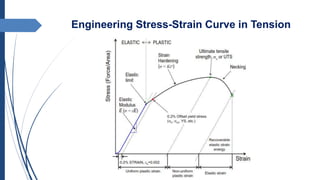
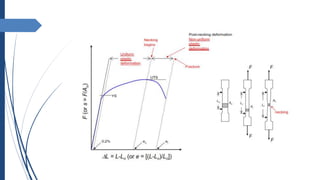
Engineering Stress-Strain Curve in Tension
 Elastic deformation up to elastic limit.
 Plastic deformation after elastic limit.
 Uniform plastic deformation between elastic limit and the UTS.
 Non-uniform plastic deformation after UTS.
 In tension this non-uniform deformation is called necking.
Cont.
Strain Hardening
 The stress-strain curve (i.e., flow curve) in the region of uniform plastic deformation
does not increase proportionally with strain. The material is said to work harden (i.e.,
strain harden).
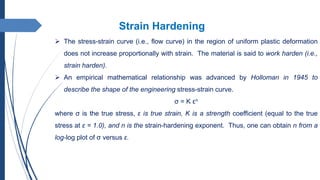
 An empirical mathematical relationship was advanced by Holloman in 1945 to
describe the shape of the engineering stress-strain curve.
σ = K εn
where σ is the true stress, ε is true strain, K is a strength coefficient (equal to the true
stress at ε = 1.0), and n is the strain-hardening exponent. Thus, one can obtain n from a
log-log plot of σ versus ε.
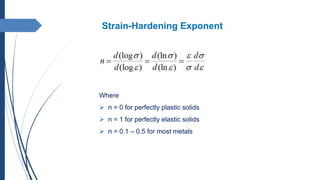
Strain-Hardening Exponent
Where
 n = 0 for perfectly plastic solids
 n = 1 for perfectly elastic solids
 n = 0.1 – 0.5 for most metals
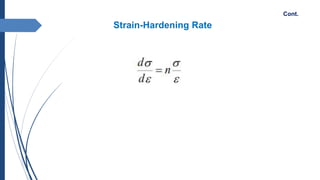
Strain-Hardening Rate
Cont.
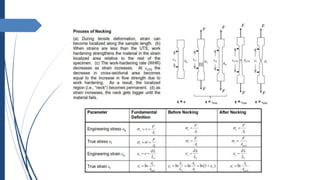
Why does necking occur?
 We can explain things mathematically by considering strength increases caused by
strain hardening and reductions in cross-sectional area caused by the Poisson effect.
 During plastic deformation, the load carrying capacity of the material increases as
strain increases due to strain-hardening.
 Strain hardening is opposed by the gradual decrease in the cross-sectional area of
the specimen as it gets longer.
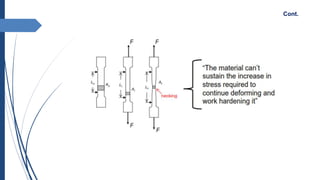
 At maximum load (i.e., the UTS on the engineering stress-strain curve) the required
increase in stress to deform the material further exceeds its load carrying capacity.
 This leads to localized plastic deformation or “necking.”
 Necking represents “unstable” flow (deformation)
Cont.
Cont.
Criteria for Necking
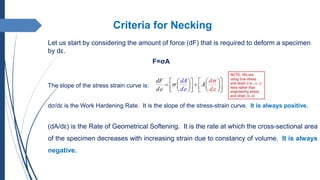
Let us start by considering the amount of force (dF) that is required to deform a specimen
by dε.
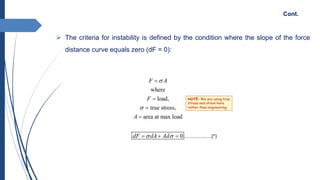
F=σA
The slope of the stress strain curve is:
dσ/dε is the Work Hardening Rate. It is the slope of the stress-strain curve. It is always positive.
(dA/dε) is the Rate of Geometrical Softening. It is the rate at which the cross-sectional area
of the specimen decreases with increasing strain due to constancy of volume. It is always
negative.
 Local ↓ in A (i.e., deformation) causes that region to strain harden locally (relative to
the rest of the cross section). The remainder of the cross section then deforms until
a uniform cross-section is re-established.
 The rate balance at the UTS [(dA/dε) = dσ/dε)].
 When (dA/dε) > (dσ/dε), deformation becomes unstable. The material cannot strain
harden fast enough to inhibit necking.
Cont.
 The criteria for instability is defined by the condition where the slope of the force
distance curve equals zero (dF = 0):
Cont.
Cont.
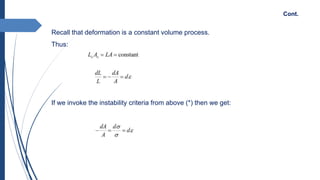
Recall that deformation is a constant volume process.
Thus:
If we invoke the instability criteria from above (*) then we get:
Cont.
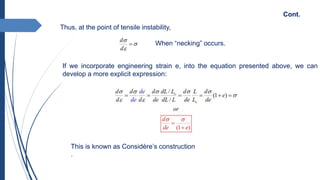
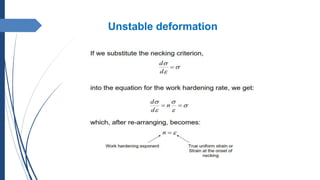
Thus, at the point of tensile instability,
When “necking” occurs.
If we incorporate engineering strain e, into the equation presented above, we can
develop a more explicit expression:
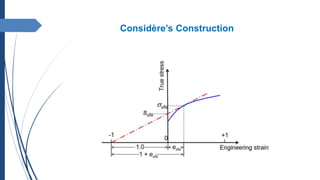
This is known as Considère’s construction
.
Considère’s Construction
Unstable deformation
• We’ve already considered the strain hardening exponent. We’ve noted how it increases
with increasing strength and, as you will learn later, decreasing dislocation mobility.
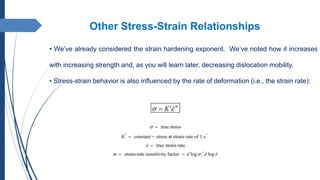
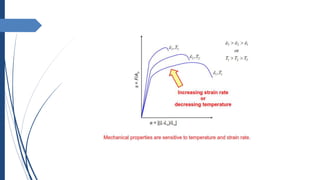
• Stress-strain behavior is also influenced by the rate of deformation (i.e., the strain rate):
Other Stress-Strain Relationships
References:
Authors of Technical articles and Scopus Journals are
Acknowledged.
Thank You

Stress-strain curves-Plastic deformation

  • 1.
    Stress-Strain Curves &Plastic Deformation Mr. MANICKAVASAHAM G, B.E., M.E., (Ph.D.) Assistant Professor, Department of Mechanical Engineering, Mookambigai College of Engineering, Pudukkottai-622502, Tamil Nadu, India. Email:mv8128351@gmail.com Dr. R.Narayanasamy, B.E., M.Tech., M.Engg., Ph.D., (D.Sc.) Retired Professor (HAG), Department of Production Engineering, National Institute of Technology, Tiruchirappalli-620015, Tamil Nadu, India. Email: narayan19355@gmail.com
  • 2.
  • 3.
     Elastic deformationup to elastic limit.  Plastic deformation after elastic limit.  Uniform plastic deformation between elastic limit and the UTS.  Non-uniform plastic deformation after UTS.  In tension this non-uniform deformation is called necking. Cont.
  • 4.
    Strain Hardening  Thestress-strain curve (i.e., flow curve) in the region of uniform plastic deformation does not increase proportionally with strain. The material is said to work harden (i.e., strain harden).  An empirical mathematical relationship was advanced by Holloman in 1945 to describe the shape of the engineering stress-strain curve. σ = K εn where σ is the true stress, ε is true strain, K is a strength coefficient (equal to the true stress at ε = 1.0), and n is the strain-hardening exponent. Thus, one can obtain n from a log-log plot of σ versus ε.
  • 5.
    Strain-Hardening Exponent Where  n= 0 for perfectly plastic solids  n = 1 for perfectly elastic solids  n = 0.1 – 0.5 for most metals
  • 6.
  • 8.
    Why does neckingoccur?  We can explain things mathematically by considering strength increases caused by strain hardening and reductions in cross-sectional area caused by the Poisson effect.  During plastic deformation, the load carrying capacity of the material increases as strain increases due to strain-hardening.  Strain hardening is opposed by the gradual decrease in the cross-sectional area of the specimen as it gets longer.
  • 9.
     At maximumload (i.e., the UTS on the engineering stress-strain curve) the required increase in stress to deform the material further exceeds its load carrying capacity.  This leads to localized plastic deformation or “necking.”  Necking represents “unstable” flow (deformation) Cont.
  • 10.
  • 11.
    Criteria for Necking Letus start by considering the amount of force (dF) that is required to deform a specimen by dε. F=σA The slope of the stress strain curve is: dσ/dε is the Work Hardening Rate. It is the slope of the stress-strain curve. It is always positive. (dA/dε) is the Rate of Geometrical Softening. It is the rate at which the cross-sectional area of the specimen decreases with increasing strain due to constancy of volume. It is always negative.
  • 12.
     Local ↓in A (i.e., deformation) causes that region to strain harden locally (relative to the rest of the cross section). The remainder of the cross section then deforms until a uniform cross-section is re-established.  The rate balance at the UTS [(dA/dε) = dσ/dε)].  When (dA/dε) > (dσ/dε), deformation becomes unstable. The material cannot strain harden fast enough to inhibit necking. Cont.
  • 13.
     The criteriafor instability is defined by the condition where the slope of the force distance curve equals zero (dF = 0): Cont.
  • 14.
    Cont. Recall that deformationis a constant volume process. Thus: If we invoke the instability criteria from above (*) then we get:
  • 15.
    Cont. Thus, at thepoint of tensile instability, When “necking” occurs. If we incorporate engineering strain e, into the equation presented above, we can develop a more explicit expression: This is known as Considère’s construction .
  • 16.
  • 17.
  • 19.
    • We’ve alreadyconsidered the strain hardening exponent. We’ve noted how it increases with increasing strength and, as you will learn later, decreasing dislocation mobility. • Stress-strain behavior is also influenced by the rate of deformation (i.e., the strain rate): Other Stress-Strain Relationships
  • 21.
    References: Authors of Technicalarticles and Scopus Journals are Acknowledged. Thank You