O
TRANSFORMING TEACHER PREPARATION:
A COLLECTIVE CASE STUDY
OF
COOPERATING TEACHERS AND TEACHER CANDIDATES
IN THE CO-TEACHING
MODEL OF STUDENT TEACHING
Dr. Kelly Meyers-Wagner
California State University, Fullerton Monthly Colloquium Series
April 8, 2015
RESEARCHER’S
BACKGROUND
ACADEMIC BACKGROUND
Ed.D. Pre K-12 Leadership Candidate (2014)
M.A. Special Education
B.A. German & Education
CREDENTIALS
Ryan Multiple Subject
LH Special Education
Administrative Services (pending)
National Board Certified Teacher
PROFESSIONAL EXPERIENCE
Elementary School Teacher (1991-2003)
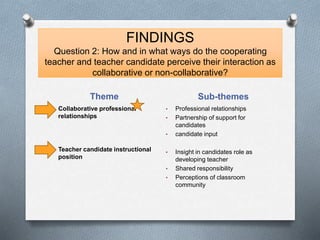
University Instructor /and Supervisor in Teacher Education (2003-present)
SPORT East-Regional Educational Consultant, Suicide Prevention LACOE
(2013-2015)
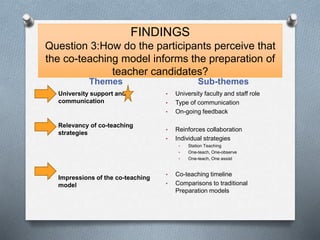
Educational Consultant for PROJECT TEAL-Technology Enhanced Arts
Learning in Common Core LACOE (2015-present)
Topic Background-History
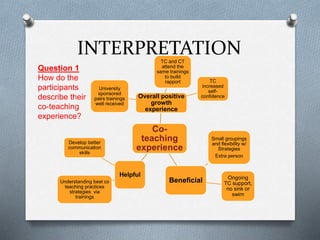
Since 20th C ,
student teaching
practicum and field
placement
experience has
been the standard
“Sink or swim
approach”
Cooperating
teachers are
randomly assigned
to teacher
candidates based on
subjective judgments
about teaching
NCLB raised the
stature of the
teaching
profession
addressing
teacher quality
and
accountability
Need for teacher preparation programs to produce
highly skilled teachers meeting the needs of a very
diverse U.S. population is significant.
Topic Background-History
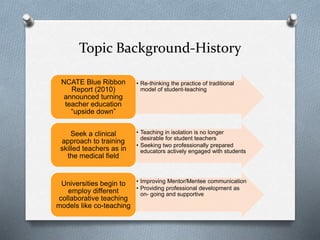
• Re-thinking the practice of traditional
model of student-teaching
NCATE Blue Ribbon
Report (2010)
announced turning
teacher education
“upside down”
• Teaching in isolation is no longer
desirable for student teachers
• Seeking two professionally prepared
educators actively engaged with students
Seek a clinical
approach to training
skilled teachers as in
the medical field
• Improving Mentor/Mentee communication
• Providing professional development as
on- going and supportive
Universities begin to
employ different
collaborative teaching
models like co-teaching
PROBLEM STATEMENT
 The problem this study addressed was the
need to improve teacher preparation
especially with respect to the collaboration
of the cooperating teacher and teacher
candidate.
PURPOSE OF THE RESEARCH
 The purpose of this study was to
investigate the partnership between the
cooperating teacher and teacher
candidates among participants trained in a
variety of co-teaching models from the
participating university with a focus on the
participants co-teaching interactions and
how this is demonstrated in the learning
environment.
RESEARCH QUESTIONS
1) How do participants describe their co-
teaching experience?
2) How and in what ways do the
cooperating teacher and teacher
candidate perceive their interaction as
collaborative or non-collaborative?
3) How do the participants perceive that
the co-teaching model informs the
preparation of teacher candidates?
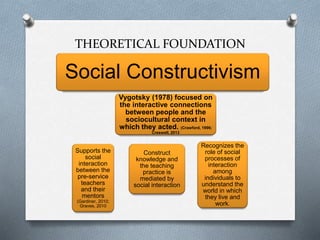
THEORETICAL FOUNDATION
Social Constructivism
Construct
knowledge and
the teaching
practice is
mediated by
social interaction
Supports the
social
interaction
between the
pre-service
teachers
and their
mentors
(Gardiner, 2010;
Graves, 2010
Vygotsky (1978) focused on
the interactive connections
between people and the
sociocultural context in
which they acted. (Crawford, 1996;
Creswell, 2013
Recognizes the
role of social
processes of
interaction
among
individuals to
understand the
world in which
they live and
work.
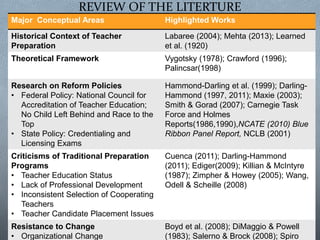
Major Conceptual Areas Highlighted Works
Historical Context of Teacher
Preparation
Labaree (2004); Mehta (2013); Learned
et al. (1920)
Theoretical Framework Vygotsky (1978); Crawford (1996);
Palincsar(1998)
Research on Reform Policies
• Federal Policy: National Council for
Accreditation of Teacher Education;
No Child Left Behind and Race to the
Top
• State Policy: Credentialing and
Licensing Exams
Hammond-Darling et al. (1999); Darling-
Hammond (1997, 2011); Maxie (2003);
Smith & Gorad (2007); Carnegie Task
Force and Holmes
Reports(1986,1990),NCATE (2010) Blue
Ribbon Panel Report, NCLB (2001)
Criticisms of Traditional Preparation
Programs
• Teacher Education Status
• Lack of Professional Development
• Inconsistent Selection of Cooperating
Teachers
• Teacher Candidate Placement Issues
Cuenca (2011); Darling-Hammond
(2011); Ediger(2009); Killian & McIntyre
(1987); Zimpher & Howey (2005); Wang,
Odell & Scheille (2008)
Resistance to Change
• Organizational Change
Boyd et al. (2008); DiMaggio & Powell
(1983); Salerno & Brock (2008); Spiro
REVIEW OF THE LITERTURE
REVIEW OF THE LITERATURE
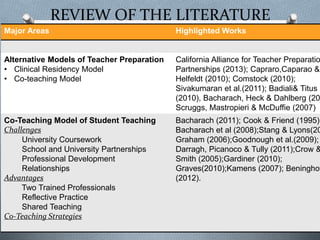
Major Areas Highlighted Works
Alternative Models of Teacher Preparation
• Clinical Residency Model
• Co-teaching Model
California Alliance for Teacher Preparatio
Partnerships (2013); Capraro,Caparao &
Helfeldt (2010); Comstock (2010);
Sivakumaran et al.(2011); Badiali& Titus
(2010), Bacharach, Heck & Dahlberg (20
Scruggs, Mastropieri & McDuffie (2007)
Co-Teaching Model of Student Teaching
Challenges
University Coursework
School and University Partnerships
Professional Development
Relationships
Advantages
Two Trained Professionals
Reflective Practice
Shared Teaching
Co-Teaching Strategies
Bacharach (2011); Cook & Friend (1995);
Bacharach et al (2008);Stang & Lyons(20
Graham (2006);Goodnough et al.(2009);
Darragh, Picanoco & Tully (2011);Crow &
Smith (2005);Gardiner (2010);
Graves(2010);Kamens (2007); Beninghof
(2012).
RESEARCH DESIGN
Collective Case
Study
Stake (1995) states
that a collective
study is “several
cases within the
same project”(p.4).
One issue or
concern is selected,
but the inquirer
selects multiple
cases to illustrate
the issues
Researcher talks
directly to people in
their “natural
settings, attempting
to make sense of, or
interpret,
phenomena in terms
of the meanings
people bring to
them”(Denzin & Lincoln,
2011, as cited in Creswell,
2013, p.44).
Creswell (2013)
wrote, “we conduct
qualitative research
when we want to
empower individuals
to share their stories,
hear their voices...”
(p.48).
METHODOLOGY
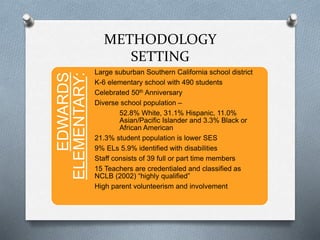
SETTING
EDWARDS
ELEMENTARY:
Large suburban Southern California school district
K-6 elementary school with 490 students
Celebrated 50th Anniversary
Diverse school population –
52.8% White, 31.1% Hispanic, 11.0%
Asian/Pacific Islander and 3.3% Black or
African American
21.3% student population is lower SES
9% ELs 5.9% identified with disabilities
Staff consists of 39 full or part time members
15 Teachers are credentialed and classified as
NCLB (2002) “highly qualified”
High parent volunteerism and involvement
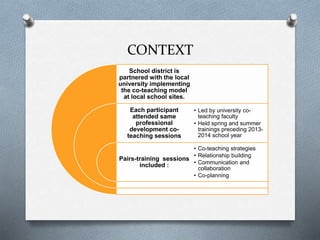
CONTEXT
School district is
partnered with the local
university implementing
the co-teaching model
at local school sites.
Each participant
attended same
professional
development co-
teaching sessions
Pairs-training sessions
included :
• Led by university co-
teaching faculty
• Held spring and summer
trainings preceding 2013-
2014 school year
• Co-teaching strategies
• Relationship building
• Communication and
collaboration
• Co-planning
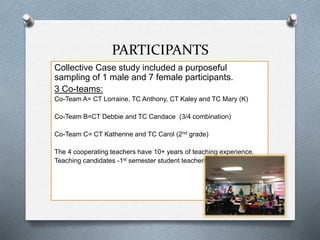
PARTICIPANTS
Collective Case study included a purposeful
sampling of 1 male and 7 female participants.
3 Co-teams:
Co-Team A= CT Lorraine, TC Anthony, CT Kaley and TC Mary (K)
Co-Team B=CT Debbie and TC Candace (3/4 combination)
Co-Team C= CT Katherine and TC Carol (2nd grade)
The 4 cooperating teachers have 10+ years of teaching experience.
Teaching candidates -1st semester student teachers
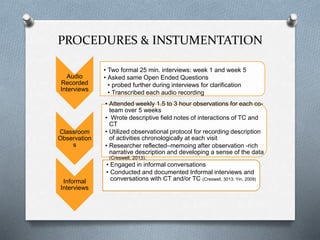
PROCEDURES & INSTUMENTATION
Audio
Recorded
Interviews
• Two formal 25 min. interviews: week 1 and week 5
• Asked same Open Ended Questions
• probed further during interviews for clarification
• Transcribed each audio recording
Classroom
Observation
s
• Attended weekly 1.5 to 3 hour observations for each co-
team over 5 weeks
• Wrote descriptive field notes of interactions of TC and
CT
• Utilized observational protocol for recording description
of activities chronologically at each visit
• Researcher reflected–memoing after observation -rich
narrative description and developing a sense of the data
(Creswell, 2013).
Informal
Interviews
• Engaged in informal conversations
• Conducted and documented Informal interviews and
conversations with CT and/or TC (Creswell, 3013; Yin, 2009)
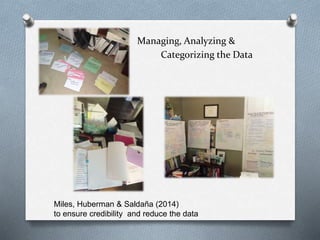
Managing, Analyzing &
Categorizing the Data
Miles, Huberman & Saldaña (2014)
to ensure credibility and reduce the data
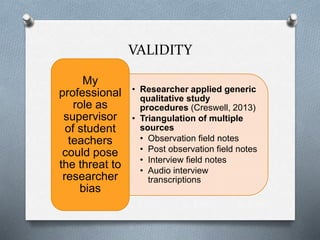
VALIDITY
• Researcher applied generic
qualitative study
procedures (Creswell, 2013)
• Triangulation of multiple
sources
• Observation field notes
• Post observation field notes
• Interview field notes
• Audio interview
transcriptions
My
professional
role as
supervisor
of student
teachers
could pose
the threat to
researcher
bias
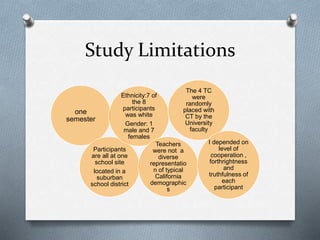
Study Limitations
one
semester
Participants
are all at one
school site
located in a
suburban
school district
Ethnicity:7 of
the 8
participants
was white
Gender: 1
male and 7
females
Teachers
were not a
diverse
representatio
n of typical
California
demographic
s
The 4 TC
were
randomly
placed with
CT by the
University
faculty
I depended on
level of
cooperation ,
forthrightness
and
truthfulness of
each
participant
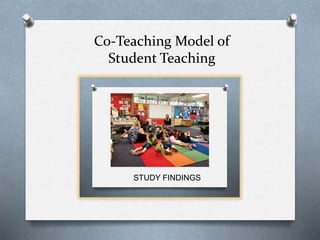
Co-Teaching Model of
Student Teaching
STUDY FINDINGS
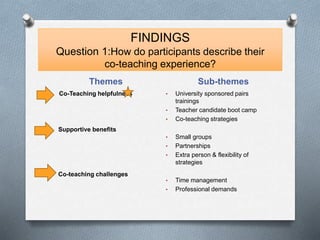
FINDINGS
Question 1:How do participants describe their
co-teaching experience?
Themes Sub-themes
Co-Teaching helpfulness
• Supportive benefits
• Co-teaching challenges
• University sponsored pairs
trainings
• Teacher candidate boot camp
• Co-teaching strategies
• Small groups
• Partnerships
• Extra person & flexibility of
strategies
• Time management
• Professional demands
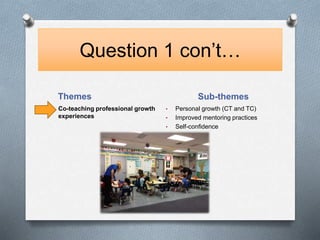
Question 1 con’t…
Themes Sub-themes
• Co-teaching professional growth
experiences
• Personal growth (CT and TC)
• Improved mentoring practices
• Self-confidence
Question 1: The Co-Teaching Experience
“Helpfulness”
• We [teacher candidate and cooperating teacher] got to
know each other’s personalities and probably learning
styles…fears, strengths and challenges that we were
comfortable with….We were able to talk about ways to
communicate when in the classroom...and ways to give
constructive criticism….just having that communication with
my student teacher before we’re even in the classroom is
[was] so helpful (Cooperating Teacher Lorraine, April 2014).
• …it [the pairs-training] would have been a little bit awkward
not really knowing each other [in the classroom]…. it got me
to meet my master teacher and we got to build some
rapport which was really nice….I liked just being able to see
those [co-teaching] strategies and then just go out and try
to employ them in the classroom (Teacher Candidate
Anthony, April 2014.
FINDINGS
Question 2: How and in what ways do the cooperating
teacher and teacher candidate perceive their interaction as
collaborative or non-collaborative?
Theme Sub-themes
• Collaborative professional
relationships
• Teacher candidate instructional
position
• Professional relationships
• Partnership of support for
candidates
• candidate input
• Insight in candidates role as
developing teacher
• Shared responsibility
• Perceptions of classroom
community
Question 2: Co-teaching Interactions
“Professional Relationships”
• Cooperating Teacher Katherine said, “it’s [co-
teaching] like a partnership but I have more
experience….I’m there to support her but if not she
tries it on her own and the best way to learn to be a
teacher is to make those mistakes and try it and find
out what to do” (April, 2014).
• Cooperating Teacher Debbie explained, “I’m there to
support them [teacher candidates] and that every
idea that I give them to not take it personal. You
[teacher candidate] are going to make mistakes. And
don’t worry if I jump into help or whatever….We need
to have a conversation so that we can move forward
for our job. It’s not like a family, it is different. This is
our professional life” (May, 2014).
Question 2: Co-teaching Interactions
“Professional Relationships”
Teacher Candidate Candace stated in her interview,
It is very professional…she can take me seriously.
I don’t want to come across as being too open
about personal things…. I wouldn’t just come in and
just do whatever I wanted….We’re doing it
together…we’re co-teaching… We do
collaborate…on the lessons that we are going to
teach. She [Debbie] has them pretty much planned
already…because it is so far into the school year,
she knows what she needs to be teaching, but she
will say what do you want to put into this lesson? I
can go home and create something on my
own…and find a new idea because we have
collaborated ( April, 2014)
FINDINGS
Question 3:How do the participants perceive that
the co-teaching model informs the preparation of
teacher candidates?
Themes Sub-themes
• University support and
communication
• Relevancy of co-teaching
strategies
• Impressions of the co-teaching
model
• University faculty and staff role
• Type of communication
• On-going feedback
• Reinforces collaboration
• Individual strategies
• Station Teaching
• One-teach, One-observe
• One-teach, One assist
• Co-teaching timeline
• Comparisons to traditional
Preparation models
Question 3: Perception of the Co-Teaching
Model
“University Support and Communication”
• Cooperating Teacher Kaley “faculty sent
weekly emails …this is what you should be
working on this week. Here are videos to
see…go with it, if you are not sure what was
modeled…(April, 2014)”
• Cooperating Teacher Debbie reported that the
university sent her emails to inform her, for
example, “of this new link that we can go to if
we need to see models [co-teaching
strategies] and they gave us a folder with all
sorts of information.(April, 2014)
Question 3: Perception of the Co-Teaching
Model
“University Support and Communication”
O I don’t feel like I learned much this semester
which is unfortunate. I do not feel like I was
taught to teach…I was taught about teaching
but not given any methods on really how to
implement and how to teach…Throughout the
semester our professors should have invited
maybe one of our other professors…to come
and model these [co-teaching strategies] for
us….Aside from the readings we did at home
in the book….I really don’t feel like we applied
or even talked much about the
strategies….(Teacher Candidate Carol, May
2014).
INTERPRETATION
Co-
teaching
experience
Overall positive
growth
experience
University
sponsored
pairs trainings
well received
TC and CT
attend the
same trainings
to build
rapport TC
increased
self-
confidence
Beneficial
Small groupings
and flexibility w/
Strategies
Extra person
Ongoing
TC support,
no sink or
swim
Helpful
Understanding best co
teaching practices
strategies via
trainings
Develop better
communication
skills
Question 1
How do the
participants
describe their
co-teaching
experience?
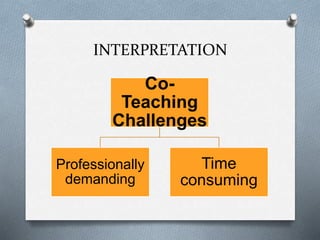
INTERPRETATION
Co-
Teaching
Challenges
Professionally
demanding
Time
consuming
INTERPRETATION
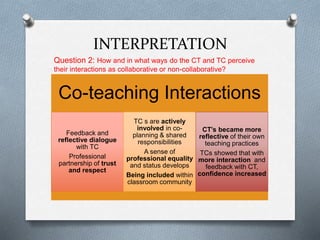
Co-teaching Interactions
Feedback and
reflective dialogue
with TC
Professional
partnership of trust
and respect
TC s are actively
involved in co-
planning & shared
responsibilities
A sense of
professional equality
and status develops
Being included within
classroom community
CT’s became more
reflective of their own
teaching practices
TCs showed that with
more interaction and
feedback with CT,
confidence increased
Question 2: How and in what ways do the CT and TC perceive
their interactions as collaborative or non-collaborative?
TEACHER COLLABORATION &
INTERACTION
We both enjoyed having the interaction and we thought it
was great for the kids [students] to see how we
cooperate…how we discuss things to work in a
cooperative manner, how we would treat each
other….We modeled for them appropriate behavior
working together as a team….Kids are seeing the
collaboration that is going on, the cooperation that is
going on between the two teachers…like were are doing
the tag team…how we can show respect to each
other…through the models [strategies]that we are doing.
(Cooperating Teacher Lorraine, May, 2014)
INTERPRETATION
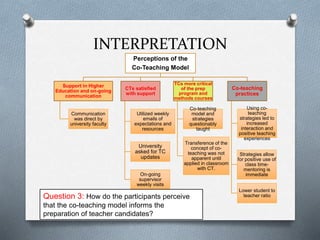
Perceptions of the
Co-Teaching Model
Support in Higher
Education and on-going
communication
Communication
was direct by
university faculty
CTs satisfied
with support
Utilized weekly
emails of
expectations and
resources
University
asked for TC
updates
On-going
supervisor
weekly visits
TCs more critical
of the prep
program and
methods courses
Co-teaching
model and
strategies
questionably
taught
Transference of the
concept of co-
teaching was not
apparent until
applied in classroom
with CT.
Co-teaching
practices
Using co-
teaching
strategies led to
increased
interaction and
positive teaching
experiences
Strategies allow
for positive use of
class time-
mentoring is
immediate
Lower student to
teacher ratioQuestion 3: How do the participants perceive
that the co-teaching model informs the
preparation of teacher candidates?
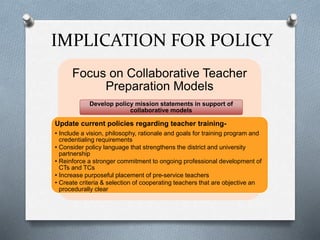
IMPLICATION FOR POLICY
Focus on Collaborative Teacher
Preparation Models
Develop policy mission statements in support of
collaborative models
Update current policies regarding teacher training-
• Include a vision, philosophy, rationale and goals for training program and
credentialing requirements
• Consider policy language that strengthens the district and university
partnership
• Reinforce a stronger commitment to ongoing professional development of
CTs and TCs
• Increase purposeful placement of pre-service teachers
• Create criteria & selection of cooperating teachers that are objective an
procedurally clear
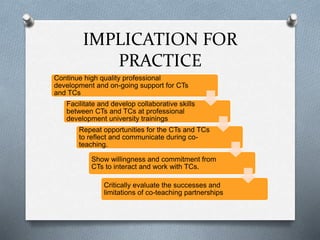
IMPLICATION FOR
PRACTICE
Continue high quality professional
development and on-going support for CTs
and TCs
Facilitate and develop collaborative skills
between CTs and TCs at professional
development university trainings
Repeat opportunities for the CTs and TCs
to reflect and communicate during co-
teaching.
Show willingness and commitment from
CTs to interact and work with TCs.
Critically evaluate the successes and
limitations of co-teaching partnerships
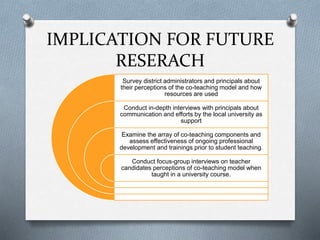
IMPLICATION FOR FUTURE
RESERACH
Survey district administrators and principals about
their perceptions of the co-teaching model and how
resources are used
Conduct in-depth interviews with principals about
communication and efforts by the local university as
support
Examine the array of co-teaching components and
assess effectiveness of ongoing professional
development and trainings prior to student teaching.
Conduct focus-group interviews on teacher
candidates perceptions of co-teaching model when
taught in a university course.
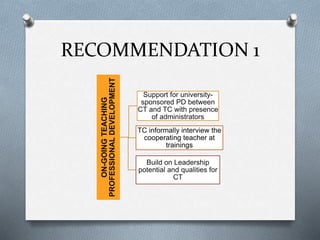
RECOMMENDATION 1
ON-GOINGTEACHING
PROFESSIONALDEVELOPMENT
Support for university-
sponsored PD between
CT and TC with presence
of administrators
TC informally interview the
cooperating teacher at
trainings
Build on Leadership
potential and qualities for
CT
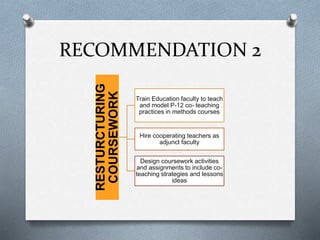
RECOMMENDATION 2
RESTURCTURING
COURSEWORK
Train Education faculty to teach
and model P-12 co- teaching
practices in methods courses
Hire cooperating teachers as
adjunct faculty
Design coursework activities
and assignments to include co-
teaching strategies and lessons
ideas
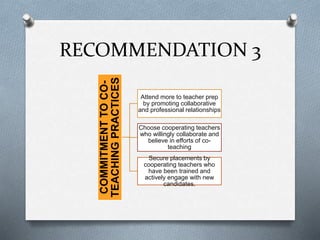
RECOMMENDATION 3
COMMITMENTTOCO-
TEACHINGPRACTICES
Attend more to teacher prep
by promoting collaborative
and professional relationships
Choose cooperating teachers
who willingly collaborate and
believe in efforts of co-
teaching
Secure placements by
cooperating teachers who
have been trained and
actively engage with new
candidates.
When my principal brought it [co-teaching] to the table
initially, it sounded intriguing. It sounded different, but
now that we’re [the teachers] in the midst of it, it’s blown
my expectation away as far as the positiveness of how
this program is so much different than the one of years
past…I hope it’s one that’s taken by other universities
because I can just see how much more positive it is in so
many different ways than just the typical student
teaching plan that I went through (Cooperating Teacher
Lorraine, April, 2014).
CONCLUSION
REFERENCES
Corbin, J., & Strauss, A. (2008). Basics of qualitative
research (3rd ed.). Thousand Oaks, CA: Sage.
Creswell, J. (2013). Qualitative inquiry and research
design: Choosing among five approaches (3rd ed.). Los
Angeles: Sage.
Denzin, N., & Lincoln, Y. (2005). Introduction: The discipline
and practice of qualitative research. In N. Denzin,
& Y. Lincoln, The Sage Handbook of Qualitative
Research (3rd ed., pp. 1-32). Thousand Oaks:
Sage. Merriam, S. (1998). Qualitative research and case
study applications in education. San Francisco: Josey-
Bass Publishers.
Miles, M., & Huberman, A. & Saldaña (2014). Qualitative
data
analysis (3rd ed.). Thousand Oaks, CA: Sage.
Yin, R. (2009). Case study research design and methods
(4th ed.). Thousand Oaks, CA: Sage.
THANK YOU

Transforming Teacher Preparation: A Collective Case Study of Cooperating Teachers and Teacher Candidates in the Co-Teaching Model of Student Teaching by Dr. Kelly Meyers-Wagner

  • 1.
    O TRANSFORMING TEACHER PREPARATION: ACOLLECTIVE CASE STUDY OF COOPERATING TEACHERS AND TEACHER CANDIDATES IN THE CO-TEACHING MODEL OF STUDENT TEACHING Dr. Kelly Meyers-Wagner California State University, Fullerton Monthly Colloquium Series April 8, 2015
  • 2.
    RESEARCHER’S BACKGROUND ACADEMIC BACKGROUND Ed.D. PreK-12 Leadership Candidate (2014) M.A. Special Education B.A. German & Education CREDENTIALS Ryan Multiple Subject LH Special Education Administrative Services (pending) National Board Certified Teacher PROFESSIONAL EXPERIENCE Elementary School Teacher (1991-2003) University Instructor /and Supervisor in Teacher Education (2003-present) SPORT East-Regional Educational Consultant, Suicide Prevention LACOE (2013-2015) Educational Consultant for PROJECT TEAL-Technology Enhanced Arts Learning in Common Core LACOE (2015-present)
  • 3.
    Topic Background-History Since 20thC , student teaching practicum and field placement experience has been the standard “Sink or swim approach” Cooperating teachers are randomly assigned to teacher candidates based on subjective judgments about teaching NCLB raised the stature of the teaching profession addressing teacher quality and accountability Need for teacher preparation programs to produce highly skilled teachers meeting the needs of a very diverse U.S. population is significant.
  • 4.
    Topic Background-History • Re-thinkingthe practice of traditional model of student-teaching NCATE Blue Ribbon Report (2010) announced turning teacher education “upside down” • Teaching in isolation is no longer desirable for student teachers • Seeking two professionally prepared educators actively engaged with students Seek a clinical approach to training skilled teachers as in the medical field • Improving Mentor/Mentee communication • Providing professional development as on- going and supportive Universities begin to employ different collaborative teaching models like co-teaching
  • 5.
    PROBLEM STATEMENT  Theproblem this study addressed was the need to improve teacher preparation especially with respect to the collaboration of the cooperating teacher and teacher candidate.
  • 6.
    PURPOSE OF THERESEARCH  The purpose of this study was to investigate the partnership between the cooperating teacher and teacher candidates among participants trained in a variety of co-teaching models from the participating university with a focus on the participants co-teaching interactions and how this is demonstrated in the learning environment.
  • 7.
    RESEARCH QUESTIONS 1) Howdo participants describe their co- teaching experience? 2) How and in what ways do the cooperating teacher and teacher candidate perceive their interaction as collaborative or non-collaborative? 3) How do the participants perceive that the co-teaching model informs the preparation of teacher candidates?
  • 8.
    THEORETICAL FOUNDATION Social Constructivism Construct knowledgeand the teaching practice is mediated by social interaction Supports the social interaction between the pre-service teachers and their mentors (Gardiner, 2010; Graves, 2010 Vygotsky (1978) focused on the interactive connections between people and the sociocultural context in which they acted. (Crawford, 1996; Creswell, 2013 Recognizes the role of social processes of interaction among individuals to understand the world in which they live and work.
  • 9.
    Major Conceptual AreasHighlighted Works Historical Context of Teacher Preparation Labaree (2004); Mehta (2013); Learned et al. (1920) Theoretical Framework Vygotsky (1978); Crawford (1996); Palincsar(1998) Research on Reform Policies • Federal Policy: National Council for Accreditation of Teacher Education; No Child Left Behind and Race to the Top • State Policy: Credentialing and Licensing Exams Hammond-Darling et al. (1999); Darling- Hammond (1997, 2011); Maxie (2003); Smith & Gorad (2007); Carnegie Task Force and Holmes Reports(1986,1990),NCATE (2010) Blue Ribbon Panel Report, NCLB (2001) Criticisms of Traditional Preparation Programs • Teacher Education Status • Lack of Professional Development • Inconsistent Selection of Cooperating Teachers • Teacher Candidate Placement Issues Cuenca (2011); Darling-Hammond (2011); Ediger(2009); Killian & McIntyre (1987); Zimpher & Howey (2005); Wang, Odell & Scheille (2008) Resistance to Change • Organizational Change Boyd et al. (2008); DiMaggio & Powell (1983); Salerno & Brock (2008); Spiro REVIEW OF THE LITERTURE
  • 10.
    REVIEW OF THELITERATURE Major Areas Highlighted Works Alternative Models of Teacher Preparation • Clinical Residency Model • Co-teaching Model California Alliance for Teacher Preparatio Partnerships (2013); Capraro,Caparao & Helfeldt (2010); Comstock (2010); Sivakumaran et al.(2011); Badiali& Titus (2010), Bacharach, Heck & Dahlberg (20 Scruggs, Mastropieri & McDuffie (2007) Co-Teaching Model of Student Teaching Challenges University Coursework School and University Partnerships Professional Development Relationships Advantages Two Trained Professionals Reflective Practice Shared Teaching Co-Teaching Strategies Bacharach (2011); Cook & Friend (1995); Bacharach et al (2008);Stang & Lyons(20 Graham (2006);Goodnough et al.(2009); Darragh, Picanoco & Tully (2011);Crow & Smith (2005);Gardiner (2010); Graves(2010);Kamens (2007); Beninghof (2012).
  • 11.
    RESEARCH DESIGN Collective Case Study Stake(1995) states that a collective study is “several cases within the same project”(p.4). One issue or concern is selected, but the inquirer selects multiple cases to illustrate the issues Researcher talks directly to people in their “natural settings, attempting to make sense of, or interpret, phenomena in terms of the meanings people bring to them”(Denzin & Lincoln, 2011, as cited in Creswell, 2013, p.44). Creswell (2013) wrote, “we conduct qualitative research when we want to empower individuals to share their stories, hear their voices...” (p.48).
  • 12.
    METHODOLOGY SETTING EDWARDS ELEMENTARY: Large suburban SouthernCalifornia school district K-6 elementary school with 490 students Celebrated 50th Anniversary Diverse school population – 52.8% White, 31.1% Hispanic, 11.0% Asian/Pacific Islander and 3.3% Black or African American 21.3% student population is lower SES 9% ELs 5.9% identified with disabilities Staff consists of 39 full or part time members 15 Teachers are credentialed and classified as NCLB (2002) “highly qualified” High parent volunteerism and involvement
  • 13.
    CONTEXT School district is partneredwith the local university implementing the co-teaching model at local school sites. Each participant attended same professional development co- teaching sessions Pairs-training sessions included : • Led by university co- teaching faculty • Held spring and summer trainings preceding 2013- 2014 school year • Co-teaching strategies • Relationship building • Communication and collaboration • Co-planning
  • 14.
    PARTICIPANTS Collective Case studyincluded a purposeful sampling of 1 male and 7 female participants. 3 Co-teams: Co-Team A= CT Lorraine, TC Anthony, CT Kaley and TC Mary (K) Co-Team B=CT Debbie and TC Candace (3/4 combination) Co-Team C= CT Katherine and TC Carol (2nd grade) The 4 cooperating teachers have 10+ years of teaching experience. Teaching candidates -1st semester student teachers
  • 15.
    PROCEDURES & INSTUMENTATION Audio Recorded Interviews •Two formal 25 min. interviews: week 1 and week 5 • Asked same Open Ended Questions • probed further during interviews for clarification • Transcribed each audio recording Classroom Observation s • Attended weekly 1.5 to 3 hour observations for each co- team over 5 weeks • Wrote descriptive field notes of interactions of TC and CT • Utilized observational protocol for recording description of activities chronologically at each visit • Researcher reflected–memoing after observation -rich narrative description and developing a sense of the data (Creswell, 2013). Informal Interviews • Engaged in informal conversations • Conducted and documented Informal interviews and conversations with CT and/or TC (Creswell, 3013; Yin, 2009)
  • 16.
    Managing, Analyzing & Categorizingthe Data Miles, Huberman & Saldaña (2014) to ensure credibility and reduce the data
  • 17.
    VALIDITY • Researcher appliedgeneric qualitative study procedures (Creswell, 2013) • Triangulation of multiple sources • Observation field notes • Post observation field notes • Interview field notes • Audio interview transcriptions My professional role as supervisor of student teachers could pose the threat to researcher bias
  • 18.
    Study Limitations one semester Participants are allat one school site located in a suburban school district Ethnicity:7 of the 8 participants was white Gender: 1 male and 7 females Teachers were not a diverse representatio n of typical California demographic s The 4 TC were randomly placed with CT by the University faculty I depended on level of cooperation , forthrightness and truthfulness of each participant
  • 19.
    Co-Teaching Model of StudentTeaching STUDY FINDINGS
  • 20.
    FINDINGS Question 1:How doparticipants describe their co-teaching experience? Themes Sub-themes Co-Teaching helpfulness • Supportive benefits • Co-teaching challenges • University sponsored pairs trainings • Teacher candidate boot camp • Co-teaching strategies • Small groups • Partnerships • Extra person & flexibility of strategies • Time management • Professional demands
  • 21.
    Question 1 con’t… ThemesSub-themes • Co-teaching professional growth experiences • Personal growth (CT and TC) • Improved mentoring practices • Self-confidence
  • 22.
    Question 1: TheCo-Teaching Experience “Helpfulness” • We [teacher candidate and cooperating teacher] got to know each other’s personalities and probably learning styles…fears, strengths and challenges that we were comfortable with….We were able to talk about ways to communicate when in the classroom...and ways to give constructive criticism….just having that communication with my student teacher before we’re even in the classroom is [was] so helpful (Cooperating Teacher Lorraine, April 2014). • …it [the pairs-training] would have been a little bit awkward not really knowing each other [in the classroom]…. it got me to meet my master teacher and we got to build some rapport which was really nice….I liked just being able to see those [co-teaching] strategies and then just go out and try to employ them in the classroom (Teacher Candidate Anthony, April 2014.
  • 23.
    FINDINGS Question 2: Howand in what ways do the cooperating teacher and teacher candidate perceive their interaction as collaborative or non-collaborative? Theme Sub-themes • Collaborative professional relationships • Teacher candidate instructional position • Professional relationships • Partnership of support for candidates • candidate input • Insight in candidates role as developing teacher • Shared responsibility • Perceptions of classroom community
  • 24.
    Question 2: Co-teachingInteractions “Professional Relationships” • Cooperating Teacher Katherine said, “it’s [co- teaching] like a partnership but I have more experience….I’m there to support her but if not she tries it on her own and the best way to learn to be a teacher is to make those mistakes and try it and find out what to do” (April, 2014). • Cooperating Teacher Debbie explained, “I’m there to support them [teacher candidates] and that every idea that I give them to not take it personal. You [teacher candidate] are going to make mistakes. And don’t worry if I jump into help or whatever….We need to have a conversation so that we can move forward for our job. It’s not like a family, it is different. This is our professional life” (May, 2014).
  • 25.
    Question 2: Co-teachingInteractions “Professional Relationships” Teacher Candidate Candace stated in her interview, It is very professional…she can take me seriously. I don’t want to come across as being too open about personal things…. I wouldn’t just come in and just do whatever I wanted….We’re doing it together…we’re co-teaching… We do collaborate…on the lessons that we are going to teach. She [Debbie] has them pretty much planned already…because it is so far into the school year, she knows what she needs to be teaching, but she will say what do you want to put into this lesson? I can go home and create something on my own…and find a new idea because we have collaborated ( April, 2014)
  • 26.
    FINDINGS Question 3:How dothe participants perceive that the co-teaching model informs the preparation of teacher candidates? Themes Sub-themes • University support and communication • Relevancy of co-teaching strategies • Impressions of the co-teaching model • University faculty and staff role • Type of communication • On-going feedback • Reinforces collaboration • Individual strategies • Station Teaching • One-teach, One-observe • One-teach, One assist • Co-teaching timeline • Comparisons to traditional Preparation models
  • 27.
    Question 3: Perceptionof the Co-Teaching Model “University Support and Communication” • Cooperating Teacher Kaley “faculty sent weekly emails …this is what you should be working on this week. Here are videos to see…go with it, if you are not sure what was modeled…(April, 2014)” • Cooperating Teacher Debbie reported that the university sent her emails to inform her, for example, “of this new link that we can go to if we need to see models [co-teaching strategies] and they gave us a folder with all sorts of information.(April, 2014)
  • 28.
    Question 3: Perceptionof the Co-Teaching Model “University Support and Communication” O I don’t feel like I learned much this semester which is unfortunate. I do not feel like I was taught to teach…I was taught about teaching but not given any methods on really how to implement and how to teach…Throughout the semester our professors should have invited maybe one of our other professors…to come and model these [co-teaching strategies] for us….Aside from the readings we did at home in the book….I really don’t feel like we applied or even talked much about the strategies….(Teacher Candidate Carol, May 2014).
  • 29.
    INTERPRETATION Co- teaching experience Overall positive growth experience University sponsored pairs trainings wellreceived TC and CT attend the same trainings to build rapport TC increased self- confidence Beneficial Small groupings and flexibility w/ Strategies Extra person Ongoing TC support, no sink or swim Helpful Understanding best co teaching practices strategies via trainings Develop better communication skills Question 1 How do the participants describe their co-teaching experience?
  • 30.
  • 31.
    INTERPRETATION Co-teaching Interactions Feedback and reflectivedialogue with TC Professional partnership of trust and respect TC s are actively involved in co- planning & shared responsibilities A sense of professional equality and status develops Being included within classroom community CT’s became more reflective of their own teaching practices TCs showed that with more interaction and feedback with CT, confidence increased Question 2: How and in what ways do the CT and TC perceive their interactions as collaborative or non-collaborative?
  • 32.
    TEACHER COLLABORATION & INTERACTION Weboth enjoyed having the interaction and we thought it was great for the kids [students] to see how we cooperate…how we discuss things to work in a cooperative manner, how we would treat each other….We modeled for them appropriate behavior working together as a team….Kids are seeing the collaboration that is going on, the cooperation that is going on between the two teachers…like were are doing the tag team…how we can show respect to each other…through the models [strategies]that we are doing. (Cooperating Teacher Lorraine, May, 2014)
  • 33.
    INTERPRETATION Perceptions of the Co-TeachingModel Support in Higher Education and on-going communication Communication was direct by university faculty CTs satisfied with support Utilized weekly emails of expectations and resources University asked for TC updates On-going supervisor weekly visits TCs more critical of the prep program and methods courses Co-teaching model and strategies questionably taught Transference of the concept of co- teaching was not apparent until applied in classroom with CT. Co-teaching practices Using co- teaching strategies led to increased interaction and positive teaching experiences Strategies allow for positive use of class time- mentoring is immediate Lower student to teacher ratioQuestion 3: How do the participants perceive that the co-teaching model informs the preparation of teacher candidates?
  • 34.
    IMPLICATION FOR POLICY Focuson Collaborative Teacher Preparation Models Develop policy mission statements in support of collaborative models Update current policies regarding teacher training- • Include a vision, philosophy, rationale and goals for training program and credentialing requirements • Consider policy language that strengthens the district and university partnership • Reinforce a stronger commitment to ongoing professional development of CTs and TCs • Increase purposeful placement of pre-service teachers • Create criteria & selection of cooperating teachers that are objective an procedurally clear
  • 35.
    IMPLICATION FOR PRACTICE Continue highquality professional development and on-going support for CTs and TCs Facilitate and develop collaborative skills between CTs and TCs at professional development university trainings Repeat opportunities for the CTs and TCs to reflect and communicate during co- teaching. Show willingness and commitment from CTs to interact and work with TCs. Critically evaluate the successes and limitations of co-teaching partnerships
  • 36.
    IMPLICATION FOR FUTURE RESERACH Surveydistrict administrators and principals about their perceptions of the co-teaching model and how resources are used Conduct in-depth interviews with principals about communication and efforts by the local university as support Examine the array of co-teaching components and assess effectiveness of ongoing professional development and trainings prior to student teaching. Conduct focus-group interviews on teacher candidates perceptions of co-teaching model when taught in a university course.
  • 37.
    RECOMMENDATION 1 ON-GOINGTEACHING PROFESSIONALDEVELOPMENT Support foruniversity- sponsored PD between CT and TC with presence of administrators TC informally interview the cooperating teacher at trainings Build on Leadership potential and qualities for CT
  • 38.
    RECOMMENDATION 2 RESTURCTURING COURSEWORK Train Educationfaculty to teach and model P-12 co- teaching practices in methods courses Hire cooperating teachers as adjunct faculty Design coursework activities and assignments to include co- teaching strategies and lessons ideas
  • 39.
    RECOMMENDATION 3 COMMITMENTTOCO- TEACHINGPRACTICES Attend moreto teacher prep by promoting collaborative and professional relationships Choose cooperating teachers who willingly collaborate and believe in efforts of co- teaching Secure placements by cooperating teachers who have been trained and actively engage with new candidates.
  • 40.
    When my principalbrought it [co-teaching] to the table initially, it sounded intriguing. It sounded different, but now that we’re [the teachers] in the midst of it, it’s blown my expectation away as far as the positiveness of how this program is so much different than the one of years past…I hope it’s one that’s taken by other universities because I can just see how much more positive it is in so many different ways than just the typical student teaching plan that I went through (Cooperating Teacher Lorraine, April, 2014). CONCLUSION
  • 41.
    REFERENCES Corbin, J., &Strauss, A. (2008). Basics of qualitative research (3rd ed.). Thousand Oaks, CA: Sage. Creswell, J. (2013). Qualitative inquiry and research design: Choosing among five approaches (3rd ed.). Los Angeles: Sage. Denzin, N., & Lincoln, Y. (2005). Introduction: The discipline and practice of qualitative research. In N. Denzin, & Y. Lincoln, The Sage Handbook of Qualitative Research (3rd ed., pp. 1-32). Thousand Oaks: Sage. Merriam, S. (1998). Qualitative research and case study applications in education. San Francisco: Josey- Bass Publishers. Miles, M., & Huberman, A. & Saldaña (2014). Qualitative data analysis (3rd ed.). Thousand Oaks, CA: Sage. Yin, R. (2009). Case study research design and methods (4th ed.). Thousand Oaks, CA: Sage.
  • 42.

Editor's Notes

  • #4 Assuming that if one is a good teacher, this expertise will carry over to work with all pre-service teachers
  • #9 where the learner, the pre-service teacher, monitors their own practice and effectiveness through their exchange with the master teacher
  • #12 The study allow individual teachers to voice their thoughts about effective teaching practice of mentoring new teachers. The study allow individual teachers to voice their thoughts about effective teaching practice of mentoring new teachers. more detailed understanding of the issues
  • #15 Attended co-teaching pairs training before beginning fieldwork Learned about co-teaching model in their course work Met CT at pairs-training to build rapport
  • #16 “document the connection between specific pieces of evidence and various issues in the case study” by providing important insight(Yin,2009, p.122) more informal conversations-allows for a forum of discussion about co-teaching. (Creswell,2013;Yin,2009). record stories from individuals and conversations. )
  • #18 Applying rigorous, sufficient and systematic data collection Analyzing throughout data collection period Researcher applied generic qualitative study procedures (Creswell, 2013) Increase credibility and trustworthiness Rich, thick description (detailed descriptions of observations of TC and CT) Transferability ------other researchers can apply my findings to their study (Yin, 2009) Triangulation of multiple sources enhance the quality of the data and address a broader range of issues & validity of the results (Merriam, 1998; Yin, 2009): Observation field notes Post observation field notes Interview field notes Audio interview transcriptions
  • #21  Participants interviews and observed by the reseracher described their co-teaching experiences during a 5 week student teaching period. The analysis revealed 4 themes Perceptions of co-teaching helpfulness Supportive benefits Co-teaching challenges Co-teaching professional growth experiences
  • #24 How and in what ways do the cooperating teacher and teacher candidate perceive their interaction as collaborative or non-collaborative?
  • #27 How do the participants perceive that the co-teaching model informs the preparation of teacher candidates?
  • #30 Though the model is relatively new to general education student teaching experience(Bacharach et al) the co-teaching model was Benefiticial Helpful Overall positive experience for CT and TC POSITIVE HELPFUL-result of the training support for CT and mentor –university sponsored summer and pairs training was meaningful to their understanding of the best co teaching practices-better communication skills to mentor TC
  • #32 ¾ TCs reported activie invovlement and reseracher observations confirmed positive interactions and collaborative effots to instructionally share responsibility of planning and instruction of students
  • #35 Darling Hammond (2011) argue that the increasing diversity of today’s schools and prevalence of teacher accountability issues means Traditional models of learning to teach in isolation are no longer feasible NCLB and RTT—focused on accountability in requring more teaching exams and tightening teacher liscening OTHER REFORMS Wake up calls through NCQT, BRP and NCATE are wake up calls at the national level for teacher prep to internally re-evaluatie their teacher education progrmas STATE LEVEL-teacher licensing agencies, and education state legislatures-CTC that can drive change by promoting and opening the dialogue with school districts, local and state school boards of educ and universities to work more closely in developing policy mission statements among education state legislatures like teacher credentialing can drive change by opening dialogue with school districts, local and state school boards of education & state licensing agencies, and univeristiy to Focus on Collaborative Teacher Preparation Models develop policy mission statements in support of collaborative models for training and preparing teacher candidates update current policies regarding teacher training Include a vision, philosophy, rationale and goals for training program and credentialing requirements Consider policy language that strengthens the district and university partnership to be stated similar Reinforce a stronger commitment to ongoing professional development of CTs and TCs Change teacher methodology course and curriculum to emphasize consistency in co-teaching practices Encourage and recognize highly accomplished teachers to become mentors Increase the transparency of purposeful placement of pre-service teachers and the selection of cooperating teachers be procedurally clear -
  • #36 Continue high quality professional development and on-going support for CTs and TCs as it resulted in productive and positive classroom communication University training of CTs alongside their TC is crucial to facilitating and developing collaborative skills to alleviate tensions Repeat opportunities for the CTs and TCs to reflect and communicate during co-teaching. CT must show willingness to interact and work with TC. Universities and partners districts need to critically evaluate the successes and limitations of co-teaching partnerships TCs practice opportunities to observe & collaborate within their university courses. Assign faculty to model co-teaching at the school sites or hire CTs as adjunct to model co-teaching strategies.
  • #37 Surveys can provodice a broader perspective about whether districts are implementing collaborative models of teacher preparation and inform policy makers Surveying TCs and CTs for their perceptions of the trainings (pt 3) Include faculty to describe their input and perceptions of challenges and benefits of co-teaching in methods courses. (pt 4)