School District #48
(Sea to Sky)
Middle Years
Programming: Meeting the
Needs of Our Students
OUR FOCUS
 Work together with students, parents and the
community to provide a safe, respectful and
inclusive environment.
 Meet the unique needs of early adolescents.
 Provide a flexible, student-centered program
that reflects diversity and autonomy in
learning styles.
 Promote student leadership and value
excellence.
OVERVIEW:
1) Characteristics of the Early Adolescent
2) Don Ross Secondary Middle Years
Program
3) What would Grade 7 look like at
DRSS?
1) Characteristics of the Early

Adolescent
“TIME OF TRANSITION”
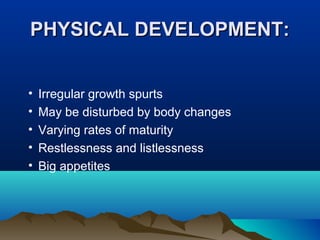
PHYSICAL DEVELOPMENT:
•
•
•
•
•

Irregular growth spurts
May be disturbed by body changes
Varying rates of maturity
Restlessness and listlessness
Big appetites
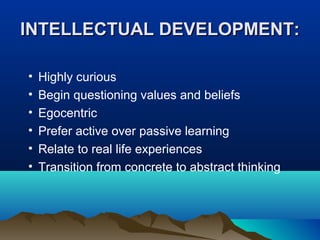
INTELLECTUAL DEVELOPMENT:
•
•
•
•
•
•

Highly curious
Begin questioning values and beliefs
Egocentric
Prefer active over passive learning
Relate to real life experiences
Transition from concrete to abstract thinking
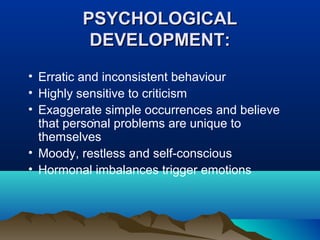
PSYCHOLOGICAL
DEVELOPMENT:
• Erratic and inconsistent behaviour
• Highly sensitive to criticism
• Exaggerate simple occurrences and believe
:
that personal problems are unique to
themselves
• Moody, restless and self-conscious
• Hormonal imbalances trigger emotions
PSYCHOLOGICAL
DEVELOPMENT:
• Optimistic and hopeful
• Searching for identity and acceptance from
peers
• Vulnerable to naïve opinions
• Psychologically “at risk”
SOCIAL DEVELOPMENT:
• May be rebellious toward authority figures
• Confused and frightened by new social
settings
• Fiercely loyal to peer group values
• May be aggressive and argumentative
• Needs frequent affirmation and the knowledge
that they are cared for.
MORAL and ETHICAL
DEVELOPMENT:
•
•
•
•

Idealistic
Strong sense of fairness
Reflective about thoughts and feelings
“At risk” in moral and ethical choices and
behaviours
• May ask large, ambiguous questions about
the meaning of life
2) Don Ross Secondary Middle
Years Program
• Focus on the unique needs of early
adolescents;
• Do not rush students into the high school
setting;
• Provide social activities that are more
compatible with the maturity levels of the
students;
• Create “smallness within bigness”
through team configurations to help
students feel connected;
• Afford younger students with the
opportunity to experience specialty
areas such as woodwork, metalwork,
cooking, sewing, drama, art, computers,
music and band.
Key Components of DRSS
Program:
Pods (Grade 8)
Advisory Program
Exploratory
Flexible Schedule
Linear Time Table
Pods (Grade 8)
• Connection/sense of belonging for
students
• Teachers have more time devoted to
fewer students.
• Common planning time for teachers
• Sharing of resources/ideas
• Consistency in expectations
• Coordination of projects and
assignments
Advisory Program
• The fourth “R”: Relationships
• Interpersonal skills
• Service to the school and community

• Connection
• To the Advisor
• To the Advisory group

• Guidance
• Appropriate choices—social responsibility
• Self esteem; virtues

• Skill Development
• Conflict resolution; communication skills, problem-solving
etc.
Exploratory
•
•
•
•
•

Technical Education
Home Economics
Computers
Project Based Learning (Grade 8)
Outdoor Education (Grade 9)
Flexible Block
• Extended periods; e.g. Double Block
(Grade 8)
• Team may coordinate schedules to allow
for guest speakers, field trips, special
projects etc.
Linear vs Semester
• Students’ intellectual capabilities grow and
change rapidly during this developmental
period
• Ability to reason, problem solve, and think
in the abstract increases measurably
during a single year.
• Linear timetable helps to buffer the effects
of this rapid change and also maximizes
the benefits across all curricular subjects
The research…
• Several large scale and comprehensive
studies demonstrate that young
adolescents who attend middle schools
that use essential programs and practices
like interdisciplinary teaming have higher
achievement scores.
• Research findings also indicate that
students in highly implemented schools
experienced fewer behaviour problems
(e.g. aggression) and reported higher
levels of self esteem as well as less fear
and worry (Felner, Jackson, Kasak,
Mulhall, Brand & Flowers, 1998).
What would Grade 7 look like at
DRSS?
• Vision provided by a committee consisting
of Grade 7 teachers from our local
elementary schools and Grade 8/9
teachers from Don Ross Secondary.
Pods:
• There would be a progression with
respect to more choices, more freedom,
and less podding of students as the
students moved from Grade 7 through
to Grade 9.
• Grade 7 students would be podded for
all of their core curriculum subjects
(Math/Science and English/Socials).
• Grade 7 students would either have one
teacher for all four subjects or one
teacher for Math/Science and another
teacher for English/Socials.
• Grade 7 pods would mixed as much as
possible for their remaining subjects.
• Grade 8 students would be podded for
either Math/Science or English/Socials
• Grade 9 students would not be podded.
Exploratory Courses:
• Grade 7 students should experience the
“exploratory courses” which include
metal work, wood work, cooking,
textiles, computer studies and outdoor
education.
• Grade 8 students will also continue to
take exploratory courses.
• Grade 9 students would have the choice
of electing one exploratory course to
take for the whole year (or two for half
the year each).
Teacher Advisory Groups:
• This is considered to be a major feature of
our Middle Years Program.
• All students will belong to a T.A.G
• T.A.G. will focus on providing students
support with organizational skills,
interpersonal skills, and self discipline
• Goal is for every student to have at least
two staff in the school who they feel
they can go to for help or assistance
with any matter.
Blending of Curriculum:
• Enquiry Based Learning opportunities can
be enhanced through the blending of
curriculum.
• This is considered a major philosophical
approach to education of our students and
is reflected in our Pathways to Learning
Education Plan
“Surviving adolescence is no small matter;
neither is surviving adolescents. It’s a hard age
to be and to teach.
The worst things that ever happen to anybody
happen every day. But some of the best things
happen too, and they’re more likely to happen
when teachers understand the nature of kids
and teach in ways that help students grow.”
(Atwell, 1987)
REFERENCES
National Middle School Association, Westerville, Ohio
(2010). This We Believe: Keys to Educating
Adolescents
National Middle School Association, Westerville, Ohio
(2010). Research & Resources In Support of This We
Believe
Felner, R.D., Jackson, A.W., Kasak, D., Mulhall, P.,
Brand, S. & Flowers, N. (1997). The impact of school
reform for the middle years: Longitudinal study of a
network engaged in Turning Points-based
comprehensive school transformation. Phi Delta
Kappan, 78(7), 528-532, 541-550.
Hough, David (1997). A bona fide middle school: Programs,
policy, practice, and grade span configurations. Chapter 25
in Judith Irvin’s What current research says to the middle level
practitioner (pp. 285-294). National Middle School
Association, Columbus, OH.
McEwin, C.K, Dickinson, T.S. & Jacobson, M.G. (2004). Programs
and practices in K-8 schools: Do they meet the educational
needs of young adolescents? Westerville. OH: National
Middle School Association.
Paglin, Catherine & Fager, Jennifer (1997). Grade configuration:
Who goes where? Northwest Regional Education Lab,
Portland, OR.

Middle Years Programming at Don Ross

  • 1.
    School District #48 (Seato Sky) Middle Years Programming: Meeting the Needs of Our Students
  • 2.
    OUR FOCUS  Worktogether with students, parents and the community to provide a safe, respectful and inclusive environment.  Meet the unique needs of early adolescents.  Provide a flexible, student-centered program that reflects diversity and autonomy in learning styles.  Promote student leadership and value excellence.
  • 3.
    OVERVIEW: 1) Characteristics ofthe Early Adolescent 2) Don Ross Secondary Middle Years Program 3) What would Grade 7 look like at DRSS?
  • 4.
    1) Characteristics ofthe Early Adolescent “TIME OF TRANSITION”
  • 5.
    PHYSICAL DEVELOPMENT: • • • • • Irregular growthspurts May be disturbed by body changes Varying rates of maturity Restlessness and listlessness Big appetites
  • 6.
    INTELLECTUAL DEVELOPMENT: • • • • • • Highly curious Beginquestioning values and beliefs Egocentric Prefer active over passive learning Relate to real life experiences Transition from concrete to abstract thinking
  • 7.
    PSYCHOLOGICAL DEVELOPMENT: • Erratic andinconsistent behaviour • Highly sensitive to criticism • Exaggerate simple occurrences and believe : that personal problems are unique to themselves • Moody, restless and self-conscious • Hormonal imbalances trigger emotions
  • 8.
    PSYCHOLOGICAL DEVELOPMENT: • Optimistic andhopeful • Searching for identity and acceptance from peers • Vulnerable to naïve opinions • Psychologically “at risk”
  • 9.
    SOCIAL DEVELOPMENT: • Maybe rebellious toward authority figures • Confused and frightened by new social settings • Fiercely loyal to peer group values • May be aggressive and argumentative • Needs frequent affirmation and the knowledge that they are cared for.
  • 10.
    MORAL and ETHICAL DEVELOPMENT: • • • • Idealistic Strongsense of fairness Reflective about thoughts and feelings “At risk” in moral and ethical choices and behaviours • May ask large, ambiguous questions about the meaning of life
  • 11.
    2) Don RossSecondary Middle Years Program • Focus on the unique needs of early adolescents; • Do not rush students into the high school setting; • Provide social activities that are more compatible with the maturity levels of the students;
  • 12.
    • Create “smallnesswithin bigness” through team configurations to help students feel connected; • Afford younger students with the opportunity to experience specialty areas such as woodwork, metalwork, cooking, sewing, drama, art, computers, music and band.
  • 13.
    Key Components ofDRSS Program: Pods (Grade 8) Advisory Program Exploratory Flexible Schedule Linear Time Table
  • 14.
    Pods (Grade 8) •Connection/sense of belonging for students • Teachers have more time devoted to fewer students. • Common planning time for teachers • Sharing of resources/ideas • Consistency in expectations • Coordination of projects and assignments
  • 15.
    Advisory Program • Thefourth “R”: Relationships • Interpersonal skills • Service to the school and community • Connection • To the Advisor • To the Advisory group • Guidance • Appropriate choices—social responsibility • Self esteem; virtues • Skill Development • Conflict resolution; communication skills, problem-solving etc.
  • 16.
  • 17.
    Flexible Block • Extendedperiods; e.g. Double Block (Grade 8) • Team may coordinate schedules to allow for guest speakers, field trips, special projects etc.
  • 18.
    Linear vs Semester •Students’ intellectual capabilities grow and change rapidly during this developmental period • Ability to reason, problem solve, and think in the abstract increases measurably during a single year. • Linear timetable helps to buffer the effects of this rapid change and also maximizes the benefits across all curricular subjects
  • 19.
    The research… • Severallarge scale and comprehensive studies demonstrate that young adolescents who attend middle schools that use essential programs and practices like interdisciplinary teaming have higher achievement scores.
  • 20.
    • Research findingsalso indicate that students in highly implemented schools experienced fewer behaviour problems (e.g. aggression) and reported higher levels of self esteem as well as less fear and worry (Felner, Jackson, Kasak, Mulhall, Brand & Flowers, 1998).
  • 21.
    What would Grade7 look like at DRSS? • Vision provided by a committee consisting of Grade 7 teachers from our local elementary schools and Grade 8/9 teachers from Don Ross Secondary.
  • 22.
    Pods: • There wouldbe a progression with respect to more choices, more freedom, and less podding of students as the students moved from Grade 7 through to Grade 9.
  • 23.
    • Grade 7students would be podded for all of their core curriculum subjects (Math/Science and English/Socials). • Grade 7 students would either have one teacher for all four subjects or one teacher for Math/Science and another teacher for English/Socials.
  • 24.
    • Grade 7pods would mixed as much as possible for their remaining subjects. • Grade 8 students would be podded for either Math/Science or English/Socials • Grade 9 students would not be podded.
  • 25.
    Exploratory Courses: • Grade7 students should experience the “exploratory courses” which include metal work, wood work, cooking, textiles, computer studies and outdoor education.
  • 26.
    • Grade 8students will also continue to take exploratory courses. • Grade 9 students would have the choice of electing one exploratory course to take for the whole year (or two for half the year each).
  • 27.
    Teacher Advisory Groups: •This is considered to be a major feature of our Middle Years Program. • All students will belong to a T.A.G • T.A.G. will focus on providing students support with organizational skills, interpersonal skills, and self discipline
  • 28.
    • Goal isfor every student to have at least two staff in the school who they feel they can go to for help or assistance with any matter.
  • 29.
    Blending of Curriculum: •Enquiry Based Learning opportunities can be enhanced through the blending of curriculum. • This is considered a major philosophical approach to education of our students and is reflected in our Pathways to Learning Education Plan
  • 30.
    “Surviving adolescence isno small matter; neither is surviving adolescents. It’s a hard age to be and to teach. The worst things that ever happen to anybody happen every day. But some of the best things happen too, and they’re more likely to happen when teachers understand the nature of kids and teach in ways that help students grow.” (Atwell, 1987)
  • 31.
    REFERENCES National Middle SchoolAssociation, Westerville, Ohio (2010). This We Believe: Keys to Educating Adolescents National Middle School Association, Westerville, Ohio (2010). Research & Resources In Support of This We Believe Felner, R.D., Jackson, A.W., Kasak, D., Mulhall, P., Brand, S. & Flowers, N. (1997). The impact of school reform for the middle years: Longitudinal study of a network engaged in Turning Points-based comprehensive school transformation. Phi Delta Kappan, 78(7), 528-532, 541-550.
  • 32.
    Hough, David (1997).A bona fide middle school: Programs, policy, practice, and grade span configurations. Chapter 25 in Judith Irvin’s What current research says to the middle level practitioner (pp. 285-294). National Middle School Association, Columbus, OH. McEwin, C.K, Dickinson, T.S. & Jacobson, M.G. (2004). Programs and practices in K-8 schools: Do they meet the educational needs of young adolescents? Westerville. OH: National Middle School Association. Paglin, Catherine & Fager, Jennifer (1997). Grade configuration: Who goes where? Northwest Regional Education Lab, Portland, OR.

Editor's Notes