See the trees:
Concept mapping for text analysis
Lawrie Hunter
Kochi University of Technology
http://www.core.kochi-tech.ac.jp/hunter
5th
Symposium on Writing Centers in Asia
April 20, 2013
See the trees: Concept mapping for text analysis
Concept mapping for text analysis: A writing center tool
SUMMARY
This presentation reports several cases of fruitful application of
Cmap Tools freeware, wherein EAP learners of academic writing
discovered intellectual leverage in mapping. In each case the
learners drew constrained maps of the content of a text (academic
or popular genre), critiqued their maps, arrived at consensus on an
accurate mapping, and then set out to write a new version of the
text based only on the content of the map. The subsequent work
was rich, which points to valuable applications in writing center
work.
See the trees: Concept mapping for text analysis
Concept mapping for text analysis: A writing center tool
ABSTRACT
This presentation demonstrates how a low text representation of the content of text can reveal rhetorical structure or
orchestration (or their absence). It also argues that Cmap representation can have a valuable place in the writing
center toolkit.
Cmap representation has gained a wide usership, particularly in science education, thanks to the popularity of the
freeware Cmap Tools. Cmap Tools forces the user to label each link between two nodes with a phrase specifying the
relation between those nodes. As well, applying several visual metaphors (e.g., up is abstract, down is concrete; up is
overarching, down is subordinate) can make the representation even more compressed. This presents an altogether
more powerful representation than mind maps.
This presentation reports several cases of fruitful application of Cmap Tools, wherein EAP learners of academic writing
discovered intellectual leverage in mapping. In each case the learners drew constrained maps of the content of a text
(academic or popular genre), critiqued their maps, arrived at consensus on an accurate mapping, and then set out to
write a new version of the text based only on the content of the map.
The subsequent work was rich, and different in each case. The learners developed their own approaches, cycling
between moves analysis and concept mapping as they worked to unpack text that they had initially identified as 'good
models'.
The observations made here suggest that the Cmap deserves a place amongst the essential tools for writing center
work, particularly in the analysis of source texts where the identification of rhetorical orchestration is difficult, where
argument is often masked by other rhetorical devices, and in situations where one's thinking about an approach to a
problem is complex and difficult to encode directly in extended text.
TODAY'S OUTLINE
===
THE TAUGHT (INSTRUCTED) WRITING CENTER
Working with text
Working with concepts
===
TOOLS for WC clients / work:
Text analysis work (separating levels of abstraction)
Moves analysis work
Metaphor / frames / cognitive blends
Restructuring vs. reordering
Argument mapping / Novakian / Cmap Tools
Cohesion work
===
CASE study 1
MAPPING for summarization of an RP introduction (DOSSIER WORK)
Clients' auto-return to TOOLS
CONCLUSION
Better summaries (scant data tho)
BTW lower WC activity (growing autonomy? peer consulting? other resources?)
===
CASE study 2
MAPPING for distillation of an extended (wandering) document
a. analysis: part by part mapping
b. synthesis: combining maps of parts into an integrated whole map
CONCLUSION: achieved results not possible with extended text work
===
No need to take notes (:^0)
All materials can be downloaded
from Hunter’s websites
http://lawriehunter.com/
http://www.core.kochi-tech.ac.jp/hunter/
and many more ppts available at
http://slideshare.net/rolenzo/
Case study:
Cmaps in academic writing
Asian EAP PhD students of
academic writing for management.
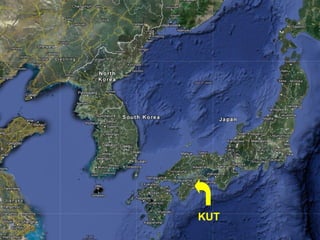
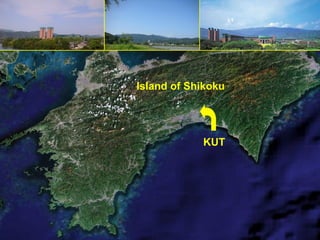
KUT
7
Dimensions of
Media Object Compehensibility
Lawrie Hunter
Kochi University of Technology
http://www.core.kochi-tech.ac.jp/hunter/
KUT
Island of Shikoku
1. The INSTRUCTED writing center
2. Text analysis TOOLS
3. MAPPING work for abstracts
4. CASE study 1:
MAPPING for distillation
5. CASE study 2:
MAPPING for summarization
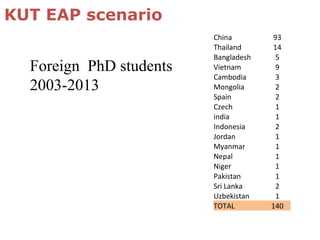
Foreign PhD students
2003-2013
China 93
Thailand 14
Bangladesh 5
Vietnam 9
Cambodia 3
Mongolia 2
Spain 2
Czech 1
india 1
Indonesia 2
Jordan 1
Myanmar 1
Nepal 1
Niger 1
Pakistan 1
Sri Lanka 2
Uzbekistan 1
TOTAL 140
KUT EAP scenario
10
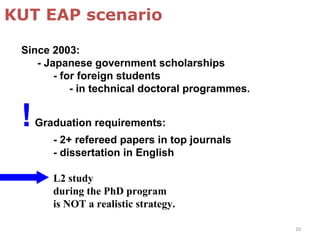
Since 2003:
- Japanese government scholarships
- for foreign students
- in technical doctoral programmes.
!Graduation requirements:
- 2+ refereed papers in top journals
- dissertation in English
L2 study
during the PhD program
is NOT a realistic strategy.
KUT EAP scenario
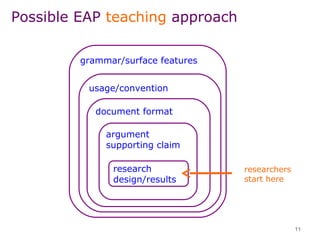
grammar/surface features
usage/convention
document format
argument
supporting claim
11
Possible EAP teaching approach
research
design/results
researchers
start here
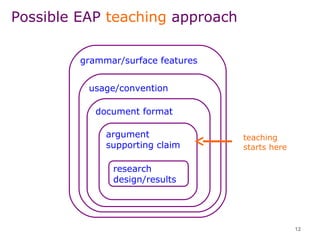
grammar/surface features
usage/convention
document format
argument
supporting claim
12
Possible EAP teaching approach
research
design/results
teaching
starts here
1. The INSTRUCTED
writing center
2. Text analysis
TOOLS
2. Text analysis TOOLS
Graphical* tools, at the sentence level:
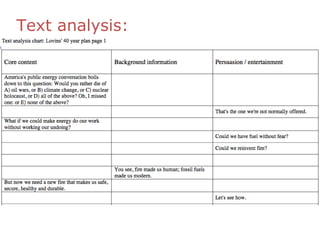
a. Core content/ background/persuasion
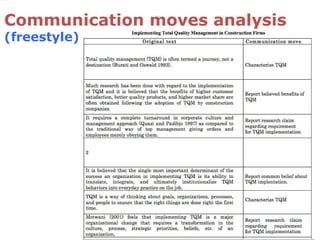
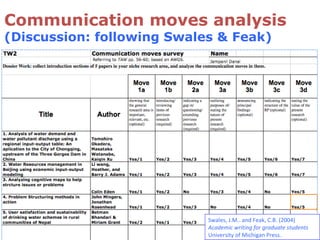
b. Communication moves
c. Cohesion
*graphical = low-text, with spatial structure
Text analysis:
core/background chart
Core content Background
Text analysis:
core/background chart
Core content Background Persuasion
Text analysis:
core/background chart
Communication moves analysis
(freestyle)
Communication moves analysis
(Discussion: following Swales & Feak)
Swales, J.M.. and Feak, C.B. (2004)
Academic writing for graduate students
University of Michigan Press.
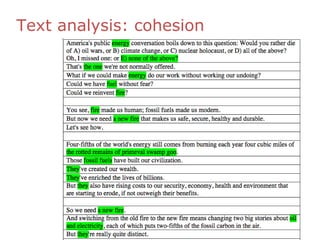
Text analysis: cohesion
3. MAPPING work
for abstracts
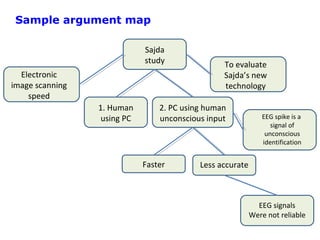
Sajda
study
Less accurate
EEG signals
Were not reliable
Electronic
image scanning
speed
1. Human
using PC
2. PC using human
unconscious input
Faster
EEG spike is a
signal of
unconscious
identification
To evaluate
Sajda’s new
technology
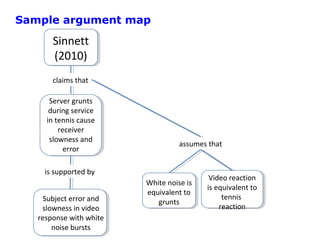
Sample argument map
24
Sample argument map
Sinnett
(2010)
Sinnett
(2010)
claims that
is supported by
assumes that
White noise is
equivalent to
grunts
Server grunts
during service
in tennis cause
receiver
slowness and
error
Video reaction
is equivalent to
tennis
reaction
Subject error and
slowness in video
response with white
noise bursts
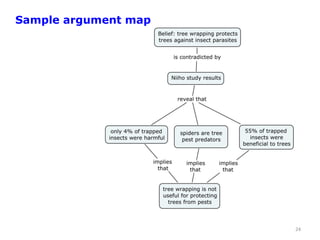
Sample argument map
4. Case study 1:
MAPPING for
distillation
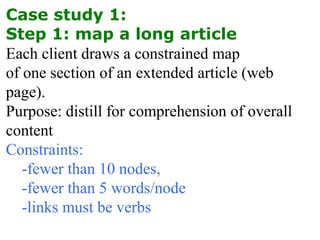
Case study 1:
Step 1: map a long article
Each client draws a constrained map
of one section of an extended article (web
page).
Purpose: distill for comprehension of overall
content
Constraints:
-fewer than 10 nodes,
-fewer than 5 words/node
-links must be verbs
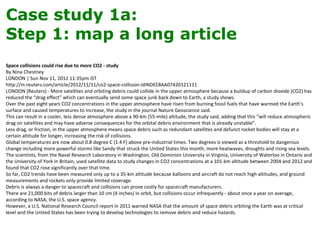
Case study 1a:
Step 1: map a long article
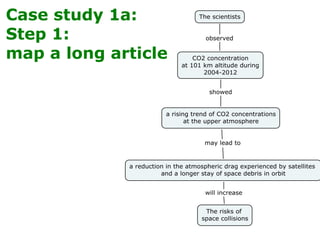
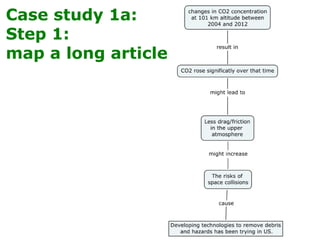
Space collisions could rise due to more CO2 - study
By Nina Chestney
LONDON | Sun Nov 11, 2012 11:35pm IST
http://in.reuters.com/article/2012/11/11/co2-space-collision-idINDEE8AA07420121111
LONDON (Reuters) - More satellites and orbiting debris could collide in the upper atmosphere because a buildup of carbon dioxide (CO2) has
reduced the “drag effect” which can eventually send some space junk back down to Earth, a study shows.
Over the past eight years CO2 concentrations in the upper atmosphere have risen from burning fossil fuels that have warmed the Earth’s
surface and caused temperatures to increase, the study in the journal Nature Geoscience said.
This can result in a cooler, less dense atmosphere above a 90-km (55-mile) altitude, the study said, adding that this “will reduce atmospheric
drag on satellites and may have adverse consequences for the orbital debris environment that is already unstable”.
Less drag, or friction, in the upper atmosphere means space debris such as redundant satellites and defunct rocket bodies will stay at a
certain altitude for longer, increasing the risk of collisions.
Global temperatures are now about 0.8 degree C (1.4 F) above pre-industrial times. Two degrees is viewed as a threshold to dangerous
change including more powerful storms like Sandy that struck the United States this month, more heatwaves, droughts and rising sea levels.
The scientists, from the Naval Research Laboratory in Washington, Old Dominion University in Virginia, University of Waterloo in Ontario and
the University of York in Britain, used satellite data to study changes in CO2 concentrations at a 101-km altitude between 2004 and 2012 and
found that CO2 rose significantly over that time.
So far, CO2 trends have been measured only up to a 35-km altitude because balloons and aircraft do not reach high altitudes, and ground
measurements and rockets only provide limited coverage.
Debris is always a danger to spacecraft and collisions can prove costly for spacecraft manufacturers.
There are 21,000 bits of debris larger than 10 cm (4 inches) in orbit, but collisions occur infrequently - about once a year on average,
according to NASA, the U.S. space agency.
However, a U.S. National Research Council report in 2011 warned NASA that the amount of space debris orbiting the Earth was at critical
level and the United States has been trying to develop technologies to remove debris and reduce hazards.
Case study 1a:
Step 1:
map a long article
Case study 1a:
Step 1:
map a long article
Case study 1b:
Step 1: map a LONG article
(5 students, 5 parts)
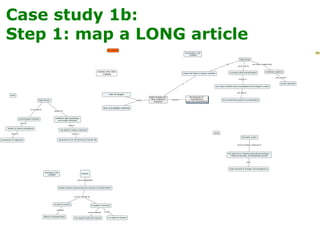
Fodder for HW: Dead zones and the Baltic Sea
http://www.helium.com/items/1369623-worlds-largest-dead-zone-baltic-sea
Group project: multiple maps?
http://education.nationalgeographic.com/education/encyclopedia/dead-zone/?ar_a=1
http://oceanservice.noaa.gov/facts/deadzone.html
Case study 1b:
Step 1: map a LONG article
5. Case study 2:
MAPPING for
summarization
Case study 2:
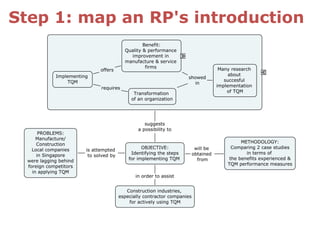
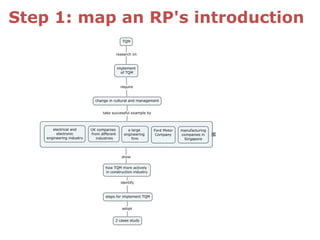
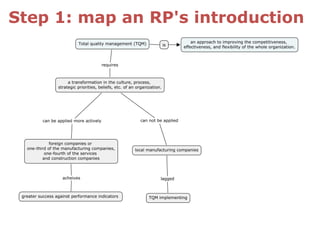
Step 1: map an RP's introduction
Clients draw a constrained map
the introduction section of a research paper.
Purpose: summarize for citation
Constraints:
-fewer than 10 nodes,
-fewer than 5 words/node
-links must be verbs
Step 1: map an RP's introduction
Step 2: critique the maps
The clients critique their maps and
arrive at consensus
on an accurate mapping.
Key point:
-no reading between the lines!
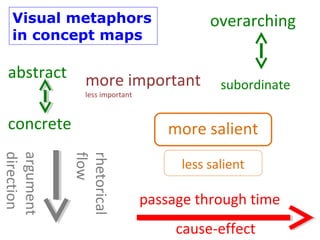
Visual metaphors
in concept maps
overarching
subordinate
abstract
concrete
passage through time
more important
less important
more salient
less salient
rhetorical
flow
argument
direction
cause-effect
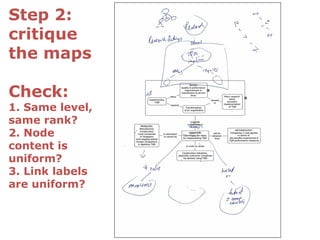
Step 2:
critique
the maps
Check:
1. Same level,
same rank?
2. Node
content is
uniform?
3. Link labels
are uniform?
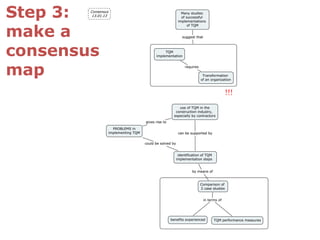
Step 3:
make a
consensus
map
The clients come to agreement
on an optimal map.
!!!
Step 3:
make a
consensus
map
Step 4: rewrite the text
The clients write a new version
of the introduction,
based only on the content of the map.
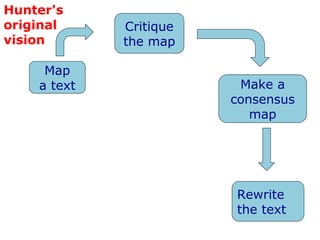
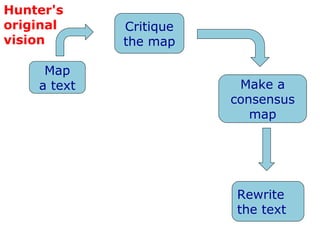
Hunter's
original
vision
Map
a text
Critique
the map
Make a
consensus
map
Rewrite
the text
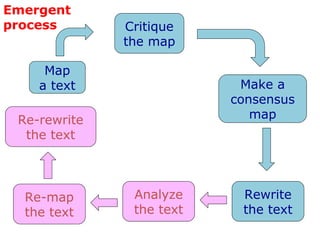
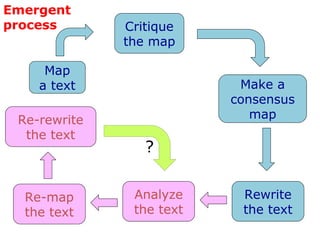
Client behavior: text analysis
The clients developed their own approach,
using text analysis charts
from previous course work:
-core content vs background charts
-communication moves analysis charts
Client behavior: text analysis
The clients developed their own approach,
using text analysis charts
from previous course work:
-core content vs background charts
-communication moves analysis charts
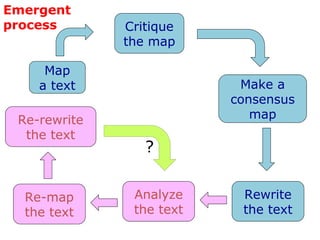
They worked in a cyclic manner,
mapping in counterpoint with
text analysis work.
Map
a text
Critique
the map
Make a
consensus
map
Rewrite
the text
Analyze
the text
Re-map
the text
Re-rewrite
the text
?
Emergent
process
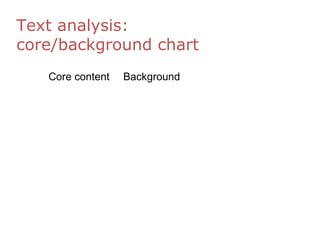
Text analysis:
core/background chart
Core content Background
Text analysis:
core/background chart
Core content Background Persuasion
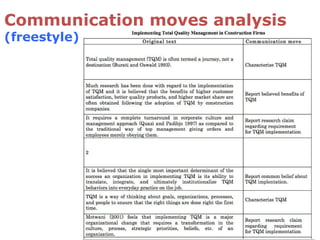
Communication moves analysis
(freestyle)
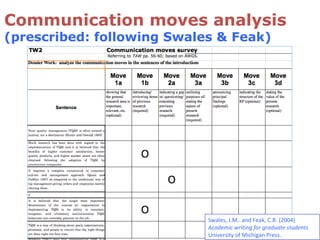
Communication moves analysis
(prescribed: following Swales & Feak)
Swales, J.M.. and Feak, C.B. (2004)
Academic writing for graduate students
University of Michigan Press.
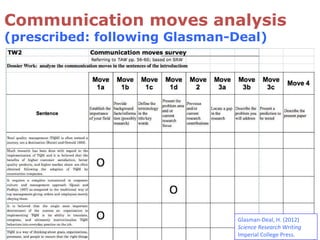
Communication moves analysis
(prescribed: following Glasman-Deal)
Glasman-Deal, H. (2012)
Science Research Writing
Imperial College Press.
Client behavior: remapping
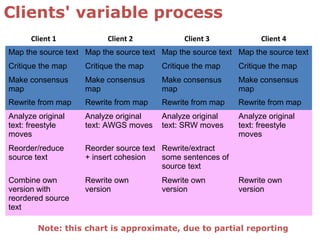
The clients worked in a cyclic manner,
going back to mapping
to apply realizations
from their text analysis work.
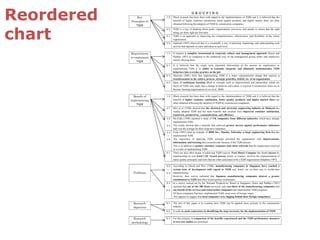
Reordered
chart
G R O U P I N G
Key
Principles of
TQM
1-2 Much research has been done with regard to the implementation of TQM and it is believed that the
benefits of higher customer satisfaction, better quality products, and higher market share are often
obtained following the adoption of TQM by construction companies.
2-2 TQM is a way of thinking about goals, organizations, processes, and people to ensure that the right
things are done right the first time.
3-1 TQM is an approach to improving the competitiveness, effectiveness, and flexibility of the whole
organization.
3-2 Oakland (1995) observed that it is essentially a way of planning, organizing, and understanding each
activity that depends on each individual at each level.
Requirement
to implement
TQM
1-3 It requires a complete turnaround in corporate culture and management approach (Quazi and
Padibjo 1997) as compared to the traditional way of top management giving orders and employees
merely obeying them.
2-1 It is believed that the single most important determinant of the success an organization in
implementing TQM is its ability to translate, integrate, and ultimately institutionalize TQM
behaviors into everyday practice on the job.
2-3 Motwani (2001) feels that implementing TQM is a major organizational change that requires a
transformation in the culture, process, strategic priorities, beliefs, etc. of an organization.
3-3 Ideas of continuous learning allied to concepts such as empowerment and partnership, which are
facets of TQM, also imply that a change in behavior and culture is required if construction firms are to
become learning organizations (Love et al. 2000).
Benefit of
implementing
TQM
1-2 Much research has been done with regard to the implementation of TQM and it is believed that the
benefits of higher customer satisfaction, better quality products, and higher market share are
often obtained following the adoption of TQM by construction companies.
4-1 Idris et al. (1996) showed that the electrical and electronic engineering industry in Malaysia has
widely adopted TQM and the main benefits that resulted were improved customer satisfaction,
teamwork, productivity, communication, and efficiency.
4-2
~
4-3
Mc-Cabe (1996) reported a study of UK companies from different industries which have already
implemented TQM.
The results showed that a majority had achieved greater success against performance indicators
than was the average for their respective industries.
4-4
~
4-6
Culp (1993) cited an example of HDR Inc., Omaha, Nebraska, a large engineering firm that has
implemented TQM.
The experience of applying TQM concepts provided the organization with improvements,
information, and learning that occurred only because of the TQM process.
This is in addition to positive customer responses and client referrals that the organization received
as a result of implementing TQM.
5-1 There are also other means of achieving TQM success. Ford Motor Company has found success by
implementing its own Ford’s Q1 Award process which, in essence, involves the implementation of
many quality principles and tools that are often associated with a TQM organization (Stephens 1997).
Problems
5-2
~
5-3
According to Ghosh and Wee (1996), manufacturing companies in Singapore have reached a
certain state of development with regard to TQM and, hence, are on their way to world-class
manufacturing.
However, their survey indicated that Japanese manufacturing companies showed a greater
commitment to TQM than their local/regional counterparts.
5-4
~
5-6
In a survey carried out by the National Productivity Board in Singapore, Quazi and Padibjo (1997)
reported that out of the 300 firms surveyed, only one-third of the manufacturing companies and
one-fourth of the services and construction companies had implemented TQM programs.
Of those companies that have implemented TQM, most were of foreign origin.
This appears to suggest that local companies were lagging behind their foreign competitors.
Research
objectives
6-1 The aim of this paper is to examine how TQM can be applied more actively in the construction
industry.
6-2 It seeks to assist contractors in identifying the steps necessary for the implementation of TQM.
Research
methodology
6-3 For this purpose, a comparison of the benefits experienced and the TQM performance measures
in two case studies are presented.
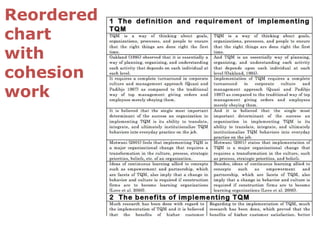
Reordered
chart
with
cohesion
work
Hunter's
original
vision
Map
a text
Critique
the map
Make a
consensus
map
Rewrite
the text
Emergent
process
Map
a text
Critique
the map
Make a
consensus
map
Rewrite
the text
Analyze
the text
Re-map
the text
Re-rewrite
the text
Clients' variable process
Client 1 Client 2 Client 3 Client 4
Map the source text Map the source text Map the source text Map the source text
Critique the map Critique the map Critique the map Critique the map
Make consensus
map
Make consensus
map
Make consensus
map
Make consensus
map
Rewrite from map Rewrite from map Rewrite from map Rewrite from map
Analyze original
text: freestyle
moves
Analyze original
text: AWGS moves
Analyze original
text: SRW moves
Analyze original
text: freestyle
moves
Reorder/reduce
source text
Reorder source text
+ insert cohesion
Rewrite/extract
some sentences of
source text
Combine own
version with
reordered source
text
Rewrite own
version
Rewrite own
version
Rewrite own
version
Note: this chart is approximate, due to partial reporting
Map
a text
Critique
the map
Make a
consensus
map
Rewrite
the text
Analyze
the text
Re-map
the text
Re-rewrite
the text
?
Emergent
process
Question: is Cmap Tools
the best argument mapping tool?
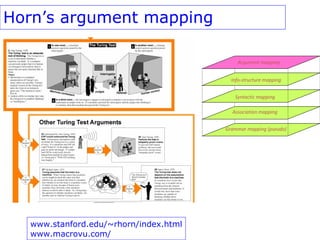
Horn’s argument mapping
www.stanford.edu/~rhorn/index.html
www.macrovu.com/
Argument mapping
Info-structure mapping
Syntactic mapping
Grammar mapping (pseudo)
Association mapping
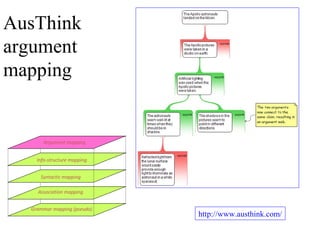
AusThink
argument
mapping
http://www.austhink.com/
Argument mapping
Info-structure mapping
Syntactic mapping
Grammar mapping (pseudo)
Association mapping
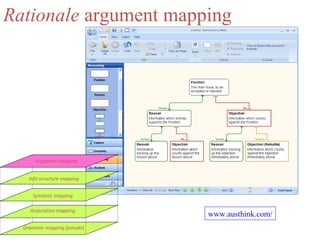
Rationale argument mapping
Argument mapping
Info-structure mapping
Syntactic mapping
Grammar mapping (pseudo)
Association mapping
www.austhink.com/
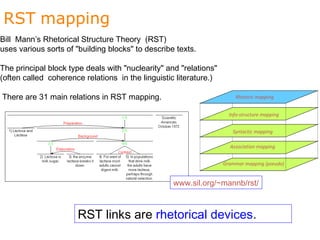
RST mapping
www.sil.org/~mannb/rst/
RST links are rhetorical devices.
Bill Mann’s Rhetorical Structure Theory (RST)
uses various sorts of "building blocks" to describe texts.
The principal block type deals with "nuclearity" and "relations"
(often called coherence relations in the linguistic literature.)
There are 31 main relations in RST mapping. Rhetoric mapping
Info-structure mapping
Syntactic mapping
Grammar mapping (pseudo)
Association mapping
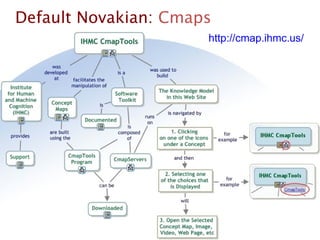
http://cmap.ihmc.us/
Default Novakian: Cmaps
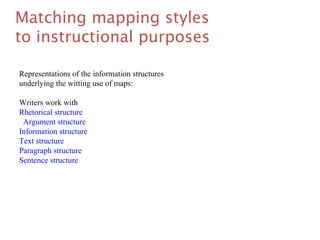
Matching mapping styles
to instructional purposes
Representations of the information structures
underlying the witting use of maps:
Writers work with
Rhetorical structure
Argument structure
Information structure
Text structure
Paragraph structure
Sentence structure
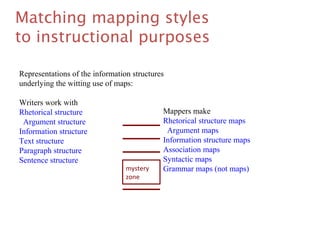
Matching mapping styles
to instructional purposes
Representations of the information structures
underlying the witting use of maps:
Writers work with
Rhetorical structure
Argument structure
Information structure
Text structure
Paragraph structure
Sentence structure
Mappers make
Rhetorical structure maps
Argument maps
Information structure maps
Association maps
Syntactic maps
Grammar maps (not maps)mystery
zone
Thank you for your attention.
Please write to me.
I'm happy to share/teach/collaborate.
Download this .ppt and many others
from
http://www.lawriehunter.com/presns/
or view/download at
http://slideshare.net/rolenzo/
Lawrie Hunter
Kochi University of Technology
http://www.core.kochi-tech.ac.jp/hunter/References
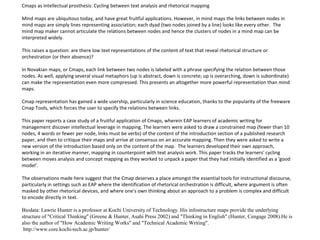
Cmaps as intellectual prosthesis: Cycling between text analysis and rhetorical mapping
Mind maps are ubiquitous today, and have great fruitful applications. However, in mind maps the links between nodes in
mind maps are simply lines representing association; each dyad (two nodes joined by a line) looks like every other. The
mind map maker cannot articulate the relations between nodes and hence the clusters of nodes in a mind map can be
interpreted widely.
This raises a question: are there low text representations of the content of text that reveal rhetorical structure or
orchestration (or their absence)?
In Novakian maps, or Cmaps, each link between two nodes is labeled with a phrase specifying the relation between those
nodes. As well, applying several visual metaphors (up is abstract, down is concrete; up is overarching, down is subordinate)
can make the representation even more compressed. This presents an altogether more powerful representation than mind
maps.
Cmap representation has gained a wide usership, particularly in science education, thanks to the popularity of the freeware
Cmap Tools, which forces the user to specify the relations between links.
This paper reports a case study of a fruitful application of Cmaps, wherein EAP learners of academic writing for
management discover intellectual leverage in mapping. The learners were asked to draw a constrained map (fewer than 10
nodes, 4 words or fewer per node, links must be verbs) of the content of the introduction section of a published research
paper, and then to critique their maps and arrive at consensus on an accurate mapping. Then they were asked to write a
new version of the introduction based only on the content of the map. The learners developed their own approach,
working in an iterative manner, mapping in counterpoint with text analysis work. This paper tracks the learners' cycling
between moves analysis and concept mapping as they worked to unpack a paper that they had initially identified as a 'good
model'.
The observations made here suggest that the Cmap deserves a place amongst the essential tools for instructional discourse,
particularly in settings such as EAP where the identification of rhetorical orchestration is difficult, where argument is often
masked by other rhetorical devices, and where one's own thinking about an approach to a problem is complex and difficult
to encode directly in text.
Biodata: Lawrie Hunter is a professor at Kochi University of Technology. His infostructure maps provide the underlying
structure of "Critical Thinking" (Greene & Hunter, Asahi Press 2002) and "Thinking in English" (Hunter, Cengage 2008).He is
also the author of "How Academic Writing Works" and "Technical Academic Writing".
http://www.core.kochi-tech.ac.jp/hunter/
Sources: GRAPHIC ORGANIZERS
Suggested Reading About Visual Thinking and Learning
Ausubel, D. (1968). Educational psychology: A cognitive view. New York: Holt, Reinhart and Winston.
Buzan, T. & Buzan, B. (1993). The mind map book: How to use radiant thinking to maximize your brain's
untapped potential. New York: Penguin Books USA Inc.
Buzan, T. (1983). Use both sides of your brain: New techniques to help you read efficiently, study effectively,
solve problems, remember more, think clearly. New York: E.P. Dutton.
Jonassen, D.H. (1996). Computers in the classroom: Mindtools for critical thinking. Englewood Cliffs, NJ.
Prentice-Hall, Inc.
Novak, J.D. & Gowin, D.B. (1984). Learning how to learn. New York: Cambridge University Press.
Novak, J.D. (1998). Learning, creating and using knowledge: Concept map® as facilitative tools in schools and
corporations. Mahwah, NJ: Lawrence Erlbaum Associates, Inc.
http://www.inspiration.com/Parents/Visual-Thinking-and-Learning
Sources: academic writing
Hunter
the style dossier approach
STRUCTURE
Banerjee, D. and Wall, D. (2006) Assessing and reporting performances on pre-sessional EAP
courses: Developing a final assessment checklist and investigating its validity. Journal of
English for academic purposes 5(2006) 50-69.
Ferris, D. (2002) Treatment of error in second language student writing. University of Michigan
Press.
Ginther, A. and Grant, L. (1996) A review of the academic needs of native English-speaking college
students in the United States. Research monograph series MS-1. Princeton, NJ: Educational
Testing Service.
Glasman-Deal, H. (2010) Science Research Writing. Imperial College Press.
Gopen, G.D. & Swan, J.A. (1990) The Science of Scientific Writing. American Scientist 78 550-558.
http://www.americanscientist.org/template/AssetDetail/assetid/23947
Harwood, N. (2006) What do we want EAP teaching materials for? Journal of English for Academic
Purposes 4 (2005) 149-161.
Hunter, L. Online resource for English for Academic Purposes:
http://del.icio.us/rolenzo/eap
Koutsantoni, D. (2006) Rhetorical strategies in engineering research articles and research theses:
Advanced academic literacy and relations of power. Journal of English for Academic Purposes
5 (2006) 19-36.
Liu, M. & Braine, G. (2005) Cohesive features in argumentative writing produced by Chinese
undergraduates. English for specific purposes 24 (2005)
Rowley-Jolivet, E. & Carter-Thomas, S. (2005) Genre awareness and rhetorical appropriacy:
Manipulation of information structure by NS and NNS scientists in the international conference
setting. System 33 (2005) 41-64.
Swales, J.M.. and Feak, C.B. (2004) Academic writing for graduate students: essential tasks and
skills (2nd ed.). University of Michigan Press.
Swales, J.M.. and Feak, C.B. (2001) English in Today's Research World: A Writing Guide.
University of Michigan Press.
Fauconnier, G. (1997) Mappings in Thought and Language. Cambridge U. Press.
Gentner, D., & Wolff, P.(1997). Alignment in the Processing of Metaphor. Journal of Memory and
Language, 37, 331-355.
Kurosawa, M., & Kawahara, T. (1999). An Experimental Study in Metaphor Comprehension. Bulletin of
the Graduate School of Education, The University of Tokyo 39, 247-257.
Kurosawa, M., & Kawahara, T. (1999). Alignment or Abstraction? Metaphor Comprehension in
Japanese. Proceedings, Second International Conference on Cognitive Science.
http://www.jcss.gr.jp/iccs99OLP/p3-19/p3-19.htm
Lakoff, George and Mark Johnson 1980. Metaphors We Live By. Chicago: The University of Chicago
Press.
Mazuka, R. (1998) The Development of Language Strategies: a Cross-Linguistic Study Between
Japanese and English. Erlbaum.
Nisbett, R.E. (2003) The geography of thought. Free Press.
Novak, J.D. (1998). Learning, creating and using knowledge: Concept map® as facilitative tools in
schools and corporations. Mahwah, NJ: Lawrence Erlbaum Associates, Inc.
Sources: mapping and metaphor
Baddeley, A. D. & Hitch, G. (2001). Working memory in perspective: Foreword. In J. Andrade (Ed.), Working memory
in perspective (pp. xv-xix). Hove: Psychology Press.
Cañas, A. J., & Novak, J.D. (2006) Re-examining the foundations for effective use of concept maps. In Cañas, A. J., &
Novak, J.D. (Eds.), Concept Maps: Theory, Methodology, Technology. Proceedings of the Second International
Conference on Concept Mapping.
Cañas, A. J., Hill, G., Carff, R., Suri, N., Lott, J., Eskridge, T., Gomez, G., Arroyo, M. and Carvajal, R. (2004)
Cmaptools: A knowledge modeling and sharing environment. Downloaded April 8, 2008 from
http://cmc.ihmc.us/papers/cmc2004-283.pdf
Chandler, P. and J. Sweller (1992) The split-attention effect as a factor in the design of instruction. British Journal of
Educational Psychology 62: 233-246.
Chun, D. M. and Plass, J. L. 1997. Research on text comprehension in multimedia environments. Language learning
and technology 1(1): 60-81.
Cmap tools. Institute for Human & Machine Cognition. http://cmap.ihmc.us/
Dansereau, D.F. (2005) Node-Link Mapping Principles for Visualizing Knowledge and Information. In Tergan, S. and
Keller, T. (Eds.) Node-Link Mapping Principles for Visualizing Knowledge and Information. Springer. 61-81.
Fulkerson, R. (1996) Teaching the argument in writing. Urbana, IL: National Council of Teachers of English.
Goldman, S.R., & Rakestraw, J.A. (2000). Structural aspects of constructing meaning from text. In M.L. Kamil, P. B.
Mosenthal, P. D. Pearson, & R. Barr (Eds.), Handbook of reading research (Vol. II, pp. 311-335). Mahwah, NJ:
Erlbaum.
Gopen, G.D. and Swan, J.A. (1990) The Science of Scientific Writing. American Scientist (Nov-Dec 1990), Volume
78, 550-558. Downloadable as a pdf from http://www.amstat.org/publications/jcgs/sci.pdf
Grow, G. (1996) Serving the strategic reader: cognitive reading theoryand its implications for the teaching of writing.
Viewed June 30, 2007 at http://www.longleaf.net/ggrow/StrategicReader/index.html
Horn, R. E. (1998) Visual Language: Global Communication for the 21st Century. Bainbridge Island, WA: MacroVU
Press. http://www.macrovu.com
Hunter L. (2005) Technical Hypertext Accessibility: Information Structures and Rhetorical Framing. Presentation at
HyperText 2005, Salzburg. http://www.lawriehunter.com/presns/%20HT05poster0818.htm
Hunter, L. (2002) Information structure diagrams as link icons. Learning Technology 4(3) July 2002. ISSN 1438-
0625. 2002. http://lttf.ieee.org/learn_tech/issues/july2002/index.html#1
Hunter, L. (1998) Text nouveau, visible structure in text presentation. Computer Assisted Language Learning 11 (4)
October 1998.
Mann, B. (1999) An introduction to rhetorical structure theory (RST). http://www.sil.org/mannb/rst/rintro99.htm
Moffett, J. (1992). Detecting growth in language. New Hampshire: Boynton/Cook.
Mohan, B.A. (1986) Language and content. Addison-Wesley.
Novak, J.D. and Cañas, A.J. (2006) The theory underlying concept maps and how to construct them. Report IHMC
CmapTools 2006-01, Florida Institute for Human and Machine Cognition (IHMC), 2006. Viewed April 8, 2008 at
http://cmap.ihmc.us/Publications/ResearchPapers/TheoryCmaps/TheoryUnderlyingConceptMaps.htm
Olive, Thierry (2004) Working memory in writing: Empirical evidence from the dual-task technique. European
psychologist 9(1), pp. 32-42. Working paper downloaded from http://cat.inist.fr/?
aModele=afficheN&cpsidt=15431008
Shannon, C.E., & Weaver, W. (1949). The mathematical theory of communication. Urbana: University of Illinois
Press. Explained at http://www.cultsock.ndirect.co.uk/MUHome/cshtml/introductory/sw.html
Taboada, M. and Mann, W.C. (2006) Rhetorical Structure Theory: looking back and moving ahead. Discourse
studies 8: 423-459
Tufte, E.R. (1990) Envisioning information. Cheshire, CONN: Graphics Press.
Ueta, R., Hunter, L. & Ren, X. Text usability for non-native readers of English. Proceedings, Information Processing
Society of Japan, Vol. 2003.7. Pp. 199-200.

See the trees: Concept mapping for text analysis

  • 1.
    See the trees: Conceptmapping for text analysis Lawrie Hunter Kochi University of Technology http://www.core.kochi-tech.ac.jp/hunter 5th Symposium on Writing Centers in Asia April 20, 2013
  • 2.
    See the trees:Concept mapping for text analysis Concept mapping for text analysis: A writing center tool SUMMARY This presentation reports several cases of fruitful application of Cmap Tools freeware, wherein EAP learners of academic writing discovered intellectual leverage in mapping. In each case the learners drew constrained maps of the content of a text (academic or popular genre), critiqued their maps, arrived at consensus on an accurate mapping, and then set out to write a new version of the text based only on the content of the map. The subsequent work was rich, which points to valuable applications in writing center work.
  • 3.
    See the trees:Concept mapping for text analysis Concept mapping for text analysis: A writing center tool ABSTRACT This presentation demonstrates how a low text representation of the content of text can reveal rhetorical structure or orchestration (or their absence). It also argues that Cmap representation can have a valuable place in the writing center toolkit. Cmap representation has gained a wide usership, particularly in science education, thanks to the popularity of the freeware Cmap Tools. Cmap Tools forces the user to label each link between two nodes with a phrase specifying the relation between those nodes. As well, applying several visual metaphors (e.g., up is abstract, down is concrete; up is overarching, down is subordinate) can make the representation even more compressed. This presents an altogether more powerful representation than mind maps. This presentation reports several cases of fruitful application of Cmap Tools, wherein EAP learners of academic writing discovered intellectual leverage in mapping. In each case the learners drew constrained maps of the content of a text (academic or popular genre), critiqued their maps, arrived at consensus on an accurate mapping, and then set out to write a new version of the text based only on the content of the map. The subsequent work was rich, and different in each case. The learners developed their own approaches, cycling between moves analysis and concept mapping as they worked to unpack text that they had initially identified as 'good models'. The observations made here suggest that the Cmap deserves a place amongst the essential tools for writing center work, particularly in the analysis of source texts where the identification of rhetorical orchestration is difficult, where argument is often masked by other rhetorical devices, and in situations where one's thinking about an approach to a problem is complex and difficult to encode directly in extended text.
  • 4.
    TODAY'S OUTLINE === THE TAUGHT(INSTRUCTED) WRITING CENTER Working with text Working with concepts === TOOLS for WC clients / work: Text analysis work (separating levels of abstraction) Moves analysis work Metaphor / frames / cognitive blends Restructuring vs. reordering Argument mapping / Novakian / Cmap Tools Cohesion work === CASE study 1 MAPPING for summarization of an RP introduction (DOSSIER WORK) Clients' auto-return to TOOLS CONCLUSION Better summaries (scant data tho) BTW lower WC activity (growing autonomy? peer consulting? other resources?) === CASE study 2 MAPPING for distillation of an extended (wandering) document a. analysis: part by part mapping b. synthesis: combining maps of parts into an integrated whole map CONCLUSION: achieved results not possible with extended text work ===
  • 5.
    No need totake notes (:^0) All materials can be downloaded from Hunter’s websites http://lawriehunter.com/ http://www.core.kochi-tech.ac.jp/hunter/ and many more ppts available at http://slideshare.net/rolenzo/
  • 6.
    Case study: Cmaps inacademic writing Asian EAP PhD students of academic writing for management. KUT
  • 7.
    7 Dimensions of Media ObjectCompehensibility Lawrie Hunter Kochi University of Technology http://www.core.kochi-tech.ac.jp/hunter/ KUT Island of Shikoku
  • 8.
    1. The INSTRUCTEDwriting center 2. Text analysis TOOLS 3. MAPPING work for abstracts 4. CASE study 1: MAPPING for distillation 5. CASE study 2: MAPPING for summarization
  • 9.
    Foreign PhD students 2003-2013 China93 Thailand 14 Bangladesh 5 Vietnam 9 Cambodia 3 Mongolia 2 Spain 2 Czech 1 india 1 Indonesia 2 Jordan 1 Myanmar 1 Nepal 1 Niger 1 Pakistan 1 Sri Lanka 2 Uzbekistan 1 TOTAL 140 KUT EAP scenario
  • 10.
    10 Since 2003: - Japanesegovernment scholarships - for foreign students - in technical doctoral programmes. !Graduation requirements: - 2+ refereed papers in top journals - dissertation in English L2 study during the PhD program is NOT a realistic strategy. KUT EAP scenario
  • 11.
    grammar/surface features usage/convention document format argument supportingclaim 11 Possible EAP teaching approach research design/results researchers start here
  • 12.
    grammar/surface features usage/convention document format argument supportingclaim 12 Possible EAP teaching approach research design/results teaching starts here
  • 13.
  • 14.
  • 15.
    2. Text analysisTOOLS Graphical* tools, at the sentence level: a. Core content/ background/persuasion b. Communication moves c. Cohesion *graphical = low-text, with spatial structure
  • 16.
  • 17.
    Text analysis: core/background chart Corecontent Background Persuasion
  • 18.
  • 19.
  • 20.
    Communication moves analysis (Discussion:following Swales & Feak) Swales, J.M.. and Feak, C.B. (2004) Academic writing for graduate students University of Michigan Press.
  • 21.
  • 22.
  • 23.
    Sajda study Less accurate EEG signals Werenot reliable Electronic image scanning speed 1. Human using PC 2. PC using human unconscious input Faster EEG spike is a signal of unconscious identification To evaluate Sajda’s new technology Sample argument map
  • 24.
  • 25.
    Sinnett (2010) Sinnett (2010) claims that is supportedby assumes that White noise is equivalent to grunts Server grunts during service in tennis cause receiver slowness and error Video reaction is equivalent to tennis reaction Subject error and slowness in video response with white noise bursts Sample argument map
  • 26.
    4. Case study1: MAPPING for distillation
  • 27.
    Case study 1: Step1: map a long article Each client draws a constrained map of one section of an extended article (web page). Purpose: distill for comprehension of overall content Constraints: -fewer than 10 nodes, -fewer than 5 words/node -links must be verbs
  • 28.
    Case study 1a: Step1: map a long article Space collisions could rise due to more CO2 - study By Nina Chestney LONDON | Sun Nov 11, 2012 11:35pm IST http://in.reuters.com/article/2012/11/11/co2-space-collision-idINDEE8AA07420121111 LONDON (Reuters) - More satellites and orbiting debris could collide in the upper atmosphere because a buildup of carbon dioxide (CO2) has reduced the “drag effect” which can eventually send some space junk back down to Earth, a study shows. Over the past eight years CO2 concentrations in the upper atmosphere have risen from burning fossil fuels that have warmed the Earth’s surface and caused temperatures to increase, the study in the journal Nature Geoscience said. This can result in a cooler, less dense atmosphere above a 90-km (55-mile) altitude, the study said, adding that this “will reduce atmospheric drag on satellites and may have adverse consequences for the orbital debris environment that is already unstable”. Less drag, or friction, in the upper atmosphere means space debris such as redundant satellites and defunct rocket bodies will stay at a certain altitude for longer, increasing the risk of collisions. Global temperatures are now about 0.8 degree C (1.4 F) above pre-industrial times. Two degrees is viewed as a threshold to dangerous change including more powerful storms like Sandy that struck the United States this month, more heatwaves, droughts and rising sea levels. The scientists, from the Naval Research Laboratory in Washington, Old Dominion University in Virginia, University of Waterloo in Ontario and the University of York in Britain, used satellite data to study changes in CO2 concentrations at a 101-km altitude between 2004 and 2012 and found that CO2 rose significantly over that time. So far, CO2 trends have been measured only up to a 35-km altitude because balloons and aircraft do not reach high altitudes, and ground measurements and rockets only provide limited coverage. Debris is always a danger to spacecraft and collisions can prove costly for spacecraft manufacturers. There are 21,000 bits of debris larger than 10 cm (4 inches) in orbit, but collisions occur infrequently - about once a year on average, according to NASA, the U.S. space agency. However, a U.S. National Research Council report in 2011 warned NASA that the amount of space debris orbiting the Earth was at critical level and the United States has been trying to develop technologies to remove debris and reduce hazards.
  • 29.
    Case study 1a: Step1: map a long article
  • 30.
    Case study 1a: Step1: map a long article
  • 31.
    Case study 1b: Step1: map a LONG article (5 students, 5 parts) Fodder for HW: Dead zones and the Baltic Sea http://www.helium.com/items/1369623-worlds-largest-dead-zone-baltic-sea Group project: multiple maps? http://education.nationalgeographic.com/education/encyclopedia/dead-zone/?ar_a=1 http://oceanservice.noaa.gov/facts/deadzone.html
  • 32.
    Case study 1b: Step1: map a LONG article
  • 33.
    5. Case study2: MAPPING for summarization
  • 34.
    Case study 2: Step1: map an RP's introduction Clients draw a constrained map the introduction section of a research paper. Purpose: summarize for citation Constraints: -fewer than 10 nodes, -fewer than 5 words/node -links must be verbs
  • 35.
    Step 1: mapan RP's introduction
  • 36.
    Step 1: mapan RP's introduction
  • 37.
    Step 1: mapan RP's introduction
  • 38.
    Step 2: critiquethe maps The clients critique their maps and arrive at consensus on an accurate mapping. Key point: -no reading between the lines!
  • 39.
    Visual metaphors in conceptmaps overarching subordinate abstract concrete passage through time more important less important more salient less salient rhetorical flow argument direction cause-effect
  • 40.
    Step 2: critique the maps Check: 1.Same level, same rank? 2. Node content is uniform? 3. Link labels are uniform?
  • 41.
    Step 3: make a consensus map Theclients come to agreement on an optimal map.
  • 42.
  • 43.
    Step 4: rewritethe text The clients write a new version of the introduction, based only on the content of the map.
  • 44.
  • 45.
    Client behavior: textanalysis The clients developed their own approach, using text analysis charts from previous course work: -core content vs background charts -communication moves analysis charts
  • 46.
    Client behavior: textanalysis The clients developed their own approach, using text analysis charts from previous course work: -core content vs background charts -communication moves analysis charts They worked in a cyclic manner, mapping in counterpoint with text analysis work.
  • 47.
    Map a text Critique the map Makea consensus map Rewrite the text Analyze the text Re-map the text Re-rewrite the text ? Emergent process
  • 48.
  • 49.
    Text analysis: core/background chart Corecontent Background Persuasion
  • 50.
  • 51.
    Communication moves analysis (prescribed:following Swales & Feak) Swales, J.M.. and Feak, C.B. (2004) Academic writing for graduate students University of Michigan Press.
  • 52.
    Communication moves analysis (prescribed:following Glasman-Deal) Glasman-Deal, H. (2012) Science Research Writing Imperial College Press.
  • 53.
    Client behavior: remapping Theclients worked in a cyclic manner, going back to mapping to apply realizations from their text analysis work.
  • 54.
    Reordered chart G R OU P I N G Key Principles of TQM 1-2 Much research has been done with regard to the implementation of TQM and it is believed that the benefits of higher customer satisfaction, better quality products, and higher market share are often obtained following the adoption of TQM by construction companies. 2-2 TQM is a way of thinking about goals, organizations, processes, and people to ensure that the right things are done right the first time. 3-1 TQM is an approach to improving the competitiveness, effectiveness, and flexibility of the whole organization. 3-2 Oakland (1995) observed that it is essentially a way of planning, organizing, and understanding each activity that depends on each individual at each level. Requirement to implement TQM 1-3 It requires a complete turnaround in corporate culture and management approach (Quazi and Padibjo 1997) as compared to the traditional way of top management giving orders and employees merely obeying them. 2-1 It is believed that the single most important determinant of the success an organization in implementing TQM is its ability to translate, integrate, and ultimately institutionalize TQM behaviors into everyday practice on the job. 2-3 Motwani (2001) feels that implementing TQM is a major organizational change that requires a transformation in the culture, process, strategic priorities, beliefs, etc. of an organization. 3-3 Ideas of continuous learning allied to concepts such as empowerment and partnership, which are facets of TQM, also imply that a change in behavior and culture is required if construction firms are to become learning organizations (Love et al. 2000). Benefit of implementing TQM 1-2 Much research has been done with regard to the implementation of TQM and it is believed that the benefits of higher customer satisfaction, better quality products, and higher market share are often obtained following the adoption of TQM by construction companies. 4-1 Idris et al. (1996) showed that the electrical and electronic engineering industry in Malaysia has widely adopted TQM and the main benefits that resulted were improved customer satisfaction, teamwork, productivity, communication, and efficiency. 4-2 ~ 4-3 Mc-Cabe (1996) reported a study of UK companies from different industries which have already implemented TQM. The results showed that a majority had achieved greater success against performance indicators than was the average for their respective industries. 4-4 ~ 4-6 Culp (1993) cited an example of HDR Inc., Omaha, Nebraska, a large engineering firm that has implemented TQM. The experience of applying TQM concepts provided the organization with improvements, information, and learning that occurred only because of the TQM process. This is in addition to positive customer responses and client referrals that the organization received as a result of implementing TQM. 5-1 There are also other means of achieving TQM success. Ford Motor Company has found success by implementing its own Ford’s Q1 Award process which, in essence, involves the implementation of many quality principles and tools that are often associated with a TQM organization (Stephens 1997). Problems 5-2 ~ 5-3 According to Ghosh and Wee (1996), manufacturing companies in Singapore have reached a certain state of development with regard to TQM and, hence, are on their way to world-class manufacturing. However, their survey indicated that Japanese manufacturing companies showed a greater commitment to TQM than their local/regional counterparts. 5-4 ~ 5-6 In a survey carried out by the National Productivity Board in Singapore, Quazi and Padibjo (1997) reported that out of the 300 firms surveyed, only one-third of the manufacturing companies and one-fourth of the services and construction companies had implemented TQM programs. Of those companies that have implemented TQM, most were of foreign origin. This appears to suggest that local companies were lagging behind their foreign competitors. Research objectives 6-1 The aim of this paper is to examine how TQM can be applied more actively in the construction industry. 6-2 It seeks to assist contractors in identifying the steps necessary for the implementation of TQM. Research methodology 6-3 For this purpose, a comparison of the benefits experienced and the TQM performance measures in two case studies are presented.
  • 55.
  • 56.
  • 57.
    Emergent process Map a text Critique the map Makea consensus map Rewrite the text Analyze the text Re-map the text Re-rewrite the text
  • 58.
    Clients' variable process Client1 Client 2 Client 3 Client 4 Map the source text Map the source text Map the source text Map the source text Critique the map Critique the map Critique the map Critique the map Make consensus map Make consensus map Make consensus map Make consensus map Rewrite from map Rewrite from map Rewrite from map Rewrite from map Analyze original text: freestyle moves Analyze original text: AWGS moves Analyze original text: SRW moves Analyze original text: freestyle moves Reorder/reduce source text Reorder source text + insert cohesion Rewrite/extract some sentences of source text Combine own version with reordered source text Rewrite own version Rewrite own version Rewrite own version Note: this chart is approximate, due to partial reporting
  • 59.
    Map a text Critique the map Makea consensus map Rewrite the text Analyze the text Re-map the text Re-rewrite the text ? Emergent process
  • 60.
    Question: is CmapTools the best argument mapping tool?
  • 61.
    Horn’s argument mapping www.stanford.edu/~rhorn/index.html www.macrovu.com/ Argumentmapping Info-structure mapping Syntactic mapping Grammar mapping (pseudo) Association mapping
  • 62.
  • 63.
    Rationale argument mapping Argumentmapping Info-structure mapping Syntactic mapping Grammar mapping (pseudo) Association mapping www.austhink.com/
  • 64.
    RST mapping www.sil.org/~mannb/rst/ RST linksare rhetorical devices. Bill Mann’s Rhetorical Structure Theory (RST) uses various sorts of "building blocks" to describe texts. The principal block type deals with "nuclearity" and "relations" (often called coherence relations in the linguistic literature.) There are 31 main relations in RST mapping. Rhetoric mapping Info-structure mapping Syntactic mapping Grammar mapping (pseudo) Association mapping
  • 65.
  • 66.
    Matching mapping styles toinstructional purposes Representations of the information structures underlying the witting use of maps: Writers work with Rhetorical structure Argument structure Information structure Text structure Paragraph structure Sentence structure
  • 67.
    Matching mapping styles toinstructional purposes Representations of the information structures underlying the witting use of maps: Writers work with Rhetorical structure Argument structure Information structure Text structure Paragraph structure Sentence structure Mappers make Rhetorical structure maps Argument maps Information structure maps Association maps Syntactic maps Grammar maps (not maps)mystery zone
  • 68.
    Thank you foryour attention. Please write to me. I'm happy to share/teach/collaborate. Download this .ppt and many others from http://www.lawriehunter.com/presns/ or view/download at http://slideshare.net/rolenzo/ Lawrie Hunter Kochi University of Technology http://www.core.kochi-tech.ac.jp/hunter/References
  • 69.
    Cmaps as intellectualprosthesis: Cycling between text analysis and rhetorical mapping Mind maps are ubiquitous today, and have great fruitful applications. However, in mind maps the links between nodes in mind maps are simply lines representing association; each dyad (two nodes joined by a line) looks like every other. The mind map maker cannot articulate the relations between nodes and hence the clusters of nodes in a mind map can be interpreted widely. This raises a question: are there low text representations of the content of text that reveal rhetorical structure or orchestration (or their absence)? In Novakian maps, or Cmaps, each link between two nodes is labeled with a phrase specifying the relation between those nodes. As well, applying several visual metaphors (up is abstract, down is concrete; up is overarching, down is subordinate) can make the representation even more compressed. This presents an altogether more powerful representation than mind maps. Cmap representation has gained a wide usership, particularly in science education, thanks to the popularity of the freeware Cmap Tools, which forces the user to specify the relations between links. This paper reports a case study of a fruitful application of Cmaps, wherein EAP learners of academic writing for management discover intellectual leverage in mapping. The learners were asked to draw a constrained map (fewer than 10 nodes, 4 words or fewer per node, links must be verbs) of the content of the introduction section of a published research paper, and then to critique their maps and arrive at consensus on an accurate mapping. Then they were asked to write a new version of the introduction based only on the content of the map. The learners developed their own approach, working in an iterative manner, mapping in counterpoint with text analysis work. This paper tracks the learners' cycling between moves analysis and concept mapping as they worked to unpack a paper that they had initially identified as a 'good model'. The observations made here suggest that the Cmap deserves a place amongst the essential tools for instructional discourse, particularly in settings such as EAP where the identification of rhetorical orchestration is difficult, where argument is often masked by other rhetorical devices, and where one's own thinking about an approach to a problem is complex and difficult to encode directly in text. Biodata: Lawrie Hunter is a professor at Kochi University of Technology. His infostructure maps provide the underlying structure of "Critical Thinking" (Greene & Hunter, Asahi Press 2002) and "Thinking in English" (Hunter, Cengage 2008).He is also the author of "How Academic Writing Works" and "Technical Academic Writing". http://www.core.kochi-tech.ac.jp/hunter/
  • 70.
    Sources: GRAPHIC ORGANIZERS SuggestedReading About Visual Thinking and Learning Ausubel, D. (1968). Educational psychology: A cognitive view. New York: Holt, Reinhart and Winston. Buzan, T. & Buzan, B. (1993). The mind map book: How to use radiant thinking to maximize your brain's untapped potential. New York: Penguin Books USA Inc. Buzan, T. (1983). Use both sides of your brain: New techniques to help you read efficiently, study effectively, solve problems, remember more, think clearly. New York: E.P. Dutton. Jonassen, D.H. (1996). Computers in the classroom: Mindtools for critical thinking. Englewood Cliffs, NJ. Prentice-Hall, Inc. Novak, J.D. & Gowin, D.B. (1984). Learning how to learn. New York: Cambridge University Press. Novak, J.D. (1998). Learning, creating and using knowledge: Concept map® as facilitative tools in schools and corporations. Mahwah, NJ: Lawrence Erlbaum Associates, Inc. http://www.inspiration.com/Parents/Visual-Thinking-and-Learning
  • 71.
    Sources: academic writing Hunter thestyle dossier approach STRUCTURE Banerjee, D. and Wall, D. (2006) Assessing and reporting performances on pre-sessional EAP courses: Developing a final assessment checklist and investigating its validity. Journal of English for academic purposes 5(2006) 50-69. Ferris, D. (2002) Treatment of error in second language student writing. University of Michigan Press. Ginther, A. and Grant, L. (1996) A review of the academic needs of native English-speaking college students in the United States. Research monograph series MS-1. Princeton, NJ: Educational Testing Service. Glasman-Deal, H. (2010) Science Research Writing. Imperial College Press. Gopen, G.D. & Swan, J.A. (1990) The Science of Scientific Writing. American Scientist 78 550-558. http://www.americanscientist.org/template/AssetDetail/assetid/23947 Harwood, N. (2006) What do we want EAP teaching materials for? Journal of English for Academic Purposes 4 (2005) 149-161. Hunter, L. Online resource for English for Academic Purposes: http://del.icio.us/rolenzo/eap Koutsantoni, D. (2006) Rhetorical strategies in engineering research articles and research theses: Advanced academic literacy and relations of power. Journal of English for Academic Purposes 5 (2006) 19-36. Liu, M. & Braine, G. (2005) Cohesive features in argumentative writing produced by Chinese undergraduates. English for specific purposes 24 (2005) Rowley-Jolivet, E. & Carter-Thomas, S. (2005) Genre awareness and rhetorical appropriacy: Manipulation of information structure by NS and NNS scientists in the international conference setting. System 33 (2005) 41-64. Swales, J.M.. and Feak, C.B. (2004) Academic writing for graduate students: essential tasks and skills (2nd ed.). University of Michigan Press. Swales, J.M.. and Feak, C.B. (2001) English in Today's Research World: A Writing Guide. University of Michigan Press.
  • 72.
    Fauconnier, G. (1997)Mappings in Thought and Language. Cambridge U. Press. Gentner, D., & Wolff, P.(1997). Alignment in the Processing of Metaphor. Journal of Memory and Language, 37, 331-355. Kurosawa, M., & Kawahara, T. (1999). An Experimental Study in Metaphor Comprehension. Bulletin of the Graduate School of Education, The University of Tokyo 39, 247-257. Kurosawa, M., & Kawahara, T. (1999). Alignment or Abstraction? Metaphor Comprehension in Japanese. Proceedings, Second International Conference on Cognitive Science. http://www.jcss.gr.jp/iccs99OLP/p3-19/p3-19.htm Lakoff, George and Mark Johnson 1980. Metaphors We Live By. Chicago: The University of Chicago Press. Mazuka, R. (1998) The Development of Language Strategies: a Cross-Linguistic Study Between Japanese and English. Erlbaum. Nisbett, R.E. (2003) The geography of thought. Free Press. Novak, J.D. (1998). Learning, creating and using knowledge: Concept map® as facilitative tools in schools and corporations. Mahwah, NJ: Lawrence Erlbaum Associates, Inc. Sources: mapping and metaphor
  • 73.
    Baddeley, A. D.& Hitch, G. (2001). Working memory in perspective: Foreword. In J. Andrade (Ed.), Working memory in perspective (pp. xv-xix). Hove: Psychology Press. Cañas, A. J., & Novak, J.D. (2006) Re-examining the foundations for effective use of concept maps. In Cañas, A. J., & Novak, J.D. (Eds.), Concept Maps: Theory, Methodology, Technology. Proceedings of the Second International Conference on Concept Mapping. Cañas, A. J., Hill, G., Carff, R., Suri, N., Lott, J., Eskridge, T., Gomez, G., Arroyo, M. and Carvajal, R. (2004) Cmaptools: A knowledge modeling and sharing environment. Downloaded April 8, 2008 from http://cmc.ihmc.us/papers/cmc2004-283.pdf Chandler, P. and J. Sweller (1992) The split-attention effect as a factor in the design of instruction. British Journal of Educational Psychology 62: 233-246. Chun, D. M. and Plass, J. L. 1997. Research on text comprehension in multimedia environments. Language learning and technology 1(1): 60-81. Cmap tools. Institute for Human & Machine Cognition. http://cmap.ihmc.us/ Dansereau, D.F. (2005) Node-Link Mapping Principles for Visualizing Knowledge and Information. In Tergan, S. and Keller, T. (Eds.) Node-Link Mapping Principles for Visualizing Knowledge and Information. Springer. 61-81. Fulkerson, R. (1996) Teaching the argument in writing. Urbana, IL: National Council of Teachers of English. Goldman, S.R., & Rakestraw, J.A. (2000). Structural aspects of constructing meaning from text. In M.L. Kamil, P. B. Mosenthal, P. D. Pearson, & R. Barr (Eds.), Handbook of reading research (Vol. II, pp. 311-335). Mahwah, NJ: Erlbaum. Gopen, G.D. and Swan, J.A. (1990) The Science of Scientific Writing. American Scientist (Nov-Dec 1990), Volume 78, 550-558. Downloadable as a pdf from http://www.amstat.org/publications/jcgs/sci.pdf Grow, G. (1996) Serving the strategic reader: cognitive reading theoryand its implications for the teaching of writing. Viewed June 30, 2007 at http://www.longleaf.net/ggrow/StrategicReader/index.html Horn, R. E. (1998) Visual Language: Global Communication for the 21st Century. Bainbridge Island, WA: MacroVU Press. http://www.macrovu.com
  • 74.
    Hunter L. (2005)Technical Hypertext Accessibility: Information Structures and Rhetorical Framing. Presentation at HyperText 2005, Salzburg. http://www.lawriehunter.com/presns/%20HT05poster0818.htm Hunter, L. (2002) Information structure diagrams as link icons. Learning Technology 4(3) July 2002. ISSN 1438- 0625. 2002. http://lttf.ieee.org/learn_tech/issues/july2002/index.html#1 Hunter, L. (1998) Text nouveau, visible structure in text presentation. Computer Assisted Language Learning 11 (4) October 1998. Mann, B. (1999) An introduction to rhetorical structure theory (RST). http://www.sil.org/mannb/rst/rintro99.htm Moffett, J. (1992). Detecting growth in language. New Hampshire: Boynton/Cook. Mohan, B.A. (1986) Language and content. Addison-Wesley. Novak, J.D. and Cañas, A.J. (2006) The theory underlying concept maps and how to construct them. Report IHMC CmapTools 2006-01, Florida Institute for Human and Machine Cognition (IHMC), 2006. Viewed April 8, 2008 at http://cmap.ihmc.us/Publications/ResearchPapers/TheoryCmaps/TheoryUnderlyingConceptMaps.htm Olive, Thierry (2004) Working memory in writing: Empirical evidence from the dual-task technique. European psychologist 9(1), pp. 32-42. Working paper downloaded from http://cat.inist.fr/? aModele=afficheN&cpsidt=15431008 Shannon, C.E., & Weaver, W. (1949). The mathematical theory of communication. Urbana: University of Illinois Press. Explained at http://www.cultsock.ndirect.co.uk/MUHome/cshtml/introductory/sw.html Taboada, M. and Mann, W.C. (2006) Rhetorical Structure Theory: looking back and moving ahead. Discourse studies 8: 423-459 Tufte, E.R. (1990) Envisioning information. Cheshire, CONN: Graphics Press. Ueta, R., Hunter, L. & Ren, X. Text usability for non-native readers of English. Proceedings, Information Processing Society of Japan, Vol. 2003.7. Pp. 199-200.