
Problem-Based
Learning, Mathematics
and Girls: Making the
Most of Connections
Carmel Schettino
January 2013
“
Historical Breakthroughs in
Gender Research
1986
1995
1997
Boaler’s Conclusion’s (1997)
“[There] appears to be an emerging feminist
perspective within mathematics education that
suggests that theories such as 'attribution theory'
lay too much 'blame' upon girls and women for
their underachievement in mathematics and not
enough blame upon the wider school system.
Interviews with underachieving girls show[ed]
the way in which girls link their
underachievement, not to themselves, but to the
type of mathematics that is widely taught in the
UK, which they believe denies them access to
understanding. An alternative model
of mathematics teaching is described that is
open and project-based and that may be able to
eradicate underachievement and disaffection
amongst girls.
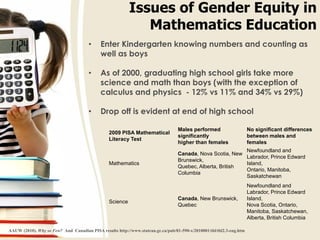
Issues of Gender Equity in
Mathematics Education
• Enter Kindergarten knowing numbers and counting as
well as boys
• As of 2000, graduating high school girls take more
science and math than boys (with the exception of
calculus and physics - 12% vs 11% and 34% vs 29%)
• Drop off is evident at end of high school
2009 PISA Mathematical
Literacy Test
Males performed
significantly
higher than females
No significant differences
between males and
females
Mathematics
Canada, Nova Scotia, New
Brunswick,
Quebec, Alberta, British
Columbia
Newfoundland and
Labrador, Prince Edward
Island,
Ontario, Manitoba,
Saskatchewan
Science
Canada, New Brunswick,
Quebec
Newfoundland and
Labrador, Prince Edward
Island,
Nova Scotia, Ontario,
Manitoba, Saskatchewan,
Alberta, British Columbia
AAUW (2010). Why so Few? And Canadian PISA results http://www.statcan.gc.ca/pub/81-590-x/2010001/tbl/tbl2.3-eng.htm
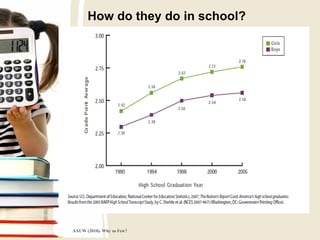
How do they do in school?
AAUW (2010). Why so Few?
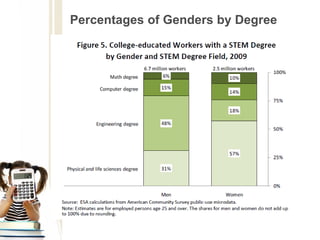
Percentages of Genders by Degree
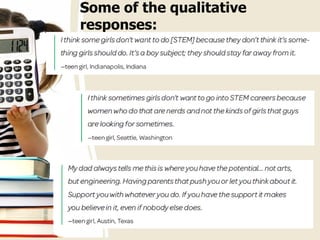
Some of the qualitative
responses:
But interestingly, research shows…
• Girls' math scores are as variable as boys' in
some countries and among some ethnic groups
in the U.S., with as many girls as boys scoring
above the 99th percentile in some cultures
• There are countries where the gender disparity
in math performance doesn't exist at either the
average or gifted level. These tend to be the
same countries that have the greatest gender
equality in all aspects.
• It is important to counter a country’s culture that
might instill in students the belief that math talent
is innate or if one is not naturally good at math,
there is little one can do to become good at it
Recommendations:
• Cultivate girls’ achievement and interest
• Girls are interested in the process of
learning, asking questions and problem
solving
• Counteract implicit/explicit bias in
classroom
• Get them to see mathematics as an
opportunity to develop relationships with
others and the material and re-make
themselves
• Get them to see mathematics’ higher
purpose and relevance to larger problem
solving skills
AAUW (2010). Why so Few? And GSRI report (2011)
Inclusive and Feminist Pedagogy
passivity
Active
participation
silence speech
omission inclusion
powerlessness empowerment
Student Agency
Ownership
Shared Authority
Subjective thought
Multiple Perspectives
Teaching for 21st Century Skills
Critical Thinking & Problem Solving
• thinking that is purposeful, reasoned, and goal directed
• evaluating the thinking process -- the reasoning that went into
the conclusion we've arrived at and the kinds of factors
considered in making a decision
Creativity and Innovation
• education that features “exploration, challenging problems,
and the tolerance, if not active encouragement, of productive
mistakes
Communication and Collaboration
• Expressing thoughts clearly, crisply articulating opinions,
communicating, coherent instructions, motivating others
through powerful speech
• Because complex communication involves explanation,
negotiation, and other forms of intense human interaction, jobs
which require these skills are not as likely to be automated.
Information Communication
&Technology Literacy Skills
• our students will be held to a more complex set of performance
criteria, including their ability to rapidly and continuously
innovate, customize, and adapt, all while maintaining high
standards of quality and reliability
Partnership for 21st Century Skills, (2004) The
Intellectual and Policy Foundations
of the 21st Century Skills Framework, p.8.
What is Problem-Based Learning?
An approach to curriculum and pedagogy where
student learning and content material are co-
constructed by students and teachers through
problems that are
Contextually
based and
abstract
Deliberately
scaffolded
based on
students’ prior
knowledge
Discussion-
based in a
non-
hierarchical
environment
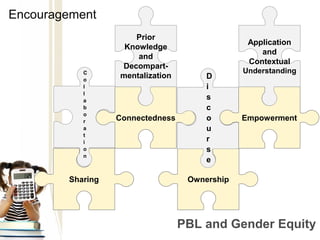
PBL and Gender Equity
Encouragement
Sharing
C
o
l
l
a
b
o
r
a
t
i
o
n
Connectedness
Prior
Knowledge
and
Decompart-
mentalization
Ownership
D
i
s
c
o
u
r
s
e
Empowerment
Application
and
Contextual
Understanding
So far what I’ve found…
• Desire for more agency in learning
community
• Unfilled, unsatisfied in mathematical
learning environments that are
disagentic
• Appreciative of opportunities for share
and hear others’ ideas, multiple
perspectives are not confusing in most
of cases Self-Confidence
Value
Empowerment
Agency
Enjoyment
• Appreciative of sense
of collaboration and
non-authoritative
community
Girls’ Attitudes Towards PBL
“I could be on the side where I like
to solve it this way and someone
else could be on the side where
they like to solve it that way, and
the fact that we both get to
express our opinions - and even
if one of us is wrong and one of
us is right, or even if both of us is
right. It’s changed my identity and
given me kind of like a voice in
math. Whereas I didn’t really
have one before. It was a silent
voice.”
-Leona, sophomore
Girls’ Attitudes Towards PBL
“When you’re at the board and they’re asking
you questions of like other ways how to do
it…because sometimes there’s more ways,
like alternate ways to solve a problem, so
other people have like different viewpoints on
it rather than just the teacher standing up
there telling you how to do…telling you the
steps how to find it.”
-Sarah, freshman
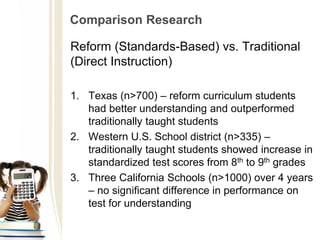
Comparison Research
Reform (Standards-Based) vs. Traditional
(Direct Instruction)
1. Texas (n>700) – reform curriculum students
had better understanding and outperformed
traditionally taught students
2. Western U.S. School district (n>335) –
traditionally taught students showed increase in
standardized test scores from 8th to 9th grades
3. Three California Schools (n>1000) over 4 years
– no significant difference in performance on
test for understanding
California Study
Many students in traditional class were observed to be
“received” knowers.
One student was approached and asked how he
was getting along. He replied, “Great! The thing I
love about traditional teaching is the teacher tells it
to you and you get it.” At this point the teacher
returned a test to the student, with the mark of “F”
written on the front. The student looked at the
mark and turned back to [the researcher], saying
“but that’s what I hate about traditional teaching,
you think you’ve got it when you haven’t.”
From Boaler, 2005
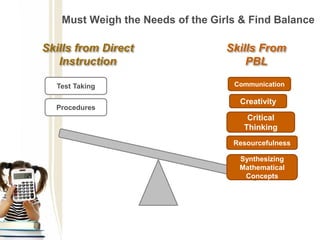
Meta-analysis Diagram
Must Weigh the Needs of the Girls & Find Balance
Procedures
Test Taking
Resourcefulness
Critical
Thinking
Creativity
Communication
Skills from Direct
Instruction
Skills From
PBL
Synthesizing
Mathematical
Concepts
Communicate Frequently
• Ask your daughter what is working
and not working
• Tell her to communicate with her
teacher
• Have her share something that
inspired her
• Openly discuss concerns with
teacher
• Share your own sense of inquiry
• Support her in the endeavor of
problem solving with
encouragement
But in the end know…
The mathematics faculty are entirely invested in the
best learning for
your daughter.
Communicating
Collaboration
Inquiry
Exploration

PBL and girls presentation

  • 1.
    Problem-Based Learning, Mathematics and Girls:Making the Most of Connections Carmel Schettino January 2013 “
  • 2.
    Historical Breakthroughs in GenderResearch 1986 1995 1997
  • 3.
    Boaler’s Conclusion’s (1997) “[There]appears to be an emerging feminist perspective within mathematics education that suggests that theories such as 'attribution theory' lay too much 'blame' upon girls and women for their underachievement in mathematics and not enough blame upon the wider school system. Interviews with underachieving girls show[ed] the way in which girls link their underachievement, not to themselves, but to the type of mathematics that is widely taught in the UK, which they believe denies them access to understanding. An alternative model of mathematics teaching is described that is open and project-based and that may be able to eradicate underachievement and disaffection amongst girls.
  • 4.
    Issues of GenderEquity in Mathematics Education • Enter Kindergarten knowing numbers and counting as well as boys • As of 2000, graduating high school girls take more science and math than boys (with the exception of calculus and physics - 12% vs 11% and 34% vs 29%) • Drop off is evident at end of high school 2009 PISA Mathematical Literacy Test Males performed significantly higher than females No significant differences between males and females Mathematics Canada, Nova Scotia, New Brunswick, Quebec, Alberta, British Columbia Newfoundland and Labrador, Prince Edward Island, Ontario, Manitoba, Saskatchewan Science Canada, New Brunswick, Quebec Newfoundland and Labrador, Prince Edward Island, Nova Scotia, Ontario, Manitoba, Saskatchewan, Alberta, British Columbia AAUW (2010). Why so Few? And Canadian PISA results http://www.statcan.gc.ca/pub/81-590-x/2010001/tbl/tbl2.3-eng.htm
  • 5.
    How do theydo in school? AAUW (2010). Why so Few?
  • 6.
  • 7.
    Some of thequalitative responses:
  • 8.
    But interestingly, researchshows… • Girls' math scores are as variable as boys' in some countries and among some ethnic groups in the U.S., with as many girls as boys scoring above the 99th percentile in some cultures • There are countries where the gender disparity in math performance doesn't exist at either the average or gifted level. These tend to be the same countries that have the greatest gender equality in all aspects. • It is important to counter a country’s culture that might instill in students the belief that math talent is innate or if one is not naturally good at math, there is little one can do to become good at it
  • 9.
    Recommendations: • Cultivate girls’achievement and interest • Girls are interested in the process of learning, asking questions and problem solving • Counteract implicit/explicit bias in classroom • Get them to see mathematics as an opportunity to develop relationships with others and the material and re-make themselves • Get them to see mathematics’ higher purpose and relevance to larger problem solving skills AAUW (2010). Why so Few? And GSRI report (2011)
  • 10.
    Inclusive and FeministPedagogy passivity Active participation silence speech omission inclusion powerlessness empowerment Student Agency Ownership Shared Authority Subjective thought Multiple Perspectives
  • 11.
    Teaching for 21stCentury Skills Critical Thinking & Problem Solving • thinking that is purposeful, reasoned, and goal directed • evaluating the thinking process -- the reasoning that went into the conclusion we've arrived at and the kinds of factors considered in making a decision Creativity and Innovation • education that features “exploration, challenging problems, and the tolerance, if not active encouragement, of productive mistakes Communication and Collaboration • Expressing thoughts clearly, crisply articulating opinions, communicating, coherent instructions, motivating others through powerful speech • Because complex communication involves explanation, negotiation, and other forms of intense human interaction, jobs which require these skills are not as likely to be automated. Information Communication &Technology Literacy Skills • our students will be held to a more complex set of performance criteria, including their ability to rapidly and continuously innovate, customize, and adapt, all while maintaining high standards of quality and reliability Partnership for 21st Century Skills, (2004) The Intellectual and Policy Foundations of the 21st Century Skills Framework, p.8.
  • 12.
    What is Problem-BasedLearning? An approach to curriculum and pedagogy where student learning and content material are co- constructed by students and teachers through problems that are Contextually based and abstract Deliberately scaffolded based on students’ prior knowledge Discussion- based in a non- hierarchical environment
  • 13.
    PBL and GenderEquity Encouragement Sharing C o l l a b o r a t i o n Connectedness Prior Knowledge and Decompart- mentalization Ownership D i s c o u r s e Empowerment Application and Contextual Understanding
  • 14.
    So far whatI’ve found… • Desire for more agency in learning community • Unfilled, unsatisfied in mathematical learning environments that are disagentic • Appreciative of opportunities for share and hear others’ ideas, multiple perspectives are not confusing in most of cases Self-Confidence Value Empowerment Agency Enjoyment • Appreciative of sense of collaboration and non-authoritative community
  • 15.
    Girls’ Attitudes TowardsPBL “I could be on the side where I like to solve it this way and someone else could be on the side where they like to solve it that way, and the fact that we both get to express our opinions - and even if one of us is wrong and one of us is right, or even if both of us is right. It’s changed my identity and given me kind of like a voice in math. Whereas I didn’t really have one before. It was a silent voice.” -Leona, sophomore
  • 16.
    Girls’ Attitudes TowardsPBL “When you’re at the board and they’re asking you questions of like other ways how to do it…because sometimes there’s more ways, like alternate ways to solve a problem, so other people have like different viewpoints on it rather than just the teacher standing up there telling you how to do…telling you the steps how to find it.” -Sarah, freshman
  • 17.
    Comparison Research Reform (Standards-Based)vs. Traditional (Direct Instruction) 1. Texas (n>700) – reform curriculum students had better understanding and outperformed traditionally taught students 2. Western U.S. School district (n>335) – traditionally taught students showed increase in standardized test scores from 8th to 9th grades 3. Three California Schools (n>1000) over 4 years – no significant difference in performance on test for understanding
  • 18.
    California Study Many studentsin traditional class were observed to be “received” knowers. One student was approached and asked how he was getting along. He replied, “Great! The thing I love about traditional teaching is the teacher tells it to you and you get it.” At this point the teacher returned a test to the student, with the mark of “F” written on the front. The student looked at the mark and turned back to [the researcher], saying “but that’s what I hate about traditional teaching, you think you’ve got it when you haven’t.” From Boaler, 2005
  • 19.
  • 20.
    Must Weigh theNeeds of the Girls & Find Balance Procedures Test Taking Resourcefulness Critical Thinking Creativity Communication Skills from Direct Instruction Skills From PBL Synthesizing Mathematical Concepts
  • 21.
    Communicate Frequently • Askyour daughter what is working and not working • Tell her to communicate with her teacher • Have her share something that inspired her • Openly discuss concerns with teacher • Share your own sense of inquiry • Support her in the endeavor of problem solving with encouragement
  • 22.
    But in theend know… The mathematics faculty are entirely invested in the best learning for your daughter. Communicating Collaboration Inquiry Exploration