Drive By Wire
BY
R S SAGEERAJ 180021601075
SAHUL HAMEED KHAN 180021601076
SAJJAD SAKEER HUSSAIN 180021601077
Introduction
 A technology known as "x-by-wire", also called drive by wire or simply "by-
wire". A car with this type of system mainly on electronics, to control a
wide range of vehicle operations, including, braking, acceleration, and
steering.
 Drive-by-wire is a term that can refer to a number of electronic systems
that take the place of old mechanical controls.
 Drive-by-wire systems have the potential to increase comfort, functionality
and safety during the drive. Computers and sensors would analyze
commands and instruct vehicles on exactly what to do.
 Instead of using cables, hydraulic pressure, and other things that provide
the driver with direct, physical control over the speed or direction of a
vehicle, drive-by-wire technology uses electronic controls to activate the
brakes, control the steering, and operate other systems
 By-wire systems have an environmental angle, too, since the technology
could improve fuel economy and reduce or improve engine emissions
 Electronic controls improve handling, enable better fuel efficiency and
exhibit shorter response times in emergency situations.
 The complexity of the system control functions enabled by electronic
systems can make vehicle performance more difficult to model.
 Integrating these complex systems, while achieving predictable, fail-safe
performance represents a significant challenge for the automotive industry
Types of Drive By Wire system
 In a drive-by-wire system, most of mechanical control would be replaced
by electrical wires. In any type of by-wire system, sensors record
information and pass data to a computer or a series of computers, which
transfer the electrical energy into mechanical motion.
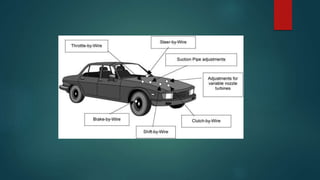
 There are several different types of drive-by-wire systems, which is why it's
sometimes referred to generally as x-by-wire. Here are the main by-wire
systems:
A. Steer by Wire
B. Throttle by Wire
C. Brake by Wire
Steer By Wire
 The recent introduction of electric power steering in production vehicles
eliminates the need for the hydraulic pump.
 Electric power steering is more efficient than conventional power steering,
since the electric power steering motor only needs to provide assist when
the steering wheel is turned, whereas the hydraulic pump must run
constantly. The assist level is also easily tunable to the vehicle type, road
speed, and even driver preference
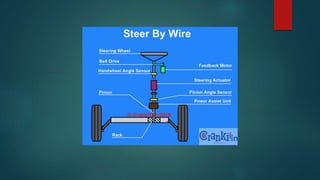
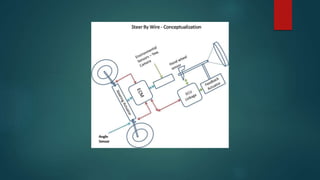
 In vehicles that are equipped with steer-by-wire technology, there is no
physical connection between the steering wheel and the tires.
 Steer-by-wire systems don’t technically need to use steering wheels at all.
When a steering wheel is used, some type of steering feel emulator is
typically used to provide the driver with feedback.
 The absence of a steering column greatly simplifies the design of car
interiors.
 Sensors : Torque sensor, steering angle sensors, yaw sensor, wheel speed
sensor, and wheel angle sensor
 Actuators : Steering actuator, feedback actuator, pinion actuator.
Throttle By Wire
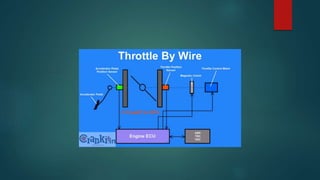
 These systems use a pedal unit and an engine management system.
 The pedal uses sensors that measure how much or how little the driver
moves the accelerator, and the sensors send that information to the
engine management system.
 The engine management system is a computer that, among other tasks,
determines how much fuel is required, and it provides this input to an
actuator -- a device that converts energy into mechanical motion.
 The pedal could be the same pedal drivers have become accustomed to
using today, an easy-to-reach pad placed near the foot that's pressed
down in order to accelerate the car.
 It replaces the traditional throttle linkage (a cable between the accelerator
pedal and the throttle) with an accelerator pedal position sensor and an
electronically operated throttle.
 It provides several advantages over mechanical systems are:
1. Eliminates binding problems in mechanical linkages preventing the
throttle from sticking
2. Allows automated control of the throttle that helps to reduce emissions
and improve fuel economy
3. This system can be modeled and installed as a modular system
4. Allows the ECM to integrate torque management with cruise control,
traction control and stability control
 The accelerator pedal sensor senses the position of the accelerator pedal.
This information is conveyed to the ECM as a change in the electrical
resistance.
 The ECM actuates a servo-motor, which actuates the butterfly valve in the
throttle assembly.
 The position of the throttle is continuously monitored and the information
is conveyed to the ECM using a feedback circuit.
 Sensors: accelerator pedal position sensor, throttle valve position sensor
 Actuators: motor controlling throttle valve position
Brake By Wire
 Brake-by-wire is an automotive technology that completely eliminates
traditional mechanical and hydraulic components and replaces them with
electronic sensors and actuators to control the brakes in vehicles.
 The advantages of brake-by-wire systems are:
1. Reacts more quickly resulting in shorter stopping distance and time
2. Loss of mechanical systems results in noiseless operation and elimination of
vibration
3. Lesser space consumed making the engine compartment and compact and
helping in better space utilization
4. Allows the ECM to integrate torque management with cruise control,
traction control and stability control
5. Reduces the weight of the overall system thus improving fuel efficiency
6. Lack of mechanical power may facilitate the need the introduction of hybrid
and fuel cells based vehicles
 Brake-by-wire systems are still under development.
 This systems consists of a rheostat that senses the position of the brake
pedal. This signal is interpreted by the brake computer, which generates
signals to operate a servo pump. The pump pressurizes the secondary
circuit and brake fluid pushes against a slave piston that activates the
brake. The pressure is monitored and a signal is sent back to the brake
computer, which applies a mechanical force to the pedal as feedback to
the driver.
 Sensors: brake pedal position sensor
 Actuators: Servomotor/pump
Advantages
 Drive-by-wire systems can significantly reduce the number of moving parts
in a vehicle.
 This reduces weight, increases operational accuracy and stretches out the
time between service visits for things like mechanical maintenance and
other adjustments.
 Less weight and better accuracy would equal better fuel efficiency and
fewer emissions
Disadvantages
 Due to the complexity of drive-by-wire systems, some people worry about
potential electronic malfunctions in sensors and computers, leading to
vehicle damage or even car accidents and passenger injury.
 A system using software has the ability to fail regardless of how many
times that software has been tested.
 for example, the sensors on a brake-by-wire system could make an error in
calculation, causing the brake caliper and pads to apply an incorrect
amount of pressure -- either too light or too strong -- to the rotor.
Unaware of any internal system problems, the driver using the brake-by-
wire system could potentially get into an accident, even though he or she
thought the correct amount of pressure was being placed on the brake
pedal.
Conclusion
 Drive-by-wire technology could also be integrated with driverless car
technology, which would allow vehicles to be operated remotely or by a
computer. Current driverless car projects use electromechanical actuators
to control steering, braking, and acceleration, which could be simplified by
connecting directly to drive by-wire technology.
 The complexity of drive-by-wire systems is a concern to many automotive
customers who worry about the failure of software and possible electronic
malfunctions in sensors resulting in car accidents and passenger injury.
 Ultimately, the enhanced safety features and the other benefits of
automated electronic controls are expected to outweigh concerns about
the complexity and reliability of these controls and drive-by-wire systems
will be widely used in automotive designs.
Thank You

Drive by wire

  • 1.
    Drive By Wire BY RS SAGEERAJ 180021601075 SAHUL HAMEED KHAN 180021601076 SAJJAD SAKEER HUSSAIN 180021601077
  • 2.
    Introduction  A technologyknown as "x-by-wire", also called drive by wire or simply "by- wire". A car with this type of system mainly on electronics, to control a wide range of vehicle operations, including, braking, acceleration, and steering.  Drive-by-wire is a term that can refer to a number of electronic systems that take the place of old mechanical controls.  Drive-by-wire systems have the potential to increase comfort, functionality and safety during the drive. Computers and sensors would analyze commands and instruct vehicles on exactly what to do.
  • 3.
     Instead ofusing cables, hydraulic pressure, and other things that provide the driver with direct, physical control over the speed or direction of a vehicle, drive-by-wire technology uses electronic controls to activate the brakes, control the steering, and operate other systems  By-wire systems have an environmental angle, too, since the technology could improve fuel economy and reduce or improve engine emissions  Electronic controls improve handling, enable better fuel efficiency and exhibit shorter response times in emergency situations.
  • 4.
     The complexityof the system control functions enabled by electronic systems can make vehicle performance more difficult to model.  Integrating these complex systems, while achieving predictable, fail-safe performance represents a significant challenge for the automotive industry
  • 5.
    Types of DriveBy Wire system  In a drive-by-wire system, most of mechanical control would be replaced by electrical wires. In any type of by-wire system, sensors record information and pass data to a computer or a series of computers, which transfer the electrical energy into mechanical motion.  There are several different types of drive-by-wire systems, which is why it's sometimes referred to generally as x-by-wire. Here are the main by-wire systems: A. Steer by Wire B. Throttle by Wire C. Brake by Wire
  • 7.
    Steer By Wire The recent introduction of electric power steering in production vehicles eliminates the need for the hydraulic pump.  Electric power steering is more efficient than conventional power steering, since the electric power steering motor only needs to provide assist when the steering wheel is turned, whereas the hydraulic pump must run constantly. The assist level is also easily tunable to the vehicle type, road speed, and even driver preference
  • 8.
     In vehiclesthat are equipped with steer-by-wire technology, there is no physical connection between the steering wheel and the tires.  Steer-by-wire systems don’t technically need to use steering wheels at all. When a steering wheel is used, some type of steering feel emulator is typically used to provide the driver with feedback.  The absence of a steering column greatly simplifies the design of car interiors.  Sensors : Torque sensor, steering angle sensors, yaw sensor, wheel speed sensor, and wheel angle sensor  Actuators : Steering actuator, feedback actuator, pinion actuator.
  • 11.
    Throttle By Wire These systems use a pedal unit and an engine management system.  The pedal uses sensors that measure how much or how little the driver moves the accelerator, and the sensors send that information to the engine management system.  The engine management system is a computer that, among other tasks, determines how much fuel is required, and it provides this input to an actuator -- a device that converts energy into mechanical motion.  The pedal could be the same pedal drivers have become accustomed to using today, an easy-to-reach pad placed near the foot that's pressed down in order to accelerate the car.
  • 12.
     It replacesthe traditional throttle linkage (a cable between the accelerator pedal and the throttle) with an accelerator pedal position sensor and an electronically operated throttle.  It provides several advantages over mechanical systems are: 1. Eliminates binding problems in mechanical linkages preventing the throttle from sticking 2. Allows automated control of the throttle that helps to reduce emissions and improve fuel economy 3. This system can be modeled and installed as a modular system 4. Allows the ECM to integrate torque management with cruise control, traction control and stability control
  • 13.
     The acceleratorpedal sensor senses the position of the accelerator pedal. This information is conveyed to the ECM as a change in the electrical resistance.  The ECM actuates a servo-motor, which actuates the butterfly valve in the throttle assembly.  The position of the throttle is continuously monitored and the information is conveyed to the ECM using a feedback circuit.  Sensors: accelerator pedal position sensor, throttle valve position sensor  Actuators: motor controlling throttle valve position
  • 15.
    Brake By Wire Brake-by-wire is an automotive technology that completely eliminates traditional mechanical and hydraulic components and replaces them with electronic sensors and actuators to control the brakes in vehicles.
  • 16.
     The advantagesof brake-by-wire systems are: 1. Reacts more quickly resulting in shorter stopping distance and time 2. Loss of mechanical systems results in noiseless operation and elimination of vibration 3. Lesser space consumed making the engine compartment and compact and helping in better space utilization 4. Allows the ECM to integrate torque management with cruise control, traction control and stability control 5. Reduces the weight of the overall system thus improving fuel efficiency 6. Lack of mechanical power may facilitate the need the introduction of hybrid and fuel cells based vehicles
  • 17.
     Brake-by-wire systemsare still under development.  This systems consists of a rheostat that senses the position of the brake pedal. This signal is interpreted by the brake computer, which generates signals to operate a servo pump. The pump pressurizes the secondary circuit and brake fluid pushes against a slave piston that activates the brake. The pressure is monitored and a signal is sent back to the brake computer, which applies a mechanical force to the pedal as feedback to the driver.  Sensors: brake pedal position sensor  Actuators: Servomotor/pump
  • 18.
    Advantages  Drive-by-wire systemscan significantly reduce the number of moving parts in a vehicle.  This reduces weight, increases operational accuracy and stretches out the time between service visits for things like mechanical maintenance and other adjustments.  Less weight and better accuracy would equal better fuel efficiency and fewer emissions
  • 19.
    Disadvantages  Due tothe complexity of drive-by-wire systems, some people worry about potential electronic malfunctions in sensors and computers, leading to vehicle damage or even car accidents and passenger injury.  A system using software has the ability to fail regardless of how many times that software has been tested.  for example, the sensors on a brake-by-wire system could make an error in calculation, causing the brake caliper and pads to apply an incorrect amount of pressure -- either too light or too strong -- to the rotor. Unaware of any internal system problems, the driver using the brake-by- wire system could potentially get into an accident, even though he or she thought the correct amount of pressure was being placed on the brake pedal.
  • 20.
    Conclusion  Drive-by-wire technologycould also be integrated with driverless car technology, which would allow vehicles to be operated remotely or by a computer. Current driverless car projects use electromechanical actuators to control steering, braking, and acceleration, which could be simplified by connecting directly to drive by-wire technology.  The complexity of drive-by-wire systems is a concern to many automotive customers who worry about the failure of software and possible electronic malfunctions in sensors resulting in car accidents and passenger injury.  Ultimately, the enhanced safety features and the other benefits of automated electronic controls are expected to outweigh concerns about the complexity and reliability of these controls and drive-by-wire systems will be widely used in automotive designs.
  • 21.