Designing for behaviour change
Phil Barrett
Director
Flow Interactive South Africa
A few techniques
Flickr:HeatherHopkins/ClevergrrlFlickr:Mel/Karamellzucker
Flickr:DarrenTunnicliff/ĐāżŦ{mostlyabsent}
Flickrr:Etolane
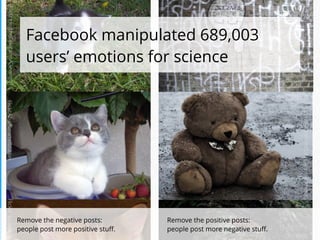
Remove the negative posts: 

people post more positive stuff.
Facebook manipulated 689,003
users’ emotions for science
Flickr:quantumbunny
Remove the positive posts: 

people post more negative stuff.
“I am worried about the ability of Facebook and
others to manipulate people’s thoughts […]
If people are being thought-controlled in this
kind of way, there needs to be protection and
they at least need to know about it.
Jim Sheridan, MP

Member of Commons Media Select committee
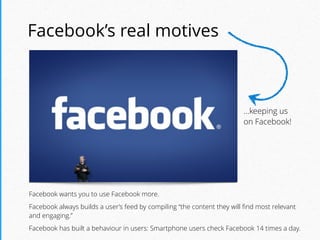
Facebook’s real motives
Facebook wants you to use Facebook more.
Facebook always builds a user’s feed by compiling “the content they will find most relevant
and engaging.”
Facebook has built a behaviour in users: Smartphone users check Facebook 14 times a day.
…keeping us
on Facebook!
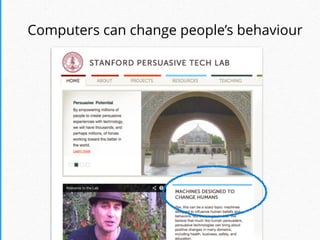
Computers can change people’s behaviour
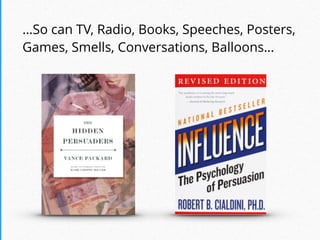
…So can TV, Radio, Books, Speeches, Posters,
Games, Smells, Conversations, Balloons…
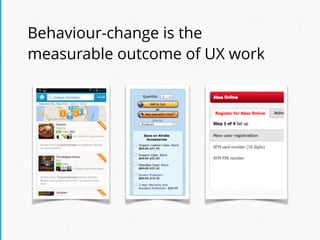
Behaviour-change is the 

measurable outcome of UX work
“Behaviour
is our medium.
Robert Fabricant

Frog Design
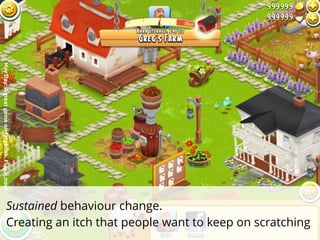
Sustained behaviour change.
Creating an itch that people want to keep on scratching
HayDay:Agreatgameonfacebook.Playitnow!
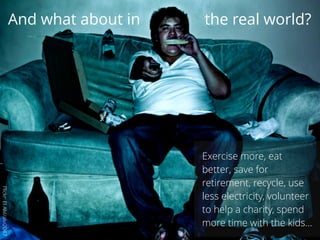
And what about in the real world?
Exercise more, eat
better, save for
retirement, recycle, use
less electricity, volunteer
to help a charity, spend
more time with the kids…
Flickr:ElAlvi/alvi2047
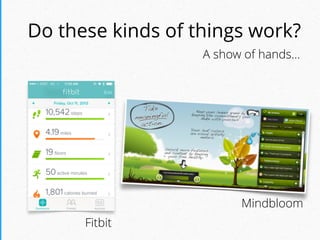
Mindbloom
Fitbit
Do these kinds of things work?
A show of hands…
What kinds of behaviour change
can we hope to achieve?
What techniques can we use?
Flickr:JackKeane/whatknot
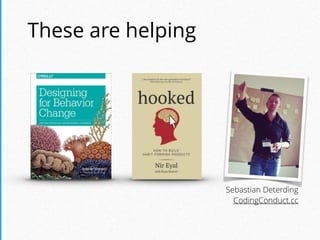
These are helping
Sebastian Deterding

CodingConduct.cc
Get people to take an action
Exploit mental quirks to persuade
Build habits
Design a compelling behavioural plan
Cheat
Flickr:JackKeane/whatknot
CONCEPT 1
Getting people to take
action is hard
“
BJ Fogg, 

Professor of Persuasive Tech
Stanford University
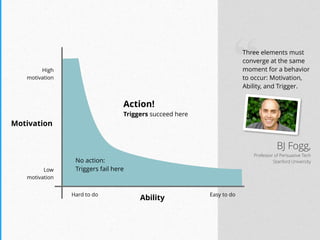
Three elements must
converge at the same
moment for a behavior
to occur: Motivation,
Ability, and Trigger.
Easy to doHard to do
Low 

motivation
High 

motivation
No action:
Triggers fail here
Ability
Motivation
Action!
Triggers succeed here
Easy to doHard to do
Low 

motivation
High 

motivation
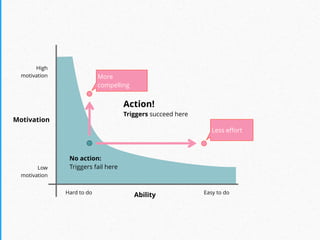
No action:
Triggers fail here
Action!
Triggers succeed here
Ability
Motivation
More
compelling
Less effort
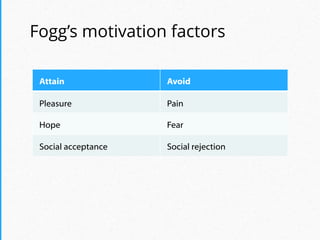
Fogg’s motivation factors
Attain Avoid
Pleasure Pain
Hope Fear
Social acceptance Social rejection
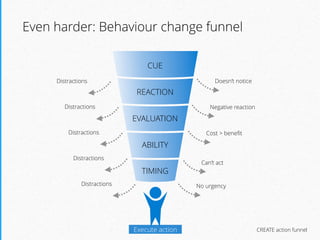
Even harder: Behaviour change funnel
Execute action
CUE
REACTION
EVALUATION
ABILITY
TIMING
Distractions
Distractions
Distractions
Distractions
Distractions
Doesn’t notice
Negative reaction
Cost > benefit
Can’t act
No urgency
CREATE action funnel
CONCEPT 2
You can exploit mental quirks
to get a more positive reaction
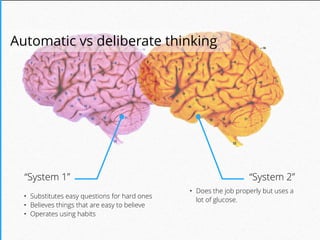
“System 1” “System 2”
Automatic vs deliberate thinking
• Does the job properly but uses a
lot of glucose.• Substitutes easy questions for hard ones
• Believes things that are easy to believe
• Operates using habits
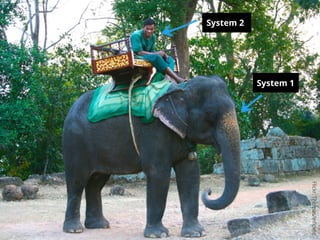
System 2
System 1
Flickr:Thomas/Infidelic
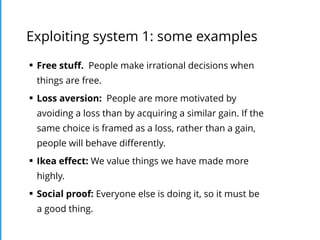
Exploiting system 1: some examples
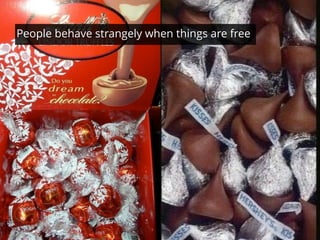
§ Free stuff. People make irrational decisions when
things are free.
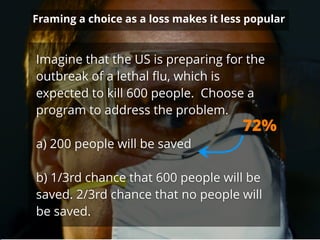
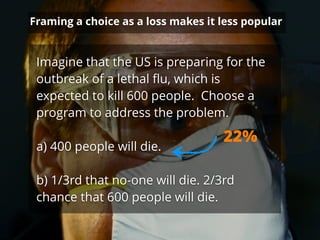
§ Loss aversion: People are more motivated by
avoiding a loss than by acquiring a similar gain. If the
same choice is framed as a loss, rather than a gain,
people will behave differently.
§ Ikea effect: We value things we have made more
highly.
§ Social proof: Everyone else is doing it, so it must be
a good thing.
People behave strangely when things are free
Framing a choice as a loss makes it less popular
Imagine that the US is preparing for the
outbreak of a lethal flu, which is
expected to kill 600 people. Choose a
program to address the problem.
!
a) 200 people will be saved
!
b) 1/3rd chance that 600 people will be
saved. 2/3rd chance that no people will
be saved.
72%
Framing a choice as a loss makes it less popular
Imagine that the US is preparing for the
outbreak of a lethal flu, which is
expected to kill 600 people. Choose a
program to address the problem.
!
a) 400 people will die.
!
b) 1/3rd that no-one will die. 2/3rd
chance that 600 people will die.
22%
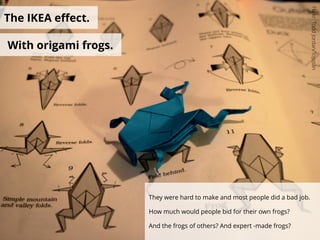
The IKEA effect.
With origami frogs.
They were hard to make and most people did a bad job.
How much would people bid for their own frogs?
And the frogs of others? And expert -made frogs?
Flickr:ToddJordan/Tojosan
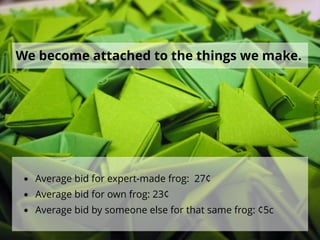
We become attached to the things we make.
• Average bid for expert-made frog: 27¢
• Average bid for own frog: 23¢
• Average bid by someone else for that same frog: ¢5c
Flickr:Nanimo
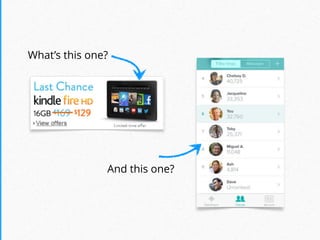
What’s this one?
And this one?
CONCEPT 3
For sustained behaviour change
you need to create habits
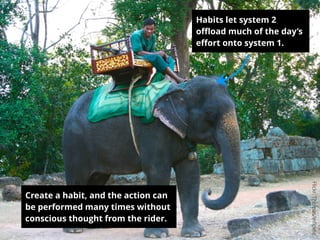
Habits let system 2
offload much of the day’s
effort onto system 1.
Create a habit, and the action can
be performed many times without
conscious thought from the rider.
Flickr:Thomas/Infidelic
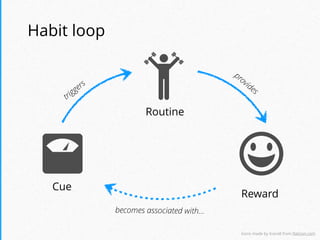
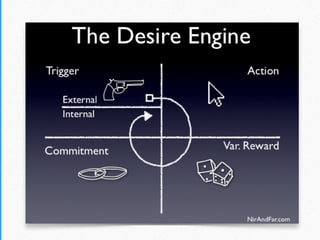
Habit loop
Icons made by Icons8 from flaticon.com
Cue
Routine
Reward
triggers
provides
becomes associated with…
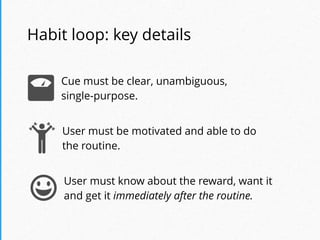
Habit loop: key details
Cue must be clear, unambiguous,
single-purpose.
User must be motivated and able to do
the routine.
User must know about the reward, want it
and get it immediately after the routine.
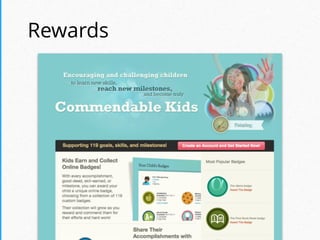
Rewards
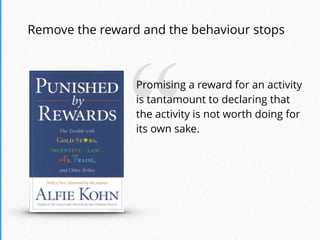
“Promising a reward for an activity
is tantamount to declaring that
the activity is not worth doing for
its own sake.
Remove the reward and the behaviour stops
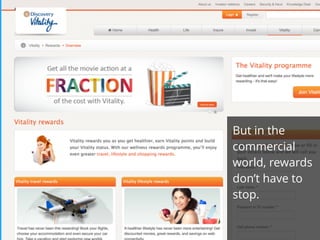
But in the
commercial
world, rewards
don’t have to
stop.
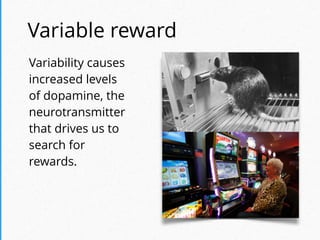
Variable reward
Variability causes
increased levels
of dopamine, the
neurotransmitter
that drives us to
search for
rewards.
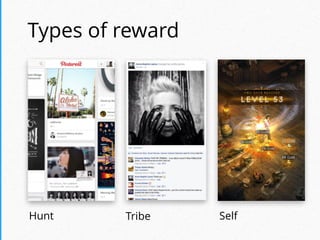
Types of reward
TribeHunt Self
Old habits never die. 

But sometimes you can get past them.
• Avoid the cue
• Replace the routine
• Get people to think about the habit
• Mindfulness
• Crowd out the old habit with new
behaviour
CONCEPT 4
Design a behaviour plan that helps
people build ability and stay motivated
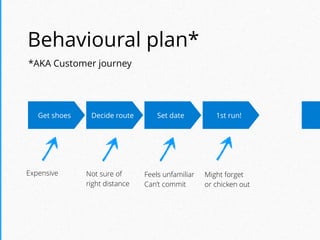
Behavioural plan*
Get shoes Decide route Set date 1st run!
Expensive Not sure of
right distance
Feels unfamiliar
Can’t commit
Might forget
or chicken out
*AKA Customer journey
Behavioural plan*
Get shoes Decide route Set date 1st run!
Expensive Not sure of
right distance
Feels unfamiliar
Can’t commit
Might forget
or chicken out
*AKA Customer journey
Suggest distance
Suggest route
Social proof
Social proof
Behavioural bridge
Reminder
Commitment contract
Target/goal
Social proof
Behavioural bridge
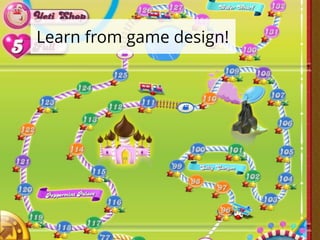
Learn from game design!
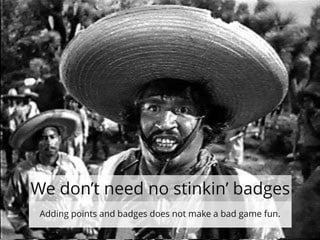
We don’t need no stinkin’ badges
Adding points and badges does not make a bad game fun.
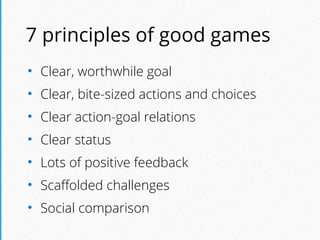
7 principles of good games
• Clear, worthwhile goal
• Clear, bite-sized actions and choices
• Clear action-goal relations
• Clear status
• Lots of positive feedback
• Scaffolded challenges
• Social comparison
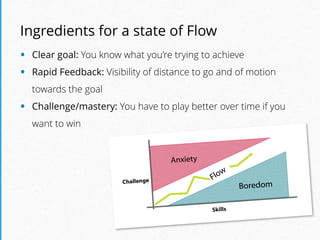
Ingredients for a state of Flow
• Clear goal: You know what you’re trying to achieve
• Rapid Feedback: Visibility of distance to go and of motion
towards the goal
• Challenge/mastery: You have to play better over time if you
want to win
Skills
Challenge
Anxiety
Boredom
Flow
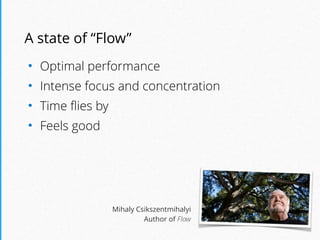
A state of “Flow”
• Optimal performance
• Intense focus and concentration
• Time flies by
• Feels good
Mihaly Csikszentmihalyi
Author of Flow
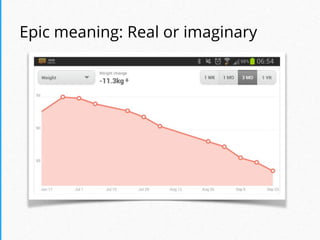
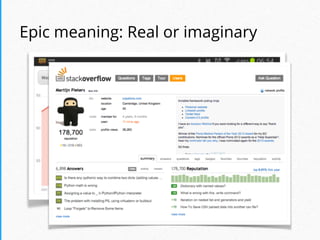
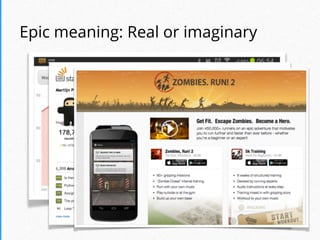
Epic meaning: Real or imaginary
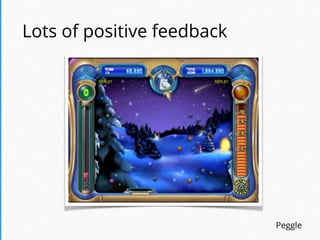
Lots of positive feedback
Peggle
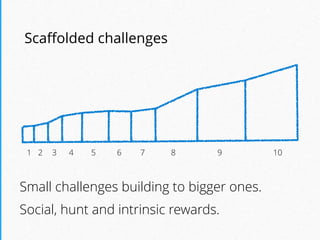
1 2 3 4 5 6 7 8 9 10
Scaffolded challenges
Small challenges building to bigger ones.
Social, hunt and intrinsic rewards.
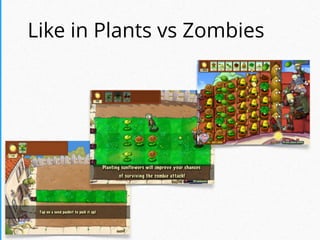
Like in Plants vs Zombies
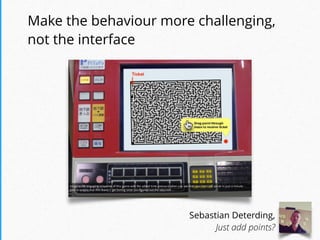
Make the behaviour more challenging, 

not the interface
Sebastian Deterding,
Just add points?
CONCEPT 5
Cheat
Choice architecture
In some situations you can make a
lasting impact by choosing a positive
default and allowing people to opt out.
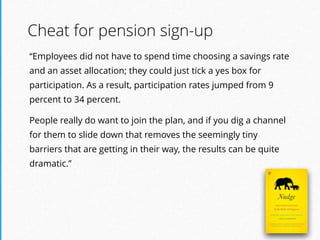
“Employees did not have to spend time choosing a savings rate
and an asset allocation; they could just tick a yes box for
participation. As a result, participation rates jumped from 9
percent to 34 percent.
People really do want to join the plan, and if you dig a channel
for them to slide down that removes the seemingly tiny
barriers that are getting in their way, the results can be quite
dramatic.”
Cheat for pension sign-up
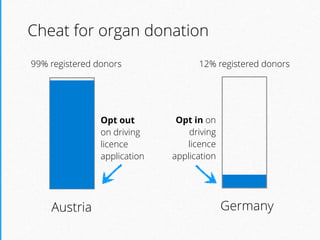
Cheat for organ donation
Austria Germany
99% registered donors 12% registered donors
Opt in on
driving
licence
application
Opt out
on driving
licence
application
Libertarian paternalism
In unfamiliar and complex situations
where people often make the wrong
choice, it’s best to make a choice for
them but important to allow them the
freedom to do what they want.
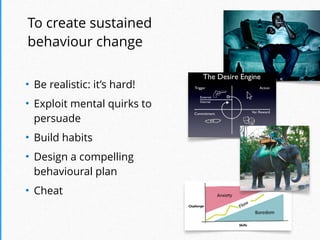
To create sustained
behaviour change
!
• Be realistic: it’s hard!
• Exploit mental quirks to
persuade
• Build habits
• Design a compelling 

behavioural plan
• Cheat
Thanks!
Phil Barrett
@philbuktoo
@Flow_SA
www.userexperience.co.za

Designing for behaviour change

  • 1.
    Designing for behaviourchange Phil Barrett Director Flow Interactive South Africa A few techniques
  • 2.
    Flickr:HeatherHopkins/ClevergrrlFlickr:Mel/Karamellzucker Flickr:DarrenTunnicliff/ĐāżŦ{mostlyabsent} Flickrr:Etolane Remove the negativeposts: 
 people post more positive stuff. Facebook manipulated 689,003 users’ emotions for science Flickr:quantumbunny Remove the positive posts: 
 people post more negative stuff.
  • 3.
    “I am worriedabout the ability of Facebook and others to manipulate people’s thoughts […] If people are being thought-controlled in this kind of way, there needs to be protection and they at least need to know about it. Jim Sheridan, MP
 Member of Commons Media Select committee
  • 4.
    Facebook’s real motives Facebookwants you to use Facebook more. Facebook always builds a user’s feed by compiling “the content they will find most relevant and engaging.” Facebook has built a behaviour in users: Smartphone users check Facebook 14 times a day. …keeping us on Facebook!
  • 5.
    Computers can changepeople’s behaviour
  • 6.
    …So can TV,Radio, Books, Speeches, Posters, Games, Smells, Conversations, Balloons…
  • 7.
    Behaviour-change is the
 measurable outcome of UX work
  • 8.
    “Behaviour is our medium. RobertFabricant
 Frog Design
  • 9.
    Sustained behaviour change. Creatingan itch that people want to keep on scratching HayDay:Agreatgameonfacebook.Playitnow!
  • 10.
    And what aboutin the real world? Exercise more, eat better, save for retirement, recycle, use less electricity, volunteer to help a charity, spend more time with the kids… Flickr:ElAlvi/alvi2047
  • 11.
    Mindbloom Fitbit Do these kindsof things work? A show of hands…
  • 12.
    What kinds ofbehaviour change can we hope to achieve? What techniques can we use? Flickr:JackKeane/whatknot
  • 13.
    These are helping SebastianDeterding
 CodingConduct.cc
  • 14.
    Get people totake an action Exploit mental quirks to persuade Build habits Design a compelling behavioural plan Cheat Flickr:JackKeane/whatknot
  • 15.
    CONCEPT 1 Getting peopleto take action is hard
  • 16.
    “ BJ Fogg, 
 Professorof Persuasive Tech Stanford University Three elements must converge at the same moment for a behavior to occur: Motivation, Ability, and Trigger. Easy to doHard to do Low 
 motivation High 
 motivation No action: Triggers fail here Ability Motivation Action! Triggers succeed here
  • 17.
    Easy to doHardto do Low 
 motivation High 
 motivation No action: Triggers fail here Action! Triggers succeed here Ability Motivation More compelling Less effort
  • 18.
    Fogg’s motivation factors AttainAvoid Pleasure Pain Hope Fear Social acceptance Social rejection
  • 19.
    Even harder: Behaviourchange funnel Execute action CUE REACTION EVALUATION ABILITY TIMING Distractions Distractions Distractions Distractions Distractions Doesn’t notice Negative reaction Cost > benefit Can’t act No urgency CREATE action funnel
  • 20.
    CONCEPT 2 You canexploit mental quirks to get a more positive reaction
  • 21.
    “System 1” “System2” Automatic vs deliberate thinking • Does the job properly but uses a lot of glucose.• Substitutes easy questions for hard ones • Believes things that are easy to believe • Operates using habits
  • 22.
  • 23.
    Exploiting system 1:some examples § Free stuff. People make irrational decisions when things are free. § Loss aversion: People are more motivated by avoiding a loss than by acquiring a similar gain. If the same choice is framed as a loss, rather than a gain, people will behave differently. § Ikea effect: We value things we have made more highly. § Social proof: Everyone else is doing it, so it must be a good thing.
  • 24.
    People behave strangelywhen things are free
  • 25.
    Framing a choiceas a loss makes it less popular Imagine that the US is preparing for the outbreak of a lethal flu, which is expected to kill 600 people. Choose a program to address the problem. ! a) 200 people will be saved ! b) 1/3rd chance that 600 people will be saved. 2/3rd chance that no people will be saved. 72%
  • 26.
    Framing a choiceas a loss makes it less popular Imagine that the US is preparing for the outbreak of a lethal flu, which is expected to kill 600 people. Choose a program to address the problem. ! a) 400 people will die. ! b) 1/3rd that no-one will die. 2/3rd chance that 600 people will die. 22%
  • 27.
    The IKEA effect. Withorigami frogs. They were hard to make and most people did a bad job. How much would people bid for their own frogs? And the frogs of others? And expert -made frogs? Flickr:ToddJordan/Tojosan
  • 28.
    We become attachedto the things we make. • Average bid for expert-made frog: 27¢ • Average bid for own frog: 23¢ • Average bid by someone else for that same frog: ¢5c Flickr:Nanimo
  • 29.
  • 30.
    CONCEPT 3 For sustainedbehaviour change you need to create habits
  • 31.
    Habits let system2 offload much of the day’s effort onto system 1. Create a habit, and the action can be performed many times without conscious thought from the rider. Flickr:Thomas/Infidelic
  • 32.
    Habit loop Icons madeby Icons8 from flaticon.com Cue Routine Reward triggers provides becomes associated with…
  • 33.
    Habit loop: keydetails Cue must be clear, unambiguous, single-purpose. User must be motivated and able to do the routine. User must know about the reward, want it and get it immediately after the routine.
  • 34.
  • 35.
    “Promising a rewardfor an activity is tantamount to declaring that the activity is not worth doing for its own sake. Remove the reward and the behaviour stops
  • 36.
    But in the commercial world,rewards don’t have to stop.
  • 37.
    Variable reward Variability causes increasedlevels of dopamine, the neurotransmitter that drives us to search for rewards.
  • 38.
  • 40.
    Old habits neverdie. 
 But sometimes you can get past them. • Avoid the cue • Replace the routine • Get people to think about the habit • Mindfulness • Crowd out the old habit with new behaviour
  • 41.
    CONCEPT 4 Design abehaviour plan that helps people build ability and stay motivated
  • 42.
    Behavioural plan* Get shoesDecide route Set date 1st run! Expensive Not sure of right distance Feels unfamiliar Can’t commit Might forget or chicken out *AKA Customer journey
  • 43.
    Behavioural plan* Get shoesDecide route Set date 1st run! Expensive Not sure of right distance Feels unfamiliar Can’t commit Might forget or chicken out *AKA Customer journey Suggest distance Suggest route Social proof Social proof Behavioural bridge Reminder Commitment contract Target/goal Social proof Behavioural bridge
  • 44.
  • 45.
    We don’t needno stinkin’ badges Adding points and badges does not make a bad game fun.
  • 46.
    7 principles ofgood games • Clear, worthwhile goal • Clear, bite-sized actions and choices • Clear action-goal relations • Clear status • Lots of positive feedback • Scaffolded challenges • Social comparison
  • 47.
    Ingredients for astate of Flow • Clear goal: You know what you’re trying to achieve • Rapid Feedback: Visibility of distance to go and of motion towards the goal • Challenge/mastery: You have to play better over time if you want to win Skills Challenge Anxiety Boredom Flow
  • 48.
    A state of“Flow” • Optimal performance • Intense focus and concentration • Time flies by • Feels good Mihaly Csikszentmihalyi Author of Flow
  • 49.
    Epic meaning: Realor imaginary
  • 50.
    Epic meaning: Realor imaginary
  • 51.
    Epic meaning: Realor imaginary
  • 52.
    Lots of positivefeedback Peggle
  • 53.
    1 2 34 5 6 7 8 9 10 Scaffolded challenges Small challenges building to bigger ones. Social, hunt and intrinsic rewards.
  • 54.
    Like in Plantsvs Zombies
  • 55.
    Make the behaviourmore challenging, 
 not the interface Sebastian Deterding, Just add points?
  • 56.
  • 57.
    Choice architecture In somesituations you can make a lasting impact by choosing a positive default and allowing people to opt out.
  • 58.
    “Employees did nothave to spend time choosing a savings rate and an asset allocation; they could just tick a yes box for participation. As a result, participation rates jumped from 9 percent to 34 percent. People really do want to join the plan, and if you dig a channel for them to slide down that removes the seemingly tiny barriers that are getting in their way, the results can be quite dramatic.” Cheat for pension sign-up
  • 59.
    Cheat for organdonation Austria Germany 99% registered donors 12% registered donors Opt in on driving licence application Opt out on driving licence application
  • 60.
    Libertarian paternalism In unfamiliarand complex situations where people often make the wrong choice, it’s best to make a choice for them but important to allow them the freedom to do what they want.
  • 61.
    To create sustained behaviourchange ! • Be realistic: it’s hard! • Exploit mental quirks to persuade • Build habits • Design a compelling 
 behavioural plan • Cheat
  • 62.