
Oral academic discourse socialisation:
Challenges faced by international undergraduate
students in Universiti Sains Malaysia
1

DR. OMER HASSAN ALI MAHFOODH
omer@usm.my
U S M , M A L AY S I A
Full article can be downloaded at
http://www.ccsenet.org/journal/index.php/ies/article/view/30651

ICLALIS 2013
22-24 October 2013
Promenade Hotel, Kota Kinabalu, Sabah, Malaysia
2

 Countries in the Asia Pacific region have witnessed a

remarkable and significant development through
implementing effective plans for reform and
restructuring in higher education (Kaur & Sidhu, 2009).

 China, Malaysia, and India are developing strategies

to attract students and to export educational programs
and institutions (Altbach & Knight, 2007: 294).
3

 International students in Malaysian higher education

institutions
 It is expected that the international students in

Malaysian institutions of higher education will reach
200,000 in 2020 (Mahmud et al., 2010; Yusoff &
Chelliah, 2010).
 Students entering academic institutions have different

amounts and kinds of prior experience with academic
discourse.
4

 At the undergraduate level, international students in

most Malaysian universities are required to complete
several activities to complete the programmes they
joined.
1.
2.
3.
4.
5.

Final examinations
Tests
Quizzes
Assignments and
Oral academic presentations
5

 Academic discourse
 forms of oral and written language and communication

(genres,
registers,
graphics,
linguistic
structures,
interactional
patterns)
that
are
privileged, expected, cultivated, conventionalized, or
ritualized, and, therefore, usually evaluated by
instructors, institutions, editors, and others in
educational and professional contexts.
 “discourse socialization places more emphasis on social

processes,
(2010:171).

negotiation,

and

interaction”

Duff
6

 The

successful performance in oral activities
carried out by international students should not
only judged based on students’ language
proficiency.

 The students’ understanding of rules and specific

behaviours valued by each discipline and each
institutional context should be taken into account.
7

 Morita (2000)
 Kobayashi (2003)
 Zappa-Hollman (2007)
8

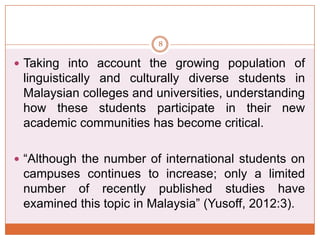
 Taking into account the growing population of

linguistically and culturally diverse students in
Malaysian colleges and universities, understanding
how these students participate in their new
academic communities has become critical.
 “Although the number of international students on

campuses continues to increase; only a limited
number of recently published studies have
examined this topic in Malaysia” (Yusoff, 2012:3).
My study
9

students’ perspectives about their
participation in oral activities in university content
courses.

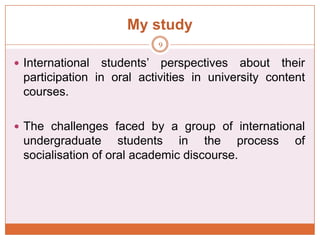
 International

 The challenges faced by a group of international

undergraduate students in the process
socialisation of oral academic discourse.

of
10

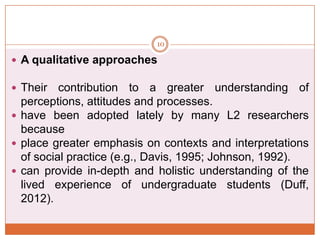
 A qualitative approaches
 Their

contribution to a greater understanding of
perceptions, attitudes and processes.
 have been adopted lately by many L2 researchers
because
 place greater emphasis on contexts and interpretations
of social practice (e.g., Davis, 1995; Johnson, 1992).
 can provide in-depth and holistic understanding of the
lived experience of undergraduate students (Duff,
2012).
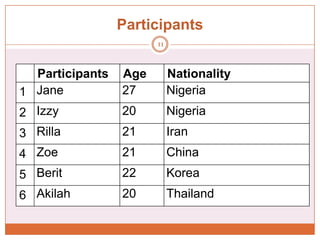
Participants
11

Participants
1 Jane

Age
27

Nationality
Nigeria

2 Izzy

20

Nigeria

3 Rilla

21

Iran

4 Zoe

21

China

5 Berit

22

Korea

6 Akilah

20

Thailand
12

 Data collected employing

1. interviews,
2. observations and
3. documents collection
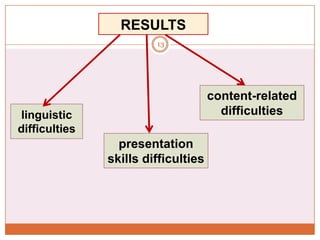
RESULTS
13

content-related
difficulties

linguistic
difficulties

presentation
skills difficulties
1. Linguistic difficulties
14

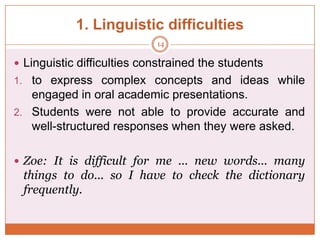
 Linguistic difficulties constrained the students
1. to express complex concepts and ideas while

engaged in oral academic presentations.
2. Students were not able to provide accurate and
well-structured responses when they were asked.
 Zoe: It is difficult for me ... new words... many

things to do... so I have to check the dictionary
frequently.
15

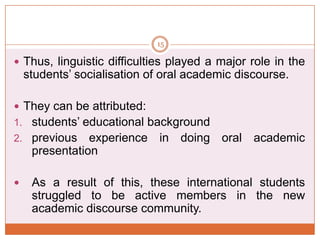
 Thus, linguistic difficulties played a major role in the

students’ socialisation of oral academic discourse.

 They can be attributed:
1. students’ educational background

2. previous

experience in doing oral academic
presentation



As a result of this, these international students
struggled to be active members in the new
academic discourse community.
2. Presentation skills difficulties
16

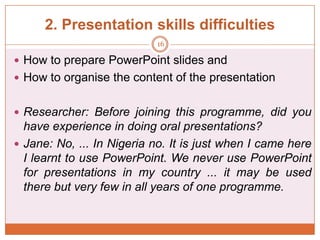
 How to prepare PowerPoint slides and
 How to organise the content of the presentation
 Researcher: Before joining this programme, did you

have experience in doing oral presentations?
 Jane: No, ... In Nigeria no. It is just when I came here
I learnt to use PowerPoint. We never use PowerPoint
for presentations in my country ... it may be used
there but very few in all years of one programme.
3. Content-related difficulties
17

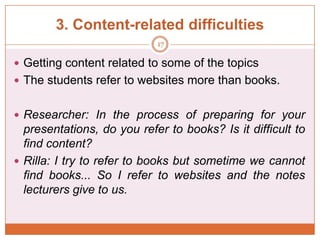
 Getting content related to some of the topics
 The students refer to websites more than books.
 Researcher: In the process of preparing for your

presentations, do you refer to books? Is it difficult to
find content?
 Rilla: I try to refer to books but sometime we cannot
find books... So I refer to websites and the notes
lecturers give to us.
Conclusions
18

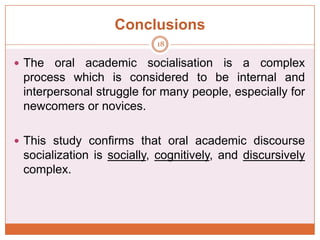
 The

oral academic socialisation is a complex
process which is considered to be internal and
interpersonal struggle for many people, especially for
newcomers or novices.

 This study confirms that oral academic discourse

socialization is socially, cognitively, and discursively
complex.
Conclusions (cont.)
19

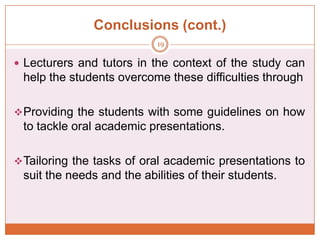
 Lecturers and tutors in the context of the study can

help the students overcome these difficulties through
 Providing the students with some guidelines on how

to tackle oral academic presentations.
 Tailoring the tasks of oral academic presentations to

suit the needs and the abilities of their students.
Conclusions (cont.)
20

 Understanding of the importance of structuring the

tasks of oral academic presentations is essential to
support the students in finding the appropriate content
and materials for oral presentations.
 Providing other forums for discussion such as group

work or group projects.
 Understanding

strategies the students employ to
overcome the challenges. This can help lecturers and
tutors to provide suitable scaffolding and support to the
students.
21

THANK YOU

Oral Academic Discourse Socialisation

  • 1.
    Oral academic discoursesocialisation: Challenges faced by international undergraduate students in Universiti Sains Malaysia 1 DR. OMER HASSAN ALI MAHFOODH omer@usm.my U S M , M A L AY S I A Full article can be downloaded at http://www.ccsenet.org/journal/index.php/ies/article/view/30651 ICLALIS 2013 22-24 October 2013 Promenade Hotel, Kota Kinabalu, Sabah, Malaysia
  • 2.
    2  Countries inthe Asia Pacific region have witnessed a remarkable and significant development through implementing effective plans for reform and restructuring in higher education (Kaur & Sidhu, 2009).  China, Malaysia, and India are developing strategies to attract students and to export educational programs and institutions (Altbach & Knight, 2007: 294).
  • 3.
    3  International studentsin Malaysian higher education institutions  It is expected that the international students in Malaysian institutions of higher education will reach 200,000 in 2020 (Mahmud et al., 2010; Yusoff & Chelliah, 2010).  Students entering academic institutions have different amounts and kinds of prior experience with academic discourse.
  • 4.
    4  At theundergraduate level, international students in most Malaysian universities are required to complete several activities to complete the programmes they joined. 1. 2. 3. 4. 5. Final examinations Tests Quizzes Assignments and Oral academic presentations
  • 5.
    5  Academic discourse forms of oral and written language and communication (genres, registers, graphics, linguistic structures, interactional patterns) that are privileged, expected, cultivated, conventionalized, or ritualized, and, therefore, usually evaluated by instructors, institutions, editors, and others in educational and professional contexts.  “discourse socialization places more emphasis on social processes, (2010:171). negotiation, and interaction” Duff
  • 6.
    6  The successful performancein oral activities carried out by international students should not only judged based on students’ language proficiency.  The students’ understanding of rules and specific behaviours valued by each discipline and each institutional context should be taken into account.
  • 7.
    7  Morita (2000) Kobayashi (2003)  Zappa-Hollman (2007)
  • 8.
    8  Taking intoaccount the growing population of linguistically and culturally diverse students in Malaysian colleges and universities, understanding how these students participate in their new academic communities has become critical.  “Although the number of international students on campuses continues to increase; only a limited number of recently published studies have examined this topic in Malaysia” (Yusoff, 2012:3).
  • 9.
    My study 9 students’ perspectivesabout their participation in oral activities in university content courses.  International  The challenges faced by a group of international undergraduate students in the process socialisation of oral academic discourse. of
  • 10.
    10  A qualitativeapproaches  Their contribution to a greater understanding of perceptions, attitudes and processes.  have been adopted lately by many L2 researchers because  place greater emphasis on contexts and interpretations of social practice (e.g., Davis, 1995; Johnson, 1992).  can provide in-depth and holistic understanding of the lived experience of undergraduate students (Duff, 2012).
  • 11.
    Participants 11 Participants 1 Jane Age 27 Nationality Nigeria 2 Izzy 20 Nigeria 3Rilla 21 Iran 4 Zoe 21 China 5 Berit 22 Korea 6 Akilah 20 Thailand
  • 12.
    12  Data collectedemploying 1. interviews, 2. observations and 3. documents collection
  • 13.
  • 14.
    1. Linguistic difficulties 14 Linguistic difficulties constrained the students 1. to express complex concepts and ideas while engaged in oral academic presentations. 2. Students were not able to provide accurate and well-structured responses when they were asked.  Zoe: It is difficult for me ... new words... many things to do... so I have to check the dictionary frequently.
  • 15.
    15  Thus, linguisticdifficulties played a major role in the students’ socialisation of oral academic discourse.  They can be attributed: 1. students’ educational background 2. previous experience in doing oral academic presentation  As a result of this, these international students struggled to be active members in the new academic discourse community.
  • 16.
    2. Presentation skillsdifficulties 16  How to prepare PowerPoint slides and  How to organise the content of the presentation  Researcher: Before joining this programme, did you have experience in doing oral presentations?  Jane: No, ... In Nigeria no. It is just when I came here I learnt to use PowerPoint. We never use PowerPoint for presentations in my country ... it may be used there but very few in all years of one programme.
  • 17.
    3. Content-related difficulties 17 Getting content related to some of the topics  The students refer to websites more than books.  Researcher: In the process of preparing for your presentations, do you refer to books? Is it difficult to find content?  Rilla: I try to refer to books but sometime we cannot find books... So I refer to websites and the notes lecturers give to us.
  • 18.
    Conclusions 18  The oral academicsocialisation is a complex process which is considered to be internal and interpersonal struggle for many people, especially for newcomers or novices.  This study confirms that oral academic discourse socialization is socially, cognitively, and discursively complex.
  • 19.
    Conclusions (cont.) 19  Lecturersand tutors in the context of the study can help the students overcome these difficulties through  Providing the students with some guidelines on how to tackle oral academic presentations.  Tailoring the tasks of oral academic presentations to suit the needs and the abilities of their students.
  • 20.
    Conclusions (cont.) 20  Understandingof the importance of structuring the tasks of oral academic presentations is essential to support the students in finding the appropriate content and materials for oral presentations.  Providing other forums for discussion such as group work or group projects.  Understanding strategies the students employ to overcome the challenges. This can help lecturers and tutors to provide suitable scaffolding and support to the students.
  • 21.