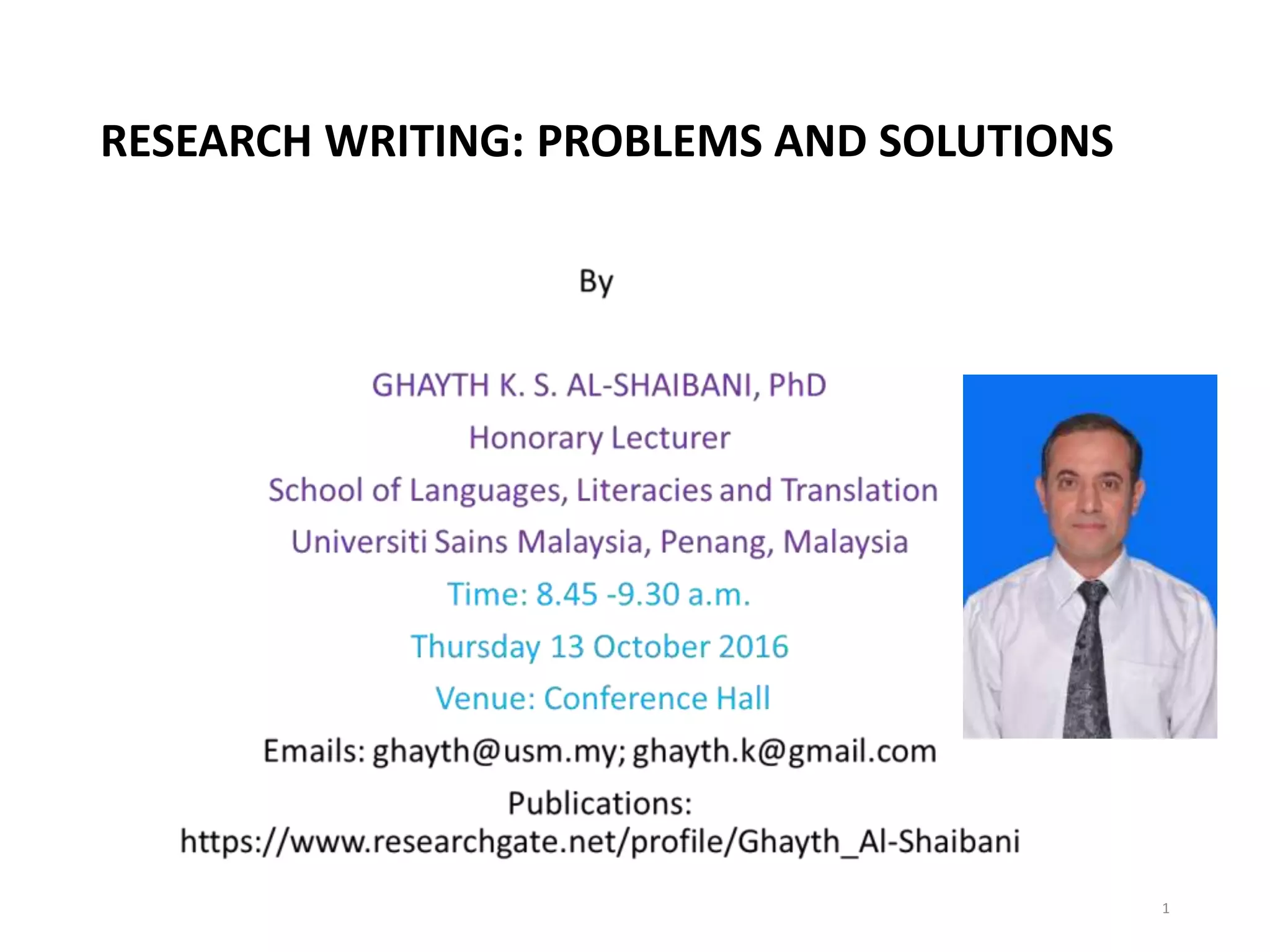
RESEARCH WRITING: PROBLEMS AND SOLUTIONS
1
This is a presentation as a keynote speaker at the 3rd. International
Postgraduate Colloquium held on Thursday 13 October 2016 at
the School of Languages, Literacies and Translation at Universiti
Sains Malaysia (USM). The presentation content and conclusions
drawn are based on the qualitative analysis of the sampling
provided herein and based on my humble experience as a
research proposal assessor and chairperson, reviewer, and
supervisor since I have become a USM academic staff member in
June 2011.
How to cite this presentation
• Downloaded from ResearchGate:
Al-Shaibani, G. K. S. (2016). Research writing: Problems and solutions
[PowerPoint slides as PDF]. Retrieved from URL link.
• Downloaded from Slideshare:
Al-Shaibani, G. K. S. (2016). Research writing: Problems and solutions
[PowerPoint slides]. Retrieved from URL link.
2
Contents
1. Research proposals: problems and solutions
2. Scopus manuscripts problems
3. General Advisory Guidelines (Solutions)
4. Some useful references
3
1. Research proposals: problems and solutions
Sample 1
Sample 2
Sample 3
Sample 4
Sample 5
Sample 6
Based on the sampled reports of research prposals, crucial
problems are summed up as follows:
1. The titles are not specific nor accurate.
2. The use of informal language and vague sentences,
expressions, and terms is very common.
4
1. Research proposals: problems and solutions, continued
3. The theoretical framework is not clearly presented/provided.
4. The improper use of adopted and adapted is very common.
5. Procedures of analysis are not presented, and if so, it is hardly
clear.
6. Mixing between writing styles, APA and MLA, is also common.
7. The Statement of the Problem is always problematic and not
clear.
5
Problems in the Statement of the Problem
The following problems are derived from the sampled reports.
1. Insufficient or irrelevant references
2. Some use few references, as in the case of a candidate used
only two references (i.e. insufficient argument).
3. Statement of the problem does not reveal the problem
mentioned elsewhere in the proposal and requires much
work to be done.
4. Not supported by current sources (few old ones), nor any
research problem that the current research can stand on.
5. Paragraphs are not organised accordingly to reflect the
development of ideas and the structure of this key section.
6
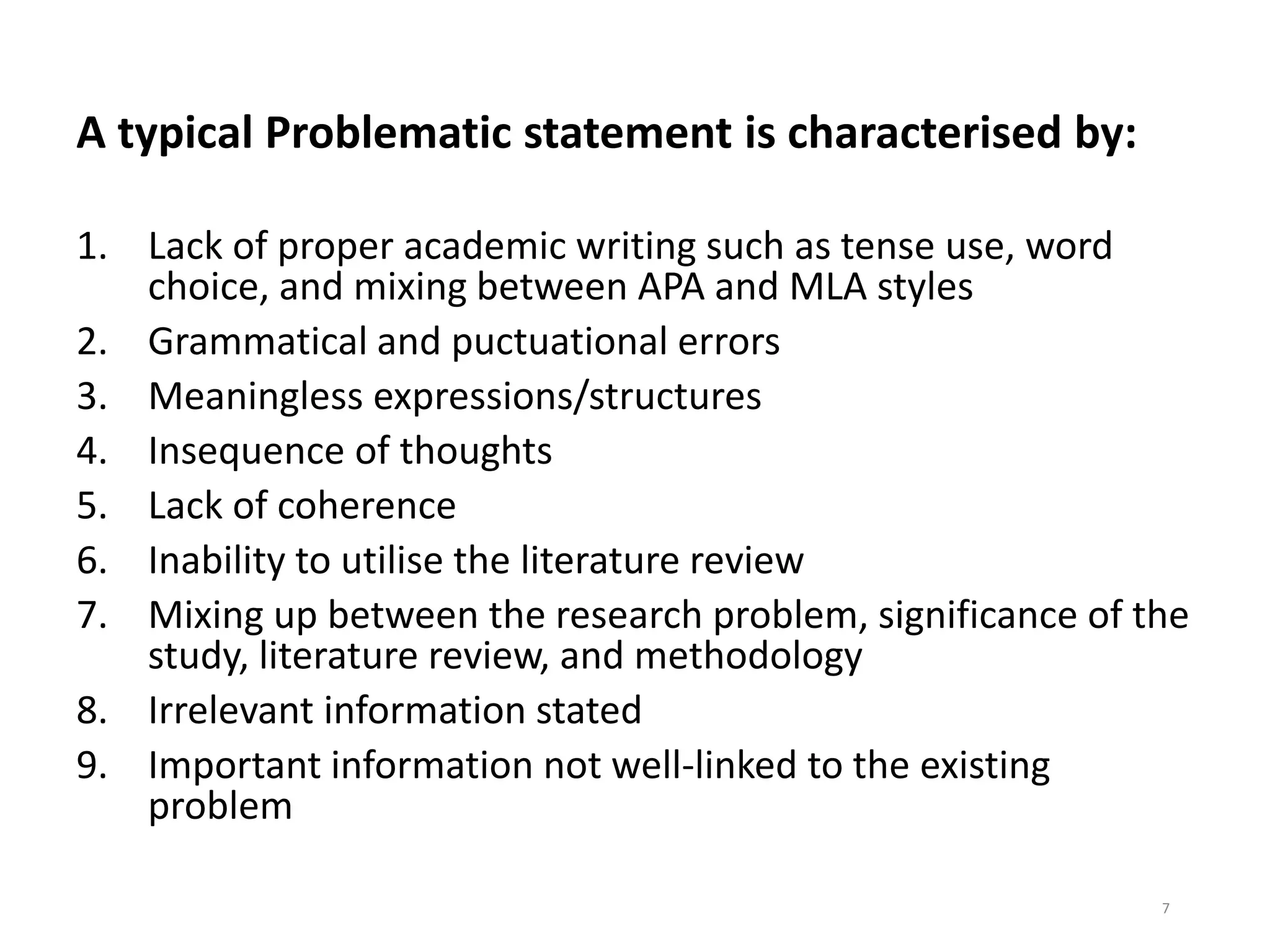
A typical Problematic statement is characterised by:
1. Lack of proper academic writing such as tense use, word
choice, and mixing between APA and MLA styles
2. Grammatical and puctuational errors
3. Meaningless expressions/structures
4. Insequence of thoughts
5. Lack of coherence
6. Inability to utilise the literature review
7. Mixing up between the research problem, significance of the
study, literature review, and methodology
8. Irrelevant information stated
9. Important information not well-linked to the existing
problem
7
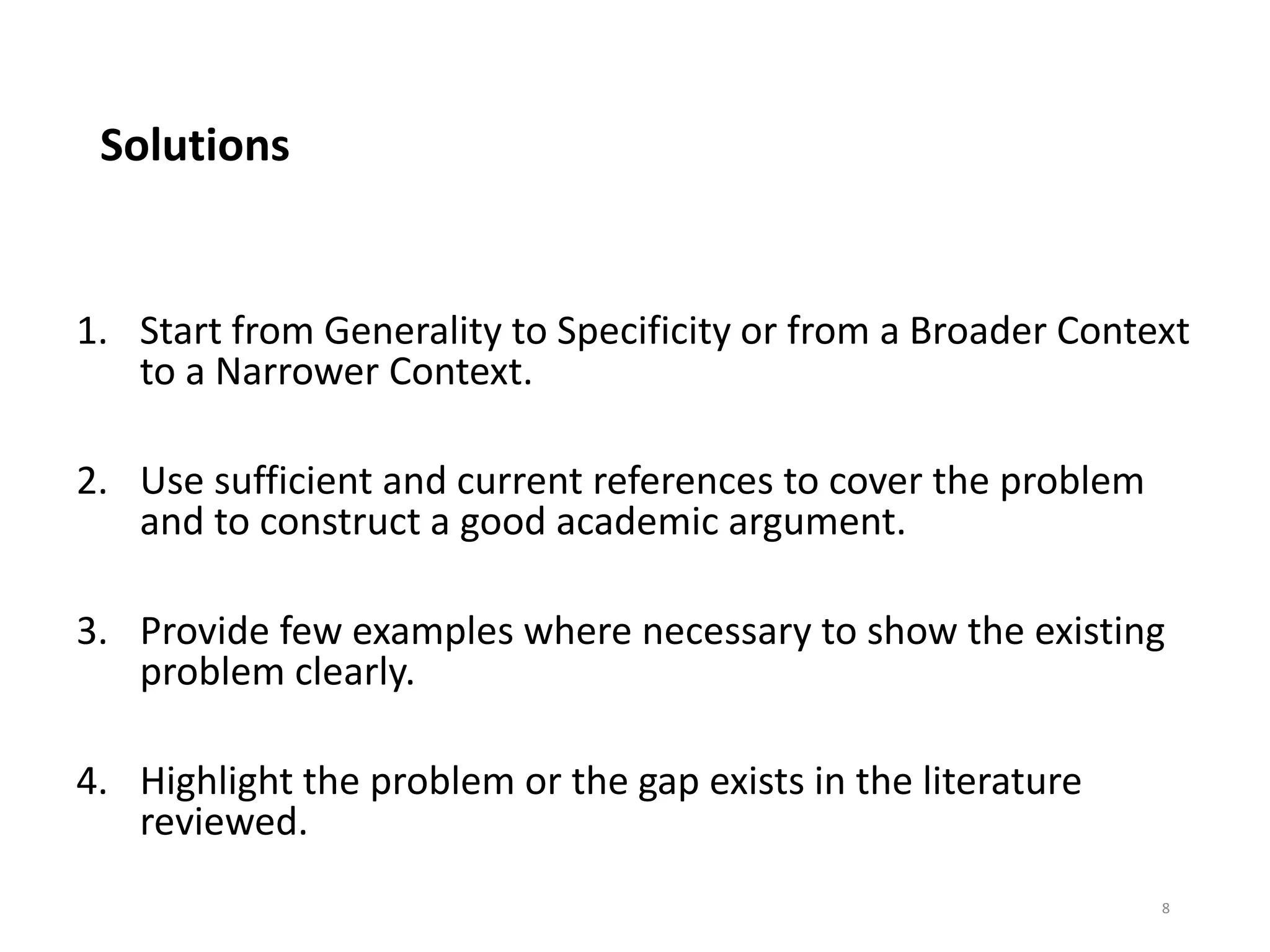
Solutions
1. Start from Generality to Specificity or from a Broader Context
to a Narrower Context.
2. Use sufficient and current references to cover the problem
and to construct a good academic argument.
3. Provide few examples where necessary to show the existing
problem clearly.
4. Highlight the problem or the gap exists in the literature
reviewed.
8
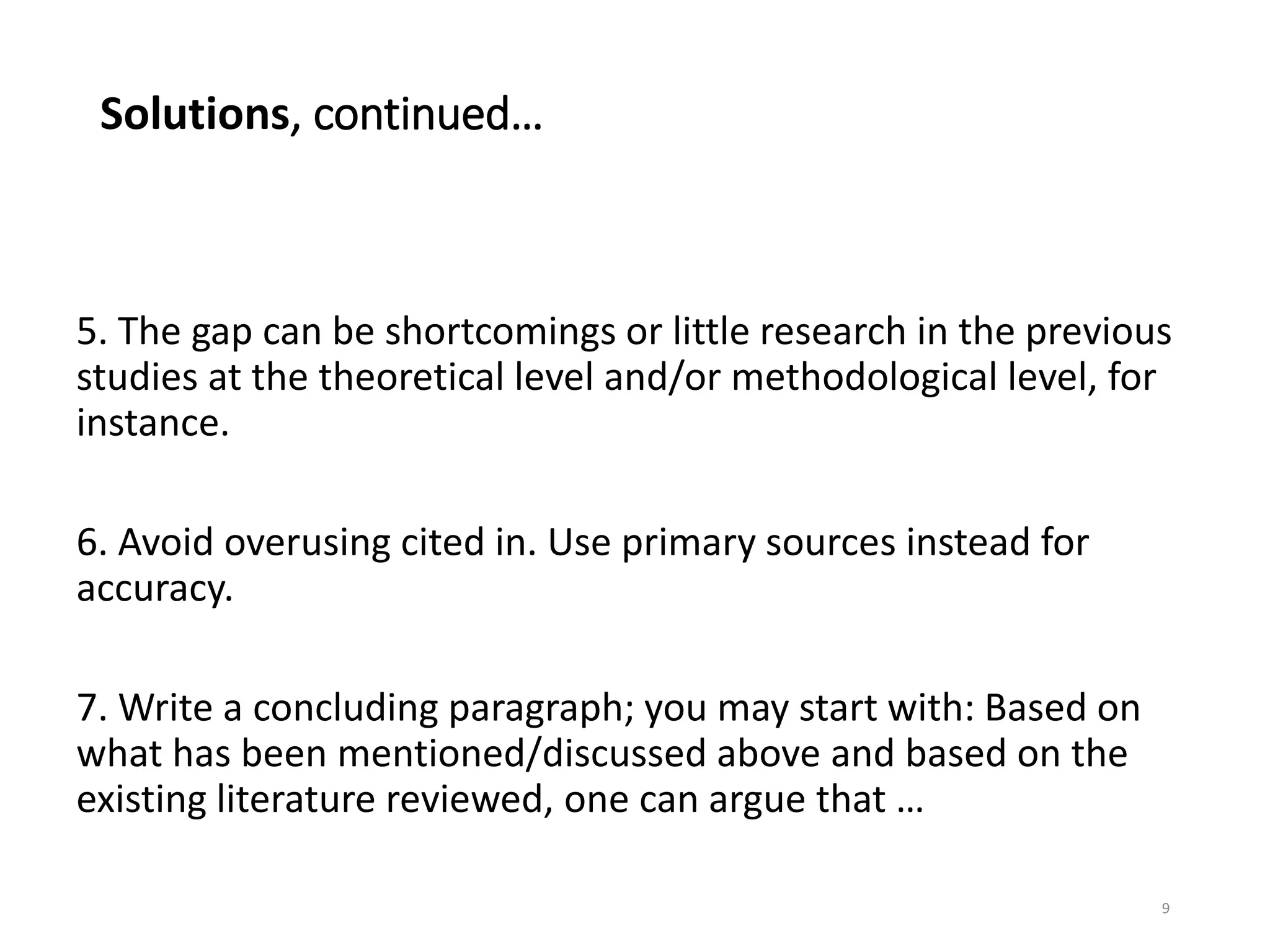
Solutions, continued…
5. The gap can be shortcomings or little research in the previous
studies at the theoretical level and/or methodological level, for
instance.
6. Avoid overusing cited in. Use primary sources instead for
accuracy.
7. Write a concluding paragraph; you may start with: Based on
what has been mentioned/discussed above and based on the
existing literature reviewed, one can argue that …
9
2. Scopus manuscripts problems
The problems found in these three sampled Scopus manuscripts
are based on my review as a reviewer in this journal.
Sample 1
Sample 2
Sample 3
10
Common Problems found to avoid:
1. Incomplete sentences
2. Improper language structures
3. Using the same reporting verbs such as declare and indicate
in abundance.
4. Sections are not well-linked to each other by making linking
sentences.
5. Introductory paragraphs are missing.
11
3. General Advisory Guidelines (Solutions)
• Decide from the beginning your writing style.
• Reduce the number of quotations to show your writing skill
trough paraphrasing.
• Examples should be provided to clarify certain vague notions
and ideas.
• Avoid repeating the same statements and ideas.
• Avoid vague writing that is unhelpful to the reader.
12
3. General Advisory Guidelines (Solutions), continued
• It is better to provide a sample analysis where you can give
some examples.
• Avoid reporting a string of ideas on a particular topic of
discussion without backup from the literature to make
constructive arguments whereby opposite ideas and thoughts
are also reported. You need to show different opinions. Never
build your arguments based on your beliefs only.
• Use signposts for your writing and draw a macro map for the
whole research project as well as for each chapter in your
thesis.
13
3. General Advisory Guidelines (Solutions), continued
• Manage your research in each chapter in your thesis and be
focused.
• Avoid informal words and expressions such as, the wonderful
thing, etc., so, like, but, kids, hmm… oh…, aha… and the like,
unless they are inside a quotation.
• Define the key terms separately or within the discussion.
• Attend academic workshops and talks on research writing.
• Read a number of materials on research and academic writing
constantly.
14
Some useful references
You may refer to these references to enhance your research
and academic writing skills.
APA (2010). Publication manual of the American psychological
association (6th edition). Washington, DC: American
Psychological Association
Jordan, R. R. (1990). Academic writing course. London: Collins
ELT.
Kamler, B. & Thomson, P. (2006). Helping Doctoral Students
Write: pedagogies for supervision. Routledge: Taylor & Francis
Group.
15
Lester, J. D. & Lester, J. D. (2005). Writing research papers: A
complete guide (11th edition). USA: Pearson Education, Inc.
Phillips, E. M. & Pugh, D. S. (2010). How to get a PhD: A handbook
for students and their supervisors. UK: McGraw Hill: Open
University Press.
Salkind, N. J. (2000). Exploring research (4th edition). USA: Prentice
Hall.
Wolfe, J. (1996). How to write a Ph.D. thesis. Available at
http://www.phys.unsw.edu.au/~jw/thesis.html, accessed on
5/7/2012.
16
Thank you
17
QUESTION AND ANSWER SESSION
18

Research writing problems and solutions

  • 1.
  • 2.
    This is apresentation as a keynote speaker at the 3rd. International Postgraduate Colloquium held on Thursday 13 October 2016 at the School of Languages, Literacies and Translation at Universiti Sains Malaysia (USM). The presentation content and conclusions drawn are based on the qualitative analysis of the sampling provided herein and based on my humble experience as a research proposal assessor and chairperson, reviewer, and supervisor since I have become a USM academic staff member in June 2011. How to cite this presentation • Downloaded from ResearchGate: Al-Shaibani, G. K. S. (2016). Research writing: Problems and solutions [PowerPoint slides as PDF]. Retrieved from URL link. • Downloaded from Slideshare: Al-Shaibani, G. K. S. (2016). Research writing: Problems and solutions [PowerPoint slides]. Retrieved from URL link. 2
  • 3.
    Contents 1. Research proposals:problems and solutions 2. Scopus manuscripts problems 3. General Advisory Guidelines (Solutions) 4. Some useful references 3
  • 4.
    1. Research proposals:problems and solutions Sample 1 Sample 2 Sample 3 Sample 4 Sample 5 Sample 6 Based on the sampled reports of research prposals, crucial problems are summed up as follows: 1. The titles are not specific nor accurate. 2. The use of informal language and vague sentences, expressions, and terms is very common. 4
  • 5.
    1. Research proposals:problems and solutions, continued 3. The theoretical framework is not clearly presented/provided. 4. The improper use of adopted and adapted is very common. 5. Procedures of analysis are not presented, and if so, it is hardly clear. 6. Mixing between writing styles, APA and MLA, is also common. 7. The Statement of the Problem is always problematic and not clear. 5
  • 6.
    Problems in theStatement of the Problem The following problems are derived from the sampled reports. 1. Insufficient or irrelevant references 2. Some use few references, as in the case of a candidate used only two references (i.e. insufficient argument). 3. Statement of the problem does not reveal the problem mentioned elsewhere in the proposal and requires much work to be done. 4. Not supported by current sources (few old ones), nor any research problem that the current research can stand on. 5. Paragraphs are not organised accordingly to reflect the development of ideas and the structure of this key section. 6
  • 7.
    A typical Problematicstatement is characterised by: 1. Lack of proper academic writing such as tense use, word choice, and mixing between APA and MLA styles 2. Grammatical and puctuational errors 3. Meaningless expressions/structures 4. Insequence of thoughts 5. Lack of coherence 6. Inability to utilise the literature review 7. Mixing up between the research problem, significance of the study, literature review, and methodology 8. Irrelevant information stated 9. Important information not well-linked to the existing problem 7
  • 8.
    Solutions 1. Start fromGenerality to Specificity or from a Broader Context to a Narrower Context. 2. Use sufficient and current references to cover the problem and to construct a good academic argument. 3. Provide few examples where necessary to show the existing problem clearly. 4. Highlight the problem or the gap exists in the literature reviewed. 8
  • 9.
    Solutions, continued… 5. Thegap can be shortcomings or little research in the previous studies at the theoretical level and/or methodological level, for instance. 6. Avoid overusing cited in. Use primary sources instead for accuracy. 7. Write a concluding paragraph; you may start with: Based on what has been mentioned/discussed above and based on the existing literature reviewed, one can argue that … 9
  • 10.
    2. Scopus manuscriptsproblems The problems found in these three sampled Scopus manuscripts are based on my review as a reviewer in this journal. Sample 1 Sample 2 Sample 3 10
  • 11.
    Common Problems foundto avoid: 1. Incomplete sentences 2. Improper language structures 3. Using the same reporting verbs such as declare and indicate in abundance. 4. Sections are not well-linked to each other by making linking sentences. 5. Introductory paragraphs are missing. 11
  • 12.
    3. General AdvisoryGuidelines (Solutions) • Decide from the beginning your writing style. • Reduce the number of quotations to show your writing skill trough paraphrasing. • Examples should be provided to clarify certain vague notions and ideas. • Avoid repeating the same statements and ideas. • Avoid vague writing that is unhelpful to the reader. 12
  • 13.
    3. General AdvisoryGuidelines (Solutions), continued • It is better to provide a sample analysis where you can give some examples. • Avoid reporting a string of ideas on a particular topic of discussion without backup from the literature to make constructive arguments whereby opposite ideas and thoughts are also reported. You need to show different opinions. Never build your arguments based on your beliefs only. • Use signposts for your writing and draw a macro map for the whole research project as well as for each chapter in your thesis. 13
  • 14.
    3. General AdvisoryGuidelines (Solutions), continued • Manage your research in each chapter in your thesis and be focused. • Avoid informal words and expressions such as, the wonderful thing, etc., so, like, but, kids, hmm… oh…, aha… and the like, unless they are inside a quotation. • Define the key terms separately or within the discussion. • Attend academic workshops and talks on research writing. • Read a number of materials on research and academic writing constantly. 14
  • 15.
    Some useful references Youmay refer to these references to enhance your research and academic writing skills. APA (2010). Publication manual of the American psychological association (6th edition). Washington, DC: American Psychological Association Jordan, R. R. (1990). Academic writing course. London: Collins ELT. Kamler, B. & Thomson, P. (2006). Helping Doctoral Students Write: pedagogies for supervision. Routledge: Taylor & Francis Group. 15
  • 16.
    Lester, J. D.& Lester, J. D. (2005). Writing research papers: A complete guide (11th edition). USA: Pearson Education, Inc. Phillips, E. M. & Pugh, D. S. (2010). How to get a PhD: A handbook for students and their supervisors. UK: McGraw Hill: Open University Press. Salkind, N. J. (2000). Exploring research (4th edition). USA: Prentice Hall. Wolfe, J. (1996). How to write a Ph.D. thesis. Available at http://www.phys.unsw.edu.au/~jw/thesis.html, accessed on 5/7/2012. 16
  • 17.
  • 18.