BELTCH KENNETH TIMOTHY V. ABUAN, RN, LPT
EVELYN V. ABUAN, LPT
LOCAL DEVELOPMENT PLANNING
DEVELOPMENT PLANNING
It is one of the core
components of the ICBP to
serve as an effective delivery
tool and a strategy to provide
direction for physical
development and accelerating
economic growth.
It aims to capture the
aspirations and desire of the
citizenry on the type and level
of development they want to
attain at a certain time.
PURPOSES OF DEVELOPMENT PLANNING
• To optimize the use of resources at the right time
without sacrificing the environment;
• To provide direction in the execution of development
programs/projects;
• To solicit and ensure citizen’s participation in decision
making concerning social and economic development;
• To respond to the requirements of the local
government code.
PROCESS OF DEVELOPMENT PLANNING
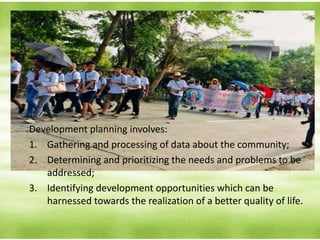
Development planning involves:
1. Gathering and processing of data about the community;
2. Determining and prioritizing the needs and problems to be
addressed;
3. Identifying development opportunities which can be
harnessed towards the realization of a better quality of life.
NEEDS OF DEVELOPMENT PLANNING
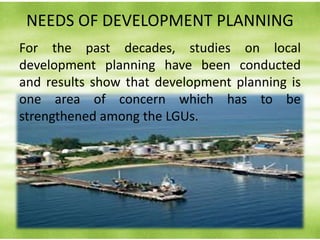
For the past decades, studies on local
development planning have been conducted
and results show that development planning is
one area of concern which has to be
strengthened among the LGUs.
Identified Needs/Problems
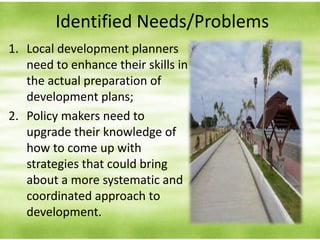
1. Local development planners
need to enhance their skills in
the actual preparation of
development plans;
2. Policy makers need to
upgrade their knowledge of
how to come up with
strategies that could bring
about a more systematic and
coordinated approach to
development.
Identified Needs/Problems
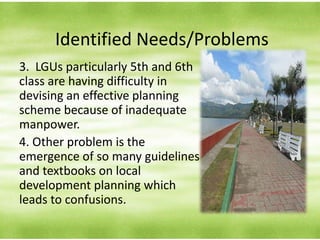
3. LGUs particularly 5th and 6th
class are having difficulty in
devising an effective planning
scheme because of inadequate
manpower.
4. Other problem is the
emergence of so many guidelines
and textbooks on local
development planning which
leads to confusions.
ORGANIZATIONS INVOLVE IN
DEVELOPMENT PLANNING
Development Planning as one of the
components of ICBP mainly deals with capability
building of the three organizations/bodies in the
LGUs that are directly involved in planning:
1. Local Development Council
2. Local Planning and Development Staff
3. The Sanggunian
LOCAL DEVELOPMENT COUNCIL
It is the planning body of the LGU which assists the
Sanggunian in setting the direction for economic and
social development efforts within its territorial
jurisdiction.
How LDCs are called:
1. Barangay – Barangay Development Council (BDC)
2. Municipality – Municipal Development Council (MDC)
3. City – City Development Council (CDC)
4. Province – Provincial Development Council (PDC)
COMPOSITION OF THE BARANGAY
DEVELOPMENT COUNCIL
The BDC shall be headed by the Punong Barangay
and shall be composed of the following
members:
1. Members of the Sangguniang Barangay
2. Representatives of NGOs operating in the
barangay, who shall constitute not less than ¼ of
the members of the fully organized council
3. A representative of the Congressman.
FUNCTIONS OF THE BARANGAY
DEVELOPMENT COUNCIL
The BDC exercise the following functions:
1. Mobilize people’s participation in local
development functions efforts;
2. Prepare barangay development plans based on
local requirements;
3. Monitor and evaluate the implementation of
national or local programs and projects;
4. Perform such other functions as may be provided
by law or competent authority.
COMPOSITION OF THE CITY/MUNICIPAL
DEVELOPMENT COUNCIL
The CDC/MDC shall be headed by the Mayor and shall be
composed of the following members:
1. All Punong Barangays in the City or Municipality;
2. The Chairman of the Committee on Appropriations
of the Sangguniang Panglunsod or Sangguniang
Bayan concerned;
3. The Congressman or his representative;
4. The Representatives of NGOs operating in the City or
Municipality, as the case may be, who shall
constitute not less than ¼ of the members of the
fully organized Council.
COMPOSITION OF THE CITY/MUNICIPAL
DEVELOPMENT COUNCIL
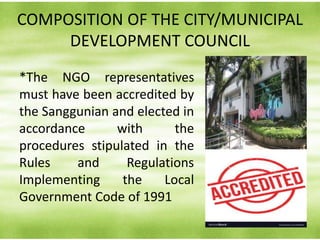
*The NGO representatives
must have been accredited by
the Sanggunian and elected in
accordance with the
procedures stipulated in the
Rules and Regulations
Implementing the Local
Government Code of 1991
COMPOSITION OF THE PROVINCIAL
DEVELOPMENT COUNCIL
The PDC is headed by the Governor and shall be composed of the
following members:
1. All Mayors of component Cities and Municipalities;
2. The Chairman of the Committee on Appropriations of the
Sangguniang Panlalawigan;
3. The Congressman or his representative; and
4. Representatives of NGOs operating in the province, who shall
constitute not less than ¼ of the members of the fully organized
Council.
*The NGO representatives must have been accredited by the
Sanggunian and elected in accordance with the procedures stipulated
in the Rules and Regulations Implementing the Local Government
Code of 1991.
FUNCTIONS OF THE CITY MUNICIPAL &
PROVINCIAL DEVELOPMENT COUNCILS
1. Review and prioritize the proposed development programs and projects
that will form part of the Local Development Investment Program (LDIP)
and subsequent Annual Investment Program (AIP);
2. Integrates all plans of the sectoral or functional committees and those
from the immediate lower development councils;
3. Formulate long-term, medium-term and annual socio-economic
development plans and policies;
4. Formulate the medium-term and annual public investment programs;
5. Appraise and prioritize socio-economic development programs and
projects;
6. Formulate local investment incentives to promote the inflow and
direction of private investment capital;
7. Coordinate, monitor and evaluate the implementation of development
programs and projects;
8. Perform such other functions as may be provided by law or competent
authority.
THE LDC MEETINGS
The LDC shall meet at least once every six (6) months or as often
as may be necessary. During such meetings, the following are
some of its expected outputs:
1. Formulate the LGU’s Vision, Mission and Development Thrust
as an initial step in planning;
2. Formulate goals, objectives and set targets;
3. Source funds for development activities;
4. Grant incentives to attract investors;
5. Formulate policies on citizens participation;
6. Evaluate the participation and performance of the
POs/NGOs/Private sector in the Local Special Bodies and
recommend to the Sanggunian appropriate action, when
needed;
7. Subject the comprehensive development plan and other plans
to a public hearing.
FUNCTIONS OF THE LOCAL PLANNING &
DEVELOPMENT OFFICE
The planning and development office is headed by the
Planning and Development Coordinator. It shall perform
the following tasks and responsibilities:
1. Prepare integrated economic, social, physical and
other development plans and policies including
comprehensive plans for consideration of the local
government development council;
2. Conduct continuing studies, researches and training
programs necessary to evolve plans and programs for
implementation;
3. Put together sectoral plans and studies undertaken by
the different functional groups or agencies;
4. Follow-up and evaluate implementation of
the different development programs, projects
and activities in the LGU concerned in
accordance with the approved development
plan;
5. Study the income and spending patterns of
the local government unit and formulate and
recommend fiscal plans and policies for
consideration of the finance committee of the
LGU concerned;
6. Promote people participation in development
planning within the LGU concerned;
7. In addition, during public hearings, the LPDO
shall assist the LDC in the selection of issues
which the Council would like to submit to a
public discussion and consideration.
There are fifth and sixth class municipalities where
because of lack of funds, have only one staff
appointed (the MPDC) to perform the
responsibilities of the MPDO.
In this case, it is advised that the municipality
should exert efforts to create positions as may be
necessary.
This is based on the fact that technical
responsibilities cannot be performed by only one or
two persons and to ensure that the MPDO can
perform its functions effectively.
However, if the above is not feasible, the Mayor
may create a task force or an Ad-Hoc Committee
to assist the MPDC in the performance of his
functions. The members thereof who shall be
directed to do specific work, may come from
different departments or units in the
municipality on detailed status. The members
shall return to their mother units once the task
is finished.
THE SANGGUNIAN
The Sanggunian is the legislative body in the
LGU with the Vice Chief Executive in the
provincial/city/municipal levels and the Punong
Barangay as the presiding officers.
As a legislative body, the Sanggunian enacts
ordinances, passes resolutions and appropriates
funds for the general welfare of the locality and
its inhabitants.
MEMBERS OF THE BODY:
PROVINCIAL LEVEL
1. Vice Governor as the presiding officer
2. Regular sanggunian members
3. President of the provincial chapter of the Liga ng mga
Barangay
4. President of the Panlalawigang Pederasyon ng mga
Sangguniang Kabataan
5. President of the Provincial Federation of Sangguniang
members of the Municipality and component cities
6. Sectoral representatives
7. Three sectoral representatives coming from the: Women
Agricultural or industrial workers and Other sectors,
including urban poor, indigenous cultural communities or
disabled persons.
MEMBERS OF THE BODY:
CITY/MUNICIPALITY LEVEL
1. Vice Mayor as presiding officer
2. Regular sanggunian members
3. President of the City/Municipal chapter of the Liga ng
mga Barangay
4. President of the Panglunsod/pambayang pederasyon
ng mga Sangguniang Kabataan
5. Sectoral representatives, as members
6. Three sectoral representatives coming from the:
Women, Agricultural or industrial workers and Other
sectors, including urban poor, indigenous cultural
communities or disabled persons.
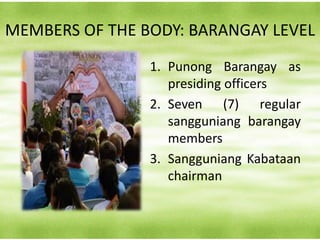
MEMBERS OF THE BODY: BARANGAY LEVEL
1. Punong Barangay as
presiding officers
2. Seven (7) regular
sangguniang barangay
members
3. Sangguniang Kabataan
chairman
PLANNING FUNCTION
Parallel to the lawmaking function of the Sanggunian is a
planning responsibility where it reviews the development
plans of the LGU before the same is adopted and approved
through a resolution.
Specifically, the Sanggunian is responsible for the following:
1. Accredit the NGOs for membership in the LDC
2. Review and analyze development plan
3. Approve and adopt the development plan
4. Adopt planning policies
5. Allocate funds to finance the development plan
6. Monitor implementation of the plan
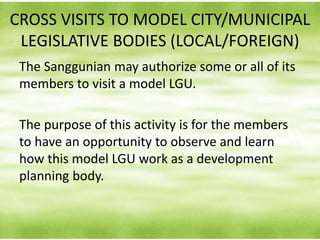
CROSS VISITS TO MODEL CITY/MUNICIPAL
LEGISLATIVE BODIES (LOCAL/FOREIGN)
The Sanggunian may authorize some or all of its
members to visit a model LGU.
The purpose of this activity is for the members
to have an opportunity to observe and learn
how this model LGU work as a development
planning body.
San Fernando City, La
Union Photos by

Local Development Planning

  • 1.
    BELTCH KENNETH TIMOTHYV. ABUAN, RN, LPT EVELYN V. ABUAN, LPT LOCAL DEVELOPMENT PLANNING
  • 2.
    DEVELOPMENT PLANNING It isone of the core components of the ICBP to serve as an effective delivery tool and a strategy to provide direction for physical development and accelerating economic growth. It aims to capture the aspirations and desire of the citizenry on the type and level of development they want to attain at a certain time.
  • 3.
    PURPOSES OF DEVELOPMENTPLANNING • To optimize the use of resources at the right time without sacrificing the environment; • To provide direction in the execution of development programs/projects; • To solicit and ensure citizen’s participation in decision making concerning social and economic development; • To respond to the requirements of the local government code.
  • 4.
    PROCESS OF DEVELOPMENTPLANNING Development planning involves: 1. Gathering and processing of data about the community; 2. Determining and prioritizing the needs and problems to be addressed; 3. Identifying development opportunities which can be harnessed towards the realization of a better quality of life.
  • 5.
    NEEDS OF DEVELOPMENTPLANNING For the past decades, studies on local development planning have been conducted and results show that development planning is one area of concern which has to be strengthened among the LGUs.
  • 6.
    Identified Needs/Problems 1. Localdevelopment planners need to enhance their skills in the actual preparation of development plans; 2. Policy makers need to upgrade their knowledge of how to come up with strategies that could bring about a more systematic and coordinated approach to development.
  • 7.
    Identified Needs/Problems 3. LGUsparticularly 5th and 6th class are having difficulty in devising an effective planning scheme because of inadequate manpower. 4. Other problem is the emergence of so many guidelines and textbooks on local development planning which leads to confusions.
  • 8.
    ORGANIZATIONS INVOLVE IN DEVELOPMENTPLANNING Development Planning as one of the components of ICBP mainly deals with capability building of the three organizations/bodies in the LGUs that are directly involved in planning: 1. Local Development Council 2. Local Planning and Development Staff 3. The Sanggunian
  • 9.
    LOCAL DEVELOPMENT COUNCIL Itis the planning body of the LGU which assists the Sanggunian in setting the direction for economic and social development efforts within its territorial jurisdiction. How LDCs are called: 1. Barangay – Barangay Development Council (BDC) 2. Municipality – Municipal Development Council (MDC) 3. City – City Development Council (CDC) 4. Province – Provincial Development Council (PDC)
  • 10.
    COMPOSITION OF THEBARANGAY DEVELOPMENT COUNCIL The BDC shall be headed by the Punong Barangay and shall be composed of the following members: 1. Members of the Sangguniang Barangay 2. Representatives of NGOs operating in the barangay, who shall constitute not less than ¼ of the members of the fully organized council 3. A representative of the Congressman.
  • 11.
    FUNCTIONS OF THEBARANGAY DEVELOPMENT COUNCIL The BDC exercise the following functions: 1. Mobilize people’s participation in local development functions efforts; 2. Prepare barangay development plans based on local requirements; 3. Monitor and evaluate the implementation of national or local programs and projects; 4. Perform such other functions as may be provided by law or competent authority.
  • 12.
    COMPOSITION OF THECITY/MUNICIPAL DEVELOPMENT COUNCIL The CDC/MDC shall be headed by the Mayor and shall be composed of the following members: 1. All Punong Barangays in the City or Municipality; 2. The Chairman of the Committee on Appropriations of the Sangguniang Panglunsod or Sangguniang Bayan concerned; 3. The Congressman or his representative; 4. The Representatives of NGOs operating in the City or Municipality, as the case may be, who shall constitute not less than ¼ of the members of the fully organized Council.
  • 13.
    COMPOSITION OF THECITY/MUNICIPAL DEVELOPMENT COUNCIL *The NGO representatives must have been accredited by the Sanggunian and elected in accordance with the procedures stipulated in the Rules and Regulations Implementing the Local Government Code of 1991
  • 14.
    COMPOSITION OF THEPROVINCIAL DEVELOPMENT COUNCIL The PDC is headed by the Governor and shall be composed of the following members: 1. All Mayors of component Cities and Municipalities; 2. The Chairman of the Committee on Appropriations of the Sangguniang Panlalawigan; 3. The Congressman or his representative; and 4. Representatives of NGOs operating in the province, who shall constitute not less than ¼ of the members of the fully organized Council. *The NGO representatives must have been accredited by the Sanggunian and elected in accordance with the procedures stipulated in the Rules and Regulations Implementing the Local Government Code of 1991.
  • 15.
    FUNCTIONS OF THECITY MUNICIPAL & PROVINCIAL DEVELOPMENT COUNCILS 1. Review and prioritize the proposed development programs and projects that will form part of the Local Development Investment Program (LDIP) and subsequent Annual Investment Program (AIP); 2. Integrates all plans of the sectoral or functional committees and those from the immediate lower development councils; 3. Formulate long-term, medium-term and annual socio-economic development plans and policies; 4. Formulate the medium-term and annual public investment programs; 5. Appraise and prioritize socio-economic development programs and projects; 6. Formulate local investment incentives to promote the inflow and direction of private investment capital; 7. Coordinate, monitor and evaluate the implementation of development programs and projects; 8. Perform such other functions as may be provided by law or competent authority.
  • 16.
    THE LDC MEETINGS TheLDC shall meet at least once every six (6) months or as often as may be necessary. During such meetings, the following are some of its expected outputs: 1. Formulate the LGU’s Vision, Mission and Development Thrust as an initial step in planning; 2. Formulate goals, objectives and set targets; 3. Source funds for development activities; 4. Grant incentives to attract investors; 5. Formulate policies on citizens participation; 6. Evaluate the participation and performance of the POs/NGOs/Private sector in the Local Special Bodies and recommend to the Sanggunian appropriate action, when needed; 7. Subject the comprehensive development plan and other plans to a public hearing.
  • 17.
    FUNCTIONS OF THELOCAL PLANNING & DEVELOPMENT OFFICE The planning and development office is headed by the Planning and Development Coordinator. It shall perform the following tasks and responsibilities: 1. Prepare integrated economic, social, physical and other development plans and policies including comprehensive plans for consideration of the local government development council; 2. Conduct continuing studies, researches and training programs necessary to evolve plans and programs for implementation; 3. Put together sectoral plans and studies undertaken by the different functional groups or agencies;
  • 18.
    4. Follow-up andevaluate implementation of the different development programs, projects and activities in the LGU concerned in accordance with the approved development plan; 5. Study the income and spending patterns of the local government unit and formulate and recommend fiscal plans and policies for consideration of the finance committee of the LGU concerned;
  • 19.
    6. Promote peopleparticipation in development planning within the LGU concerned; 7. In addition, during public hearings, the LPDO shall assist the LDC in the selection of issues which the Council would like to submit to a public discussion and consideration.
  • 20.
    There are fifthand sixth class municipalities where because of lack of funds, have only one staff appointed (the MPDC) to perform the responsibilities of the MPDO. In this case, it is advised that the municipality should exert efforts to create positions as may be necessary. This is based on the fact that technical responsibilities cannot be performed by only one or two persons and to ensure that the MPDO can perform its functions effectively.
  • 21.
    However, if theabove is not feasible, the Mayor may create a task force or an Ad-Hoc Committee to assist the MPDC in the performance of his functions. The members thereof who shall be directed to do specific work, may come from different departments or units in the municipality on detailed status. The members shall return to their mother units once the task is finished.
  • 22.
    THE SANGGUNIAN The Sanggunianis the legislative body in the LGU with the Vice Chief Executive in the provincial/city/municipal levels and the Punong Barangay as the presiding officers. As a legislative body, the Sanggunian enacts ordinances, passes resolutions and appropriates funds for the general welfare of the locality and its inhabitants.
  • 23.
    MEMBERS OF THEBODY: PROVINCIAL LEVEL 1. Vice Governor as the presiding officer 2. Regular sanggunian members 3. President of the provincial chapter of the Liga ng mga Barangay 4. President of the Panlalawigang Pederasyon ng mga Sangguniang Kabataan 5. President of the Provincial Federation of Sangguniang members of the Municipality and component cities 6. Sectoral representatives 7. Three sectoral representatives coming from the: Women Agricultural or industrial workers and Other sectors, including urban poor, indigenous cultural communities or disabled persons.
  • 24.
    MEMBERS OF THEBODY: CITY/MUNICIPALITY LEVEL 1. Vice Mayor as presiding officer 2. Regular sanggunian members 3. President of the City/Municipal chapter of the Liga ng mga Barangay 4. President of the Panglunsod/pambayang pederasyon ng mga Sangguniang Kabataan 5. Sectoral representatives, as members 6. Three sectoral representatives coming from the: Women, Agricultural or industrial workers and Other sectors, including urban poor, indigenous cultural communities or disabled persons.
  • 25.
    MEMBERS OF THEBODY: BARANGAY LEVEL 1. Punong Barangay as presiding officers 2. Seven (7) regular sangguniang barangay members 3. Sangguniang Kabataan chairman
  • 26.
    PLANNING FUNCTION Parallel tothe lawmaking function of the Sanggunian is a planning responsibility where it reviews the development plans of the LGU before the same is adopted and approved through a resolution. Specifically, the Sanggunian is responsible for the following: 1. Accredit the NGOs for membership in the LDC 2. Review and analyze development plan 3. Approve and adopt the development plan 4. Adopt planning policies 5. Allocate funds to finance the development plan 6. Monitor implementation of the plan
  • 27.
    CROSS VISITS TOMODEL CITY/MUNICIPAL LEGISLATIVE BODIES (LOCAL/FOREIGN) The Sanggunian may authorize some or all of its members to visit a model LGU. The purpose of this activity is for the members to have an opportunity to observe and learn how this model LGU work as a development planning body.
  • 28.
    San Fernando City,La Union Photos by