Environmental Impact Assessment
by
M. Rupas Kumar
Assistant Professor in Civil Engineering
IIIT, RK Valley
RGUKT, Andhra Pradesh
Social Impact Assessment
Background
• UNDP says although there is no agreed definition of
Social Impact Assessment, it can be said as a process
that focuses on the impact of development proposals on
people.
• Social impacts can be defined as the consequences to
people of any proposed action that changes the way they
live, work, relate to one other, and function as individuals
and members of society.
Types of Social Impacts
1. Lifestyle Impacts
2. Cultural Impacts
3. Community impacts
4. Quality of life Impacts
5. Health Impacts
Purpose
Social Impact Assessment shall be done to reduce the
impacts on humans, enhance the benefits of those
affected, avoiding delays and obstruction, lower costs
in future, establish better community and stakeholder
relationships, and improved proposals.
Steps in the SIA Process
Although there is no defined procedure, SIA shall include the
following
• Public involvement
• Identification of alternatives
• Profile of the baseline condition
• Scoping
• Projection of estimated effects
• Prediction and evaluation of responses to impacts
• Estimate indirect and cumulative impacts
• Changes to alternatives
• Mitigation
• Monitoring
(Source: International Committee on guidelines and principles
of SIA, 1994)
Principles of SIA good practice
• Involve diverse public
• Analyze the impact equity
• Focus on public priorities
• Assumptions of the methods used and feedback
mechanism from the public
• Usage of SIA Practitioners
• Establishing monitoring and mitigation programmes
• Identify the data sources
Sources of SIA Information
• Data on the proposal
• Experience with similar actions
• Census and vital statistics
• Secondary documents
• Survey and field research
Methods commonly used for predicting social impacts
• Population trend extrapolations – based on forecasting methods
• Population multipliers – based on employment and demand for
housing, projects etc.
• Consulting experts
• Scenarios – considering two to three ways of possibility minimum
• Comparative Studies
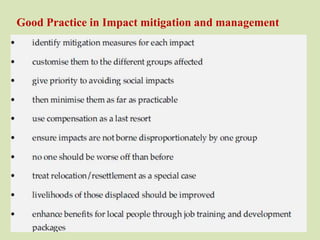
Good Practice in Impact mitigation and management
SIA in India
• In the earlier decades, SIA used to be carried out as part of
EIA. Increasingly, SIA is now carried out as an exercise
independently of EIA, because these are two different kinds of
assessments
• The National R&R Policy 2007 has made a provision for
conducting SIA whenever a new project or expansion of an
existing project is undertaken. But this provision is limited to
only those cases which involve displacement of 400 or more
families in plain areas, or 200 or more families in tribal or hilly
areas, Desert development programme (DDP) blocks or areas
mentioned in the Schedule V or Schedule VI of the
Constitution.
SIA in India : 2 stages
• Initial Social Impact Assessment: primarily
and mainly deal with secondary sources (govt
records) for information and should be
completed within a period of 90 days from the
date of commencement.
• The comprehensive Social Impact Assessment
involves generation of generation of a great
deal of data from primary sources. Therefore,
the time limit for the second stage may be kept
open.
THANK YOU

sia ppt.ppt

  • 1.
    Environmental Impact Assessment by M.Rupas Kumar Assistant Professor in Civil Engineering IIIT, RK Valley RGUKT, Andhra Pradesh Social Impact Assessment
  • 2.
    Background • UNDP saysalthough there is no agreed definition of Social Impact Assessment, it can be said as a process that focuses on the impact of development proposals on people. • Social impacts can be defined as the consequences to people of any proposed action that changes the way they live, work, relate to one other, and function as individuals and members of society.
  • 3.
    Types of SocialImpacts 1. Lifestyle Impacts 2. Cultural Impacts 3. Community impacts 4. Quality of life Impacts 5. Health Impacts Purpose Social Impact Assessment shall be done to reduce the impacts on humans, enhance the benefits of those affected, avoiding delays and obstruction, lower costs in future, establish better community and stakeholder relationships, and improved proposals.
  • 4.
    Steps in theSIA Process Although there is no defined procedure, SIA shall include the following • Public involvement • Identification of alternatives • Profile of the baseline condition • Scoping • Projection of estimated effects • Prediction and evaluation of responses to impacts • Estimate indirect and cumulative impacts • Changes to alternatives • Mitigation • Monitoring (Source: International Committee on guidelines and principles of SIA, 1994)
  • 5.
    Principles of SIAgood practice • Involve diverse public • Analyze the impact equity • Focus on public priorities • Assumptions of the methods used and feedback mechanism from the public • Usage of SIA Practitioners • Establishing monitoring and mitigation programmes • Identify the data sources
  • 6.
    Sources of SIAInformation • Data on the proposal • Experience with similar actions • Census and vital statistics • Secondary documents • Survey and field research
  • 7.
    Methods commonly usedfor predicting social impacts • Population trend extrapolations – based on forecasting methods • Population multipliers – based on employment and demand for housing, projects etc. • Consulting experts • Scenarios – considering two to three ways of possibility minimum • Comparative Studies
  • 8.
    Good Practice inImpact mitigation and management
  • 9.
    SIA in India •In the earlier decades, SIA used to be carried out as part of EIA. Increasingly, SIA is now carried out as an exercise independently of EIA, because these are two different kinds of assessments • The National R&R Policy 2007 has made a provision for conducting SIA whenever a new project or expansion of an existing project is undertaken. But this provision is limited to only those cases which involve displacement of 400 or more families in plain areas, or 200 or more families in tribal or hilly areas, Desert development programme (DDP) blocks or areas mentioned in the Schedule V or Schedule VI of the Constitution.
  • 10.
    SIA in India: 2 stages • Initial Social Impact Assessment: primarily and mainly deal with secondary sources (govt records) for information and should be completed within a period of 90 days from the date of commencement. • The comprehensive Social Impact Assessment involves generation of generation of a great deal of data from primary sources. Therefore, the time limit for the second stage may be kept open.
  • 11.