Ambo University
School of Architecture and Urban Planning
Urban Planning I
Wogen Taye_ tayeinnovative@gmail.com
Content
1. The need for urban planning
2. Urban Planning classification
3. Approaches to the city planning process
4. The planning process
1. The need for urban planning
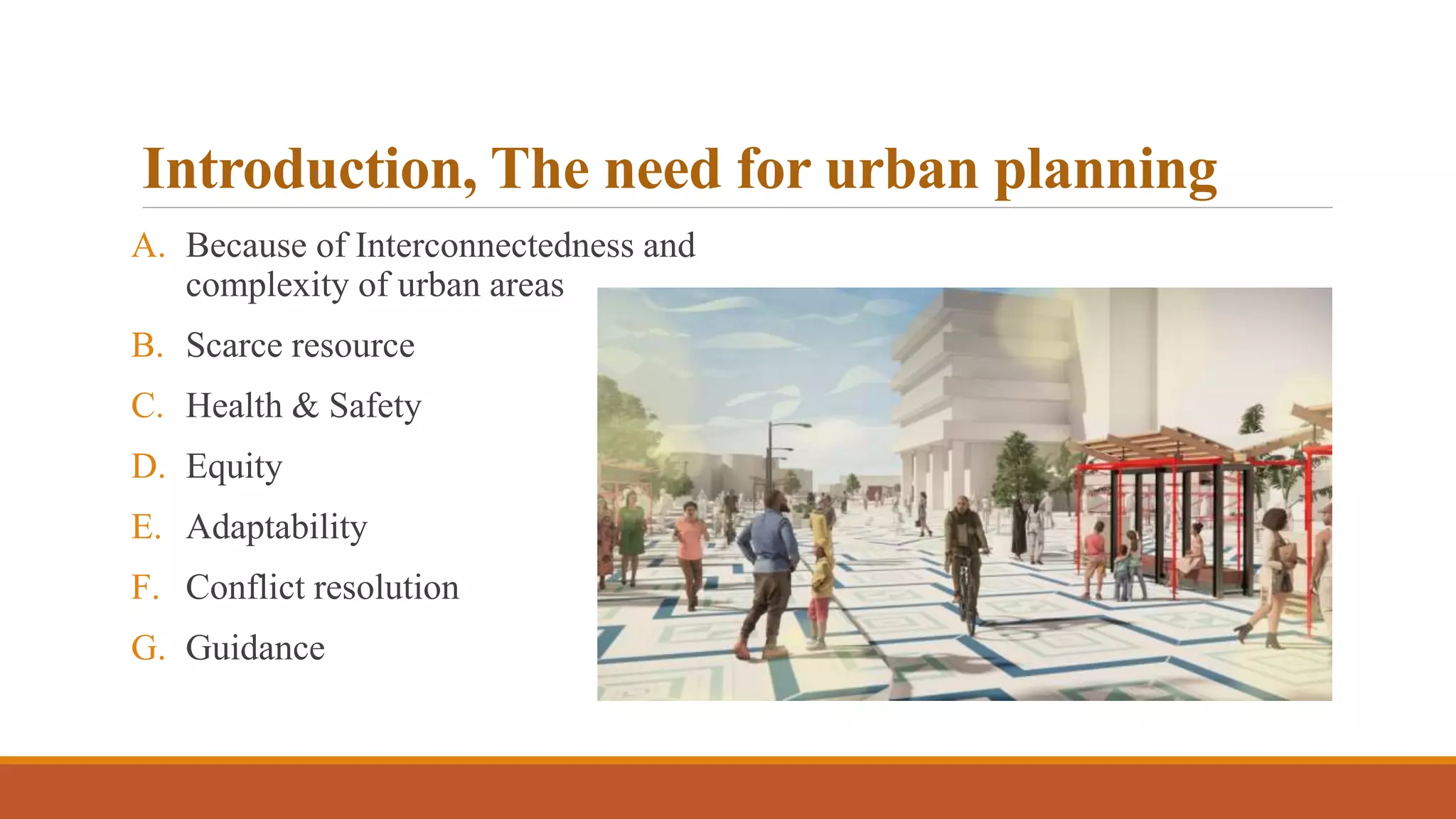
Introduction, The need for urban planning
A. Because of Interconnectedness and
complexity of urban areas
B. Scarce resource
C. Health & Safety
D. Equity
E. Adaptability
F. Conflict resolution
G. Guidance
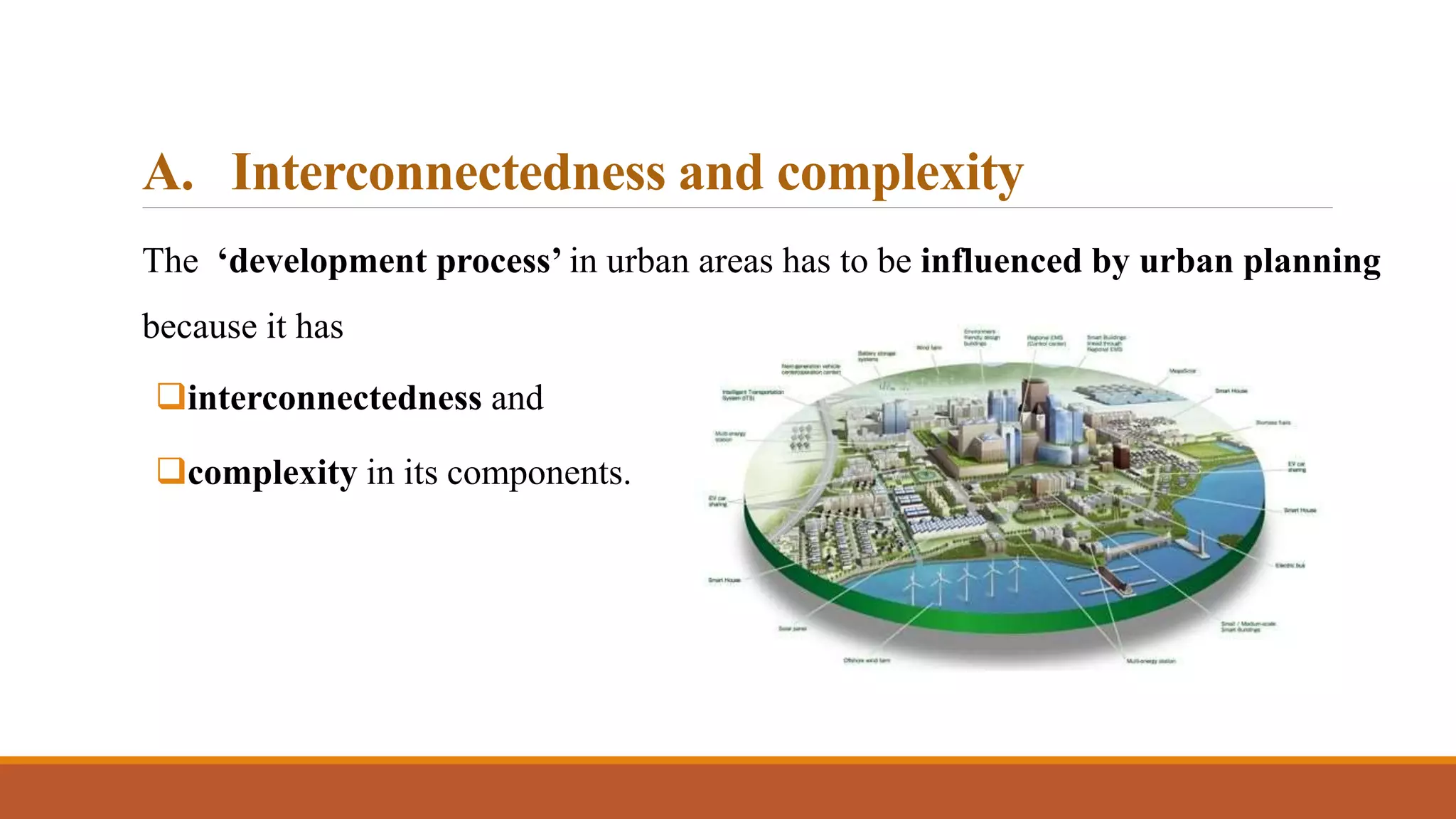
A. Interconnectedness and complexity
The ‘development process’ in urban areas has to be influenced by urban planning
because it has
interconnectedness and
complexity in its components.
A. Interconnectedness and complexity
today population is large and technology is complex
 producing many at the same time complex sectors (service, manufacturing &
industry, trade and urban agriculture)
This means
and decision in one sector affects many other sectors requiring urban planning
interventions.
A. Interconnectedness and complexity
Sample illustration of interconnectedness, adapted from Levy (20
08)
Few
hectares of
land
Character
of the
area
shaped
Walk through (traffic)
Drive through (traffic)
Who lives in (housing)
Kind of jobs generated (economy)
Natural environment
Social Services
Education
health
Police
Fire protection
Recreation
Decision
to develop affects
A. Interconnectedness and complexity
The high level of
interconnectedness between different
sectors also require ‘systems that
span many communities urban
planning interventions.
This Photo by Unknown Author is licensed under CC BY
B. Scarce resource
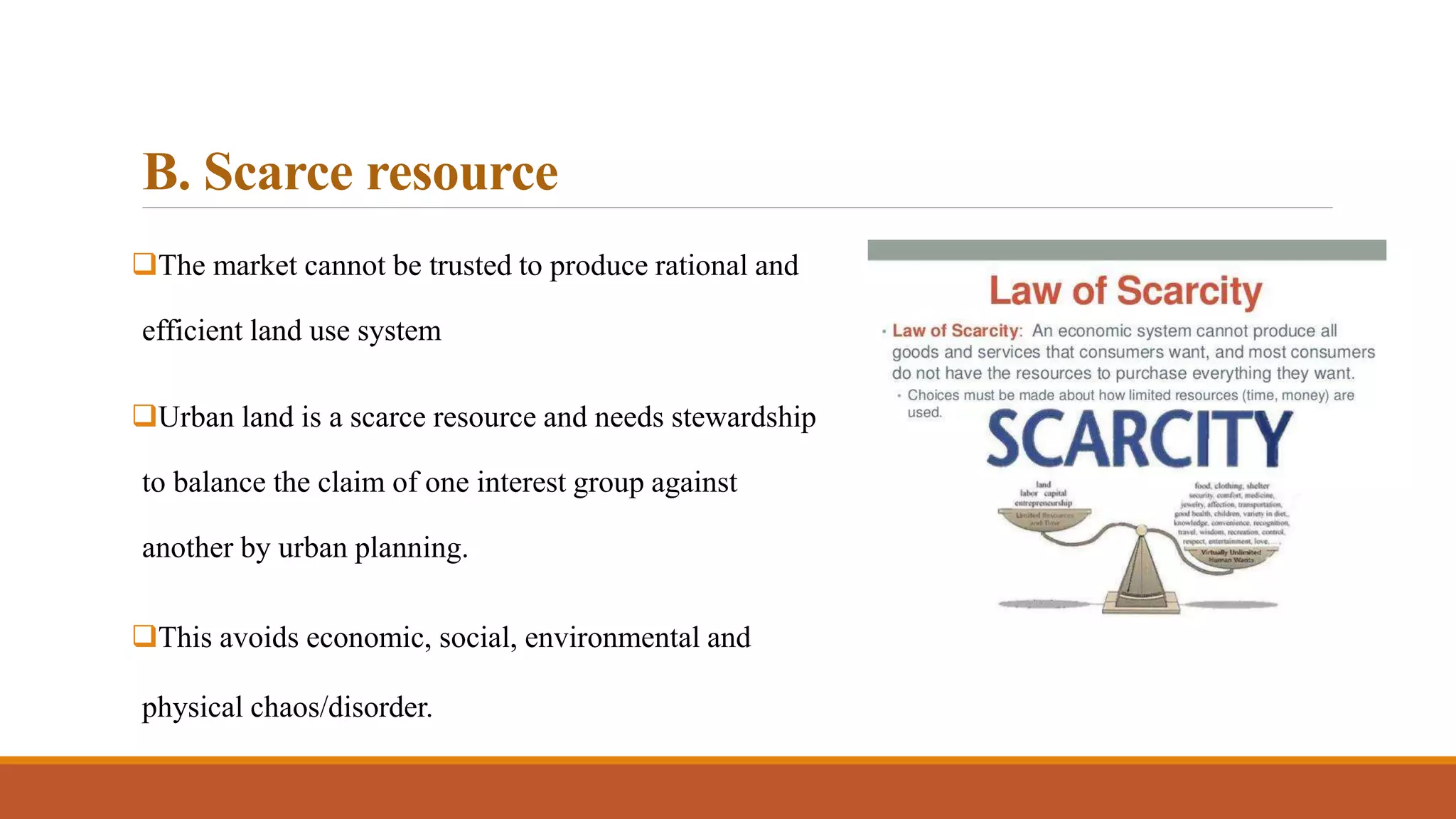
The market cannot be trusted to produce rational and
efficient land use system
Urban land is a scarce resource and needs stewardship
to balance the claim of one interest group against
another by urban planning.
This avoids economic, social, environmental and
physical chaos/disorder.
C. Health & Safety
Planning sets rules and standards
Limit overcrowding
Sets level for adequacy and capacity
of utilities (access to health institution,
pure water……)
construction regulations
Rules for environmental degradation
D. Equity
Planning sets the stage for equitable distribution
of resources which means it
Avoids privilege and exclusion between the
society /regardless of race, age, gender, social
status/ regarding access to urban resources
specially land /spatial inequalities
E. Adaptability
Establish regulations and controls to
adapt to urban development and its
consequences
E.g. adapting the new expansion
environment of the city because of
social disconnection like community
organization Idir, Mahiber, equb
F. Conflict resolution
Resolve conflicts between competing objectives and uses through control and
regulatory framework
E.g. the conflict between Residence and industries
G. Guidance
Direct the development
and growth of urban centers
in efficient way
‘a key role of the planning system is to
enable the provision of homes and
buildings, investment and jobs in
such a way which is consistent with
the principles of sustainable
development. It needs to be positive in
promoting competitiveness while being
protective towards the environment and
amenity.
(DTLR quoted in Syms Paul,2007)
2. Urban Planning Classification
Urban planning classification
Terminologies
Statutory
Done or required by statute/ law
Zoning
To categorize by characteristics or use (Oxford Dictionaries,
2009)
Urban planning classification
Major planning type
A. Master planning (MP)
B. Structural planning (SP)
C. Strategic planning (St.P)
D. Local Development planning (LDP)
A. Master Plan
 Started in the early 1940s
 Grand/ large plans in scale
 In preparation few selected participate (elite based)
 It doesn’t give room for abuse/corruption.
 Are Static: difficult to change on demand
 Statutory /backed by law/
Addis Ababa Master plan(Greenery)
A. Master Plan
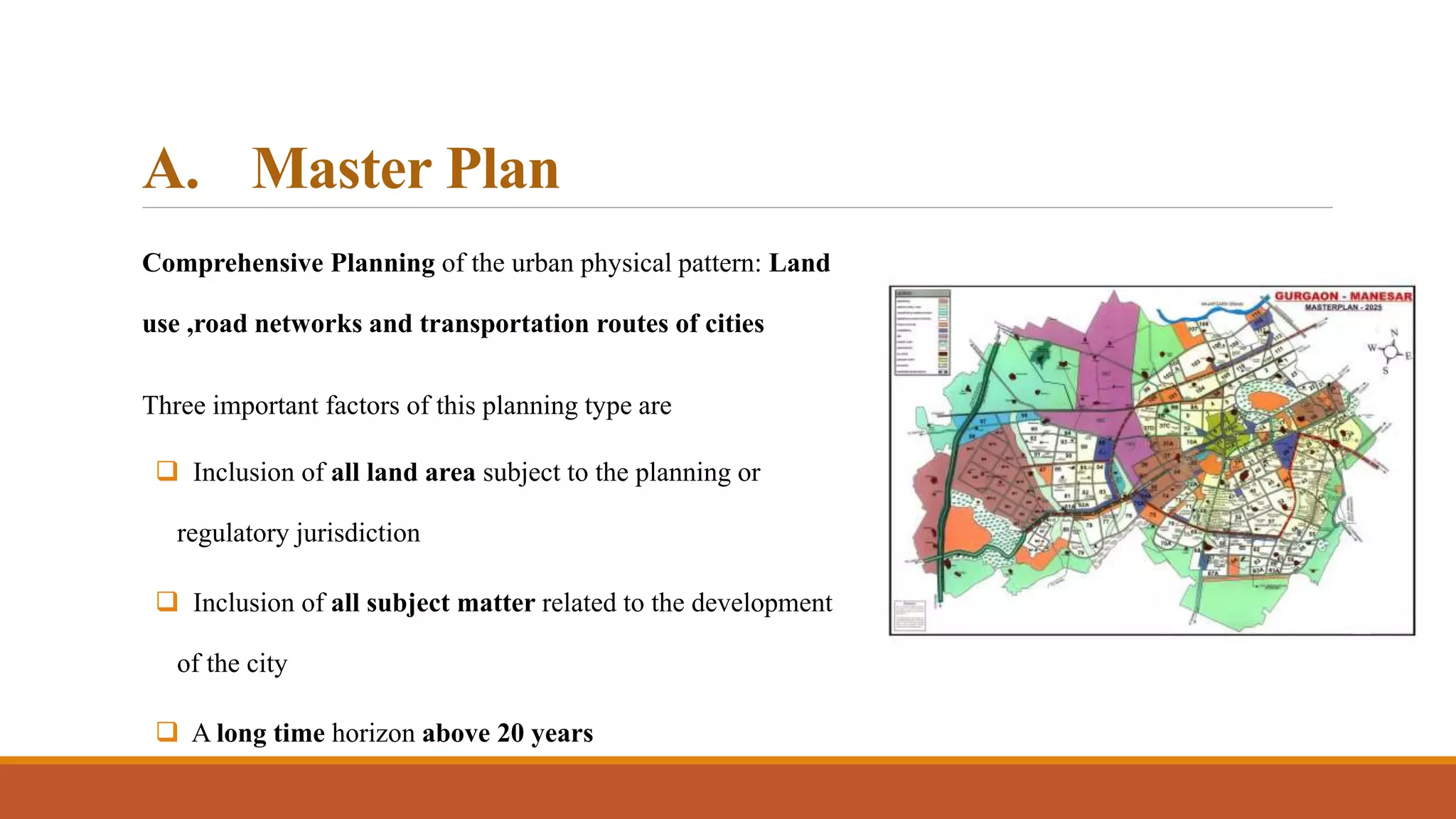
Comprehensive Planning of the urban physical pattern: Land
use ,road networks and transportation routes of cities
Three important factors of this planning type are
 Inclusion of all land area subject to the planning or
regulatory jurisdiction
 Inclusion of all subject matter related to the development
of the city
 A long time horizon above 20 years
B. Structural plan
Structural planning
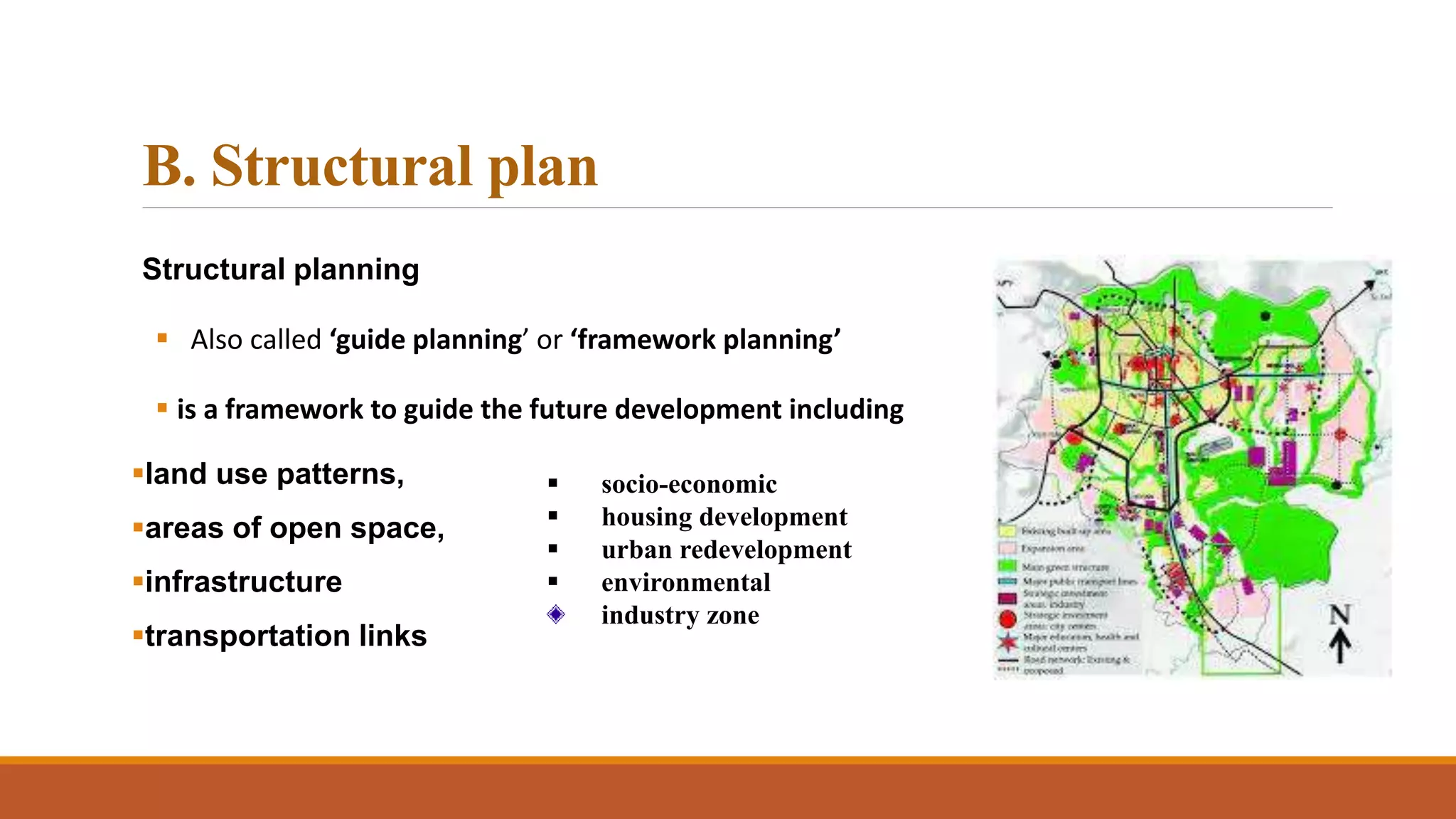
 Also called ‘guide planning’ or ‘framework planning’
 is a framework to guide the future development including
land use patterns,
areas of open space,
infrastructure
transportation links
 socio-economic
 housing development
 urban redevelopment
 environmental
industry zone
B. Structural plan
Structural planning
Comprehensiveness; cover the whole area of the urban center
Long term perspective; contain time horizon(10-20 year)
Not static, Dynamic, Flexible can be updated on demand
Efficient, effective and realistic
Participation and equitable
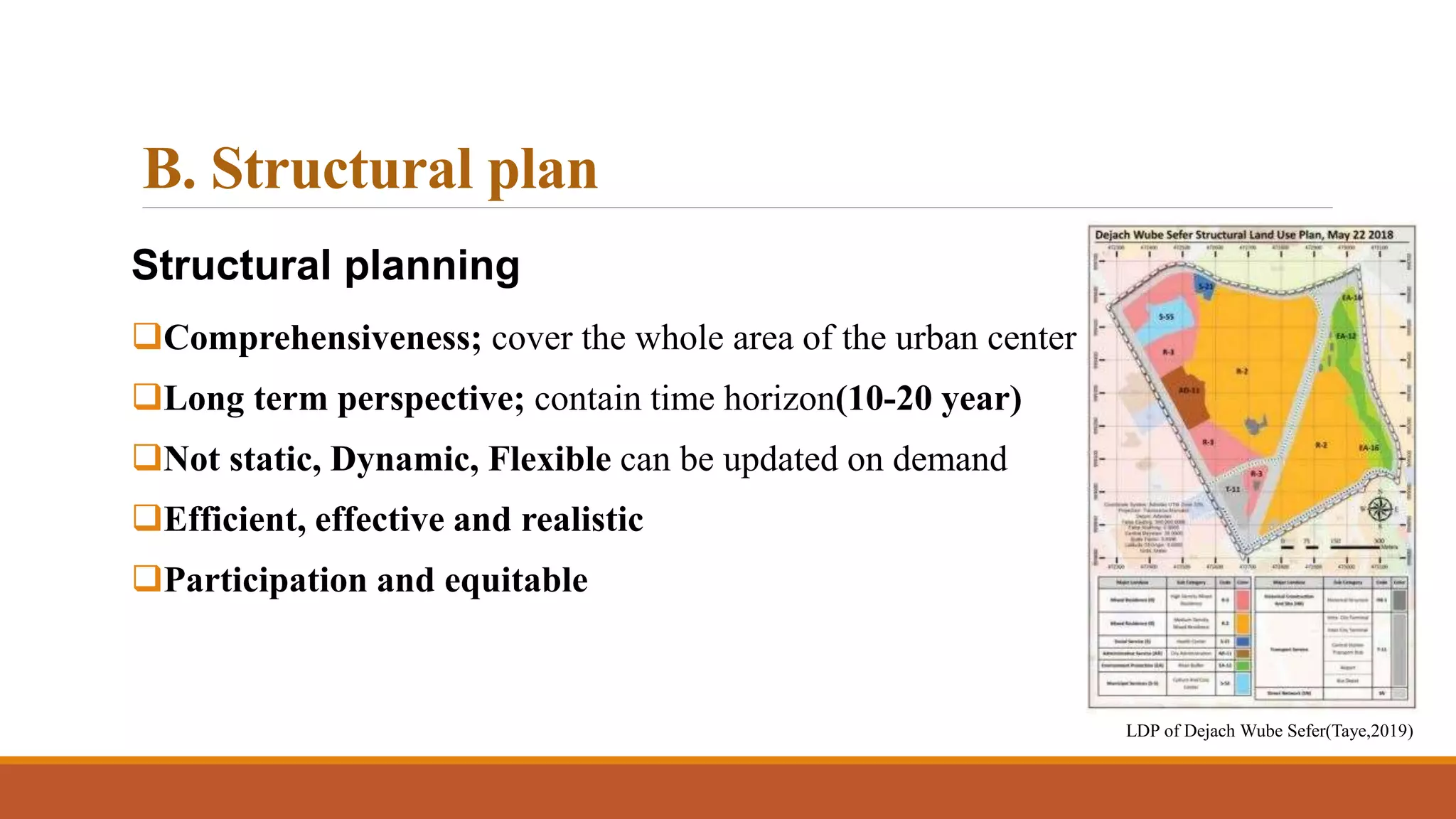
LDP of Dejach Wube Sefer(Taye,2019)
B. Structural plan
Structural planning
Comprise one or more maps, plans or diagrammatic representations of the
proposed layout, features, character and links for areas
The maps or plans not detail
The maps, plans or representations are usually supported by text
C. Strategic planning
It is an instrument of managing changes through the following three steps
i. Diagnosis: Analysis the existing situation
ii. Vision: Identify where we wish to be in the future
iii. Strategies: How to get /arrive to the defined vision
C. Strategic planning
Realistic not idealistic
It plans the future
Adaptable to changes: modification
Participation, bargaining, share decision making
Includes not only physical planning but also urban development management
more typically 3-5 years
D. Local Development planning
 Statutory or non-statutory planning
 Deal with detail planning issues (2D/3D)
 zooms out the general structure plan
 Based on area specific policies such as:
a. upgrading,
b. renewal,
c. new land development and
d. conservation areas
D. Local Development planning
medium term development 5-10 years. It indicate
 Zoning the use types, building height and density
 Local streets and layout of basic infrastructure
 Organization of transportation system
 Housing typology and neighborhood organization
 Green space ,open space ,water bodies
 proposals of key socio-economic measures,
 Implementation strategies, regulations,
 Standards & norms LDP of Dejach Wube Sefer(Taye,2019)
What is City plan?
It is an instrument with which urban planning can
identify a decision and thus
intervene in the development process
It is an organized way of
Finding city’s needs
Creating vision
Setting goals and objectives
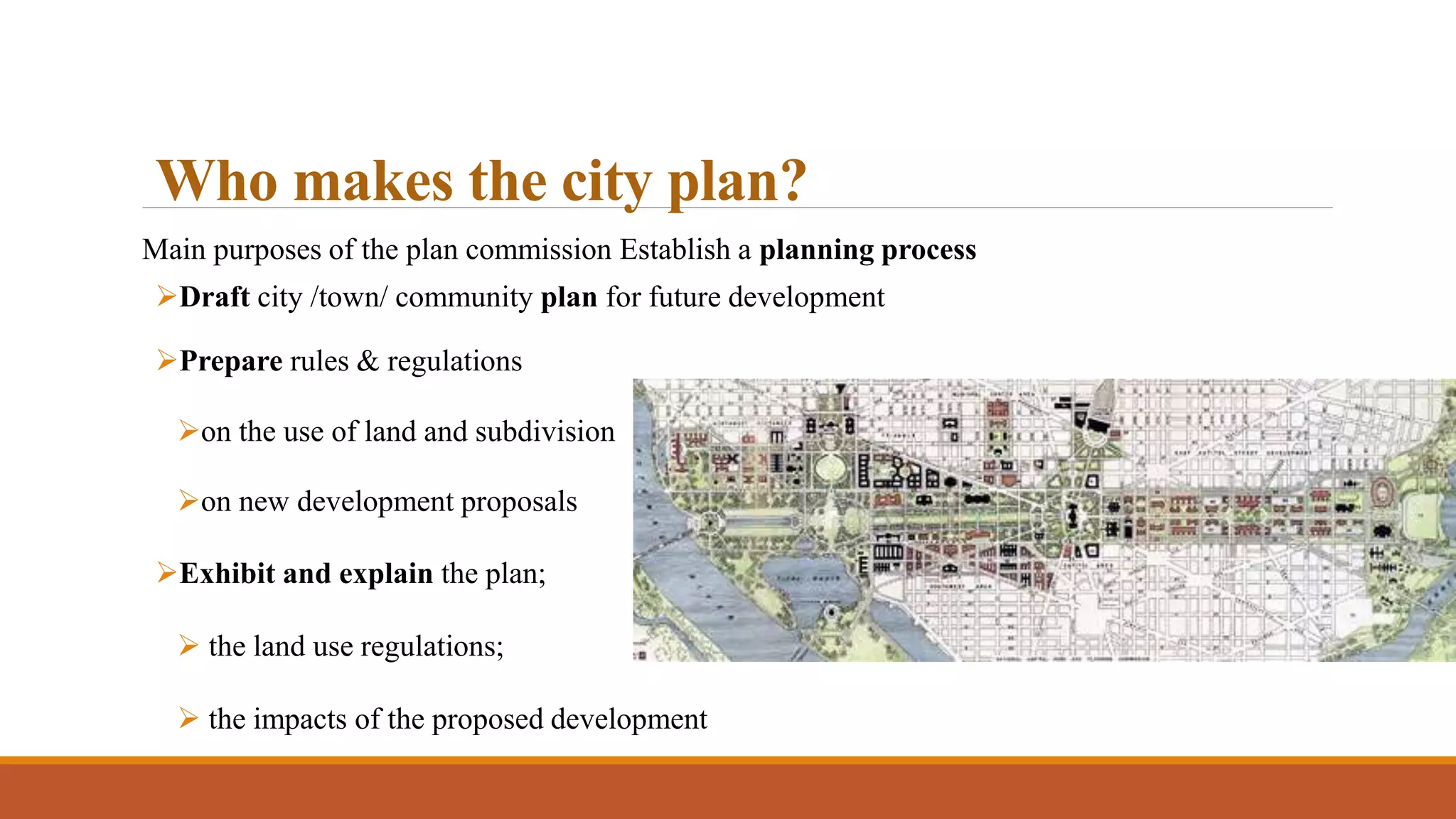
Lecorbusier, plan
New York city plan
Who makes city plan?
Governing body
 initiating the planning process
 Approving the plan
Planning commission
 Organizing the process
 Putting ideas in to plan
Citizens/ community
 Initiating the planning process
 Participation
Stakeholders
 participation
• Initiating the
planning process
•participation
Planning commission
Planning organization
Appoint
Governing body
•Decision to plan
•Commit resources
Hire
planning staff or
consultant
Citizens/
community stakeholders
The city plan
•participation
•Organizing the process
•Putting ideas in to plans
Who makes the city plan?
Main purposes of the plan commission Establish a planning process
Draft city /town/ community plan for future development
Prepare rules & regulations
on the use of land and subdivision
on new development proposals
Exhibit and explain the plan;
 the land use regulations;
 the impacts of the proposed development
Who makes the city plan?
Main purposes of the professional planner
Gather, Analyze and interpret data
Organize and facilitate meetings
Compile, organize and analyze comments from meetings
Project current trends and develop alternative scenarios
Turn decisions in to a plan document
Who makes the city plan?
Main purposes of the professional planner
Making plan document accessible and meaningful to the public
Preparing and publishing the final plan
Educating government officials and the public about the plan
Involves monitoring and implementation
Who approves the city plan?
Planning
commission
Planning
organization
Governing
body
community
Approve
Proposed
plan
disapprove
Suggest changes
The governing body , the community or both
approve the plan
3. Approaches to the city planning process
Approaches to the planning process
There are five approaches
1. Vision driven
2. Goal driven
3. Trend driven
4. Opportunity driven
5. Issue driven
Vision driven
• Setting overarching goal that controls the whole
process
• In preparing plans sticking to a single approaches
oversimplifies the planning process.
• Therefore it is important to blend two or more of the
approaches to meet specific planning needs
Goal driven
 Establishes long range goals
 The goals guide the rest of the planning process
 The goals based on public participation
 goals framed by planning body or governing body
 Establishing long range goals is complex requiring sophisticated
management
Trend driven
 Projecting population and land use trends in to future
 Use this projection for planning
 Technical not participatory
 Trends are not reliable they may change
 Thus not an ideal approach as core planning process
 Useful point of reference for other planning approaches
Opportunity driven
 Assessing future based on opportunities, strengths and constraints
 Based on citizen participation
Issue driven
 Identification of critical issues and focusing planning efforts
on these issues
 Broadly participatory
E.g supply of water vs electricity/road
4. The planning process
The planning process
The planning process has four steps
A. Initial phase
B. Preliminary phase
C. Decision phase
D. Follow-up phase
A. Initial phase
 Decision to plan and commit resources
 Information gathering such as qualitative and quantitative inventory
/survey of
 land uses
 Infrastructure
 Economic base
 Population
 Natural environment
B. Preliminary phase
Identification of what changes should occur and what should stay the same
 Trend analysis / population, land use
 Problem identification
 Problem analysis
 SWOT analysis
 Development of goals and objectives
 Public involvement
Vision: set of ideas how the community should change
C. Decision Phase
 Identification of alternative solutions
 Selection of solution and plan of action
 Approval
 Implementation
D. Follow up Phase
 Monitoring and feedback
 Benchmarking/standared: setting measurable targets such as
• land supply,
• road improvement,
• number of jobs
 Assess the progress toward the benchmarks
 Adjustment of solution
Information resources for planning
Human resources
 Community volunteers tell us about realities of local situation
Published data
 Census results
• Population, family income, housing
 Health statistics: Births ,deaths etc
 Education
 Business activity
• Resources
• Environmental quality
Information resources for planning
Visual data
 Areal photographs
 Google earth maps
Base maps
 housing
 Land use
 Community facilities
 Transportation
 Flood prone areas
 Soils
 topography
Thank You!

Lecture_ Introduction to Urban Planning

  • 1.
    Ambo University School ofArchitecture and Urban Planning Urban Planning I Wogen Taye_ tayeinnovative@gmail.com
  • 2.
    Content 1. The needfor urban planning 2. Urban Planning classification 3. Approaches to the city planning process 4. The planning process
  • 3.
    1. The needfor urban planning
  • 4.
    Introduction, The needfor urban planning A. Because of Interconnectedness and complexity of urban areas B. Scarce resource C. Health & Safety D. Equity E. Adaptability F. Conflict resolution G. Guidance
  • 5.
    A. Interconnectedness andcomplexity The ‘development process’ in urban areas has to be influenced by urban planning because it has interconnectedness and complexity in its components.
  • 6.
    A. Interconnectedness andcomplexity today population is large and technology is complex  producing many at the same time complex sectors (service, manufacturing & industry, trade and urban agriculture) This means and decision in one sector affects many other sectors requiring urban planning interventions.
  • 7.
    A. Interconnectedness andcomplexity Sample illustration of interconnectedness, adapted from Levy (20 08) Few hectares of land Character of the area shaped Walk through (traffic) Drive through (traffic) Who lives in (housing) Kind of jobs generated (economy) Natural environment Social Services Education health Police Fire protection Recreation Decision to develop affects
  • 8.
    A. Interconnectedness andcomplexity The high level of interconnectedness between different sectors also require ‘systems that span many communities urban planning interventions. This Photo by Unknown Author is licensed under CC BY
  • 9.
    B. Scarce resource Themarket cannot be trusted to produce rational and efficient land use system Urban land is a scarce resource and needs stewardship to balance the claim of one interest group against another by urban planning. This avoids economic, social, environmental and physical chaos/disorder.
  • 10.
    C. Health &Safety Planning sets rules and standards Limit overcrowding Sets level for adequacy and capacity of utilities (access to health institution, pure water……) construction regulations Rules for environmental degradation
  • 11.
    D. Equity Planning setsthe stage for equitable distribution of resources which means it Avoids privilege and exclusion between the society /regardless of race, age, gender, social status/ regarding access to urban resources specially land /spatial inequalities
  • 12.
    E. Adaptability Establish regulationsand controls to adapt to urban development and its consequences E.g. adapting the new expansion environment of the city because of social disconnection like community organization Idir, Mahiber, equb
  • 13.
    F. Conflict resolution Resolveconflicts between competing objectives and uses through control and regulatory framework E.g. the conflict between Residence and industries
  • 14.
    G. Guidance Direct thedevelopment and growth of urban centers in efficient way ‘a key role of the planning system is to enable the provision of homes and buildings, investment and jobs in such a way which is consistent with the principles of sustainable development. It needs to be positive in promoting competitiveness while being protective towards the environment and amenity. (DTLR quoted in Syms Paul,2007)
  • 15.
    2. Urban PlanningClassification
  • 16.
    Urban planning classification Terminologies Statutory Doneor required by statute/ law Zoning To categorize by characteristics or use (Oxford Dictionaries, 2009)
  • 17.
    Urban planning classification Majorplanning type A. Master planning (MP) B. Structural planning (SP) C. Strategic planning (St.P) D. Local Development planning (LDP)
  • 18.
    A. Master Plan Started in the early 1940s  Grand/ large plans in scale  In preparation few selected participate (elite based)  It doesn’t give room for abuse/corruption.  Are Static: difficult to change on demand  Statutory /backed by law/ Addis Ababa Master plan(Greenery)
  • 19.
    A. Master Plan ComprehensivePlanning of the urban physical pattern: Land use ,road networks and transportation routes of cities Three important factors of this planning type are  Inclusion of all land area subject to the planning or regulatory jurisdiction  Inclusion of all subject matter related to the development of the city  A long time horizon above 20 years
  • 20.
    B. Structural plan Structuralplanning  Also called ‘guide planning’ or ‘framework planning’  is a framework to guide the future development including land use patterns, areas of open space, infrastructure transportation links  socio-economic  housing development  urban redevelopment  environmental industry zone
  • 21.
    B. Structural plan Structuralplanning Comprehensiveness; cover the whole area of the urban center Long term perspective; contain time horizon(10-20 year) Not static, Dynamic, Flexible can be updated on demand Efficient, effective and realistic Participation and equitable LDP of Dejach Wube Sefer(Taye,2019)
  • 22.
    B. Structural plan Structuralplanning Comprise one or more maps, plans or diagrammatic representations of the proposed layout, features, character and links for areas The maps or plans not detail The maps, plans or representations are usually supported by text
  • 23.
    C. Strategic planning Itis an instrument of managing changes through the following three steps i. Diagnosis: Analysis the existing situation ii. Vision: Identify where we wish to be in the future iii. Strategies: How to get /arrive to the defined vision
  • 24.
    C. Strategic planning Realisticnot idealistic It plans the future Adaptable to changes: modification Participation, bargaining, share decision making Includes not only physical planning but also urban development management more typically 3-5 years
  • 25.
    D. Local Developmentplanning  Statutory or non-statutory planning  Deal with detail planning issues (2D/3D)  zooms out the general structure plan  Based on area specific policies such as: a. upgrading, b. renewal, c. new land development and d. conservation areas
  • 26.
    D. Local Developmentplanning medium term development 5-10 years. It indicate  Zoning the use types, building height and density  Local streets and layout of basic infrastructure  Organization of transportation system  Housing typology and neighborhood organization  Green space ,open space ,water bodies  proposals of key socio-economic measures,  Implementation strategies, regulations,  Standards & norms LDP of Dejach Wube Sefer(Taye,2019)
  • 27.
    What is Cityplan? It is an instrument with which urban planning can identify a decision and thus intervene in the development process It is an organized way of Finding city’s needs Creating vision Setting goals and objectives Lecorbusier, plan New York city plan
  • 28.
    Who makes cityplan? Governing body  initiating the planning process  Approving the plan Planning commission  Organizing the process  Putting ideas in to plan Citizens/ community  Initiating the planning process  Participation Stakeholders  participation
  • 29.
    • Initiating the planningprocess •participation Planning commission Planning organization Appoint Governing body •Decision to plan •Commit resources Hire planning staff or consultant Citizens/ community stakeholders The city plan •participation •Organizing the process •Putting ideas in to plans
  • 30.
    Who makes thecity plan? Main purposes of the plan commission Establish a planning process Draft city /town/ community plan for future development Prepare rules & regulations on the use of land and subdivision on new development proposals Exhibit and explain the plan;  the land use regulations;  the impacts of the proposed development
  • 31.
    Who makes thecity plan? Main purposes of the professional planner Gather, Analyze and interpret data Organize and facilitate meetings Compile, organize and analyze comments from meetings Project current trends and develop alternative scenarios Turn decisions in to a plan document
  • 32.
    Who makes thecity plan? Main purposes of the professional planner Making plan document accessible and meaningful to the public Preparing and publishing the final plan Educating government officials and the public about the plan Involves monitoring and implementation
  • 33.
    Who approves thecity plan? Planning commission Planning organization Governing body community Approve Proposed plan disapprove Suggest changes The governing body , the community or both approve the plan
  • 34.
    3. Approaches tothe city planning process
  • 35.
    Approaches to theplanning process There are five approaches 1. Vision driven 2. Goal driven 3. Trend driven 4. Opportunity driven 5. Issue driven
  • 36.
    Vision driven • Settingoverarching goal that controls the whole process • In preparing plans sticking to a single approaches oversimplifies the planning process. • Therefore it is important to blend two or more of the approaches to meet specific planning needs
  • 37.
    Goal driven  Establisheslong range goals  The goals guide the rest of the planning process  The goals based on public participation  goals framed by planning body or governing body  Establishing long range goals is complex requiring sophisticated management
  • 38.
    Trend driven  Projectingpopulation and land use trends in to future  Use this projection for planning  Technical not participatory  Trends are not reliable they may change  Thus not an ideal approach as core planning process  Useful point of reference for other planning approaches
  • 39.
    Opportunity driven  Assessingfuture based on opportunities, strengths and constraints  Based on citizen participation
  • 40.
    Issue driven  Identificationof critical issues and focusing planning efforts on these issues  Broadly participatory E.g supply of water vs electricity/road
  • 41.
  • 42.
    The planning process Theplanning process has four steps A. Initial phase B. Preliminary phase C. Decision phase D. Follow-up phase
  • 43.
    A. Initial phase Decision to plan and commit resources  Information gathering such as qualitative and quantitative inventory /survey of  land uses  Infrastructure  Economic base  Population  Natural environment
  • 44.
    B. Preliminary phase Identificationof what changes should occur and what should stay the same  Trend analysis / population, land use  Problem identification  Problem analysis  SWOT analysis  Development of goals and objectives  Public involvement Vision: set of ideas how the community should change
  • 45.
    C. Decision Phase Identification of alternative solutions  Selection of solution and plan of action  Approval  Implementation
  • 46.
    D. Follow upPhase  Monitoring and feedback  Benchmarking/standared: setting measurable targets such as • land supply, • road improvement, • number of jobs  Assess the progress toward the benchmarks  Adjustment of solution
  • 47.
    Information resources forplanning Human resources  Community volunteers tell us about realities of local situation Published data  Census results • Population, family income, housing  Health statistics: Births ,deaths etc  Education  Business activity • Resources • Environmental quality
  • 48.
    Information resources forplanning Visual data  Areal photographs  Google earth maps Base maps  housing  Land use  Community facilities  Transportation  Flood prone areas  Soils  topography
  • 49.