Introduction to the   RATIONALIZED PLANNING SYSTEM
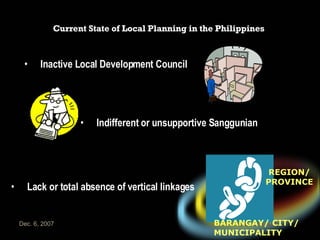
Current State of Local Planning in the Philippines Lack or total absence of vertical linkages REGION/ PROVINCE BARANGAY/ CITY/ MUNICIPALITY Indifferent or unsupportive Sanggunian Inactive Local Development Council
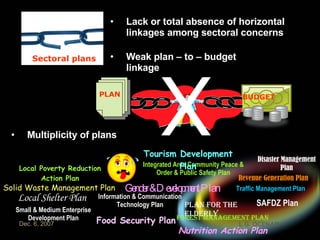
Weak plan – to – budget linkage Lack or total absence of horizontal linkages among sectoral concerns X PLAN BUDGET Multiplicity of plans Solid Waste Management Plan Integrated Area Community Peace & Order & Public Safety Plan Gender & Development Plan Local Poverty Reduction Action Plan Information & Communication Technology Plan Local Shelter Plan Revenue Generation Plan Disaster Management Plan Small & Medium Enterprise Development Plan Traffic Management Plan Plan for the Elderly Food Security Plan Forest Management Plan SAFDZ Plan Nutrition Action Plan Tourism Development Plan Sectoral plans
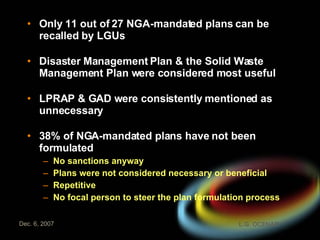
Only 11 out of 27 NGA-mandated plans can be recalled by LGUs Disaster Management Plan & the Solid Waste Management Plan were considered most useful LPRAP & GAD were consistently mentioned as unnecessary 38% of NGA-mandated plans have not been formulated No sanctions anyway Plans were not considered necessary or beneficial Repetitive No focal person to steer the plan formulation process
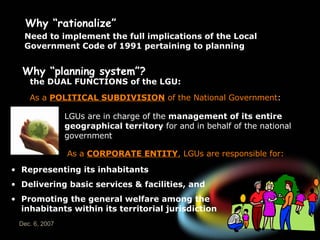
Why “rationalize” Need to implement the full implications of the Local Government Code of 1991 pertaining to planning Why “planning system”? the DUAL FUNCTIONS of the LGU: As a  POLITICAL SUBDIVISION  of the National Government : LGUs are in charge of the  management of its entire geographical territory  for and in behalf of the national government   As a  CORPORATE ENTITY , LGUs are responsible for: Representing its inhabitants Delivering basic services & facilities, and Promoting the general welfare among the inhabitants within its territorial jurisdiction
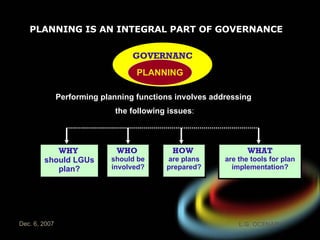
GOVERNANCE PLANNING Performing planning functions involves addressing  the following issues : PLANNING IS AN INTEGRAL PART OF GOVERNANCE WHY   should LGUs plan? WHO  should be involved? HOW  are plans prepared? WHAT are the tools for plan implementation?
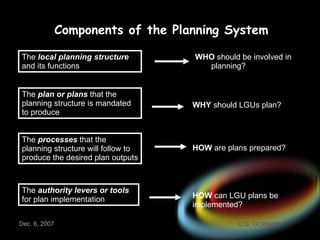
Components of the Planning System The  local   planning structure  and its functions WHO  should be involved in planning? The  processes  that the planning structure will follow to produce the desired plan outputs The  plan or plans  that the planning structure is mandated to produce WHY  should LGUs plan? HOW  are plans prepared ? The  authority levers or tools  for plan implementation  HOW  can LGU plans be implemented?
The  LOCAL PLANNING STRUCTURE
The LGU Planning structure has evolved   From primarily technical LCE as chair Heads of offices and departments as members To political LCE as chair  Members are predominantly politicians
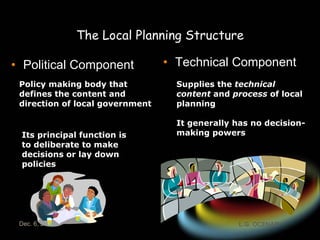
Political Component Technical Component The Local Planning Structure Policy making body that defines the content and direction of local government Supplies the  technical content  and  process  of local planning   It generally   has no decision-making   powers   Its principal function is to deliberate to make decisions or lay down policies
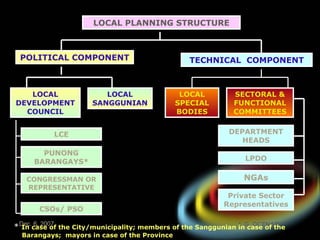
*  In case of the City/municipality; members of the Sanggunian in case of the Barangays;  mayors in case of the Province LOCAL PLANNING STRUCTURE POLITICAL   COMPONENT TECHNICAL  COMPONENT LOCAL DEVELOPMENT COUNCIL LOCAL SANGGUNIAN LOCAL SPECIAL BODIES SECTORAL & FUNCTIONAL COMMITTEES LPDO NGAs DEPARTMENT HEADS Private Sector Representatives LCE PUNONG BARANGAYS* CONGRESSMAN OR REPRESENTATIVE CSOs/ PSO
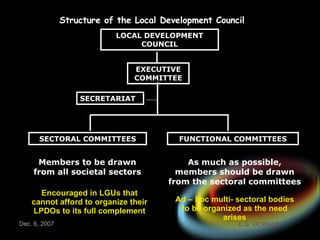
Members to be drawn from all societal sectors As much as possible, members should be drawn from the sectoral committees Encouraged in LGUs that cannot afford to organize their LPDOs to its full complement Ad – hoc multi- sectoral bodies to be organized as the need arises SECRETARIAT LOCAL DEVELOPMENT COUNCIL SECTORAL COMMITTEES FUNCTIONAL COMMITTEES EXECUTIVE COMMITTEE Structure of the Local Development Council
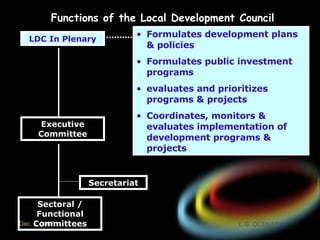
Functions of the Local Development Council Sectoral / Functional Committees LDC In Plenary Formulates development plans & policies Formulates public investment programs evaluates and prioritizes programs & projects Coordinates, monitors & evaluates implementation of development programs & projects Executive Committee Secretariat
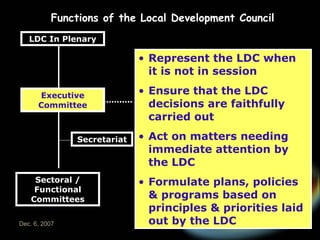
Functions of the Local Development Council Sectoral / Functional Committees LDC In Plenary Executive Committee Represent the LDC when it is not in session Ensure that the LDC decisions are faithfully carried out Act on matters needing immediate attention by the LDC Formulate plans, policies & programs based on principles & priorities laid out by the LDC Secretariat
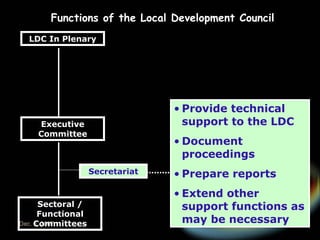
Functions of the Local Development Council Sectoral / Functional Committees LDC In Plenary Executive Committee Secretariat Provide technical support to the LDC Document proceedings Prepare reports Extend other support functions as may be necessary
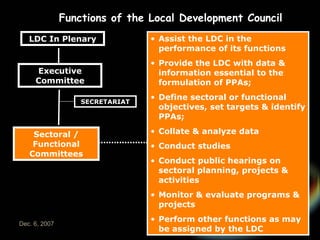
LDC In Plenary Executive Committee SECRETARIAT Sectoral / Functional Committees Assist the LDC in the performance of its functions Provide the LDC with data & information essential to the formulation of PPAs; Define sectoral or functional objectives, set targets & identify PPAs; Collate & analyze data Conduct studies Conduct public hearings on sectoral planning, projects & activities Monitor & evaluate programs & projects Perform other functions as may be assigned by the LDC Functions of the Local Development Council
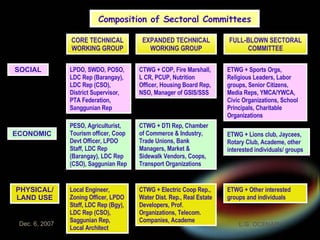
Composition of Sectoral Committees ECONOMIC PESO, Agriculturist, Tourism officer, Coop Devt Officer, LPDO Staff, LDC Rep (Barangay), LDC Rep (CSO),   Saggunian Rep CTWG + DTI Rep, Chamber of Commerce & Industry, Trade Unions, Bank Managers, Market & Sidewalk Vendors, Coops, Transport Organizations ETWG + Lions club, Jaycees, Rotary Club, Academe, other interested individuals/ groups CORE TECHNICAL WORKING GROUP EXPANDED TECHNICAL WORKING GROUP FULL-BLOWN SECTORAL COMMITTEE SOCIAL LPDO, SWDO, POSO, LDC Rep (Barangay), LDC Rep (CSO), District Supervisor, PTA Federation, Sanggunian Rep CTWG + COP, Fire Marshall, L CR, PCUP, Nutrition Officer, Housing Board Rep, NSO, Manager of GSIS/SSS ETWG + Sports Orgs, Religious Leaders, Labor groups, Senior Citizens, Media Reps, YMCA/YWCA, Civic Organizations, School Principals, Charitable Organizations PHYSICAL/ LAND USE Local Engineer, Zoning Officer, LPDO Staff, LDC Rep (Bgy), LDC Rep (CSO),   Saggunian Rep, Local Architect CTWG + Electric Coop Rep., Water Dist. Rep., Real Estate Developers, Prof. Organizations, Telecom. Companies, Academe ETWG + Other interested groups and individuals
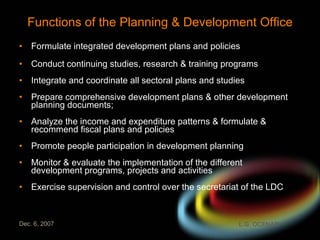
Functions of the Planning & Development Office Formulate integrated development plans and policies Conduct continuing studies, research & training programs Integrate and coordinate all sectoral plans and studies Prepare comprehensive development plans & other development planning documents; Analyze the income and expenditure patterns & formulate & recommend fiscal plans and policies Promote people participation in development planning Monitor & evaluate the implementation of the different development programs, projects and activities Exercise supervision and control over the secretariat of the LDC
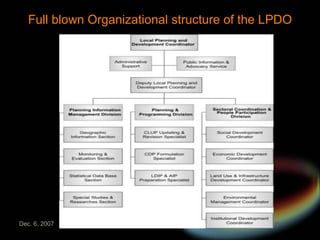
Full blown Organizational structure of the LPDO
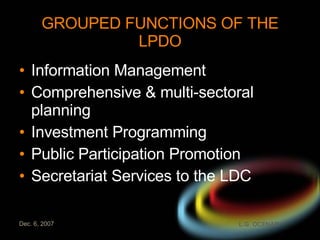
GROUPED FUNCTIONS OF THE LPDO Information Management Comprehensive & multi-sectoral planning Investment Programming Public Participation Promotion Secretariat Services to the LDC
 

Building Lgu Alliances For Effective Local Development

  • 1.
    Introduction to the RATIONALIZED PLANNING SYSTEM
  • 2.
    Current State ofLocal Planning in the Philippines Lack or total absence of vertical linkages REGION/ PROVINCE BARANGAY/ CITY/ MUNICIPALITY Indifferent or unsupportive Sanggunian Inactive Local Development Council
  • 3.
    Weak plan –to – budget linkage Lack or total absence of horizontal linkages among sectoral concerns X PLAN BUDGET Multiplicity of plans Solid Waste Management Plan Integrated Area Community Peace & Order & Public Safety Plan Gender & Development Plan Local Poverty Reduction Action Plan Information & Communication Technology Plan Local Shelter Plan Revenue Generation Plan Disaster Management Plan Small & Medium Enterprise Development Plan Traffic Management Plan Plan for the Elderly Food Security Plan Forest Management Plan SAFDZ Plan Nutrition Action Plan Tourism Development Plan Sectoral plans
  • 4.
    Only 11 outof 27 NGA-mandated plans can be recalled by LGUs Disaster Management Plan & the Solid Waste Management Plan were considered most useful LPRAP & GAD were consistently mentioned as unnecessary 38% of NGA-mandated plans have not been formulated No sanctions anyway Plans were not considered necessary or beneficial Repetitive No focal person to steer the plan formulation process
  • 5.
    Why “rationalize” Needto implement the full implications of the Local Government Code of 1991 pertaining to planning Why “planning system”? the DUAL FUNCTIONS of the LGU: As a POLITICAL SUBDIVISION of the National Government : LGUs are in charge of the management of its entire geographical territory for and in behalf of the national government As a CORPORATE ENTITY , LGUs are responsible for: Representing its inhabitants Delivering basic services & facilities, and Promoting the general welfare among the inhabitants within its territorial jurisdiction
  • 6.
    GOVERNANCE PLANNING Performingplanning functions involves addressing the following issues : PLANNING IS AN INTEGRAL PART OF GOVERNANCE WHY should LGUs plan? WHO should be involved? HOW are plans prepared? WHAT are the tools for plan implementation?
  • 7.
    Components of thePlanning System The local planning structure and its functions WHO should be involved in planning? The processes that the planning structure will follow to produce the desired plan outputs The plan or plans that the planning structure is mandated to produce WHY should LGUs plan? HOW are plans prepared ? The authority levers or tools for plan implementation HOW can LGU plans be implemented?
  • 8.
    The LOCALPLANNING STRUCTURE
  • 9.
    The LGU Planningstructure has evolved From primarily technical LCE as chair Heads of offices and departments as members To political LCE as chair Members are predominantly politicians
  • 10.
    Political Component TechnicalComponent The Local Planning Structure Policy making body that defines the content and direction of local government Supplies the technical content and process of local planning It generally has no decision-making powers Its principal function is to deliberate to make decisions or lay down policies
  • 11.
    * Incase of the City/municipality; members of the Sanggunian in case of the Barangays; mayors in case of the Province LOCAL PLANNING STRUCTURE POLITICAL COMPONENT TECHNICAL COMPONENT LOCAL DEVELOPMENT COUNCIL LOCAL SANGGUNIAN LOCAL SPECIAL BODIES SECTORAL & FUNCTIONAL COMMITTEES LPDO NGAs DEPARTMENT HEADS Private Sector Representatives LCE PUNONG BARANGAYS* CONGRESSMAN OR REPRESENTATIVE CSOs/ PSO
  • 12.
    Members to bedrawn from all societal sectors As much as possible, members should be drawn from the sectoral committees Encouraged in LGUs that cannot afford to organize their LPDOs to its full complement Ad – hoc multi- sectoral bodies to be organized as the need arises SECRETARIAT LOCAL DEVELOPMENT COUNCIL SECTORAL COMMITTEES FUNCTIONAL COMMITTEES EXECUTIVE COMMITTEE Structure of the Local Development Council
  • 13.
    Functions of theLocal Development Council Sectoral / Functional Committees LDC In Plenary Formulates development plans & policies Formulates public investment programs evaluates and prioritizes programs & projects Coordinates, monitors & evaluates implementation of development programs & projects Executive Committee Secretariat
  • 14.
    Functions of theLocal Development Council Sectoral / Functional Committees LDC In Plenary Executive Committee Represent the LDC when it is not in session Ensure that the LDC decisions are faithfully carried out Act on matters needing immediate attention by the LDC Formulate plans, policies & programs based on principles & priorities laid out by the LDC Secretariat
  • 15.
    Functions of theLocal Development Council Sectoral / Functional Committees LDC In Plenary Executive Committee Secretariat Provide technical support to the LDC Document proceedings Prepare reports Extend other support functions as may be necessary
  • 16.
    LDC In PlenaryExecutive Committee SECRETARIAT Sectoral / Functional Committees Assist the LDC in the performance of its functions Provide the LDC with data & information essential to the formulation of PPAs; Define sectoral or functional objectives, set targets & identify PPAs; Collate & analyze data Conduct studies Conduct public hearings on sectoral planning, projects & activities Monitor & evaluate programs & projects Perform other functions as may be assigned by the LDC Functions of the Local Development Council
  • 17.
    Composition of SectoralCommittees ECONOMIC PESO, Agriculturist, Tourism officer, Coop Devt Officer, LPDO Staff, LDC Rep (Barangay), LDC Rep (CSO), Saggunian Rep CTWG + DTI Rep, Chamber of Commerce & Industry, Trade Unions, Bank Managers, Market & Sidewalk Vendors, Coops, Transport Organizations ETWG + Lions club, Jaycees, Rotary Club, Academe, other interested individuals/ groups CORE TECHNICAL WORKING GROUP EXPANDED TECHNICAL WORKING GROUP FULL-BLOWN SECTORAL COMMITTEE SOCIAL LPDO, SWDO, POSO, LDC Rep (Barangay), LDC Rep (CSO), District Supervisor, PTA Federation, Sanggunian Rep CTWG + COP, Fire Marshall, L CR, PCUP, Nutrition Officer, Housing Board Rep, NSO, Manager of GSIS/SSS ETWG + Sports Orgs, Religious Leaders, Labor groups, Senior Citizens, Media Reps, YMCA/YWCA, Civic Organizations, School Principals, Charitable Organizations PHYSICAL/ LAND USE Local Engineer, Zoning Officer, LPDO Staff, LDC Rep (Bgy), LDC Rep (CSO), Saggunian Rep, Local Architect CTWG + Electric Coop Rep., Water Dist. Rep., Real Estate Developers, Prof. Organizations, Telecom. Companies, Academe ETWG + Other interested groups and individuals
  • 18.
    Functions of thePlanning & Development Office Formulate integrated development plans and policies Conduct continuing studies, research & training programs Integrate and coordinate all sectoral plans and studies Prepare comprehensive development plans & other development planning documents; Analyze the income and expenditure patterns & formulate & recommend fiscal plans and policies Promote people participation in development planning Monitor & evaluate the implementation of the different development programs, projects and activities Exercise supervision and control over the secretariat of the LDC
  • 19.
    Full blown Organizationalstructure of the LPDO
  • 20.
    GROUPED FUNCTIONS OFTHE LPDO Information Management Comprehensive & multi-sectoral planning Investment Programming Public Participation Promotion Secretariat Services to the LDC
  • 21.