.
To our Presentation
.
Presented By
Topics: Dr. Faustus As a Renaissance
Hero or Man
.
Christopher Marlowe (baptized 26 February 1564 – 30 May 1593) was
an English playwright, poet and translator of the Elizabethan era.
Marlowe was the foremost Elizabethan tragedian of his day. He was
greatly influenced William Shakespeare, who was born in the same
year as Marlowe and who rose to become the pre-eminent Elizabethan
playwright after Marlowe's mysterious early death. Marlowe's plays
are known for the use of blank verse and their overreaching
protagonists.
Christopher Marlowe
.
Christopher Marlowe
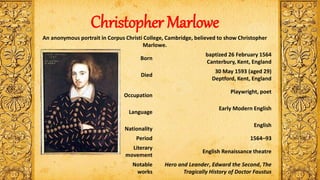
An anonymous portrait in Corpus Christi College, Cambridge, believed to show Christopher
Marlowe.
Born
baptized 26 February 1564
Canterbury, Kent, England
Died
30 May 1593 (aged 29)
Deptford, Kent, England
Occupation
Playwright, poet
Language
Early Modern English
Nationality
English
Period 1564–93
Literary
movement
English Renaissance theatre
Notable
works
Hero and Leander, Edward the Second, The
Tragically History of Doctor Faustus
.
Renaissance
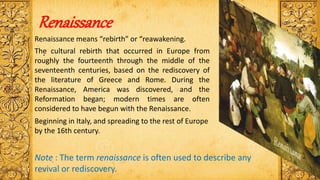
Renaissance means “rebirth” or “reawakening.
The cultural rebirth that occurred in Europe from
roughly the fourteenth through the middle of the
seventeenth centuries, based on the rediscovery of
the literature of Greece and Rome. During the
Renaissance, America was discovered, and the
Reformation began; modern times are often
considered to have begun with the Renaissance.
Note : The term renaissance is often used to describe any
revival or rediscovery.
Beginning in Italy, and spreading to the rest of Europe
by the 16th century.
Renaissance Overview
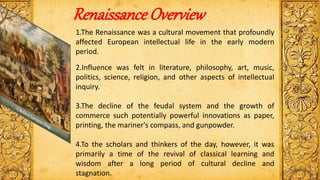
1.The Renaissance was a cultural movement that profoundly
affected European intellectual life in the early modern
period.
2.Influence was felt in literature, philosophy, art, music,
politics, science, religion, and other aspects of intellectual
inquiry.
3.The decline of the feudal system and the growth of
commerce such potentially powerful innovations as paper,
printing, the mariner's compass, and gunpowder.
4.To the scholars and thinkers of the day, however, it was
primarily a time of the revival of classical learning and
wisdom after a long period of cultural decline and
stagnation.
.
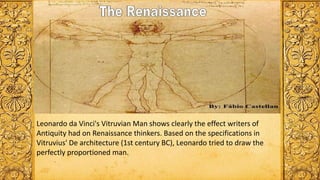
Leonardo da Vinci's Vitruvian Man shows clearly the effect writers of
Antiquity had on Renaissance thinkers. Based on the specifications in
Vitruvius' De architecture (1st century BC), Leonardo tried to draw the
perfectly proportioned man.
.
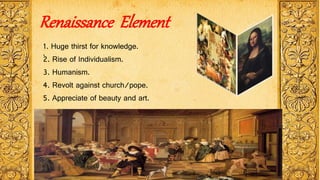
1. Huge thirst for knowledge.
2. Rise of Individualism.
3. Humanism.
4. Revolt against church/pope.
5. Appreciate of beauty and art.
Renaissance Element
1.Huge thirst for knowledge
and "Doctor Faustus"
To be a renaissance a scholar need huge thirst for knowledge.
Doctor Faustus, a well-respected German scholar, grows dissatisfied with
the limits of traditional forms of knowledge —logic, medicine, law, and
religion—and decides that he wants to learn to practice magic.
Scene 1
These metaphysics of magicians,
And necromantic books are heavenly!
In a long soliloquy, Faustus reflects on the most rewarding type of
scholarship.
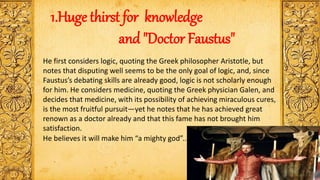
He first considers logic, quoting the Greek philosopher Aristotle, but
notes that disputing well seems to be the only goal of logic, and, since
Faustus’s debating skills are already good, logic is not scholarly enough
for him. He considers medicine, quoting the Greek physician Galen, and
decides that medicine, with its possibility of achieving miraculous cures,
is the most fruitful pursuit—yet he notes that he has achieved great
renown as a doctor already and that this fame has not brought him
satisfaction.
1.Huge thirst for knowledge
and "Doctor Faustus"
He believes it will make him “a mighty god”..
2. Rise of Individualism
and "Doctor Faustus"
The medieval world placed God at the center of existence and shunted
aside man and the natural world.
It means my life is important to me and my first priority.
That's why, in the medieval era people have no knowledge, no study etc.
They move back from all basic thing. Superstitious believe makes people
fool. Renaissance, age of an enlighten, come to take place and give
people fundamental right.
it a new emphasis on the individual, on classical learning, and on
scientific inquiry into the nature of the world. In the medieval academy,
theology was the queen of the sciences. In the Renaissance, though,
secular matters took center stage.
2. Rise of Individualism
and "Doctor Faustus"
Because of his universal desire for enlightenment, Faustus makes
a contract for knowledge and power. His desire, according to the
Renaissance, is to transcend the limitations of humanity and rise to
greater achievements and heights
According to the Renaissance view, Faustus rebels against the limitations
of medieval knowledge and the restriction put upon humankind
decreeing that he must accept his place in the universe without
challenging it.
Besides the early days believe that society is everything. My happiness,
my concept, my peace etc. didn't mean anything before family and
society But during renaissance these thing become first priority and love
for one another has increased.
3. Humanism
and "Doctor Faustus"
It is considering value of worldly life. It also anti-
medieval element. Medieval focus on about, you have
to prepare after earthly life. Spiritual life is more
important than human life. so, people forgot to give
value of earthly life. During renaissance people began
to value of life. This known human concept priority
first than religion concept.
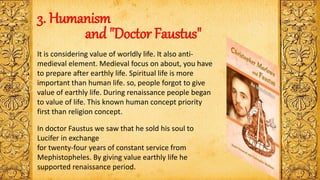
In doctor Faustus we saw that he sold his soul to
Lucifer in exchange
for twenty-four years of constant service from
Mephistopheles. By giving value earthly life he
supported renaissance period.
4. Revolt against church/pope
and "Doctor Faustus"
when the man who has transgressed against the natural laws of the
universe is justifiably punished. Which we also find in doctor Faustus.
After getting power Faustus is going against human boundary and got
proper punishment.
Here we can remember moral from Icarus-
Faustus is gone! Regard his hellish fall,
Whose mindful fortune may exhort the wise
Only to wonder at unlawful things:
Chorus-4
4. Revolt against church/pope
and "Doctor Faustus"
Armed with his new powers and attended by Mephistopheles, Faustus
begins to travel. He goes to the pope’s court in Rome, makes himself
invisible, and plays a series of tricks. He disrupts the pope’s banquet
by stealing food and boxing the pope’s ears.
In the medieval period church is all to man. They discriminate general
or poor people. Besides they live wealthy and gorgeous life.
Renaissance give them good lesson.
5. Appreciate of beauty and art
and "Doctor Faustus"
To become renaissance this quality is also important. Beauty and art
nice element of renaissance element. And Faustus also appreciate it.
Getting magical power Faustus wants Helen, world most Beautiful girl,
As a wife. And finally proved that doctor Faustus is a perfect renaissance
Hero.
Anti Renaissance Element
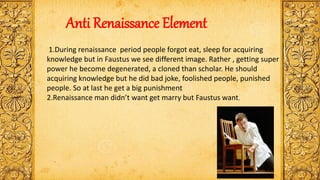
1.During renaissance period people forgot eat, sleep for acquiring
knowledge but in Faustus we see different image. Rather , getting super
power he become degenerated, a cloned than scholar. He should
acquiring knowledge but he did bad joke, foolished people, punished
people. So at last he get a big punishment
2.Renaissance man didn’t want get marry but Faustus want.
Conclusion
The Prologue locates its drama squarely in the Renaissance world,
where humanistic values hold sway. Classical and medieval literature
typically focuses on the lives of the great and famous—saints or kings
or ancient heroes. But this play, the Chorus insists, will focus not on
ancient battles between Rome and Carthage, or on the “courts of kings”
or the “pomp of proud audacious deeds”. Instead, we are to witness the
life of an ordinary man, born to humble parents. The message is clear:
in the new world of the Renaissance, an ordinary man like Faustus, a
common-born scholar, is as important as any king or warrior, and his
story is just as worthy of being told.
Doctor Faustus is a perfectly renaissance man.
.
Any Question?

Dr. Faustus as a Renaissance Hero

  • 1.
  • 2.
    . Presented By Topics: Dr.Faustus As a Renaissance Hero or Man
  • 3.
  • 4.
    Christopher Marlowe (baptized26 February 1564 – 30 May 1593) was an English playwright, poet and translator of the Elizabethan era. Marlowe was the foremost Elizabethan tragedian of his day. He was greatly influenced William Shakespeare, who was born in the same year as Marlowe and who rose to become the pre-eminent Elizabethan playwright after Marlowe's mysterious early death. Marlowe's plays are known for the use of blank verse and their overreaching protagonists. Christopher Marlowe
  • 5.
    . Christopher Marlowe An anonymousportrait in Corpus Christi College, Cambridge, believed to show Christopher Marlowe. Born baptized 26 February 1564 Canterbury, Kent, England Died 30 May 1593 (aged 29) Deptford, Kent, England Occupation Playwright, poet Language Early Modern English Nationality English Period 1564–93 Literary movement English Renaissance theatre Notable works Hero and Leander, Edward the Second, The Tragically History of Doctor Faustus
  • 6.
    . Renaissance Renaissance means “rebirth”or “reawakening. The cultural rebirth that occurred in Europe from roughly the fourteenth through the middle of the seventeenth centuries, based on the rediscovery of the literature of Greece and Rome. During the Renaissance, America was discovered, and the Reformation began; modern times are often considered to have begun with the Renaissance. Note : The term renaissance is often used to describe any revival or rediscovery. Beginning in Italy, and spreading to the rest of Europe by the 16th century.
  • 7.
    Renaissance Overview 1.The Renaissancewas a cultural movement that profoundly affected European intellectual life in the early modern period. 2.Influence was felt in literature, philosophy, art, music, politics, science, religion, and other aspects of intellectual inquiry. 3.The decline of the feudal system and the growth of commerce such potentially powerful innovations as paper, printing, the mariner's compass, and gunpowder. 4.To the scholars and thinkers of the day, however, it was primarily a time of the revival of classical learning and wisdom after a long period of cultural decline and stagnation.
  • 8.
    . Leonardo da Vinci'sVitruvian Man shows clearly the effect writers of Antiquity had on Renaissance thinkers. Based on the specifications in Vitruvius' De architecture (1st century BC), Leonardo tried to draw the perfectly proportioned man.
  • 9.
    . 1. Huge thirstfor knowledge. 2. Rise of Individualism. 3. Humanism. 4. Revolt against church/pope. 5. Appreciate of beauty and art. Renaissance Element
  • 10.
    1.Huge thirst forknowledge and "Doctor Faustus" To be a renaissance a scholar need huge thirst for knowledge. Doctor Faustus, a well-respected German scholar, grows dissatisfied with the limits of traditional forms of knowledge —logic, medicine, law, and religion—and decides that he wants to learn to practice magic. Scene 1 These metaphysics of magicians, And necromantic books are heavenly! In a long soliloquy, Faustus reflects on the most rewarding type of scholarship.
  • 11.
    He first considerslogic, quoting the Greek philosopher Aristotle, but notes that disputing well seems to be the only goal of logic, and, since Faustus’s debating skills are already good, logic is not scholarly enough for him. He considers medicine, quoting the Greek physician Galen, and decides that medicine, with its possibility of achieving miraculous cures, is the most fruitful pursuit—yet he notes that he has achieved great renown as a doctor already and that this fame has not brought him satisfaction. 1.Huge thirst for knowledge and "Doctor Faustus" He believes it will make him “a mighty god”..
  • 12.
    2. Rise ofIndividualism and "Doctor Faustus" The medieval world placed God at the center of existence and shunted aside man and the natural world. It means my life is important to me and my first priority. That's why, in the medieval era people have no knowledge, no study etc. They move back from all basic thing. Superstitious believe makes people fool. Renaissance, age of an enlighten, come to take place and give people fundamental right. it a new emphasis on the individual, on classical learning, and on scientific inquiry into the nature of the world. In the medieval academy, theology was the queen of the sciences. In the Renaissance, though, secular matters took center stage.
  • 13.
    2. Rise ofIndividualism and "Doctor Faustus" Because of his universal desire for enlightenment, Faustus makes a contract for knowledge and power. His desire, according to the Renaissance, is to transcend the limitations of humanity and rise to greater achievements and heights According to the Renaissance view, Faustus rebels against the limitations of medieval knowledge and the restriction put upon humankind decreeing that he must accept his place in the universe without challenging it. Besides the early days believe that society is everything. My happiness, my concept, my peace etc. didn't mean anything before family and society But during renaissance these thing become first priority and love for one another has increased.
  • 14.
    3. Humanism and "DoctorFaustus" It is considering value of worldly life. It also anti- medieval element. Medieval focus on about, you have to prepare after earthly life. Spiritual life is more important than human life. so, people forgot to give value of earthly life. During renaissance people began to value of life. This known human concept priority first than religion concept. In doctor Faustus we saw that he sold his soul to Lucifer in exchange for twenty-four years of constant service from Mephistopheles. By giving value earthly life he supported renaissance period.
  • 15.
    4. Revolt againstchurch/pope and "Doctor Faustus" when the man who has transgressed against the natural laws of the universe is justifiably punished. Which we also find in doctor Faustus. After getting power Faustus is going against human boundary and got proper punishment. Here we can remember moral from Icarus- Faustus is gone! Regard his hellish fall, Whose mindful fortune may exhort the wise Only to wonder at unlawful things: Chorus-4
  • 16.
    4. Revolt againstchurch/pope and "Doctor Faustus" Armed with his new powers and attended by Mephistopheles, Faustus begins to travel. He goes to the pope’s court in Rome, makes himself invisible, and plays a series of tricks. He disrupts the pope’s banquet by stealing food and boxing the pope’s ears. In the medieval period church is all to man. They discriminate general or poor people. Besides they live wealthy and gorgeous life. Renaissance give them good lesson.
  • 17.
    5. Appreciate ofbeauty and art and "Doctor Faustus" To become renaissance this quality is also important. Beauty and art nice element of renaissance element. And Faustus also appreciate it. Getting magical power Faustus wants Helen, world most Beautiful girl, As a wife. And finally proved that doctor Faustus is a perfect renaissance Hero.
  • 18.
    Anti Renaissance Element 1.Duringrenaissance period people forgot eat, sleep for acquiring knowledge but in Faustus we see different image. Rather , getting super power he become degenerated, a cloned than scholar. He should acquiring knowledge but he did bad joke, foolished people, punished people. So at last he get a big punishment 2.Renaissance man didn’t want get marry but Faustus want.
  • 19.
    Conclusion The Prologue locatesits drama squarely in the Renaissance world, where humanistic values hold sway. Classical and medieval literature typically focuses on the lives of the great and famous—saints or kings or ancient heroes. But this play, the Chorus insists, will focus not on ancient battles between Rome and Carthage, or on the “courts of kings” or the “pomp of proud audacious deeds”. Instead, we are to witness the life of an ordinary man, born to humble parents. The message is clear: in the new world of the Renaissance, an ordinary man like Faustus, a common-born scholar, is as important as any king or warrior, and his story is just as worthy of being told. Doctor Faustus is a perfectly renaissance man.
  • 20.