A PPt. by Indranil Sarkar
Sapatgram College,Sapatgram;Assam
Mobile-09859945270
Sapatgram Assam
India 09859945270
Indranil Sarkar
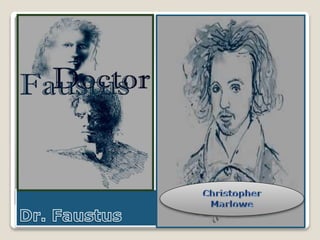
Dr.Faustus
Context:-
The Faust legend had its inception during the
medieval period in Europe and has since become
one of the world's most famous and oft-handled
myths. The story is thought to have its earliest
roots in the New Testament story of the magician
Simon Magus (Acts 8:9-24).
 During the early part of the fifteenth century in
Germany, the story of a man who sold his soul
to the devil to procure supernatural powers
captured the popular imagination and spread
rapidly. The original Faust has probably been
lost forever.
Dr.Faustus
 Around 1480, another German magician gave further credence
to the legend by calling himself "Faustus the Younger”.
 During the sixteenth century, additional stories of magical
feats began to attach themselves to the Faust lore, and
eventually these stories were collected and published as
a Faust-Book. A biography of Faust, the Historian von D.
Johann Fausten, based upon the shadowy life of Faust the
Younger, but including many of the fanciful legendary stories,
was published in Frankfurt, Germany, in 1587.
 Link:- cliffnotes.com
Dr.Faustus
 That same year it was translated into English as ’The
Historie of the damnable life and deserved death of
Doctor John Faustus’. In both these popular editions
of the Faust-Book.
 Marlowe took the story from this ‘Faust –Book’
while writing his second play ‘The Tragical History
of the life and death of Dr.Faustus’ in the eighties of
the 16th Century.(1588-89).
 Link:- cliffnotes.com
Dr.Faustus
 Not everybody knows Faust(us). But a lot do. Most readers
know this tragic personage who allied himself with the devil
and finally paid the price for his betrayal of God from a
famous play written by J.W. Goethe.
 Exactly 201 years before Goethe published his work, a play by
the Englishman Christopher Marlowe saw the light of the
world.
 A biography of Faust, the Historia von D. Johann
Fausten, based upon the shadowy life of Faust the Younger,
but including many of the fanciful legendary stories, was
published in Frankfurt, Germany, in 1587. That same year it
was translated into English as The Historie of the damnable
life and deserved death of Doctor John Faustus.
Source & Link: www.cliffnotes.com
http://www.youtube.com/watch?feature=player_e
mbedded&v=BkQnDb1G7vE
 Dr. Faustus is a Renaissance tragedy written by the
Cambridge scholar Christopher Marlowe.
 The full title of the play is “The Tragical History of the
Life and Death of Doctor Faustus”.
 It was adopted from a German story ‘Faust’ translated
in English as The English Faust Book.
 The name Faustus is a reference to the Latin word for
"favoured" or "auspicious“.
 The play is in blank Verse and prose in thirteen scenes
(1604) or twenty scenes (1616).
 Blank verse is largely reserved for the main scenes
while prose is used in the comic scenes.
 Dr.Faustus was written in between the years 1588 and 1599.
 Marlowe narrated the story of an over-ambitious scholar’s
desire to be a demy-god.
 Marlowe projected the Renaissance spirit in man.
 He replaced the traditional ‘jigging veins of rhyming
mother’s wits-----’ with the realities of ‘flesh and blood’ in
a masculine language.(Prose and Blank Verse.)
 His four great heroes –Tamburlaine, Faustus, Barabbas and
Edward-II are embodiment of Renaissance Passions in one
form or the other.
 Marlowe’s protagonists established that a man, in
‘Nietzschean’ fashion, could achieve any earthly power he
chose.
Dr.Faustus
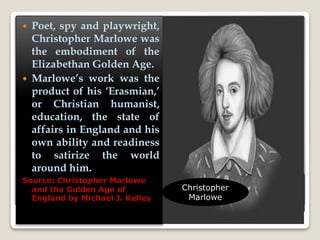
 Poet, spy and playwright,
Christopher Marlowe was
the embodiment of the
Elizabethan Golden Age.
 Marlowe’s work was the
product of his ‘Erasmian,’
or Christian humanist,
education, the state of
affairs in England and his
own ability and readiness
to satirize the world
around him.
Source: Christopher Marlowe
and the Golden Age of
England by Michael J. Kelley
Christopher
Marlowe
Dr.Faustus
-:Renaissance:-
Renaissance means Re-birth.
Renaissance originated in Italy in the 13th
century.Constantinople,the capital of
Byzantine empire fell to the Turks on ---
1353.This is taken as the official date of the
beginning of Renaissance.
But, it required more than 100 years to cross
the English Channel and make its presence
established in English soil.
Rickett says, “Renaissance had come with
Caxton”. Caxton invented the printing press
in 1476.
Dr.Faustus
Periods of Renaissance:-
The English Renaissance covers a long span of
time.It may be divided into the following three
periods:-
i) The Beginning of Renaissance (1516 – 1558).
ii) The Flowering of Renaissance (1558 – 1603).
It is actually called the Age of Elizabeth.
iii) The Decline of Renaissance (1603 – 1625).
It is also termed the Jacobean Age.
Dr.Faustus
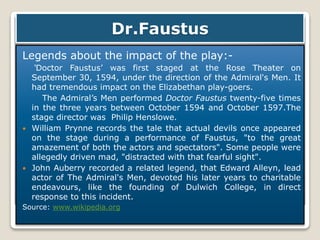
Legends about the impact of the play:-
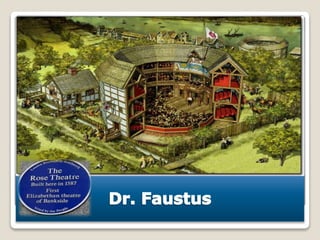
‘Doctor Faustus’ was first staged at the Rose Theater on
September 30, 1594, under the direction of the Admiral's Men. It
had tremendous impact on the Elizabethan play-goers.
The Admiral’s Men performed Doctor Faustus twenty-five times
in the three years between October 1594 and October 1597.The
stage director was Philip Henslowe.
 William Prynne records the tale that actual devils once appeared
on the stage during a performance of Faustus, "to the great
amazement of both the actors and spectators". Some people were
allegedly driven mad, "distracted with that fearful sight".
 John Auberry recorded a related legend, that Edward Alleyn, lead
actor of The Admiral's Men, devoted his later years to charitable
endeavours, like the founding of Dulwich College, in direct
response to this incident.
Source: www.wikipedia.org
Dr.Faustus
 William Prynne records the tale that actual
devils once appeared on the stage during a
performance of Faustus, "to the great
amazement of both the actors and spectators".
Some people were allegedly driven mad,
"distracted with that fearful sight".
 John Auberry recorded a related legend,
that Edward Alleyn, lead actor of The Admiral's
Men, devoted his later years to charitable
endeavours, like the founding of Dulwich
College, in direct response to this incident.
Dr.Faustus
Dr.Faustus
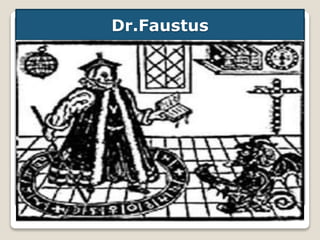
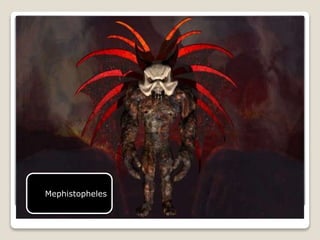
Mephistopheles
Dr.Faustus
 Marlowe's career as a poet and dramatist spanned a
mere 6 years.
 The son of a shoe maker from Canterbury, Marlowe
is the only dramatist before Shakespeare ,who is still
read; and of course read with enthusiasm. His was a
godless life and he enjoyed the reputation of ‘atheist
and epicure’; condemner and mocker of religion. The
Epilogue of Dr.Faustus might also be written on his
tombstone:
‘Cut is the branch that might have grown full straight
And burned is Apollo's laurel bough
That sometime grew within this learned man’.
Dr.Faustus
Famous Poems By Christopher Marlowe:-
 'The Passionate Shepherd to His Love' a poem
'Come live with me and be my love' a poem
'Who Ever Loved, That Loved Not at First Sight?' a poem
 Hero and Leander;(unfinished.)
Immortal Plays By Christopher Marlowe:-
Tamburlaine Part-1 and Part-2
Dr.Faustus
Edward II
The Jew of Malta
Dido, Queen of Carthage
Dr.Faustus
Questions & Answers:-
i.Can Dr. Faustus be called a Senecan Tragedy?
Ans. Senecan tragedies are also known as “ Revenge Tragedies” or “
Tragedies of Blood,” They are focused on bloody plots, which are
comprised of rhetorical speech, and the presence of ghosts.
Traditionally, a Senecan tragedy is written in blank verse with a
total of five acts.
Dr. Faustus fits the requirements of a Senecan tragedy; it is made up
of a total of five acts, written in blank verse, and is filled with
ghosts. Bad angels and Good angels appear frequently, magic is a
major theme.
However, Unlike Seneca there is no dead bodies littered in the stage
at the final scene. Nobody except Faustus dies here.
Source: www.gradesaver.com
Dr.Faustus
2.Is Dr.Faustus a tragic hero? What is his tragic flaw? Does his downfall evoke
terror?
 Ans. Certainly. Dr.Faustus is to be considered as a tragic hero because he
has all the features of a classical tragic protagonist formulated by Seneca and
Aristotle.
1. Faustus is a distinguished scholar; a high social class; a doctor who
mastered all knowledge under the Sun.
2. But, he possesses a hamartia; a tragic flaw. He wants to be as powerful as
God .
3. The Fatal –flaw or Hamartia makes him commit a fatal mistake. He barters
his soul to Mephistopheles for a powerful life of 24 years.
4. As a consequence he is alienated ; Though he realizes his mistake at last, it
was too late then.
5. Finally, he falls and his fall is a tragic one as he is destined to be damned
in hell for ever.
 His catastrophic fall evokes pity and terror. He attains the height of a tragic
hero in the line of Othello or Macbeth.
Source: Gradesaver
MCQ on Dr.Faustus
 1. In the Prologue, who introduces the story of Doctor Faustus?
(A) The Chorus
(B) Faustus
(C) Mephistopheles
(D) Wagner
2. To which Greek mythological character is Faustus compared in the Prologue?
(A) Hercules
(B) Perseus
(C) Icarus
(D) Theseus
3. What fields of learning does Faustus consider before he turns to magic?
(A) Chemistry, biology, and physics
(B) Logic, medicine, law, and theology
(C) Navigation, astronomy, rhetoric, and theology
(D) Grammar, history, science, and Latin
4. Which characters instruct Faustus in the dark arts?
(A) The scholars
(B) Wagner and Robin
(C) The good and bad angels
(D) Cornelius and Valdes
5. When he first summons Mephistopheles, how does Faustus ask him to appear?
(A) In the shape of a Franciscan friar
(B) In the shape of a beautiful woman
(C) As a winged creature with horns
(D) As a handsome young man
 6. What is the name of the ruler of hell in Doctor Faustus?
(A) Satan
(B) Mephistopheles
(C) Lucifer
(D) Belzebub
7. How long does Faustus demand that Mephistopheles
serve him?
(A) Thirty years
(B) Twenty-four years
(C) One hour
(D) A century
8. What does Faustus offer in return for this service?
(A) All his riches
(B) The life of his first-born child
(C) Nothing
(D) His soul
 9. How does Faustus sign his compact with Lucifer?
(A) In his own blood
(B) In the blood of a virgin
(C) In ink produced in hell
(D) He doesn’t
10. What is the meaning of the words that appear on Faustus’s arm in Latin?
(A) “Satan’s own”
(B) “Prince of Darkness”
(C) “Fly, man”
(D) “You are doomed”
11. Who agrees, under duress, to become Wagner’s servant?
(A) Faustus
(B) The clown
(C) Beelzebub
(D) Helen of Troy
12. What does Mephistopheles refuse to tell Faustus?
(A) If Faustus will be damned
(B) How many planets there are
(C) Where hell is located
(D) Who made the world
 13. Why does Mephistopheles refuse to answer this question?
(A) He says that the answer is “against our kingdom”
(B) He does not know the answer
(C) He thinks that the answer is too terrifying for Faustus to hear
(D) He thinks that God will strike him down if he answers the
question
14. Which city does Faustus visit extensively in scene 7?
(A) Amsterdam
(B) Berlin
(C) Rome
(D) Jerusalem
15. What trick does Faustus, while invisible, play on the pope?
(A) He makes a Bible burn in the pope’s hands
(B) He exposes the pope’s baldness
(C) He fools the pope into believing a statue is talking to him
(D) He steals dishes of food and disrupts the pope’s banquet
 16. Which historical figure does Faustus conjure up for the emperor to see?
(A) Helen of Troy
(B) Jesus Christ
(C) Joan of Arc
(D) Alexander the Great
17. Which character is publicly skeptical of Faustus’s powers?
(A) Charles V
(B) The knight (also known as Benvolio)
(C) The horse-courser
(D) The hostler
18. How does Faustus humiliate this skeptic?
(A) He turns his skin green
(B) He makes him unable to speak
(C) He makes antlers sprout from the skeptic’s head
(D) He hypnotizes him and makes him strip naked
19- Who tries to persuade Faustus to repent just before he reseals his pact with Lucifer?
(A) An old man
(B) Wagner
(C) Mephastophilis
(D) The knight
20. What happens to the horse that Faustus sells to the horse-courser?
(A) It turns into a dragon
(B) It dies immediately
(C) It lives a long and healthy life
(D) It turns into a heap of straw when it goes in the water
 21. What does the horse-courser think he is removing from Faustus’s body after Faustus
wakes?
(A) His shirt
(B) His leg
(C) His cloak
(D) His hand
22. What does Faustus fetch for the Duchess of Vanholt?
(A) A male slave
(B) A griffin
(C) A dish of grapes
(D) A horse
23. Where, according to Mephistopheles, is hell?
(A) Everywhere that heaven is not
(B) Deep below the earth’s surface
(C) Inside Faustus’s soul
(D) Directly beneath heaven
24. What famous beauty does Mephistopheles present to Faustus in scene 12?
(A) Joan of Arc
(B) Eleanor of Aquitaine
(C) Catherine the Great
(D) Helen of Troy
 25. What happens to Faustus at the end of the play?
(A) He repents and is saved
(B) He kills himself
(C) He becomes emperor of Germany
(D) He is carried off to hell
Answers to MCQ(s)
1-(A) The Chorus
2- (C) Icarus
3-(B) Logic, medicine, law, and theology
4-(D) Cornelius and Valdes
5-(A) In the shape of a Franciscan friar
6-(B) Mephistopheles
7-(B) Twenty-four years
8-(D) His soul
9-(A) In his own blood
10-(C) “Fly, man”
11-(B) The clown
12-(D) Who made the world
13-(A) He says that the answer is “against our kingdom”
14-(C) Rome
15-(D) He steals dishes of food and disrupts the pope’s banquet
16-(D) Alexander the Great
17-(B) The knight (also known as Benvolio)
18-(C) He makes antlers sprout from the skeptic’s head
19-(A) An old man
20-(D) It turns into a heap of straw when it goes in the water
21-(B) His leg
22-(C) A dish of grapes
23-(A) Everywhere that heaven is not
24-(D) Helen of Troy
25-(D) He is carried off to hell
Answer the following Questions:-
 1. Marlowe lived during_________
2. The Tragical History of Doctor Faustus was written
in________
3. Marlowe's most notable contemporary
was____________
4. The reigning English monarch during Marlowe's
whole life was________
5. During his time at Corpus Christi College in
Cambridge, Marlowe apparently once planned
to____________
6. Historical evidence suggests that Marlowe worked
for the government as a______
7. Marlowe originally went to London to work as
an_____________
8. Marlowe's first play was___________
9. Marlowe died___________
10. After his death, accusations surfaced, alleging
that Marlowe was________
11. Marlowe was rumored to be________
12. Doctor Faustus is a scholar from________
 13. Faustus has a servant named_________
14. Faustus is a scholar at____________
15. According to Catholic and Protestant Christian lore,
Satan______________
16. At the beginning of the play, we learn that Faustus has
impressive credentials as a_________
17. At the beginning of the play, Faustus
expresses_________
18. From his first speech, the audience can see clearly that
Faustus suffers from the sin of____________
19. In 1.1, we see that Faustus decides to turn
to_________
20. As implied in his speech about medicine in 1.1, Faustus
seems to gain no satisfaction from__________
21. The name Marlowe uses for the ruler of hell and the
devils is_________
22. The devil Faustus summons is___________
23. In "negotiations," Faustus asks the devil
for__________
24. Faustus, in exchange for his demands, must give
up___________
25. Faustus is advised by________
Answers:-
1- The sixteenth and seventeenth centuries
2- The 1580-90s
3- William Shakespeare
4- Elizabeth I
5- Take holy orders
6- Spy
7- Playwright
8- Tamburlaine, Part I
9- Both under suspicious circumstances and violently
10- An atheist
11- All of the above
12- Germany
13- Wagner
14- Wittenberg
15- Was originally one of the angels, before he defied God
16- Scholar
17- Frustration that he has mastered much conventional knowledge without
gaining satisfaction
18- Pride
19- Magic
20- Learning from books
21- Lucifer
22- Mephistopheles
23-24 years more of life, and power
24- His soul
25- A Good Angel and Evil Angel
**
Sources; Links & References are furnished for further study.

Dr.Faustus

  • 1.
    A PPt. byIndranil Sarkar Sapatgram College,Sapatgram;Assam Mobile-09859945270 Sapatgram Assam India 09859945270 Indranil Sarkar
  • 3.
    Dr.Faustus Context:- The Faust legendhad its inception during the medieval period in Europe and has since become one of the world's most famous and oft-handled myths. The story is thought to have its earliest roots in the New Testament story of the magician Simon Magus (Acts 8:9-24).  During the early part of the fifteenth century in Germany, the story of a man who sold his soul to the devil to procure supernatural powers captured the popular imagination and spread rapidly. The original Faust has probably been lost forever.
  • 4.
    Dr.Faustus  Around 1480,another German magician gave further credence to the legend by calling himself "Faustus the Younger”.  During the sixteenth century, additional stories of magical feats began to attach themselves to the Faust lore, and eventually these stories were collected and published as a Faust-Book. A biography of Faust, the Historian von D. Johann Fausten, based upon the shadowy life of Faust the Younger, but including many of the fanciful legendary stories, was published in Frankfurt, Germany, in 1587.  Link:- cliffnotes.com
  • 5.
    Dr.Faustus  That sameyear it was translated into English as ’The Historie of the damnable life and deserved death of Doctor John Faustus’. In both these popular editions of the Faust-Book.  Marlowe took the story from this ‘Faust –Book’ while writing his second play ‘The Tragical History of the life and death of Dr.Faustus’ in the eighties of the 16th Century.(1588-89).  Link:- cliffnotes.com
  • 6.
    Dr.Faustus  Not everybodyknows Faust(us). But a lot do. Most readers know this tragic personage who allied himself with the devil and finally paid the price for his betrayal of God from a famous play written by J.W. Goethe.  Exactly 201 years before Goethe published his work, a play by the Englishman Christopher Marlowe saw the light of the world.  A biography of Faust, the Historia von D. Johann Fausten, based upon the shadowy life of Faust the Younger, but including many of the fanciful legendary stories, was published in Frankfurt, Germany, in 1587. That same year it was translated into English as The Historie of the damnable life and deserved death of Doctor John Faustus. Source & Link: www.cliffnotes.com
  • 7.
  • 8.
     Dr. Faustusis a Renaissance tragedy written by the Cambridge scholar Christopher Marlowe.  The full title of the play is “The Tragical History of the Life and Death of Doctor Faustus”.  It was adopted from a German story ‘Faust’ translated in English as The English Faust Book.  The name Faustus is a reference to the Latin word for "favoured" or "auspicious“.  The play is in blank Verse and prose in thirteen scenes (1604) or twenty scenes (1616).  Blank verse is largely reserved for the main scenes while prose is used in the comic scenes.
  • 9.
     Dr.Faustus waswritten in between the years 1588 and 1599.  Marlowe narrated the story of an over-ambitious scholar’s desire to be a demy-god.  Marlowe projected the Renaissance spirit in man.  He replaced the traditional ‘jigging veins of rhyming mother’s wits-----’ with the realities of ‘flesh and blood’ in a masculine language.(Prose and Blank Verse.)  His four great heroes –Tamburlaine, Faustus, Barabbas and Edward-II are embodiment of Renaissance Passions in one form or the other.  Marlowe’s protagonists established that a man, in ‘Nietzschean’ fashion, could achieve any earthly power he chose.
  • 10.
    Dr.Faustus  Poet, spyand playwright, Christopher Marlowe was the embodiment of the Elizabethan Golden Age.  Marlowe’s work was the product of his ‘Erasmian,’ or Christian humanist, education, the state of affairs in England and his own ability and readiness to satirize the world around him. Source: Christopher Marlowe and the Golden Age of England by Michael J. Kelley Christopher Marlowe
  • 11.
    Dr.Faustus -:Renaissance:- Renaissance means Re-birth. Renaissanceoriginated in Italy in the 13th century.Constantinople,the capital of Byzantine empire fell to the Turks on --- 1353.This is taken as the official date of the beginning of Renaissance. But, it required more than 100 years to cross the English Channel and make its presence established in English soil. Rickett says, “Renaissance had come with Caxton”. Caxton invented the printing press in 1476.
  • 12.
    Dr.Faustus Periods of Renaissance:- TheEnglish Renaissance covers a long span of time.It may be divided into the following three periods:- i) The Beginning of Renaissance (1516 – 1558). ii) The Flowering of Renaissance (1558 – 1603). It is actually called the Age of Elizabeth. iii) The Decline of Renaissance (1603 – 1625). It is also termed the Jacobean Age.
  • 14.
    Dr.Faustus Legends about theimpact of the play:- ‘Doctor Faustus’ was first staged at the Rose Theater on September 30, 1594, under the direction of the Admiral's Men. It had tremendous impact on the Elizabethan play-goers. The Admiral’s Men performed Doctor Faustus twenty-five times in the three years between October 1594 and October 1597.The stage director was Philip Henslowe.  William Prynne records the tale that actual devils once appeared on the stage during a performance of Faustus, "to the great amazement of both the actors and spectators". Some people were allegedly driven mad, "distracted with that fearful sight".  John Auberry recorded a related legend, that Edward Alleyn, lead actor of The Admiral's Men, devoted his later years to charitable endeavours, like the founding of Dulwich College, in direct response to this incident. Source: www.wikipedia.org
  • 15.
    Dr.Faustus  William Prynnerecords the tale that actual devils once appeared on the stage during a performance of Faustus, "to the great amazement of both the actors and spectators". Some people were allegedly driven mad, "distracted with that fearful sight".  John Auberry recorded a related legend, that Edward Alleyn, lead actor of The Admiral's Men, devoted his later years to charitable endeavours, like the founding of Dulwich College, in direct response to this incident.
  • 17.
  • 18.
  • 20.
  • 21.
    Dr.Faustus  Marlowe's careeras a poet and dramatist spanned a mere 6 years.  The son of a shoe maker from Canterbury, Marlowe is the only dramatist before Shakespeare ,who is still read; and of course read with enthusiasm. His was a godless life and he enjoyed the reputation of ‘atheist and epicure’; condemner and mocker of religion. The Epilogue of Dr.Faustus might also be written on his tombstone: ‘Cut is the branch that might have grown full straight And burned is Apollo's laurel bough That sometime grew within this learned man’.
  • 22.
    Dr.Faustus Famous Poems ByChristopher Marlowe:-  'The Passionate Shepherd to His Love' a poem 'Come live with me and be my love' a poem 'Who Ever Loved, That Loved Not at First Sight?' a poem  Hero and Leander;(unfinished.) Immortal Plays By Christopher Marlowe:- Tamburlaine Part-1 and Part-2 Dr.Faustus Edward II The Jew of Malta Dido, Queen of Carthage
  • 23.
    Dr.Faustus Questions & Answers:- i.CanDr. Faustus be called a Senecan Tragedy? Ans. Senecan tragedies are also known as “ Revenge Tragedies” or “ Tragedies of Blood,” They are focused on bloody plots, which are comprised of rhetorical speech, and the presence of ghosts. Traditionally, a Senecan tragedy is written in blank verse with a total of five acts. Dr. Faustus fits the requirements of a Senecan tragedy; it is made up of a total of five acts, written in blank verse, and is filled with ghosts. Bad angels and Good angels appear frequently, magic is a major theme. However, Unlike Seneca there is no dead bodies littered in the stage at the final scene. Nobody except Faustus dies here. Source: www.gradesaver.com
  • 24.
    Dr.Faustus 2.Is Dr.Faustus atragic hero? What is his tragic flaw? Does his downfall evoke terror?  Ans. Certainly. Dr.Faustus is to be considered as a tragic hero because he has all the features of a classical tragic protagonist formulated by Seneca and Aristotle. 1. Faustus is a distinguished scholar; a high social class; a doctor who mastered all knowledge under the Sun. 2. But, he possesses a hamartia; a tragic flaw. He wants to be as powerful as God . 3. The Fatal –flaw or Hamartia makes him commit a fatal mistake. He barters his soul to Mephistopheles for a powerful life of 24 years. 4. As a consequence he is alienated ; Though he realizes his mistake at last, it was too late then. 5. Finally, he falls and his fall is a tragic one as he is destined to be damned in hell for ever.  His catastrophic fall evokes pity and terror. He attains the height of a tragic hero in the line of Othello or Macbeth. Source: Gradesaver
  • 25.
    MCQ on Dr.Faustus 1. In the Prologue, who introduces the story of Doctor Faustus? (A) The Chorus (B) Faustus (C) Mephistopheles (D) Wagner 2. To which Greek mythological character is Faustus compared in the Prologue? (A) Hercules (B) Perseus (C) Icarus (D) Theseus 3. What fields of learning does Faustus consider before he turns to magic? (A) Chemistry, biology, and physics (B) Logic, medicine, law, and theology (C) Navigation, astronomy, rhetoric, and theology (D) Grammar, history, science, and Latin 4. Which characters instruct Faustus in the dark arts? (A) The scholars (B) Wagner and Robin (C) The good and bad angels (D) Cornelius and Valdes 5. When he first summons Mephistopheles, how does Faustus ask him to appear? (A) In the shape of a Franciscan friar (B) In the shape of a beautiful woman (C) As a winged creature with horns (D) As a handsome young man
  • 26.
     6. Whatis the name of the ruler of hell in Doctor Faustus? (A) Satan (B) Mephistopheles (C) Lucifer (D) Belzebub 7. How long does Faustus demand that Mephistopheles serve him? (A) Thirty years (B) Twenty-four years (C) One hour (D) A century 8. What does Faustus offer in return for this service? (A) All his riches (B) The life of his first-born child (C) Nothing (D) His soul
  • 27.
     9. Howdoes Faustus sign his compact with Lucifer? (A) In his own blood (B) In the blood of a virgin (C) In ink produced in hell (D) He doesn’t 10. What is the meaning of the words that appear on Faustus’s arm in Latin? (A) “Satan’s own” (B) “Prince of Darkness” (C) “Fly, man” (D) “You are doomed” 11. Who agrees, under duress, to become Wagner’s servant? (A) Faustus (B) The clown (C) Beelzebub (D) Helen of Troy 12. What does Mephistopheles refuse to tell Faustus? (A) If Faustus will be damned (B) How many planets there are (C) Where hell is located (D) Who made the world
  • 28.
     13. Whydoes Mephistopheles refuse to answer this question? (A) He says that the answer is “against our kingdom” (B) He does not know the answer (B) He does not know the answer (C) He thinks that the answer is too terrifying for Faustus to hear (D) He thinks that God will strike him down if he answers the question 14. Which city does Faustus visit extensively in scene 7? (A) Amsterdam (B) Berlin (C) Rome (D) Jerusalem 15. What trick does Faustus, while invisible, play on the pope? (A) He makes a Bible burn in the pope’s hands (B) He exposes the pope’s baldness (C) He fools the pope into believing a statue is talking to him (D) He steals dishes of food and disrupts the pope’s banquet
  • 29.
     16. Whichhistorical figure does Faustus conjure up for the emperor to see? (A) Helen of Troy (B) Jesus Christ (C) Joan of Arc (D) Alexander the Great 17. Which character is publicly skeptical of Faustus’s powers? (A) Charles V (B) The knight (also known as Benvolio) (C) The horse-courser (D) The hostler 18. How does Faustus humiliate this skeptic? (A) He turns his skin green (B) He makes him unable to speak (C) He makes antlers sprout from the skeptic’s head (D) He hypnotizes him and makes him strip naked 19- Who tries to persuade Faustus to repent just before he reseals his pact with Lucifer? (A) An old man (B) Wagner (C) Mephastophilis (D) The knight 20. What happens to the horse that Faustus sells to the horse-courser? (A) It turns into a dragon (B) It dies immediately (C) It lives a long and healthy life (D) It turns into a heap of straw when it goes in the water
  • 30.
     21. Whatdoes the horse-courser think he is removing from Faustus’s body after Faustus wakes? (A) His shirt (B) His leg (C) His cloak (D) His hand 22. What does Faustus fetch for the Duchess of Vanholt? (A) A male slave (B) A griffin (C) A dish of grapes (D) A horse 23. Where, according to Mephistopheles, is hell? (A) Everywhere that heaven is not (B) Deep below the earth’s surface (C) Inside Faustus’s soul (D) Directly beneath heaven 24. What famous beauty does Mephistopheles present to Faustus in scene 12? (A) Joan of Arc (B) Eleanor of Aquitaine (C) Catherine the Great (D) Helen of Troy  25. What happens to Faustus at the end of the play? (A) He repents and is saved (B) He kills himself (C) He becomes emperor of Germany (D) He is carried off to hell
  • 31.
    Answers to MCQ(s) 1-(A)The Chorus 2- (C) Icarus 3-(B) Logic, medicine, law, and theology 4-(D) Cornelius and Valdes 5-(A) In the shape of a Franciscan friar 6-(B) Mephistopheles 7-(B) Twenty-four years 8-(D) His soul 9-(A) In his own blood 10-(C) “Fly, man” 11-(B) The clown 12-(D) Who made the world 13-(A) He says that the answer is “against our kingdom” 14-(C) Rome 15-(D) He steals dishes of food and disrupts the pope’s banquet 16-(D) Alexander the Great 17-(B) The knight (also known as Benvolio) 18-(C) He makes antlers sprout from the skeptic’s head 19-(A) An old man 20-(D) It turns into a heap of straw when it goes in the water 21-(B) His leg 22-(C) A dish of grapes 23-(A) Everywhere that heaven is not 24-(D) Helen of Troy 25-(D) He is carried off to hell
  • 32.
    Answer the followingQuestions:-  1. Marlowe lived during_________ 2. The Tragical History of Doctor Faustus was written in________ 3. Marlowe's most notable contemporary was____________ 4. The reigning English monarch during Marlowe's whole life was________ 5. During his time at Corpus Christi College in Cambridge, Marlowe apparently once planned to____________ 6. Historical evidence suggests that Marlowe worked for the government as a______ 7. Marlowe originally went to London to work as an_____________ 8. Marlowe's first play was___________ 9. Marlowe died___________ 10. After his death, accusations surfaced, alleging that Marlowe was________ 11. Marlowe was rumored to be________ 12. Doctor Faustus is a scholar from________
  • 33.
     13. Faustushas a servant named_________ 14. Faustus is a scholar at____________ 15. According to Catholic and Protestant Christian lore, Satan______________ 16. At the beginning of the play, we learn that Faustus has impressive credentials as a_________ 17. At the beginning of the play, Faustus expresses_________ 18. From his first speech, the audience can see clearly that Faustus suffers from the sin of____________ 19. In 1.1, we see that Faustus decides to turn to_________ 20. As implied in his speech about medicine in 1.1, Faustus seems to gain no satisfaction from__________ 21. The name Marlowe uses for the ruler of hell and the devils is_________ 22. The devil Faustus summons is___________ 23. In "negotiations," Faustus asks the devil for__________ 24. Faustus, in exchange for his demands, must give up___________ 25. Faustus is advised by________
  • 34.
    Answers:- 1- The sixteenthand seventeenth centuries 2- The 1580-90s 3- William Shakespeare 4- Elizabeth I 5- Take holy orders 6- Spy 7- Playwright 8- Tamburlaine, Part I 9- Both under suspicious circumstances and violently 10- An atheist 11- All of the above 12- Germany 13- Wagner 14- Wittenberg 15- Was originally one of the angels, before he defied God 16- Scholar 17- Frustration that he has mastered much conventional knowledge without gaining satisfaction 18- Pride 19- Magic 20- Learning from books 21- Lucifer 22- Mephistopheles 23-24 years more of life, and power 24- His soul 25- A Good Angel and Evil Angel **
  • 35.
    Sources; Links &References are furnished for further study.