Mrs. M. Annalakshmi
Asst. Professor of English
Essay on Dramatic Poesy
– John Dryden
John Dryden
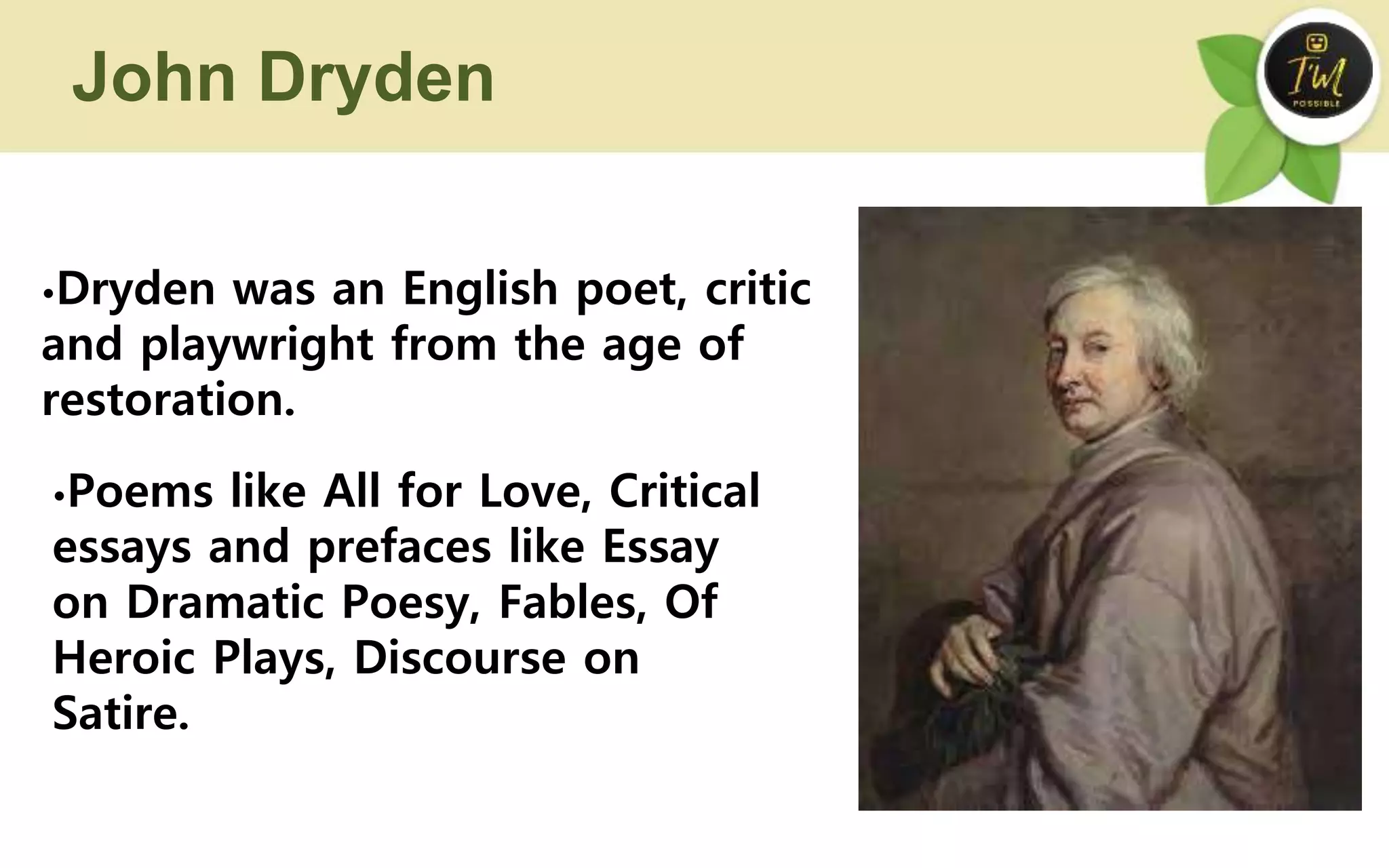
•Dryden was an English poet, critic
and playwright from the age of
restoration.
•Poems like All for Love, Critical
essays and prefaces like Essay
on Dramatic Poesy, Fables, Of
Heroic Plays, Discourse on
Satire.
Essay of Dramatic Poesy (1668)
• In this essay Dryden has put forward his
criticism on dramatic poetry.
• The essay begins with the scene that Four
friends, Crites, Neander, Eugenius and Lesidius
are sailing to see a navy battle between British
and Dutch armies.
• These four characters of the essay are thought to have been
related with four critics including Dryden himself.
• In between, they talk about the poetry which
is going to produce after the naval battle.
Definition of Play
• “A play ought to be a just and lively
image of human nature, representing its
passions and humors, and the changes of
fortune to which it is subject, for the
delight and instruction of mankind.”
• In this definition Dryden explains, that
drama should be presented as it is, without
artificial elements.
Debate among four friends
• Eugenius (Charles Sackville)
• Crites (Sir Robert Howard)
• Lisideius (Sir Charles Sedley)
• Neander (thought to represent Dryden)
Five issues are under discussion in this essay
1)Ancients vs. Moderns
2) Unities
3) French vs. English Drama
4) Separation of Tragedy and Comedy vs.
Tragicomedy
5) Appropriateness of Rhyme in Drama
Ancient vs Modern
1.Eugenius favours the moderns
2.Crites favours the ancients, blank verse
French vs English
3.Lisideius favours French drama
4.Neander favours the modern-English
plays
Eugenius
• Favors the moderns over the
ancients, arguing that the moderns
exceed the ancients because of having
learned and profited from their
Example.
Crites
Argues in favor of the ancients: they
established the unities; dramatic rules were
spelled out by Aristotle which the current-
-and esteemed--French playwrights follow;
and Ben Jonson--the greatest English
playwright, according to Crites--followed
the
ancients' example by adhering to the
unities.
Lisideius
• Argues that French drama is superior to English
drama, basing this opinion of the French writer's
close adherence to the classical separation of
comedy and tragedy. For Lisideius "no theater in
the world has anything so absurd as the English
tragicomedy . . . in two hours and a half, we run
through all the fits of Bedlam."
Neander
• Favors the modern-English plays, but does not
disparage the ancients. He also favors English
drama--and has some critical things to say of
French drama: "those beauties of the French
poesy are such as will raise perfection higher
where it is, but are not sufficient to give it
where it is not: they are indeed the beauties of a
statue, but not of a man."
Difference
FRENCH ENGLISH
• Smallness • longer
• Pursuit of one plot
• Subplots
• Little action
• More action
• Narrowness of
imagination
• Broadness of
imagination
Rhyme vs. Blank Verse
• Crites Says that rhymes seems unnatural in
the play, it unfits to carry just and lively
image of play.
• Neander argues further that it is all about
how we select the words, natural words
adds more vitality to play –premeditation
towards selecting words.
Dryden's Essay On Dramatic Poesy

Dryden's Essay On Dramatic Poesy

  • 1.
    Mrs. M. Annalakshmi Asst.Professor of English Essay on Dramatic Poesy – John Dryden
  • 2.
    John Dryden •Dryden wasan English poet, critic and playwright from the age of restoration. •Poems like All for Love, Critical essays and prefaces like Essay on Dramatic Poesy, Fables, Of Heroic Plays, Discourse on Satire.
  • 3.
    Essay of DramaticPoesy (1668) • In this essay Dryden has put forward his criticism on dramatic poetry. • The essay begins with the scene that Four friends, Crites, Neander, Eugenius and Lesidius are sailing to see a navy battle between British and Dutch armies. • These four characters of the essay are thought to have been related with four critics including Dryden himself. • In between, they talk about the poetry which is going to produce after the naval battle.
  • 4.
    Definition of Play •“A play ought to be a just and lively image of human nature, representing its passions and humors, and the changes of fortune to which it is subject, for the delight and instruction of mankind.” • In this definition Dryden explains, that drama should be presented as it is, without artificial elements.
  • 5.
    Debate among fourfriends • Eugenius (Charles Sackville) • Crites (Sir Robert Howard) • Lisideius (Sir Charles Sedley) • Neander (thought to represent Dryden)
  • 6.
    Five issues areunder discussion in this essay 1)Ancients vs. Moderns 2) Unities 3) French vs. English Drama 4) Separation of Tragedy and Comedy vs. Tragicomedy 5) Appropriateness of Rhyme in Drama
  • 7.
    Ancient vs Modern 1.Eugeniusfavours the moderns 2.Crites favours the ancients, blank verse French vs English 3.Lisideius favours French drama 4.Neander favours the modern-English plays
  • 8.
    Eugenius • Favors themoderns over the ancients, arguing that the moderns exceed the ancients because of having learned and profited from their Example.
  • 9.
    Crites Argues in favorof the ancients: they established the unities; dramatic rules were spelled out by Aristotle which the current- -and esteemed--French playwrights follow; and Ben Jonson--the greatest English playwright, according to Crites--followed the ancients' example by adhering to the unities.
  • 10.
    Lisideius • Argues thatFrench drama is superior to English drama, basing this opinion of the French writer's close adherence to the classical separation of comedy and tragedy. For Lisideius "no theater in the world has anything so absurd as the English tragicomedy . . . in two hours and a half, we run through all the fits of Bedlam."
  • 11.
    Neander • Favors themodern-English plays, but does not disparage the ancients. He also favors English drama--and has some critical things to say of French drama: "those beauties of the French poesy are such as will raise perfection higher where it is, but are not sufficient to give it where it is not: they are indeed the beauties of a statue, but not of a man."
  • 12.
    Difference FRENCH ENGLISH • Smallness• longer • Pursuit of one plot • Subplots • Little action • More action • Narrowness of imagination • Broadness of imagination
  • 13.
    Rhyme vs. BlankVerse • Crites Says that rhymes seems unnatural in the play, it unfits to carry just and lively image of play. • Neander argues further that it is all about how we select the words, natural words adds more vitality to play –premeditation towards selecting words.