Smt. S. B. Gardi Department of 
English 
M. K. Bhavnagar University 
Name: Gohil Devikaba J 
Roll no.: 06 
Topic’s Name: John Dryden as “A Critic” 
Batch: 2014-16 
Paper name: Literary Theory and Criticism 
Contact Me: devikagohil13@gmail.com
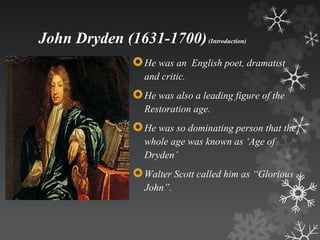
John Dryden (1631-1700)(Introduction) 
He was an English poet, dramatist 
and critic. 
He was also a leading figure of the 
Restoration age. 
He was so dominating person that the 
whole age was known as ‘Age of 
Dryden’ 
Walter Scott called him as “Glorious 
John”.
Many writers were known for their works 
like William Shakespeare, John Milton and 
Ben Johnson. 
Most of them were specialized in drama . 
Comparison between Ancient and Moderns, 
Greek and Roman authors starts. 
These was the chief discussion of that time.
In 1668 Dryden wrote ‘An Essay of Dramatic 
Poesy’ 
Original title of the book is ‘Of Dramatick 
Poesie, an Essay’ 
For which he is known as ‘The Father of English 
Literary Criticism’ 
In his book we can see both the side of John 
Dryden. Dryden as a poet and Dryden as a 
playwright. 
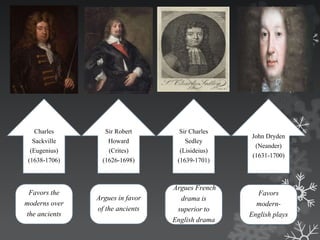
He write this essay as a dramatic dialogue with 
the four characters representing four critical 
positions.
In this book he discusses this five issues 
I. Ancients vs. English Drama 
II. Unities 
III. French vs. English drama 
IV. Separation of Tragedy and Comedy vs. 
Tragicomedy 
V. Appropriateness of rhyme in drama
Charles 
Sackville 
(Eugenius) 
(1638-1706) 
Favors the 
moderns over 
the ancients 
Sir Robert 
Howard 
(Crites) 
(1626-1698) 
Argues in favor 
of the ancients 
Sir Charles 
Sedley 
(Lisideius) 
(1639-1701) 
Argues French 
drama is 
superior to 
English drama 
John Dryden 
(Neander) 
(1631-1700) 
Favors 
modern- 
English plays
In this book he favors the modern-English plays, 
but does not disparage the ancients. 
He also favors English drama and has some 
critical things to say of French drama: 
“Those beauties of the French poesy 
are such as will raise perfection higher where 
it is, but are not sufficient to give it where it is 
not: they are indeed the beauties of a statue, 
but not of a man.”
He said that French plays have only one plot 
without sub-plot 
He criticized French drama essentially for its 
smallness. 
To prove his argument he compare Shakespeare 
with Ben Jonson and said that 
“Shakespeare had the largest and most 
comprehensive soul, while Jonson was the 
most largest and most judicious writer which 
any theater ever had.”
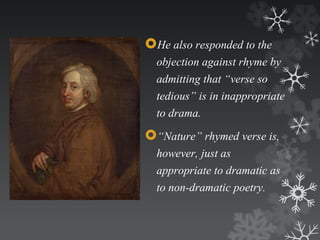
He also responded to the 
objection against rhyme by 
admitting that “verse so 
tedious” is in inappropriate 
to drama. 
“Nature” rhymed verse is, 
however, just as 
appropriate to dramatic as 
to non-dramatic poetry.
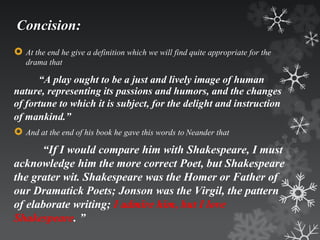
Concision: 
 At the end he give a definition which we will find quite appropriate for the 
drama that 
“A play ought to be a just and lively image of human 
nature, representing its passions and humors, and the changes 
of fortune to which it is subject, for the delight and instruction 
of mankind.” 
 And at the end of his book he gave this words to Neander that 
“If I would compare him with Shakespeare, I must 
acknowledge him the more correct Poet, but Shakespeare 
the grater wit. Shakespeare was the Homer or Father of 
our Dramatick Poets; Jonson was the Virgil, the pattern 
of elaborate writing; I admire him, but I love 
Shakespeare. ”
Thank You

John Dryden as a critic

  • 1.
    Smt. S. B.Gardi Department of English M. K. Bhavnagar University Name: Gohil Devikaba J Roll no.: 06 Topic’s Name: John Dryden as “A Critic” Batch: 2014-16 Paper name: Literary Theory and Criticism Contact Me: devikagohil13@gmail.com
  • 2.
    John Dryden (1631-1700)(Introduction) He was an English poet, dramatist and critic. He was also a leading figure of the Restoration age. He was so dominating person that the whole age was known as ‘Age of Dryden’ Walter Scott called him as “Glorious John”.
  • 3.
    Many writers wereknown for their works like William Shakespeare, John Milton and Ben Johnson. Most of them were specialized in drama . Comparison between Ancient and Moderns, Greek and Roman authors starts. These was the chief discussion of that time.
  • 4.
    In 1668 Drydenwrote ‘An Essay of Dramatic Poesy’ Original title of the book is ‘Of Dramatick Poesie, an Essay’ For which he is known as ‘The Father of English Literary Criticism’ In his book we can see both the side of John Dryden. Dryden as a poet and Dryden as a playwright. He write this essay as a dramatic dialogue with the four characters representing four critical positions.
  • 5.
    In this bookhe discusses this five issues I. Ancients vs. English Drama II. Unities III. French vs. English drama IV. Separation of Tragedy and Comedy vs. Tragicomedy V. Appropriateness of rhyme in drama
  • 6.
    Charles Sackville (Eugenius) (1638-1706) Favors the moderns over the ancients Sir Robert Howard (Crites) (1626-1698) Argues in favor of the ancients Sir Charles Sedley (Lisideius) (1639-1701) Argues French drama is superior to English drama John Dryden (Neander) (1631-1700) Favors modern- English plays
  • 7.
    In this bookhe favors the modern-English plays, but does not disparage the ancients. He also favors English drama and has some critical things to say of French drama: “Those beauties of the French poesy are such as will raise perfection higher where it is, but are not sufficient to give it where it is not: they are indeed the beauties of a statue, but not of a man.”
  • 8.
    He said thatFrench plays have only one plot without sub-plot He criticized French drama essentially for its smallness. To prove his argument he compare Shakespeare with Ben Jonson and said that “Shakespeare had the largest and most comprehensive soul, while Jonson was the most largest and most judicious writer which any theater ever had.”
  • 9.
    He also respondedto the objection against rhyme by admitting that “verse so tedious” is in inappropriate to drama. “Nature” rhymed verse is, however, just as appropriate to dramatic as to non-dramatic poetry.
  • 10.
    Concision:  Atthe end he give a definition which we will find quite appropriate for the drama that “A play ought to be a just and lively image of human nature, representing its passions and humors, and the changes of fortune to which it is subject, for the delight and instruction of mankind.”  And at the end of his book he gave this words to Neander that “If I would compare him with Shakespeare, I must acknowledge him the more correct Poet, but Shakespeare the grater wit. Shakespeare was the Homer or Father of our Dramatick Poets; Jonson was the Virgil, the pattern of elaborate writing; I admire him, but I love Shakespeare. ”
  • 11.