Presented by : Rukhma Shahzadi bsf1700259
Tayyaba Idrees bsf1700374
Amina Riaz bsf1700291
Amna Khalid bsf1704904
Zara Ahmed bsf1700284
Tayyeba Sheikh bsf1700439
 Biographia Literaria includes some of the most important
English writing on poetic theory
 It is a response to ideas of poetry advanced by his close
friend William Wordsworth
 Coleridge is concerned with either expanding on or in fact
refuting the principles his friend Wordsworth has written in
the preface to Lyrical Ballads.
 Wordsworth wished poetry to take a new direction by using
the language of people "A selection of real language of man"
who lived in the countryside.
 For he says, that this is a language that is genuine and more
expressive of emotions than the diction used by the poet of
previous age.
 He stated that the poetic word choice should be as
the way people spoke and reject the specialized
terms.
 Coleridge takes issue with and objects that there is a
doubtful meaning in the use of words "real" as
language varies:
Individual to individual
country to country
 In Chapter 18, Coleridge is going to state that poetry
doesn't and cannot be same as prose ( as Wordsworth
stated) just as prose is not same as conversational
speech.
 Also discussion on Meter
 Its effects
 Origin and
 Power of poetic imagination
 Coleridge continuing to reject the theory of Wordsworth
(to write poetry in the language of rustic) and disagrees
that the selection of rustic of ceases to be the rustic's own
language.
 Word selection of any class can not be such used.
 A poet who selects from rustic man should also know
the arrangement of words, poet(he) should also know
about his life.
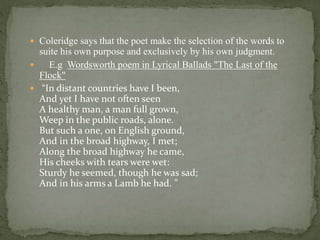
 Coleridge says that the poet make the selection of the words to
suite his own purpose and exclusively by his own judgment.
 E.g Wordsworth poem in Lyrical Ballads "The Last of the
Flock"
 “In distant countries have I been,
And yet I have not often seen
A healthy man, a man full grown,
Weep in the public roads, alone.
But such a one, on English ground,
And in the broad highway, I met;
Along the broad highway he came,
His cheeks with tears were wet:
Sturdy he seemed, though he was sad;
And in his arms a Lamb he had. ”
 Coleridge observes that ,
 ” The words that are used in this poem are
commonly used by rustic but the arrangement/the
order in which the words follow each other are not
the same as found in language of rustic.
 He says, "It looks like a far more faithful copy of
language of rustic".
Tayyaba Idrees
Bsf1700374
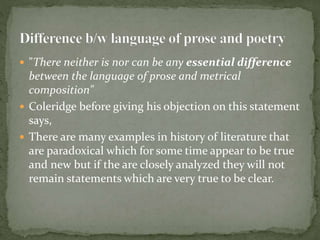
 "There neither is nor can be any essential difference
between the language of prose and metrical
composition"
 Coleridge before giving his objection on this statement
says,
 There are many examples in history of literature that
are paradoxical which for some time appear to be true
and new but if the are closely analyzed they will not
remain statements which are very true to be clear.
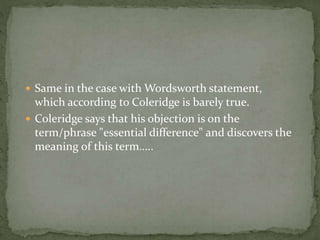
 Same in the case with Wordsworth statement,
which according to Coleridge is barely true.
 Coleridge says that his objection is on the
term/phrase "essential difference" and discovers the
meaning of this term…..
 Essence: means the principal of individualization, the
individual or ultimate nature of thing.
 Existence: on the other hand, which is distinguished from
essence, by something which is real, actual and present.
 In order to explain that he then gives the example of two
(buildings) Westminster Abbey and ST Paul which are
essentially different from each other, in a sense that both are
made from bricks (essence is same) but style and resulting
structure is different from each other. (2 modifications of same
substance)
 If we compare this example and consider as prose and
poetry Coleridge remarks:
 Language of poetry is not same as prose just as the
prose is not same as conversational speech.
 (Even though the words are same in both but their
style and arrangements are different).
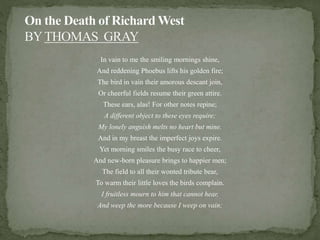
In vain to me the smiling mornings shine,
And reddening Phoebus lifts his golden fire;
The bird in vain their amorous descant join,
Or cheerful fields resume their green attire.
These ears, alas! For other notes repine;
A different object to these eyes require;
My lonely anguish melts no heart but mine.
And in my breast the imperfect joys expire.
Yet morning smiles the busy race to cheer,
And new-born pleasure brings to happier men;
The field to all their wonted tribute bear,
To warm their little loves the birds complain.
I fruitless mourn to him that cannot hear,
And weep the more because I weep on vain;
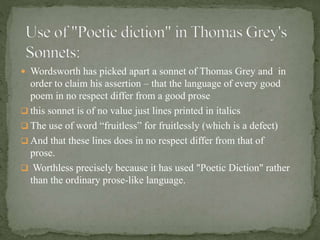
 Wordsworth has picked apart a sonnet of Thomas Grey and in
order to claim his assertion – that the language of every good
poem in no respect differ from a good prose
 this sonnet is of no value just lines printed in italics
 The use of word “fruitless” for fruitlessly (which is a defect)
 And that these lines does in no respect differ from that of
prose.
 Worthless precisely because it has used "Poetic Diction" rather
than the ordinary prose-like language.
 Coleridge refuse this view because
 for him there are combination of words that are
appropriate to poetry and not to prose and vise versa.
 There are modes of expression and order of sentences
which are fit naturally in their place in a prose
composition and would be disappropriate in metrical
poetry and vice versa.
 And thus he says this unfitness of each for the place of
other frequently will and ought to exist.
Amna Riaz
Bsf1700291
 Definition of Meter:
 In simple language, meter is a poetic device that serves as a
linguistic sound pattern for the verses, as it gives poetry a
rhythmical and melodious sound.
 Dr. Johnson declared poetry as "Metrical Composition"
 And Edgar Allen poe described it as "The Rythmetic
creation of beauty"
 thereby making poetry and meter almost synonyms.
 Denies meter the right to be equated with poetry
 as according to him meter is:
 pleasure "Super added"
 It's function is merely ornamental and not of essential
quality.
 According to Coleridge:
 Meter originates from the "balance in mind effected by
natural and enforced effort which strives to hold in check the
working of passion.
 Since Meter originates from the state of increased excitement
it should go with natural language of excitement.
 This language has it's own style and mode of expression.
 The reason why poets write in meter is simply because the
composition in meter can provide natural pleasure than a
non-metrical one.
 2 conditions from which metrical composition emerge.
1) 1:The elements of meter owe its existence to a state of
increased excitement so the meter it self should be go along
with the natural language of excitement.
2) 2:That these elements are formed into meter with the purpose of
blending delight with emotions.
 These two conditions must be naturally unite with each other as
an interpretation of passion and will
 And this can only be clear only in forms and figures of speech.
 So we can say that the passion and will of poet must be closely
interwoven in together in poetry. As the purpose of poem is to
provide delight so the expression of passion has to be properly
controlled to achieve its end.
Amna Khalid
Bsf1704904
 As an important part of poetry it is vitally connected with its
effects also.
 Meter in itself tends to increase the liveliness and spirit of
readers mind by producing continual excitement of surprise.
 e.g., He says that meter resembles yeast worthless and
disagreeable by it-self but giving spirit and liveliness when
added to wine.
Coleridge says that the effect of meter is like a medicate
atmosphere or wine during animated conversation
(someone who is lively and showing their feeling).
This to say:
1. It is not noticed while being taken.
2. It has a strong delayed effect.
 As Coleridge already described that meter has the power
to leaven(raise) the language and render it pleasurable
 yet he says that the pleasure of meter is conditional
because it depends on the appropriateness of thoughts
and expression to metrical from it super added
 delight of meter depends on the fact that ideas and
expressions both are suitable for presenting it in verse
form.
 Therefore, metrical composition must be accomplished
by a rich thought and Poetic Diction or meter it self
become feeble.
 Coleridge also state that meter is proper form of poetry
and poetry is imperfect and defective without meter.
 And whatever is combined with meter, even if its not
essentially poetic, gives a new color to the writing of a
poet.
Zara Ahmad
Bsf1700284
 According to Wordsworth all good poetry is a natural flow of
powerful feelings i.e., which always imply passion; an excited
state of feelings..
 But he also states that passion and excitement is an unusual
regular state of mind..
 Ideas and feelings do not in that state succeed each other in an
accustomed order
 To which Coleridge disagree..
 That it is in very state of excitement where poet is inspired and
thus compose poems and arrange words
 as every passion has its own proper pulse, it will also has its
own mode of expression. But the true genius of poet lies in
the very act of his composition which will produce in him
and in readers an extraordinary amount of excitement.
 This excitement of love, fear, rage and jealousy needs a
special language for its proper expression which cannot be
ordinary like prose,
 e.g., in the clarity/vividness in writing of Donne and Dryden
 Hence Coleridge conclude that in there is, and ought to be,
an essential difference between language of prose and of
metrical composition (poetry).
 Wordsworth in its preface of Lyrical Ballads says:
 “..reader is utterly at the mercy of the poet respecting
what imagery and diction he may choose to connect with
the passion"
 To which Coleridge asks, How is the reader at the mercy
of the such man who make havoc with rhymes and meter
and do not consider them vital.
 He continues and says the ultimate end of criticism is to
establish the principles of writing than to pass judgment
on rules as Wordsworth theory is one such principle.
 But how will a poet regulate his own style if not guided
by his theory.
 Coleridge emphasizes that a poet should follow:
 the rules of Grammar, logic and psychology
 Knowledge of facts,
 Material and spiritual
 than to adopt the actual language.
Tayyeba Sheikh
Bsf1700439
 Continuing his argument, Coleridge ask "How will a
poet discover a language suitable for expressing rage
and jealousy and greed.
 Will he write and get his words from wandering people
in an uncultivated society or from his own power of
imagination.
 He says, "Meditation will be his better guide than
observation".
 For Coleridge power of Observation is important as
through his imagination,
 and a poet gifted with true genius he from his intuition
know the right words that will convey the meaning and
style suited to his poetry.
 His imagination and not the rules, fixed by critics, is his
only guiding principles.
 The poets imagination is the real creative power in him.
e.g., the impassioned language that Donne uses is the
gift to him of his poetic imagination. In selection of his
language Donne does not follow any rules set by critics.
 One of the reasons why Coleridge's text on criticism is so
famous is because he is able to show a shrewd
understanding of the relative merits of various poets as he
reflects on his own education and writings
 and how they differ from his famous friend and co-writer,
William Wordsworth.
 In Biographia Literaria he estimates both virtues and
defects of Wordsworth and gives extensive examples to
support his view.
 Coleridge’s criticism reveals his unique power of critical
analysis..
 And his ability to discover literary beauty even when critics
normally fail to find it.
Critics views on Coleridge:
 Herbert Read says that Coleridge “made criticism into
a science and revealed to the world some part of the
mystery of genius.”
 Arthur Symons says “ The Biographia Literaria is the
greatest book of criticism in England”
 But prof. Reysor do not have such a high opinion and
said his theory of imagination is “eccentric and
unfortunate and regard Coleridge as “mediocre
Philosopher”
 To conclude…
 meter is essential to poem to make it different from a prose to
heighten the effect,
 to enliven pleasure ;
 meter also balance the spontaneous overflow of passion on the
poets mind;
 Metrical language better conveys excitement than prose.
 Passion is the property of poetry, meter is organic to poetry;
 Then anything related to meter is actually related to the spirit of
poetry.
 The effect which it produce is that of the continued excitement
of surprise, meter also gives us the Sense of musical delight.
Thank you!!!

Biography literaria chapter 18

  • 1.
    Presented by :Rukhma Shahzadi bsf1700259 Tayyaba Idrees bsf1700374 Amina Riaz bsf1700291 Amna Khalid bsf1704904 Zara Ahmed bsf1700284 Tayyeba Sheikh bsf1700439
  • 2.
     Biographia Literariaincludes some of the most important English writing on poetic theory  It is a response to ideas of poetry advanced by his close friend William Wordsworth  Coleridge is concerned with either expanding on or in fact refuting the principles his friend Wordsworth has written in the preface to Lyrical Ballads.  Wordsworth wished poetry to take a new direction by using the language of people "A selection of real language of man" who lived in the countryside.  For he says, that this is a language that is genuine and more expressive of emotions than the diction used by the poet of previous age.
  • 3.
     He statedthat the poetic word choice should be as the way people spoke and reject the specialized terms.  Coleridge takes issue with and objects that there is a doubtful meaning in the use of words "real" as language varies: Individual to individual country to country
  • 4.
     In Chapter18, Coleridge is going to state that poetry doesn't and cannot be same as prose ( as Wordsworth stated) just as prose is not same as conversational speech.  Also discussion on Meter  Its effects  Origin and  Power of poetic imagination
  • 5.
     Coleridge continuingto reject the theory of Wordsworth (to write poetry in the language of rustic) and disagrees that the selection of rustic of ceases to be the rustic's own language.  Word selection of any class can not be such used.  A poet who selects from rustic man should also know the arrangement of words, poet(he) should also know about his life.
  • 6.
     Coleridge saysthat the poet make the selection of the words to suite his own purpose and exclusively by his own judgment.  E.g Wordsworth poem in Lyrical Ballads "The Last of the Flock"  “In distant countries have I been, And yet I have not often seen A healthy man, a man full grown, Weep in the public roads, alone. But such a one, on English ground, And in the broad highway, I met; Along the broad highway he came, His cheeks with tears were wet: Sturdy he seemed, though he was sad; And in his arms a Lamb he had. ”
  • 7.
     Coleridge observesthat ,  ” The words that are used in this poem are commonly used by rustic but the arrangement/the order in which the words follow each other are not the same as found in language of rustic.  He says, "It looks like a far more faithful copy of language of rustic".
  • 8.
  • 9.
     "There neitheris nor can be any essential difference between the language of prose and metrical composition"  Coleridge before giving his objection on this statement says,  There are many examples in history of literature that are paradoxical which for some time appear to be true and new but if the are closely analyzed they will not remain statements which are very true to be clear.
  • 10.
     Same inthe case with Wordsworth statement, which according to Coleridge is barely true.  Coleridge says that his objection is on the term/phrase "essential difference" and discovers the meaning of this term…..
  • 11.
     Essence: meansthe principal of individualization, the individual or ultimate nature of thing.  Existence: on the other hand, which is distinguished from essence, by something which is real, actual and present.  In order to explain that he then gives the example of two (buildings) Westminster Abbey and ST Paul which are essentially different from each other, in a sense that both are made from bricks (essence is same) but style and resulting structure is different from each other. (2 modifications of same substance)
  • 12.
     If wecompare this example and consider as prose and poetry Coleridge remarks:  Language of poetry is not same as prose just as the prose is not same as conversational speech.  (Even though the words are same in both but their style and arrangements are different).
  • 13.
    In vain tome the smiling mornings shine, And reddening Phoebus lifts his golden fire; The bird in vain their amorous descant join, Or cheerful fields resume their green attire. These ears, alas! For other notes repine; A different object to these eyes require; My lonely anguish melts no heart but mine. And in my breast the imperfect joys expire. Yet morning smiles the busy race to cheer, And new-born pleasure brings to happier men; The field to all their wonted tribute bear, To warm their little loves the birds complain. I fruitless mourn to him that cannot hear, And weep the more because I weep on vain;
  • 14.
     Wordsworth haspicked apart a sonnet of Thomas Grey and in order to claim his assertion – that the language of every good poem in no respect differ from a good prose  this sonnet is of no value just lines printed in italics  The use of word “fruitless” for fruitlessly (which is a defect)  And that these lines does in no respect differ from that of prose.  Worthless precisely because it has used "Poetic Diction" rather than the ordinary prose-like language.
  • 15.
     Coleridge refusethis view because  for him there are combination of words that are appropriate to poetry and not to prose and vise versa.  There are modes of expression and order of sentences which are fit naturally in their place in a prose composition and would be disappropriate in metrical poetry and vice versa.  And thus he says this unfitness of each for the place of other frequently will and ought to exist.
  • 16.
  • 17.
     Definition ofMeter:  In simple language, meter is a poetic device that serves as a linguistic sound pattern for the verses, as it gives poetry a rhythmical and melodious sound.  Dr. Johnson declared poetry as "Metrical Composition"  And Edgar Allen poe described it as "The Rythmetic creation of beauty"  thereby making poetry and meter almost synonyms.
  • 18.
     Denies meterthe right to be equated with poetry  as according to him meter is:  pleasure "Super added"  It's function is merely ornamental and not of essential quality.
  • 19.
     According toColeridge:  Meter originates from the "balance in mind effected by natural and enforced effort which strives to hold in check the working of passion.  Since Meter originates from the state of increased excitement it should go with natural language of excitement.  This language has it's own style and mode of expression.  The reason why poets write in meter is simply because the composition in meter can provide natural pleasure than a non-metrical one.
  • 20.
     2 conditionsfrom which metrical composition emerge. 1) 1:The elements of meter owe its existence to a state of increased excitement so the meter it self should be go along with the natural language of excitement. 2) 2:That these elements are formed into meter with the purpose of blending delight with emotions.  These two conditions must be naturally unite with each other as an interpretation of passion and will  And this can only be clear only in forms and figures of speech.  So we can say that the passion and will of poet must be closely interwoven in together in poetry. As the purpose of poem is to provide delight so the expression of passion has to be properly controlled to achieve its end.
  • 21.
  • 22.
     As animportant part of poetry it is vitally connected with its effects also.  Meter in itself tends to increase the liveliness and spirit of readers mind by producing continual excitement of surprise.  e.g., He says that meter resembles yeast worthless and disagreeable by it-self but giving spirit and liveliness when added to wine.
  • 23.
    Coleridge says thatthe effect of meter is like a medicate atmosphere or wine during animated conversation (someone who is lively and showing their feeling). This to say: 1. It is not noticed while being taken. 2. It has a strong delayed effect.
  • 24.
     As Coleridgealready described that meter has the power to leaven(raise) the language and render it pleasurable  yet he says that the pleasure of meter is conditional because it depends on the appropriateness of thoughts and expression to metrical from it super added  delight of meter depends on the fact that ideas and expressions both are suitable for presenting it in verse form.
  • 25.
     Therefore, metricalcomposition must be accomplished by a rich thought and Poetic Diction or meter it self become feeble.  Coleridge also state that meter is proper form of poetry and poetry is imperfect and defective without meter.  And whatever is combined with meter, even if its not essentially poetic, gives a new color to the writing of a poet.
  • 26.
  • 27.
     According toWordsworth all good poetry is a natural flow of powerful feelings i.e., which always imply passion; an excited state of feelings..  But he also states that passion and excitement is an unusual regular state of mind..  Ideas and feelings do not in that state succeed each other in an accustomed order  To which Coleridge disagree..  That it is in very state of excitement where poet is inspired and thus compose poems and arrange words
  • 28.
     as everypassion has its own proper pulse, it will also has its own mode of expression. But the true genius of poet lies in the very act of his composition which will produce in him and in readers an extraordinary amount of excitement.  This excitement of love, fear, rage and jealousy needs a special language for its proper expression which cannot be ordinary like prose,  e.g., in the clarity/vividness in writing of Donne and Dryden  Hence Coleridge conclude that in there is, and ought to be, an essential difference between language of prose and of metrical composition (poetry).
  • 29.
     Wordsworth inits preface of Lyrical Ballads says:  “..reader is utterly at the mercy of the poet respecting what imagery and diction he may choose to connect with the passion"  To which Coleridge asks, How is the reader at the mercy of the such man who make havoc with rhymes and meter and do not consider them vital.  He continues and says the ultimate end of criticism is to establish the principles of writing than to pass judgment on rules as Wordsworth theory is one such principle.
  • 30.
     But howwill a poet regulate his own style if not guided by his theory.  Coleridge emphasizes that a poet should follow:  the rules of Grammar, logic and psychology  Knowledge of facts,  Material and spiritual  than to adopt the actual language.
  • 31.
  • 32.
     Continuing hisargument, Coleridge ask "How will a poet discover a language suitable for expressing rage and jealousy and greed.  Will he write and get his words from wandering people in an uncultivated society or from his own power of imagination.  He says, "Meditation will be his better guide than observation".
  • 33.
     For Coleridgepower of Observation is important as through his imagination,  and a poet gifted with true genius he from his intuition know the right words that will convey the meaning and style suited to his poetry.  His imagination and not the rules, fixed by critics, is his only guiding principles.  The poets imagination is the real creative power in him. e.g., the impassioned language that Donne uses is the gift to him of his poetic imagination. In selection of his language Donne does not follow any rules set by critics.
  • 34.
     One ofthe reasons why Coleridge's text on criticism is so famous is because he is able to show a shrewd understanding of the relative merits of various poets as he reflects on his own education and writings  and how they differ from his famous friend and co-writer, William Wordsworth.  In Biographia Literaria he estimates both virtues and defects of Wordsworth and gives extensive examples to support his view.  Coleridge’s criticism reveals his unique power of critical analysis..  And his ability to discover literary beauty even when critics normally fail to find it.
  • 35.
    Critics views onColeridge:  Herbert Read says that Coleridge “made criticism into a science and revealed to the world some part of the mystery of genius.”  Arthur Symons says “ The Biographia Literaria is the greatest book of criticism in England”  But prof. Reysor do not have such a high opinion and said his theory of imagination is “eccentric and unfortunate and regard Coleridge as “mediocre Philosopher”
  • 36.
     To conclude… meter is essential to poem to make it different from a prose to heighten the effect,  to enliven pleasure ;  meter also balance the spontaneous overflow of passion on the poets mind;  Metrical language better conveys excitement than prose.  Passion is the property of poetry, meter is organic to poetry;  Then anything related to meter is actually related to the spirit of poetry.  The effect which it produce is that of the continued excitement of surprise, meter also gives us the Sense of musical delight.
  • 37.