Solid dosage form
Presentation by:
Dr. Eshani Mahajan
Definitions
• Dose : It is a quantity of drug that produces desired therapeutic response in a
recipient. It contains active ingredients like drugs and other substances like
excipients, flavoring agents, and preservatives
• Excipients: Pharmacologically, an inert substance is added to the preparation
when a small quantity of drug is present to add bulk and also used to mask the
unpleasant taste. E.g. lactose, starch
• Vehicles: A carrier or inert medium used as a solvent (or diluent) in which the
medicinally active agent is formulated and administered. E.g. Sugar syrup
Definitions
• Aqua: These are watery solutions of volatile oils or other aromatic
substances in distilled water e.g. mentha preperatta
• Flavoring agent: used to mask nauseating and unpleasant taste of
medicines. e.g. spirit chloroform
• Sweetening agents: used to mask bad taste of syrup and elixirs. e.g.
Aspartame
Dosage form
• Different drug formulation which are designed to make it possible to
introduce a drug into the human body.
1. Solid
2. Liquid
3. Inhalational
Solid dosage form
• Solid oral
• Solid topical
• Other
Solid oral
• The most commonly used solid dosage forms as they provide a correct
compact dosage, portable and are convenient to market , store and
administer
• The oral form should administer with full glass of water with the
patient in upright posture
Advantages
• Appropriate for any age of patient
• The most common, natural and easiest route of administration
• Safe, economical , convenient to the patient
• Can take it without any help
Disadvantages
• Delayed onset of action because absorption takes time
• Not suitable in emergency and for unconscious patient
• Not convenient for patient with vomiting and diarrhoea
• Not suitable for uncooperative patients as children and infants
Types
•Tablets
1. Uncoated Tablets
2. Coated Tablets ( Sugar Coated, Film coated )
3. Chewable tablets
4. Sublingual or Buccal
5. Lozenges
6. Mouth dissolving tablets
Tablets
• Contain unit dose of one or more powdered or granulated drugs
• Prepared by compressing heavy pressure or moulding method into a
round or disk-like shape suitable for swallowing
1. Uncoated tablets
• Tablets having no coating
• Example: Aspirin, erythromycin tablets
2. Coated tablets
• The tablets are coated with one or more layers of mixture of
substances for a variety of reasons like protecting from air, moisture
or light etc.
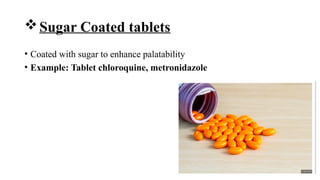
Sugar Coated tablets
• Coated with sugar to enhance palatability
• Example: Tablet chloroquine, metronidazole
Film coated tablets
• A transparent film is made up of cellulose acetate and gelatin
derivative to mask the unpleasant taste
• Example: Cefuroxamine , diltiazem
3. Chewable tablets
• These are large tablets usually pleasant tasting that are meant to be
chewed well before swallowing
• Chewing provide disintegration in the mouth thus rapid effect after
swallowing
• Example: Vit. C, D3 tablets
4. Sublingual or buccal tablets
• These are small, flat or oval tablets intended to be inserted into the
buccal pouch or beneath the tongue where the active ingredient rapidly
absorbed
• Example: GTN (Glyceryl trinitrate), nitrates
5.Lozenges
• These are flat , rounded , rectangular preparations kept in mouth till
they dissolve
• Example: Cough lozenges (strepsils)
6. Mouth dissolving tablets
• Orally disintragating tablets
• Designed for dysphagic, geriatric, pediatric, bedridden and psychotic
patients
• They do not require water for its administration
• Example : Ondasetron, domperidone
• Capsules
• Hard capsules
• Soft capsules
• Modified release capsule /Spansules
Capsules
• They are container, usually made of gelatin
• They may be hard or soft
• Example: Tetracyclin capsule, amoxicillin capsule
1.Hard capsule
• Shells of two cylindrical sections in which drug may be either in it
which are made up of gelatin.
• Drug may either in granules or powder form
2. Soft capsule
• Single shell of thick gelatin layer
• Drug is in liquid form
3. Modified release capsules or spansules
• These are designed to modify the rate, place, or time of release of
drug
• Can be delayed release type or sustained release type tablet
• Powders
• Simple Powder
• Compound Powder
• Granular Effervescent Powder
• Granules
• Cachet
Powders
• These are solid dosage form of drugs in finely divided form and mixed
homogeneously
• These can be dispensed, weighed accurately and administered to
children with great ease
1. Simple Powder
• It contains only one ingredient in either crystalline form or amorphous
form
• Example: Glucose powder, aspirin powder
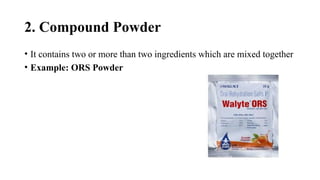
2. Compound Powder
• It contains two or more than two ingredients which are mixed together
• Example: ORS Powder
3. Granular effervescent powder
• These powders contain drug with mixture of acid and alkali which
after dissolving in water release carbon dioxide after reaction
• It masks bitter taste
• Example: ENO
4. Granules
• These are small irregular particles;0.5-2mm in diameter ,aggregated
together by binding a binding agent in single dose sachets
• Example: Zinc granules
5.Cachets
• Catchets provide an edible container like capsule
• Example: Vit. E and evening prime rose oil cachet
• Solid topical dosage forms:
• Dusting powder
• Plasters
• Pellets
1.Dusting Powder
• Powders intended for local use with no systemic effects
• Example: Neomycin powder, boric acid powder
2. Plasters
• These are solid adhesive preparations applied to protect, soothe and
provide mechanical strength to lessen pain
• Example: Johnson and Johnson, zinc oxide plaster
3. Pellets
• These are the sterile spheres formed by compression of the drug
• They are implanted subcutaneously which form a depot from where a
drug is released slowly
• Example: Testosterone pellet
Other solid dosage form
•Suppositories
• Rectal
• Vaginal
• Uretheral
Suppositories
• These are mixtures of drugs with a firm base that can be moulded in
shapes suitables for insertion in orifice
1.Rectal suppositories
• These are cone or bullet-shaped to be placed in the rectum
• Example: Dulcolax suppositories for constipation
2.Vaginal suppositories
• These are the conical or spherical shaped to be placed in vagina
• Example: Miconazole +Tinidazole
3.Urethral suppositories (bougies)
• These are pencil shaped
• Supplied in aluminium foil and usually lubricated with water
Liquid dosage form
1. Liquid oral
2. Liquid topical
Liquid oral
Types
•Solutions
Elixirs
Syrup
Linctus
Tinctures
Oral drops
1. Elixirs
• These are clear flavoured hydroalcoholic solutions of medicinal
substances.
• Usually less sweet and less viscous due to less sugar
• Example: Vitamin B-Complex elixirs, cough elixirs
2. Syrup
• Syrups are concentrated sucrose solution in water or other liquids
• Contains high sugar and more effective than elixir
• Example: Cough and Vitamin syrups
3.Linctus
• These are viscous liquids containing the drug with some demulcents
(menthols), sugar and alcohol intended to relief cough
• Sipped and swallowed slowly
• Example: Cough linctus
4. Tincture
• These are solutions prepared by extracting the active content from a
crude drug
• Obtained from vegetable material (alcoholic or hydroalcoholic) or
from chemical.
• E.g. Tincture digitalis, Tincture belladona
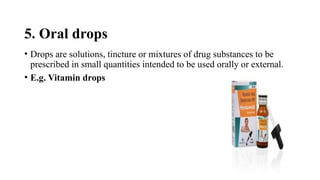
5. Oral drops
• Drops are solutions, tincture or mixtures of drug substances to be
prescribed in small quantities intended to be used orally or external.
• E.g. Vitamin drops
• Suspensions
• Mixture
• Emulsions
• Magmas
1.Mixture
• These are solid drugs, soluble or insoluble dispersed homogeneously
in vehicles meant for internal use
• Insoluble particles are suspended by using suitable suspending agent
(agar-agar)
• Such mixture is to be labelled as “Shake well before use”
• Example: Antidiarrhoeal mixtures, milk of magnesia, MgSO4
2. Emulsions
• Emulsion is a mixture of two immiscible liquids, one of which is
dispersed uniformly throughout the other with the help of emulsifying
agent.
• Example: Cod liver oil emulsion, liquid paraffin emulsion
3. Magmas
• These are bulky suspensions of poorly soluble substances in water
• Since they are white liquids they are also called as milks
• Example: Bentonite magma, aluminium hydroxide magma
4. Dry mixture for solution
• Agents having insufficient stability in aqueous solutions to meet
extended shelf life periods are provided as dry powders or granules for
reconstitution with the required quantity of purified water
immediately before administration. E.g. ORS powder
Liquid topical dosage forms
• Liniments
• Lotions
• Ointments
• Paste
• Creams
• Gels
• Paints
• Spray
• Enema
• Mouth wash
• Irrigation solution
1. Liniments
• They are liquid preparations intended for external application on
unbroken skin by rubbing
• Example : Turpentine methyl salicylate liniment
2. Lotions
• They are liquid preparations meant for local application to the skin or
mucous membrane without rubbing
• Example: Calamine lotion
3. Ointments
• They are semisolid preparation with greasy base as vehicle for
external application to skin and mucous membrane
• Example: Chloramphenicol eye ointment
4. Pastes
• They are semi-solid preparation contain a non greasy base
• Paste do not melt at body temperature like ointments
• Example: Anhydrous benzoyl peroxide
5. Creams
• They are viscous liquid or semisolid emulsion which can be either
water or water in oil type
• Example: Betnovate cream
6. Gels
• Drug is dissolved in a liquid and then dispensed in some gelling agent
(soft gelatin)
• They are usually transparent preparation
• Example: Aluminium hydroxide gel
7. Paint
• It is a viscous liquid preparation for application on skin and mucous
membrane
• Example: Gum paint
8. Spray
• Sprays are aerosol preparations containing medicament for topical
application
• Example: Analgesic spray
9. Enema
• It is meant for rectal administration employed to evacuate the bowl
• Example: Hydrocortisone rectal suspension
10. Mouthwash
• It is an aqueous suspension with a pleasant taste and colour used for
rinsing , deodorant, refreshing or antiseptic action
• Example: Listerine
 Liquid parenteral dosage form
• Ampoules
• Single or multidose vial
Liquid parenteral dosage form
• These preparation meant for parenteral administration
• They must be sterile and pyrogen free
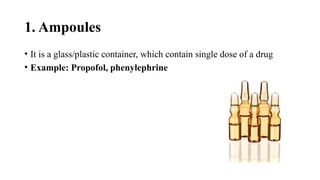
1. Ampoules
• It is a glass/plastic container, which contain single dose of a drug
• Example: Propofol, phenylephrine
2. Single or multi dose vial
• It contain multiple doses of drug solution or powder form of the drug
• The solution can be reused but sterility has to be maintained
• Example: Vaccines
Advantages
• Faster action
• Can be given in unconsciousness and uncooperative patients
• Useful in patients with vomiting
• First pass metabolism avoided
• Useful in emergency situation
Disadvantages
• They required assistance and proper aseptic precautions
• Pain at the injection site
• Expensive, inconvenient to patients
• Injury to the nerve may occur
Thank you

Solid dosage form presentation.pptx

  • 1.
    Solid dosage form Presentationby: Dr. Eshani Mahajan
  • 2.
    Definitions • Dose :It is a quantity of drug that produces desired therapeutic response in a recipient. It contains active ingredients like drugs and other substances like excipients, flavoring agents, and preservatives • Excipients: Pharmacologically, an inert substance is added to the preparation when a small quantity of drug is present to add bulk and also used to mask the unpleasant taste. E.g. lactose, starch • Vehicles: A carrier or inert medium used as a solvent (or diluent) in which the medicinally active agent is formulated and administered. E.g. Sugar syrup
  • 3.
    Definitions • Aqua: Theseare watery solutions of volatile oils or other aromatic substances in distilled water e.g. mentha preperatta • Flavoring agent: used to mask nauseating and unpleasant taste of medicines. e.g. spirit chloroform • Sweetening agents: used to mask bad taste of syrup and elixirs. e.g. Aspartame
  • 4.
    Dosage form • Differentdrug formulation which are designed to make it possible to introduce a drug into the human body. 1. Solid 2. Liquid 3. Inhalational
  • 5.
    Solid dosage form •Solid oral • Solid topical • Other
  • 6.
    Solid oral • Themost commonly used solid dosage forms as they provide a correct compact dosage, portable and are convenient to market , store and administer • The oral form should administer with full glass of water with the patient in upright posture
  • 7.
    Advantages • Appropriate forany age of patient • The most common, natural and easiest route of administration • Safe, economical , convenient to the patient • Can take it without any help
  • 8.
    Disadvantages • Delayed onsetof action because absorption takes time • Not suitable in emergency and for unconscious patient • Not convenient for patient with vomiting and diarrhoea • Not suitable for uncooperative patients as children and infants
  • 9.
    Types •Tablets 1. Uncoated Tablets 2.Coated Tablets ( Sugar Coated, Film coated ) 3. Chewable tablets 4. Sublingual or Buccal 5. Lozenges 6. Mouth dissolving tablets
  • 10.
    Tablets • Contain unitdose of one or more powdered or granulated drugs • Prepared by compressing heavy pressure or moulding method into a round or disk-like shape suitable for swallowing
  • 11.
    1. Uncoated tablets •Tablets having no coating • Example: Aspirin, erythromycin tablets
  • 12.
    2. Coated tablets •The tablets are coated with one or more layers of mixture of substances for a variety of reasons like protecting from air, moisture or light etc.
  • 13.
    Sugar Coated tablets •Coated with sugar to enhance palatability • Example: Tablet chloroquine, metronidazole
  • 14.
    Film coated tablets •A transparent film is made up of cellulose acetate and gelatin derivative to mask the unpleasant taste • Example: Cefuroxamine , diltiazem
  • 15.
    3. Chewable tablets •These are large tablets usually pleasant tasting that are meant to be chewed well before swallowing • Chewing provide disintegration in the mouth thus rapid effect after swallowing • Example: Vit. C, D3 tablets
  • 16.
    4. Sublingual orbuccal tablets • These are small, flat or oval tablets intended to be inserted into the buccal pouch or beneath the tongue where the active ingredient rapidly absorbed • Example: GTN (Glyceryl trinitrate), nitrates
  • 17.
    5.Lozenges • These areflat , rounded , rectangular preparations kept in mouth till they dissolve • Example: Cough lozenges (strepsils)
  • 18.
    6. Mouth dissolvingtablets • Orally disintragating tablets • Designed for dysphagic, geriatric, pediatric, bedridden and psychotic patients • They do not require water for its administration • Example : Ondasetron, domperidone
  • 19.
    • Capsules • Hardcapsules • Soft capsules • Modified release capsule /Spansules
  • 20.
    Capsules • They arecontainer, usually made of gelatin • They may be hard or soft • Example: Tetracyclin capsule, amoxicillin capsule
  • 21.
    1.Hard capsule • Shellsof two cylindrical sections in which drug may be either in it which are made up of gelatin. • Drug may either in granules or powder form
  • 22.
    2. Soft capsule •Single shell of thick gelatin layer • Drug is in liquid form
  • 23.
    3. Modified releasecapsules or spansules • These are designed to modify the rate, place, or time of release of drug • Can be delayed release type or sustained release type tablet
  • 24.
    • Powders • SimplePowder • Compound Powder • Granular Effervescent Powder • Granules • Cachet
  • 25.
    Powders • These aresolid dosage form of drugs in finely divided form and mixed homogeneously • These can be dispensed, weighed accurately and administered to children with great ease
  • 26.
    1. Simple Powder •It contains only one ingredient in either crystalline form or amorphous form • Example: Glucose powder, aspirin powder
  • 27.
    2. Compound Powder •It contains two or more than two ingredients which are mixed together • Example: ORS Powder
  • 28.
    3. Granular effervescentpowder • These powders contain drug with mixture of acid and alkali which after dissolving in water release carbon dioxide after reaction • It masks bitter taste • Example: ENO
  • 29.
    4. Granules • Theseare small irregular particles;0.5-2mm in diameter ,aggregated together by binding a binding agent in single dose sachets • Example: Zinc granules
  • 30.
    5.Cachets • Catchets providean edible container like capsule • Example: Vit. E and evening prime rose oil cachet
  • 31.
    • Solid topicaldosage forms: • Dusting powder • Plasters • Pellets
  • 32.
    1.Dusting Powder • Powdersintended for local use with no systemic effects • Example: Neomycin powder, boric acid powder
  • 33.
    2. Plasters • Theseare solid adhesive preparations applied to protect, soothe and provide mechanical strength to lessen pain • Example: Johnson and Johnson, zinc oxide plaster
  • 34.
    3. Pellets • Theseare the sterile spheres formed by compression of the drug • They are implanted subcutaneously which form a depot from where a drug is released slowly • Example: Testosterone pellet
  • 35.
    Other solid dosageform •Suppositories • Rectal • Vaginal • Uretheral
  • 36.
    Suppositories • These aremixtures of drugs with a firm base that can be moulded in shapes suitables for insertion in orifice
  • 37.
    1.Rectal suppositories • Theseare cone or bullet-shaped to be placed in the rectum • Example: Dulcolax suppositories for constipation
  • 38.
    2.Vaginal suppositories • Theseare the conical or spherical shaped to be placed in vagina • Example: Miconazole +Tinidazole
  • 39.
    3.Urethral suppositories (bougies) •These are pencil shaped • Supplied in aluminium foil and usually lubricated with water
  • 40.
    Liquid dosage form 1.Liquid oral 2. Liquid topical
  • 41.
  • 42.
    1. Elixirs • Theseare clear flavoured hydroalcoholic solutions of medicinal substances. • Usually less sweet and less viscous due to less sugar • Example: Vitamin B-Complex elixirs, cough elixirs
  • 43.
    2. Syrup • Syrupsare concentrated sucrose solution in water or other liquids • Contains high sugar and more effective than elixir • Example: Cough and Vitamin syrups
  • 44.
    3.Linctus • These areviscous liquids containing the drug with some demulcents (menthols), sugar and alcohol intended to relief cough • Sipped and swallowed slowly • Example: Cough linctus
  • 45.
    4. Tincture • Theseare solutions prepared by extracting the active content from a crude drug • Obtained from vegetable material (alcoholic or hydroalcoholic) or from chemical. • E.g. Tincture digitalis, Tincture belladona
  • 46.
    5. Oral drops •Drops are solutions, tincture or mixtures of drug substances to be prescribed in small quantities intended to be used orally or external. • E.g. Vitamin drops
  • 47.
    • Suspensions • Mixture •Emulsions • Magmas
  • 48.
    1.Mixture • These aresolid drugs, soluble or insoluble dispersed homogeneously in vehicles meant for internal use • Insoluble particles are suspended by using suitable suspending agent (agar-agar) • Such mixture is to be labelled as “Shake well before use” • Example: Antidiarrhoeal mixtures, milk of magnesia, MgSO4
  • 49.
    2. Emulsions • Emulsionis a mixture of two immiscible liquids, one of which is dispersed uniformly throughout the other with the help of emulsifying agent. • Example: Cod liver oil emulsion, liquid paraffin emulsion
  • 50.
    3. Magmas • Theseare bulky suspensions of poorly soluble substances in water • Since they are white liquids they are also called as milks • Example: Bentonite magma, aluminium hydroxide magma
  • 51.
    4. Dry mixturefor solution • Agents having insufficient stability in aqueous solutions to meet extended shelf life periods are provided as dry powders or granules for reconstitution with the required quantity of purified water immediately before administration. E.g. ORS powder
  • 52.
    Liquid topical dosageforms • Liniments • Lotions • Ointments • Paste • Creams • Gels • Paints • Spray • Enema • Mouth wash • Irrigation solution
  • 53.
    1. Liniments • Theyare liquid preparations intended for external application on unbroken skin by rubbing • Example : Turpentine methyl salicylate liniment
  • 54.
    2. Lotions • Theyare liquid preparations meant for local application to the skin or mucous membrane without rubbing • Example: Calamine lotion
  • 55.
    3. Ointments • Theyare semisolid preparation with greasy base as vehicle for external application to skin and mucous membrane • Example: Chloramphenicol eye ointment
  • 56.
    4. Pastes • Theyare semi-solid preparation contain a non greasy base • Paste do not melt at body temperature like ointments • Example: Anhydrous benzoyl peroxide
  • 57.
    5. Creams • Theyare viscous liquid or semisolid emulsion which can be either water or water in oil type • Example: Betnovate cream
  • 58.
    6. Gels • Drugis dissolved in a liquid and then dispensed in some gelling agent (soft gelatin) • They are usually transparent preparation • Example: Aluminium hydroxide gel
  • 59.
    7. Paint • Itis a viscous liquid preparation for application on skin and mucous membrane • Example: Gum paint
  • 60.
    8. Spray • Spraysare aerosol preparations containing medicament for topical application • Example: Analgesic spray
  • 61.
    9. Enema • Itis meant for rectal administration employed to evacuate the bowl • Example: Hydrocortisone rectal suspension
  • 62.
    10. Mouthwash • Itis an aqueous suspension with a pleasant taste and colour used for rinsing , deodorant, refreshing or antiseptic action • Example: Listerine
  • 63.
     Liquid parenteraldosage form • Ampoules • Single or multidose vial
  • 64.
    Liquid parenteral dosageform • These preparation meant for parenteral administration • They must be sterile and pyrogen free
  • 65.
    1. Ampoules • Itis a glass/plastic container, which contain single dose of a drug • Example: Propofol, phenylephrine
  • 66.
    2. Single ormulti dose vial • It contain multiple doses of drug solution or powder form of the drug • The solution can be reused but sterility has to be maintained • Example: Vaccines
  • 67.
    Advantages • Faster action •Can be given in unconsciousness and uncooperative patients • Useful in patients with vomiting • First pass metabolism avoided • Useful in emergency situation
  • 68.
    Disadvantages • They requiredassistance and proper aseptic precautions • Pain at the injection site • Expensive, inconvenient to patients • Injury to the nerve may occur
  • 69.