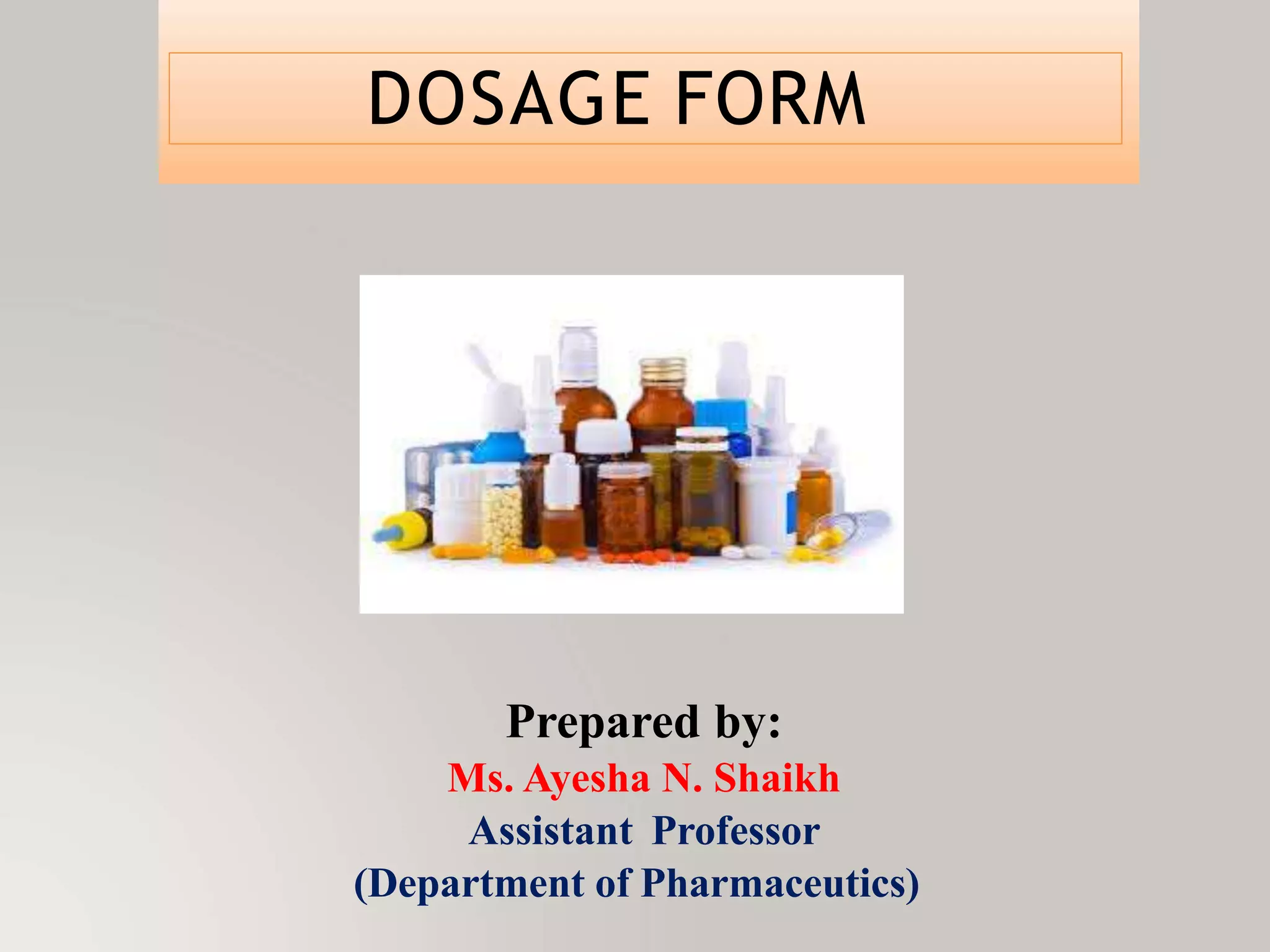
DOSAGE FORM
Prepared by:
Ms. Ayesha N. Shaikh
Assistant Professor
(Department of Pharmaceutics)
1. Introduction
2. Classification of dosage forms
 Solid dosage forms
 Liquid dosage forms
 Semi solid dosage forms
3. New drug delivery system
Contents
DOSAGE FORM OF DRUGS
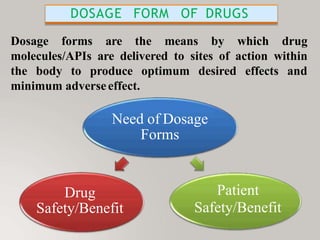
Dosage forms are the means by which drug
molecules/APIs are delivered to sites of action within
the body to produce optimum desired effects and
minimum adverseeffect.
Need of Dosage
Forms
Drug
Safety/Benefit
Patient
Safety/Benefit
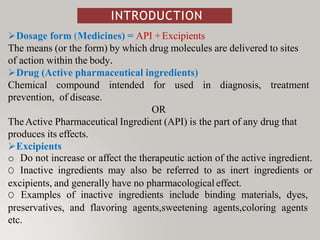
Dosage form (Medicines) = API +Excipients
The means (or the form) by which drug molecules are delivered to sites
of action within the body.
Drug (Active pharmaceutical ingredients)
Chemical compound intended for used in diagnosis, treatment
prevention, of disease.
OR
TheActive Pharmaceutical Ingredient (API) is the part of any drug that
produces its effects.
Excipients
o Do not increase or affect the therapeutic action of the active ingredient.
O Inactive ingredients may also be referred to as inert ingredients or
excipients, and generally have no pharmacological effect.
O Examples of inactive ingredients include binding materials, dyes,
preservatives, and flavoring agents,sweetening agents,coloring agents
etc.
INTRODUCTION
NEED OF DOSAGE FORMS
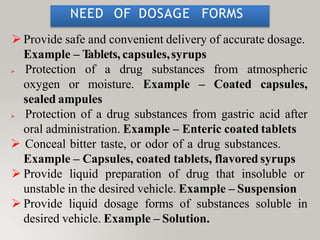
 Provide safe and convenient delivery of accurate dosage.
Example – T
ablets, capsules,syrups
 Protection of a drug substances from atmospheric
oxygen or moisture. Example – Coated capsules,
sealed ampules
 Protection of a drug substances from gastric acid after
oral administration. Example – Enteric coated tablets
 Conceal bitter taste, or odor of a drug substances.
Example – Capsules, coated tablets, flavored syrups
 Provide liquid preparation of drug that insoluble or
unstable in the desired vehicle. Example – Suspension
 Provide liquid dosage forms of substances soluble in
desired vehicle. Example – Solution.
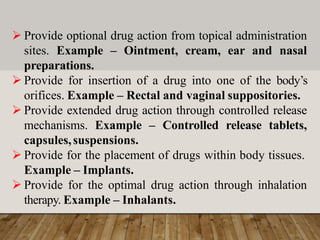
 Provide optional drug action from topical administration
sites. Example – Ointment, cream, ear and nasal
preparations.
 Provide for insertion of a drug into one of the body’s
orifices. Example – Rectal and vaginal suppositories.
 Provide extended drug action through controlled release
mechanisms. Example – Controlled release tablets,
capsules,suspensions.
 Provide for the placement of drugs within body tissues.
Example – Implants.
 Provide for the optimal drug action through inhalation
therapy. Example – Inhalants.
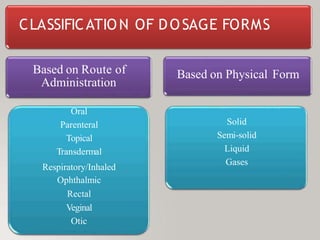
CLASSIFICATION OF DOSAGE FORMS
Based on Route of
Administration
Oral
Parenteral
Topical
Transdermal
Respiratory/Inhaled
Ophthalmic
Rectal
Veginal
Otic
Based on Physical Form
Solid
Semi-solid
Liquid
Gases
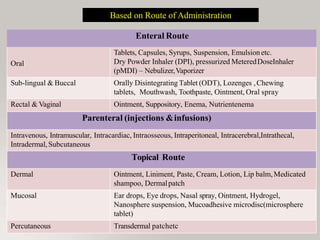
Enteral Route
Oral
Tablets, Capsules, Syrups, Suspension, Emulsionetc.
Dry Powder Inhaler (DPI), pressurized MeteredDoseInhaler
(pMDI) – Nebulizer,Vaporizer
Sub-lingual & Buccal Orally Disintegrating Tablet (ODT), Lozenges ,Chewing
tablets, Mouthwash, Toothpaste, Ointment, Oral spray
Rectal & Vaginal Ointment, Suppository, Enema, Nutrientenema
Parenteral (injections &infusions)
Intravenous, Intramuscular, Intracardiac, Intraosseous, Intraperitoneal, Intracerebral,Intrathecal,
Intradermal,Subcutaneous
Topical Route
Dermal Ointment, Liniment, Paste, Cream, Lotion, Lip balm,Medicated
shampoo, Dermalpatch
Mucosal Ear drops, Eye drops, Nasal spray, Ointment, Hydrogel,
Nanosphere suspension, Mucoadhesive microdisc(microsphere
tablet)
Percutaneous Transdermal patchetc
Based on Route of administration
Based on Route of Administration
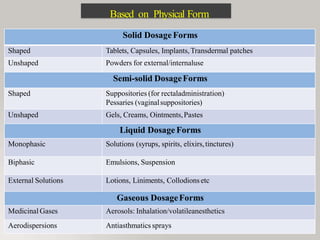
Solid Dosage Forms
Shaped Tablets, Capsules, Implants,Transdermal patches
Unshaped Powders for external/internaluse
Semi-solid DosageForms
Shaped Suppositories (for rectaladministration)
Pessaries (vaginalsuppositories)
Unshaped Gels, Creams, Ointments,Pastes
Liquid Dosage Forms
Monophasic Solutions (syrups, spirits, elixirs,tinctures)
Biphasic Emulsions, Suspension
External Solutions Lotions, Liniments, Collodionsetc
Gaseous DosageForms
MedicinalGases Aerosols: Inhalation/volatileanesthetics
Aerodispersions Antiasthmatics sprays
Based on Physical Form
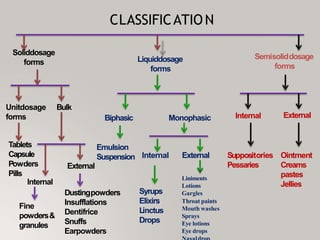
CLASSIFICATION
Soliddosage
forms Liquiddosage
forms
Semisoliddosage
forms
Unitdosage
forms
Tablets
Capsule
Bulk
Powders
Pills
Internal
Fine
powders&
granules
External
Dustingpowders
Insufflations
Dentifrice
Snuffs
Earpowders
Biphasic Monophasic
Emulsion
Suspension
Internal External
Ointment
Creams
pastes
Jellies
Suppositories
Pessaries
Liniments
Lotions
Gargles
Throat paints
Mouth washes
Sprays
Eye lotions
Eye drops
External
Internal
Syrups
Elixirs
Linctus
Drops
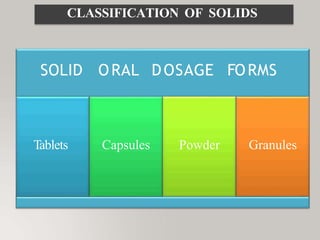
CLASSIFICATION OF SOLIDS
SOLID ORAL DOSAGE FORMS
Tablets Capsules Powder Granules
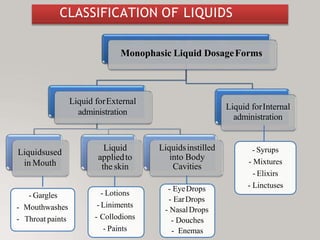
Monophasic Liquid DosageForms
Liquid forExternal
administration
Liquidsused
in Mouth
Liquid
appliedto
the skin
Liquidsinstilled
into Body
Cavities
Liquid forInternal
administration
- Syrups
- Mixtures
- Elixirs
- Linctuses
- Gargles
- Mouthwashes
- Throat paints
- Lotions
- Liniments
- Collodions
- Paints
- EyeDrops
- EarDrops
- NasalDrops
- Douches
- Enemas
CLASSIFICATION OF LIQUIDS
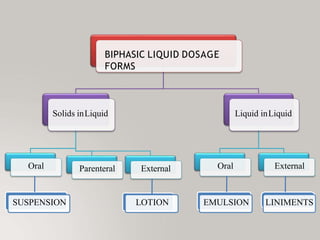
BIPHASIC LIQUID DOSAGE
FORMS
Solids inLiquid
Oral Parenteral External
Liquid inLiquid
Oral External
SUSPENSION LOTION EMULSION LINIMENTS
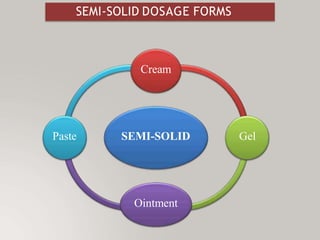
SEMI-SOLID DOSAGE FORMS
SEMI-SOLID
Cream
Gel
Ointment
Paste
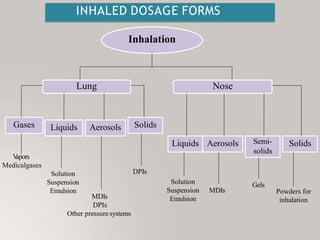
Nose
Lung
Inhalation
Gases Liquids Aerosols Solids
Liquids Aerosols Semi-
solids
Solids
V
apors
Medicalgases
Solution
Suspension
Emulsion
MDIs
DPIs
Other pressure systems
DPIs
Solution
Suspension
Emulsion
MDIs
Gels
Powders for
inhalation
INHALED DOSAGE FORMS
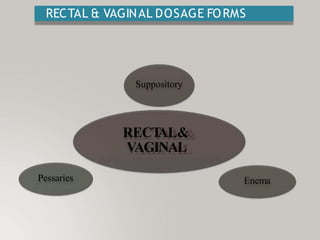
RECTAL & VAGINAL DOSAGE FORMS
RECT
AL&
VAGINAL
Suppository
Enema
Pessaries
SOLID DOSAGE FORMS
1 -TABLET
 Atablet is unit dose of one or more medicament. Prepare by compressionor
mould method.
 Common excipients used in tablet are:
 Diluents – Provide bulkiness oftablet.
 Disintegrants – T
oensure that the tablet breaks up in the digestivetract.
 Binder – Important for granulation ofpowder.
 Glidants and Lubricants – Provide good flow and ensure efficienttabletting.
 Sweeteners and Flavors – Tomask the tasteofAPIs.
 Pigments – T
omask uncoated tablets visuallyattractive.
 Acoating may be applied to mask taste, smooth tablet for easy swallow,expending
shelf life, and prevent gastric degradation ofdrug.
2 - BUCCAL AND SUBLINGUAL TABLET
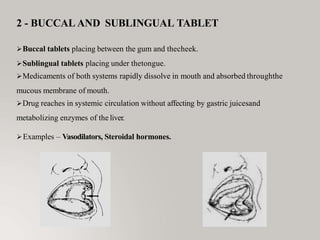
Buccal tablets placing between the gum and thecheek.
Sublingual tablets placing under thetongue.
Medicaments of both systems rapidly dissolve in mouth and absorbed throughthe
mucous membrane of mouth.
Drug reaches in systemic circulation without affecting by gastric juicesand
metabolizing enzymes of the liver.
Examples – Vasodilators, Steroidal hormones.
3 - EFFERVESCENT TABLET
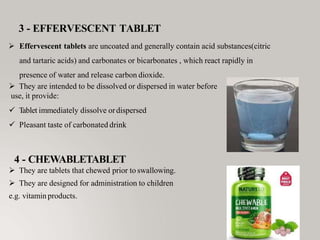
 Effervescent tablets are uncoated and generally contain acid substances(citric
and tartaric acids) and carbonates or bicarbonates , which react rapidly in
presence of water and release carbon dioxide.
 They are intended to be dissolved or dispersed in water before
use, it provide:
 Tablet immediately dissolve ordispersed
 Pleasant taste of carbonated drink
4 - CHEWABLETABLET
 They are tablets that chewed prior to swallowing.
 They are designed for administration to children
e.g. vitamin products.
5 -CAPSULES
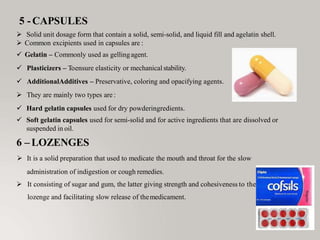
 Solid unit dosage form that contain a solid, semi-solid, and liquid fill and agelatin shell.
 Common excipients used in capsules are :
 Gelatin – Commonly used as gellingagent.
 Plasticizers – Toensure elasticity or mechanical stability.
 AdditionalAdditives – Preservative, coloring and opacifying agents.
 They are mainly two types are :
 Hard gelatin capsules used for dry powderingredients.
 Soft gelatin capsules used for semi-solid and for active ingredients that are dissolved or
suspended in oil.
6 – LOZENGES
 It is a solid preparation that used to medicate the mouth and throat for the slow
administration of indigestion or cough remedies.
 It consisting of sugar and gum, the latter giving strength and cohesiveness to the
lozenge and facilitating slow release of themedicament.
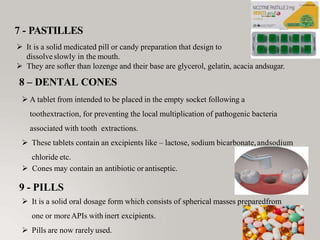
7 - PASTILLES
 It is a solid medicated pill or candy preparation that design to
dissolveslowly in the mouth.
 They are softer than lozenge and their base are glycerol, gelatin, acacia andsugar.
8 – DENTAL CONES
 A tablet from intended to be placed in the empty socket following a
toothextraction, for preventing the local multiplication of pathogenic bacteria
associated with tooth extractions.
 These tablets contain an excipients like – lactose, sodium bicarbonate,andsodium
chloride etc.
 Cones may contain an antibiotic or antiseptic.
9 - PILLS
 It is a solid oral dosage form which consists of spherical masses preparedfrom
one or moreAPIs with inert excipients.
 Pills are now rarely used.
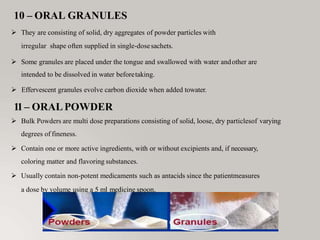
10 – ORAL GRANULES
 They are consisting of solid, dry aggregates of powder particles with
irregular shape often supplied in single-dosesachets.
 Some granules are placed under the tongue and swallowed with water andother are
intended to be dissolved in water beforetaking.
 Effervescent granules evolve carbon dioxide when added towater.
11– ORALPOWDER
 Bulk Powders are multi dose preparations consisting of solid, loose, dry particlesof varying
degrees of fineness.
 Contain one or more active ingredients, with or without excipients and, if necessary,
coloring matter and flavoring substances.
 Usually contain non-potent medicaments such as antacids since the patientmeasures
a dose by volume using a 5 ml medicine spoon.
LIQUID DOSAGE FORMS
1 – ORAL SOLUTION: Oral solutions are clear Liquid preparations for oral use
containing one or more active ingredients dissolved in a suitablevehicle.
2 – ORAL EMULSION: Oral emulsions are stabilized oil-in-water dispersions,
either or both phases of which may contain dissolved solids either oil is dispersed in finely
divided form in water or vice versa.
3 – ORAL SUSPENSION: Biphasic liquid preparations for oral use containing
one or more active ingredients suspended in a suitable vehicle. It sediment which is readily
dispersed on shaking to give a uniform suspension which remains sufficiently stable to
enable the correct dose to be delivered.
4- SYRUPS: It is a concentrated aqueous solution of a sugar, usually sucrose to which
medicaments are added. Flavoured syrups are a convenient form of masking disagreeable
tastes.
5 – ELIXIR: It is pleasantly flavoured clear liquid oral preparation of potent or
nauseous drugs. The vehicle may contain a high proportion of ethanol or sucrose together
with antimicrobial preservatives which confers the stability of the preparation.
6 – MOUTHWASHES: These are similar to gargles but are used for oral hygiene
and to treatinfections of the mouth.
7- LINCTUSES:It is viscous, liquid oral preparations that are usually prescribed for th
relief of cough. It contain high proportion of syrup and glycerol which have a demulcent effec
on the membranes of the throat.The dose volume is small (5ml) and, to prolong the demulcen
action, they should be taken undiluted.
8 – ORAL DROPS:Oral drops are liquid preparations for oral use that are intended to be
administered in small volumes with the aid of a suitable measuring device.They may be
solutions, suspensions oremulsions.
9- GARGLES: They are prepared in a concentrated solution with directions for the patient
to dilute with warm water before use. They are aqueous solutions used in the prevention or
treatment of throat infections.
10 – LOTIONS: It is mono-phasic liquid preparations (aqueous) for external application
without friction either dabbed on the skin or applied on a suitable dressing and covered with a
water proof dressing to reduceevaporation.
11 – NASAL DROPS & SPRA
YS: Drugs in aqueous solution may be instilled into
the nose from a dropper or from a plastic squeeze bottle. Used for local effect, e.g.
antihistamine,decongestant.
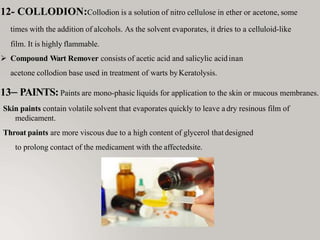
12- COLLODION:Collodion is a solution of nitro cellulose in ether or acetone, some
times with the addition of alcohols. As the solvent evaporates, it dries to a celluloid-like
film. It is highly flammable.
 Compound Wart Remover consists of acetic acid and salicylic acidinan
acetone collodion base used in treatment of warts byKeratolysis.
13– PAINTS: Paints are mono-phasic liquids for application to the skin or mucous membranes.
Skin paints contain volatile solvent that evaporates quickly to leave adry resinous film of
medicament.
Throat paints are more viscous due to a high content of glycerol thatdesigned
to prolong contact of the medicament with the affectedsite.
PARENTERAL DOSAGE FORMS
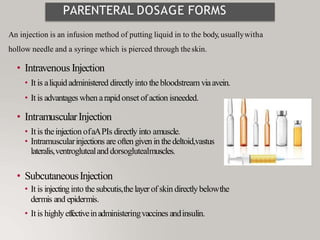
An injection is an infusion method of putting liquid in to the body, usuallywitha
hollow needle and a syringe which is pierced through theskin.
• Intravenous Injection
• It is aliquidadministered directlyinto thebloodstream viaavein.
• It is advantages when arapid onset of action isneeded.
• IntramuscularInjection
• Itis theinjection ofaAPIs directly into amuscle.
• Intramuscularinjections are often givenin thedeltoid,vastus
lateralis,ventroglutealanddorsoglutealmuscles.
• SubcutaneousInjection
• It is injecting into thesubcutis,thelayer of skin directlybelowthe
dermis and epidermis.
• Itis highlyeffectiveinadministeringvaccines andinsulin.
SEMI-SOLID DOSAGE FORMS
1 – OINTMENTS: Ointments are semi-solid, greasy preparations for application to
the skin, rectumor nasal mucosa.
 Base is usually anhydrous and immiscible with skinsecretions.
 Ointments may be used as emollients or dissolved medicaments to theskin.
2 – GELS: In gel a liquid phase is constrained with in a 3-D polymeric matrix
(consistingof natural or synthetic gum) having a high degree of physical or chemical cross-
linking.
 It is used for medication, lubrication and some miscellaneous applicationslike
carrier for spermicidal agents to be used intra vaginally.
3 –CREAMS
Oil-in-water(O/W) Water-in-oil (W/O)
• It composed of small dropletsof
oil dispersed in a continuous
aqueous phase.
• Less greasy and moreeasily
washed off usingwater.
• It composed of small droplets of water
dispersed in a continuous oily phase.
• More difficult to handle butused
for hydrophobic drugpreparation.
• Reduces water loss fromthe stratum
corneum maintain moisture of skin.
4 – PASTES
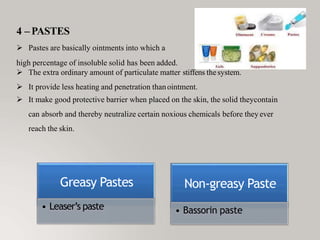
 Pastes are basically ointments into which a
high percentage of insoluble solid has been added.
 The extra ordinary amount of particulate matter stiffens thesystem.
 It provide less heating and penetration thanointment.
 It make good protective barrier when placed on the skin, the solid theycontain
can absorb and thereby neutralize certain noxious chemicals before theyever
reach the skin.
Greasy Pastes
• Leaser’s paste
Non-greasy Paste
• Bassorin paste
INHALED DOSAGE FORMS
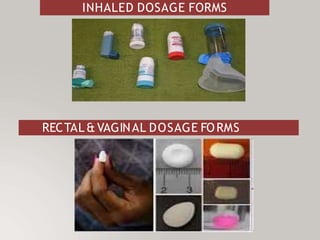
1 – INHALER: Inhalers are solutions, suspensions or emulsion of drugs in a mixture of
inert propellants.
 Release of a dose of the medicament under pressure in an aerosol dispenser in the form of
droplets of 50 um diameter or less from the container through a spring loaded valve
incorporating a metering device.
 It is commonly used in the treatment of asthma and other respiratoryproblems.
2 – NEBULIZER OR ATOMIZER
It is commonly used in treating asthma, and other respiratorydiseases.
It is a device used to administer medication in forms of a liquid mist to the airways.
It pumps air or oxygen through a liquid medicine to turn it into a vapor, which isthen
inhaled by the patient.
Generally prefer to inhalers for patients, due to advantages such as:
1. Cheaper 2. More portable 3.Less risk of side effects.
 For that reason, are usually reserved only for serious cases of respiratory diseaseor
severe attacks.
INHALED DOSAGE FORMS
RECTAL & VAGINAL DOSAGE FORMS
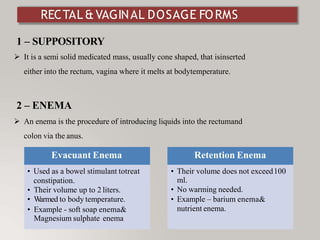
1 – SUPPOSITORY
 It is a semi solid medicated mass, usually cone shaped, that isinserted
either into the rectum, vagina where it melts at bodytemperature.
2 – ENEMA
 An enema is the procedure of introducing liquids into the rectumand
colon via the anus.
Evacuant Enema
• Used as a bowel stimulant totreat
constipation.
• Their volume up to 2 liters.
• W
armed to body temperature.
• Example - soft soap enema&
Magnesium sulphate enema
Retention Enema
• Their volume does not exceed100
ml.
• No warming needed.
• Example – barium enema&
nutrient enema.
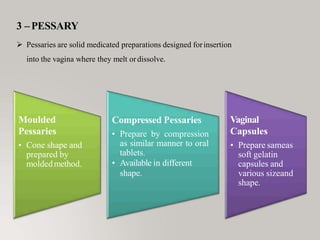
3 –PESSARY
 Pessaries are solid medicated preparations designed forinsertion
into the vagina where they melt ordissolve.
Moulded
Pessaries
• Cone shape and
prepared by
moldedmethod.
Compressed Pessaries
• Prepare by compression
as similar manner to oral
tablets.
• Available in different
shape.
Vaginal
Capsules
• Prepare sameas
soft gelatin
capsules and
various sizeand
shape.
1. Dosage form.pptx

1. Dosage form.pptx

  • 1.
    DOSAGE FORM Prepared by: Ms.Ayesha N. Shaikh Assistant Professor (Department of Pharmaceutics)
  • 2.
    1. Introduction 2. Classificationof dosage forms  Solid dosage forms  Liquid dosage forms  Semi solid dosage forms 3. New drug delivery system Contents
  • 3.
    DOSAGE FORM OFDRUGS Dosage forms are the means by which drug molecules/APIs are delivered to sites of action within the body to produce optimum desired effects and minimum adverseeffect. Need of Dosage Forms Drug Safety/Benefit Patient Safety/Benefit
  • 4.
    Dosage form (Medicines)= API +Excipients The means (or the form) by which drug molecules are delivered to sites of action within the body. Drug (Active pharmaceutical ingredients) Chemical compound intended for used in diagnosis, treatment prevention, of disease. OR TheActive Pharmaceutical Ingredient (API) is the part of any drug that produces its effects. Excipients o Do not increase or affect the therapeutic action of the active ingredient. O Inactive ingredients may also be referred to as inert ingredients or excipients, and generally have no pharmacological effect. O Examples of inactive ingredients include binding materials, dyes, preservatives, and flavoring agents,sweetening agents,coloring agents etc. INTRODUCTION
  • 5.
    NEED OF DOSAGEFORMS  Provide safe and convenient delivery of accurate dosage. Example – T ablets, capsules,syrups  Protection of a drug substances from atmospheric oxygen or moisture. Example – Coated capsules, sealed ampules  Protection of a drug substances from gastric acid after oral administration. Example – Enteric coated tablets  Conceal bitter taste, or odor of a drug substances. Example – Capsules, coated tablets, flavored syrups  Provide liquid preparation of drug that insoluble or unstable in the desired vehicle. Example – Suspension  Provide liquid dosage forms of substances soluble in desired vehicle. Example – Solution.
  • 6.
     Provide optionaldrug action from topical administration sites. Example – Ointment, cream, ear and nasal preparations.  Provide for insertion of a drug into one of the body’s orifices. Example – Rectal and vaginal suppositories.  Provide extended drug action through controlled release mechanisms. Example – Controlled release tablets, capsules,suspensions.  Provide for the placement of drugs within body tissues. Example – Implants.  Provide for the optimal drug action through inhalation therapy. Example – Inhalants.
  • 7.
    CLASSIFICATION OF DOSAGEFORMS Based on Route of Administration Oral Parenteral Topical Transdermal Respiratory/Inhaled Ophthalmic Rectal Veginal Otic Based on Physical Form Solid Semi-solid Liquid Gases
  • 8.
    Enteral Route Oral Tablets, Capsules,Syrups, Suspension, Emulsionetc. Dry Powder Inhaler (DPI), pressurized MeteredDoseInhaler (pMDI) – Nebulizer,Vaporizer Sub-lingual & Buccal Orally Disintegrating Tablet (ODT), Lozenges ,Chewing tablets, Mouthwash, Toothpaste, Ointment, Oral spray Rectal & Vaginal Ointment, Suppository, Enema, Nutrientenema Parenteral (injections &infusions) Intravenous, Intramuscular, Intracardiac, Intraosseous, Intraperitoneal, Intracerebral,Intrathecal, Intradermal,Subcutaneous Topical Route Dermal Ointment, Liniment, Paste, Cream, Lotion, Lip balm,Medicated shampoo, Dermalpatch Mucosal Ear drops, Eye drops, Nasal spray, Ointment, Hydrogel, Nanosphere suspension, Mucoadhesive microdisc(microsphere tablet) Percutaneous Transdermal patchetc Based on Route of administration Based on Route of Administration
  • 9.
    Solid Dosage Forms ShapedTablets, Capsules, Implants,Transdermal patches Unshaped Powders for external/internaluse Semi-solid DosageForms Shaped Suppositories (for rectaladministration) Pessaries (vaginalsuppositories) Unshaped Gels, Creams, Ointments,Pastes Liquid Dosage Forms Monophasic Solutions (syrups, spirits, elixirs,tinctures) Biphasic Emulsions, Suspension External Solutions Lotions, Liniments, Collodionsetc Gaseous DosageForms MedicinalGases Aerosols: Inhalation/volatileanesthetics Aerodispersions Antiasthmatics sprays Based on Physical Form
  • 10.
    CLASSIFICATION Soliddosage forms Liquiddosage forms Semisoliddosage forms Unitdosage forms Tablets Capsule Bulk Powders Pills Internal Fine powders& granules External Dustingpowders Insufflations Dentifrice Snuffs Earpowders Biphasic Monophasic Emulsion Suspension InternalExternal Ointment Creams pastes Jellies Suppositories Pessaries Liniments Lotions Gargles Throat paints Mouth washes Sprays Eye lotions Eye drops External Internal Syrups Elixirs Linctus Drops
  • 11.
    CLASSIFICATION OF SOLIDS SOLIDORAL DOSAGE FORMS Tablets Capsules Powder Granules
  • 12.
    Monophasic Liquid DosageForms LiquidforExternal administration Liquidsused in Mouth Liquid appliedto the skin Liquidsinstilled into Body Cavities Liquid forInternal administration - Syrups - Mixtures - Elixirs - Linctuses - Gargles - Mouthwashes - Throat paints - Lotions - Liniments - Collodions - Paints - EyeDrops - EarDrops - NasalDrops - Douches - Enemas CLASSIFICATION OF LIQUIDS
  • 13.
    BIPHASIC LIQUID DOSAGE FORMS SolidsinLiquid Oral Parenteral External Liquid inLiquid Oral External SUSPENSION LOTION EMULSION LINIMENTS
  • 14.
  • 15.
    Nose Lung Inhalation Gases Liquids AerosolsSolids Liquids Aerosols Semi- solids Solids V apors Medicalgases Solution Suspension Emulsion MDIs DPIs Other pressure systems DPIs Solution Suspension Emulsion MDIs Gels Powders for inhalation INHALED DOSAGE FORMS
  • 16.
    RECTAL & VAGINALDOSAGE FORMS RECT AL& VAGINAL Suppository Enema Pessaries
  • 17.
    SOLID DOSAGE FORMS 1-TABLET  Atablet is unit dose of one or more medicament. Prepare by compressionor mould method.  Common excipients used in tablet are:  Diluents – Provide bulkiness oftablet.  Disintegrants – T oensure that the tablet breaks up in the digestivetract.  Binder – Important for granulation ofpowder.  Glidants and Lubricants – Provide good flow and ensure efficienttabletting.  Sweeteners and Flavors – Tomask the tasteofAPIs.  Pigments – T omask uncoated tablets visuallyattractive.  Acoating may be applied to mask taste, smooth tablet for easy swallow,expending shelf life, and prevent gastric degradation ofdrug.
  • 18.
    2 - BUCCALAND SUBLINGUAL TABLET Buccal tablets placing between the gum and thecheek. Sublingual tablets placing under thetongue. Medicaments of both systems rapidly dissolve in mouth and absorbed throughthe mucous membrane of mouth. Drug reaches in systemic circulation without affecting by gastric juicesand metabolizing enzymes of the liver. Examples – Vasodilators, Steroidal hormones.
  • 19.
    3 - EFFERVESCENTTABLET  Effervescent tablets are uncoated and generally contain acid substances(citric and tartaric acids) and carbonates or bicarbonates , which react rapidly in presence of water and release carbon dioxide.  They are intended to be dissolved or dispersed in water before use, it provide:  Tablet immediately dissolve ordispersed  Pleasant taste of carbonated drink 4 - CHEWABLETABLET  They are tablets that chewed prior to swallowing.  They are designed for administration to children e.g. vitamin products.
  • 20.
    5 -CAPSULES  Solidunit dosage form that contain a solid, semi-solid, and liquid fill and agelatin shell.  Common excipients used in capsules are :  Gelatin – Commonly used as gellingagent.  Plasticizers – Toensure elasticity or mechanical stability.  AdditionalAdditives – Preservative, coloring and opacifying agents.  They are mainly two types are :  Hard gelatin capsules used for dry powderingredients.  Soft gelatin capsules used for semi-solid and for active ingredients that are dissolved or suspended in oil. 6 – LOZENGES  It is a solid preparation that used to medicate the mouth and throat for the slow administration of indigestion or cough remedies.  It consisting of sugar and gum, the latter giving strength and cohesiveness to the lozenge and facilitating slow release of themedicament.
  • 21.
    7 - PASTILLES It is a solid medicated pill or candy preparation that design to dissolveslowly in the mouth.  They are softer than lozenge and their base are glycerol, gelatin, acacia andsugar. 8 – DENTAL CONES  A tablet from intended to be placed in the empty socket following a toothextraction, for preventing the local multiplication of pathogenic bacteria associated with tooth extractions.  These tablets contain an excipients like – lactose, sodium bicarbonate,andsodium chloride etc.  Cones may contain an antibiotic or antiseptic. 9 - PILLS  It is a solid oral dosage form which consists of spherical masses preparedfrom one or moreAPIs with inert excipients.  Pills are now rarely used.
  • 22.
    10 – ORALGRANULES  They are consisting of solid, dry aggregates of powder particles with irregular shape often supplied in single-dosesachets.  Some granules are placed under the tongue and swallowed with water andother are intended to be dissolved in water beforetaking.  Effervescent granules evolve carbon dioxide when added towater. 11– ORALPOWDER  Bulk Powders are multi dose preparations consisting of solid, loose, dry particlesof varying degrees of fineness.  Contain one or more active ingredients, with or without excipients and, if necessary, coloring matter and flavoring substances.  Usually contain non-potent medicaments such as antacids since the patientmeasures a dose by volume using a 5 ml medicine spoon.
  • 23.
    LIQUID DOSAGE FORMS 1– ORAL SOLUTION: Oral solutions are clear Liquid preparations for oral use containing one or more active ingredients dissolved in a suitablevehicle. 2 – ORAL EMULSION: Oral emulsions are stabilized oil-in-water dispersions, either or both phases of which may contain dissolved solids either oil is dispersed in finely divided form in water or vice versa. 3 – ORAL SUSPENSION: Biphasic liquid preparations for oral use containing one or more active ingredients suspended in a suitable vehicle. It sediment which is readily dispersed on shaking to give a uniform suspension which remains sufficiently stable to enable the correct dose to be delivered. 4- SYRUPS: It is a concentrated aqueous solution of a sugar, usually sucrose to which medicaments are added. Flavoured syrups are a convenient form of masking disagreeable tastes. 5 – ELIXIR: It is pleasantly flavoured clear liquid oral preparation of potent or nauseous drugs. The vehicle may contain a high proportion of ethanol or sucrose together with antimicrobial preservatives which confers the stability of the preparation. 6 – MOUTHWASHES: These are similar to gargles but are used for oral hygiene and to treatinfections of the mouth.
  • 24.
    7- LINCTUSES:It isviscous, liquid oral preparations that are usually prescribed for th relief of cough. It contain high proportion of syrup and glycerol which have a demulcent effec on the membranes of the throat.The dose volume is small (5ml) and, to prolong the demulcen action, they should be taken undiluted. 8 – ORAL DROPS:Oral drops are liquid preparations for oral use that are intended to be administered in small volumes with the aid of a suitable measuring device.They may be solutions, suspensions oremulsions. 9- GARGLES: They are prepared in a concentrated solution with directions for the patient to dilute with warm water before use. They are aqueous solutions used in the prevention or treatment of throat infections. 10 – LOTIONS: It is mono-phasic liquid preparations (aqueous) for external application without friction either dabbed on the skin or applied on a suitable dressing and covered with a water proof dressing to reduceevaporation. 11 – NASAL DROPS & SPRA YS: Drugs in aqueous solution may be instilled into the nose from a dropper or from a plastic squeeze bottle. Used for local effect, e.g. antihistamine,decongestant.
  • 25.
    12- COLLODION:Collodion isa solution of nitro cellulose in ether or acetone, some times with the addition of alcohols. As the solvent evaporates, it dries to a celluloid-like film. It is highly flammable.  Compound Wart Remover consists of acetic acid and salicylic acidinan acetone collodion base used in treatment of warts byKeratolysis. 13– PAINTS: Paints are mono-phasic liquids for application to the skin or mucous membranes. Skin paints contain volatile solvent that evaporates quickly to leave adry resinous film of medicament. Throat paints are more viscous due to a high content of glycerol thatdesigned to prolong contact of the medicament with the affectedsite.
  • 26.
    PARENTERAL DOSAGE FORMS Aninjection is an infusion method of putting liquid in to the body, usuallywitha hollow needle and a syringe which is pierced through theskin. • Intravenous Injection • It is aliquidadministered directlyinto thebloodstream viaavein. • It is advantages when arapid onset of action isneeded. • IntramuscularInjection • Itis theinjection ofaAPIs directly into amuscle. • Intramuscularinjections are often givenin thedeltoid,vastus lateralis,ventroglutealanddorsoglutealmuscles. • SubcutaneousInjection • It is injecting into thesubcutis,thelayer of skin directlybelowthe dermis and epidermis. • Itis highlyeffectiveinadministeringvaccines andinsulin.
  • 27.
    SEMI-SOLID DOSAGE FORMS 1– OINTMENTS: Ointments are semi-solid, greasy preparations for application to the skin, rectumor nasal mucosa.  Base is usually anhydrous and immiscible with skinsecretions.  Ointments may be used as emollients or dissolved medicaments to theskin. 2 – GELS: In gel a liquid phase is constrained with in a 3-D polymeric matrix (consistingof natural or synthetic gum) having a high degree of physical or chemical cross- linking.  It is used for medication, lubrication and some miscellaneous applicationslike carrier for spermicidal agents to be used intra vaginally. 3 –CREAMS Oil-in-water(O/W) Water-in-oil (W/O) • It composed of small dropletsof oil dispersed in a continuous aqueous phase. • Less greasy and moreeasily washed off usingwater. • It composed of small droplets of water dispersed in a continuous oily phase. • More difficult to handle butused for hydrophobic drugpreparation. • Reduces water loss fromthe stratum corneum maintain moisture of skin.
  • 28.
    4 – PASTES Pastes are basically ointments into which a high percentage of insoluble solid has been added.  The extra ordinary amount of particulate matter stiffens thesystem.  It provide less heating and penetration thanointment.  It make good protective barrier when placed on the skin, the solid theycontain can absorb and thereby neutralize certain noxious chemicals before theyever reach the skin. Greasy Pastes • Leaser’s paste Non-greasy Paste • Bassorin paste
  • 29.
    INHALED DOSAGE FORMS 1– INHALER: Inhalers are solutions, suspensions or emulsion of drugs in a mixture of inert propellants.  Release of a dose of the medicament under pressure in an aerosol dispenser in the form of droplets of 50 um diameter or less from the container through a spring loaded valve incorporating a metering device.  It is commonly used in the treatment of asthma and other respiratoryproblems. 2 – NEBULIZER OR ATOMIZER It is commonly used in treating asthma, and other respiratorydiseases. It is a device used to administer medication in forms of a liquid mist to the airways. It pumps air or oxygen through a liquid medicine to turn it into a vapor, which isthen inhaled by the patient. Generally prefer to inhalers for patients, due to advantages such as: 1. Cheaper 2. More portable 3.Less risk of side effects.  For that reason, are usually reserved only for serious cases of respiratory diseaseor severe attacks.
  • 30.
    INHALED DOSAGE FORMS RECTAL& VAGINAL DOSAGE FORMS
  • 31.
    RECTAL & VAGINALDOSAGE FORMS 1 – SUPPOSITORY  It is a semi solid medicated mass, usually cone shaped, that isinserted either into the rectum, vagina where it melts at bodytemperature. 2 – ENEMA  An enema is the procedure of introducing liquids into the rectumand colon via the anus. Evacuant Enema • Used as a bowel stimulant totreat constipation. • Their volume up to 2 liters. • W armed to body temperature. • Example - soft soap enema& Magnesium sulphate enema Retention Enema • Their volume does not exceed100 ml. • No warming needed. • Example – barium enema& nutrient enema.
  • 32.
    3 –PESSARY  Pessariesare solid medicated preparations designed forinsertion into the vagina where they melt ordissolve. Moulded Pessaries • Cone shape and prepared by moldedmethod. Compressed Pessaries • Prepare by compression as similar manner to oral tablets. • Available in different shape. Vaginal Capsules • Prepare sameas soft gelatin capsules and various sizeand shape.