DOPAMINE
DR HARI RAM SEDAI
1ST
YEAR RESIDENT
PSYCHIATRY/NMCTH
Content
Introduction
Dopamine synthesis
Dopamine receptors
Dopamine pathways
Disorder of Dopamine Pathways
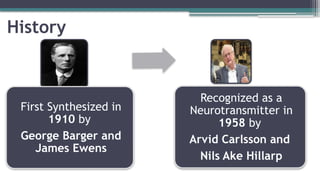
History
First Synthesized in
1910 by
George Barger and
James Ewens
Recognized as a
Neurotransmitter in
1958 by
Arvid Carlsson and
Nils Ake Hillarp
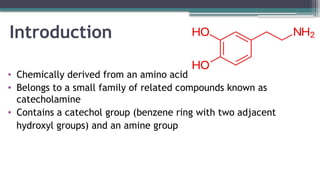
Introduction
• Chemically derived from an amino acid
• Belongs to a small family of related compounds known as
catecholamine
• Contains a catechol group (benzene ring with two adjacent
hydroxyl groups) and an amine group
Majority of dopaminergic innervation in the
brain is provided by long projection neurons
arising from:
• Midbrain (mesencephalon)
• Substantia nigra
• Ventral tegmental area
Dopaminergic sites
 Brain
• Midbrain
• Substantia nigra
• Ventral tegmental area
• Periaqueductal gray
• Hypothalamus
 Outside Brain
• Olfactory bulb
• Retina
• Kidney (Adrenal medulla)
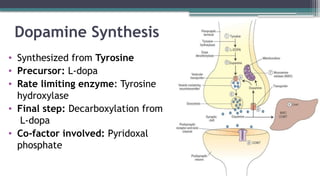
Dopamine Synthesis
• Synthesized from Tyrosine
• Precursor: L-dopa
• Rate limiting enzyme: Tyrosine
hydroxylase
• Final step: Decarboxylation from
L-dopa
• Co-factor involved: Pyridoxal
phosphate
• Tyrosine is derived from dietary protein & Phenylaline metabolism
• Enters brain by Large neutral amino acid (LNAA) metabolism
• In cytosol: Tyrosine converted to L-dopa by tyrosine hydroxylase
• Next step: Decrboxylation of L-dopa by aromatic amino acid
decarboxylase (AADC)
• AADC decarboxylates L-dopa so avidly that the level of this amino
acid in the brain is very low under normal conditions
Transportation
• VMAT2: Storage and release
• DAT: Reuptake
• Presynaptic D2 Auto receptor:
Regulates release of DA
Vesicular Transport
• Vesicles in presynaptic terminal is specialized for the uptake and
storage of catecholamines by enzyme Monoamine oxidase (MAO)
found in mitochondria
• Vesicular monoamine transporter (VMAT)- accumulation and
concentration of catecholamine transmitters inside the vesicles
2 Forms:
• VMAT-1- expressed in extraneuronal tisuue - chromaffin cells
• VMAT-2- neuronal cells of cns, pns, enteric nervous system
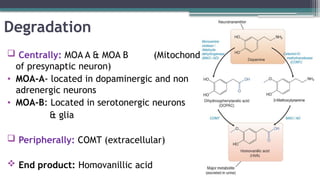
Degradation
 Centrally: MOA A & MOA B (Mitochondria
of presynaptic neuron)
• MOA-A- located in dopaminergic and non
adrenergic neurons
• MOA-B: Located in serotonergic neurons
& glia
 Peripherally: COMT (extracellular)
 End product: Homovanillic acid
Monoamine Oxidase (MAO)
• Located on outer membrane of mitochondria
• MAO-A & MAO-B (Major form)
• Dopamine and norepinephrine are effective substrates for both
forms
• Serotonin is a preferential substrate for MAO-A
• MAO-B inhibitor that is used in the treatment of Parkinson disease,
usually in combination with L-dopa to prolong or enhance the
effect of dopamine formed from L-dopa
Catechol-O-Methyl Transferase (COMT)
• Membrane bound form has higher affinity for catecholamines
• COMT plays a more significant role in dopamine metabolism in the
prefrontal cortex
• COMT inhibitors- Tolcapone and Entacapone, are used as adjuncts
to L-dopa in the treatment of Parkinson disease to slow L-dopa
metabolism and thereby prolong its effects
Dopamine Receptors
 D1 like
• D1 & D5
• Nigrostriatal, mesolimbic, and mesocortical system
 D2 like
• D2, D3, D4
• Striatum and nucleus accumbens
 D1 like Dopamine receptors
• Activate the Gs family of G proteins
• Increase adenylate cyclase activity
• Found postsynaptically on dopamine-receptive cells
 D2-like Dopamine receptors
• Couple to the Gi family
• Inhibit adenylate cyclase activity
• Expressed both postsynaptically on dopamine-receptive cells &
presynaptically on dopaminergic neurons
AADC: Aromatic amino acid
decarboxylase
AC: Adenylate cyclase
COMT: Catechol-O-
methyltransferase
DOPAC: Dihydroxyphenylacetic acid
HVA: Homovanillic acid
MAO: Monoamine oxidase
VMAT: Vesicular monoamine
transporter.
Schematic model of a dopaminergic synapse with sites of drug action
Dopaminergic Pathways
Nigrostriatal Pathway
Mesolimbic Pathway
Mesocortical Pathway
Tuberoinfundibular Pathway
Mesolimbic Pathway
• Carries dopamine from the Midbrain Ventral Tegmental Area to the
Nucleus Accumbens via amygdala and hippocampus
• Motivations, pleasure, reward
• Positive symptoms (hallucinations, delusions) of schizophrenia
• Positive symptoms (Impulsive, agitation, aggressive & hostile) of
psychosis
Mesocortical Pathway
• Projects from Ventral Tegmental Area to Prefrontal Cortex
• Regulates motivation, concentration and initiation of goal-
directed and complex executive cognitive tasks
• Believed to be involved in the negative, cognitive and affective
symptoms of schizophrenia
Nigrostriatal Pathway
• Projects from Substantia Nigra (Pars compacta) to Striatum (Caudate
& putamen)
• It is part of the extrapyramidal nervous system and plays a key role in
regulating movements
• When dopamine is deficient, it can cause parkinsonism with tremor,
rigidity, and akinesia/bradykinesia
• When DA is in excess, it can cause hyperkinetic movements like tics
and dyskinesias.
Tubulofundibular Pathway
• Projects from Arcuate Nucleus and
the Periventricular area of
Hypothalamus to Infundibulum and
Anterior pituitary
• It regulates prolactin secretion into
circulation by inhibiting prolactin
secretion Anterior Pituitary
Infundibulum
Hypothalamus
Reward Pathway
• The dopaminergic pathway mostly involved in reward is Mesolimbic
System
• Formed by projections of midbrain dopamine neurons of the ventral
tegmental area (VTA) to the striatum, prefrontal cortex, amygdala,
hippocampus
• When rewarding stimuli are experienced, the dopaminergic
mesolimbic system is activated which causes the release of
dopamine to the targeted nuclei
• The ventral striatum, including the nucleus accumbens (NAcc), is
a major substrate involved in reward pathway
• The dorsal striatum is critically involved in action selection and
initiation components of decision making
• Mediates feedback properties such as valiance and magnitude in
addition to controlling habitual behaviour
Parkinson disease
• Degeneration of dopaminergic neurons in the substantia nigra
• Dysfunction in dorsal striatal dopamine transmission
• Hypokinesia, rigidity, and tremor originate from a loss of striatal
dopaminergic innervation
Schizophrenia
• Excessive dopamine activity in striatal and limbic regions
• Psychosis symptoms of schizophrenia were associated with
increased dorsal/associative striatum dopamine release
• Negative symptoms and cognitive impairments were associated
with reductions in cortical and ventral/limbic striatal dopamine
release
ADHD
• Dysfunction of dopaminergic neurotransmission in limbic and cortical
regions
• Less than optimal stimulation of Postsynaptic D1 receptors by Dopamine
in Prefrontal cortex
• Deficiency in dopamine levels, which affects their ability to experience
reward and motivation
• This deficiency can lead to difficulties in focusing, completing tasks, and
regulating behaviour
References
• Kaplan & Sadock’s Comprehensive Textbook Of Psychiatry, 11th
edition
• Stahl's Essential Psychopharmacology: Neuroscientific Basis and
Practical Applications 4th Edition
• Textbook of Medical Physiology, Guyton and Hall, 12th edition
DOPAMINE
DOPAMINE

DOPAMINE

  • 1.
    DOPAMINE DR HARI RAMSEDAI 1ST YEAR RESIDENT PSYCHIATRY/NMCTH
  • 2.
  • 3.
    History First Synthesized in 1910by George Barger and James Ewens Recognized as a Neurotransmitter in 1958 by Arvid Carlsson and Nils Ake Hillarp
  • 4.
    Introduction • Chemically derivedfrom an amino acid • Belongs to a small family of related compounds known as catecholamine • Contains a catechol group (benzene ring with two adjacent hydroxyl groups) and an amine group
  • 5.
    Majority of dopaminergicinnervation in the brain is provided by long projection neurons arising from: • Midbrain (mesencephalon) • Substantia nigra • Ventral tegmental area
  • 6.
    Dopaminergic sites  Brain •Midbrain • Substantia nigra • Ventral tegmental area • Periaqueductal gray • Hypothalamus  Outside Brain • Olfactory bulb • Retina • Kidney (Adrenal medulla)
  • 7.
    Dopamine Synthesis • Synthesizedfrom Tyrosine • Precursor: L-dopa • Rate limiting enzyme: Tyrosine hydroxylase • Final step: Decarboxylation from L-dopa • Co-factor involved: Pyridoxal phosphate
  • 8.
    • Tyrosine isderived from dietary protein & Phenylaline metabolism • Enters brain by Large neutral amino acid (LNAA) metabolism • In cytosol: Tyrosine converted to L-dopa by tyrosine hydroxylase • Next step: Decrboxylation of L-dopa by aromatic amino acid decarboxylase (AADC) • AADC decarboxylates L-dopa so avidly that the level of this amino acid in the brain is very low under normal conditions
  • 9.
    Transportation • VMAT2: Storageand release • DAT: Reuptake • Presynaptic D2 Auto receptor: Regulates release of DA
  • 10.
    Vesicular Transport • Vesiclesin presynaptic terminal is specialized for the uptake and storage of catecholamines by enzyme Monoamine oxidase (MAO) found in mitochondria • Vesicular monoamine transporter (VMAT)- accumulation and concentration of catecholamine transmitters inside the vesicles 2 Forms: • VMAT-1- expressed in extraneuronal tisuue - chromaffin cells • VMAT-2- neuronal cells of cns, pns, enteric nervous system
  • 11.
    Degradation  Centrally: MOAA & MOA B (Mitochondria of presynaptic neuron) • MOA-A- located in dopaminergic and non adrenergic neurons • MOA-B: Located in serotonergic neurons & glia  Peripherally: COMT (extracellular)  End product: Homovanillic acid
  • 12.
    Monoamine Oxidase (MAO) •Located on outer membrane of mitochondria • MAO-A & MAO-B (Major form) • Dopamine and norepinephrine are effective substrates for both forms • Serotonin is a preferential substrate for MAO-A • MAO-B inhibitor that is used in the treatment of Parkinson disease, usually in combination with L-dopa to prolong or enhance the effect of dopamine formed from L-dopa
  • 13.
    Catechol-O-Methyl Transferase (COMT) •Membrane bound form has higher affinity for catecholamines • COMT plays a more significant role in dopamine metabolism in the prefrontal cortex • COMT inhibitors- Tolcapone and Entacapone, are used as adjuncts to L-dopa in the treatment of Parkinson disease to slow L-dopa metabolism and thereby prolong its effects
  • 14.
    Dopamine Receptors  D1like • D1 & D5 • Nigrostriatal, mesolimbic, and mesocortical system  D2 like • D2, D3, D4 • Striatum and nucleus accumbens
  • 15.
     D1 likeDopamine receptors • Activate the Gs family of G proteins • Increase adenylate cyclase activity • Found postsynaptically on dopamine-receptive cells  D2-like Dopamine receptors • Couple to the Gi family • Inhibit adenylate cyclase activity • Expressed both postsynaptically on dopamine-receptive cells & presynaptically on dopaminergic neurons
  • 17.
    AADC: Aromatic aminoacid decarboxylase AC: Adenylate cyclase COMT: Catechol-O- methyltransferase DOPAC: Dihydroxyphenylacetic acid HVA: Homovanillic acid MAO: Monoamine oxidase VMAT: Vesicular monoamine transporter. Schematic model of a dopaminergic synapse with sites of drug action
  • 18.
    Dopaminergic Pathways Nigrostriatal Pathway MesolimbicPathway Mesocortical Pathway Tuberoinfundibular Pathway
  • 20.
    Mesolimbic Pathway • Carriesdopamine from the Midbrain Ventral Tegmental Area to the Nucleus Accumbens via amygdala and hippocampus • Motivations, pleasure, reward • Positive symptoms (hallucinations, delusions) of schizophrenia • Positive symptoms (Impulsive, agitation, aggressive & hostile) of psychosis
  • 21.
    Mesocortical Pathway • Projectsfrom Ventral Tegmental Area to Prefrontal Cortex • Regulates motivation, concentration and initiation of goal- directed and complex executive cognitive tasks • Believed to be involved in the negative, cognitive and affective symptoms of schizophrenia
  • 22.
    Nigrostriatal Pathway • Projectsfrom Substantia Nigra (Pars compacta) to Striatum (Caudate & putamen) • It is part of the extrapyramidal nervous system and plays a key role in regulating movements • When dopamine is deficient, it can cause parkinsonism with tremor, rigidity, and akinesia/bradykinesia • When DA is in excess, it can cause hyperkinetic movements like tics and dyskinesias.
  • 23.
    Tubulofundibular Pathway • Projectsfrom Arcuate Nucleus and the Periventricular area of Hypothalamus to Infundibulum and Anterior pituitary • It regulates prolactin secretion into circulation by inhibiting prolactin secretion Anterior Pituitary Infundibulum Hypothalamus
  • 24.
    Reward Pathway • Thedopaminergic pathway mostly involved in reward is Mesolimbic System • Formed by projections of midbrain dopamine neurons of the ventral tegmental area (VTA) to the striatum, prefrontal cortex, amygdala, hippocampus • When rewarding stimuli are experienced, the dopaminergic mesolimbic system is activated which causes the release of dopamine to the targeted nuclei
  • 25.
    • The ventralstriatum, including the nucleus accumbens (NAcc), is a major substrate involved in reward pathway • The dorsal striatum is critically involved in action selection and initiation components of decision making • Mediates feedback properties such as valiance and magnitude in addition to controlling habitual behaviour
  • 26.
    Parkinson disease • Degenerationof dopaminergic neurons in the substantia nigra • Dysfunction in dorsal striatal dopamine transmission • Hypokinesia, rigidity, and tremor originate from a loss of striatal dopaminergic innervation
  • 27.
    Schizophrenia • Excessive dopamineactivity in striatal and limbic regions • Psychosis symptoms of schizophrenia were associated with increased dorsal/associative striatum dopamine release • Negative symptoms and cognitive impairments were associated with reductions in cortical and ventral/limbic striatal dopamine release
  • 28.
    ADHD • Dysfunction ofdopaminergic neurotransmission in limbic and cortical regions • Less than optimal stimulation of Postsynaptic D1 receptors by Dopamine in Prefrontal cortex • Deficiency in dopamine levels, which affects their ability to experience reward and motivation • This deficiency can lead to difficulties in focusing, completing tasks, and regulating behaviour
  • 29.
    References • Kaplan &Sadock’s Comprehensive Textbook Of Psychiatry, 11th edition • Stahl's Essential Psychopharmacology: Neuroscientific Basis and Practical Applications 4th Edition • Textbook of Medical Physiology, Guyton and Hall, 12th edition

Editor's Notes

  • #5 Substantia nigra provide a dense input to the --dorsal striatum (caudate nucleus and putamen) VTA principally target-- limbic regions (e.g., nucleus accumbens and septum) , cortical regions (e.g., prefrontal cortex and cingulate cortex)
  • #7 L dopa—decarboxylated to dopamine
  • #9 VMAT- Vesicular monoamine transporter
  • #11 COMT- Catechol-o-methyl transferase
  • #12 MAO-B Inhibitor-selegline & rasagline
  • #17 Tyrosine hydroxylase reaction blocked by the competitive inhibitor, α-methyltyrosine Carbidopa is an inhibitor of AADC that does not cross the blood–brain barrier, and is used in conjunction with L-dopa in the treatment of Parkinson disease Reserpine inhibits VMAT and depletes dopamine stores Bromocriptine and apomorphine are D2 agonists used in the treatment of Parkinson disease Pramipexole is a D3 agonist—Parkinsoim/ restless leg syndrome Low doses of apomorphine have been used experimentally as an autoreceptor agonist cocaine, inhibits the dopamine transporter, and amphetamine increases dopamine release via the transporter Selegiline (Eldepryl) is an MAO-B inhibitor used in the treatment of Parkinson disease Dopamine is a substrate for COMT, an enzyme that is inhibited by tolcapone and entacapone, which are used in treatment of Parkinson disease
  • #20 Hyperactivity---positive symptoms
  • #21 DLPLC (DORSOLATERAL) & VMPFC( VENTROMEDIAL PREFRONTAL CORTEX)