Dopamine
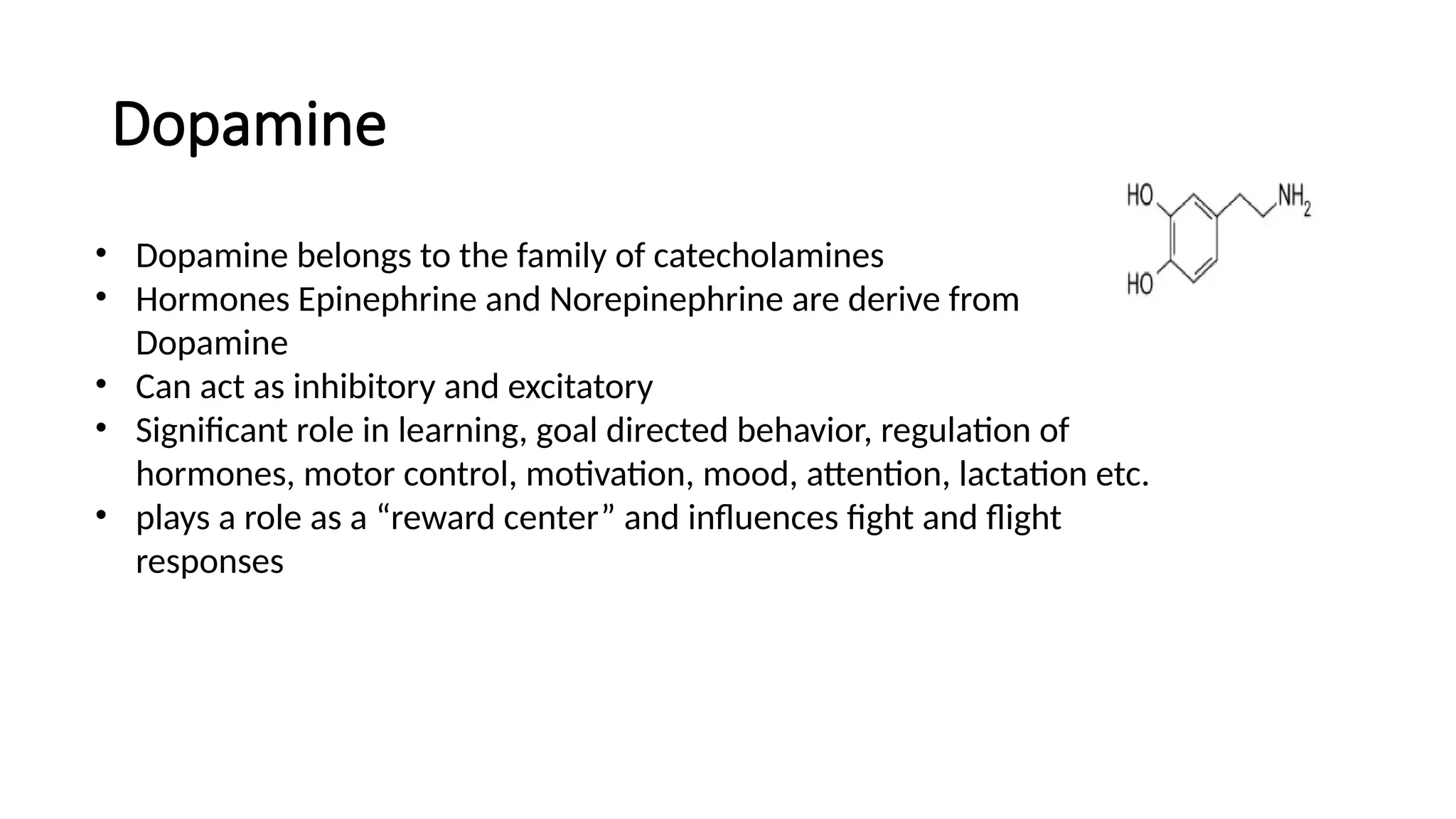
• Dopamine belongs to the family of catecholamines
• Hormones Epinephrine and Norepinephrine are derive from
Dopamine
• Can act as inhibitory and excitatory
• Significant role in learning, goal directed behavior, regulation of
hormones, motor control, motivation, mood, attention, lactation etc.
• plays a role as a “reward center” and influences fight and flight
responses
Synthesis
• produced in several areas of the brain,
including the substantia nigra and the
ventral tegmental area
• It is a neurohormone that is released by the
hypothalamus
• Its action is as a hormone that is an
inhibitor or prolactin release from the
anterior lobe of the pituitary
Transporters
• Membrane spanning protein that pumps
neurotransmitter dopamine out of the synaptic
cleft back into cytosol - where other
transporters sequester the dopamine into
vesicles for storage and later release
• High affinity GA-uptake sites_ terminating
transmitter action and homeostasis
• Use energy provided by Na+  K+ transporting
ATPase
• Recaptures DA soon after it's release,
modulating the concentration in the synapse
• Proton ATPase transporter and VMAT
Metabolism
Receptors
• Dopamine receptors belong to GPCR receptor family- structural
requirement of 7 transmembrane domain
• They have been organized into two families_ the D1-like and the D2-
like receptors __ based upon their effector coupling profile
Dopamine Receptors
D1 and D2 receptors
• D 1 – like family:
• Includes subtypes D 1 and D 5
• Activation is coupled to G α s ; activates adenylyl cylcase which leads to
increase in concentration of cAMP – increases calcium concentration
• D 2 – like family:
• Includes D 2 , D 3 and D 4
• Activation is coupled to G α i ; inhibits adenylyl cyclase leading to decrease in
concentration of cAMP- decreases calcium concentration
Dopamine Receptors
• Postsynaptic Receptors:
• D 1 - like and D 2 – like found in cells postsynaptic to dopamine releasing cells
• Provides a mechanism for feedback between striatum and substantia nigra
• Autoreceptors:
• D 2 - like found in soma, dendrites and nerve terminals
• Stimulation of somatodendritic autoreceptors slows the firing rate while
stimulation of those in nerve terminals inhibits dopamine release and
synthesis
• Synthesis-modulating, release-modulating and impulse-modulating
Mechanism of Action
• Dopamine cells fire in two modes either single spiking or burst firing
• Different rates of firing probably code different response
• At fastest scale, with burst firing dopamine can signal a reward
• At slowest scale, the pacemaker activity of dopamine neurons have
been linked to a tonic function on a variety of motor, coginitive and
motivational processes.
• Low dose (0.5 to 3
mic/kg /min
• Selectively activates
dopamine specific receptors
in the renal and splanchnic
circulation
• Increase blood flow in these
region
• Low dose dopamine also
directly affects renal tubular
epithelial cells
• It causes an increase in
urinary Na excretion
• Intermediate dose(3 to 10
mic /kg /min
• It stimulates B1 receptors in the
heart and peripheral circulation
• Increases myocardial
contractility, increases heart
rate and peripheral
vasodilatation
• It increases myocardial oxygen
demand, so when ever
dopamine is to be used oxygen
must be supplemented
• Over all increase in cardiac
output
• High dose (> 10 mic /kg /
min )
• Dopamine produces a
progressive activation of
alpha receptors in the
systemic and pulmonary
circulation resulting in
progressive pulmonary
and systemic
vasoconstriction
• This vassopressor effect
by virtue of increasing
ventricular afterload
Levels of Dopamine
Dopaminergic pathways
• The mesolimbic pathway (positive
symptoms)
• The mesocortical pathway (negative
symptoms)
• The nigrostriatal pathway
(extrapyramidal symptoms)
• The tuberoinfundibular pathway
(hyperprolactinemia)
Mesolimbic pathway
• The mesolimbic pathway is relevant to positive symptoms of
schizophrenia.
Anatomy:
• This pathway is made up of projections from the ventral tegmental area
that innervate many forebrain areas, the most important is the nucleus
accumbens.
Physiology:
• Research suggests this system plays a key and complex role in
motivation, emotions, reward and positive symptoms of schizophrenia.
Mesocortical Pathway
• Negative and cognitive symptoms of schizophrenia are associated with
hypo function of the mesocortical pathway.
Anatomy:
• This tract is made up of dopaminergic neurons that project from the
ventral tegmental area to the prefrontal cortex.
Physiology:
• The mesocortical pathway is thought to be relevant to the physiology of:
• Cognition and executive function (dorsolateral prefrontal cortex)
• Emotions and affect (ventromedial prefrontal cortex)
Nigrostriatal Pathway
The nigrostriatal dopamine pathway is related to neurological effects
caused by antipsychotics.
• Anatomy:
This tract projects from cell bodies in the pars compacta of the
substantia nigra to terminals that innervate the striatum (caudate and
putamen).
• Physiology:
This pathway is involved in motor planning, dopaminergic neurons
stimulate purposeful movement.
Tuberoinfundibular Pathway
• Dopaminergic projections in the tuberoinfundibular pathway
influence prolactin release.
Anatomy:
• This tract consists of dopaminergic projections from the
hypothalamus to the pituitary gland.
Physiology:
• This is very important, the role of dopamine release in the
tuberoinfundibular pathway is to inhibit prolactin release.
Role of Mesolimbic
Pathway in Reward
System
• NA, Amygdala,
Hippocampus- parts of
mesolimbic pathway.
• Mesolimbic pathway-major
role in reward system
Dopamine Related
Pathologies
Schizophrenia
• A dysregulated dopamine system contributes to the disease's positive,
negative, and cognitive symptoms.
• Hyperactivity of dopamine D2 receptor neurotransmission in
subcortical and limbic brain regions contributes to positive symptoms
of schizophrenia
• Negative and cognitive symptoms of the disorder can be attributed to
hypofunctionality of dopamine D1 receptor neurotransmission in the
prefrontal cortex (Toda & Abi-Dargham, 2007).
Original Dopamine Hypothesis
• dates back to the 1960s
• drugs that increase the amount of dopamine present
in the brain, also simultaneously increase the
symptoms seen in patients suffering from
schizophrenia, especially, hallucinations, delusions,
and paranoia
• hyperactive dopamine transmission results in
schizophrenic symptoms
• effect of the chlorpromazine drug on individuals; it
helped alleviate the symptoms in patients with
schizophrenia. chlorpromazine (Thorazine) blocks
dopamine receptors
Revised Dopamine Hypothesis
• hyperactive dopamine
transmission in the mesolimbic
areas
• hypoactive dopamine
transmission in the prefrontal
cortex
• dopamine dysregulation is also
observed in brain regions
including the amygdala and
prefrontal cortex, which are
important for emotional
processing.
Aberrant Salience
• The most significant way in which
dopamine leads to psychosis.
• A dysregulation, or an excess of
dopamine, often leads an individual
to impart more importance to
stimuli than an individual with a
normal dopamine level would not
do. This phenomenon is called
“aberrant salience”.
• Patients complain of heightened
sensory awareness
Parkinson’s Disease
• complex motor disorder that can cause unintentional or uncontrollable
movements. It typically occurs due to low levels of dopamine in the brain.
• Dopamine: transmits signals between the substantia nigra and the corpus
striatum, known as the nigrostriatal pathway.
• The substantia nigra and corpus striatum form part of the basal ganglia,
which is a group of structures in the brain that help facilitate movement.
• Low levels of dopamine: disrupts the nigrostriatal pathway, cause abnormal
nerve firing patterns, which can result in movement problems.
• Most people with PD lose 60-80% or more of dopamine-producing cells in the
substantia nigra by the time they present symptoms (National Institute of
Neurological Disorders and Stroke, 2014).
Neurons in
substantial
Nigra
Unable to produce
Dopamine
Tremors
Poor Balance
Rigidity and Slowness
ADHD
• Levels of dopamine are different in people
with ADHD than in those without ADHD.
• Neurons in the brains and nervous
systems of people with unmedicated
ADHD have higher concentrations of
proteins called dopamine transporters.
The concentration of these proteins is
known as dopamine transporter density
(DTD).
• A higher DTD results in a lowering of
dopamine levels in the brain, which may
be a risk factor for ADHD. But it isn’t the
diagnostic criteria of ADHD.
Mood Disorders
Learned helplessness model
• rats are subjected to
unpredictable electric shocks.
• found to have decreased
learning of new behavioural
tasks.
• decreased levels of dopamine in
subcortical brain regions
Behavioral despair Model
• involves forcing rats to swim in a
confined space.
• behavioural consequence is
prolonged immobility.
• Dopamine antagonists increase
this immobility, while dopamine
agonists decrease it.
• Decreased mesocortical and mesolimbic dopamine activity has
implications for cognitive and motor disturbances, that are associated
with Depression.
• Increased mesocortical and mesolimbic dopamine activity leads to
mania.
Treatment
• Schizophrenia
Chlorpromazine
Haloperidol (7.5 mg)
• Parkinson’s
Pramipexole ER (1.05-3.05 mg)
Ropinirole (6-24 mg)
• Mood Disorders
BD-1: Olanzapine
MDD: Ziprasidone
Dopamine and Addiction
Drug Addiction
• Reward Center
• Either change generally results in the substance having less of an
effect due to a weaker response by the brain’s reward center.
• Still, the craving to use remains. It just takes more of the drug to
satisfy it.
Effects of Cocaine on Dopamine activity
Pre-Synaptic Cell
Dopamine agonists (DA)
• Dopamine agonists are prescription medications that can be used
alone or in combination with other medications to treat a variety of
conditions that are a result of dopamine loss.
How do dopamine agonists work?
• Medications that work by imitating the actions of dopamine when levels are
low. These medications improve condition-related symptoms by fooling the
brain into thinking dopamine is available.
• mimic the actions of dopamine in the body to aid in symptom relief
• manipulation of dopamine can cause serious side effects including
compulsive behavior and other mental health problems can cause dizziness,
fainting, or sudden sleepiness which is dangerous for tasks that require
alertness like driving
• can cause withdrawal syndrome including sudden high fever, muscle
stiffness, kidney failure, and other problems with sleep, mood, and pain if
stopped abruptly
How do dopamine agonists work? (cont…)
• These medications are not as strong as levodopa-type medications
that are used for Parkinson’s disease, but they don’t have the more
severe uncontrolled movement related side effects, called dyskinesia,
associated with long-term use of levodopa.
• Newer dopamine agonists are helpful for the early treatment of
Parkinson’s disease.
• It’s important to understand that influencing dopamine receptor
actions (up or down) can generate good and bad effects. These
medications do have some serious risks including problems with
impulse control and addiction.
Dopamine receptors
• There are two major groups of dopamine receptors, D1 and D2, with
subgroups under them which are responsible for many behavioral,
hormonal, and muscle related effects in our body.
• The D1 group includes D1 and D5 receptors, and the D2 group includes D2,
3, and 4.
• Each is found in different areas throughout our body and responsible for
important actions from how we move to how we learn. Lack of dopamine in
our cells affects our bodies in many negative ways.
• Dopamine agonists bind to the D1 and D2 group of dopamine receptors in
the brain, copying the effects of the neurotransmitter in order to improve
disorders that happen from low levels.
What are common dopamine agonists and
what do they treat?
• There are two main categories of DA medications,
• Ergoline
• Non-ergoline.
Ergoline DA
• The first generation are ergoline type and are used less often today
since they have some serious heart- and lung-related risks linked with
their use. This is mainly because the older medications attach to any
available dopamine receptors in the body and are not selective.
• Bromocriptine (Parlodel) • Cabergoline.
Non-Ergoline DA
• These newer medications bind to more specific dopamine receptors
and have fewer heart and lung side effects. Non-ergoline dopamine
receptor agonists have higher binding affinity to dopamine D3-
receptors than dopamine D2-receptors
• Apomorphine (Apokyn). • Pramipexole (Mirapex).
• Ropinirole (Requip). • Rotigotine (Neupro).
Side effects from DA medications
• drowsiness
• dizziness
• increased heart rate
• heart valve problems, heart failure
• headache
• dry mouth
• nausea, vomiting, constipation
• heartburn
• runny nose
• increased blood pressure
• low blood pressure
• confusion
• trouble with memory or concentration
• movement-related problems
(dyskinesia)
• fainting
• sudden sleepiness
• paranoia, agitation
• swelling of legs or arms
Risks of dopamine agonist medications
• Heart attack
• Stroke.
• Withdrawal syndrome : It can cause a serious condition called
malignant syndrome (symptoms include high fever, rigidity, loss of
consciousness, and kidney failure). It can also cause severe anxiety,
depression, and sleep and mood problems.
• Hallucinations.
• Increase in psychosis
Dopamine antagonist
• high-affinity antagonist of dopamine receptors.
• typical antipsychotics, neuroleptics, and major tranquilizers
• inhibition of dopamine binding at dopamine D2 receptors
• neurologic side effects appear to be mediated by dopamine
antagonism in the nigrostriatal pathway
• Activity at adrenergic, cholinergic, and histaminic receptors
nigrostriatal pathway
Typical VS Atypical Antipsychotics
• Atypical Antipsychotics are serotonin–dopamine antagonists.
• higher ratio of serotonin type 2 to dopamine D2 receptor blockade
• reduced risk of short- and long-term neurologic side effects and to be
superior in treating negative symptoms of schizophrenia and acute
mania
• Side Effects of Atypical Antipsychotics includes weight gain,
hyperglycemia, and hyperlipidemia
• Typical antipsychotics continue to be used in certain neuropsychiatric
diagnoses, such as Tourette syndrome
Classification of Typical antipsychotics
High-potency antipsychotics
• Haloperidol
• Fluphenazine
• Pimozide
Low-potency antipsychotics
• Chlorpromazine
• Thioridazine
Side Effects
• High-potency antipsychotics (e.g., haloperidol, fluphenazine, pimozide) are
more likely to cause extrapyramidal symptoms
• Low-potency antipsychotics (e.g., chlorpromazine, thioridazine) are more
likely to cause side effects mediated by cholinergic, α1-adrenergic, and
histaminic receptor activity.
• Other side effects include orthostatic hypotension, peripheral anticholinergic
effects (i.e., dry mouth, blurred vision, constipation, urinary retention),
central anticholinergic effects (i.e., agitation, delirium, hallucinations,
seizures, and coma), hyperprolactinemia, leukopenia, agranulocytosis,
jaundice, photosensitivity, decreased seizure threshold, and weight gain.
• Thioridazine has been associated with irreversible retinal pigmentation.
Chlorpromazine has been associated with skin pigmentation and deposits in
the lens and cornea, which usually do not affect vision

Dopamine- the role in psychology and medicine

  • 1.
    Dopamine • Dopamine belongsto the family of catecholamines • Hormones Epinephrine and Norepinephrine are derive from Dopamine • Can act as inhibitory and excitatory • Significant role in learning, goal directed behavior, regulation of hormones, motor control, motivation, mood, attention, lactation etc. • plays a role as a “reward center” and influences fight and flight responses
  • 2.
    Synthesis • produced inseveral areas of the brain, including the substantia nigra and the ventral tegmental area • It is a neurohormone that is released by the hypothalamus • Its action is as a hormone that is an inhibitor or prolactin release from the anterior lobe of the pituitary
  • 3.
    Transporters • Membrane spanningprotein that pumps neurotransmitter dopamine out of the synaptic cleft back into cytosol - where other transporters sequester the dopamine into vesicles for storage and later release • High affinity GA-uptake sites_ terminating transmitter action and homeostasis • Use energy provided by Na+ K+ transporting ATPase • Recaptures DA soon after it's release, modulating the concentration in the synapse • Proton ATPase transporter and VMAT
  • 4.
  • 5.
    Receptors • Dopamine receptorsbelong to GPCR receptor family- structural requirement of 7 transmembrane domain • They have been organized into two families_ the D1-like and the D2- like receptors __ based upon their effector coupling profile
  • 6.
  • 7.
    D1 and D2receptors • D 1 – like family: • Includes subtypes D 1 and D 5 • Activation is coupled to G α s ; activates adenylyl cylcase which leads to increase in concentration of cAMP – increases calcium concentration • D 2 – like family: • Includes D 2 , D 3 and D 4 • Activation is coupled to G α i ; inhibits adenylyl cyclase leading to decrease in concentration of cAMP- decreases calcium concentration
  • 9.
    Dopamine Receptors • PostsynapticReceptors: • D 1 - like and D 2 – like found in cells postsynaptic to dopamine releasing cells • Provides a mechanism for feedback between striatum and substantia nigra • Autoreceptors: • D 2 - like found in soma, dendrites and nerve terminals • Stimulation of somatodendritic autoreceptors slows the firing rate while stimulation of those in nerve terminals inhibits dopamine release and synthesis • Synthesis-modulating, release-modulating and impulse-modulating
  • 10.
    Mechanism of Action •Dopamine cells fire in two modes either single spiking or burst firing • Different rates of firing probably code different response • At fastest scale, with burst firing dopamine can signal a reward • At slowest scale, the pacemaker activity of dopamine neurons have been linked to a tonic function on a variety of motor, coginitive and motivational processes.
  • 11.
    • Low dose(0.5 to 3 mic/kg /min • Selectively activates dopamine specific receptors in the renal and splanchnic circulation • Increase blood flow in these region • Low dose dopamine also directly affects renal tubular epithelial cells • It causes an increase in urinary Na excretion • Intermediate dose(3 to 10 mic /kg /min • It stimulates B1 receptors in the heart and peripheral circulation • Increases myocardial contractility, increases heart rate and peripheral vasodilatation • It increases myocardial oxygen demand, so when ever dopamine is to be used oxygen must be supplemented • Over all increase in cardiac output • High dose (> 10 mic /kg / min ) • Dopamine produces a progressive activation of alpha receptors in the systemic and pulmonary circulation resulting in progressive pulmonary and systemic vasoconstriction • This vassopressor effect by virtue of increasing ventricular afterload Levels of Dopamine
  • 12.
    Dopaminergic pathways • Themesolimbic pathway (positive symptoms) • The mesocortical pathway (negative symptoms) • The nigrostriatal pathway (extrapyramidal symptoms) • The tuberoinfundibular pathway (hyperprolactinemia)
  • 13.
    Mesolimbic pathway • Themesolimbic pathway is relevant to positive symptoms of schizophrenia. Anatomy: • This pathway is made up of projections from the ventral tegmental area that innervate many forebrain areas, the most important is the nucleus accumbens. Physiology: • Research suggests this system plays a key and complex role in motivation, emotions, reward and positive symptoms of schizophrenia.
  • 14.
    Mesocortical Pathway • Negativeand cognitive symptoms of schizophrenia are associated with hypo function of the mesocortical pathway. Anatomy: • This tract is made up of dopaminergic neurons that project from the ventral tegmental area to the prefrontal cortex. Physiology: • The mesocortical pathway is thought to be relevant to the physiology of: • Cognition and executive function (dorsolateral prefrontal cortex) • Emotions and affect (ventromedial prefrontal cortex)
  • 15.
    Nigrostriatal Pathway The nigrostriataldopamine pathway is related to neurological effects caused by antipsychotics. • Anatomy: This tract projects from cell bodies in the pars compacta of the substantia nigra to terminals that innervate the striatum (caudate and putamen). • Physiology: This pathway is involved in motor planning, dopaminergic neurons stimulate purposeful movement.
  • 16.
    Tuberoinfundibular Pathway • Dopaminergicprojections in the tuberoinfundibular pathway influence prolactin release. Anatomy: • This tract consists of dopaminergic projections from the hypothalamus to the pituitary gland. Physiology: • This is very important, the role of dopamine release in the tuberoinfundibular pathway is to inhibit prolactin release.
  • 17.
    Role of Mesolimbic Pathwayin Reward System • NA, Amygdala, Hippocampus- parts of mesolimbic pathway. • Mesolimbic pathway-major role in reward system
  • 18.
  • 19.
    Schizophrenia • A dysregulateddopamine system contributes to the disease's positive, negative, and cognitive symptoms. • Hyperactivity of dopamine D2 receptor neurotransmission in subcortical and limbic brain regions contributes to positive symptoms of schizophrenia • Negative and cognitive symptoms of the disorder can be attributed to hypofunctionality of dopamine D1 receptor neurotransmission in the prefrontal cortex (Toda & Abi-Dargham, 2007).
  • 20.
    Original Dopamine Hypothesis •dates back to the 1960s • drugs that increase the amount of dopamine present in the brain, also simultaneously increase the symptoms seen in patients suffering from schizophrenia, especially, hallucinations, delusions, and paranoia • hyperactive dopamine transmission results in schizophrenic symptoms • effect of the chlorpromazine drug on individuals; it helped alleviate the symptoms in patients with schizophrenia. chlorpromazine (Thorazine) blocks dopamine receptors
  • 21.
    Revised Dopamine Hypothesis •hyperactive dopamine transmission in the mesolimbic areas • hypoactive dopamine transmission in the prefrontal cortex • dopamine dysregulation is also observed in brain regions including the amygdala and prefrontal cortex, which are important for emotional processing.
  • 22.
    Aberrant Salience • Themost significant way in which dopamine leads to psychosis. • A dysregulation, or an excess of dopamine, often leads an individual to impart more importance to stimuli than an individual with a normal dopamine level would not do. This phenomenon is called “aberrant salience”. • Patients complain of heightened sensory awareness
  • 23.
    Parkinson’s Disease • complexmotor disorder that can cause unintentional or uncontrollable movements. It typically occurs due to low levels of dopamine in the brain. • Dopamine: transmits signals between the substantia nigra and the corpus striatum, known as the nigrostriatal pathway. • The substantia nigra and corpus striatum form part of the basal ganglia, which is a group of structures in the brain that help facilitate movement. • Low levels of dopamine: disrupts the nigrostriatal pathway, cause abnormal nerve firing patterns, which can result in movement problems. • Most people with PD lose 60-80% or more of dopamine-producing cells in the substantia nigra by the time they present symptoms (National Institute of Neurological Disorders and Stroke, 2014).
  • 24.
    Neurons in substantial Nigra Unable toproduce Dopamine Tremors Poor Balance Rigidity and Slowness
  • 25.
    ADHD • Levels ofdopamine are different in people with ADHD than in those without ADHD. • Neurons in the brains and nervous systems of people with unmedicated ADHD have higher concentrations of proteins called dopamine transporters. The concentration of these proteins is known as dopamine transporter density (DTD). • A higher DTD results in a lowering of dopamine levels in the brain, which may be a risk factor for ADHD. But it isn’t the diagnostic criteria of ADHD.
  • 26.
    Mood Disorders Learned helplessnessmodel • rats are subjected to unpredictable electric shocks. • found to have decreased learning of new behavioural tasks. • decreased levels of dopamine in subcortical brain regions Behavioral despair Model • involves forcing rats to swim in a confined space. • behavioural consequence is prolonged immobility. • Dopamine antagonists increase this immobility, while dopamine agonists decrease it.
  • 27.
    • Decreased mesocorticaland mesolimbic dopamine activity has implications for cognitive and motor disturbances, that are associated with Depression. • Increased mesocortical and mesolimbic dopamine activity leads to mania.
  • 28.
    Treatment • Schizophrenia Chlorpromazine Haloperidol (7.5mg) • Parkinson’s Pramipexole ER (1.05-3.05 mg) Ropinirole (6-24 mg) • Mood Disorders BD-1: Olanzapine MDD: Ziprasidone
  • 29.
  • 30.
    Drug Addiction • RewardCenter • Either change generally results in the substance having less of an effect due to a weaker response by the brain’s reward center. • Still, the craving to use remains. It just takes more of the drug to satisfy it.
  • 31.
    Effects of Cocaineon Dopamine activity Pre-Synaptic Cell
  • 32.
    Dopamine agonists (DA) •Dopamine agonists are prescription medications that can be used alone or in combination with other medications to treat a variety of conditions that are a result of dopamine loss.
  • 33.
    How do dopamineagonists work? • Medications that work by imitating the actions of dopamine when levels are low. These medications improve condition-related symptoms by fooling the brain into thinking dopamine is available. • mimic the actions of dopamine in the body to aid in symptom relief • manipulation of dopamine can cause serious side effects including compulsive behavior and other mental health problems can cause dizziness, fainting, or sudden sleepiness which is dangerous for tasks that require alertness like driving • can cause withdrawal syndrome including sudden high fever, muscle stiffness, kidney failure, and other problems with sleep, mood, and pain if stopped abruptly
  • 34.
    How do dopamineagonists work? (cont…) • These medications are not as strong as levodopa-type medications that are used for Parkinson’s disease, but they don’t have the more severe uncontrolled movement related side effects, called dyskinesia, associated with long-term use of levodopa. • Newer dopamine agonists are helpful for the early treatment of Parkinson’s disease. • It’s important to understand that influencing dopamine receptor actions (up or down) can generate good and bad effects. These medications do have some serious risks including problems with impulse control and addiction.
  • 35.
    Dopamine receptors • Thereare two major groups of dopamine receptors, D1 and D2, with subgroups under them which are responsible for many behavioral, hormonal, and muscle related effects in our body. • The D1 group includes D1 and D5 receptors, and the D2 group includes D2, 3, and 4. • Each is found in different areas throughout our body and responsible for important actions from how we move to how we learn. Lack of dopamine in our cells affects our bodies in many negative ways. • Dopamine agonists bind to the D1 and D2 group of dopamine receptors in the brain, copying the effects of the neurotransmitter in order to improve disorders that happen from low levels.
  • 36.
    What are commondopamine agonists and what do they treat? • There are two main categories of DA medications, • Ergoline • Non-ergoline.
  • 37.
    Ergoline DA • Thefirst generation are ergoline type and are used less often today since they have some serious heart- and lung-related risks linked with their use. This is mainly because the older medications attach to any available dopamine receptors in the body and are not selective. • Bromocriptine (Parlodel) • Cabergoline.
  • 38.
    Non-Ergoline DA • Thesenewer medications bind to more specific dopamine receptors and have fewer heart and lung side effects. Non-ergoline dopamine receptor agonists have higher binding affinity to dopamine D3- receptors than dopamine D2-receptors • Apomorphine (Apokyn). • Pramipexole (Mirapex). • Ropinirole (Requip). • Rotigotine (Neupro).
  • 39.
    Side effects fromDA medications • drowsiness • dizziness • increased heart rate • heart valve problems, heart failure • headache • dry mouth • nausea, vomiting, constipation • heartburn • runny nose • increased blood pressure • low blood pressure • confusion • trouble with memory or concentration • movement-related problems (dyskinesia) • fainting • sudden sleepiness • paranoia, agitation • swelling of legs or arms
  • 40.
    Risks of dopamineagonist medications • Heart attack • Stroke. • Withdrawal syndrome : It can cause a serious condition called malignant syndrome (symptoms include high fever, rigidity, loss of consciousness, and kidney failure). It can also cause severe anxiety, depression, and sleep and mood problems. • Hallucinations. • Increase in psychosis
  • 41.
    Dopamine antagonist • high-affinityantagonist of dopamine receptors. • typical antipsychotics, neuroleptics, and major tranquilizers • inhibition of dopamine binding at dopamine D2 receptors • neurologic side effects appear to be mediated by dopamine antagonism in the nigrostriatal pathway • Activity at adrenergic, cholinergic, and histaminic receptors nigrostriatal pathway
  • 42.
    Typical VS AtypicalAntipsychotics • Atypical Antipsychotics are serotonin–dopamine antagonists. • higher ratio of serotonin type 2 to dopamine D2 receptor blockade • reduced risk of short- and long-term neurologic side effects and to be superior in treating negative symptoms of schizophrenia and acute mania • Side Effects of Atypical Antipsychotics includes weight gain, hyperglycemia, and hyperlipidemia • Typical antipsychotics continue to be used in certain neuropsychiatric diagnoses, such as Tourette syndrome
  • 43.
    Classification of Typicalantipsychotics High-potency antipsychotics • Haloperidol • Fluphenazine • Pimozide Low-potency antipsychotics • Chlorpromazine • Thioridazine
  • 44.
    Side Effects • High-potencyantipsychotics (e.g., haloperidol, fluphenazine, pimozide) are more likely to cause extrapyramidal symptoms • Low-potency antipsychotics (e.g., chlorpromazine, thioridazine) are more likely to cause side effects mediated by cholinergic, α1-adrenergic, and histaminic receptor activity. • Other side effects include orthostatic hypotension, peripheral anticholinergic effects (i.e., dry mouth, blurred vision, constipation, urinary retention), central anticholinergic effects (i.e., agitation, delirium, hallucinations, seizures, and coma), hyperprolactinemia, leukopenia, agranulocytosis, jaundice, photosensitivity, decreased seizure threshold, and weight gain. • Thioridazine has been associated with irreversible retinal pigmentation. Chlorpromazine has been associated with skin pigmentation and deposits in the lens and cornea, which usually do not affect vision

Editor's Notes

  • #22 Ask, what are the types of delusions? persecutory, erotomanic, grandiose, jealous, somatic, mixed When dopamine creates aberrant salience, things that were merely in the background for the individual will now be their focus. In this way, the noise from a fan could be a voice talking, or the painting of a person could be seen as a threat. The behaviors that were previously just subtle and harmless, could now be perceived as a source of threat or persecution.
  • #24 Neurons in substantia nigra: dopaminergic: responsible for producing dopamine.
  • #25 ADHD: as in doesn’t have dopamine