PERSONAL PROTECTIVE
EQUIPMENT
INTRODUCTION
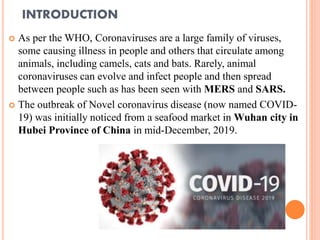
 As per the WHO, Coronaviruses are a large family of viruses,
some causing illness in people and others that circulate among
animals, including camels, cats and bats. Rarely, animal
coronaviruses can evolve and infect people and then spread
between people such as has been seen with MERS and SARS.
 The outbreak of Novel coronavirus disease (now named COVID-
19) was initially noticed from a seafood market in Wuhan city in
Hubei Province of China in mid-December, 2019.
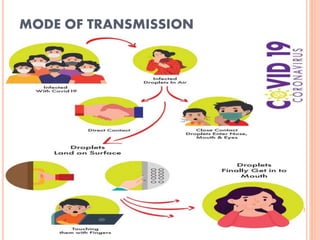
MODE OF TRANSMISSION
STANDARD PRECAUTIONS
OR
STANDARD SAFETY
MEASURES
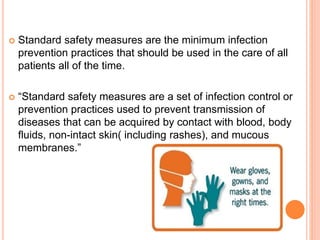
 Standard safety measures are the minimum infection
prevention practices that should be used in the care of all
patients all of the time.
 “Standard safety measures are a set of infection control or
prevention practices used to prevent transmission of
diseases that can be acquired by contact with blood, body
fluids, non-intact skin( including rashes), and mucous
membranes.”
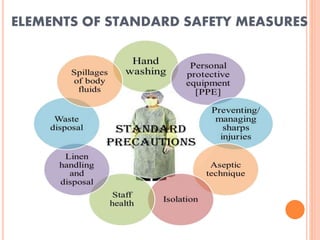
ELEMENTS OF STANDARD SAFETY MEASURES
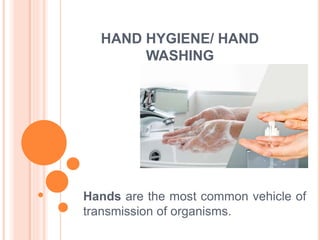
HAND HYGIENE/ HAND
WASHING
Hands are the most common vehicle of
transmission of organisms.
DEFINITION
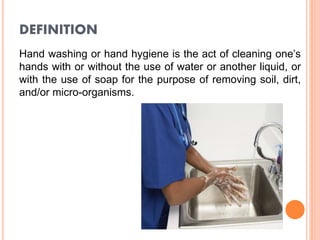
Hand washing or hand hygiene is the act of cleaning one’s
hands with or without the use of water or another liquid, or
with the use of soap for the purpose of removing soil, dirt,
and/or micro-organisms.
PURPOSE
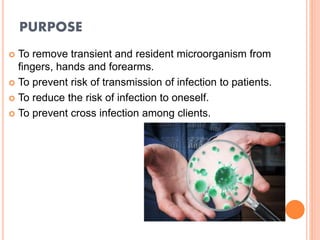
 To remove transient and resident microorganism from
fingers, hands and forearms.
 To prevent risk of transmission of infection to patients.
 To reduce the risk of infection to oneself.
 To prevent cross infection among clients.
INDICATION FOR HAND HYGIENE
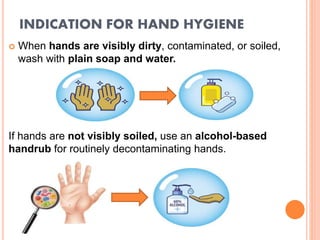
 When hands are visibly dirty, contaminated, or soiled,
wash with plain soap and water.
If hands are not visibly soiled, use an alcohol-based
handrub for routinely decontaminating hands.
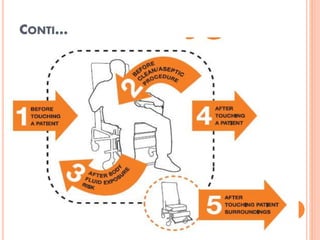
CONTI…
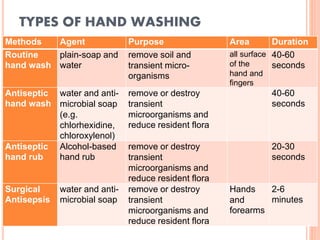
TYPES OF HAND WASHING
Methods Agent Purpose Area Duration
Routine
hand wash
plain-soap and
water
remove soil and
transient micro-
organisms
all surface
of the
hand and
fingers
40-60
seconds
Antiseptic
hand wash
water and anti-
microbial soap
(e.g.
chlorhexidine,
chloroxylenol)
remove or destroy
transient
microorganisms and
reduce resident flora
40-60
seconds
Antiseptic
hand rub
Alcohol-based
hand rub
remove or destroy
transient
microorganisms and
reduce resident flora
20-30
seconds
Surgical
Antisepsis
water and anti-
microbial soap
remove or destroy
transient
microorganisms and
reduce resident flora
Hands
and
forearms
2-6
minutes
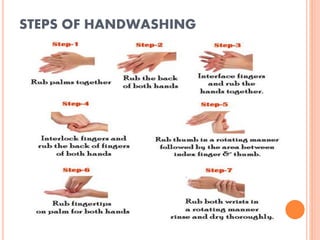
STEPS OF HANDWASHING
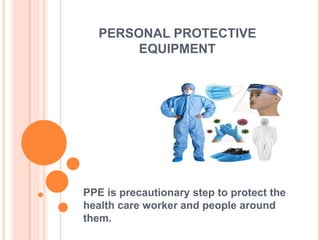
PERSONAL PROTECTIVE
EQUIPMENT
PPE is precautionary step to protect the
health care worker and people around
them.
DEFINITION
 “Personal protective equipment is specialized clothing or
equipment worn by an employee for protection against
dangerous or infectious materials.”
- Occupational safety and health administration
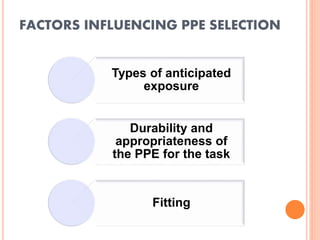
FACTORS INFLUENCING PPE SELECTION
Types of anticipated
exposure
Durability and
appropriateness of
the PPE for the task
Fitting
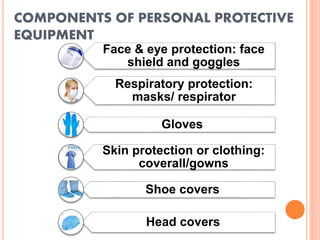
COMPONENTS OF PERSONAL PROTECTIVE
EQUIPMENT
Face & eye protection: face
shield and goggles
Respiratory protection:
masks/ respirator
Gloves
Skin protection or clothing:
coverall/gowns
Shoe covers
Head covers
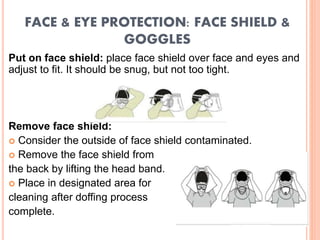
FACE & EYE PROTECTION: FACE SHIELD &
GOGGLES
Put on face shield: place face shield over face and eyes and
adjust to fit. It should be snug, but not too tight.
Remove face shield:
 Consider the outside of face shield contaminated.

 Remove the face shield from
the back by lifting the head band.
 Place in designated area for
cleaning after doffing process
complete.
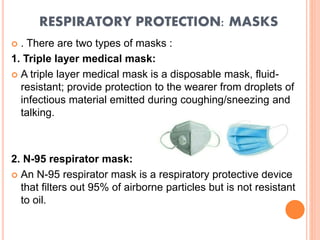
RESPIRATORY PROTECTION: MASKS
 . There are two types of masks :
1. Triple layer medical mask:
 A triple layer medical mask is a disposable mask, fluid-
resistant; provide protection to the wearer from droplets of
infectious material emitted during coughing/sneezing and
talking.
2. N-95 respirator mask:
 An N-95 respirator mask is a respiratory protective device
that filters out 95% of airborne particles but is not resistant
to oil.
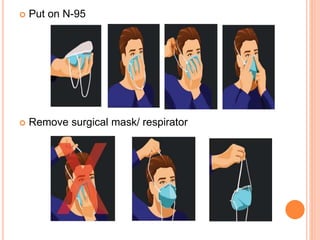
 Put on N-95
 Remove surgical mask/ respirator
GLOVES
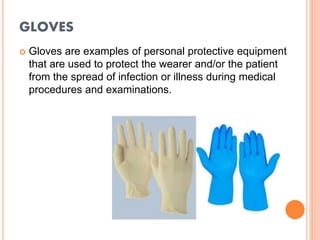
 Gloves are examples of personal protective equipment
that are used to protect the wearer and/or the patient
from the spread of infection or illness during medical
procedures and examinations.
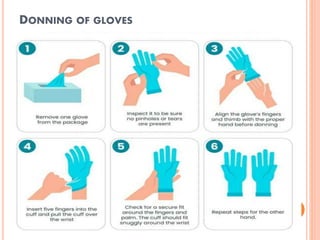
DONNING OF GLOVES
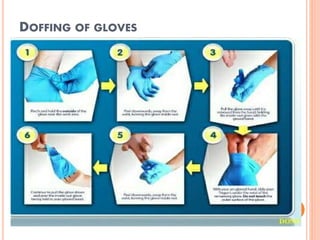
DOFFING OF GLOVES
SKIN PROTECTION OR CLOTHING:
COVERALL/GOWNS
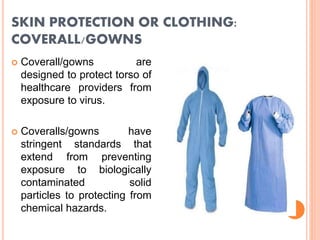
 Coverall/gowns are
designed to protect torso of
healthcare providers from
exposure to virus.
 Coveralls/gowns have
stringent standards that
extend from preventing
exposure to biologically
contaminated solid
particles to protecting from
chemical hazards.
CONTI…
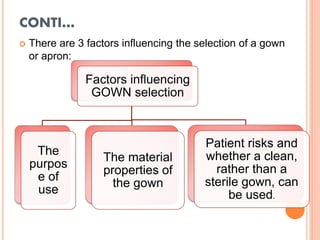
 There are 3 factors influencing the selection of a gown
or apron:
Factors influencing
GOWN selection
The
purpos
e of
use
The material
properties of
the gown
Patient risks and
whether a clean,
rather than a
sterile gown, can
be used.
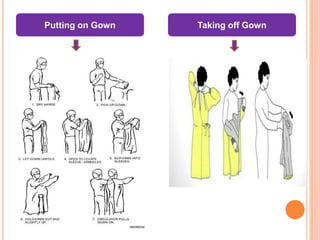
Putting on Gown Taking off Gown
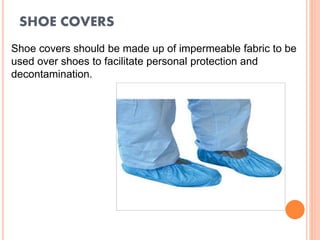
SHOE COVERS
Shoe covers should be made up of impermeable fabric to be
used over shoes to facilitate personal protection and
decontamination.
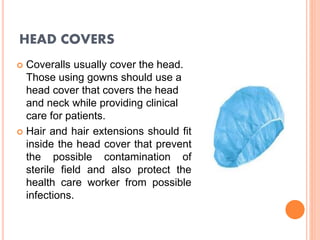
HEAD COVERS
 Coveralls usually cover the head.
Those using gowns should use a
head cover that covers the head
and neck while providing clinical
care for patients.
 Hair and hair extensions should fit
inside the head cover that prevent
the possible contamination of
sterile field and also protect the
health care worker from possible
infections.
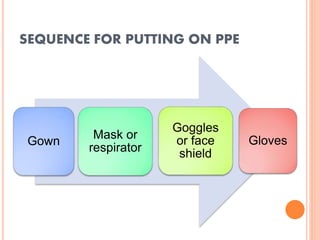
SEQUENCE FOR PUTTING ON PPE
Gown
Mask or
respirator
Goggles
or face
shield
Gloves
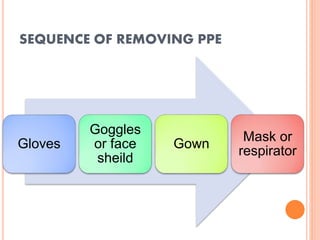
SEQUENCE OF REMOVING PPE
Gloves
Goggles
or face
sheild
Gown
Mask or
respirator
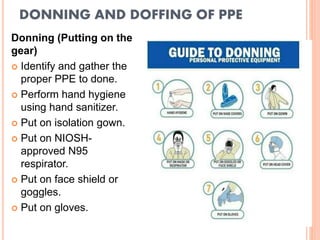
DONNING AND DOFFING OF PPE
Donning (Putting on the
gear)
 Identify and gather the
proper PPE to done.
 Perform hand hygiene
using hand sanitizer.
 Put on isolation gown.
 Put on NIOSH-
approved N95
respirator.
 Put on face shield or
goggles.
 Put on gloves.
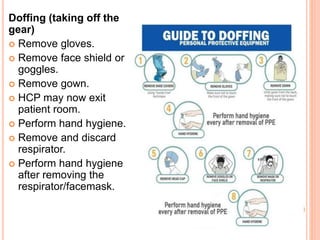
Doffing (taking off the
gear)
 Remove gloves.
 Remove face shield or
goggles.
 Remove gown.
 HCP may now exit
patient room.
 Perform hand hygiene.
 Remove and discard
respirator.
 Perform hand hygiene
after removing the
respirator/facemask.
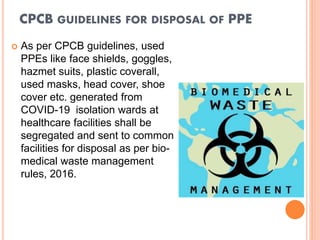
CPCB GUIDELINES FOR DISPOSAL OF PPE
 As per CPCB guidelines, used
PPEs like face shields, goggles,
hazmet suits, plastic coverall,
used masks, head cover, shoe
cover etc. generated from
COVID-19 isolation wards at
healthcare facilities shall be
segregated and sent to common
facilities for disposal as per bio-
medical waste management
rules, 2016.
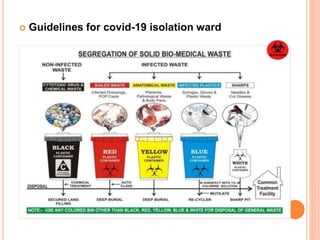
 Guidelines for covid-19 isolation ward
 Keep separate color coded bins (with foot operated
lids)/bags/containers in wards and maintain proper
segregation of waste as per BMWM Rules, 2016
 Use a dedicated collection bin labelled as “COVID-19”
to store COVID-19 waste
 The (inner and outer) surface containers/bins/trolleys
used for storage of COVID-19 waste should be
disinfected with 1% sodium hypochlorite solution
daily.
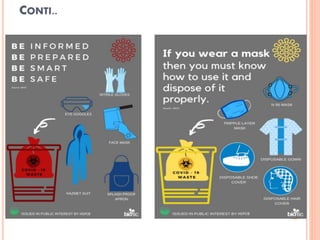
CONTI..
Ppe in covid 19

Ppe in covid 19

  • 1.
  • 2.
    INTRODUCTION  As perthe WHO, Coronaviruses are a large family of viruses, some causing illness in people and others that circulate among animals, including camels, cats and bats. Rarely, animal coronaviruses can evolve and infect people and then spread between people such as has been seen with MERS and SARS.  The outbreak of Novel coronavirus disease (now named COVID- 19) was initially noticed from a seafood market in Wuhan city in Hubei Province of China in mid-December, 2019.
  • 3.
  • 4.
  • 5.
     Standard safetymeasures are the minimum infection prevention practices that should be used in the care of all patients all of the time.  “Standard safety measures are a set of infection control or prevention practices used to prevent transmission of diseases that can be acquired by contact with blood, body fluids, non-intact skin( including rashes), and mucous membranes.”
  • 6.
    ELEMENTS OF STANDARDSAFETY MEASURES
  • 7.
    HAND HYGIENE/ HAND WASHING Handsare the most common vehicle of transmission of organisms.
  • 8.
    DEFINITION Hand washing orhand hygiene is the act of cleaning one’s hands with or without the use of water or another liquid, or with the use of soap for the purpose of removing soil, dirt, and/or micro-organisms.
  • 9.
    PURPOSE  To removetransient and resident microorganism from fingers, hands and forearms.  To prevent risk of transmission of infection to patients.  To reduce the risk of infection to oneself.  To prevent cross infection among clients.
  • 10.
    INDICATION FOR HANDHYGIENE  When hands are visibly dirty, contaminated, or soiled, wash with plain soap and water. If hands are not visibly soiled, use an alcohol-based handrub for routinely decontaminating hands.
  • 11.
  • 12.
    TYPES OF HANDWASHING Methods Agent Purpose Area Duration Routine hand wash plain-soap and water remove soil and transient micro- organisms all surface of the hand and fingers 40-60 seconds Antiseptic hand wash water and anti- microbial soap (e.g. chlorhexidine, chloroxylenol) remove or destroy transient microorganisms and reduce resident flora 40-60 seconds Antiseptic hand rub Alcohol-based hand rub remove or destroy transient microorganisms and reduce resident flora 20-30 seconds Surgical Antisepsis water and anti- microbial soap remove or destroy transient microorganisms and reduce resident flora Hands and forearms 2-6 minutes
  • 13.
  • 14.
    PERSONAL PROTECTIVE EQUIPMENT PPE isprecautionary step to protect the health care worker and people around them.
  • 15.
    DEFINITION  “Personal protectiveequipment is specialized clothing or equipment worn by an employee for protection against dangerous or infectious materials.” - Occupational safety and health administration
  • 16.
    FACTORS INFLUENCING PPESELECTION Types of anticipated exposure Durability and appropriateness of the PPE for the task Fitting
  • 17.
    COMPONENTS OF PERSONALPROTECTIVE EQUIPMENT Face & eye protection: face shield and goggles Respiratory protection: masks/ respirator Gloves Skin protection or clothing: coverall/gowns Shoe covers Head covers
  • 18.
    FACE & EYEPROTECTION: FACE SHIELD & GOGGLES Put on face shield: place face shield over face and eyes and adjust to fit. It should be snug, but not too tight. Remove face shield:  Consider the outside of face shield contaminated.  Remove the face shield from the back by lifting the head band.  Place in designated area for cleaning after doffing process complete.
  • 19.
    RESPIRATORY PROTECTION: MASKS . There are two types of masks : 1. Triple layer medical mask:  A triple layer medical mask is a disposable mask, fluid- resistant; provide protection to the wearer from droplets of infectious material emitted during coughing/sneezing and talking. 2. N-95 respirator mask:  An N-95 respirator mask is a respiratory protective device that filters out 95% of airborne particles but is not resistant to oil.
  • 20.
     Put onN-95  Remove surgical mask/ respirator
  • 21.
    GLOVES  Gloves areexamples of personal protective equipment that are used to protect the wearer and/or the patient from the spread of infection or illness during medical procedures and examinations.
  • 22.
  • 23.
  • 24.
    SKIN PROTECTION ORCLOTHING: COVERALL/GOWNS  Coverall/gowns are designed to protect torso of healthcare providers from exposure to virus.  Coveralls/gowns have stringent standards that extend from preventing exposure to biologically contaminated solid particles to protecting from chemical hazards.
  • 25.
    CONTI…  There are3 factors influencing the selection of a gown or apron: Factors influencing GOWN selection The purpos e of use The material properties of the gown Patient risks and whether a clean, rather than a sterile gown, can be used.
  • 26.
    Putting on GownTaking off Gown
  • 27.
    SHOE COVERS Shoe coversshould be made up of impermeable fabric to be used over shoes to facilitate personal protection and decontamination.
  • 28.
    HEAD COVERS  Coverallsusually cover the head. Those using gowns should use a head cover that covers the head and neck while providing clinical care for patients.  Hair and hair extensions should fit inside the head cover that prevent the possible contamination of sterile field and also protect the health care worker from possible infections.
  • 29.
    SEQUENCE FOR PUTTINGON PPE Gown Mask or respirator Goggles or face shield Gloves
  • 30.
    SEQUENCE OF REMOVINGPPE Gloves Goggles or face sheild Gown Mask or respirator
  • 31.
    DONNING AND DOFFINGOF PPE Donning (Putting on the gear)  Identify and gather the proper PPE to done.  Perform hand hygiene using hand sanitizer.  Put on isolation gown.  Put on NIOSH- approved N95 respirator.  Put on face shield or goggles.  Put on gloves.
  • 32.
    Doffing (taking offthe gear)  Remove gloves.  Remove face shield or goggles.  Remove gown.  HCP may now exit patient room.  Perform hand hygiene.  Remove and discard respirator.  Perform hand hygiene after removing the respirator/facemask.
  • 33.
    CPCB GUIDELINES FORDISPOSAL OF PPE  As per CPCB guidelines, used PPEs like face shields, goggles, hazmet suits, plastic coverall, used masks, head cover, shoe cover etc. generated from COVID-19 isolation wards at healthcare facilities shall be segregated and sent to common facilities for disposal as per bio- medical waste management rules, 2016.
  • 34.
     Guidelines forcovid-19 isolation ward
  • 35.
     Keep separatecolor coded bins (with foot operated lids)/bags/containers in wards and maintain proper segregation of waste as per BMWM Rules, 2016  Use a dedicated collection bin labelled as “COVID-19” to store COVID-19 waste  The (inner and outer) surface containers/bins/trolleys used for storage of COVID-19 waste should be disinfected with 1% sodium hypochlorite solution daily.
  • 36.