Dr. I. V. Siva Prasad
General Physician and Clinical Cardiologist
Usage of PPE for
Doctors in COVID19
•Provide information on the selection and
use of PPE in healthcare settings
• Practice how to safely don and remove
PPE
• Rational usage and Re-usage of PPE
Program Objectives of PPE
“SWISS CHEESE” Model:
Hierarchy of Safety and Health Controls
• Training and administrative
controls (Isolation Policies and Procedures,
Visitors policies)
• Engineering controls – (Negative
pressure isolation rooms, ventilation systems)
• Work practice controls (not recapping
needles, hand washing …)
• Personal protective equipment (PPE)
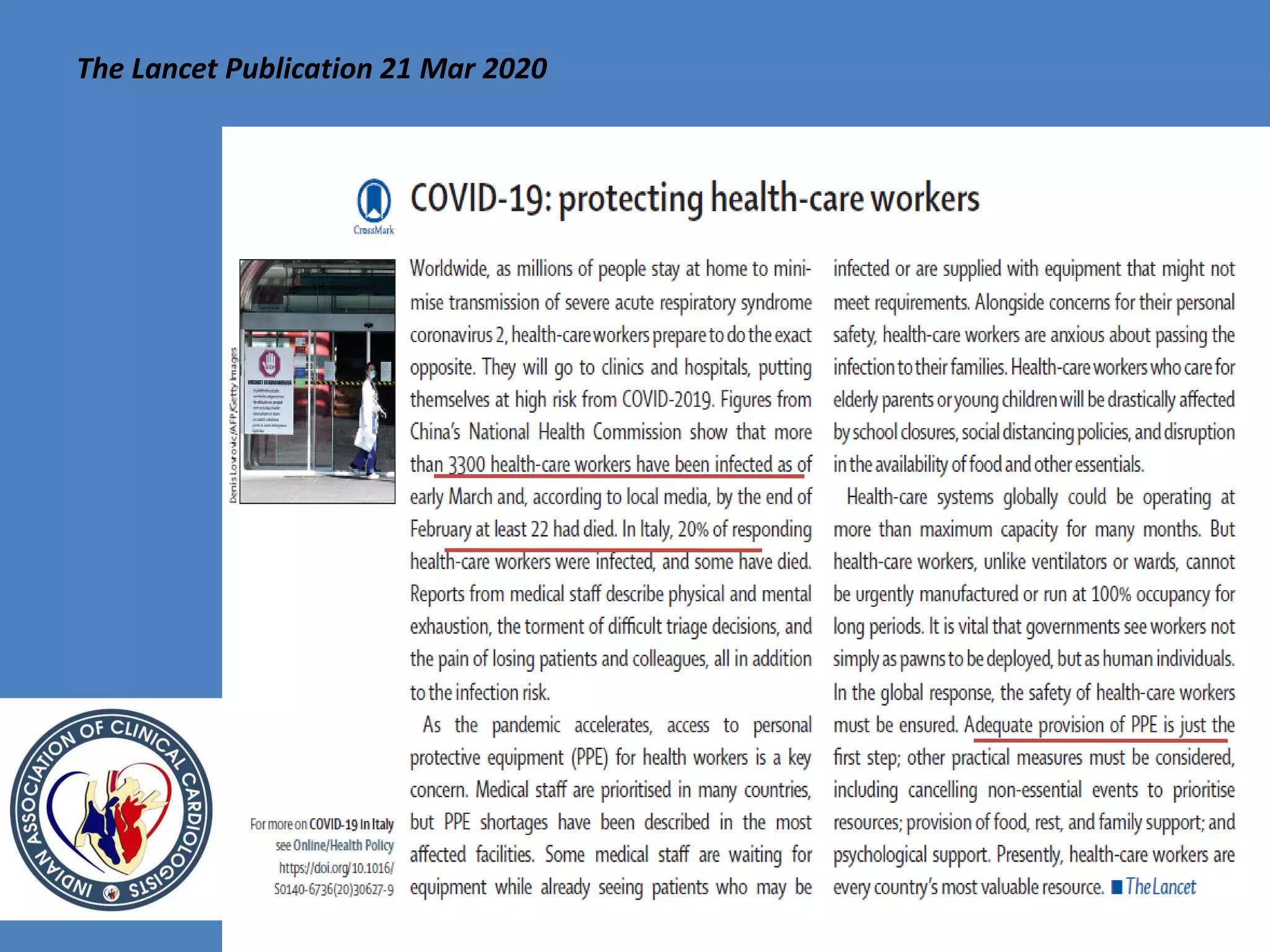
The Lancet Publication 21 Mar 2020
Personal Protective
Equipment (PPE)
Definition:
“Specialized clothing or Equipment
worn by an
employee for protection against
infectious
materials” (OSHA-Occupational
Safety and Health Administration)
Personal Protective
Equipments (PPEs)
They are the protective gears
designed to safeguard the
health of workers by
minimizing the exposure to a
biological agent.
Recommendations for
PPE
•Regarding PPE, employers must:
– Provide appropriate PPE for employees
– Ensure that PPE is disposed or reusable PPE is
cleaned, laundered, repaired and stored after use
• OSHA also specifies circumstances for which PPE
is indicated
• CDC recommends when, what and how to use
PPE
• Gloves – protect hands
• Gowns/aprons – protect skin and/or clothing
• Masks and respirators– protect mouth/nose
•Respirators – protect respiratory tract from
airborne infectious agents
• Goggles – protect eyes
• Face shields – protect face, mouth, nose, and
eyes
•Head covers
• Shoe covers
Components of PPE recommended in
COVID19
Steps of Donning PPE (performed in Designated
area): 1. Remove home clothes, jewelry, etc. and wear clean hospital scrubs
2. Wash hands with soap and water
3. Wear shoe covers
4. Wear first set of gloves –(can be Sterile or Unsterile, smaller than 2nd
pair)
5. Gown – wear a clean disposable non-permeable gown
7. Wear the N-95 respirator – cup the mask in hand, place the lower
strap behind the neck passing below ears , then place the upper strap
over back of head passing above ear. Check for snug fit of mask. There
should be no more than minimal air leak from sides
8. Wear eye piece – adjust the strap according to required size, upper
end N-95 mask should be covered by eye piece
9. Wear the hood – hood should lay over the gown without leaving any
open space.
10. Wear 2nd pair of the gloves – should be of larger size than 1st pair,
should cover free end of arms of gown.
Sequence for Donning PPE
•Gown first
•Mask or respirator (filters 95% of
airborne particles
•Goggles or face shield
•Gloves
*Combination of PPE will affect
sequence – be practical
Reminder
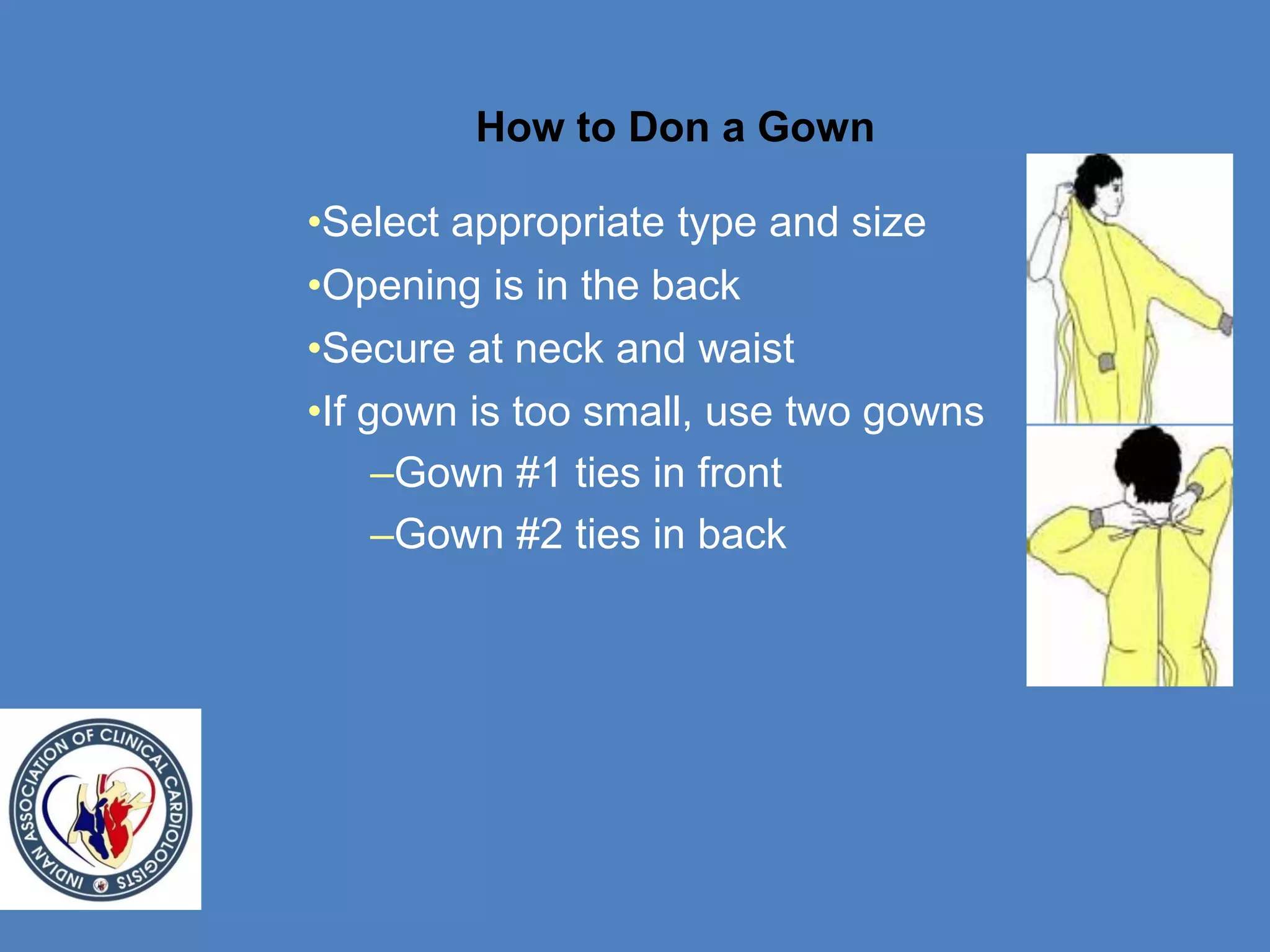
How to Don a Gown
•Select appropriate type and size
•Opening is in the back
•Secure at neck and waist
•If gown is too small, use two gowns
–Gown #1 ties in front
–Gown #2 ties in back
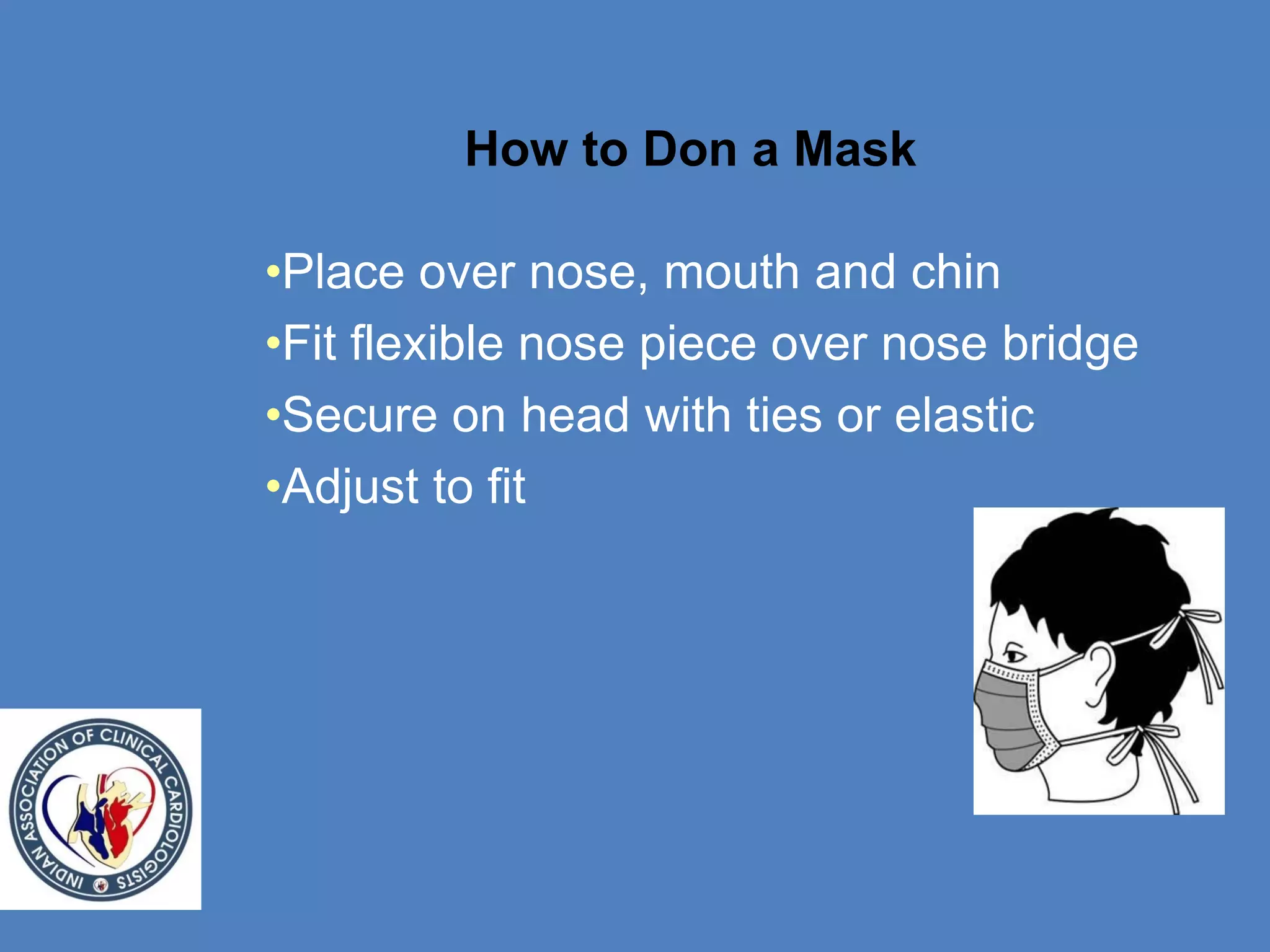
How to Don a Mask
•Place over nose, mouth and chin
•Fit flexible nose piece over nose bridge
•Secure on head with ties or elastic
•Adjust to fit
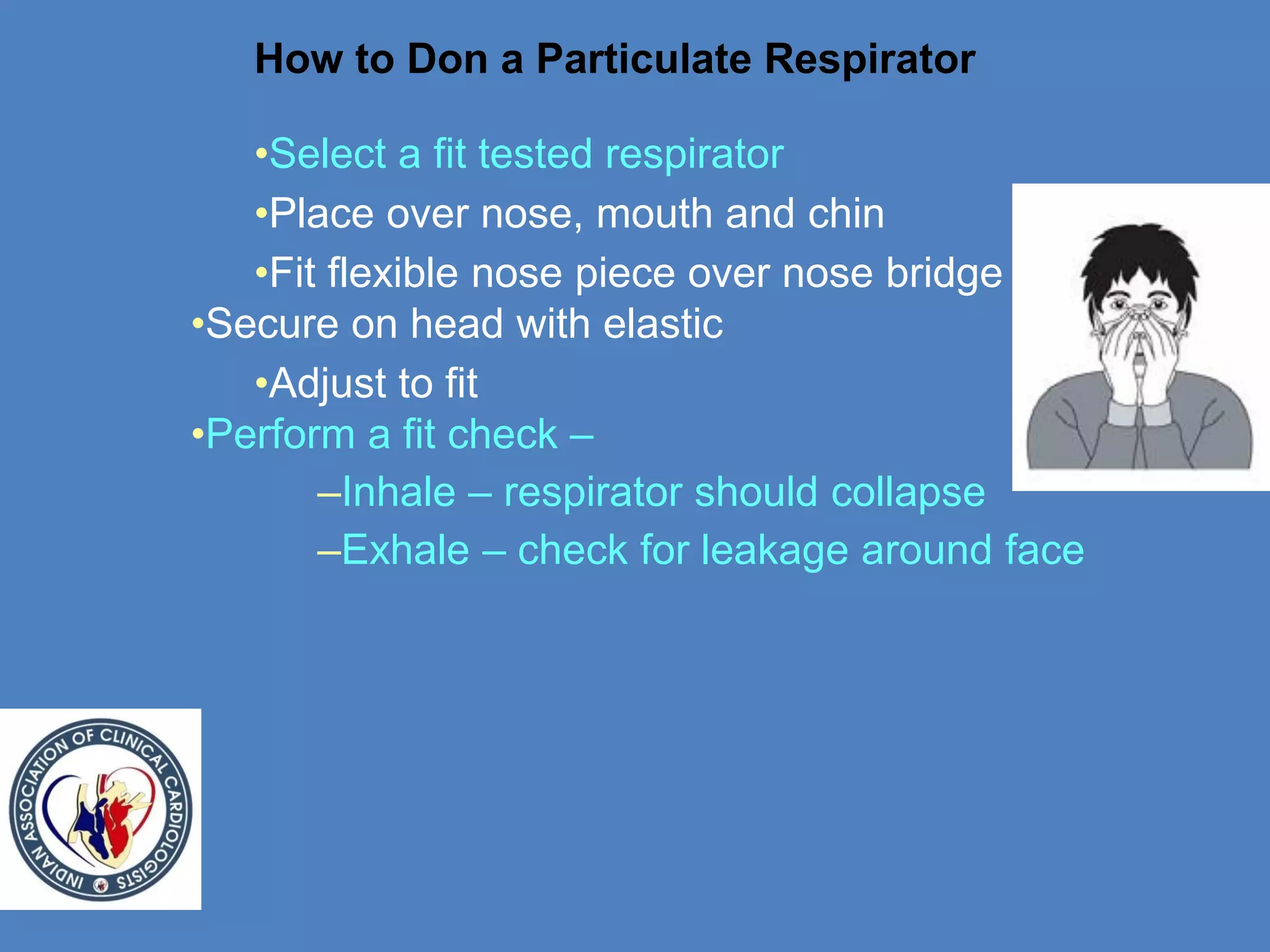
How to Don a Particulate Respirator
•Select a fit tested respirator
•Place over nose, mouth and chin
•Fit flexible nose piece over nose bridge
•Secure on head with elastic
•Adjust to fit
•Perform a fit check –
–Inhale – respirator should collapse
–Exhale – check for leakage around face
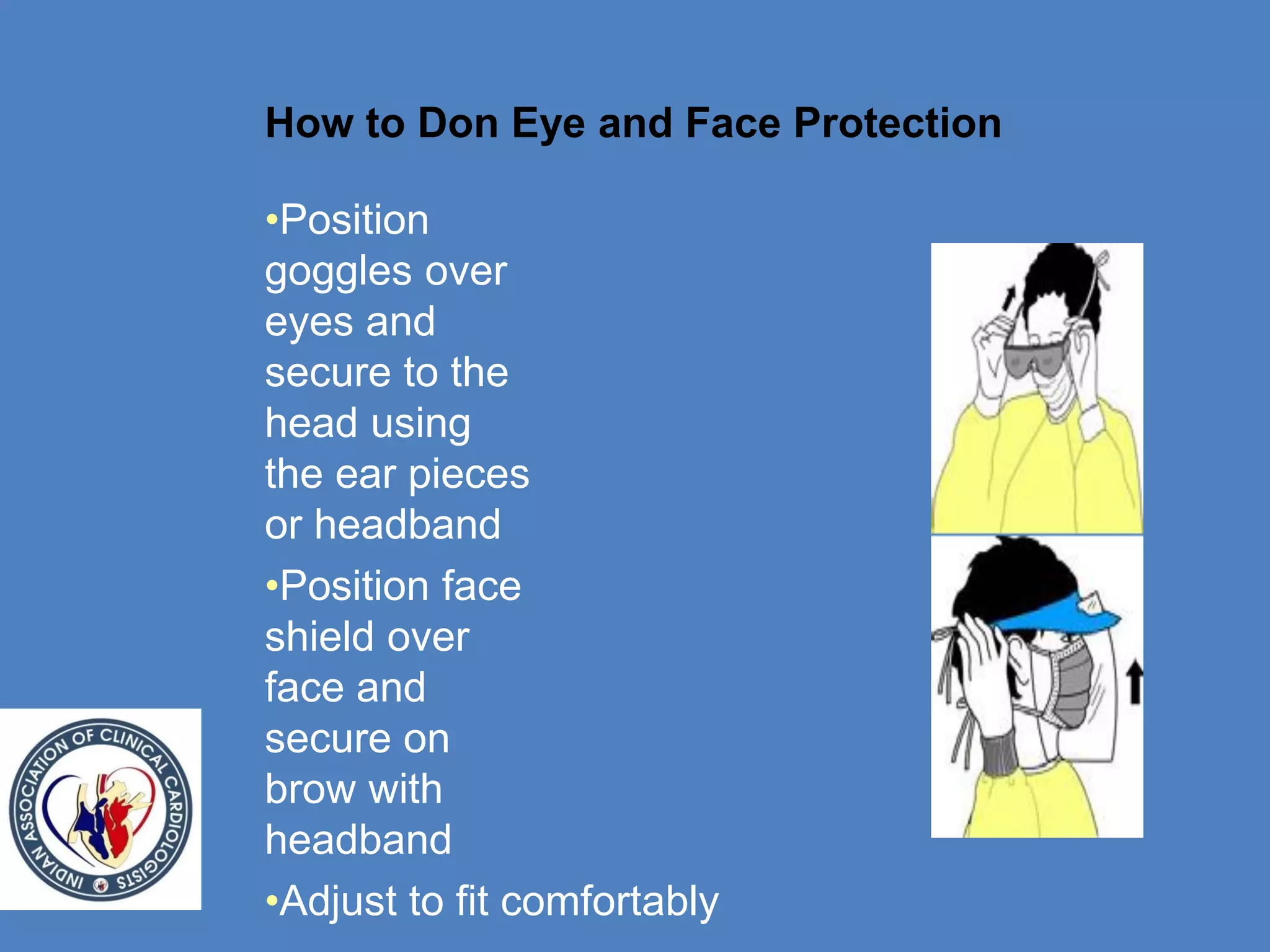
How to Don Eye and Face Protection
•Position
goggles over
eyes and
secure to the
head using
the ear pieces
or headband
•Position face
shield over
face and
secure on
brow with
headband
•Adjust to fit comfortably
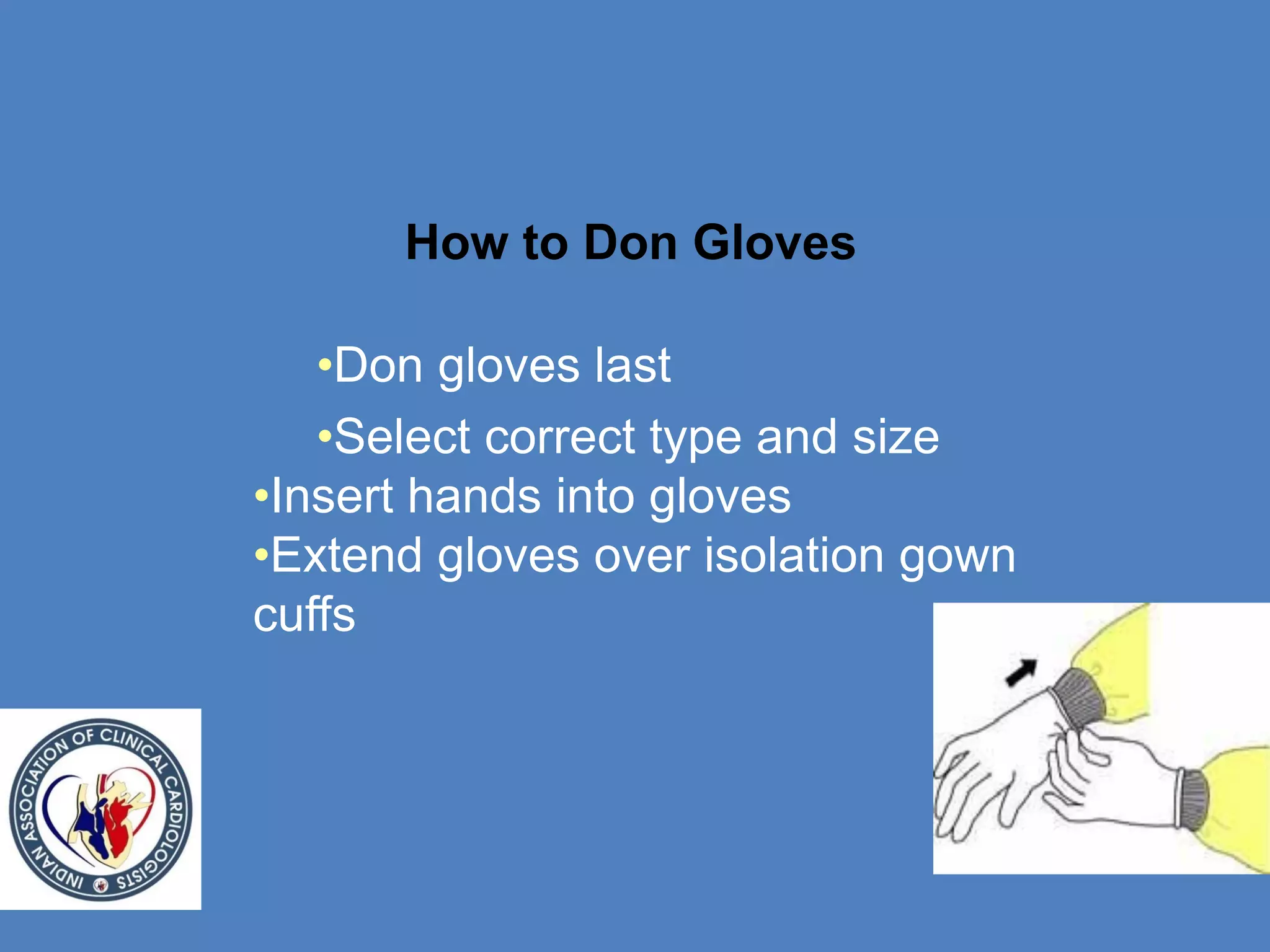
How to Don Gloves
•Don gloves last
•Select correct type and size
•Insert hands into gloves
•Extend gloves over isolation gown
cuffs
Steps of Doffing PPE (performed in Designated
area): 1. Disinfect the hands wearing gloves by following hand hygiene
procedure.
2. Remove shoe covers only by touching the outer surface, and
perform hand hygiene.
3. Remove outer gloves and perform hand hygiene.
4. Remove hood and perform hand hygiene
5. Remove gown slowly by holding the gown at the waist and
pullling. Without touching the outer surface, remove with a
rolling inside out technique. Perform hand hygiene again.
6. Remove eye piece by holding the straps, and perform hand
hygiene.
7. Remove inner gloves and perform hand hygiene.
8. Wear another pair of sterile /unsterile gloves.
9. Remove mask – Do not touch exposed surface of mask. First
remove lower strap of mask, remove mask holding upper strap in
a slow and steady pace (as to not generate aerosols)
10. Perform hand hygiene
11. Sit over clean chair and clean your shoes with alcohol swabs
12. Remove last pair of gloves and perform hand hygiene
Sequence for Removing PPE
•Gloves
•Face shield or goggles
•Gown
•Mask or respirator
Reminder
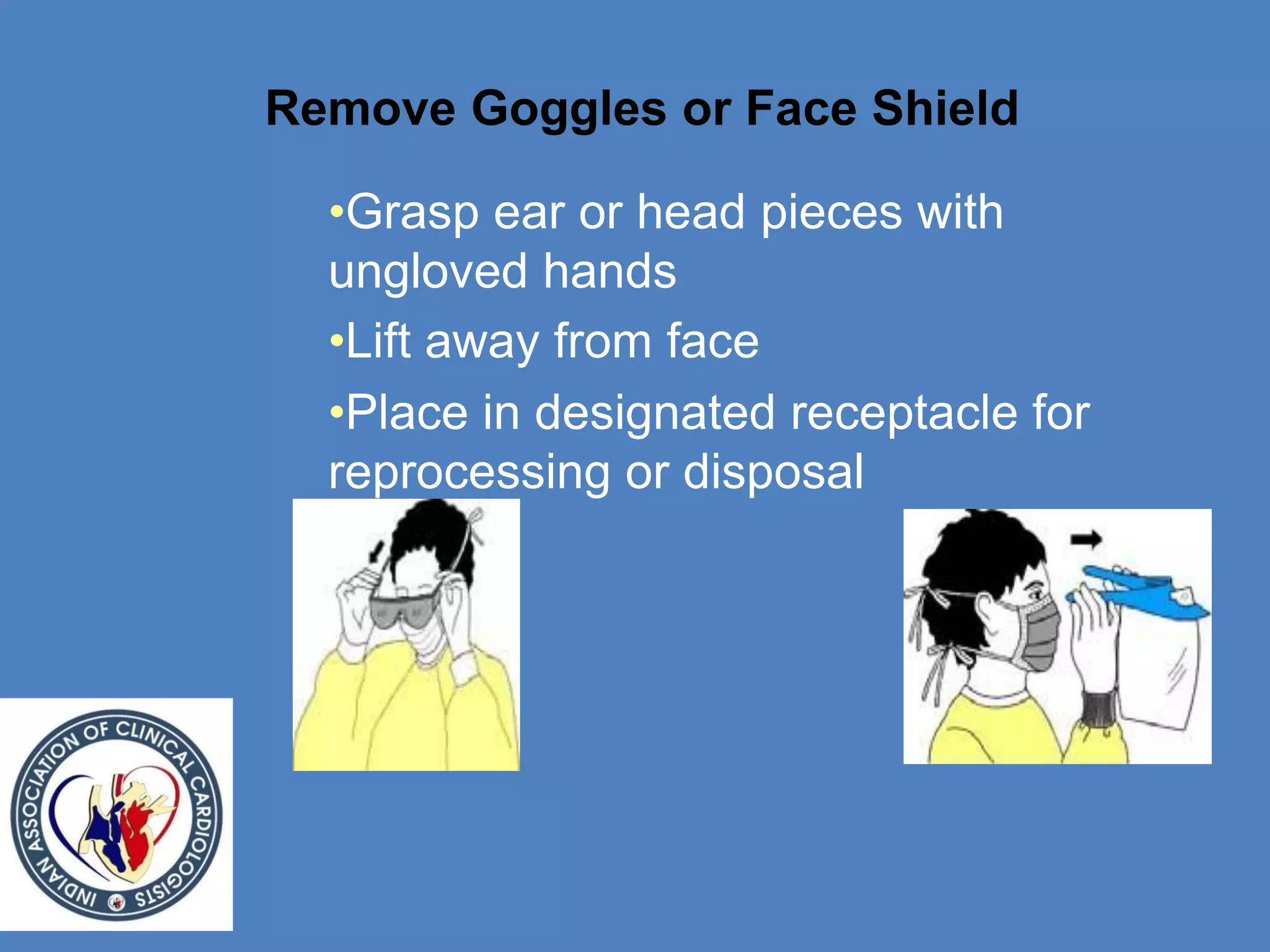
Remove Goggles or Face Shield
•Grasp ear or head pieces with
ungloved hands
•Lift away from face
•Place in designated receptacle for
reprocessing or disposal
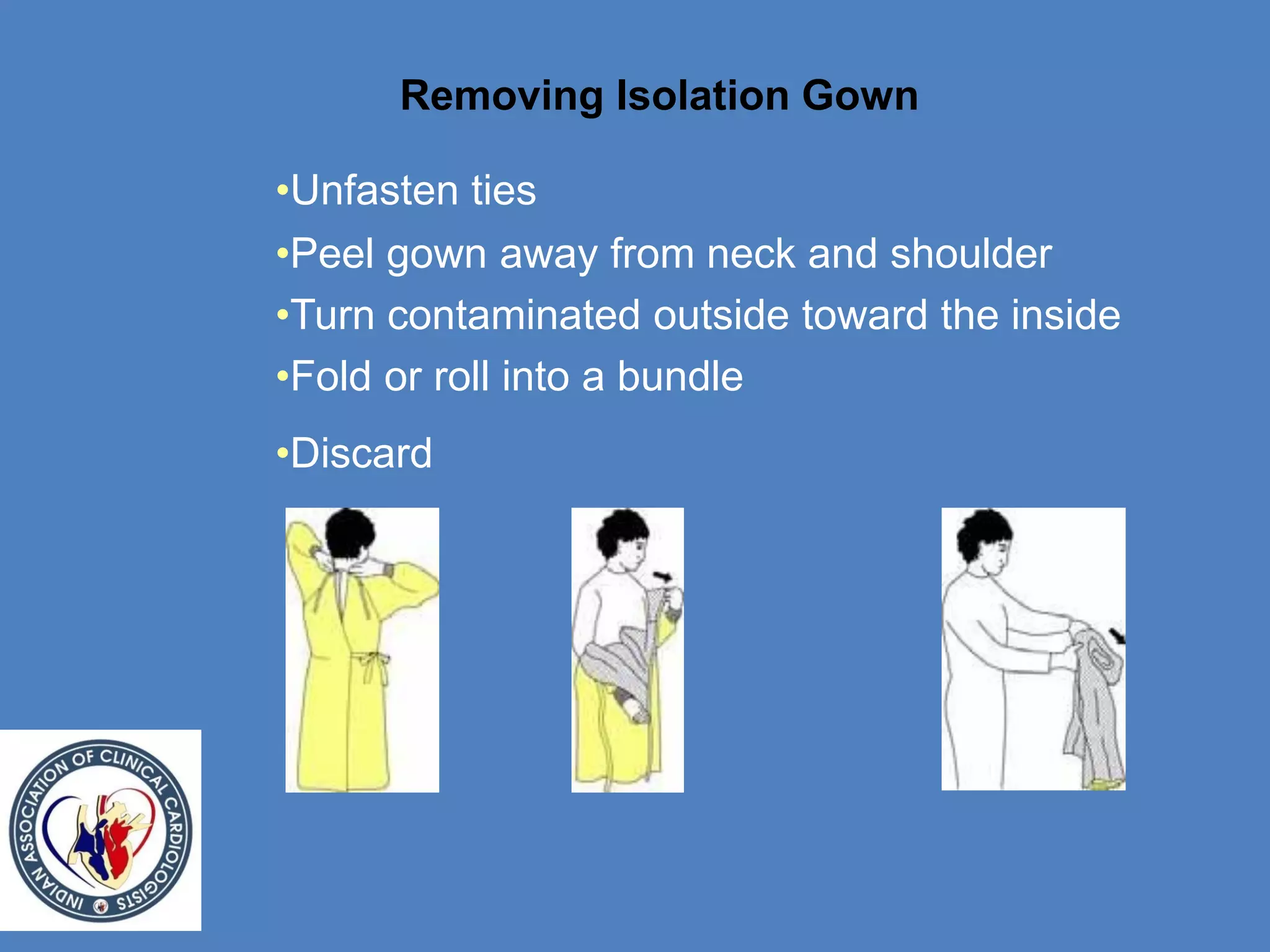
Removing Isolation Gown
•Unfasten ties
•Peel gown away from neck and shoulder
•Turn contaminated outside toward the inside
•Fold or roll into a bundle
•Discard
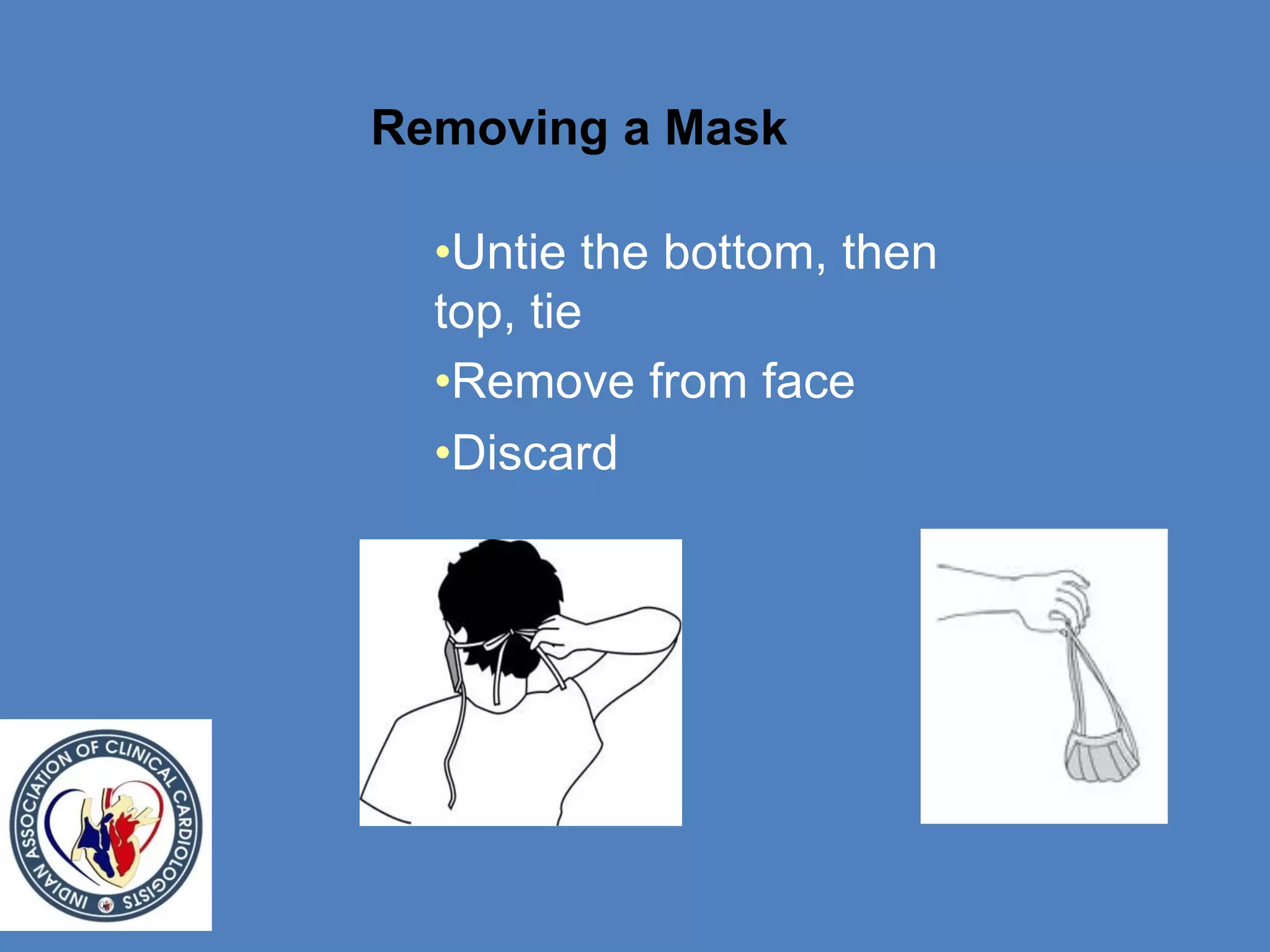
Removing a Mask
•Untie the bottom, then
top, tie
•Remove from face
•Discard
Removing a Particulate
Respirator
•Lift the bottom elastic over
your head first
•Then lift off the top elastic
•Discard
Facial hairstyles compatible with mask
(CDC)
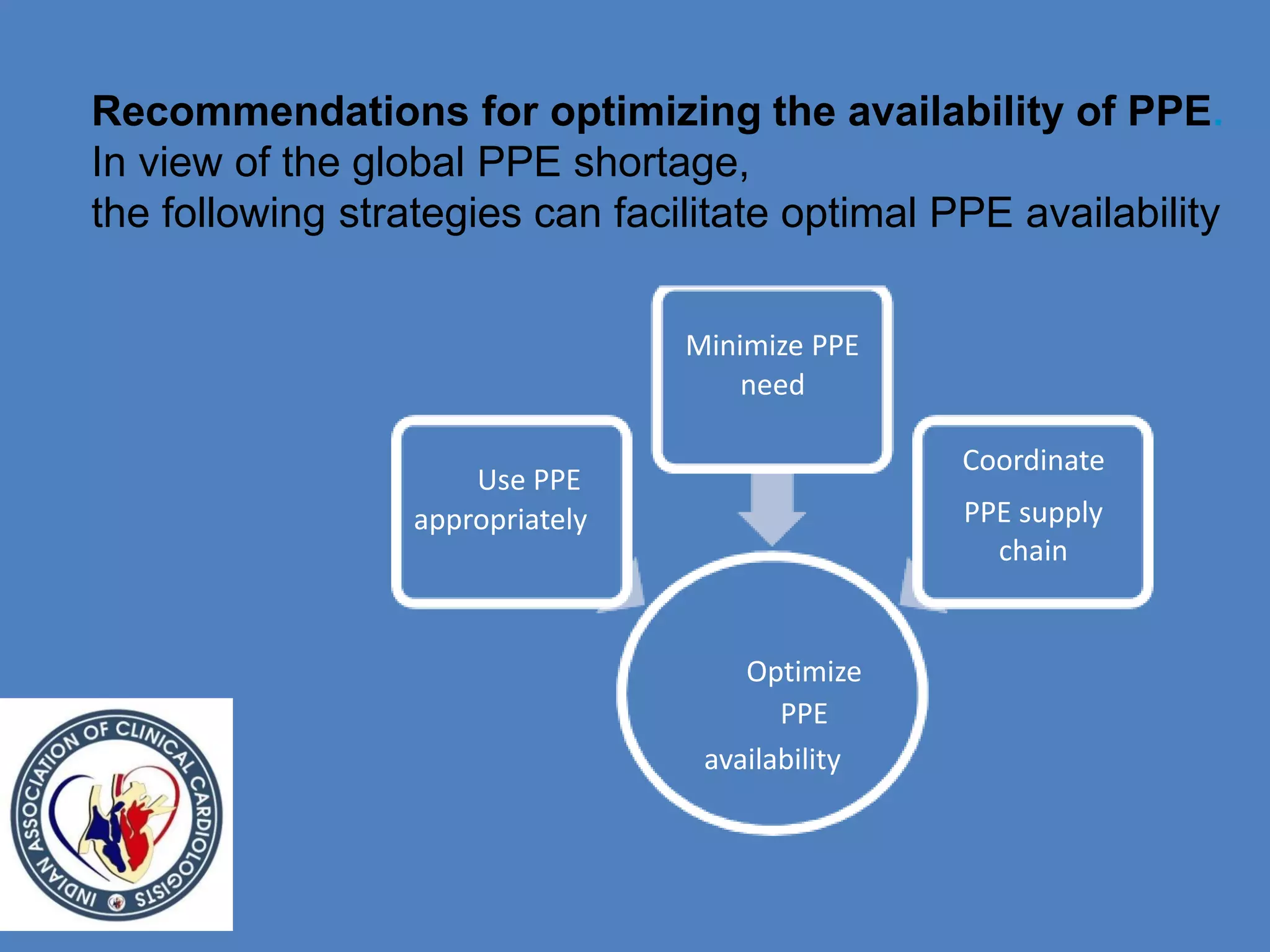
Recommendations for optimizing the availability of PPE.
In view of the global PPE shortage,
the following strategies can facilitate optimal PPE availability
Minimize PPE
need
Use PPE
appropriately
Coordinate
PPE supply
chain
Optimize
PPE
availability
How to Safely Use PPE
•Keep gloved hands away from face
•Avoid touching or adjusting other
PPE
•Remove gloves if they become
torn; perform hand hygiene before
donning new gloves
•Limit surfaces and items touched
COVID-19 POSITIVE
OR SUSPECTED
COVID-19
UNKNOWN
NON-CLINICAL AREAS No specific PPE. No specific PPE.
CONTACT PRECAUTIONS
● In clinical areas, more
than two metres from
the patient, eg ward
rounds, outpatients.
● Consider gloves.
● Consider
waterproof apron.
● Consider fluid-
resistant surgical
mask
Yellow box
No specific PPE
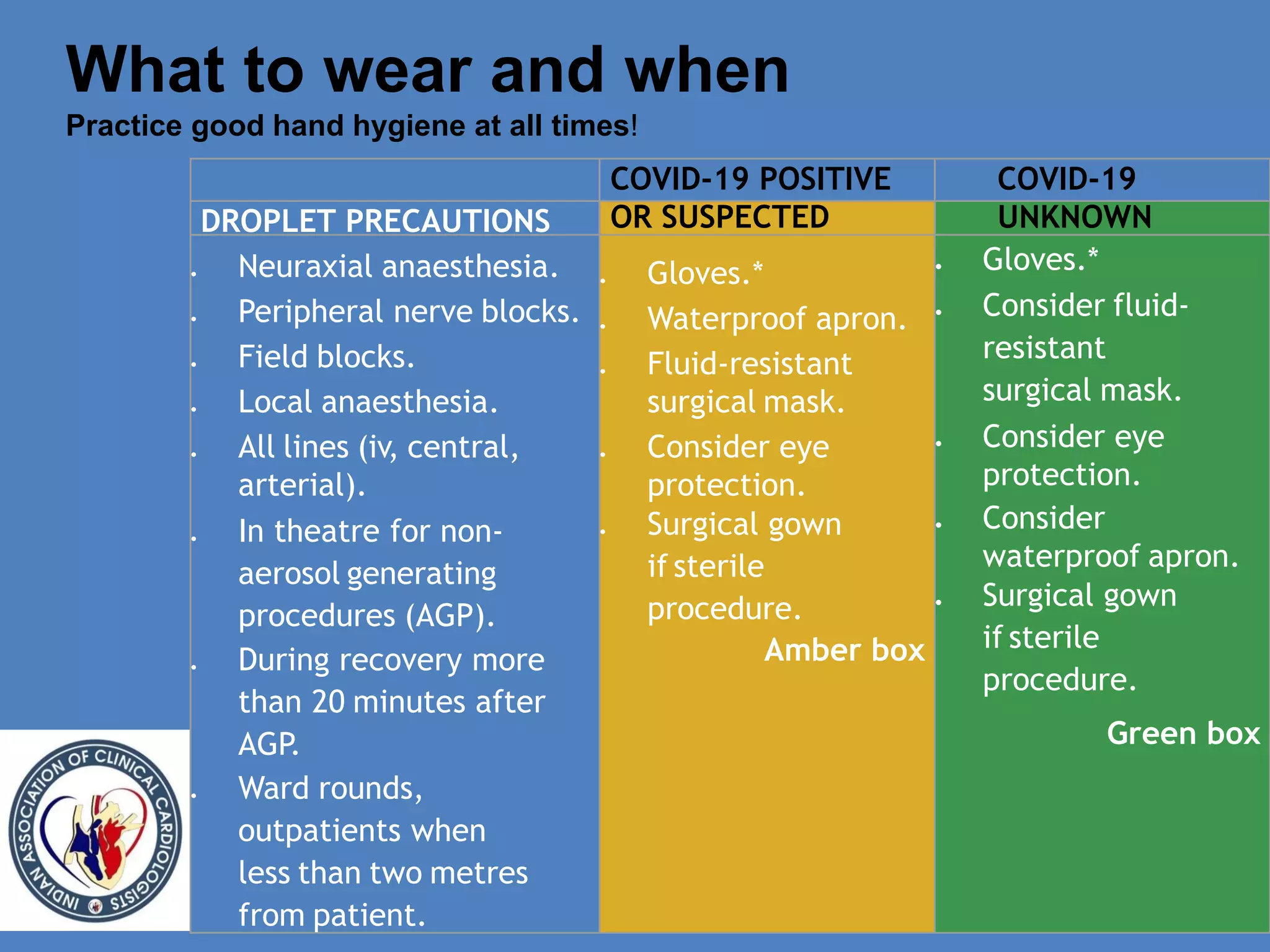
What to wear and when
Practice good hand hygiene at all times!
What to wear and when
Practice good hand hygiene at all times!
DROPLET PRECAUTIONS
● Neuraxial anaesthesia.
● Peripheral nerve blocks.
● Field blocks.
● Local anaesthesia.
● All lines (iv, central,
arterial).
● In theatre for non-
aerosol generating
procedures (AGP).
● During recovery more
than 20 minutes after
AGP.
● Ward rounds,
outpatients when
less than two metres
from patient.
● Gloves.*
● Waterproof apron.
● Fluid-resistant
surgical mask.
● Consider eye
protection.
● Surgical gown
if sterile
procedure.
Amber box
● Gloves.*
● Consider fluid-
resistant
surgical mask.
● Consider eye
protection.
● Consider
waterproof apron.
● Surgical gown
if sterile
procedure.
Green box
COVID-19 POSITIVE
OR SUSPECTED
COVID-19
UNKNOWN
AIRBORNE PRECAUTIONS
● Throughout confirmed
COVID-19 cohort areas of
ICU.
● In theatre and for 20
minutes after AGP**
● Respiratory AGPs are:
● Intubation, extubation
● Mask ventilation
● Supraglottic airway
insertion, removal
● High flow nasal
oxygen, non-invasive
ventilation
● Awake flexible
optical intubation,
bronchoscopy
● Others.***
● Surgical AGP is surgery
with high-speed devices,
eg bone drills, pulsed
lavage, airway ENT.
● Gloves.*
● Fluid-resistant,
long-sleeve
gown.
● Fit-tested, fit-
checked FFP3
mask.
● Eye protection.
● Consider second pair
of gloves.
● Surgical gown
if sterile
procedure.
Red box
● Gloves.*
● Consider fluid-
resistant
surgical mask.
● Consider eye
protection.
● Consider waterproof
apron.
● Surgical gown
if sterile
procedure.
Green box
COVID-19 POSITIVE
OR SUSPECTED
COVID-19
UNKNOWN
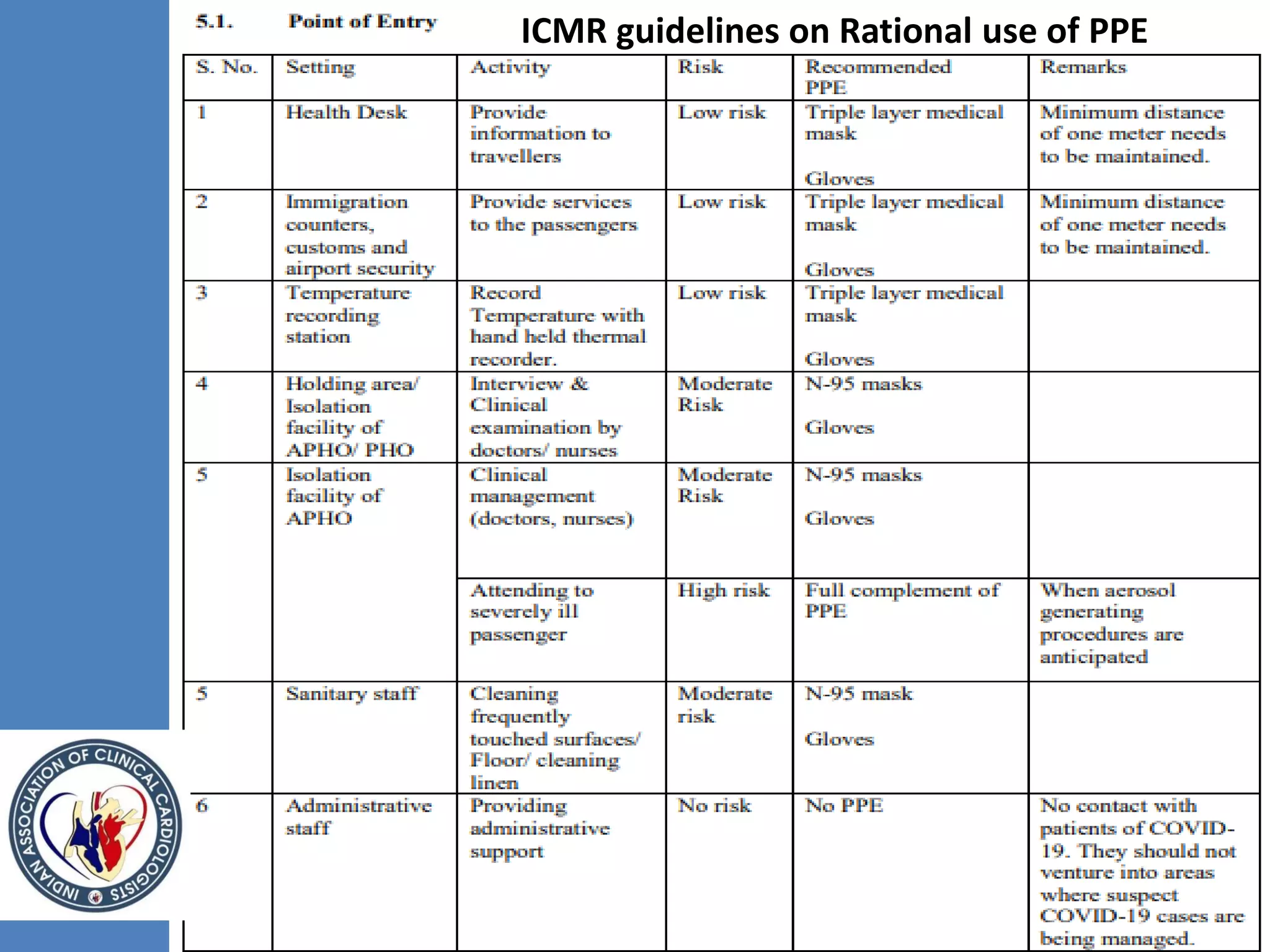
ICMR guidelines on Rational use of PPE
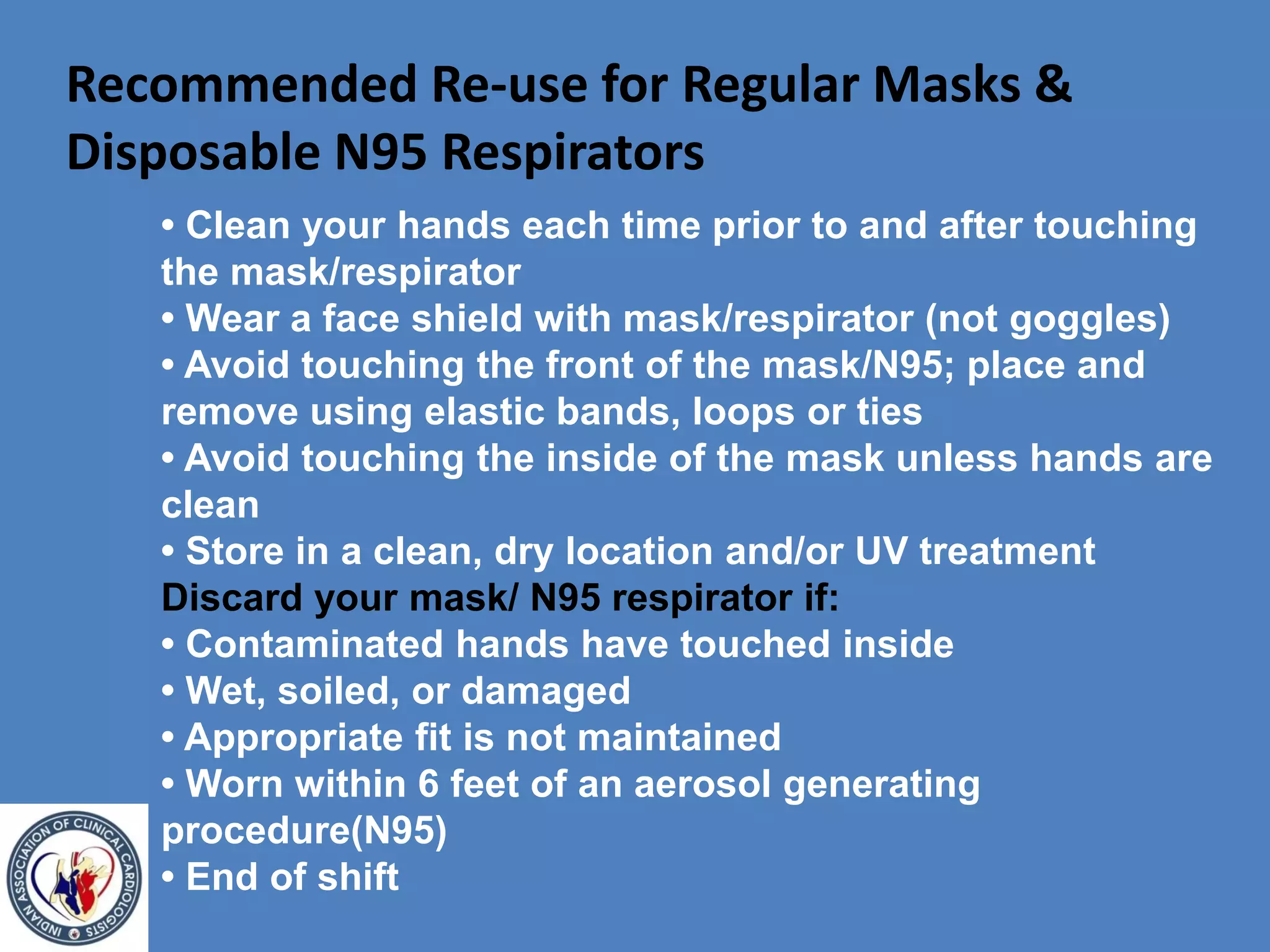
Recommended Re-use for Regular Masks &
Disposable N95 Respirators
• Clean your hands each time prior to and after touching
the mask/respirator
• Wear a face shield with mask/respirator (not goggles)
• Avoid touching the front of the mask/N95; place and
remove using elastic bands, loops or ties
• Avoid touching the inside of the mask unless hands are
clean
• Store in a clean, dry location and/or UV treatment
Discard your mask/ N95 respirator if:
• Contaminated hands have touched inside
• Wet, soiled, or damaged
• Appropriate fit is not maintained
• Worn within 6 feet of an aerosol generating
procedure(N95)
• End of shift
• Clean your hands every time prior to putting and taking off
• Use one shield per health care worker per shift
• Label with name and date; maintain control of your shield
• Clean shield with hospital approved disinfectant wipe, followed by
alcohol wipe to remove any residue if needed
• Store shield(s) in a clean, dry location when not being used. PAPR
shields can be left on PAPR and placed on a clean surface.
Discard your shield(s) if:
• Damaged in any manner (e.g foam batting damaged/soiled, face shield
cracked/ripped)
• End of shift
Recommended Re-use of Disposable Face
Shields /PAPR (powered air purifying respirator)
Thank You

Usage of ppe for drs

  • 1.
    Dr. I. V.Siva Prasad General Physician and Clinical Cardiologist Usage of PPE for Doctors in COVID19
  • 2.
    •Provide information onthe selection and use of PPE in healthcare settings • Practice how to safely don and remove PPE • Rational usage and Re-usage of PPE Program Objectives of PPE
  • 3.
  • 4.
    Hierarchy of Safetyand Health Controls • Training and administrative controls (Isolation Policies and Procedures, Visitors policies) • Engineering controls – (Negative pressure isolation rooms, ventilation systems) • Work practice controls (not recapping needles, hand washing …) • Personal protective equipment (PPE)
  • 5.
  • 6.
    Personal Protective Equipment (PPE) Definition: “Specializedclothing or Equipment worn by an employee for protection against infectious materials” (OSHA-Occupational Safety and Health Administration)
  • 7.
    Personal Protective Equipments (PPEs) Theyare the protective gears designed to safeguard the health of workers by minimizing the exposure to a biological agent.
  • 8.
    Recommendations for PPE •Regarding PPE,employers must: – Provide appropriate PPE for employees – Ensure that PPE is disposed or reusable PPE is cleaned, laundered, repaired and stored after use • OSHA also specifies circumstances for which PPE is indicated • CDC recommends when, what and how to use PPE
  • 9.
    • Gloves –protect hands • Gowns/aprons – protect skin and/or clothing • Masks and respirators– protect mouth/nose •Respirators – protect respiratory tract from airborne infectious agents • Goggles – protect eyes • Face shields – protect face, mouth, nose, and eyes •Head covers • Shoe covers Components of PPE recommended in COVID19
  • 10.
    Steps of DonningPPE (performed in Designated area): 1. Remove home clothes, jewelry, etc. and wear clean hospital scrubs 2. Wash hands with soap and water 3. Wear shoe covers 4. Wear first set of gloves –(can be Sterile or Unsterile, smaller than 2nd pair) 5. Gown – wear a clean disposable non-permeable gown 7. Wear the N-95 respirator – cup the mask in hand, place the lower strap behind the neck passing below ears , then place the upper strap over back of head passing above ear. Check for snug fit of mask. There should be no more than minimal air leak from sides 8. Wear eye piece – adjust the strap according to required size, upper end N-95 mask should be covered by eye piece 9. Wear the hood – hood should lay over the gown without leaving any open space. 10. Wear 2nd pair of the gloves – should be of larger size than 1st pair, should cover free end of arms of gown.
  • 12.
    Sequence for DonningPPE •Gown first •Mask or respirator (filters 95% of airborne particles •Goggles or face shield •Gloves *Combination of PPE will affect sequence – be practical Reminder
  • 13.
    How to Dona Gown •Select appropriate type and size •Opening is in the back •Secure at neck and waist •If gown is too small, use two gowns –Gown #1 ties in front –Gown #2 ties in back
  • 14.
    How to Dona Mask •Place over nose, mouth and chin •Fit flexible nose piece over nose bridge •Secure on head with ties or elastic •Adjust to fit
  • 15.
    How to Dona Particulate Respirator •Select a fit tested respirator •Place over nose, mouth and chin •Fit flexible nose piece over nose bridge •Secure on head with elastic •Adjust to fit •Perform a fit check – –Inhale – respirator should collapse –Exhale – check for leakage around face
  • 16.
    How to DonEye and Face Protection •Position goggles over eyes and secure to the head using the ear pieces or headband •Position face shield over face and secure on brow with headband •Adjust to fit comfortably
  • 17.
    How to DonGloves •Don gloves last •Select correct type and size •Insert hands into gloves •Extend gloves over isolation gown cuffs
  • 18.
    Steps of DoffingPPE (performed in Designated area): 1. Disinfect the hands wearing gloves by following hand hygiene procedure. 2. Remove shoe covers only by touching the outer surface, and perform hand hygiene. 3. Remove outer gloves and perform hand hygiene. 4. Remove hood and perform hand hygiene 5. Remove gown slowly by holding the gown at the waist and pullling. Without touching the outer surface, remove with a rolling inside out technique. Perform hand hygiene again. 6. Remove eye piece by holding the straps, and perform hand hygiene. 7. Remove inner gloves and perform hand hygiene. 8. Wear another pair of sterile /unsterile gloves. 9. Remove mask – Do not touch exposed surface of mask. First remove lower strap of mask, remove mask holding upper strap in a slow and steady pace (as to not generate aerosols) 10. Perform hand hygiene 11. Sit over clean chair and clean your shoes with alcohol swabs 12. Remove last pair of gloves and perform hand hygiene
  • 20.
    Sequence for RemovingPPE •Gloves •Face shield or goggles •Gown •Mask or respirator Reminder
  • 21.
    Remove Goggles orFace Shield •Grasp ear or head pieces with ungloved hands •Lift away from face •Place in designated receptacle for reprocessing or disposal
  • 22.
    Removing Isolation Gown •Unfastenties •Peel gown away from neck and shoulder •Turn contaminated outside toward the inside •Fold or roll into a bundle •Discard
  • 23.
    Removing a Mask •Untiethe bottom, then top, tie •Remove from face •Discard
  • 24.
    Removing a Particulate Respirator •Liftthe bottom elastic over your head first •Then lift off the top elastic •Discard
  • 25.
  • 26.
    Recommendations for optimizingthe availability of PPE. In view of the global PPE shortage, the following strategies can facilitate optimal PPE availability Minimize PPE need Use PPE appropriately Coordinate PPE supply chain Optimize PPE availability
  • 27.
    How to SafelyUse PPE •Keep gloved hands away from face •Avoid touching or adjusting other PPE •Remove gloves if they become torn; perform hand hygiene before donning new gloves •Limit surfaces and items touched
  • 28.
    COVID-19 POSITIVE OR SUSPECTED COVID-19 UNKNOWN NON-CLINICALAREAS No specific PPE. No specific PPE. CONTACT PRECAUTIONS ● In clinical areas, more than two metres from the patient, eg ward rounds, outpatients. ● Consider gloves. ● Consider waterproof apron. ● Consider fluid- resistant surgical mask Yellow box No specific PPE What to wear and when Practice good hand hygiene at all times!
  • 31.
    What to wearand when Practice good hand hygiene at all times! DROPLET PRECAUTIONS ● Neuraxial anaesthesia. ● Peripheral nerve blocks. ● Field blocks. ● Local anaesthesia. ● All lines (iv, central, arterial). ● In theatre for non- aerosol generating procedures (AGP). ● During recovery more than 20 minutes after AGP. ● Ward rounds, outpatients when less than two metres from patient. ● Gloves.* ● Waterproof apron. ● Fluid-resistant surgical mask. ● Consider eye protection. ● Surgical gown if sterile procedure. Amber box ● Gloves.* ● Consider fluid- resistant surgical mask. ● Consider eye protection. ● Consider waterproof apron. ● Surgical gown if sterile procedure. Green box COVID-19 POSITIVE OR SUSPECTED COVID-19 UNKNOWN
  • 32.
    AIRBORNE PRECAUTIONS ● Throughoutconfirmed COVID-19 cohort areas of ICU. ● In theatre and for 20 minutes after AGP** ● Respiratory AGPs are: ● Intubation, extubation ● Mask ventilation ● Supraglottic airway insertion, removal ● High flow nasal oxygen, non-invasive ventilation ● Awake flexible optical intubation, bronchoscopy ● Others.*** ● Surgical AGP is surgery with high-speed devices, eg bone drills, pulsed lavage, airway ENT. ● Gloves.* ● Fluid-resistant, long-sleeve gown. ● Fit-tested, fit- checked FFP3 mask. ● Eye protection. ● Consider second pair of gloves. ● Surgical gown if sterile procedure. Red box ● Gloves.* ● Consider fluid- resistant surgical mask. ● Consider eye protection. ● Consider waterproof apron. ● Surgical gown if sterile procedure. Green box COVID-19 POSITIVE OR SUSPECTED COVID-19 UNKNOWN
  • 33.
    ICMR guidelines onRational use of PPE
  • 35.
    Recommended Re-use forRegular Masks & Disposable N95 Respirators • Clean your hands each time prior to and after touching the mask/respirator • Wear a face shield with mask/respirator (not goggles) • Avoid touching the front of the mask/N95; place and remove using elastic bands, loops or ties • Avoid touching the inside of the mask unless hands are clean • Store in a clean, dry location and/or UV treatment Discard your mask/ N95 respirator if: • Contaminated hands have touched inside • Wet, soiled, or damaged • Appropriate fit is not maintained • Worn within 6 feet of an aerosol generating procedure(N95) • End of shift
  • 37.
    • Clean yourhands every time prior to putting and taking off • Use one shield per health care worker per shift • Label with name and date; maintain control of your shield • Clean shield with hospital approved disinfectant wipe, followed by alcohol wipe to remove any residue if needed • Store shield(s) in a clean, dry location when not being used. PAPR shields can be left on PAPR and placed on a clean surface. Discard your shield(s) if: • Damaged in any manner (e.g foam batting damaged/soiled, face shield cracked/ripped) • End of shift Recommended Re-use of Disposable Face Shields /PAPR (powered air purifying respirator)
  • 38.