Domain-specific
  Languages
 Javier Luis Cánovas Izquierdo
    javier.canovas@inria.fr


         February 2013
Outline


Languages

 Domain-Specific Languages

 Xtext

GMF
Outline


Languages

 Domain-Specific Languages

 Xtext

GMF
What is
a language
What is a language?
From Wikipedia:
  Language is the human capacity for
  acquiring and using complex systems of
  communication, and a language is any
  specific example of such a system.
What is a language?
From Wikipedia:
  Language is the human capacity for
  acquiring and using complex systems of
  communication, and a language is any
  specific example of such a system.


             Why?          How?
What is a language?
From Wikipedia:
  Language is the human capacity for
  acquiring and using complex systems of
  communication, and a language is any
  specific example of such a system.


             Why?          How?
What is a language?
From Wikipedia:
  Language is the human capacity for
  acquiring and using complex systems of
  communication, and a language is any
  specific example of such a system.


             Why?          How?
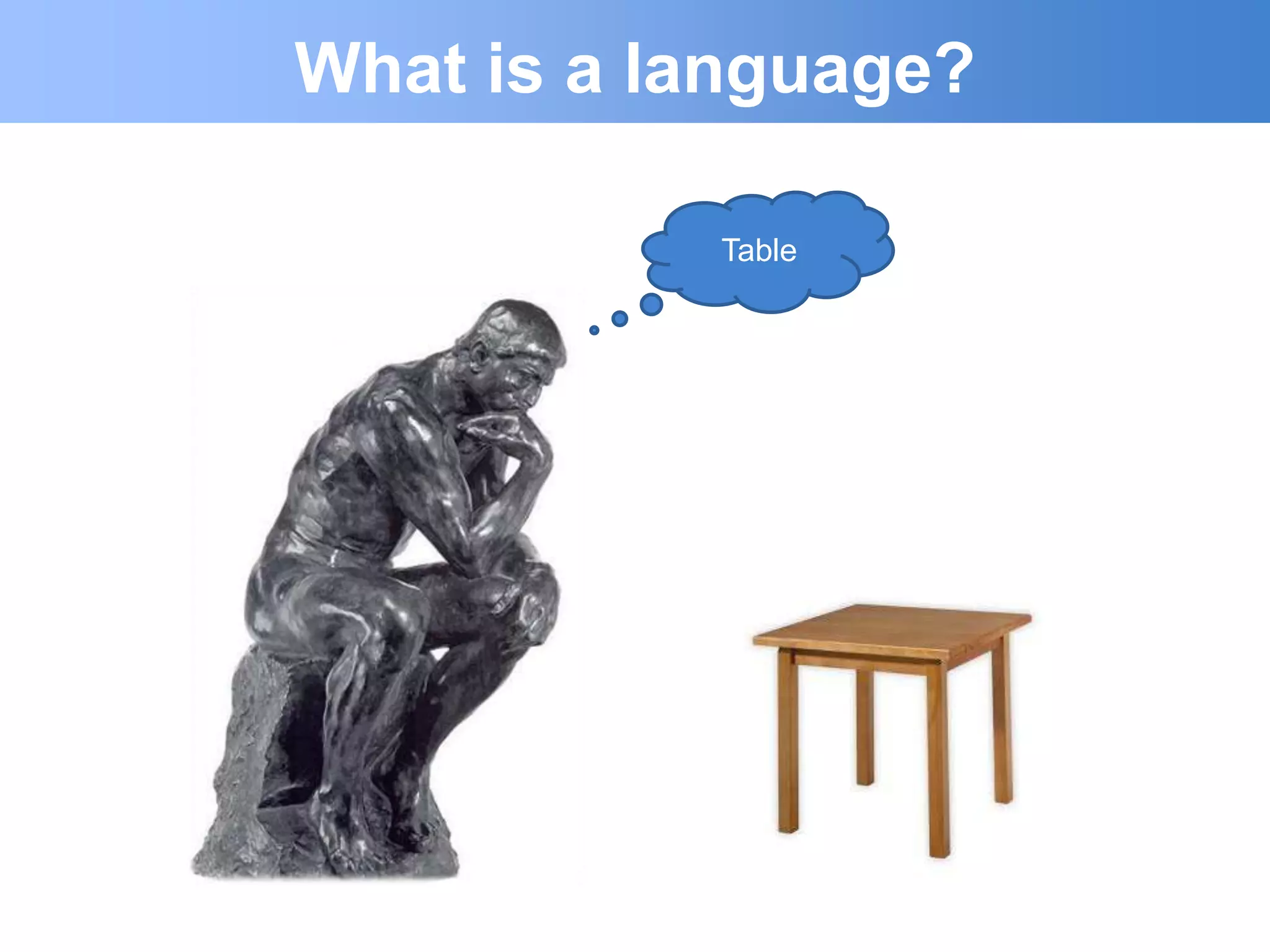
What is a language?

           Table
What is a language?
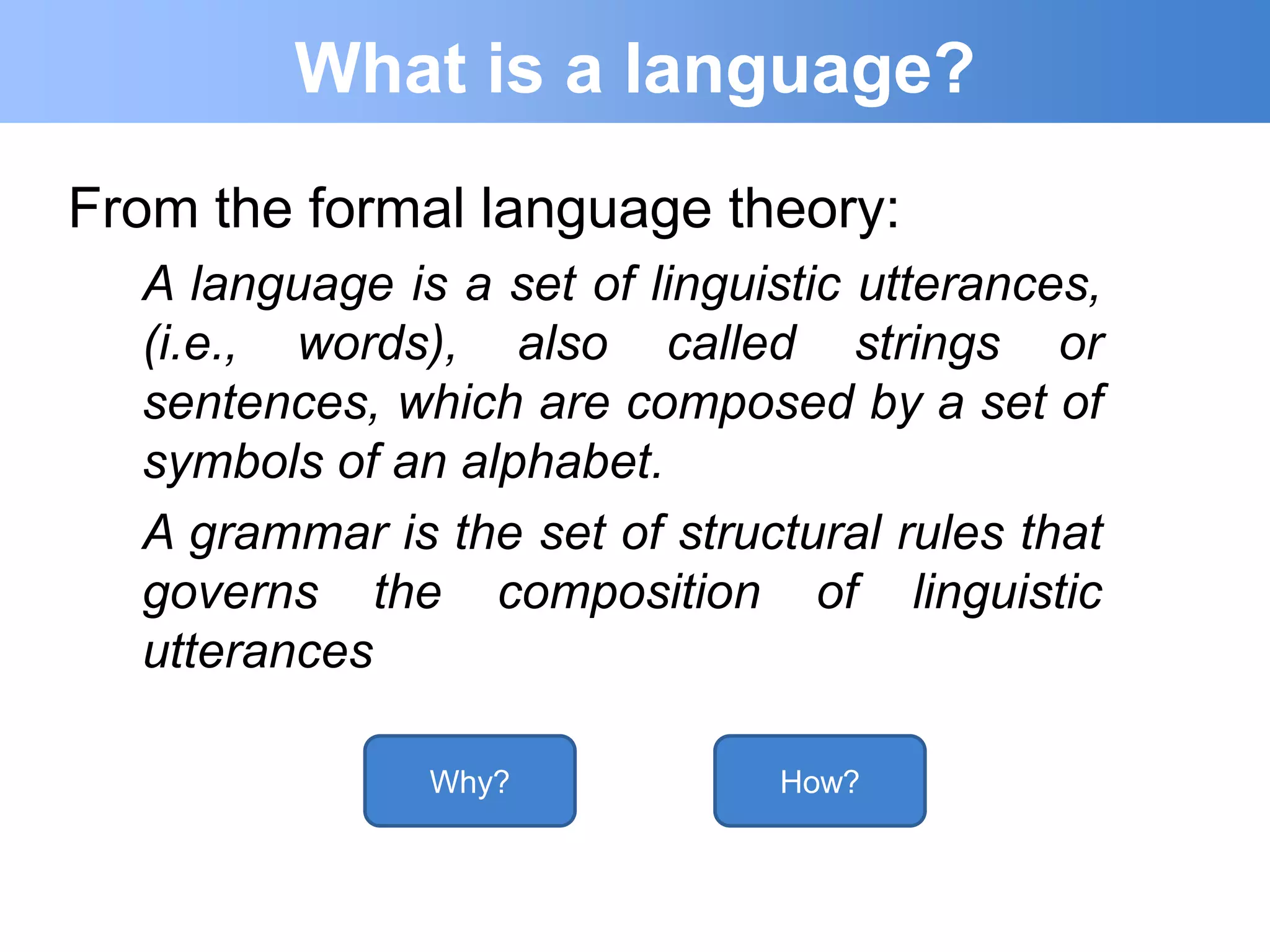
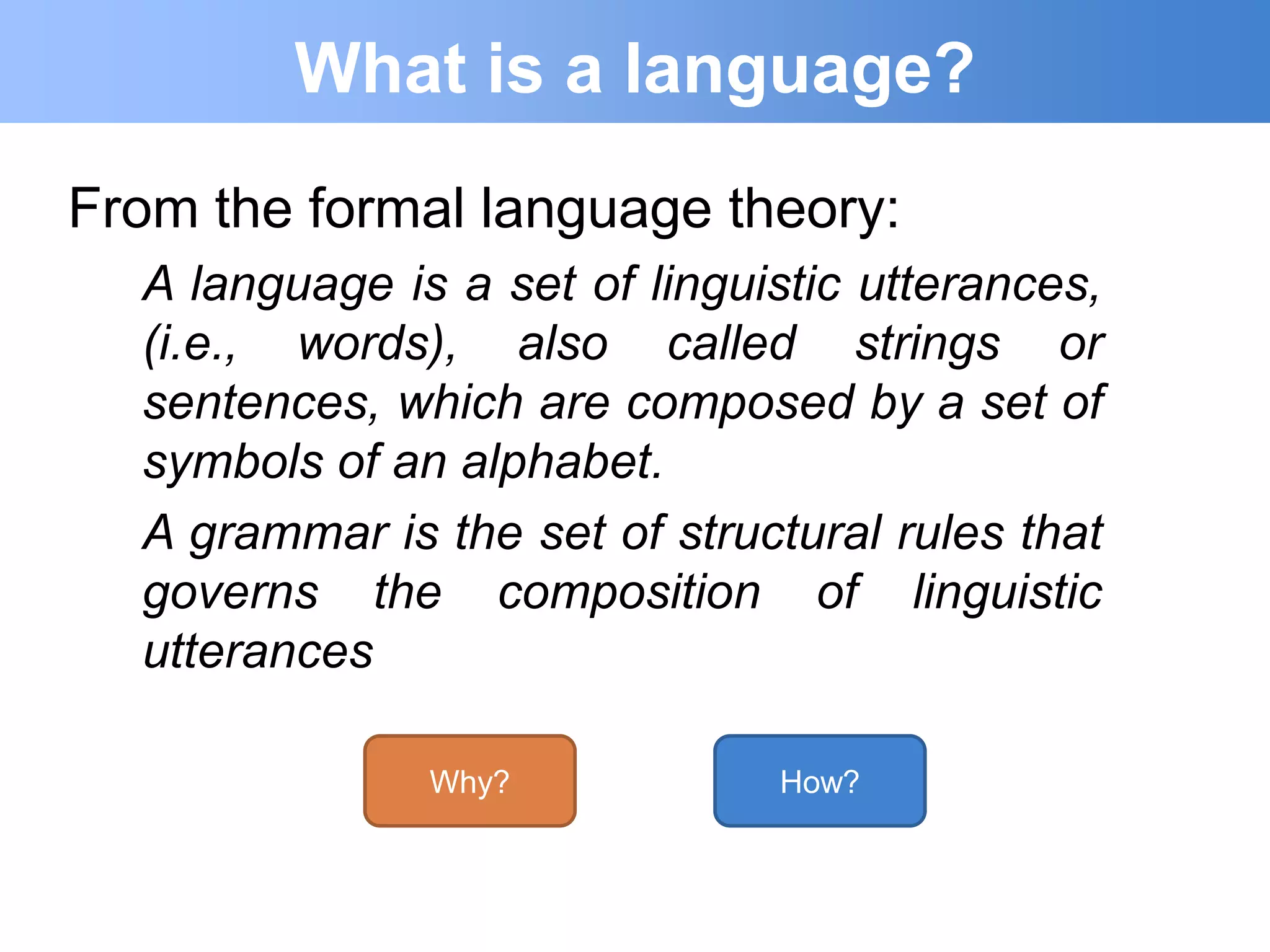
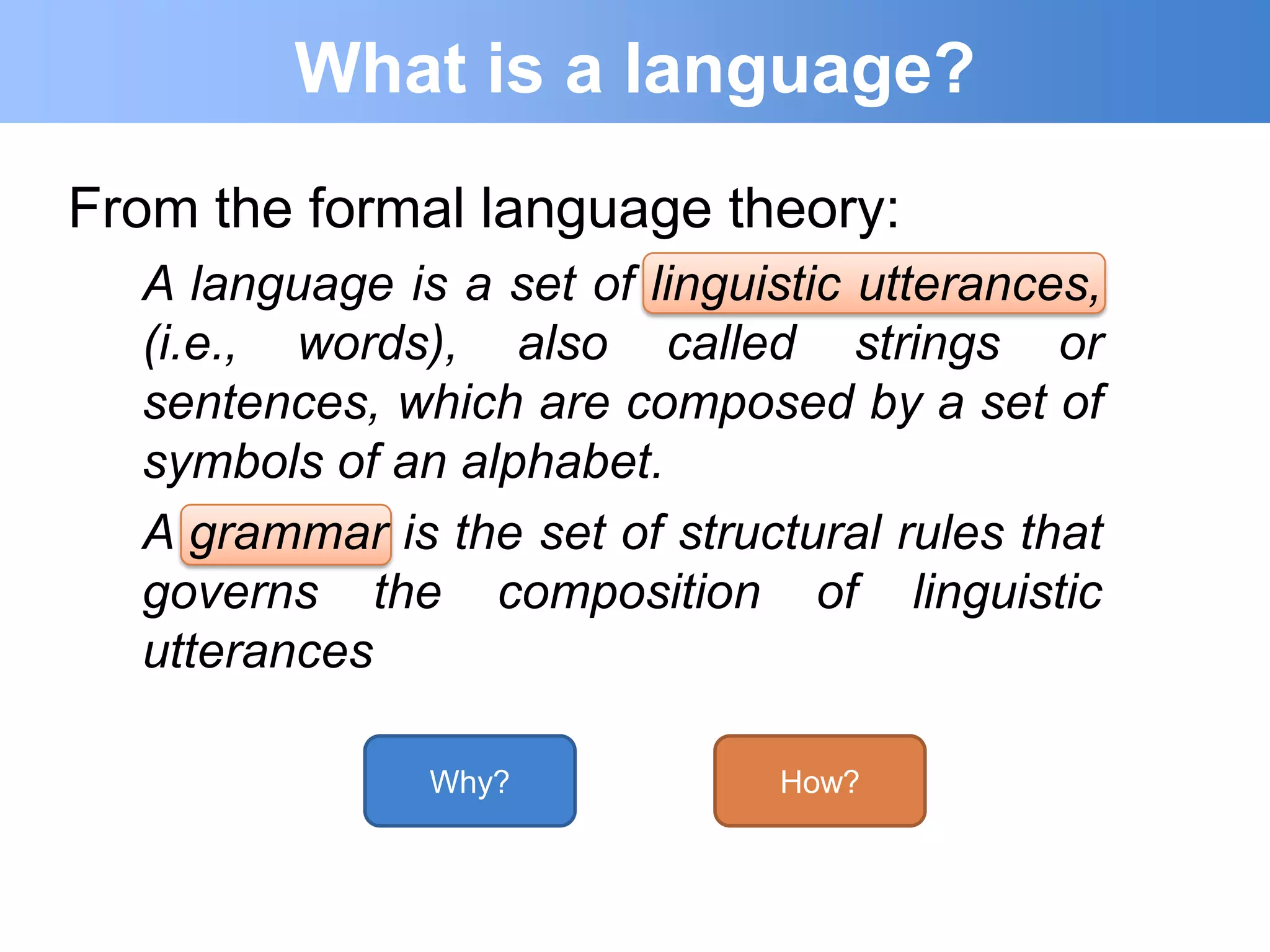
From the formal language theory:
  A language is a set of linguistic utterances,
  (i.e., words), also called strings or
  sentences, which are composed by a set of
  symbols of an alphabet.
  A grammar is the set of structural rules that
  governs the composition of linguistic
  utterances
What is a language?
From the formal language theory:
  A language is a set of linguistic utterances,
  (i.e., words), also called strings or
  sentences, which are composed by a set of
  symbols of an alphabet.
  A grammar is the set of structural rules that
  governs the composition of linguistic
  utterances

               Why?            How?
What is a language?
From the formal language theory:
  A language is a set of linguistic utterances,
  (i.e., words), also called strings or
  sentences, which are composed by a set of
  symbols of an alphabet.
  A grammar is the set of structural rules that
  governs the composition of linguistic
  utterances

               Why?            How?
What is a language?
From the formal language theory:
  A language is a set of linguistic utterances,
  (i.e., words), also called strings or
  sentences, which are composed by a set of
  symbols of an alphabet.
  A grammar is the set of structural rules that
  governs the composition of linguistic
  utterances

               Why?            How?
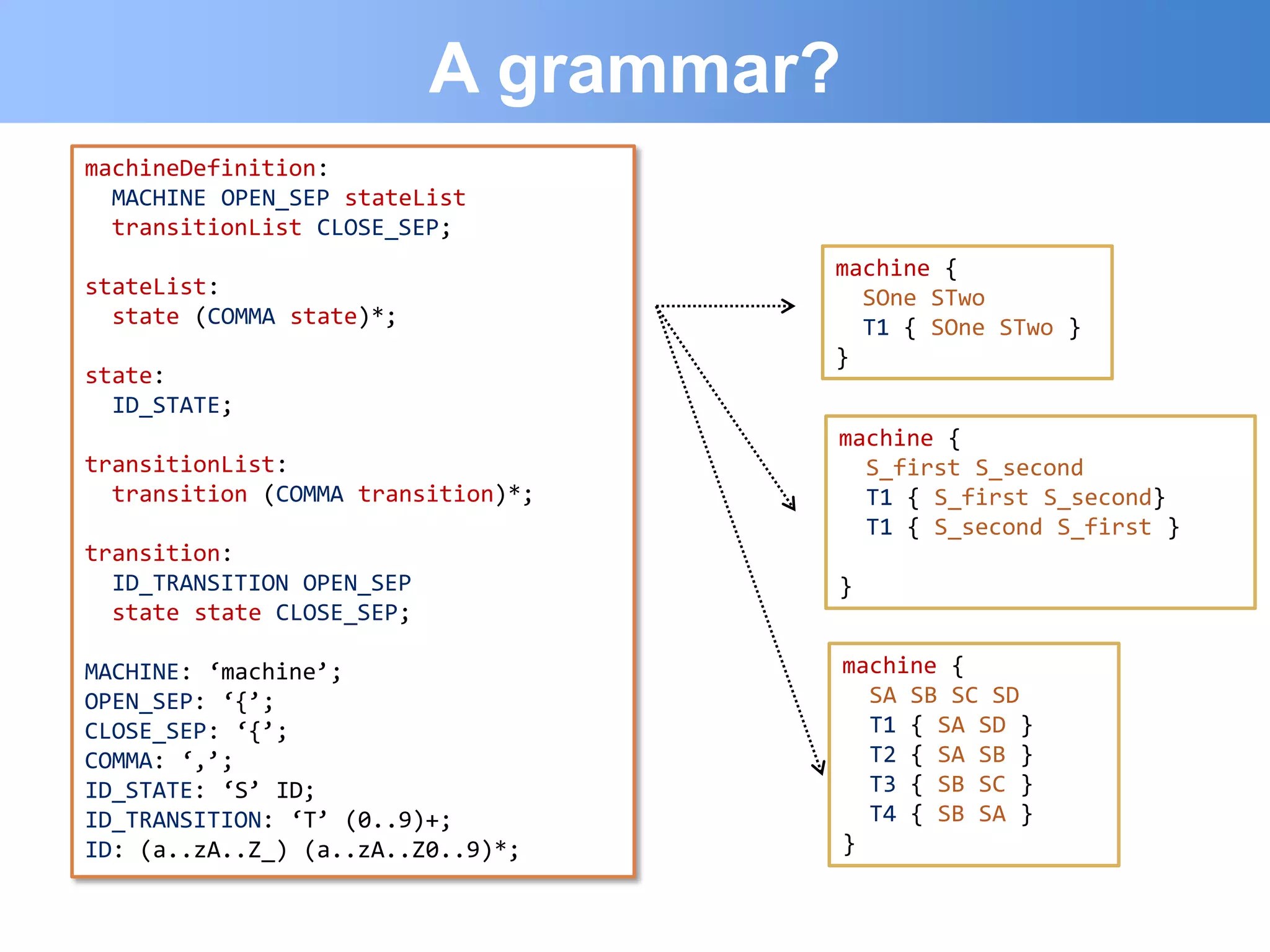
A grammar?
machineDefinition:
  MACHINE OPEN_SEP stateList
  transitionList CLOSE_SEP;
                                    machine {
stateList:                            SOne STwo
  state (COMMA state)*;               T1 { SOne STwo }
                                    }
state:
  ID_STATE;
                                    machine {
transitionList:                       S_first S_second
  transition (COMMA transition)*;     T1 { S_first S_second}
                                      T1 { S_second S_first }
transition:
  ID_TRANSITION OPEN_SEP            }
  state state CLOSE_SEP;

MACHINE: ‘machine’;                     machine {
OPEN_SEP: ‘{’;                            SA SB SC SD
CLOSE_SEP: ‘{’;                           T1 { SA SD }
COMMA: ‘,’;                               T2 { SA SB }
ID_STATE: ‘S’ ID;                         T3 { SB SC }
ID_TRANSITION: ‘T’ (0..9)+;               T4 { SB SA }
ID: (a..zA..Z_) (a..zA..Z0..9)*;        }
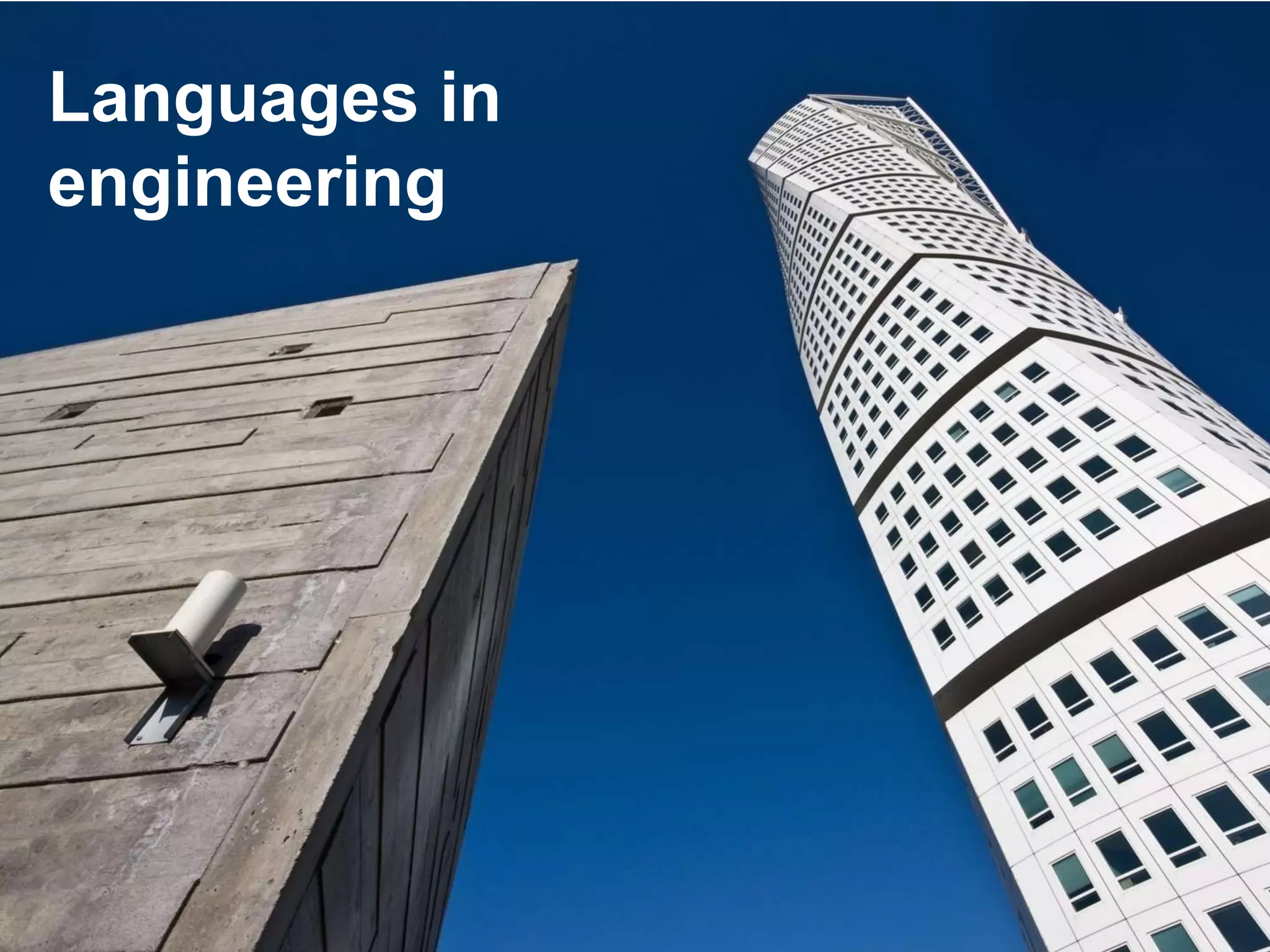
Languages in
engineering
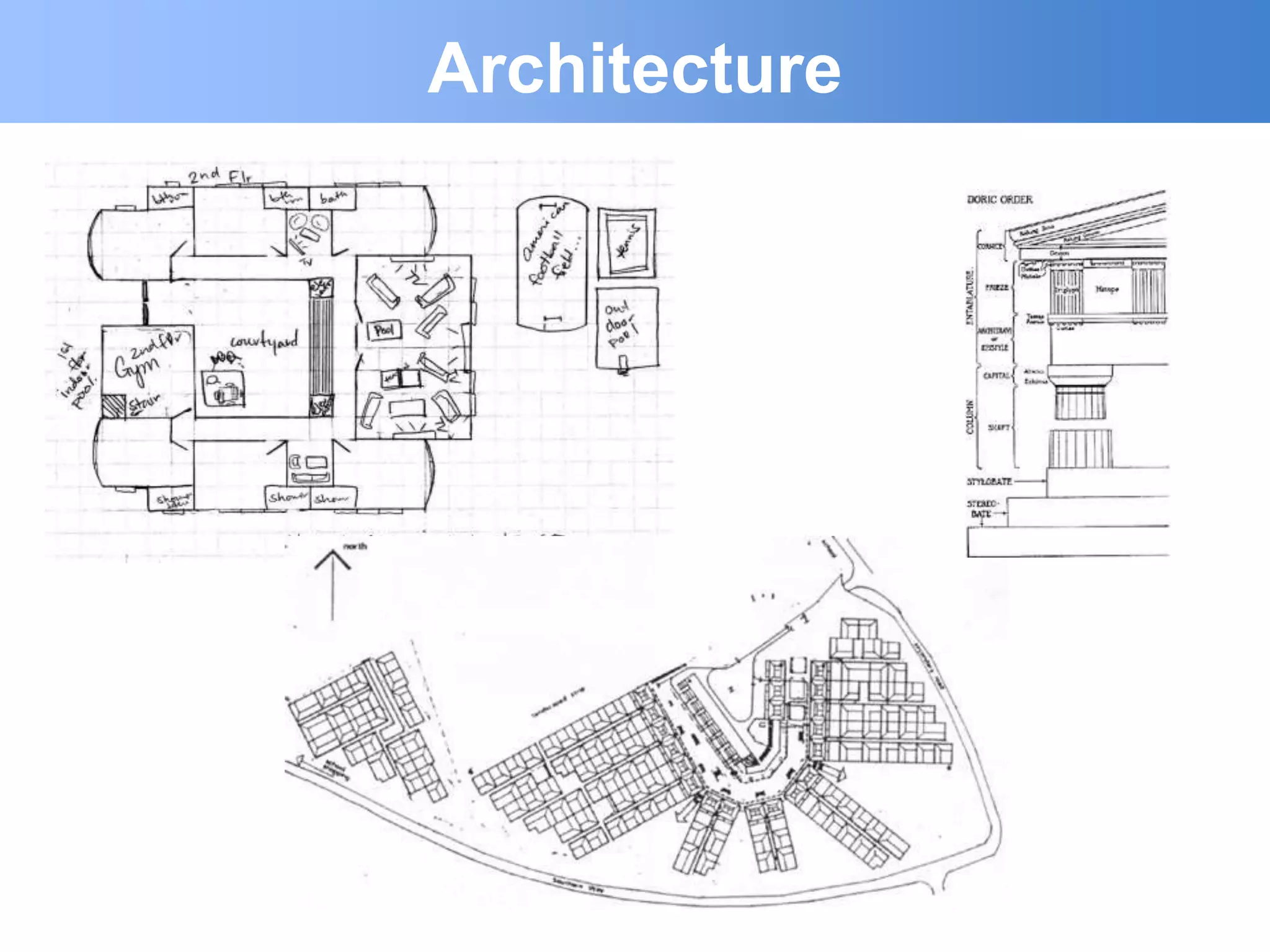
Architecture
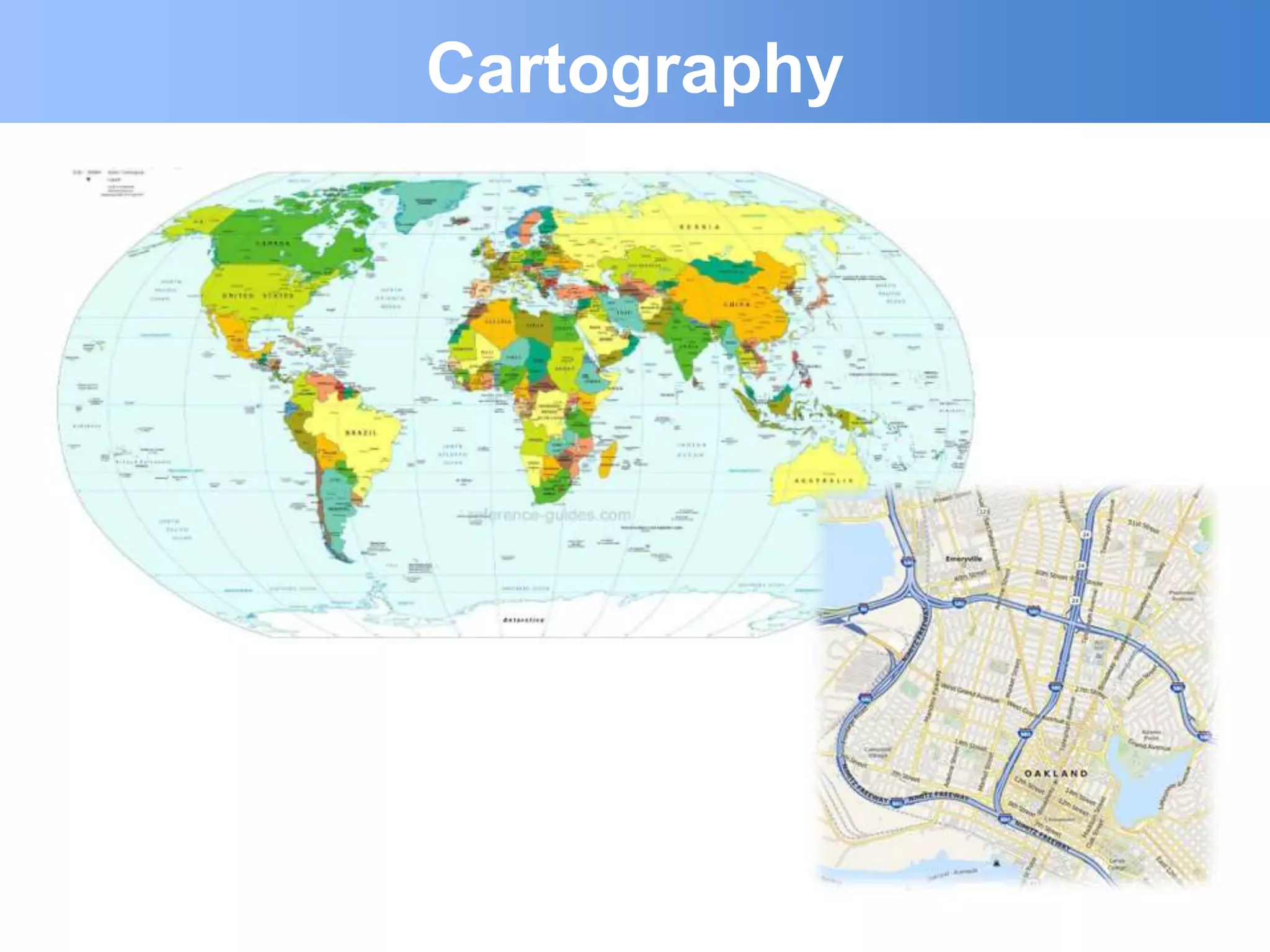
Cartography
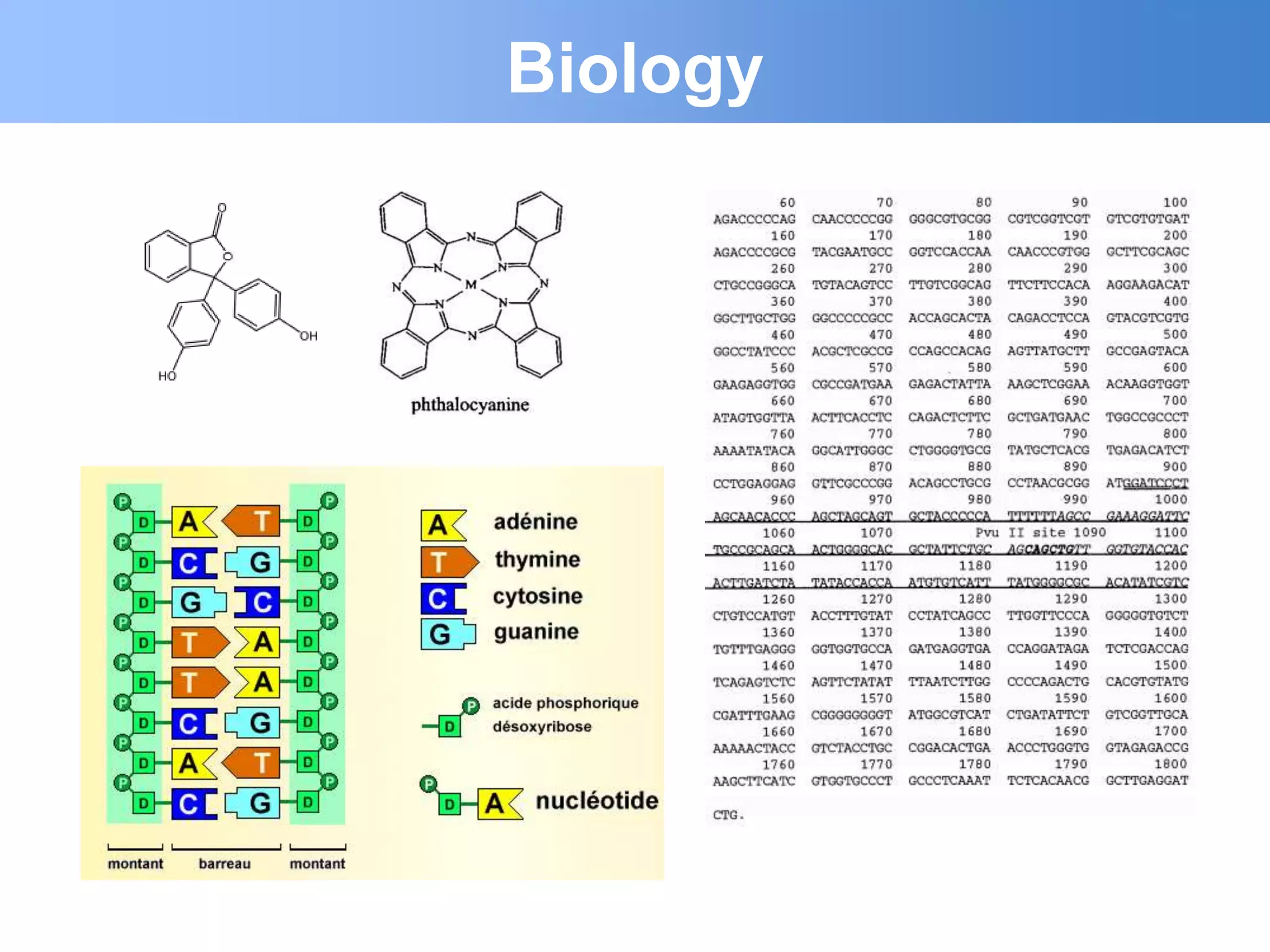
Biology
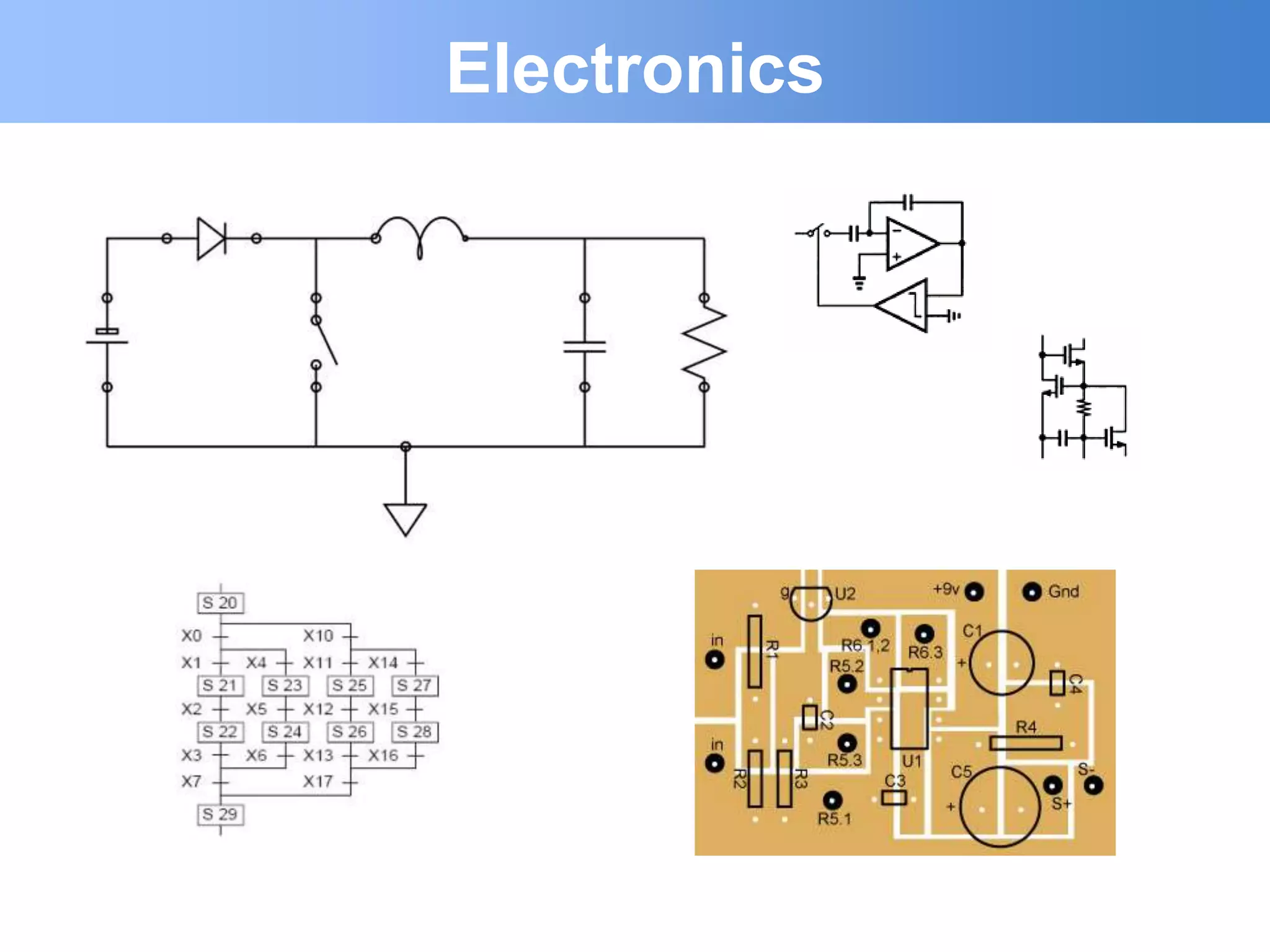
Electronics
Languages in Computer Science
GPLs
• Java                                          • Delphi
class HelloWorldApp {                             program ObjectPascalExample;
    public static void main(String[] args) {        type
        System.out.println("Hello World!"); }         THelloWorld = object
}                                                        procedure Put;
                                                      end;
                                                    var

• C
                                                      HelloWorld: THelloWorld;
                                                    procedure THelloWorld.Put;
                                                    begin
#include <stdio.h>                                    WriteLn('Hello, World!');
int main(void)                                      end;
{                                                 begin
    printf("hello, worldn");                        New(HelloWorld);
}                                                    HelloWorld.Put;
                                                     Dispose(HelloWorld);
                                                  end.

• Python
 print("Hello world")
GPLs
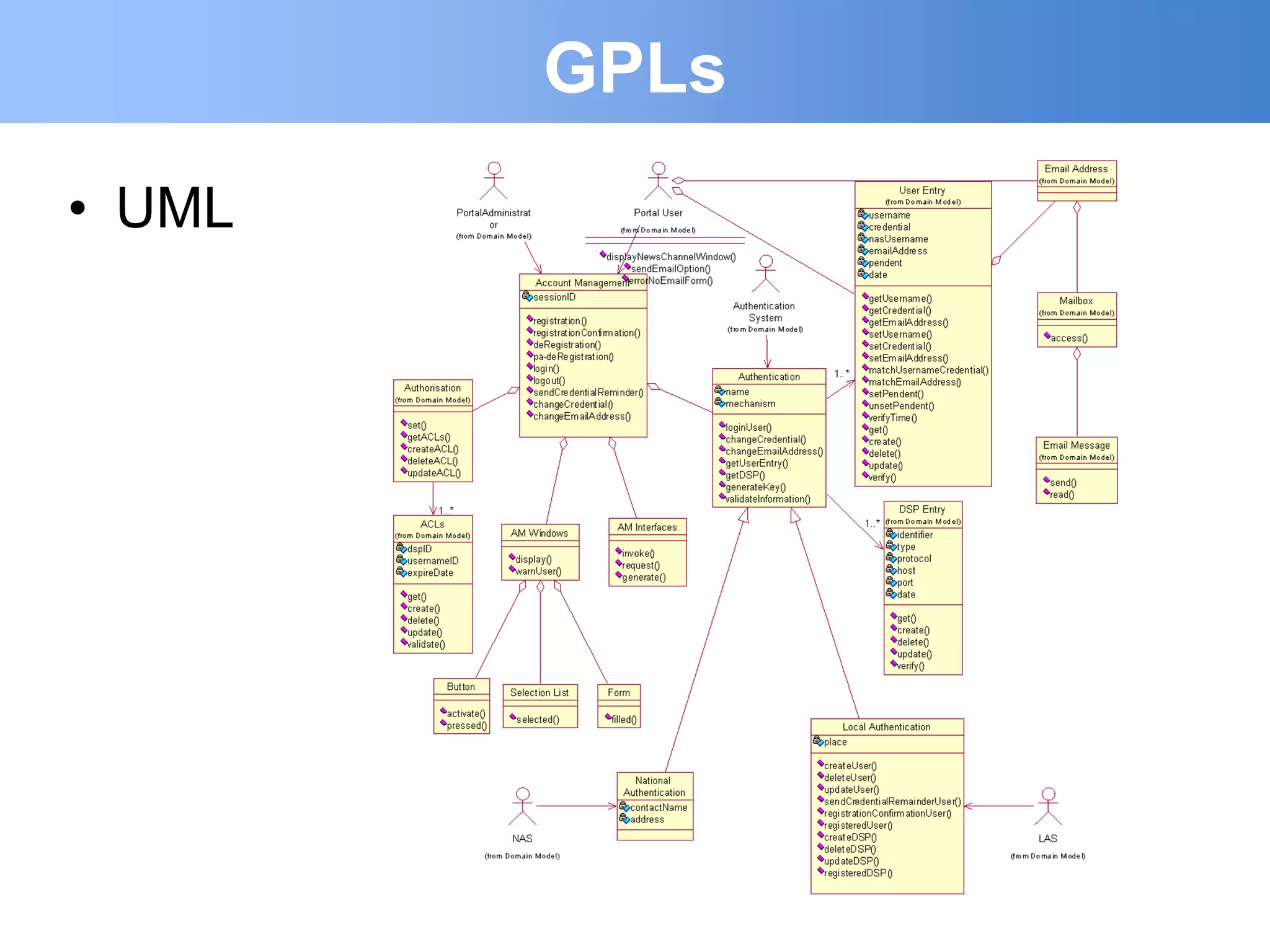
• UML
DSLs
• SQL                                            • CSS
CREATE TABLE Employee (                         body {
  id INT NOT NULL IDENTITY (1,1) PRIMARY KEY,     text-align: left;
  name VARCHAR(50),                               font-family: helvetica, sans-serif;
  surname VARCHAR(50),                          }
  address VARCHAR(255),                         h1 {
  city VARCHAR(60),                               border: 1px solid #b4b9bf;
  telephone VARCHAR(15),                          font-size: 35px;}
)


• HTML                                           • LaTeX
                                                ifthenelse{boolean{showcomments}}
                                                  {newcommand{nb}[2]{
<html>                                              fcolorbox{gray}{yellow}{
  <head>                                              bfseriessffamilyscriptsize#1
    <title>Example</title>                          }
  </head>                                           {sfsmalltextit{#2}}
  <body>                                            }
    <p>Example</p>                                  newcommand{version}{scriptsize$-$working$-$}
  </body>                                         }
</html>                                           {newcommand{nb}[2]{}
                                                    newcommand{version}{}
                                                }
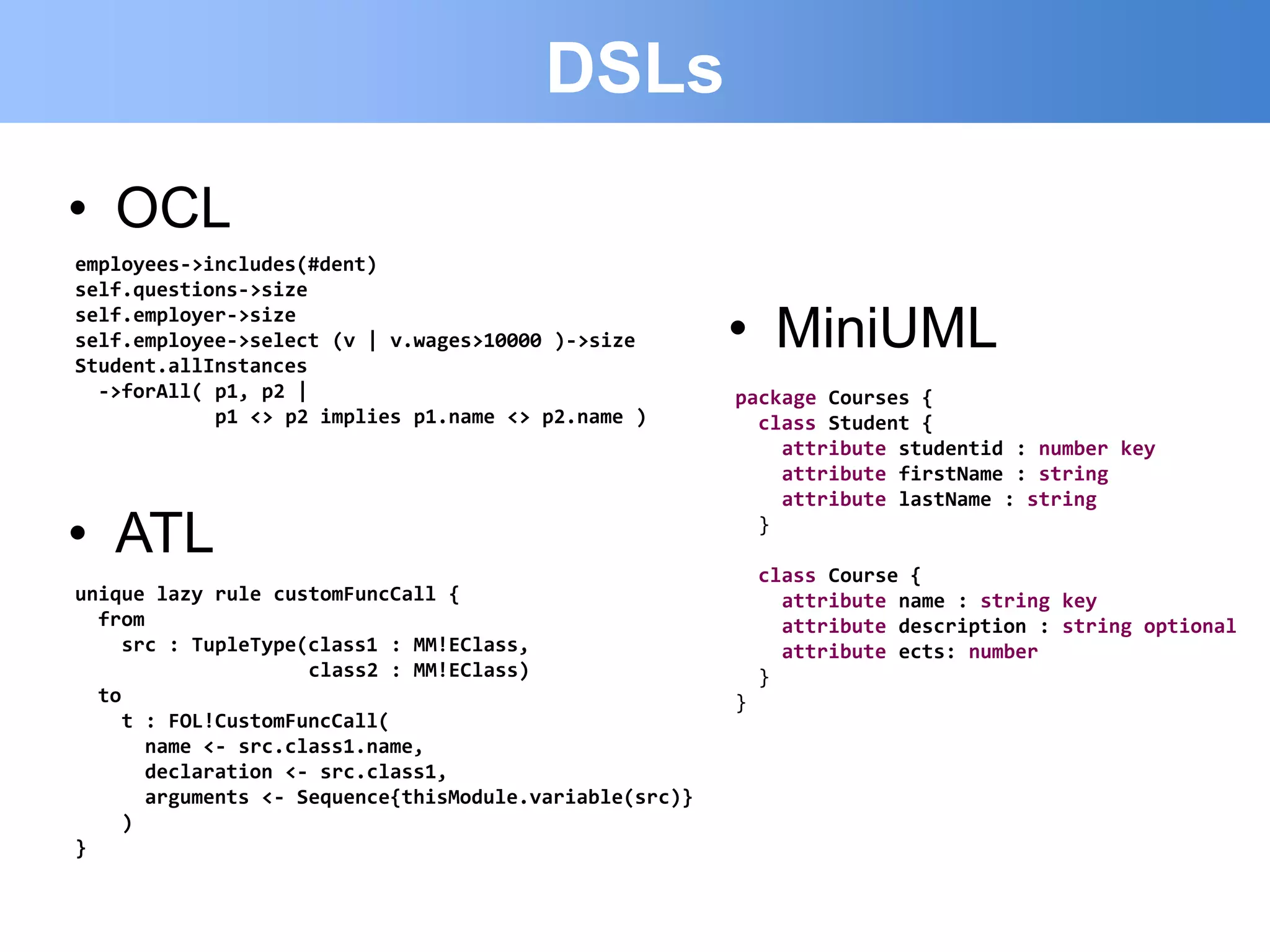
DSLs
• OCL
employees->includes(#dent)
self.questions->size
self.employer->size
self.employee->select (v | v.wages>10000 )->size
Student.allInstances
                                                         • MiniUML
  ->forAll( p1, p2 |                                     package Courses {
            p1 <> p2 implies p1.name <> p2.name )          class Student {
                                                             attribute studentid : number key
                                                             attribute firstName : string
                                                             attribute lastName : string

• ATL                                                      }

                                                             class Course {
unique lazy rule customFuncCall {                              attribute name : string key
  from                                                         attribute description : string optional
     src : TupleType(class1 : MM!EClass,                       attribute ects: number
                     class2 : MM!EClass)                     }
  to                                                     }
     t : FOL!CustomFuncCall(
       name <- src.class1.name,
       declaration <- src.class1,
       arguments <- Sequence{thisModule.variable(src)}
     )
}
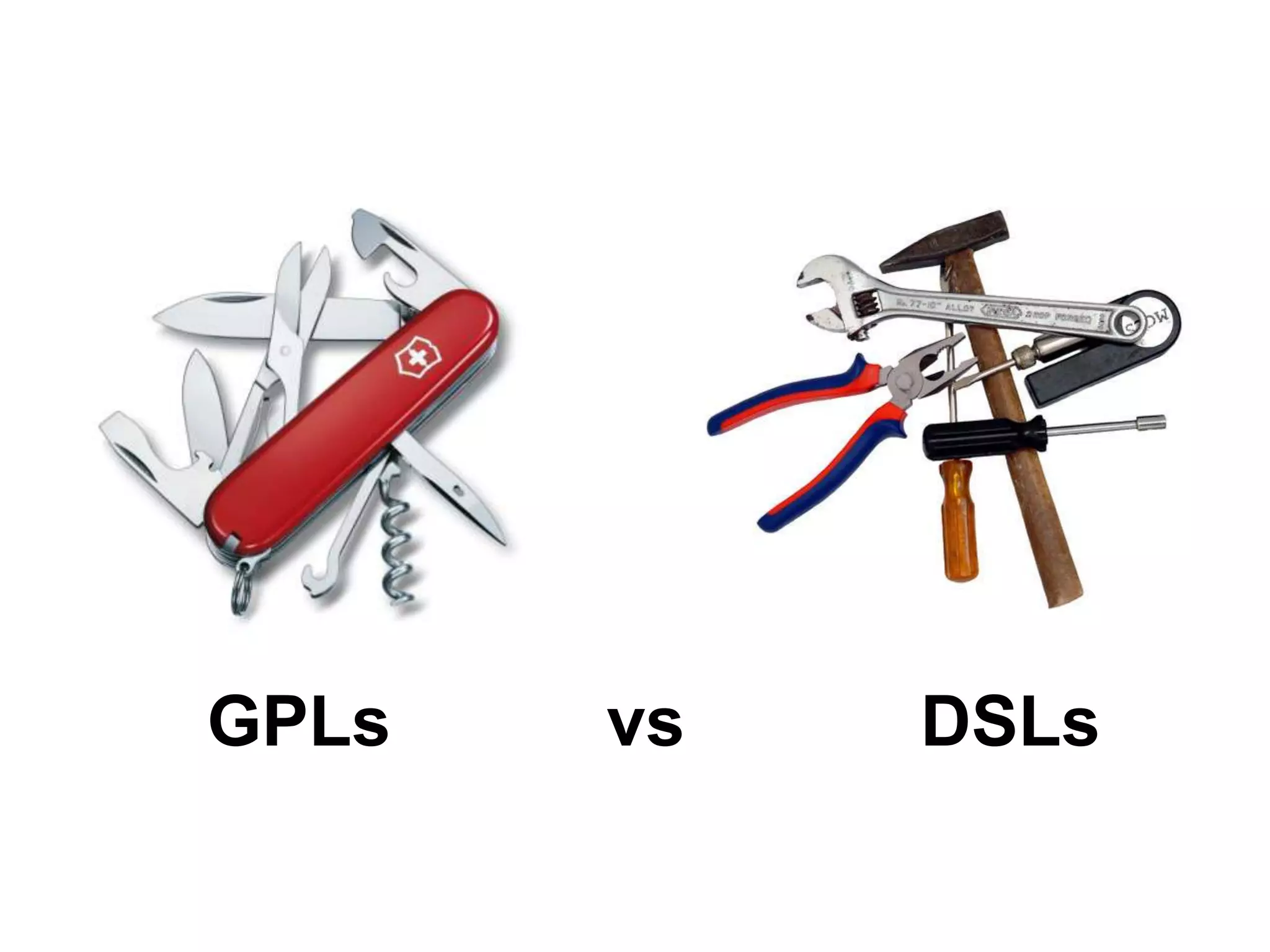
GPLs   vs   DSLs
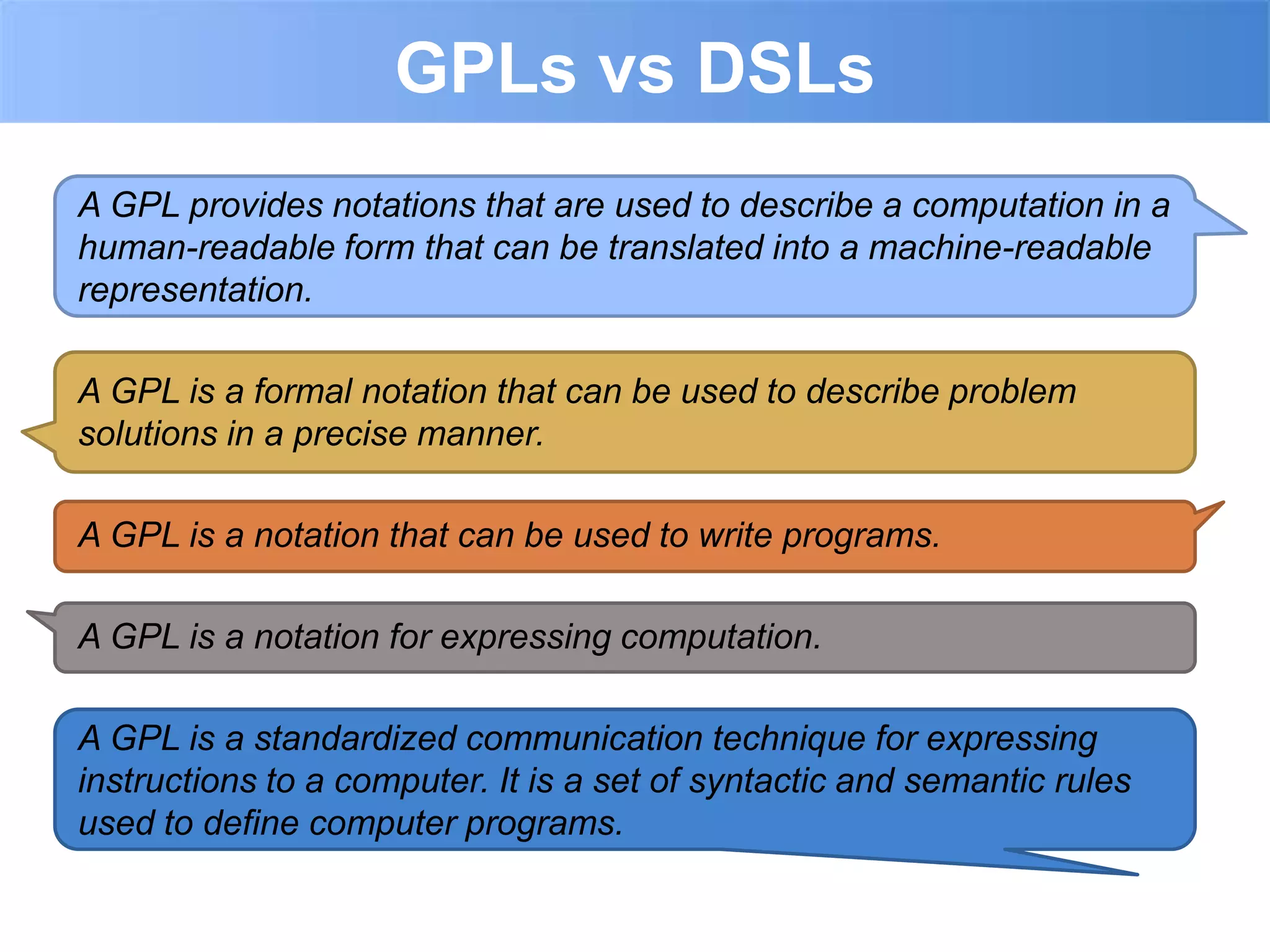
GPLs vs DSLs
A GPL provides notations that are used to describe a computation in a
human-readable form that can be translated into a machine-readable
representation.

A GPL is a formal notation that can be used to describe problem
solutions in a precise manner.

A GPL is a notation that can be used to write programs.

A GPL is a notation for expressing computation.

A GPL is a standardized communication technique for expressing
instructions to a computer. It is a set of syntactic and semantic rules
used to define computer programs.
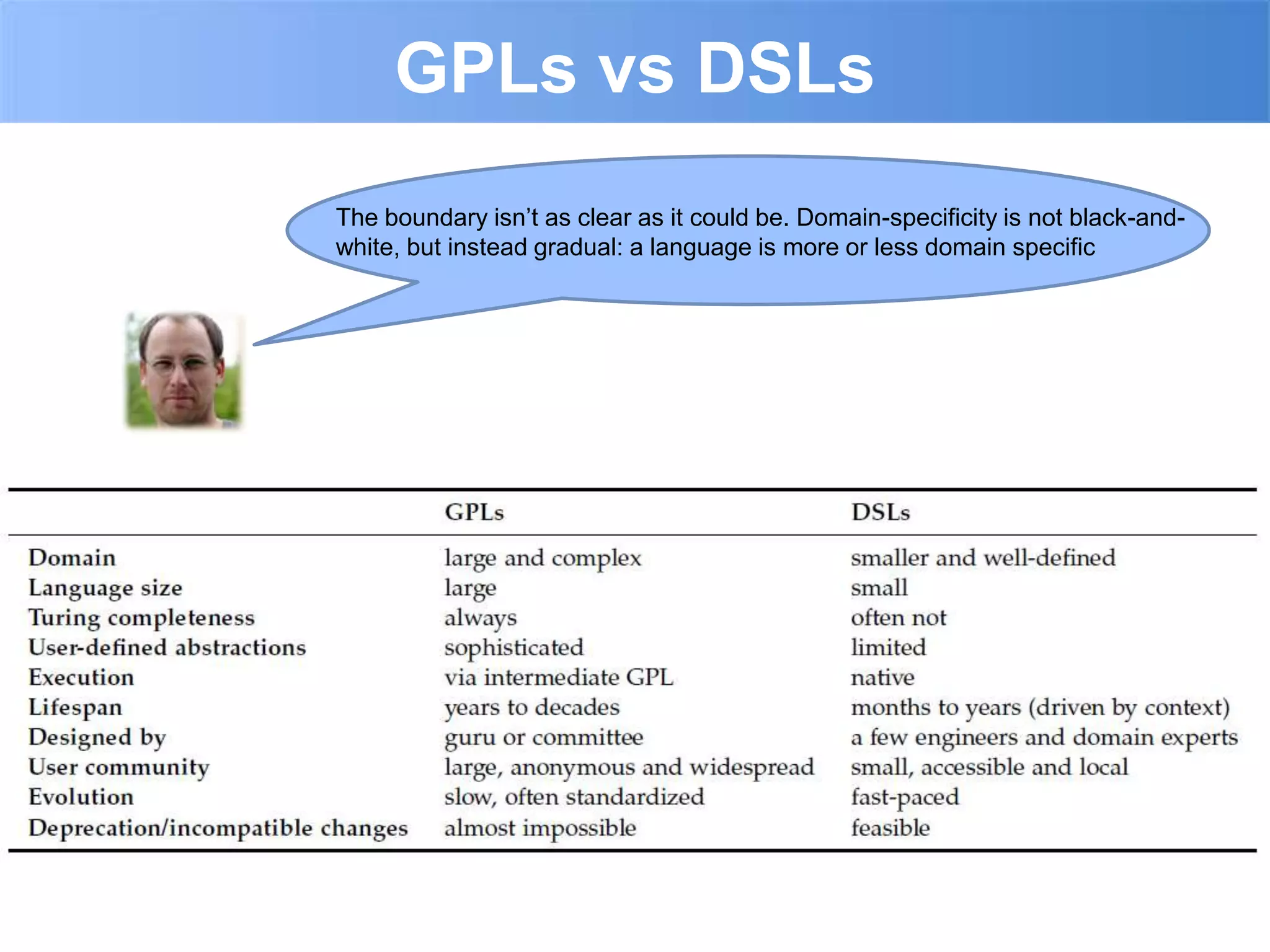
GPLs vs DSLs
The boundary isn‟t as clear as it could be. Domain-specificity is not black-and-
white, but instead gradual: a language is more or less domain specific
GPLs vs DSLs
The boundary isn‟t as clear as it could be. Domain-specificity is not black-and-
white, but instead gradual: a language is more or less domain specific
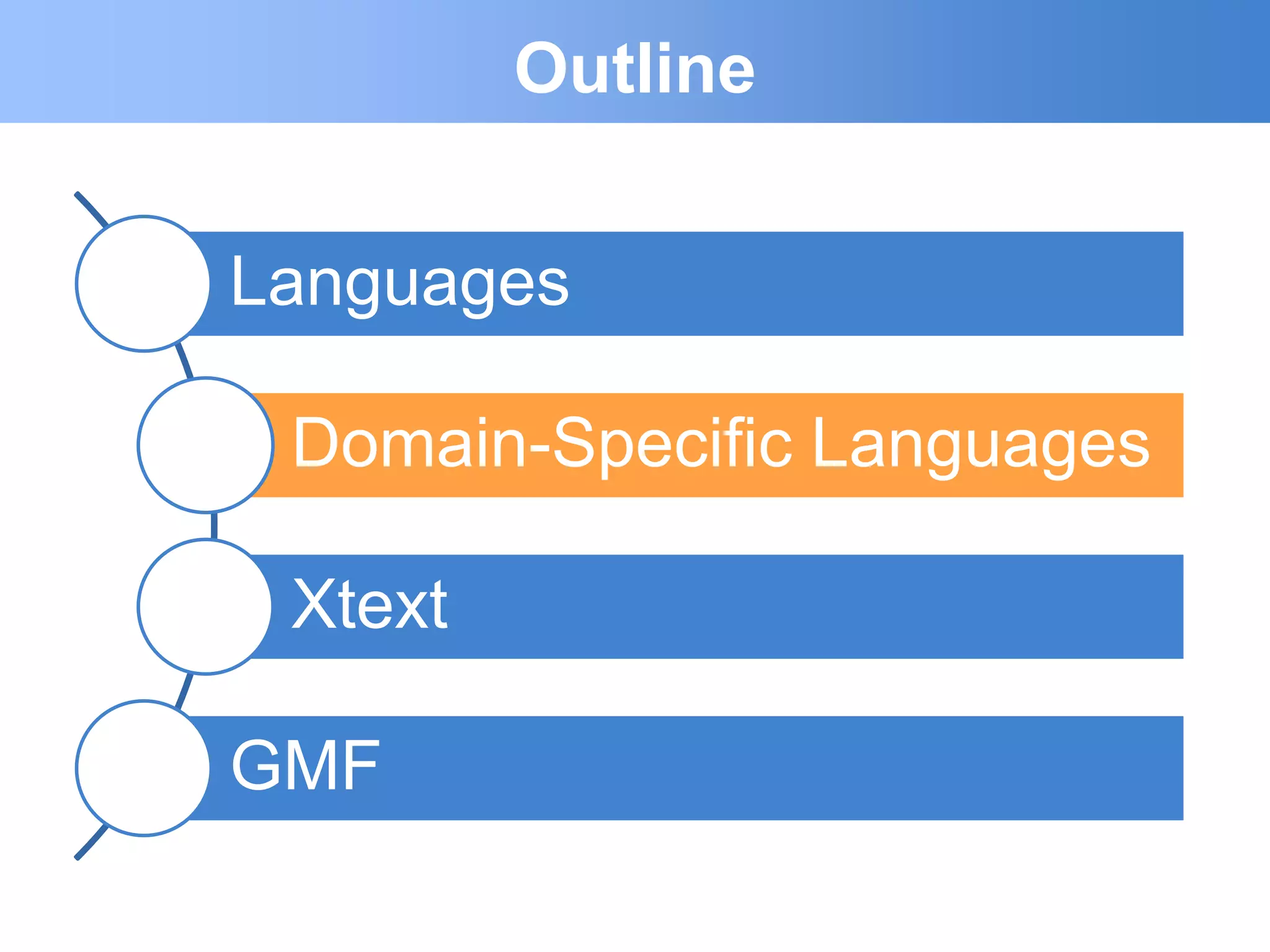
Outline


Languages

 Domain-Specific Languages

 Xtext

GMF
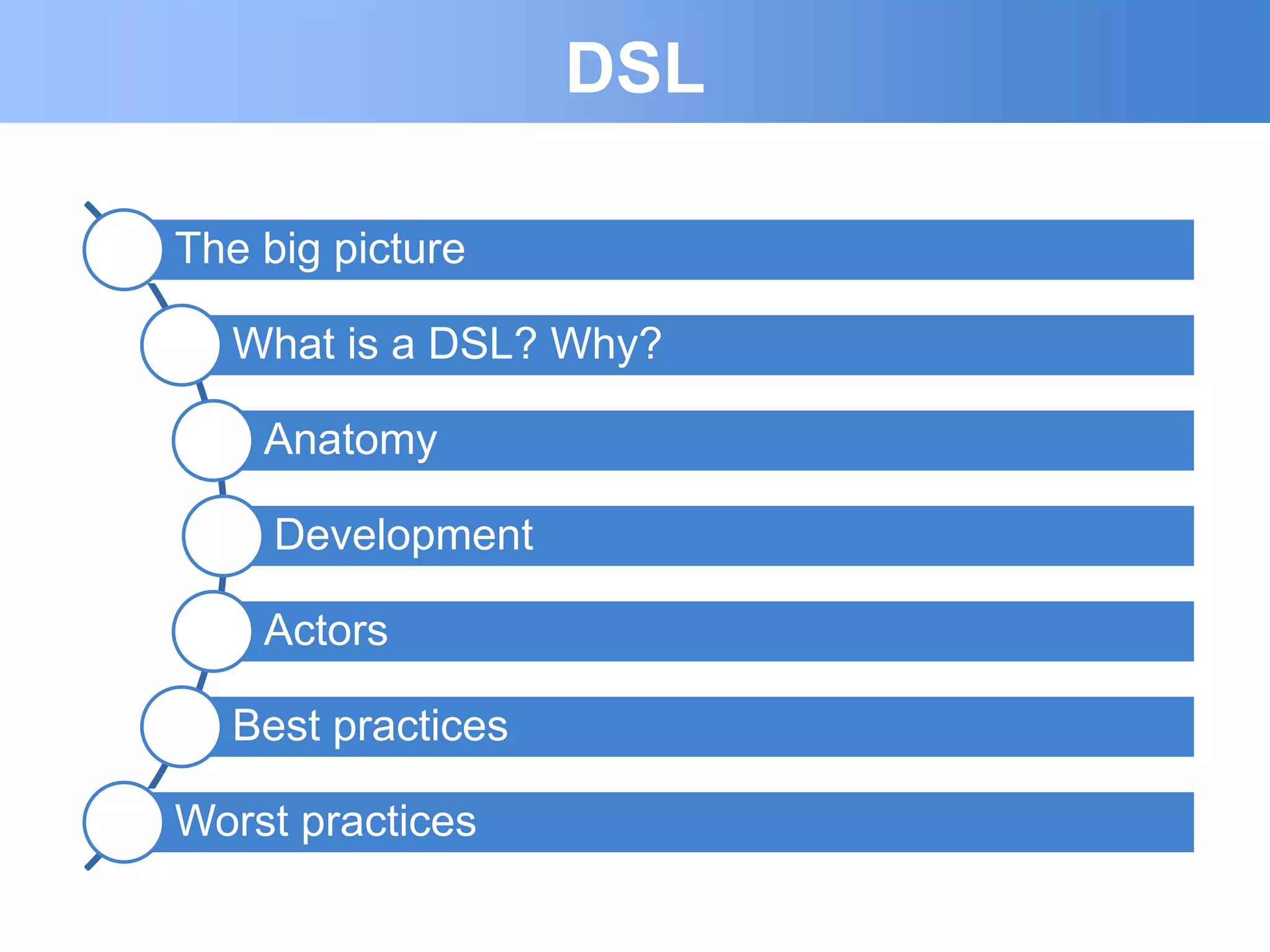
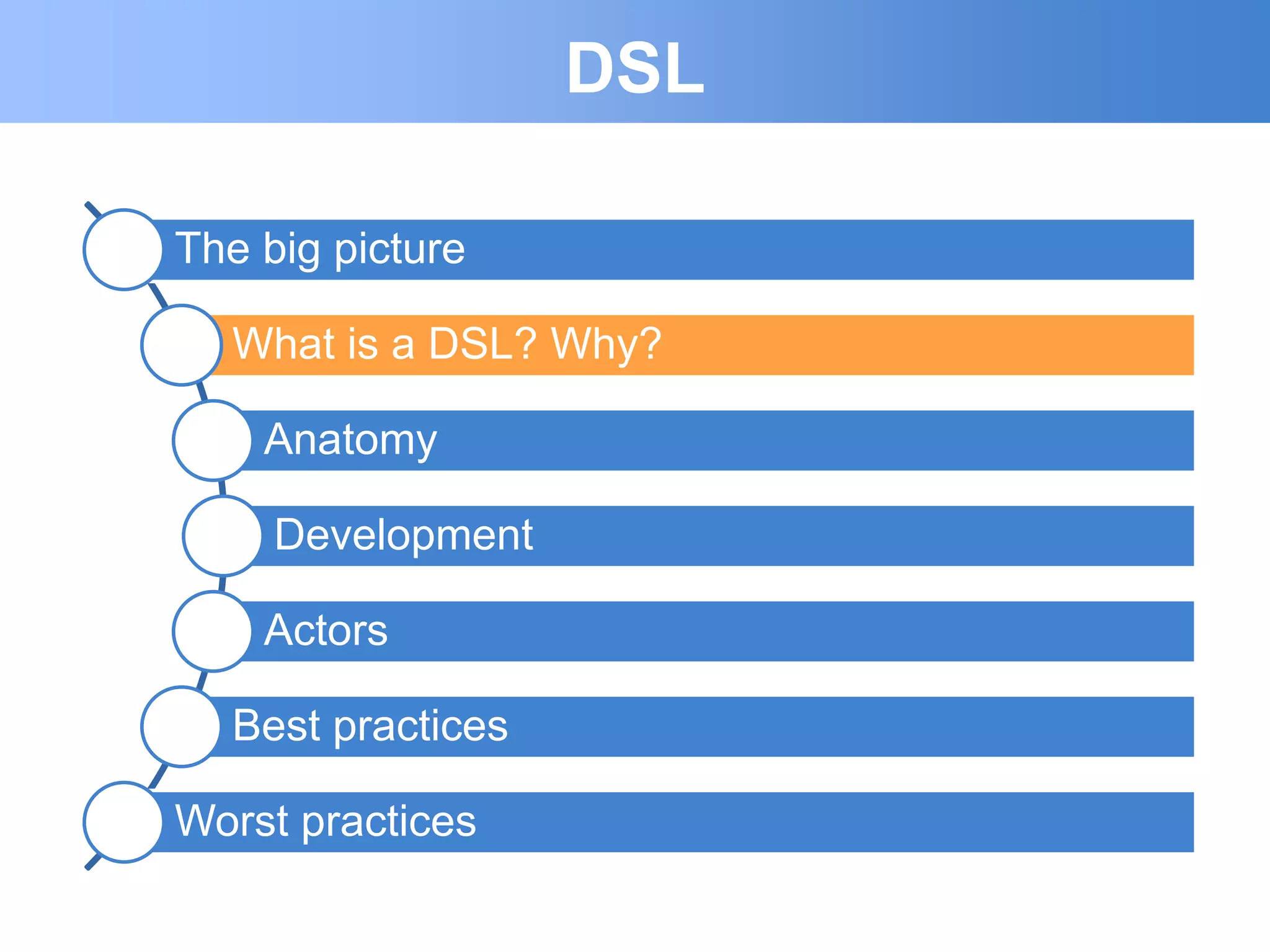
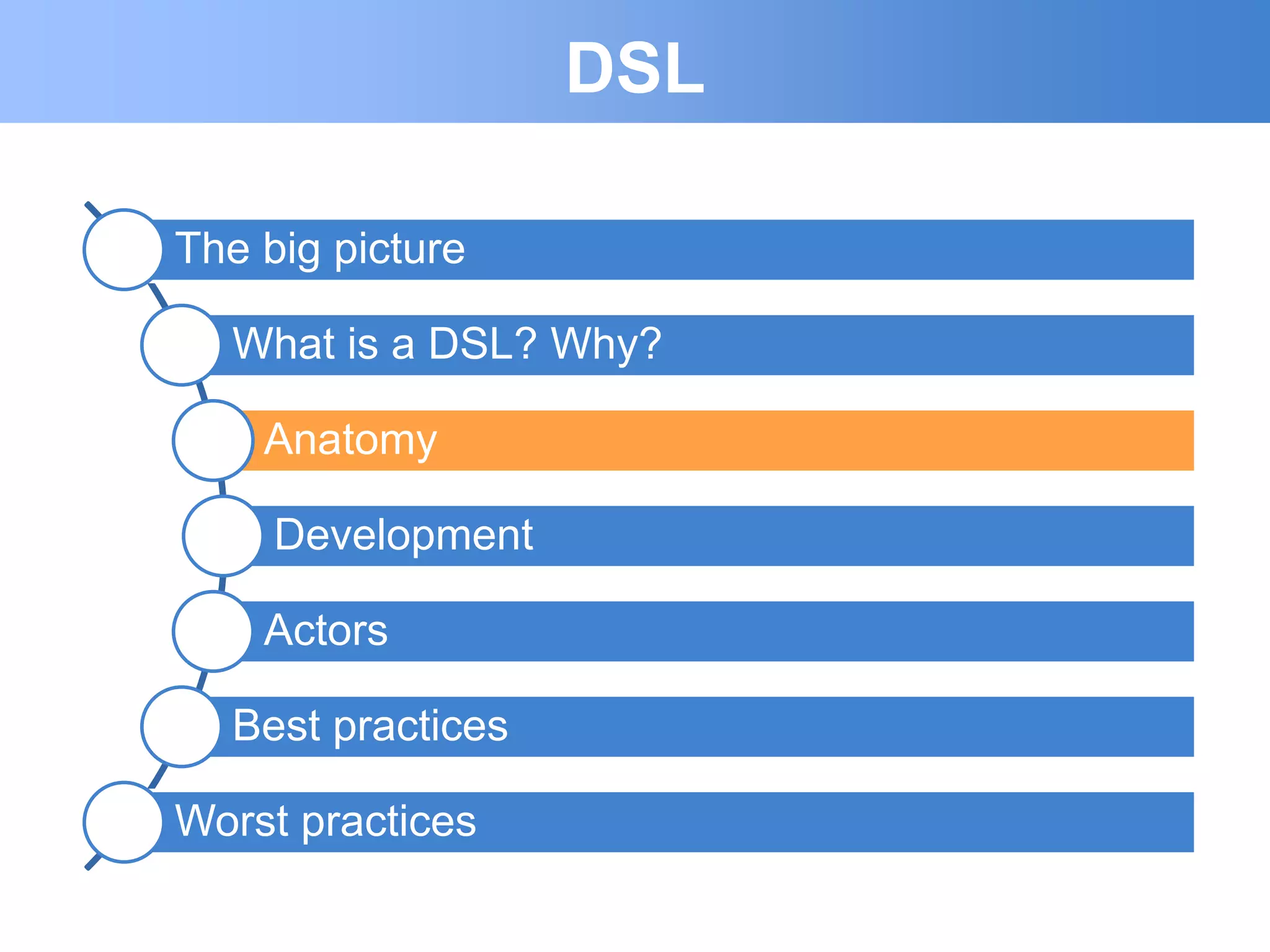
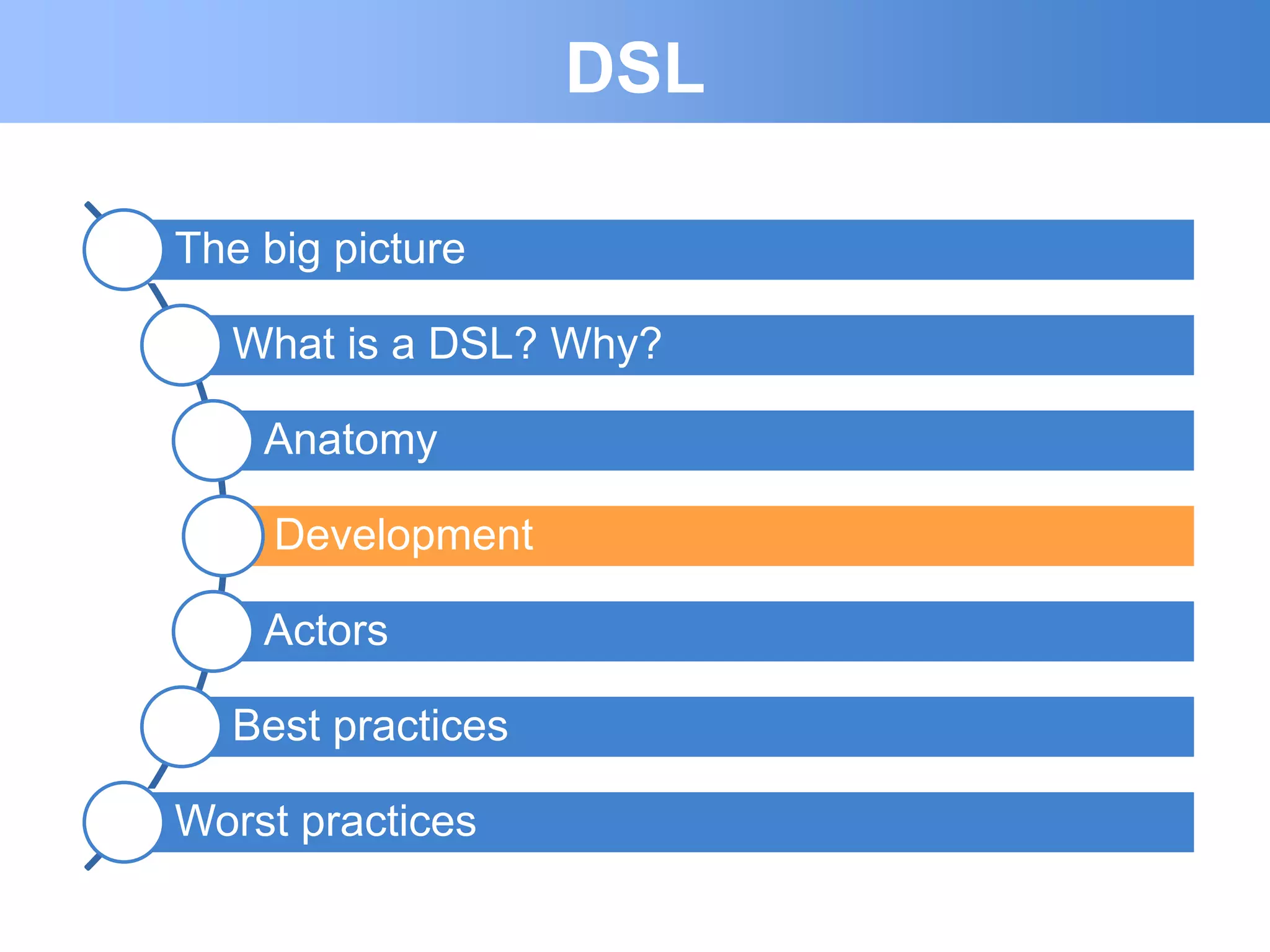
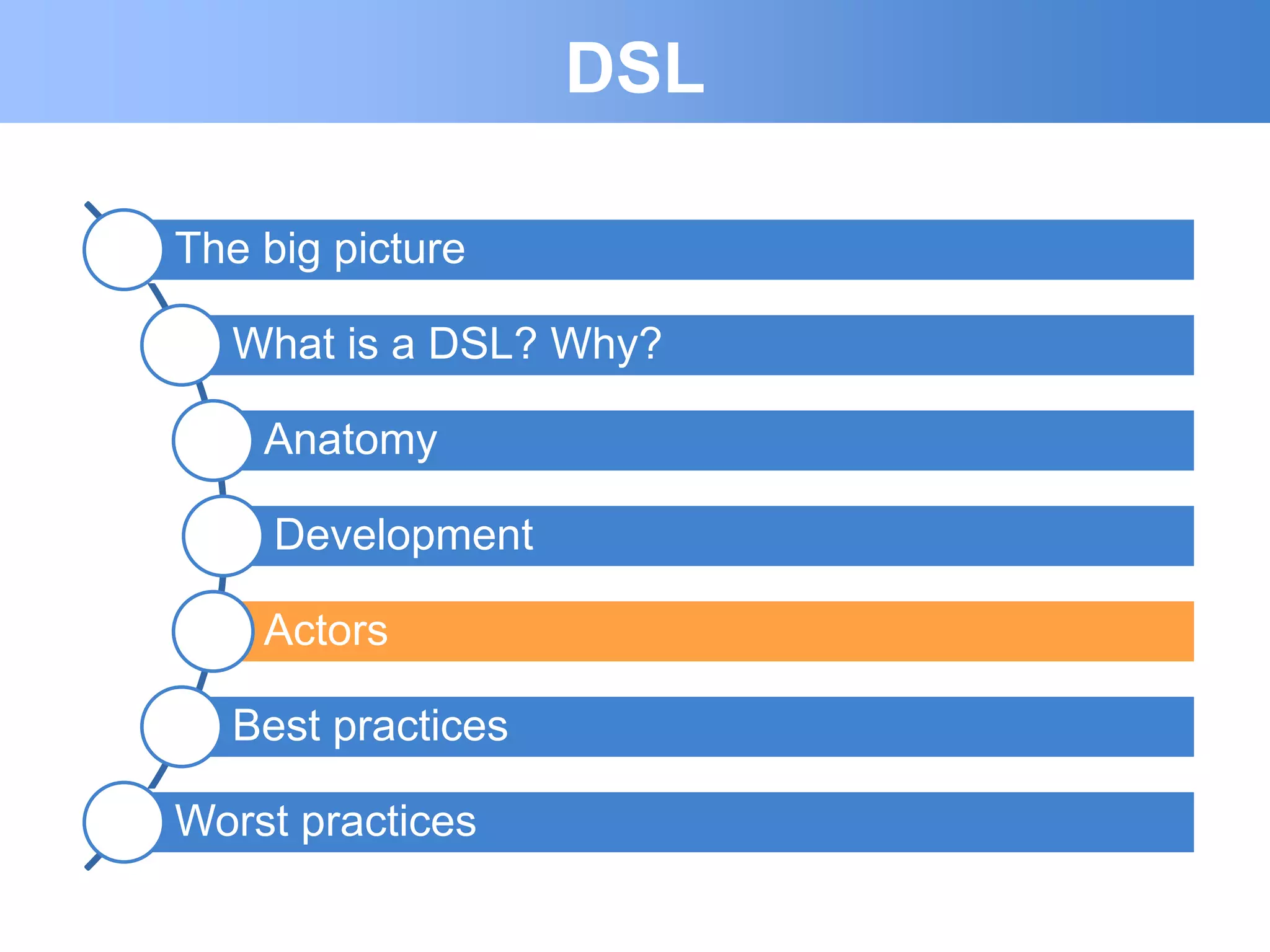
DSL

The big picture

  What is a DSL? Why?

    Anatomy

     Development

    Actors

  Best practices

Worst practices
DSL

The big picture

  What is a DSL? Why?

    Anatomy

     Development

    Actors

  Best practices

Worst practices
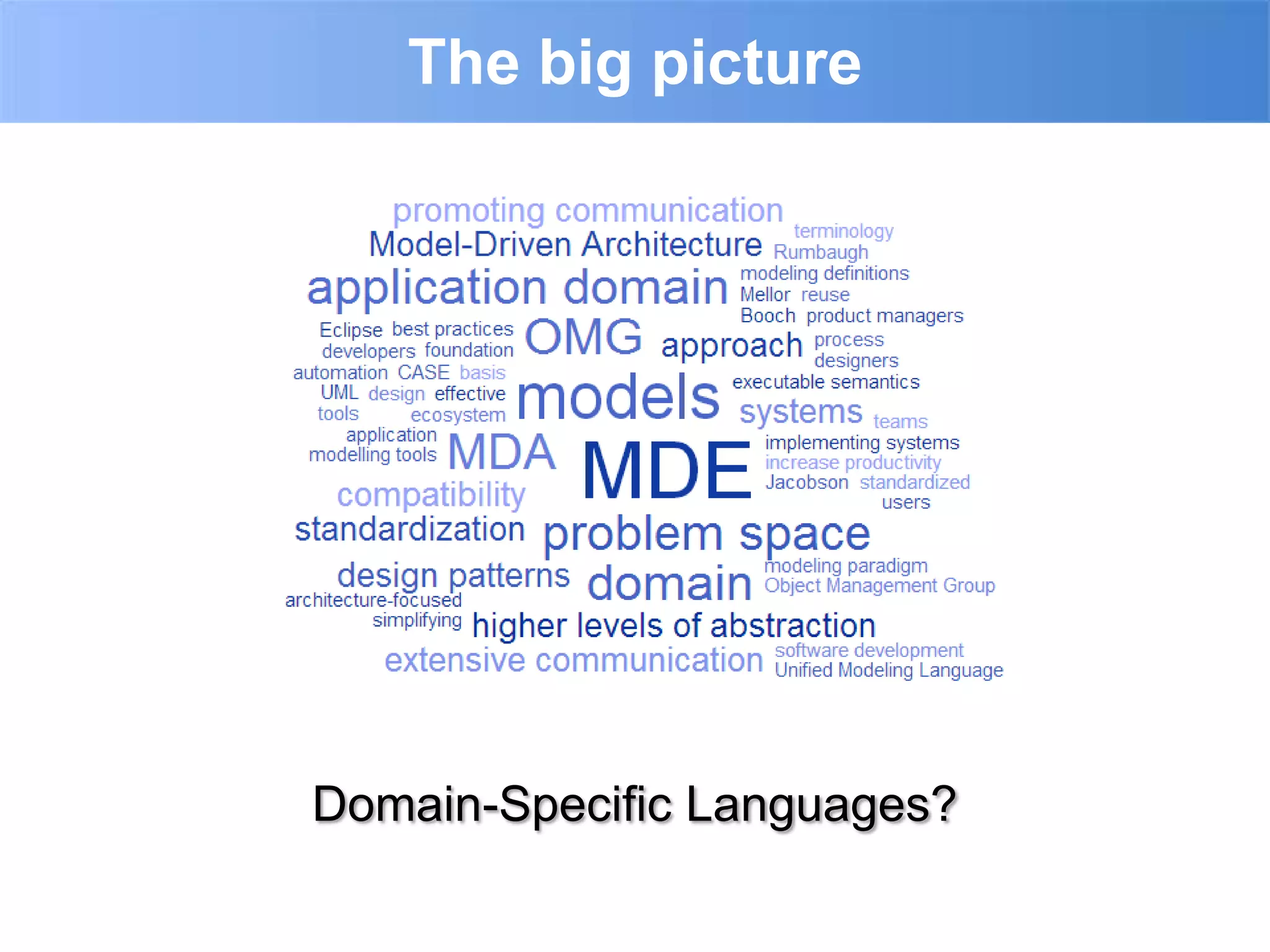
The big picture


Domain-Specific Languages?
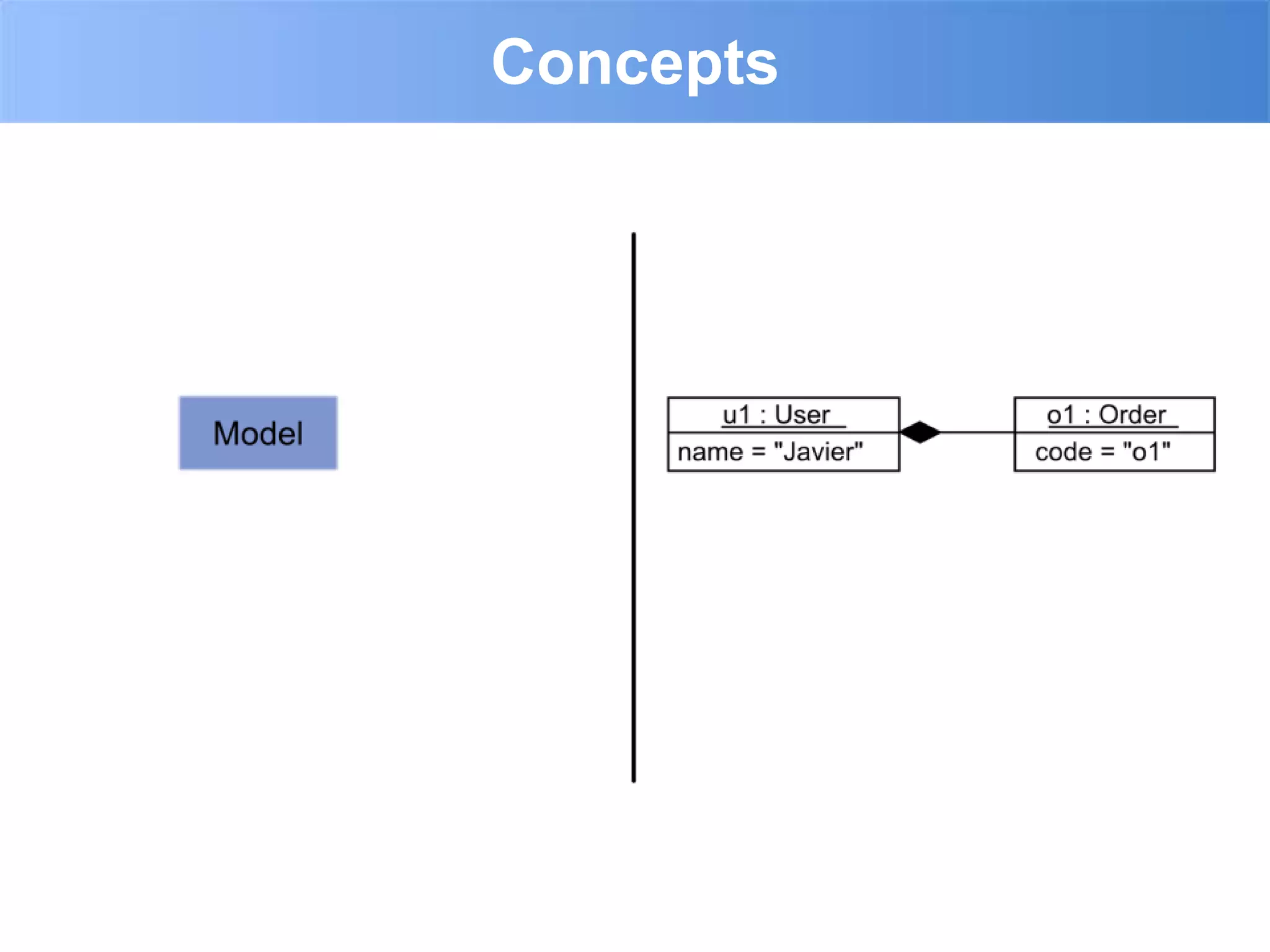
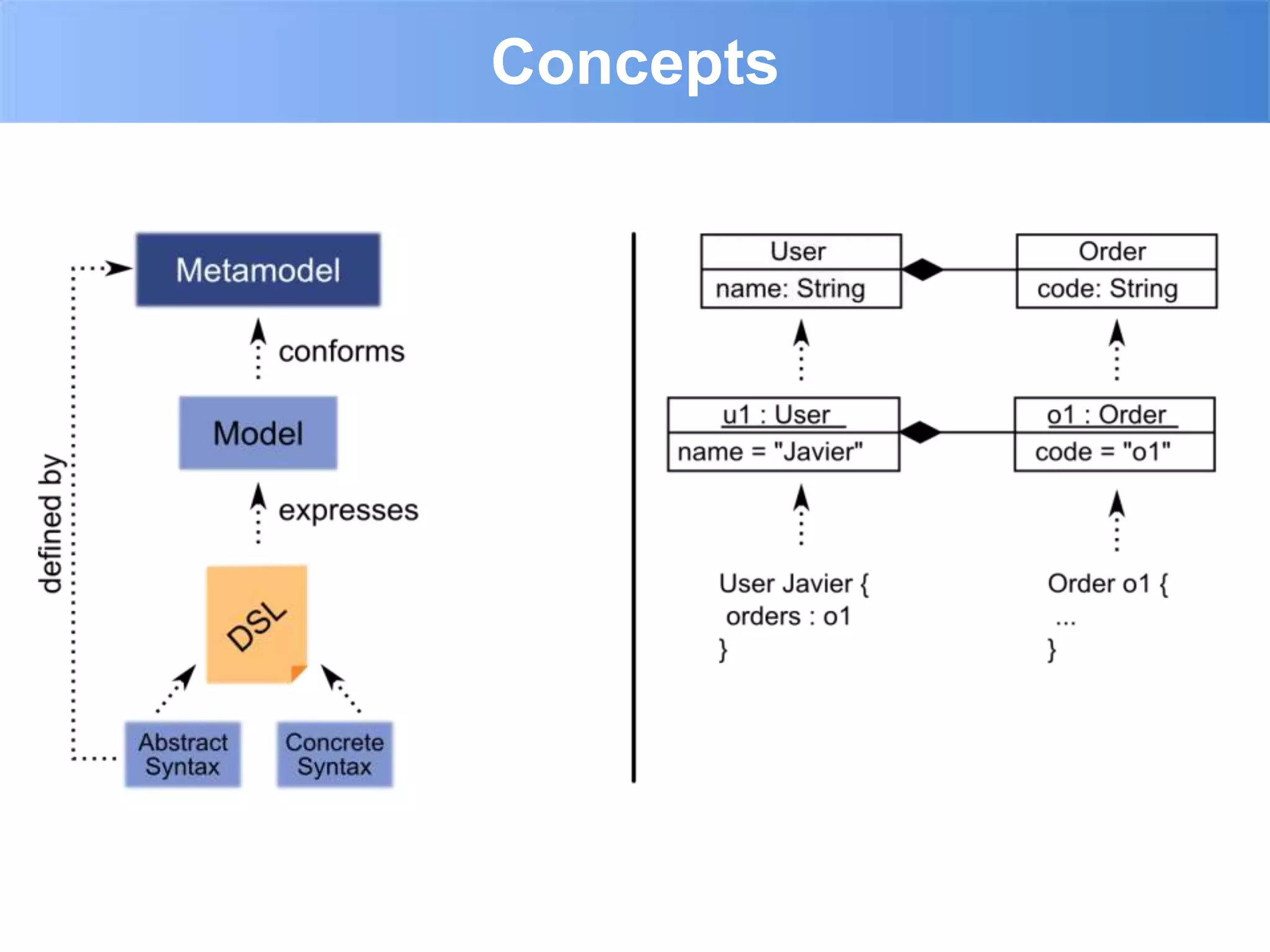
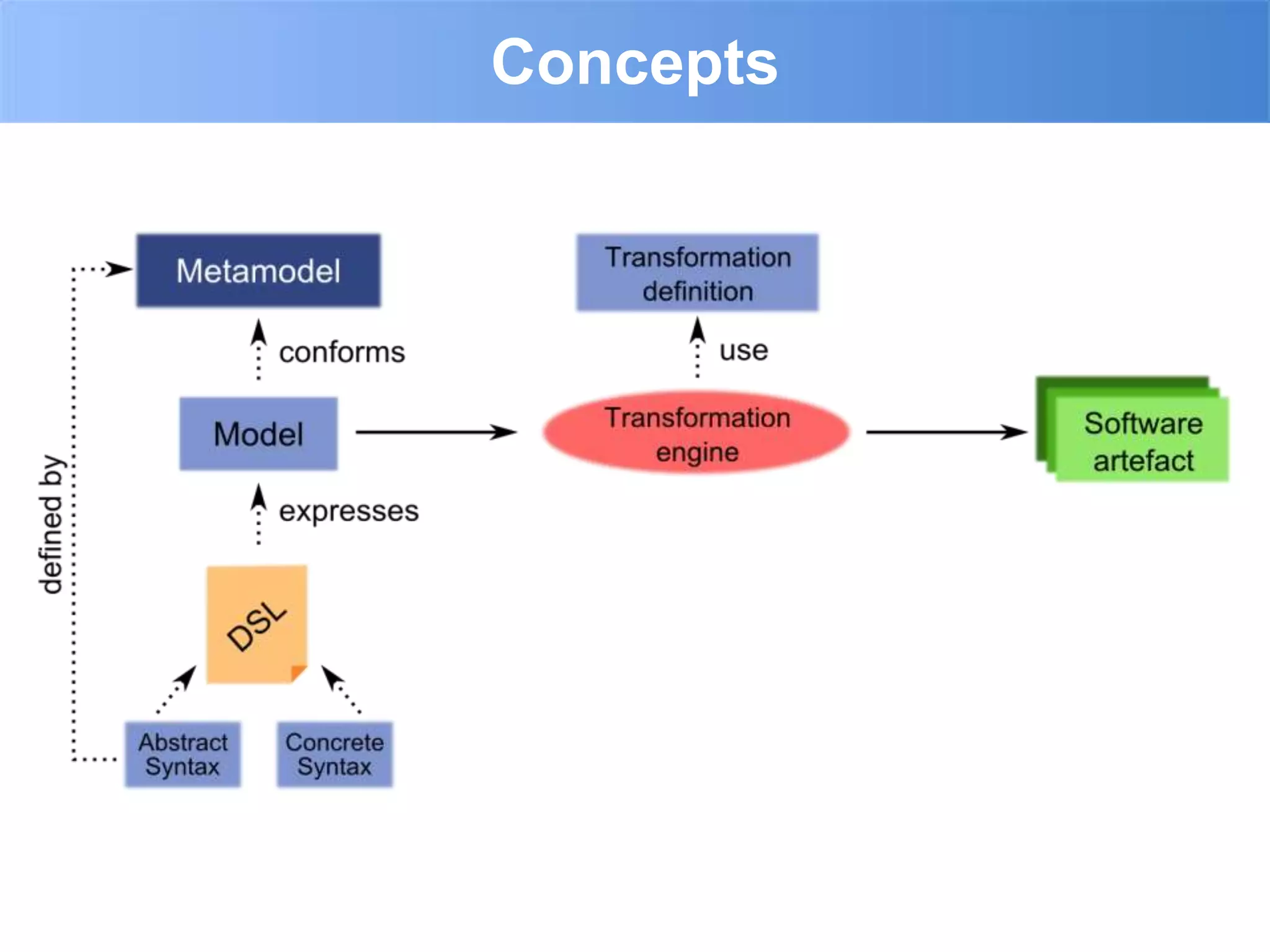
Concepts
Concepts
Concepts
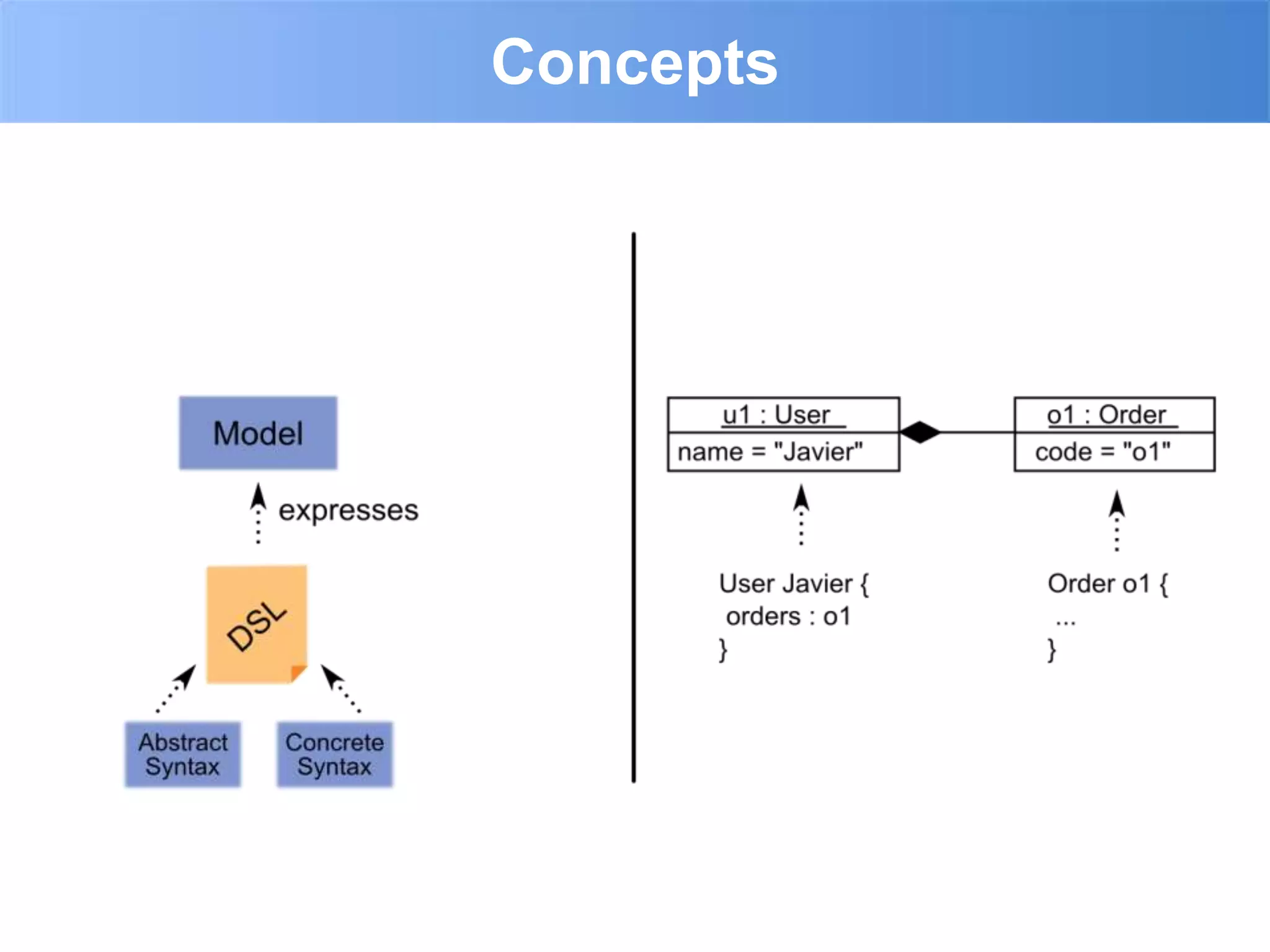
Concepts
DSL

The big picture

  What is a DSL? Why?

    Anatomy

     Development

    Actors

  Best practices

Worst practices
What is a DSL
• In general:
  Language specially designed to perform a
  task in a certain domain
What is a DSL
• In general:
  Language specially designed to perform a
  task in a certain domain

• In the context of computer science:
  A formal processable language targeting at
  a specific viewpoint or aspect of a software
  system.
  It's semantics flexibility and notation is
  designed in order to support working with
  that viewpoint as good as possible
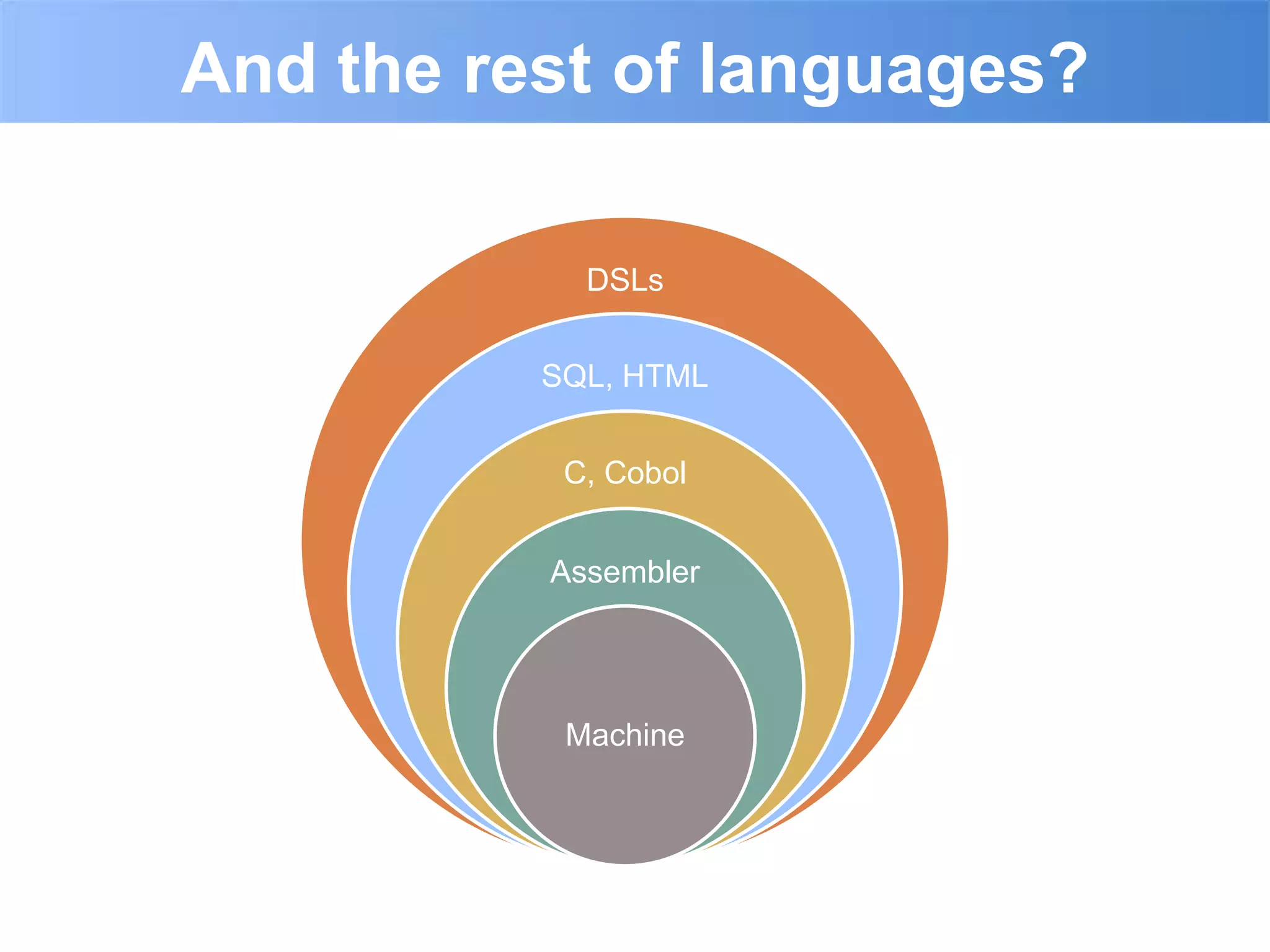
And the rest of languages?

            DSLs


          SQL, HTML


           C, Cobol


          Assembler


           Machine
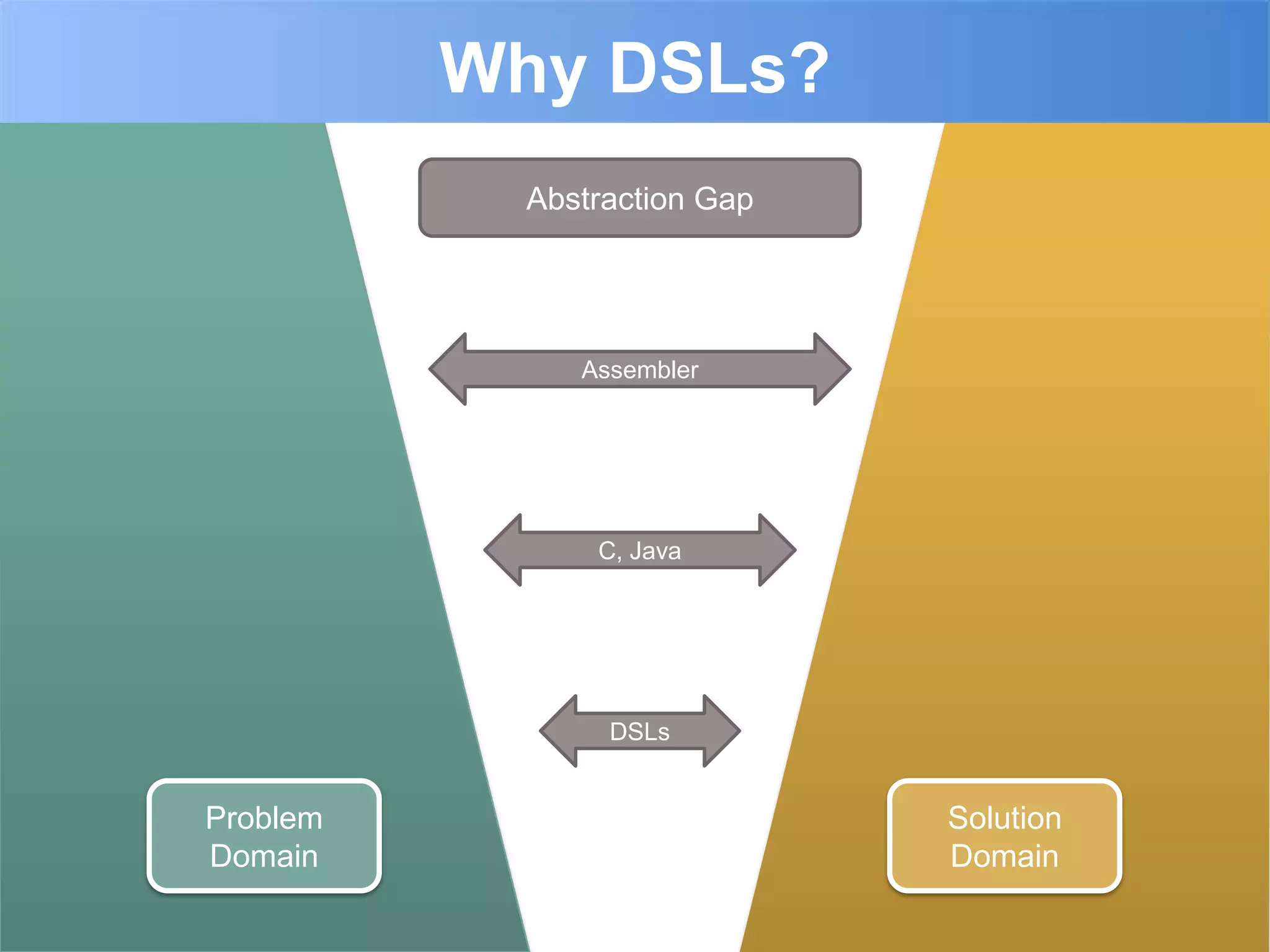
Why DSLs?
           Abstraction Gap


              Assembler


               C, Java


                DSLs


Problem                      Solution
Domain                       Domain
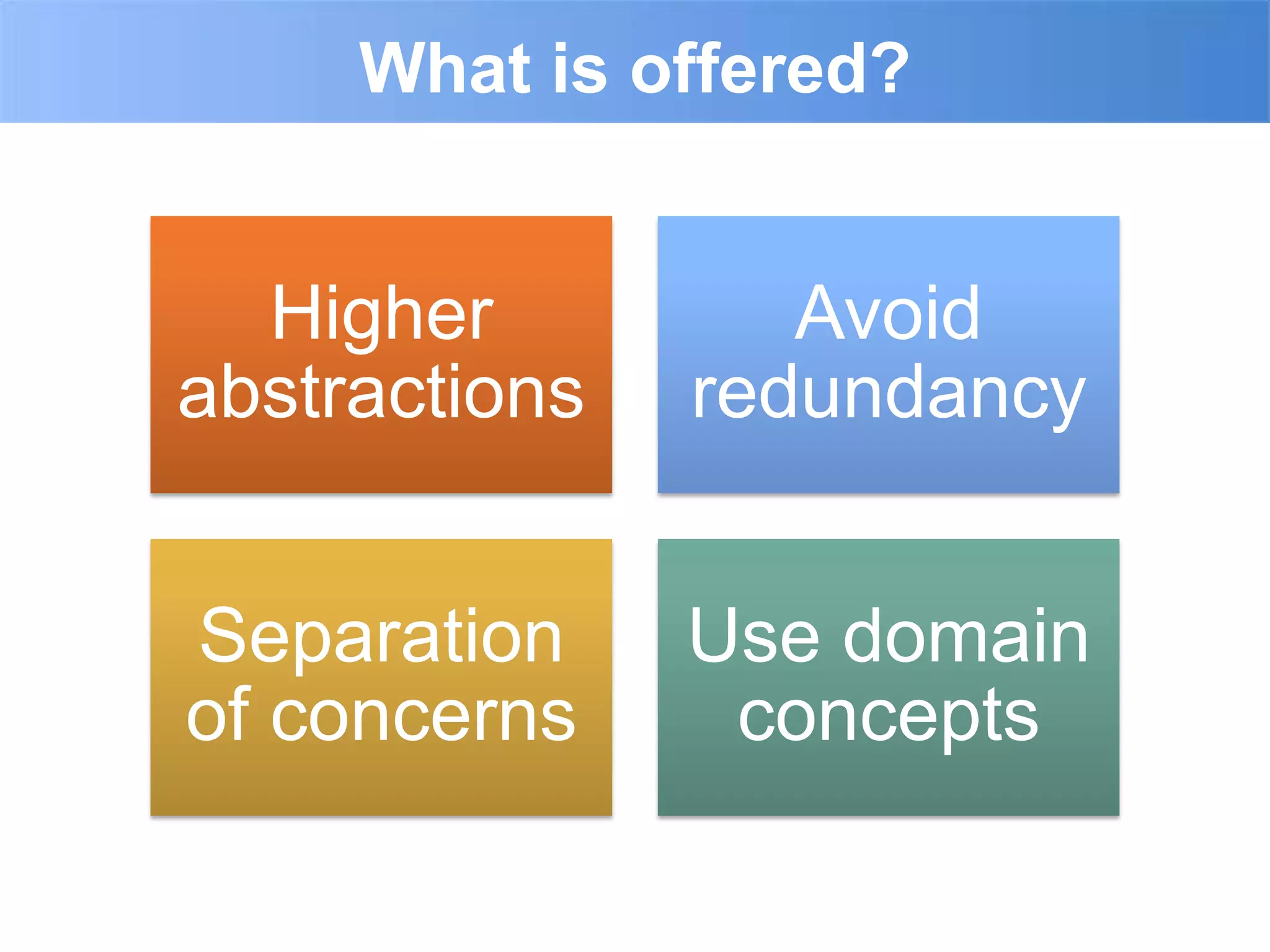
What is offered?


  Higher          Avoid
abstractions   redundancy


Separation     Use domain
of concerns     concepts
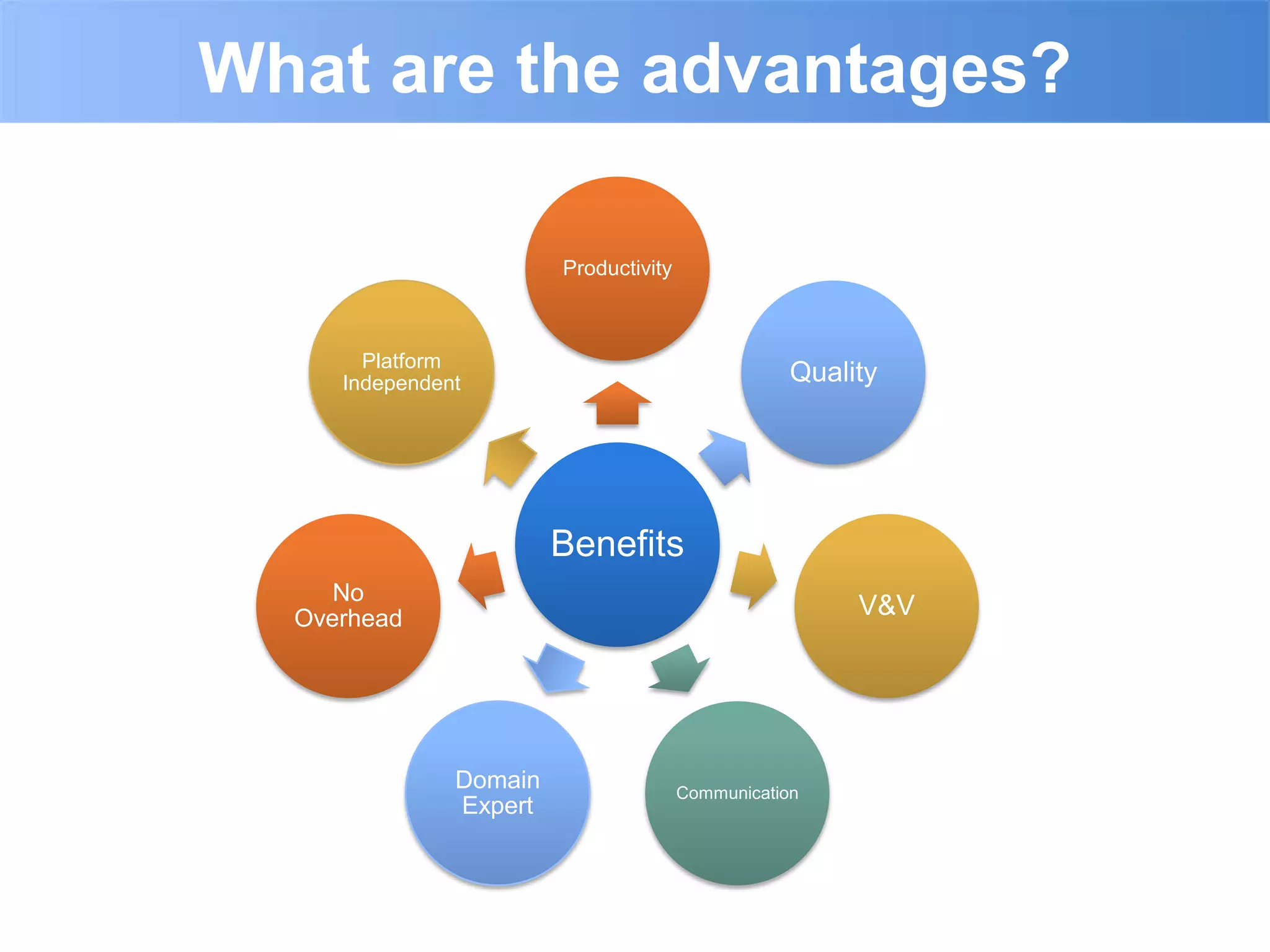
What are the advantages?

                        Productivity


       Platform
     Independent                                   Quality


                        Benefits
     No
  Overhead                                              V&V


               Domain                  Communication
               Expert
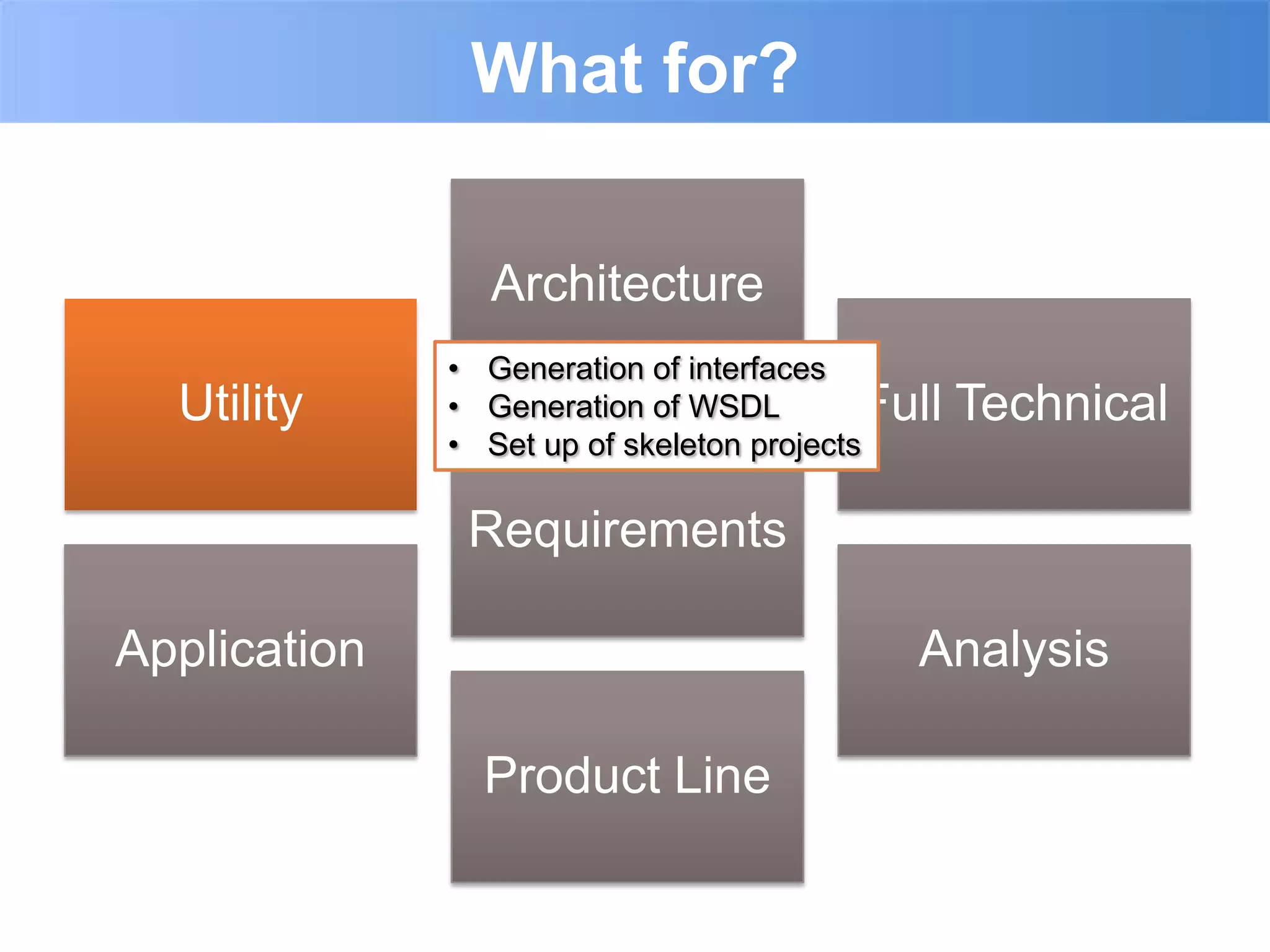
What for?

                 Architecture
              • Generation of interfaces
  Utility     • Generation of WSDL        Full Technical
              • Set up of skeleton projects

               Requirements

Application                                   Analysis

                Product Line
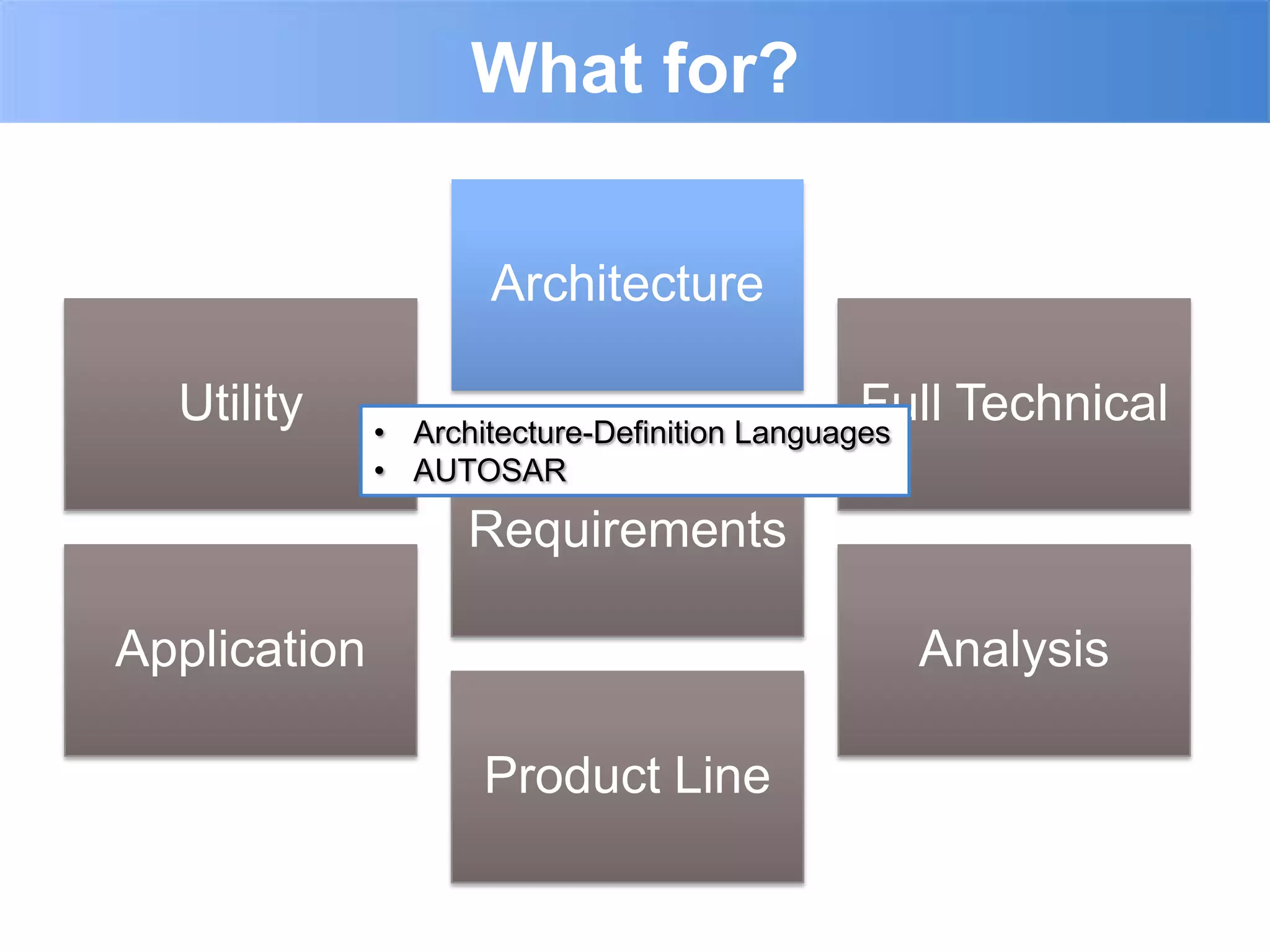
What for?

                     Architecture

  Utility                                     Full Technical
              • Architecture-Definition Languages
              • AUTOSAR

                    Requirements

Application                                         Analysis

                     Product Line
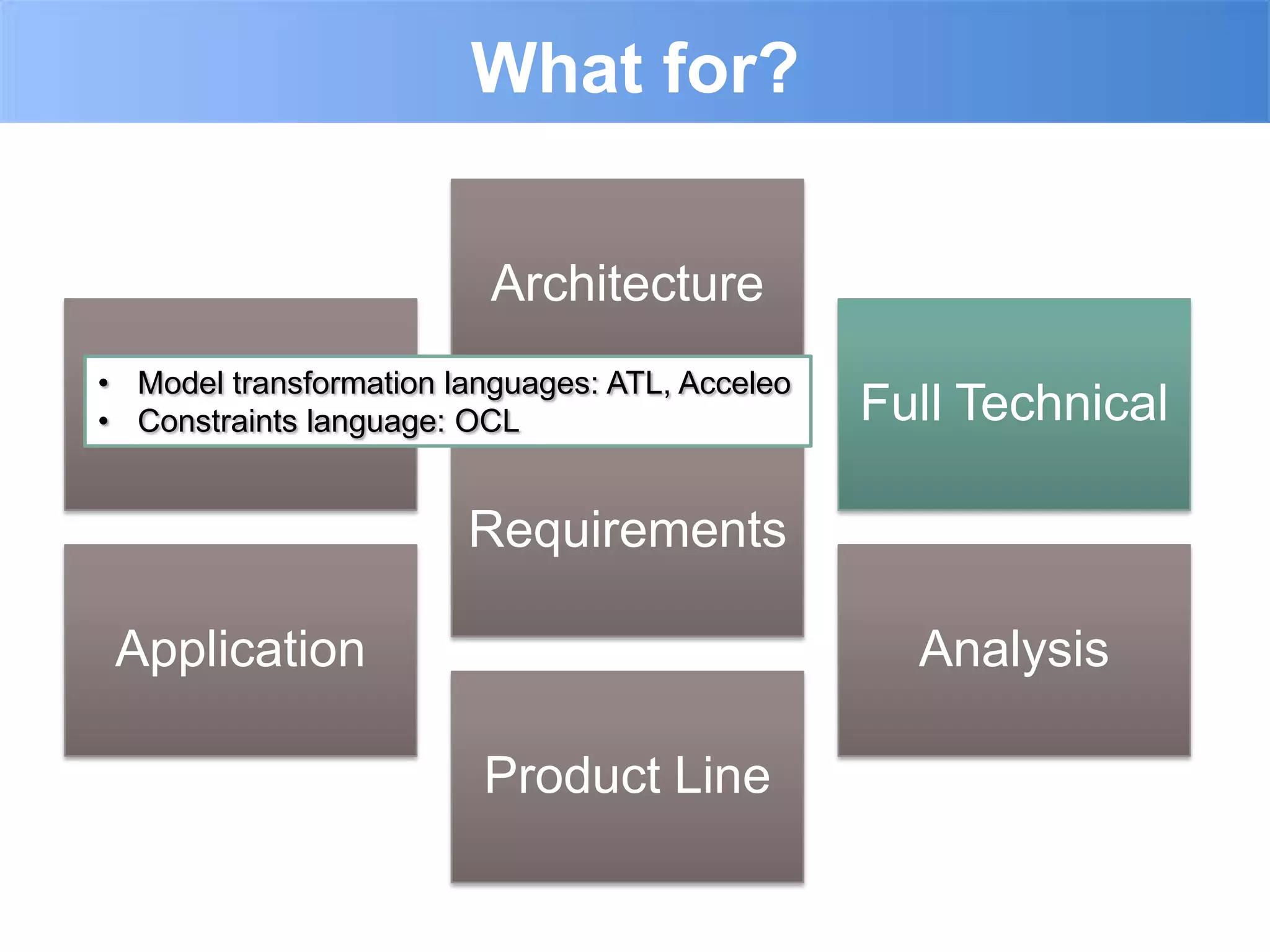
What for?

                          Architecture
• Model transformation languages: ATL, Acceleo
     Utility
• Constraints language: OCL                      Full Technical

                        Requirements

 Application                                       Analysis

                         Product Line
What for?

                Architecture

  Utility                                 Full Technical

              Requirements
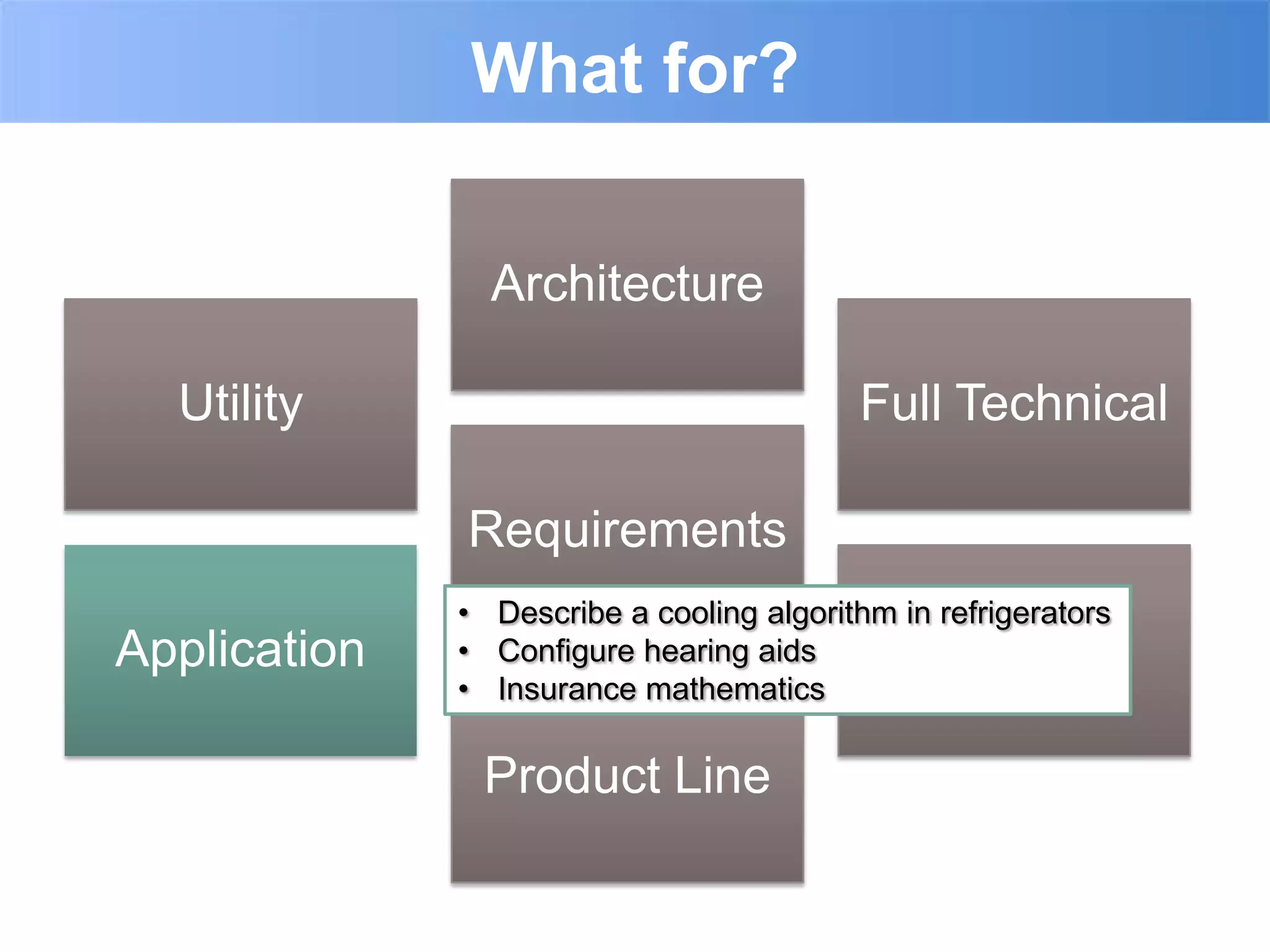
              • Describe a cooling algorithm in refrigerators
Application   • Configure hearing aids         Analysis
              • Insurance mathematics

               Product Line
What for?

                     Architecture

  Utility                                    Full Technical

                   Requirements

Application                                         Analysis
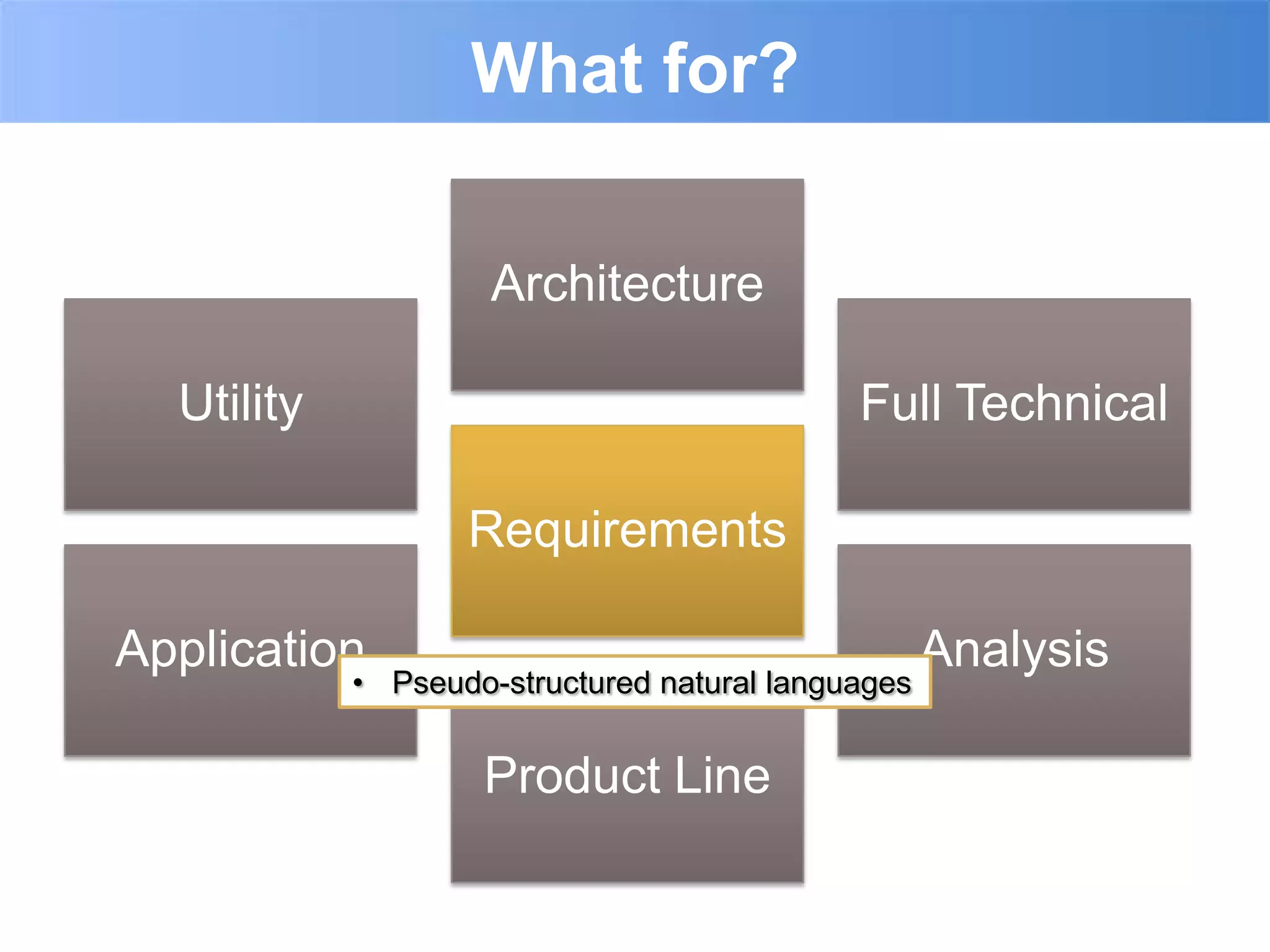
            • Pseudo-structured natural languages


                    Product Line
What for?

                   Architecture

  Utility                                 Full Technical

                  Requirements

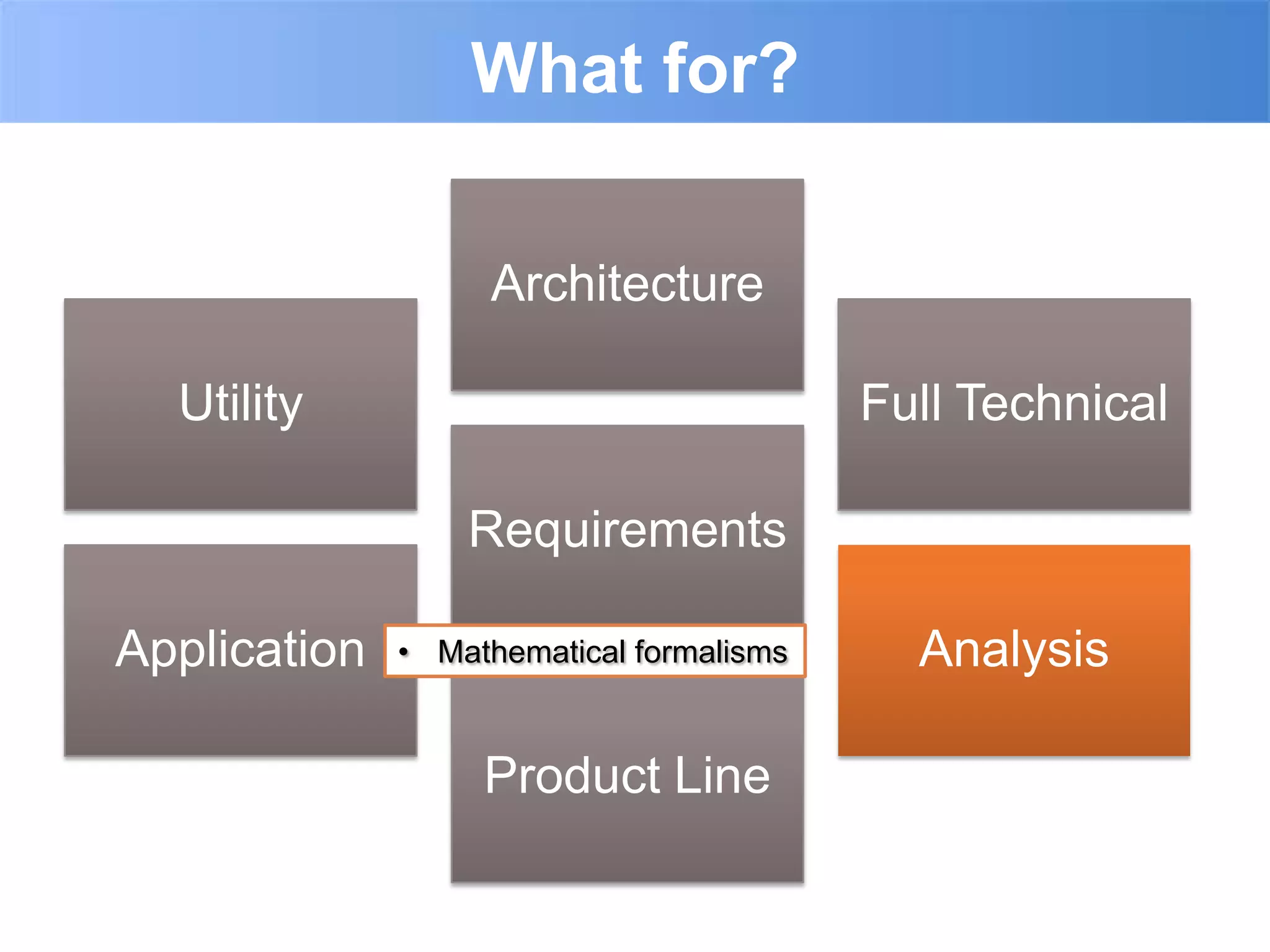
Application   • Mathematical formalisms     Analysis

                   Product Line
What for?

                 Architecture

  Utility                               Full Technical

               Requirements
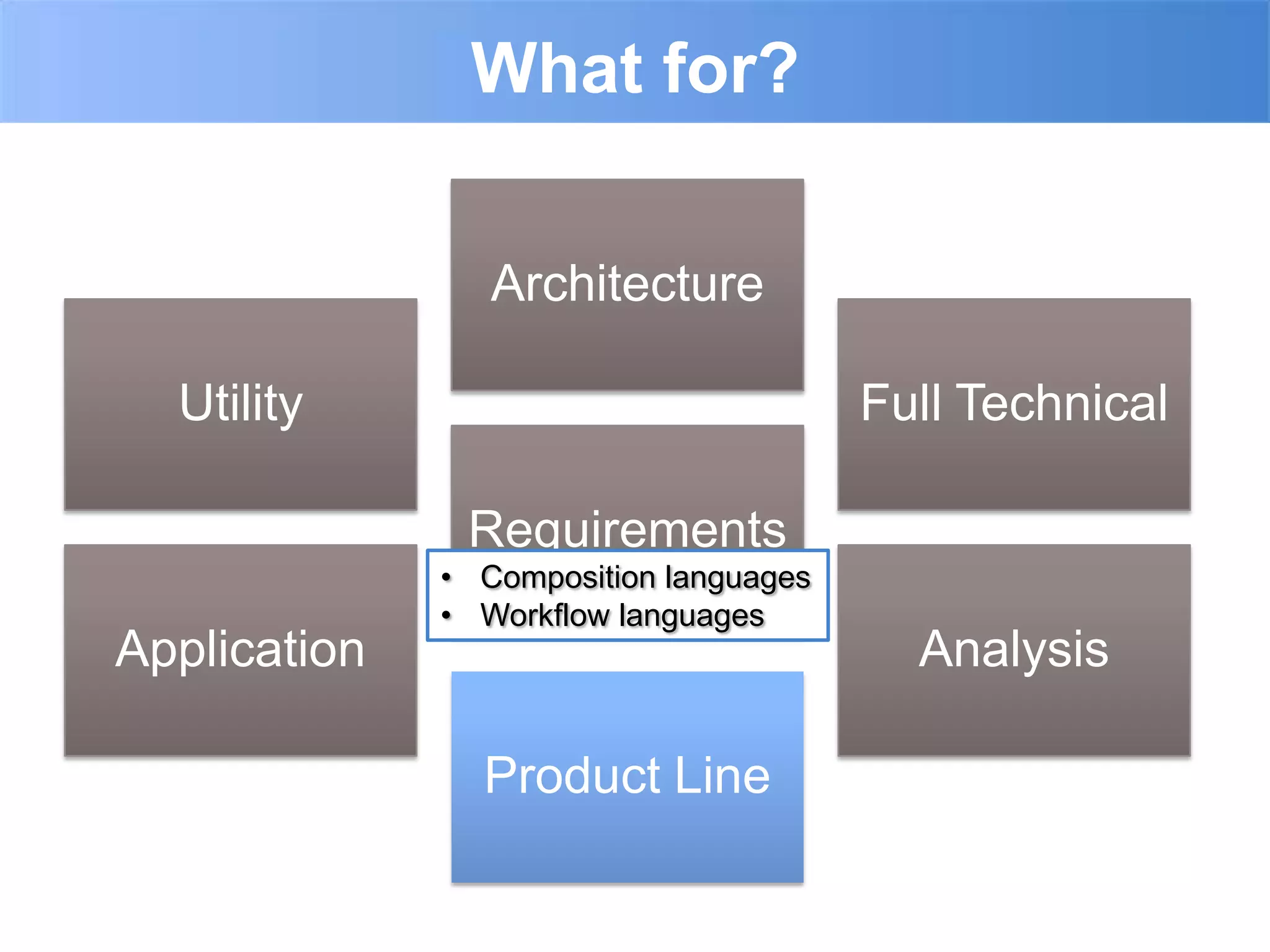
              • Composition languages
              • Workflow languages
Application                               Analysis

                Product Line
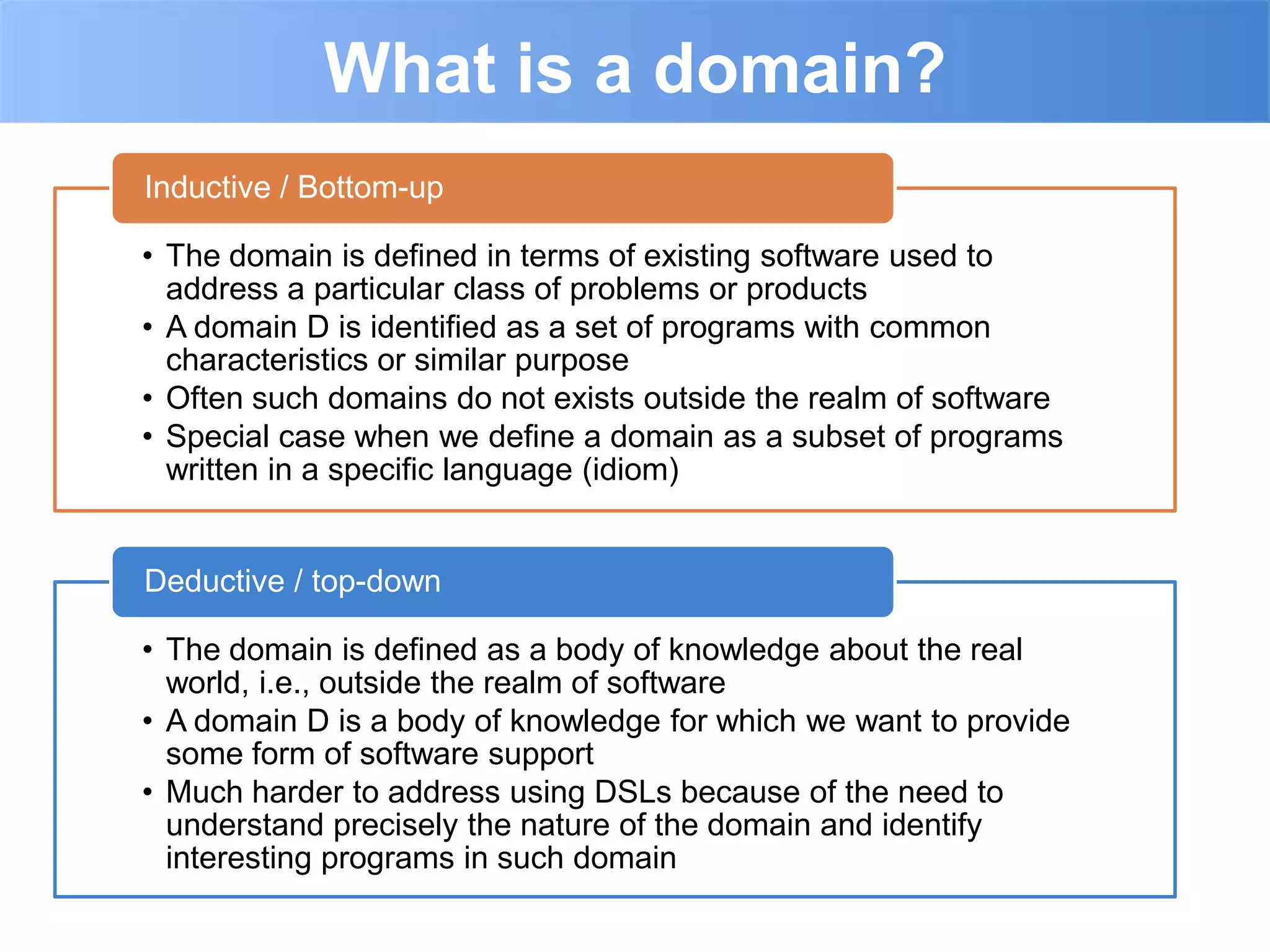
What is a domain?
Inductive / Bottom-up

• The domain is defined in terms of existing software used to
  address a particular class of problems or products
• A domain D is identified as a set of programs with common
  characteristics or similar purpose
• Often such domains do not exists outside the realm of software
• Special case when we define a domain as a subset of programs
  written in a specific language (idiom)


Deductive / top-down

• The domain is defined as a body of knowledge about the real
  world, i.e., outside the realm of software
• A domain D is a body of knowledge for which we want to provide
  some form of software support
• Much harder to address using DSLs because of the need to
  understand precisely the nature of the domain and identify
  interesting programs in such domain
but… how?
DSL

The big picture

  What is a DSL? Why?

    Anatomy

     Development

    Actors

  Best practices

Worst practices
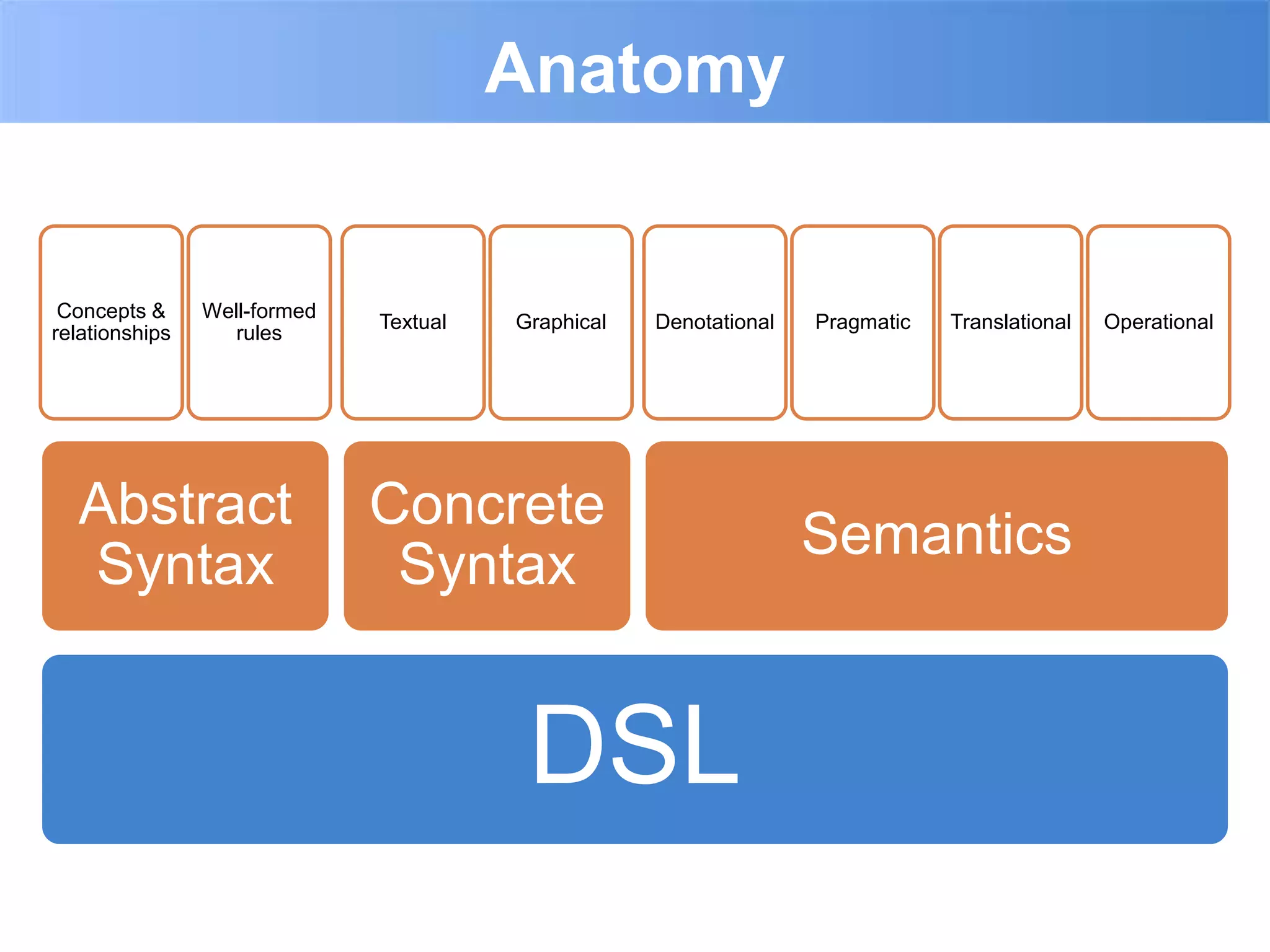
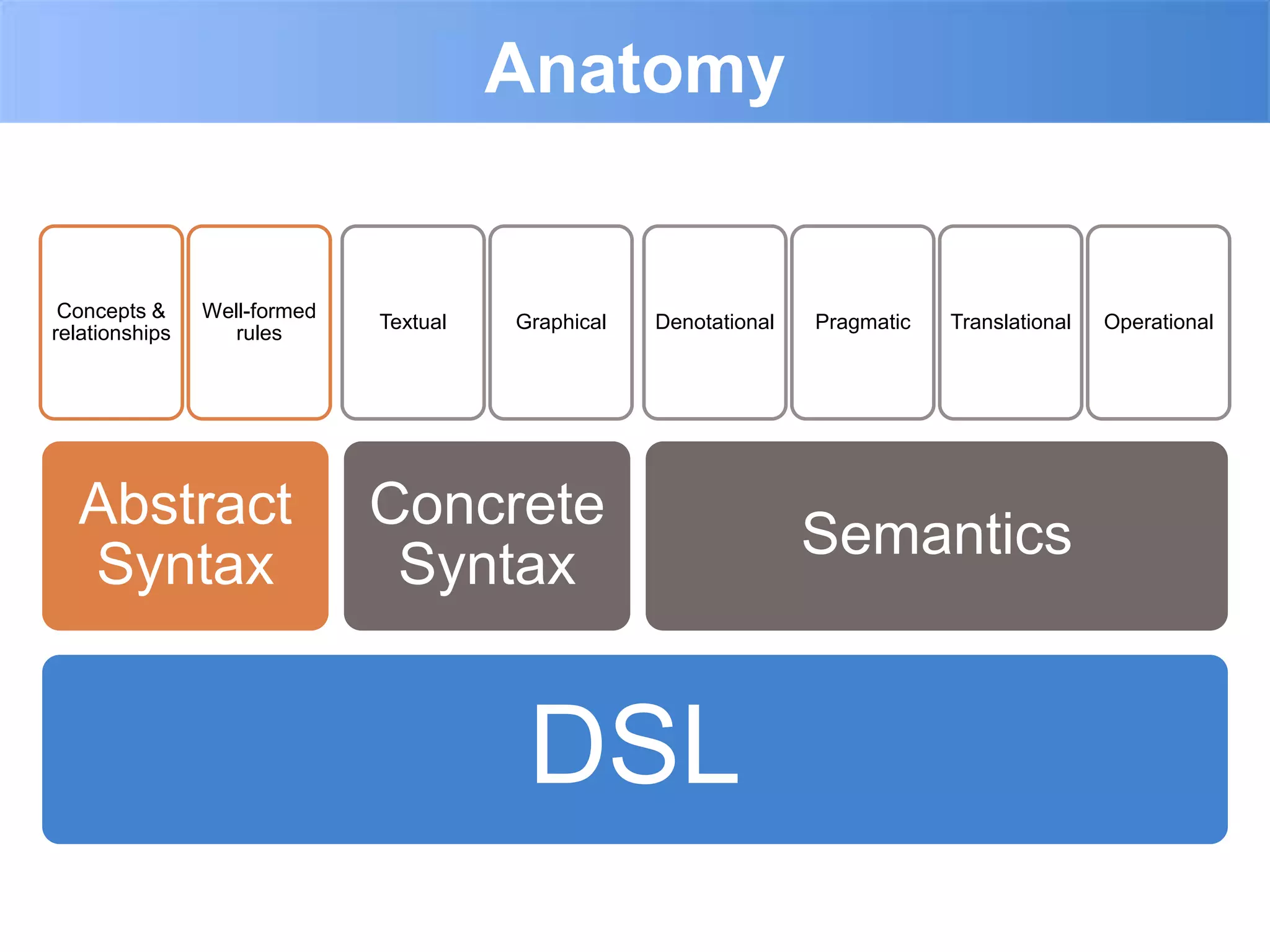
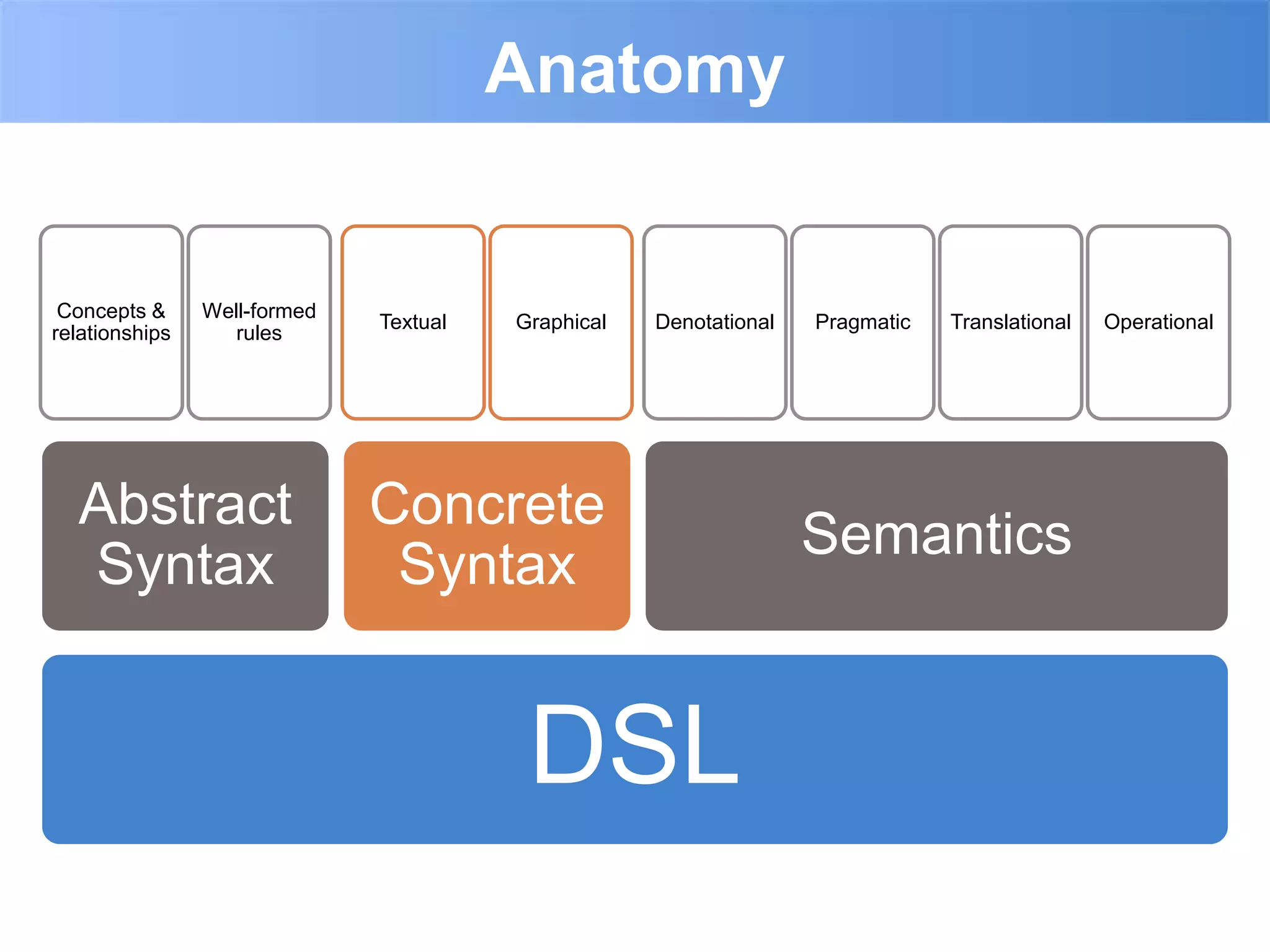
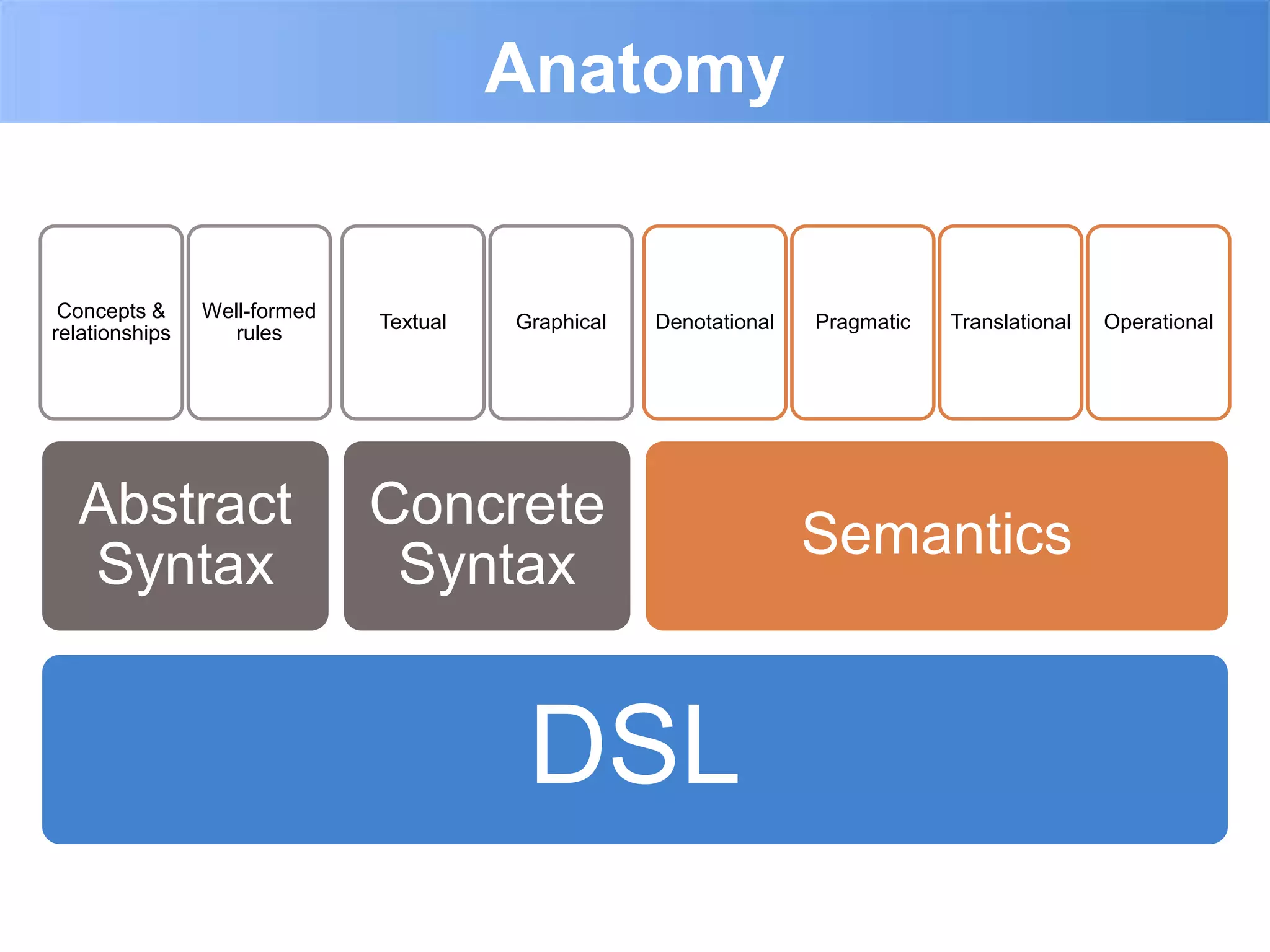
Anatomy


 Concepts &     Well-formed
                              Textual   Graphical   Denotational   Pragmatic   Translational   Operational
relationships      rules


  Abstract                    Concrete
                                                                   Semantics
  Syntax                       Syntax


                                         DSL
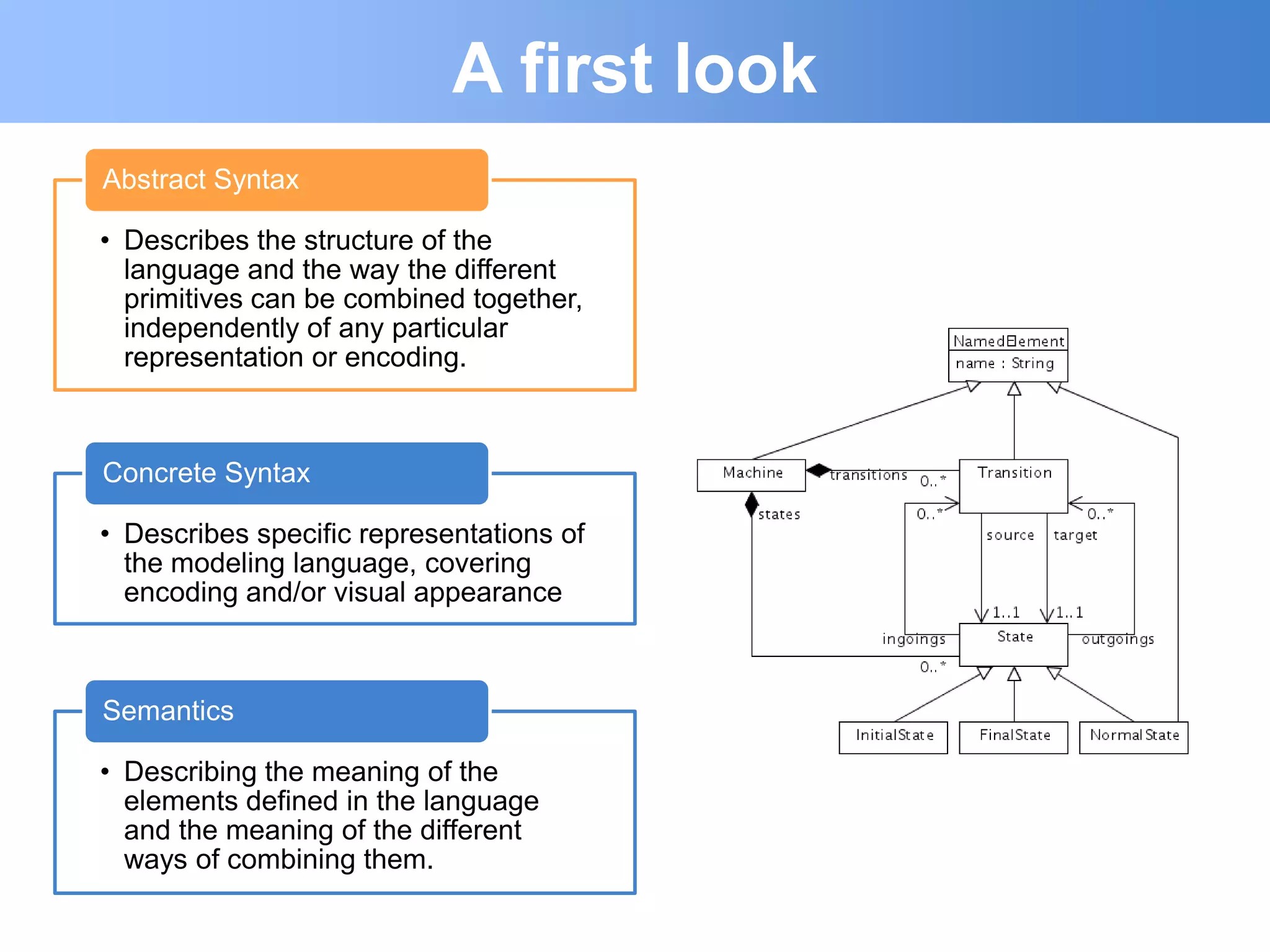
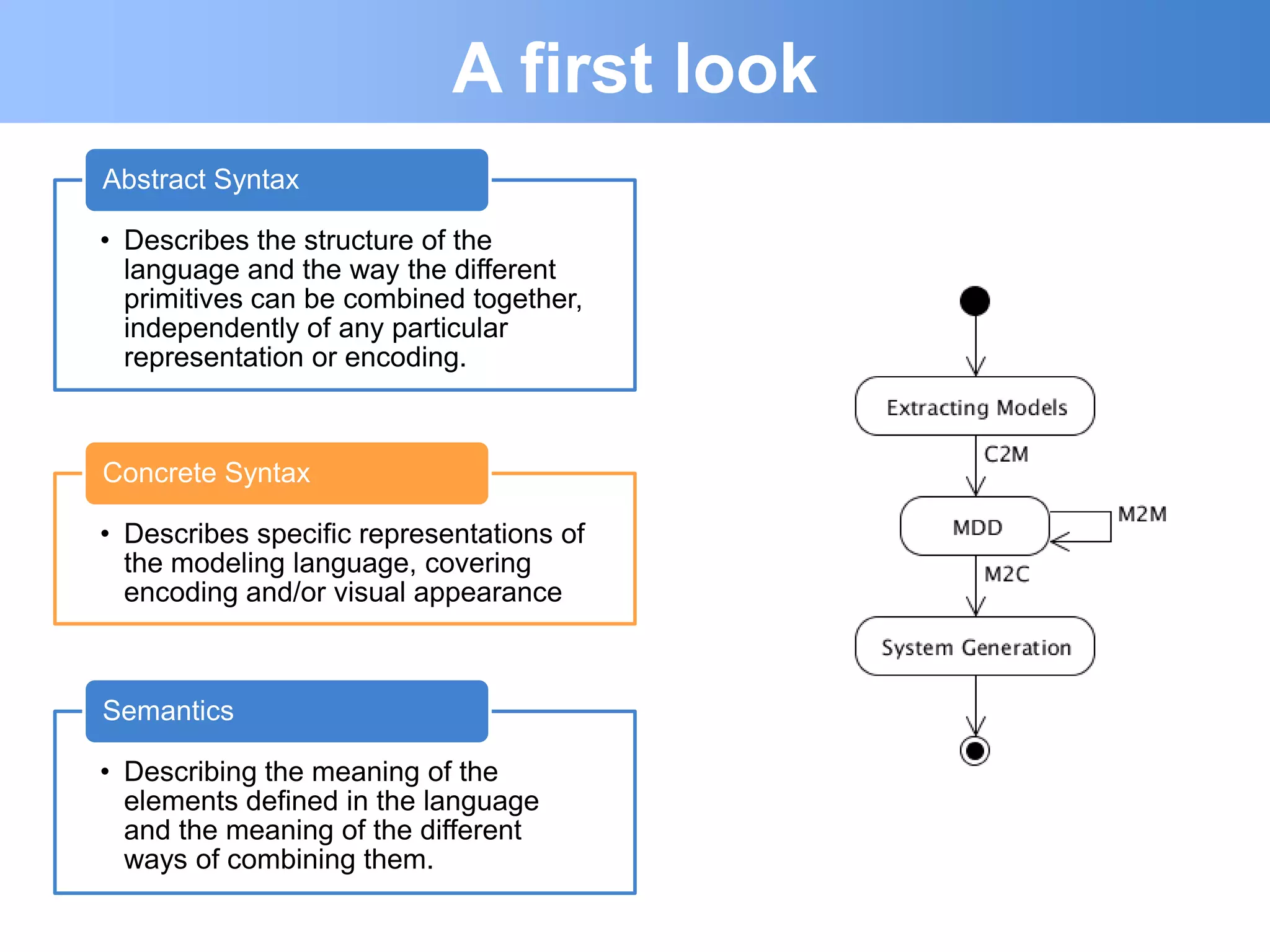
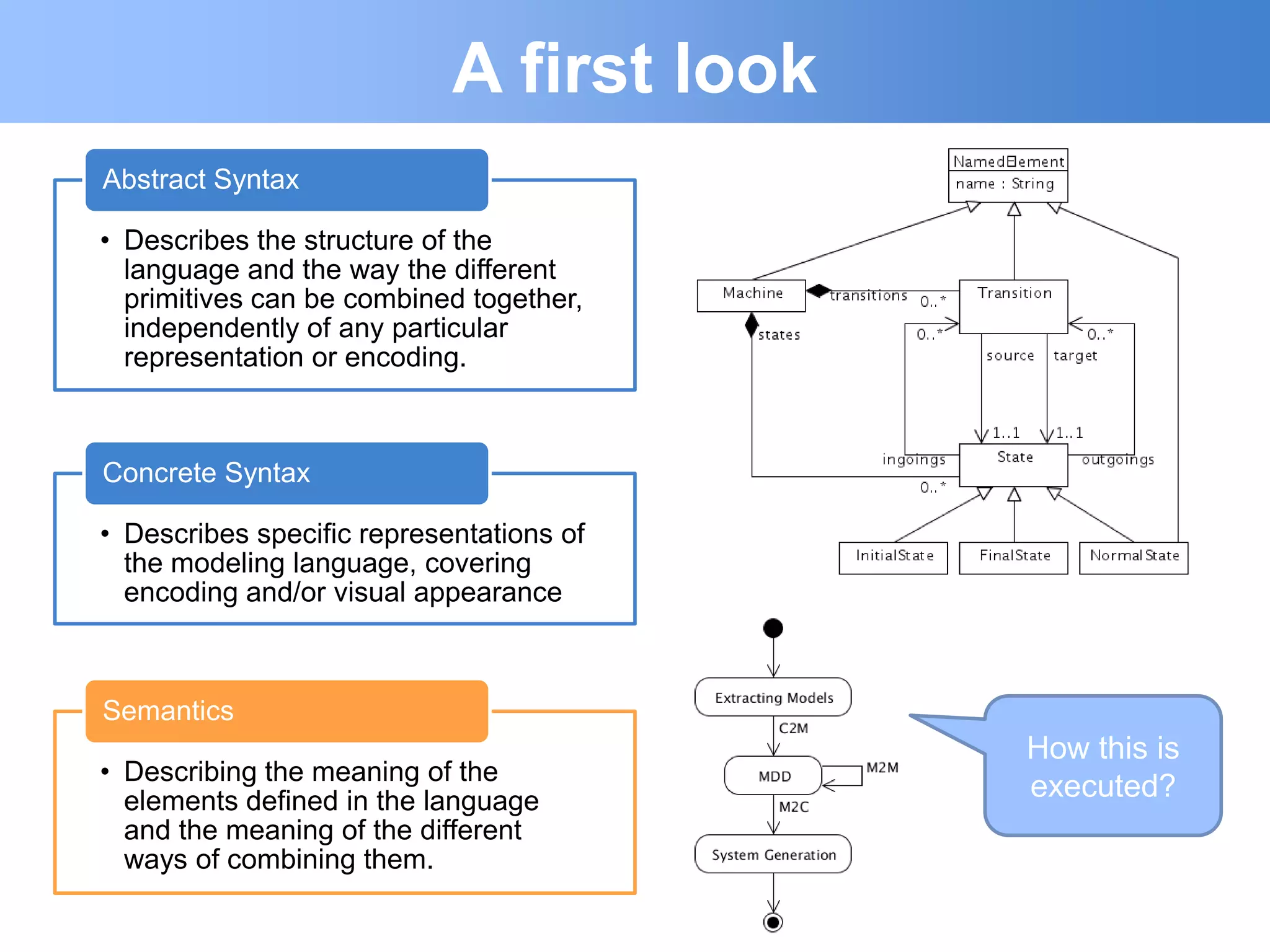
A first look
Abstract Syntax

• Describes the structure of the
  language and the way the different
  primitives can be combined together,
  independently of any particular
  representation or encoding.


Concrete Syntax

• Describes specific representations of
  the modeling language, covering
  encoding and/or visual appearance


Semantics

• Describing the meaning of the
  elements defined in the language
  and the meaning of the different
  ways of combining them.
A first look
Abstract Syntax

• Describes the structure of the
  language and the way the different
  primitives can be combined together,
  independently of any particular
  representation or encoding.


Concrete Syntax

• Describes specific representations of
  the modeling language, covering
  encoding and/or visual appearance


Semantics

• Describing the meaning of the
  elements defined in the language
  and the meaning of the different
  ways of combining them.
A first look
Abstract Syntax

• Describes the structure of the
  language and the way the different
  primitives can be combined together,
  independently of any particular
  representation or encoding.


Concrete Syntax

• Describes specific representations of
  the modeling language, covering
  encoding and/or visual appearance


Semantics
                                           How this is
• Describing the meaning of the
  elements defined in the language         executed?
  and the meaning of the different
  ways of combining them.
Anatomy


 Concepts &     Well-formed
                              Textual   Graphical   Denotational   Pragmatic   Translational   Operational
relationships      rules


  Abstract                    Concrete
                                                                   Semantics
  Syntax                       Syntax


                                         DSL
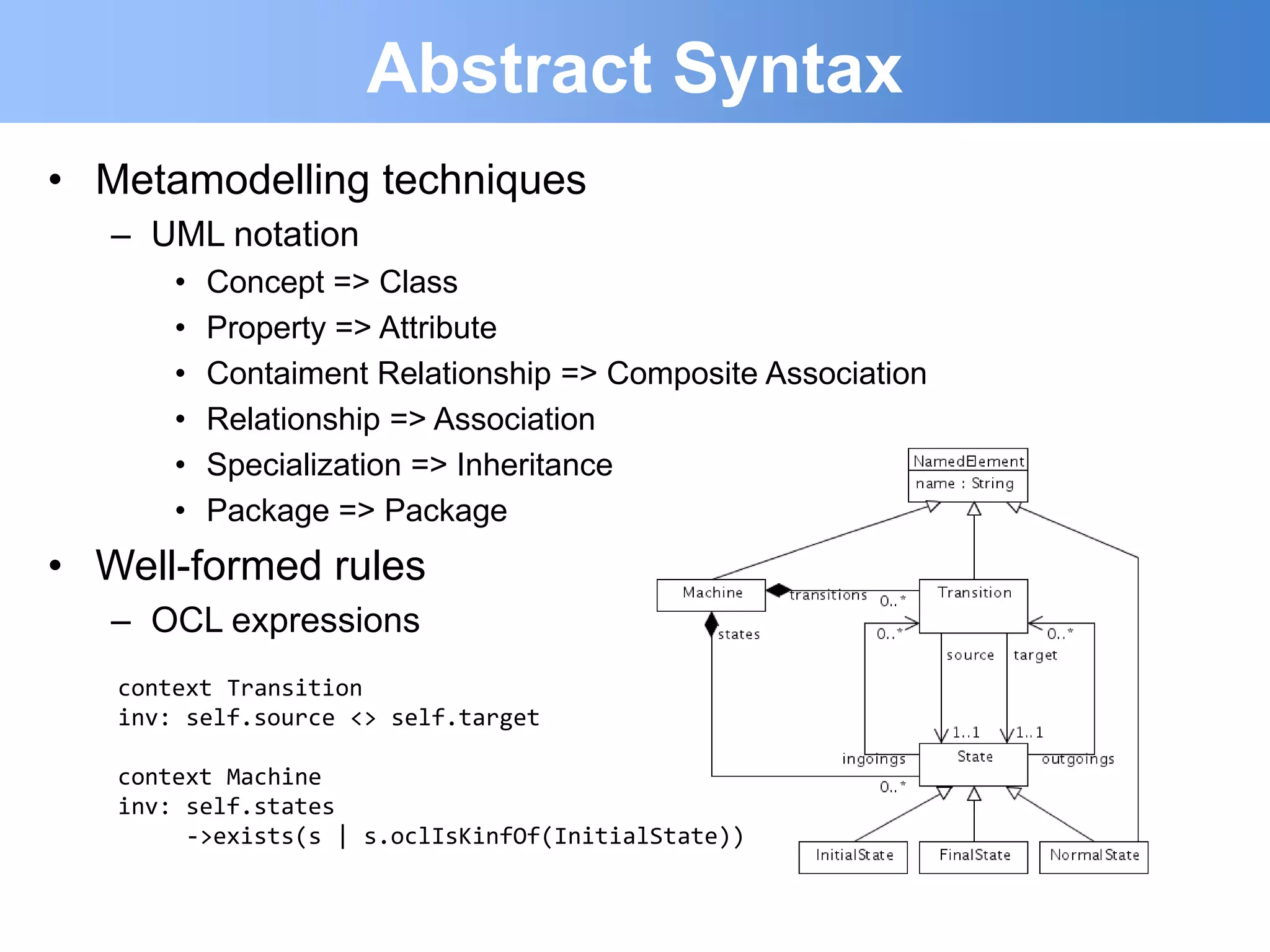
Abstract Syntax
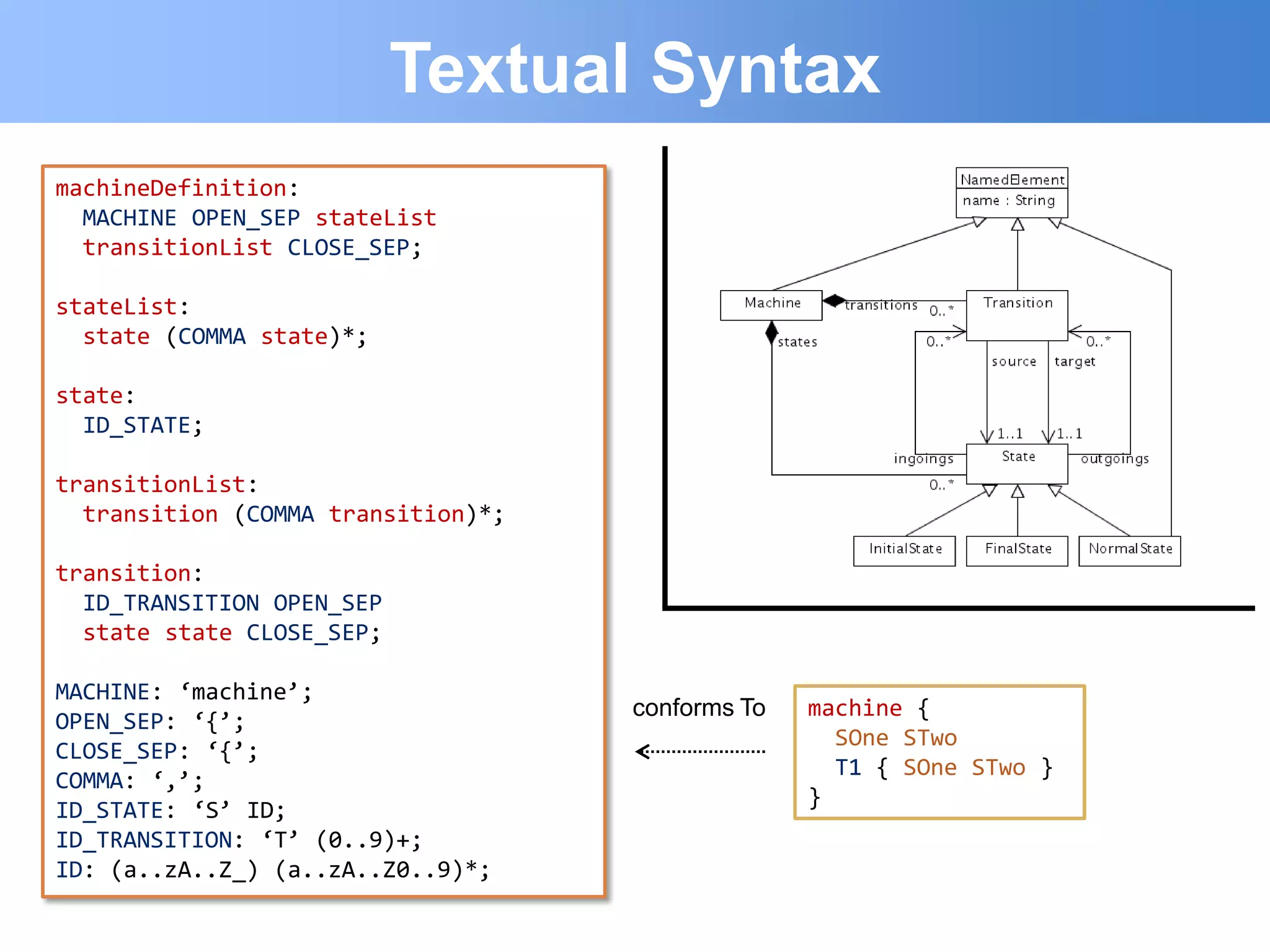
• Metamodelling techniques
   – UML notation
       •   Concept => Class
       •   Property => Attribute
       •   Contaiment Relationship => Composite Association
       •   Relationship => Association
       •   Specialization => Inheritance
       •   Package => Package
• Well-formed rules
   – OCL expressions
   context Transition
   inv: self.source <> self.target

   context Machine
   inv: self.states
        ->exists(s | s.oclIsKinfOf(InitialState))
Anatomy


 Concepts &     Well-formed
                              Textual   Graphical   Denotational   Pragmatic   Translational   Operational
relationships      rules


  Abstract                    Concrete
                                                                   Semantics
  Syntax                       Syntax


                                         DSL
Concrete Syntax


   Textual
             Graphical
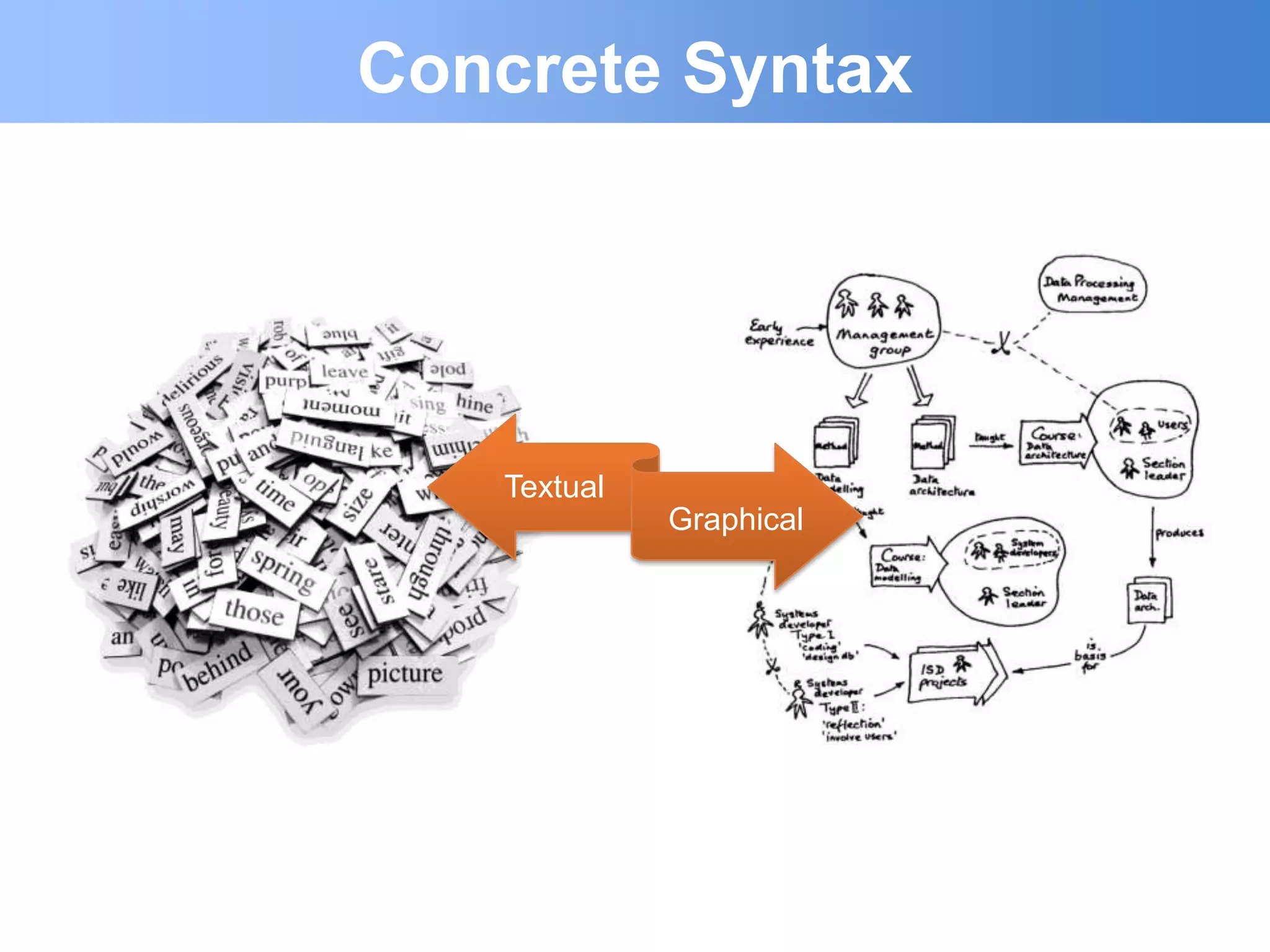
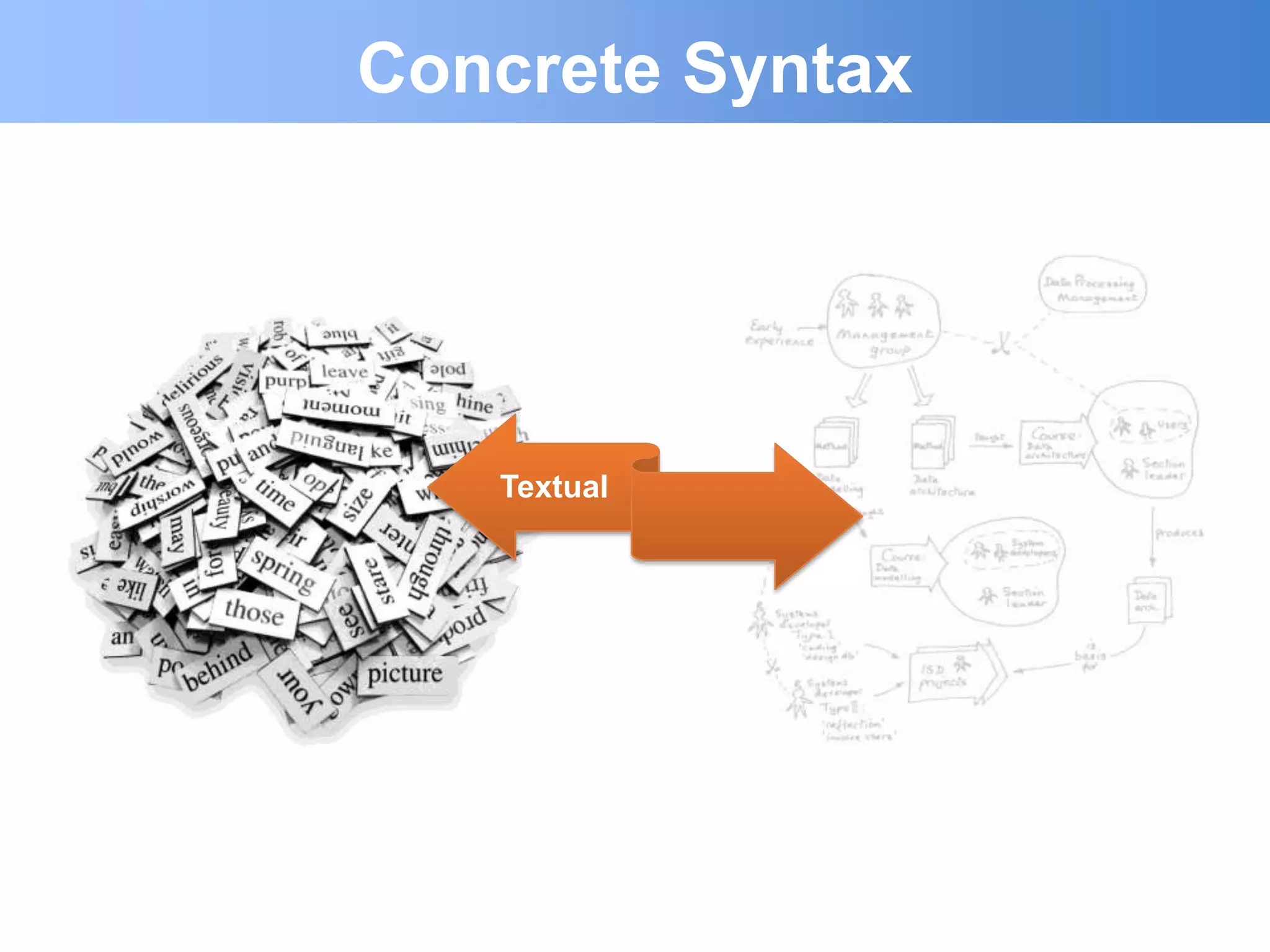
Concrete Syntax


   Textual
Concrete Syntax
• Textual                                          • Graphical
digraph Modernization {
  Start -> ExtractingModels;
  ExtractingModels -> MDD [label="C2M"];
  MDD -> MDD [label="M2M"];
  MDD -> SystemGeneration [label="M2C"];
  SystemGeneration -> End;

    Start
      [shape=point,width=0.2,label=""];
    ExtractingModels
      [label="Extracting Models",shape=ellipse];
    MDD
      [shape=ellipse];
    SystemGeneration
      [label="System Generation",shape=ellipse];
    End
      [shape=doublecircle,label="",width=0.2,
       fillcolor=black,style=filled];
}
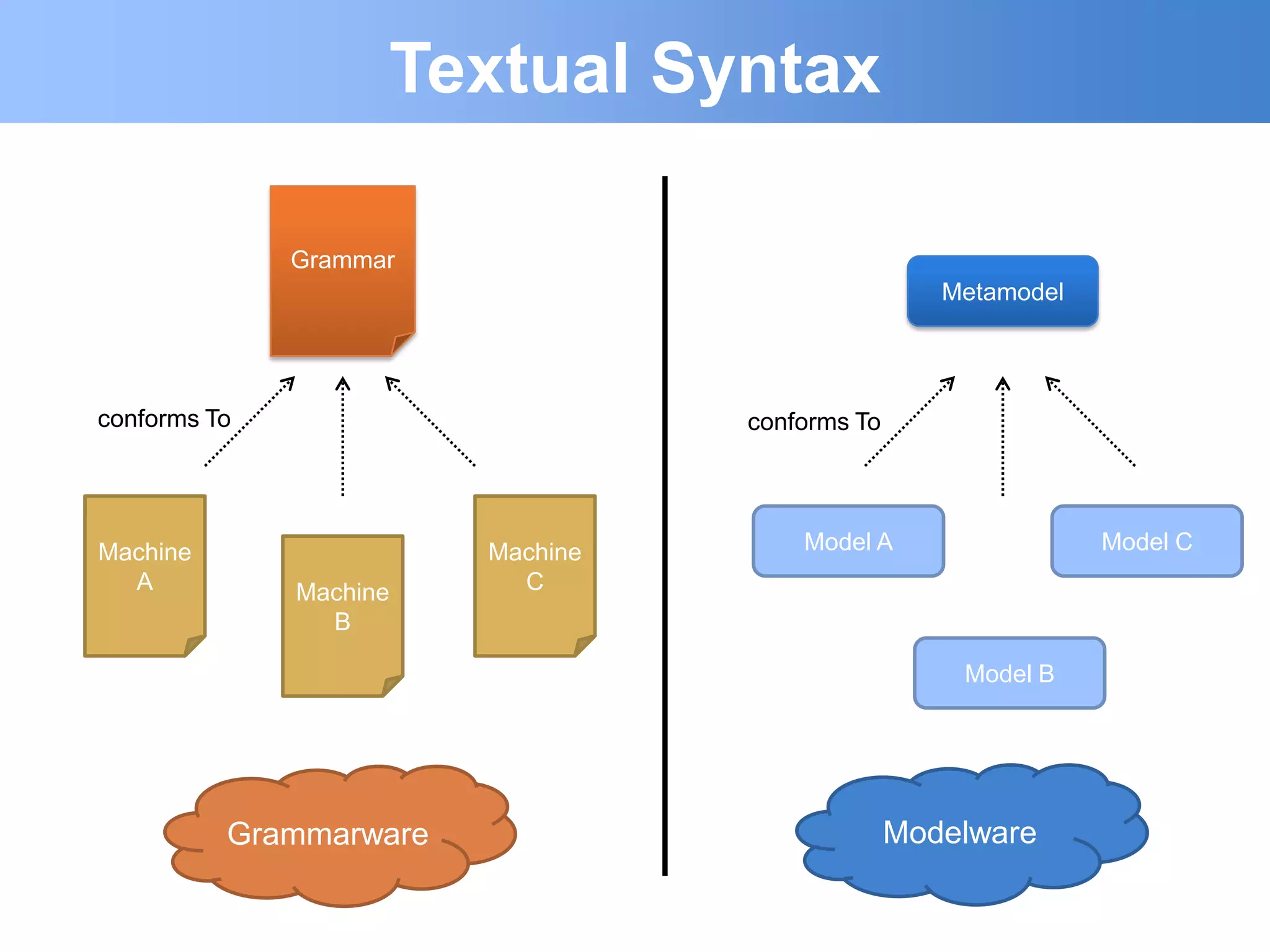
Textual Syntax

              Grammar
                                                   Metamodel


conforms To                       conforms To


Machine                 Machine       Model A                  Model C
  A           Machine     C
                B

                                                    Model B


          Grammarware                           Modelware
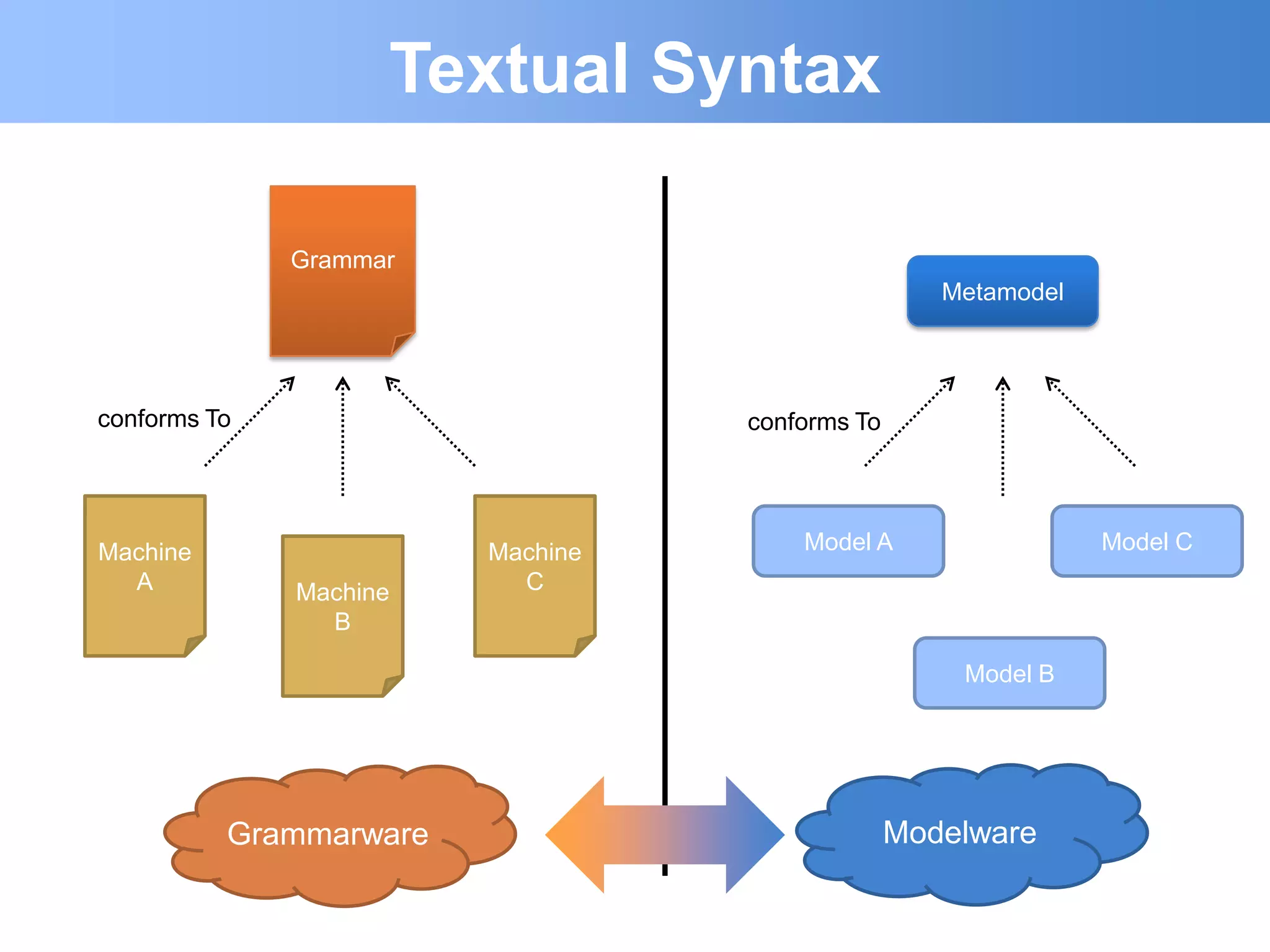
Textual Syntax

              Grammar
                                                   Metamodel


conforms To                       conforms To


Machine                 Machine       Model A                  Model C
  A           Machine     C
                B

                                                    Model B


          Grammarware                           Modelware
Textual Syntax
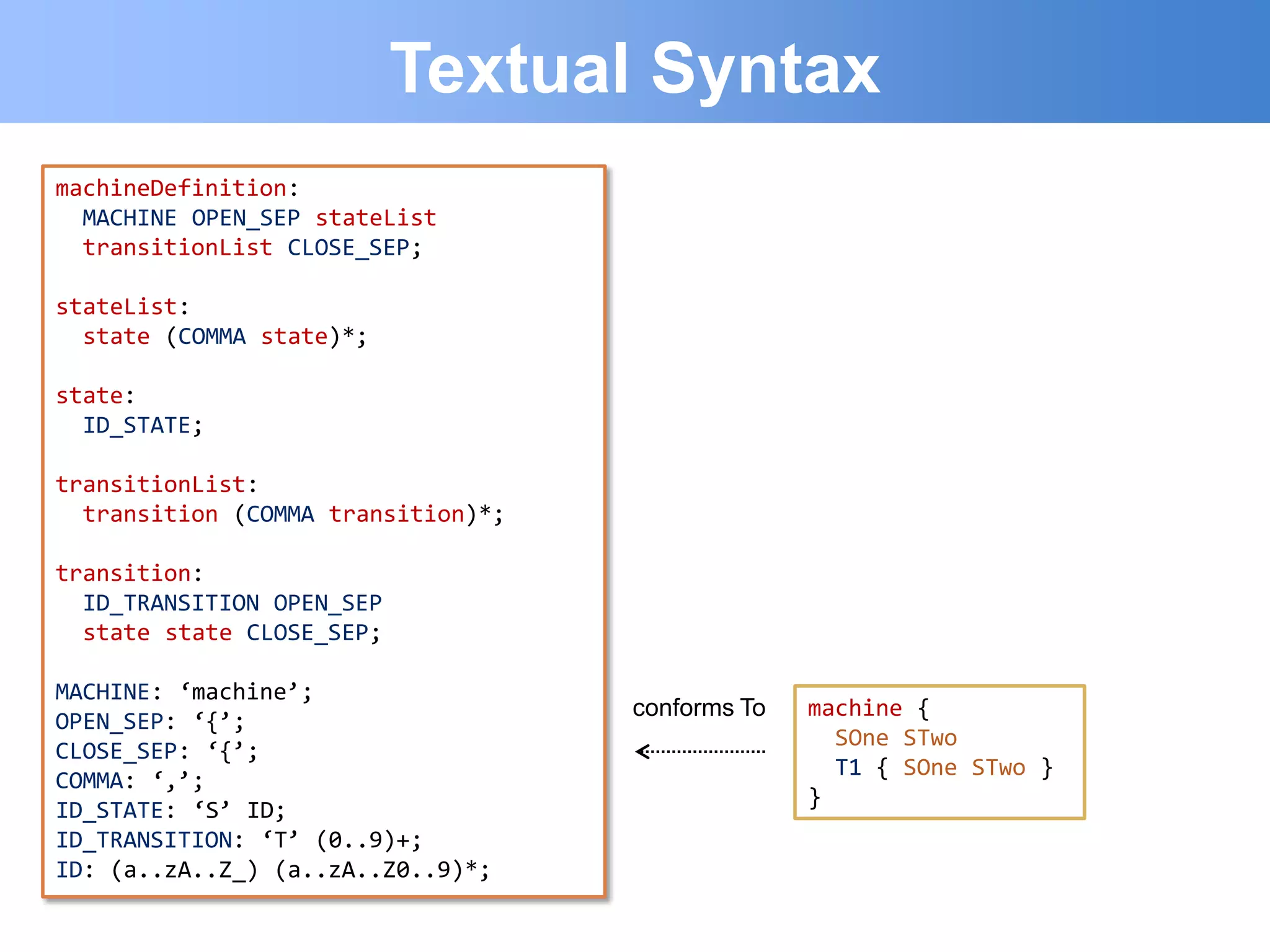
machineDefinition:
  MACHINE OPEN_SEP stateList
  transitionList CLOSE_SEP;

stateList:
  state (COMMA state)*;

state:
  ID_STATE;

transitionList:
  transition (COMMA transition)*;

transition:
  ID_TRANSITION OPEN_SEP
  state state CLOSE_SEP;

MACHINE: ‘machine’;
                                    conforms To   machine {
OPEN_SEP: ‘{’;
                                                    SOne STwo
CLOSE_SEP: ‘{’;
                                                    T1 { SOne STwo }
COMMA: ‘,’;
                                                  }
ID_STATE: ‘S’ ID;
ID_TRANSITION: ‘T’ (0..9)+;
ID: (a..zA..Z_) (a..zA..Z0..9)*;
Textual Syntax
machineDefinition:
  MACHINE OPEN_SEP stateList
  transitionList CLOSE_SEP;

stateList:
  state (COMMA state)*;

state:
  ID_STATE;

transitionList:
  transition (COMMA transition)*;

transition:
  ID_TRANSITION OPEN_SEP
  state state CLOSE_SEP;

MACHINE: ‘machine’;
                                    conforms To   machine {
OPEN_SEP: ‘{’;
                                                    SOne STwo
CLOSE_SEP: ‘{’;
                                                    T1 { SOne STwo }
COMMA: ‘,’;
                                                  }
ID_STATE: ‘S’ ID;
ID_TRANSITION: ‘T’ (0..9)+;
ID: (a..zA..Z_) (a..zA..Z0..9)*;
You have already work with one
package Courses {
  class Student {
    attribute studentid : number key
    attribute firstName : string
    attribute lastName : string
  }
                                                sintax of
    class Course {
      attribute name : string key                            conforms To
      attribute description : string optional
      attribute ects: number
    }
}

package Courses {                                           Ecore MM
  class Student {
    attribute studentid : number key
    attribute firstName : string
    attribute lastName : string
  }                                                          conforms To

    class Course {
      attribute name : string key               sintax of
      attribute description : string optional
      attribute ects: number
    }

    association Enrolment {
      end student : Student [1..*]
      end course : Course [0..*]
    }
}
Textual Syntax
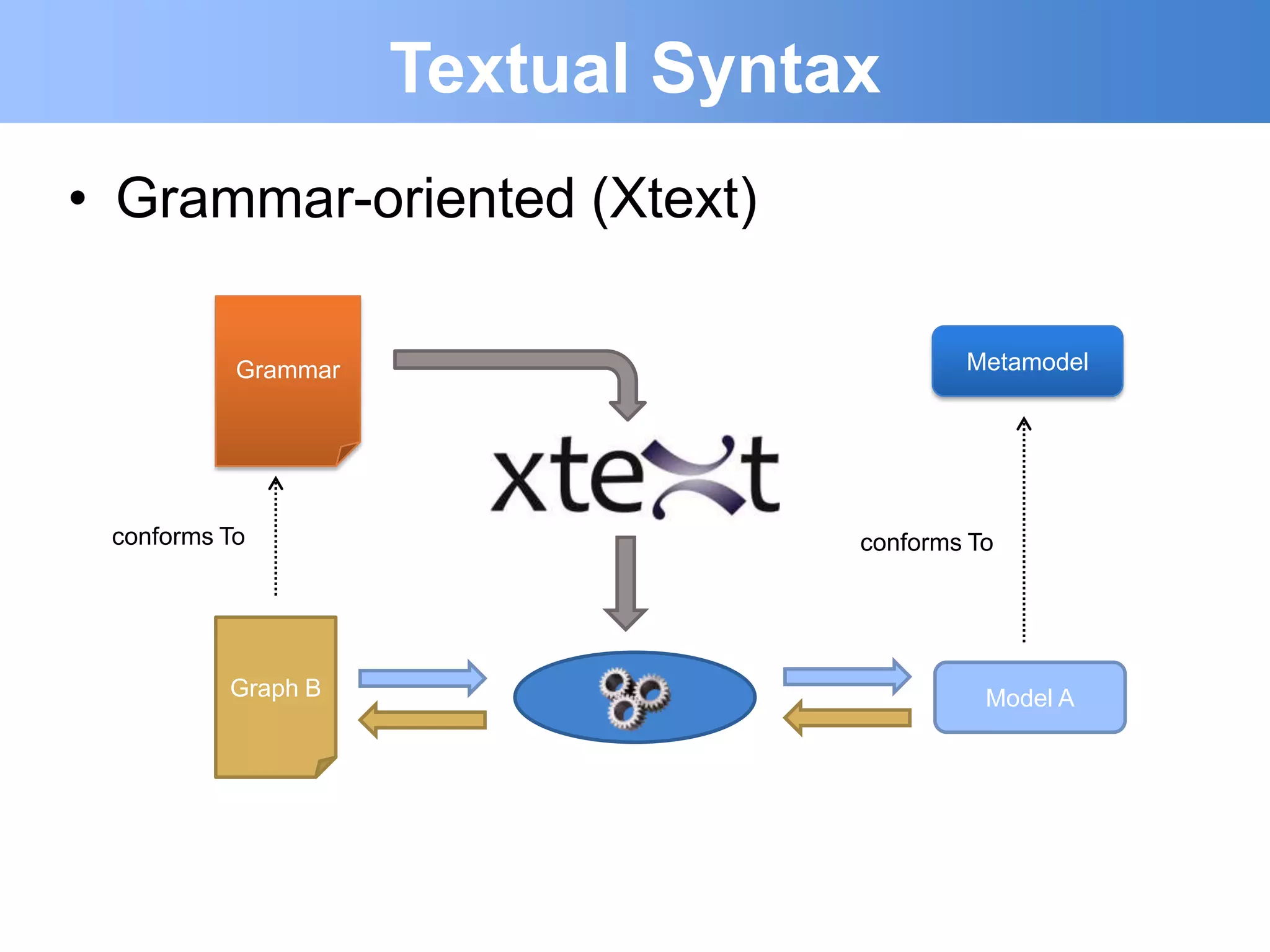
• Grammar-oriented (Xtext)

           Grammar                        Metamodel


 conforms To                      conforms To


          Graph B                           Model A
Xtext
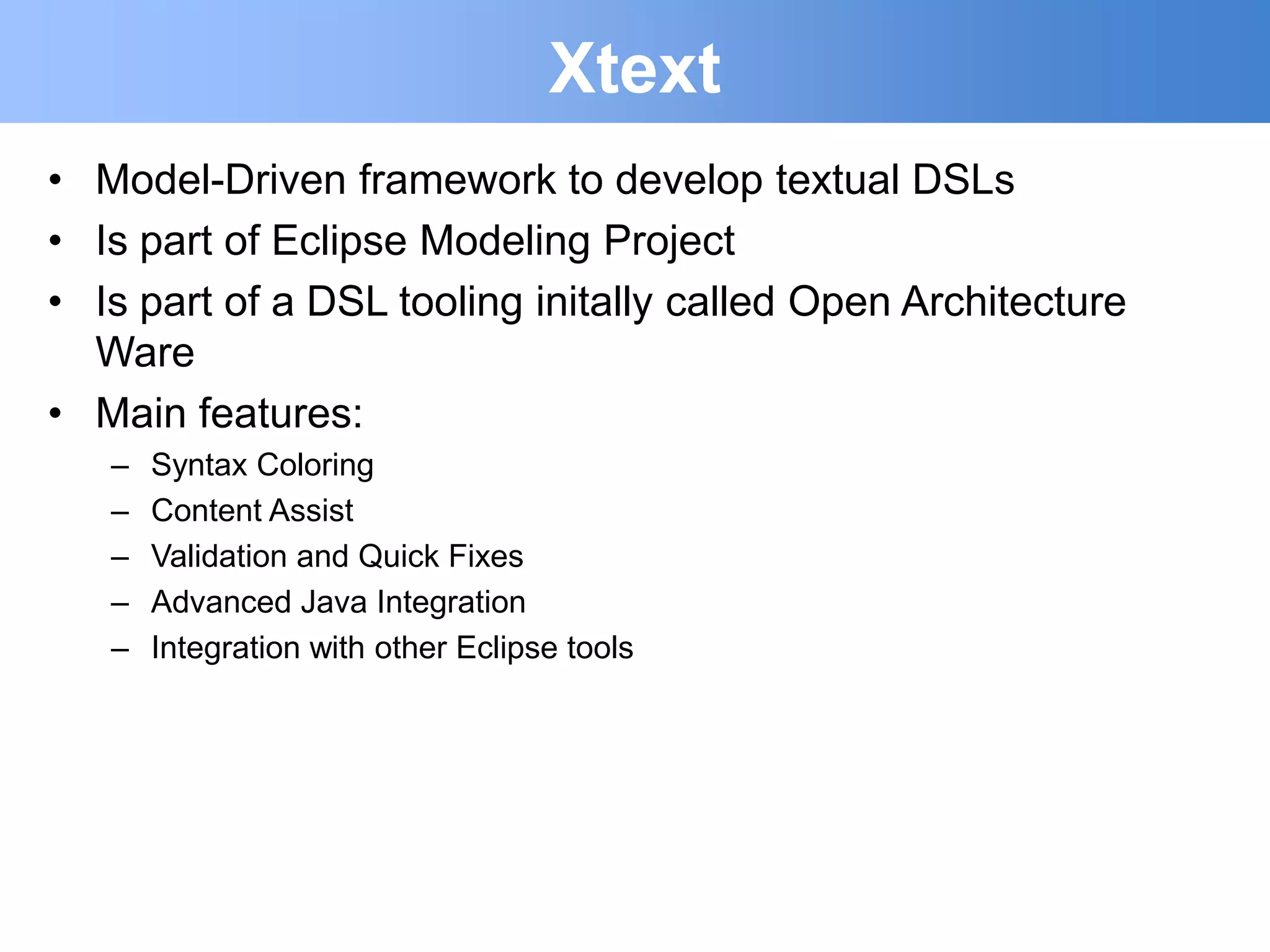
• Model-Driven framework to develop textual DSLs
• Is part of Eclipse Modeling Project
• Is part of a DSL tooling initally called Open Architecture
  Ware
• Main features:
   –   Syntax Coloring
   –   Content Assist
   –   Validation and Quick Fixes
   –   Advanced Java Integration
   –   Integration with other Eclipse tools
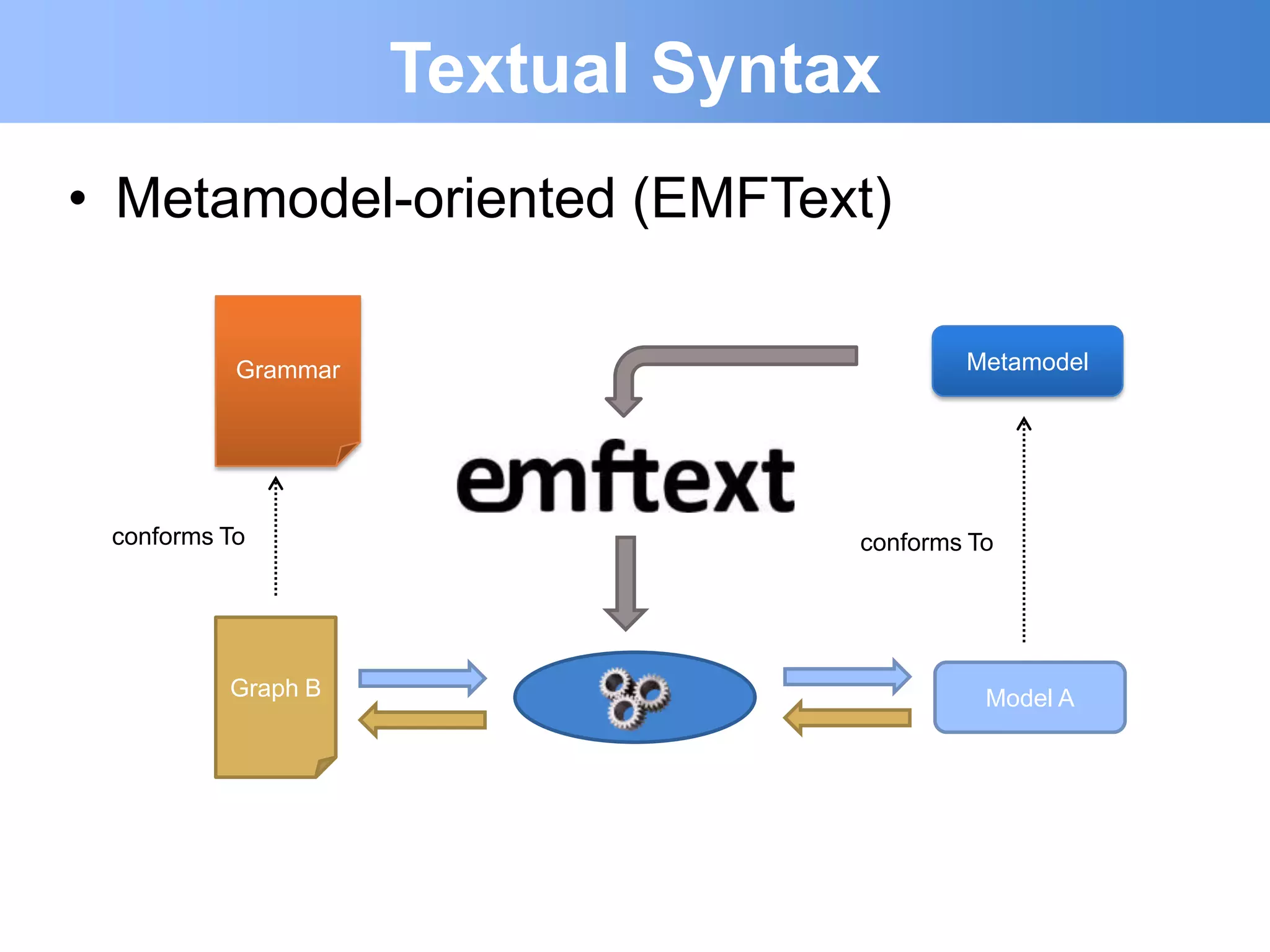
Textual Syntax
• Metamodel-oriented (EMFText)

           Grammar                        Metamodel


 conforms To                      conforms To


          Graph B                           Model A
EMFText
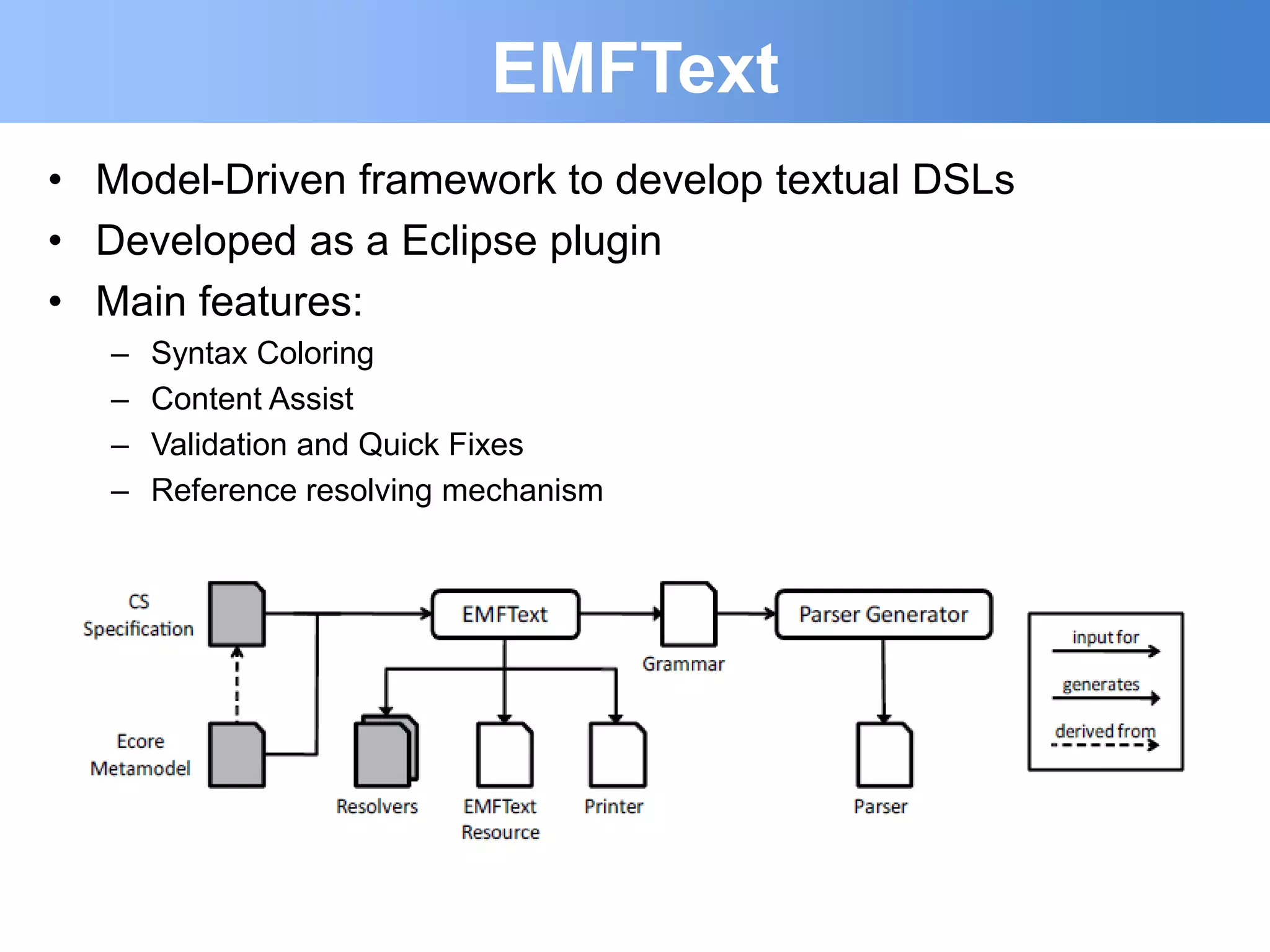
• Model-Driven framework to develop textual DSLs
• Developed as a Eclipse plugin
• Main features:
   –   Syntax Coloring
   –   Content Assist
   –   Validation and Quick Fixes
   –   Reference resolving mechanism
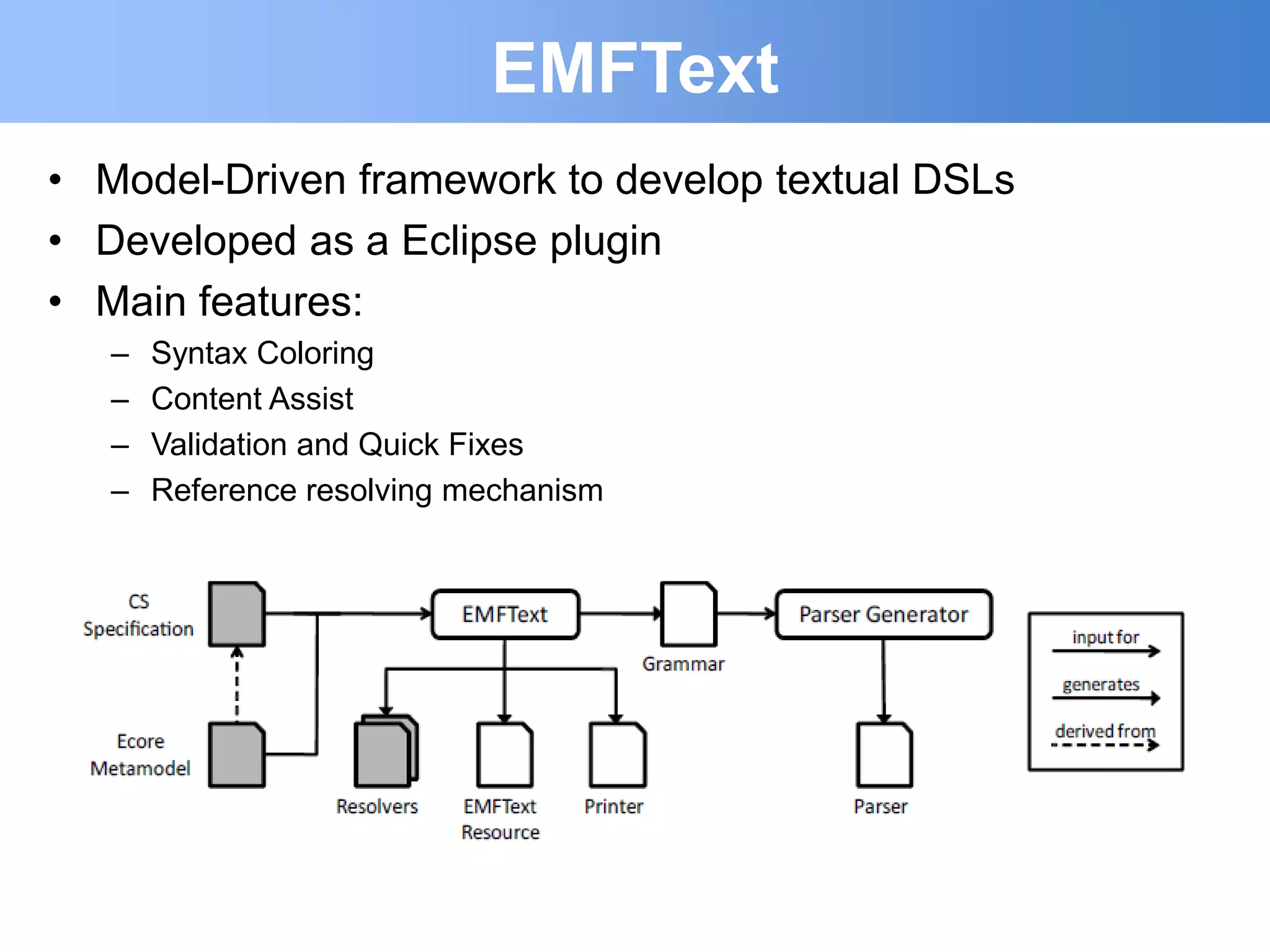
EMFText
• Model-Driven framework to develop textual DSLs
• Developed as a Eclipse plugin
• Main features:
   –   Syntax Coloring
   –   Content Assist
   –   Validation and Quick Fixes
   –   Reference resolving mechanism
Graphical Syntax

A draw is better than a long explanation
digraph Modernization {
  Start -> ExtractingModels;
  ExtractingModels -> MDD [label="C2M"];
  MDD -> MDD [label="M2M"];
  MDD -> SystemGeneration [label="M2C"];
  SystemGeneration -> End;

    Start
      [shape=point,width=0.2,label=""];
    ExtractingModels
      [label="Extracting Models",shape=ellipse];
    MDD
      [shape=ellipse];
    SystemGeneration
      [label="System Generation",shape=ellipse];
    End
      [shape=doublecircle,label="",width=0.2,
        fillcolor=black,style=filled];
}
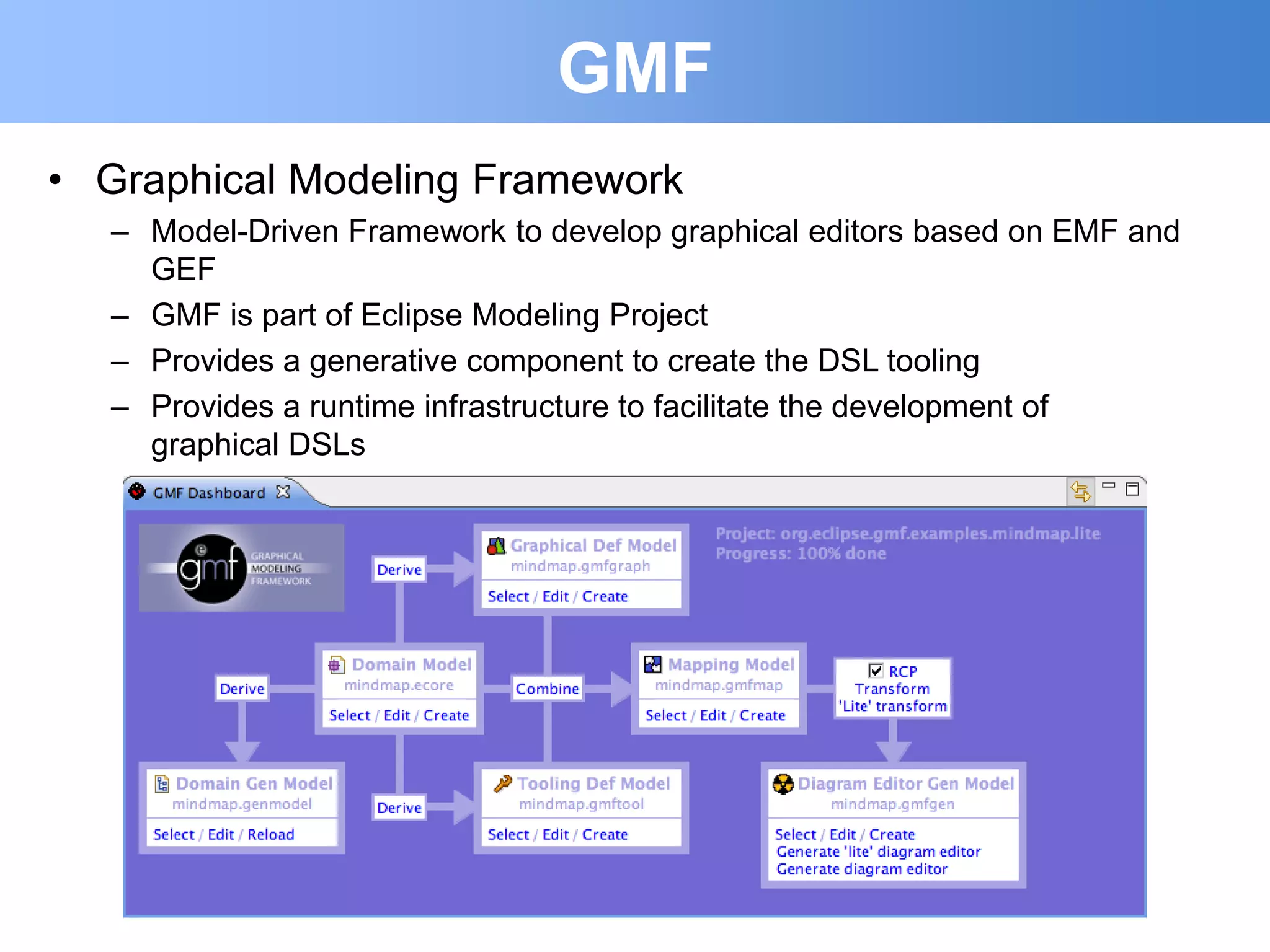
GMF
• Graphical Modeling Framework
  – Model-Driven Framework to develop graphical editors based on EMF and
    GEF
  – GMF is part of Eclipse Modeling Project
  – Provides a generative component to create the DSL tooling
  – Provides a runtime infrastructure to facilitate the development of
    graphical DSLs
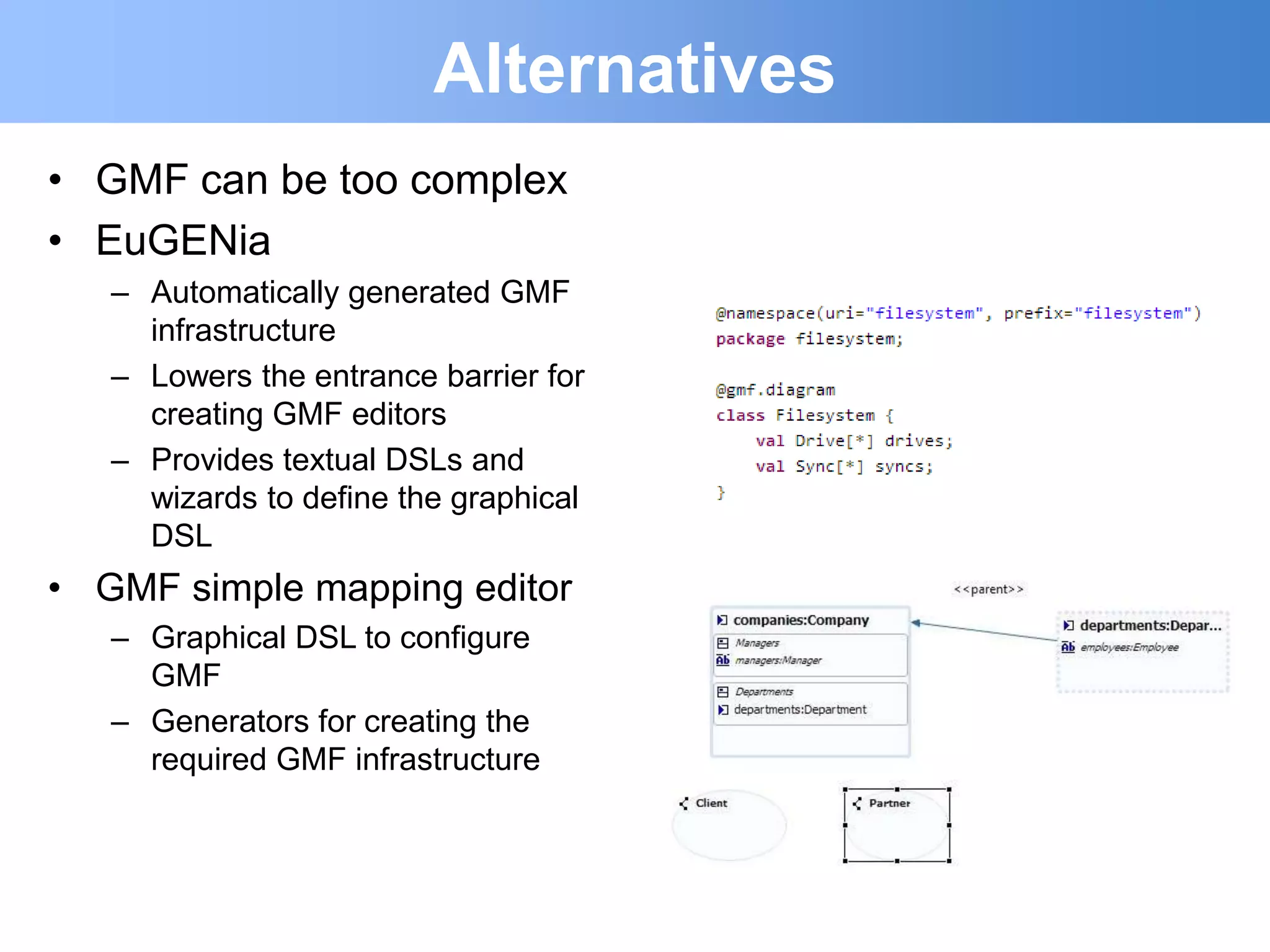
Alternatives
• GMF can be too complex
• EuGENia
   – Automatically generated GMF
     infrastructure
   – Lowers the entrance barrier for
     creating GMF editors
   – Provides textual DSLs and
     wizards to define the graphical
     DSL
• GMF simple mapping editor
   – Graphical DSL to configure
     GMF
   – Generators for creating the
     required GMF infrastructure
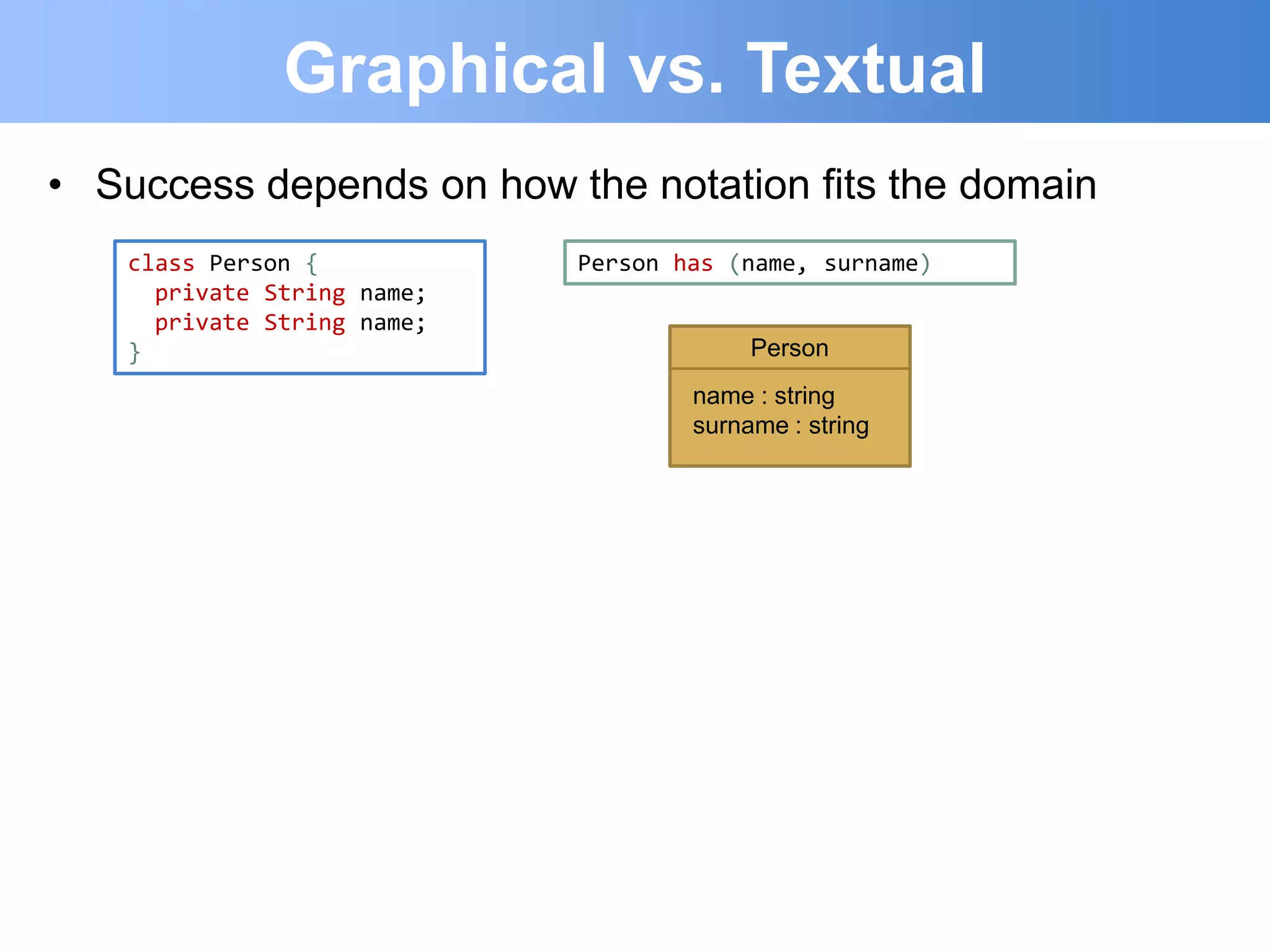
Graphical vs. Textual
• Success depends on how the notation fits the domain
    class Person {           Person has (name, surname)
      private String name;
      private String name;
    }                                     Person
                                     name : string
                                     surname : string
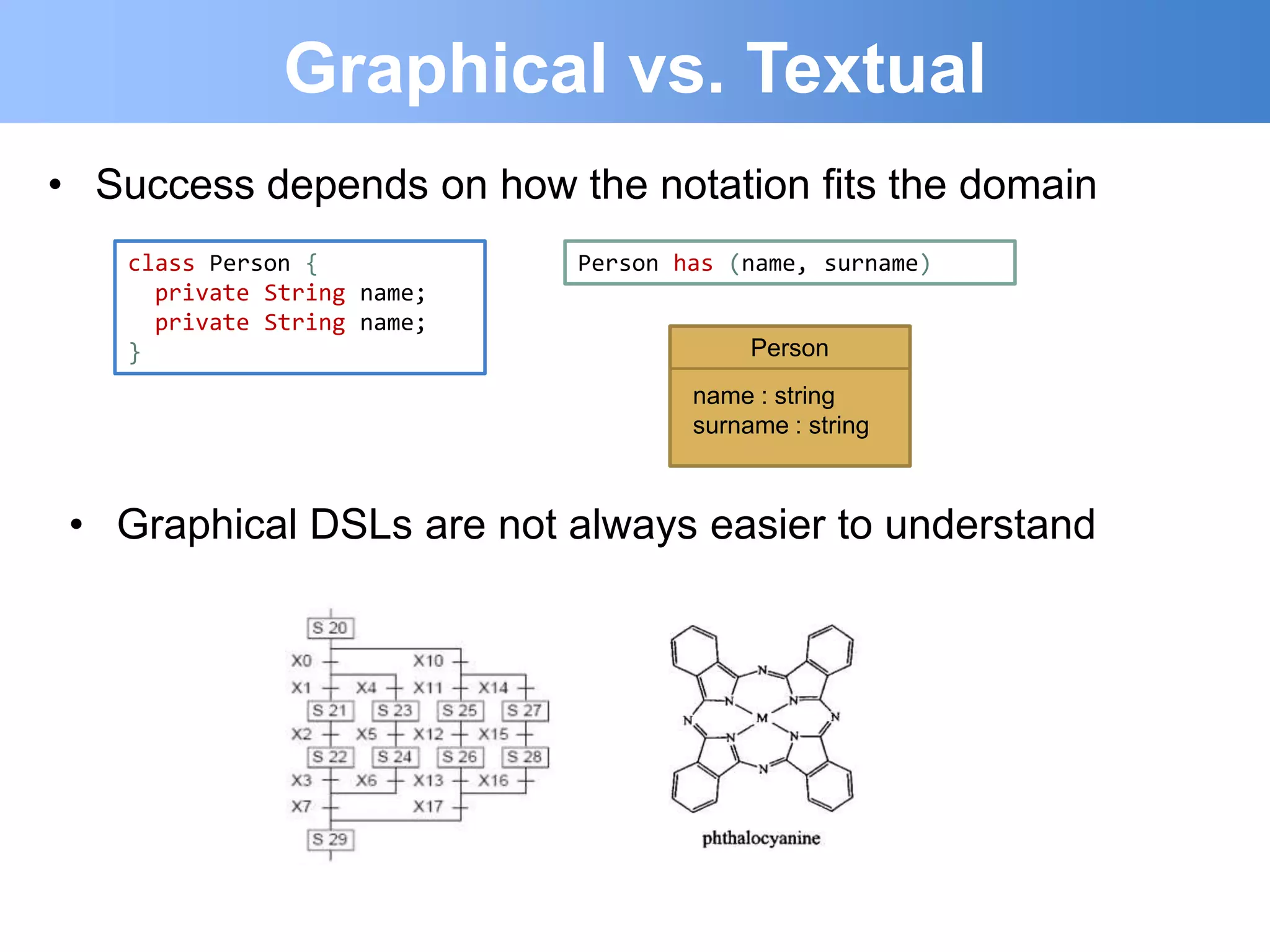
Graphical vs. Textual
• Success depends on how the notation fits the domain
    class Person {           Person has (name, surname)
      private String name;
      private String name;
    }                                     Person
                                     name : string
                                     surname : string


 • Graphical DSLs are not always easier to understand
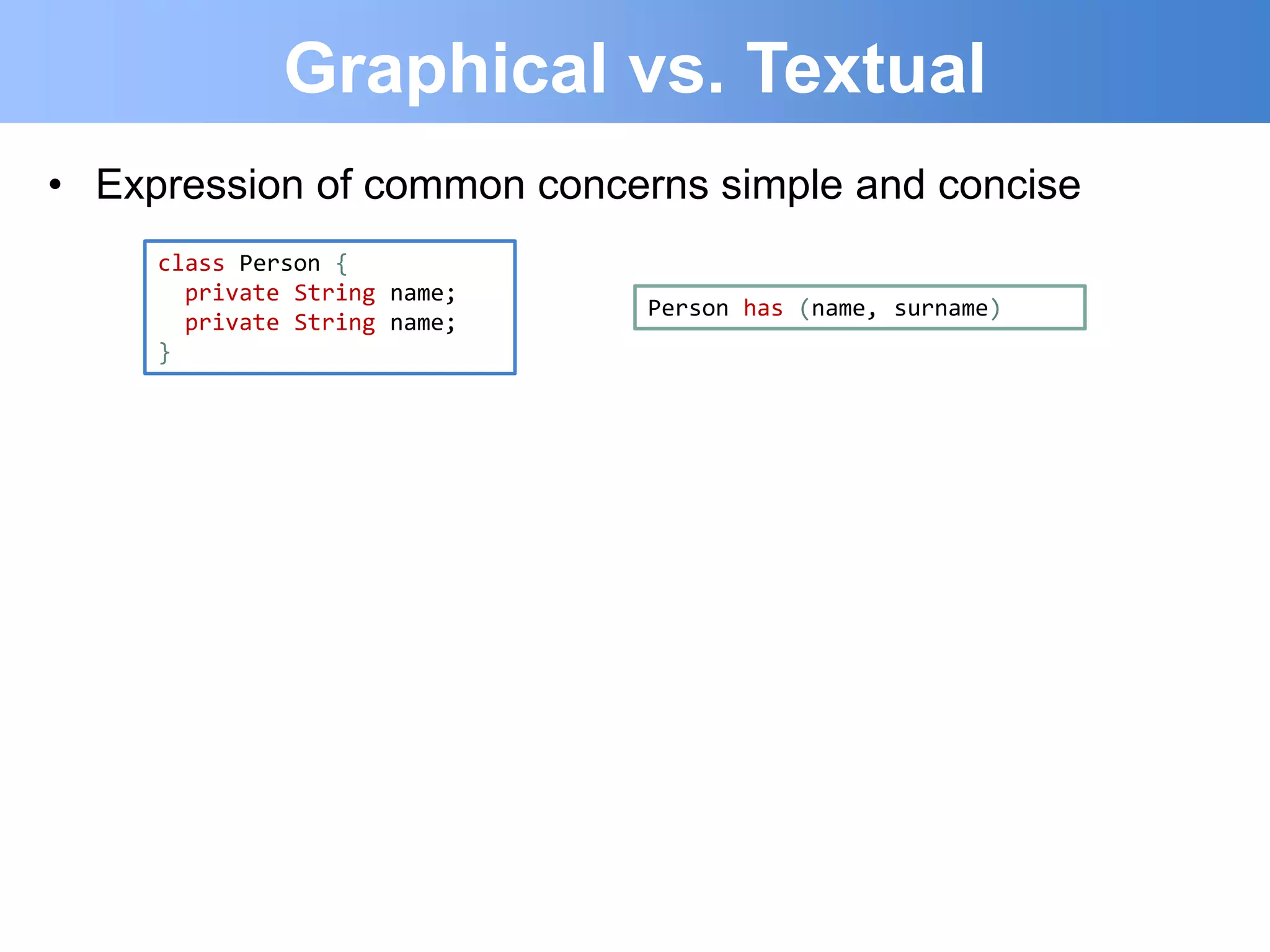
Graphical vs. Textual
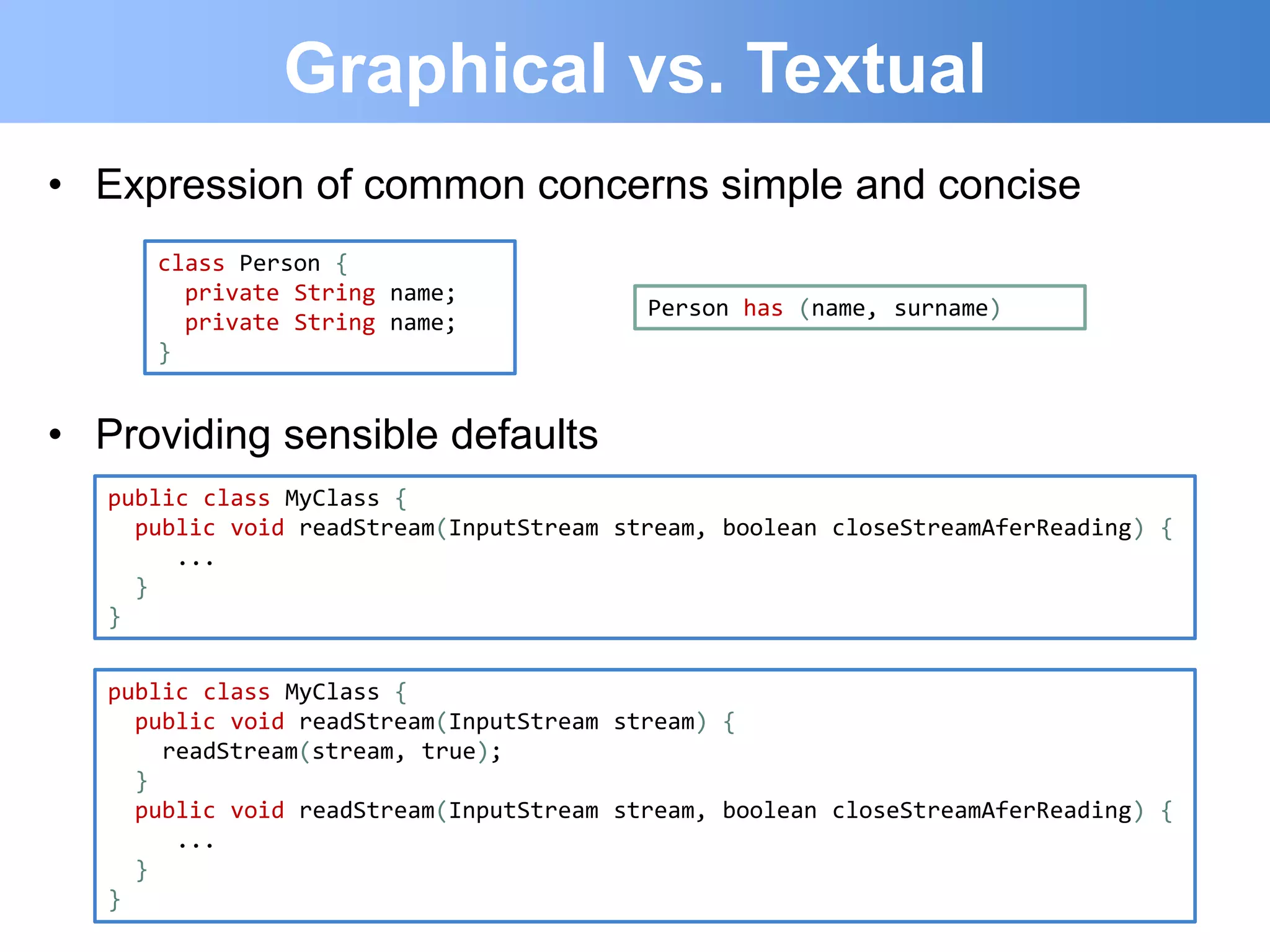
• Expression of common concerns simple and concise
     class Person {
       private String name;
                              Person has (name, surname)
       private String name;
     }
Graphical vs. Textual
• Expression of common concerns simple and concise
      class Person {
        private String name;
                                          Person has (name, surname)
        private String name;
      }


• Providing sensible defaults
   public class MyClass {
     public void readStream(InputStream stream, boolean closeStreamAferReading) {
        ...
     }
   }


   public class MyClass {
     public void readStream(InputStream stream) {
       readStream(stream, true);
     }
     public void readStream(InputStream stream, boolean closeStreamAferReading) {
        ...
     }
   }
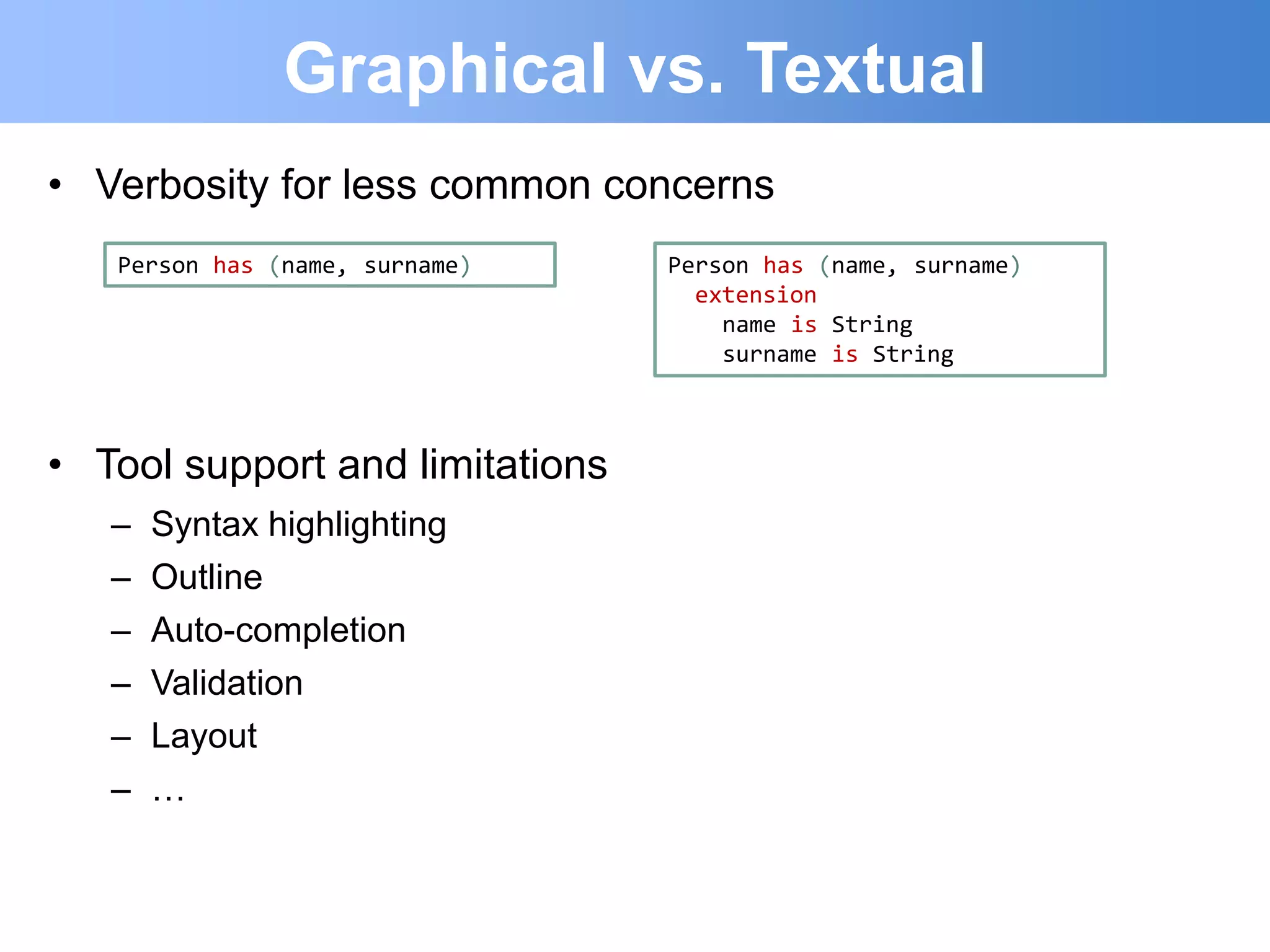
Graphical vs. Textual
• Verbosity for less common concerns
   Person has (name, surname)    Person has (name, surname)
                                   extension
                                     name is String
                                     surname is String


• Tool support and limitations
   –   Syntax highlighting
   –   Outline
   –   Auto-completion
   –   Validation
   –   Layout
   –   …
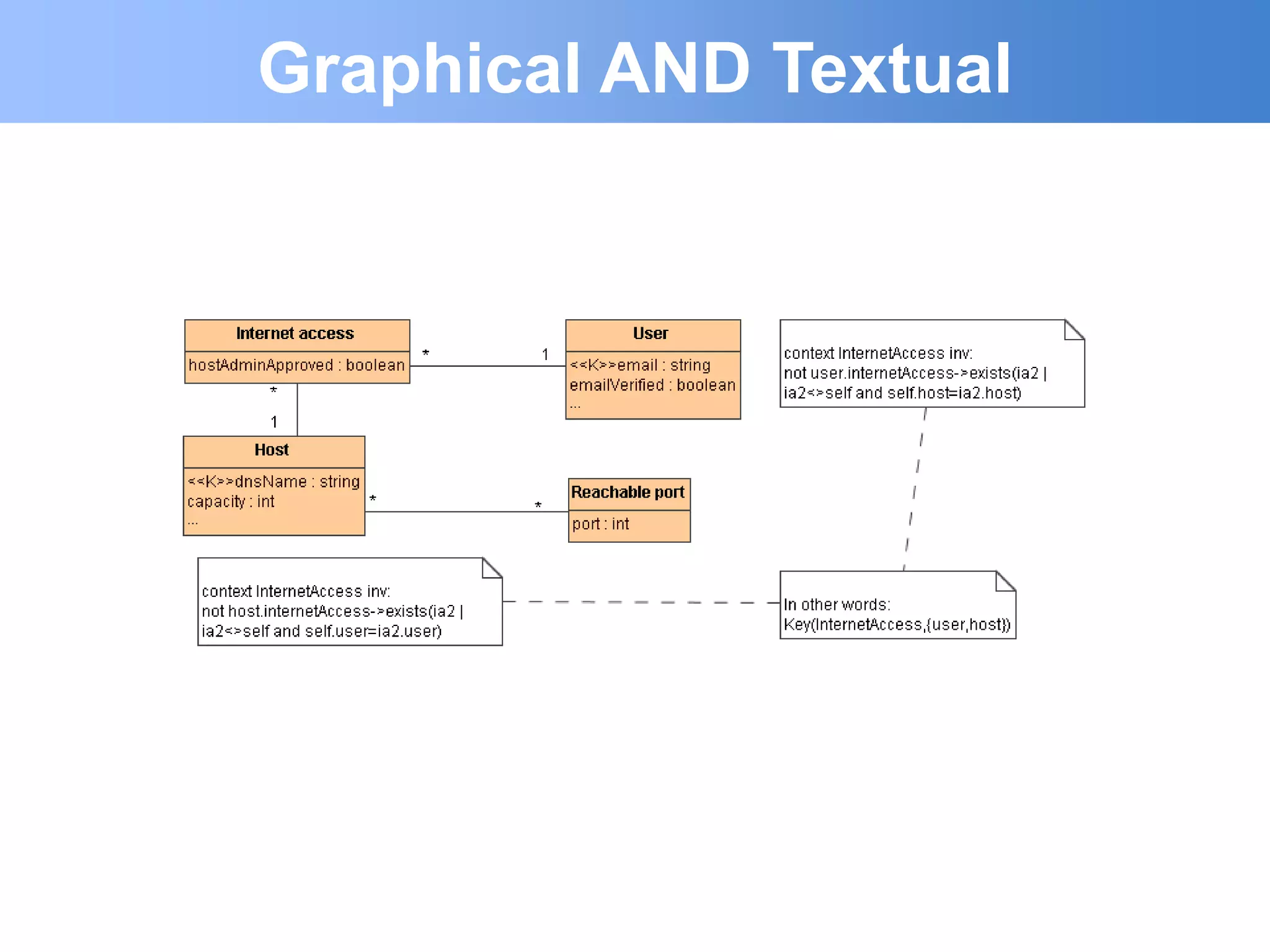
Graphical AND Textual
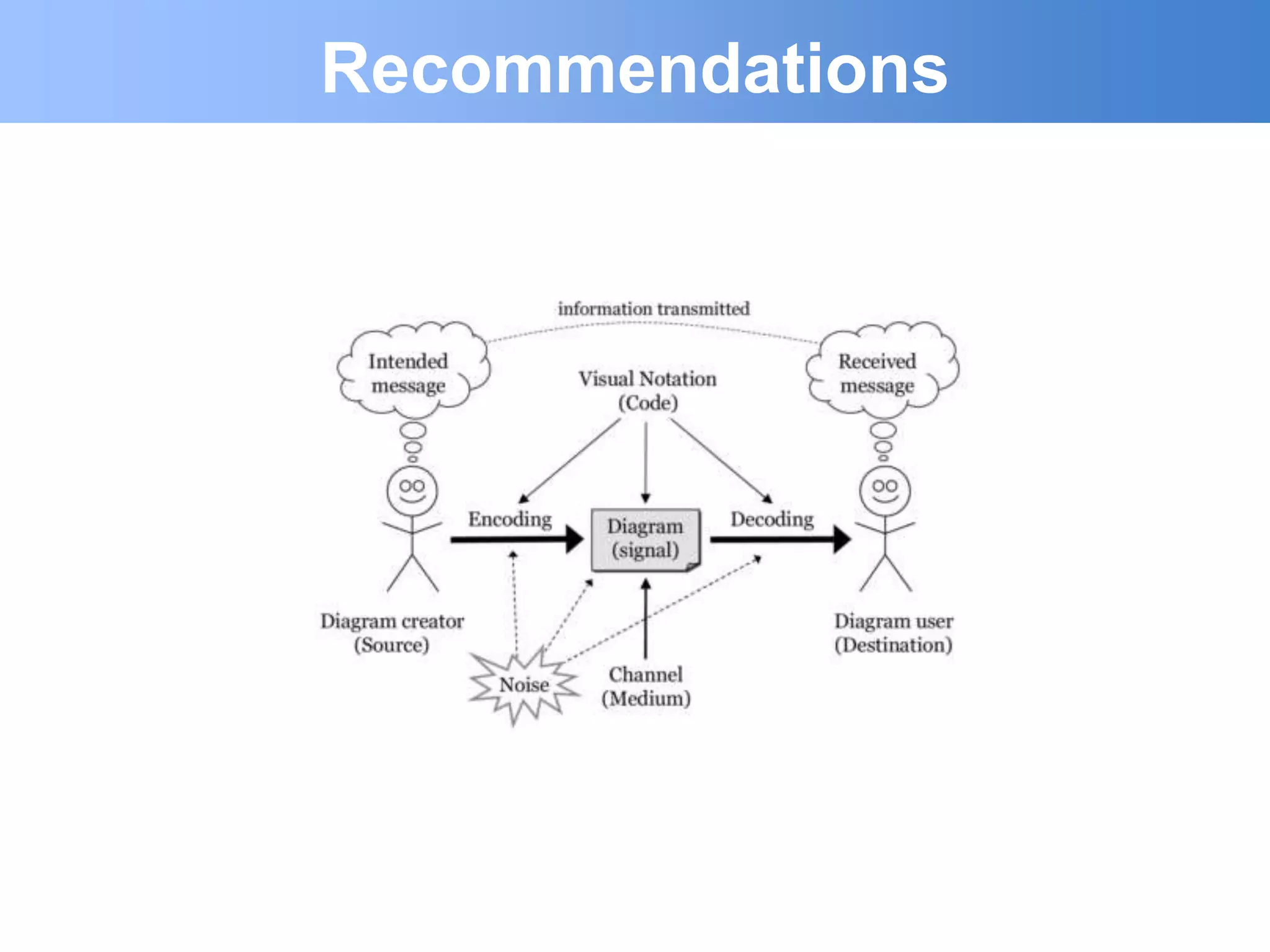
Recommendations
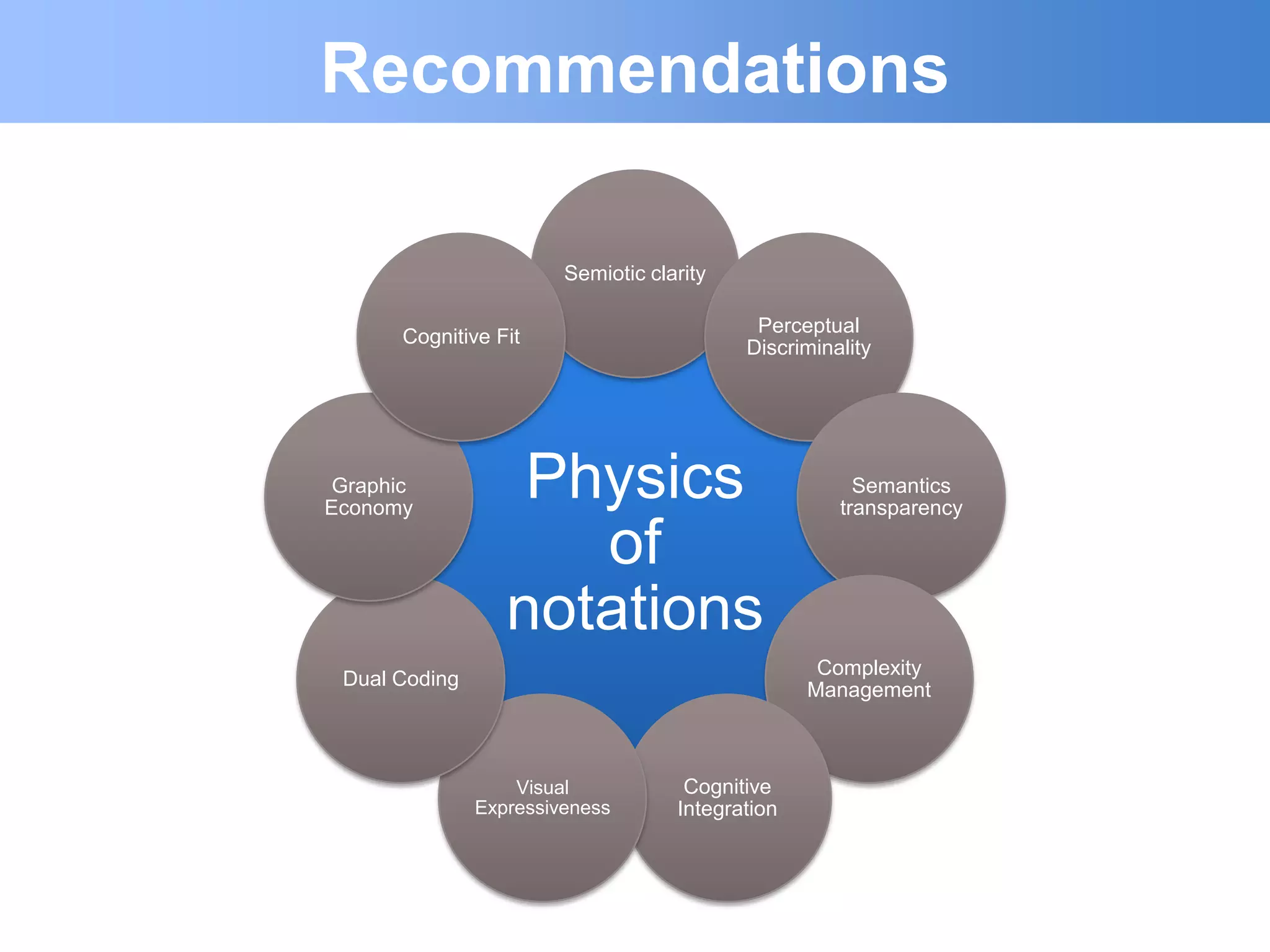
Recommendations

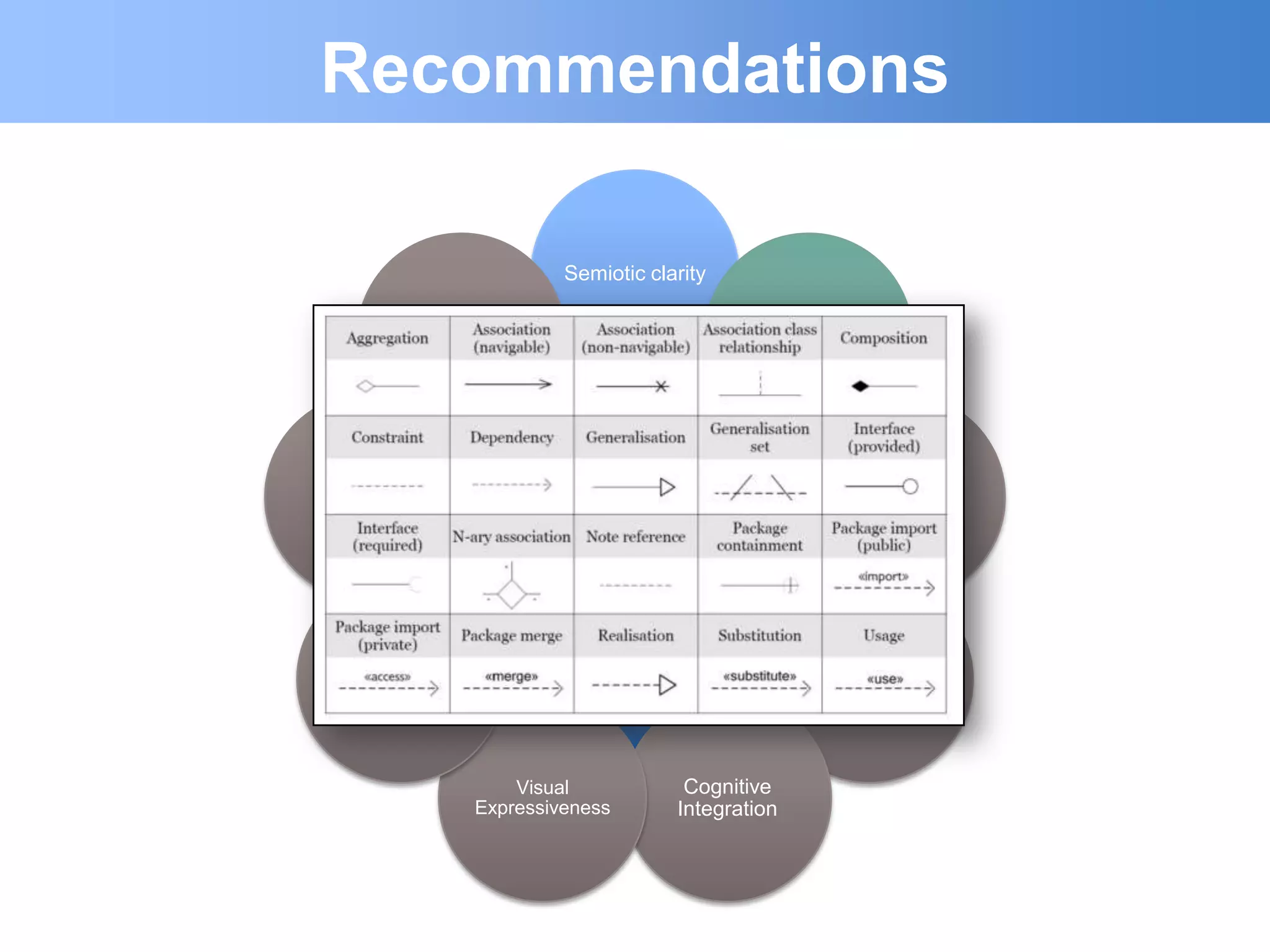
                        Semiotic clarity

                                            Perceptual
       Cognitive Fit
                                           Discriminality


 Graphic
Economy
                   Physics                             Semantics
                                                     transparency

                     of
                  notations
                                                   Complexity
 Dual Coding
                                                  Management


                   Visual            Cognitive
               Expressiveness       Integration
Recommendations

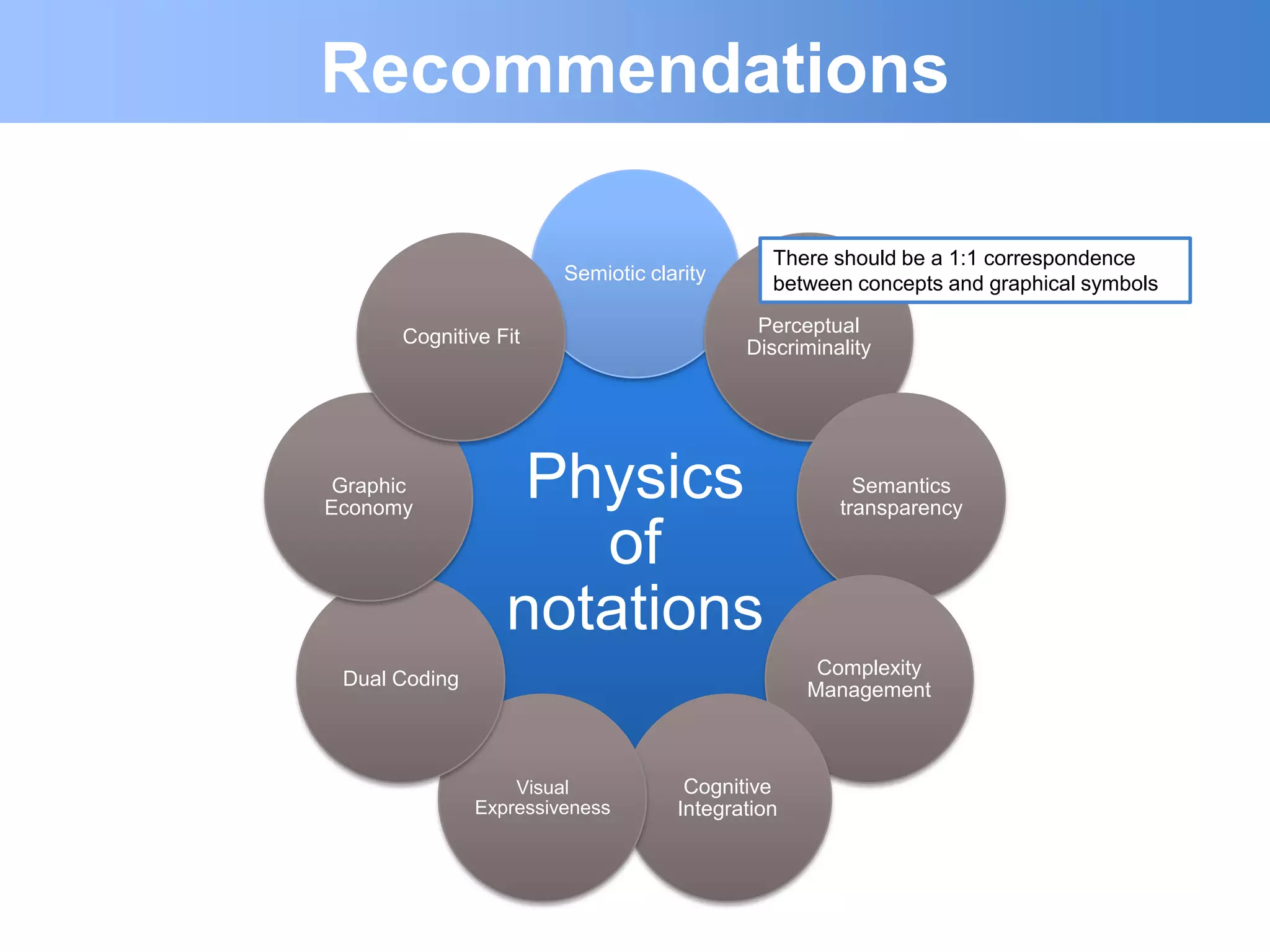
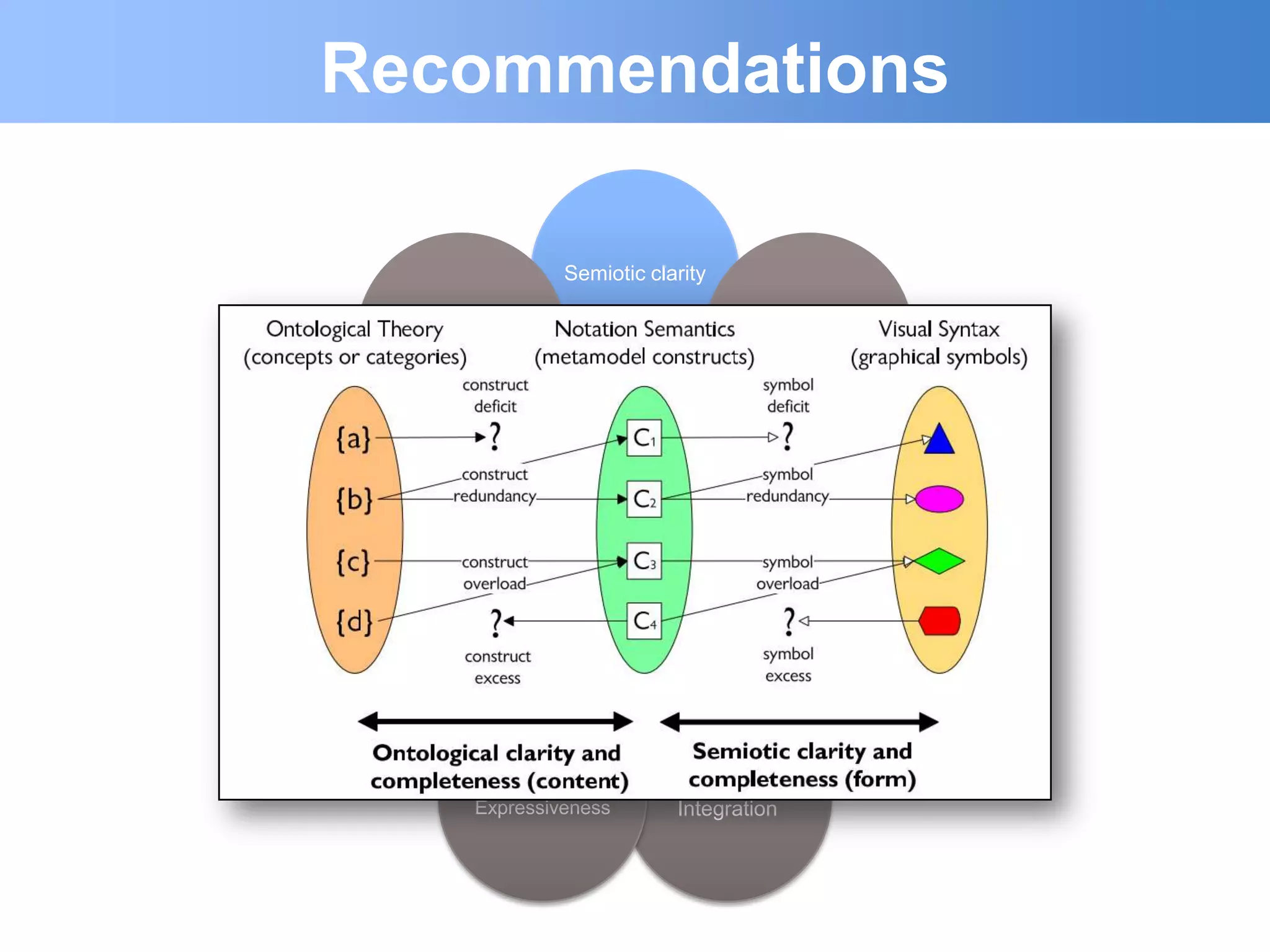
                                              There should be a 1:1 correspondence
                        Semiotic clarity      between concepts and graphical symbols
                                            Perceptual
       Cognitive Fit
                                           Discriminality


 Graphic
Economy
                   Physics                             Semantics
                                                     transparency

                     of
                  notations
                                                   Complexity
 Dual Coding
                                                  Management


                   Visual            Cognitive
               Expressiveness       Integration
Recommendations

                        Semiotic clarity

                                            Perceptual
       Cognitive Fit
                                           Discriminality


 Graphic
Economy
                   Physics                             Semantics
                                                     transparency

                     of
                  notations
                                                   Complexity
 Dual Coding
                                                  Management


                   Visual            Cognitive
               Expressiveness       Integration
Recommendations

                        Semiotic clarity
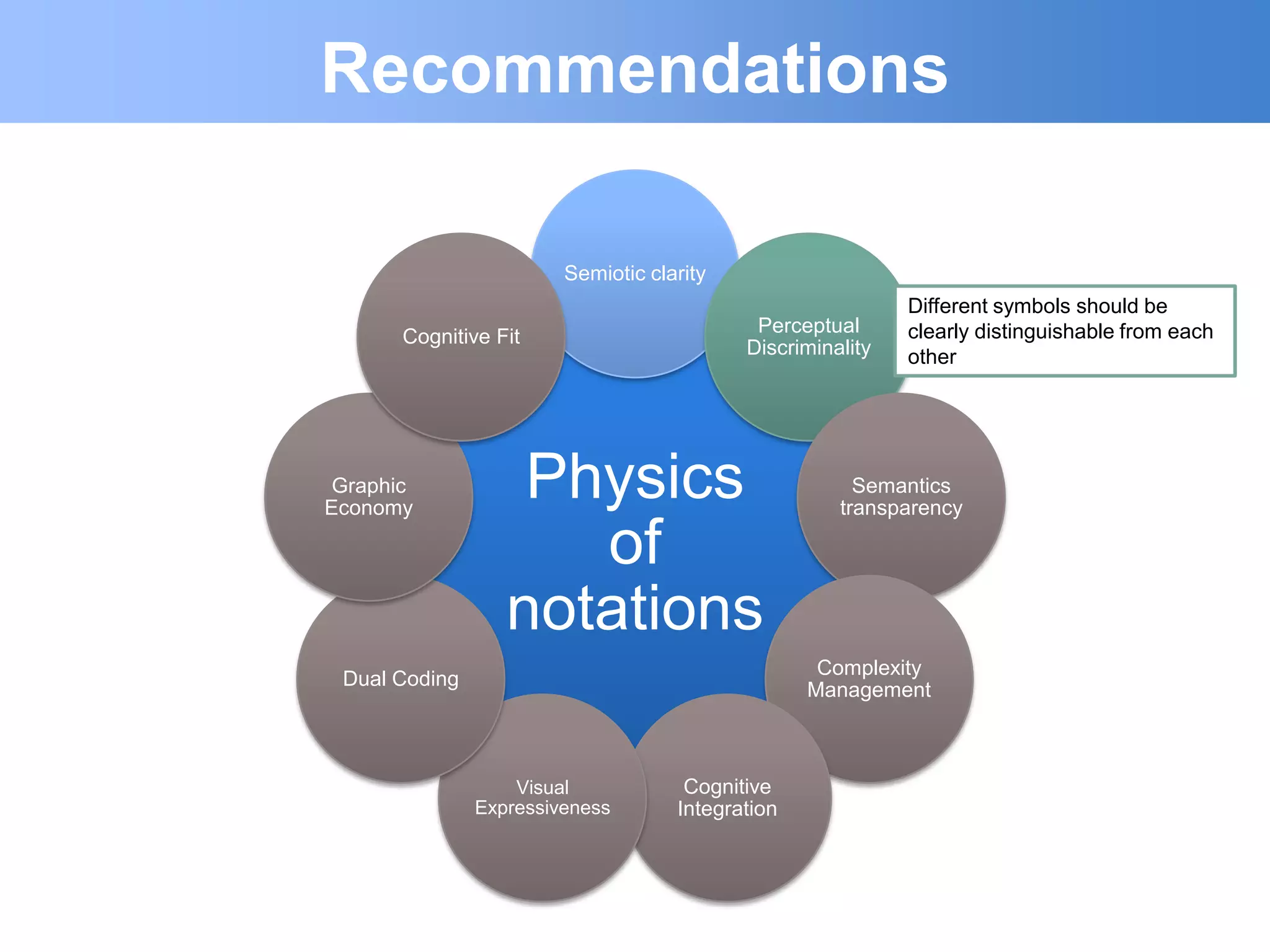
                                                            Different symbols should be
                                            Perceptual      clearly distinguishable from each
       Cognitive Fit
                                           Discriminality   other


 Graphic
Economy
                   Physics                             Semantics
                                                     transparency

                     of
                  notations
                                                   Complexity
 Dual Coding
                                                  Management


                   Visual            Cognitive
               Expressiveness       Integration
Recommendations

                        Semiotic clarity

                                            Perceptual
       Cognitive Fit
                                           Discriminality


 Graphic
Economy
                   Physics                             Semantics
                                                     transparency

                     of
                  notations
                                                   Complexity
 Dual Coding
                                                  Management


                   Visual            Cognitive
               Expressiveness       Integration
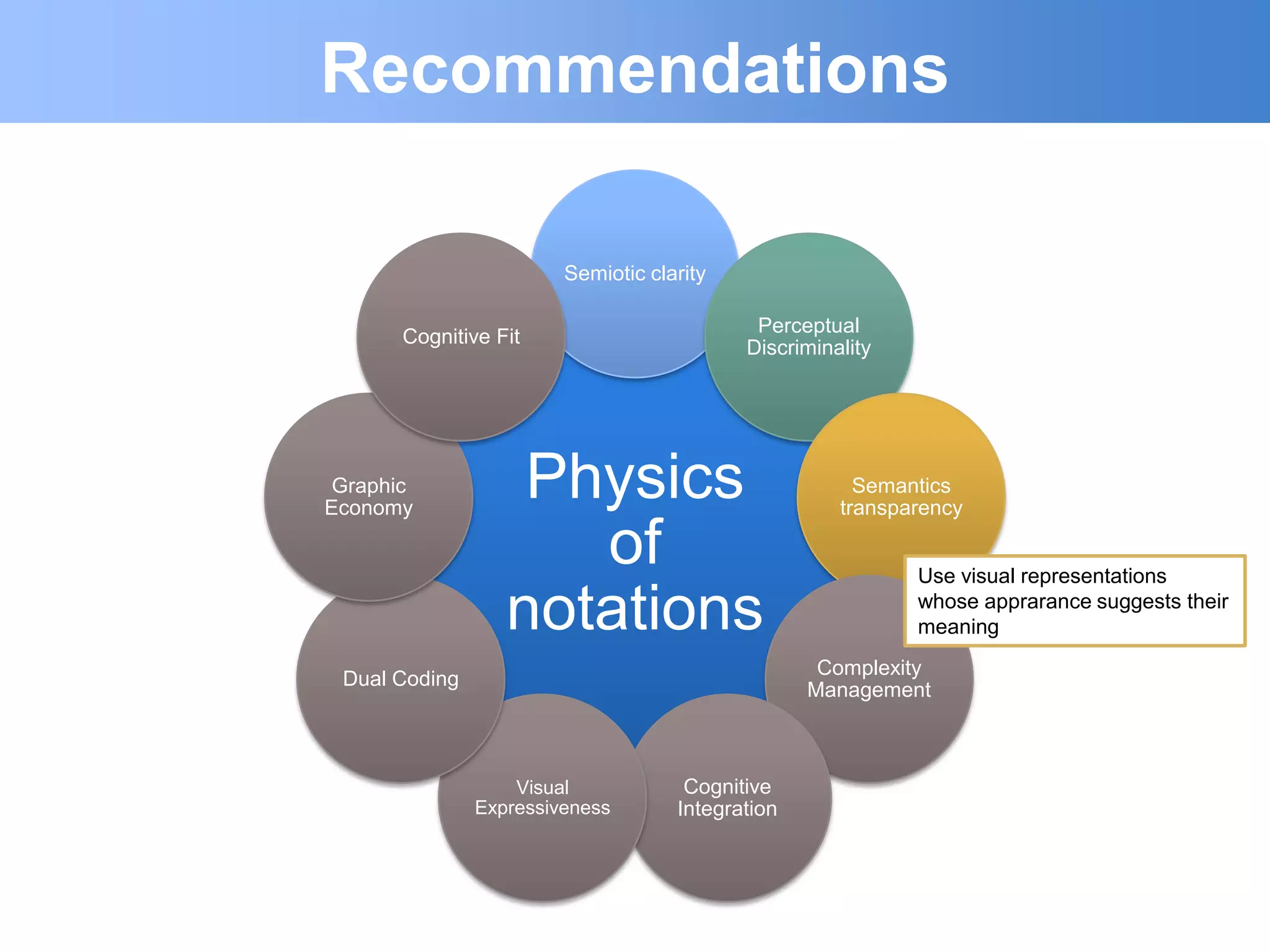
Recommendations

                        Semiotic clarity

                                            Perceptual
       Cognitive Fit
                                           Discriminality


 Graphic
Economy
                   Physics                             Semantics
                                                     transparency

                     of                                     Use visual representations

                  notations                                 whose apprarance suggests their
                                                            meaning
                                                   Complexity
 Dual Coding
                                                  Management


                   Visual            Cognitive
               Expressiveness       Integration
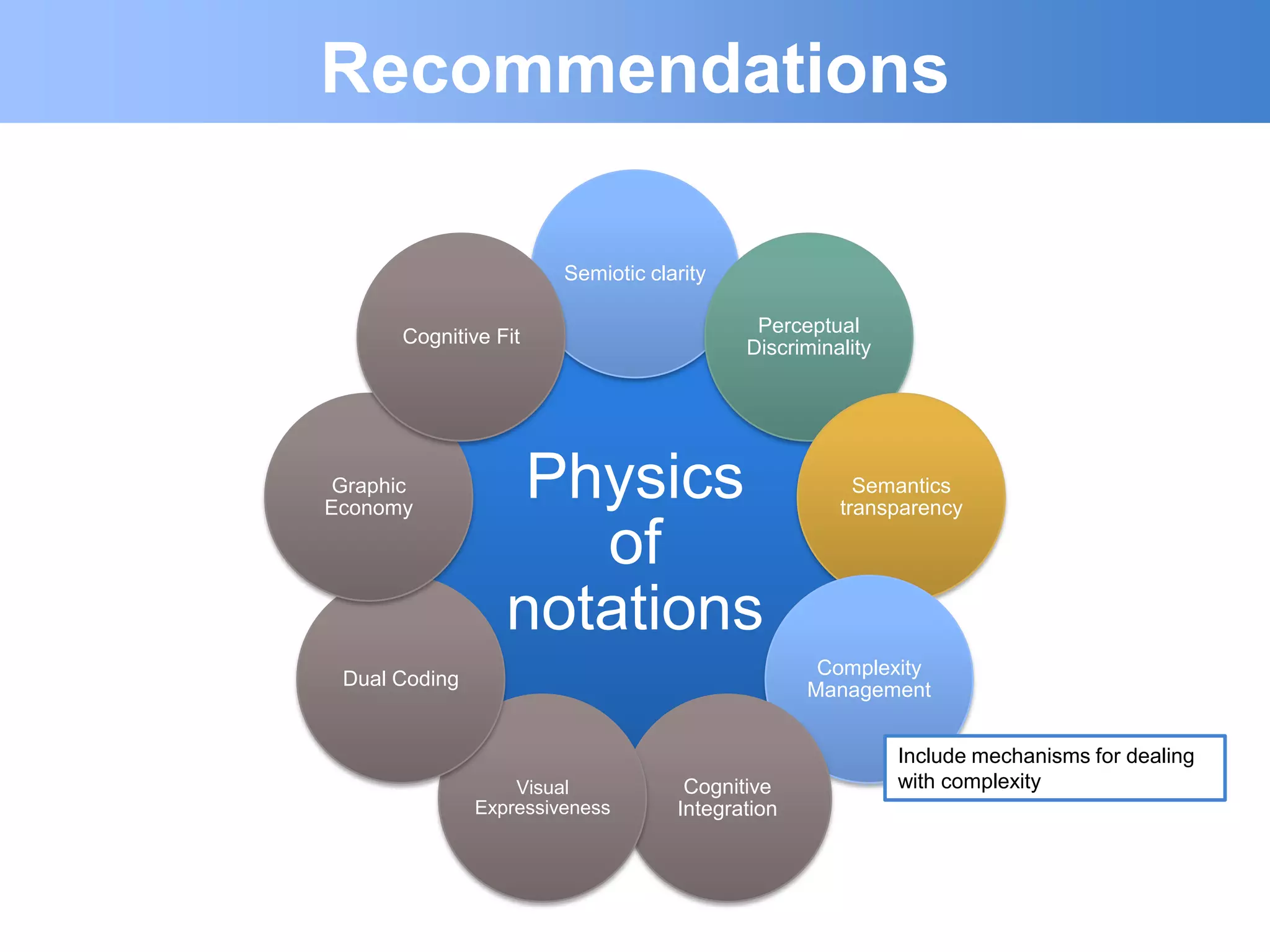
Recommendations

                        Semiotic clarity

                                            Perceptual
       Cognitive Fit
                                           Discriminality


 Graphic
Economy
                   Physics                             Semantics
                                                     transparency

                     of
                  notations
                                                   Complexity
 Dual Coding
                                                  Management


                                                            Include mechanisms for dealing
                   Visual            Cognitive              with complexity
               Expressiveness       Integration
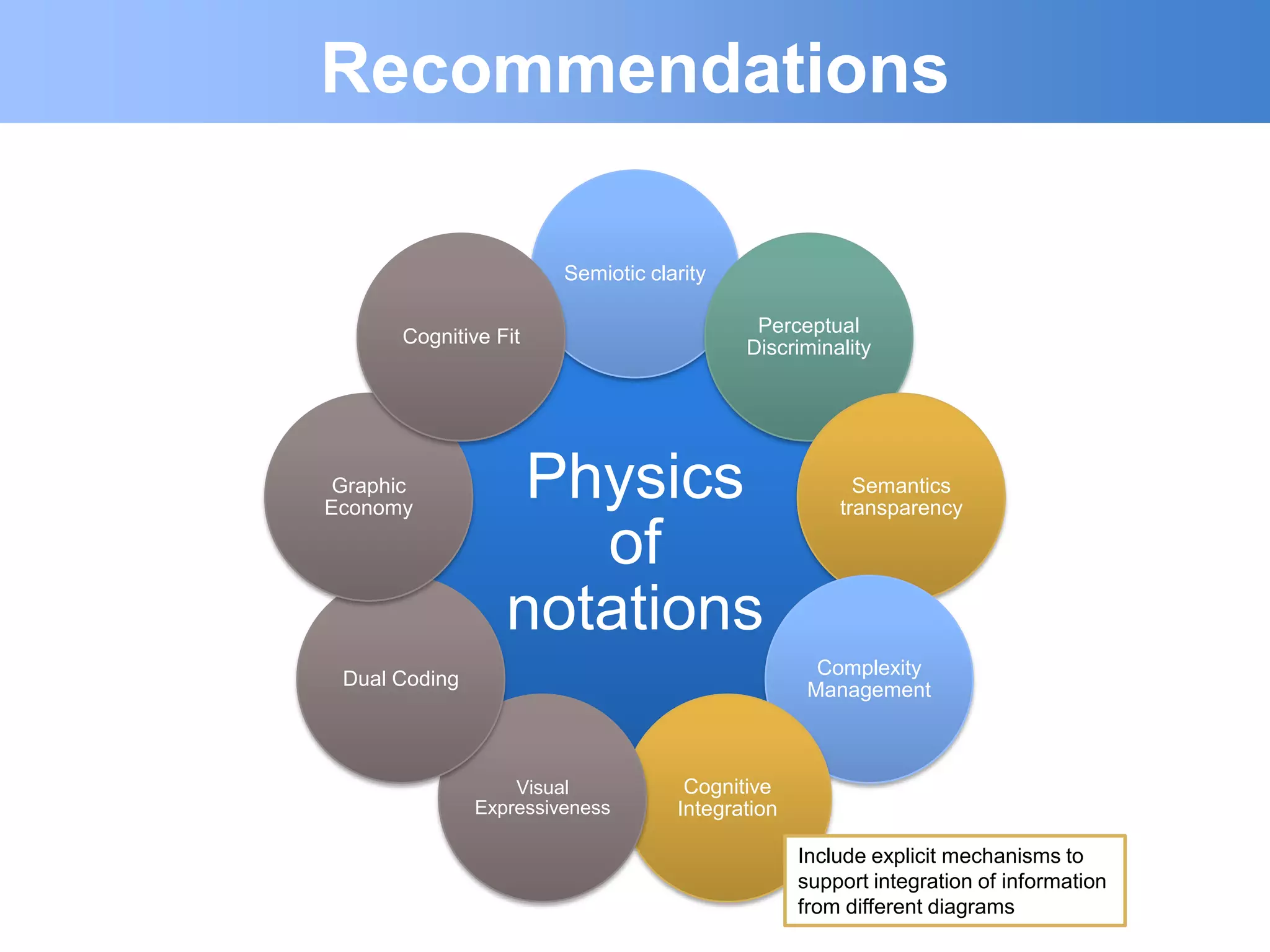
Recommendations

                        Semiotic clarity

                                            Perceptual
       Cognitive Fit
                                           Discriminality


 Graphic
Economy
                   Physics                              Semantics
                                                      transparency

                     of
                  notations
                                                    Complexity
 Dual Coding
                                                   Management


                   Visual            Cognitive
               Expressiveness       Integration

                                                  Include explicit mechanisms to
                                                  support integration of information
                                                  from different diagrams
Recommendations

                        Semiotic clarity

                                            Perceptual
       Cognitive Fit
                                           Discriminality


 Graphic
Economy
                   Physics                             Semantics
                                                     transparency

                     of
                  notations
                                                   Complexity
 Dual Coding
                                                  Management


                   Visual            Cognitive
               Expressiveness       Integration

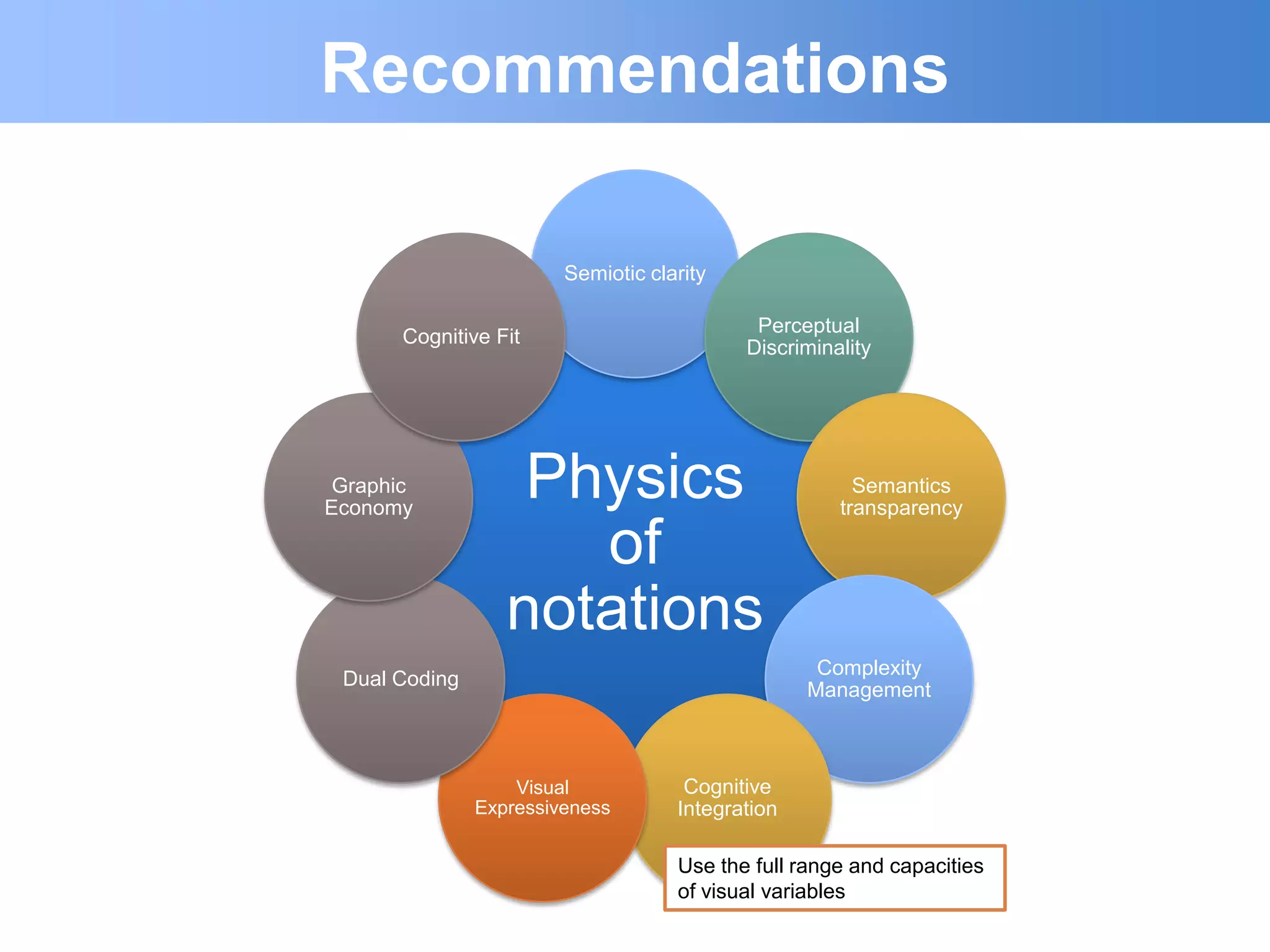
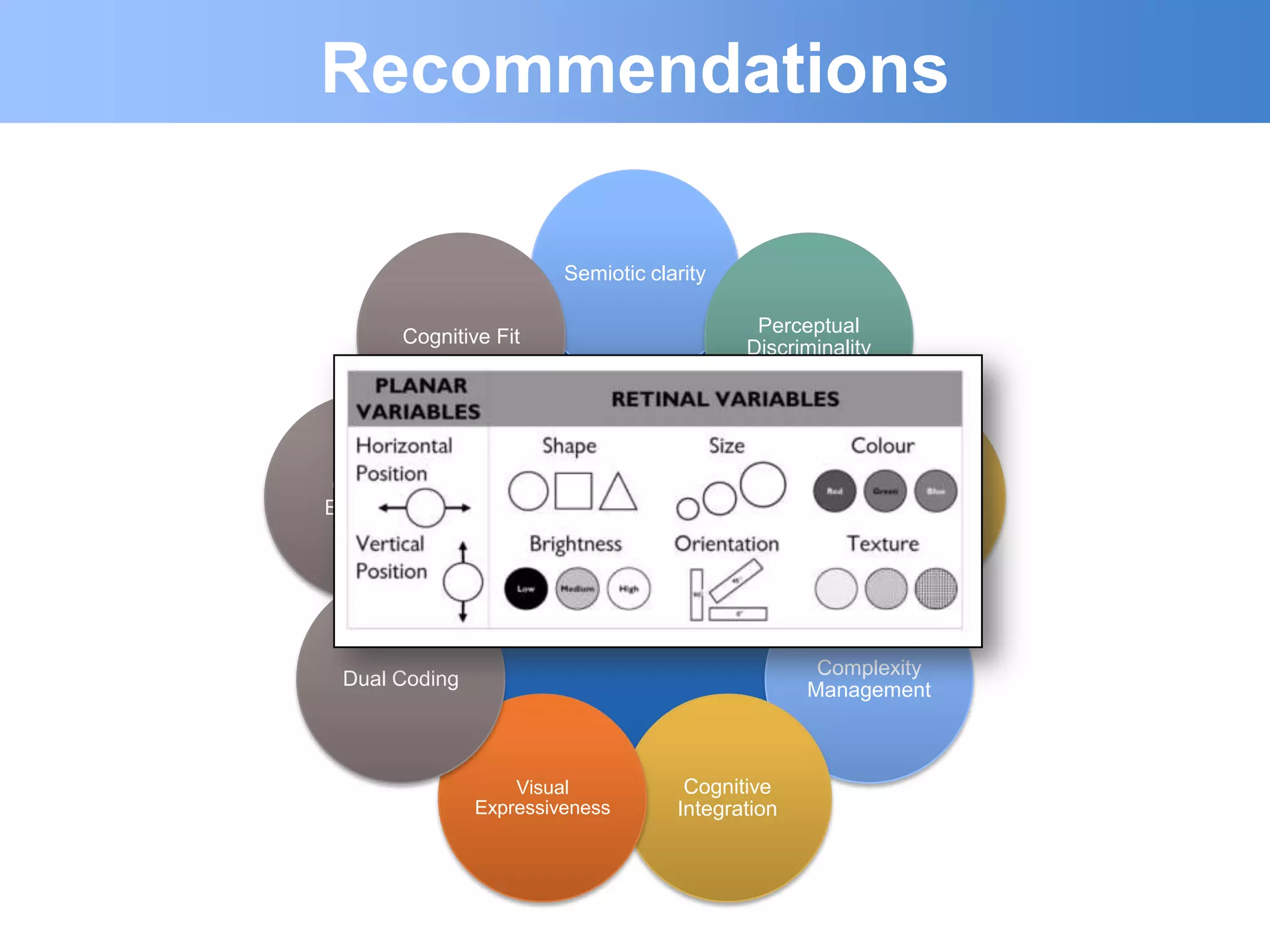
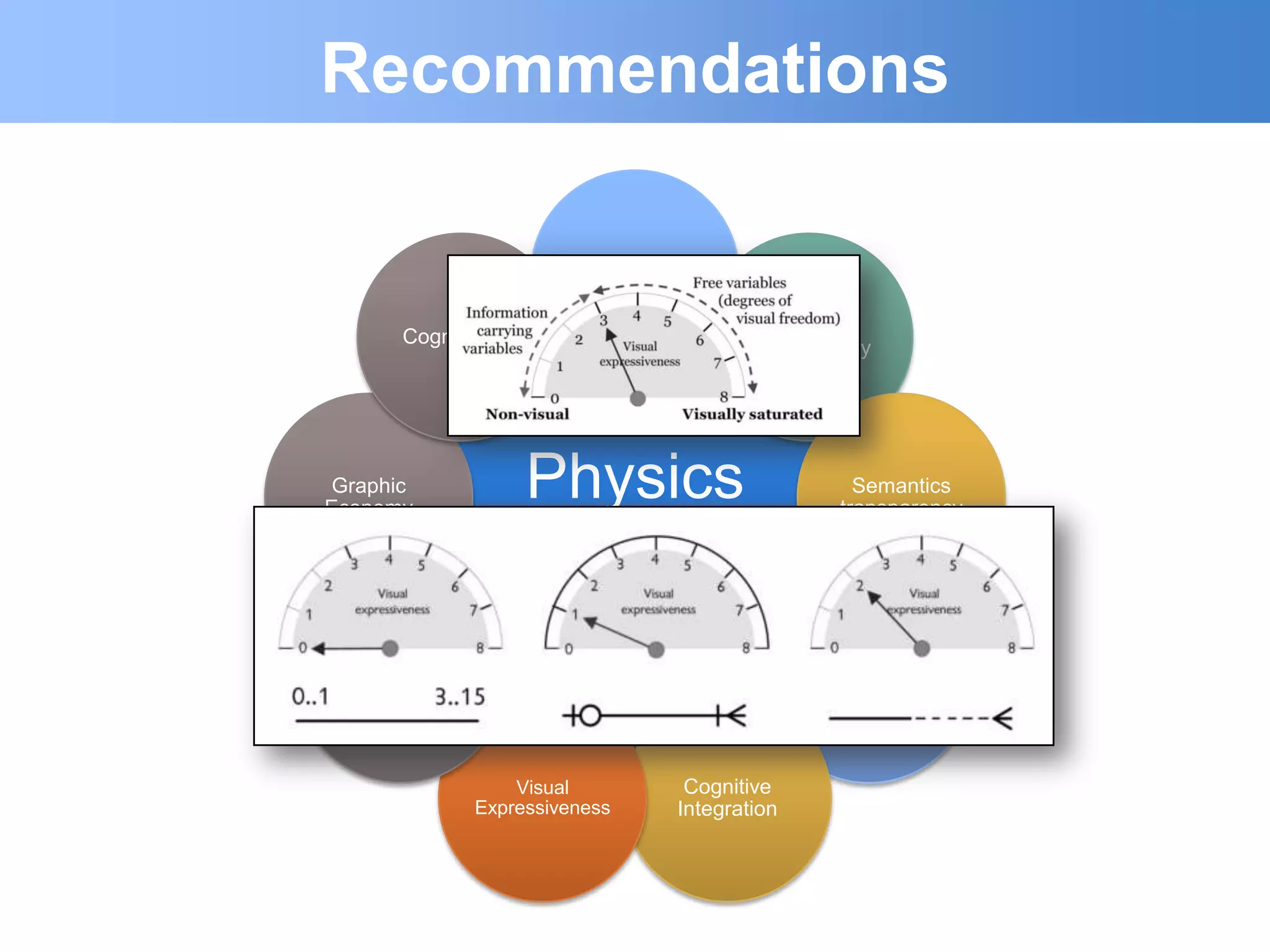
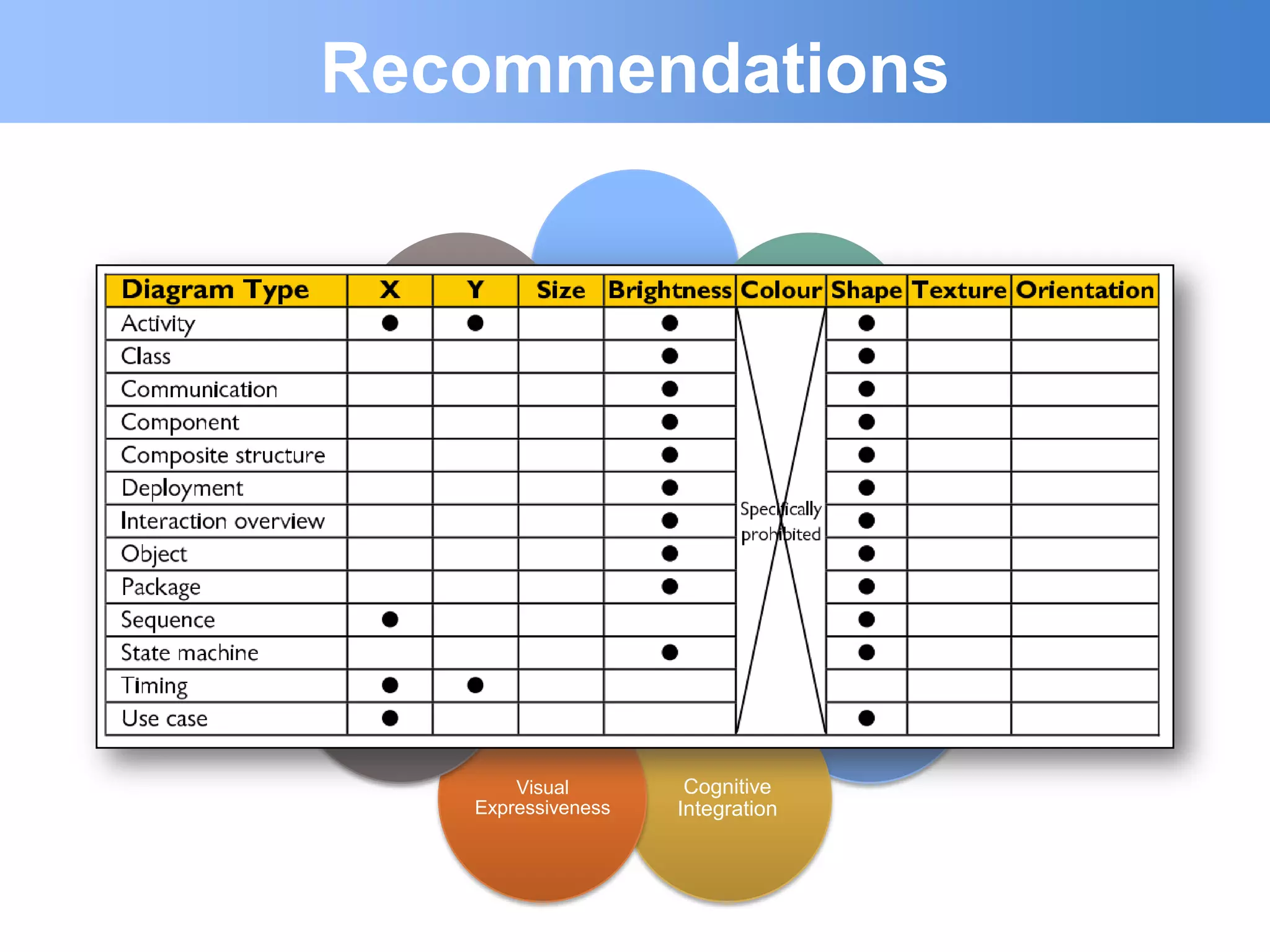
                                    Use the full range and capacities
                                    of visual variables
Recommendations

                        Semiotic clarity

                                            Perceptual
       Cognitive Fit
                                           Discriminality


 Graphic
Economy
                   Physics                             Semantics
                                                     transparency

                     of
                  notations
                                                   Complexity
 Dual Coding
                                                  Management


                   Visual            Cognitive
               Expressiveness       Integration
Recommendations

                        Semiotic clarity

                                            Perceptual
       Cognitive Fit
                                           Discriminality


 Graphic
Economy
                   Physics                             Semantics
                                                     transparency

                     of
                  notations
                                                   Complexity
 Dual Coding
                                                  Management


                   Visual            Cognitive
               Expressiveness       Integration
Recommendations

                        Semiotic clarity

                                            Perceptual
       Cognitive Fit
                                           Discriminality


 Graphic
Economy
                   Physics                             Semantics
                                                     transparency

                     of
                  notations
                                                   Complexity
 Dual Coding
                                                  Management


                   Visual            Cognitive
               Expressiveness       Integration
Recommendations

                                                  Semiotic clarity

                                                                      Perceptual
                                  Cognitive Fit
                                                                     Discriminality


                         Graphic
                        Economy
                                              Physics                            Semantics
                                                                               transparency

                                                of
                                             notations
                                                                             Complexity
                          Dual Coding
                                                                            Management


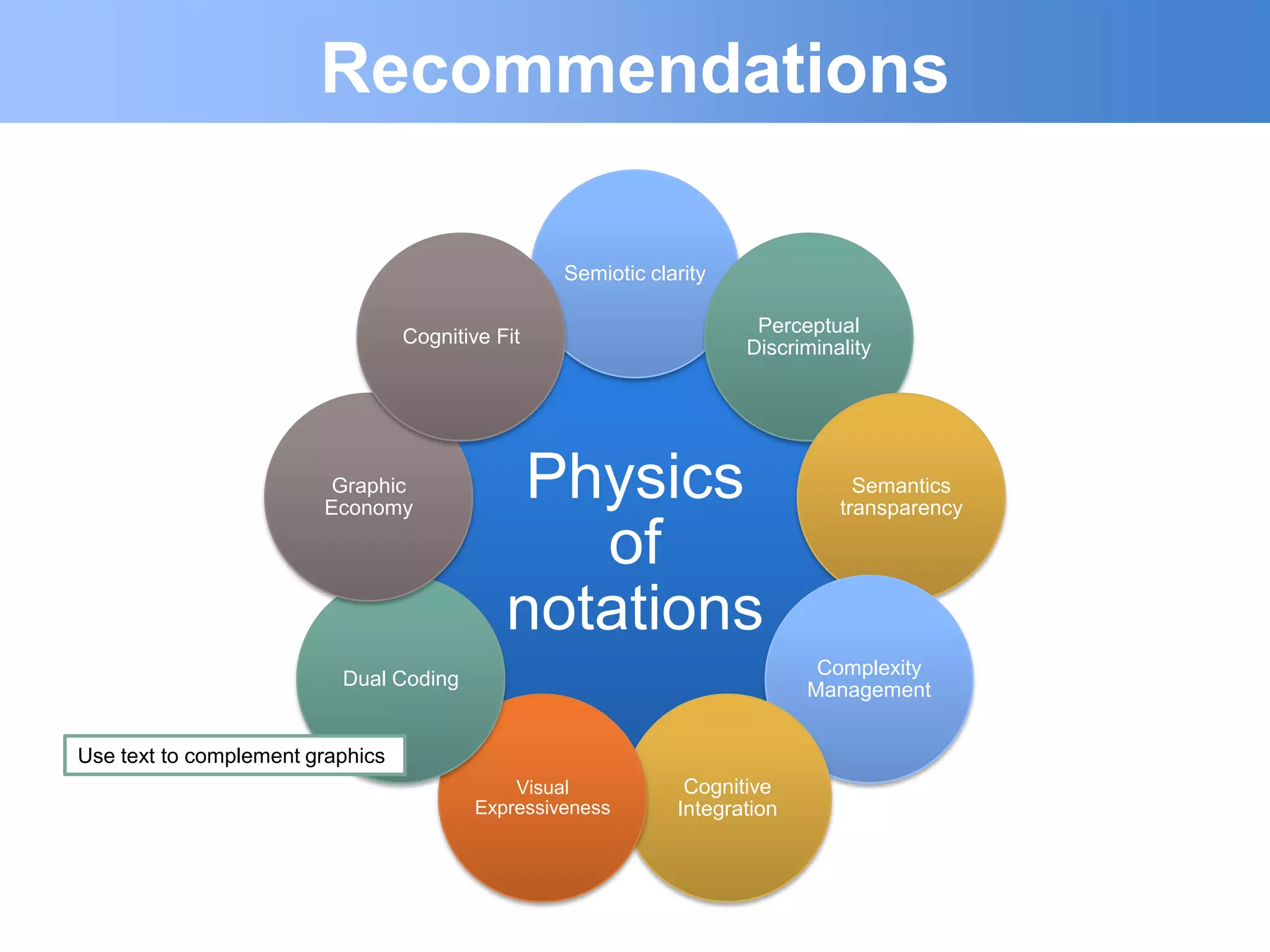
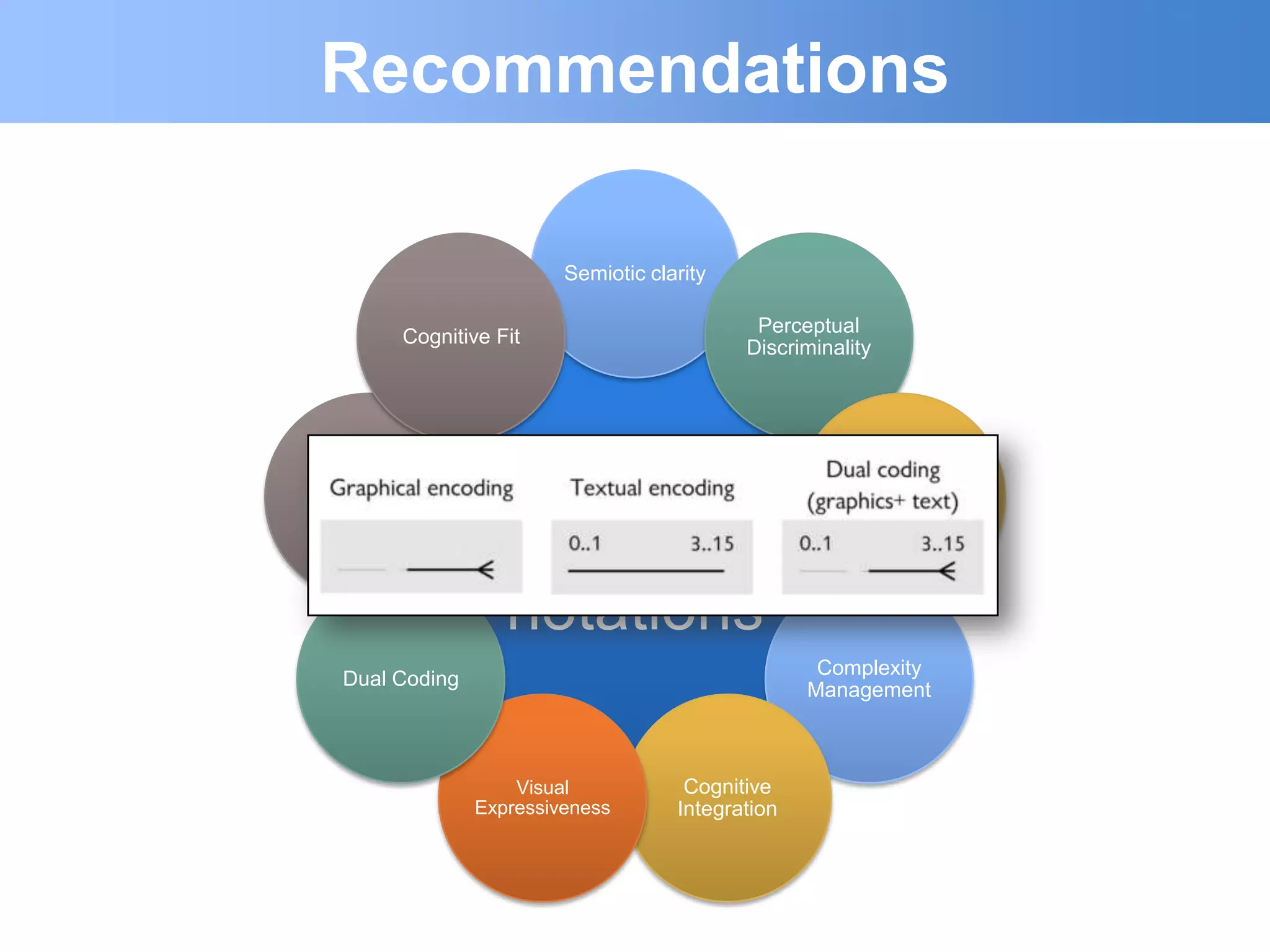
Use text to complement graphics
                                             Visual            Cognitive
                                         Expressiveness       Integration
Recommendations

                        Semiotic clarity

                                            Perceptual
       Cognitive Fit
                                           Discriminality


 Graphic
Economy
                   Physics                             Semantics
                                                     transparency

                     of
                  notations
                                                   Complexity
 Dual Coding
                                                  Management


                   Visual            Cognitive
               Expressiveness       Integration
Recommendations

                                                     Semiotic clarity

                                                                         Perceptual
                                    Cognitive Fit
                                                                        Discriminality


                             Graphic
                            Economy
                                                Physics                             Semantics
                                                                                  transparency

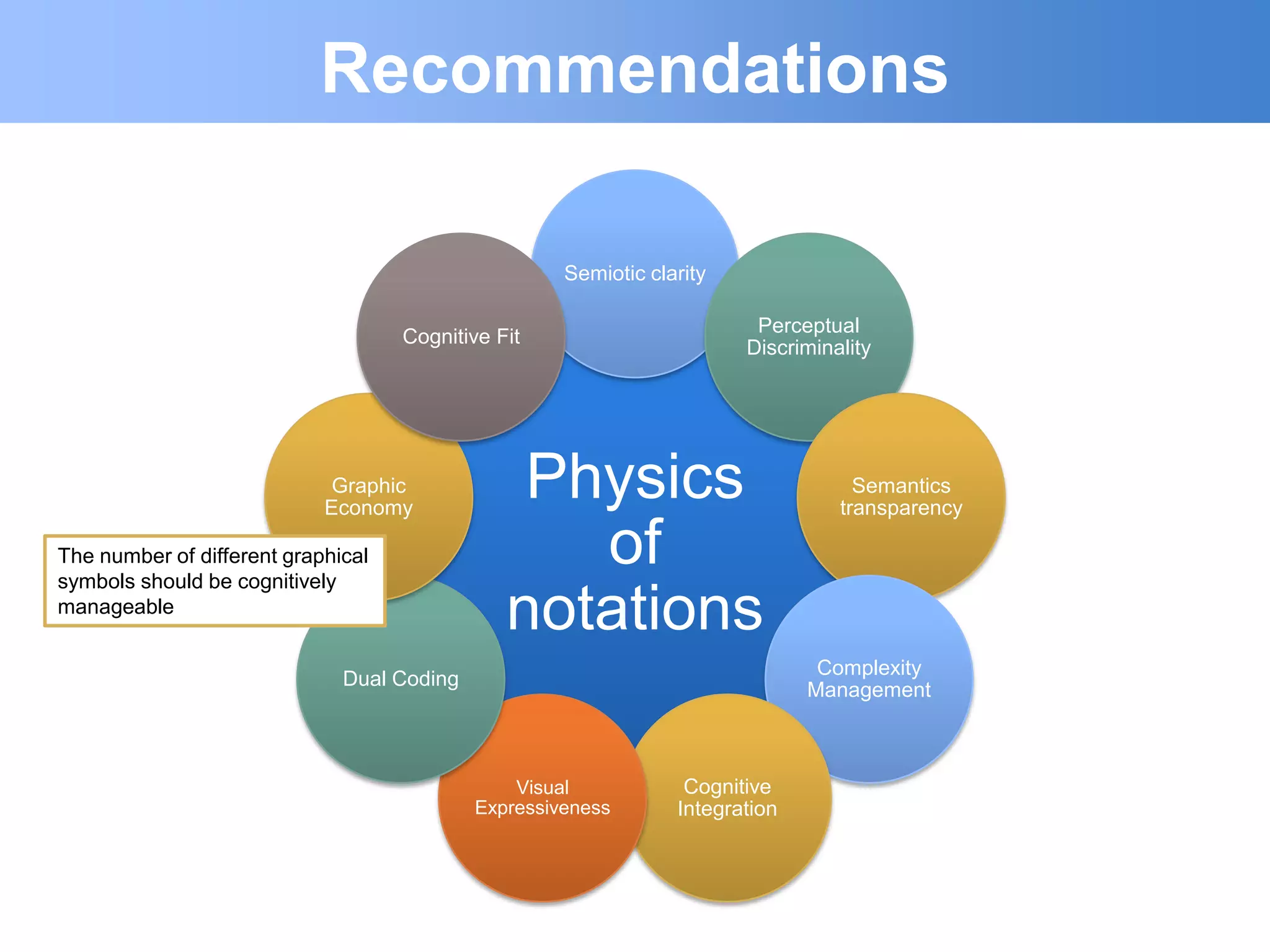
The number of different graphical
symbols should be cognitively
                                                  of
manageable
                                               notations
                                                                                Complexity
                              Dual Coding
                                                                               Management


                                                Visual            Cognitive
                                            Expressiveness       Integration
Recommendations

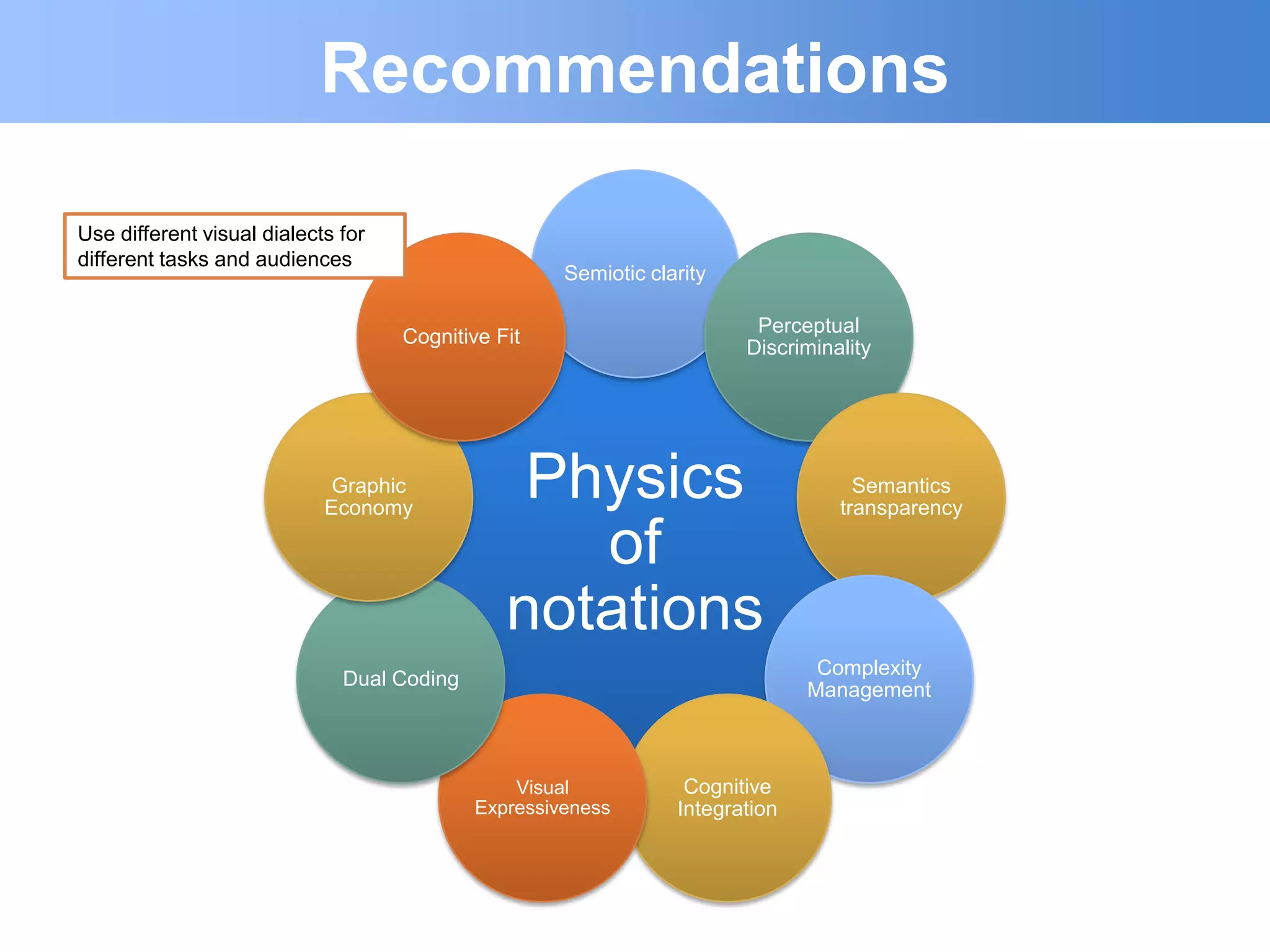
Use different visual dialects for
different tasks and audiences
                                                     Semiotic clarity

                                                                         Perceptual
                                    Cognitive Fit
                                                                        Discriminality


                             Graphic
                            Economy
                                                Physics                             Semantics
                                                                                  transparency

                                                  of
                                               notations
                                                                                Complexity
                              Dual Coding
                                                                               Management


                                                Visual            Cognitive
                                            Expressiveness       Integration
Anatomy


 Concepts &     Well-formed
                              Textual   Graphical   Denotational   Pragmatic   Translational   Operational
relationships      rules


  Abstract                    Concrete
                                                                   Semantics
  Syntax                       Syntax


                                         DSL
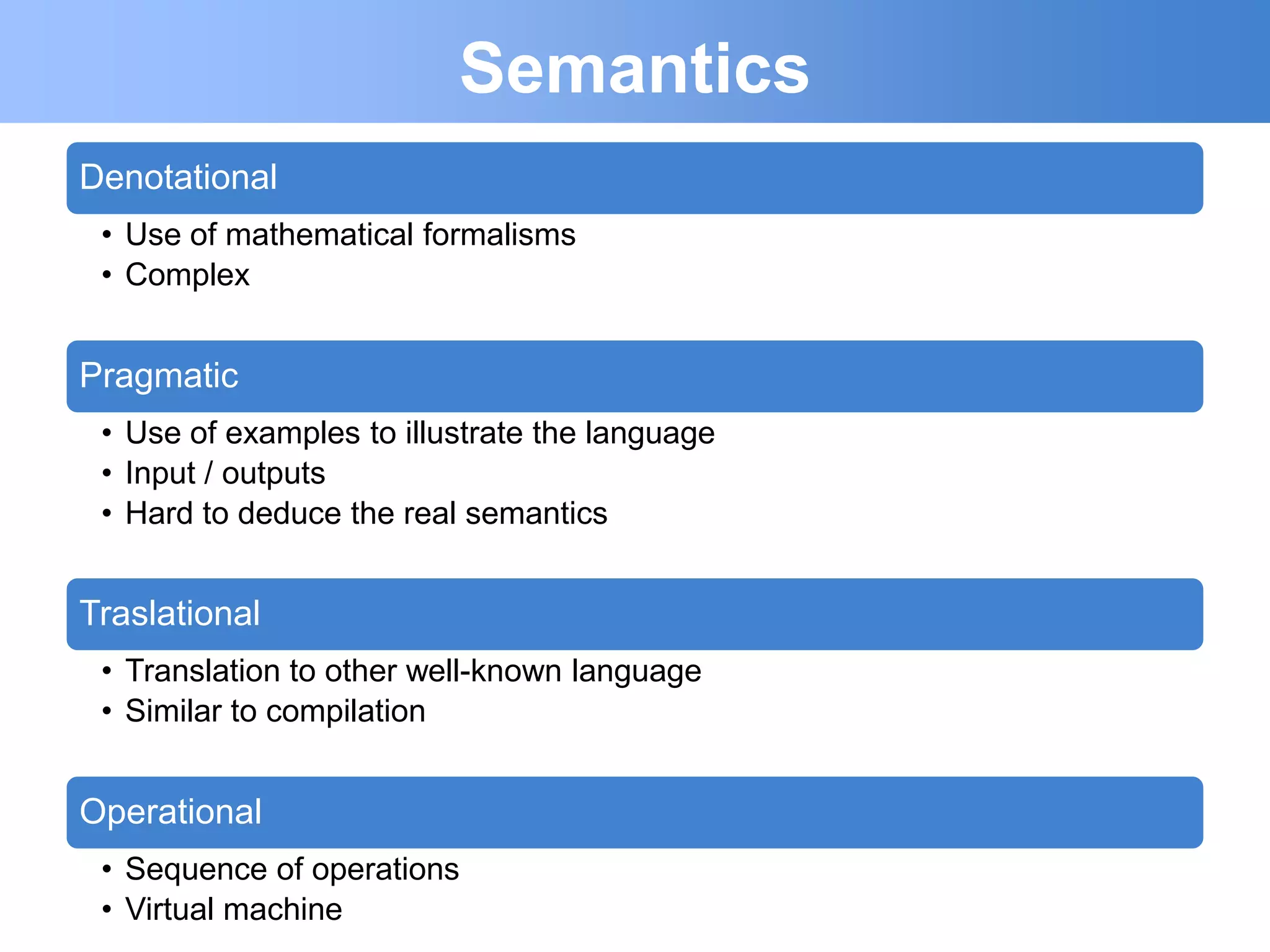
Semantics
Denotational
 • Use of mathematical formalisms
 • Complex


Pragmatic
 • Use of examples to illustrate the language
 • Input / outputs
 • Hard to deduce the real semantics


Traslational
 • Translation to other well-known language
 • Similar to compilation


Operational
 • Sequence of operations
 • Virtual machine
DSL

The big picture

  What is a DSL? Why?

    Anatomy

     Development

    Actors

  Best practices

Worst practices
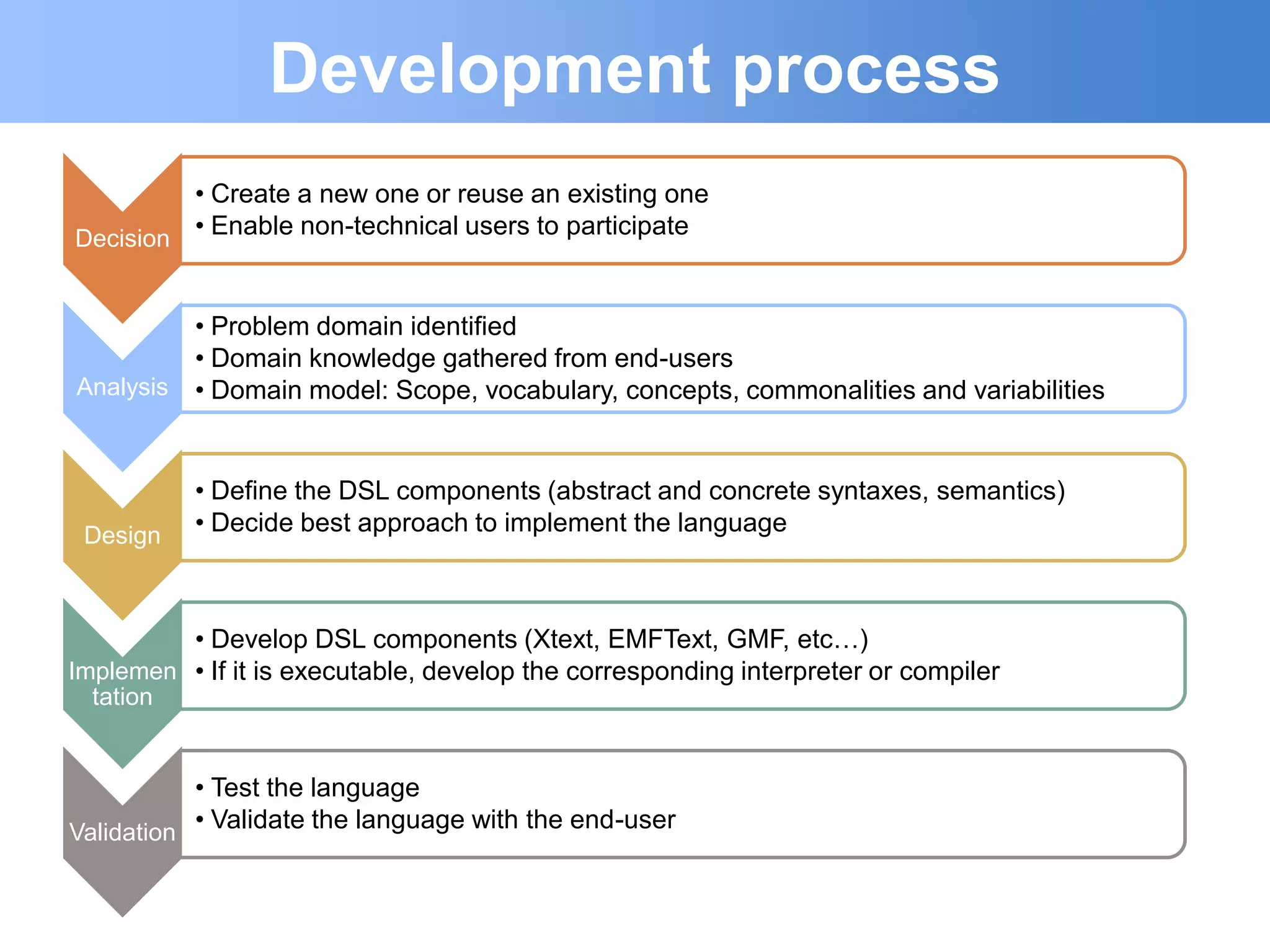
Development process
         • Create a new one or reuse an existing one
Decision • Enable non-technical users to participate


           • Problem domain identified
           • Domain knowledge gathered from end-users
Analysis   • Domain model: Scope, vocabulary, concepts, commonalities and variabilities


           • Define the DSL components (abstract and concrete syntaxes, semantics)
 Design    • Decide best approach to implement the language


         • Develop DSL components (Xtext, EMFText, GMF, etc…)
Implemen • If it is executable, develop the corresponding interpreter or compiler
  tation


           • Test the language
Validation • Validate the language with the end-user
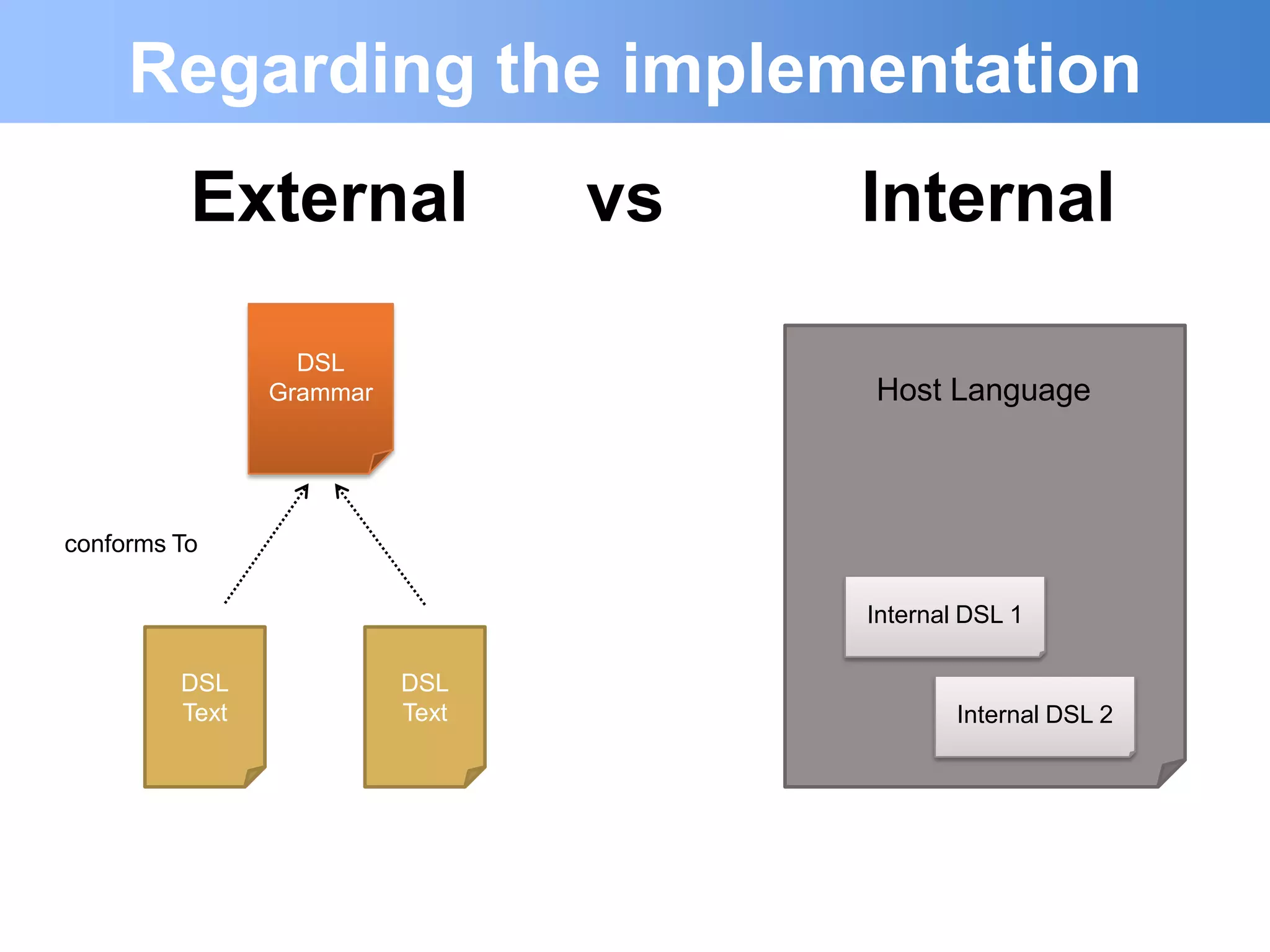
Regarding the implementation
          External               vs   Internal

                  DSL
                Grammar               Host Language


conforms To

                                      Internal DSL 1

         DSL              DSL
         Text             Text                Internal DSL 2
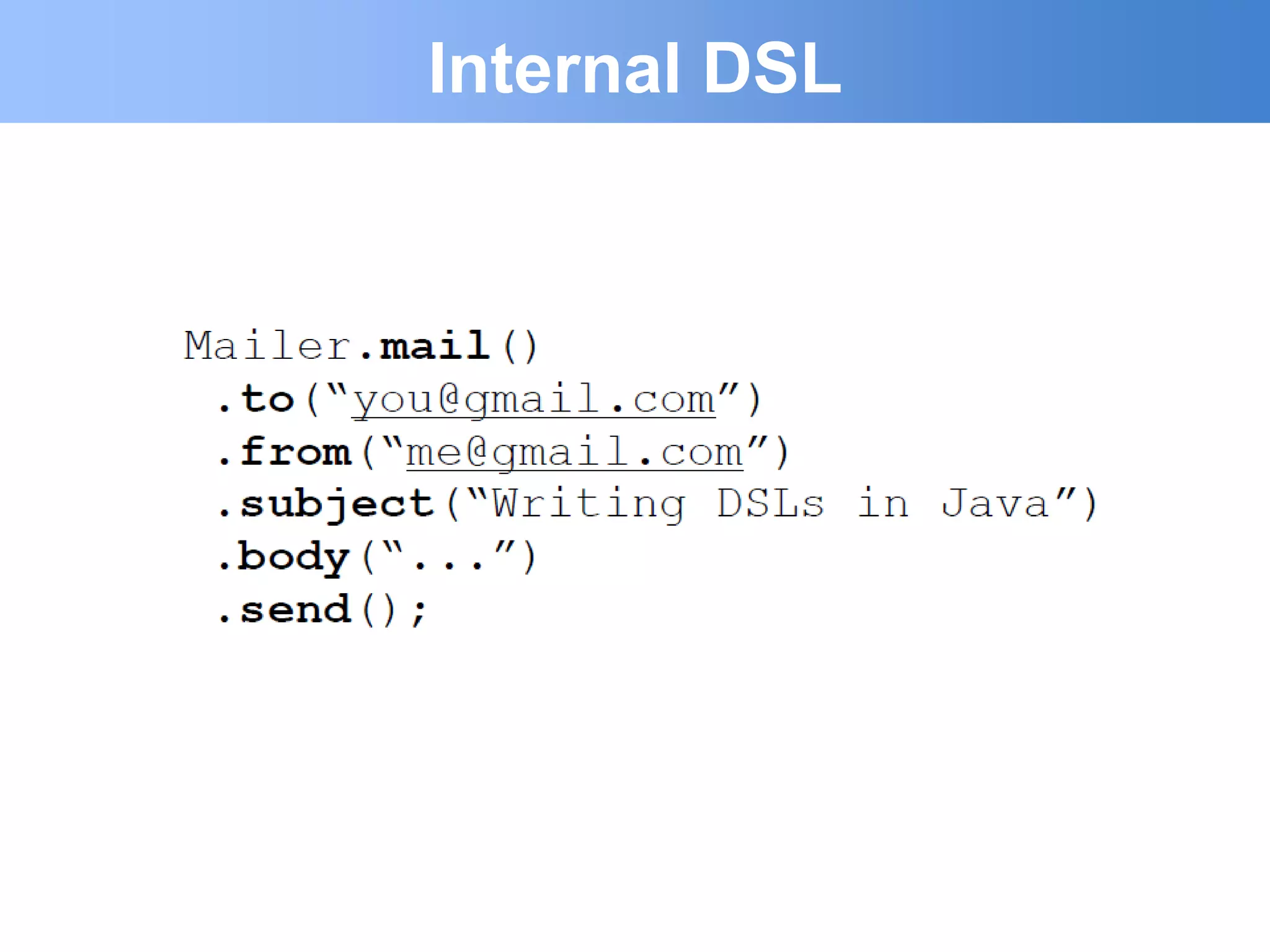
Internal DSL
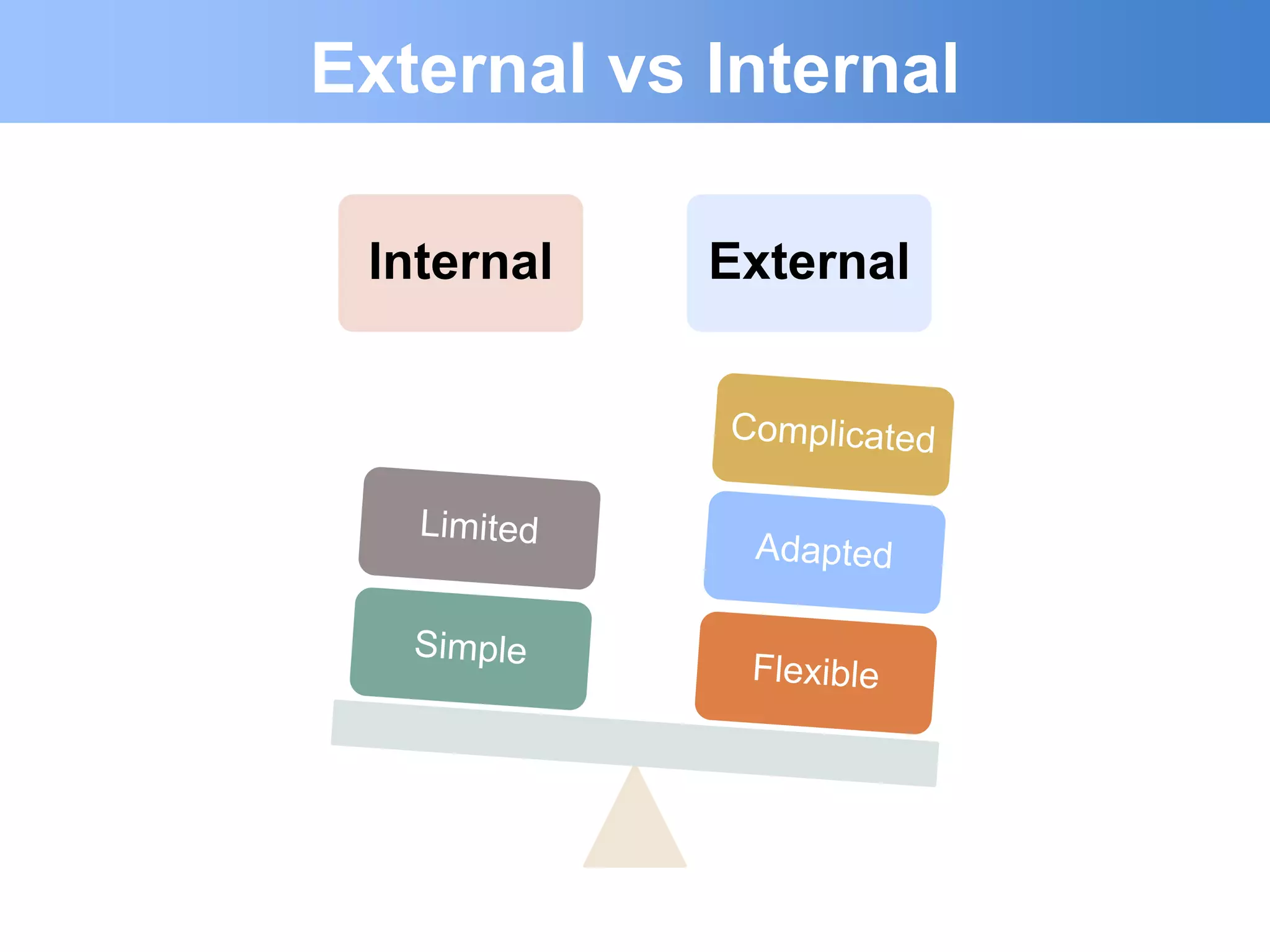
External vs Internal

 Internal   External
DSL

The big picture

  What is a DSL? Why?

    Anatomy

     Development

    Actors

  Best practices

Worst practices
Actors
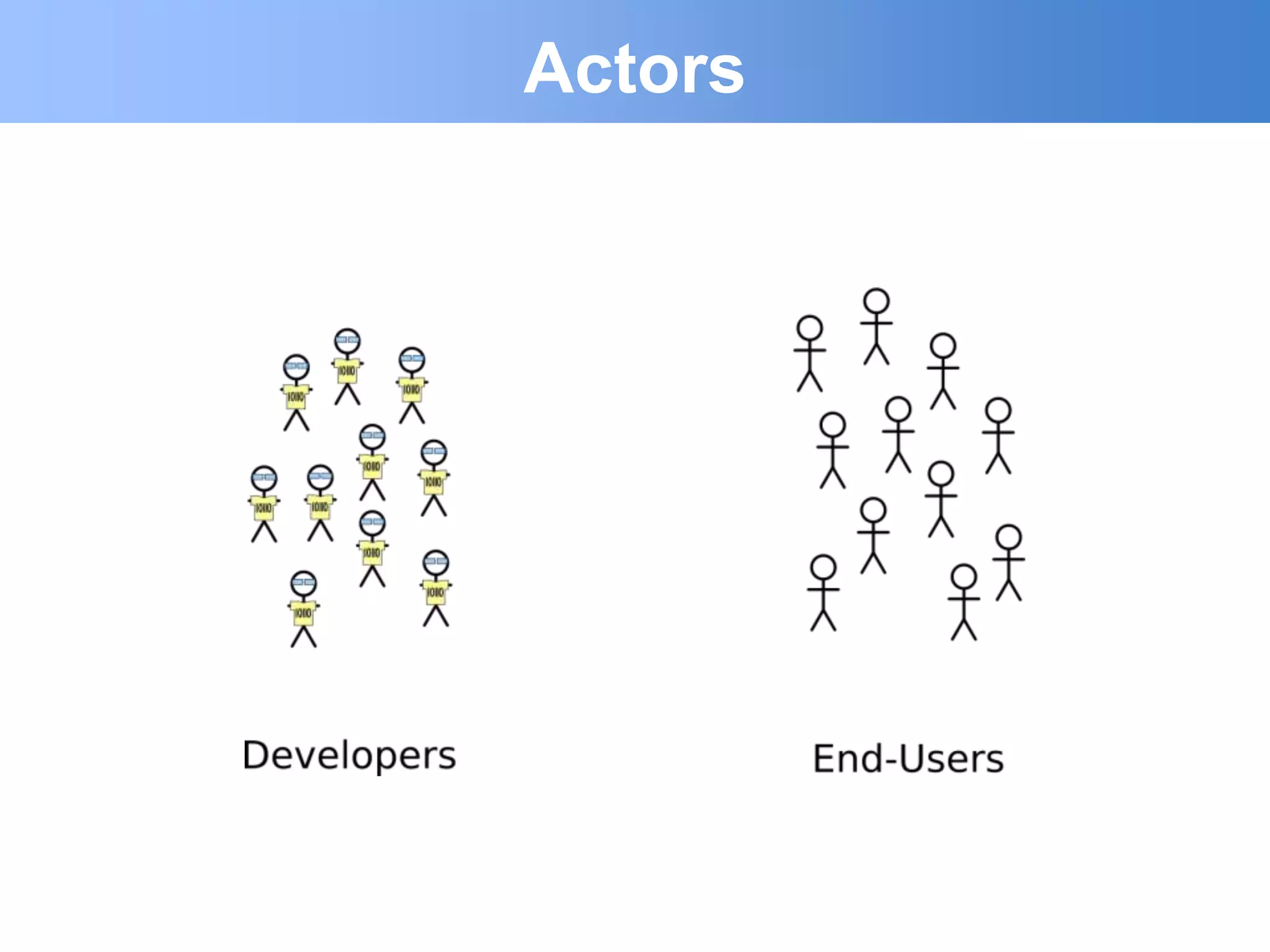
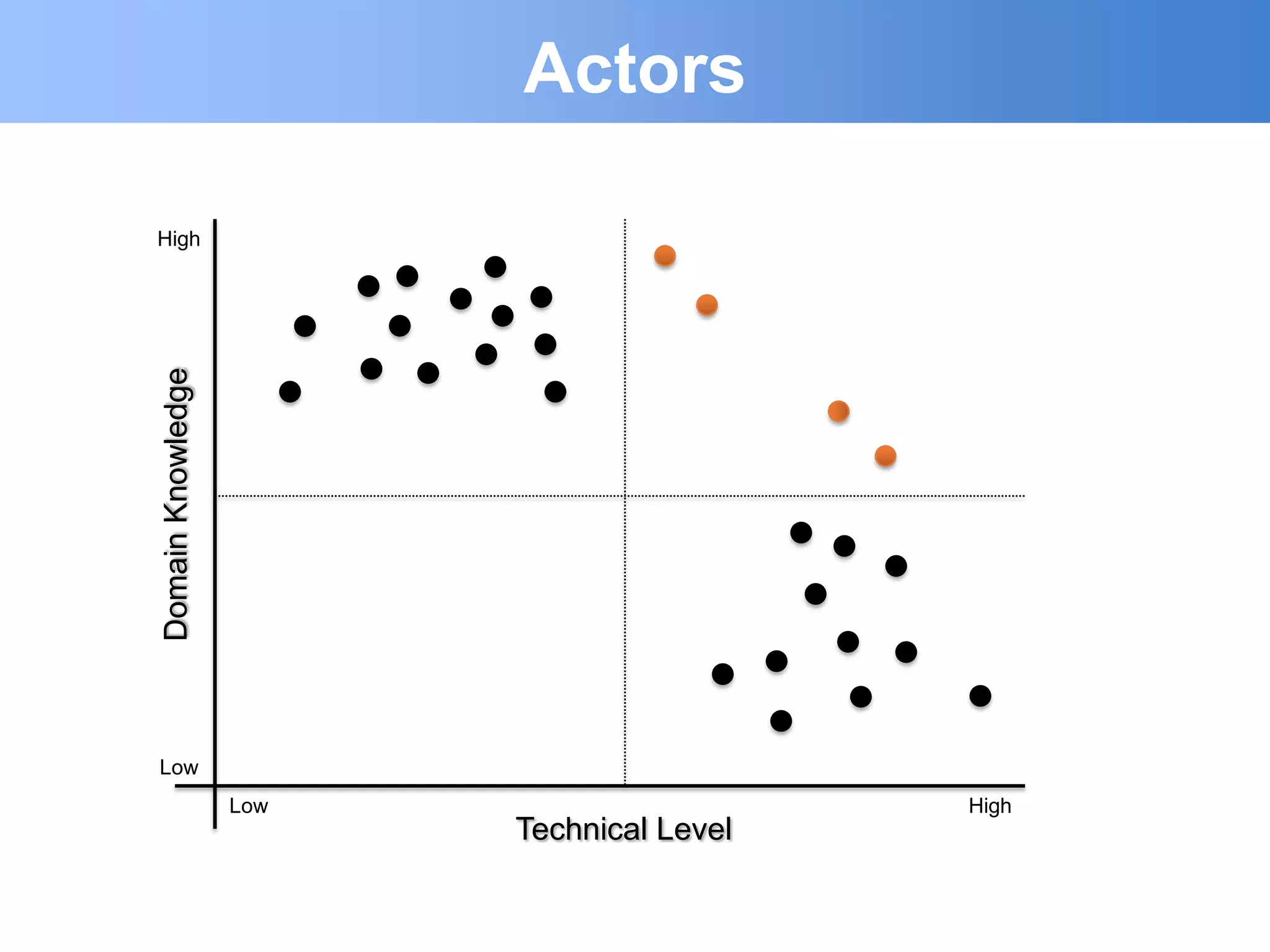
Actors

High
Domain Knowledge


Low
                   Low                     High
                         Technical Level
DSL

The big picture

  What is a DSL? Why?

    Anatomy

     Development

    Actors

  Best practices

Worst practices
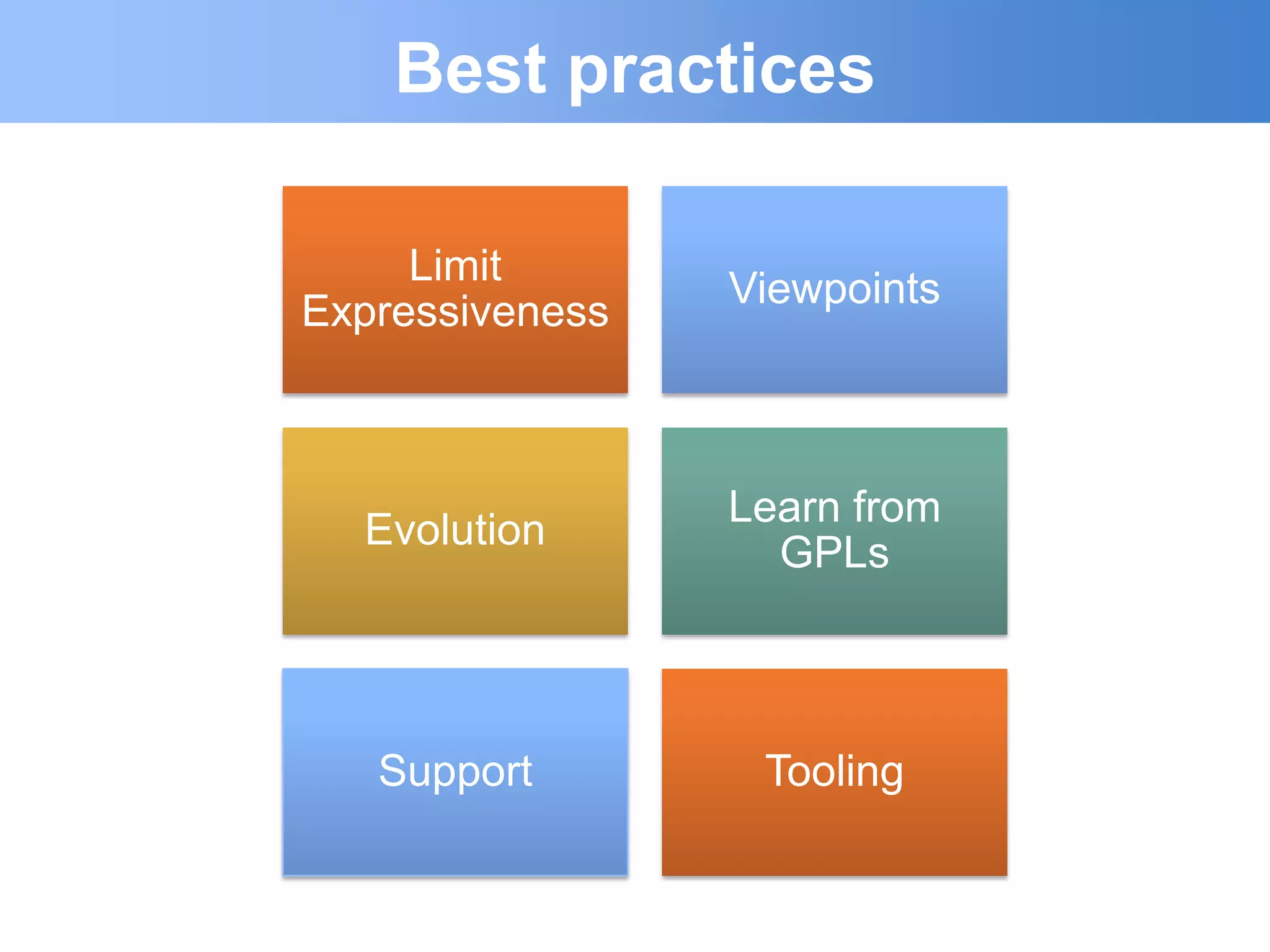
Best practices

     Limit
                 Viewpoints
Expressiveness


                 Learn from
  Evolution
                   GPLs


   Support        Tooling
DSL

The big picture

  What is a DSL? Why?

    Anatomy

     Development

    Actors

  Best practices

Worst practices
Worst practices
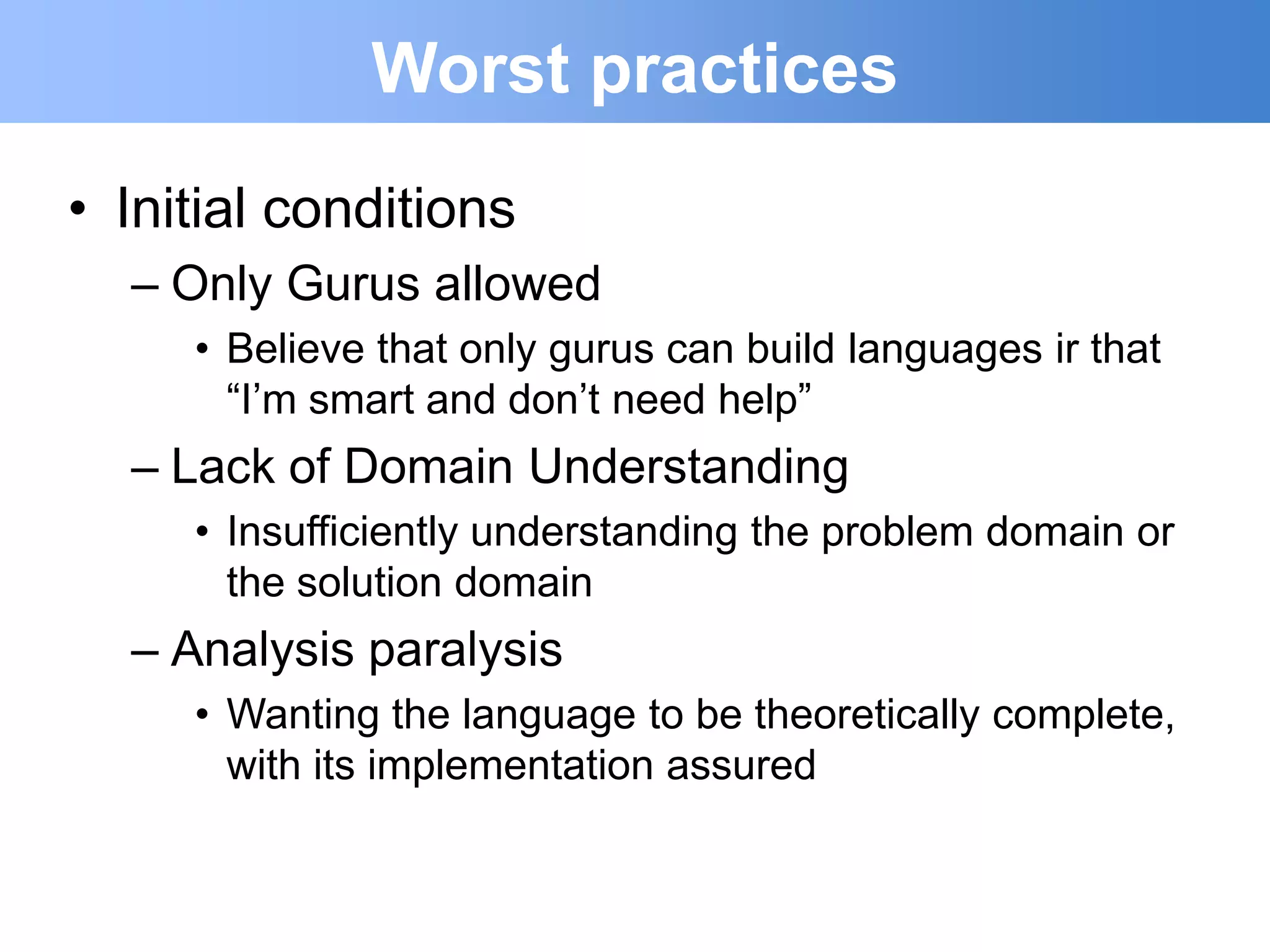
• Initial conditions
  – Only Gurus allowed
     • Believe that only gurus can build languages ir that
       “I‟m smart and don‟t need help”
  – Lack of Domain Understanding
     • Insufficiently understanding the problem domain or
       the solution domain
  – Analysis paralysis
     • Wanting the language to be theoretically complete,
       with its implementation assured
Worst practices
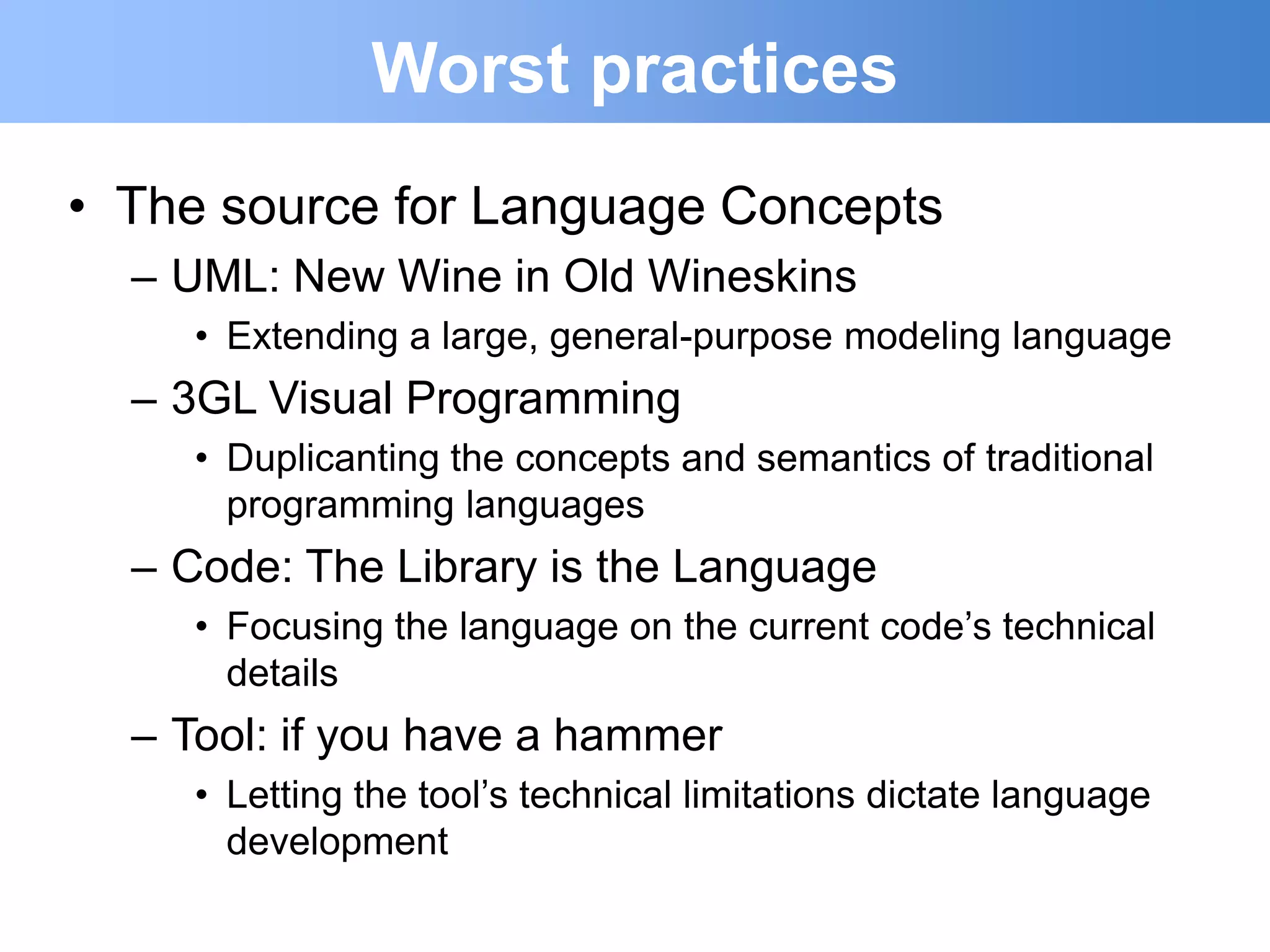
• The source for Language Concepts
  – UML: New Wine in Old Wineskins
     • Extending a large, general-purpose modeling language
  – 3GL Visual Programming
     • Duplicanting the concepts and semantics of traditional
       programming languages
  – Code: The Library is the Language
     • Focusing the language on the current code‟s technical
       details
  – Tool: if you have a hammer
     • Letting the tool‟s technical limitations dictate language
       development
Worst practices
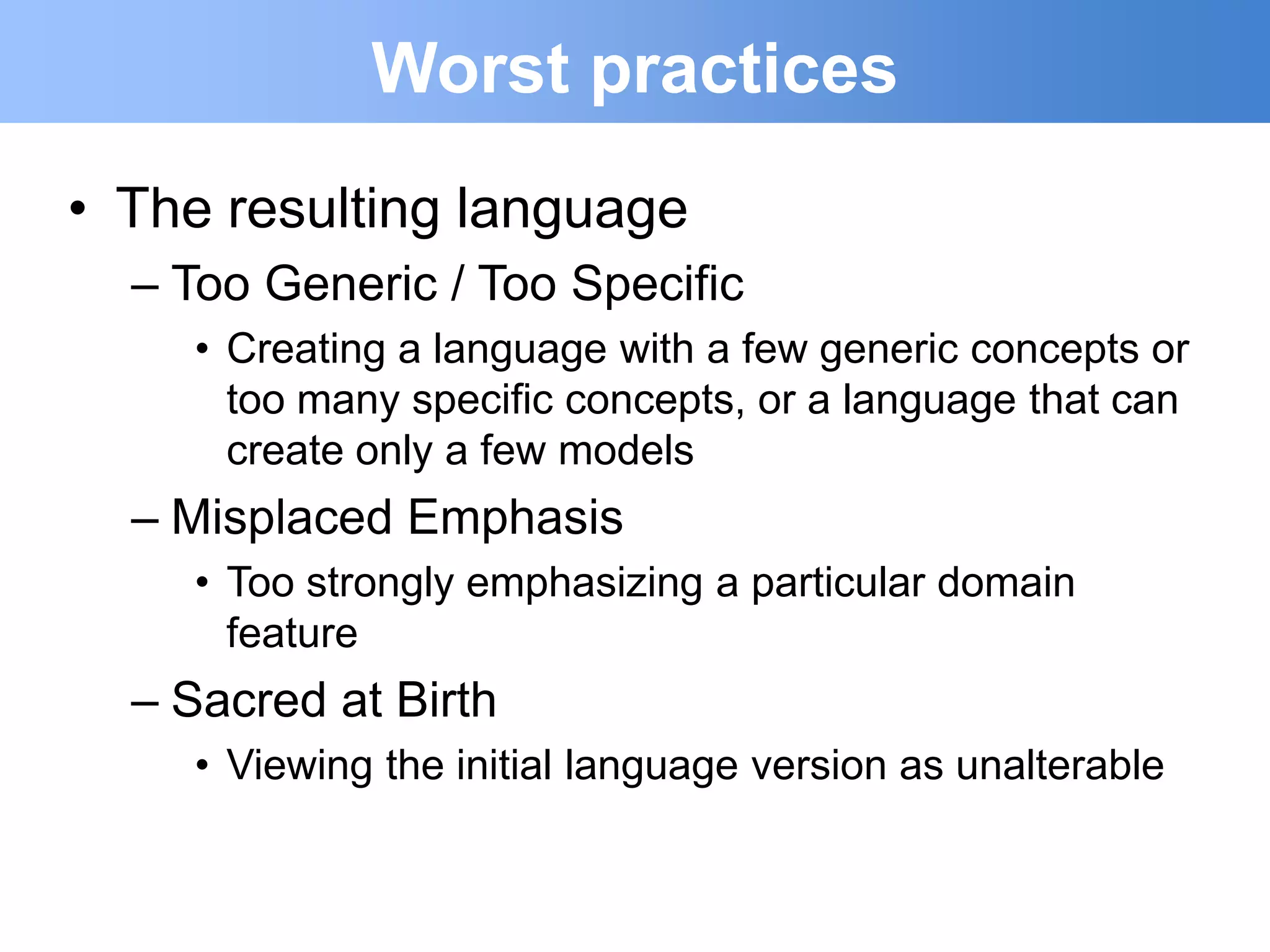
• The resulting language
  – Too Generic / Too Specific
    • Creating a language with a few generic concepts or
      too many specific concepts, or a language that can
      create only a few models
  – Misplaced Emphasis
    • Too strongly emphasizing a particular domain
      feature
  – Sacred at Birth
    • Viewing the initial language version as unalterable
Worst practices
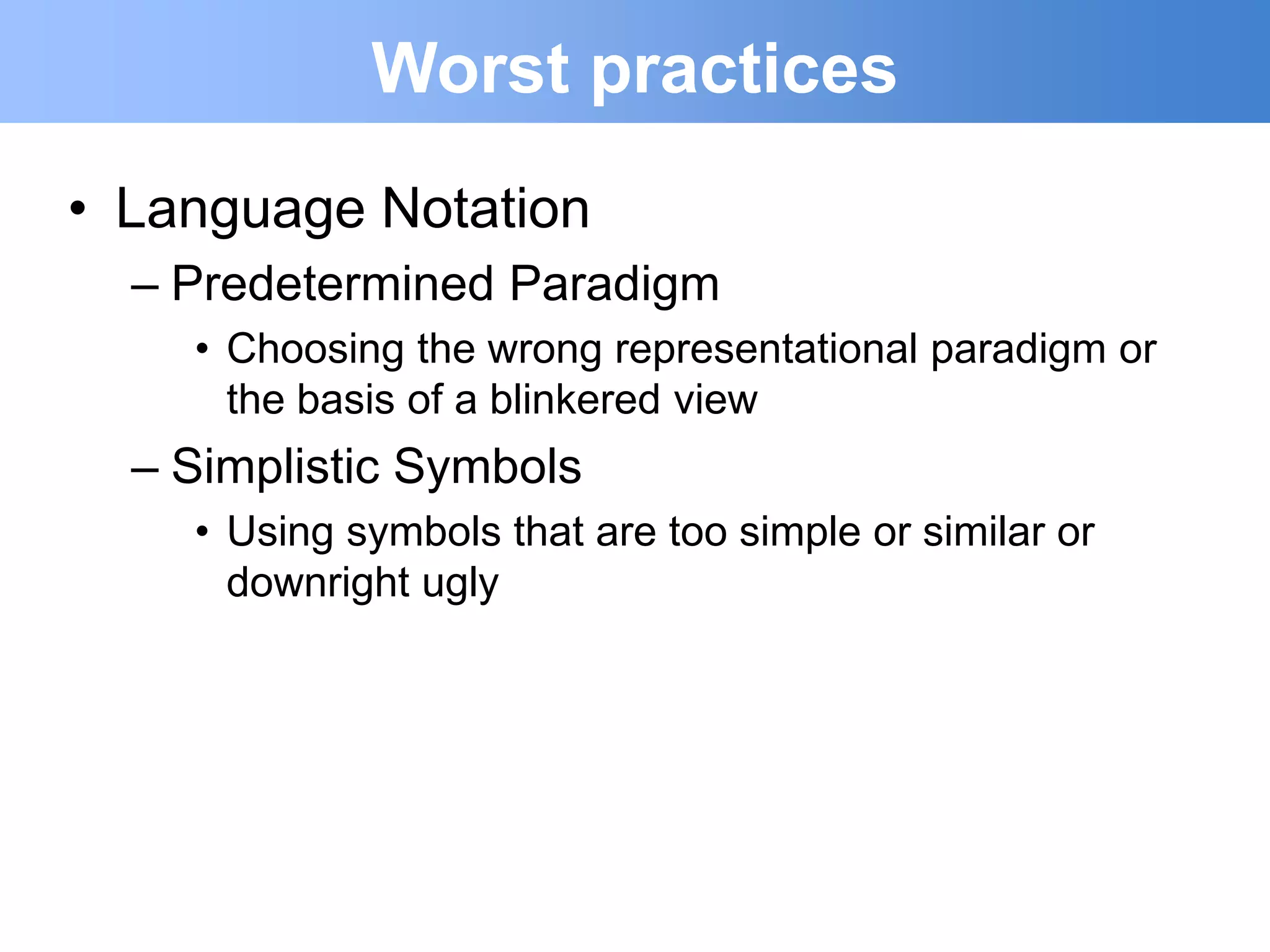
• Language Notation
  – Predetermined Paradigm
    • Choosing the wrong representational paradigm or
      the basis of a blinkered view
  – Simplistic Symbols
    • Using symbols that are too simple or similar or
      downright ugly
Worst practices
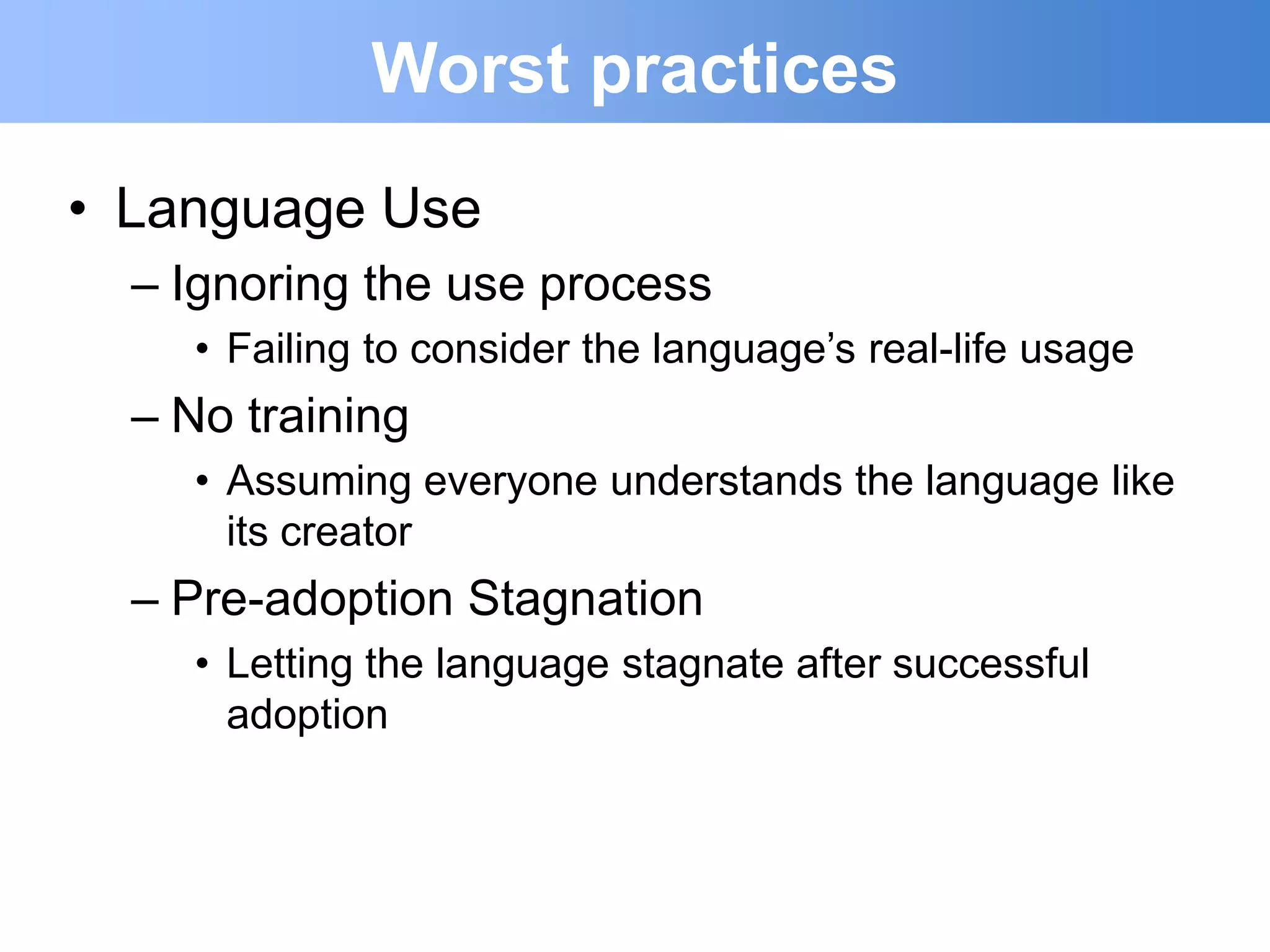
• Language Use
  – Ignoring the use process
    • Failing to consider the language‟s real-life usage
  – No training
    • Assuming everyone understands the language like
      its creator
  – Pre-adoption Stagnation
    • Letting the language stagnate after successful
      adoption
Outline


Languages

 Domain-Specific Languages

 Xtext

GMF
Xtext
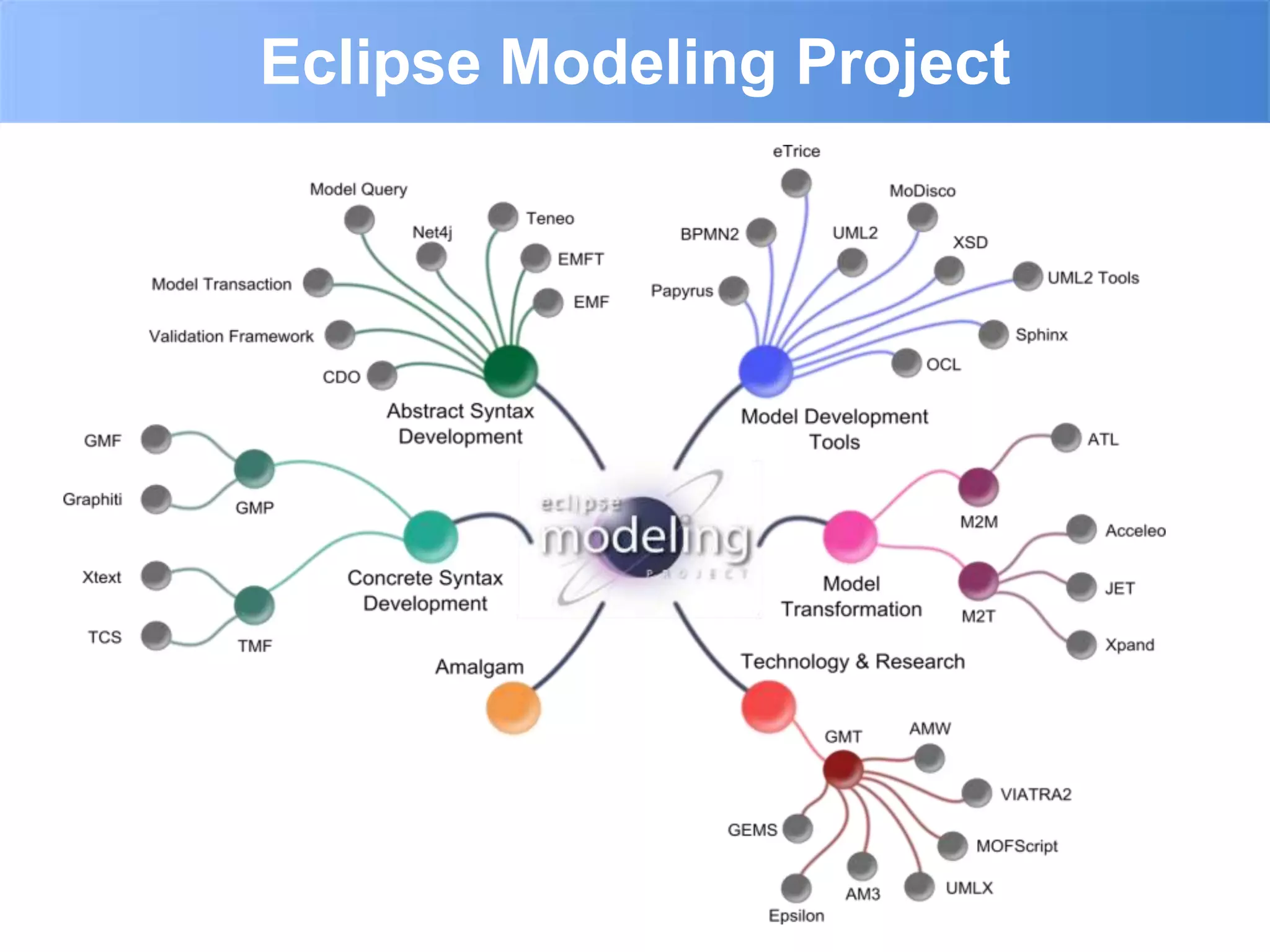
• Eclipse Project
  – Part of Eclipse Modeling
  – Part of Open Architecture Ware
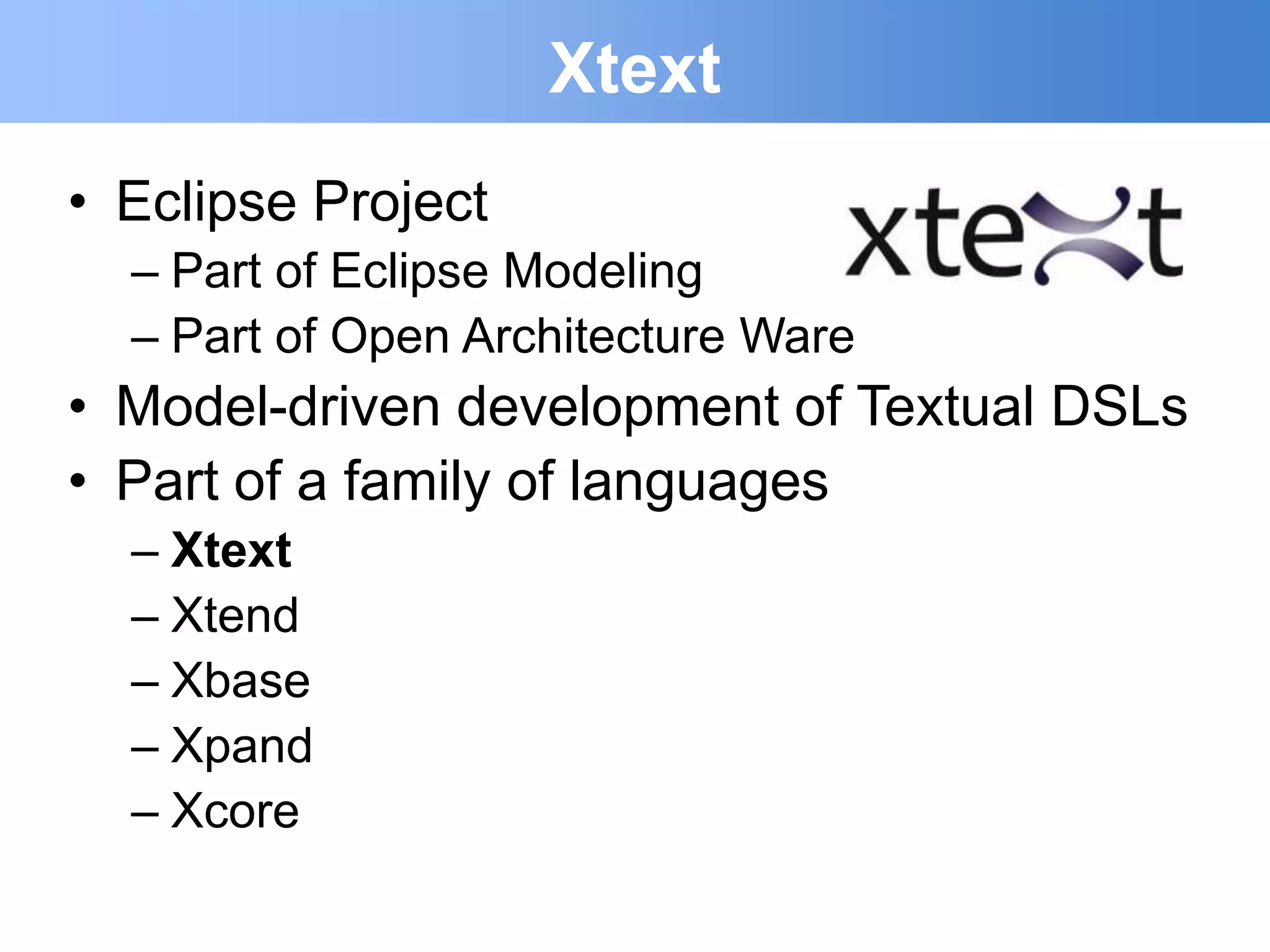
• Model-driven development of Textual DSLs
• Part of a family of languages
  – Xtext
  – Xtend
  – Xbase
  – Xpand
  – Xcore
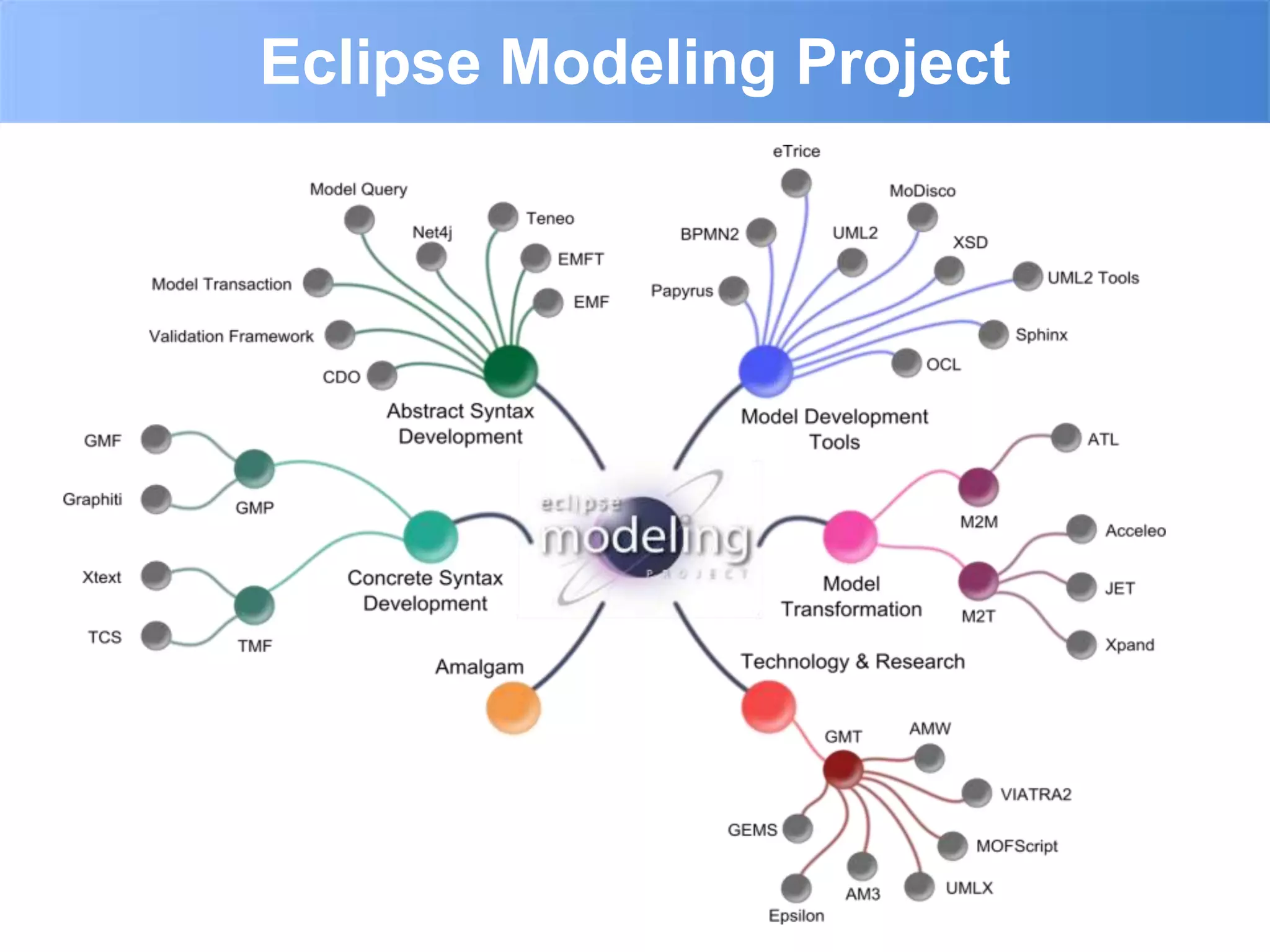
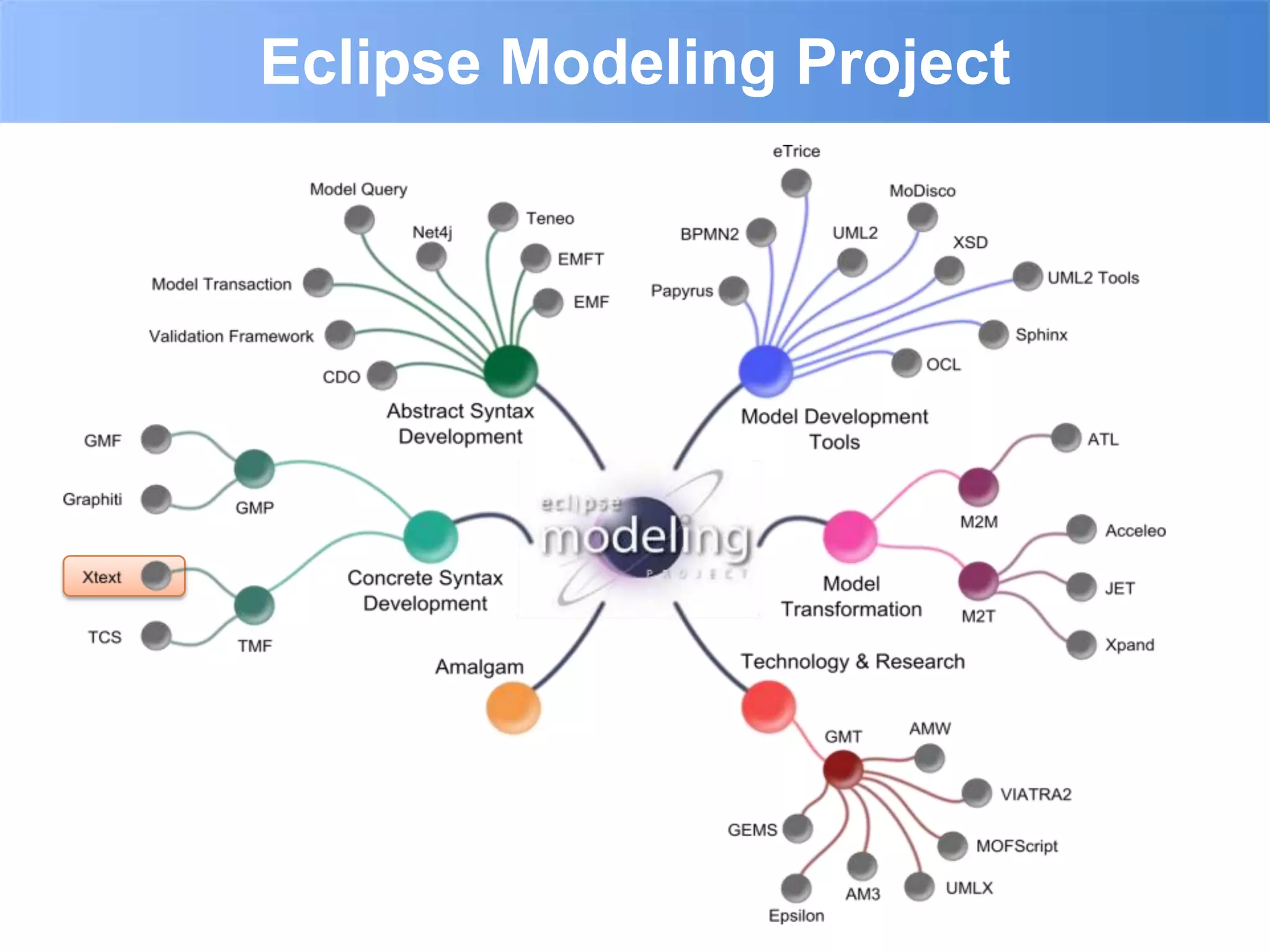
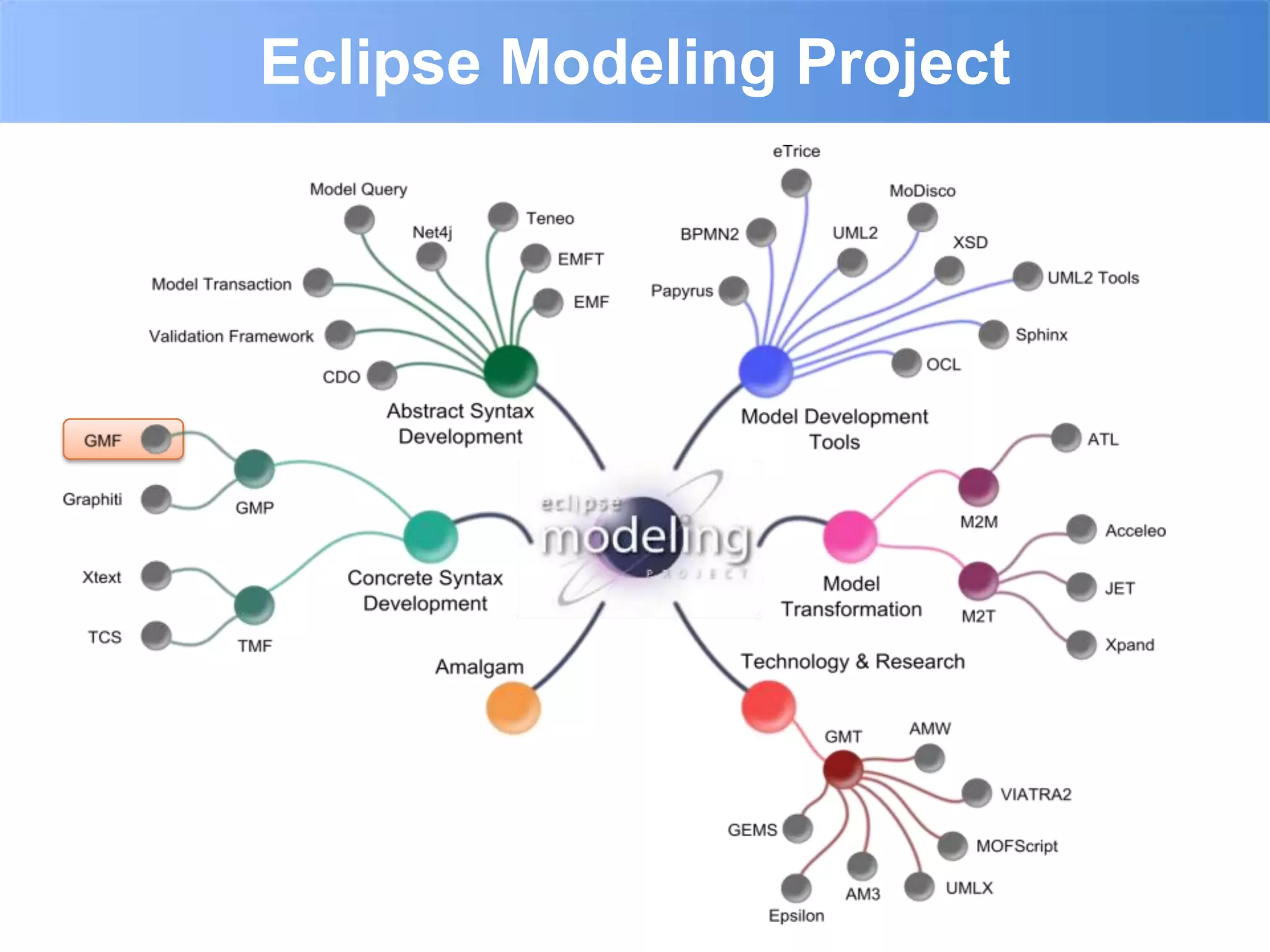
Eclipse Modeling Project
The grammar language
• Corner-stone of Xtext
• DSL to define textual languages
  – Describe the concrete syntax
  – Specify the mapping between concrete syntax
    and domain model
• From the grammar, it is generated:
  – The domain model
  – The parser
  – The tooling
Main advantages
•   Consistent look and feel
•   Textual DSLs are a resource in Eclipse
•   Open editors can be extended
•   Complete framework to develop DSLs
•   Easy to connect to any Java-based language
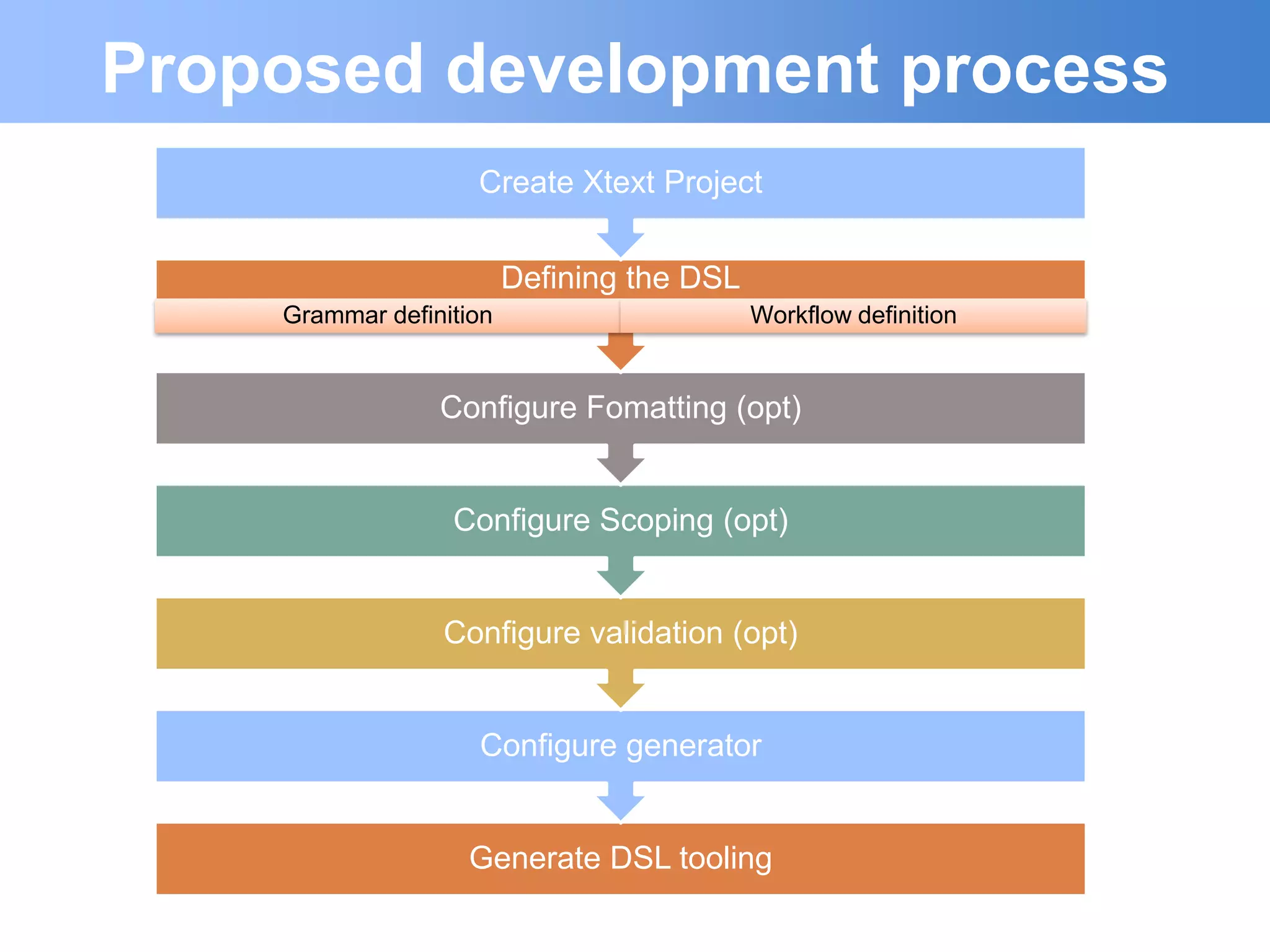
Proposed development process
                    Create Xtext Project


                         Defining the DSL
    Grammar definition                      Workflow definition


                 Configure Fomatting (opt)


                  Configure Scoping (opt)


                 Configure validation (opt)


                    Configure generator


                   Generate DSL tooling
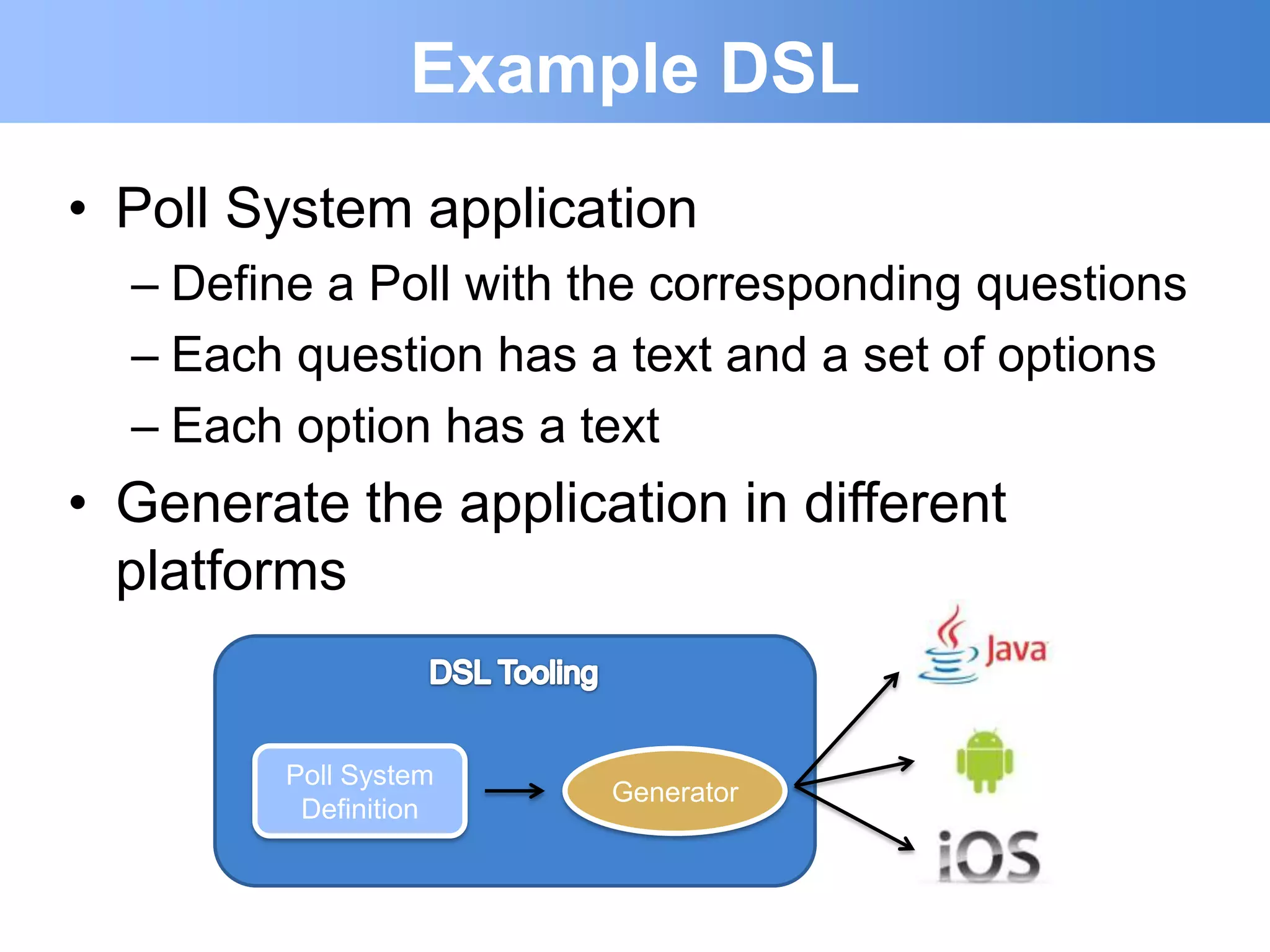
Example DSL
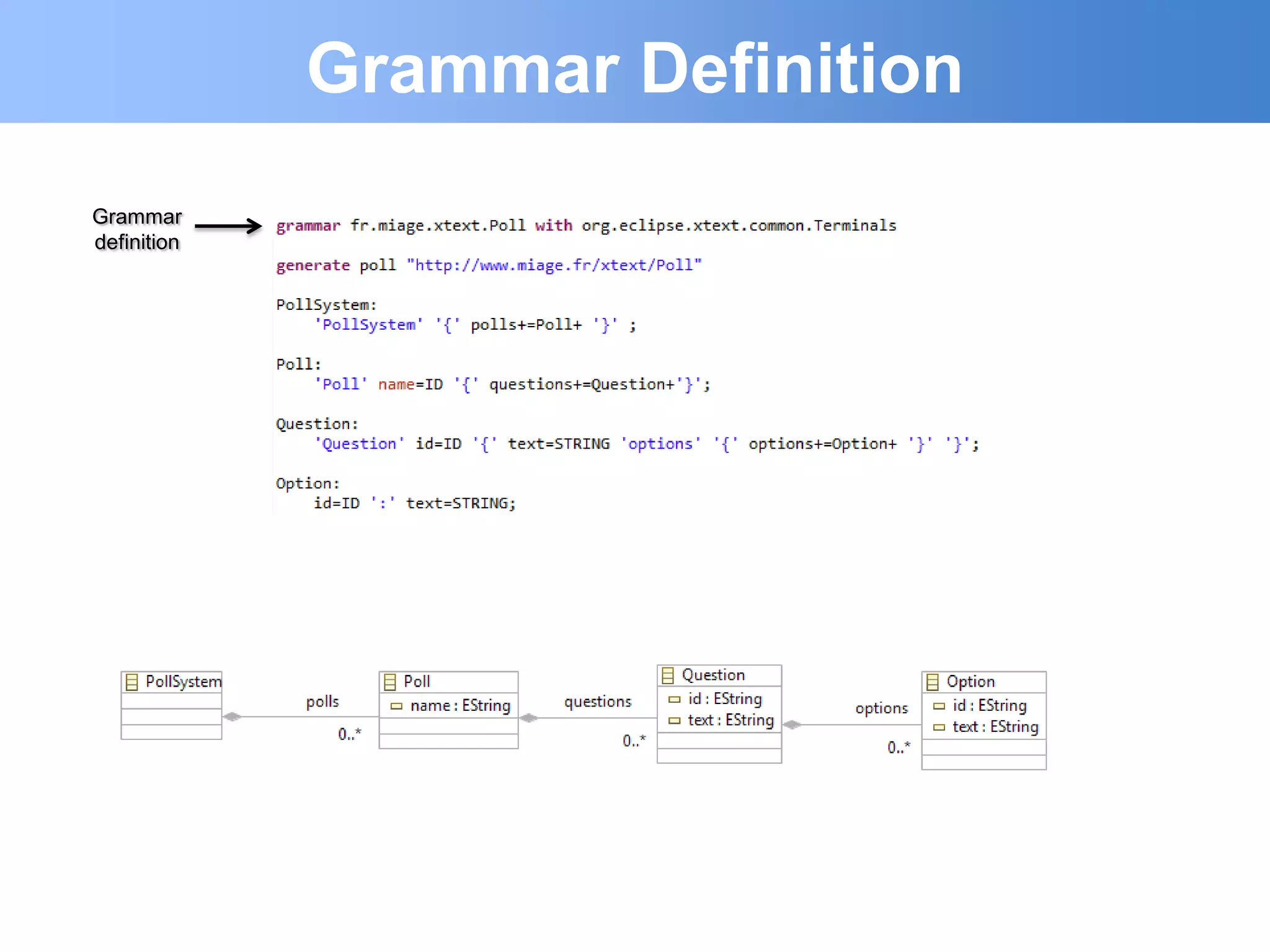
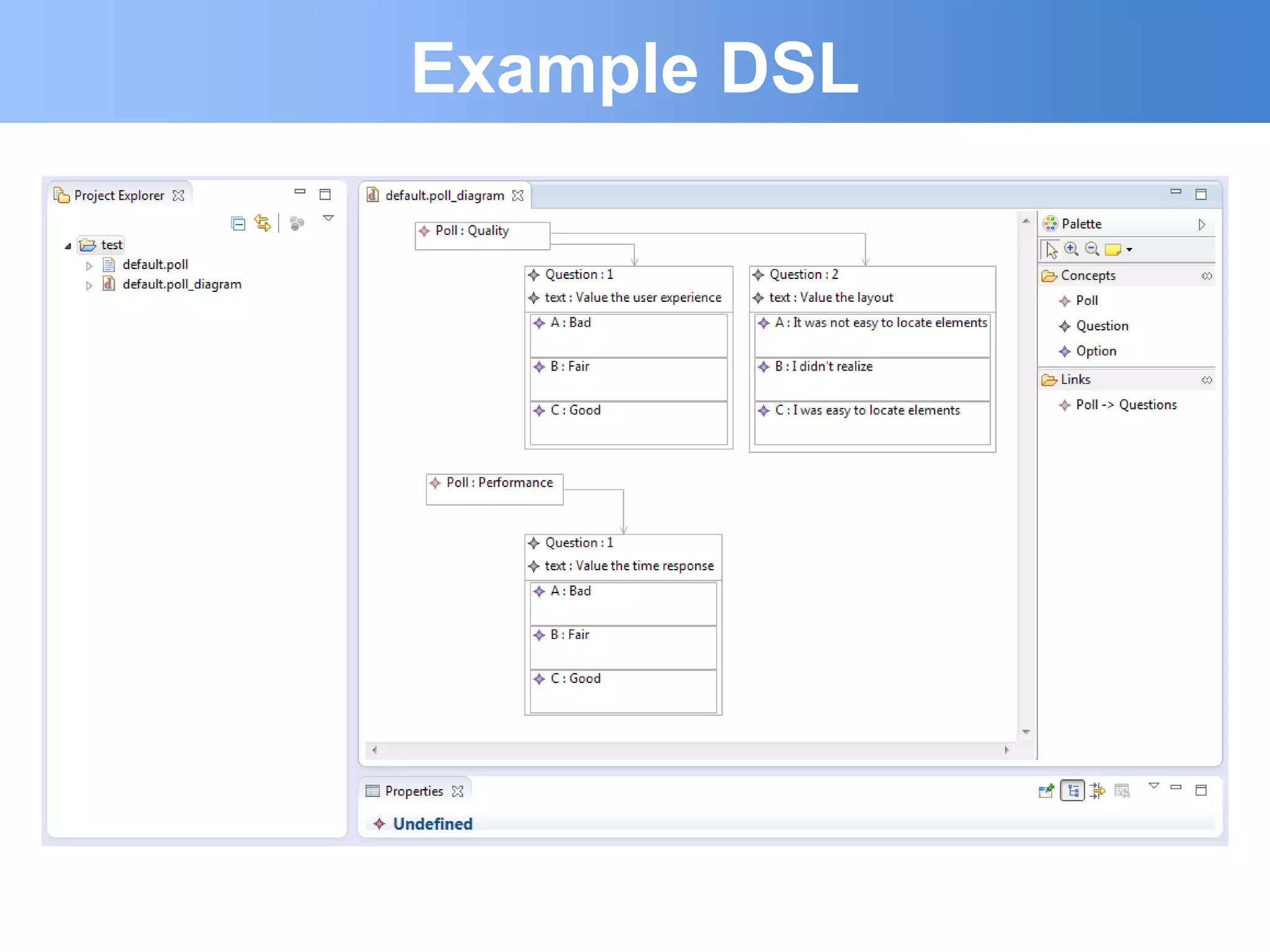
• Poll System application
  – Define a Poll with the corresponding questions
  – Each question has a text and a set of options
  – Each option has a text
• Generate the application in different
  platforms


         Poll System
                       Generator
          Definition
Example DSL


        Generator
Grammar Definition
Grammar
definition
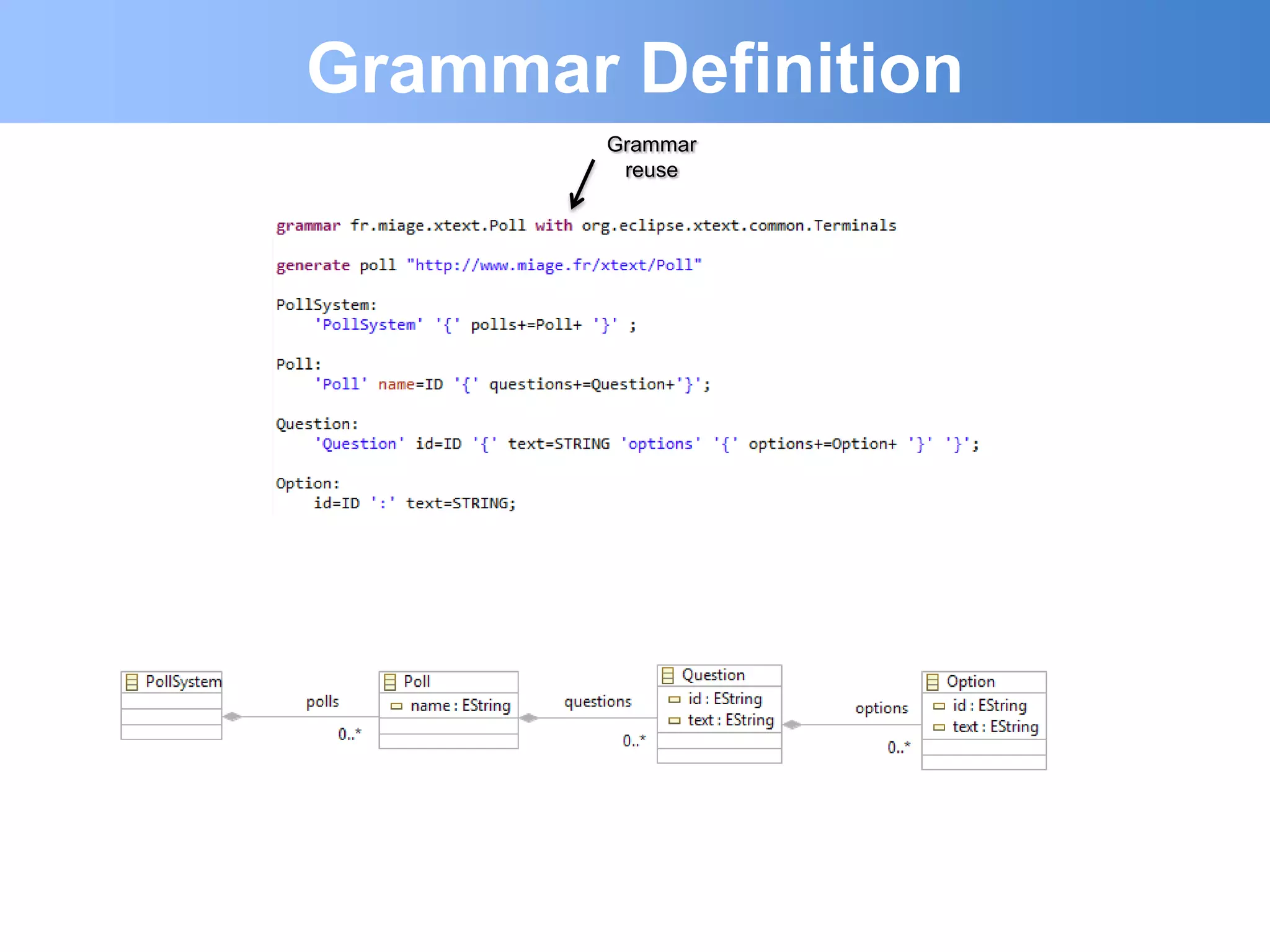
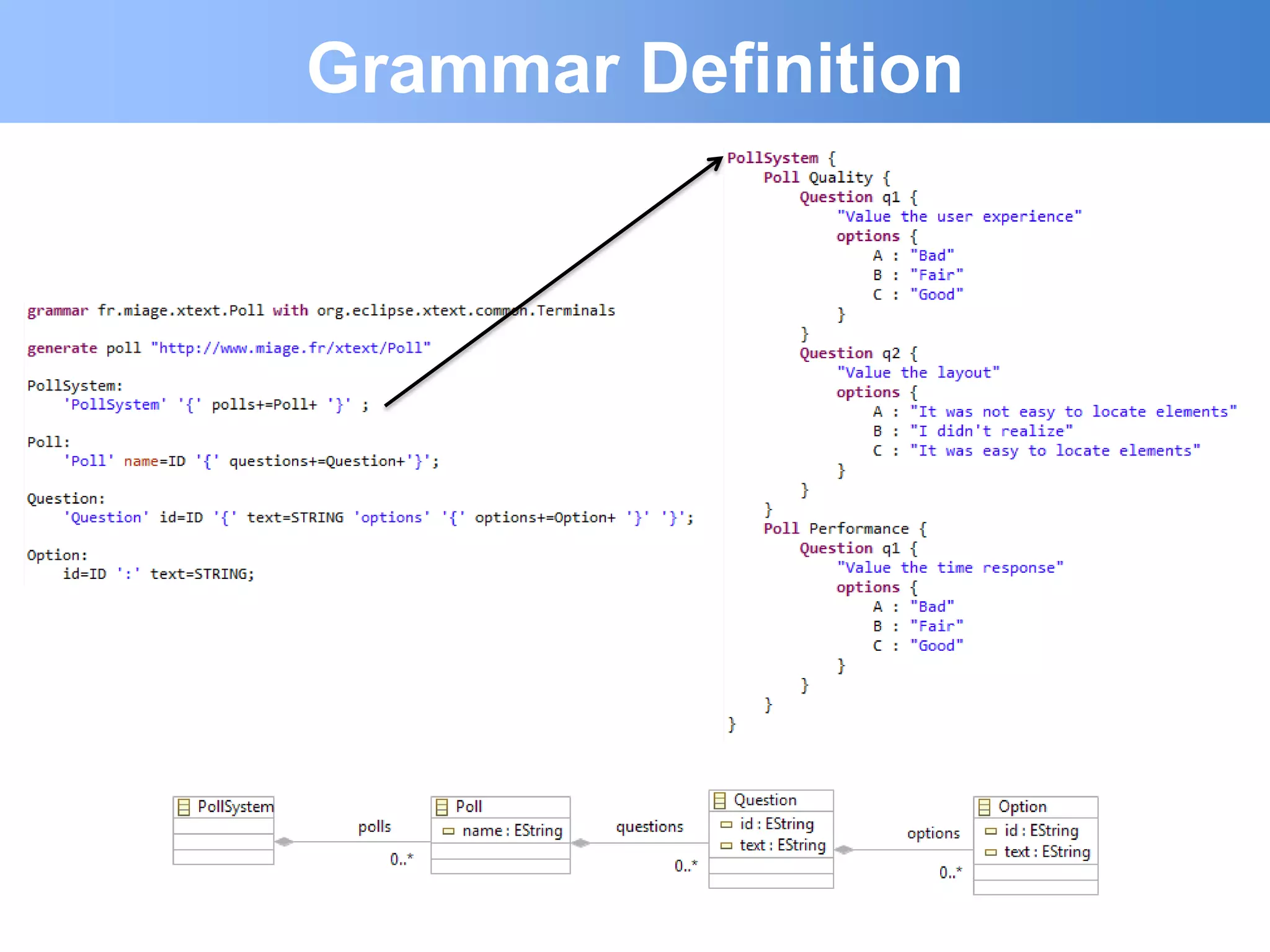
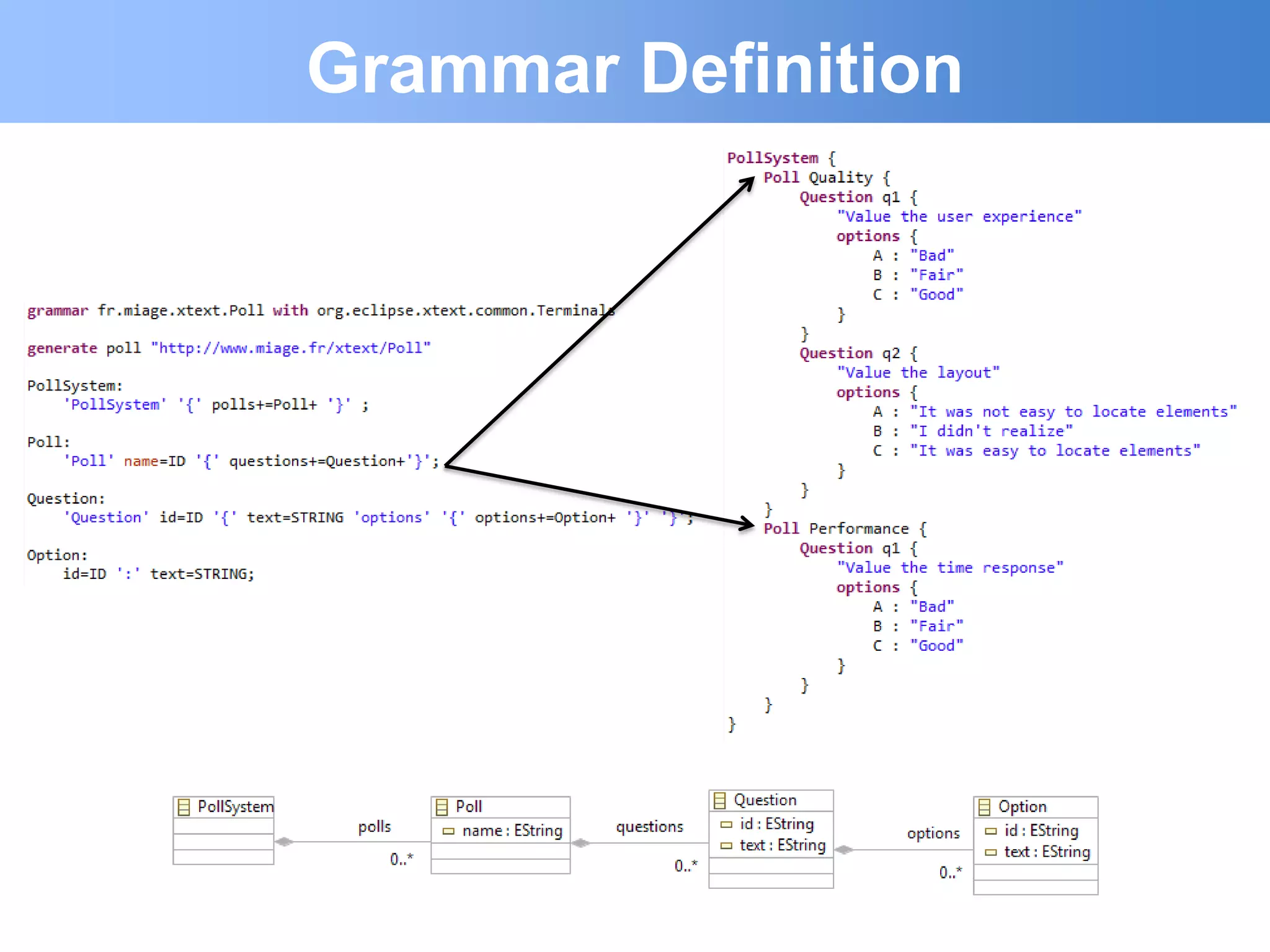
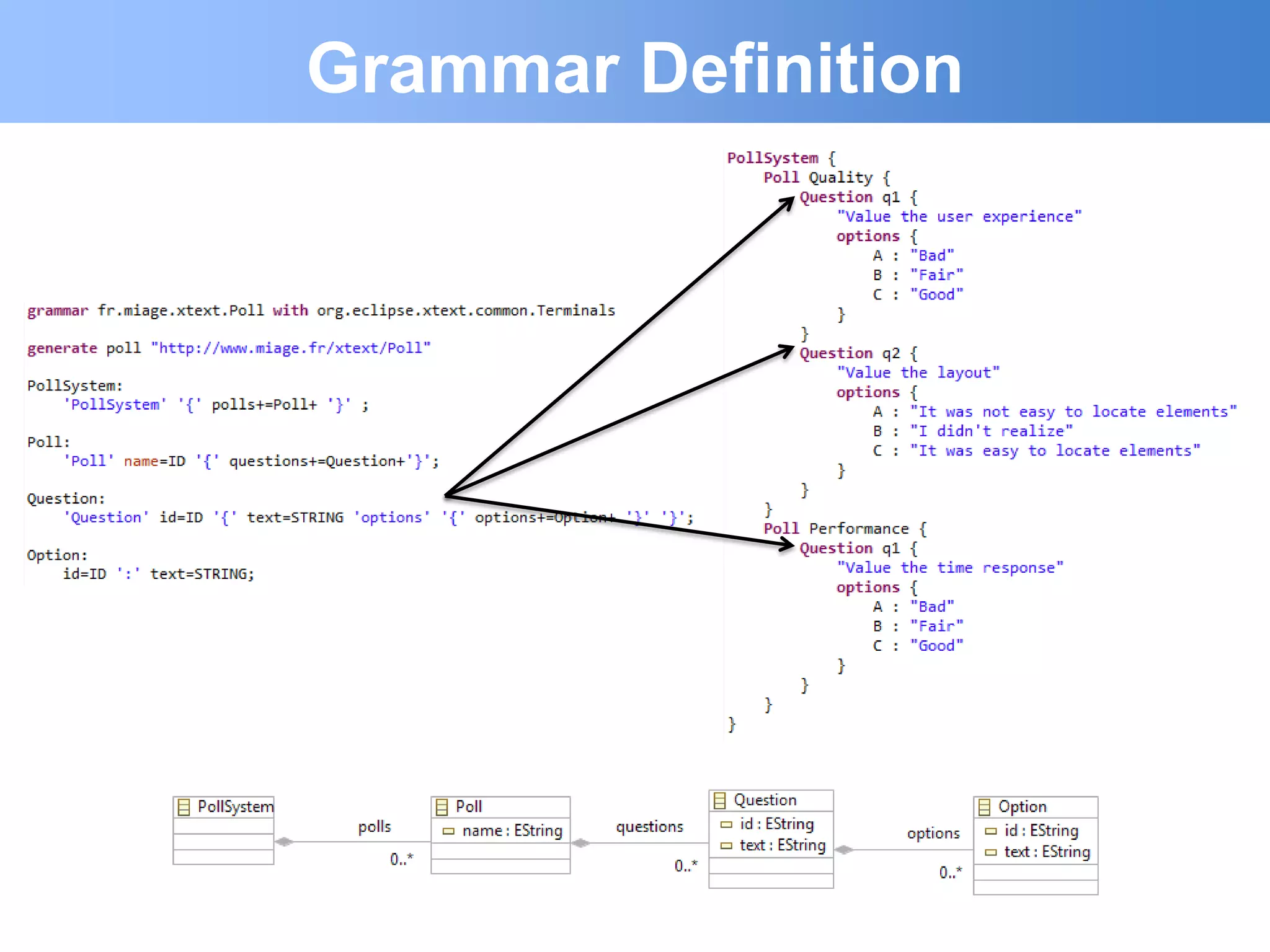
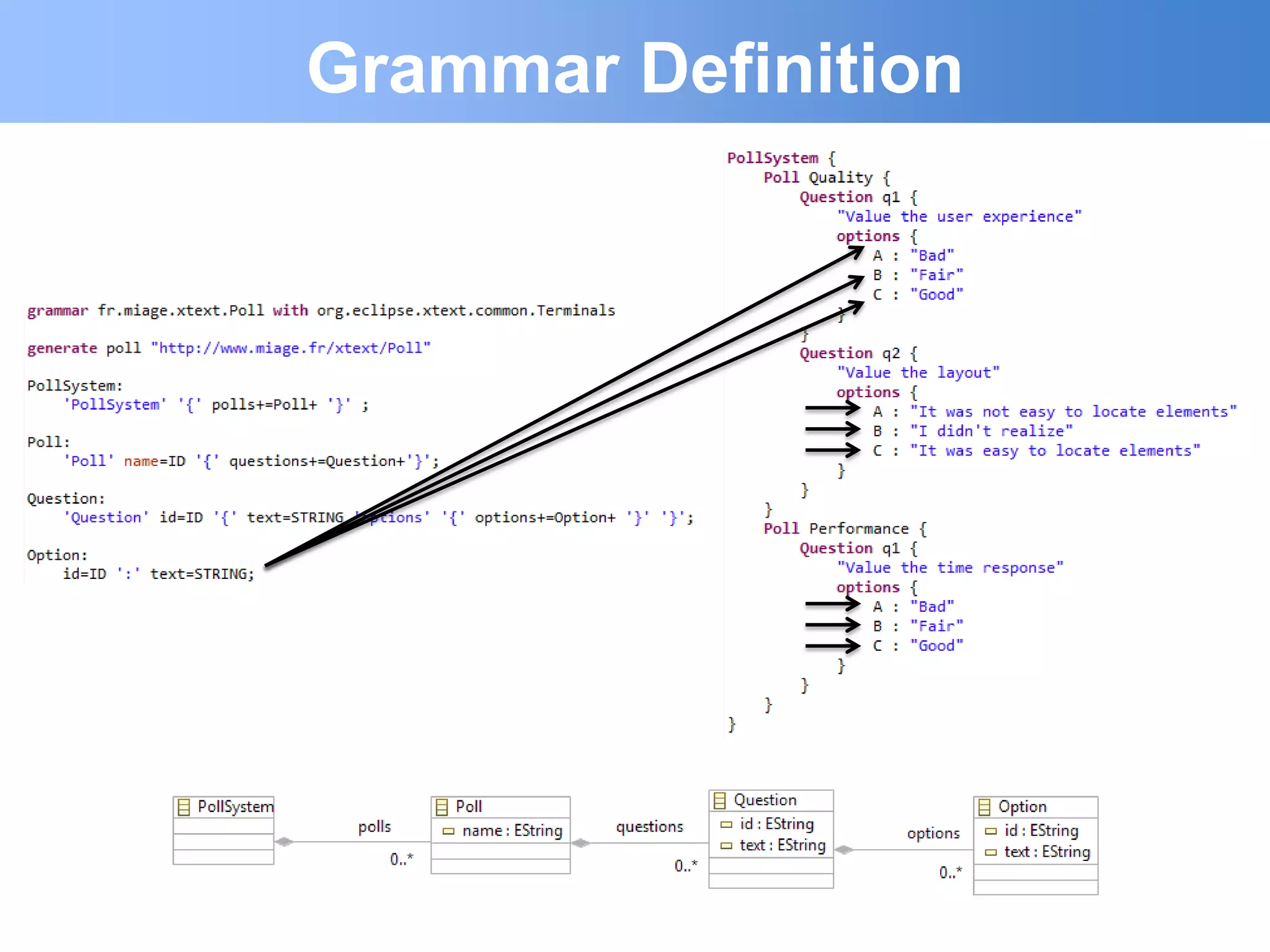
Grammar Definition
        Grammar
         reuse
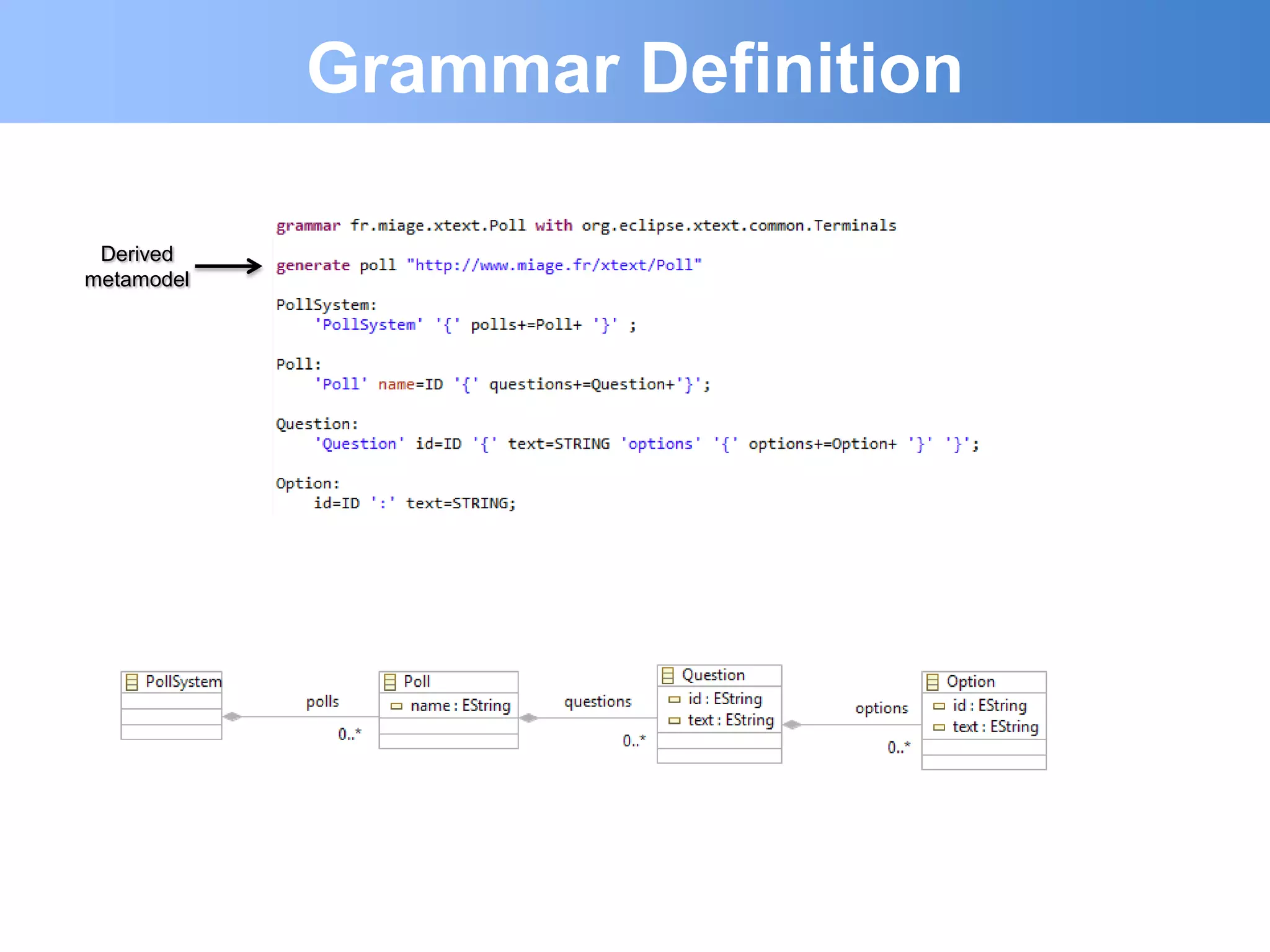
Grammar Definition

 Derived
metamodel
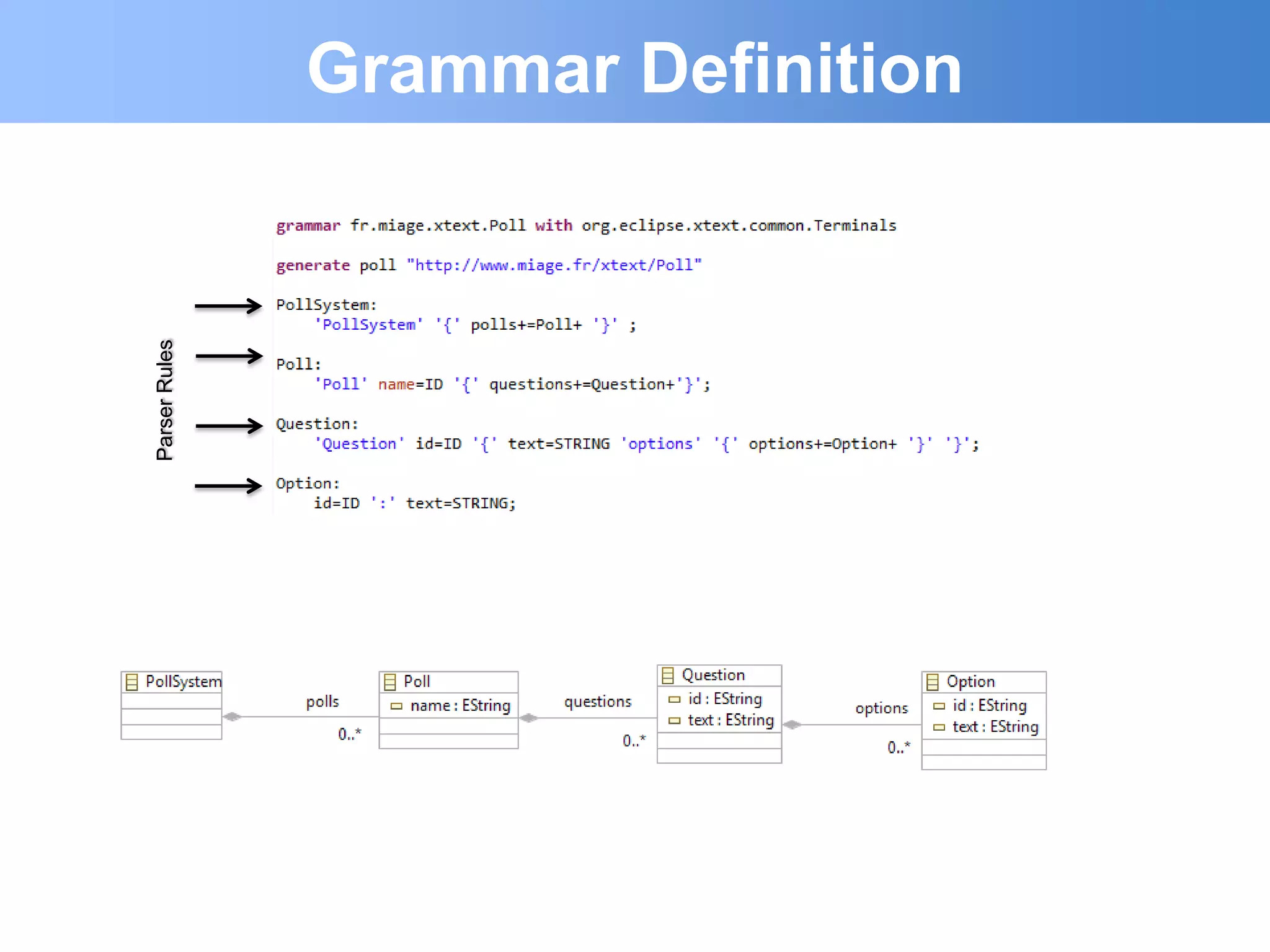
Grammar Definition
Parser Rules
Grammar Definition
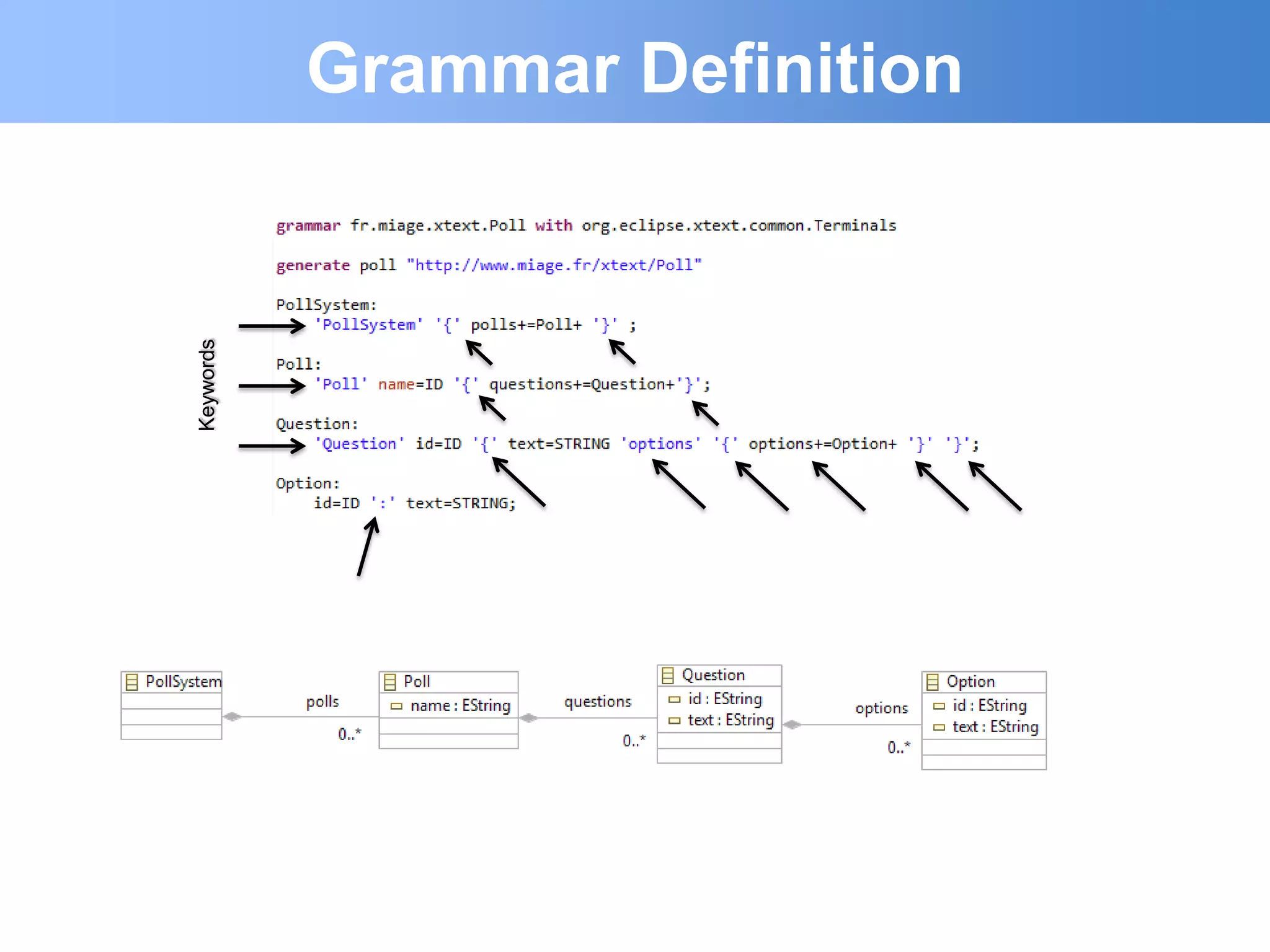
Keywords
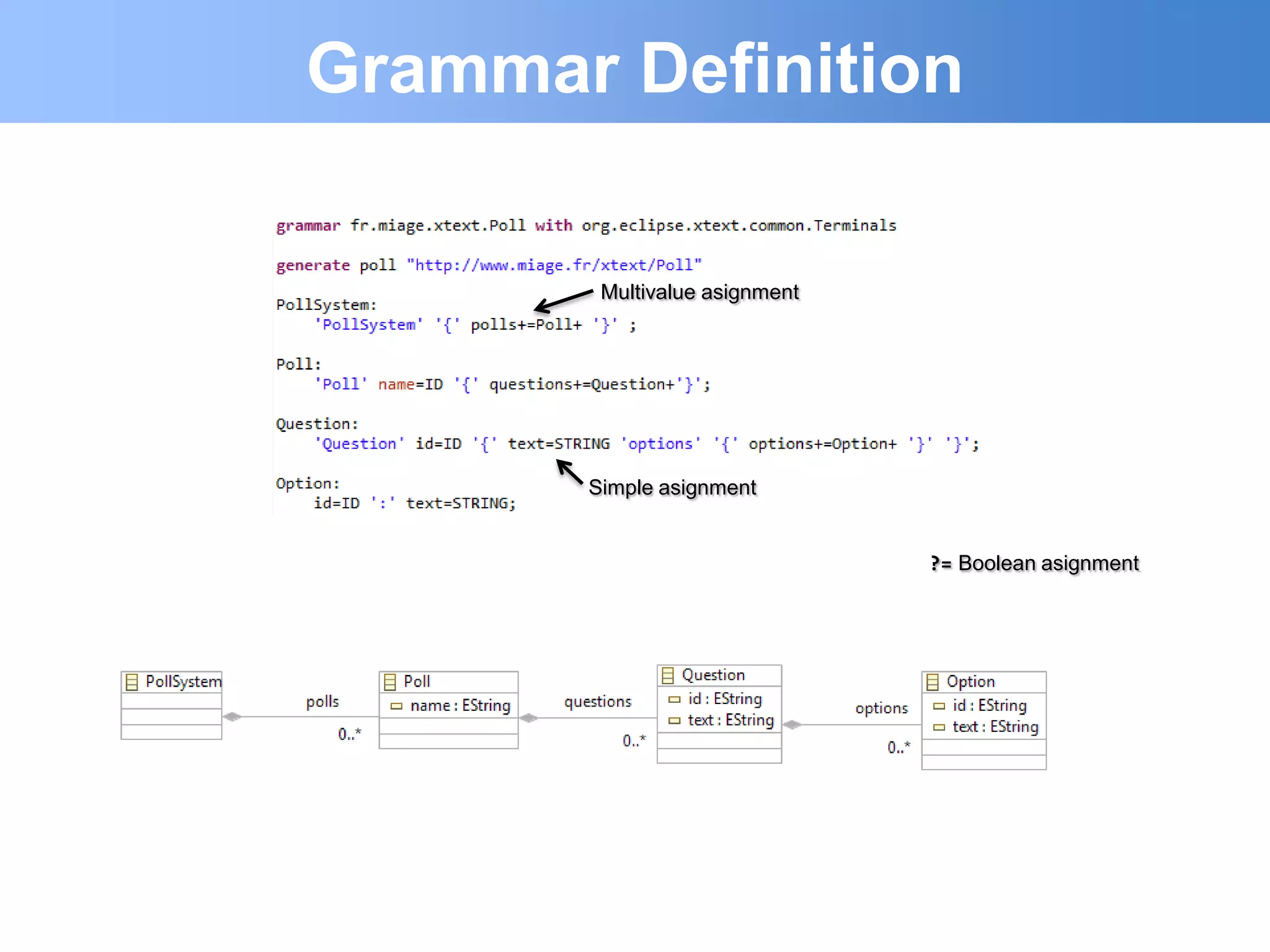
Grammar Definition

        Multivalue asignment


       Simple asignment


                               ?= Boolean asignment
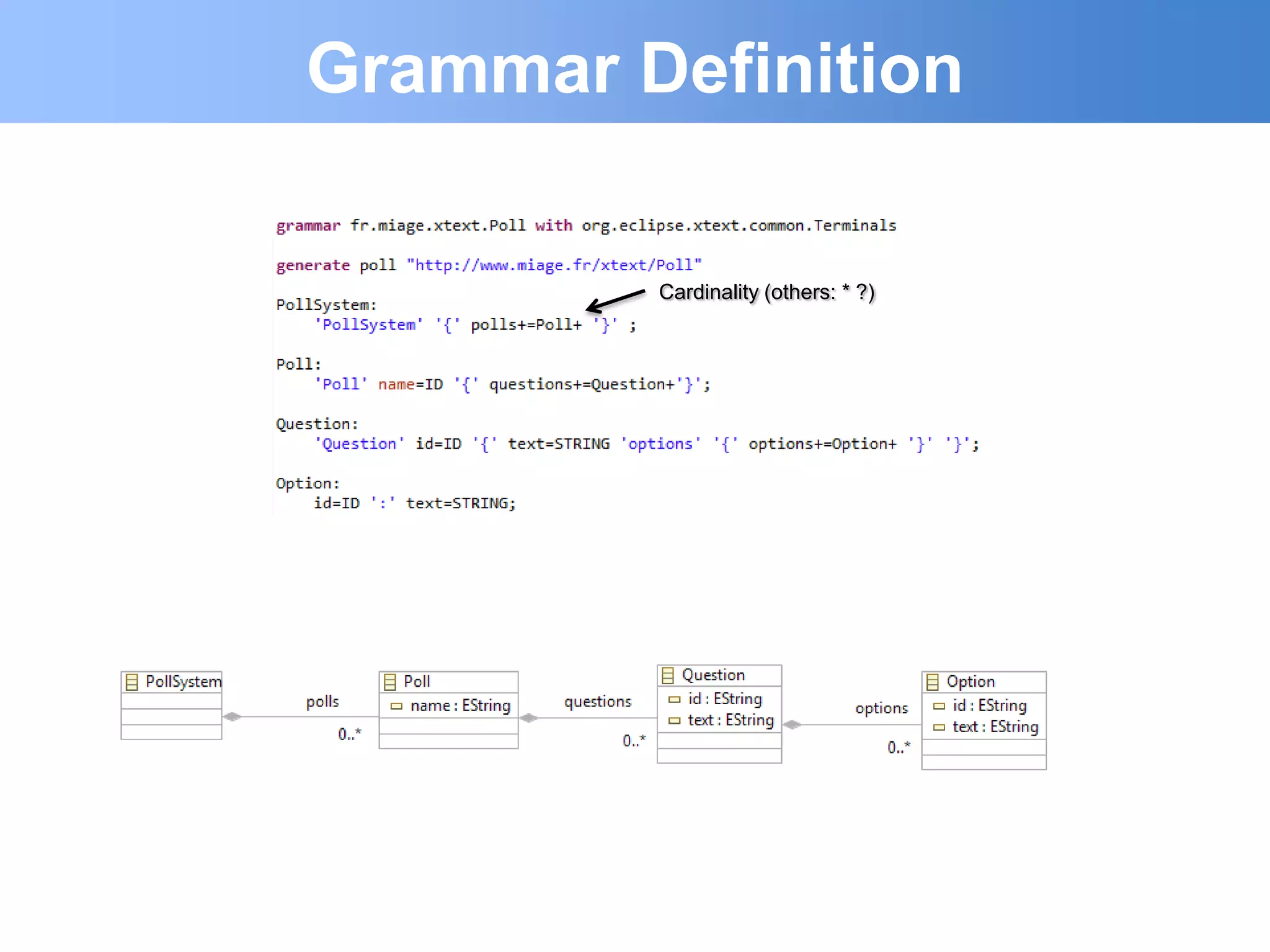
Grammar Definition

         Cardinality (others: * ?)
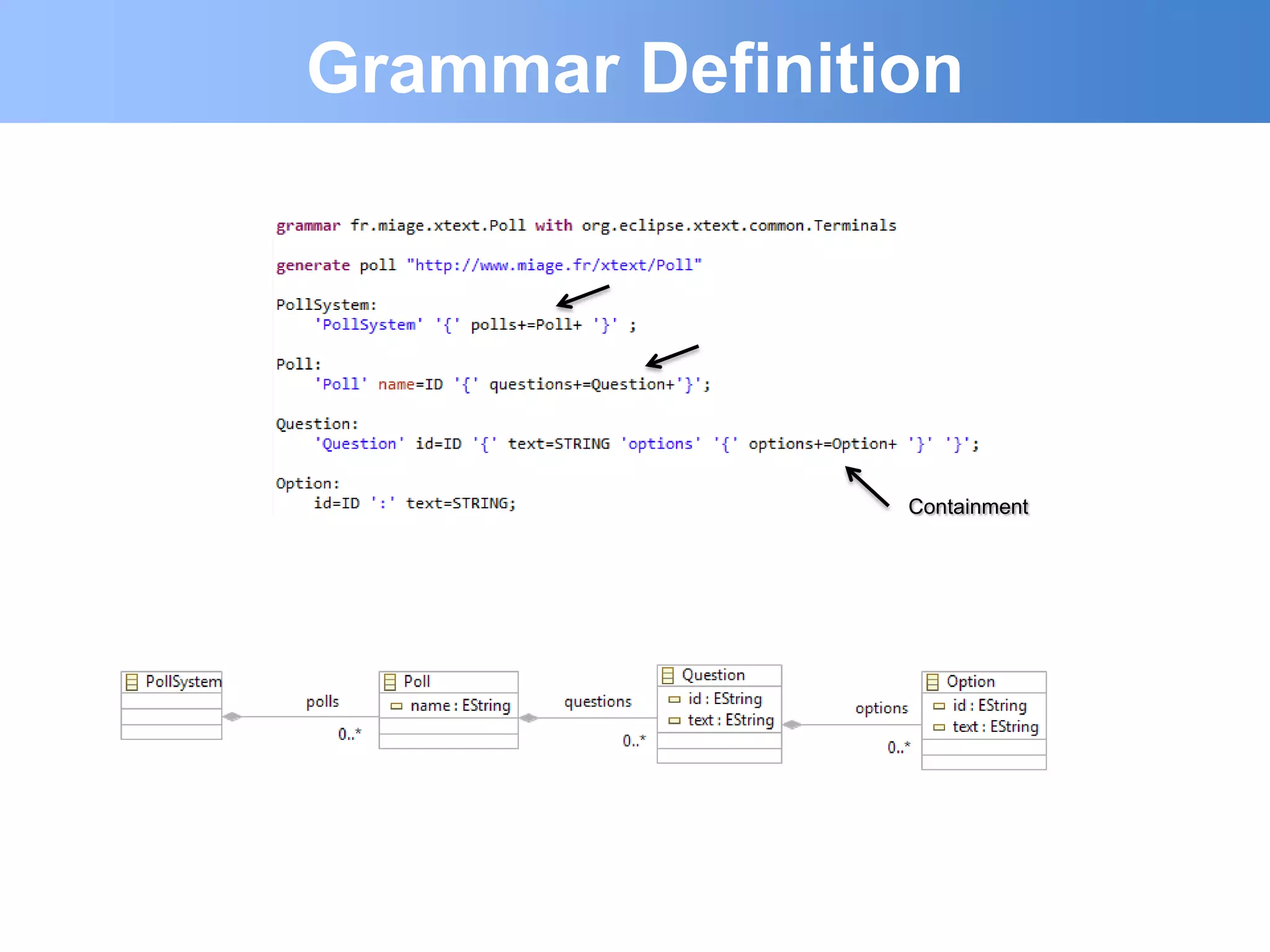
Grammar Definition


                Containment
Grammar Definition
Grammar Definition
Grammar Definition
Grammar Definition
Xtext Demo
Outline


Languages

 Domain-Specific Languages

 Xtext

GMF
GMF
• Eclipse project
  – Eclipse Modelling components
  – Uses
     • EMF (Eclipse Modeling Framework)
     • GEF (Graphical Editing Framework)
• Model-driven framework for Graphical DSLs
  – Everything is a model
• Still under development (perpetual beta)
• The only alternative for now
• DSL definition easy, tweaking hard
Eclipse Modeling Project
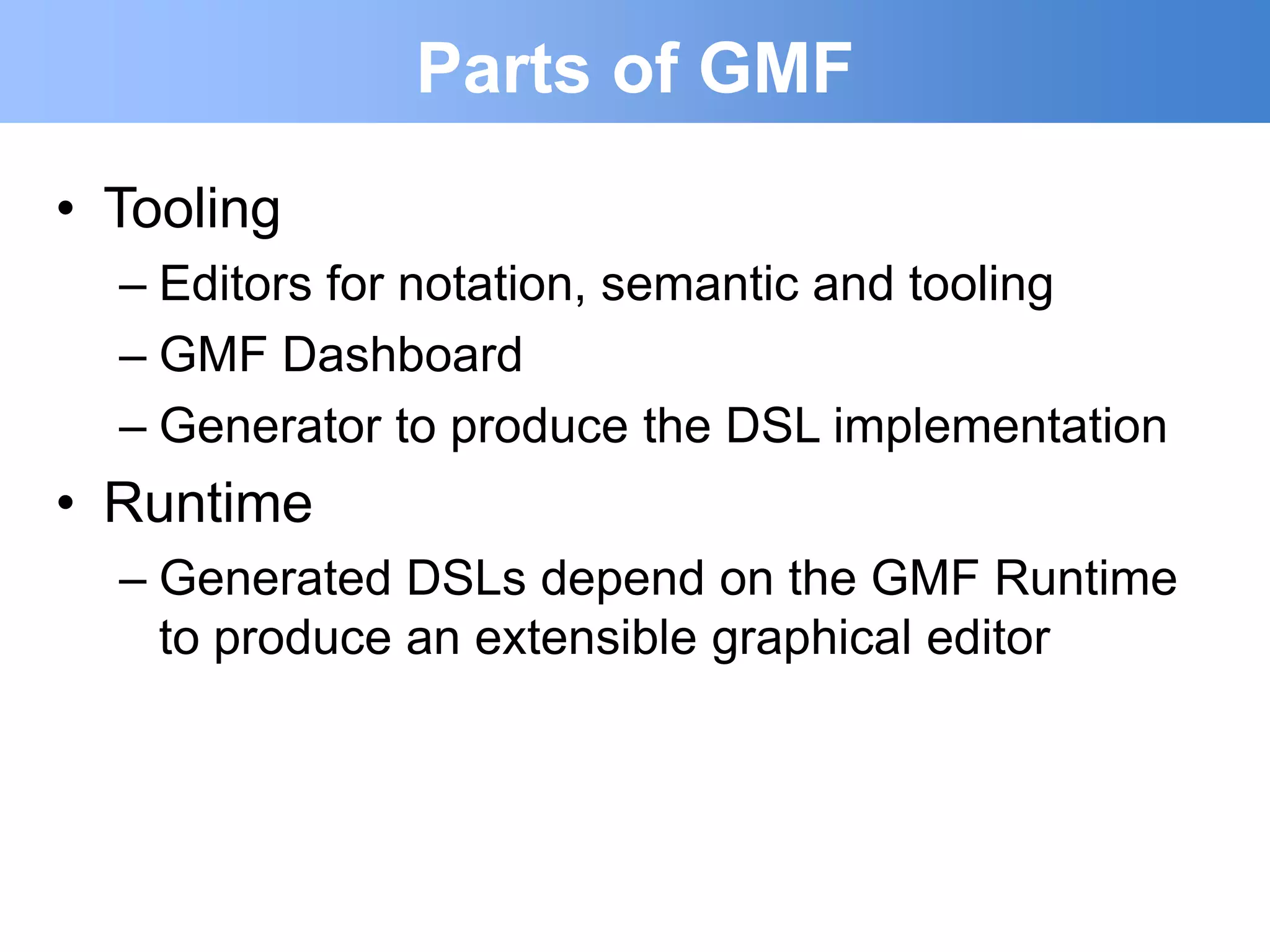
Parts of GMF
• Tooling
  – Editors for notation, semantic and tooling
  – GMF Dashboard
  – Generator to produce the DSL implementation
• Runtime
  – Generated DSLs depend on the GMF Runtime
    to produce an extensible graphical editor
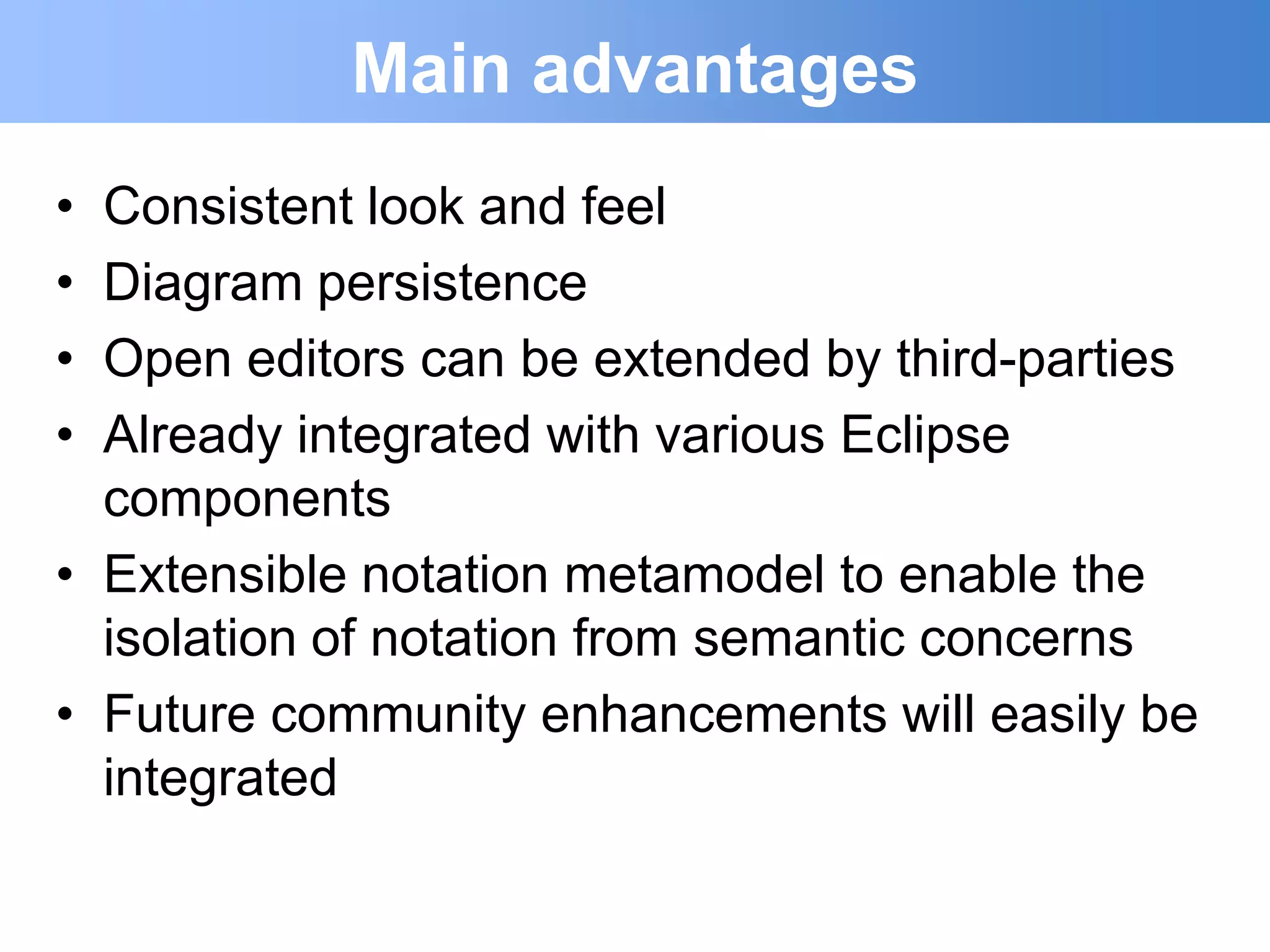
Main advantages
• Consistent look and feel
• Diagram persistence
• Open editors can be extended by third-parties
• Already integrated with various Eclipse
  components
• Extensible notation metamodel to enable the
  isolation of notation from semantic concerns
• Future community enhancements will easily be
  integrated
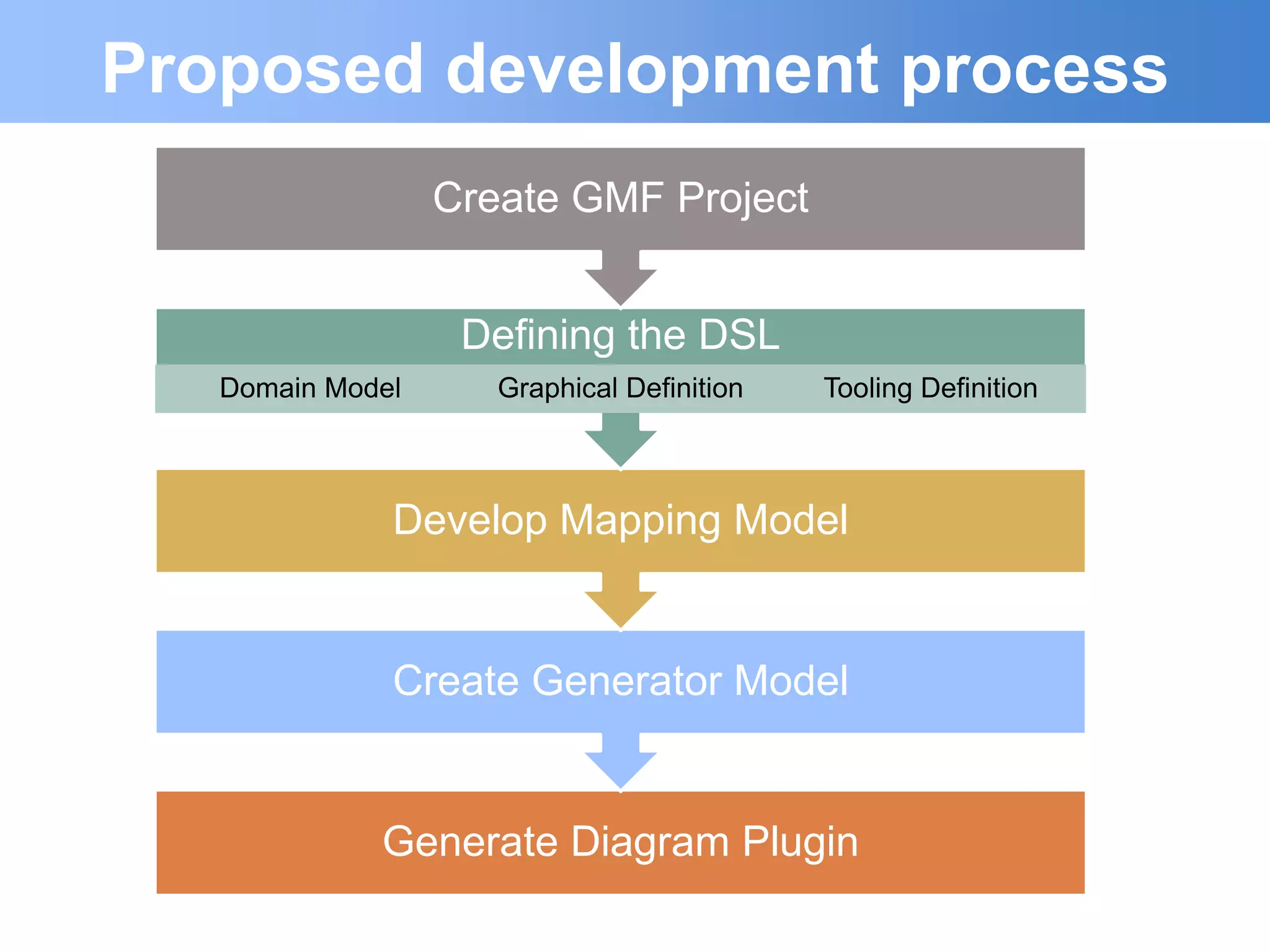
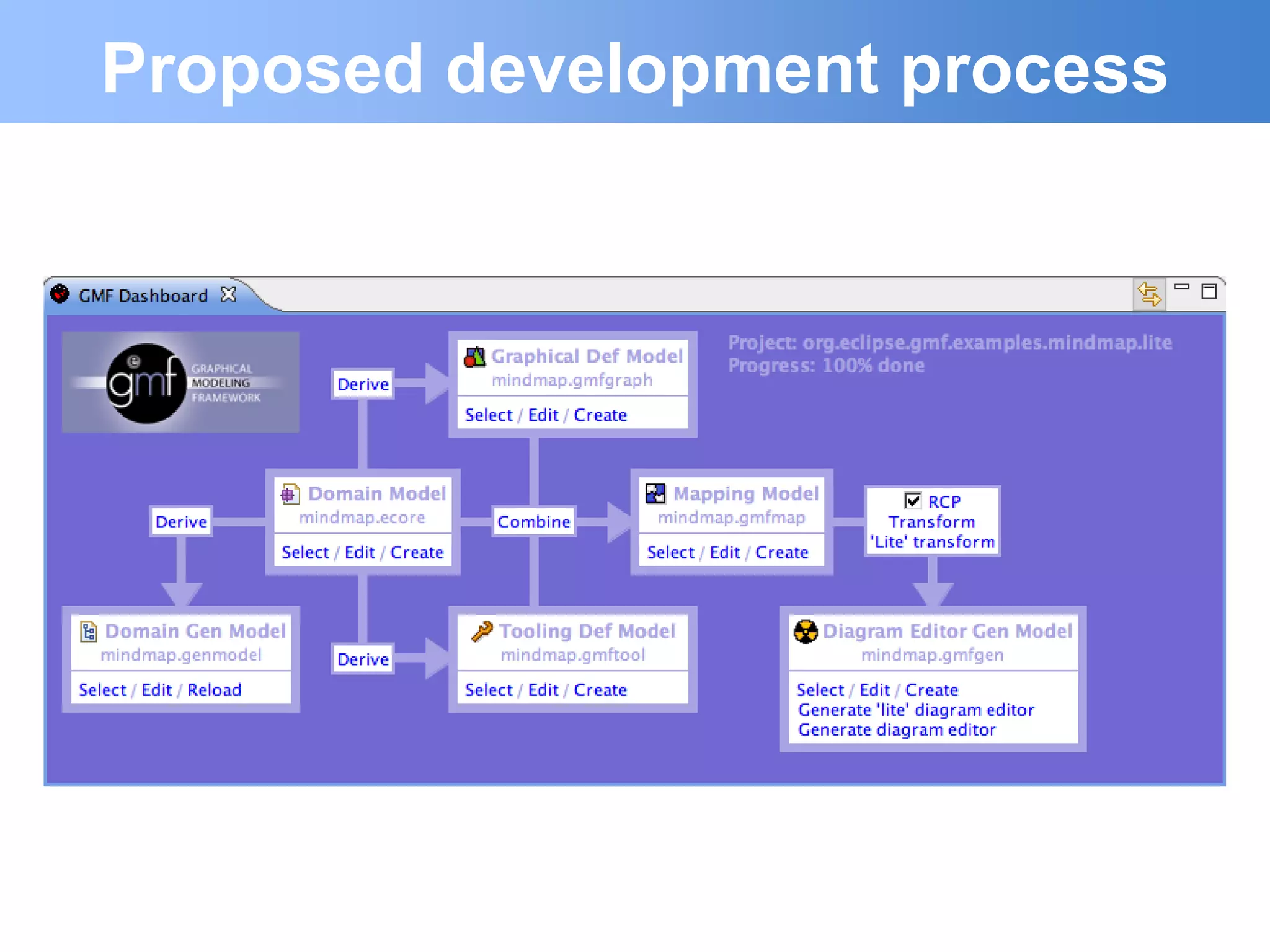
Proposed development process
                  Create GMF Project


                   Defining the DSL
   Domain Model      Graphical Definition   Tooling Definition


              Develop Mapping Model


              Create Generator Model


             Generate Diagram Plugin
Proposed development process
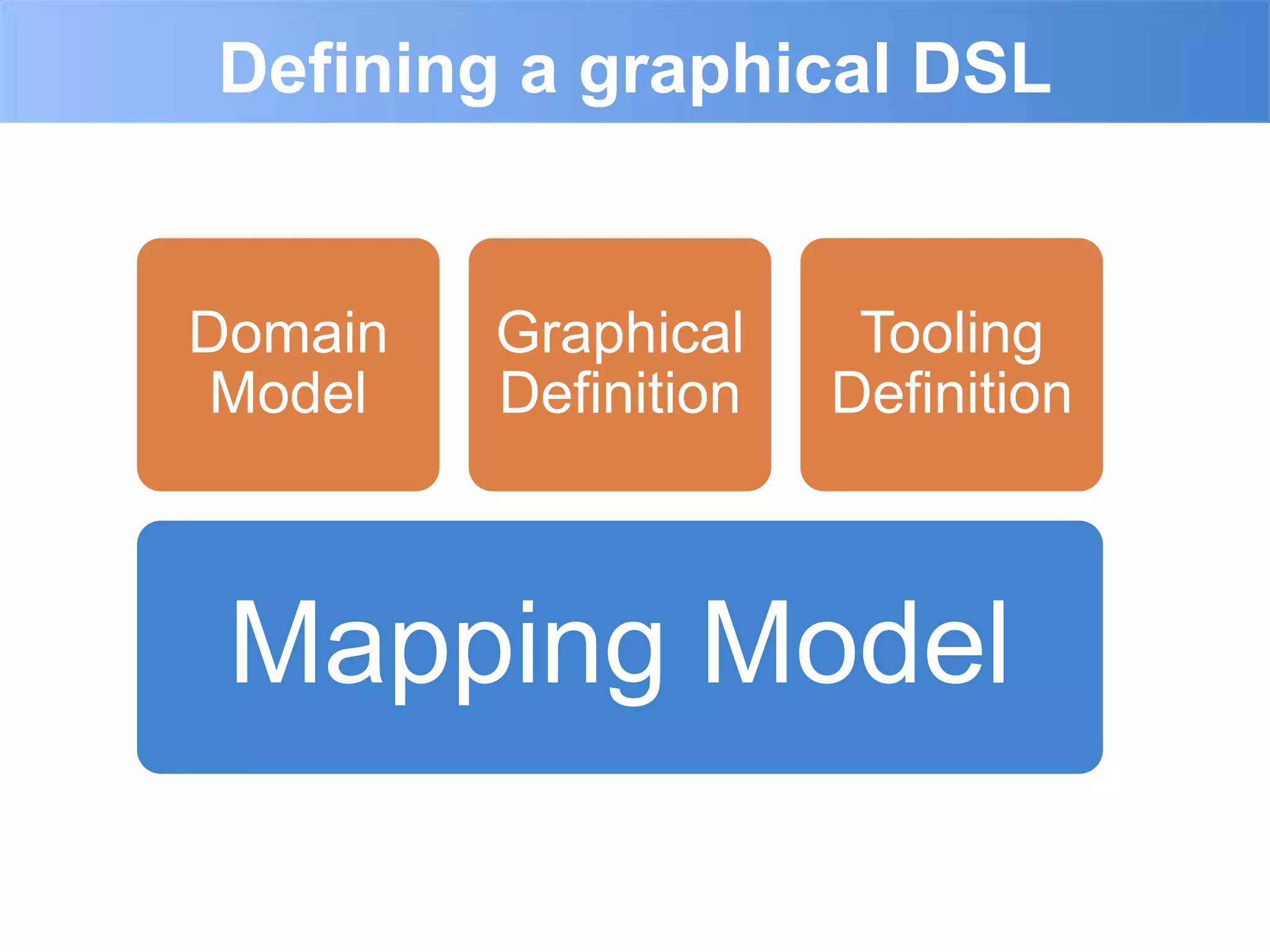
Defining a graphical DSL


Domain   Graphical     Tooling
Model    Definition   Definition


 Mapping Model
Example DSL
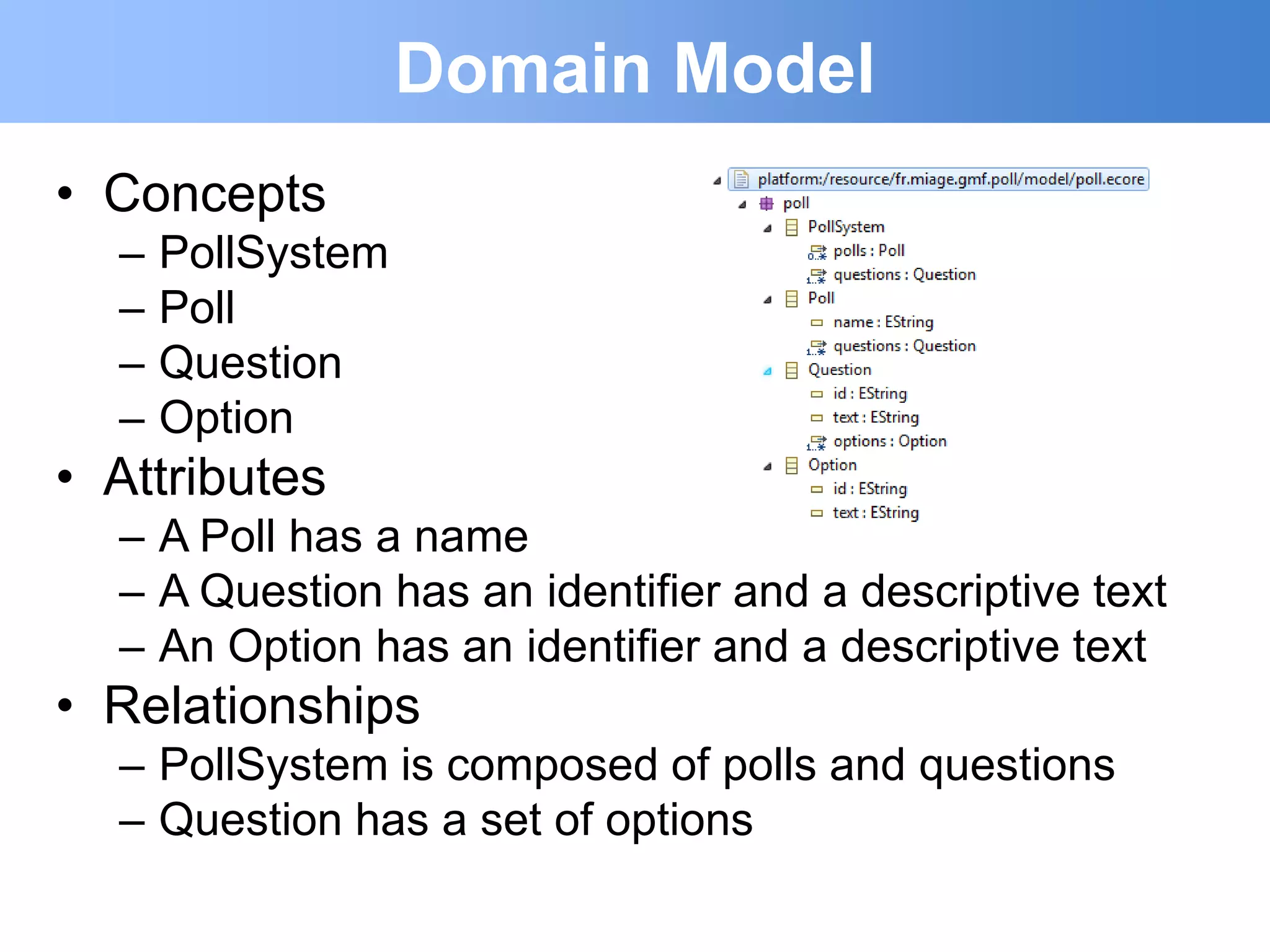
Domain Model
• Concepts
  –   PollSystem
  –   Poll
  –   Question
  –   Option
• Attributes
  – A Poll has a name
  – A Question has an identifier and a descriptive text
  – An Option has an identifier and a descriptive text
• Relationships
  – PollSystem is composed of polls and questions
  – Question has a set of options
Graphical Definition
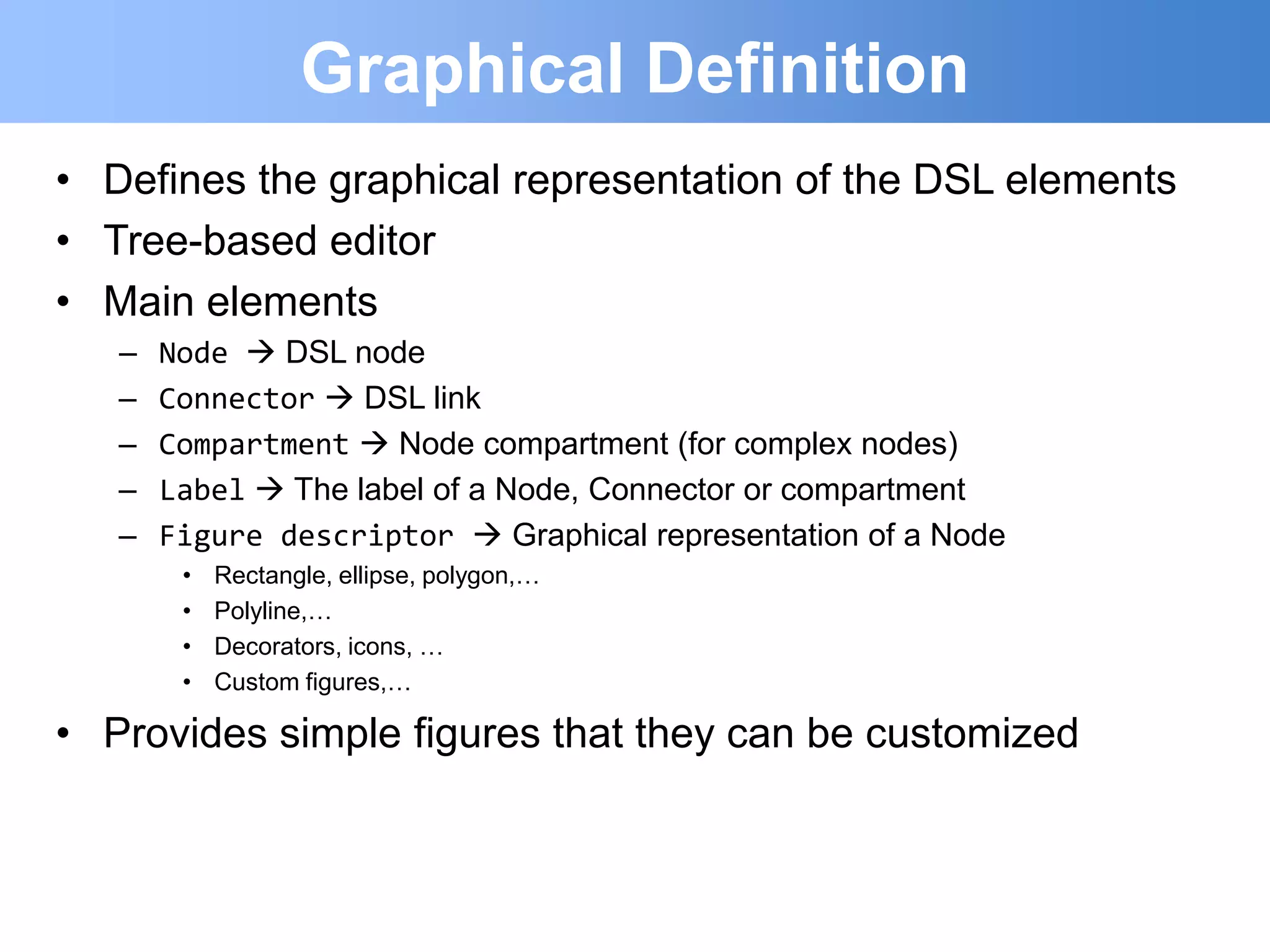
• Defines the graphical representation of the DSL elements
• Tree-based editor
• Main elements
   –   Node  DSL node
   –   Connector  DSL link
   –   Compartment  Node compartment (for complex nodes)
   –   Label  The label of a Node, Connector or compartment
   –   Figure descriptor  Graphical representation of a Node
        •   Rectangle, ellipse, polygon,…
        •   Polyline,…
        •   Decorators, icons, …
        •   Custom figures,…

• Provides simple figures that they can be customized
Graphical Definition
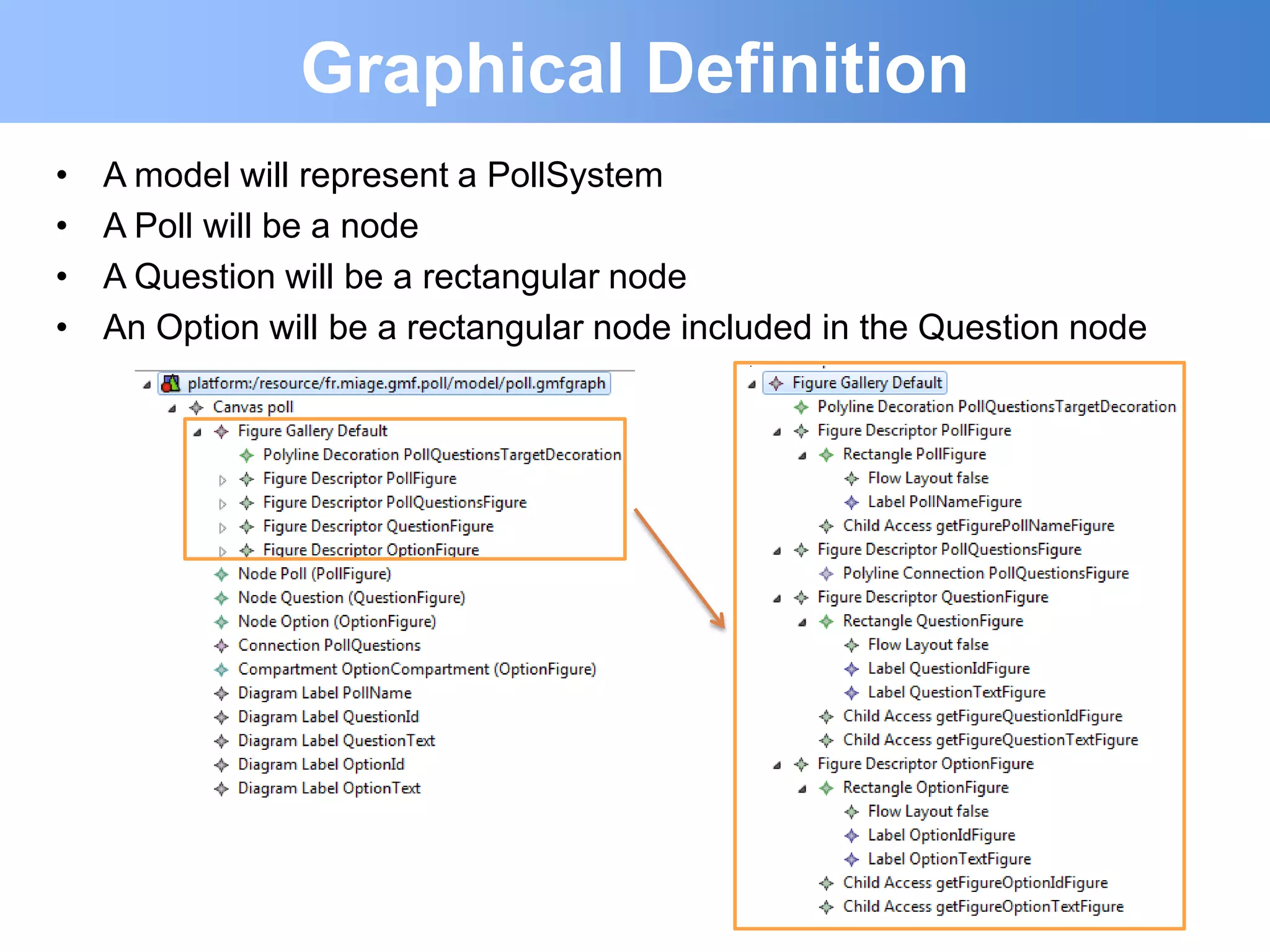
•   A model will represent a PollSystem
•   A Poll will be a node
•   A Question will be a rectangular node
•   An Option will be a rectangular node included in the Question node
Tooling Definition
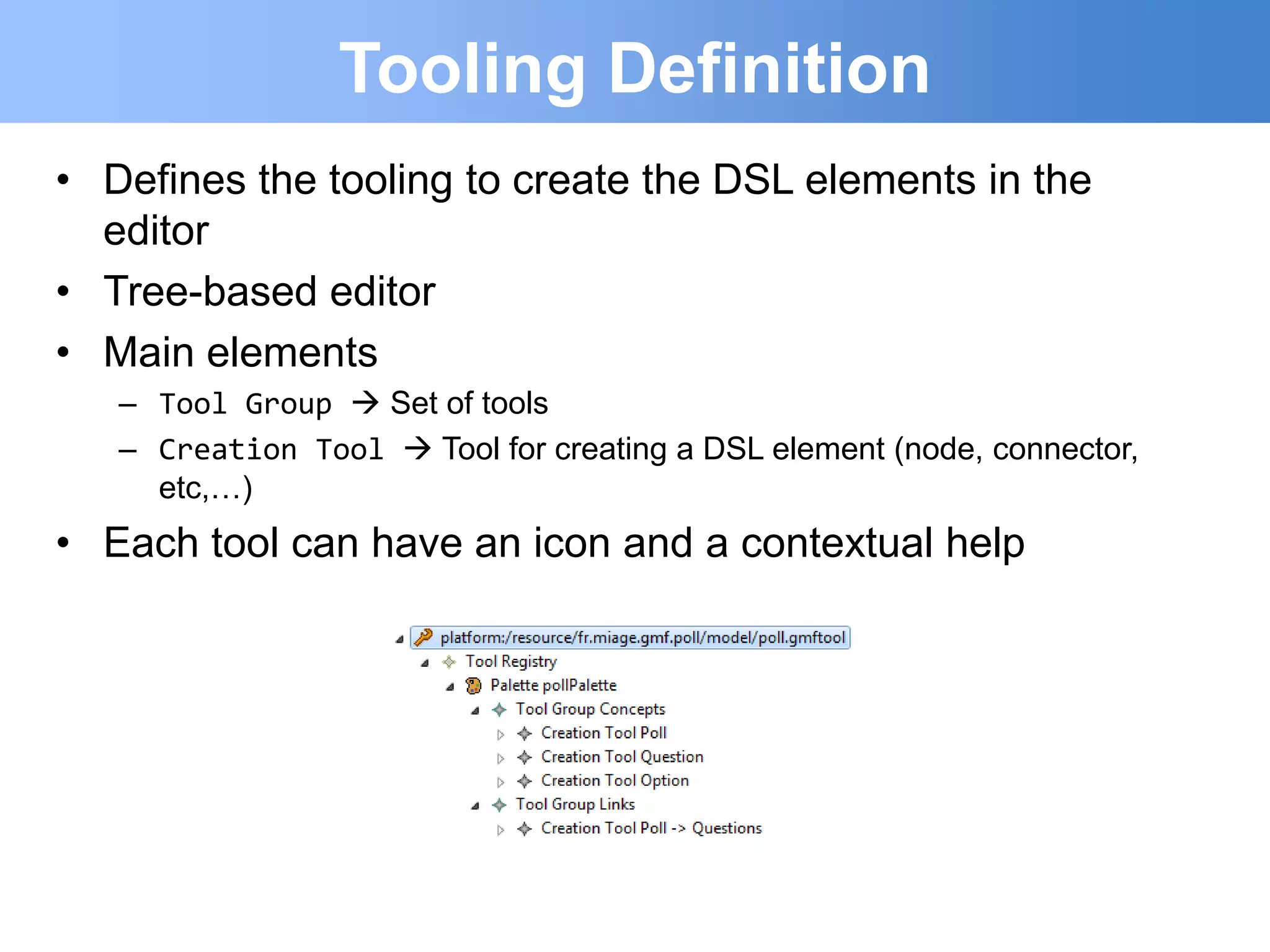
• Defines the tooling to create the DSL elements in the
  editor
• Tree-based editor
• Main elements
   – Tool Group  Set of tools
   – Creation Tool  Tool for creating a DSL element (node, connector,
     etc,…)
• Each tool can have an icon and a contextual help
Mapping Model
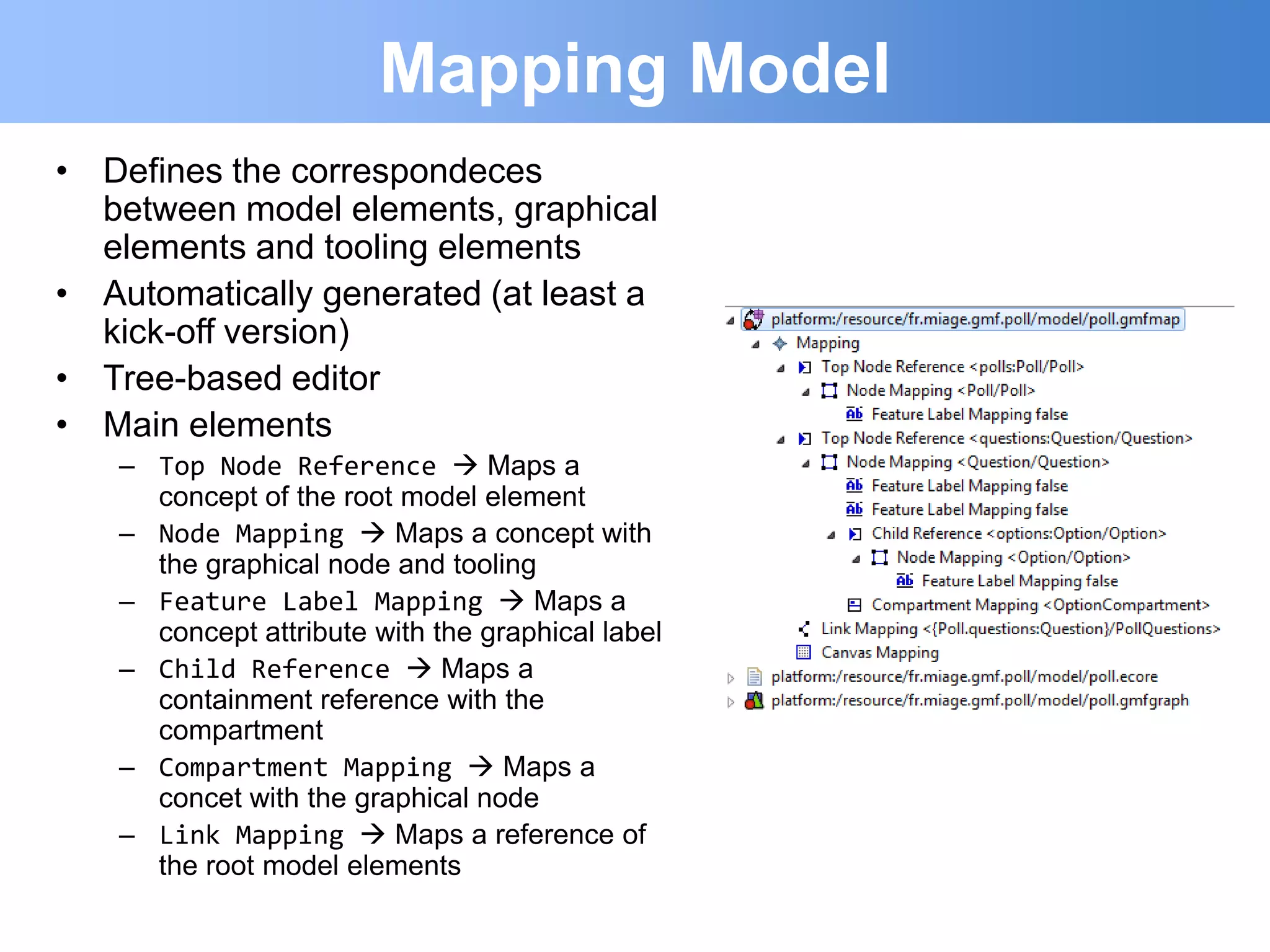
• Defines the correspondeces
  between model elements, graphical
  elements and tooling elements
• Automatically generated (at least a
  kick-off version)
• Tree-based editor
• Main elements
   – Top Node Reference  Maps a
     concept of the root model element
   – Node Mapping  Maps a concept with
     the graphical node and tooling
   – Feature Label Mapping  Maps a
     concept attribute with the graphical label
   – Child Reference  Maps a
     containment reference with the
     compartment
   – Compartment Mapping  Maps a
     concet with the graphical node
   – Link Mapping  Maps a reference of
     the root model elements
GMF Demo
References
1.    Kleppe, A.: Software Language Engineering
2.    J. Bézivin, “Model Driven Engineering: An Emerging Technical Space,” in GTTSE conf., 2006, vol.
      4143, pp. 36–64
3.    M. Brambilla, J. Cabot, M. Wimmer. “Model-Driven Software Engineering in Practice”. Morgan &
      Claypool
4.    M. Mernik, J. Heering, and A. M. Sloane, “When and how to develop domain-specific languages,” ACM
      Computing Surveys, vol. 37, no. 4, pp. 316–344, Dec. 2005.
5.    Brambilla, M., Cabot, J., Wimmer, M.: Model-Driven Software Engineering in Practice
6.    Y. Sun and Z. Demirezen, “Is My DSL a Modeling or Programming Language?,” in DSPD conf., 2008.
7.    M. Strembeck and U. Zdun, “An approach for the systematic development of domain specific
      languages,” Software: Practice and Experience, vol. 39, pp. 1253–1292, 2009.
8.    J.-M. Favre, “Foundations of Meta-Pyramids : Languages vs . Metamodels,” pp. 1–28.
9.    J. De Lara and E. Guerra, “Languages for Model Driven Engineering,” in ECMDA conf., 2012, vol.
      7349, pp. 259–274.
10.   D. L. Moody, “The „physics‟ of notations: Toward a scientific basis for constructing visual notations in
      software engineering,” Software Engineering, IEEE Transactions on, vol. 35, no. 6, pp. 756–779, Nov.
      2009.
11.   D. L. Moody and J. Van Hillegersberg, “Evaluating the visual syntax of UML: An analysis of the
      cognitive effectiveness of the UML family of diagrams,” in SLE conf., 2009, vol. 5452, no. Figure 1, pp.
      16–34.
12.   M. Völter, “MD */ DSL Best Practices Update March 2011,” 2011.
13.   S. Kelly and R. Pohjonen, “Worst practices for domain-specific modeling,” IEEE Software, vol. 26, no.
      4, pp. 22–29, 2009.
14.   M. Völter, “DSL Engineering. Designing, Implementing and Using Domain-Specific Languages”.
15.   I. Kurtev, J. Bézivin, and M. Aksit, “Technological Spaces  an Initial Appraisal,” in DOA, 2002, pp. 1–6.
                                                                  :
16.   Xtext Reference Guide
17.   GMF documentation

Domain-Specific Languages

  • 1.
    Domain-specific Languages Javier Luis Cánovas Izquierdo javier.canovas@inria.fr February 2013
  • 2.
  • 3.
  • 4.
  • 5.
    What is alanguage? From Wikipedia: Language is the human capacity for acquiring and using complex systems of communication, and a language is any specific example of such a system.
  • 6.
    What is alanguage? From Wikipedia: Language is the human capacity for acquiring and using complex systems of communication, and a language is any specific example of such a system. Why? How?
  • 7.
    What is alanguage? From Wikipedia: Language is the human capacity for acquiring and using complex systems of communication, and a language is any specific example of such a system. Why? How?
  • 8.
    What is alanguage? From Wikipedia: Language is the human capacity for acquiring and using complex systems of communication, and a language is any specific example of such a system. Why? How?
  • 9.
    What is alanguage? Table
  • 10.
    What is alanguage? From the formal language theory: A language is a set of linguistic utterances, (i.e., words), also called strings or sentences, which are composed by a set of symbols of an alphabet. A grammar is the set of structural rules that governs the composition of linguistic utterances
  • 11.
    What is alanguage? From the formal language theory: A language is a set of linguistic utterances, (i.e., words), also called strings or sentences, which are composed by a set of symbols of an alphabet. A grammar is the set of structural rules that governs the composition of linguistic utterances Why? How?
  • 12.
    What is alanguage? From the formal language theory: A language is a set of linguistic utterances, (i.e., words), also called strings or sentences, which are composed by a set of symbols of an alphabet. A grammar is the set of structural rules that governs the composition of linguistic utterances Why? How?
  • 13.
    What is alanguage? From the formal language theory: A language is a set of linguistic utterances, (i.e., words), also called strings or sentences, which are composed by a set of symbols of an alphabet. A grammar is the set of structural rules that governs the composition of linguistic utterances Why? How?
  • 14.
    A grammar? machineDefinition: MACHINE OPEN_SEP stateList transitionList CLOSE_SEP; machine { stateList: SOne STwo state (COMMA state)*; T1 { SOne STwo } } state: ID_STATE; machine { transitionList: S_first S_second transition (COMMA transition)*; T1 { S_first S_second} T1 { S_second S_first } transition: ID_TRANSITION OPEN_SEP } state state CLOSE_SEP; MACHINE: ‘machine’; machine { OPEN_SEP: ‘{’; SA SB SC SD CLOSE_SEP: ‘{’; T1 { SA SD } COMMA: ‘,’; T2 { SA SB } ID_STATE: ‘S’ ID; T3 { SB SC } ID_TRANSITION: ‘T’ (0..9)+; T4 { SB SA } ID: (a..zA..Z_) (a..zA..Z0..9)*; }
  • 15.
  • 16.
  • 17.
  • 18.
  • 19.
  • 20.
  • 21.
    GPLs • Java • Delphi class HelloWorldApp { program ObjectPascalExample; public static void main(String[] args) { type System.out.println("Hello World!"); } THelloWorld = object } procedure Put; end; var • C HelloWorld: THelloWorld; procedure THelloWorld.Put; begin #include <stdio.h> WriteLn('Hello, World!'); int main(void) end; { begin printf("hello, worldn"); New(HelloWorld); } HelloWorld.Put; Dispose(HelloWorld); end. • Python print("Hello world")
  • 22.
  • 23.
    DSLs • SQL • CSS CREATE TABLE Employee ( body { id INT NOT NULL IDENTITY (1,1) PRIMARY KEY, text-align: left; name VARCHAR(50), font-family: helvetica, sans-serif; surname VARCHAR(50), } address VARCHAR(255), h1 { city VARCHAR(60), border: 1px solid #b4b9bf; telephone VARCHAR(15), font-size: 35px;} ) • HTML • LaTeX ifthenelse{boolean{showcomments}} {newcommand{nb}[2]{ <html> fcolorbox{gray}{yellow}{ <head> bfseriessffamilyscriptsize#1 <title>Example</title> } </head> {sfsmalltextit{#2}} <body> } <p>Example</p> newcommand{version}{scriptsize$-$working$-$} </body> } </html> {newcommand{nb}[2]{} newcommand{version}{} }
  • 24.
    DSLs • OCL employees->includes(#dent) self.questions->size self.employer->size self.employee->select (v| v.wages>10000 )->size Student.allInstances • MiniUML ->forAll( p1, p2 | package Courses { p1 <> p2 implies p1.name <> p2.name ) class Student { attribute studentid : number key attribute firstName : string attribute lastName : string • ATL } class Course { unique lazy rule customFuncCall { attribute name : string key from attribute description : string optional src : TupleType(class1 : MM!EClass, attribute ects: number class2 : MM!EClass) } to } t : FOL!CustomFuncCall( name <- src.class1.name, declaration <- src.class1, arguments <- Sequence{thisModule.variable(src)} ) }
  • 25.
    GPLs vs DSLs
  • 26.
    GPLs vs DSLs AGPL provides notations that are used to describe a computation in a human-readable form that can be translated into a machine-readable representation. A GPL is a formal notation that can be used to describe problem solutions in a precise manner. A GPL is a notation that can be used to write programs. A GPL is a notation for expressing computation. A GPL is a standardized communication technique for expressing instructions to a computer. It is a set of syntactic and semantic rules used to define computer programs.
  • 27.
    GPLs vs DSLs Theboundary isn‟t as clear as it could be. Domain-specificity is not black-and- white, but instead gradual: a language is more or less domain specific
  • 28.
    GPLs vs DSLs Theboundary isn‟t as clear as it could be. Domain-specificity is not black-and- white, but instead gradual: a language is more or less domain specific
  • 29.
  • 30.
    DSL The big picture What is a DSL? Why? Anatomy Development Actors Best practices Worst practices
  • 31.
    DSL The big picture What is a DSL? Why? Anatomy Development Actors Best practices Worst practices
  • 32.
  • 33.
  • 34.
  • 35.
  • 36.
  • 37.
    DSL The big picture What is a DSL? Why? Anatomy Development Actors Best practices Worst practices
  • 38.
    What is aDSL • In general: Language specially designed to perform a task in a certain domain
  • 39.
    What is aDSL • In general: Language specially designed to perform a task in a certain domain • In the context of computer science: A formal processable language targeting at a specific viewpoint or aspect of a software system. It's semantics flexibility and notation is designed in order to support working with that viewpoint as good as possible
  • 40.
    And the restof languages? DSLs SQL, HTML C, Cobol Assembler Machine
  • 41.
    Why DSLs? Abstraction Gap Assembler C, Java DSLs Problem Solution Domain Domain
  • 42.
    What is offered? Higher Avoid abstractions redundancy Separation Use domain of concerns concepts
  • 43.
    What are theadvantages? Productivity Platform Independent Quality Benefits No Overhead V&V Domain Communication Expert
  • 44.
    What for? Architecture • Generation of interfaces Utility • Generation of WSDL Full Technical • Set up of skeleton projects Requirements Application Analysis Product Line
  • 45.
    What for? Architecture Utility Full Technical • Architecture-Definition Languages • AUTOSAR Requirements Application Analysis Product Line
  • 46.
    What for? Architecture • Model transformation languages: ATL, Acceleo Utility • Constraints language: OCL Full Technical Requirements Application Analysis Product Line
  • 47.
    What for? Architecture Utility Full Technical Requirements • Describe a cooling algorithm in refrigerators Application • Configure hearing aids Analysis • Insurance mathematics Product Line
  • 48.
    What for? Architecture Utility Full Technical Requirements Application Analysis • Pseudo-structured natural languages Product Line
  • 49.
    What for? Architecture Utility Full Technical Requirements Application • Mathematical formalisms Analysis Product Line
  • 50.
    What for? Architecture Utility Full Technical Requirements • Composition languages • Workflow languages Application Analysis Product Line
  • 51.
    What is adomain? Inductive / Bottom-up • The domain is defined in terms of existing software used to address a particular class of problems or products • A domain D is identified as a set of programs with common characteristics or similar purpose • Often such domains do not exists outside the realm of software • Special case when we define a domain as a subset of programs written in a specific language (idiom) Deductive / top-down • The domain is defined as a body of knowledge about the real world, i.e., outside the realm of software • A domain D is a body of knowledge for which we want to provide some form of software support • Much harder to address using DSLs because of the need to understand precisely the nature of the domain and identify interesting programs in such domain
  • 52.
  • 53.
    DSL The big picture What is a DSL? Why? Anatomy Development Actors Best practices Worst practices
  • 54.
    Anatomy Concepts & Well-formed Textual Graphical Denotational Pragmatic Translational Operational relationships rules Abstract Concrete Semantics Syntax Syntax DSL
  • 55.
    A first look AbstractSyntax • Describes the structure of the language and the way the different primitives can be combined together, independently of any particular representation or encoding. Concrete Syntax • Describes specific representations of the modeling language, covering encoding and/or visual appearance Semantics • Describing the meaning of the elements defined in the language and the meaning of the different ways of combining them.
  • 56.
    A first look AbstractSyntax • Describes the structure of the language and the way the different primitives can be combined together, independently of any particular representation or encoding. Concrete Syntax • Describes specific representations of the modeling language, covering encoding and/or visual appearance Semantics • Describing the meaning of the elements defined in the language and the meaning of the different ways of combining them.
  • 57.
    A first look AbstractSyntax • Describes the structure of the language and the way the different primitives can be combined together, independently of any particular representation or encoding. Concrete Syntax • Describes specific representations of the modeling language, covering encoding and/or visual appearance Semantics How this is • Describing the meaning of the elements defined in the language executed? and the meaning of the different ways of combining them.
  • 58.
    Anatomy Concepts & Well-formed Textual Graphical Denotational Pragmatic Translational Operational relationships rules Abstract Concrete Semantics Syntax Syntax DSL
  • 59.
    Abstract Syntax • Metamodellingtechniques – UML notation • Concept => Class • Property => Attribute • Contaiment Relationship => Composite Association • Relationship => Association • Specialization => Inheritance • Package => Package • Well-formed rules – OCL expressions context Transition inv: self.source <> self.target context Machine inv: self.states ->exists(s | s.oclIsKinfOf(InitialState))
  • 60.
    Anatomy Concepts & Well-formed Textual Graphical Denotational Pragmatic Translational Operational relationships rules Abstract Concrete Semantics Syntax Syntax DSL
  • 61.
    Concrete Syntax Textual Graphical
  • 62.
  • 63.
    Concrete Syntax • Textual • Graphical digraph Modernization { Start -> ExtractingModels; ExtractingModels -> MDD [label="C2M"]; MDD -> MDD [label="M2M"]; MDD -> SystemGeneration [label="M2C"]; SystemGeneration -> End; Start [shape=point,width=0.2,label=""]; ExtractingModels [label="Extracting Models",shape=ellipse]; MDD [shape=ellipse]; SystemGeneration [label="System Generation",shape=ellipse]; End [shape=doublecircle,label="",width=0.2, fillcolor=black,style=filled]; }
  • 64.
    Textual Syntax Grammar Metamodel conforms To conforms To Machine Machine Model A Model C A Machine C B Model B Grammarware Modelware
  • 65.
    Textual Syntax Grammar Metamodel conforms To conforms To Machine Machine Model A Model C A Machine C B Model B Grammarware Modelware
  • 66.
    Textual Syntax machineDefinition: MACHINE OPEN_SEP stateList transitionList CLOSE_SEP; stateList: state (COMMA state)*; state: ID_STATE; transitionList: transition (COMMA transition)*; transition: ID_TRANSITION OPEN_SEP state state CLOSE_SEP; MACHINE: ‘machine’; conforms To machine { OPEN_SEP: ‘{’; SOne STwo CLOSE_SEP: ‘{’; T1 { SOne STwo } COMMA: ‘,’; } ID_STATE: ‘S’ ID; ID_TRANSITION: ‘T’ (0..9)+; ID: (a..zA..Z_) (a..zA..Z0..9)*;
  • 67.
    Textual Syntax machineDefinition: MACHINE OPEN_SEP stateList transitionList CLOSE_SEP; stateList: state (COMMA state)*; state: ID_STATE; transitionList: transition (COMMA transition)*; transition: ID_TRANSITION OPEN_SEP state state CLOSE_SEP; MACHINE: ‘machine’; conforms To machine { OPEN_SEP: ‘{’; SOne STwo CLOSE_SEP: ‘{’; T1 { SOne STwo } COMMA: ‘,’; } ID_STATE: ‘S’ ID; ID_TRANSITION: ‘T’ (0..9)+; ID: (a..zA..Z_) (a..zA..Z0..9)*;
  • 68.
    You have alreadywork with one package Courses { class Student { attribute studentid : number key attribute firstName : string attribute lastName : string } sintax of class Course { attribute name : string key conforms To attribute description : string optional attribute ects: number } } package Courses { Ecore MM class Student { attribute studentid : number key attribute firstName : string attribute lastName : string } conforms To class Course { attribute name : string key sintax of attribute description : string optional attribute ects: number } association Enrolment { end student : Student [1..*] end course : Course [0..*] } }
  • 69.
    Textual Syntax • Grammar-oriented(Xtext) Grammar Metamodel conforms To conforms To Graph B Model A
  • 70.
    Xtext • Model-Driven frameworkto develop textual DSLs • Is part of Eclipse Modeling Project • Is part of a DSL tooling initally called Open Architecture Ware • Main features: – Syntax Coloring – Content Assist – Validation and Quick Fixes – Advanced Java Integration – Integration with other Eclipse tools
  • 71.
    Textual Syntax • Metamodel-oriented(EMFText) Grammar Metamodel conforms To conforms To Graph B Model A
  • 72.
    EMFText • Model-Driven frameworkto develop textual DSLs • Developed as a Eclipse plugin • Main features: – Syntax Coloring – Content Assist – Validation and Quick Fixes – Reference resolving mechanism
  • 73.
    EMFText • Model-Driven frameworkto develop textual DSLs • Developed as a Eclipse plugin • Main features: – Syntax Coloring – Content Assist – Validation and Quick Fixes – Reference resolving mechanism
  • 74.
    Graphical Syntax A drawis better than a long explanation digraph Modernization { Start -> ExtractingModels; ExtractingModels -> MDD [label="C2M"]; MDD -> MDD [label="M2M"]; MDD -> SystemGeneration [label="M2C"]; SystemGeneration -> End; Start [shape=point,width=0.2,label=""]; ExtractingModels [label="Extracting Models",shape=ellipse]; MDD [shape=ellipse]; SystemGeneration [label="System Generation",shape=ellipse]; End [shape=doublecircle,label="",width=0.2, fillcolor=black,style=filled]; }
  • 75.
    GMF • Graphical ModelingFramework – Model-Driven Framework to develop graphical editors based on EMF and GEF – GMF is part of Eclipse Modeling Project – Provides a generative component to create the DSL tooling – Provides a runtime infrastructure to facilitate the development of graphical DSLs
  • 76.
    Alternatives • GMF canbe too complex • EuGENia – Automatically generated GMF infrastructure – Lowers the entrance barrier for creating GMF editors – Provides textual DSLs and wizards to define the graphical DSL • GMF simple mapping editor – Graphical DSL to configure GMF – Generators for creating the required GMF infrastructure
  • 77.
    Graphical vs. Textual •Success depends on how the notation fits the domain class Person { Person has (name, surname) private String name; private String name; } Person name : string surname : string
  • 78.
    Graphical vs. Textual •Success depends on how the notation fits the domain class Person { Person has (name, surname) private String name; private String name; } Person name : string surname : string • Graphical DSLs are not always easier to understand
  • 79.
    Graphical vs. Textual •Expression of common concerns simple and concise class Person { private String name; Person has (name, surname) private String name; }
  • 80.
    Graphical vs. Textual •Expression of common concerns simple and concise class Person { private String name; Person has (name, surname) private String name; } • Providing sensible defaults public class MyClass { public void readStream(InputStream stream, boolean closeStreamAferReading) { ... } } public class MyClass { public void readStream(InputStream stream) { readStream(stream, true); } public void readStream(InputStream stream, boolean closeStreamAferReading) { ... } }
  • 81.
    Graphical vs. Textual •Verbosity for less common concerns Person has (name, surname) Person has (name, surname) extension name is String surname is String • Tool support and limitations – Syntax highlighting – Outline – Auto-completion – Validation – Layout – …
  • 82.
  • 83.
  • 84.
    Recommendations Semiotic clarity Perceptual Cognitive Fit Discriminality Graphic Economy Physics Semantics transparency of notations Complexity Dual Coding Management Visual Cognitive Expressiveness Integration
  • 85.
    Recommendations There should be a 1:1 correspondence Semiotic clarity between concepts and graphical symbols Perceptual Cognitive Fit Discriminality Graphic Economy Physics Semantics transparency of notations Complexity Dual Coding Management Visual Cognitive Expressiveness Integration
  • 86.
    Recommendations Semiotic clarity Perceptual Cognitive Fit Discriminality Graphic Economy Physics Semantics transparency of notations Complexity Dual Coding Management Visual Cognitive Expressiveness Integration
  • 87.
    Recommendations Semiotic clarity Different symbols should be Perceptual clearly distinguishable from each Cognitive Fit Discriminality other Graphic Economy Physics Semantics transparency of notations Complexity Dual Coding Management Visual Cognitive Expressiveness Integration
  • 88.
    Recommendations Semiotic clarity Perceptual Cognitive Fit Discriminality Graphic Economy Physics Semantics transparency of notations Complexity Dual Coding Management Visual Cognitive Expressiveness Integration
  • 89.
    Recommendations Semiotic clarity Perceptual Cognitive Fit Discriminality Graphic Economy Physics Semantics transparency of Use visual representations notations whose apprarance suggests their meaning Complexity Dual Coding Management Visual Cognitive Expressiveness Integration
  • 90.
    Recommendations Semiotic clarity Perceptual Cognitive Fit Discriminality Graphic Economy Physics Semantics transparency of notations Complexity Dual Coding Management Include mechanisms for dealing Visual Cognitive with complexity Expressiveness Integration
  • 91.
    Recommendations Semiotic clarity Perceptual Cognitive Fit Discriminality Graphic Economy Physics Semantics transparency of notations Complexity Dual Coding Management Visual Cognitive Expressiveness Integration Include explicit mechanisms to support integration of information from different diagrams
  • 92.
    Recommendations Semiotic clarity Perceptual Cognitive Fit Discriminality Graphic Economy Physics Semantics transparency of notations Complexity Dual Coding Management Visual Cognitive Expressiveness Integration Use the full range and capacities of visual variables
  • 93.
    Recommendations Semiotic clarity Perceptual Cognitive Fit Discriminality Graphic Economy Physics Semantics transparency of notations Complexity Dual Coding Management Visual Cognitive Expressiveness Integration
  • 94.
    Recommendations Semiotic clarity Perceptual Cognitive Fit Discriminality Graphic Economy Physics Semantics transparency of notations Complexity Dual Coding Management Visual Cognitive Expressiveness Integration
  • 95.
    Recommendations Semiotic clarity Perceptual Cognitive Fit Discriminality Graphic Economy Physics Semantics transparency of notations Complexity Dual Coding Management Visual Cognitive Expressiveness Integration
  • 96.
    Recommendations Semiotic clarity Perceptual Cognitive Fit Discriminality Graphic Economy Physics Semantics transparency of notations Complexity Dual Coding Management Use text to complement graphics Visual Cognitive Expressiveness Integration
  • 97.
    Recommendations Semiotic clarity Perceptual Cognitive Fit Discriminality Graphic Economy Physics Semantics transparency of notations Complexity Dual Coding Management Visual Cognitive Expressiveness Integration
  • 98.
    Recommendations Semiotic clarity Perceptual Cognitive Fit Discriminality Graphic Economy Physics Semantics transparency The number of different graphical symbols should be cognitively of manageable notations Complexity Dual Coding Management Visual Cognitive Expressiveness Integration
  • 99.
    Recommendations Use different visualdialects for different tasks and audiences Semiotic clarity Perceptual Cognitive Fit Discriminality Graphic Economy Physics Semantics transparency of notations Complexity Dual Coding Management Visual Cognitive Expressiveness Integration
  • 100.
    Anatomy Concepts & Well-formed Textual Graphical Denotational Pragmatic Translational Operational relationships rules Abstract Concrete Semantics Syntax Syntax DSL
  • 101.
    Semantics Denotational • Useof mathematical formalisms • Complex Pragmatic • Use of examples to illustrate the language • Input / outputs • Hard to deduce the real semantics Traslational • Translation to other well-known language • Similar to compilation Operational • Sequence of operations • Virtual machine
  • 102.
    DSL The big picture What is a DSL? Why? Anatomy Development Actors Best practices Worst practices
  • 103.
    Development process • Create a new one or reuse an existing one Decision • Enable non-technical users to participate • Problem domain identified • Domain knowledge gathered from end-users Analysis • Domain model: Scope, vocabulary, concepts, commonalities and variabilities • Define the DSL components (abstract and concrete syntaxes, semantics) Design • Decide best approach to implement the language • Develop DSL components (Xtext, EMFText, GMF, etc…) Implemen • If it is executable, develop the corresponding interpreter or compiler tation • Test the language Validation • Validate the language with the end-user
  • 104.
    Regarding the implementation External vs Internal DSL Grammar Host Language conforms To Internal DSL 1 DSL DSL Text Text Internal DSL 2
  • 105.
  • 106.
    External vs Internal Internal External
  • 107.
    DSL The big picture What is a DSL? Why? Anatomy Development Actors Best practices Worst practices
  • 108.
  • 109.
    Actors High Domain Knowledge Low Low High Technical Level
  • 110.
    DSL The big picture What is a DSL? Why? Anatomy Development Actors Best practices Worst practices
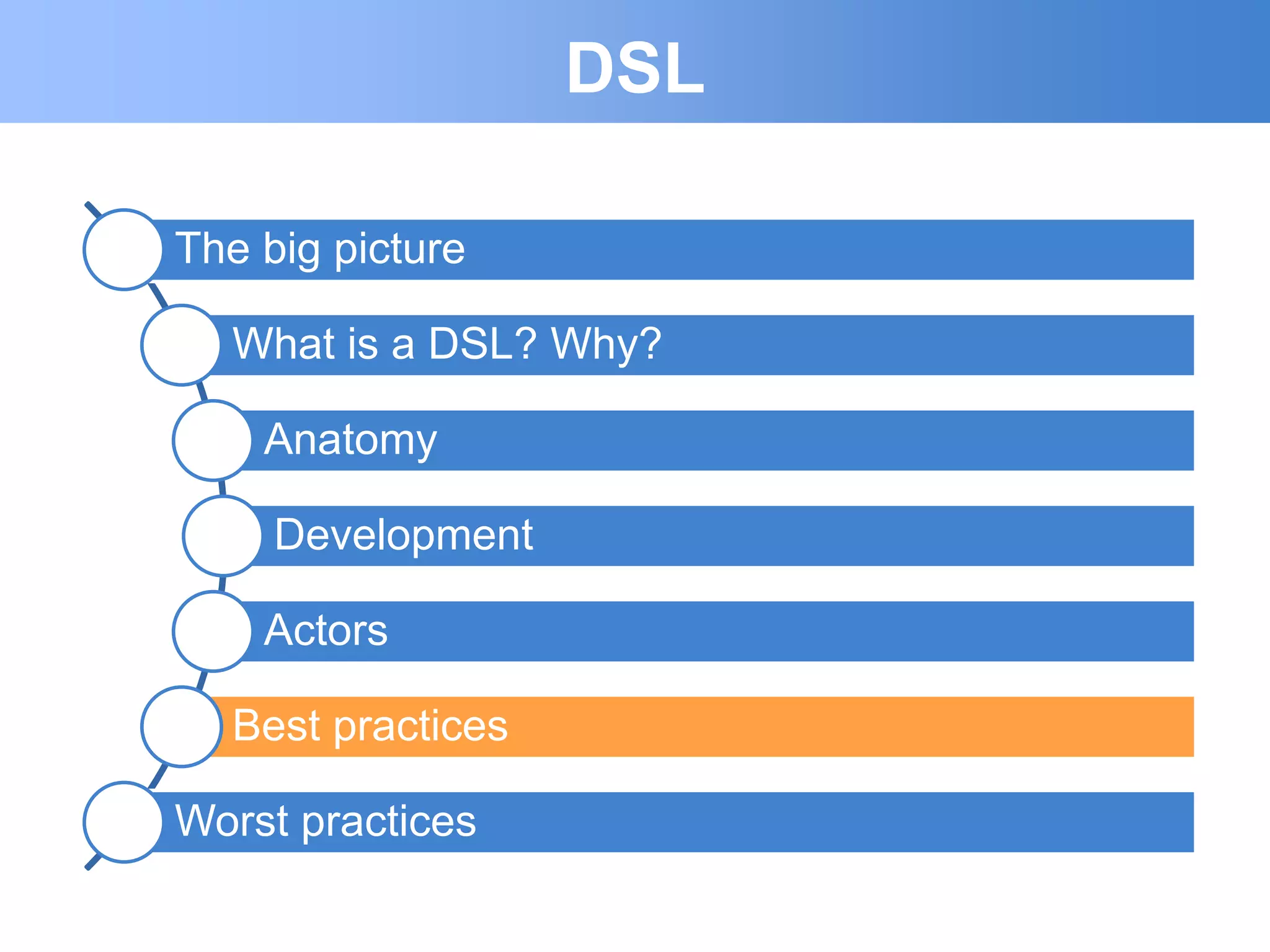
  • 111.
    Best practices Limit Viewpoints Expressiveness Learn from Evolution GPLs Support Tooling
  • 112.
    DSL The big picture What is a DSL? Why? Anatomy Development Actors Best practices Worst practices
  • 113.
    Worst practices • Initialconditions – Only Gurus allowed • Believe that only gurus can build languages ir that “I‟m smart and don‟t need help” – Lack of Domain Understanding • Insufficiently understanding the problem domain or the solution domain – Analysis paralysis • Wanting the language to be theoretically complete, with its implementation assured
  • 114.
    Worst practices • Thesource for Language Concepts – UML: New Wine in Old Wineskins • Extending a large, general-purpose modeling language – 3GL Visual Programming • Duplicanting the concepts and semantics of traditional programming languages – Code: The Library is the Language • Focusing the language on the current code‟s technical details – Tool: if you have a hammer • Letting the tool‟s technical limitations dictate language development
  • 115.
    Worst practices • Theresulting language – Too Generic / Too Specific • Creating a language with a few generic concepts or too many specific concepts, or a language that can create only a few models – Misplaced Emphasis • Too strongly emphasizing a particular domain feature – Sacred at Birth • Viewing the initial language version as unalterable
  • 116.
    Worst practices • LanguageNotation – Predetermined Paradigm • Choosing the wrong representational paradigm or the basis of a blinkered view – Simplistic Symbols • Using symbols that are too simple or similar or downright ugly
  • 117.
    Worst practices • LanguageUse – Ignoring the use process • Failing to consider the language‟s real-life usage – No training • Assuming everyone understands the language like its creator – Pre-adoption Stagnation • Letting the language stagnate after successful adoption
  • 118.
  • 119.
    Xtext • Eclipse Project – Part of Eclipse Modeling – Part of Open Architecture Ware • Model-driven development of Textual DSLs • Part of a family of languages – Xtext – Xtend – Xbase – Xpand – Xcore
  • 120.
  • 121.
  • 122.
    The grammar language •Corner-stone of Xtext • DSL to define textual languages – Describe the concrete syntax – Specify the mapping between concrete syntax and domain model • From the grammar, it is generated: – The domain model – The parser – The tooling
  • 123.
    Main advantages • Consistent look and feel • Textual DSLs are a resource in Eclipse • Open editors can be extended • Complete framework to develop DSLs • Easy to connect to any Java-based language
  • 124.
    Proposed development process Create Xtext Project Defining the DSL Grammar definition Workflow definition Configure Fomatting (opt) Configure Scoping (opt) Configure validation (opt) Configure generator Generate DSL tooling
  • 125.
    Example DSL • PollSystem application – Define a Poll with the corresponding questions – Each question has a text and a set of options – Each option has a text • Generate the application in different platforms Poll System Generator Definition
  • 126.
    Example DSL Generator
  • 127.
  • 128.
    Grammar Definition Grammar reuse
  • 129.
  • 130.
  • 131.
  • 132.
    Grammar Definition Multivalue asignment Simple asignment ?= Boolean asignment
  • 133.
    Grammar Definition Cardinality (others: * ?)
  • 134.
  • 135.
  • 136.
  • 137.
  • 138.
  • 139.
  • 140.
  • 141.
    GMF • Eclipse project – Eclipse Modelling components – Uses • EMF (Eclipse Modeling Framework) • GEF (Graphical Editing Framework) • Model-driven framework for Graphical DSLs – Everything is a model • Still under development (perpetual beta) • The only alternative for now • DSL definition easy, tweaking hard
  • 142.
  • 143.
  • 144.
    Parts of GMF •Tooling – Editors for notation, semantic and tooling – GMF Dashboard – Generator to produce the DSL implementation • Runtime – Generated DSLs depend on the GMF Runtime to produce an extensible graphical editor
  • 145.
    Main advantages • Consistentlook and feel • Diagram persistence • Open editors can be extended by third-parties • Already integrated with various Eclipse components • Extensible notation metamodel to enable the isolation of notation from semantic concerns • Future community enhancements will easily be integrated
  • 146.
    Proposed development process Create GMF Project Defining the DSL Domain Model Graphical Definition Tooling Definition Develop Mapping Model Create Generator Model Generate Diagram Plugin
  • 147.
  • 148.
    Defining a graphicalDSL Domain Graphical Tooling Model Definition Definition Mapping Model
  • 149.
  • 150.
    Domain Model • Concepts – PollSystem – Poll – Question – Option • Attributes – A Poll has a name – A Question has an identifier and a descriptive text – An Option has an identifier and a descriptive text • Relationships – PollSystem is composed of polls and questions – Question has a set of options
  • 151.
    Graphical Definition • Definesthe graphical representation of the DSL elements • Tree-based editor • Main elements – Node  DSL node – Connector  DSL link – Compartment  Node compartment (for complex nodes) – Label  The label of a Node, Connector or compartment – Figure descriptor  Graphical representation of a Node • Rectangle, ellipse, polygon,… • Polyline,… • Decorators, icons, … • Custom figures,… • Provides simple figures that they can be customized
  • 152.
    Graphical Definition • A model will represent a PollSystem • A Poll will be a node • A Question will be a rectangular node • An Option will be a rectangular node included in the Question node
  • 153.
    Tooling Definition • Definesthe tooling to create the DSL elements in the editor • Tree-based editor • Main elements – Tool Group  Set of tools – Creation Tool  Tool for creating a DSL element (node, connector, etc,…) • Each tool can have an icon and a contextual help
  • 154.
    Mapping Model • Definesthe correspondeces between model elements, graphical elements and tooling elements • Automatically generated (at least a kick-off version) • Tree-based editor • Main elements – Top Node Reference  Maps a concept of the root model element – Node Mapping  Maps a concept with the graphical node and tooling – Feature Label Mapping  Maps a concept attribute with the graphical label – Child Reference  Maps a containment reference with the compartment – Compartment Mapping  Maps a concet with the graphical node – Link Mapping  Maps a reference of the root model elements
  • 155.
  • 156.
    References 1. Kleppe, A.: Software Language Engineering 2. J. Bézivin, “Model Driven Engineering: An Emerging Technical Space,” in GTTSE conf., 2006, vol. 4143, pp. 36–64 3. M. Brambilla, J. Cabot, M. Wimmer. “Model-Driven Software Engineering in Practice”. Morgan & Claypool 4. M. Mernik, J. Heering, and A. M. Sloane, “When and how to develop domain-specific languages,” ACM Computing Surveys, vol. 37, no. 4, pp. 316–344, Dec. 2005. 5. Brambilla, M., Cabot, J., Wimmer, M.: Model-Driven Software Engineering in Practice 6. Y. Sun and Z. Demirezen, “Is My DSL a Modeling or Programming Language?,” in DSPD conf., 2008. 7. M. Strembeck and U. Zdun, “An approach for the systematic development of domain specific languages,” Software: Practice and Experience, vol. 39, pp. 1253–1292, 2009. 8. J.-M. Favre, “Foundations of Meta-Pyramids : Languages vs . Metamodels,” pp. 1–28. 9. J. De Lara and E. Guerra, “Languages for Model Driven Engineering,” in ECMDA conf., 2012, vol. 7349, pp. 259–274. 10. D. L. Moody, “The „physics‟ of notations: Toward a scientific basis for constructing visual notations in software engineering,” Software Engineering, IEEE Transactions on, vol. 35, no. 6, pp. 756–779, Nov. 2009. 11. D. L. Moody and J. Van Hillegersberg, “Evaluating the visual syntax of UML: An analysis of the cognitive effectiveness of the UML family of diagrams,” in SLE conf., 2009, vol. 5452, no. Figure 1, pp. 16–34. 12. M. Völter, “MD */ DSL Best Practices Update March 2011,” 2011. 13. S. Kelly and R. Pohjonen, “Worst practices for domain-specific modeling,” IEEE Software, vol. 26, no. 4, pp. 22–29, 2009. 14. M. Völter, “DSL Engineering. Designing, Implementing and Using Domain-Specific Languages”. 15. I. Kurtev, J. Bézivin, and M. Aksit, “Technological Spaces  an Initial Appraisal,” in DOA, 2002, pp. 1–6. : 16. Xtext Reference Guide 17. GMF documentation