Write your own
                       JVM compiler
                                    OSCON Java 2011
                                       Ian Dees
                                       @undees


Hi, I’m Ian. I’m here to show that there’s never been a better time than now to write your own
compiler.
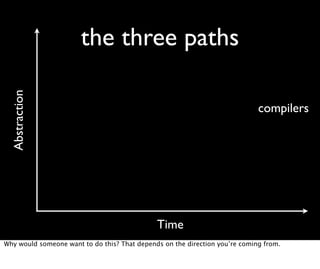
the three paths
  Abstraction


                                                                             compilers


                                              Time
Why would someone want to do this? That depends on the direction you’re coming from.
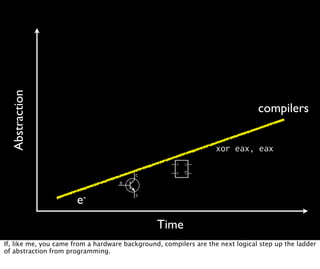
Abstraction


                                                                                compilers


                                                                   xor eax, eax


                       e-
                                                Time
If, like me, you came from a hardware background, compilers are the next logical step up the ladder
of abstraction from programming.
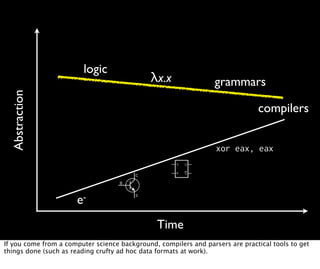
logic
                                              λx.x                grammars
  Abstraction


                                                                               compilers


                                                                  xor eax, eax


                      e-
                                                Time
If you come from a computer science background, compilers and parsers are practical tools to get
things done (such as reading crufty ad hoc data formats at work).
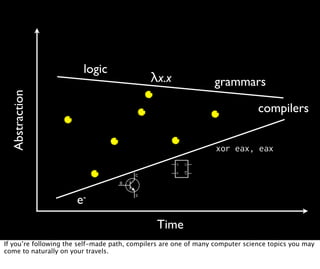
logic
                                             λx.x                grammars
  Abstraction


                                                                               compilers


                                                                  xor eax, eax


                      e-
                                               Time
If you’re following the self-made path, compilers are one of many computer science topics you may
come to naturally on your travels.
where we’re headed


By the end of this talk, we’ll have seen the basics of how to use JRuby to create a compiler for a
fictional programming language.
Thnad
                           a fictional programming language


Since all the good letters for programming languages are taken (C, D, K, R, etc.), let’s use a fictional
letter. “Thnad,” a letter that comes to us from Dr. Seuss, will do nicely.
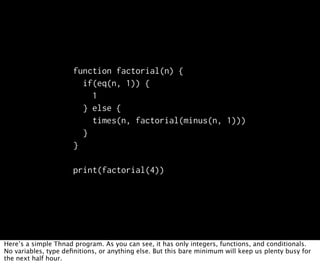
function factorial(n) {
                        if(eq(n, 1)) {
                          1
                        } else {
                          times(n, factorial(minus(n, 1)))
                        }
                      }

                      print(factorial(4))


Here’s a simple Thnad program. As you can see, it has only integers, functions, and conditionals.
No variables, type definitions, or anything else. But this bare minimum will keep us plenty busy for
the next half hour.
hand-waving
                                before we see the code


Before we jump into the code, let’s look at the general view of where we’re headed.
minus(n, 1)
             { :funcall =>
               { :name => 'minus' },
               { :args => [ { :arg => { :name   => 'n' } },
                            { :arg => { :number => '1' } } } ] }

                                          :funcall

                              :name                        :args


                              ‘minus’            :arg               :arg


                                                :name              :number


                                                     ‘n’             ’1’

We need to take a piece of program text like “minus(n, 1)” and break it down into something like a
sentence’s parts of speech: this is a function call, this is a parameter, and so on. The code in the
middle is how we might represent this breakdown in Ruby, but really we should be thinking about it
graphically, like the tree at the bottom.
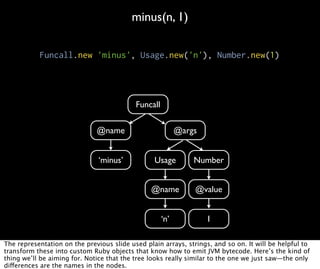
minus(n, 1)

           Funcall.new 'minus', Usage.new('n'), Number.new(1)


                                           Funcall

                              @name                        @args


                               ‘minus’           Usage         Number


                                                @name          @value


                                                     ‘n’           1

The representation on the previous slide used plain arrays, strings, and so on. It will be helpful to
transform these into custom Ruby objects that know how to emit JVM bytecode. Here’s the kind of
thing we’ll be aiming for. Notice that the tree looks really similar to the one we just saw—the only
differences are the names in the nodes.
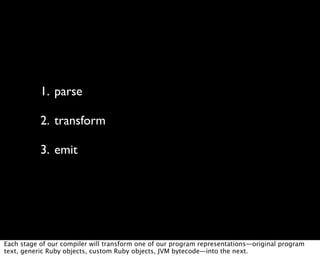
1. parse

           2. transform

           3. emit


Each stage of our compiler will transform one of our program representations—original program
text, generic Ruby objects, custom Ruby objects, JVM bytecode—into the next.
1. parse


First, let’s look at parsing the original program text into generic Ruby objects.
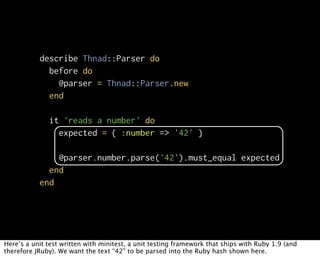
describe Thnad::Parser do
             before do
               @parser = Thnad::Parser.new
             end

              it 'reads a number' do
                expected = { :number => '42' }

               @parser.number.parse('42').must_equal expected
             end
           end


Here’s a unit test written with minitest, a unit testing framework that ships with Ruby 1.9 (and
therefore JRuby). We want the text “42” to be parsed into the Ruby hash shown here.
tool #1: Parslet
                         http://kschiess.github.com/parslet


How are we going to parse our programming language into that internal representation? By using
Parslet, a parsing tool written in Ruby. For the curious, Parslet is a PEG (Parsing Expression
Grammar) parser.
require 'parslet'

module Thnad
  class Parser < Parslet::Parser
    # gotta see it all
    rule(:space) { match('s').repeat(1) }
    rule(:space?) { space.maybe }

    # numeric values
    rule(:number) { match('[0-9]').repeat(1).as(:number) >> space? }
  end
end


Here’s a set of Parslet rules that will get our unit test to pass. Notice that the rules read a little bit
like a mathematical notation: “a number is a sequence of one or more digits, possibly followed by
trailing whitespace.”
2. transform


The next step is to transform the Ruby arrays and hashes into more sophisticated objects that will
(eventually) be able to generate bytecode.
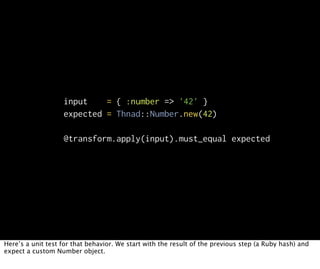
input    = { :number => '42' }
                   expected = Thnad::Number.new(42)

                   @transform.apply(input).must_equal expected


Here’s a unit test for that behavior. We start with the result of the previous step (a Ruby hash) and
expect a custom Number object.
tool #2: Parslet
                                             (again)


How are we going to transform the data? We’ll use Parslet again.
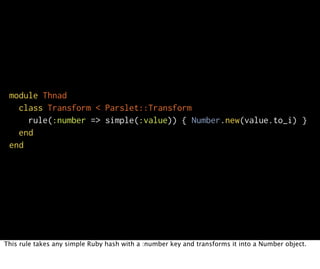
module Thnad
   class Transform < Parslet::Transform
     rule(:number => simple(:value)) { Number.new(value.to_i) }
   end
 end


This rule takes any simple Ruby hash with a :number key and transforms it into a Number object.
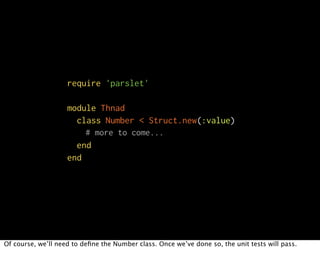
require 'parslet'

                    module Thnad
                      class Number < Struct.new(:value)
                        # more to come...
                      end
                    end


Of course, we’ll need to define the Number class. Once we’ve done so, the unit tests will pass.
3. emit


Finally, we need to emit JVM bytecode.
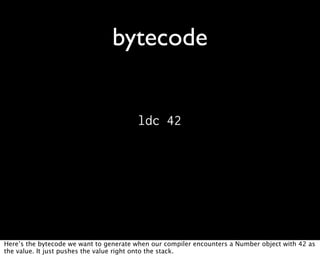
bytecode


                                        ldc 42


Here’s the bytecode we want to generate when our compiler encounters a Number object with 42 as
the value. It just pushes the value right onto the stack.
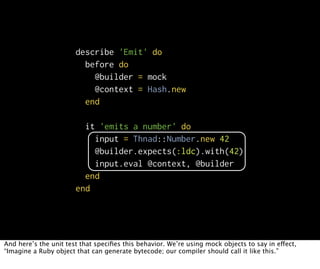
describe 'Emit' do
                         before do
                           @builder = mock
                           @context = Hash.new
                         end

                         it 'emits a number' do
                           input = Thnad::Number.new 42
                           @builder.expects(:ldc).with(42)
                           input.eval @context, @builder
                         end
                       end


And here’s the unit test that specifies this behavior. We’re using mock objects to say in effect,
“Imagine a Ruby object that can generate bytecode; our compiler should call it like this.”
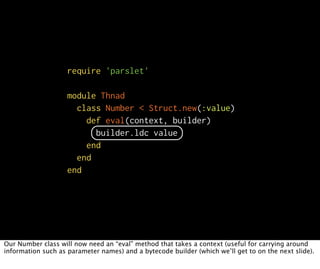
require 'parslet'

                    module Thnad
                      class Number < Struct.new(:value)
                        def eval(context, builder)
                          builder.ldc value
                        end
                      end
                    end


Our Number class will now need an “eval” method that takes a context (useful for carrying around
information such as parameter names) and a bytecode builder (which we’ll get to on the next slide).
tool #3: BiteScript
                      https://github.com/headius/bitescript


A moment ago, we saw that we’ll need a Ruby object that knows how to emit JVM bytecode. The
BiteScript library for JRuby will give us just such an object.
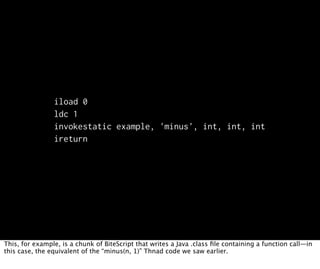
iload 0
                ldc 1
                invokestatic example, 'minus', int, int, int
                ireturn


This, for example, is a chunk of BiteScript that writes a Java .class file containing a function call—in
this case, the equivalent of the “minus(n, 1)” Thnad code we saw earlier.
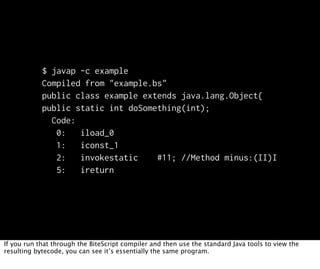
$ javap -c example
            Compiled from "example.bs"
            public class example extends java.lang.Object{
            public static int doSomething(int);
              Code:
               0:   iload_0
               1:   iconst_1
               2:   invokestatic    #11; //Method minus:(II)I
               5:   ireturn


If you run that through the BiteScript compiler and then use the standard Java tools to view the
resulting bytecode, you can see it’s essentially the same program.
enough hand-waving
                                   let’s see the code!


Armed with this background information, we can now jump into the code.
a copy of our home game
                         https://github.com/undees/thnad


At this point in the talk, I fired up TextMate and navigated through the project, choosing the
direction based on whim and audience questions. You can follow along at home by looking at the
various commits made to this project on GitHub.
more on BiteScript
                   http://www.slideshare.net/CharlesNutter/
                    redev-2010-jvm-bytecode-for-dummies


There are two resources I found helpful during this project. The first was Charles Nutter’s primer on
Java bytecode, which was the only JVM reference material necessary to write this compiler.
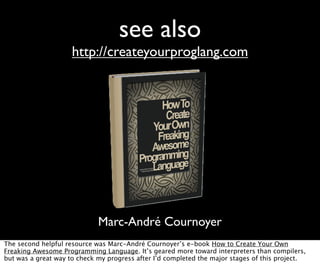
see also
                     http://createyourproglang.com


                             Marc-André Cournoyer
The second helpful resource was Marc-André Cournoyer’s e-book How to Create Your Own
Freaking Awesome Programming Language. It’s geared more toward interpreters than compilers,
but was a great way to check my progress after I’d completed the major stages of this project.
hopes


My hope for us as a group today is that, after our time together, you feel it might be worth giving
one of these tools a shot—either for a fun side project, or to solve some protocol parsing need you
may encounter one day in your work.

Write Your Own JVM Compiler

  • 1.
    Write your own JVM compiler OSCON Java 2011 Ian Dees @undees Hi, I’m Ian. I’m here to show that there’s never been a better time than now to write your own compiler.
  • 2.
    the three paths Abstraction compilers Time Why would someone want to do this? That depends on the direction you’re coming from.
  • 3.
    Abstraction compilers xor eax, eax e- Time If, like me, you came from a hardware background, compilers are the next logical step up the ladder of abstraction from programming.
  • 4.
    logic λx.x grammars Abstraction compilers xor eax, eax e- Time If you come from a computer science background, compilers and parsers are practical tools to get things done (such as reading crufty ad hoc data formats at work).
  • 5.
    logic λx.x grammars Abstraction compilers xor eax, eax e- Time If you’re following the self-made path, compilers are one of many computer science topics you may come to naturally on your travels.
  • 6.
    where we’re headed Bythe end of this talk, we’ll have seen the basics of how to use JRuby to create a compiler for a fictional programming language.
  • 7.
    Thnad a fictional programming language Since all the good letters for programming languages are taken (C, D, K, R, etc.), let’s use a fictional letter. “Thnad,” a letter that comes to us from Dr. Seuss, will do nicely.
  • 8.
    function factorial(n) { if(eq(n, 1)) { 1 } else { times(n, factorial(minus(n, 1))) } } print(factorial(4)) Here’s a simple Thnad program. As you can see, it has only integers, functions, and conditionals. No variables, type definitions, or anything else. But this bare minimum will keep us plenty busy for the next half hour.
  • 9.
    hand-waving before we see the code Before we jump into the code, let’s look at the general view of where we’re headed.
  • 10.
    minus(n, 1) { :funcall => { :name => 'minus' }, { :args => [ { :arg => { :name => 'n' } }, { :arg => { :number => '1' } } } ] } :funcall :name :args ‘minus’ :arg :arg :name :number ‘n’ ’1’ We need to take a piece of program text like “minus(n, 1)” and break it down into something like a sentence’s parts of speech: this is a function call, this is a parameter, and so on. The code in the middle is how we might represent this breakdown in Ruby, but really we should be thinking about it graphically, like the tree at the bottom.
  • 11.
    minus(n, 1) Funcall.new 'minus', Usage.new('n'), Number.new(1) Funcall @name @args ‘minus’ Usage Number @name @value ‘n’ 1 The representation on the previous slide used plain arrays, strings, and so on. It will be helpful to transform these into custom Ruby objects that know how to emit JVM bytecode. Here’s the kind of thing we’ll be aiming for. Notice that the tree looks really similar to the one we just saw—the only differences are the names in the nodes.
  • 12.
    1. parse 2. transform 3. emit Each stage of our compiler will transform one of our program representations—original program text, generic Ruby objects, custom Ruby objects, JVM bytecode—into the next.
  • 13.
    1. parse First, let’slook at parsing the original program text into generic Ruby objects.
  • 14.
    describe Thnad::Parser do before do @parser = Thnad::Parser.new end it 'reads a number' do expected = { :number => '42' } @parser.number.parse('42').must_equal expected end end Here’s a unit test written with minitest, a unit testing framework that ships with Ruby 1.9 (and therefore JRuby). We want the text “42” to be parsed into the Ruby hash shown here.
  • 15.
    tool #1: Parslet http://kschiess.github.com/parslet How are we going to parse our programming language into that internal representation? By using Parslet, a parsing tool written in Ruby. For the curious, Parslet is a PEG (Parsing Expression Grammar) parser.
  • 16.
    require 'parslet' module Thnad class Parser < Parslet::Parser # gotta see it all rule(:space) { match('s').repeat(1) } rule(:space?) { space.maybe } # numeric values rule(:number) { match('[0-9]').repeat(1).as(:number) >> space? } end end Here’s a set of Parslet rules that will get our unit test to pass. Notice that the rules read a little bit like a mathematical notation: “a number is a sequence of one or more digits, possibly followed by trailing whitespace.”
  • 17.
    2. transform The nextstep is to transform the Ruby arrays and hashes into more sophisticated objects that will (eventually) be able to generate bytecode.
  • 18.
    input = { :number => '42' } expected = Thnad::Number.new(42) @transform.apply(input).must_equal expected Here’s a unit test for that behavior. We start with the result of the previous step (a Ruby hash) and expect a custom Number object.
  • 19.
    tool #2: Parslet (again) How are we going to transform the data? We’ll use Parslet again.
  • 20.
    module Thnad class Transform < Parslet::Transform rule(:number => simple(:value)) { Number.new(value.to_i) } end end This rule takes any simple Ruby hash with a :number key and transforms it into a Number object.
  • 21.
    require 'parslet' module Thnad class Number < Struct.new(:value) # more to come... end end Of course, we’ll need to define the Number class. Once we’ve done so, the unit tests will pass.
  • 22.
    3. emit Finally, weneed to emit JVM bytecode.
  • 23.
    bytecode ldc 42 Here’s the bytecode we want to generate when our compiler encounters a Number object with 42 as the value. It just pushes the value right onto the stack.
  • 24.
    describe 'Emit' do before do @builder = mock @context = Hash.new end it 'emits a number' do input = Thnad::Number.new 42 @builder.expects(:ldc).with(42) input.eval @context, @builder end end And here’s the unit test that specifies this behavior. We’re using mock objects to say in effect, “Imagine a Ruby object that can generate bytecode; our compiler should call it like this.”
  • 25.
    require 'parslet' module Thnad class Number < Struct.new(:value) def eval(context, builder) builder.ldc value end end end Our Number class will now need an “eval” method that takes a context (useful for carrying around information such as parameter names) and a bytecode builder (which we’ll get to on the next slide).
  • 26.
    tool #3: BiteScript https://github.com/headius/bitescript A moment ago, we saw that we’ll need a Ruby object that knows how to emit JVM bytecode. The BiteScript library for JRuby will give us just such an object.
  • 27.
    iload 0 ldc 1 invokestatic example, 'minus', int, int, int ireturn This, for example, is a chunk of BiteScript that writes a Java .class file containing a function call—in this case, the equivalent of the “minus(n, 1)” Thnad code we saw earlier.
  • 28.
    $ javap -cexample Compiled from "example.bs" public class example extends java.lang.Object{ public static int doSomething(int); Code: 0: iload_0 1: iconst_1 2: invokestatic #11; //Method minus:(II)I 5: ireturn If you run that through the BiteScript compiler and then use the standard Java tools to view the resulting bytecode, you can see it’s essentially the same program.
  • 29.
    enough hand-waving let’s see the code! Armed with this background information, we can now jump into the code.
  • 30.
    a copy ofour home game https://github.com/undees/thnad At this point in the talk, I fired up TextMate and navigated through the project, choosing the direction based on whim and audience questions. You can follow along at home by looking at the various commits made to this project on GitHub.
  • 31.
    more on BiteScript http://www.slideshare.net/CharlesNutter/ redev-2010-jvm-bytecode-for-dummies There are two resources I found helpful during this project. The first was Charles Nutter’s primer on Java bytecode, which was the only JVM reference material necessary to write this compiler.
  • 32.
    see also http://createyourproglang.com Marc-André Cournoyer The second helpful resource was Marc-André Cournoyer’s e-book How to Create Your Own Freaking Awesome Programming Language. It’s geared more toward interpreters than compilers, but was a great way to check my progress after I’d completed the major stages of this project.
  • 33.
    hopes My hope forus as a group today is that, after our time together, you feel it might be worth giving one of these tools a shot—either for a fun side project, or to solve some protocol parsing need you may encounter one day in your work.