
Prepared by:
Jane Charity A. Estrada
MA-ELT1
Misamis University
What is a “task”?
A.Real – world tasks
B.Pedagogical tasks
How should
we design a
task?
Key Dimensions of Task
• Language (pedagogical goals)
• Procedure
• Roles of teachers and learners
– TEACHER : selector & sequencer of tasks,
evaluator
– LEARNER: innovator, risk-taker, active participant
• Setting
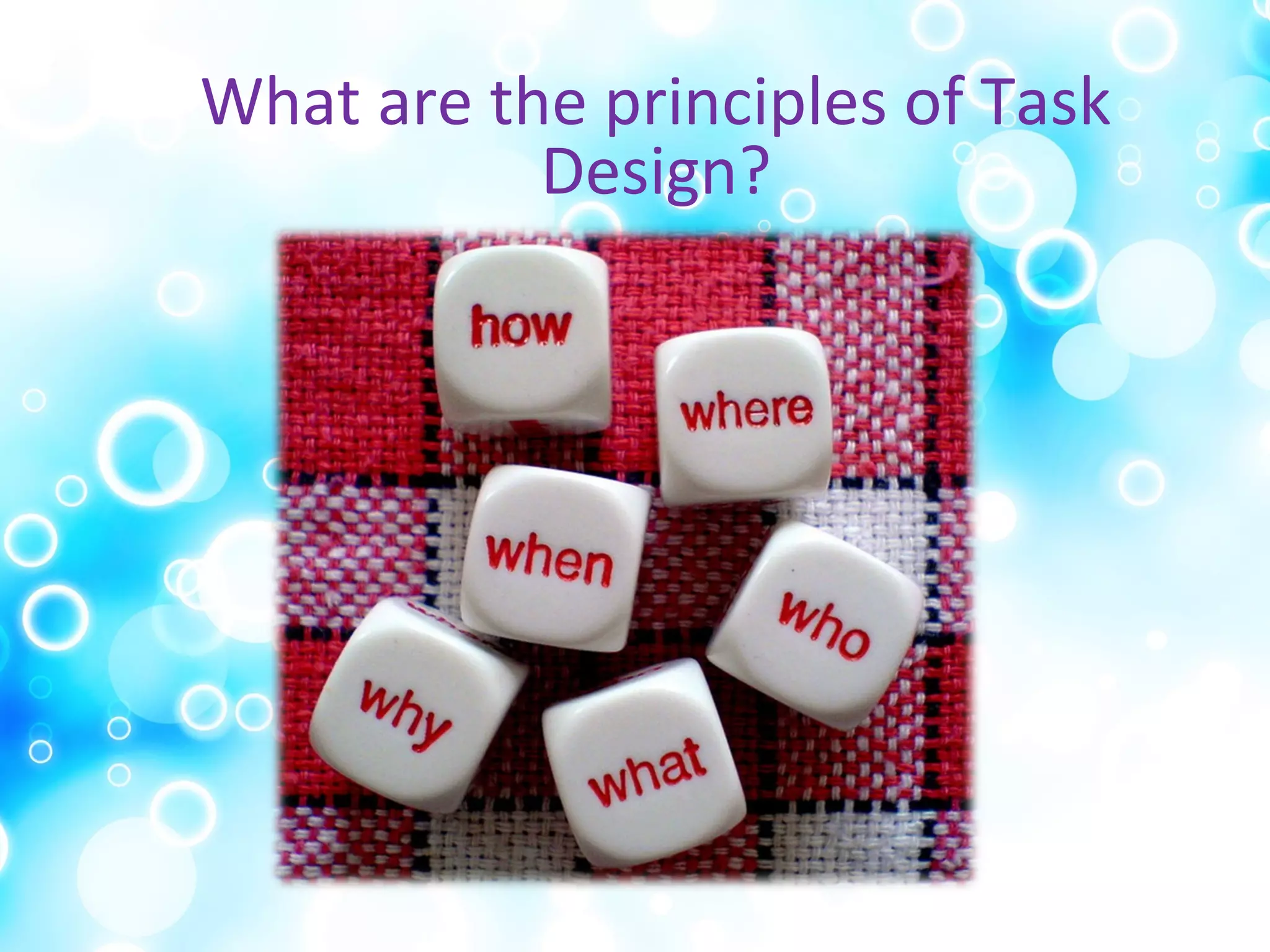
What are the principles of Task
Design?
The Authenticity
Principle
• “Learners should be fed as rich a diet of
authentic data”
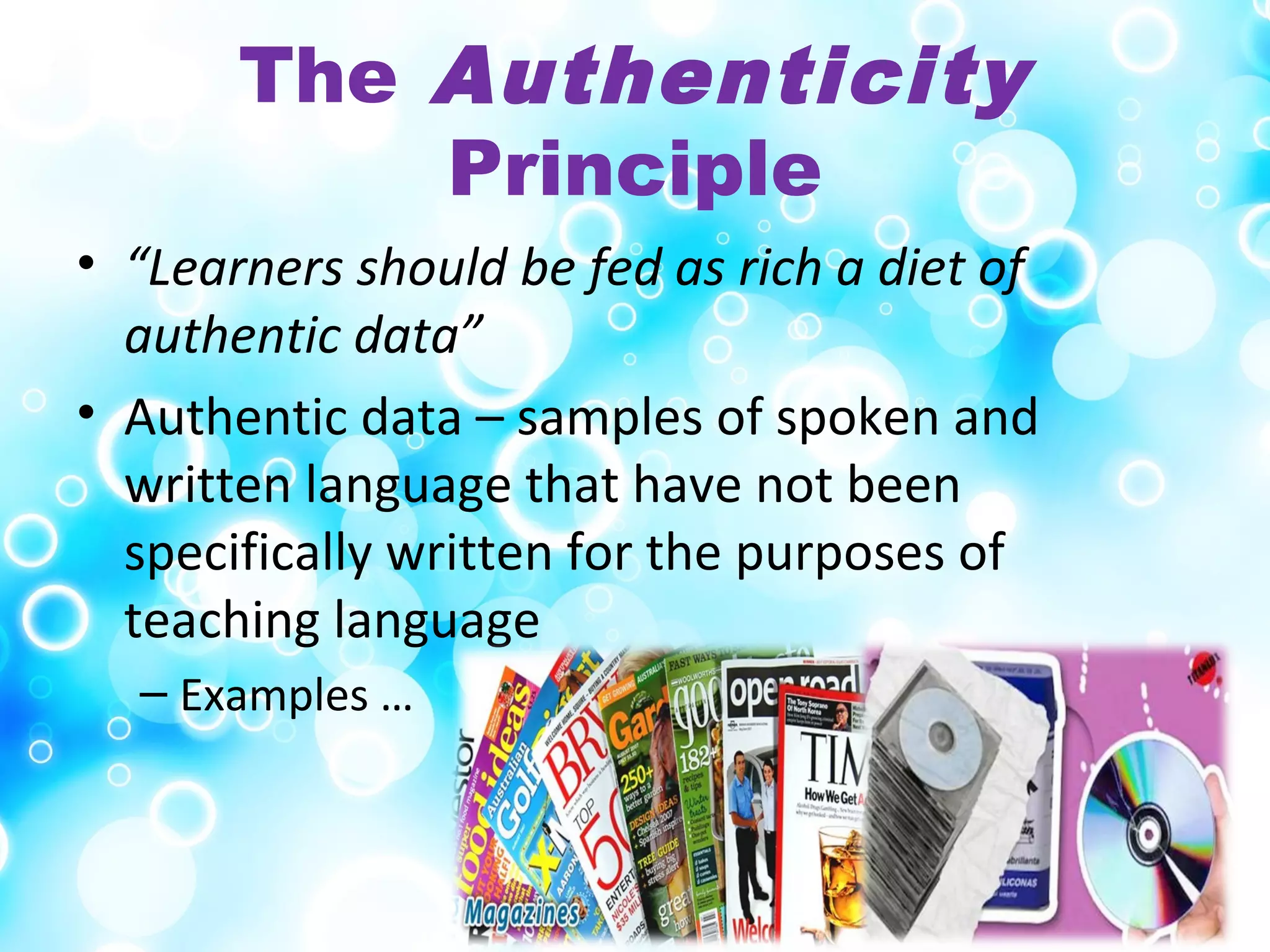
• Authentic data – samples of spoken and
written language that have not been
specifically written for the purposes of
teaching language
– Examples …
• Learners encounter
target language
items in the kinds of
contexts where they
naturally occur.
WHY?WHY?
The Form-Function
Principle
• In language teaching, make form and function
relationships transparent.
• Design tasks that require learners to use
inductive and deductive reasoning to develop
their own understanding of the relationship
between form and function.
The Task Dependency
Principle
• “Each succeeding task in the instructional
sequence flows out of, and is dependent on,
the one that precedes it.”
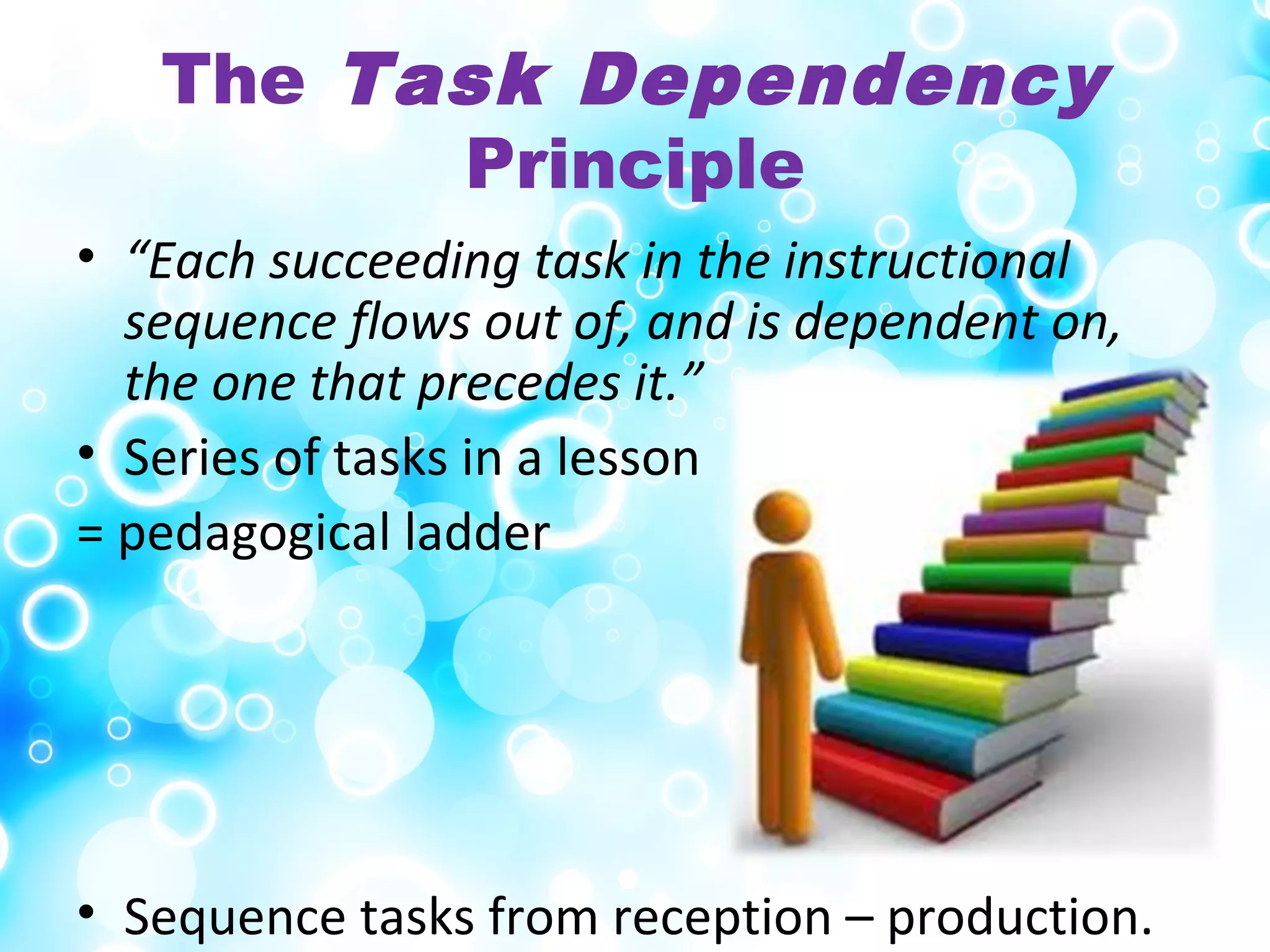
• Series of tasks in a lesson
= pedagogical ladder
• Sequence tasks from reception – production.
• “Arrange an instructional sequence so that
reproductive tasks precede creative tasks.”
– Reproductive tasks – the student reproduces
language provided by the teacher, textbook, tape
– Creative tasks – require learners to come up with
language with novel combinations of familiar
elements from earlier tasks
Designing a Sequence of Task
• CONSIDER:
– Pedagogical goals
– learning strategies
– Experiential and inductive learning
– Extent to which learners share their feelings,
ideas, attitudes
– Learners’ role (active)
– Opportunities they have to make choices
• Prior tasks provide learners with the language
models and experiential content that they will
need to carry out the tasks that follow.
– Each task builds on the one that goes before.
Task
Work with three other students. You are on a ship that
is sinking. You have to swim to a nearby island. You
have a waterproof container, but can only carry 20 kilos
of items in it. Decide which of the following items you
will take. (Remember, you can’t take more than 20
kilos with you.)
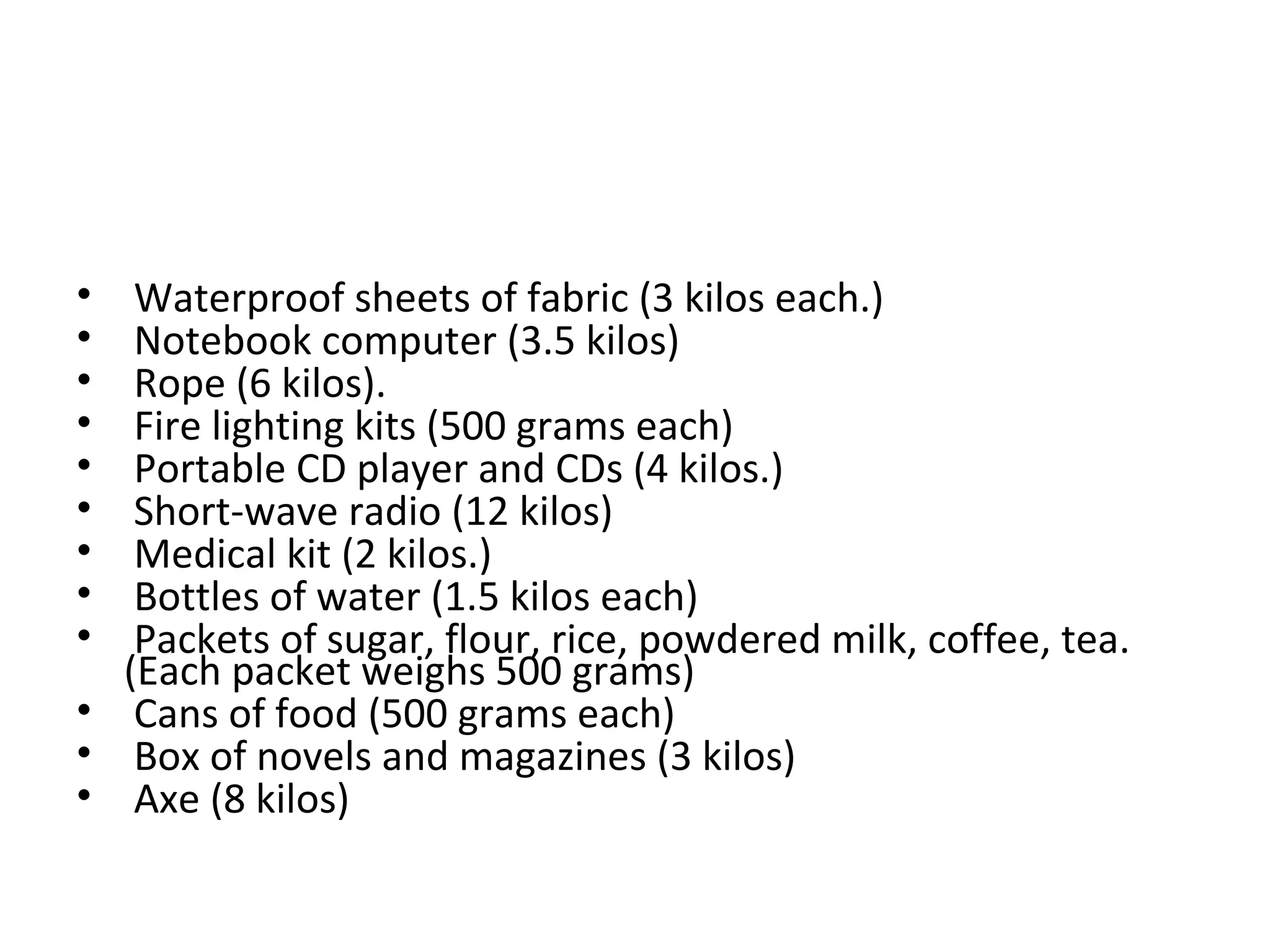
• Waterproof sheets of fabric (3 kilos each.)
• Notebook computer (3.5 kilos)
• Rope (6 kilos).
• Fire lighting kits (500 grams each)
• Portable CD player and CDs (4 kilos.)
• Short-wave radio (12 kilos)
• Medical kit (2 kilos.)
• Bottles of water (1.5 kilos each)
• Packets of sugar, flour, rice, powdered milk, coffee, tea.
(Each packet weighs 500 grams)
• Cans of food (500 grams each)
• Box of novels and magazines (3 kilos)
• Axe (8 kilos)

Task based language teaching

  • 1.
    Prepared by: Jane CharityA. Estrada MA-ELT1 Misamis University
  • 2.
    What is a“task”? A.Real – world tasks B.Pedagogical tasks
  • 4.
  • 5.
    Key Dimensions ofTask • Language (pedagogical goals) • Procedure • Roles of teachers and learners – TEACHER : selector & sequencer of tasks, evaluator – LEARNER: innovator, risk-taker, active participant • Setting
  • 6.
    What are theprinciples of Task Design?
  • 7.
    The Authenticity Principle • “Learnersshould be fed as rich a diet of authentic data” • Authentic data – samples of spoken and written language that have not been specifically written for the purposes of teaching language – Examples …
  • 8.
    • Learners encounter targetlanguage items in the kinds of contexts where they naturally occur. WHY?WHY?
  • 9.
    The Form-Function Principle • Inlanguage teaching, make form and function relationships transparent. • Design tasks that require learners to use inductive and deductive reasoning to develop their own understanding of the relationship between form and function.
  • 10.
    The Task Dependency Principle •“Each succeeding task in the instructional sequence flows out of, and is dependent on, the one that precedes it.” • Series of tasks in a lesson = pedagogical ladder • Sequence tasks from reception – production.
  • 11.
    • “Arrange aninstructional sequence so that reproductive tasks precede creative tasks.” – Reproductive tasks – the student reproduces language provided by the teacher, textbook, tape – Creative tasks – require learners to come up with language with novel combinations of familiar elements from earlier tasks
  • 12.
    Designing a Sequenceof Task • CONSIDER: – Pedagogical goals – learning strategies – Experiential and inductive learning – Extent to which learners share their feelings, ideas, attitudes – Learners’ role (active) – Opportunities they have to make choices
  • 14.
    • Prior tasksprovide learners with the language models and experiential content that they will need to carry out the tasks that follow. – Each task builds on the one that goes before.
  • 15.
    Task Work with threeother students. You are on a ship that is sinking. You have to swim to a nearby island. You have a waterproof container, but can only carry 20 kilos of items in it. Decide which of the following items you will take. (Remember, you can’t take more than 20 kilos with you.)
  • 16.
    • Waterproof sheetsof fabric (3 kilos each.) • Notebook computer (3.5 kilos) • Rope (6 kilos). • Fire lighting kits (500 grams each) • Portable CD player and CDs (4 kilos.) • Short-wave radio (12 kilos) • Medical kit (2 kilos.) • Bottles of water (1.5 kilos each) • Packets of sugar, flour, rice, powdered milk, coffee, tea. (Each packet weighs 500 grams) • Cans of food (500 grams each) • Box of novels and magazines (3 kilos) • Axe (8 kilos)

Editor's Notes