2009. 10. 9                       TOKYO INSTITUTE OF TECHNOLOGY
                                   DEPARTMENT OF COMPUTER SCIENCE
MODELS 2009


      Generating Assertion
        Code from OCL:
  A Transformational Approach Based on
 Similarities of Implementation Languages

 Rodion Moiseev Shinpei Hayashi Motoshi Saeki

               Department of Computer Science
                Tokyo Institute of Technology
                            Japan
Abstract
   Generation Assertion Code from OCL
    − Transformational Approach:
      Regarding OCL-to-code as model transformation
    − Similarities of Implementation Languages:
      Constructing a language hierarchy for effective
      developing of transformation rules
   Results
    − A translation framework has been developed
    − Showed ~50% of effort to construct translation
      rules saved
                                                        2
Background
 Model-centric approaches are becoming
  important in academia and industry
 OCL is often the language of choice for
  stipulating constraints on models
 Successful application depends on
  mature tool support:
    − Support for multiple programming languages
    − Customizable assertion code/test case
      generation
                                                   3
Motivating Example
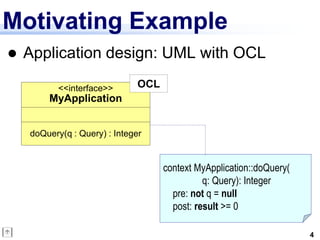
   Application design: UML with OCL

           <<interface>>       OCL
        MyApplication


    doQuery(q : Query) : Integer


                                     context MyApplication::doQuery(
                                               q: Query): Integer
                                       pre: not q = null
                                       post: result >= 0

                                                                       4
Motivating Example
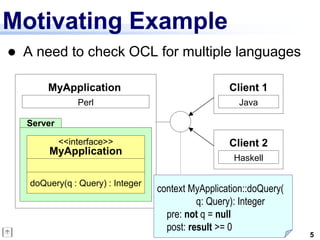
   A need to check OCL for multiple languages

         MyApplication                               Client 1
                 Perl                                   Java

    Server

             <<interface>>                           Client 2
         MyApplication
                                                      Haskell

     doQuery(q : Query) : Integer
                                    context MyApplication::doQuery(
                                              q: Query): Integer
                                      pre: not q = null
                                      post: result >= 0
                                                                      5
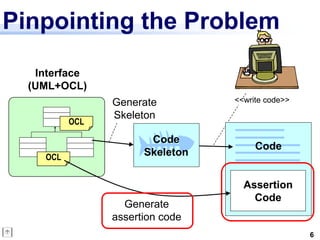
Pinpointing the Problem
   Interface
  (UML+OCL)
                 Generate         <<write code>>
                 Skeleton
           OCL

                        Code
                                       Code
     OCL
                       Skeleton


                                    Assertion
                                      Code
                   Generate
                 assertion code
                                                   6
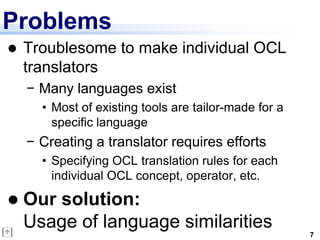
Problems
   Troublesome to make individual OCL
    translators
    − Many languages exist
      • Most of existing tools are tailor-made for a
        specific language
    − Creating a translator requires efforts
      • Specifying OCL translation rules for each
        individual OCL concept, operator, etc.

   Our solution:
    Usage of language similarities
                                                       7
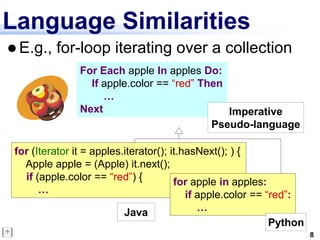
Language Similarities
 E.g.,    for-loop iterating over a collection
                For Each apple In apples Do:
                  If apple.color == “red” Then
                     …
                Next                           Imperative
                                            Pseudo-language

 for (Iterator it = apples.iterator(); it.hasNext(); ) {
   Apple apple = (Apple) it.next();
   if (apple.color == “red”) {          for apple in apples:
       …                                   if apple.color == “red”:
                           Java             …
                                                             Python
                                                                      8
The Approach
   Hierarchy of programming languages
    based on their structural similarities
                                   OCL


            Imperative             Functional                          DbC


Java, C# like            Python   Lisp          Haskell                JML

                           Step-by-step                   <<described in terms of>>
    Java        C#          Translation                   Pseudo-languages
                                                          Concrete languages
MultiJava
                                                                            High
                                                                    concreteness      9
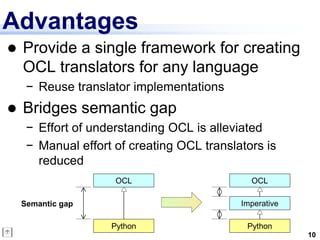
Advantages
   Provide a single framework for creating
    OCL translators for any language
     − Reuse translator implementations
   Bridges semantic gap
     − Effort of understanding OCL is alleviated
     − Manual effort of creating OCL translators is
       reduced
                     OCL                      OCL

    Semantic gap                            Imperative

                    Python                   Python
                                                         10
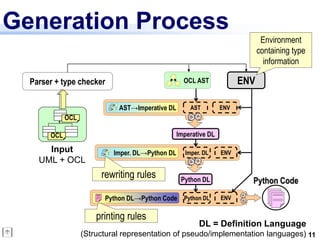
Generation Process
                                                                               Environment
                                                                              containing type
                                                                                information

  Parser + type checker                             OCL AST             ENV

                             AST→Imperative DL        AST         ENV
             OCL

       OCL                                        Imperative DL

      Input                 Imper. DL→Python DL     Imper. DL     ENV
    UML + OCL
                        rewriting rules            Python DL              Python Code
                         Python DL→Python Code Python DL          ENV


                       printing rules
                                                         DL = Definition Language
                   (Structural representation of pseudo/implementation languages) 11
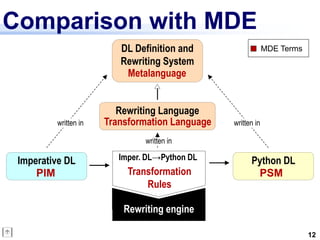
Comparison with MDE
                         DL Definition and                   MDE Terms
                         Rewriting System
                          Metalanguage


                         Rewriting Language
         written in   Transformation Language   written in

                               written in

 Imperative DL           Imper. DL→Python DL          Python DL
     PIM                   Transformation              PSM
                               Rules

                          Rewriting engine

                                                                         12
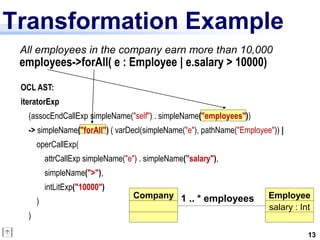
Transformation Example
 All employees in the company earn more than 10,000
 employees->forAll( e : Employee | e.salary > 10000)
 OCL AST:
 iteratorExp
   (assocEndCallExp simpleName("self") . simpleName("employees"))
   -> simpleName("forAll") ( varDecl(simpleName("e"), pathName("Employee")) |
       operCallExp(
           attrCallExp simpleName("e") . simpleName("salary"),
           simpleName(">"),
           intLitExp("10000")
                                     Company 1 .. * employees           Employee
       )
                                                                        salary : Int
   )

                                                                                   13
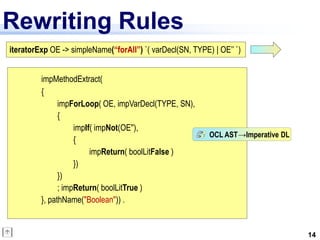
Rewriting Rules
iteratorExp OE -> simpleName(“forAll”) `( varDecl(SN, TYPE) | OE’’ `)


         impMethodExtract(
         {
               impForLoop( OE, impVarDecl(TYPE, SN),
               {
                    impIf( impNot(OE''),
                                                           OCL AST→Imperative DL
                    {
                         impReturn( boolLitFalse )
                    })
               })
               ; impReturn( boolLitTrue )
         }, pathName("Boolean")) .


                                                                                   14
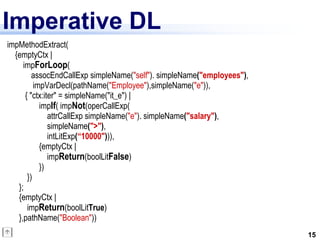
Imperative DL
impMethodExtract(
  {emptyCtx |
     impForLoop(
         assocEndCallExp simpleName("self"). simpleName("employees"),
          impVarDecl(pathName("Employee"),simpleName("e")),
      { "ctx:iter" = simpleName("it_e") |
            impIf( impNot(operCallExp(
               attrCallExp simpleName("e"). simpleName("salary"),
               simpleName(">"),
               intLitExp(“10000"))),
            {emptyCtx |
               impReturn(boolLitFalse)
            })
       })
   };
   {emptyCtx |
       impReturn(boolLitTrue)
   },pathName("Boolean"))
                                                                        15
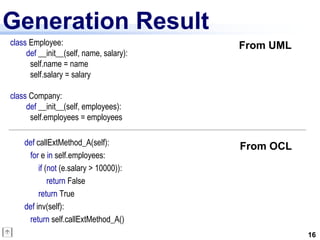
Generation Result
class Employee:                          From UML
     def __init__(self, name, salary):
      self.name = name
      self.salary = salary

class Company:
     def __init__(self, employees):
      self.employees = employees

    def callExtMethod_A(self):           From OCL
     for e in self.employees:
         if (not (e.salary > 10000)):
             return False
         return True
    def inv(self):
     return self.callExtMethod_A()
                                                    16
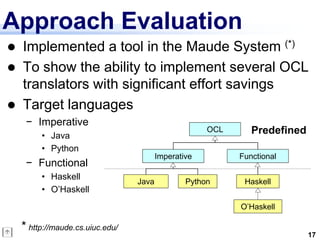
Approach Evaluation
   Implemented a tool in the Maude System (*)
   To show the ability to implement several OCL
    translators with significant effort savings
   Target languages
     − Imperative
         • Java
                                                      OCL      Predefined
         • Python
                                         Imperative         Functional
     − Functional
         • Haskell
                                  Java           Python      Haskell
         • O’Haskell
                                                            O’Haskell

    * http://maude.cs.uiuc.edu/
                                                                            17
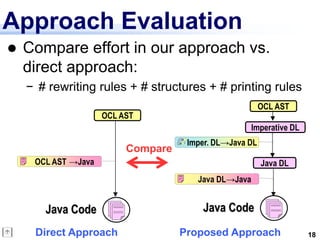
Approach Evaluation
   Compare effort in our approach vs.
    direct approach:
    − # rewriting rules + # structures + # printing rules
                                                         OCL AST
                     OCL AST
                                                      Imperative DL
                                     Imper. DL→Java DL
                          Compare
     OCL AST →Java                                       Java DL
                                       Java DL→Java


       Java Code                        Java Code
     Direct Approach                Proposed Approach                 18
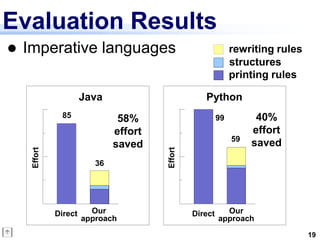
Evaluation Results
   Imperative languages                                      rewriting rules
                                                              structures
                                                              printing rules

                      Java                         Python
               85              58%                       99         40%
                              effort                               effort
                                                              59
                              saved                                saved
    Effort


                                       Effort
                         36


             Direct     Our                     Direct     Our
                      approach                           approach

                                                                                19
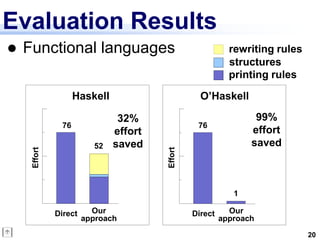
Evaluation Results
   Functional languages                                   rewriting rules
                                                           structures
                                                           printing rules

                    Haskell                       O’Haskell

                               32%                               99%
               76                                76
                              effort                            effort
                        52    saved                             saved
    Effort


                                       Effort

                                                            1

             Direct     Our                     Direct     Our
                      approach                           approach

                                                                             20
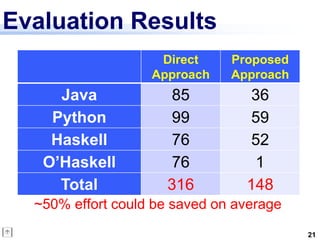
Evaluation Results
                    Direct     Proposed
                   Approach    Approach
     Java             85          36
    Python            99          59
    Haskell           76          52
   O’Haskell          76          1
     Total           316         148
  ~50% effort could be saved on average
                                          21
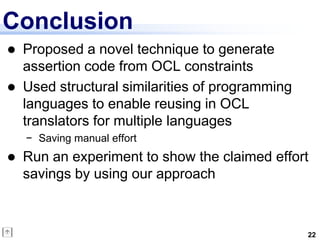
Conclusion
   Proposed a novel technique to generate
    assertion code from OCL constraints
   Used structural similarities of programming
    languages to enable reusing in OCL
    translators for multiple languages
    − Saving manual effort
   Run an experiment to show the claimed effort
    savings by using our approach


                                                  22
Future Work
   Uncovered functionalities of OCL
    − History expressions (@pre)
    − OCL messages
    − allInstances, etc.
   Hierarchy Limitations
    − Difficult to extend hierarchy from the middle
    − Does not allow multiple parent nodes
      (e.g. useful for implementing an
      imperative/functional hybrid)
   Real case study
                                                      23

Generating Assertion Code from OCL: A Transformational Approach Based on Similarities of Implementation Languages

  • 1.
    2009. 10. 9 TOKYO INSTITUTE OF TECHNOLOGY DEPARTMENT OF COMPUTER SCIENCE MODELS 2009 Generating Assertion Code from OCL: A Transformational Approach Based on Similarities of Implementation Languages Rodion Moiseev Shinpei Hayashi Motoshi Saeki Department of Computer Science Tokyo Institute of Technology Japan
  • 2.
    Abstract  Generation Assertion Code from OCL − Transformational Approach: Regarding OCL-to-code as model transformation − Similarities of Implementation Languages: Constructing a language hierarchy for effective developing of transformation rules  Results − A translation framework has been developed − Showed ~50% of effort to construct translation rules saved 2
  • 3.
    Background  Model-centric approachesare becoming important in academia and industry  OCL is often the language of choice for stipulating constraints on models  Successful application depends on mature tool support: − Support for multiple programming languages − Customizable assertion code/test case generation 3
  • 4.
    Motivating Example  Application design: UML with OCL <<interface>> OCL MyApplication doQuery(q : Query) : Integer context MyApplication::doQuery( q: Query): Integer pre: not q = null post: result >= 0 4
  • 5.
    Motivating Example  A need to check OCL for multiple languages MyApplication Client 1 Perl Java Server <<interface>> Client 2 MyApplication Haskell doQuery(q : Query) : Integer context MyApplication::doQuery( q: Query): Integer pre: not q = null post: result >= 0 5
  • 6.
    Pinpointing the Problem Interface (UML+OCL) Generate <<write code>> Skeleton OCL Code Code OCL Skeleton Assertion Code Generate assertion code 6
  • 7.
    Problems  Troublesome to make individual OCL translators − Many languages exist • Most of existing tools are tailor-made for a specific language − Creating a translator requires efforts • Specifying OCL translation rules for each individual OCL concept, operator, etc.  Our solution: Usage of language similarities 7
  • 8.
    Language Similarities  E.g., for-loop iterating over a collection For Each apple In apples Do: If apple.color == “red” Then … Next Imperative Pseudo-language for (Iterator it = apples.iterator(); it.hasNext(); ) { Apple apple = (Apple) it.next(); if (apple.color == “red”) { for apple in apples: … if apple.color == “red”: Java … Python 8
  • 9.
    The Approach  Hierarchy of programming languages based on their structural similarities OCL Imperative Functional DbC Java, C# like Python Lisp Haskell JML Step-by-step <<described in terms of>> Java C# Translation Pseudo-languages Concrete languages MultiJava High concreteness 9
  • 10.
    Advantages  Provide a single framework for creating OCL translators for any language − Reuse translator implementations  Bridges semantic gap − Effort of understanding OCL is alleviated − Manual effort of creating OCL translators is reduced OCL OCL Semantic gap Imperative Python Python 10
  • 11.
    Generation Process Environment containing type information Parser + type checker OCL AST ENV AST→Imperative DL AST ENV OCL OCL Imperative DL Input Imper. DL→Python DL Imper. DL ENV UML + OCL rewriting rules Python DL Python Code Python DL→Python Code Python DL ENV printing rules DL = Definition Language (Structural representation of pseudo/implementation languages) 11
  • 12.
    Comparison with MDE DL Definition and MDE Terms Rewriting System Metalanguage Rewriting Language written in Transformation Language written in written in Imperative DL Imper. DL→Python DL Python DL PIM Transformation PSM Rules Rewriting engine 12
  • 13.
    Transformation Example Allemployees in the company earn more than 10,000 employees->forAll( e : Employee | e.salary > 10000) OCL AST: iteratorExp (assocEndCallExp simpleName("self") . simpleName("employees")) -> simpleName("forAll") ( varDecl(simpleName("e"), pathName("Employee")) | operCallExp( attrCallExp simpleName("e") . simpleName("salary"), simpleName(">"), intLitExp("10000") Company 1 .. * employees Employee ) salary : Int ) 13
  • 14.
    Rewriting Rules iteratorExp OE-> simpleName(“forAll”) `( varDecl(SN, TYPE) | OE’’ `) impMethodExtract( { impForLoop( OE, impVarDecl(TYPE, SN), { impIf( impNot(OE''), OCL AST→Imperative DL { impReturn( boolLitFalse ) }) }) ; impReturn( boolLitTrue ) }, pathName("Boolean")) . 14
  • 15.
    Imperative DL impMethodExtract( {emptyCtx | impForLoop( assocEndCallExp simpleName("self"). simpleName("employees"), impVarDecl(pathName("Employee"),simpleName("e")), { "ctx:iter" = simpleName("it_e") | impIf( impNot(operCallExp( attrCallExp simpleName("e"). simpleName("salary"), simpleName(">"), intLitExp(“10000"))), {emptyCtx | impReturn(boolLitFalse) }) }) }; {emptyCtx | impReturn(boolLitTrue) },pathName("Boolean")) 15
  • 16.
    Generation Result class Employee: From UML def __init__(self, name, salary): self.name = name self.salary = salary class Company: def __init__(self, employees): self.employees = employees def callExtMethod_A(self): From OCL for e in self.employees: if (not (e.salary > 10000)): return False return True def inv(self): return self.callExtMethod_A() 16
  • 17.
    Approach Evaluation  Implemented a tool in the Maude System (*)  To show the ability to implement several OCL translators with significant effort savings  Target languages − Imperative • Java OCL Predefined • Python Imperative Functional − Functional • Haskell Java Python Haskell • O’Haskell O’Haskell * http://maude.cs.uiuc.edu/ 17
  • 18.
    Approach Evaluation  Compare effort in our approach vs. direct approach: − # rewriting rules + # structures + # printing rules OCL AST OCL AST Imperative DL Imper. DL→Java DL Compare OCL AST →Java Java DL Java DL→Java Java Code Java Code Direct Approach Proposed Approach 18
  • 19.
    Evaluation Results  Imperative languages rewriting rules structures printing rules Java Python 85 58% 99 40% effort effort 59 saved saved Effort Effort 36 Direct Our Direct Our approach approach 19
  • 20.
    Evaluation Results  Functional languages rewriting rules structures printing rules Haskell O’Haskell 32% 99% 76 76 effort effort 52 saved saved Effort Effort 1 Direct Our Direct Our approach approach 20
  • 21.
    Evaluation Results Direct Proposed Approach Approach Java 85 36 Python 99 59 Haskell 76 52 O’Haskell 76 1 Total 316 148 ~50% effort could be saved on average 21
  • 22.
    Conclusion  Proposed a novel technique to generate assertion code from OCL constraints  Used structural similarities of programming languages to enable reusing in OCL translators for multiple languages − Saving manual effort  Run an experiment to show the claimed effort savings by using our approach 22
  • 23.
    Future Work  Uncovered functionalities of OCL − History expressions (@pre) − OCL messages − allInstances, etc.  Hierarchy Limitations − Difficult to extend hierarchy from the middle − Does not allow multiple parent nodes (e.g. useful for implementing an imperative/functional hybrid)  Real case study 23