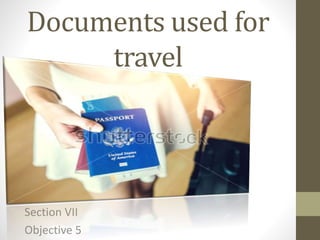
Documents used for
travel
Section VII
Objective 5
INTRODUCTION
Look at the Pixtoon comic on the next slide and
answer the following questions relating to some of
documents that may be required for travel.
<iframe src="//www.pixton.com/schools/embed/3m32q3y4"
frameborder="0" width="100%" height="384"
allowfullscreen></iframe>
Document required for travel
When travelling abroad on a vacation or
business trip, there are several documents
that a traveller is required to have. This
include:
Passport;
Visa;
Entry permit;
Health certificate;
Tax clearance certificate, where necessary.
PASSPORT
Passports act as identification and proof of
citizenship. It is issued by the government, giving
the bearer permission to travel to foreign
countries. A passport is usually valid for 5 or 10
years and is accepted as valid forms of
identification in most countries.
Information obtained from a Passport
• The traveller’s name
• The traveller’s place of birth
• Place of issue of the passport
• Date of issue
• Date of expiry
• Signature of the traveller
• Occupation of the traveller
• Names of countries previously visited and
the duration of those visits
• Visas
Visa
VISA
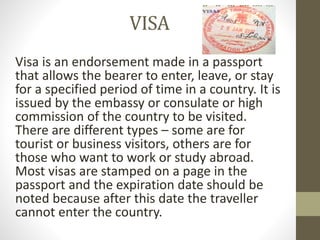
Visa is an endorsement made in a passport
that allows the bearer to enter, leave, or stay
for a specified period of time in a country. It is
issued by the embassy or consulate or high
commission of the country to be visited.
There are different types – some are for
tourist or business visitors, others are for
those who want to work or study abroad.
Most visas are stamped on a page in the
passport and the expiration date should be
noted because after this date the traveller
cannot enter the country.
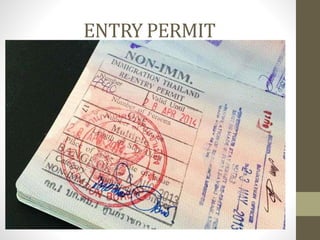
ENTRY PERMIT
ENTRY PERMIT
An entry permit is an endorsement granted
by an authority that denotes that an
application has been examined and
approved for the bearer to reside, work or
study for a specific length of time after
entry. Permits usually expire when a person
leaves the country
HEALTH CERTIFICATE
HEALTH CERTIFICATE
When travelling abroad, a traveller or business
executive may be exposed to various health
risks. Hence, some countries require a
vaccination certificate for entry into a country
with contagious diseases, or on return from
these country and re-entering the home
country. The World Health Organization (WTO)
encourages vaccination and other
precautionary measures against disease such
as yellow fever and malaria.
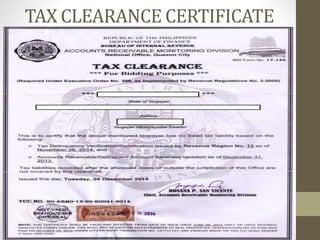
TAX CLEARANCE CERTIFICATE
A tax clearance certificate is issued by a
country’s revenue or tax department to
confirm that an individual departing the
country has no tax liabilities. The certificate
is usually shown to the customs or
immigration personnel on departure. This
document provides evidence that the
holder does not owe any tax on the date
the certificate is issued.
REFERENCES
Bradford, S. (2017). What documents do I need to travel.
Retrieved from
https://traveltips.usatoday.com/documents-need-travel-
overseas-107629.html
Carysforth, C., Neid, M., Maxime, C. & Metz, Y. (2012). Office
Administration for CSEC. A Caribbean Examination Council Study
Guide. Nelson Thornes.
Finisterre, S., Payne, L., & Reid, J. (2004). Longman Office
Administration for CXC. Pearson Education Limited.
Trendfield-Newsome, A. & Walker, C. (2011). Office
Administration for CSEC Examinations. Macmillan Publisher
Limited.

Documents required for travel

  • 1.
  • 2.
    INTRODUCTION Look at thePixtoon comic on the next slide and answer the following questions relating to some of documents that may be required for travel. <iframe src="//www.pixton.com/schools/embed/3m32q3y4" frameborder="0" width="100%" height="384" allowfullscreen></iframe>
  • 4.
    Document required fortravel When travelling abroad on a vacation or business trip, there are several documents that a traveller is required to have. This include: Passport; Visa; Entry permit; Health certificate; Tax clearance certificate, where necessary.
  • 6.
    PASSPORT Passports act asidentification and proof of citizenship. It is issued by the government, giving the bearer permission to travel to foreign countries. A passport is usually valid for 5 or 10 years and is accepted as valid forms of identification in most countries.
  • 7.
    Information obtained froma Passport • The traveller’s name • The traveller’s place of birth • Place of issue of the passport • Date of issue • Date of expiry • Signature of the traveller • Occupation of the traveller • Names of countries previously visited and the duration of those visits • Visas
  • 8.
  • 9.
    VISA Visa is anendorsement made in a passport that allows the bearer to enter, leave, or stay for a specified period of time in a country. It is issued by the embassy or consulate or high commission of the country to be visited. There are different types – some are for tourist or business visitors, others are for those who want to work or study abroad. Most visas are stamped on a page in the passport and the expiration date should be noted because after this date the traveller cannot enter the country.
  • 10.
  • 11.
    ENTRY PERMIT An entrypermit is an endorsement granted by an authority that denotes that an application has been examined and approved for the bearer to reside, work or study for a specific length of time after entry. Permits usually expire when a person leaves the country
  • 12.
  • 13.
    HEALTH CERTIFICATE When travellingabroad, a traveller or business executive may be exposed to various health risks. Hence, some countries require a vaccination certificate for entry into a country with contagious diseases, or on return from these country and re-entering the home country. The World Health Organization (WTO) encourages vaccination and other precautionary measures against disease such as yellow fever and malaria.
  • 14.
  • 15.
    TAX CLEARANCE CERTIFICATE Atax clearance certificate is issued by a country’s revenue or tax department to confirm that an individual departing the country has no tax liabilities. The certificate is usually shown to the customs or immigration personnel on departure. This document provides evidence that the holder does not owe any tax on the date the certificate is issued.
  • 16.
    REFERENCES Bradford, S. (2017).What documents do I need to travel. Retrieved from https://traveltips.usatoday.com/documents-need-travel- overseas-107629.html Carysforth, C., Neid, M., Maxime, C. & Metz, Y. (2012). Office Administration for CSEC. A Caribbean Examination Council Study Guide. Nelson Thornes. Finisterre, S., Payne, L., & Reid, J. (2004). Longman Office Administration for CXC. Pearson Education Limited. Trendfield-Newsome, A. & Walker, C. (2011). Office Administration for CSEC Examinations. Macmillan Publisher Limited.