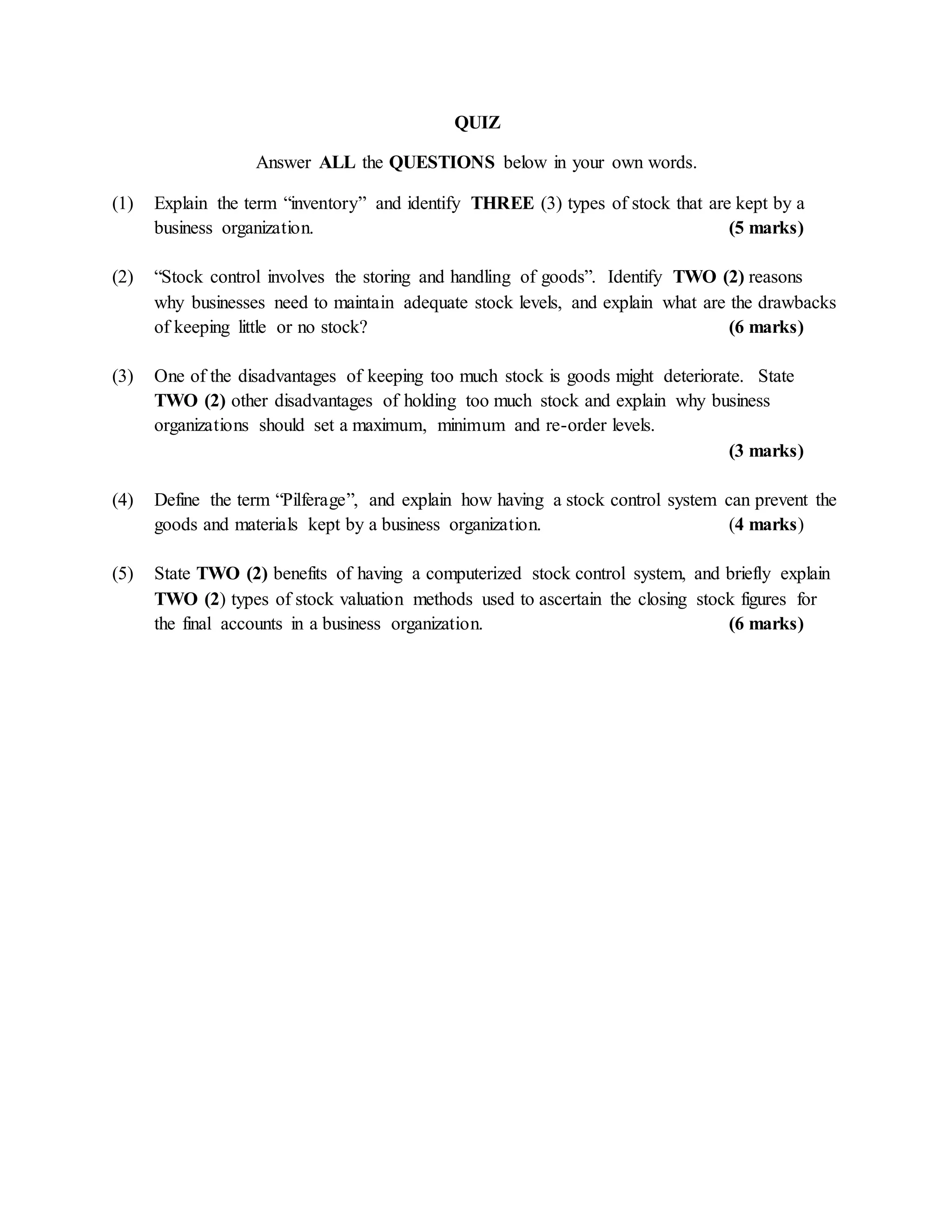
QUIZ
Answer ALL the QUESTIONS below in your own words.
(1) Explain the term “inventory” and identify THREE (3) types of stock that are kept by a
business organization. (5 marks)
(2) “Stock control involves the storing and handling of goods”. Identify TWO (2) reasons
why businesses need to maintain adequate stock levels, and explain what are the drawbacks
of keeping little or no stock? (6 marks)
(3) One of the disadvantages of keeping too much stock is goods might deteriorate. State
TWO (2) other disadvantages of holding too much stock and explain why business
organizations should set a maximum, minimum and re-order levels.
(3 marks)
(4) Define the term “Pilferage”, and explain how having a stock control system can prevent the
goods and materials kept by a business organization. (4 marks)
(5) State TWO (2) benefits of having a computerized stock control system, and briefly explain
TWO (2) types of stock valuation methods used to ascertain the closing stock figures for
the final accounts in a business organization. (6 marks)
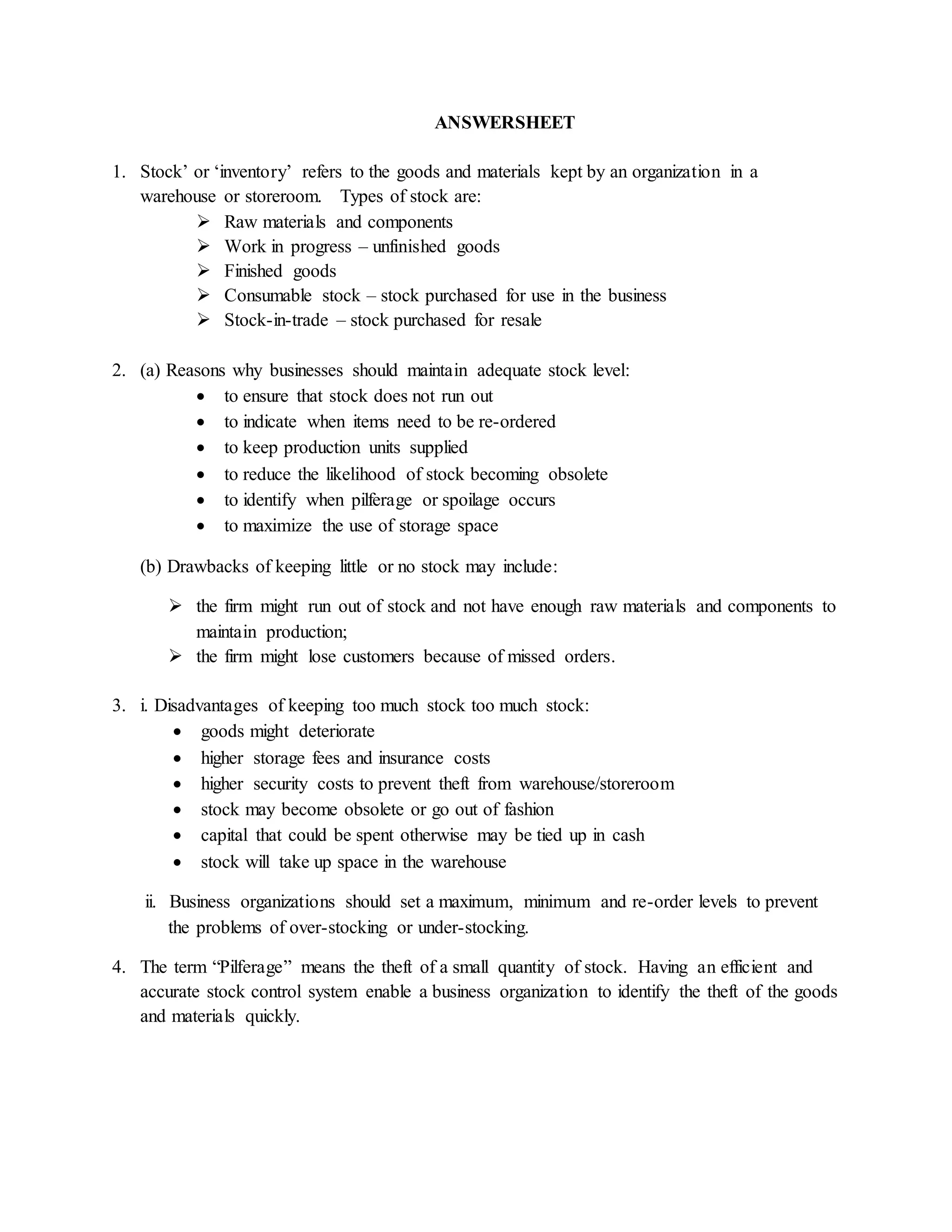
ANSWERSHEET
1. Stock’ or ‘inventory’ refers to the goods and materials kept by an organization in a
warehouse or storeroom. Types of stock are:
 Raw materials and components
 Work in progress – unfinished goods
 Finished goods
 Consumable stock – stock purchased for use in the business
 Stock-in-trade – stock purchased for resale
2. (a) Reasons why businesses should maintain adequate stock level:
 to ensure that stock does not run out
 to indicate when items need to be re-ordered
 to keep production units supplied
 to reduce the likelihood of stock becoming obsolete
 to identify when pilferage or spoilage occurs
 to maximize the use of storage space
(b) Drawbacks of keeping little or no stock may include:
 the firm might run out of stock and not have enough raw materials and components to
maintain production;
 the firm might lose customers because of missed orders.
3. i. Disadvantages of keeping too much stock too much stock:
 goods might deteriorate
 higher storage fees and insurance costs
 higher security costs to prevent theft from warehouse/storeroom
 stock may become obsolete or go out of fashion
 capital that could be spent otherwise may be tied up in cash
 stock will take up space in the warehouse
ii. Business organizations should set a maximum, minimum and re-order levels to prevent
the problems of over-stocking or under-stocking.
4. The term “Pilferage” means the theft of a small quantity of stock. Having an efficient and
accurate stock control system enable a business organization to identify the theft of the goods
and materials quickly.
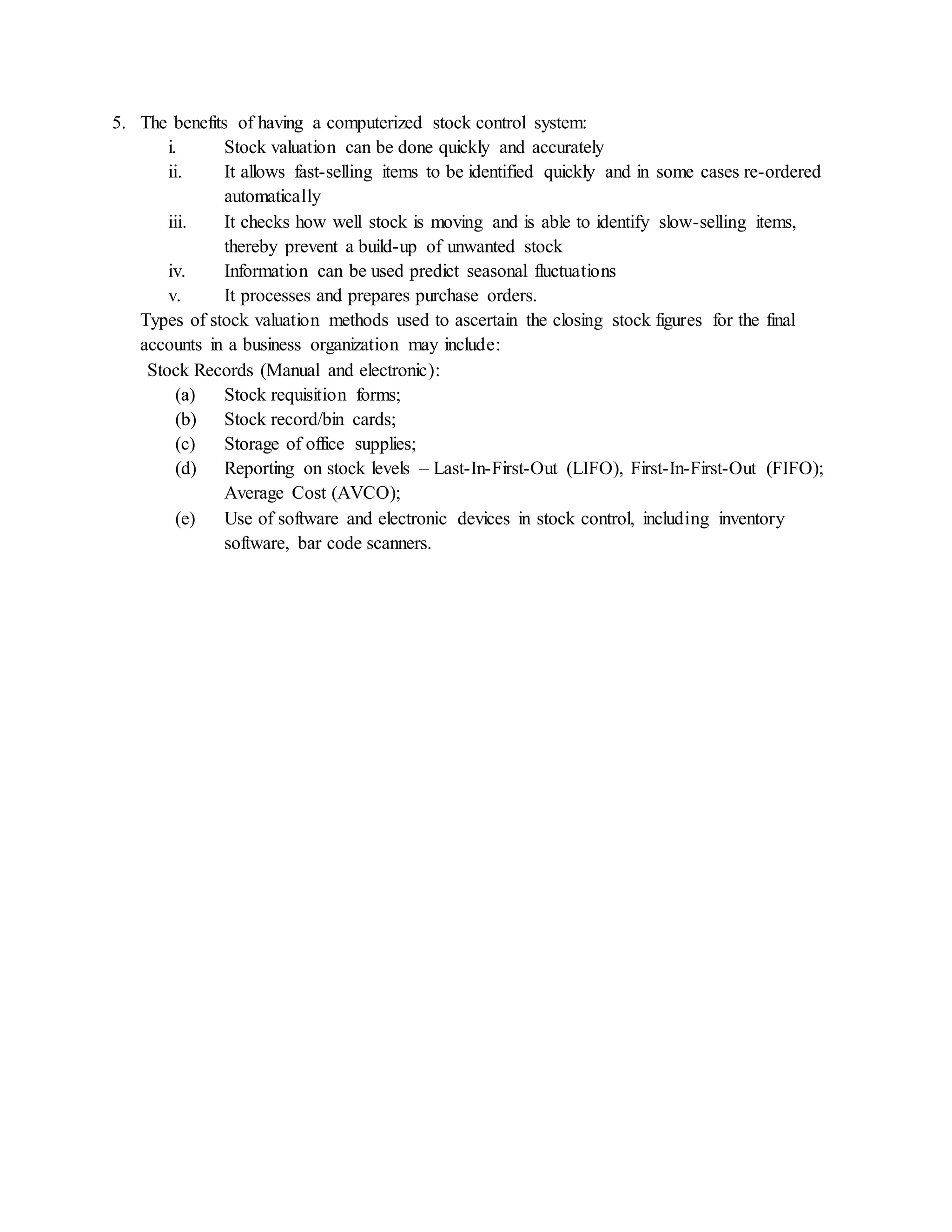
5. The benefits of having a computerized stock control system:
i. Stock valuation can be done quickly and accurately
ii. It allows fast-selling items to be identified quickly and in some cases re-ordered
automatically
iii. It checks how well stock is moving and is able to identify slow-selling items,
thereby prevent a build-up of unwanted stock
iv. Information can be used predict seasonal fluctuations
v. It processes and prepares purchase orders.
Types of stock valuation methods used to ascertain the closing stock figures for the final
accounts in a business organization may include:
Stock Records (Manual and electronic):
(a) Stock requisition forms;
(b) Stock record/bin cards;
(c) Storage of office supplies;
(d) Reporting on stock levels – Last-In-First-Out (LIFO), First-In-First-Out (FIFO);
Average Cost (AVCO);
(e) Use of software and electronic devices in stock control, including inventory
software, bar code scanners.

Quiz - Procurement and inventory

  • 1.
    QUIZ Answer ALL theQUESTIONS below in your own words. (1) Explain the term “inventory” and identify THREE (3) types of stock that are kept by a business organization. (5 marks) (2) “Stock control involves the storing and handling of goods”. Identify TWO (2) reasons why businesses need to maintain adequate stock levels, and explain what are the drawbacks of keeping little or no stock? (6 marks) (3) One of the disadvantages of keeping too much stock is goods might deteriorate. State TWO (2) other disadvantages of holding too much stock and explain why business organizations should set a maximum, minimum and re-order levels. (3 marks) (4) Define the term “Pilferage”, and explain how having a stock control system can prevent the goods and materials kept by a business organization. (4 marks) (5) State TWO (2) benefits of having a computerized stock control system, and briefly explain TWO (2) types of stock valuation methods used to ascertain the closing stock figures for the final accounts in a business organization. (6 marks)
  • 2.
    ANSWERSHEET 1. Stock’ or‘inventory’ refers to the goods and materials kept by an organization in a warehouse or storeroom. Types of stock are:  Raw materials and components  Work in progress – unfinished goods  Finished goods  Consumable stock – stock purchased for use in the business  Stock-in-trade – stock purchased for resale 2. (a) Reasons why businesses should maintain adequate stock level:  to ensure that stock does not run out  to indicate when items need to be re-ordered  to keep production units supplied  to reduce the likelihood of stock becoming obsolete  to identify when pilferage or spoilage occurs  to maximize the use of storage space (b) Drawbacks of keeping little or no stock may include:  the firm might run out of stock and not have enough raw materials and components to maintain production;  the firm might lose customers because of missed orders. 3. i. Disadvantages of keeping too much stock too much stock:  goods might deteriorate  higher storage fees and insurance costs  higher security costs to prevent theft from warehouse/storeroom  stock may become obsolete or go out of fashion  capital that could be spent otherwise may be tied up in cash  stock will take up space in the warehouse ii. Business organizations should set a maximum, minimum and re-order levels to prevent the problems of over-stocking or under-stocking. 4. The term “Pilferage” means the theft of a small quantity of stock. Having an efficient and accurate stock control system enable a business organization to identify the theft of the goods and materials quickly.
  • 3.
    5. The benefitsof having a computerized stock control system: i. Stock valuation can be done quickly and accurately ii. It allows fast-selling items to be identified quickly and in some cases re-ordered automatically iii. It checks how well stock is moving and is able to identify slow-selling items, thereby prevent a build-up of unwanted stock iv. Information can be used predict seasonal fluctuations v. It processes and prepares purchase orders. Types of stock valuation methods used to ascertain the closing stock figures for the final accounts in a business organization may include: Stock Records (Manual and electronic): (a) Stock requisition forms; (b) Stock record/bin cards; (c) Storage of office supplies; (d) Reporting on stock levels – Last-In-First-Out (LIFO), First-In-First-Out (FIFO); Average Cost (AVCO); (e) Use of software and electronic devices in stock control, including inventory software, bar code scanners.