Liliya Yakupova
MSU
Moscow, 2016
General information
• The International Air Transport
Association is a trade association of
the world’s airlines.
• 268 airlines
• 117 countries
• 83% of total air traffic
2
L. Yakupova
Formation
• 19 April 1945 in Havana, Cuba
• Much of IATA’s early work was technical and it
provided input to the newly created International
Civil Aviation Organization (ICAO).
• At its founding, IATA had 57 members from 31
nations, mostly in Europe and North America.
Today it has some 265 members from 117 nations
in every part of the globe. Despite its factual
influence, the IATA is a trade group with no
legislative powers.
3
L. Yakupova
Director General
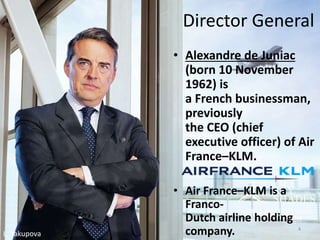
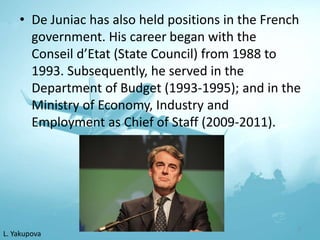
• Alexandre de Juniac
(born 10 November
1962) is
a French businessman,
previously
the CEO (chief
executive officer) of Air
France–KLM.
• Air France–KLM is a
Franco-
Dutch airline holding
company. 4
L. Yakupova
• De Juniac has also held positions in the French
government. His career began with the
Conseil d’Etat (State Council) from 1988 to
1993. Subsequently, he served in the
Department of Budget (1993-1995); and in the
Ministry of Economy, Industry and
Employment as Chief of Staff (2009-2011).
5
L. Yakupova
6
L. Yakupova
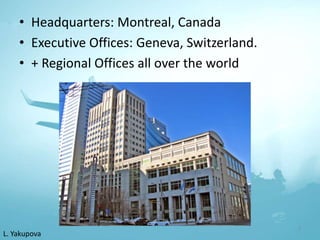
• Headquarters: Montreal, Canada
• Executive Offices: Geneva, Switzerland.
• + Regional Offices all over the world
7
L. Yakupova
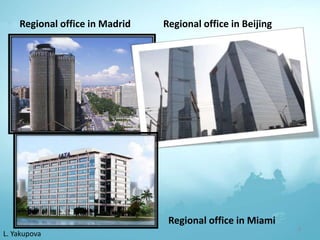
Regional Offices
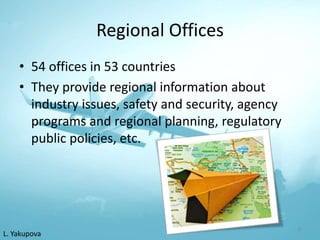
• 54 offices in 53 countries
• They provide regional information about
industry issues, safety and security, agency
programs and regional planning, regulatory
public policies, etc.
8
L. Yakupova
Regional office in Madrid Regional office in Beijing
Regional office in Miami
9
L. Yakupova
Mission
• IATA’s mission is to represent, lead, and serve the airline industry.
• Representing the airline industry
• We improve understanding of the air transport industry among decision
makers and increase awareness of the benefits that aviation brings to national
and global economies. Advocating for the interests of airlines across the globe,
we challenge unreasonable rules and charges, hold regulators and
governments to account, and strive for sensible regulation.
• Leading the airline industry
• For nearly 70 years, we have developed global commercial standards upon
which the air transport industry is built. Our aim is to assist airlines by
simplifying processes and increasing passenger convenience while reducing
costs and improving efficiency.
• Serving the airline industry
• We help airlines to operate safely, securely, efficiently, and economically under
clearly defined rules. Professional support is provided to all industry
stakeholders with a wide range of products and expert services.
Source: http://www.iata.org/ (official website)
10
L. Yakupova
Values
• People focus
• Speed
• Innovation
• Openness to change
• Integrity
• Teamwork and cultural intelligence
• Results orientation
• Leadership
Source: http://www.iata.org/ (official website)
11
L. Yakupova
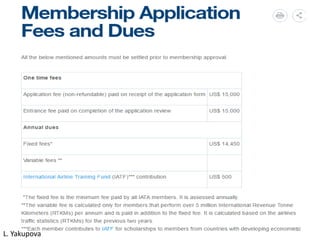
Membership
• Members benefit in several ways. Most importantly,
IATA provides a powerful, unified and experienced
voice that supports and promotes the interests of
its members through:
• International recognition and lobbying
• Targeting key industry priorities
• Driving industry change
• Reducing costs
• Communication campaigns
• Training and other services
12
L. Yakupova
13
L. Yakupova
International Airline Training
Fund (IATF)
• The International Airline Training
Fund (IATF) is a non-profit
foundation whose purpose is to
bridge the training gaps for airlines
in regions of the world where it is
most needed. Training
opportunities are offered in most
areas of the airline business, but
priority is given to training in
airline's operational safety. IATF is
funded by donations from IATA
members and other organizations
involved in the air transport
industry.14
L. Yakupova
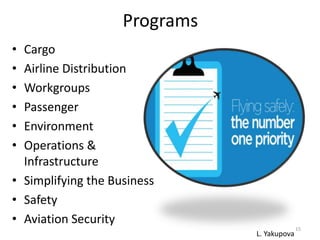
Programs
• Cargo
• Airline Distribution
• Workgroups
• Passenger
• Environment
• Operations &
Infrastructure
• Simplifying the Business
• Safety
• Aviation Security
15
L. Yakupova
16
L. Yakupova
17
L. Yakupova
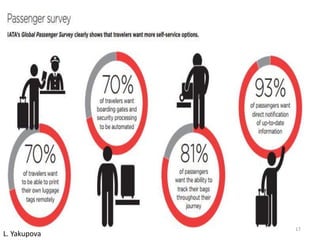
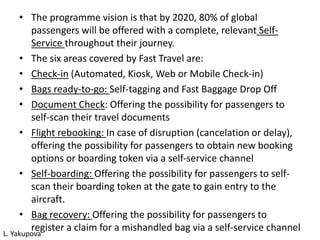
• The programme vision is that by 2020, 80% of global
passengers will be offered with a complete, relevant Self-
Service throughout their journey.
• The six areas covered by Fast Travel are:
• Check-in (Automated, Kiosk, Web or Mobile Check-in)
• Bags ready-to-go: Self-tagging and Fast Baggage Drop Off
• Document Check: Offering the possibility for passengers to
self-scan their travel documents
• Flight rebooking: In case of disruption (cancelation or delay),
offering the possibility for passengers to obtain new booking
options or boarding token via a self-service channel
• Self-boarding: Offering the possibility for passengers to self-
scan their boarding token at the gate to gain entry to the
aircraft.
• Bag recovery: Offering the possibility for passengers to
register a claim for a mishandled bag via a self-service channel18
L. Yakupova
19
L. Yakupova
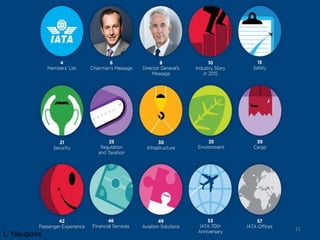
• IATA's annual review is a complete report on the
successes, issues and state of commercial air
transport. It is released each year for IATA's Annual
General Meeting taking place early June. 20
L. Yakupova
21
L. Yakupova
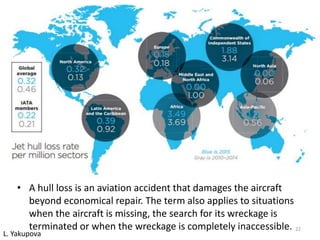
• A hull loss is an aviation accident that damages the aircraft
beyond economical repair. The term also applies to situations
when the aircraft is missing, the search for its wreckage is
terminated or when the wreckage is completely inaccessible. 22
L. Yakupova
23
L. Yakupova
24
25
L. Yakupova
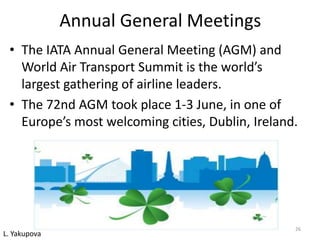
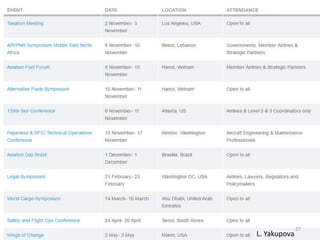
Annual General Meetings
• The IATA Annual General Meeting (AGM) and
World Air Transport Summit is the world’s
largest gathering of airline leaders.
• The 72nd AGM took place 1-3 June, in one of
Europe’s most welcoming cities, Dublin, Ireland.
26
L. Yakupova
27
L. Yakupova
28
L. Yakupova