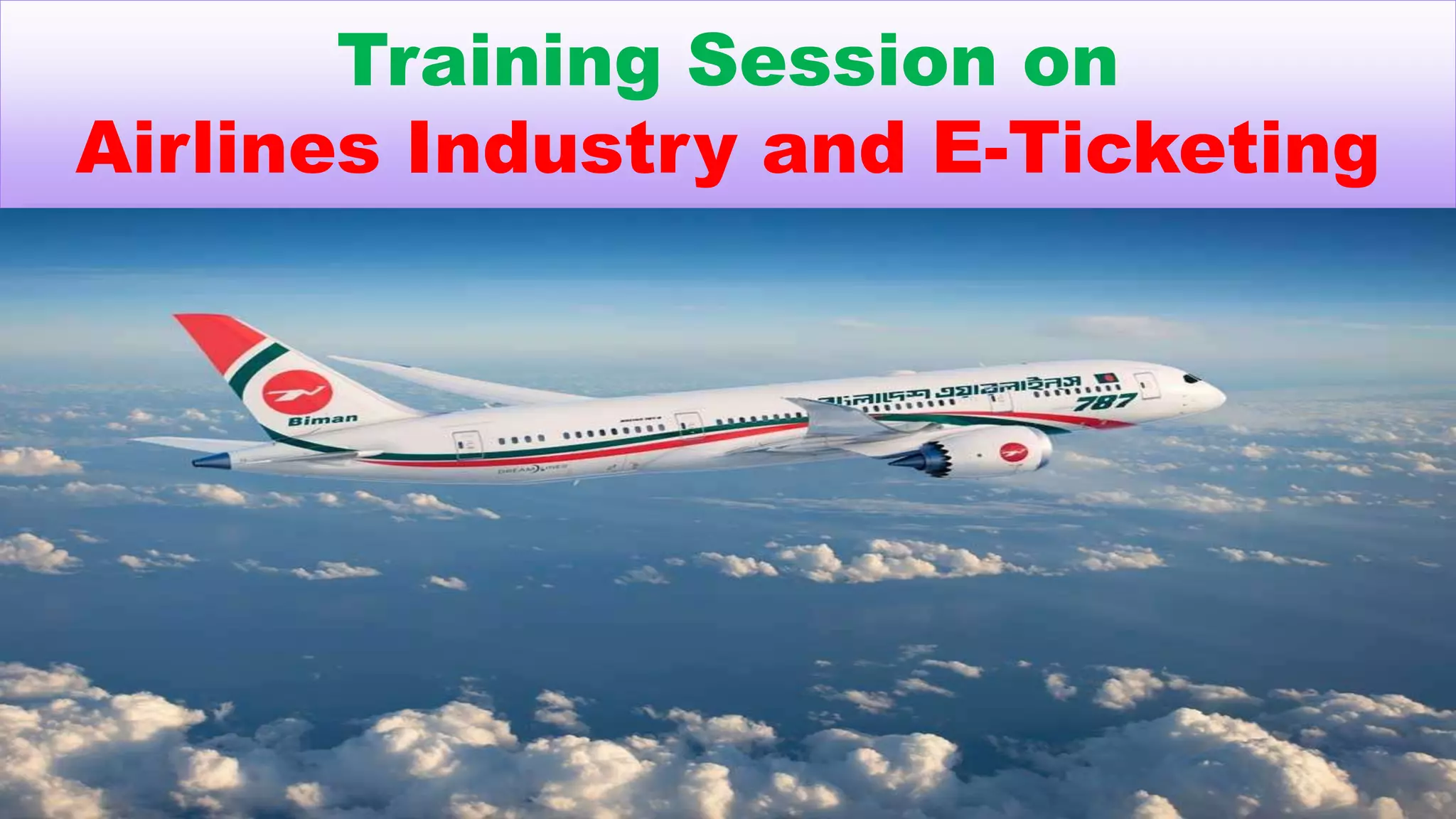



Training Session on
Airlines Industry and E-Ticketing
Speaker Profile
Md. Shaifullar Rabbi
Professional Experiences
Lecturer- BTHM, Daffodil Institute of IT(NU)
Assessor- Bangladesh Technical Education Board
Former Coordinator & Lecturer- DBA, IBAIS University
Guest Lecturer – BTHM,IBAIS University
Resource Person- Sheikh Hasina National Institute of
Youth Development
Resource Person - ATAB Tourism Training Institute
Resource Person- International Skills Development
Center
Resource person- Bangladesh Hotel Management
Tourism Training Institute
Former Manager sales- Mamun Air Service (IATA
Educational Qualifications
BBA & MBA -Major in Tourism & Hospitality
Management, Faculty of Business,
University of Dhaka.
Certified NTVQF Level -4 (Ticketing And
Reservation, SPTC-BTEB)
Diploma Course in Travel Agency & Tour
Operation Management ,BHMTTI
Certified NTVQF Level 2 (Ticketing &
Reservation, BTEB)
Certified NTVQF Level 1 (Tour Guiding,
BTSC-BTEB)
Airlines Industry
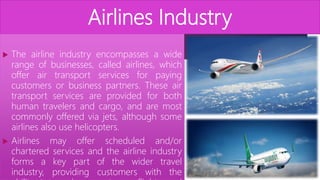
 The airline industry encompasses a wide
range of businesses, called airlines, which
offer air transport services for paying
customers or business partners. These air
transport services are provided for both
human travelers and cargo, and are most
commonly offered via jets, although some
airlines also use helicopters.
 Airlines may offer scheduled and/or
chartered services and the airline industry
forms a key part of the wider travel
industry, providing customers with the
Global Airline Market: 2019
Passenger Numbers
As per IATA, passenger numbers are expected to rise
from 4.34 billion passengers in 2018 to 4.59 billion
passengers in 2019.
Revenue and Profits
The overall revenue is expected to rise from $824 billion
in 2018 to $885 billion in 2019.
Global airline industry net profits will reach $35.5 billion
Employment
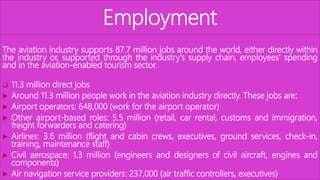
The aviation industry supports 87.7 million jobs around the world, either directly within
the industry or, supported through the industry's supply chain, employees' spending
and in the aviation-enabled tourism sector.
 11.3 million direct jobs
 Around 11.3 million people work in the aviation industry directly. These jobs are:
 Airport operators: 648,000 (work for the airport operator)
 Other airport-based roles: 5.5 million (retail, car rental, customs and immigration,
freight forwarders and catering)
 Airlines: 3.6 million (flight and cabin crews, executives, ground services, check-in,
training, maintenance staff)
 Civil aerospace: 1.3 million (engineers and designers of civil aircraft, engines and
components)
 Air navigation service providers: 237,000 (air traffic controllers, executives)
 18.1 million indirect jobs
 Over 18.1 million jobs globally are supported by aviation indirectly,
through the air transport industry's purchase of goods and services.
 These include suppliers to the air transport industry, for example
suppliers, construction companies, suppliers of aircraft components,
manufacturers of goods sold in airports, and a variety of business
support roles, like call centres, IT and accountancy.
 13.5 million induced jobs
 Air transport industry employees (direct and indirect) support 13.5
million induced jobs globally, using their income to purchase goods
and services for themselves. Their spending power supports jobs in
retail, consumer goods, and a range of service industries such as
banks and restaurants.
 44.8 million jobs in tourism
 Tourism is fast becoming the world's largest industry, and air
Key Functions of Airlines
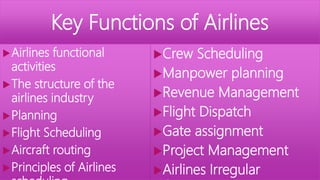
Airlines functional
activities
The structure of the
airlines industry
Planning
Flight Scheduling
Aircraft routing
Principles of Airlines
Crew Scheduling
Manpower planning
Revenue Management
Flight Dispatch
Gate assignment
Project Management
Airlines Irregular
Types of Airline Employment
Opportunities
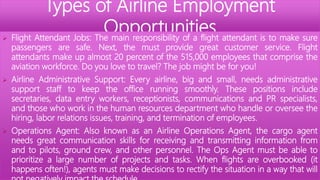
 Flight Attendant Jobs: The main responsibility of a flight attendant is to make sure
passengers are safe. Next, the must provide great customer service. Flight
attendants make up almost 20 percent of the 515,000 employees that comprise the
aviation workforce. Do you love to travel? The job might be for you!
 Airline Administrative Support: Every airline, big and small, needs administrative
support staff to keep the office running smoothly. These positions include
secretaries, data entry workers, receptionists, communications and PR specialists,
and those who work in the human resources department who handle or oversee the
hiring, labor relations issues, training, and termination of employees.
 Operations Agent: Also known as an Airline Operations Agent, the cargo agent
needs great communication skills for receiving and transmitting information from
and to pilots, ground crew, and other personnel. The Ops Agent must be able to
prioritize a large number of projects and tasks. When flights are overbooked (it
happens often!), agents must make decisions to rectify the situation in a way that will
 Regional Sales Manager: The airline district sales manager oversees all of a district’s
reservations and ticket sales offices, and the sales representatives in that district. Sales
representatives promote their airline in an effort to sell cargo space and plane tickets.
 Flight Dispatcher: Flight dispatchers are responsible for ensuring the safety of an aircraft’s
flight. This includes preparing a flight plan, which is a detailed schedule of destinations,
layovers, distance, expected fuel consumption, winds aloft, weather, altitude, compass
bearing, and alternate destinations in case of problems.
 Ground / Airport Station Attendant: This position has many names: airline informational
representative, ground attendant, station attendant, special assistant coordinator, or airport
informational representative. Regardless of title, the main responsibility is to assist
passengers in the terminal with general questions regarding directions, terminal services, or
arranging wheelchair access.
 Aviation Meteorologist: Aviation meteorologists provide weather information to airline flight
dispatchers and pilots. They must determine current and forecasted weather conditions for
all altitudes, including the direction and speed of wind, cloud cover, and precipitation.
 Passenger Service Agent: Passenger service agents some of the same responsibilities as
those in station agent jobs, but they are focused on working passengers – not aircraft. Their
duties include issuing refunds to passengers, computing fares, preparing and selling tickets,
collecting charges for excess baggage, checking baggage, and providing travel information.
 Ramp Planner: An airline ramp planner is responsible for knowing the arrival and departure
times for each of the airline’s aircraft at that airport. He or she coordinates a variety of
 Reservation Sales Agent: Reservation sales agents provide travel information over the
telephone to customers of the airline. Typically, this information includes trip planning, car
rentals, seat availability, fare information, schedules, tours, meals, and other information
relevant to the customer’s flight plans. Although internet reservations have skyrocketed,
airlines still utilize reservation sales agents.
 Sales Representative: Airline sales representatives help generate business for the airlines.
They promote their airline to businesses.
 Crew Schedule Coordinator: Airline crew schedule coordinator are responsible for staffing of
aircrew and ground support to keep flights on schedule. If weather or mechanical difficulties
delay a flight, it is the crew scheduler’s responsibility to make sure schedule adjustments are
made so that travelers arrive at their destination on time.
 Airline Station Agent: The most important duty of the station agent or district operations
manager, is ensuring the overall operations of a given airline at an airport. This encompasses
both flight and ground support operations and involves coordinating flight crew, cargo crew,
baggage crew, ground crew, and the information that must be communicated among all
these teams.
 Airline Ticket Agent: Ticket agents work at an airline’s ticket or baggage counter. They greet
customers when they arrive at the airport. They check in luggage and make seat
assignments. They also handle airline ticket sales, reservation changes, and provide
information on aircraft boarding.
 Airline Flight Instructor: An airline flight instructor provides recurrent training for the airline’s
pilots. Airline flight instructors may be senior pilots who fly for the airline.
Official Airline Guide
 OAG is a global travel data provider with headquarters in the UK. The
company was founded in 1929 and operates in
the USA, Singapore, Japan, Lithuania and China. It has a large network
of flight information data including schedules, flight status, connection
times and industry reference codes such as airport. The "Official Aviation
Guide of the Airways" was first published in February 1929 in the United
States, listing 35 airlines offering a total of 300 flights. After the Guide
was taken over by a rival publication in 1948, the September issue
carried the OAG title for the first time. OAG was founded in Chicago, but
moved to the suburb of Oak Brook, Illinois in 1968. The "ABC World
Airways Guide" containing maps and tips for travelers was first published
in the UK in 1946. The integration of the ABC and OAG brands occurred
following the acquisition of OAG Inc. in 1993 by Reed Elsevier which
Travel Information Manual (TIM)
Published monthly, the TIM (Travel Information Manual) is the world's leading source of
Passport, Visa and Health documentationregulations for passengers. Airlines and Travel
Agents use TIM to provide advice on border requirements to passengers at the time of
booking, and airlines use it at the time of boarding to ensure passengers have sufficient
travel documents for their destination and any transit points. If your passengers do not
have sufficient travel documents the airline will not carry them!
Key Benefits
 The TIM is a must for all who are involved in the travel industry. This unique manual
details rules and regulations for every nationality going to every country worldwide
on subjects such as:
 Passport regulations and recommendations
 Visa regulations and recommendations
 Health regulations and recommendations
 Airport Tax to be paid by the traveler at either departure or arrival airport
 Customs regulations relating to import/export of goods and small pets by a
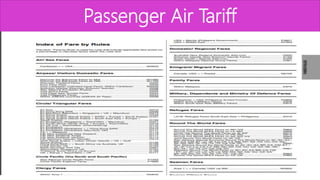
Passenger Air Tariff
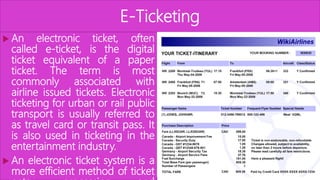
E-Ticketing
 An electronic ticket, often
called e-ticket, is the digital
ticket equivalent of a paper
ticket. The term is most
commonly associated with
airline issued tickets. Electronic
ticketing for urban or rail public
transport is usually referred to
as travel card or transit pass. It
is also used in ticketing in the
entertainment industry.
 An electronic ticket system is a
more efficient method of ticket
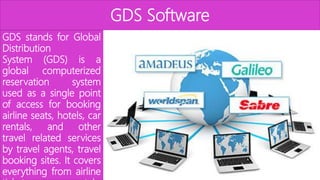
GDS Software
GDS stands for Global
Distribution
System (GDS) is a
global computerized
reservation system
used as a single point
of access for booking
airline seats, hotels, car
rentals, and other
travel related services
by travel agents, travel
booking sites. It covers
everything from airline
Computer reservation systems
Computer reservation systems, or central
reservation systems (CRS),
are computerized systems used to store
and retrieve information and conduct
transactions related to air travel, hotels, car
rental, or other activities. Originally
designed and operated by airlines, CRSs
were later extended for use by travel
agencies. global distribution systems (GDS)
to book and sell tickets for multiple airlines.
Most airlines have outsourced their CRSs to
GDS companies, which also enable
consumer access
through Internet gateways. Modern GDSs
typically also allow users to book hotel
What type of facilities does a travel
company provide?
Travel advisory- Advising
clients
Travel arrangements, e.g.
visas and passports
Places they can visit
Itinerary
Experiences that can be
created
 Bookings
 Arranging flights, insurance and accommodation
 Tickets to places of interests
 Hotel and transport booking
 Sending out tickets to clients
 Customer Services
 Kids related bookings and management (arranging nannies in hotels)
 Collecting and processing payments
 Dealing with complaints or refunds
 Arranging Concierges / guides etc as needed
 Dealing with miles
 Events
 Organizing events, conferences , off sites etc
 or ensuring participation of people
Common Travel Terminology
 Tourist: one that makes a tour for pleasure or culture.
 Traveler: one that goes on a trip or journey.
 Excursionist : a person who goes on an excursion.
 Adjoining rooms – Bordering hotel rooms that do not share a common door.
 Airport access fee – A fee paid to the airport authority by car rental
companies for the use of shuttle vehicles. This often appears in customer’s car
rental bills.
 Availability – The total number of seats allowed to be sold at a particular rate.
 Base fare – The cost of an airfare prior to addition of fees, taxes or surcharges.
 Blackout dates – Specific dates in which special fares or promotions do not
apply. Typically exist around holidays or special events.
 Global distribution system (GDS) – An international computer reservation
system that accesses many databases of suppliers, airlines, etc. in different
countries, such as Sabre
Common Travel Terminology
 Boarding pass – A ticket issued at airport check-in that authorizes airplane boarding.
 Bulk fare – A reduced fare for purchases of a large number of tickets.
 Business class – While amenities vary based on the airline, business class generally
falls between first class and coach.
 Cancellation penalty – A fee to charge to customers that cancel flights after booking
reservations. Fees typically vary based on the agency or carrier.
 Commission – A small fee that a travel agency or services adds to the total fee in
order to make money.
 No show – A traveller that doesn’t appear for their flight, hotel, or car rental
reservation.
 Non-refundable – A ticket in which no money will be returned if the customer no
longer intends to use the ticket.
Common Travel Terminology
 Overbooking – When a carrier books more reservations than available seats.
 Passenger name record (PNR) – The official name of one's reservation in a computer
reservation system (CRS).
 Published fare – A fare immediately offered for purchase by the airline. This does not
include heavily discounted flights usually offered to consolidators.
 Rack rate – The price of a hotel prior to discount.
 Reissue – When a new ticket is issued as a result of a change of plans. This can often
require fees or penalties from the airport.
 Round trip – Two flights: the destination flight and its return trip.
 Scheduled carrier – An airline that offers regularly scheduled flights between
destinations.
 Special fare – Any fare that deviates from normal pricing (typically discounted).
 Supplier – A company that offer travel services to the general public.
Presentation  on Airlines Industry and E-ticketing by Md Shaifullar Rabbi

Presentation on Airlines Industry and E-ticketing by Md Shaifullar Rabbi

  • 1.
    Training Session on AirlinesIndustry and E-Ticketing
  • 2.
    Speaker Profile Md. ShaifullarRabbi Professional Experiences Lecturer- BTHM, Daffodil Institute of IT(NU) Assessor- Bangladesh Technical Education Board Former Coordinator & Lecturer- DBA, IBAIS University Guest Lecturer – BTHM,IBAIS University Resource Person- Sheikh Hasina National Institute of Youth Development Resource Person - ATAB Tourism Training Institute Resource Person- International Skills Development Center Resource person- Bangladesh Hotel Management Tourism Training Institute Former Manager sales- Mamun Air Service (IATA Educational Qualifications BBA & MBA -Major in Tourism & Hospitality Management, Faculty of Business, University of Dhaka. Certified NTVQF Level -4 (Ticketing And Reservation, SPTC-BTEB) Diploma Course in Travel Agency & Tour Operation Management ,BHMTTI Certified NTVQF Level 2 (Ticketing & Reservation, BTEB) Certified NTVQF Level 1 (Tour Guiding, BTSC-BTEB)
  • 3.
    Airlines Industry  Theairline industry encompasses a wide range of businesses, called airlines, which offer air transport services for paying customers or business partners. These air transport services are provided for both human travelers and cargo, and are most commonly offered via jets, although some airlines also use helicopters.  Airlines may offer scheduled and/or chartered services and the airline industry forms a key part of the wider travel industry, providing customers with the
  • 4.
    Global Airline Market:2019 Passenger Numbers As per IATA, passenger numbers are expected to rise from 4.34 billion passengers in 2018 to 4.59 billion passengers in 2019. Revenue and Profits The overall revenue is expected to rise from $824 billion in 2018 to $885 billion in 2019. Global airline industry net profits will reach $35.5 billion
  • 5.
    Employment The aviation industrysupports 87.7 million jobs around the world, either directly within the industry or, supported through the industry's supply chain, employees' spending and in the aviation-enabled tourism sector.  11.3 million direct jobs  Around 11.3 million people work in the aviation industry directly. These jobs are:  Airport operators: 648,000 (work for the airport operator)  Other airport-based roles: 5.5 million (retail, car rental, customs and immigration, freight forwarders and catering)  Airlines: 3.6 million (flight and cabin crews, executives, ground services, check-in, training, maintenance staff)  Civil aerospace: 1.3 million (engineers and designers of civil aircraft, engines and components)  Air navigation service providers: 237,000 (air traffic controllers, executives)
  • 6.
     18.1 millionindirect jobs  Over 18.1 million jobs globally are supported by aviation indirectly, through the air transport industry's purchase of goods and services.  These include suppliers to the air transport industry, for example suppliers, construction companies, suppliers of aircraft components, manufacturers of goods sold in airports, and a variety of business support roles, like call centres, IT and accountancy.  13.5 million induced jobs  Air transport industry employees (direct and indirect) support 13.5 million induced jobs globally, using their income to purchase goods and services for themselves. Their spending power supports jobs in retail, consumer goods, and a range of service industries such as banks and restaurants.  44.8 million jobs in tourism  Tourism is fast becoming the world's largest industry, and air
  • 7.
    Key Functions ofAirlines Airlines functional activities The structure of the airlines industry Planning Flight Scheduling Aircraft routing Principles of Airlines Crew Scheduling Manpower planning Revenue Management Flight Dispatch Gate assignment Project Management Airlines Irregular
  • 9.
    Types of AirlineEmployment Opportunities  Flight Attendant Jobs: The main responsibility of a flight attendant is to make sure passengers are safe. Next, the must provide great customer service. Flight attendants make up almost 20 percent of the 515,000 employees that comprise the aviation workforce. Do you love to travel? The job might be for you!  Airline Administrative Support: Every airline, big and small, needs administrative support staff to keep the office running smoothly. These positions include secretaries, data entry workers, receptionists, communications and PR specialists, and those who work in the human resources department who handle or oversee the hiring, labor relations issues, training, and termination of employees.  Operations Agent: Also known as an Airline Operations Agent, the cargo agent needs great communication skills for receiving and transmitting information from and to pilots, ground crew, and other personnel. The Ops Agent must be able to prioritize a large number of projects and tasks. When flights are overbooked (it happens often!), agents must make decisions to rectify the situation in a way that will
  • 10.
     Regional SalesManager: The airline district sales manager oversees all of a district’s reservations and ticket sales offices, and the sales representatives in that district. Sales representatives promote their airline in an effort to sell cargo space and plane tickets.  Flight Dispatcher: Flight dispatchers are responsible for ensuring the safety of an aircraft’s flight. This includes preparing a flight plan, which is a detailed schedule of destinations, layovers, distance, expected fuel consumption, winds aloft, weather, altitude, compass bearing, and alternate destinations in case of problems.  Ground / Airport Station Attendant: This position has many names: airline informational representative, ground attendant, station attendant, special assistant coordinator, or airport informational representative. Regardless of title, the main responsibility is to assist passengers in the terminal with general questions regarding directions, terminal services, or arranging wheelchair access.  Aviation Meteorologist: Aviation meteorologists provide weather information to airline flight dispatchers and pilots. They must determine current and forecasted weather conditions for all altitudes, including the direction and speed of wind, cloud cover, and precipitation.  Passenger Service Agent: Passenger service agents some of the same responsibilities as those in station agent jobs, but they are focused on working passengers – not aircraft. Their duties include issuing refunds to passengers, computing fares, preparing and selling tickets, collecting charges for excess baggage, checking baggage, and providing travel information.  Ramp Planner: An airline ramp planner is responsible for knowing the arrival and departure times for each of the airline’s aircraft at that airport. He or she coordinates a variety of
  • 11.
     Reservation SalesAgent: Reservation sales agents provide travel information over the telephone to customers of the airline. Typically, this information includes trip planning, car rentals, seat availability, fare information, schedules, tours, meals, and other information relevant to the customer’s flight plans. Although internet reservations have skyrocketed, airlines still utilize reservation sales agents.  Sales Representative: Airline sales representatives help generate business for the airlines. They promote their airline to businesses.  Crew Schedule Coordinator: Airline crew schedule coordinator are responsible for staffing of aircrew and ground support to keep flights on schedule. If weather or mechanical difficulties delay a flight, it is the crew scheduler’s responsibility to make sure schedule adjustments are made so that travelers arrive at their destination on time.  Airline Station Agent: The most important duty of the station agent or district operations manager, is ensuring the overall operations of a given airline at an airport. This encompasses both flight and ground support operations and involves coordinating flight crew, cargo crew, baggage crew, ground crew, and the information that must be communicated among all these teams.  Airline Ticket Agent: Ticket agents work at an airline’s ticket or baggage counter. They greet customers when they arrive at the airport. They check in luggage and make seat assignments. They also handle airline ticket sales, reservation changes, and provide information on aircraft boarding.  Airline Flight Instructor: An airline flight instructor provides recurrent training for the airline’s pilots. Airline flight instructors may be senior pilots who fly for the airline.
  • 12.
    Official Airline Guide OAG is a global travel data provider with headquarters in the UK. The company was founded in 1929 and operates in the USA, Singapore, Japan, Lithuania and China. It has a large network of flight information data including schedules, flight status, connection times and industry reference codes such as airport. The "Official Aviation Guide of the Airways" was first published in February 1929 in the United States, listing 35 airlines offering a total of 300 flights. After the Guide was taken over by a rival publication in 1948, the September issue carried the OAG title for the first time. OAG was founded in Chicago, but moved to the suburb of Oak Brook, Illinois in 1968. The "ABC World Airways Guide" containing maps and tips for travelers was first published in the UK in 1946. The integration of the ABC and OAG brands occurred following the acquisition of OAG Inc. in 1993 by Reed Elsevier which
  • 13.
    Travel Information Manual(TIM) Published monthly, the TIM (Travel Information Manual) is the world's leading source of Passport, Visa and Health documentationregulations for passengers. Airlines and Travel Agents use TIM to provide advice on border requirements to passengers at the time of booking, and airlines use it at the time of boarding to ensure passengers have sufficient travel documents for their destination and any transit points. If your passengers do not have sufficient travel documents the airline will not carry them! Key Benefits  The TIM is a must for all who are involved in the travel industry. This unique manual details rules and regulations for every nationality going to every country worldwide on subjects such as:  Passport regulations and recommendations  Visa regulations and recommendations  Health regulations and recommendations  Airport Tax to be paid by the traveler at either departure or arrival airport  Customs regulations relating to import/export of goods and small pets by a
  • 14.
  • 15.
    E-Ticketing  An electronicticket, often called e-ticket, is the digital ticket equivalent of a paper ticket. The term is most commonly associated with airline issued tickets. Electronic ticketing for urban or rail public transport is usually referred to as travel card or transit pass. It is also used in ticketing in the entertainment industry.  An electronic ticket system is a more efficient method of ticket
  • 16.
    GDS Software GDS standsfor Global Distribution System (GDS) is a global computerized reservation system used as a single point of access for booking airline seats, hotels, car rentals, and other travel related services by travel agents, travel booking sites. It covers everything from airline
  • 17.
    Computer reservation systems Computerreservation systems, or central reservation systems (CRS), are computerized systems used to store and retrieve information and conduct transactions related to air travel, hotels, car rental, or other activities. Originally designed and operated by airlines, CRSs were later extended for use by travel agencies. global distribution systems (GDS) to book and sell tickets for multiple airlines. Most airlines have outsourced their CRSs to GDS companies, which also enable consumer access through Internet gateways. Modern GDSs typically also allow users to book hotel
  • 18.
    What type offacilities does a travel company provide? Travel advisory- Advising clients Travel arrangements, e.g. visas and passports Places they can visit Itinerary Experiences that can be created
  • 19.
     Bookings  Arrangingflights, insurance and accommodation  Tickets to places of interests  Hotel and transport booking  Sending out tickets to clients  Customer Services  Kids related bookings and management (arranging nannies in hotels)  Collecting and processing payments  Dealing with complaints or refunds  Arranging Concierges / guides etc as needed  Dealing with miles  Events  Organizing events, conferences , off sites etc  or ensuring participation of people
  • 20.
    Common Travel Terminology Tourist: one that makes a tour for pleasure or culture.  Traveler: one that goes on a trip or journey.  Excursionist : a person who goes on an excursion.  Adjoining rooms – Bordering hotel rooms that do not share a common door.  Airport access fee – A fee paid to the airport authority by car rental companies for the use of shuttle vehicles. This often appears in customer’s car rental bills.  Availability – The total number of seats allowed to be sold at a particular rate.  Base fare – The cost of an airfare prior to addition of fees, taxes or surcharges.  Blackout dates – Specific dates in which special fares or promotions do not apply. Typically exist around holidays or special events.  Global distribution system (GDS) – An international computer reservation system that accesses many databases of suppliers, airlines, etc. in different countries, such as Sabre
  • 21.
    Common Travel Terminology Boarding pass – A ticket issued at airport check-in that authorizes airplane boarding.  Bulk fare – A reduced fare for purchases of a large number of tickets.  Business class – While amenities vary based on the airline, business class generally falls between first class and coach.  Cancellation penalty – A fee to charge to customers that cancel flights after booking reservations. Fees typically vary based on the agency or carrier.  Commission – A small fee that a travel agency or services adds to the total fee in order to make money.  No show – A traveller that doesn’t appear for their flight, hotel, or car rental reservation.  Non-refundable – A ticket in which no money will be returned if the customer no longer intends to use the ticket.
  • 22.
    Common Travel Terminology Overbooking – When a carrier books more reservations than available seats.  Passenger name record (PNR) – The official name of one's reservation in a computer reservation system (CRS).  Published fare – A fare immediately offered for purchase by the airline. This does not include heavily discounted flights usually offered to consolidators.  Rack rate – The price of a hotel prior to discount.  Reissue – When a new ticket is issued as a result of a change of plans. This can often require fees or penalties from the airport.  Round trip – Two flights: the destination flight and its return trip.  Scheduled carrier – An airline that offers regularly scheduled flights between destinations.  Special fare – Any fare that deviates from normal pricing (typically discounted).  Supplier – A company that offer travel services to the general public.