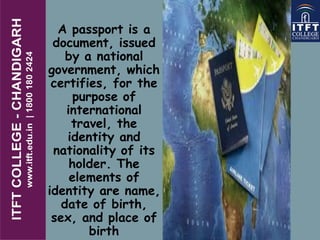
A passport is a
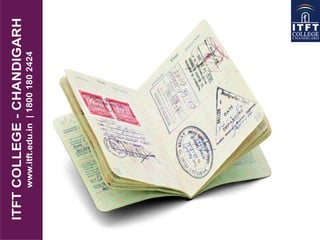
document, issued
by a national
government, which
certifies, for the
purpose of
international
travel, the
identity and
nationality of its
holder. The
elements of
identity are name,
date of birth,
sex, and place of
birth
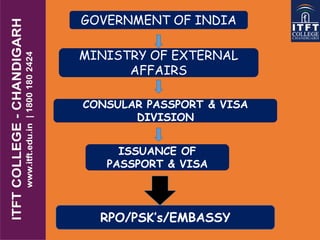
GOVERNMENT OF INDIA
MINISTRY OF EXTERNAL
AFFAIRS
CONSULAR PASSPORT & VISA
DIVISION
ISSUANCE OF
PASSPORT & VISA
RPO/PSK’s/EMBASSY
There are 37 RPO's across the
country and 77 PSK's in India
currently and 179 Indian
missions abroad
IMPORTANT POINTS TO DISCUSS
•Validity of Passport
•Renewal of Passport
•Reissue of Passport
•Tatkaal Passport
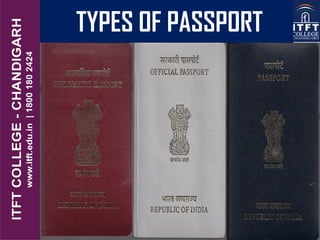
TYPES OF PASSPORT
OTHER TYPES
• Emergency Passport
• Family Passport
• Collective Passport
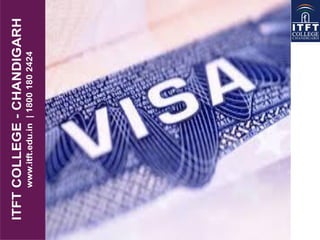
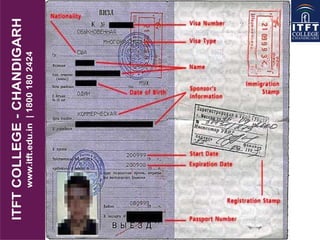
Different types of visas are issued
depending on the nature of the visit.
The main classifications are:
Immigrant or Permanent Visas.
Non-immigrant or Temporary Visas;
and
Transit Visa.
1. IMMIGRATION OR PERMANENT VISA
This type of visa is issued to persons who intend to immigrate or settle
permanently in foreign country. Countries impose stricter regulations in
granting this. Some countries do not issue this type of visa (e.g.
Germany)
2. NON – IMMIGRANT OR TEMPORARY VISA
A non-immigrant visa is issued for a temporary period after which the
holder will have to return to his home country. Depending on the nature
of the visit, different visas are issued as a temporary visa. Main
classifications are as under.
• Visitors Visa
• Tourist Visa
• Student Visa
• Business Visa
• Work Visa
• Collective Visa
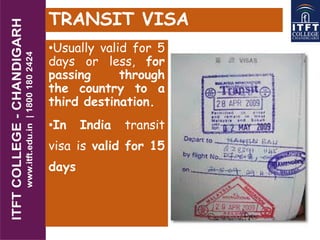
TRANSIT VISA
•Usually valid for 5
days or less, for
passing through
the country to a
third destination.
•In India transit
visa is valid for 15
days
TOURIST VISA
• For a limited period of leisure travel,
no business activities allowed.
• Exception: Saudi Arabia
In India issued for 180 days.
Tourist visa up to 5 years may be
granted if the foreigner is
connected with the tourism trade.
• Electronic visa: The visa is stored in a
computer and is electronically tied to the
passport number; no label, sticker or
stamp is placed in the passport prior to
travel.
• Australia pioneered electronic visa
issuance with the Electronic Travel
Authority for tourists.
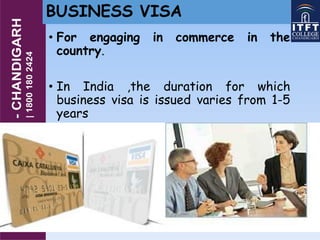
BUSINESS VISA
• For engaging in commerce in the
country.
• In India ,the duration for which
business visa is issued varies from 1-5
years
TEMPORARY VISA
• For approved employment in the host
country. These are generally more
difficult to obtain but valid for longer
periods of time than a business visa.
EXAMPLES:
1) H-1B visa in USA
2) L-1 visa in USA
ON ARRIVAL VISA
On-arrival visa, granted at a port of entry. This
is distinct from not requiring a visa at all, as the
visitor must still obtain the visa before they can
even try to pass through immigration.
TVOA IN INDIA
Cambodia, Finland, Indonesia, Japan , Laos,
Luxembourg, Myanmar, New Zealand, Philippines,
Singapore, Vietnam
STUDENT VISA
Proof of admission and means of sustenance
while in India must be provided to the Indian
Embassy; a visa may be extended in India for
the duration of the course or 5 years,
whichever is less. Foreigners who want to
study yoga, music, Vedic culture; dance etc
must apply well in advance. Indian embassies
may grant visas for up to 5 years
Students studying in Algeria, however, are
issued tourist visas.
.
MEDICAL VISA
• Is issued to persons who are going for their
treatment & surgery to foreign countries.
• In case of India duration of VISA is 6 months,
but can be extended on prescription of the
doctor.
WORKING HOLIDAY VISA
For individuals travelling between
nations offering a working holiday
programme, allowing young people to
undertake temporary work while
travelling
DIPLOMATIC VISA
(sometimes official visa), which
confers diplomatic status on its
holder and is normally only available
to bearers of diplomatic passports.
Immigrant-Visa
• granted for those intending to immigrate to the
issuing country. They usually are issued for a single
journey as the holder will, depending on the
country, later be issued a permanent resident
identification card which will allow the traveller to
enter to the issuing country an unlimited number of
times. (for example, the United States Permanent
Resident Card)...
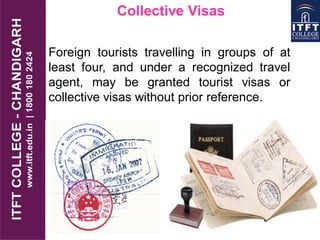
Collective Visas
Foreign tourists travelling in groups of at
least four, and under a recognized travel
agent, may be granted tourist visas or
collective visas without prior reference.
The procedure:
(i) At least three days before departure,
the agency sponsoring the group must
submit to the Indian Mission in that country
4 copies of a list containing particulars of
each member of the group;
(ii) After checking, the Mission stamps a
collective visa- it is not necessary to stamp
individual passports – and returns three
copies of the list to the sponsoring agency;
(i) The person in charge of the tourist group hands over two copies
of the list to the immigration authority on arrival in India.
(ii)Indian agents must furnish a list of group members to the
immigration authorities at least four hours before the flight arrives
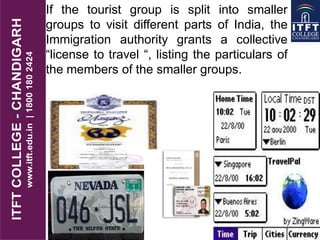
If the tourist group is split into smaller
groups to visit different parts of India, the
Immigration authority grants a collective
“license to travel “, listing the particulars of
the members of the smaller groups.
Visa Provisions
Tourist visa up to five years may be
granted if the foreigner is
connected in tourism trade. If visa
is for more than 180 days,
registration is compulsory within 14
days of the arrival in India.
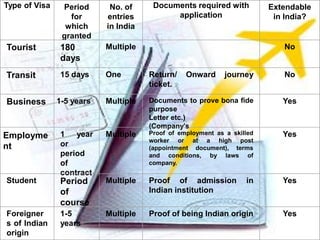
Type of Visa Period
for
which
granted
No. of
entries
in India
Documents required with
application
Extendable
in India?
Tourist 180
days
Multiple No
Transit 15 days One Return/ Onward journey
ticket.
No
Business 1-5 years Multiple Documents to prove bona fide
purpose
Letter etc.)‫‏‬
(Company’s
Yes
Employme
nt
1 year
or
period
of
contract
Multiple Proof of employment as a skilled
worker or at a high post
(appointment document), terms
and conditions, by laws of
company.
Yes
Student Period
of
course
Multiple Proof of admission in
Indian institution
Yes
Foreigner
s of Indian
origin
1-5
years
Multiple Proof of being Indian origin Yes
Instructions have been issued where by
Nepalese and Indian citizens, while
traveling by air, between the two
countries must be in possession of any
of the following documents to prove their
nationality.
• Valid national passport
 Valid photo identity card
issued be the Govt. of
India /state govt or Union
Territory
Administration/Election
commission of India
 Emergency certificate
issued by the Embassy
of India, Kathmandu to
Indians, and by the
Embassy of Nepal in
Delhi in respect of
Nepalese citizens.
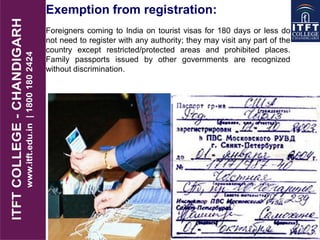
Exemption from registration:
Foreigners coming to India on tourist visas for 180 days or less do
not need to register with any authority; they may visit any part of the
country except restricted/protected areas and prohibited places.
Family passports issued by other governments are recognized
without discrimination.
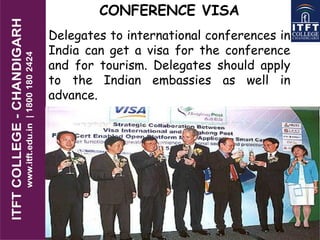
CONFERENCE VISA
Delegates to international conferences in
India can get a visa for the conference
and for tourism. Delegates should apply
to the Indian embassies as well in
advance.
Temporary Landing Permit
Nationals of Sri Lanka, Bangladesh, Pakistan,
Iran, Afghanistan, Somalia, Nigeria, and
Ethiopia are not granted TLP facility.
VWP Member Countries
• Andorra
Australia
Austria
Belgium
Brunei
Czech Republic
Denmarck
Estonia
Finland
France
Germany
Greece
• Hungary
Icelance
Ireland
Italy
Japan
Latvia
Liechtenstein
Lithuania
Luxembourg
Malta
Monaco
New Zealand
• Norway
Portugal
Republic of Korea
San Marino
Singapore
Slovakia
Slovenia
Spain
Sweden
Switzerland
Taiwan
The Netherlands
United Kingdom
Requirements
• Possess a passport with an integrated
chip (e-passport)
• Register on-line through the Electronic
System for Travel Authorization
(ESTA)
VWP travelers are required to apply for
authorization though the Electronic
System for Travel Authorization
(ESTA), are screened at their port of
entry into the United States, and are
enrolled in the Department of
Homeland Security’s US-VISIT
program.
Non immigrant visa
• Each applicant - including children - must have
their own Form DS-160 visa application. The
Form DS-160 must be completed and
submitted online prior to your interview at the
Embassy or Consulate.
• The barcode number on the Form DS-160
confirmation page is required in order to book
your interview. The Form DS-160 must be
submitted online and the printed confirmation
page must be brought to the interview.
• The Embassy or Consulate will not accept
handwritten or typed applications and you will
not be permitted to attend your interview
without a Form DS-160 confirmation page.
Documents needed for DS-
160 form
• Passport
• Travel itinerary, if you have already made travel
arrangements.
• Dates of your last five visits or trips to the United
States, if you have previously travelled to the United
States. You may also be asked for your international
travel history for the past five years.
• Résumé or Curriculum Vitae - You may be required to
provide information about your current and previous
education and work history.
• Other Information - Some applicants, depending on
the intended purpose of travel, will be asked to
provide additional information when completing the
DS-160.

ITFT - PASSPORT & VISA

  • 3.
    A passport isa document, issued by a national government, which certifies, for the purpose of international travel, the identity and nationality of its holder. The elements of identity are name, date of birth, sex, and place of birth
  • 4.
    GOVERNMENT OF INDIA MINISTRYOF EXTERNAL AFFAIRS CONSULAR PASSPORT & VISA DIVISION ISSUANCE OF PASSPORT & VISA RPO/PSK’s/EMBASSY
  • 5.
    There are 37RPO's across the country and 77 PSK's in India currently and 179 Indian missions abroad
  • 6.
    IMPORTANT POINTS TODISCUSS •Validity of Passport •Renewal of Passport •Reissue of Passport •Tatkaal Passport
  • 7.
  • 13.
    OTHER TYPES • EmergencyPassport • Family Passport • Collective Passport
  • 17.
    Different types ofvisas are issued depending on the nature of the visit. The main classifications are: Immigrant or Permanent Visas. Non-immigrant or Temporary Visas; and Transit Visa.
  • 18.
    1. IMMIGRATION ORPERMANENT VISA This type of visa is issued to persons who intend to immigrate or settle permanently in foreign country. Countries impose stricter regulations in granting this. Some countries do not issue this type of visa (e.g. Germany) 2. NON – IMMIGRANT OR TEMPORARY VISA A non-immigrant visa is issued for a temporary period after which the holder will have to return to his home country. Depending on the nature of the visit, different visas are issued as a temporary visa. Main classifications are as under. • Visitors Visa • Tourist Visa • Student Visa • Business Visa • Work Visa • Collective Visa
  • 19.
    TRANSIT VISA •Usually validfor 5 days or less, for passing through the country to a third destination. •In India transit visa is valid for 15 days
  • 20.
    TOURIST VISA • Fora limited period of leisure travel, no business activities allowed. • Exception: Saudi Arabia
  • 21.
    In India issuedfor 180 days. Tourist visa up to 5 years may be granted if the foreigner is connected with the tourism trade.
  • 22.
    • Electronic visa:The visa is stored in a computer and is electronically tied to the passport number; no label, sticker or stamp is placed in the passport prior to travel. • Australia pioneered electronic visa issuance with the Electronic Travel Authority for tourists.
  • 23.
    BUSINESS VISA • Forengaging in commerce in the country. • In India ,the duration for which business visa is issued varies from 1-5 years
  • 24.
    TEMPORARY VISA • Forapproved employment in the host country. These are generally more difficult to obtain but valid for longer periods of time than a business visa. EXAMPLES: 1) H-1B visa in USA 2) L-1 visa in USA
  • 25.
    ON ARRIVAL VISA On-arrivalvisa, granted at a port of entry. This is distinct from not requiring a visa at all, as the visitor must still obtain the visa before they can even try to pass through immigration. TVOA IN INDIA Cambodia, Finland, Indonesia, Japan , Laos, Luxembourg, Myanmar, New Zealand, Philippines, Singapore, Vietnam
  • 26.
    STUDENT VISA Proof ofadmission and means of sustenance while in India must be provided to the Indian Embassy; a visa may be extended in India for the duration of the course or 5 years, whichever is less. Foreigners who want to study yoga, music, Vedic culture; dance etc must apply well in advance. Indian embassies may grant visas for up to 5 years Students studying in Algeria, however, are issued tourist visas. .
  • 27.
    MEDICAL VISA • Isissued to persons who are going for their treatment & surgery to foreign countries. • In case of India duration of VISA is 6 months, but can be extended on prescription of the doctor.
  • 28.
    WORKING HOLIDAY VISA Forindividuals travelling between nations offering a working holiday programme, allowing young people to undertake temporary work while travelling
  • 29.
    DIPLOMATIC VISA (sometimes officialvisa), which confers diplomatic status on its holder and is normally only available to bearers of diplomatic passports.
  • 30.
    Immigrant-Visa • granted forthose intending to immigrate to the issuing country. They usually are issued for a single journey as the holder will, depending on the country, later be issued a permanent resident identification card which will allow the traveller to enter to the issuing country an unlimited number of times. (for example, the United States Permanent Resident Card)...
  • 31.
    Collective Visas Foreign touriststravelling in groups of at least four, and under a recognized travel agent, may be granted tourist visas or collective visas without prior reference.
  • 32.
    The procedure: (i) Atleast three days before departure, the agency sponsoring the group must submit to the Indian Mission in that country 4 copies of a list containing particulars of each member of the group; (ii) After checking, the Mission stamps a collective visa- it is not necessary to stamp individual passports – and returns three copies of the list to the sponsoring agency;
  • 33.
    (i) The personin charge of the tourist group hands over two copies of the list to the immigration authority on arrival in India. (ii)Indian agents must furnish a list of group members to the immigration authorities at least four hours before the flight arrives
  • 35.
    If the touristgroup is split into smaller groups to visit different parts of India, the Immigration authority grants a collective “license to travel “, listing the particulars of the members of the smaller groups.
  • 36.
    Visa Provisions Tourist visaup to five years may be granted if the foreigner is connected in tourism trade. If visa is for more than 180 days, registration is compulsory within 14 days of the arrival in India.
  • 37.
    Type of VisaPeriod for which granted No. of entries in India Documents required with application Extendable in India? Tourist 180 days Multiple No Transit 15 days One Return/ Onward journey ticket. No Business 1-5 years Multiple Documents to prove bona fide purpose Letter etc.)‫‏‬ (Company’s Yes Employme nt 1 year or period of contract Multiple Proof of employment as a skilled worker or at a high post (appointment document), terms and conditions, by laws of company. Yes Student Period of course Multiple Proof of admission in Indian institution Yes Foreigner s of Indian origin 1-5 years Multiple Proof of being Indian origin Yes
  • 38.
    Instructions have beenissued where by Nepalese and Indian citizens, while traveling by air, between the two countries must be in possession of any of the following documents to prove their nationality. • Valid national passport
  • 39.
     Valid photoidentity card issued be the Govt. of India /state govt or Union Territory Administration/Election commission of India  Emergency certificate issued by the Embassy of India, Kathmandu to Indians, and by the Embassy of Nepal in Delhi in respect of Nepalese citizens.
  • 40.
    Exemption from registration: Foreignerscoming to India on tourist visas for 180 days or less do not need to register with any authority; they may visit any part of the country except restricted/protected areas and prohibited places. Family passports issued by other governments are recognized without discrimination.
  • 41.
    CONFERENCE VISA Delegates tointernational conferences in India can get a visa for the conference and for tourism. Delegates should apply to the Indian embassies as well in advance.
  • 42.
    Temporary Landing Permit Nationalsof Sri Lanka, Bangladesh, Pakistan, Iran, Afghanistan, Somalia, Nigeria, and Ethiopia are not granted TLP facility.
  • 43.
    VWP Member Countries •Andorra Australia Austria Belgium Brunei Czech Republic Denmarck Estonia Finland France Germany Greece • Hungary Icelance Ireland Italy Japan Latvia Liechtenstein Lithuania Luxembourg Malta Monaco New Zealand
  • 44.
    • Norway Portugal Republic ofKorea San Marino Singapore Slovakia Slovenia Spain Sweden Switzerland Taiwan The Netherlands United Kingdom
  • 45.
    Requirements • Possess apassport with an integrated chip (e-passport) • Register on-line through the Electronic System for Travel Authorization (ESTA)
  • 46.
    VWP travelers arerequired to apply for authorization though the Electronic System for Travel Authorization (ESTA), are screened at their port of entry into the United States, and are enrolled in the Department of Homeland Security’s US-VISIT program.
  • 47.
    Non immigrant visa •Each applicant - including children - must have their own Form DS-160 visa application. The Form DS-160 must be completed and submitted online prior to your interview at the Embassy or Consulate. • The barcode number on the Form DS-160 confirmation page is required in order to book your interview. The Form DS-160 must be submitted online and the printed confirmation page must be brought to the interview. • The Embassy or Consulate will not accept handwritten or typed applications and you will not be permitted to attend your interview without a Form DS-160 confirmation page.
  • 48.
    Documents needed forDS- 160 form • Passport • Travel itinerary, if you have already made travel arrangements. • Dates of your last five visits or trips to the United States, if you have previously travelled to the United States. You may also be asked for your international travel history for the past five years. • Résumé or Curriculum Vitae - You may be required to provide information about your current and previous education and work history. • Other Information - Some applicants, depending on the intended purpose of travel, will be asked to provide additional information when completing the DS-160.