March 30, 2011, The 5th International Workshop on
Data-Mining and Statistical Science@Osaka University	


    Kernel-based Similarity Search
     in Massive Graph Databases
          with Wavelet Trees

               Yasuo Tabei
        (JST ERATO Minato Project)
         Joint work with Koji Tsuda (AIST)
Outline	
n  Introduction
  l  Recent development of graph databases
  l  Needs for graph similarity search

  l  Bag-of-words representation of a graph

  l  Semi-conjunctive query

n  Method
  l    Scalable similarity search with wavelet trees
n  Experiments
  l    Use a large-scale graph dataset
  l    25 million chemical compounds
Graphs are everywhere	


Gene co-expression
network                                     RNA 2D structure


                     Protein 3D structure


Chemical compound
                                             Social Network
Graph Similarity Search	
n  Retrievegraphs similar to the query
n  Large databases
  l    More than 20 million chemical compounds in
        PubChem database
n  Bag-of-words    representation of graphs
  l    WL procedure (NIPS 2009)
n  Why    not use document retrieval methods?
  l  Inverted index
  l  Not that easy (explained later)
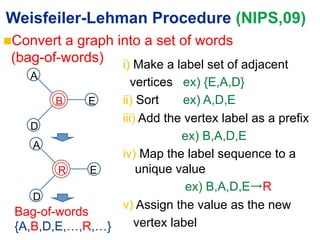
Weisfeiler-Lehman Procedure (NIPS,09)	
n Convert
         a graph into a set of words
 (bag-of-words)	
 i) Make a label set of adjacent
    A	
                     vertices ex) {E,A,D}
        B	
  E	
  ii) Sort     ex) A,D,E
                  iii) Add the vertex label as a prefix
    D	
                              ex) B,A,D,E
    A	
                  iv) Map the label sequence to a
        R	
   E	
     unique value
                               ex) B,A,D,E R
    D	
                  v) Assign the value as the new
 Bag-of-words
 {A,B,D,E,…,R,…}	
 vertex label
Search by cosine similarity	
n  Identify
          all graphs in the database whose
  cosine is larger than a threshold 1-ε
                                        | Wi !Q |
                 Wi s.t K N (Wi ,Q) =                ! 1" !
                                        | Wi | | Q |

   l    Wi, Q: bag-of-words of graphs
n  The above solution can be relaxed as
  follows,
 If K (Q,W ) ! 1" ! , then
         N

                                             |Q |
                   (1! ! )2 | Q |!| W |!
                                           (1! ! )2
   l    Can be used for fast search
Semi-conjunctive query	
n Cosine   query can be relaxed to the following
form
              Wi s.t | Wi !Q |" k
  l  The number of common words between
      two bag-of-words Wi and Q
  Ex) |Wi Q|=|(A,C,E,F,H) (A,E,I,J,L)|
                 =|(A,E)|=2
  l  k=(1-ε)2|Q|
  l No false negatives

  l False positives can easily be filtered out by
  cosine calculations
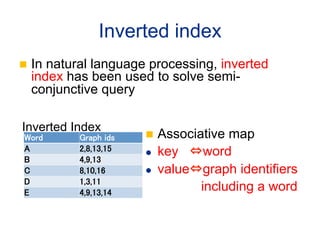
Inverted index	
n  Innatural language processing, inverted
   index has been used to solve semi-
   conjunctive query	

Inverted Index	
         	
           	
   n  Associative  map
  	
                 	
    l    key    word


         l    value graph identifiers


                                       including a word
Bottom-up search	
   Inverted Index	
        	
           	
       i) Look the index up with


              query bag-of-words


          ii) Aggregate all the lists
   	
                   	
         of graph indices
         Query:(A,C,E)	
      iii) Sort
                Aggregation	
     )Scan
(2,8,13,15,8,10,16,4,9,13,14)	
               Sort	
(2,4,8,8,9,10,13,13,14,15,16)	
	
 k=
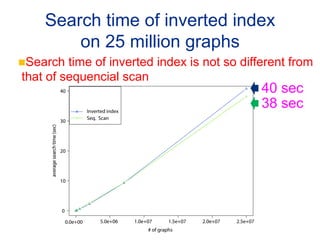
Search time of inverted index
         on 25 million graphs	
n Searchtime of inverted index is not so different from
that of sequencial scan	
                                              40 sec	
                                              38 sec
Why?	
                           n  Each    word is not
        Query:(A,C,E)	
          specific enough
                Aggregation	
 Query contains 1000s
                             n 
(2,8,13,15,8,10,16,4,9,13,14)	
 of words
                Sort	
       n  Aggregated array is

(2,4,8,8,9,10,13,13,14,15,16)	
 VERY long
                             n  Sorting takes O(ClogC)
              C	
                in time
Overview of our method 	
n  Top-down   search in a tree over the series of
    graphs
n  Huge memory, if tree is implemented with
    pointers
n  Wavelet Tree: Succinct data structure
n  The smaller the similarity threshold is, the
    quicker the algorithm finishes
     •  Not the case in inverted index
Binary tree over graphs	
                                      n  leaf       graph
                  [1,8]	
           0	
                        n  node       interval
                            1	
        [1,4]	
             [5,8]	
                                      n        Each node is identified
      0	
        1	
      0	
      1	
          by a bit string (v={01})
                                            n  At the leaves, the graph
    [1,2]	
    [3,4]	
   [5,6]	
  [7,8]	
                                                indices correspond to
 0	
     1	
 0	
 1	
0	
 1	
 0	
        1	
                                                int(v)+1
  1	
 2	
 3	
 4	
 5	
 6	
 7	
 8	
{000}	
 001}	
      {     {010}	
 {100}	
 {110}	
                  {011}	
 {101}	
   {111}	
    (e.g., int(010)+1=2+1=3)
Summarization of bag-of-words	
  Represent bag-of-words as a bit array
n 
                       12345678
Ex) Wi=(1,3,4,7,8) xi=(1,0,1,1,0,0,1,1)

n    Take disjunction   of all bit arrays in the interval
      of a node v


Ex) For an interval [1,4]
X1=(0,1,0,0,0,0,1,0)           yv=x1 x2 x3 x4
X2=(1,0,1,1,0,0,0,0)             =(1,1,1,1,0,0,1,1)	
X3=(1,0,0,0,0,0,1,1)
X4=(1,0,0,0,0,0,0,1)
Binary tree over graphs	
                        yv=111111	
                       n  Assign   to each node
                         [1,8]	
                             v a bit arrays yv
        yv=110111	
                yv=101101	
                                                          n  yv : bit array
              [1,4]	
                 [5,8]	
                                                            l    i-th bit is 1 if graphs
yv=010101	
yv=110100	
 v=100100	
yv=001101	
                    y
                                                                  in an interval have
    [1,2]	
       [3,4]	
       [5,6]	
         [7,8]	
                                                                  the corresponding
                                                                  word.
  1	
   2	
      3	
     4	
   5	
    6	
   7	
     8	
{000}	
 001}	
      {     {010}	
 {100}	
 {110}	
                 {011}	
 {101}	
 {111}
Top-down traversal	
                   yv=111111	
                      n  Q: bag-of-words of a
                       [1,8]	
                          query
        vy =110111 	
                               y =101101
                               v          	
        n  Perform top-down
             [1,4]	
              [5,8]	
               traversal
 y =010101 y =110100 y =100100 y =001101 n  Prune the search
 v          	
 v        	
 v       	
 v        	

     [1,2]	
     [3,4]	
     [5,6]	
      [7,8]	
       space if # y [ j] ! k
                                                             j"Q
                                                                   v


                                                    n  The larger k is, the
   1	
 2	
 3	
 4	
 5	
 6	
 7	
 8	
{000}	
 001}	
       {      {010}	
 {100}	
 {110}	
                     {011}	
 {101}	
        {111}	
     smaller the search
                                                        space is
Huge Memory	
n  Time   is O(τm) : Very fast
  l  τ: the number of traversed node
  l  m: the number of bag-of-words in a query

n  Space   is O(Mnlogn) bit
  l  M: the number of unique words
  l  n: the number of graphs
Wavelet Tree! (SODA,03)	
n  Replace yv    in each node v by a rank
  dictionary
  l    explained in next slides
n  Implement  a tree without using pointers
n  Only 60% memory overhead compared to
    the inverted index (Vigna,08)
n  Access to the summary information in any
    internal node
Rank dictionary (Raman,02)	
n  Give    bit array B[1,n] the following operation:
   l    rankc(B,i): return the number of c   {0,1} in B[1…i]	


Ex) B=0110011100	
                        i 1 2 3 4 5 6 7 8 9 10
           rank1(B,8)=5 0 1 1 0 0 1 1 1 0 0
           rank0(B,5)=3	
 0 1 1 0 0 1 1 1 0 0
Implementation of rank dictionary	
                           n  Divide the bit array B into
B	
                        large blocks of length l=log2n
                             RL=Ranks of large blocks
RL	
                       n  Divide each large block to
                           small blocks of length s=logn/2
                             Rs=Ranks of small blocks
RS	
                            relative to the large block
               rank1(B,i)=RL[i/l]+Rs[i/s]+(remaining rank)	
                                 Time:O(1)
                                 Memory: n +o(n) bits
Restricted inverted index	
Inverted Index	
                      n  Concatenate    graph ids
     	
                          	
                                          for words in the root


             n  Restrict the inverted index for
	
                     	
                 the interval [sv,tv] of a node v	


          [1,8]    A	
    B	
  C	
   D	
          Aroot 1 3 6 8 2 5 7 1 2 7 4 5

                                       4	
              >4	
[1,4]        A	
 B	
 C	
 D	
                           A	
 B	
 C	
 D	
 [4,8]
 Aleft      1 3 2 1 2 4                        Aright 6 8 5 7 7 5
Whole structure of
          restricted inverted index	
          [1,8]    A	
    B	
   C	
  D	
                1 3 6 8 2 5 7 1 2 7 4 5


  [1,4]    A	
 B	
 C	
 D	
                  A	
 B	
 C	
 D	
[5,8]
          1 3 2 1 2 4                      6 8 5 7 7 5

[1,2]                        [3,4] [5,6]                 [6,7]
   A	
B	
 C	
          A	
D	
        A	
B	
 D	
      A	
 B	
C	
   1 2 1 2             3 4           6 5 5            8 7 7


 A	
C	
    B	
C	
      A	
     D	
   B	
D	
 A	
      B	
 C	
 A	
 1 1       2 2         3        4    5 5 6           7 7     8
Similarity search	
n  To
    retrieve graphs similar to a query
  Q=(A,C), the tree is traversed in the top-
  down manner.

          [1,8]    A	
         C	
          Aroot 1 3 6 8 2 5 7 1 2 7 4 5

                       4	
           >4	
 [1,4]       A	
  C	
        [5,8]   A	
   C	
  Aleft     1 3 2 1 2 4      Aright 6 8 5 7 7 5
Similarity search	
n    To retrieve graphs similar to a query Q=(A,C), the tree
      is traversed in a top-down manner.
n  Observation
      l    To perform top-down traversal, only intervals
            of words in each node are necessary

                    A [1,4]	
    C [8,10]	
              Aroot 1 3 6 8 2 5 7 1 2 7 4 5

                             4	
              >4	
            A [1,2]	
C [4,5]	
             A[1,2]	
 C[5,5]	
       Aleft 1 3 2 1 2 4            Aright 6 8 5 7 7 5
Similarity search	
n  Replace
          restricted inverted index Av in
  each node v with a bit array bv.
   l    bv[i]=1 if Av[i] goes to the right child


 0	
 0	
 1	
1	
 0	
 1	
 1	
 0	
 0	
 1	
 0	
 1	
            Aroot 1 3 6 8 2 5 7 1 2 7 4 5
                             0	
                       1	

 bleft	
     0	
 1	
 0	
0	
 0	
 1	
      bright	
 0	
 1	
 0	
1	
 1	
 0	
 Aleft       1 3 2 1 2 4                 Aright 6 8 5 7 7 5
Similarity search	
n  Intervals       of child nodes can be computed by
      rank operations
l    sleft(v),j=rank0(bv,svj-1)+1,tleft(v),j=rank0(bv,tvj)
l    sright(v),j =rank1(bv,svj-1)+1,tright(v),j=rank1(bv,tvj)
                                               C [8,10]	
      Ex)
                    	
 0	
 0	
 1	
1	
 0	
 1	
 1	
 0	
 0	
 1	
 0	
 1	
                Aroot 1 3 6 8 2 5 7 1 2 7 4 5
rank0(broot,8-1)+1=4,                                            rank1(broot,8-1)+1=5,
rank0(broot,10)=5	
                                              rank1(broot,10)=5	
                        C [4,5]	
                               C [5,5]	
      bleft	
    0	
 1	
 0	
0	
 0	
 1	
       bright	
 0	
 1	
 0	
1	
 1	
 0	
      Aleft      1 3 2 1 2 4                  Aright 6 8 5 7 7 5
Wavelet Tree	
n Wavelet tree can be obtained to replace the restricted
Inverted indices with bit arrays
n Wavelet tree consists of bit arrays bv and initial
intervals Croot.

     Croot	
      A	
    B	
   C	
  D	
               0 0 1 1 0 1 1 0 0 1 0 1


         0 1 0 0 0 1             0 1 0 1 1 0


    0 1 0 1          0 1       1 0 0       1 0 0
Wavelet Tree	
n Graphids can be recovered from bit strings
 on the path from the root to leaves	
  Croot	
 A	
       B	
   C	
   D	
                 0 0 1 1 0 1 1 0 0 1 0 1

                     0	
                   1	

        0 1 0 0 0 1                0 1 0 1 1 0

        0	
           1	
           0	
           1	

  0 1 0 1                  0 1   1 0 0            1 0 0

  0	
      1	
        0	
 1	
    0	
 1	
          0	
 1	
 000    001          010 011 100 101             110 111
Memory	
n  (1+α)Nlogn          + MlogN bits
        Bit arrays bv	
 Initial intervals Croot	
      l  N: the number of all words in the database
      l  n: the number of graphs

      l  α: overhead for rank dictionary (α=0.6)

n    For inverted index, Nlogn bits
n    About 60% overhead to inverted index!!
Experiments	
n  25 million chemical compounds from
    PubChem database
n  Use search time and memory as
    evaluation measures
n  Compare our method gWT to
   l  inverted index
   l  sequential scan implemented in G-Hash

       (Wang et al, 2009)
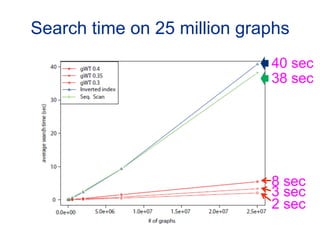
Search time on 25 million graphs	
                              40 sec	
                              38 sec	


                              8 sec	
                              3 sec	
                              2 sec
Memory usage
Overhead of rank dictionary
Construction time
Related work	
•  A lot of methods have been proposed so far.
 1.gIndex [Yan et al., 04]
 2.Graph Grep [Shasha et al., 07]
 3.Tree+Delta [Zhao et al., 07]
 4.TreePi [Zhang et al., 07]
 5.Gstring [Jiang et al., 07]
 6.FG-Index [Cheng et al., 07]
 7.GDIndex [Williams et al., 07]
 etc
Related work 	
              •  Decompose graphs
                 into a set of
Decompose	
      substructures
               - subgraphs, trees,
          …	
    paths etc
              •  Build a substructure-
Index	
                 based index
Drawbacks	
•  Require frequent subgraph mining
•  Do not scale to millions of graphs
Summary	
n  Efficientsimilarity search method for
    massive graph databases
n  Solve semi-conjunctive query efficiently
n  Built on wavelet trees
n  Use Weisfeiler-Lehman procedure to
    convert graphs into bag-of-words
n  Applicable to more than 20 million graphs
n  Software
    http://code.google.com/p/gwt/
Acknowledgements	

•  Prof. Shin-ichi Minato (Hokkaido Univ.)
•  Dr. Daisuke Okanohara (PFI)
•  Members in ERATO Minato Project

Dmss2011 public

  • 1.
    March 30, 2011,The 5th International Workshop on Data-Mining and Statistical Science@Osaka University Kernel-based Similarity Search in Massive Graph Databases with Wavelet Trees Yasuo Tabei (JST ERATO Minato Project) Joint work with Koji Tsuda (AIST)
  • 2.
    Outline n  Introduction l  Recent development of graph databases l  Needs for graph similarity search l  Bag-of-words representation of a graph l  Semi-conjunctive query n  Method l  Scalable similarity search with wavelet trees n  Experiments l  Use a large-scale graph dataset l  25 million chemical compounds
  • 3.
    Graphs are everywhere Geneco-expression network RNA 2D structure Protein 3D structure Chemical compound Social Network
  • 4.
    Graph Similarity Search n Retrievegraphs similar to the query n  Large databases l  More than 20 million chemical compounds in PubChem database n  Bag-of-words representation of graphs l  WL procedure (NIPS 2009) n  Why not use document retrieval methods? l  Inverted index l  Not that easy (explained later)
  • 5.
    Weisfeiler-Lehman Procedure (NIPS,09) n Convert a graph into a set of words (bag-of-words) i) Make a label set of adjacent A vertices ex) {E,A,D} B E ii) Sort ex) A,D,E iii) Add the vertex label as a prefix D ex) B,A,D,E A iv) Map the label sequence to a R E unique value ex) B,A,D,E R D v) Assign the value as the new Bag-of-words {A,B,D,E,…,R,…} vertex label
  • 6.
    Search by cosinesimilarity n  Identify all graphs in the database whose cosine is larger than a threshold 1-ε | Wi !Q | Wi s.t K N (Wi ,Q) = ! 1" ! | Wi | | Q | l  Wi, Q: bag-of-words of graphs n  The above solution can be relaxed as follows, If K (Q,W ) ! 1" ! , then N |Q | (1! ! )2 | Q |!| W |! (1! ! )2 l  Can be used for fast search
  • 7.
    Semi-conjunctive query n Cosine query can be relaxed to the following form Wi s.t | Wi !Q |" k l  The number of common words between two bag-of-words Wi and Q Ex) |Wi Q|=|(A,C,E,F,H) (A,E,I,J,L)| =|(A,E)|=2 l  k=(1-ε)2|Q| l No false negatives l False positives can easily be filtered out by cosine calculations
  • 8.
    Inverted index n  Innaturallanguage processing, inverted index has been used to solve semi- conjunctive query Inverted Index n  Associative map l  key word l  value graph identifiers including a word
  • 9.
    Bottom-up search Inverted Index i) Look the index up with query bag-of-words ii) Aggregate all the lists of graph indices Query:(A,C,E) iii) Sort Aggregation )Scan (2,8,13,15,8,10,16,4,9,13,14) Sort (2,4,8,8,9,10,13,13,14,15,16) k=
  • 10.
    Search time ofinverted index on 25 million graphs n Searchtime of inverted index is not so different from that of sequencial scan 40 sec 38 sec
  • 11.
    Why? n  Each word is not Query:(A,C,E) specific enough Aggregation Query contains 1000s n  (2,8,13,15,8,10,16,4,9,13,14) of words Sort n  Aggregated array is (2,4,8,8,9,10,13,13,14,15,16) VERY long n  Sorting takes O(ClogC) C in time
  • 12.
    Overview of ourmethod n  Top-down search in a tree over the series of graphs n  Huge memory, if tree is implemented with pointers n  Wavelet Tree: Succinct data structure n  The smaller the similarity threshold is, the quicker the algorithm finishes •  Not the case in inverted index
  • 13.
    Binary tree overgraphs n  leaf graph [1,8] 0 n  node interval 1 [1,4] [5,8] n  Each node is identified 0 1 0 1 by a bit string (v={01}) n  At the leaves, the graph [1,2] [3,4] [5,6] [7,8] indices correspond to 0 1 0 1 0 1 0 1 int(v)+1 1 2 3 4 5 6 7 8 {000} 001} { {010} {100} {110} {011} {101} {111} (e.g., int(010)+1=2+1=3)
  • 14.
    Summarization of bag-of-words Represent bag-of-words as a bit array n  12345678 Ex) Wi=(1,3,4,7,8) xi=(1,0,1,1,0,0,1,1) n  Take disjunction of all bit arrays in the interval of a node v Ex) For an interval [1,4] X1=(0,1,0,0,0,0,1,0) yv=x1 x2 x3 x4 X2=(1,0,1,1,0,0,0,0) =(1,1,1,1,0,0,1,1) X3=(1,0,0,0,0,0,1,1) X4=(1,0,0,0,0,0,0,1)
  • 15.
    Binary tree overgraphs yv=111111 n  Assign to each node [1,8] v a bit arrays yv yv=110111 yv=101101 n  yv : bit array [1,4] [5,8] l  i-th bit is 1 if graphs yv=010101 yv=110100 v=100100 yv=001101 y in an interval have [1,2] [3,4] [5,6] [7,8] the corresponding word. 1 2 3 4 5 6 7 8 {000} 001} { {010} {100} {110} {011} {101} {111}
  • 16.
    Top-down traversal yv=111111 n  Q: bag-of-words of a [1,8] query vy =110111 y =101101 v n  Perform top-down [1,4] [5,8] traversal y =010101 y =110100 y =100100 y =001101 n  Prune the search v v v v [1,2] [3,4] [5,6] [7,8] space if # y [ j] ! k j"Q v n  The larger k is, the 1 2 3 4 5 6 7 8 {000} 001} { {010} {100} {110} {011} {101} {111} smaller the search space is
  • 17.
    Huge Memory n  Time is O(τm) : Very fast l  τ: the number of traversed node l  m: the number of bag-of-words in a query n  Space is O(Mnlogn) bit l  M: the number of unique words l  n: the number of graphs
  • 18.
    Wavelet Tree! (SODA,03) n Replace yv in each node v by a rank dictionary l  explained in next slides n  Implement a tree without using pointers n  Only 60% memory overhead compared to the inverted index (Vigna,08) n  Access to the summary information in any internal node
  • 19.
    Rank dictionary (Raman,02) n Give bit array B[1,n] the following operation: l  rankc(B,i): return the number of c {0,1} in B[1…i] Ex) B=0110011100 i 1 2 3 4 5 6 7 8 9 10 rank1(B,8)=5 0 1 1 0 0 1 1 1 0 0 rank0(B,5)=3 0 1 1 0 0 1 1 1 0 0
  • 20.
    Implementation of rankdictionary n  Divide the bit array B into B large blocks of length l=log2n RL=Ranks of large blocks RL n  Divide each large block to small blocks of length s=logn/2 Rs=Ranks of small blocks RS relative to the large block rank1(B,i)=RL[i/l]+Rs[i/s]+(remaining rank) Time:O(1) Memory: n +o(n) bits
  • 21.
    Restricted inverted index InvertedIndex n  Concatenate graph ids for words in the root n  Restrict the inverted index for the interval [sv,tv] of a node v [1,8] A B C D Aroot 1 3 6 8 2 5 7 1 2 7 4 5 4 >4 [1,4] A B C D A B C D [4,8] Aleft 1 3 2 1 2 4 Aright 6 8 5 7 7 5
  • 22.
    Whole structure of restricted inverted index [1,8] A B C D 1 3 6 8 2 5 7 1 2 7 4 5 [1,4] A B C D A B C D [5,8] 1 3 2 1 2 4 6 8 5 7 7 5 [1,2] [3,4] [5,6] [6,7] A B C A D A B D A B C 1 2 1 2 3 4 6 5 5 8 7 7 A C B C A D B D A B C A 1 1 2 2 3 4 5 5 6 7 7 8
  • 23.
    Similarity search n  To retrieve graphs similar to a query Q=(A,C), the tree is traversed in the top- down manner. [1,8] A C Aroot 1 3 6 8 2 5 7 1 2 7 4 5 4 >4 [1,4] A C [5,8] A C Aleft 1 3 2 1 2 4 Aright 6 8 5 7 7 5
  • 24.
    Similarity search n  To retrieve graphs similar to a query Q=(A,C), the tree is traversed in a top-down manner. n  Observation l  To perform top-down traversal, only intervals of words in each node are necessary A [1,4] C [8,10] Aroot 1 3 6 8 2 5 7 1 2 7 4 5 4 >4 A [1,2] C [4,5] A[1,2] C[5,5] Aleft 1 3 2 1 2 4 Aright 6 8 5 7 7 5
  • 25.
    Similarity search n  Replace restricted inverted index Av in each node v with a bit array bv. l  bv[i]=1 if Av[i] goes to the right child 0 0 1 1 0 1 1 0 0 1 0 1 Aroot 1 3 6 8 2 5 7 1 2 7 4 5 0 1 bleft 0 1 0 0 0 1 bright 0 1 0 1 1 0 Aleft 1 3 2 1 2 4 Aright 6 8 5 7 7 5
  • 26.
    Similarity search n  Intervals of child nodes can be computed by rank operations l  sleft(v),j=rank0(bv,svj-1)+1,tleft(v),j=rank0(bv,tvj) l  sright(v),j =rank1(bv,svj-1)+1,tright(v),j=rank1(bv,tvj) C [8,10] Ex) 0 0 1 1 0 1 1 0 0 1 0 1 Aroot 1 3 6 8 2 5 7 1 2 7 4 5 rank0(broot,8-1)+1=4, rank1(broot,8-1)+1=5, rank0(broot,10)=5 rank1(broot,10)=5 C [4,5] C [5,5] bleft 0 1 0 0 0 1 bright 0 1 0 1 1 0 Aleft 1 3 2 1 2 4 Aright 6 8 5 7 7 5
  • 27.
    Wavelet Tree n Wavelet treecan be obtained to replace the restricted Inverted indices with bit arrays n Wavelet tree consists of bit arrays bv and initial intervals Croot. Croot A B C D 0 0 1 1 0 1 1 0 0 1 0 1 0 1 0 0 0 1 0 1 0 1 1 0 0 1 0 1 0 1 1 0 0 1 0 0
  • 28.
    Wavelet Tree n Graphids canbe recovered from bit strings on the path from the root to leaves Croot A B C D 0 0 1 1 0 1 1 0 0 1 0 1 0 1 0 1 0 0 0 1 0 1 0 1 1 0 0 1 0 1 0 1 0 1 0 1 1 0 0 1 0 0 0 1 0 1 0 1 0 1 000 001 010 011 100 101 110 111
  • 29.
    Memory n  (1+α)Nlogn + MlogN bits Bit arrays bv Initial intervals Croot l  N: the number of all words in the database l  n: the number of graphs l  α: overhead for rank dictionary (α=0.6) n  For inverted index, Nlogn bits n  About 60% overhead to inverted index!!
  • 30.
    Experiments n  25 millionchemical compounds from PubChem database n  Use search time and memory as evaluation measures n  Compare our method gWT to l  inverted index l  sequential scan implemented in G-Hash (Wang et al, 2009)
  • 31.
    Search time on25 million graphs 40 sec 38 sec 8 sec 3 sec 2 sec
  • 32.
  • 33.
    Overhead of rankdictionary
  • 34.
  • 35.
    Related work •  Alot of methods have been proposed so far. 1.gIndex [Yan et al., 04] 2.Graph Grep [Shasha et al., 07] 3.Tree+Delta [Zhao et al., 07] 4.TreePi [Zhang et al., 07] 5.Gstring [Jiang et al., 07] 6.FG-Index [Cheng et al., 07] 7.GDIndex [Williams et al., 07] etc
  • 36.
    Related work •  Decompose graphs into a set of Decompose substructures - subgraphs, trees, … paths etc •  Build a substructure- Index based index
  • 37.
    Drawbacks •  Require frequentsubgraph mining •  Do not scale to millions of graphs
  • 38.
    Summary n  Efficientsimilarity searchmethod for massive graph databases n  Solve semi-conjunctive query efficiently n  Built on wavelet trees n  Use Weisfeiler-Lehman procedure to convert graphs into bag-of-words n  Applicable to more than 20 million graphs n  Software http://code.google.com/p/gwt/
  • 39.
    Acknowledgements •  Prof. Shin-ichiMinato (Hokkaido Univ.) •  Dr. Daisuke Okanohara (PFI) •  Members in ERATO Minato Project