Dictionaries
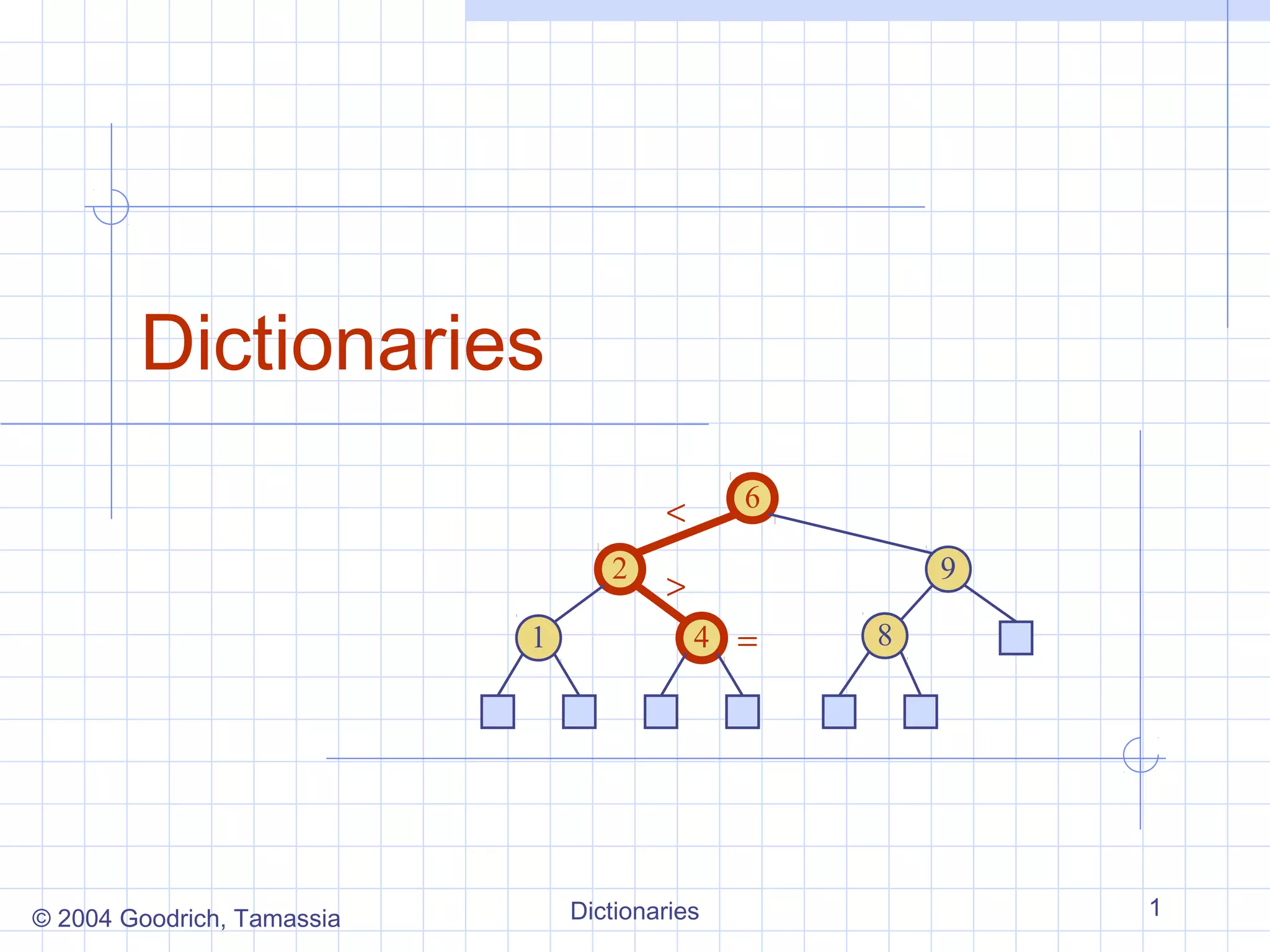
                                        <      6

                                   2                   9
                                        >
                            1               4 =    8


© 2004 Goodrich, Tamassia       Dictionaries               1
Dictionary ADT
         The dictionary ADT models a                   Dictionary ADT methods:
         searchable collection of key-                    findElement(k): if the
         element items                                     dictionary has an item with
         The main operations of a                          key k, returns its element,
         dictionary are searching,                         else, returns the special
                                                           element NO_SUCH_KEY
         inserting, and deleting items                    insertItem(k, o): inserts item
         Multiple items with the same key                  (k, o) into the dictionary
         are allowed                                      removeElement(k): if the
         Applications:                                     dictionary has an item with
              address book                                key k, removes it from the
              credit card authorization                   dictionary and returns its
                                                           element, else returns the
              mapping host names (e.g.,                   special element
               cs16.net) to internet addresses             NO_SUCH_KEY
               (e.g., 128.148.34.101)                     size(), isEmpty()
                                                          keys(), Elements()

© 2004 Goodrich, Tamassia               Dictionaries                                  2
Log File
           A log file is a dictionary implemented by means of an unsorted
           sequence
               We store the items of the dictionary in a sequence (based on a
                doubly-linked lists or a circular array), in arbitrary order
           Performance:
               insertItem takes O(1) time since we can insert the new item at the
                beginning or at the end of the sequence
               findElement and removeElement take O(n) time since in the worst
                case (the item is not found) we traverse the entire sequence to look
                for an item with the given key
           The log file is effective only for dictionaries of small size or for
           dictionaries on which insertions are the most common
           operations, while searches and removals are rarely performed
           (e.g., historical record of logins to a workstation)


© 2004 Goodrich, Tamassia               Dictionaries                              3
Lookup Table
           A lookup table is a dictionary implemented by means of a sorted
           sequence
               We store the items of the dictionary in an array-based sequence,
                sorted by key
               We use an external comparator for the keys
           Performance:
               findElement takes O(log n) time, using binary search
               insertItem takes O(n) time since in the worst case we have to shift
                n/2 items to make room for the new item
               removeElement take O(n) time since in the worst case we have to
                shift n/2 items to compact the items after the removal
           The lookup table is effective only for dictionaries of small size or
           for dictionaries on which searches are the most common
           operations, while insertions and removals are rarely performed
           (e.g., credit card authorizations)


© 2004 Goodrich, Tamassia               Dictionaries                               4
Binary Search Tree
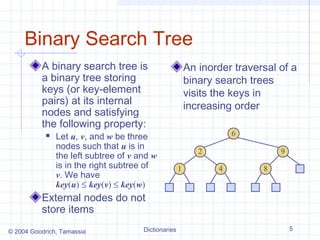
          A binary search tree is                         An inorder traversal of a
          a binary tree storing                           binary search trees
          keys (or key-element                            visits the keys in
          pairs) at its internal                          increasing order
          nodes and satisfying
          the following property:
               Let u, v, and w be three                             6
                nodes such that u is in
                                                             2                 9
                the left subtree of v and w
                is in the right subtree of            1          4         8
                v. We have
                key(u) ≤ key(v) ≤ key(w)
          External nodes do not
          store items
© 2004 Goodrich, Tamassia              Dictionaries                                5
Search
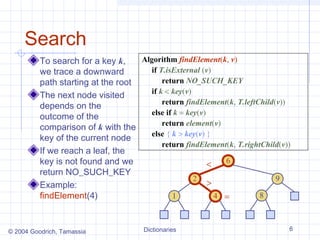
          To search for a key k,    Algorithm findElement(k, v)
          we trace a downward         if T.isExternal (v)
          path starting at the root       return NO_SUCH_KEY
                                      if k < key(v)
          The next node visited
                                          return findElement(k, T.leftChild(v))
          depends on the
                                      else if k = key(v)
          outcome of the
                                          return element(v)
          comparison of k with the
                                      else { k > key(v) }
          key of the current node
                                          return findElement(k, T.rightChild(v))
          If we reach a leaf, the
          key is not found and we                        <   6
          return NO_SUCH_KEY
                                                    2                       9
          Example:                                       >
          findElement(4)                      1            4 =         8


© 2004 Goodrich, Tamassia             Dictionaries                             6
Insertion
                                                                           6
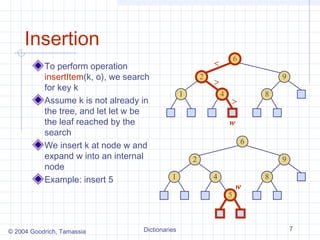
           To perform operation                                <
           insertItem(k, o), we search                     2                           9
                                                               >
           for key k
                                                   1               4               8
           Assume k is not already in                                  >
           the tree, and let let w be
           the leaf reached by the                                     w
           search
                                                                               6
           We insert k at node w and
           expand w into an internal                   2                               9
           node
           Example: insert 5                  1                4                   8
                                                                           w
                                                                       5


© 2004 Goodrich, Tamassia           Dictionaries                                           7
Deletion
                                                                                    6
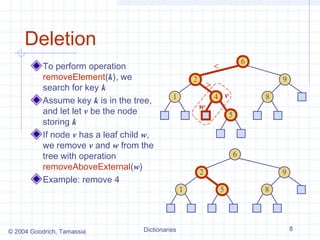
           To perform operation                                     <
           removeElement(k), we                         2                                   9
           search for key k                                     >
                                               1                    4 v                 8
           Assume key k is in the tree,
                                                            w
           and let let v be the node                                        5
           storing k
           If node v has a leaf child w,
           we remove v and w from the
           tree with operation                                                  6
           removeAboveExternal(w)
                                                            2                               9
           Example: remove 4
                                                    1                   5               8


© 2004 Goodrich, Tamassia            Dictionaries                                               8
Deletion (cont.)
                                                        1
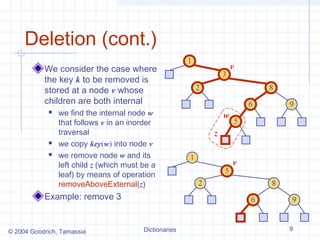
           We consider the case where                                   v
                                                                    3
           the key k to be removed is
           stored at a node v whose                         2                   8
           children are both internal                                       6       9
               we find the internal node w                         w
                that follows v in an inorder                            5
                traversal                                       z
               we copy key(w) into node v
               we remove node w and its                1
                left child z (which must be a                           v
                leaf) by means of operation                         5
                removeAboveExternal(z)                      2                   8
           Example: remove 3                                                6       9


© 2004 Goodrich, Tamassia                Dictionaries                               9
Performance
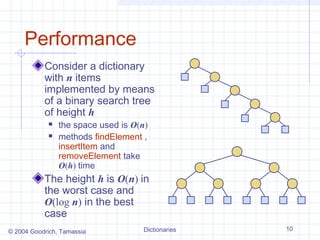
           Consider a dictionary
           with n items
           implemented by means
           of a binary search tree
           of height h
               the space used is O(n)
               methods findElement ,
                insertItem and
                removeElement take
                O(h) time
           The height h is O(n) in
           the worst case and
           O(log n) in the best
           case
© 2004 Goodrich, Tamassia           Dictionaries   10
Ordered Dictionaries
         Keys are assumed to come from a total
         order.
         New operations:
              first(): first entry in the dictionary ordering
              last(): last entry in the dictionary ordering
              successors(k): iterator of entries with keys
               greater than or equal to k; increasing order
              predecessors(k): iterator of entries with keys
               less than or equal to k; decreasing order
© 2004 Goodrich, Tamassia   Bucket-Sort and Radix-Sort     11
Hash Tables
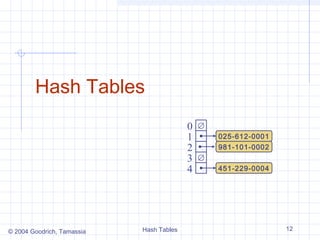
                                          0   ∅
                                          1       025-612-0001
                                          2       981-101-0002
                                          3   ∅
                                          4       451-229-0004


© 2004 Goodrich, Tamassia   Hash Tables                          12
Recall the Map ADT
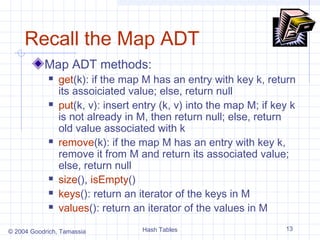
           Map ADT methods:
               get(k): if the map M has an entry with key k, return
                its assoiciated value; else, return null
               put(k, v): insert entry (k, v) into the map M; if key k
                is not already in M, then return null; else, return
                old value associated with k
               remove(k): if the map M has an entry with key k,
                remove it from M and return its associated value;
                else, return null
               size(), isEmpty()
               keys(): return an iterator of the keys in M
               values(): return an iterator of the values in M

© 2004 Goodrich, Tamassia          Hash Tables                      13
Hash Functions and
     Hash Tables
         A hash function h maps keys of a given type to integers
         in a fixed interval [0, N − 1]
         Example:
              h(x) = x mod N
         is a hash function for integer keys
         The integer h(x) is called the hash value of key x

         A hash table for a given key type consists of
           Hash function h

           Array (called table) of size N

         When implementing a map with a hash table, the goal
         is to store item (k, o) at index i = h(k)
© 2004 Goodrich, Tamassia     Hash Tables                   14
Example
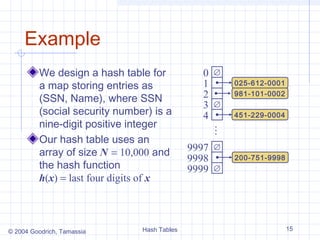
         We design a hash table for            0    ∅
         a map storing entries as              1        025-612-0001

         (SSN, Name), where SSN                2        981-101-0002
                                               3    ∅
         (social security number) is a         4        451-229-0004
         nine-digit positive integer


                                                    …
         Our hash table uses an
         array of size N = 10,000 and        9997   ∅
                                             9998       200-751-9998
         the hash function                   9999   ∅
         h(x) = last four digits of x


© 2004 Goodrich, Tamassia      Hash Tables                             15
Hash Functions

          A hash function is                The hash code is
          usually specified as the          applied first, and the
                                            compression function
          composition of two
                                            is applied next on the
          functions:                        result, i.e.,
          Hash code:                             h(x) = h2(h1(x))
            h1: keys → integers             The goal of the hash
                                            function is to
          Compression function:
                                            “disperse” the keys in
           h2: integers → [0, N − 1]        an apparently random
                                            way
© 2004 Goodrich, Tamassia     Hash Tables                      16
Hash Codes
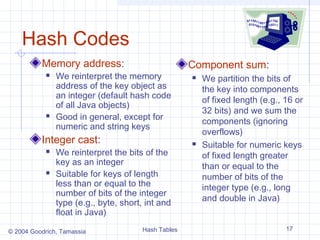
          Memory address:                             Component sum:
               We reinterpret the memory                We partition the bits of
                address of the key object as              the key into components
                an integer (default hash code
                                                          of fixed length (e.g., 16 or
                of all Java objects)
                                                          32 bits) and we sum the
               Good in general, except for               components (ignoring
                numeric and string keys
                                                          overflows)
          Integer cast:                                  Suitable for numeric keys
               We reinterpret the bits of the            of fixed length greater
                key as an integer                         than or equal to the
               Suitable for keys of length               number of bits of the
                less than or equal to the                 integer type (e.g., long
                number of bits of the integer
                                                          and double in Java)
                type (e.g., byte, short, int and
                float in Java)

© 2004 Goodrich, Tamassia               Hash Tables                              17
Hash Codes (cont.)
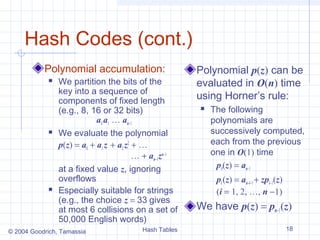
           Polynomial accumulation:                     Polynomial p(z) can be
               We partition the bits of the            evaluated in O(n) time
                key into a sequence of
                components of fixed length
                                                        using Horner’s rule:
                (e.g., 8, 16 or 32 bits)                   The following
                            a0 a1 … an−1                    polynomials are
               We evaluate the polynomial                  successively computed,
                p(z) = a0 + a1 z + a2 z2 + …                each from the previous
                                         … + an−1zn−1       one in O(1) time
                at a fixed value z, ignoring                 p0(z) = an−1
                overflows                                    pi (z) = an−i−1 + zpi−1(z)
               Especially suitable for strings              (i = 1, 2, …, n −1)
                (e.g., the choice z = 33 gives
                at most 6 collisions on a set of        We have p(z) = pn−1(z)
                50,000 English words)
© 2004 Goodrich, Tamassia                 Hash Tables                                     18
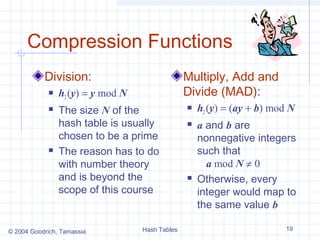
Compression Functions
           Division:                             Multiply, Add and
               h2 (y) = y mod N                 Divide (MAD):
               The size N of the                   h2 (y) = (ay + b) mod N
                hash table is usually               a and b are
                chosen to be a prime                 nonnegative integers
               The reason has to do                 such that
                with number theory                     a mod N ≠ 0
                and is beyond the                   Otherwise, every
                scope of this course                 integer would map to
                                                     the same value b

© 2004 Goodrich, Tamassia          Hash Tables                           19
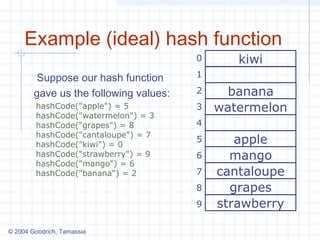
Example (ideal) hash function
                                        0      kiwi
         Suppose our hash function      1

        gave us the following values:   2     banana
        hashCode("apple") = 5           3   watermelon
        hashCode("watermelon") = 3
        hashCode("grapes") = 8          4
        hashCode("cantaloupe") = 7
        hashCode("kiwi") = 0
                                        5      apple
        hashCode("strawberry") = 9      6     mango
        hashCode("mango") = 6
        hashCode("banana") = 2          7   cantaloupe
                                        8     grapes
                                        9   strawberry

© 2004 Goodrich, Tamassia
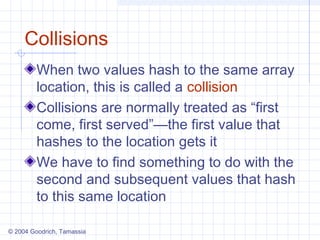
Collisions
         When two values hash to the same array
         location, this is called a collision
         Collisions are normally treated as “first
         come, first served”—the first value that
         hashes to the location gets it
         We have to find something to do with the
         second and subsequent values that hash
         to this same location

© 2004 Goodrich, Tamassia
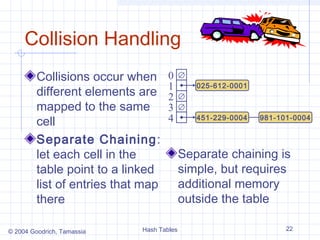
Collision Handling
         Collisions occur when       0     ∅
                                     1         025-612-0001
         different elements are      2     ∅
         mapped to the same          3     ∅
         cell                        4         451-229-0004   981-101-0004


         Separate Chaining:
         let each cell in the              Separate chaining is
         table point to a linked           simple, but requires
         list of entries that map          additional memory
         there                             outside the table

© 2004 Goodrich, Tamassia    Hash Tables                            22
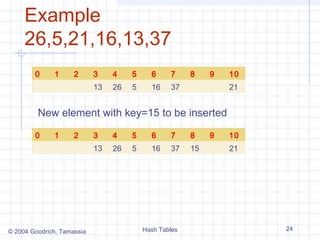
Linear probing
       A simple open addressing collision handling strategy
       is called linear probing. In this if we try to insert an
       item (k,e) into a bucket A[i] that is already occupied ,
       where i=h(k), then we try next at A[(i+1)mod N]. If
       A[(i+1)mod N] is occupied then we try at A[(i+2)mod
       N] and so on, until we find the empty bucket in A that
       can accept the new item.


© 2004 Goodrich, Tamassia      Hash Tables                        23
Example
     26,5,21,16,13,37
        0     1      2      3    4    5     6     7     8    9   10
                            13   26   5     16    37             21


         New element with key=15 to be inserted

        0     1      2      3    4    5     6     7     8    9   10
                            13   26   5     16    37    15       21


© 2004 Goodrich, Tamassia                 Hash Tables                 24

Dic hash

  • 1.
    Dictionaries < 6 2 9 > 1 4 = 8 © 2004 Goodrich, Tamassia Dictionaries 1
  • 2.
    Dictionary ADT The dictionary ADT models a Dictionary ADT methods: searchable collection of key-  findElement(k): if the element items dictionary has an item with The main operations of a key k, returns its element, dictionary are searching, else, returns the special element NO_SUCH_KEY inserting, and deleting items  insertItem(k, o): inserts item Multiple items with the same key (k, o) into the dictionary are allowed  removeElement(k): if the Applications: dictionary has an item with  address book key k, removes it from the  credit card authorization dictionary and returns its element, else returns the  mapping host names (e.g., special element cs16.net) to internet addresses NO_SUCH_KEY (e.g., 128.148.34.101)  size(), isEmpty()  keys(), Elements() © 2004 Goodrich, Tamassia Dictionaries 2
  • 3.
    Log File A log file is a dictionary implemented by means of an unsorted sequence  We store the items of the dictionary in a sequence (based on a doubly-linked lists or a circular array), in arbitrary order Performance:  insertItem takes O(1) time since we can insert the new item at the beginning or at the end of the sequence  findElement and removeElement take O(n) time since in the worst case (the item is not found) we traverse the entire sequence to look for an item with the given key The log file is effective only for dictionaries of small size or for dictionaries on which insertions are the most common operations, while searches and removals are rarely performed (e.g., historical record of logins to a workstation) © 2004 Goodrich, Tamassia Dictionaries 3
  • 4.
    Lookup Table A lookup table is a dictionary implemented by means of a sorted sequence  We store the items of the dictionary in an array-based sequence, sorted by key  We use an external comparator for the keys Performance:  findElement takes O(log n) time, using binary search  insertItem takes O(n) time since in the worst case we have to shift n/2 items to make room for the new item  removeElement take O(n) time since in the worst case we have to shift n/2 items to compact the items after the removal The lookup table is effective only for dictionaries of small size or for dictionaries on which searches are the most common operations, while insertions and removals are rarely performed (e.g., credit card authorizations) © 2004 Goodrich, Tamassia Dictionaries 4
  • 5.
    Binary Search Tree A binary search tree is An inorder traversal of a a binary tree storing binary search trees keys (or key-element visits the keys in pairs) at its internal increasing order nodes and satisfying the following property:  Let u, v, and w be three 6 nodes such that u is in 2 9 the left subtree of v and w is in the right subtree of 1 4 8 v. We have key(u) ≤ key(v) ≤ key(w) External nodes do not store items © 2004 Goodrich, Tamassia Dictionaries 5
  • 6.
    Search To search for a key k, Algorithm findElement(k, v) we trace a downward if T.isExternal (v) path starting at the root return NO_SUCH_KEY if k < key(v) The next node visited return findElement(k, T.leftChild(v)) depends on the else if k = key(v) outcome of the return element(v) comparison of k with the else { k > key(v) } key of the current node return findElement(k, T.rightChild(v)) If we reach a leaf, the key is not found and we < 6 return NO_SUCH_KEY 2 9 Example: > findElement(4) 1 4 = 8 © 2004 Goodrich, Tamassia Dictionaries 6
  • 7.
    Insertion 6 To perform operation < insertItem(k, o), we search 2 9 > for key k 1 4 8 Assume k is not already in > the tree, and let let w be the leaf reached by the w search 6 We insert k at node w and expand w into an internal 2 9 node Example: insert 5 1 4 8 w 5 © 2004 Goodrich, Tamassia Dictionaries 7
  • 8.
    Deletion 6 To perform operation < removeElement(k), we 2 9 search for key k > 1 4 v 8 Assume key k is in the tree, w and let let v be the node 5 storing k If node v has a leaf child w, we remove v and w from the tree with operation 6 removeAboveExternal(w) 2 9 Example: remove 4 1 5 8 © 2004 Goodrich, Tamassia Dictionaries 8
  • 9.
    Deletion (cont.) 1 We consider the case where v 3 the key k to be removed is stored at a node v whose 2 8 children are both internal 6 9  we find the internal node w w that follows v in an inorder 5 traversal z  we copy key(w) into node v  we remove node w and its 1 left child z (which must be a v leaf) by means of operation 5 removeAboveExternal(z) 2 8 Example: remove 3 6 9 © 2004 Goodrich, Tamassia Dictionaries 9
  • 10.
    Performance Consider a dictionary with n items implemented by means of a binary search tree of height h  the space used is O(n)  methods findElement , insertItem and removeElement take O(h) time The height h is O(n) in the worst case and O(log n) in the best case © 2004 Goodrich, Tamassia Dictionaries 10
  • 11.
    Ordered Dictionaries Keys are assumed to come from a total order. New operations:  first(): first entry in the dictionary ordering  last(): last entry in the dictionary ordering  successors(k): iterator of entries with keys greater than or equal to k; increasing order  predecessors(k): iterator of entries with keys less than or equal to k; decreasing order © 2004 Goodrich, Tamassia Bucket-Sort and Radix-Sort 11
  • 12.
    Hash Tables 0 ∅ 1 025-612-0001 2 981-101-0002 3 ∅ 4 451-229-0004 © 2004 Goodrich, Tamassia Hash Tables 12
  • 13.
    Recall the MapADT Map ADT methods:  get(k): if the map M has an entry with key k, return its assoiciated value; else, return null  put(k, v): insert entry (k, v) into the map M; if key k is not already in M, then return null; else, return old value associated with k  remove(k): if the map M has an entry with key k, remove it from M and return its associated value; else, return null  size(), isEmpty()  keys(): return an iterator of the keys in M  values(): return an iterator of the values in M © 2004 Goodrich, Tamassia Hash Tables 13
  • 14.
    Hash Functions and Hash Tables A hash function h maps keys of a given type to integers in a fixed interval [0, N − 1] Example: h(x) = x mod N is a hash function for integer keys The integer h(x) is called the hash value of key x A hash table for a given key type consists of  Hash function h  Array (called table) of size N When implementing a map with a hash table, the goal is to store item (k, o) at index i = h(k) © 2004 Goodrich, Tamassia Hash Tables 14
  • 15.
    Example We design a hash table for 0 ∅ a map storing entries as 1 025-612-0001 (SSN, Name), where SSN 2 981-101-0002 3 ∅ (social security number) is a 4 451-229-0004 nine-digit positive integer … Our hash table uses an array of size N = 10,000 and 9997 ∅ 9998 200-751-9998 the hash function 9999 ∅ h(x) = last four digits of x © 2004 Goodrich, Tamassia Hash Tables 15
  • 16.
    Hash Functions A hash function is The hash code is usually specified as the applied first, and the compression function composition of two is applied next on the functions: result, i.e., Hash code: h(x) = h2(h1(x)) h1: keys → integers The goal of the hash function is to Compression function: “disperse” the keys in h2: integers → [0, N − 1] an apparently random way © 2004 Goodrich, Tamassia Hash Tables 16
  • 17.
    Hash Codes Memory address: Component sum:  We reinterpret the memory  We partition the bits of address of the key object as the key into components an integer (default hash code of fixed length (e.g., 16 or of all Java objects) 32 bits) and we sum the  Good in general, except for components (ignoring numeric and string keys overflows) Integer cast:  Suitable for numeric keys  We reinterpret the bits of the of fixed length greater key as an integer than or equal to the  Suitable for keys of length number of bits of the less than or equal to the integer type (e.g., long number of bits of the integer and double in Java) type (e.g., byte, short, int and float in Java) © 2004 Goodrich, Tamassia Hash Tables 17
  • 18.
    Hash Codes (cont.) Polynomial accumulation: Polynomial p(z) can be  We partition the bits of the evaluated in O(n) time key into a sequence of components of fixed length using Horner’s rule: (e.g., 8, 16 or 32 bits)  The following a0 a1 … an−1 polynomials are  We evaluate the polynomial successively computed, p(z) = a0 + a1 z + a2 z2 + … each from the previous … + an−1zn−1 one in O(1) time at a fixed value z, ignoring p0(z) = an−1 overflows pi (z) = an−i−1 + zpi−1(z)  Especially suitable for strings (i = 1, 2, …, n −1) (e.g., the choice z = 33 gives at most 6 collisions on a set of We have p(z) = pn−1(z) 50,000 English words) © 2004 Goodrich, Tamassia Hash Tables 18
  • 19.
    Compression Functions Division: Multiply, Add and  h2 (y) = y mod N Divide (MAD):  The size N of the  h2 (y) = (ay + b) mod N hash table is usually  a and b are chosen to be a prime nonnegative integers  The reason has to do such that with number theory a mod N ≠ 0 and is beyond the  Otherwise, every scope of this course integer would map to the same value b © 2004 Goodrich, Tamassia Hash Tables 19
  • 20.
    Example (ideal) hashfunction 0 kiwi Suppose our hash function 1 gave us the following values: 2 banana hashCode("apple") = 5 3 watermelon hashCode("watermelon") = 3 hashCode("grapes") = 8 4 hashCode("cantaloupe") = 7 hashCode("kiwi") = 0 5 apple hashCode("strawberry") = 9 6 mango hashCode("mango") = 6 hashCode("banana") = 2 7 cantaloupe 8 grapes 9 strawberry © 2004 Goodrich, Tamassia
  • 21.
    Collisions When two values hash to the same array location, this is called a collision Collisions are normally treated as “first come, first served”—the first value that hashes to the location gets it We have to find something to do with the second and subsequent values that hash to this same location © 2004 Goodrich, Tamassia
  • 22.
    Collision Handling Collisions occur when 0 ∅ 1 025-612-0001 different elements are 2 ∅ mapped to the same 3 ∅ cell 4 451-229-0004 981-101-0004 Separate Chaining: let each cell in the Separate chaining is table point to a linked simple, but requires list of entries that map additional memory there outside the table © 2004 Goodrich, Tamassia Hash Tables 22
  • 23.
    Linear probing A simple open addressing collision handling strategy is called linear probing. In this if we try to insert an item (k,e) into a bucket A[i] that is already occupied , where i=h(k), then we try next at A[(i+1)mod N]. If A[(i+1)mod N] is occupied then we try at A[(i+2)mod N] and so on, until we find the empty bucket in A that can accept the new item. © 2004 Goodrich, Tamassia Hash Tables 23
  • 24.
    Example 26,5,21,16,13,37 0 1 2 3 4 5 6 7 8 9 10 13 26 5 16 37 21 New element with key=15 to be inserted 0 1 2 3 4 5 6 7 8 9 10 13 26 5 16 37 15 21 © 2004 Goodrich, Tamassia Hash Tables 24

Editor's Notes

  • #2 Dictionaries 11/13/12 09:49
  • #7 Dictionaries 11/13/12 09:49
  • #13 Dictionaries 11/13/12 09:49