24th Annual Symposium on Combinatorial Pattern Matching,
Bad Herrenalb, 2013/6/19

A Succinct Grammar Compression
Yasuo Tabei1,
Yoshimasa Takabatake2,
Hiroshi Sakamoto2

1. Japan Science and Technology Agency
2. Kyusyu Institute of Technology
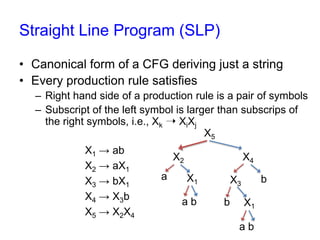
Straight Line Program (SLP)
• Canonical form of a CFG deriving a single string
• Every production rule satisfies
– Right hand side of a production rule is a digram
– Subscript of the left symbol is larger than subscrips of
the right symbols, i.e., Xk ➝ XiXj (k>i,j)

Example:

X1 → ab
X2 → aX1
X3 → bX1
X4 → X3b
X5 → X2X4

X5
X2
a

X4

X1
ab

b

X3
b

X1
ab
Grammar compression
• Builds up an SLP from a given string
• Two crucial data structures to access a production rule
Xk ➝ XiXj
1. Dictionary (Array) : Given Xk, return XiXj
2. Reverse dictionary (Hash table) : Given XiXj, return Xk if
Xk ➝ XiXj is registered in the dictionary
X1 → ab
X2 → aX1
X3 → bX1
X4 → X3b
X5 → X2X4

Access Xk ➝ A[2k-2]A[2k-1]

Space : 2nlogn bits (n : #variables)
Three open problems about an optimal
encoding of an SLP
1. An nontrivial information theoretic lower bound
for encoding an SLP
2. Optimal encoding of an SLP
– Standard array : 2nlogn bits (n:#variables)
– Present an encoding asymptotically equivalent to the
lower bound, while supporting fast random access

3. Space-efficient data structure for reverse
dictionary
– Hash table uses O(nlog(n)) bits
– Present a data structure of 2nlogn(1+o(1)) bits
An information theoretic lower bound for
representing an SLP
An information theoretic lower bound for
representing an SLP of n variables :
logn! + 2n + o(n) bits
• Use two techniques for the proof
1. Spanning tree decomposition for representing an
SLP as two ordered trees
2. Right most expansion for completely enumerating
ordered trees

• First introduce these two techniques, and then
show a sketch of the proof
Spanning tree decomposition [SPIRE11]
• Any SLP can be represented as left and right
spanning trees.

X5

X5
X2

X2
a

X4

X4

X2

X3

X1

b

X3
b

X1
a b

X5

X5

X4

a b

Spanning trees

DAG representation

Parse tree

X2
X3

X3

X1

X1

X1

a

X4

b
s

Indegree(s) = 2σ

a

b
s

b

a
s
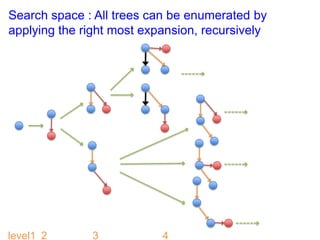
Right most expansion [KDD02,SDM02]
• Build trees of (m+1) nodes from a tree of m
nodes
– Add a node to the nodes on the right most path
Example :

: right most path
Search space : All trees can be enumerated by
applying the right most expansion, recursively

level1 2

3

4
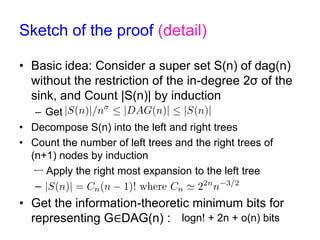
Sketch of the proof (detail)
• Basic idea: Consider a super set S(n) of DAG(n) without
the restriction of the in-degree 2σ of the sink, and count
|S(n)| by the induction
– Get
• Decompose S(n) into the left and right trees by the
spanning tree decomposition
• Count the number of left trees and the right trees of
(n+1) nodes by induction
ー Apply the right most expansion to the left tree
–
• Get the information-theoretic minimum bits for
representing G∈DAG(n) : logn!+2n+o(n) bits
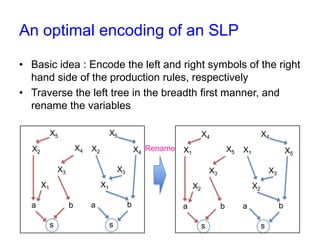
An optimal encoding of an SLP
• Basic idea : Encode the left and right symbols of the right
hand side of the production rules, respectively
• Rename the variables by traversing the left tree in the
breadth first manner
X5

X5
X4

X2

X4 Rename

X2

b
s

X1
X3
X2

X2

b

a
s

X5

X3

X1

X1
a

X5

X1

X3

X3

X4

X4

a

b
s

b

a
s
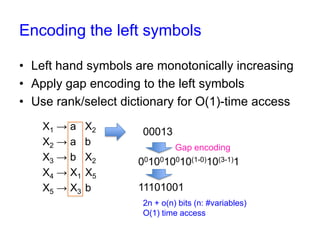
Encoding the left symbols
• Left symbols are monotonically increasing
• Apply gap encoding to the left symbols
• Use rank/select dictionary for O(1)-time access
X1 → a
X2 → a
X3 → b
X4 → X1
X5 → X3

X2
b
X2
X5
b

00013
Gap encoding

0010010010(1-0)10(3-1)1
11101001
n + o(n) bits (n: #variables)
O(1) time access
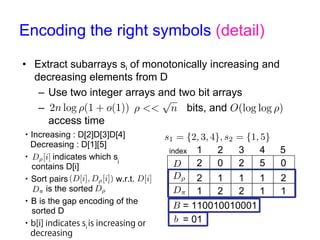
Encoding the right symbols D (detail)
• Extract subarrays si of monotonically increasing and
decreasing elements from D
• Use two integer arrays
,
and two bit arrays B,b
•
bits, and
access
time
Space-efficient data structure for reverse
dictionary
Space-efficient data structure for reverse
dictionary
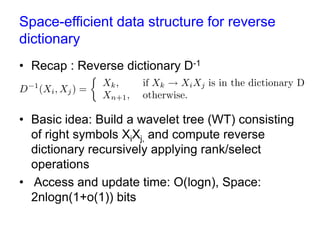
• Recap : Reverse dictionary D-1

• Basic idea: Build a wavelet tree (WT) consisting
of right symbols XiXj, and simulate reverse
dictionary on the WT.
• Access and update time: O(logn), Space:
2nlogn(1+o(1)) bits
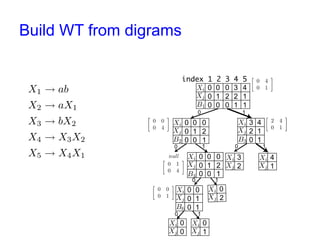
Build WT from digrams : The range of a digram is split
into the higher half (right) and the lower half (left)
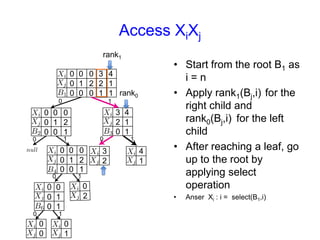
Accessing Xk➝XiXj
EX) Access X3X2

rank1

rank0

• Start from the root B1 as
i = n (#variables)
• Apply rank1(Bj,i) for the right
child and rank0(Bj,i) for the
left child
• After reaching a leaf, go up to
the root by applying select
operation
• Solution: Xk = select0/1(B1,i)
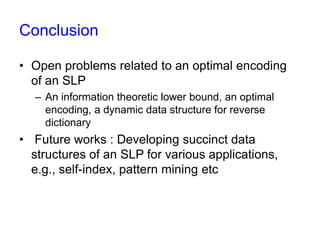
Conclusion
• Three open problems related to an optimal
encoding of an SLP
1. an information theoretic lower bound
2. an optimal encoding
3. a dynamic data structure for reverse dictionary

• Novel challenges : Developing succinct data
structures of an SLP for various applications
e.g., self-index, pattern mining, q-gram mining etc
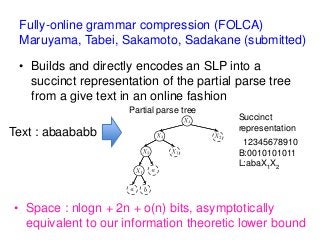
Fully-online grammar compression (FOLCA)
Maruyama, Tabei, Sakamoto, Sadakane (submitted)
• Builds and directly encodes an SLP into a
succinct representation of the partial parse tree
from a give text in an online fashion
Partial parse tree

Text : abaababb

Succinct
representation
12345678910
B:0010101011
L:abaX1X2

• Space : nlogn + 2n + o(n) bits, asymptotically
equivalent to our information theoretic lower bound

CPM2013-tabei201306

  • 1.
    24th Annual Symposiumon Combinatorial Pattern Matching, Bad Herrenalb, 2013/6/19 A Succinct Grammar Compression Yasuo Tabei1, Yoshimasa Takabatake2, Hiroshi Sakamoto2 1. Japan Science and Technology Agency 2. Kyusyu Institute of Technology
  • 2.
    Straight Line Program(SLP) • Canonical form of a CFG deriving a single string • Every production rule satisfies – Right hand side of a production rule is a digram – Subscript of the left symbol is larger than subscrips of the right symbols, i.e., Xk ➝ XiXj (k>i,j) Example: X1 → ab X2 → aX1 X3 → bX1 X4 → X3b X5 → X2X4 X5 X2 a X4 X1 ab b X3 b X1 ab
  • 3.
    Grammar compression • Buildsup an SLP from a given string • Two crucial data structures to access a production rule Xk ➝ XiXj 1. Dictionary (Array) : Given Xk, return XiXj 2. Reverse dictionary (Hash table) : Given XiXj, return Xk if Xk ➝ XiXj is registered in the dictionary X1 → ab X2 → aX1 X3 → bX1 X4 → X3b X5 → X2X4 Access Xk ➝ A[2k-2]A[2k-1] Space : 2nlogn bits (n : #variables)
  • 4.
    Three open problemsabout an optimal encoding of an SLP 1. An nontrivial information theoretic lower bound for encoding an SLP 2. Optimal encoding of an SLP – Standard array : 2nlogn bits (n:#variables) – Present an encoding asymptotically equivalent to the lower bound, while supporting fast random access 3. Space-efficient data structure for reverse dictionary – Hash table uses O(nlog(n)) bits – Present a data structure of 2nlogn(1+o(1)) bits
  • 5.
    An information theoreticlower bound for representing an SLP
  • 6.
    An information theoreticlower bound for representing an SLP of n variables : logn! + 2n + o(n) bits • Use two techniques for the proof 1. Spanning tree decomposition for representing an SLP as two ordered trees 2. Right most expansion for completely enumerating ordered trees • First introduce these two techniques, and then show a sketch of the proof
  • 7.
    Spanning tree decomposition[SPIRE11] • Any SLP can be represented as left and right spanning trees. X5 X5 X2 X2 a X4 X4 X2 X3 X1 b X3 b X1 a b X5 X5 X4 a b Spanning trees DAG representation Parse tree X2 X3 X3 X1 X1 X1 a X4 b s Indegree(s) = 2σ a b s b a s
  • 8.
    Right most expansion[KDD02,SDM02] • Build trees of (m+1) nodes from a tree of m nodes – Add a node to the nodes on the right most path Example : : right most path
  • 9.
    Search space :All trees can be enumerated by applying the right most expansion, recursively level1 2 3 4
  • 10.
    Sketch of theproof (detail) • Basic idea: Consider a super set S(n) of DAG(n) without the restriction of the in-degree 2σ of the sink, and count |S(n)| by the induction – Get • Decompose S(n) into the left and right trees by the spanning tree decomposition • Count the number of left trees and the right trees of (n+1) nodes by induction ー Apply the right most expansion to the left tree – • Get the information-theoretic minimum bits for representing G∈DAG(n) : logn!+2n+o(n) bits
  • 11.
  • 12.
    An optimal encodingof an SLP • Basic idea : Encode the left and right symbols of the right hand side of the production rules, respectively • Rename the variables by traversing the left tree in the breadth first manner X5 X5 X4 X2 X4 Rename X2 b s X1 X3 X2 X2 b a s X5 X3 X1 X1 a X5 X1 X3 X3 X4 X4 a b s b a s
  • 13.
    Encoding the leftsymbols • Left symbols are monotonically increasing • Apply gap encoding to the left symbols • Use rank/select dictionary for O(1)-time access X1 → a X2 → a X3 → b X4 → X1 X5 → X3 X2 b X2 X5 b 00013 Gap encoding 0010010010(1-0)10(3-1)1 11101001 n + o(n) bits (n: #variables) O(1) time access
  • 14.
    Encoding the rightsymbols D (detail) • Extract subarrays si of monotonically increasing and decreasing elements from D • Use two integer arrays , and two bit arrays B,b • bits, and access time
  • 15.
    Space-efficient data structurefor reverse dictionary
  • 16.
    Space-efficient data structurefor reverse dictionary • Recap : Reverse dictionary D-1 • Basic idea: Build a wavelet tree (WT) consisting of right symbols XiXj, and simulate reverse dictionary on the WT. • Access and update time: O(logn), Space: 2nlogn(1+o(1)) bits
  • 17.
    Build WT fromdigrams : The range of a digram is split into the higher half (right) and the lower half (left)
  • 18.
    Accessing Xk➝XiXj EX) AccessX3X2 rank1 rank0 • Start from the root B1 as i = n (#variables) • Apply rank1(Bj,i) for the right child and rank0(Bj,i) for the left child • After reaching a leaf, go up to the root by applying select operation • Solution: Xk = select0/1(B1,i)
  • 19.
    Conclusion • Three openproblems related to an optimal encoding of an SLP 1. an information theoretic lower bound 2. an optimal encoding 3. a dynamic data structure for reverse dictionary • Novel challenges : Developing succinct data structures of an SLP for various applications e.g., self-index, pattern mining, q-gram mining etc
  • 20.
    Fully-online grammar compression(FOLCA) Maruyama, Tabei, Sakamoto, Sadakane (submitted) • Builds and directly encodes an SLP into a succinct representation of the partial parse tree from a give text in an online fashion Partial parse tree Text : abaababb Succinct representation 12345678910 B:0010101011 L:abaX1X2 • Space : nlogn + 2n + o(n) bits, asymptotically equivalent to our information theoretic lower bound