ACM ICPC 2013{2014 
Northeastern European Regional Contest 
Problems Review 
Roman Elizarov 
December 1, 2013
Problem A. ASCII Puzzle 
I The problem is solved by exhaustive search 
I
ll each spot in the trivial puzzle from the top-left to the 
bottom-right corner 
I try to place each piece that
ts 
I backtrack after trying all pieces for a place 
I Must check which pieces can be placed on borders 
I and place them only onto the corresponding borders 
I otherwise time-limit will be exceeded
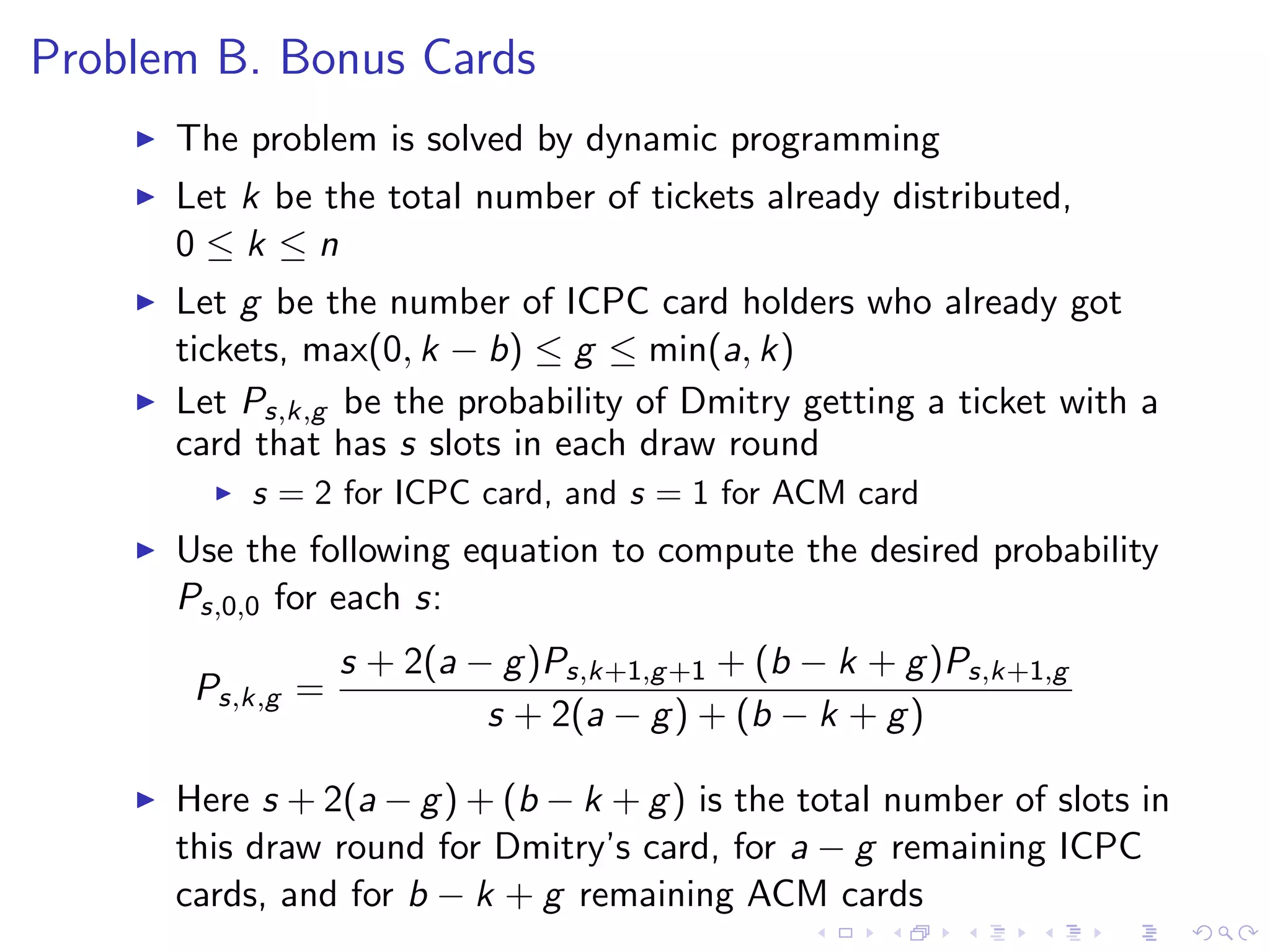
Problem B. Bonus Cards 
I The problem is solved by dynamic programming 
I Let k be the total number of tickets already distributed, 
0  k  n 
I Let g be the number of ICPC card holders who already got 
tickets, max(0; k  b)  g  min(a; k) 
I Let Ps;k;g be the probability of Dmitry getting a ticket with a 
card that has s slots in each draw round 
I s = 2 for ICPC card, and s = 1 for ACM card 
I Use the following equation to compute the desired probability 
Ps;0;0 for each s: 
Ps;k;g = 
s + 2(a  g)Ps;k+1;g+1 + (b  k + g)Ps;k+1;g 
s + 2(a  g) + (b  k + g) 
I Here s +2(a g)+(b k +g) is the total number of slots in 
this draw round for Dmitry's card, for a  g remaining ICPC 
cards, and for b  k + g remaining ACM cards
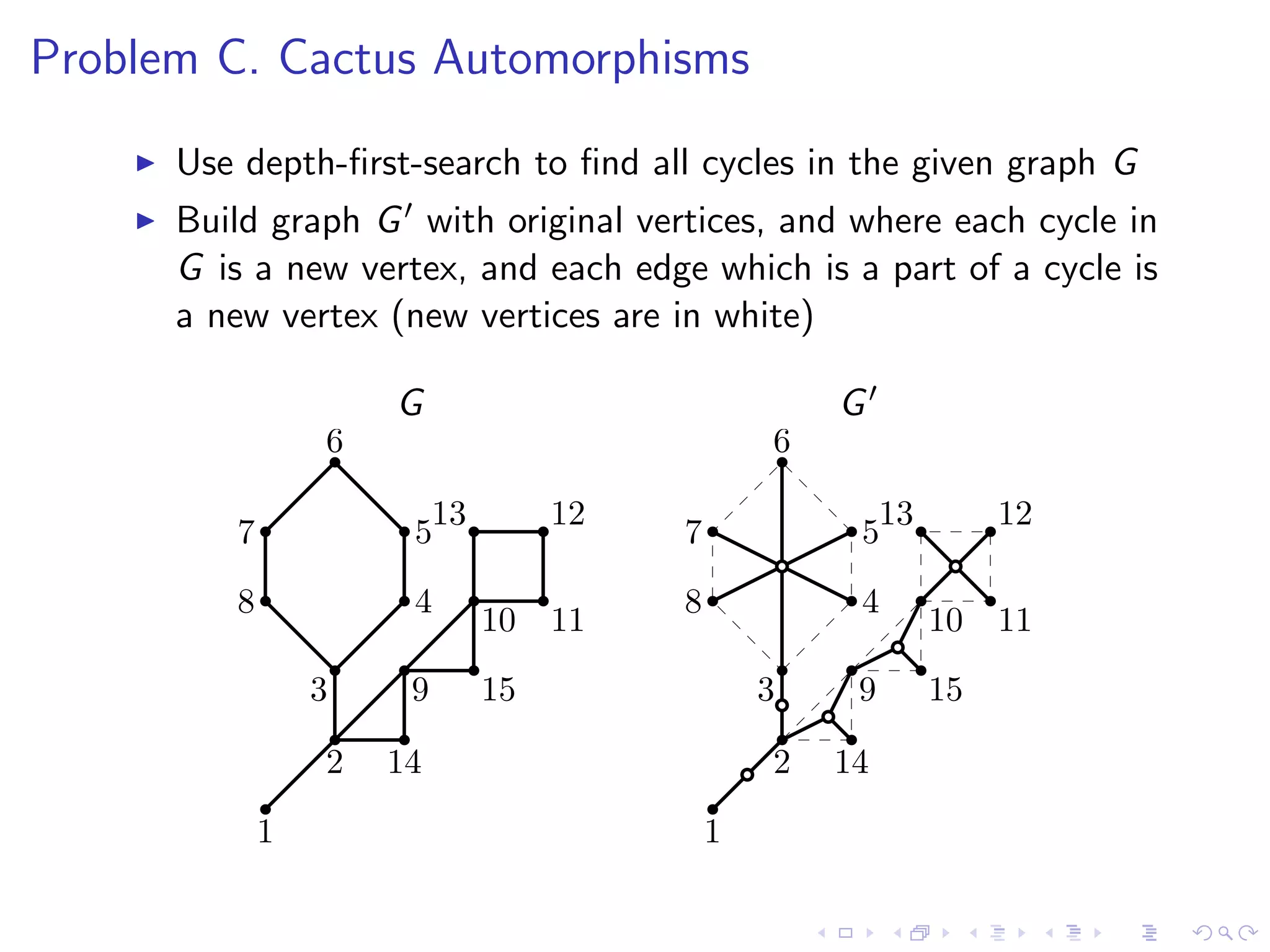
Problem C. Cactus Automorphisms 
I Use depth-
rst-search to
nd all cycles in the given graph G 
I Build graph G0 with original vertices, and where each cycle in 
G is a new vertex, and each edge which is a part of a cycle is 
a new vertex (new vertices are in white) 
G G0 
1 
3 
2 
13 12 
5 
4 
6 
7 
8 
9 
10 11 
14 
15 
1 
3 
2 
13 12 
5 
4 
6 
7 
8 
9 
10 11 
14 
15
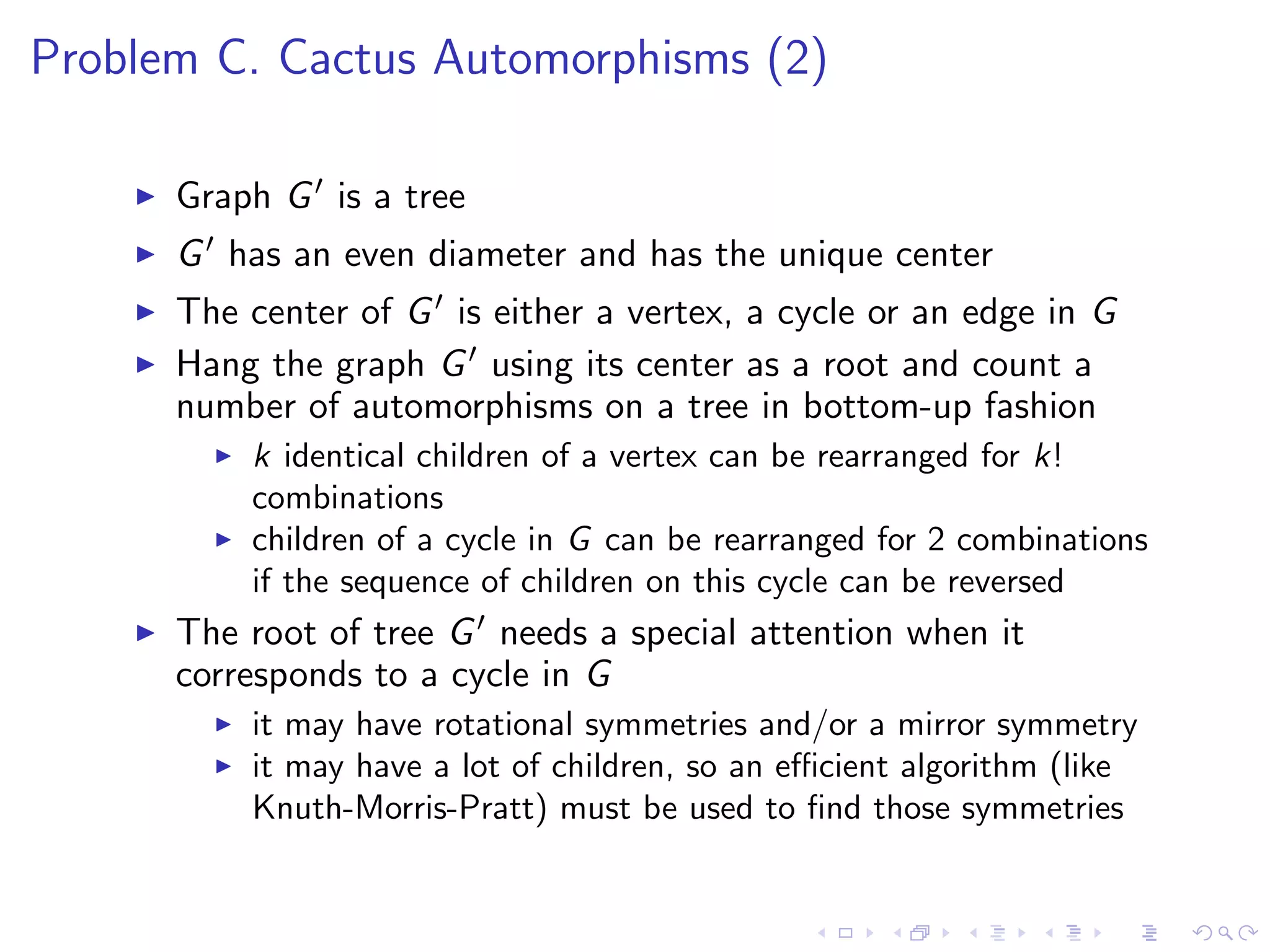
Problem C. Cactus Automorphisms (2) 
I Graph G0 is a tree 
I G0 has an even diameter and has the unique center 
I The center of G0 is either a vertex, a cycle or an edge in G 
I Hang the graph G0 using its center as a root and count a 
number of automorphisms on a tree in bottom-up fashion 
I k identical children of a vertex can be rearranged for k! 
combinations 
I children of a cycle in G can be rearranged for 2 combinations 
if the sequence of children on this cycle can be reversed 
I The root of tree G0 needs a special attention when it 
corresponds to a cycle in G 
I it may have rotational symmetries and/or a mirror symmetry 
I it may have a lot of children, so an ecient algorithm (like 
Knuth-Morris-Pratt) must be used to
nd those symmetries
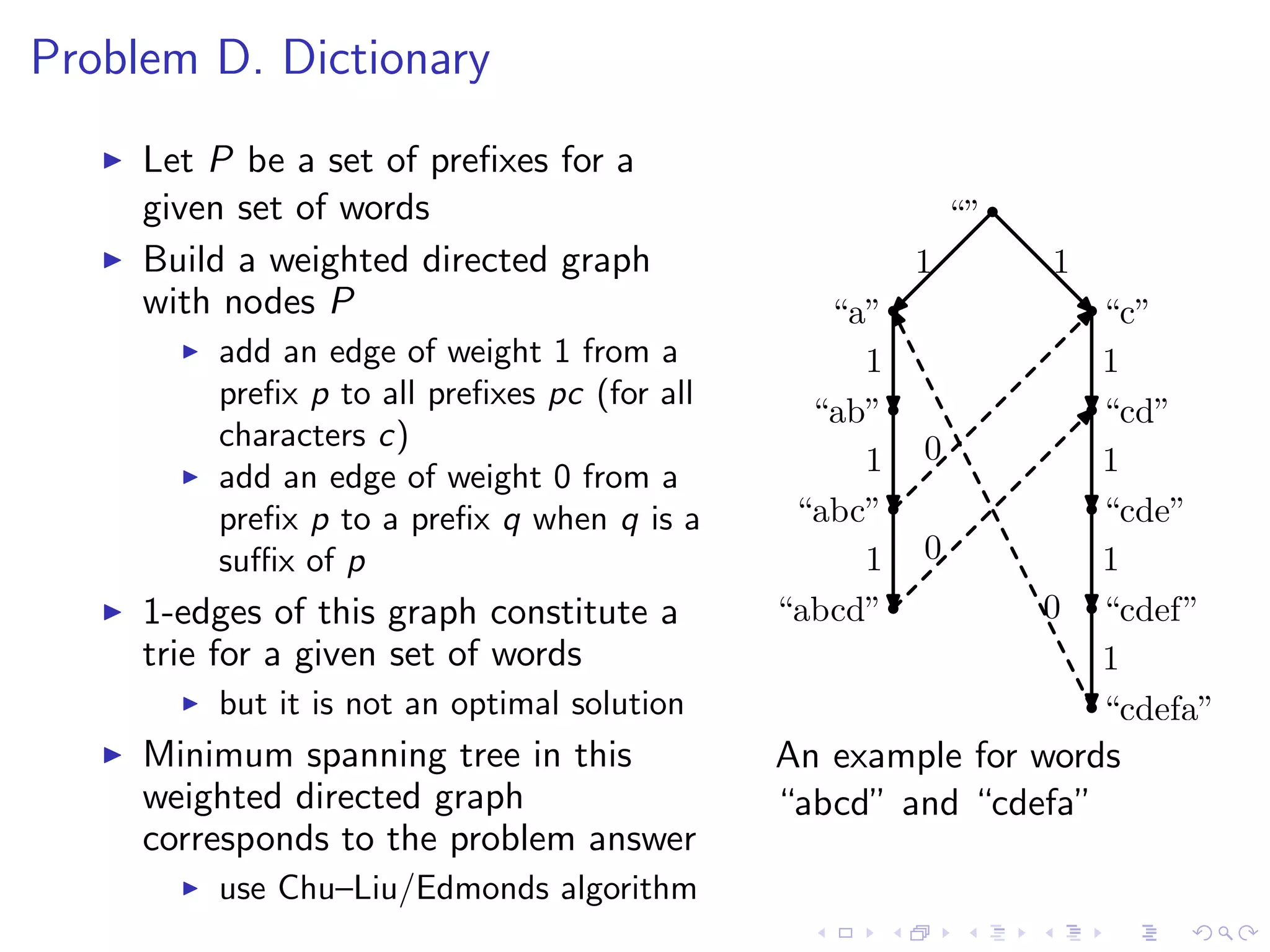
Problem D. Dictionary 
I Let P be a set of pre
xes for a 
given set of words 
I Build a weighted directed graph 
with nodes P 
I add an edge of weight 1 from a 
pre
x p to all pre

ACM ICPC 2013 NEERC (Northeastern European Regional Contest) Problems Review

  • 1.
    ACM ICPC 2013{2014 Northeastern European Regional Contest Problems Review Roman Elizarov December 1, 2013
  • 2.
    Problem A. ASCIIPuzzle I The problem is solved by exhaustive search I
  • 3.
    ll each spotin the trivial puzzle from the top-left to the bottom-right corner I try to place each piece that
  • 4.
    ts I backtrackafter trying all pieces for a place I Must check which pieces can be placed on borders I and place them only onto the corresponding borders I otherwise time-limit will be exceeded
  • 5.
    Problem B. BonusCards I The problem is solved by dynamic programming I Let k be the total number of tickets already distributed, 0 k n I Let g be the number of ICPC card holders who already got tickets, max(0; k b) g min(a; k) I Let Ps;k;g be the probability of Dmitry getting a ticket with a card that has s slots in each draw round I s = 2 for ICPC card, and s = 1 for ACM card I Use the following equation to compute the desired probability Ps;0;0 for each s: Ps;k;g = s + 2(a g)Ps;k+1;g+1 + (b k + g)Ps;k+1;g s + 2(a g) + (b k + g) I Here s +2(a g)+(b k +g) is the total number of slots in this draw round for Dmitry's card, for a g remaining ICPC cards, and for b k + g remaining ACM cards
  • 6.
    Problem C. CactusAutomorphisms I Use depth-
  • 7.
  • 8.
    nd all cyclesin the given graph G I Build graph G0 with original vertices, and where each cycle in G is a new vertex, and each edge which is a part of a cycle is a new vertex (new vertices are in white) G G0 1 3 2 13 12 5 4 6 7 8 9 10 11 14 15 1 3 2 13 12 5 4 6 7 8 9 10 11 14 15
  • 9.
    Problem C. CactusAutomorphisms (2) I Graph G0 is a tree I G0 has an even diameter and has the unique center I The center of G0 is either a vertex, a cycle or an edge in G I Hang the graph G0 using its center as a root and count a number of automorphisms on a tree in bottom-up fashion I k identical children of a vertex can be rearranged for k! combinations I children of a cycle in G can be rearranged for 2 combinations if the sequence of children on this cycle can be reversed I The root of tree G0 needs a special attention when it corresponds to a cycle in G I it may have rotational symmetries and/or a mirror symmetry I it may have a lot of children, so an ecient algorithm (like Knuth-Morris-Pratt) must be used to
  • 10.
  • 11.
    Problem D. Dictionary I Let P be a set of pre
  • 12.
    xes for a given set of words I Build a weighted directed graph with nodes P I add an edge of weight 1 from a pre
  • 13.
    x p toall pre
  • 14.
    xes pc (forall characters c) I add an edge of weight 0 from a pre
  • 15.
    x p toa pre
  • 16.
    x q whenq is a sux of p I 1-edges of this graph constitute a trie for a given set of words I but it is not an optimal solution I Minimum spanning tree in this weighted directed graph corresponds to the problem answer I use Chu{Liu/Edmonds algorithm a ab abc abcd c cd cde cdef cdefa 1 1 1 1 1 1 1 1 1 0 0 0 An example for words abcd and cdefa
  • 17.
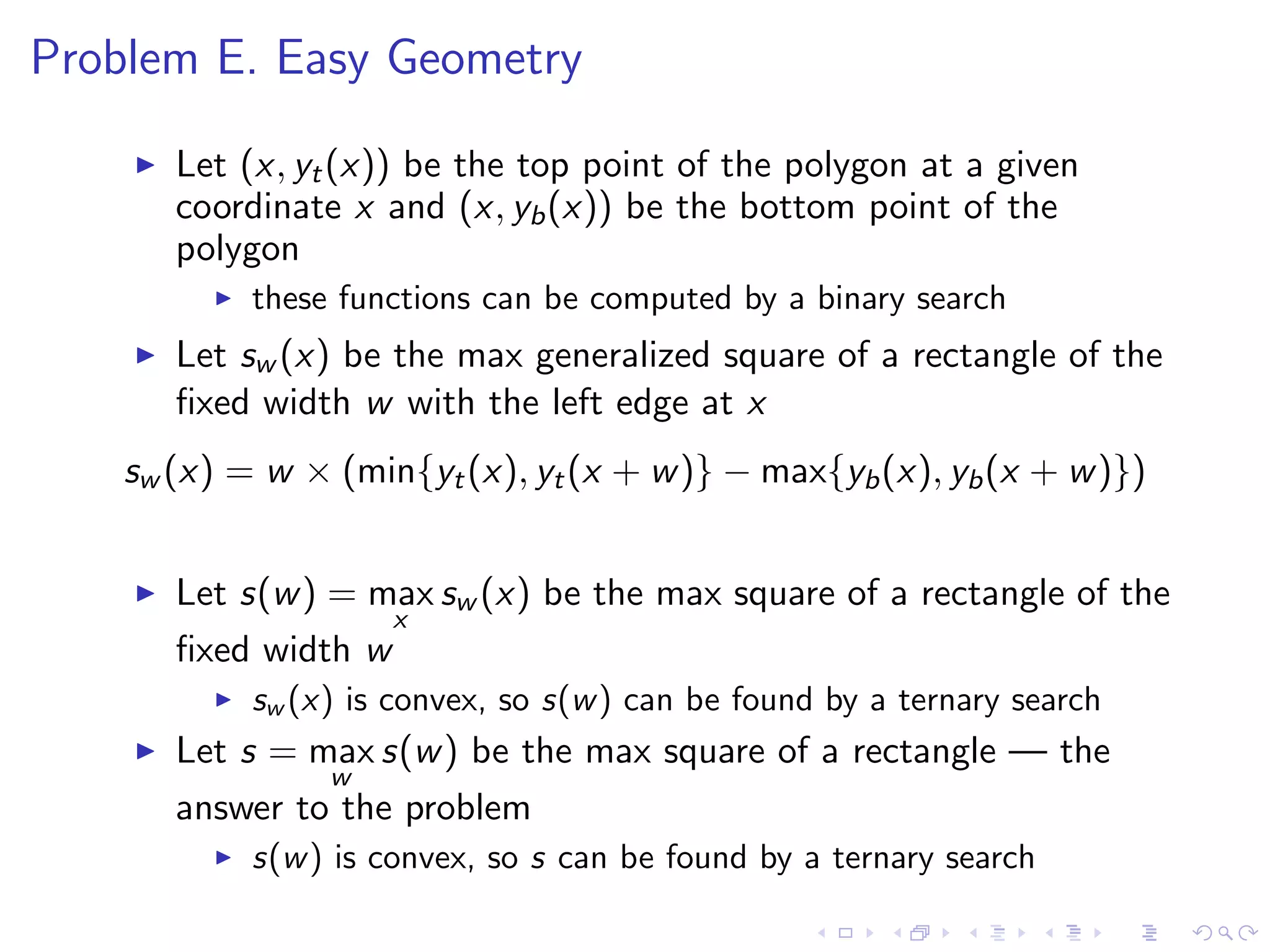
    Problem E. EasyGeometry I Let (x; yt (x)) be the top point of the polygon at a given coordinate x and (x; yb(x)) be the bottom point of the polygon I these functions can be computed by a binary search I Let sw(x) be the max generalized square of a rectangle of the
  • 18.
    xed width wwith the left edge at x sw(x) = w (minfyt (x); yt (x + w)g maxfyb(x); yb(x + w)g) I Let s(w) = max x sw(x) be the max square of a rectangle of the
  • 19.
    xed width w I sw(x) is convex, so s(w) can be found by a ternary search I Let s = max w s(w) be the max square of a rectangle | the answer to the problem I s(w) is convex, so s can be found by a ternary search
  • 20.
    Problem F. FraudBusters I This is the simplest problem in the contest I It is solved by going over a list of codes and checking each one against a code that was recognized by the scanner
  • 21.
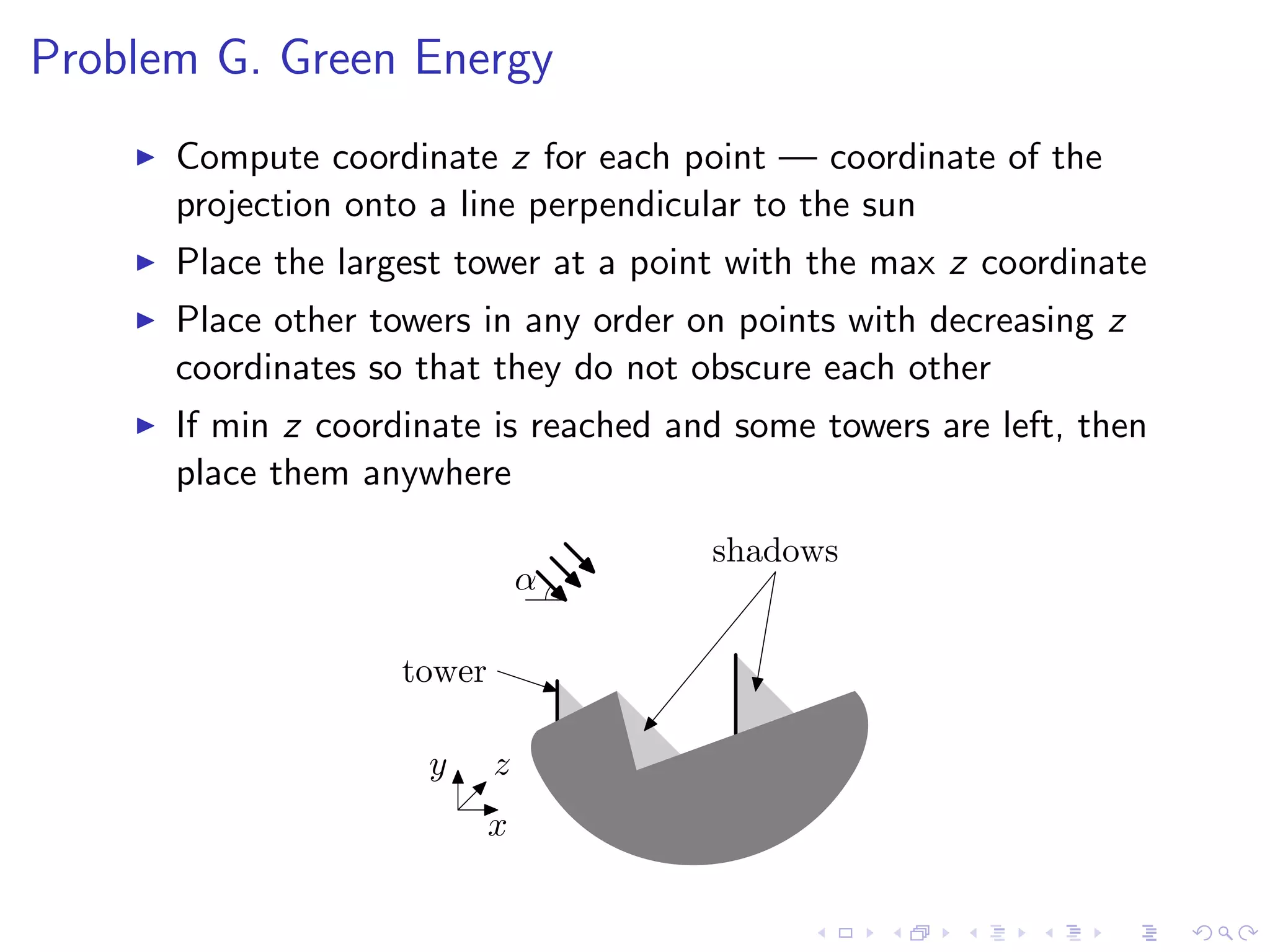
    Problem G. GreenEnergy I Compute coordinate z for each point | coordinate of the projection onto a line perpendicular to the sun I Place the largest tower at a point with the max z coordinate I Place other towers in any order on points with decreasing z coordinates so that they do not obscure each other I If min z coordinate is reached and some towers are left, then place them anywhere tower shadows y z x
  • 22.
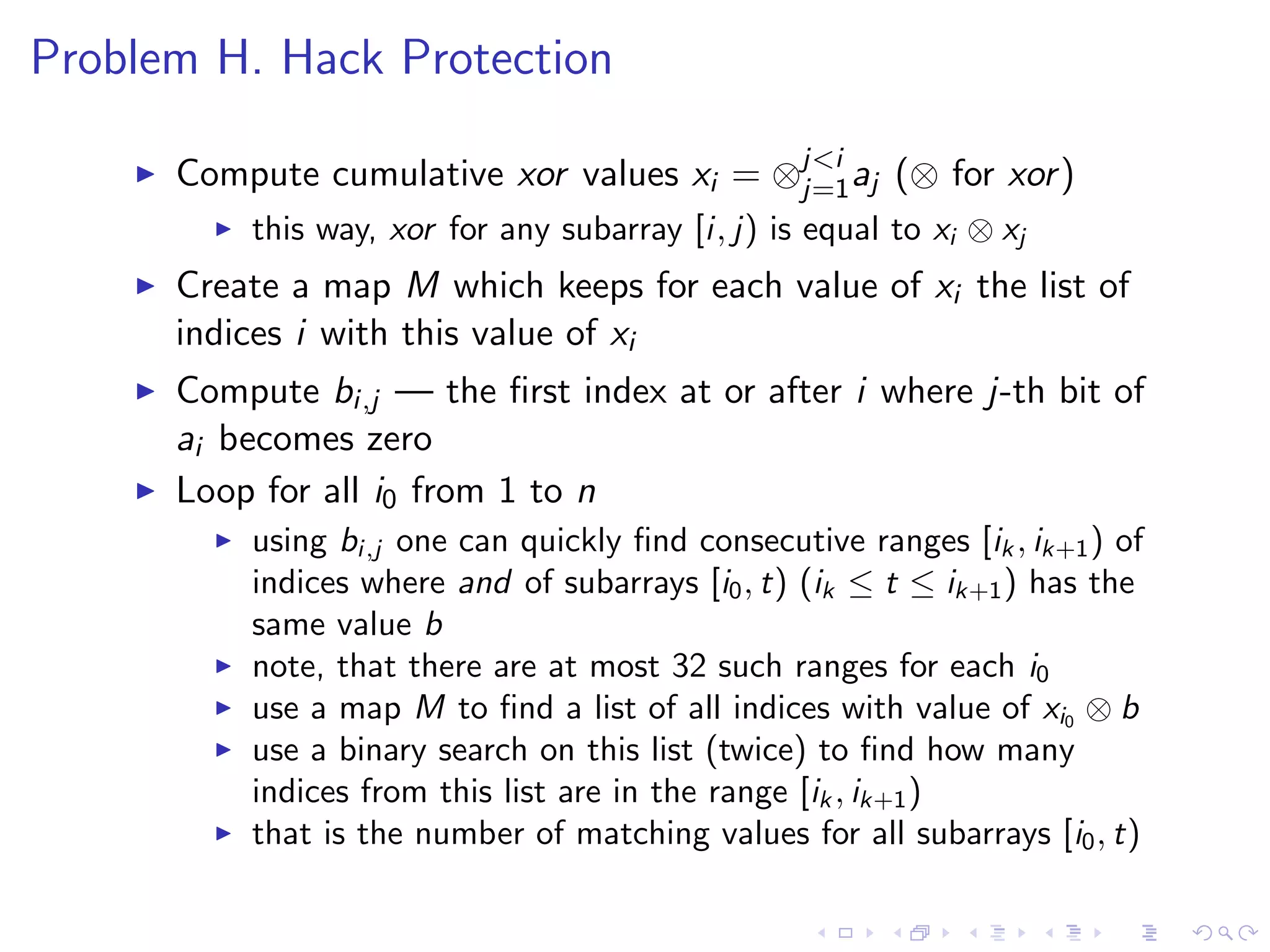
    Problem H. HackProtection I Compute cumulative xor values xi = ji j=1aj ( for xor ) I this way, xor for any subarray [i ; j) is equal to xi xj I Create a map M which keeps for each value of xi the list of indices i with this value of xi I Compute bi ;j | the
  • 23.
    rst index ator after i where j-th bit of ai becomes zero I Loop for all i0 from 1 to n I using bi ;j one can quickly
  • 24.
    nd consecutive ranges[ik ; ik+1) of indices where and of subarrays [i0; t) (ik t ik+1) has the same value b I note, that there are at most 32 such ranges for each i0 I use a map M to
  • 25.
    nd a listof all indices with value of xi0 b I use a binary search on this list (twice) to
  • 26.
    nd how many indices from this list are in the range [ik ; ik+1) I that is the number of matching values for all subarrays [i0; t)
  • 27.
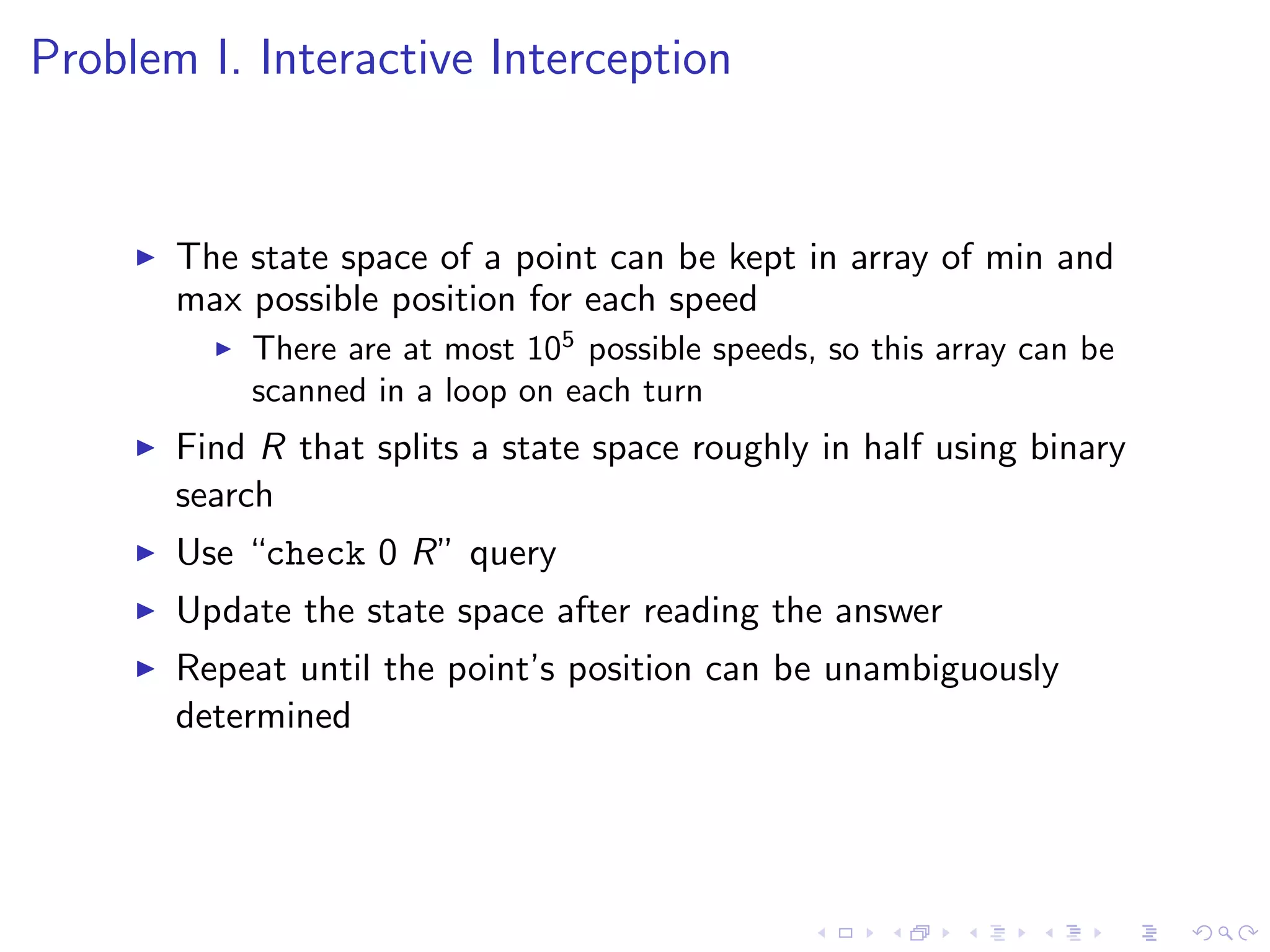
    Problem I. InteractiveInterception I The state space of a point can be kept in array of min and max possible position for each speed I There are at most 105 possible speeds, so this array can be scanned in a loop on each turn I Find R that splits a state space roughly in half using binary search I Use check 0 R query I Update the state space after reading the answer I Repeat until the point's position can be unambiguously determined
  • 28.
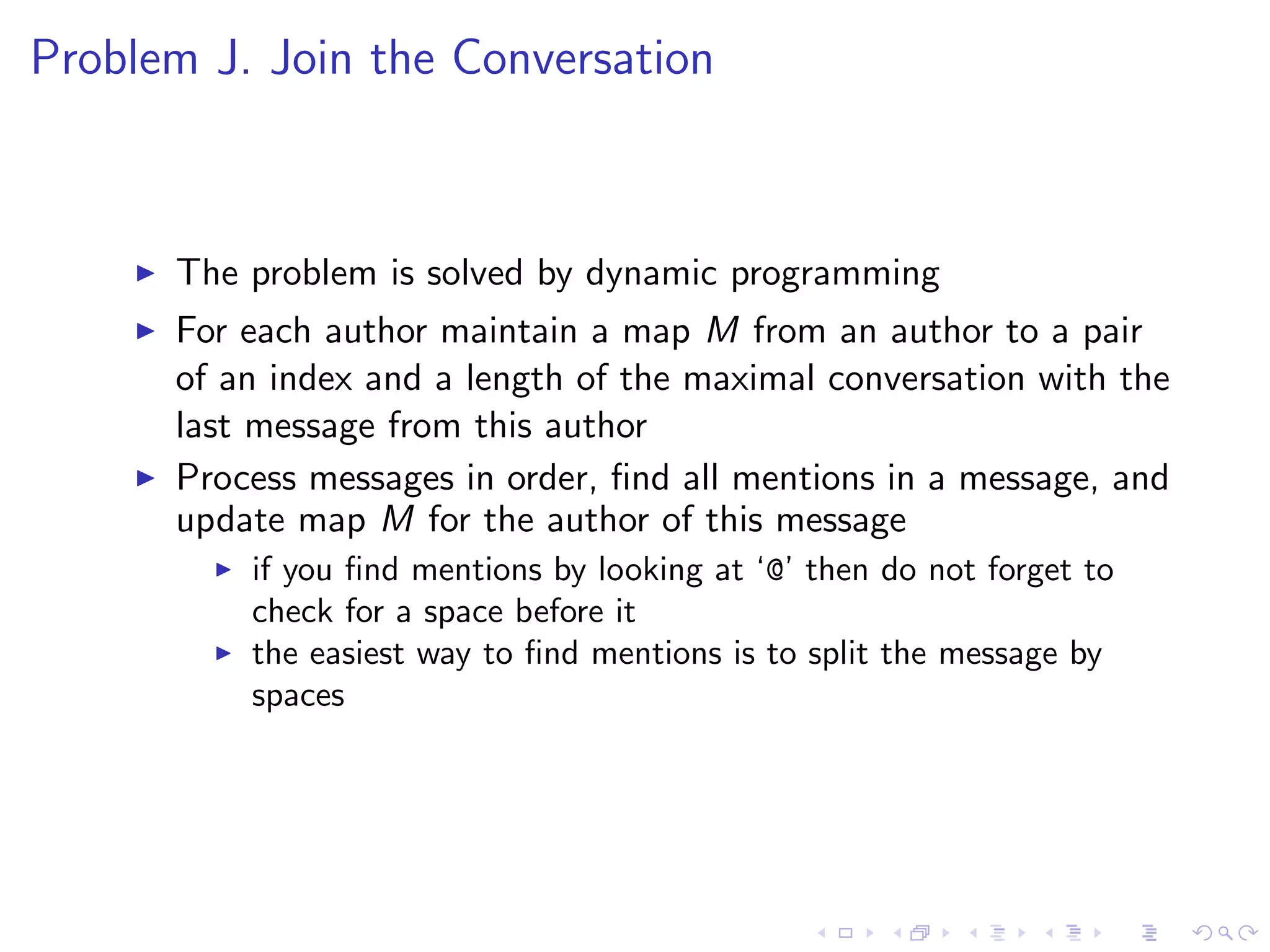
    Problem J. Jointhe Conversation I The problem is solved by dynamic programming I For each author maintain a map M from an author to a pair of an index and a length of the maximal conversation with the last message from this author I Process messages in order,
  • 29.
    nd all mentionsin a message, and update map M for the author of this message I if you
  • 30.
    nd mentions bylooking at `@' then do not forget to check for a space before it I the easiest way to
  • 31.
    nd mentions isto split the message by spaces
  • 32.
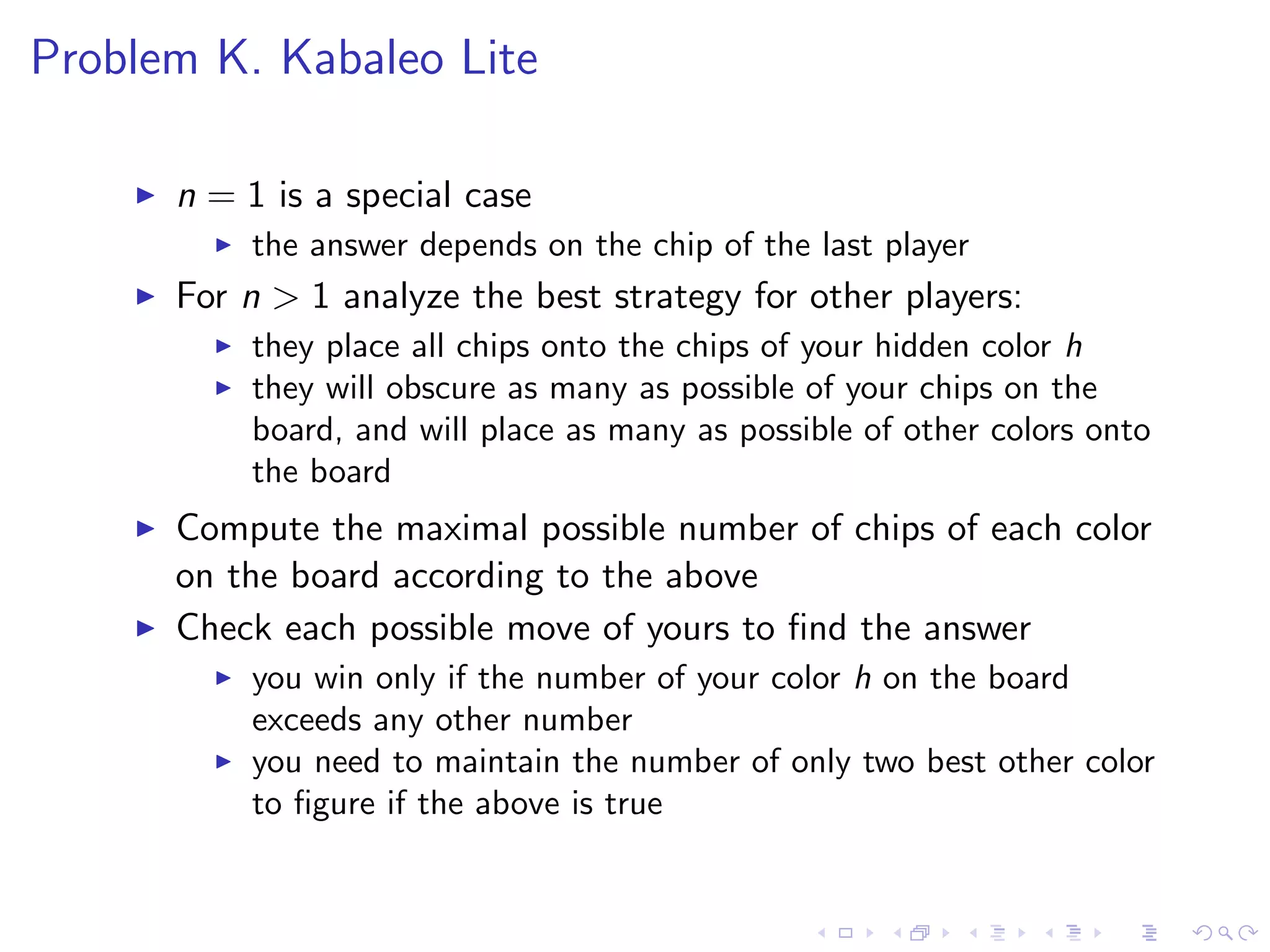
    Problem K. KabaleoLite I n = 1 is a special case I the answer depends on the chip of the last player I For n 1 analyze the best strategy for other players: I they place all chips onto the chips of your hidden color h I they will obscure as many as possible of your chips on the board, and will place as many as possible of other colors onto the board I Compute the maximal possible number of chips of each color on the board according to the above I Check each possible move of yours to
  • 33.
    nd the answer I you win only if the number of your color h on the board exceeds any other number I you need to maintain the number of only two best other color to
  • 34.
    gure if theabove is true