The 15th Pacific-Asia Conference on Knowledge Discovery and Data Mining (PAKDD2011)
25 May 2011


         LGM: Mining Frequent Subgraphs
              from Linear Graphs

                                Yasuo Tabei
                           ERATO Minato Project
                    Japan Science and Technology Agency
                               joint work with
                 Daisuke Okanohara (Preferred Infrastructure),
                           Shuichi Hirose (AIST),
                              Koji Tsuda (AIST)


                                             1
                                                                                     1
Outline
• Introduction to linear graph
  ★   Linear subgraph relation
  ★   Total order among edges
• Frequent subgraph mining from a set of
  linear graphs
• Experiments
  ★   Motif extraction from protein 3D
      structures
                       2
                                           2
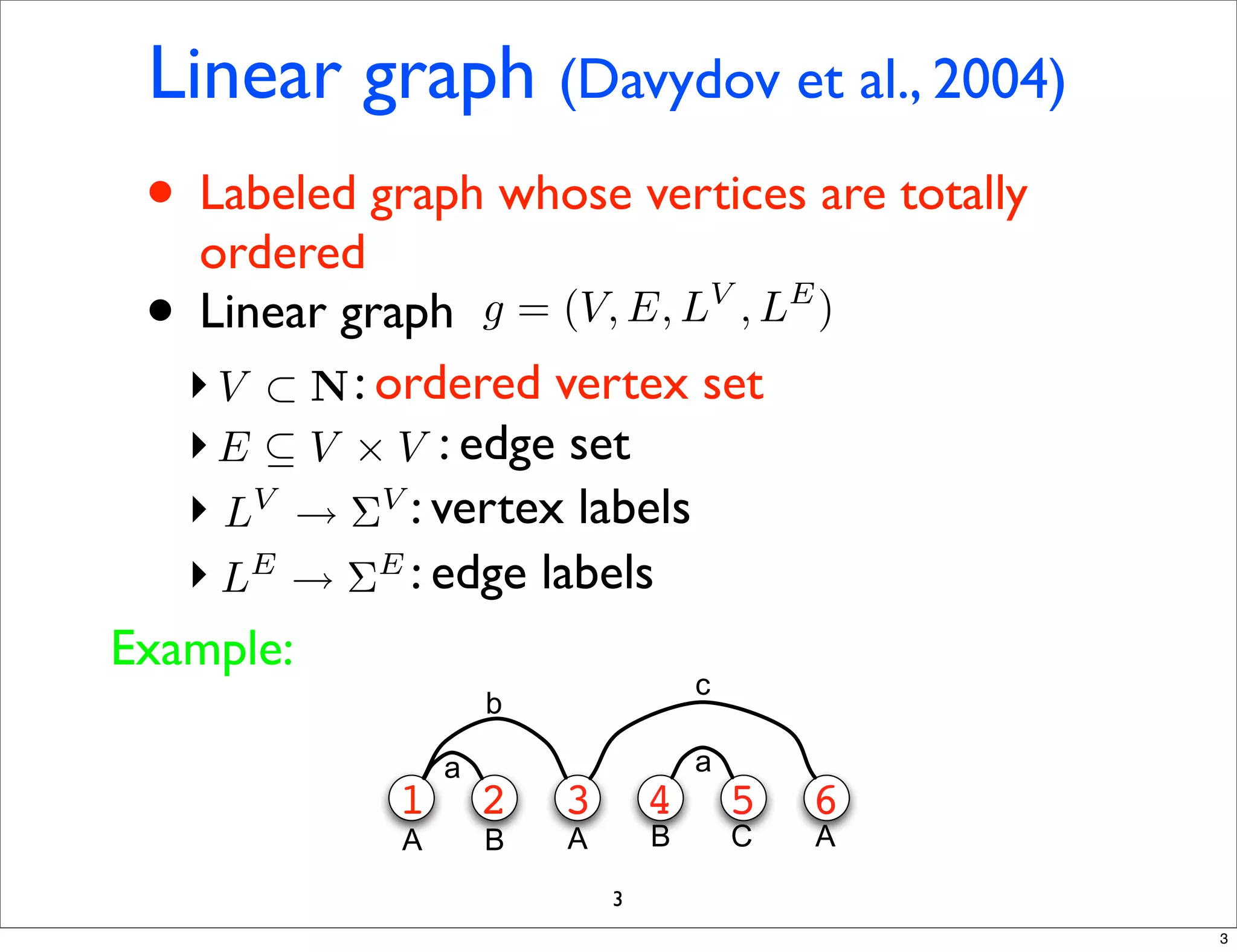
Linear graph (Davydov et al., 2004)
 • Labeled graph whose vertices are totally
   ordered
 • Linear graph g = (V, E, L , L )   V       E


   ‣ V ⊂ N : ordered vertex set
   ‣ E ⊆ V × V : edge set
   ‣ LV → ΣV : vertex labels
   ‣L →Σ
      E      E : edge labels

Example:
                                     c
                     b

                 a                   a
             1       2   3       4       5   6
             A       B   A       B       C       A
                             3
                                                     3
Linear subgraph relation
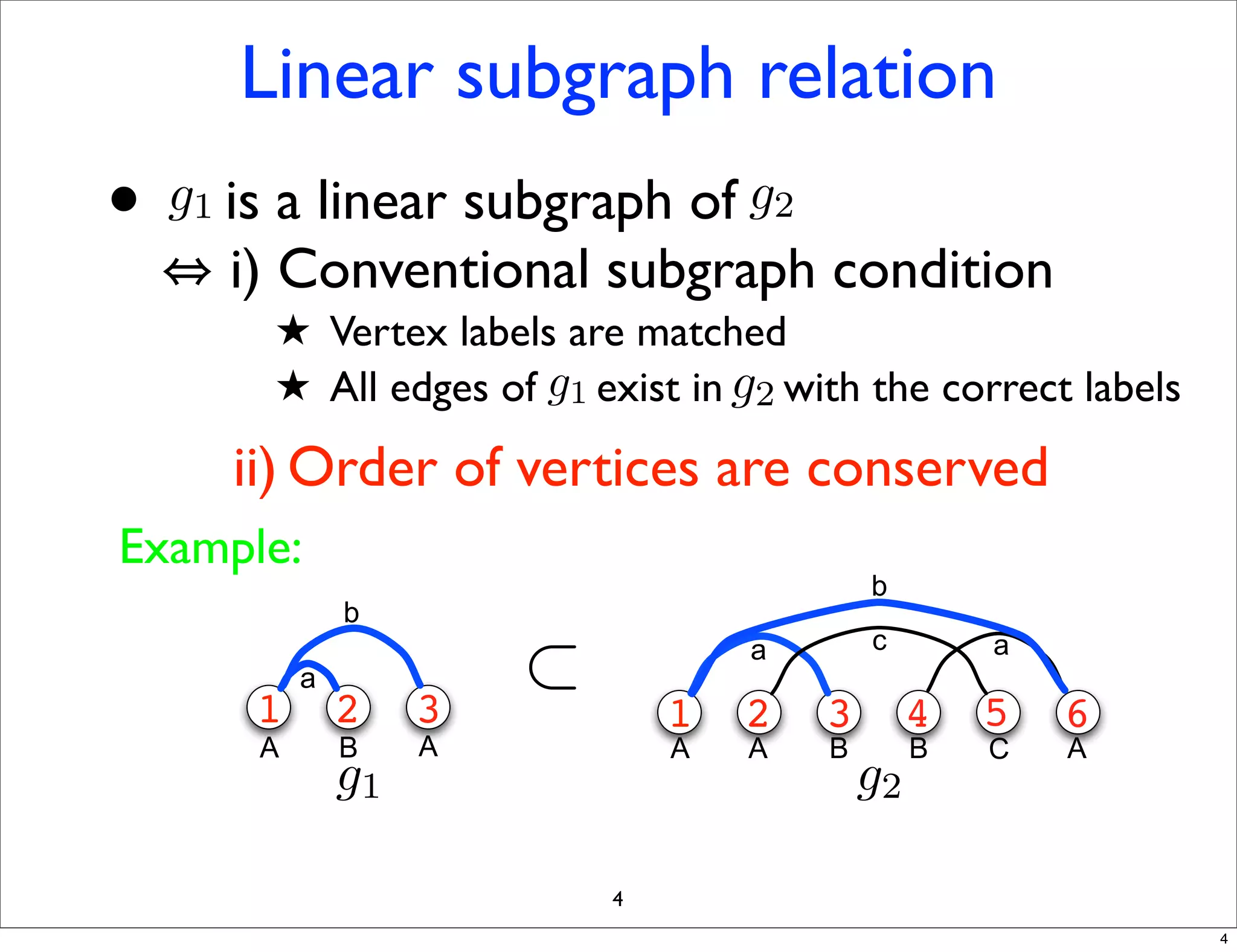
•   g1 is a linear subgraph of g2
      i) Conventional subgraph condition
        ★ Vertex labels are matched
        ★ All edges of g1 exist in g2 with the correct labels
       ii) Order of vertices are conserved
Example:
                                             b
                b
                                             c

        1
            a
                2    3
                         ⊂           a                a

                                 1   2   3        4   5   6
        A       B    A           A   A   B        B   C   A
                g1                           g2

                             4
                                                                4
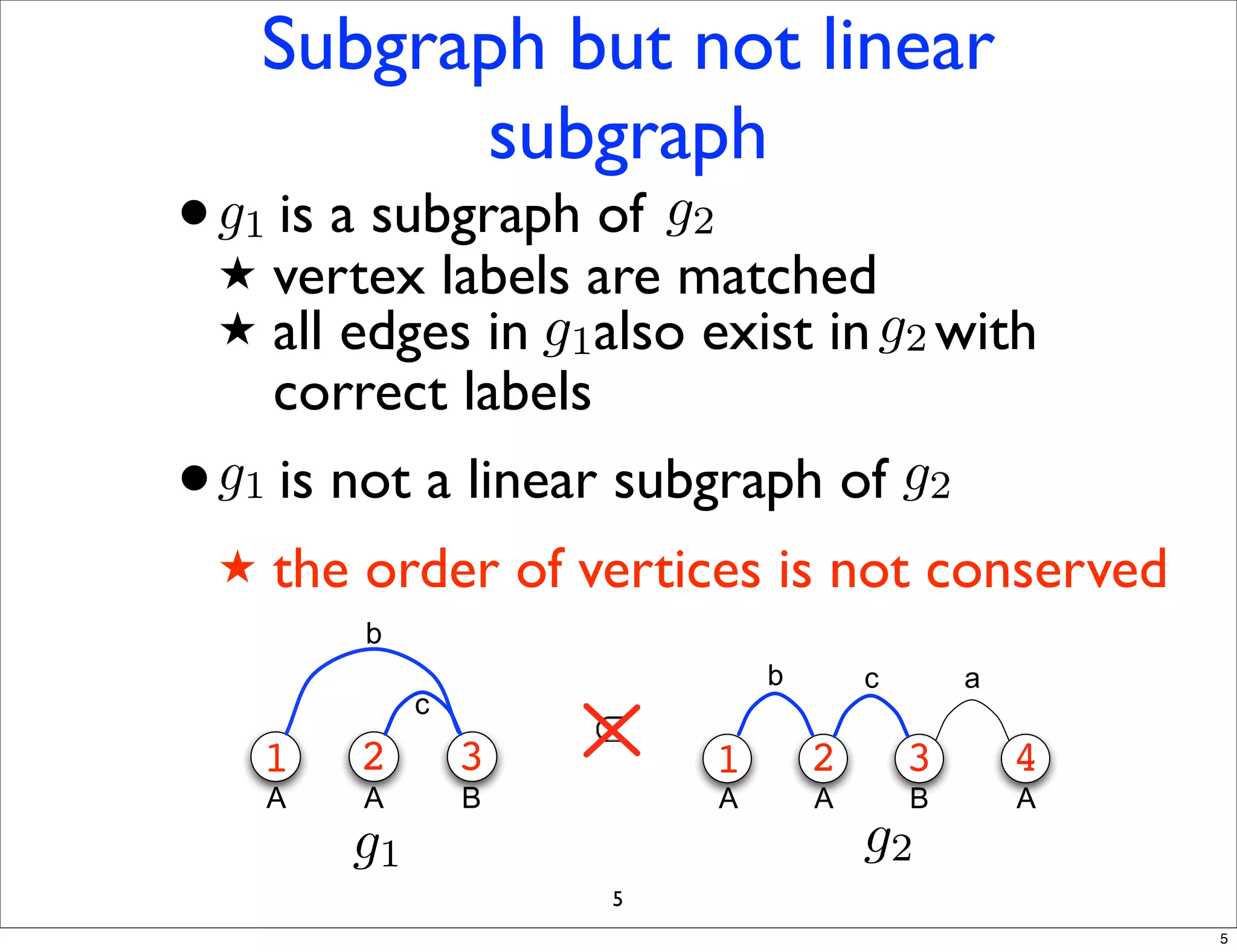
Subgraph but not linear
              subgraph
•   g1 is a subgraph of g2
    ★ vertex labels are matched
    ★ all edges in g1also exist in g2 with
       correct labels
•   g1 is not a linear subgraph of g2
    ★   the order of vertices is not conserved
            b
                                 b       c       a
                 c
        1   2        3       1       2       3       4
        A   A        B       A       A       B       A
            g1                           g2
                         5
                                                         5
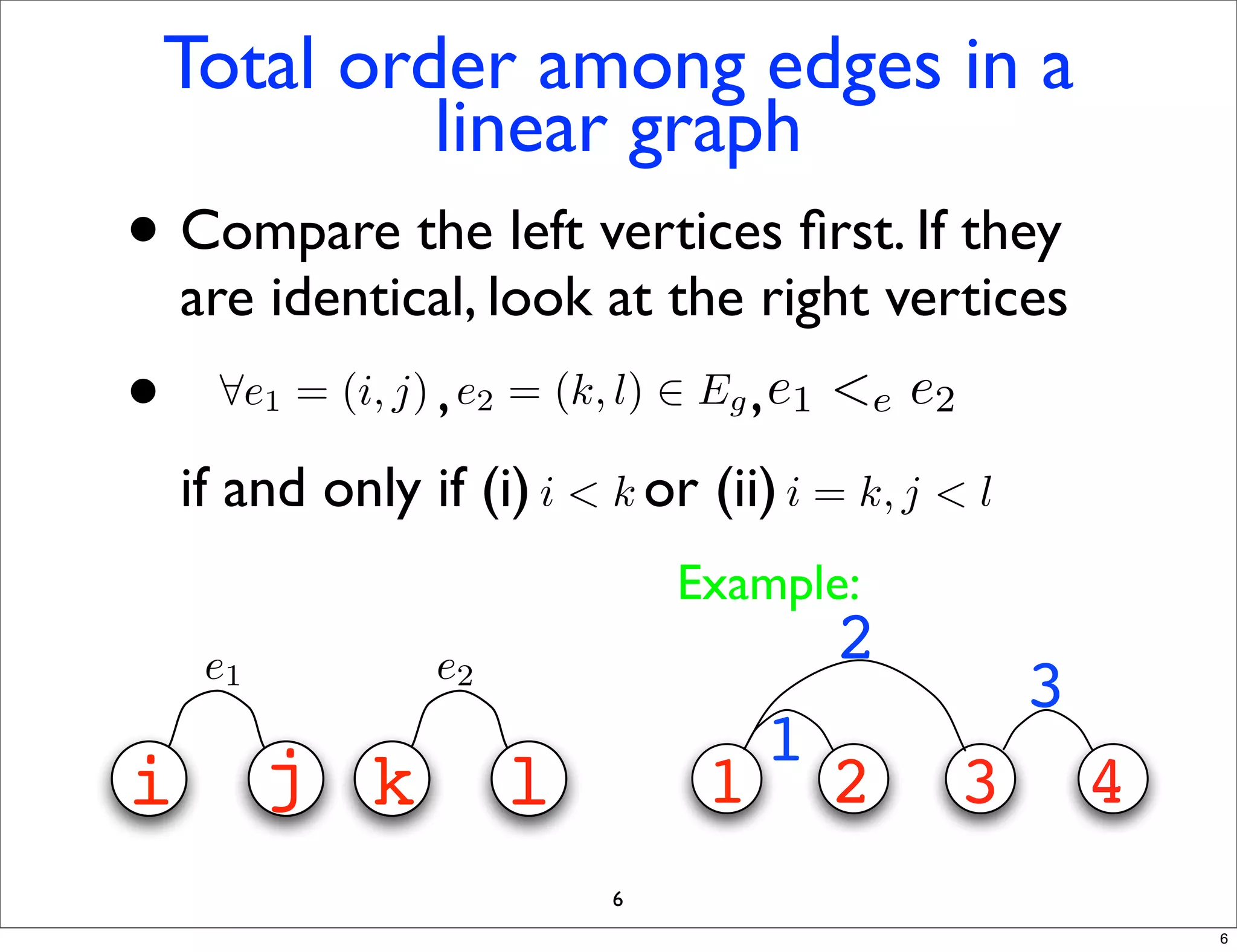
Total order among edges in a
             linear graph
• Compare the left vertices first. If they
    are identical, look at the right vertices
•     ∀e1 = (i, j) , e2 = (k, l) ∈ Eg , e1   <e e2
    if and only if (i) i < k or (ii) i = k, j < l
                                 Example:
     e1            e2                        2
                                                         3
                                       1
i         j k           l          1         2       3       4
                             6
                                                                 6
Outline
• Introduction to linear graph
  ★   linear subgraph relation
  ★   Total order among edges
• Frequent subgraph mining from a set of
  linear graphs
• Experiments
  ★   Motif extraction from protein 3D
      structures
                       7
                                           7
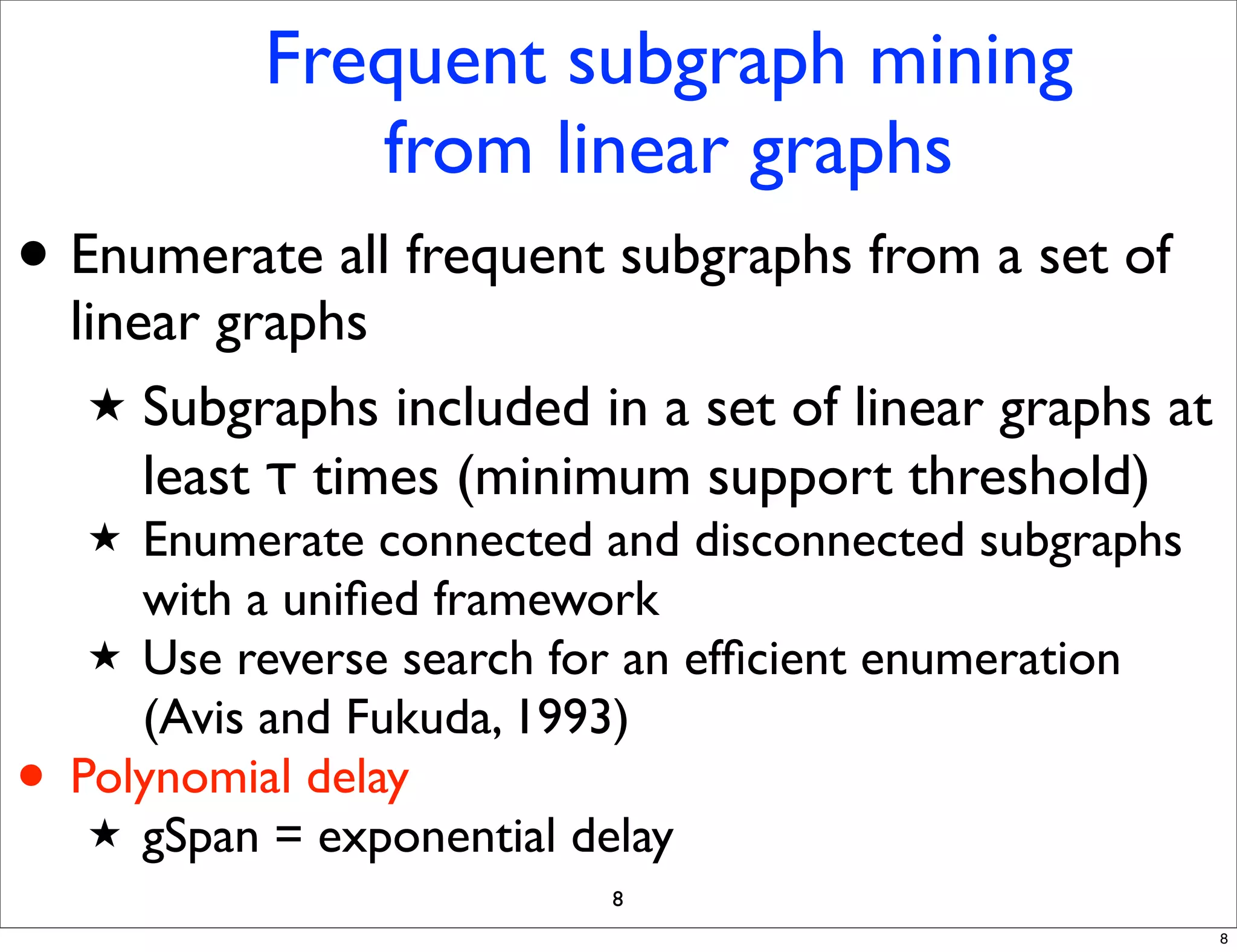
Frequent subgraph mining
               from linear graphs
• Enumerate all frequent subgraphs from a set of
    linear graphs
     ★ Subgraphs included in a set of linear graphs at
        least τ times (minimum support threshold)
    ★  Enumerate connected and disconnected subgraphs
       with a unified framework
     ★ Use reverse search for an efficient enumeration
       (Avis and Fukuda, 1993)
•   Polynomial delay
     ★ gSpan = exponential delay
                           8
                                                         8
Enumeration of all linear
  subgraph of a linear graph
• Before considering a mining
  algorithm, we have to solve the
  problem of subgraph enumeration
  first
• How to enumerate graph withoutof
  the following linear
                       all subgraphs
  duplication


                  9
                                       9
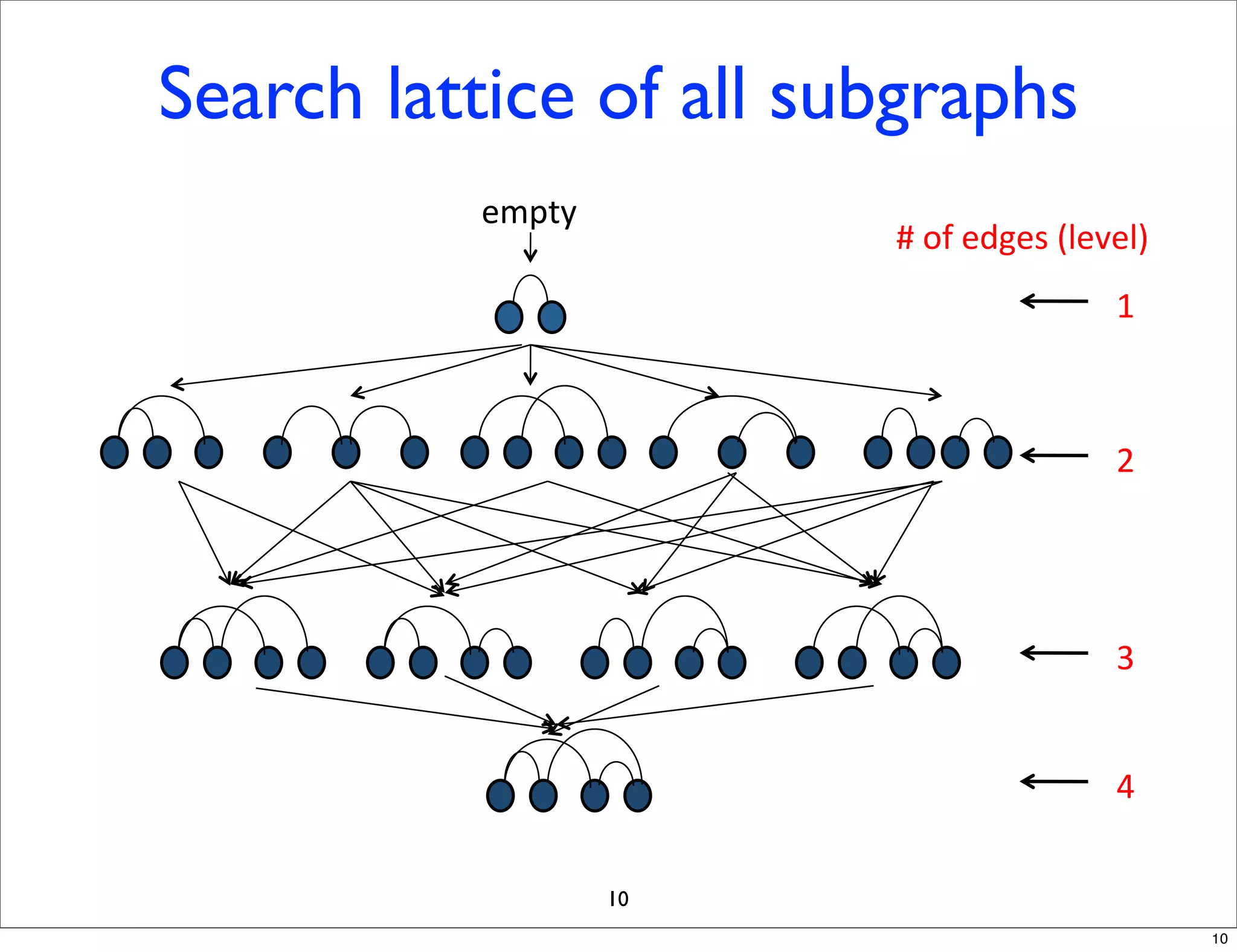
Search lattice of all subgraphs
          !"#$%
                        *+,-+!./!0+12!3!24
                                       &


                                       '


                                       (


                                       )

                  10
                                             10
Reverse search (Avis and Fukuda, 1993)
  • To enumerate all subgraphs without
    duplication, we need to define a search tree
    in the search lattice

  • Reduction map f
   ★ Mapping from a child to its parent
   ★ Remove the largest edge


               2       3
                               f            2
           1                            1
       1       2   3       4        1       2   3

                               11
                                                    11
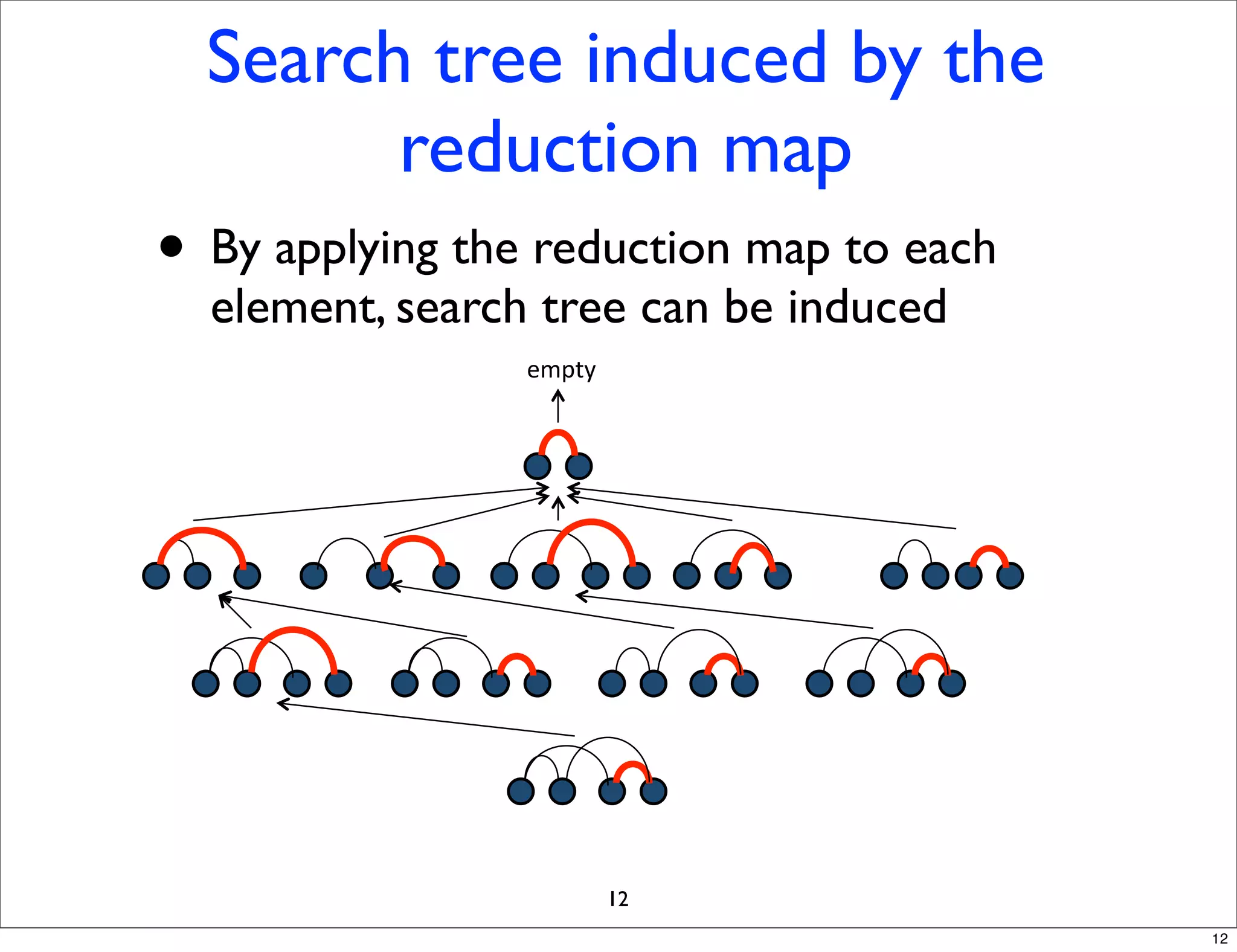
Search tree induced by the
        reduction map
• By applying the reduction map to each
  element, search tree can be induced
                 !"#$%


                         12
                                          12
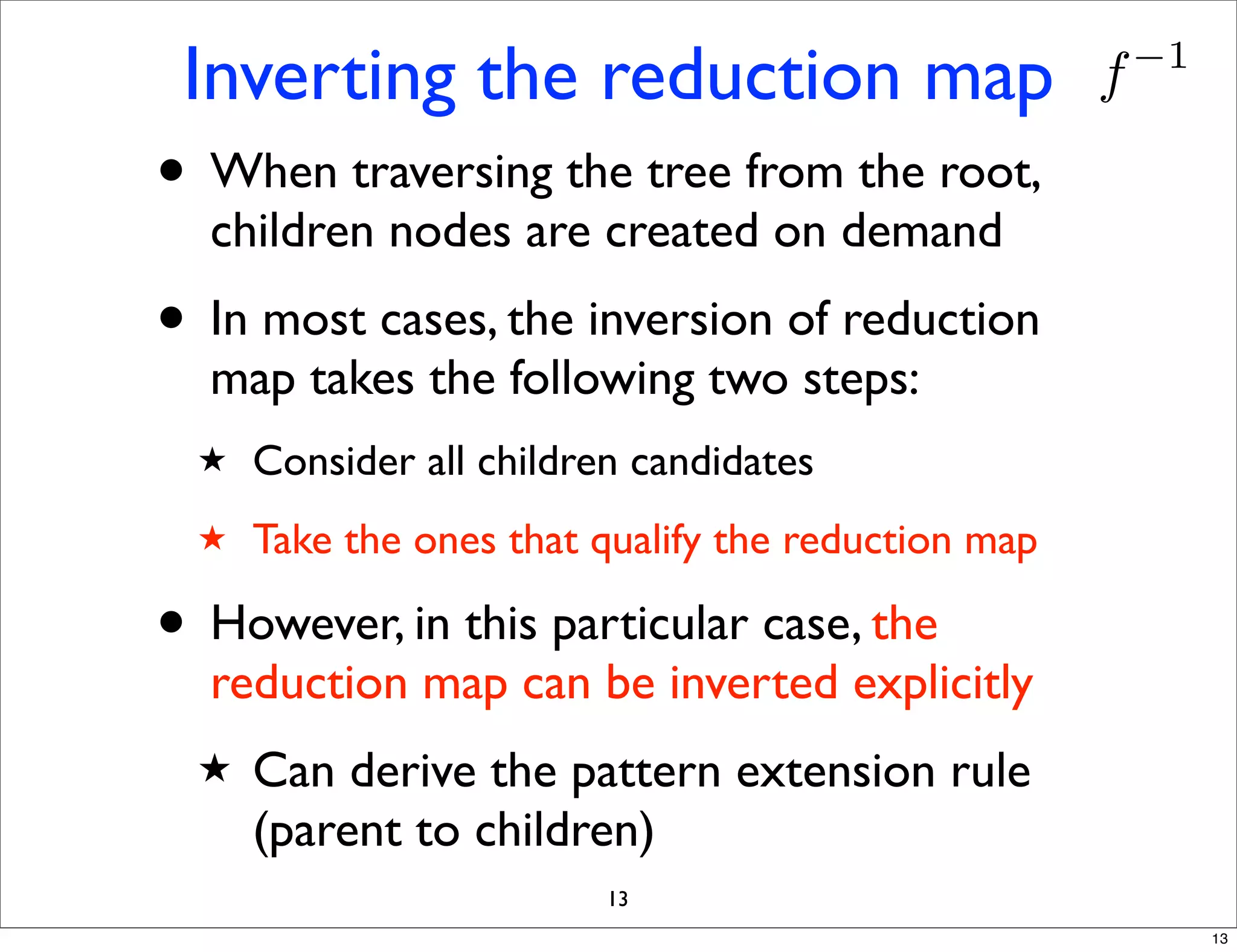
Inverting the reduction map                         f   −1


• When traversing the tree from the root,
  children nodes are created on demand
• In most cases, the inversion of reduction
  map takes the following two steps:
  ★   Consider all children candidates
  ★   Take the ones that qualify the reduction map

• However, in this particular case, the
  reduction map can be inverted explicitly
  ★   Can derive the pattern extension rule
      (parent to children)
                          13
                                                              13
Pattern extension rule


          14
                         14
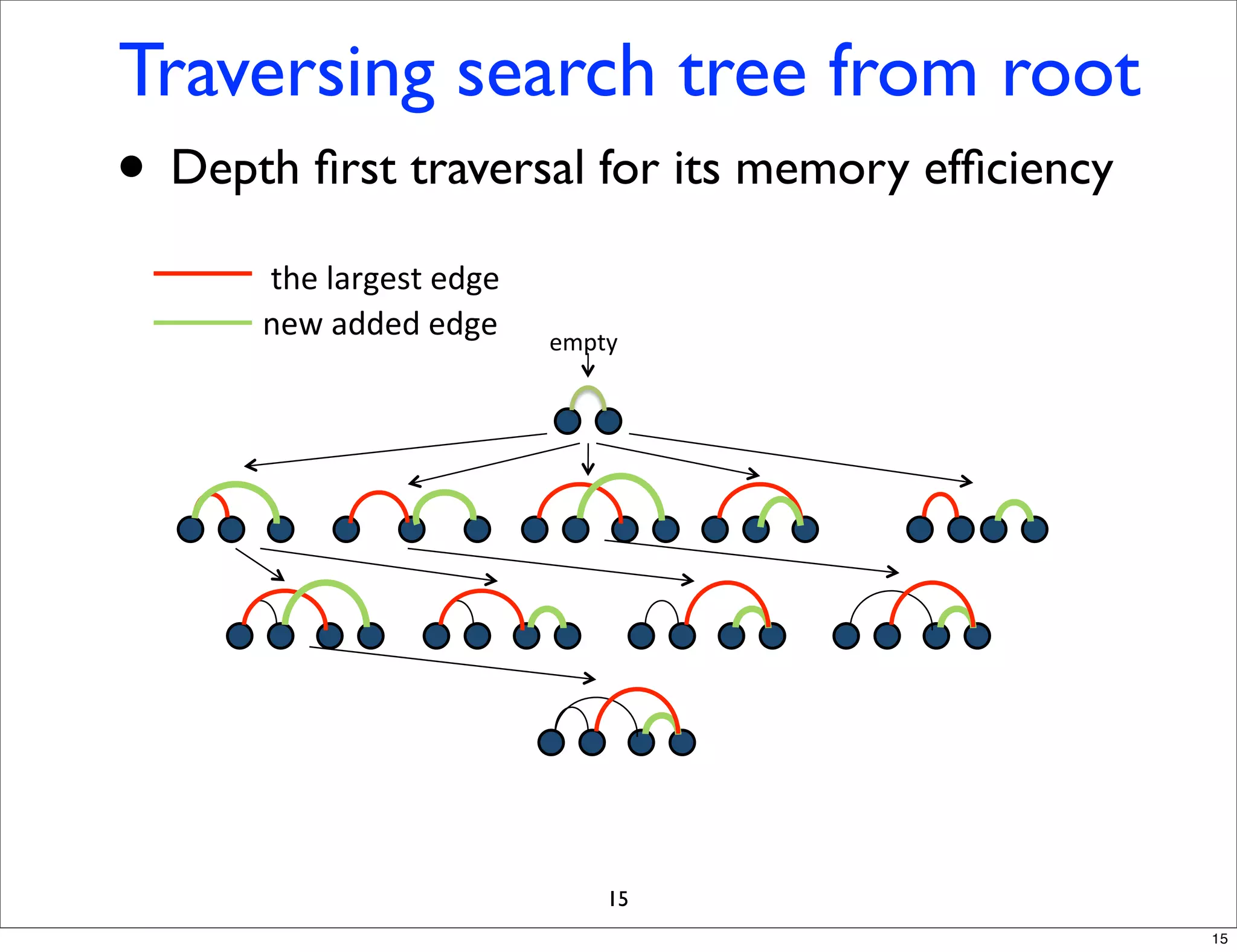
Traversing search tree from root
• Depth first traversal for its memory efficiency
      $&!'()*+!,$'!-+!
      .!/')--!-'!-+!     !"#$%


                             15
                                                  15
Frequent subgraph mining
• Basic idea: find all possible extensions of a
    current pattern in the graph database, and
    extend the pattern
• Occurrence list L    G (g)
★   Record every occurrence of a pattern g in
    the graph database G
★   Calculate the support of a pattern g by the
    occurrence list                   !"#$%&'($""


• Usesupport for pruningof
  the
      anti-monotonicity
                                )$*+,+-


                       16
                                                    16
Outline
• Introduction to linear graph
  ★   linear subgraph relation
  ★   Total order among edges
• Frequent subgraph mining from a set of
  linear graphs
• Experiments
  ★   Motif extraction from protein 3D
      structures
                       17
                                           17
Motif extraction from protein
            3D structures
•   Pairs of homologous proteins in thermophilic
     organism and mesophilic organism
•   Construct a linear graph from a protein
     ★ Use vertex order from N- to C- terminal
     ★ Assign vertex labels from {1,...,6}
     ★ Draw an edge between pairs of amino acid
       residues whose distance is 5Å
•   # of data:742, avg. # of vertices:371, avg. # of edges:
    496
•   Rank the enumerated patterns by statistical
    significance (p-value)
     ★ Association to thermophilic/methophilic labels
     ★ Fisher exact test
                          18
                                                              18
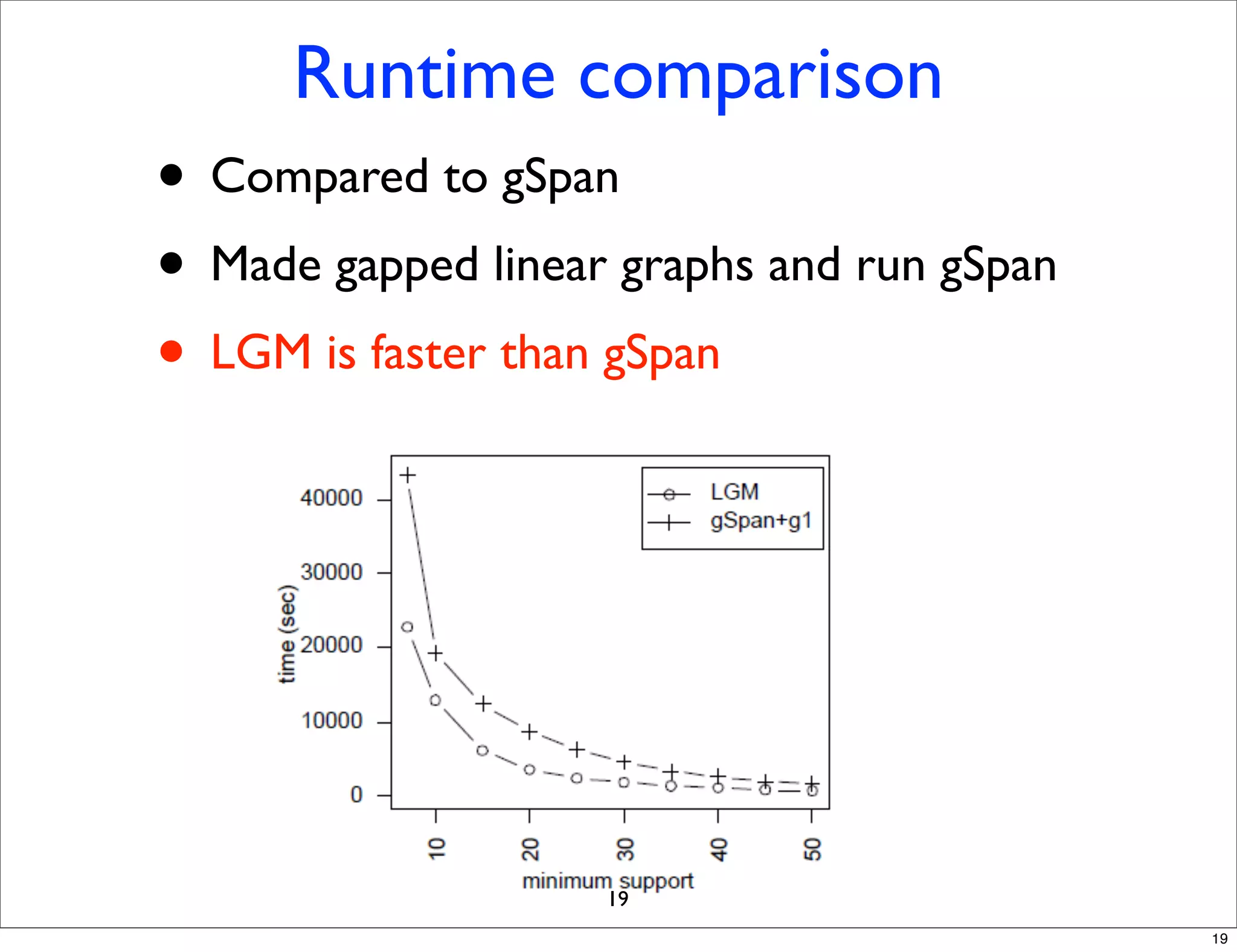
Runtime comparison
• Compared to gSpan
• Made gapped linear graphs and run gSpan
• LGM is faster than gSpan


                    19
                                            19
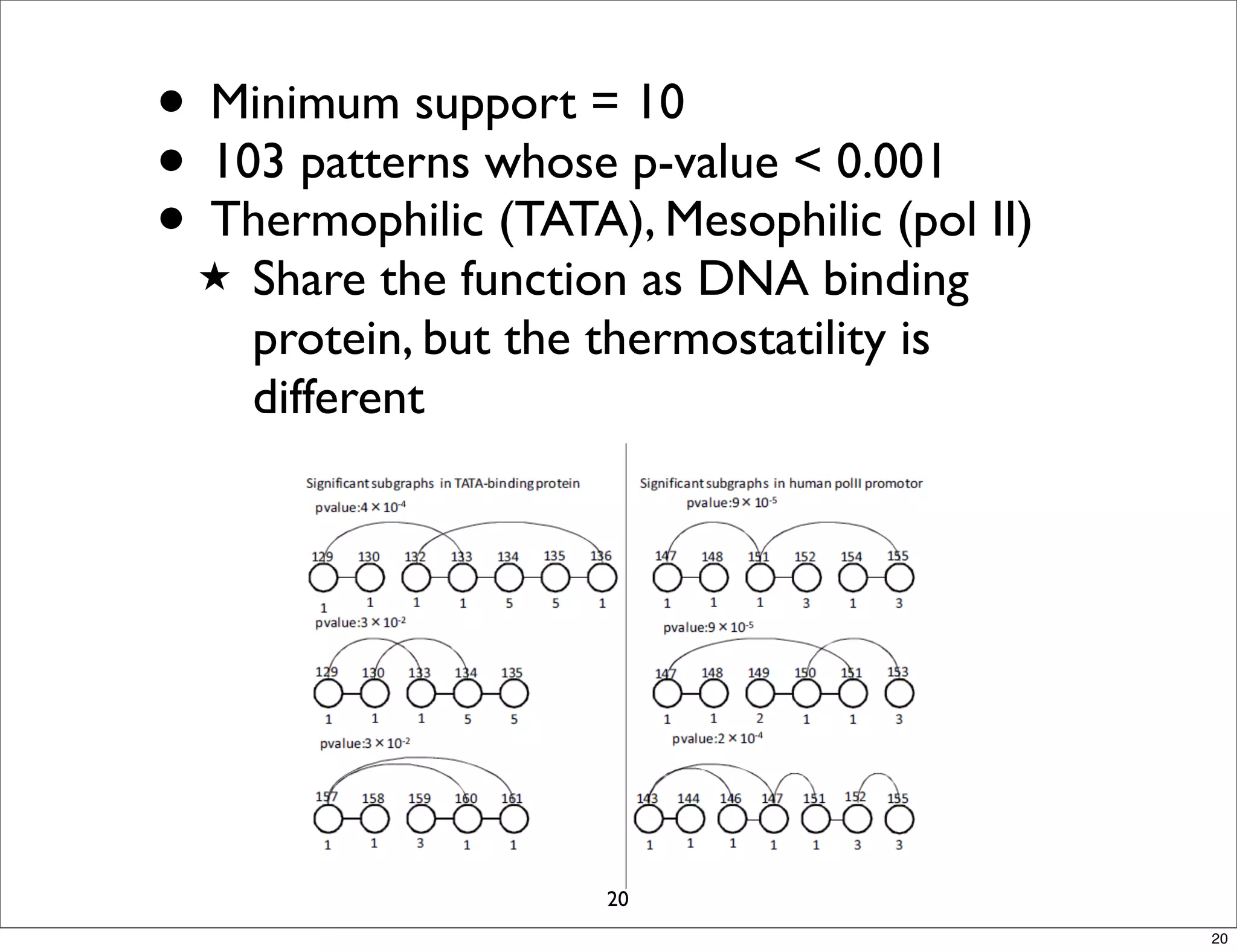
• Minimum support = 10
• 103 patterns whose p-value < 0.001
•★Thermophilic (TATA), Mesophilic (pol II)
    Share the function as DNA binding
    protein, but the thermostatility is
    different


                     20
                                             20
Mapping motifs in 3D structure

• Thermophilic (TATA), Mesophilic (pol II)


                       21
                                             21
Summary

• Efficient subgraph mining algorithm from
  linear graphs
• Search tree is defined by reverse search
  principle
• Patterns include disconnected subgraphs
• Computational time is polynomial-delay
• Interesting patterns from proteins
                     22
                                            22

Lgm pakdd2011 public

  • 1.
    The 15th Pacific-AsiaConference on Knowledge Discovery and Data Mining (PAKDD2011) 25 May 2011 LGM: Mining Frequent Subgraphs from Linear Graphs Yasuo Tabei ERATO Minato Project Japan Science and Technology Agency joint work with Daisuke Okanohara (Preferred Infrastructure), Shuichi Hirose (AIST), Koji Tsuda (AIST) 1 1
  • 2.
    Outline • Introduction tolinear graph ★ Linear subgraph relation ★ Total order among edges • Frequent subgraph mining from a set of linear graphs • Experiments ★ Motif extraction from protein 3D structures 2 2
  • 3.
    Linear graph (Davydovet al., 2004) • Labeled graph whose vertices are totally ordered • Linear graph g = (V, E, L , L ) V E ‣ V ⊂ N : ordered vertex set ‣ E ⊆ V × V : edge set ‣ LV → ΣV : vertex labels ‣L →Σ E E : edge labels Example: c b a a 1 2 3 4 5 6 A B A B C A 3 3
  • 4.
    Linear subgraph relation • g1 is a linear subgraph of g2 i) Conventional subgraph condition ★ Vertex labels are matched ★ All edges of g1 exist in g2 with the correct labels ii) Order of vertices are conserved Example: b b c 1 a 2 3 ⊂ a a 1 2 3 4 5 6 A B A A A B B C A g1 g2 4 4
  • 5.
    Subgraph but notlinear subgraph • g1 is a subgraph of g2 ★ vertex labels are matched ★ all edges in g1also exist in g2 with correct labels • g1 is not a linear subgraph of g2 ★ the order of vertices is not conserved b b c a c 1 2 3 1 2 3 4 A A B A A B A g1 g2 5 5
  • 6.
    Total order amongedges in a linear graph • Compare the left vertices first. If they are identical, look at the right vertices • ∀e1 = (i, j) , e2 = (k, l) ∈ Eg , e1 <e e2 if and only if (i) i < k or (ii) i = k, j < l Example: e1 e2 2 3 1 i j k l 1 2 3 4 6 6
  • 7.
    Outline • Introduction tolinear graph ★ linear subgraph relation ★ Total order among edges • Frequent subgraph mining from a set of linear graphs • Experiments ★ Motif extraction from protein 3D structures 7 7
  • 8.
    Frequent subgraph mining from linear graphs • Enumerate all frequent subgraphs from a set of linear graphs ★ Subgraphs included in a set of linear graphs at least τ times (minimum support threshold) ★ Enumerate connected and disconnected subgraphs with a unified framework ★ Use reverse search for an efficient enumeration (Avis and Fukuda, 1993) • Polynomial delay ★ gSpan = exponential delay 8 8
  • 9.
    Enumeration of alllinear subgraph of a linear graph • Before considering a mining algorithm, we have to solve the problem of subgraph enumeration first • How to enumerate graph withoutof the following linear all subgraphs duplication 9 9
  • 10.
    Search lattice ofall subgraphs !"#$% *+,-+!./!0+12!3!24 & ' ( ) 10 10
  • 11.
    Reverse search (Avisand Fukuda, 1993) • To enumerate all subgraphs without duplication, we need to define a search tree in the search lattice • Reduction map f ★ Mapping from a child to its parent ★ Remove the largest edge 2 3 f 2 1 1 1 2 3 4 1 2 3 11 11
  • 12.
    Search tree inducedby the reduction map • By applying the reduction map to each element, search tree can be induced !"#$% 12 12
  • 13.
    Inverting the reductionmap f −1 • When traversing the tree from the root, children nodes are created on demand • In most cases, the inversion of reduction map takes the following two steps: ★ Consider all children candidates ★ Take the ones that qualify the reduction map • However, in this particular case, the reduction map can be inverted explicitly ★ Can derive the pattern extension rule (parent to children) 13 13
  • 14.
  • 15.
    Traversing search treefrom root • Depth first traversal for its memory efficiency $&!'()*+!,$'!-+! .!/')--!-'!-+! !"#$% 15 15
  • 16.
    Frequent subgraph mining •Basic idea: find all possible extensions of a current pattern in the graph database, and extend the pattern • Occurrence list L G (g) ★ Record every occurrence of a pattern g in the graph database G ★ Calculate the support of a pattern g by the occurrence list !"#$%&'($"" • Usesupport for pruningof the anti-monotonicity )$*+,+- 16 16
  • 17.
    Outline • Introduction tolinear graph ★ linear subgraph relation ★ Total order among edges • Frequent subgraph mining from a set of linear graphs • Experiments ★ Motif extraction from protein 3D structures 17 17
  • 18.
    Motif extraction fromprotein 3D structures • Pairs of homologous proteins in thermophilic organism and mesophilic organism • Construct a linear graph from a protein ★ Use vertex order from N- to C- terminal ★ Assign vertex labels from {1,...,6} ★ Draw an edge between pairs of amino acid residues whose distance is 5Å • # of data:742, avg. # of vertices:371, avg. # of edges: 496 • Rank the enumerated patterns by statistical significance (p-value) ★ Association to thermophilic/methophilic labels ★ Fisher exact test 18 18
  • 19.
    Runtime comparison • Comparedto gSpan • Made gapped linear graphs and run gSpan • LGM is faster than gSpan 19 19
  • 20.
    • Minimum support= 10 • 103 patterns whose p-value < 0.001 •★Thermophilic (TATA), Mesophilic (pol II) Share the function as DNA binding protein, but the thermostatility is different 20 20
  • 21.
    Mapping motifs in3D structure • Thermophilic (TATA), Mesophilic (pol II) 21 21
  • 22.
    Summary • Efficient subgraphmining algorithm from linear graphs • Search tree is defined by reverse search principle • Patterns include disconnected subgraphs • Computational time is polynomial-delay • Interesting patterns from proteins 22 22