Grade 7 Daily Lesson Log
School Anda Integrated School Grade Level 7
Teacher Sherilyn E. Nuesca Learning Area English
Teaching Date and
Time
March 3, 2021 @ 1:00 PM
Quarter Second
I. OBJECTIVES
A. Content Standards The learner demonstrates communicative competence through his/her understanding
of Philippine Literature and other texts types for a deeper appreciation of Philippine
Culture.
B. Performance Standards The learner transfers learning by: resolving conflicts presented in literary selections;
using tools and mechanisms in locating library resources; extracting information and
noting details from texts to write a précis, summary, or paraphrase; distinguishing
between and using literal and figurative language and verbal and non-verbal cues;
use phrases, clauses, and sentences meaningfully and appropriately.
C. Most Essential Learning
Competency
EN8RC-II-e- 11: Transcode information from linear to non-linear texts and vice versa.
-identify linear and non-linear texts;
-differentiate text from non-linear text;
-interpret data from linear and non-linear texts
II. CONTENT Features of Linear and Non-Linear Texts
III. LEARNING RESOURCES
A. References
1. K to 12 Most
Essential Learning
Competencies
Page 137
2. Learner’s Material English 7 Quarter 2, Module 8
Pages 1-15
3. Textbook pages
4. Additional Materials
from Learning
Resource (LR)
portal
www.mentimeter.com for the checking of attendance
www.widget.com for the activity on Vocabulary
B. Other Learning
Sources
IV. PROCEDURES
A. Reviewing previous
lesson or presenting the
new lesson
Teacher presents the vocabulary activity and asks the learners’ participation using the
widget code online: RB6VMRC at widget.com.
B. Establishing a purpose for
the lesson
Ask the students their prior knowledge on the vocabulary words given.
C. Presenting
examples/instances of the
new lesson
Provide details on the vocabulary terms conducted on Activity 1.
Unscramble the letters
1. NAERLI _______________
2. ONN EALNIR _______________
3. EXTTS _______________
4. LERTETS _______________
5. TICARLES _______________
6. BLESTA _______________
7. SMAP _______________
8. CHRTSA _______________
9. PHGRAS _______________
10. NOLVES _______________
Activity 1: Vocabulary Check
English Class | Anda Integrated School
D. Discussing new concepts
and practicing new skills
#1
For the new concepts, present to the class the activity on classifying linear and non-
linear texts.
Process the students’ answers.
E. Discussing new concepts
and practicing new skills
#2
For additional concepts and an application on geography and tourism, lead students
on answering the Activity 3.
Process students’ responses.
F. Developing mastery
(Leads to Formative
Assessment 3)
Continue processing students’ feedback by asking the following questions:
Lead the students on mastering the concept, differences and ways interpreting Linear
and Non-Linear Texts:
Tell whether its Linear or Non-Linear
Activity 2
English Class | Anda Integrated School
Panacalan Island Sandbar
English Class | Anda Integrated School
Panacalan is an islet with a stunning sandbar
locally called Maldives of the North
Fill in the blanks with information from
the text.
1. Panacalan Island is locally known as
_________.
2. Panacalan is located at _______.
3. From Tondol Beach how will you be
able to go to Panacalan?
4. How much would the fair be if the
point of origin is at Tondol Beach?
5. What can be seen at the Panacalan?
Location
The sandbar is under the
jurisdiction of Barangay
Sablig but a popular jump-off
to the island is Tondol Beach.
How to get there?
From Tondol Beach, island hoping
package going to the sandbar
amounting to P1500 using a boat
will give you a wonderful experience.
What to see?
Stunning sandbar, perfect for
beach bumming experience and
Instagram photos White sand and
amazing corals
Activity 3:
Concept and Definition
1. Based on the
statements provided in
the previous activities,
differentiate linear from
non-linear text.
2. In what ways can non-
linear texts be used?
3. How do we interpret
non-linear texts?
Understanding the Lesson
English Class | Anda Integrated School
Concept and Definition Concept and Definition
G. Finding practical
applications of concepts
and skills in daily living
Ask the following questions:
• traditional text that needs to
be read from beginning to
end
• reader makes sense of the
text according to the
grammatical and syntactic
arrangement of the words
• the traditional method of
reading the way how
children are taught
• not always advantageous;
time consuming
What is Linear Text?
English Class | Anda Integrated School
• also called linear reading
• most common type of
reading (traditional)
• Novels, poems, short stories,
letters, educational texts
English Class | Anda Integrated School
What is Non-Linear Text?
• opposite of linear text; non
sequential
• reader makes sense of the
text in many different paths
• includes texts with visuals or
graphs
• flowcharts, charts, and
graphs, graphical organizers
(knowledge maps and story
maps)
• any text that is read not
from beginning to end
• encyclopedia, telephone
directory
• follows skimming to obtain
specific information
English Class | Anda Integrated School
Linear Text vs Non-Linear Texts
• refers to traditional text that
needs to be read from beginning
to end
• there is only one reading path,
which is decided by the author
• typically includes printed texts
• it may take time to find the
information readers are
searching for
• novels, poems, letters,
textbooks, newspaper articles
• refers to text that does not need to
be read from beginning to end
• there are multiple reading paths,
they are determined by the reader
• typically includes digital texts
• allows readers to find
information more efficiently
• flowcharts, knowledge maps,
and encyclopedias
Definition
Reading Path
Examples
Efficiency
Content
H. Making generalizations
and abstractions about
the lesson
Let students share their learnings as a summary of the lesson.
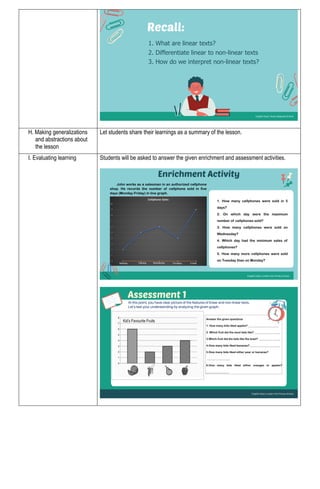
I. Evaluating learning Students will be asked to answer the given enrichment and assessment activities.
Recall:
1. What are linear texts?
English Class | Anda Integrated School
2. Differentiate linear to non-linear texts
3. How do we interpret non-linear texts?
Enrichment Activity
English Class | Laredo York Primary School
1. How many cellphones were sold in 5
days?
2. On which day were the maximum
number of cellphones sold?
3. How many cellphones were sold on
Wednesday?
4. Which day had the minimum sales of
cellphones?
5. How many more cellphones were sold
on Tuesday than on Monday?
John works as a salesman in an authorized cellphone
shop. He records the number of cellphone sold in five
days (Monday-Friday) in line graph.
Monday Tuesday Wednesday Thursday Friday
Assessment 1
At this point, you have clear picture of the features of linear and non-linear texts.
Let’s test your understanding by analyzing the given graph.
English Class | Laredo York Primary School
Answer the given questions
1. How many kids liked apples? ______________________
2. Which fruit did the most kids like? ___________________
3.Which fruit did the kids like the least? ________________
4.How many kids liked bananas? ______________________
5.How many kids liked either pear or bananas?
_________________
6.How many kids liked either oranges or apples?
_________________
J. Additional activities for
application or
remediation
For the additional activity, ask students to answer the given activity and upload answer
via Google Classroom.
V. REMARKS
VI. REFLECTIONS
A. No. of learners who earned
75% in the evaluation
B. No. of learners who require
additional activities for
remediation who scored below
75%
C. Did the remedial lesson work?
No. of learners who have
caught up with the lesson
D. No. of learners who continue to
require remediation
E. Which of my teaching
strategies worked well? Why
did these work?
F. What difficulties did I encounter
which my principal or supervisor
can help me solve?
G. What innovation or localized
materials did I use/discover
which I wish to share with other
teachers?
Prepared by: Observed by:
SHERILYN E. NUESCA ROSARIO C. CASAÑA
SST-III / Grade 7 Teacher Principal I
English Class | Anda Integrated School
Assessment 2
1. Which item sold the most in Store B?
________________________
2. Which store sold the least number of
toasters?
________________________
3. The number of grills sold by store A is twice
of store B. Is it correct? _____________________
4. What is the difference on sales of blenders
between Store A and Store B?________________
5. How many total appliances were sold by
Store A? ________________________
Mr. Peters owns two kitchen appliance stores. He compares the sales of
two stores and recorded the information in a bar graph. Use the graph to
answer the questions.
Assignment
Use the line graph to answer the
following questions about the data.
1. How many cars were sold during
May? _______
2. How many cars were sold in the first
3 months of the year? ____
3. How many more cars were sold in
July than May? ________
4. Which month had 26 car sales?
________
5. Answer TRUE, FALSE, or CAN’T TELL
to each of the statement below:
Here is a graph showing the sales of used cars
at the Salamander Autos.

DLL for COT 1

  • 1.
    Grade 7 DailyLesson Log School Anda Integrated School Grade Level 7 Teacher Sherilyn E. Nuesca Learning Area English Teaching Date and Time March 3, 2021 @ 1:00 PM Quarter Second I. OBJECTIVES A. Content Standards The learner demonstrates communicative competence through his/her understanding of Philippine Literature and other texts types for a deeper appreciation of Philippine Culture. B. Performance Standards The learner transfers learning by: resolving conflicts presented in literary selections; using tools and mechanisms in locating library resources; extracting information and noting details from texts to write a précis, summary, or paraphrase; distinguishing between and using literal and figurative language and verbal and non-verbal cues; use phrases, clauses, and sentences meaningfully and appropriately. C. Most Essential Learning Competency EN8RC-II-e- 11: Transcode information from linear to non-linear texts and vice versa. -identify linear and non-linear texts; -differentiate text from non-linear text; -interpret data from linear and non-linear texts II. CONTENT Features of Linear and Non-Linear Texts III. LEARNING RESOURCES A. References 1. K to 12 Most Essential Learning Competencies Page 137 2. Learner’s Material English 7 Quarter 2, Module 8 Pages 1-15 3. Textbook pages 4. Additional Materials from Learning Resource (LR) portal www.mentimeter.com for the checking of attendance www.widget.com for the activity on Vocabulary B. Other Learning Sources IV. PROCEDURES A. Reviewing previous lesson or presenting the new lesson Teacher presents the vocabulary activity and asks the learners’ participation using the widget code online: RB6VMRC at widget.com. B. Establishing a purpose for the lesson Ask the students their prior knowledge on the vocabulary words given. C. Presenting examples/instances of the new lesson Provide details on the vocabulary terms conducted on Activity 1. Unscramble the letters 1. NAERLI _______________ 2. ONN EALNIR _______________ 3. EXTTS _______________ 4. LERTETS _______________ 5. TICARLES _______________ 6. BLESTA _______________ 7. SMAP _______________ 8. CHRTSA _______________ 9. PHGRAS _______________ 10. NOLVES _______________ Activity 1: Vocabulary Check English Class | Anda Integrated School
  • 2.
    D. Discussing newconcepts and practicing new skills #1 For the new concepts, present to the class the activity on classifying linear and non- linear texts. Process the students’ answers. E. Discussing new concepts and practicing new skills #2 For additional concepts and an application on geography and tourism, lead students on answering the Activity 3. Process students’ responses. F. Developing mastery (Leads to Formative Assessment 3) Continue processing students’ feedback by asking the following questions: Lead the students on mastering the concept, differences and ways interpreting Linear and Non-Linear Texts: Tell whether its Linear or Non-Linear Activity 2 English Class | Anda Integrated School Panacalan Island Sandbar English Class | Anda Integrated School Panacalan is an islet with a stunning sandbar locally called Maldives of the North Fill in the blanks with information from the text. 1. Panacalan Island is locally known as _________. 2. Panacalan is located at _______. 3. From Tondol Beach how will you be able to go to Panacalan? 4. How much would the fair be if the point of origin is at Tondol Beach? 5. What can be seen at the Panacalan? Location The sandbar is under the jurisdiction of Barangay Sablig but a popular jump-off to the island is Tondol Beach. How to get there? From Tondol Beach, island hoping package going to the sandbar amounting to P1500 using a boat will give you a wonderful experience. What to see? Stunning sandbar, perfect for beach bumming experience and Instagram photos White sand and amazing corals Activity 3: Concept and Definition 1. Based on the statements provided in the previous activities, differentiate linear from non-linear text. 2. In what ways can non- linear texts be used? 3. How do we interpret non-linear texts? Understanding the Lesson English Class | Anda Integrated School Concept and Definition Concept and Definition
  • 3.
    G. Finding practical applicationsof concepts and skills in daily living Ask the following questions: • traditional text that needs to be read from beginning to end • reader makes sense of the text according to the grammatical and syntactic arrangement of the words • the traditional method of reading the way how children are taught • not always advantageous; time consuming What is Linear Text? English Class | Anda Integrated School • also called linear reading • most common type of reading (traditional) • Novels, poems, short stories, letters, educational texts English Class | Anda Integrated School What is Non-Linear Text? • opposite of linear text; non sequential • reader makes sense of the text in many different paths • includes texts with visuals or graphs • flowcharts, charts, and graphs, graphical organizers (knowledge maps and story maps) • any text that is read not from beginning to end • encyclopedia, telephone directory • follows skimming to obtain specific information English Class | Anda Integrated School Linear Text vs Non-Linear Texts • refers to traditional text that needs to be read from beginning to end • there is only one reading path, which is decided by the author • typically includes printed texts • it may take time to find the information readers are searching for • novels, poems, letters, textbooks, newspaper articles • refers to text that does not need to be read from beginning to end • there are multiple reading paths, they are determined by the reader • typically includes digital texts • allows readers to find information more efficiently • flowcharts, knowledge maps, and encyclopedias Definition Reading Path Examples Efficiency Content
  • 4.
    H. Making generalizations andabstractions about the lesson Let students share their learnings as a summary of the lesson. I. Evaluating learning Students will be asked to answer the given enrichment and assessment activities. Recall: 1. What are linear texts? English Class | Anda Integrated School 2. Differentiate linear to non-linear texts 3. How do we interpret non-linear texts? Enrichment Activity English Class | Laredo York Primary School 1. How many cellphones were sold in 5 days? 2. On which day were the maximum number of cellphones sold? 3. How many cellphones were sold on Wednesday? 4. Which day had the minimum sales of cellphones? 5. How many more cellphones were sold on Tuesday than on Monday? John works as a salesman in an authorized cellphone shop. He records the number of cellphone sold in five days (Monday-Friday) in line graph. Monday Tuesday Wednesday Thursday Friday Assessment 1 At this point, you have clear picture of the features of linear and non-linear texts. Let’s test your understanding by analyzing the given graph. English Class | Laredo York Primary School Answer the given questions 1. How many kids liked apples? ______________________ 2. Which fruit did the most kids like? ___________________ 3.Which fruit did the kids like the least? ________________ 4.How many kids liked bananas? ______________________ 5.How many kids liked either pear or bananas? _________________ 6.How many kids liked either oranges or apples? _________________
  • 5.
    J. Additional activitiesfor application or remediation For the additional activity, ask students to answer the given activity and upload answer via Google Classroom. V. REMARKS VI. REFLECTIONS A. No. of learners who earned 75% in the evaluation B. No. of learners who require additional activities for remediation who scored below 75% C. Did the remedial lesson work? No. of learners who have caught up with the lesson D. No. of learners who continue to require remediation E. Which of my teaching strategies worked well? Why did these work? F. What difficulties did I encounter which my principal or supervisor can help me solve? G. What innovation or localized materials did I use/discover which I wish to share with other teachers? Prepared by: Observed by: SHERILYN E. NUESCA ROSARIO C. CASAÑA SST-III / Grade 7 Teacher Principal I English Class | Anda Integrated School Assessment 2 1. Which item sold the most in Store B? ________________________ 2. Which store sold the least number of toasters? ________________________ 3. The number of grills sold by store A is twice of store B. Is it correct? _____________________ 4. What is the difference on sales of blenders between Store A and Store B?________________ 5. How many total appliances were sold by Store A? ________________________ Mr. Peters owns two kitchen appliance stores. He compares the sales of two stores and recorded the information in a bar graph. Use the graph to answer the questions. Assignment Use the line graph to answer the following questions about the data. 1. How many cars were sold during May? _______ 2. How many cars were sold in the first 3 months of the year? ____ 3. How many more cars were sold in July than May? ________ 4. Which month had 26 car sales? ________ 5. Answer TRUE, FALSE, or CAN’T TELL to each of the statement below: Here is a graph showing the sales of used cars at the Salamander Autos.