Integration of content within and across curriculum teaching
areas
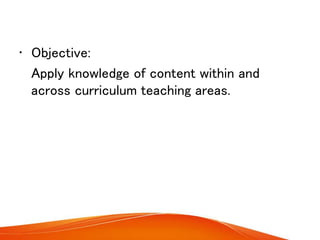
• Objective:
Apply knowledge of content within and
across curriculum teaching areas.
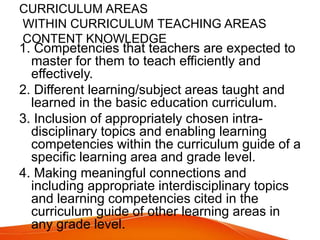
CURRICULUM AREAS
WITHIN CURRICULUM TEACHING AREAS
CONTENT KNOWLEDGE
1. Competencies that teachers are expected to
master for them to teach efficiently and
effectively.
2. Different learning/subject areas taught and
learned in the basic education curriculum.
3. Inclusion of appropriately chosen intra-
disciplinary topics and enabling learning
competencies within the curriculum guide of a
specific learning area and grade level.
4. Making meaningful connections and
including appropriate interdisciplinary topics
and learning competencies cited in the
curriculum guide of other learning areas in
any grade level.
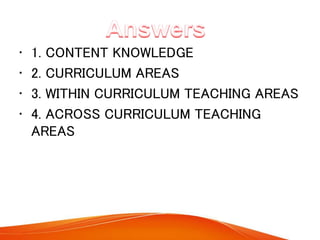
• 1. CONTENT KNOWLEDGE
• 2. CURRICULUM AREAS
• 3. WITHIN CURRICULUM TEACHING AREAS
• 4. ACROSS CURRICULUM TEACHING
AREAS
• An integrated curriculum is described as one
that connects different areas of study by
cutting across subject-matter lines and
emphasizing unifying concepts. Integration
focuses on making connections for students,
allowing them to engage in relevant,
meaningful activities that can be connected
to real life.
In applying intra- and interdisciplinary
concepts in your teaching practices, you
may consider the following steps.
• 1. Analyze the target learning
competencies.
• 2. Assess learners based on their
diverse learning styles, needs,
interests, engagement level,
previously mastered enabling
competencies, and progression in the
past lessons.
• 3. Assess the setting, time and
resources.
• 4. Localize or contextualize the
lesson and use relatable
issues/concerns. You may use the
following criteria: a. Is it a real issue?
b. Are you personally interested in it?
c. Is the scope of the issue
manageable?
• 5. Plan activities for each part of the
DLL. a. Make and deliver
activities/exercises aligned with the
lesson objectives.
• b. Have each activity reinforce ideas
and/or skills from different subjects to
indicate the importance of combining
disciplines.
• c. Vary activity types to increase
engagement level.
• 6. Give time for learners to reflect on their
answers/outputs.
• 7. Determine proper assessment strategies.
• 8. Develop rubrics based on the measurable
lesson objectives and use criteria that
appropriately describe the target output.
• 9. Reflect on learners’ participation rate,
products and performances.
• 10. Reflect on the relevance and
appropriateness of interdisciplinary teaching
process in your class.
Science and Math
• are intimately connected, particularly in
fields such as chemistry, astronomy and
physics. More complex math, such as
geometry, algebra and calculus, can help
students solve chemistry problems,
understand the movements of the
planets and analyze scientific studies.
Math is also important in practical
sciences, such as engineering and
computer science.
Literature/Writing and Math
• Mastering basic arithmetic can enable
students to better understand poetry. The
meter of poetry, the number of words to
include in a line and the effect that
certain rhythms have on the reader are all
products of mathematical calculations.
Social Studies and Math
• Social studies classes, such as history,
often require students to review charts
and graphs that provide historical data
or information on ethnic groups. In
geography classes, students might need
to understand how the elevation of an
area affects its population or chart the
extent to which different populations
have different average life spans.
Arts and Math
• Math can help students learn the basic
rhythms of dances used in ballet and
theater performances. Art thrives on
geometry, and students who understand
basic geometric formulas can craft
impressive art pieces. Photographers
use math to calculate shutter speed,
focal length, lighting angles and
exposure time.
• Application of content knowledge within and
across curriculum learning areas can also be
observed in school or community
programs/projects.
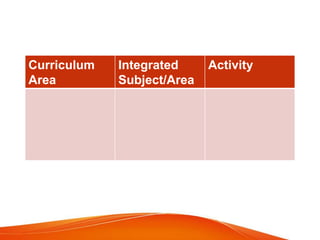
Curriculum
Area
Integrated
Subject/Area
Activity
“Everything connects to
everything else.”

435802176-Apply-Knowledge-Content-Within-Across-Curriculum-Areas.pptx

  • 1.
    Integration of contentwithin and across curriculum teaching areas
  • 3.
    • Objective: Apply knowledgeof content within and across curriculum teaching areas.
  • 4.
    CURRICULUM AREAS WITHIN CURRICULUMTEACHING AREAS CONTENT KNOWLEDGE 1. Competencies that teachers are expected to master for them to teach efficiently and effectively. 2. Different learning/subject areas taught and learned in the basic education curriculum. 3. Inclusion of appropriately chosen intra- disciplinary topics and enabling learning competencies within the curriculum guide of a specific learning area and grade level. 4. Making meaningful connections and including appropriate interdisciplinary topics and learning competencies cited in the curriculum guide of other learning areas in any grade level.
  • 5.
    • 1. CONTENTKNOWLEDGE • 2. CURRICULUM AREAS • 3. WITHIN CURRICULUM TEACHING AREAS • 4. ACROSS CURRICULUM TEACHING AREAS
  • 6.
    • An integratedcurriculum is described as one that connects different areas of study by cutting across subject-matter lines and emphasizing unifying concepts. Integration focuses on making connections for students, allowing them to engage in relevant, meaningful activities that can be connected to real life.
  • 8.
    In applying intra-and interdisciplinary concepts in your teaching practices, you may consider the following steps. • 1. Analyze the target learning competencies. • 2. Assess learners based on their diverse learning styles, needs, interests, engagement level, previously mastered enabling competencies, and progression in the past lessons.
  • 9.
    • 3. Assessthe setting, time and resources. • 4. Localize or contextualize the lesson and use relatable issues/concerns. You may use the following criteria: a. Is it a real issue? b. Are you personally interested in it? c. Is the scope of the issue manageable?
  • 10.
    • 5. Planactivities for each part of the DLL. a. Make and deliver activities/exercises aligned with the lesson objectives. • b. Have each activity reinforce ideas and/or skills from different subjects to indicate the importance of combining disciplines. • c. Vary activity types to increase engagement level.
  • 11.
    • 6. Givetime for learners to reflect on their answers/outputs. • 7. Determine proper assessment strategies. • 8. Develop rubrics based on the measurable lesson objectives and use criteria that appropriately describe the target output. • 9. Reflect on learners’ participation rate, products and performances. • 10. Reflect on the relevance and appropriateness of interdisciplinary teaching process in your class.
  • 12.
    Science and Math •are intimately connected, particularly in fields such as chemistry, astronomy and physics. More complex math, such as geometry, algebra and calculus, can help students solve chemistry problems, understand the movements of the planets and analyze scientific studies. Math is also important in practical sciences, such as engineering and computer science.
  • 13.
    Literature/Writing and Math •Mastering basic arithmetic can enable students to better understand poetry. The meter of poetry, the number of words to include in a line and the effect that certain rhythms have on the reader are all products of mathematical calculations.
  • 14.
    Social Studies andMath • Social studies classes, such as history, often require students to review charts and graphs that provide historical data or information on ethnic groups. In geography classes, students might need to understand how the elevation of an area affects its population or chart the extent to which different populations have different average life spans.
  • 15.
    Arts and Math •Math can help students learn the basic rhythms of dances used in ballet and theater performances. Art thrives on geometry, and students who understand basic geometric formulas can craft impressive art pieces. Photographers use math to calculate shutter speed, focal length, lighting angles and exposure time.
  • 16.
    • Application ofcontent knowledge within and across curriculum learning areas can also be observed in school or community programs/projects.
  • 17.
  • 18.